Chapter XIII · The Symbolism of Jade
Reading edition
Jade in Early Times—Used to Reanimate and Preserve the Dead—Jade as a Night-shining Jewel—Connection with the Pearl, Coral, Mandrake, Moon, Dragon, Fish, &c.—Jade Beliefs in Japan—Jade Amulets—The Chinese Cicada Amulet and Egyptian Search—Butterfly, Frog, and Bird Amulets—Jade and the Mother-goddess—The Chinese Universe—Great Bear and “World Mill”—Babylonian Astronomy in China—Star Deities—The Fung-shui Doctrine—Jade Symbols of Deities—Tigress as a Mother-goddess—Links with the West—The Two Souls in China and Egypt—Jade as an Elixir—Jade and Herbs—Jade and Babylonian Nig-gil-ma—Jade and Rhinoceros Horn—Jade Beliefs in Prehistoric Europe—Jade and Colour Symbolism—Jade contains Heat and Moisture—Jade as “The Jewel that Grants all Desires”.
One’s thoughts at once turn to China when mention is made of jade, for in no other country in the world has it been utilized for such a variety of purposes or connected more closely with the social organization and with religious beliefs and ceremonies.
Native artisans acquired great skill in working this tenacious mineral, and the finest art products in China are those exquisite jade ornaments, symbols, and vessels that survive from various periods of its history. Not only did the accomplished and patient workers, especially of the Han period (200 B.C.–200 A.D.), achieve a high degree of excellence in carving and engraving jade, and in producing beautiful forms; they also dealt with their hard mineral so as to utilize its various colours and shades, and thus increase the æsthetic qualities of their art products. The artistic genius, as well as the religious beliefs, of the Chinese has been enshrined in nephrite.
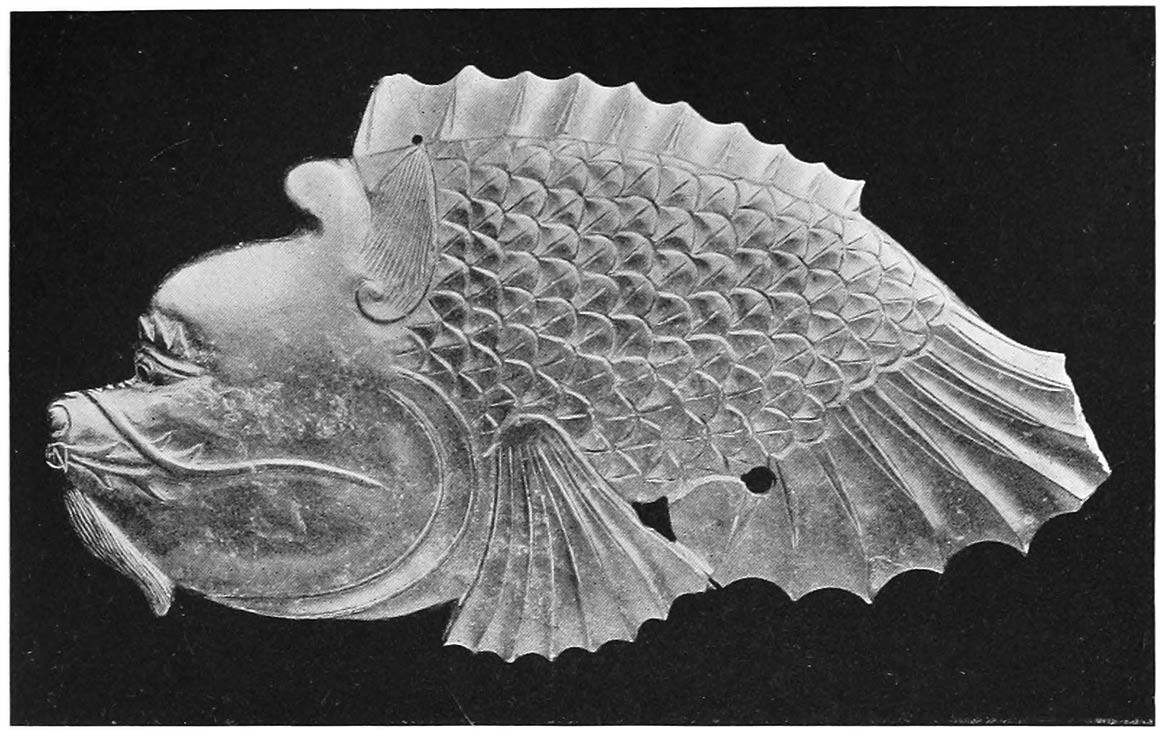
MORTUARY FISH IN JADE, OF HAN PERIOD
Laufer refers to this as “a marvellous carving of exceedingly fine workmanship”. In the Han Period sacrifices were offered to a fish in jade in prayers for rain.
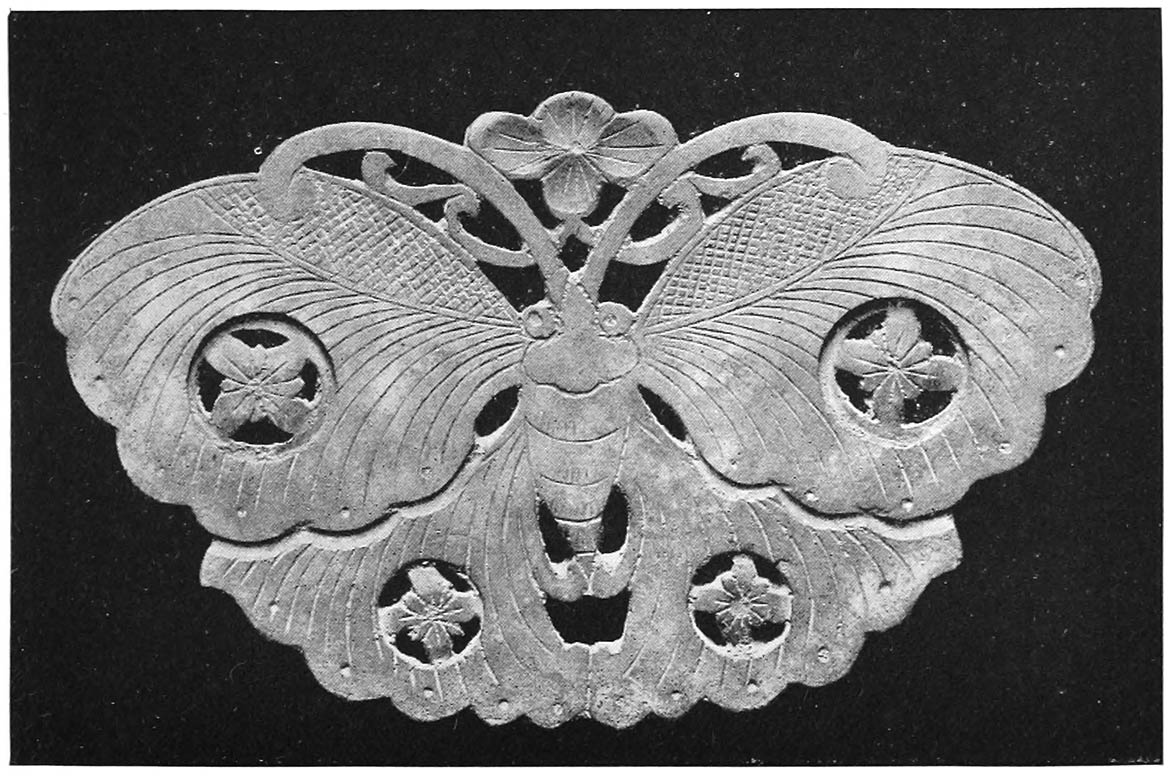
FIGURE OF BUTTERFLY IN WHITE AND BROWNISH-YELLOW JADE, TSʼIN OR HAN PERIOD
A unique specimen among mortuary offerings of considerable age and unusual workmanship. A plum-blossom pattern is depicted between the antennæ of the butterfly (see page 225).
Both pictures by courtesy of B. Laufer, author of “Jade”, Field Museum, Chicago
Stone implements have been found, but, as in ancient Egypt, these were still being manufactured long after metals came into general use.
The fact that the same beliefs were connected with jade as with pearls, shells, gold, &c., is brought out very clearly in Chinese records regarding ancient burial customs. It was considered to be as necessary in ancient China as in ancient Egypt that the bodies of the dead should be preserved from decay. The Egyptians mummified their dead, and laid on and beside them a variety of charms that were supposed to afford protection and assist in the process of reanimation; withal, food offerings were provided. The Chinese, who have long been noted for their tendency to find substitutes for religious offerings, including paper money, believed that the bodies of the dead could be preserved by magic. At any rate, they did not consider it necessary to practise the science of mummification. In the Li Ki (chapter 56) the orthodox treatment of the bodies of the Emperor and others is set forth as follows:
According to De Groot, pearls were introduced into the mouth of the dead during the Han Dynasty. “At least”, he says, “it is stated that their mouths were filled with rice, and pearls and jade stone were put therein, in accordance with the established ceremonial usages.” And Poh hu thung i, a well-known work, professedly written in the first century, says: “On stuffing the mouth of the Son of Heaven with rice, they put jade therein; in the case of a feudal lord they introduce pearls; in that of a great officer and so downwards, as also in that of ordinary officials, cowries are used to this end”.
In China the lion-headed shark, a form of the sea-god, is likewise a makara or sea-dragon. Gold and night-shining pearls are connected with the makara as with the dragon. The Chinese dragon, as we have seen, is born from gold, while curative herbs like the “Red Cloud herb” and the “dragon’s whiskers herb” are emanations of the dragon. Gold, like the herb, contains “soul substance” in concentrated form. Pounded gold, the chief ingredient in the makara-dhwaja medicine, is believed in India to renew youth and promote longevity like pounded jade and gold in China.
The intimate connection between the Mother deity and precious metals and stones is brought out by Lucian in his De Dea Syria. He refers to the goddess Hera of Hierapolis, who has “something of the attributes of Athene, and of Aphrodite, and of Selene, and of Rhea, and of Artemis, and of Nemesis, and of the Fates”, and describes her as follows:
As the metal associated with the moon was usually silver, gold being chiefly, although not always, the sun metal, we should expect to find silver connected with jade and pearls.
It is significant therefore to find references in Chinese literature to “Pearls of Jade”, to “Fire Jade” that sheds light or even “boils a pot”, and to find silver being regarded as a substitute for jade. Shells, pearls, gold, silver, and jade contained “soul substance” derived from the Great Mother. As we have seen, Nu Kwa, the mythical Chinese Empress (the sister of Fu Hi, the “Chinese Adam”), who stopped the Deluge, took the place of the ancient goddess in popular legend. She was credited, as has been indicated, with planning the course of the Celestial River, with creating dragons, with re-erecting one of the four pillars that supported the firmament, and with creating jade for the benefit of mankind. In Japan Nu Kwa is remembered as Jokwa.
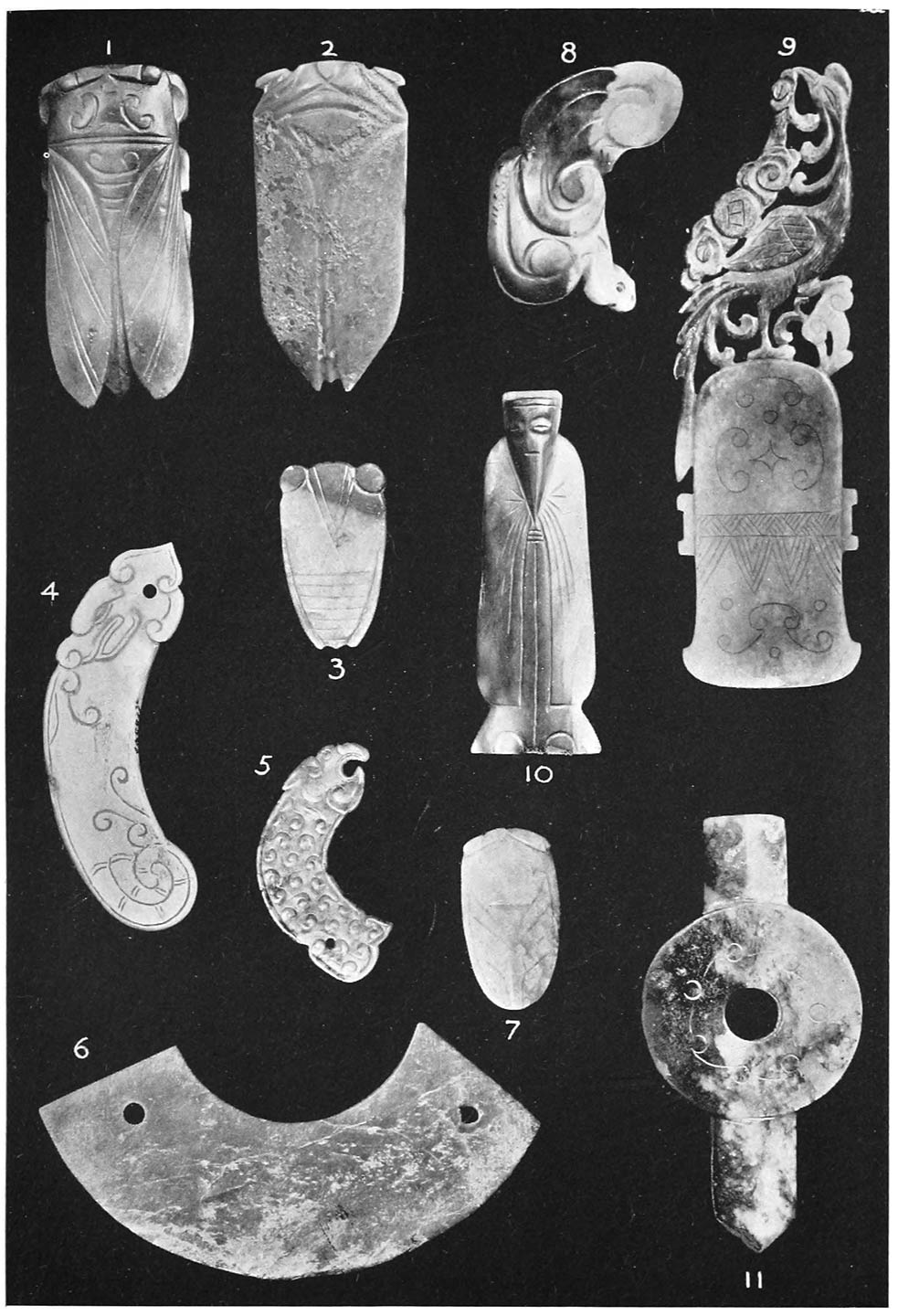
AMULETS FOR THE DEAD, AND OTHER OBJECTS IN JADE
1. 2. 3. 7. Tongue Amulets. 4. Amulet for eye. 5. 6. Lip amulets. 8. Girdle in shape of fungus of immortality. 9. Axe-shaped girdle ornament. 10. Carving of man (Han Period). 11. Jade image (Knei Pi) used in sacrifices to sun, moon and stars.
By courtesy of B. Laufer, author of “Jade”, Field Museum, Chicago
Light is thrown on Chinese beliefs regarding resurrection by the cicada mortuary amulet which was made of jade. It was placed on the tongue of the dead and seems therefore to have been like the Egyptian scarab amulet, a guarantee of immortality.
One of the important ceremonies in connection with the process of reanimating an Egyptian corpse was “the opening of the mouth”. It was necessary that the reanimated corpse should speak with “the true voice” and justify itself in the court of Osiris, judge of the dead, when the heart was weighed in the balance.
Tongue and heart were closely connected. According to the beliefs associated with the cult of Ptah, which was fused with the cult of Osiris, the heart was “the mind”, and the source of all power and all life. The tongue expressed the thoughts of the mind.
Ptah, the great, is the mind and tongue of the gods.
Ptah, from whom proceeded the power
Of the mind,
And of the tongue.…
It (the mind) is the one that bringeth forth every successful issue.
The mind was the essence of life: the tongue, which formed the word, was the active agent of the mind (heart).
This Egyptian doctrine was symbolized by the beetle which rolls a bit of dung in the dust into the form of a ball, and then, having dug a hole in the ground, pushes it in and buries it. Thereafter the beetle enters the subterranean chamber to devour the ball. This beetle also collects dung to feed the larvæ which ultimately emerge from the ground in beetle form.
As the Chinese substituted jade for pearls, so did they substitute the cicada for the dung-beetle.
The cicada belongs to that class of insect which feeds on the juices of plants. It is large and broad with brightly-coloured wings. The male has on each side of the body a sort of drum which enables it to make that chirping noise called “the song of the cicada”, referred to by the ancient classical poets. When the female lays her eggs she bores a hole in a tree and deposits them in it. Wingless larvæ are hatched, and they bore their way into the ground to feed on the juices of roots. After a time—in some cases after the lapse of several years—the cicada emerges from the ground, the skin breaks open, and the winged insect rises in the air. The most remarkable species of the cicada is found in the United States, where it passes through a life-history of seventeen years, the greater part of that time being spent underground—the larval stage. In China the newly-hatched larva sometimes bores down into the earth to a depth of about twenty feet.
The fact that the cicada feeds on the juices of plants apparently connected it with the idea of the Tree of Life, the source of “soul substance”.
He notes that “in modern times the combination of butterfly and plum-blossom is used to express a rebus with the meaning ‘Always great age’”. This amulet is of great antiquity.
The butterfly symbol of resurrection is found in Mexico. The Codex Remensis shows an anthropomorphic butterfly from whose mouth a human face emerges. Freyja, the Scandinavian goddess, is connected with the butterfly, and in Greece and Italy the same insect was associated with the idea of resurrection. Psyche (a name signifying “soul”) has butterfly wings. Apparently the butterfly, like the cicada, was supposed to derive its vitality from the mother-goddess’s Tree of Life.
Another important Chinese mortuary jade object was the frog or toad amulet. As we have seen, the frog was connected with the moon and the lunar goddess, and in China, as in ancient Egypt, was a symbol of resurrection.
Stone coffins were used in ancient times. The books of the later Han Dynasty (at the beginning of our era) tell about a pious governor, Wang Khiao, who receives a jade coffin from heaven. It was placed by unseen hands in his hall. His servants endeavoured to take it away, but found it could not be moved.
Here we have jade used for the preservation of the dead, associated with the sky, with cows, water, and stone, and, in addition, a reference to green copper. Jade has taken the place of pearls, and pearls were, as has been shown, connected with the mother-goddess, the sky and cow deity who was the source of fertilizing and creative moisture and “soul substance”. The standing stones of the mother-goddess were supposed to perspire, and to split and give birth to dragons or gods. This idea appears to lie behind the story regarding the perspiring cows. An influence was at work on the night when the sage was buried in the jade coffin, and that influence came from the sky, and was concentrated in jade. It is necessary, therefore, at this point, to get at Chinese ideas regarding the connection between jade and the mysterious influence or influences in what we call “Nature”.
Behind all mythologies lie basic ideas regarding the universe. To understand a local or localized mythology, it is necessary that we should know something regarding the world in which lived those who invented or perpetuated the myths.
The Chinese world was flat, and over it was the dome of the firmament supported by four pillars. These pillars were situated at the four cardinal points, and were each guarded by a sentinel deity. The deities exercised an influence on the world and on all living beings in it, and their influence was particularly strong during their seasons.
Like the ancient Egyptians and Babylonians the Chinese believed that their world was surrounded by water. There are references in the texts to the “Four Seas”, and to what the Egyptians called the “Great Circle” (Okeanos).
Chinese palaces and universities were in ancient times models of the world. One of the odes says of King Wu:
Copyright H. G. Ponting. F.R.G.S.
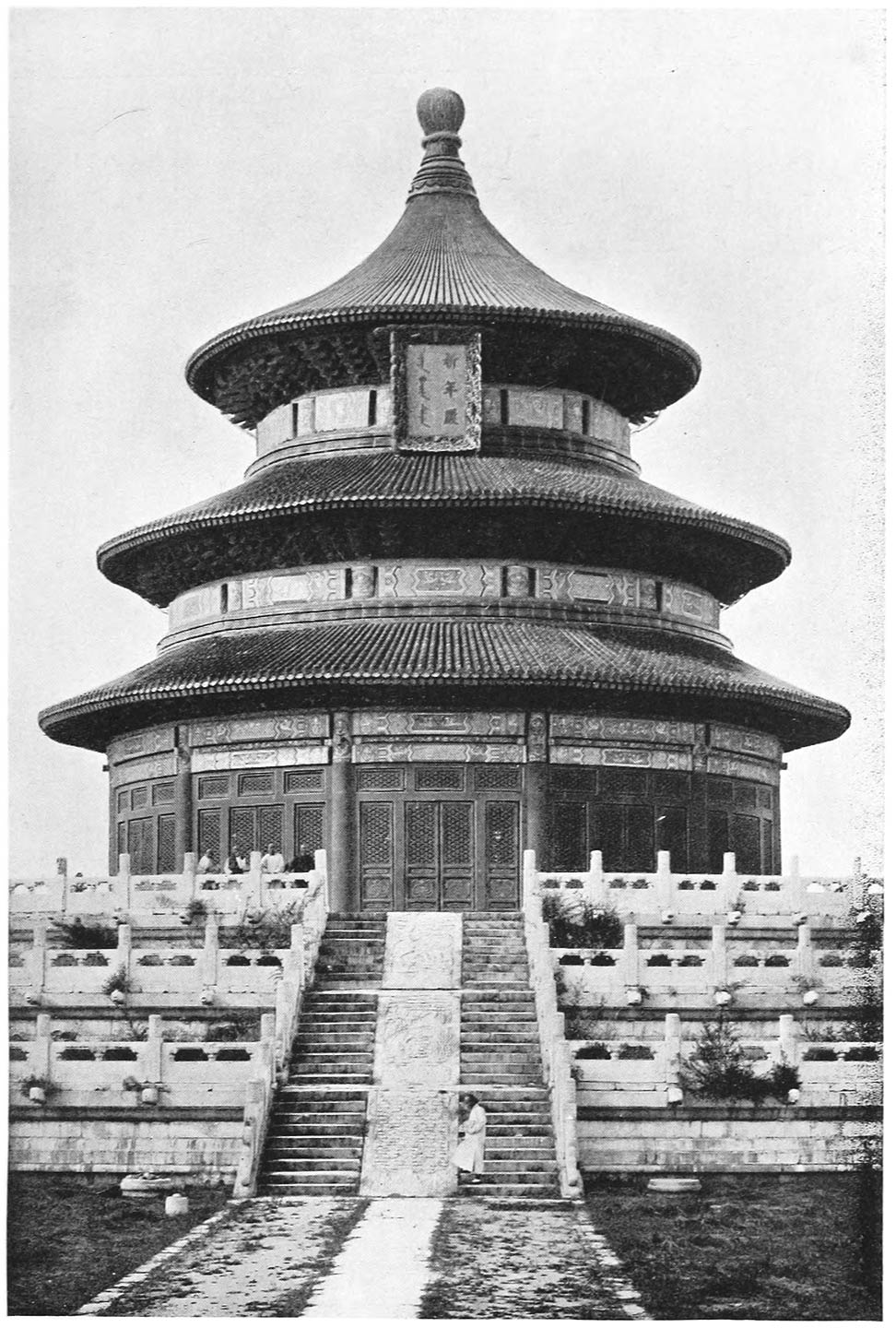
THE TEMPLE OF HEAVEN, PEKING
This greatest of Confucian temples, with its tiles of deep cobalt blue shining in the sunshine, is the most conspicuous object in the city. “During the ceremonies inside everything is blue; the sacrificial utensils are of blue porcelain, the worshippers are robed in blue, even the atmosphere is blue, venetians made of thin rods of blue glass, strung together by cords, being hung down over the tracery of the doors and windows” (Bushell).
Much attention was paid by the Chinese to the shape and situation of a temple, college, palace, or grave. Each was subjected to good and bad influences, and as seafarers set their sails to take full advantage of a favourable breeze, so did the Chinese construct edifices and graves to take full advantage of favourable influences emanating from what may be called the “magic tanks” of the universe—the cardinal points and the sky.
The beliefs involved in this custom are not peculiar to China. In Scottish Gaelic, for instance, there is the old saying:
Shut the north window,
And quickly close the window to the south;
And shut the window facing west;
Evil never came from the east.
The gods of the four quarters of China, from whom influences flowed, were: The Blue (or Green) Dragon (east), the Red Bird (south), the White Tiger (west), and the Black Tortoise (north). The east is the left side, and the west is the right side; a worshipper therefore faces the south. In Irish and Scottish Gaelic lore the south is the right side, and the north is the left side; a worshipper therefore faces the east.
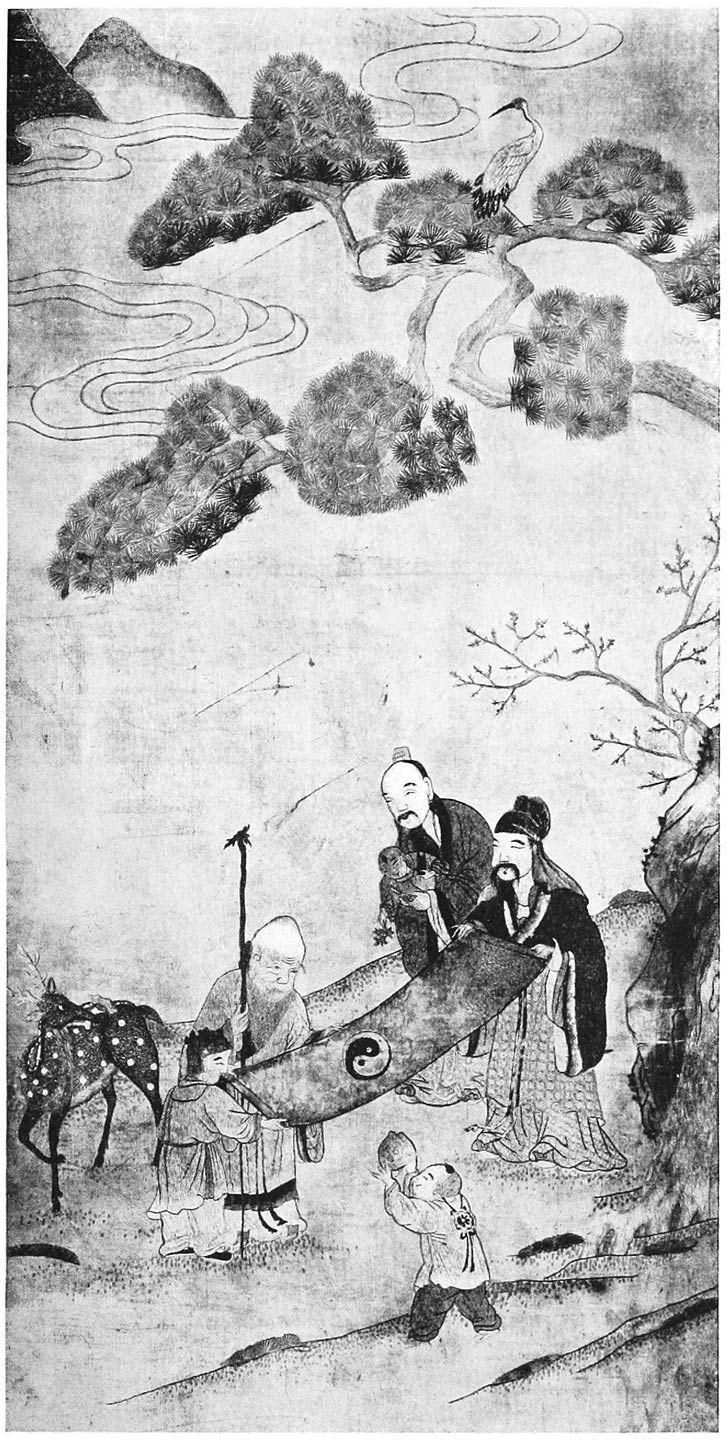
THREE SAGES STUDYING SYMBOL OF YIN AND YANG
(The Yin is the black and the Yang the white “comma” forming circle)
From a Chinese painting in the British Museum
East—the Blue Dragon, Spring, Wood; Planet, Jupiter; liver and gall.
South—the Red Bird, Summer, Fire, the Sun; Planet, Mars; heart and large intestines.
West—the White Tiger, Autumn, Wind, Metal; Planet, Venus; lungs and small intestine.
North—the Black Tortoise, Winter, Cold, Water; Planet, Mercury; kidneys and bladder.
Isaiah (xiv, 4–14) refers to the supreme star-god when he makes Lucifer declare: “I will ascend unto heaven, I will exalt my throne above the stars of God; I will sit also upon the mount of the congregation, in the sides of the north; I will ascend above the heights of the clouds; I will be the most High”.
Jade being strongly imbued with Yang or “soul substance” was intimately associated with all the gods, and the various colours of jade were connected with the colours of the “airts” and of the heavens and earth. Laufer quotes from the eighteenth chapter of Chou li, which deals with the functions of the Master of Religious Ceremonies:
The shape, as well as the colours, of the jade symbols was of ritualistic importance.
What would appear to be the most ancient Chinese doctrine regarding the influences or “breaths” that emanated from Nature, and affected the living and the dead, is summed up in the term Fung-shui. “Fung” means wind, and “shui” means “the water from the clouds which the wind distributes over the world”. Certain winds are good, and certain winds are bad.
The importance attached to wind and water appears to be connected with the ancient belief, found in Babylonia and Egypt, that wind is the “breath of life”, the soul, and that water is the source of all life—“the water of life”.
When the dead were buried it was considered necessary, according to Fung-shui principles, to have graves facing the south, and the Dragon symbol on the left (east) side of the coffin, and the Tiger symbol on the right (west) side, while the Red Bird of the south was on the front, and the Black Tortoise of the north on the back.
Here we find jade and gold closely associated in the Fung-shui system.
As we have seen, white jade was used when the Tiger god of the West was worshipped; it is known as “tiger jade”; a tiger was depicted on the jade symbol. To the Chinese the tiger was the king of all animals and “lord of the mountains”, and the tiger-jade ornament was specially reserved for commanders of armies. The male tiger was, among other things, the god of war, and in this capacity it not only assisted the armies of the emperors, but fought the demons that threatened the dead in their graves.
In jade-lore, as will be seen, we touch on complex religious beliefs and conceptions not entirely of Chinese origin. Indeed, it is necessary to leave China and investigate the religious systems of more ancient countries to understand rightly Chinese ideas regarding jade as a substitute for gold, pearls, precious stones, &c., and its connection with vegetation and the Great Mother, the source of all life.
It remains with us to deal with Chinese ideas regarding the soul which was protected by jade, the concentrated form of “soul substance”.
The living performed ceremonies to assist the soul of the dead on its last journey. Priests chanted:
Egyptian, Babylonian, and Indian ideas regarding the Western Paradise are here significantly mingled.
During life the soul might leave the body for a period, either during sleep or when one fainted suddenly.
This belief is widespread. The soul, in folk-stories, is sometimes seen, as in Scotland, as a bee, or bird, or serpent, as in Norway as an insect or mouse, as in Indonesia and elsewhere as a worm, snake, butterfly, or mouse, and even, as in different countries, as deer, cats, pigs, crocodiles, &c. Chinese beliefs regarding souls as butterflies, cicadas, &c., have already been referred to.
The souls of Chinese ancestors, who passed to the Otherworld, became identified with the deities who protected households. Emperors became, after death, emperors in heaven and their souls were the deified preservers of their dynasties. Clan and tribal ancestors were protectors of their clans and tribes, and families were ever under the care of the souls of their founders. The belief became deeply rooted in China that the ancestral soul exercised from generation to generation a beneficent influence over a home. It is not surprising to find, therefore, that gods are exceedingly numerous in China, and that it is sometimes difficult to distinguish an ancestor from a god and a god from an ancestor. The State religion was something apart from domestic religion. Emperors worshipped the deities that controlled the nation’s destinies, and families worshipped the deities of the household.
Local and imported beliefs were fused and developed on Chinese soil, and when, in time, Buddhism was introduced it was mixed with pre-existing religious systems. Chinese Buddhism is consequently found to have local features that distinguish it from the Buddhism of Tibet, Burmah, and Japan, in which countries there was, in like manner, culture-mixing.
It is of special interest to find that the Chinese Nu Kwa who caused the flood to retreat was the creator of the jade which protected mankind and ensured longevity by preserving the seed or shen of life, being impregnated with Yang, the male principle. In Babylonia, the seed of mankind was preserved during the flood by the nig-gil-ma.
In the Sumerian version of the Creation legend, the three great gods Anu, Enlil, and Enki, assisted by the Great Mother goddess Ninkharasagga, first created mankind, then the nig-gil-ma, and lastly the four-legged animals of the field. The mysterious nig-gil-ma is referred to in the story of the Deluge as “Preserver of the seed of mankind”, while the ship or ark is “Preserver of Life”, literally “She that preserves life”. A later magical text refers to the creation after that of mankind and animals of “two small creatures, one white and one black”. Man and animals were saved from the flood and the nig-gil-ma played its or their part “in ensuring their survival”.
The Babylonian reference in a magical text to the nig-gil-ma as “two small creatures, one white and one black” is therefore highly significant. Apparently, like jade, the nig-gil-ma symbolized “the male principle”, and “the spirit” of “a beautiful woman”. Thus mandrake (ginseng), the Plant of Life, red earth, jade, the pearl and the pot or jar or bowl, and the Deluge ship, and the ship of the sun-god, were forms, avatars, or manifestations of the Great Mother who preserved the seed of mankind and the elixir of life—in the Pot it grew the Plant of Life, and from it could be drunk the dew of life, the water of life, plant and water being impregnated with the “spirit” of jade. Jade-lore is of highly complex character because, as has been indicated, the early instructors of the Chinese attached to the mineral the Egypto-Babylonian doctrines regarding the Great Mother and her shells, pearls, precious stones, gold, silver and copper, herbs, trees, cereals, red earth, &c. The Babylonian evidence regarding the nig-gil-ma as a herb, and as a silver or stone jar, pot, or cup, in which was preserved the seed of mankind (“soul substance”) may explain why in the Chinese Deluge myth there is no ark or ship. The goddess provided jade instead of a boat and she created dragons to control the rain-supply, so that the world might not again suffer from the effects of a flood.
The virtues of jade were shared to a certain degree by rhinoceros horn, which, as we have seen, was reputed to shine by night.
Apparently the “psychological motive” for searching for jade in China and Europe came from the Khotan area in Chinese Turkestan, whence jade was carried to Babylonia during the Sumerian period. It is probable that bronze was first manufactured in the jade-bearing area of Asia, and that the people who carried “the knowledge of bronze-making into Europe”, as Professor Elliot Smith suggests, “also introduced the appreciation of jade”. Laufer comments in this connection: “Originality is certainly the rarest thing in the world, and in the history of mankind the original thoughts are appallingly sparse. There is, in the light of historical facts and experience, no reason to credit the prehistoric and early populations of Europe with any spontaneous ideas relative to jade.” After receiving jade and adopting the beliefs attached to it, they set out to search for it, and found it in Europe.
The polished axe pendants of jade found in Malta were evidently charms. Among the Greeks jade was “the kidney stone”; it cured diseases of the kidneys. The Spaniards brought jade or jadeite from Mexico, and called it “the loin stone” (piedra de hijada). Sir Walter Raleigh introduced it into England, and used the Spanish name from which “jade” is derived.
Jade is, in short, a “luck stone”: the giver of children, health, immortality, wisdom, power, victory, growth, food, clothing, &c. It is “the jewel that grants all desires” in this world and the next, and is therefore connected with all religious beliefs, while it also plays its part as a symbol in the social organization, being the medium through which the mysterious forces of nature exercise their influence in every sphere of human thought and activity.