WELL-KNOWN ESSAYISTS, CRITICS AND SKETCH WRITERS.
Reading edition
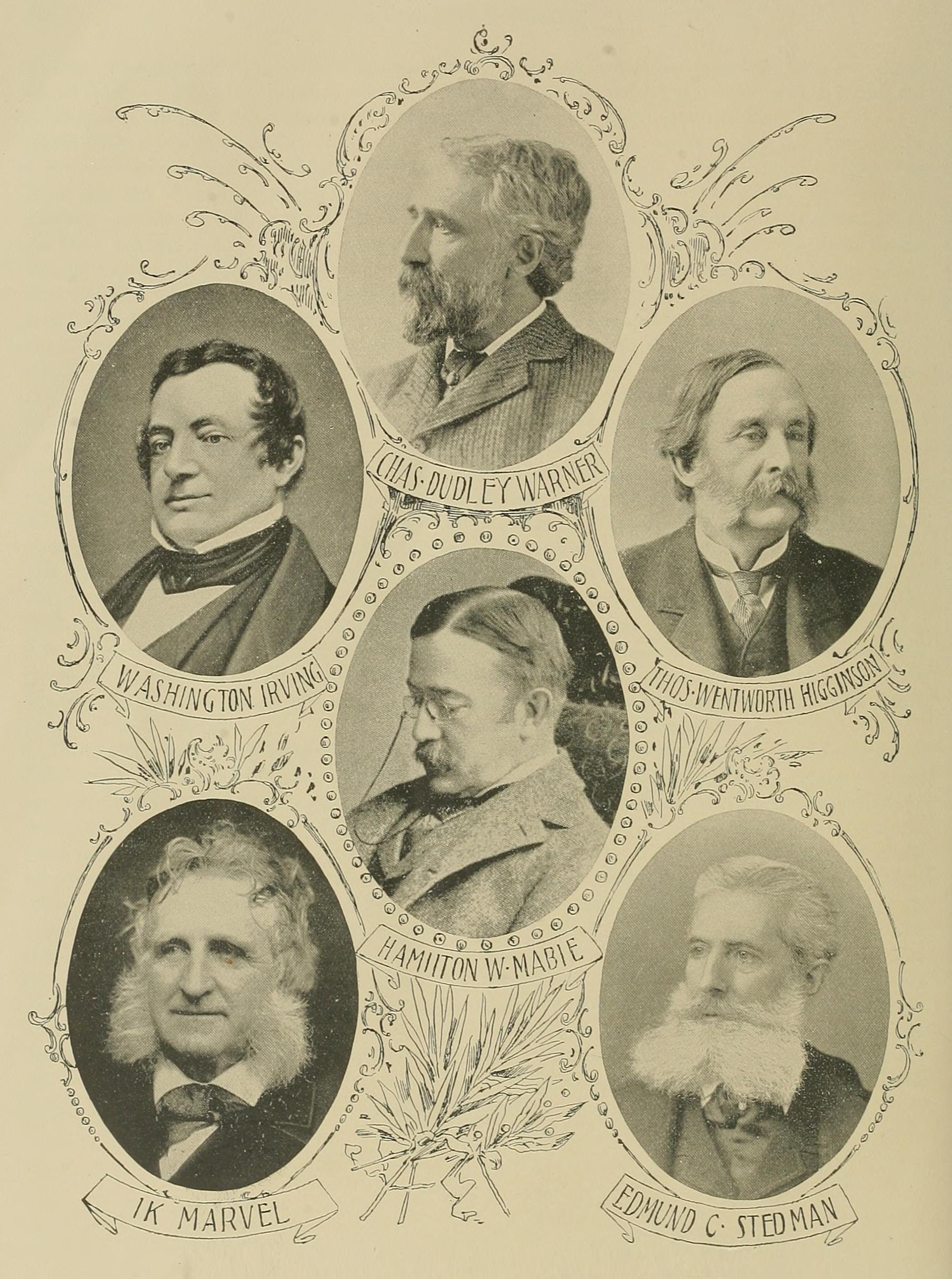
DISTINGUISHED ESSAYISTS AND LITERARY CRITICS.
CHAS. DUDLEY WARNER WASHINGTON IRVING • THOS. WENTWORTH HIGGINSON HAMILTON W. MABIE IK MARVEL • EDMUND C. STEDMAN

WASHINGTON IRVING.
THE FIRST AMERICAN AUTHOR OF RENOWN.
“The Cervantes of the New World.”
HE first American who openly adopted literature as a calling and successfully relied upon his pen for support was Washington Irving, and the abiding popularity of this author is the best guarantee of his permanent place in the world of letters. Since 1802, when Irving begun to write, empires have arisen and passed away; new arts have been invented and adopted, and have pushed the old out of use; the household economy of mankind has undergone a revolution; science has learned a new dialect and forgotten the old; but the words of this charming writer are still as bright and even more read by men and women to-day than when they came fresh from his pen and their brilliant author was not only the literary lion of America, but was a shining light in the circles of the old World. The pages of Irving are a striking illustration of the fact that the language of the heart never becomes obsolete, that Truth, and Good, and Beauty, the offspring of God, are not subject to the changes which beset the empire of man, and we feel sure that Washington Irving, whose works were the delight of our grandparents and parents, and are now contributing to our own happiness, will also be read with the same eager pleasure by those who come after us.

It was on the 3rd of April, 1783, when the British were in possession of New York City and George Washington was exerting his forces to drive them away, that young Irving was born. Like Benjamin Franklin, he was the youngest of many sons. His father was a Scotchman and his mother an Englishwoman, who emigrated to America soon after their marriage and settled in New York about the year 1770. The Irvings were staunch patriots and did what they could to relieve the sufferings of American prisoners while the British held the city, and their son was not christened until the English evacuated the town and George Washington came in and took possession. In her exultation over this event Mrs. Irving exclaimed: “Washington’s work is ended and this child shall be named after him.” Six years later, in 1789, George Washington took the oath of office as the first President of the United States, in New York, which was then the capital of the country. Shortly after this the Scotch servant girl with little Irving in charge, seeing the President on the street called out: “Please, your honor, here’s a bairn was named after you.” Washington bade her bring the boy to him, and placing his hands on his head gave him his blessing.
As a boy Irving was playful rather than studious. His delicate health prevented his entering college, and the educational training which he received was at sundry small schools, and this ceased at the age of sixteen, at which time he began to study law. Irving’s opportunity came in 1802, when his brother, Dr. Peter Irving, established a daily paper, to which Washington, then only nineteen, contributed a series of essays under the signature of “Jonathan Oldstyle.” They were written in a humorous vein and met an instant success, being quoted and copied as far and wide as the sayings of Benjamin Franklin’s “Poor Richard” had been fifty years before.
In 1804 Irving’s failing health compelled him to abandon his legal studies and he went abroad, spending two years in European travel, and gathering a stock of material for his future writings. In 1806 he returned to New York, took up again the study of law and was admitted to the bar, but never practised the profession. The next year, with his brother and James K. Paulding, he started the “Salmagundi; or, Whim-Whams and Opinions of ♦Launcelot Langstaff, Esq.,” which was published fortnightly and ran through twenty numbers. This humorous magazine, intended by its authors only to “hit off” the gossip of that day, has now become an amusing history of society events a century ago, and is still widely read. The next two years were occupied in writing his “Knickerbocker’s History of New York,” which was published in December, 1809. This was to have been the joint work of Washington Irving and his brother, Peter, but the latter was called away to Europe, and Washington did it alone. To introduce this book, Irving, with genuine Yankee shrewdness, advertised in the newspapers some months in advance of its publication for an old gentleman by the name of Knickerbocker, who had suddenly disappeared, leaving behind him the manuscript of a book and his board bill unpaid. It was finally announced that his landlord had decided to publish the book in the hope of realizing enough profit to satisfy his claim for board against the author. It proved to be the most readable book which had yet appeared in America and was received with enthusiasm by the public. Abroad it created almost as great a sensation. Sir Walter Scott read it aloud to his family, and it first revealed to the critics of the Old World that America was to have a literature of its own. This book quickly brought its author both reputation and money, and with bright hopes he entered the business firm of his brother as a silent partner.
During the War of 1812 Irving was editorially connected with the “Analectic Magazine” in Philadelphia, for which he wrote a number of articles. He was stanchly patriotic throughout the war, though he deplored its existence. In 1815, after peace was proclaimed, he made a second voyage across the Atlantic, intending to remain only a short while, but the failure of his brother’s firm blasted his business hopes and necessitated his return to literature. He, therefore, remained abroad for seventeen years, and it was in the Old Country that he wrote his famous “Sketch Book,” published in parts in New York in 1819, and in book form in London in 1820, the author receiving for the copyright four hundred pounds (nearly $2,000). In 1822 he published “Bracebridge Hall, or, The Humorist;” and in 1824 the “Tales of the Traveler.” From 1826 to 1829 Irving spent much time in Spain, where he gathered material for the “Life of Christopher Columbus” (1828); “Chronicles of the Conquest of Granada,” and “The Alhambra, or, The New Sketch Book,” which appeared in 1832.
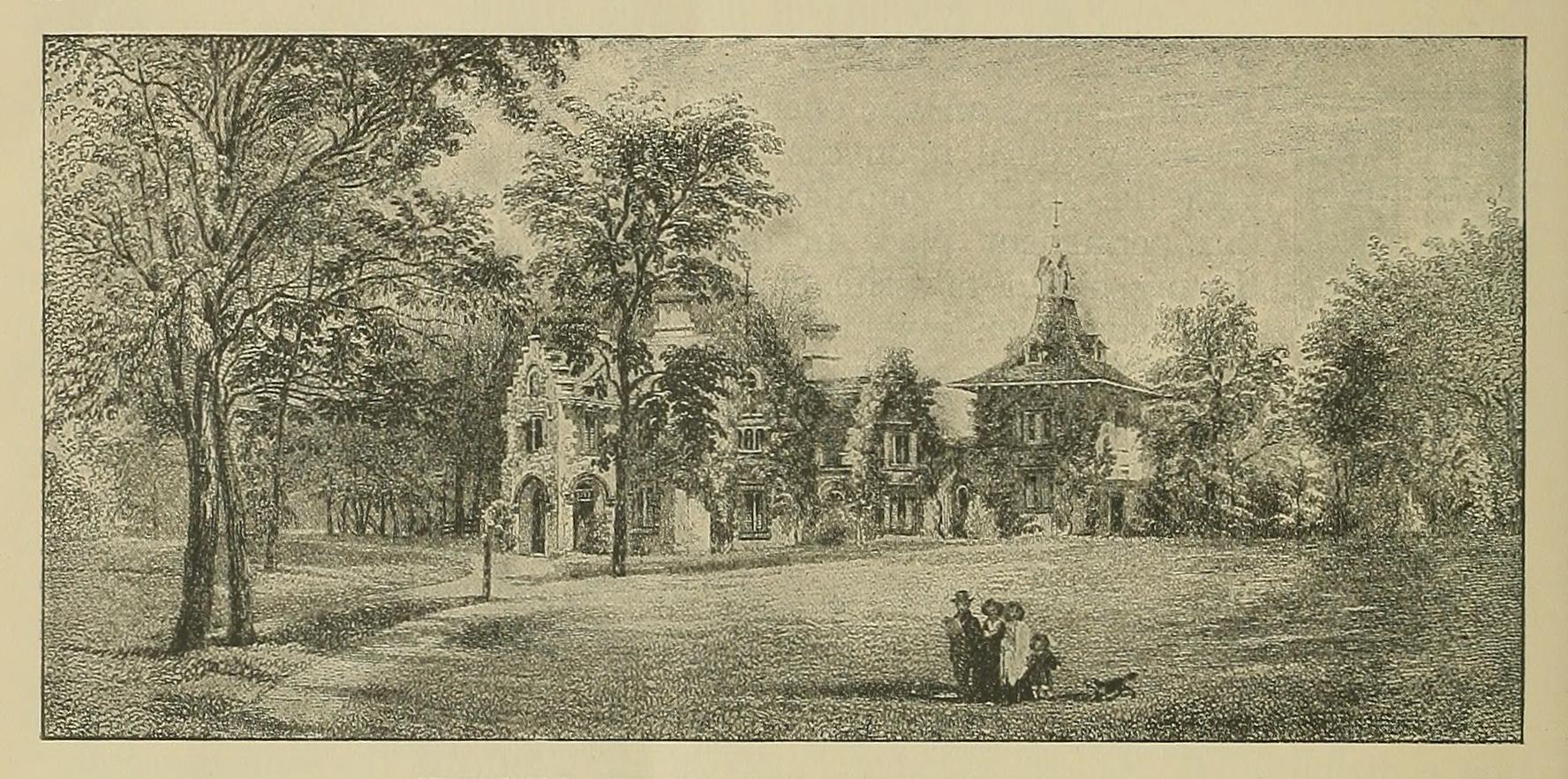
SUNNYSIDE, THE HOME OF WASHINGTON IRVING.
During the last two years of Irving’s stay abroad he was Secretary of the United States Legation at London, and on his return to America in 1832 was received with great public honor. His books now brought him an adequate income, and he built for himself a handsome villa at Irvington, New York—which he named “Sunnyside”—where he continued to reside until his death, with the exception of four years (1842–46), during which time he represented the United States at the Court of Madrid. While residing at Sunnyside he wrote the “Tours of the Prairies” (1835); “Astoria” (1836); “Adventures of Captain Bonneville” (1837). After his return from the Court of Spain he edited a new edition of his complete works, issued in 1850. He also published in 1849 and 1850 “Oliver Goldsmith: a Biography,” and “Mahomet and His Successors.” From 1850 to 1859 he published only two books, namely, “♦Wolfert’s Roost and Other Papers” and the “Life of George Washington;” the latter issued just before his death, which occurred at Sunnyside, November 28, 1859. His nephew, P. H. Irving, afterwards prepared the “Life and Letters of Washington Irving” (1863), and also edited and published his “Spanish Papers and Other Miscellanies” (1866.)
That Irving never married may be attributed to the fact that his fiancé, Miss Matilda Hoffman, a charming and beautiful girl, to whom he was devotedly attached, died suddenly soon after they were engaged. Irving, then twenty-six, bore the blow like a man, but he carried the scar through life.
The fame of Irving becomes the more resplendent when we remember that he was the first great pioneer in American letters. Franklin was the only man of any note who had preceded him, and his writings were confined to a much smaller scope. It was while Bryon and Scott were leaders of English letters that Irving, without the advantage of a college education, went to England and met and associated with the greatest of English authors, issued several of his books and made good his own title to an honorable position in literature among them, not only leaving his impress upon English society but he created an illustrious following among her authors that any man should be proud of; for it is from Irving’s “Sketch Book” that the revival of Christmas feasts was inaugurated, which Dickens afterwards took up and pursued to further lengths, making Irving his model in more ways than is generally supposed. Sir Walter Scott and Thackeray were his friends and admirers. The latter calls Irving the “first ambassador whom the new world of letters sent to the old.” At home Irving’s influence was even greater. His tales like “Rip Van Winkle” and its fellows became the first fruits of an abundant harvest, rich in local flavor, which later American story-tellers like Hawthorne, Poe, Bret Harte and Cable, all in their own way, following in his footsteps, have gathered after him.
The genius of Irving was not of that stalwart, rugged character which conquered by admiration. It rather won its way softly and by the aid of genial sentiment, human sympathy and pungent humor. His heart was quick to catch the sentiment, and his imagination as quick to follow the thread of an incident to its most charming conclusion. He it was who peopled the green nooks of “Sleepy Hollow” and the rocky crags of the Catskills, describing landscape and character with a charm which no later American writer has surpassed; and it was his delicate subtlety and keen insight which called into being in his “Knickerbocker’s History” a civilization, giving to the legend the substance of truth, and presenting a fiction so that it passed for a fact. This is a feat which very few authors have accomplished.
That Irving might have been a successful historian is evinced by his “Life of Columbus” and “Life of Washington,” in which his exhaustive inquiry into details and his treatment of the same leave nothing new in the lives of these great men to be told; but it is on his descriptive essays, such as we find in his “Sketch Book,” “The Alhambra” and “Knickerbocker’s History,” that his title to enduring fame most securely rests.
The poet, Lowell, in his “Fable for Critics,” thus happily characterizes Washington Irving:
“What! Irving? thrice welcome warm heart and fine brain,
You bring back the happiest spirit from Spain,
And the gravest sweet humor, that ever were there
Since Cervantes met death in his gentle despair;
Nay, don’t be embarrassed, nor look so beseeching,
I shan’t run directly against my own preaching,
And having just laughed at their Raphaels and Dantes,
Go to setting you up beside matchless Cervantes;
But allow me to speak what I honestly feel,
To a true poet-heart add the fun of Dick Steele,
Throw in all of Addison, minus the chill,
With the whole of that partnership’s stock and good-will,
Mix well, and while stirring, hum o’er, as a spell,
The ‘fine old English Gentleman,’ simmer it well,
Sweeten just to your own private liking, then strain,
That only the finest and clearest remain.
Let it stand out of doors till a soul it receives
From the warm lazy sun loitering down through green leaves,
And you’ll find a choice nature not wholly deserving
A name either English or Yankee—just Irving.”
THE ORGAN OF WESTMINSTER ABBEY.
FROM THE SKETCH BOOK.
HE sound of casual footsteps had ceased from the abbey. I could only hear, now and then, the distant voice of the priest repeating the evening service, and the faint responses of the choir; these paused for a time, and all was hushed. The stillness, the desertion and obscurity that were gradually prevailing around, gave a deeper and more solemn interest to the place:
For in the silent grave no conversation,
No joyful tread of friends, no voice of lovers,
No careful father’s counsel—nothing’s heard,
For nothing is, but all oblivion,
Dust, and an endless darkness.
Suddenly the notes of the deep-laboring organ burst upon the ear, falling with double and redoubled intensity, and rolling, as it were, huge billows of sound. How well do their volume and grandeur accord with this mighty building! With what pomp do they swell through its vast vaults, and breathe their awful harmony through these caves of death, and make the silent sepulchre vocal! And now they rise in triumph and acclamation, heaving higher and higher their accordant notes, and piling sound on sound. And now they pause, and the soft voices of the choir break out into sweet gushes of melody; they soar aloft, and warble along the roof, and seem to play about these lofty vaults like the pure airs of heaven. Again the pealing organ heaves its thrilling thunders, compressing air into music, and rolling it forth upon the soul. What long-drawn cadences! What solemn sweeping concords! It grows more and more dense and powerful—it fills the vast pile, and seems to jar the very walls—the ear is stunned—the senses are overwhelmed. And now it is winding up in full jubilee—it is rising from the earth to heaven—The very soul seems rapt away and floated upwards on this swelling tide of harmony!
I sat for some time lost in that kind of reverie which a strain of music is apt sometimes to inspire: the shadows of evening were gradually thickening round me; the monuments began to cast deeper and deeper gloom; and the distant clock again gave token of the slowly waning day.
BALTUS VAN TASSEL’S FARM.
CHABOD Crane had a soft and foolish heart toward the sex; and it is not to be wondered at, that so tempting a morsel soon found favor in his eyes; more especially after he had visited her in her paternal mansion. Old Baltus Van Tassel was a perfect picture of a thriving, contented, liberal-hearted farmer. He seldom, it is true, sent either his eyes or his thoughts beyond the boundaries of his own farm; but within those everything was snug, happy, and well-conditioned. He was satisfied with his wealth, but not proud of it; and piqued himself upon the hearty abundance, rather than the style in which he lived. His stronghold was situated on the banks of the Hudson, in one of those green, sheltered, fertile nooks, in which the Dutch farmers are so fond of nestling. A great elm-tree spread its branches over it, at the foot of which bubbled up a spring of the softest and sweetest water, in a little well formed of a barrel; and then stole sparkling away through the grass, to a neighboring brook, that bubbled along among alders and dwarf willows. Hard by the farmhouse was a vast barn, that might have served for a church; every window and crevice of which seemed bursting forth with the treasures of the farm; the flail was busily resounding within it from morning to night; swallows and martins skimmed twittering about the eaves; and rows of pigeons, some with one eye turned up, as if watching the weather, some with their heads under their wings, or buried in their bosoms, and others swelling and cooing, and bowing about their dames, were enjoying the sunshine on the roof. Sleek, unwielding porkers were grunting in the repose and abundance of their pens; whence sallied forth, now and then, troops of sucking pigs, as if to snuff the air. A stately squadron of snowy geese were riding in an adjoining pond, convoying whole fleets of ducks; regiments of turkeys were gobbling through the farmyard, and guinea fowls fretting about it, like ill-tempered housewives, with their peevish, discontented cry. Before the barn door strutted the gallant cock, that pattern of a husband, a warrior, and a fine gentleman, clapping his burnished wings, and crowing in the pride and gladness of his heart—sometimes tearing up the earth with his feet, and then generously calling his ever-hungry family of wives and children to enjoy the rich morsel which he had discovered.
The pedagogue’s mouth watered, as he looked upon this sumptuous promise of winter fare. In his devouring mind’s eye, he pictured to himself every roasting-pig running about with a pudding in his belly and an apple in his mouth; the pigeons were snugly put to bed in a comfortable pie, and tucked in with a coverlet of crust; the geese were swimming in their own gravy; and the ducks pairing cosily in dishes, like snug married couples, with a decent competency of onion sauce. In the porkers he saw carved out the future sleek side of bacon and juicy relishing ham; not a turkey but he beheld daintily trussed up, with its gizard under its wing, and, peradventure, a necklace of savory sausages; and even bright chanticleer himself lay sprawling on his back, in a side-dish, with uplifted claws, as if craving that quarter which his chivalrous spirit disdained to ask while living.
As the enraptured Ichabod fancied all this, and as he rolled his great green eyes over the fat meadowlands, the rich fields of wheat, of rye, of buckwheat, and Indian corn, and the orchards burdened with ruddy fruit, which surrounded the warm tenement of Van Tassel, his heart yearned after the damsel, who was to inherit those domains, and his imagination expanded with the idea, how they might be readily turned into cash, and the money invested in immense tracts of wild land and shingle palaces in the wilderness.
Nay, his busy ♦fancy already realized his hopes, and presented to him the blooming Katrina, with a whole family of children, mounted on the top of a wagon loaded with household trumpery, with pots and kettles dangling beneath; and he beheld himself bestriding a pacing mare, with a colt at her heels, setting out for Kentucky, Tennessee, or the Lord knows where.
COLUMBUS AT BARCELONA.
(FROM “LIFE OF COLUMBUS.”)
HE letter of Columbus to the Spanish monarchs had produced the greatest sensation at court. The event he announced was considered the most extraordinary of their prosperous reign, and, following so close upon the conquest of Granada, was pronounced a signal mark of divine favor for that triumph achieved in the cause of the true faith. The sovereigns themselves were for a time dazzled by this sudden and easy acquisition of a new empire, of indefinite extent and apparently boundless wealth.
About the middle of April Columbus arrived at Barcelona, where every preparation had been made to give him a solemn and magnificent reception. The beauty and serenity of the weather in that genial season and favored climate contributed to give splendor to this memorable ceremony. As he drew near the place, many of the more youthful courtiers and hidalgos, together with a vast concourse of the populace, came forth to meet and welcome him. His entrance into this noble city has been compared to one of those triumphs which the Romans were accustomed to decree to conquerors. First were paraded the Indians, painted according to their savage fashion, and decorated with their national ornaments of gold; after these were borne various kinds of live parrots, together with stuffed birds and animals of unknown species, and rare plants supposed to be of precious qualities; while great care was taken to make a conspicuous display of Indian coronets, bracelets, and other decorations of gold, which might give an idea of the wealth of the newly discovered regions. After this followed Columbus on horseback, surrounded by a brilliant cavalcade of Spanish chivalry. The streets were almost impassable from the countless multitude; the windows and balconies were crowded with the fair; the very roofs were covered with spectators. It seemed as if the public eye could not be sated with gazing on these trophies of an unknown world, or on the remarkable man by whom it had been discovered. There was a sublimity in this event that mingled a solemn feeling with the public joy. It was looked upon as a vast and signal dispensation of Providence in reward for the piety of the monarchs; and the majestic and venerable appearance of the discoverer, so different from the youth and buoyancy generally expected from roving enterprise, seemed in harmony with the grandeur and dignity of his achievement.
To receive him with suitable pomp and distinction, the sovereigns had ordered their throne to be placed in public, under a rich canopy of brocade of gold, in a vast and splendid saloon. Here the king and queen awaited his arrival, seated in state, with the Prince Juan beside them, and attended by the dignitaries of their court, and the principal nobility of Castile, Valencia, Catalonia, and Aragon, all impatient to behold the man who had conferred so incalculable a benefit upon the nation. At length Columbus entered the hall, surrounded by a brilliant crowd of cavaliers, among whom, says Las Casas, he was conspicuous for his stately and commanding person, which, with his countenance rendered venerable by his gray hairs, gave him the august appearance of a senator of Rome. A modest smile lighted up his features, showing that he enjoyed the state and glory in which he came, and certainly nothing could be more deeply moving to a mind inflamed by noble ambition, and conscious of having greatly deserved, than these testimonials of the admiration and gratitude of a nation or rather of a world. As Columbus approached, the sovereigns rose, as if receiving a person of the highest rank. Bending his knees, he offered to kiss their hands; but there was some hesitation on their part to permit this act of homage. Raising him in the most gracious manner, they ordered him to seat himself in their presence; a rare honor in this proud and punctilious court.
At their request he now gave an account of the most striking events of his voyage, and a description of the islands discovered. He displayed specimens of unknown birds and other animals; of rare plants of medicinal and aromatic virtues; of native gold in dust, in crude masses, or labored into barbaric ornaments; and, above all, the natives of these countries, who were objects of intense and inexhaustible interest. All these he pronounced mere harbingers of greater discoveries yet to be made, which would add realms of incalculable wealth to the dominions of their majesties, and whole nations of proselytes to the true faith.
When he had finished, the sovereigns sank on their knees, and, raising their clasped hands to heaven, their eyes filled with tears of joy and gratitude, poured forth thanks and praises to God for so great a providence; all present followed their example; a deep and solemn enthusiasm pervaded that splendid assembly, and prevented all common acclamations of triumph. The anthem Te Deum laudamus, chanted by the choir of the royal chapel, with the accompaniment of instruments, rose in full body of sacred harmony, bearing up as it were the feelings and thoughts of the auditors to heaven, “so that,” says the venerable Las Casas, “it seemed as if in that hour they communicated with celestial delights.” Such was the solemn and pious manner in which the brilliant court of Spain celebrated this sublime event; offering up a grateful tribute of melody and praise, and giving glory to God for the discovery of another world.
THE GALLOPING HESSIAN.
HE revel now gradually broke up. The old farmers gathered together their families in their wagons, and were heard for some time rattling along the hollow roads and over the distant hills. Some of the damsels mounted on pillions behind their favorite swains, and their light-hearted laughter, mingling with the clatter of hoofs, echoed along the silent woodlands, sounding fainter and fainter until they gradually died away—and the late scene of noise and frolic was all silent and deserted. Ichabod only lingered behind, according to the custom of country lovers, to have a tête-à-tête with the heiress, fully convinced that he was now on the high road to success. What passed at this interview I will not pretend to say, for, in fact, I do not know. Something, however, I fear me, must have gone wrong, for he certainly sallied forth, after no very great interval, with an air quite desolate and chapfallen. Oh these women! these women! Could that girl have been playing off any of her coquettish tricks? Was her encouragement of the poor pedagogue all a mere sham to secure her conquest of his rival? Heaven only knows, not I! Let it suffice to say, Ichabod stole forth with the air of one who had been sacking a hen-roost, rather than a fair lady’s heart. Without looking to the right or left to notice the scene of rural wealth on which he had so often gloated, he went straight to the stable, and with several hearty cuffs and kicks, roused his steed most uncourteously from the comfortable quarters in which he was soundly sleeping, dreaming of mountains of corn and oats, and whole valleys of timothy and clover.
It was the very witching time of night that Ichabod, heavy-hearted and crestfallen, pursued his travels homewards, along the sides of the lofty hills which rise above Tarrytown, and which he had traversed so cheerily in the afternoon. The hour was as dismal as himself. Far below him the Tappan Zee spread its dusk and indistinct waste of waters, with here and there the tall mast of a sloop riding quietly at anchor under the land. In the dead hush of midnight he could even hear the barking of the watch-dog from the opposite shore of the Hudson; but it was so vague and faint as only to give an idea of his distance from this faithful companion of man. Now and then, too, the long-drawn crowing of a cock, accidentally awakened, would sound far, far off, from some farmhouse away among the hills—but it was like a dreaming sound in his ear. No signs of life occurred near him, but occasionally the melancholy chirp of a cricket, or perhaps the guttural twang of a bullfrog, from a neighboring marsh, as if sleeping uncomfortably, and turning suddenly in his bed.
All the stories of ghosts and goblins that he had heard in the afternoon now came crowding upon his recollection. The night grew darker and darker, the stars seemed to sink deeper in the sky, and driving clouds occasionally hid them from his sight. He had never felt so lonely and dismal. He was, moreover, approaching the very place where many of the scenes of the ghost stories had been laid. In the centre of the road stood an enormous tulip-tree, which towered like a giant above all the other trees of the neighborhood, and formed a kind of landmark. Its limbs were gnarled and fantastic, large enough to form trunks for ordinary trees, twisting down almost to the earth and rising again into the air. It was connected with the tragical story of the unfortunate André, who had been taken prisoner hard by; and was universally known by the name of Major André’s tree. The common people regarded it with a mixture of respect and superstition, partly out of sympathy for the fate of its ill-starred namesake, and partly from the tales of strange sights and doleful lamentations told concerning it.
As Ichabod approached this fearful tree, he began to whistle; he thought his whistle was answered; it was but a blast sweeping sharply through the dry branches. As he approached a little nearer, he thought he saw something white hanging in the midst of the tree—he paused and ceased whistling; but, on looking more narrowly, perceived that it was a place where the tree had been scathed by lightning, and the white wood laid bare. Suddenly he heard a groan—his teeth chattered, and his knees smote against the saddle; it was but the rubbing of one huge bough upon another, as they were swayed about by the breeze. He passed the tree in safety, but new perils lay before him.
About two hundred yards from the tree a small brook crossed the road, and ran into a marshy and thickly-wooded glen, known by the name of Wiley’s Swamp. A few rough logs, laid side by side, served for a bridge over this stream. On that side of the road where the brook entered the wood, a group of oaks and chestnuts, matted thick with wild grape-vines, threw a cavernous gloom over it. To pass this bridge was the severest trial. It was at this identical spot that the unfortunate André was captured, and under the covert of those chestnuts and vines were the sturdy ♦yeoman concealed who surprised him. This has ever since been considered a haunted stream, and fearful are the feelings of the schoolboy who has to pass it alone after dark.
As he approached the stream, his heart began to thump; he summoned up, however, all his resolution, gave his horse half a score of kicks in the ribs, and attempted to dash briskly across the bridge; but instead of starting forward, the perverse old animal made a lateral movement, and ran broadside against the fence. Ichabod, whose fears increased with the delay, jerked the reins on the other side, and kicked lustily with the contrary foot; it was all in vain; his steed started, it is true, but it was only to plunge to the opposite side of the road into a thicket of brambles and alder-bushes. The schoolmaster now bestowed both whip and heel upon the starveling ribs of old Gunpowder, who dashed forward, snuffing and snorting, but came to a stand just by the bridge, with a suddenness that had nearly sent his rider sprawling over his head. Just at this moment a plashy tramp by the side of the bridge caught the sensitive ear of Ichabod. In the dark shadow of the grove, on the margin of the brook, he beheld something huge, misshapen, black and towering. It stirred not, but seemed gathered up in the gloom, like some gigantic monster ready to spring upon the traveler.
The hair of the affrighted pedagogue rose upon his head with terror. What was to be done? To turn and fly was now too late; and, besides, what chance was there of escaping ghost or goblin, if such it was, which could ride upon the wings of the wind? Summoning up, therefore, a show of courage, he demanded in stammering accents—“Who are you?” He received no reply. He repeated his demand in a still more agitated voice. Still there was no answer. Once more he cudgelled the sides of the inflexible Gunpowder, and, shutting his eyes, broke forth with involuntary fervor into a psalm tune. Just then the shadowy object of alarm put itself in motion, and with a scramble and a bound stood at once in the middle of the road. Though the night was dark and dismal, yet the form of the unknown might now in some degree be ascertained. He appeared to be a horseman of large dimensions, and mounted on a black horse of powerful frame. He made no offer of molestation or sociability, but kept aloof on one side of the road, jogging along on the blind side of old Gunpowder, who had now got over his fright and waywardness.
Ichabod, who had no relish for this strange midnight companion, and bethought himself of the adventure of Brom Bones with the Galloping Hessian, now quickened his steed in hopes of leaving him behind. The stranger, however, quickened his horse to an equal pace. Ichabod pulled up, and fell into a walk, thinking to lag behind—the other did the same. His heart began to sink within him; he endeavored to resume his psalm tune, but his parched tongue clove to the roof of his mouth, and he could not utter a stave. There was something in the moody and dogged silence of this pertinacious companion that was mysterious and appalling. It was soon fearfully accounted for. On mounting a rising ground, which brought the figure of his fellow-traveler in relief against the sky, gigantic in height, and muffled in a cloak, Ichabod was horror-struck on perceiving that he was headless!—but his horror was still more increased on observing that the head, which should have rested on his shoulders, was carried before him on the pommel of the saddle: his terror rose to desperation; he rained a shower of kicks and blows upon Gunpowder, hoping by a sudden movement to give his companion the slip—but the spectre started full jump with him. Away then they dashed, through thick and thin; stones flying and sparks flashing at every bound. Ichabod’s flimsy garments fluttered in the air, as he stretched his long lank body away over his horse’s head, in the eagerness of his flight.
They had now reached the road which turns off to Sleepy Hollow; but Gunpowder, who seemed possessed with a demon, instead of keeping up it, made an opposite turn, and plunged headlong down the hill to the left. This road leads through a sandy hollow, shaded by trees for about a quarter of a mile, where it crosses the bridge famous in goblin story, and just beyond swells the green knoll on which stands the whitewashed church.
As yet the panic of the steed had given his unskilful rider an apparent advantage in the chase; but just as he had got half-way through the hollow the girths of the saddle gave way, and he felt it slipping from under him. He seized it by the pommel, and endeavored to hold it firm, but in vain; and he had just time to save himself by clasping old Gunpowder round the neck, when the saddle fell to the earth, and he heard it trampled under foot by his pursuer. For a moment the terror of Hans Van Ripper’s wrath passed across his mind—for it was his Sunday saddle; but this was no time for petty fears; the goblin was hard on his haunches; and (unskilful rider that he was!) he had much ado to maintain his seat; sometimes slipping on one side, sometimes on the other, and sometimes jolted on the high ridge of his horse’s backbone, with a violence that he verily feared would cleave him asunder.
An opening in the trees now cheered him with the hopes that the church bridge was at hand. The wavering reflection of a silver star in the bosom of the brook told him that he was not mistaken. He saw the walls of the church dimly glaring under the trees beyond. He recollected the place where Brom Bones’ ghostly competitor had disappeared. “If I can but reach that bridge,” thought Ichabod, “I am safe.” Just then he heard the black steed panting and blowing close behind him; he even fancied that he felt his hot breath. Another convulsive kick in the ribs, and old Gunpowder sprang upon the bridge; he thundered over the resounding planks; he gained the opposite side; and now Ichabod cast a look behind to see if his pursuer should vanish, according to rule, in a flash of fire and brimstone. Just then he saw the goblin rising in his stirrups and in the very act of hurling his head at him. Ichabod endeavored to dodge the horrible missile, but too late. It encountered his cranium with a tremendous crash—he was tumbled headlong into the dust, and Gunpowder, the black steed, and the goblin rider passed by like a whirlwind.
The next morning the old horse was found without his saddle, and with the bridle under his feet, soberly cropping the grass at his master’s gate. Ichabod did not make his appearance at breakfast—dinner-hour came, but no Ichabod. The boys assembled in the schoolhouse, and strolled idly about the banks of the brook; but no schoolmaster. Hans Van Ripper now began to feel some uneasiness about the fate of poor Ichabod and his saddle. An inquiry was set on foot, and after diligent investigation they came upon his traces. In one part of the road leading to the church was found the saddle trampled in the dirt; the tracks of horses’ hoofs deeply dented in the road, and evidently at furious speed, were traced to the bridge, beyond which, on the bank of a broad part of the brook, where the water ran deep and black, was found the hat of the unfortunate Ichabod, and close beside it a shattered pumpkin.
The brook was searched, but the body of the schoolmaster was not to be discovered. Hans Van Ripper, as executor of his estate, examined the bundle, which contained all his worldly effects. They consisted of two shirts and a half; two stocks for the neck; a pair or two of worsted stockings; an old pair of corduroy smallclothes; a rusty razor; a book of psalm tunes, full of dog’s ears; and a broken pitch-pipe. As to the books and furniture of the schoolhouse, they belonged to the community, excepting Cotton Mather’s History of Witchcraft, a New England Almanac, and a book of dreams and fortune-telling: in which last was a sheet of foolscap much scribbled and blotted in several fruitless attempts to make a copy of verses in honor of the heiress of Van Tassel. These magic books and the poetic scrawl were forthwith consigned to the flames by Hans Van Ripper; who from that time forward determined to send his children no more to school, observing that he never knew any good come of this same reading and writing. Whatever money the schoolmaster possessed, and he had received his quarter’s pay but a day or two before, he must have had about his person at the time of his disappearance.
The mysterious event caused much speculation at the church on the following Sunday. Knots of gazers and gossips were collected in the churchyard, at the bridge, and at the spot where the hat and pumpkin had been found. The stories of Brouwer, of Bones, and a whole budget of others, were called to mind; and when they had diligently considered them all, and compared them with the symptoms of the present case, they shook their heads, and came to the conclusion that Ichabod had been carried off by the Galloping Hessian. As he was a bachelor, and in nobody’s debt, nobody troubled his head any more about him, the school was removed to a different part of the Hollow, and another pedagogue reigned in his stead.

CHARLES DUDLEY WARNER.
HUMORIST AND JOURNALIST.
HARLES DUDLEY WARNER belongs to a class of writers which has been aptly called the meditative school in American literature, but few of the so-called meditative writers so sparkle with humor as does the genial and humane author of “My Summer in a Garden,” and few writers of any school have so succeeded in presenting wholesome truth and lofty thought in the pleasing form of humorous conversation on such common subjects as gardening, back-log fires, and the every-day life of the farmer-boy.

He is one of our leading apostles of culture, and he is himself a glowing example of the worth of culture, for he has steadily raised himself from the flat levels of life to a lofty pinnacle of influence and power simply because he possessed in high degree a keen insight, a dainty lightness of touch, a delicacy of thought and style, a kindly humor, and a racy scent for “human nature.” It was a long time before he discovered his own powers and he labored at a distasteful profession until his nature cried out for its true sphere, but his early life in many respects was imperceptibly ministering to the man that was to be.
He was born of English non-conformist stock, in the hill country of Plainfield, Massachusetts, in 1829—a lineal descendent of a “Pilgrim Father” and the son of a well-to-do farmer, of more than ordinary mental parts. He had his period in the New England district school, and in 1851 he was graduated from Hamilton College, New York, where he had gained a college reputation as a writer.
Had he not been a “born writer” the next period of his life would have made a literary career impossible for him. A winter in Michigan, ending in dismal failure, two years of frontier life as a surveyor, and then the pursuit of legal studies, followed by the practice of law in Chicago seemed to have been hostages to fortune against the pursuit of fame in the field of pure literature.
But he had the blood of the “Brahman caste” and it was certain to assert itself. In 1860, his friend Hawley (now United States Senator from Connecticut) invited him to accept the position of assistant editor on the Hartford “Press,” and his talents for successful journalism were at once apparent, from which he stepped quite naturally into the narrower circle—“the brotherhood of authors.”
“My Summer in a Garden” (1870), his first literary work, was first written as a series of weekly articles for the Hartford “Courant,” and their reception at once made him a man of note.
This work is a delightful prose pastoral, in which the author described his experiences with gardening and finds quaint and subtle connections between “pusley” and “original sin,” while its humorous touches of nature and human nature give it a peculiar charm. “Saunterings,” a volume of reminiscences of European travel, was also published the same year.
“Back-Log Studies” (1872), written in praise of the sweet and kindly influences of the home fireside, appeared first as a series in “Scribner’s Magazine” and added much to the author’s reputation, as it marked a decided advance in style and elegance of diction.
His carefully prepared occasional addresses, on such subjects as Education, Culture and Progress, show that he has deep convictions and an earnestness of heart, as well as the delicate fancy and playful humor which first made him a favorite author. If he is an apostle of culture, he is no less the herald of the truth that “the scholar must make his poetry and learning subserve the wants of the toiling and aspiring multitude.”
“Baddeck, and That Sort of Thing” (1874) is a delightful sketch of travels, a field of literature in which Warner is a master. “My Winter on the Nile” (1876), “In the Levant” (1877), “In the Wilderness” (1878), “Roundabout Journey” (1883), and “Their Pilgrimage” (1886) are his other contributions to this department of literature.
In 1884 he became coeditor of “Harper’s Magazine,” to which he has contributed a valuable series of papers on “Studies in the South,” “Studies in the Great West,” and “Mexican Papers,” critically discussing the educational, political, and social condition of these states.
He is the author of “Captain John Smith,” and of “Washington Irving” in the “Men of Letters Series” of which he is editor.
Nowhere is his humor more free and unrestrained than in “Being A Boy” and in “How I Shot the Bear.”
His home is at Hartford, Conn.
THE MORAL QUALITY OF VEGETABLES.¹
FROM “MY SUMMER IN A GARDEN.”
AM more and more impressed with the moral qualities of vegetables, and contemplate forming a science which shall rank with comparative philology—the science of comparative vegetable morality. We live in an age of Protoplasm. And, if life matter is essentially the same in all forms of life, I propose to begin early, and ascertain the nature of the plants for which I am responsible. I will not associate with any vegetable which is disreputable, or has not some quality which can contribute to my moral growth....
Why do we respect some vegetables and despise others, when all of them come to an equal honor or ignominy on the table? The bean is a graceful, confiding, engaging vine; but you never can put beans into poetry nor into the highest sort of prose. There is no dignity in the bean. Corn—which in my garden grows alongside the bean, and, so far as I can see, with no affectation of superiority—is, however, the child of song. It waves in all literature. But mix it with beans, and its high tone is gone. Succotash is vulgar. It is the bean in it. The bean is a vulgar vegetable, without culture, or any flavor of high society among vegetables.
Then there is the cool cucumber—like so many people, good for nothing when its ripe and the wildness has gone out of it. How inferior to the melon, which grows upon a similar vine, is of a like watery consistency, but is not half so valuable! The cucumber is a sort of low comedian in a company where the melon is a minor gentleman. I might also contrast the celery with the potato. The associations are as opposite as the dining-room of the duchess and the cabin of the peasant. I admire the potato both in vine and blossom; but it is not aristocratic....
The lettuce is to me a most interesting study. Lettuce is like conversation: it must be fresh and crisp, so sparkling that you scarcely notice the bitter in it. Lettuce, like most talkers, is however apt to run rapidly to seed. Blessed is that sort which comes to a head, and so remains—like a few people I know—growing more solid and satisfactory and tender at the same time, and whiter at the centre, and crisp in their maturity. Lettuce, like conversation, requires a good deal of oil, to avoid friction, and keep the company smooth; a pinch of Attic Salt, a dash of pepper, a quantity of mustard and vinegar, by all means—but so mixed that you will notice no sharp contrast—and a trifle of sugar. You can put anything—and the more things the better—into salad, as into conversation; but everything depends upon the skill in mixing. I feel that I am in the best society when I am with lettuce. It is in the select circle of vegetables. The tomato appears well on the table; but you do not want to ask its origin. It is a most agreeable parvenu.
Of course, I have said nothing about the berries. They live in another and more ideal region; except perhaps the currant. Here we see that even among berries there are degrees of breeding. The currant is well enough, clear as truth, and exquisite in color; but I ask you to notice how far it is from the exclusive hauteur of the aristocratic strawberry, and the native refinement of the quietly elegant raspberry.
Talk about the Darwinian theory of development, and the principle of natural selection! I should like to see a garden let to run in accordance with it. If I had left my vegetables and weeds to a free fight, in which the strongest specimens only should come to maturity, and the weaker go to the wall, I can clearly see that I should have had a pretty mess of it. It would have been a scene of passion and license and brutality. The “pusley” would have strangled the strawberry; the upright corn, which has now ears to hear the guilty beating of the hearts of the children who steal the raspberries, would have been dragged to the earth by the wandering bean; the snakegrass would have left no place for the potatoes under ground; and the tomatoes would have been swamped by the lusty weeds. With a firm hand I have had to make my own “natural selection.”


DONALD GRANT MITCHELL.
AUTHOR OF “REVERIES OF A BACHELOR” AND “DREAM LIFE.”
NDER the pen name of “Ik Marvel,” Donald G. Mitchell is among the best known literary men of the world. His chief works consist of a dozen volumes or more ranging back for fifty years; but readers who know the “Reveries of a Bachelor” and “Dream Life,” possess a clear comprehension of this author. In learning those books they have learned him by heart. Except that he has mellowed with age there is little change in his charming style from his first book issued in 1847 to his last—“American Land and Letters”—which appeared in 1897.

Washington Irving spoke of being drawn to Donald G. Mitchell, by the qualities of head and heart which he found in his writings. No doubt if Irving had named these qualities he would have agreed with the general verdict that they consisted in a clearness of conception with which he grasped his theme, the faithfulness with which his thought pursued it, the sympathy with which he treated it and the quality of modesty, grace, dignity and sweetness which characterized his style. Says one of his critics: “Mitchell is a man who never stands in front of his subject, and who never asks attention to himself.” Washington Irving had the same characteristics and it was natural that they should be drawn together. In early life, Mitchell seems to have been much under Irving. “Dream Life” was dedicated to that veteran, and some of the best sketches that can now be found of Irving are in Mitchell’s written recollections of him. The disciple however, was not an imitator. Mitchell’s papers on “The Squire” and “The Country Church” are as characteristic as any thing in the “Sketch Book,” but their writer’s style is his own.
Donald G. Mitchell was born in Norwich, Connecticut, April 12, 1822. He graduated at Yale in 1841 and afterwards worked three years on his grandfather’s farm, thus acquiring a taste for agriculture which has clung to him through life, and which shows itself in his “Edgewood” books. His first contributions were to the “Albany Cultivator,” a farm journal. He begun the study of law in 1847, but abandoned it for literature.
Mr. Mitchell has been several times abroad, always returning with something refreshing for his American readers. He has also lectured on literature at Yale College. In 1853, he was appointed United States Consul to Venice by President Pierce, but resigned after a few months. His home has been, since 1855, on his charming country place, “Edgewood,” near New Haven, Connecticut, and nearly all his books—except “English Lands and Letters” (1890), and “American Lands and Letters” (1897)—are fragrant with the breath of the farm and rural scenery.
Mr. Mitchell was married in 1853 to Miss Mary F. Pringle, of Charleston, South Carolina, who accompanied him when he went as Consul to Venice.
Mr. Mitchell filled a number of semi-public positions, and was one of the first members of the council of the Yale Art School at its establishment in 1865. He was also one of the judges of Industrial Art at the Centennial Exhibition of 1876, and was United States Commissioner at the Paris Exposition in 1878. His contributions to “The Atlantic Monthly,” to “Harper’s Magazine,” and other periodicals, his lectures and addresses on Literature and Agriculture have always been well received.
Among his books not already mentioned are “The Seven Stories with Basement and Attic,” a series of tales of travel; “A Single Novel;” “Doctor Johns;” one juvenile story “About Old Story-Tellers,” and an elaborate genealogy of his mother’s family entitled “The Woodbridge Record.”
WASHINGTON IRVING.
(FROM THE INTRODUCTION TO “DREAM LIFE.”)
N the summer of 1852 Mr. Irving made a stay of a few weeks at Saratoga; and, by good fortune, I chanced to occupy a room upon the same corridor of the hotel, within a few doors of his, and shared many of his early morning walks to the “Spring.” What at once struck me very forcibly in the course of these walks was the rare alertness and minuteness of his observation. Not a fair young face could dash past us in its drapery of muslin, but the eye of the old gentleman—he was then almost seventy—drank in all its freshness and beauty, with the keen appetite and the graceful admiration of a boy; not a dowager brushed past us, bedizened with finery, but he fastened the apparition in his memory with some piquant remark, as the pin of an entomologist fastens a gaudy fly. No rheumatic old hero-invalid, battered in long wars with the doctors, no droll marplot of a boy, could appear within range, but I could see in the changeful expression of my companion the admeasurements and quiet adjustment of the appeal which either made upon his sympathy or his humor. A flower, a tree, a burst of music, a country market man hoist upon his wagon of cabbage—all these by turns caught and engaged his attention, however little they might interrupt the flow of his talk.
He was utterly incapable of being “lionized.” Time and again, under the trees in the court of the hotel, did I hear him enter upon some pleasant story, lighted up with that rare turn of his eye and by his deft expressions; when, as chance acquaintances grouped around him, as is the way of watering-places, and eager listeners multiplied, his hilarity and spirit took a chill from the increasing auditory, and drawing abruptly to a close, he would sidle away with a friend, and be gone....
I saw Mr. Irving afterwards repeatedly in New York, and passed two delightful days at Sunnyside. I can never forget a drive with him on a crisp autumn morning through Sleepy Hollow and all the notable localities of his neighborhood, in the course of which he called my attention, in the most unaffected and incidental way, to those which had been specially illustrated by his pen, and with a rare humor recounted to me some of his boyish adventures among the old Dutch farmers of that region.
Most of all it is impossible for me to forget the rare kindliness of his manner, his friendly suggestions, and the beaming expression of his eye. I met it last at the little stile from which I strolled away to the railway station. When I saw the kind face again, it was in the coffin at the little church where he attended services. But the eyes were closed, and the wonderful radiance of expression gone. It seemed to me that death never took away more from a living face. It was but a cold shadow lying there of the man who had taught a nation to love him.
GLIMPSES OF “DREAM-LIFE”
By Ik Marvel
With original illustrations by Corwin K. Linson.
SHAW!—said my Aunt Tabithy—have you not done with dreaming?
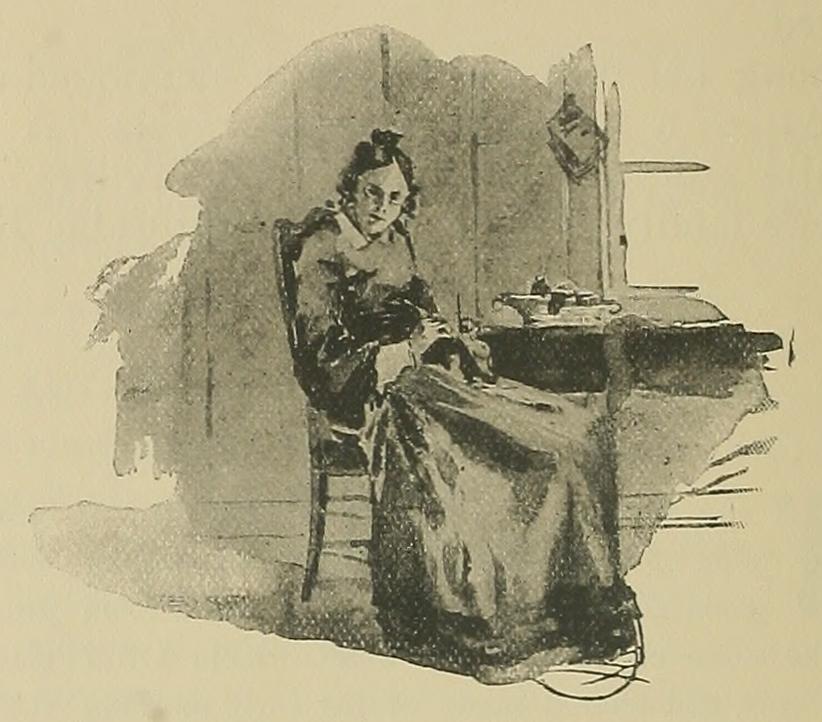
“PSHAW! SAID MY AUNT TABITHY”
My Aunt Tabithy, though an excellent and most notable person, loves occasionally a quiet bit of satire. And when I told her that I was sharpening my pen for a new story of those dreamy fancies, and half-experiences, which lie grouped along the journeying hours of my solitary life, she smiled as if in derision.
It is very idle to get angry with a good-natured old lady: I did better than this: I made her listen to me.
Exhausted, do you say, Aunt Tabithy? Is life then exhausted, is hope gone out, is fancy dead?
No, no, Aunt Tabithy—this life of musing does not exhaust so easily. It is like the springs on the farm-land, that are fed with all the showers and the dews of the year, and that from the narrow fissures of the rock send up streams continually. Dream-land will never be exhausted until we enter on the land of dreams; and until, in “shuffling off this mortal coil,” thought will become fact and all facts will be only thought.
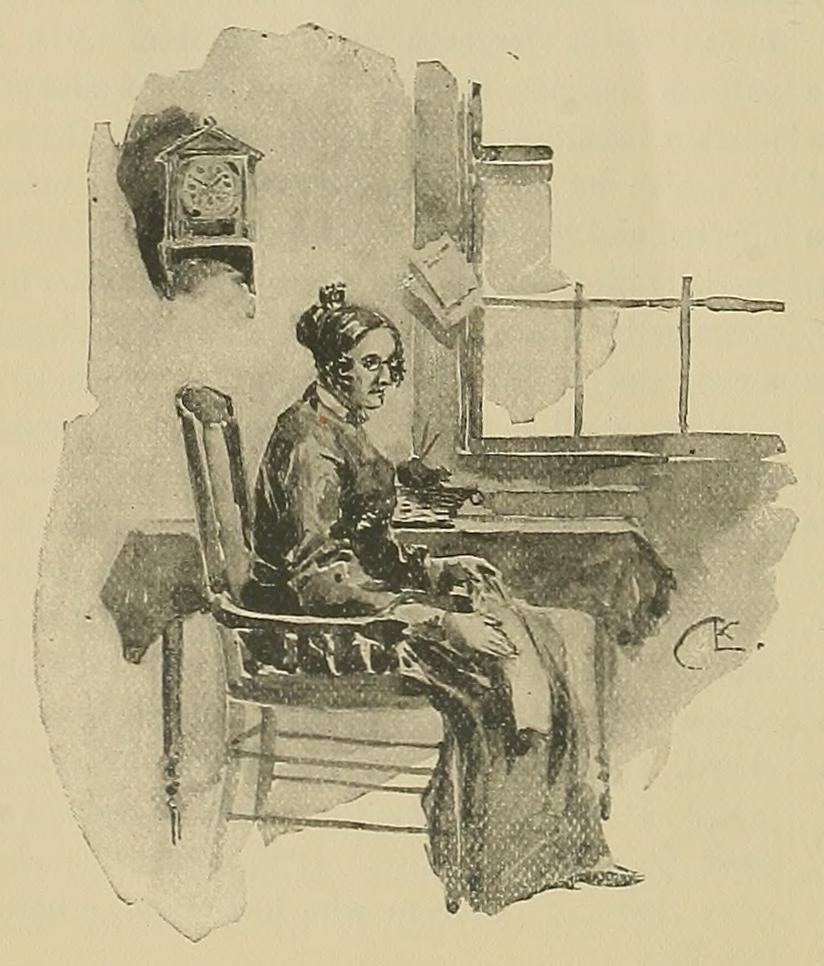
“ISAAC, YOU ARE A SAD FELLOW”
It was warm weather, and my aunt was dozing. “What is this all to be about?” said she, recovering her knitting-needle.
“About love, and toil, and duty, and sorrow,” said I.
My aunt finished the needle she was upon—smoothed the stocking-leg over her knee, and went on to ask me in a very bantering way, if my stock of youthful loves was not nearly exhausted.
A better man than myself—if he had only a fair share of vanity—would have been nettled at this; and I replied somewhat tartly, that I had never professed to write my experiences. Life after all is but a bundle of hints, each suggesting actual and positive development, but rarely reaching it. And as I recall these hints, and in fancy, trace them to their issues, I am as truly dealing with life, as if my life had dealt them all to me.
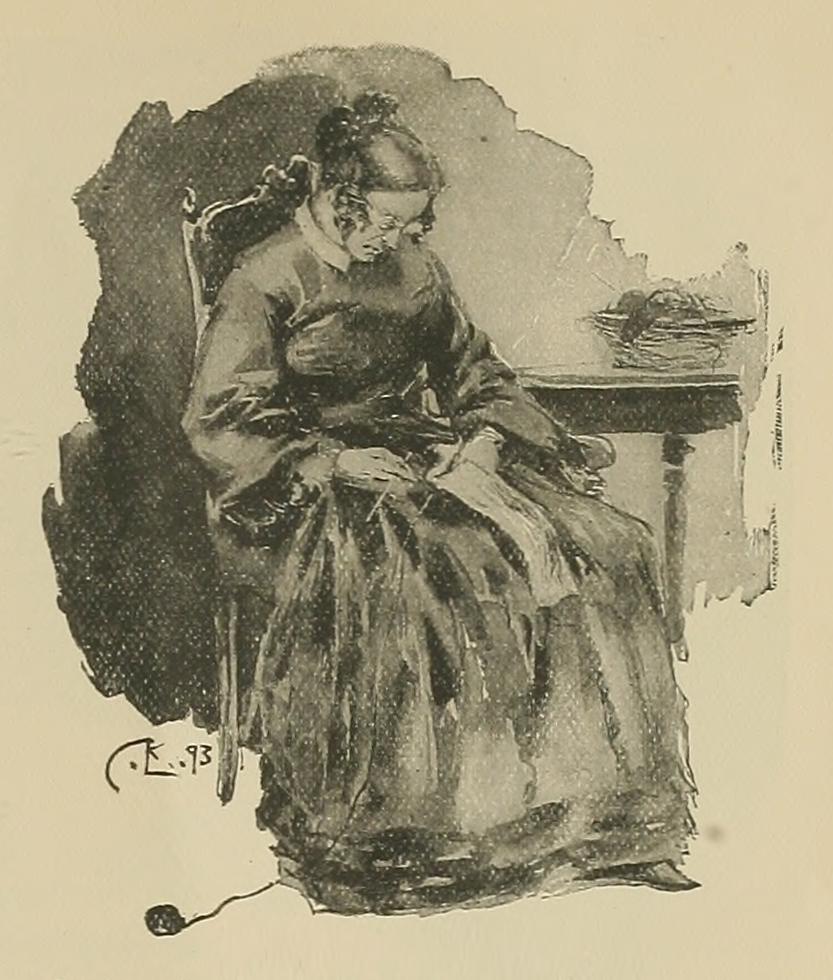
“MY AUNT WAS DOZING”
This is what I would be doing in the present book;—I would catch up here and there the shreds of feeling, which the brambles and roughnesses of the world have left tangling on my heart, and weave them out into those soft and perfect tissues, which—if the world had been only a little less rough—might now perhaps enclose my heart altogether.
“Ah,” said my Aunt Tabithy, as she smoothed the stocking-leg again, with a sigh—“there is after all but one youth-time; and if you put down its memories once, you can find no second growth.”
My Aunt Tabithy was wrong. There is as much growth in the thoughts and feelings that run behind us, as in those that run before us. You may make a rich, full picture of your childhood to-day; but let the hour go by, and the darkness stoop to your pillow with its million shapes of the past, and my word for it, you shall have some flash of childhood lighten upon you that was unknown to your busiest thought of the morning.
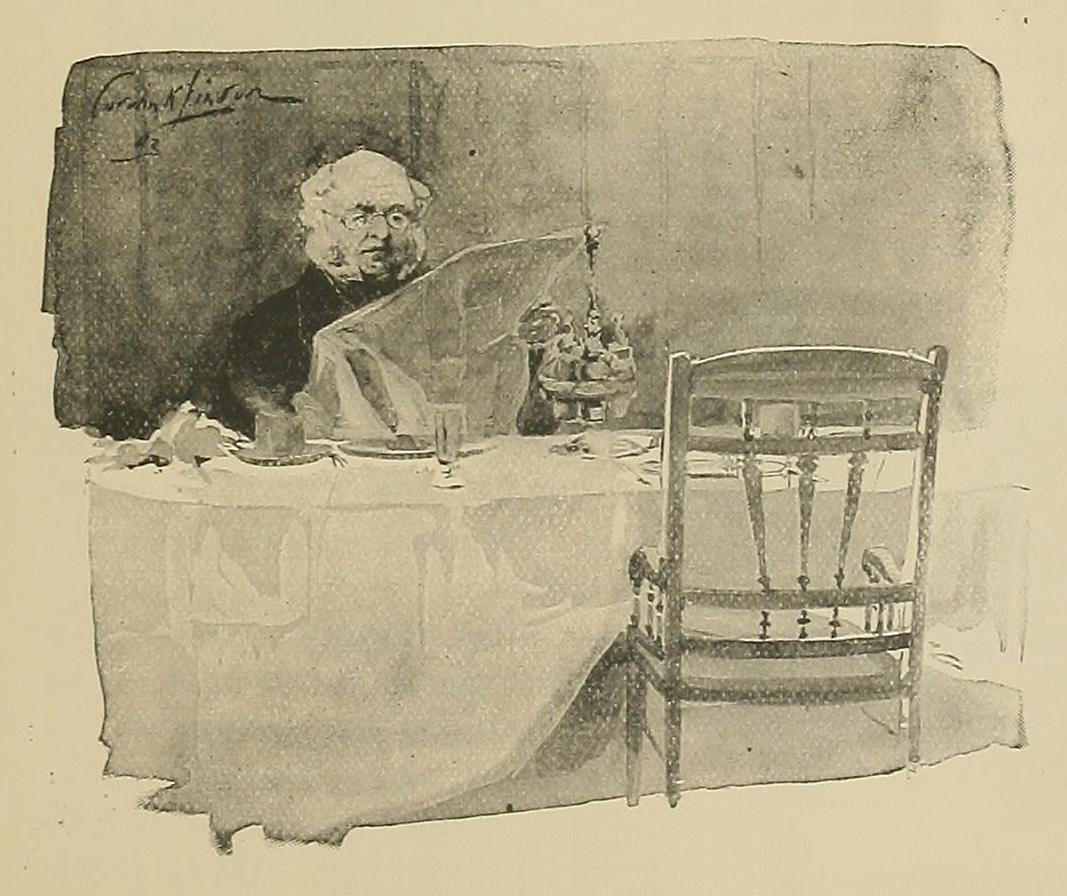
“THE JUSTICE OF THE PEACE”
I know no nobler forage-ground for a romantic, venturesome, mischievous boy, than the garret of an old family mansion on a day of storm. It is a perfect field of chivalry. There is great fun in groping through a tall barrel of books and pamphlets, on the look-out for startling pictures; and there are chestnuts in the garret, drying, which you have discovered on a ledge of the chimney; and you slide a few into your pocket, and munch them quietly—giving now and then one to Nelly, and begging her to keep silent;—for you have a great fear of its being forbidden fruit.
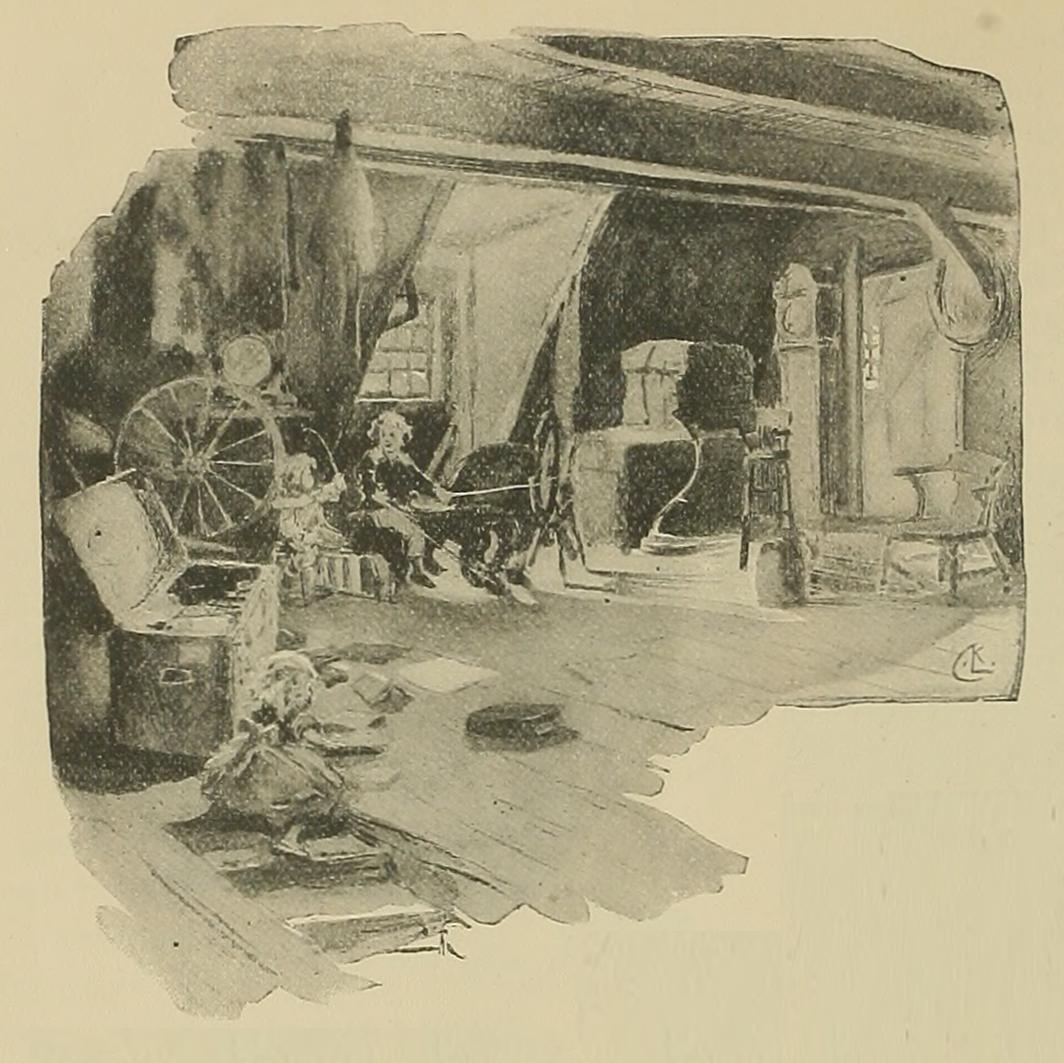
“A PERFECT FIELD OF CHIVALRY”
Old family garrets have their stock, as I said, of cast-away clothes, of twenty years gone by; and it is rare sport to put them on; buttoning in a pillow or two for the sake of good fulness; and then to trick out Nelly in some strange-shaped headgear and old-fashioned brocade petticoat caught up with pins; and in such guise, to steal cautiously down stairs, and creep slyly into the sitting-room—half afraid of a scolding, and very sure of good fun;—trying to look very sober, and yet almost ready to die with the laugh that you know you will make. And your mother tries to look harshly at little Nelly for putting on her grandmother’s best bonnet; but Nelly’s laughing eyes forbid it utterly, and the mother spoils all her scolding with a perfect shower of kisses.
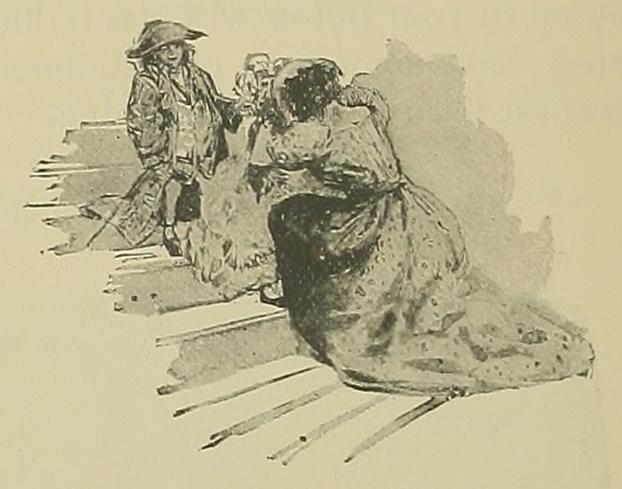
“TRICKED OUT”
After this, you go marching, very stately, into the nursery; and utterly amaze the old nurse; and make a deal of wonderment for the staring, half-frightened baby, who drops his rattle, and makes a bob at you, as if he would jump into your waistcoat pocket.
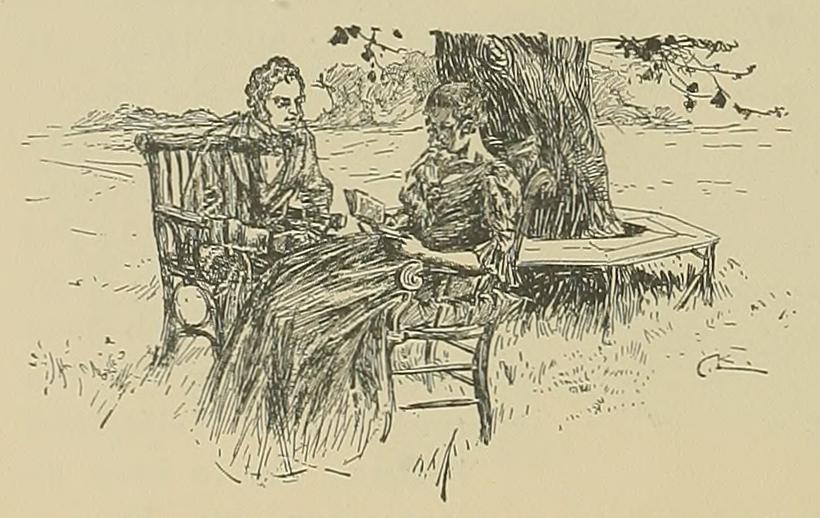
“THERE IS AFTER ALL BUT ONE YOUTH-TIME”
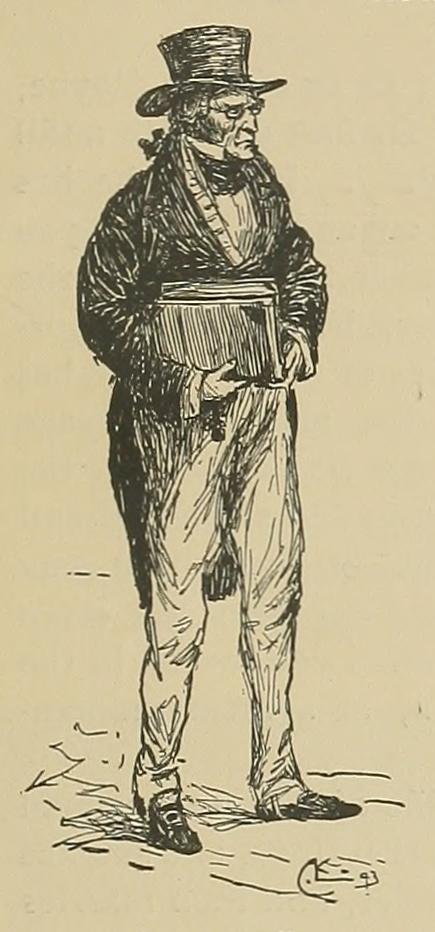
You have looked admiringly many a day upon the tall fellows who play at the door of Dr. Bidlow’s school; you have looked with reverence. Dr. Bidlow seems to you to belong to a race of giants; and yet he is a spare, thin man, with a hooked nose, a large, flat, gold watch-key, a crack in his voice, a wig, and very dirty wristbands.
“LONG, WEARY DAYS OF CONFINEMENT”
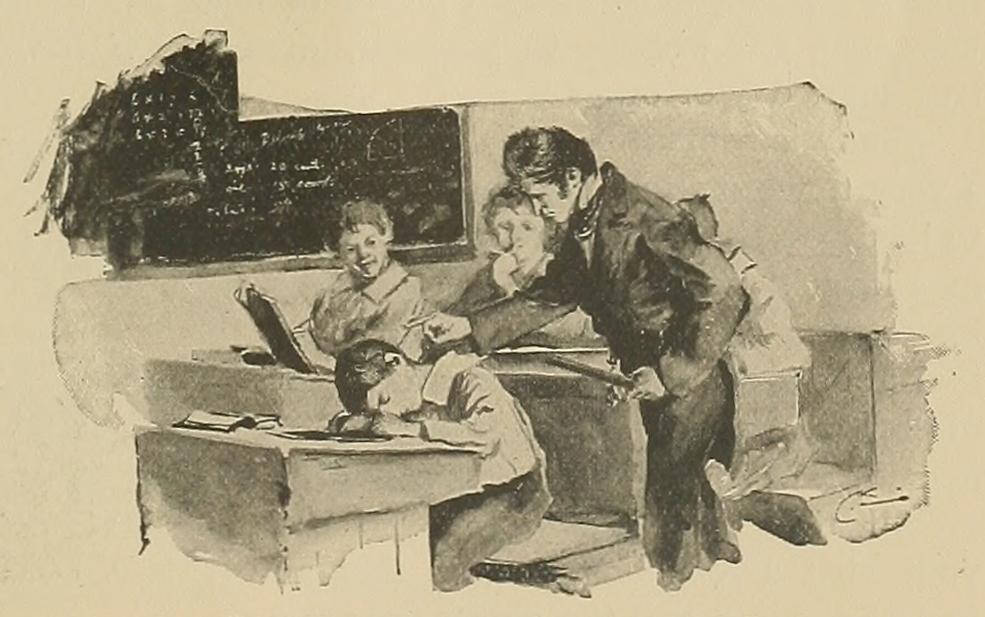
You, however, come very little under his control; you enter upon the proud life in the small-boys’ department—under the dominion of the English master. He is a different personage from Dr. Bidlow: he is a dapper, little man, who twinkles his eye in a peculiar fashion, and steps very springily around behind the benches, glancing now and then at the books—cautioning one scholar about his dog’s ears, and startling another from a doze by a very loud and odious snap of his forefinger upon the boy’s head.
There are some tall trees that overshadow an angle of the schoolhouse; and the larger scholars play surprising gymnastic tricks upon their lower limbs.
“OLD BID”
In time, however, you get to performing some modest experiments yourself upon the very lowest limbs,—taking care to avoid the observation of the larger boys, who else might laugh at you: you especially avoid the notice of one stout fellow in pea-green breeches, who is a sort of “bully” among the small boys.
One day you are well in the tops of the trees, and being dared by the boys below, you venture higher—higher than any boy has gone before. You feel very proud, so you advance cautiously out upon the limb: it bends and sways fearfully with your weight: presently it cracks: you try to return, but it is too late; then comes a sense of dizziness—a succession of quick blows, and a dull, heavy crash!
“STARTLING ANOTHER FROM A DOZE”
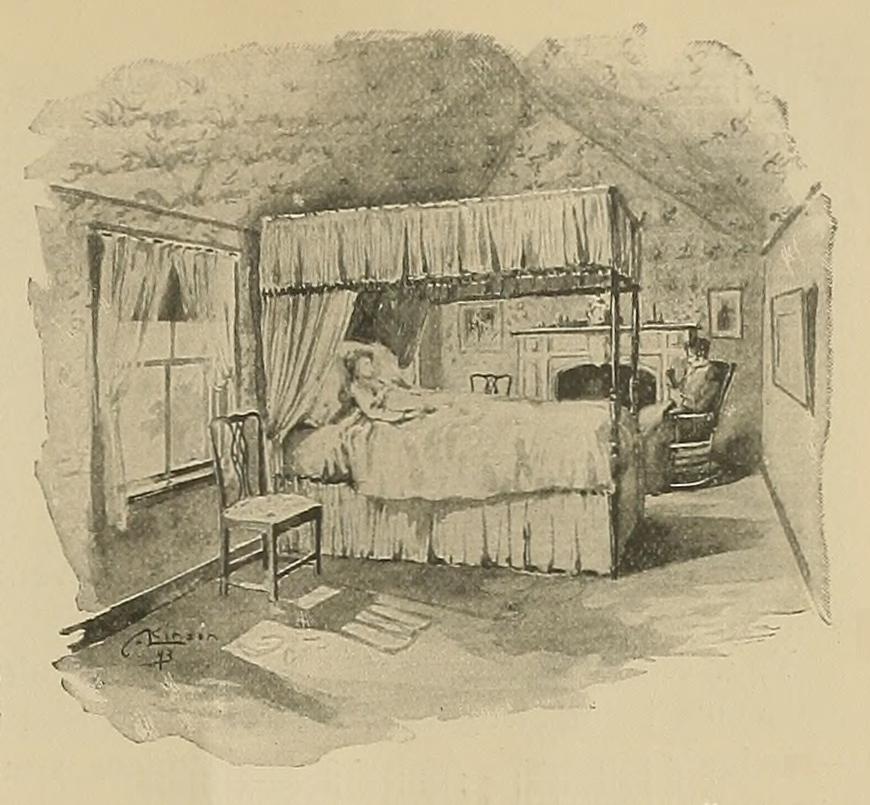
After this, come those long, weary days of confinement, when you lie still, through all the hours of noon, looking out upon the cheerful sunshine, only through the windows of your little room. Yet it seems a grand thing to have the whole household attendant upon you; and when you groan with pain, you are sure of meeting sad, sympathizing looks.
“AND EAT A DINNER IN A TAVERN”
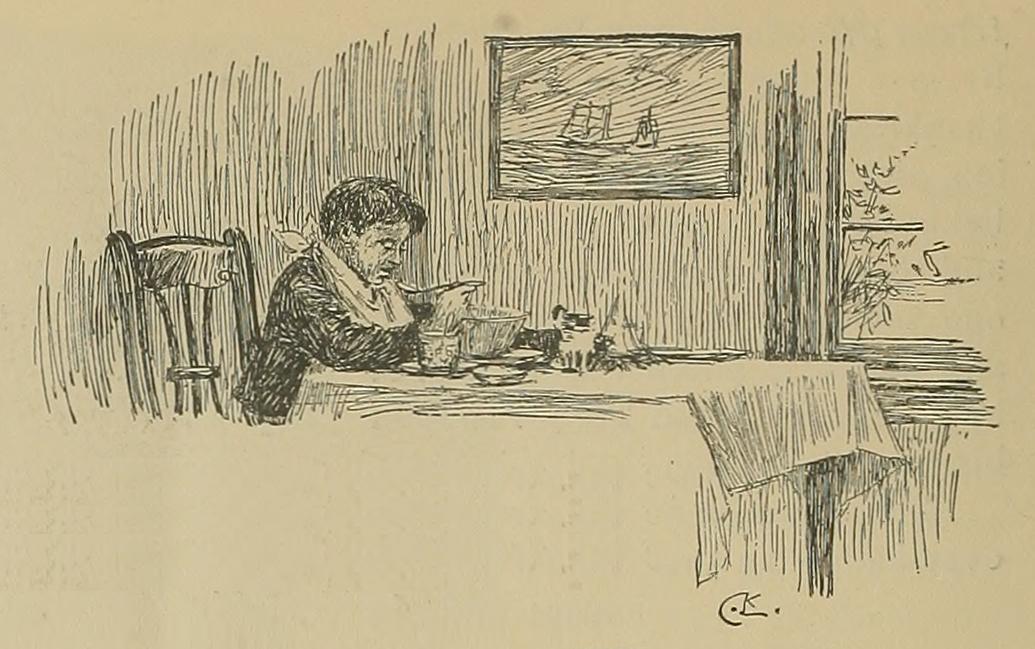
To visit, is a great thing in the boy-calendar:—to go away on a visit in a coach, with a trunk, and a greatcoat, and an umbrella:—this is large! As you journey on, after bidding your friends adieu, and as you see fences and houses to which you have not been used, you think them very odd indeed; but it occurs to you, that the geographies speak of very various national characteristics, and you are greatly gratified with this opportunity of verifying your study.
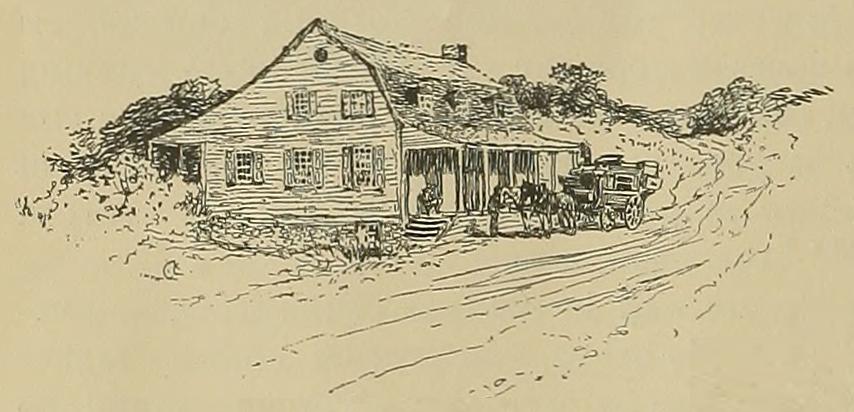
“AWAY ON A VISIT IN A COACH”
Your old aunt, whom you visit, you think wears a very queer cap, being altogether different from that of the old nurse, or of Mrs. Boyne,—Madge’s mother. As for acquaintances, you fall in the very first day with a tall boy next door, called Nat, which seems an extraordinary name. Besides, he has traveled; and as he sits with you on the summer nights under the linden trees, he tells you gorgeous stories of the things he has seen. He has made the voyage to London; and he talks about the ship (a real ship) and starboard and larboard, and the spanker, in a way quite surprising; and he takes the stern oar in the little skiff, when you row off in the cove abreast of the town, in a most seaman-like way.
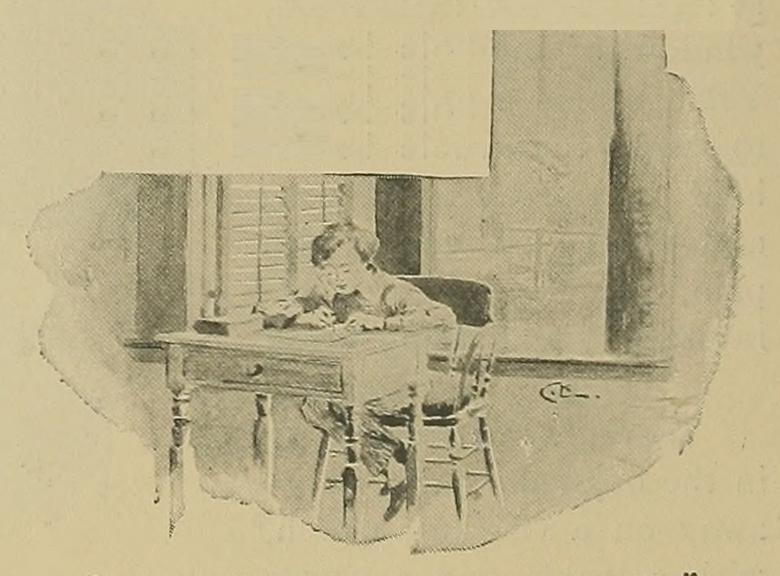
“IT IS RATHER A PRETTY NAME TO WRITE”
Besides Nat, there is a girl lives over the opposite side of the way, named Jenny, with an eye as black as a coal. She has any quantity of toys, and she has an odd old uncle, who sometimes makes you stand up together, and then marries you after his fashion,—much to the amusement of a grown-up housemaid, whenever she gets a peep at the performance. And it makes you somewhat proud to hear her called your wife; and you wonder to yourself, dreamily, if it won’t be true some day or other.
Jenny is romantic, and talks of Thaddeus of Warsaw in a very touching manner, and promises to lend you the book. She folds billets in a lover’s fashion, and practices love-knots upon her bonnet strings. She looks out of the corners of her eyes very often, and sighs. She is frequently by herself, and pulls flowers to pieces.
All this time, for you are making your visit a very long one, so that autumn has come, and the nights are growing cool, and Jenny and yourself are transferring your little coquetries to the chimney-corner;—poor Charlie lies sick at home. Boyhood, thank Heaven, does not suffer severely from sympathy when the object is remote.
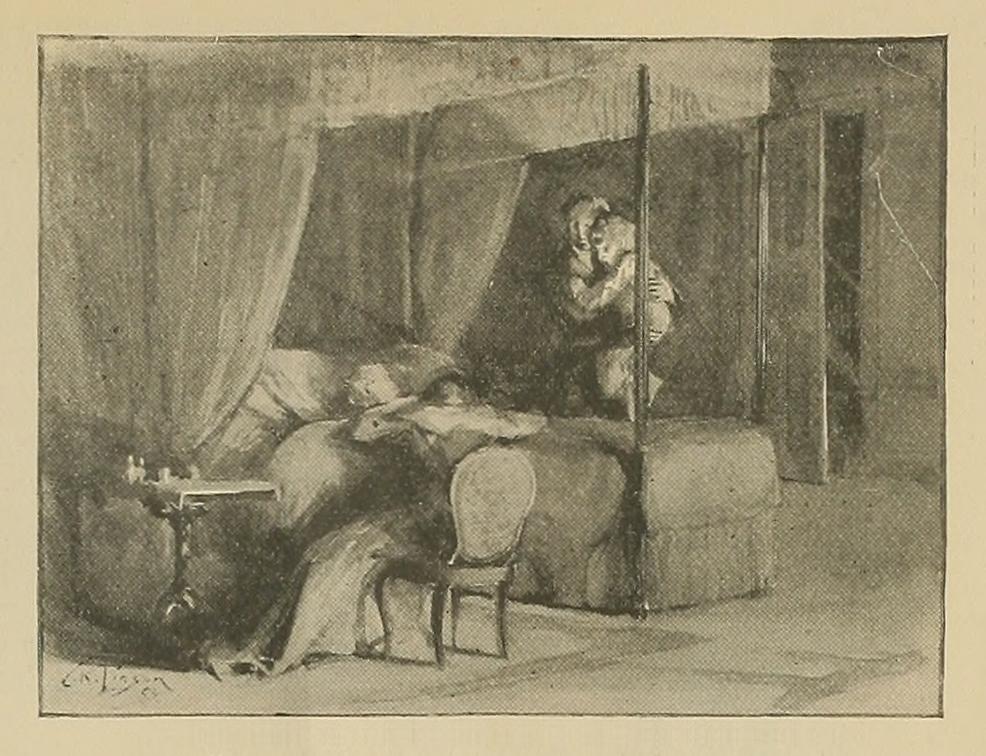
“THE DOCTOR LIFTS YOU IN HIS ARMS”
It is on a frosty, bleak evening, when you are playing with Nat, that the letter reaches you which says Charlie is growing worse, and that you must come to your home. It is quite dark when you reach home, but you see the bright reflection of a fire within, and presently at the open door Nelly clapping her hands for welcome. But there are sad faces when you enter. Your mother folds you to her heart; but at your first noisy outburst of joy, puts her finger on her lip, and whispers poor Charlie’s name. The Doctor you see, too, slipping softly out of the bed-room door with glasses in his hand; and—you hardly know how—your spirits grow sad, and your heart gravitates to the heavy air of all about you.
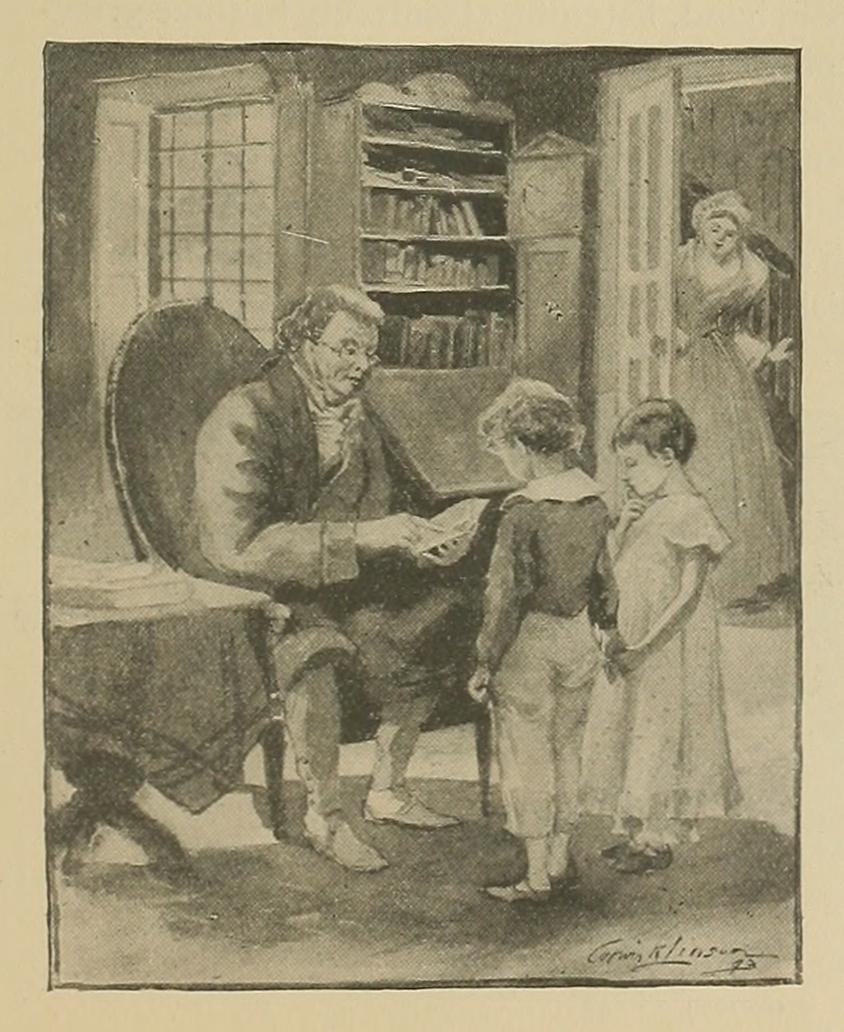
“WHO SOMETIMES MAKES YOU STAND UP TOGETHER”
You drop to sleep after that day’s fatigue, with singular and perplexed fancies haunting you; and when you wake up with a shudder in the middle of the night, you get up stealthily and creep down stairs; the bed-room door stands open, a little lamp is flickering on the hearth, and the gaunt shadow of the bedstead lies dark upon the ceiling. Your mother is in her chair, with her head upon her hand—though it is long after midnight. The Doctor is standing with his back toward you, and looks very solemn as he takes out his watch. He is not counting Charlie’s pulse, for he has dropped his hand; and it lies carelessly, but oh, how thin! over the edge of the bed.
He shakes his head mournfully at your mother; and she springs forward, and lays her fingers upon the forehead of the boy, and passes her hand over his mouth.
“Is he asleep, Doctor?” she says, in a tone you do not know.
“Dear Madam, he will never waken in this world.”
There is no cry—only a bowing down of your mother’s head upon the body of poor, dead Charlie!—and only when you see her form shake and quiver with the deep, smothered sobs, your crying bursts forth loud and strong.
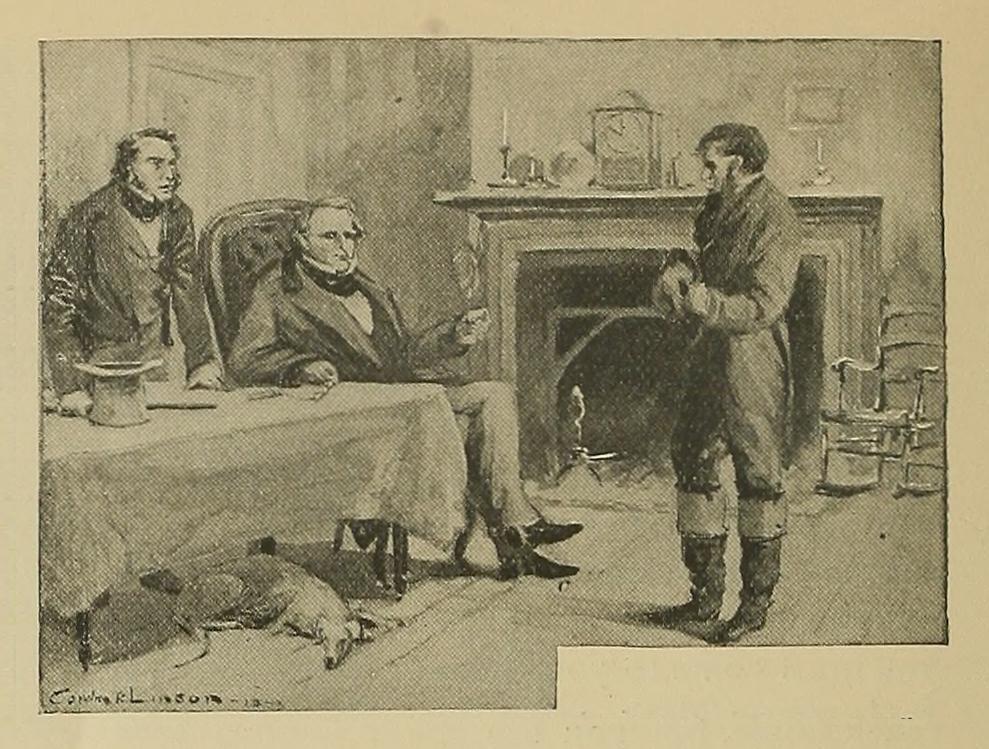
“LISTENING ATTENTIVELY TO SOME GRIEVOUS COMPLAINT”
The Doctor lifts you in his arms, that you may see—that pale head,—those blue eyes all sunken,—that flaxen hair gone,—those white lips pinched and hard!—Never, never, will the boy forget his first terrible sight of Death!
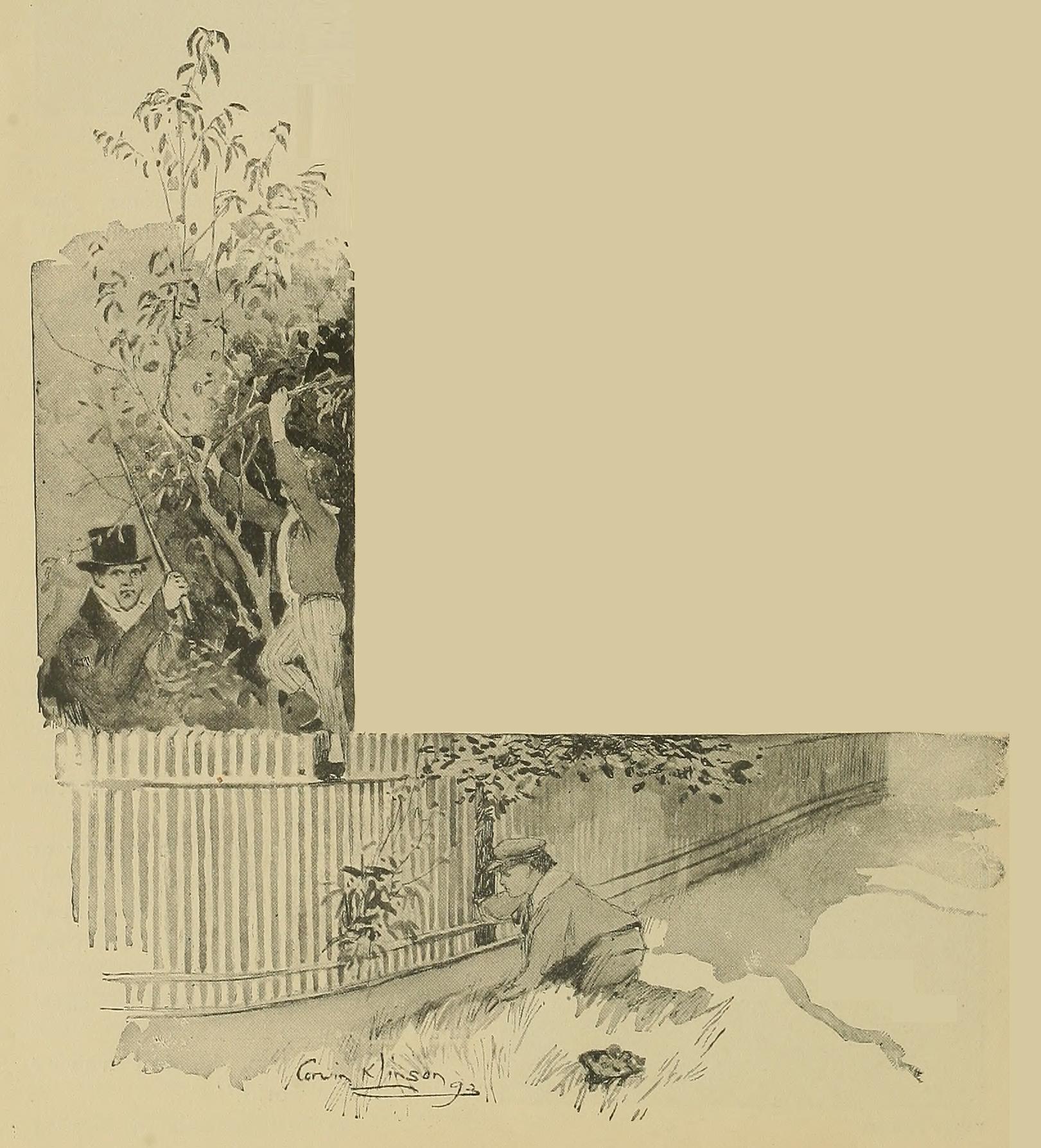
“SOME OF BIDLOW’S BOYS”
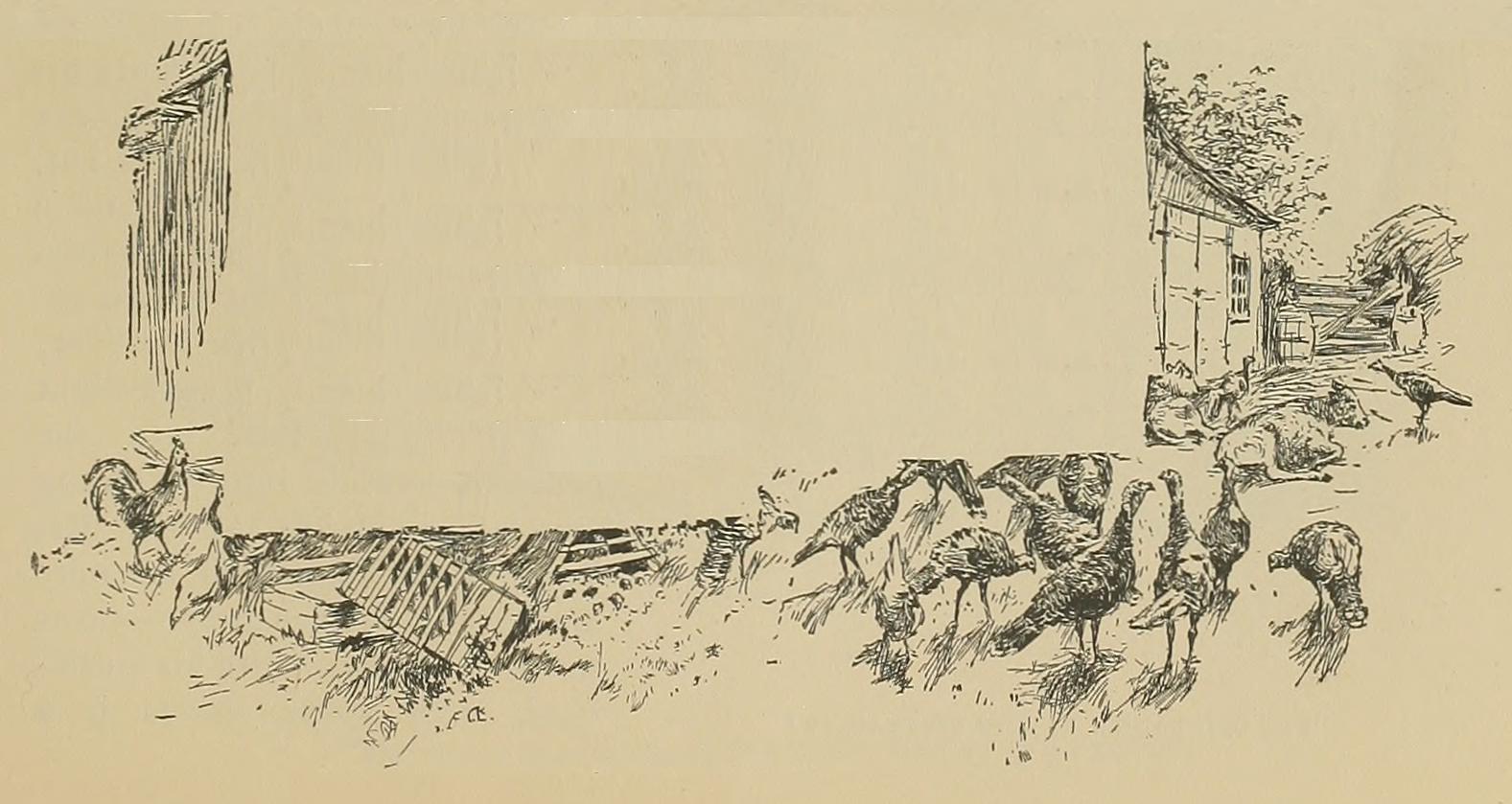
Frank has a grandfather living in the country, a good specimen of the old-fashioned New England farmer. He is a Justice of the Peace, and many are the country courts that you peep upon, with Frank, from the door of the great dining-room. You watch curiously the old gentleman, sitting in his big arm-chair, with his spectacles in their silver case at his elbow, and his snuff-box in hand, listening attentively to some grievous complaint; you see him ponder deeply—with a pinch of snuff to aid his judgment,—and you listen with intense admiration, as he gives a loud, preparatory “Ahem,” and clears away the intricacies of the case with a sweep of that strong practical sense which distinguishes the New England farmer,—getting at the very hinge of the matter, without any consciousness of his own precision, and satisfying the defendant by the clearness of his talk, as much as by the leniency of his judgment. He farms some fifteen hundred acres,—“suitably divided,” as the old-school agriculturists say, into “woodland, pasture, and tillage.” The farm-house, a large irregularly built mansion of wood, stands upon a shelf of the hills looking southward, and is shaded by century-old oaks. The barns and outbuildings are grouped in a brown phalanx a little to the northward of the dwelling. Between them a high timber gate opens upon the scattered pasture-lands of the hills. Opposite to this, and across the farmyard, which is the lounging-place of scores of red-necked turkeys, and of matronly hens, clucking to their callow brood, another gate of similar pretensions opens upon the wide meadow-land.
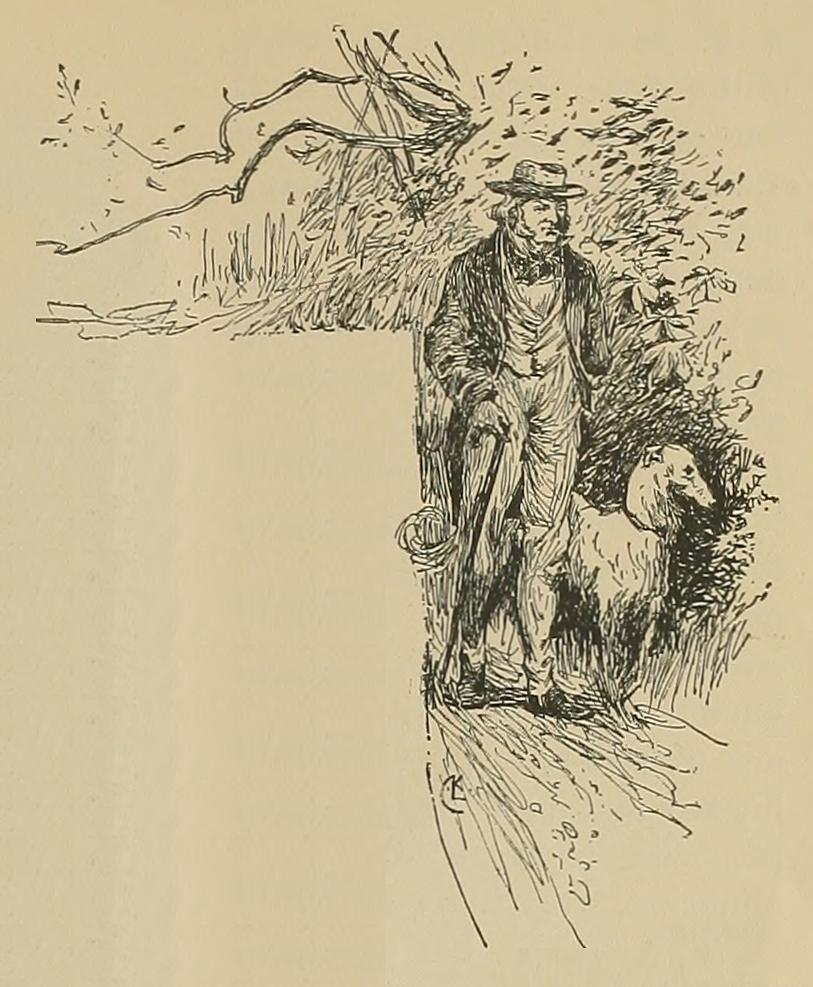
“A SQUIRE”
So it is, that as you lie there upon the sunny greensward, at the old Squire’s door, you muse upon the time when some rich-lying land, with huge granaries and cozy old mansion sleeping under the trees, shall be yours;—when the brooks shall water your meadows, and come laughing down your pasture-lands;—when the clouds shall shed their spring fragrance upon your lawns, and the daisies bless your paths.
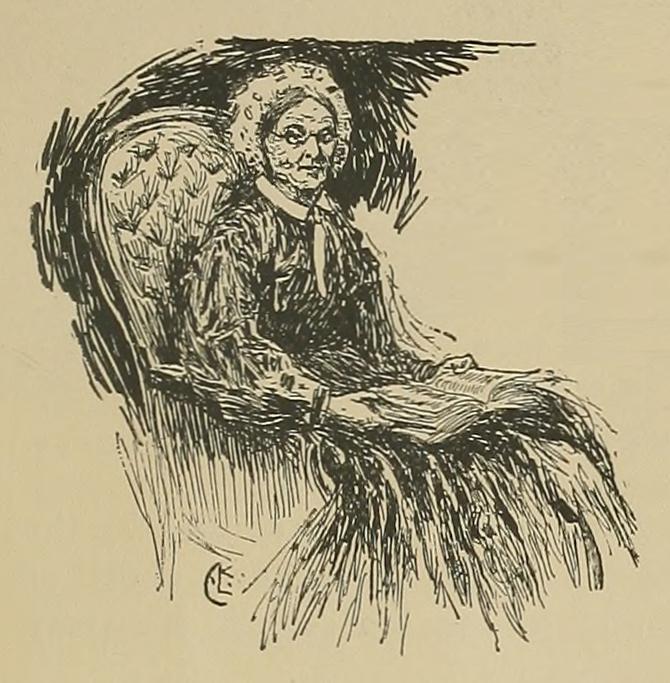
“SOME TIDY OLD LADY IN BLACK”
You will then be a Squire, with your cane, your lean-limbed hound, your stocking-leg of specie, and your snuff-box. You will be the happy and respected husband of some tidy old lady in black and spectacles,—a little phthisicky, like Frank’s grandmother,—and an accomplished cook of stewed pears, and Johnny-cakes!
THE CHOIR
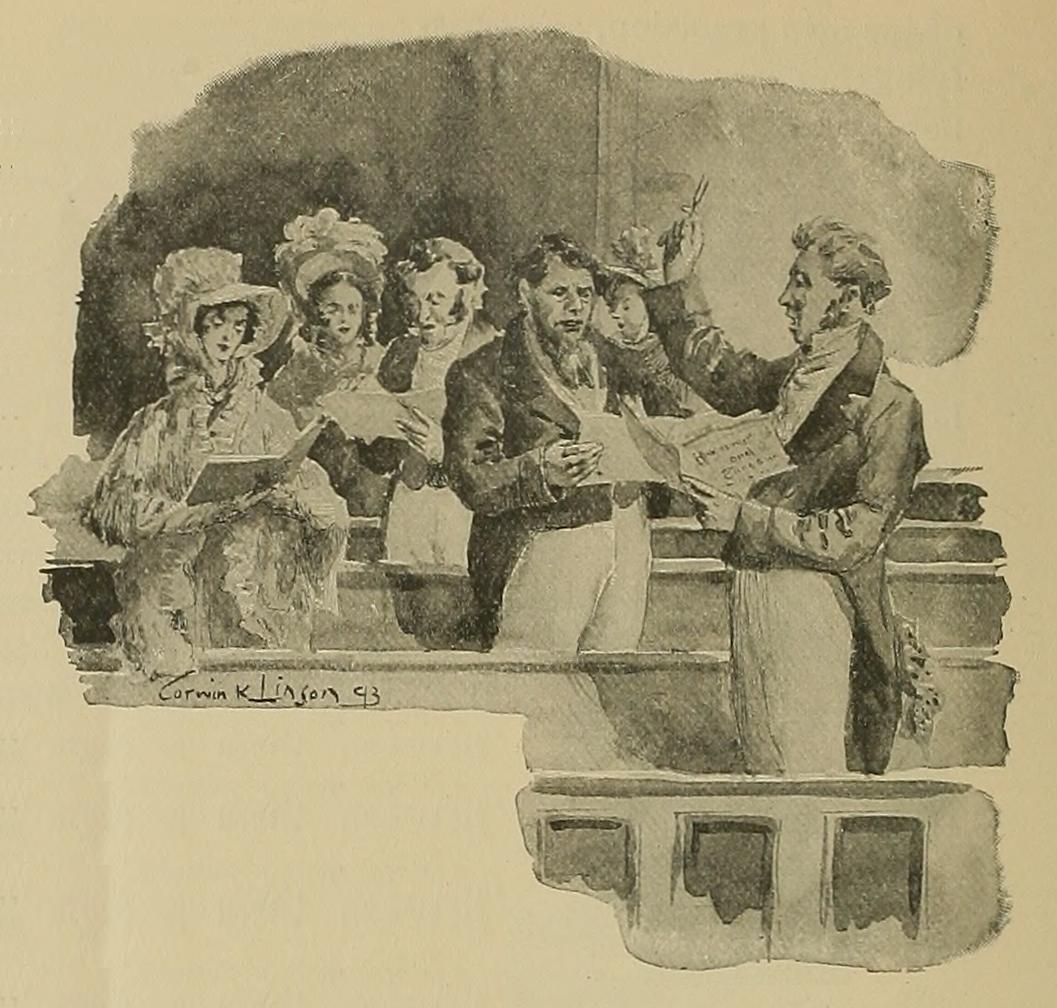
The country church is a square old building of wood, without paint or decoration, and of that genuine, Puritanic stamp, which is now fast giving way to Greek porticos, and to cockney towers. The unpainted pews are ranged in square forms, and by age have gained the color of those fragmentary wrecks of cigar-boxes, which you see upon the top shelves in the bar-rooms of country taverns. The minister’s desk is lofty, and has once been honored with a coating of paint;—as well as the huge sounding-board, which, to your great amazement, protrudes from the wall, at a very dangerous angle of inclination, over the speaker’s head.
The singing has a charm for you. There is a long, thin-faced, flax-haired man, who carries a tuning-fork in his waistcoat pocket, and who leads the choir. His position is in the very front rank of gallery benches, facing the desk; and by the time the old clergyman has read two verses of the psalm, the country chorister turns around to his little group of aids—consisting of the blacksmith, a carroty headed school-master, two women in snuff-colored silks, and a girl in a pink bonnet, somewhat inclined to frivolity,—to announce the tune.
“FAT OLD LADIES IN IRON SPECTACLES”
This being done in an authoritative manner, he lifts his long music-book,—glances again at his little company, clears his throat by a powerful “Ahem,” followed by a powerful use of a bandanna pocket-handkerchief,—draws out his tuning fork, and waits for the parson to close his reading. He now reviews once more his company,—throws a reproving glance at the young woman in the pink hat, who at the moment is biting off a stout bunch of fennel,—lifts his music-book, thumps upon the rail with his fork, listens keenly, gives a slight “Ahem,” falls into the cadence,—swells into a strong crescendo,—catches at the first word of the line, as if he were afraid it might get away,—turns to his company,—lifts his music-book with spirit,—gives it a powerful slap with the disengaged hand, and, with a majestic toss of the head, soars away, with half the women below straggling on in his wake, into some such brave old melody as—Litchfield!
THE DEACON
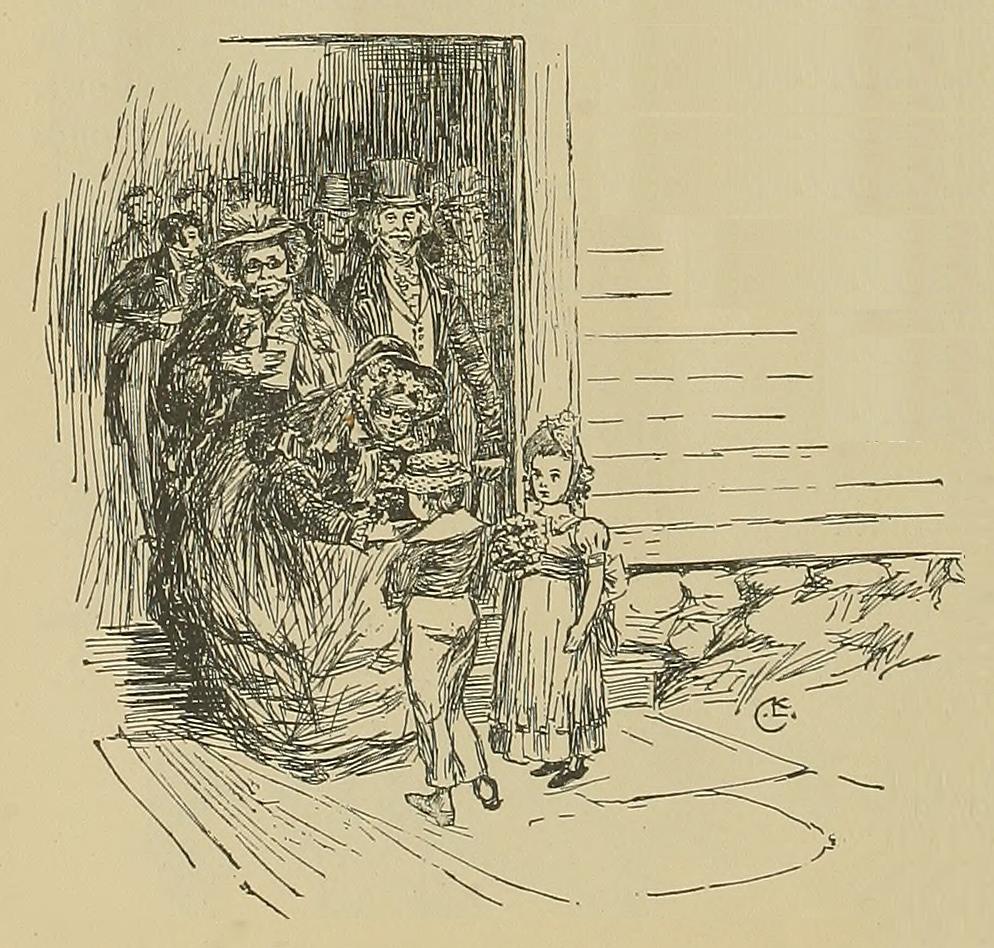
Being a visitor, and in the Squire’s pew, you are naturally an object of considerable attention to the girls about your age; as well as to a great many fat old ladies in iron spectacles, who mortify you excessively by patting you under the chin after church; and insist upon mistaking you for Frank; and force upon you very dry cookies, spiced with caraway seeds.
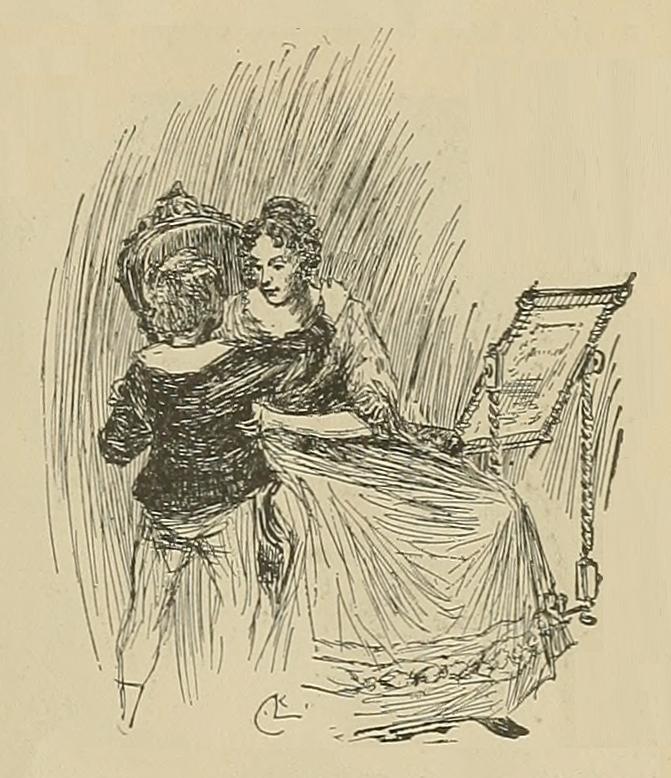
“IN TONES OF TENDER ADMONITION”
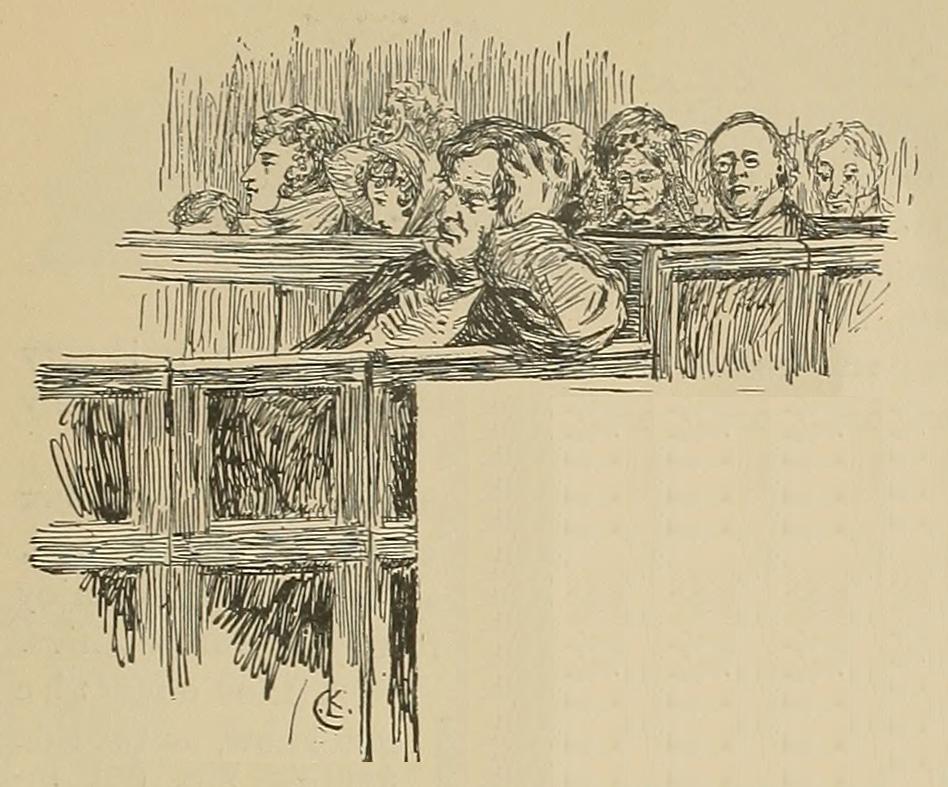
The farmers you have a high respect for;—particularly for one weazen-faced old gentleman in a brown surtout, who brings his whip into church with him, who sings in a very strong voice, and who drives a span of gray colts. Another townsman, who attracts your attention is a stout deacon, who before entering always steps around the corner of the church and puts his hat upon the ground to adjust his wig in a quiet way. He then marches up the broad aisle in a stately manner, and plants his hat, and a big pair of buckskin mittens, on the little table under the desk. When he is fairly seated in his corner of the pew, with his elbow upon the top-rail—almost the only man who can comfortably reach it,—you observe that he spreads his brawny fingers over his scalp, in an exceedingly cautious manner; and you innocently think again, that it is very hypocritical in a deacon to be pretending to lean upon his hand when he is only keeping his wig straight.
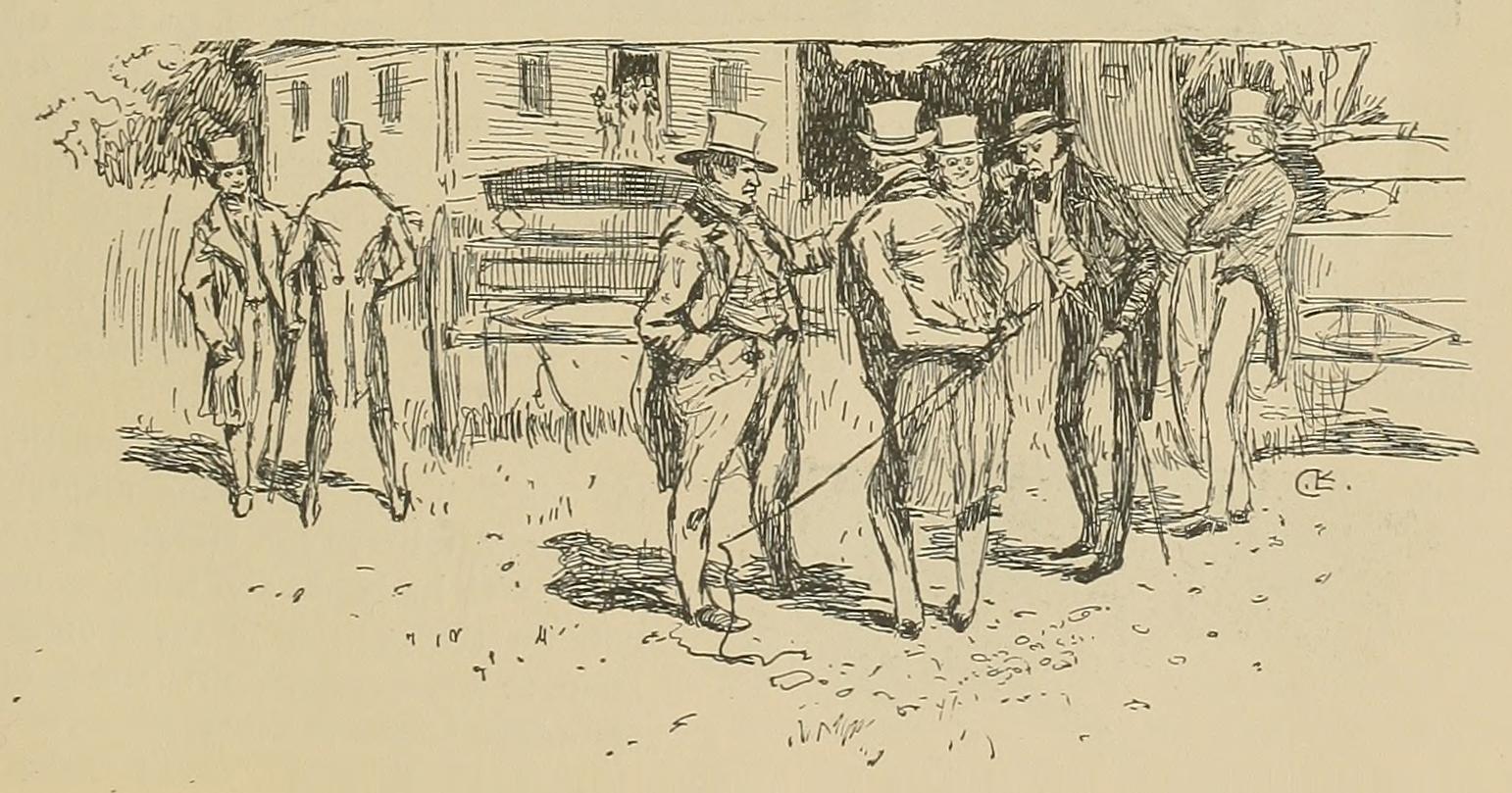
“THE OLD MEN GATHER ON THE SUNNY SIDE OF THE BUILDING”
After the morning service, they have an “hour’s intermission,” as the preacher calls it; during which the old men gather on a sunny side of the building, and, after shaking hands all around, and asking after the “folks” at home, they enjoy a quiet talk about the crops, branching off, now and then, it may be, into politics.
Little does the boy know, as the tide of years drifts by, floating him out insensibly from the harbor of his home upon the great sea of life,—what joys, what opportunities, what affections, are slipping from him.
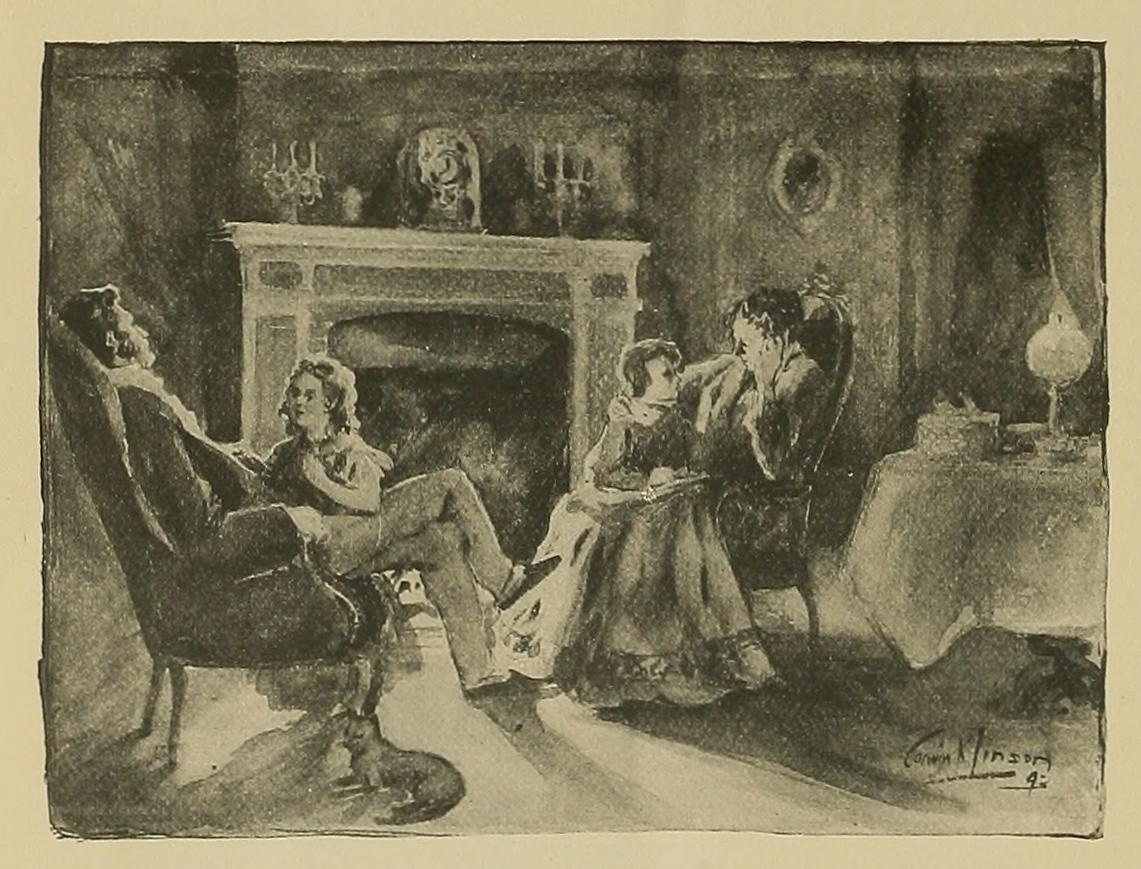
“THE FIRELIGHT GLIMMERS UPON THE WALLS OF YOUR HOME”
But now, you are there. The fire-light glimmers upon the walls of your cherished home, like the Vestal fire of old upon the figures of adoring virgins, or like the flame of Hebrew sacrifice, whose incense bore hearts to heaven. The big chair of your father is drawn to its wonted corner by the chimney-side; his head, just touched with gray, lies back upon its oaken top. Little Nelly leans upon his knee, looking up for some reply to her girlish questionings. Opposite, sits your mother; her figure is thin, her look cheerful, yet subdued;—her arm perhaps resting on your shoulder, as she talks to you in tones of tender admonition, of the days that are to come.
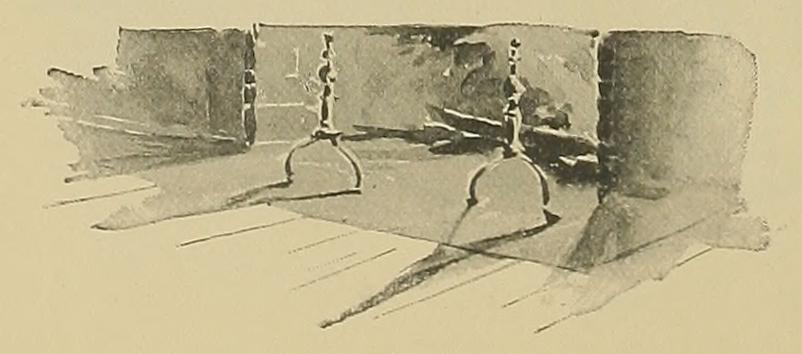
The cat is purring on the hearth; the clock is ticking on the mantel. The great table in the middle of the room, with its books and work, waits only for the lighting of the evening lamp, to see a return to its stores of embroidery, and of story.
THOMAS WENTWORTH HIGGINSON.
PATRIOT AND MAN OF LETTERS.
HOMAS WENTWORTH HIGGINSON is one of the group of men of whom their countrymen should be most proud. He has taken a noble part in the battles on behalf of freedom, which the last half-century has seen, and everywhere has borne himself with a nobility, a devotion and a courage worthy of all praise. The man who was driven from his church because he preached the freedom of the slaves, who sat with Parker and Phillips under indictment for murder for their part in attempting to rescue a fugitive slave, who was colonel of the first regiment of freed slaves mustered into the army of the United States, who bravely fought and patiently suffered for the cause of the Union; surely this man, if he had no other claims upon our respect and attention, should hold a high place in the hearts of his fellows.
Colonel Higginson is a native of Cambridge, Massachusetts, and in 1847, when he was twenty-four years old, became pastor of a Congregational Church in Newburyport, Massachusetts. Here his anti-slavery preaching allowed him to remain but three years. From 1852 until 1858 he was pastor of a free church in Worcester, after which he left the ministry and devoted himself to literature. During all this time his activity in the anti-slavery agitation was frequently getting him into trouble, and, with his friends who participated in the attempted rescue of Anthony Burns, he was discharged from custody only through a flaw in the indictment. He took part in the organization of the bands of free-state, emigrants to Kansas, and was personally acquainted with John Brown. With his regiment of colored troops, he took possession of Jacksonville, Florida; but was wounded in 1863 and was compelled to resign from the army. He has been an earnest advocate of equal suffrage for men and women and of the higher education for both sexes. He has served in his State Legislature and as a member of the State Board of Education.
Colonel Higginson’s contributions to literature consist largely of volumes of essays that originally appeared in the “Atlantic Monthly” or other periodicals, and historical and biographical work. Some of his best known books are “Atlantic Essays;” “Young Folk’s History of the United States;” “Young Folk’s Book of American Explorers;” “Short Stories of American Authors;” “A Larger History of the United States;” “The Monarch of Dreams;” and “Brief Biographies of European Statesmen.” Besides these, he has translated his “Young Folk’s History of the United States” into German and French for publication in those languages, and has also published a number of English translations of modern and ancient classics. Colonel Higginson is one of our most popular writers, particularly upon American history, and his service to the cause of American letters has been no less distinguished than his share in the great victory which made our country in truth the land of the free.
“A PURITAN SUNDAY MORNING.”¹
FROM “ATLANTIC ESSAYS.”
T is nine o’clock upon a summer Sunday morning, in the year sixteen hundred and something. The sun looks down brightly on a little forest settlement, around whose expanding fields the great American wilderness recedes each day, withdrawing its bears and wolves and Indians into an ever remoter distance—not yet so far removed but a stout wooden gate at the end of the village street indicates that there is danger outside. It would look very busy and thriving in this little place to-day but for the Sabbath stillness which broods over everything with almost an excess of calm. Even the smoke ascends more faintly than usual from the chimneys of the numerous log-huts and these few framed houses, and since three o’clock yesterday afternoon not a stroke of this world’s work has been done. Last night a Preparatory Lecture was held, and now comes the consummation of the whole week’s life, in the solemn act of worship. In which settlement of the great Massachusetts Colony is the great ceremonial to pass before our eyes? If it be Cambridge village, a drum is sounding its peaceful summons to the congregation. If it be Salem village, a bell is sounding its more ecclesiastic peal, and a red flag is simultaneously hung forth from the meeting-house, like the auction-flag of later periods. If it be Haverhill village, then Abraham Tyler has been blowing his horn assiduously for half an hour—a service for which Abraham, each year, receives a half pound of pork from every family in town.
Be it drum, bell, or horn that gives the summons, we will draw near to this important building, the centre of the village, the one public edifice: meeting-house, town-house, schoolhouse, watch-house, all in one. So important is it, that no one can legally dwell more than half a mile from it. And yet the people ride to “meeting,” short though the distance be, for at yonder oaken block a wife dismounts from behind her husband; and has it not, moreover, been found needful to impose a fine of forty shillings on fast trotting to and fro? All sins are not modern ones, young gentlemen.
We approach nearer still, and come among the civic institutions. This is the pillory, yonder are the stocks, and there is a large wooden cage, a terror to evil-doers, but let us hope empty now. Round the meeting-house is a high wooden paling, to which the law permits citizens to tie their horses, provided it be not done too near the passageway. For at that opening stands a sentry, clothed in a suit of armor which is painted black, and cost the town twenty-four shillings by the bill. He bears also a heavy match-lock musket; his rest, or iron fork, is stuck in the ground, ready to support the weapon; and he is girded with his bandolier, or broad leather belt, which sustains a sword and a dozen tin cartridge-boxes.
O the silence of this place of worship, after the solemn service sets in! “People do not sneeze or cough here in public assemblies,” says one writer triumphantly, “so much as in England.” The warning caution, “Be short,” which the minister has inscribed above his study-door, claims no authority over his pulpit. He may pray his hour, unpausing, and no one thinks it long; for, indeed, at prayer-meetings four persons will sometimes pray an hour each—one with confession, one with private petitions, a third with petitions for Church and Kingdom, and a fourth with thanksgiving—each theme being conscientiously treated by itself. Then he may preach his hour, and, turning his hour-glass, may say—but that he cannot foresee the levity to be born in a later century with Mather Byles—“Now, my hearers, we will take another glass.”

HAMILTON W. MABIE.
THE MODERN CRITIC.
N the modern school of literary critics, whose best representatives are Coleridge, Carlyle, Arnold, Lowell and Stedman, Hamilton W. Mabie has a prominent place. His aim has been, as is the aim of all great criticism, not only to give an estimate of a man’s work, but to show the man’s soul. He was born at Cold Springs, on the banks of the Hudson, of a family of culture. He was prepared for college under a private tutor, and graduated at Williams College in the Class of ’67—a class which numbered many men of fame.

From boyhood ♦Mabie has been a great reader, and he is familiar with the classics of all literatures, as well as a student of contemporaneous literature.
After a course of law at Columbia University his literary tendencies drew him into his natural field and away from a profession uncongenial to him. In 1879 he took a position on the staff of the “Christian Union,” which under its new name, the “Outlook,” under the joint editorship of Mabie and Lyman Abbott, has taken a prominent place among the foremost religious journals of the world. “My Study Fire,” which expresses our author’s ideas of the function of literature, and the attitude and spirit of the literary man, first appeared as a series of articles in this religious journal.
In the last few years Mr. Mabie has taken a prominent place on the platform on literary and educational subjects, though he scrupulously keeps his public speaking subordinate to his writing. His addresses are marked with elegance, grace, and all the fruits of culture, and they show a profound study of the problems of life and spirit. He has a beautiful home at Summit, New Jersey, an enviable site for a writer, with the multitudinous charms of nature without and the gathered wisdom of the world’s great thinkers within.
He is a man of robust life, of clear, healthy mind and of high faith. He has declared that “Skepticism is the root of all evil in us and in our arts. We do not believe enough in God, in ourselves, and in the divine laws under which we live. Great art involves great faith—a clear, resolute, victorious insight into and grasp of things, a belief real enough in
‘The mighty hopes which make us men’
to inspire and sustain heroic tasks,” a declaration quite typical of all his thought.
COUNTRY SIGHTS AND SOUNDS
By Hamilton W. Mabie
Illustrated from original photographs by Conrad Baer.
T the end of February the observer begins to see the faint forerunners of spring. The willow shows signs of renewing its freshness, and the long stretch of cold, with brilliant or steely skies, is interrupted by days full of an indescribable softness. It is almost pathetic to note with what joy the spirit of man takes cognizance of these first hints of the color, the bloom and the warmth slowly creeping up to the southern horizon-line. For we are children of the sun, and, much as we love our hearthstones, we are never quite at home unless we have the freedom of the out-of-door world. Winter finds its great charm in the ingathering of the memories of the summer that is gone and in the anticipation of the summer that is at hand. Half the cheer of the blazing log lies in the air of the woods which it brings into the narrow room.
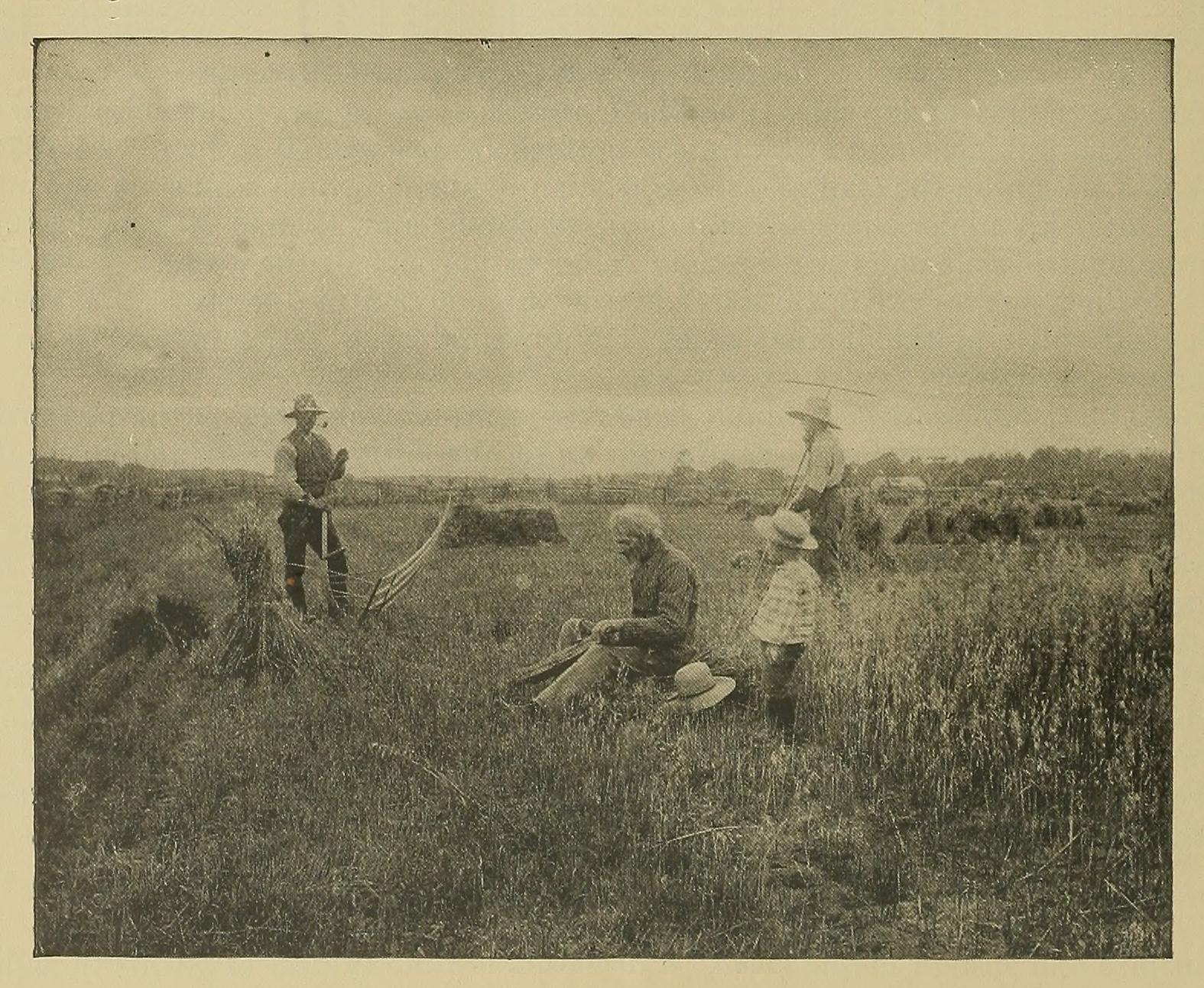
ON THE FARM IN CANADA
To be out of doors is the normal condition of the natural man. At some period of our ancestral life, so dim in our thought but so potential in our temper, disposition and physique, we have all lived, so to speak, in the open air; and although city-born and city-bred, we turn to the country with an instinctive feeling that we belong there. There are a few cockneys to whom the sound of Bow Bells is sweeter than the note of the bluebird, the resonant clarion of chanticleer or the far-off bleating of sheep; but to the immense majority of men these noises are like sounds that were familiar in childhood. I have sometimes thought that the deepest charm of the country lies in the fact that it was the home and play-ground of the childhood of the race, and, however long some of us have been departed from it, it stirs within us rare memories and associations which are imperishable. The lowing of cattle coming home at nightfall; the bleating of sheep on the hillside pastures; the crowing of the cock, are older than any human speech which now exists. They were ancient sounds before our oldest histories were written. I know of nothing sweeter to the man who comes out of the heat and noise and dust of the city in midsummer than to be awakened on the first morning by that irregular tinkle of bells which accompanies the early processions of the cows. One may never have come nearer a farm than his great-grandfather, but that sound makes him feel as if he were at home after some long and arduous absence.
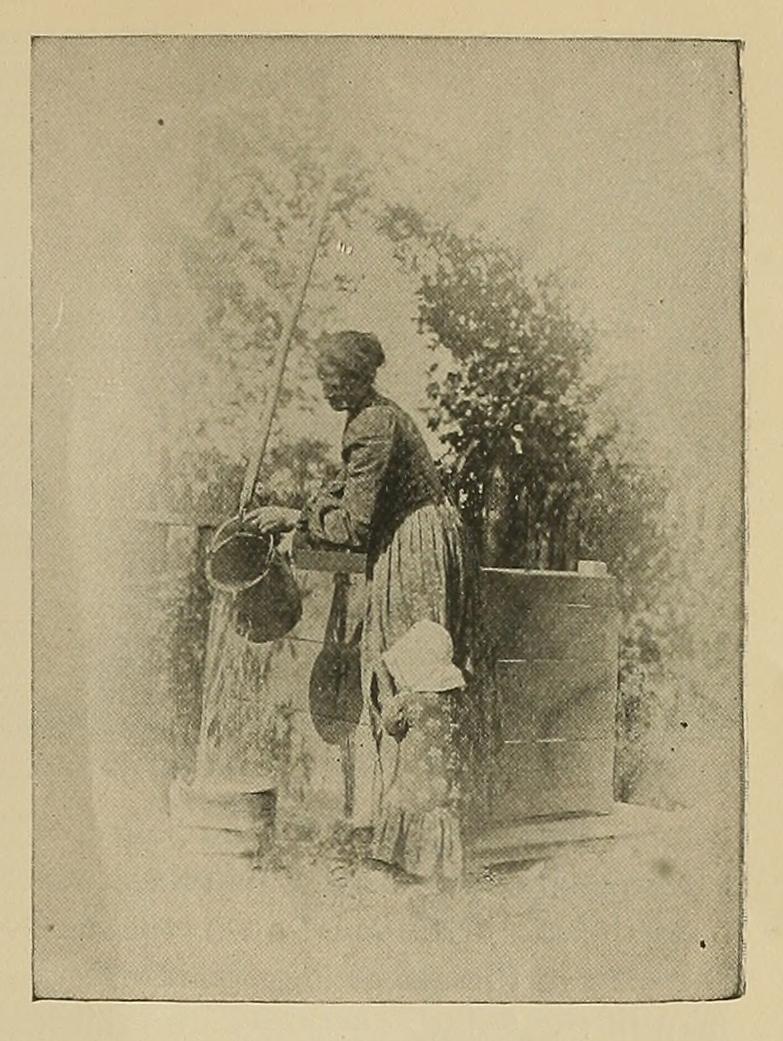
THE OLD WELL-CURB
And one has but to put into his pocket a few of those clever newspapers which satirize society people in spirited and well-drawn lines, and carry them into the country, to discover that the picturesque flees the city and loves the country; so far, that is, as people are concerned. There is certainly something wrong with our modern dress; it is impossible to discover anything suggestive or poetic in it, or to make any thing artistic out of it. Well-dressed individual men and women are often attractive to the eye; but when this is true it is because the charm of the person survives the monotonous uniformity of good clothes. Nothing can make the evening dress in which man extinguishes his personality either significant or artistic; but the man in overalls and shirt-sleeves is often a strikingly picturesque figure. Country life as a whole is steeped in the picturesque, in spite of the machines which so largely take the place of the old-time hand labor. One must go to the fields to find the poetry of human occupation; the man in the street is often interesting but he rarely stirs the imagination; the man in the fields constantly sets the imagination loose. What elemental strength and meaning are expressed in those peasant-figures of Millet? They belong to the world in which they toil; they disclose their identity with it; they express something of its meaning in their vigorous or bent forms.
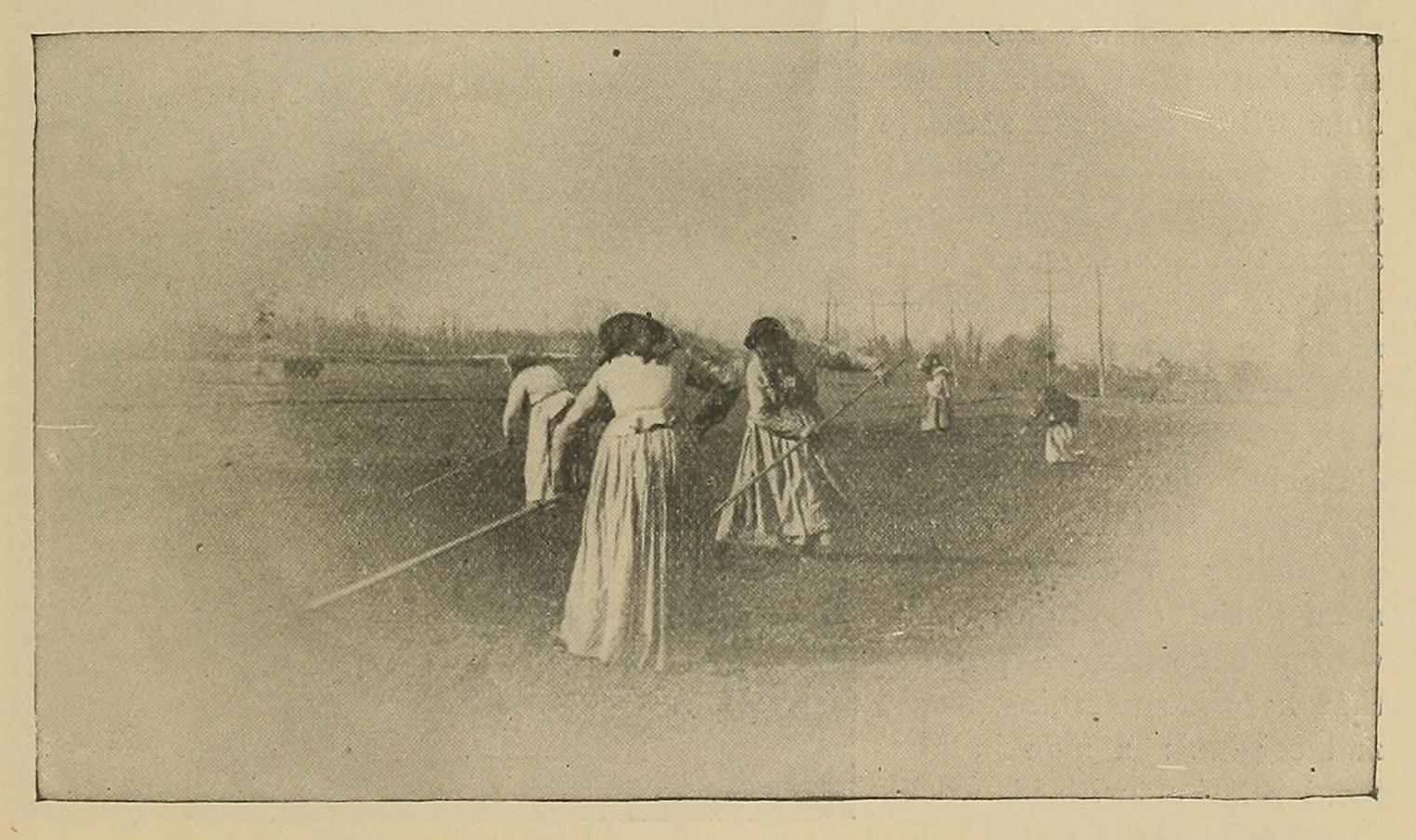
IMMIGRANT WOMEN HOEING POTATOES
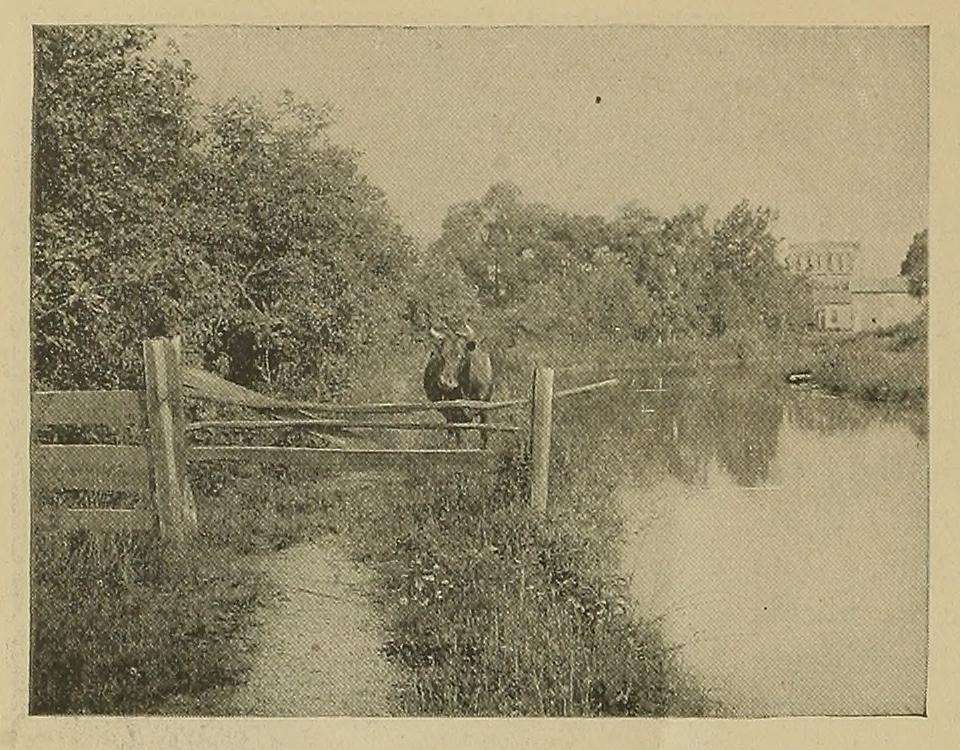
WAITING FOR MILKING-TIME
The entire life of the field is poetic in the true sense; from the hour when the last snow begins to melt to the hour when the last sheaf of grain goes creaking through the bars. The sower, moving across the open furrows, has a kind of antique picturesqueness; he seems to have stepped out of that ancient frieze with which the earliest habits encircled the oldest days. He expresses freedom, virility, personality in every movement; the eye follows him with a deepening impression that here is something native and original: a man in first-hand relations with his world. The reaper who follows him when sun and cloud have done their share, is not less striking and effective; and when the sheaves lie in rows or piles on the freshly cut stubble, the slow-moving, noisily creaking wagon, constantly pausing to take on its ripe load, seems a fit accessory in the staging of this pastoral drama. The fact that this poetry of motion is bound to toil so arduous and exacting that it often becomes a kind of relentless drudgery, is full of significance to those who believe that beauty is not esoteric, but the affluence of universal life in its normal relations and occupations.
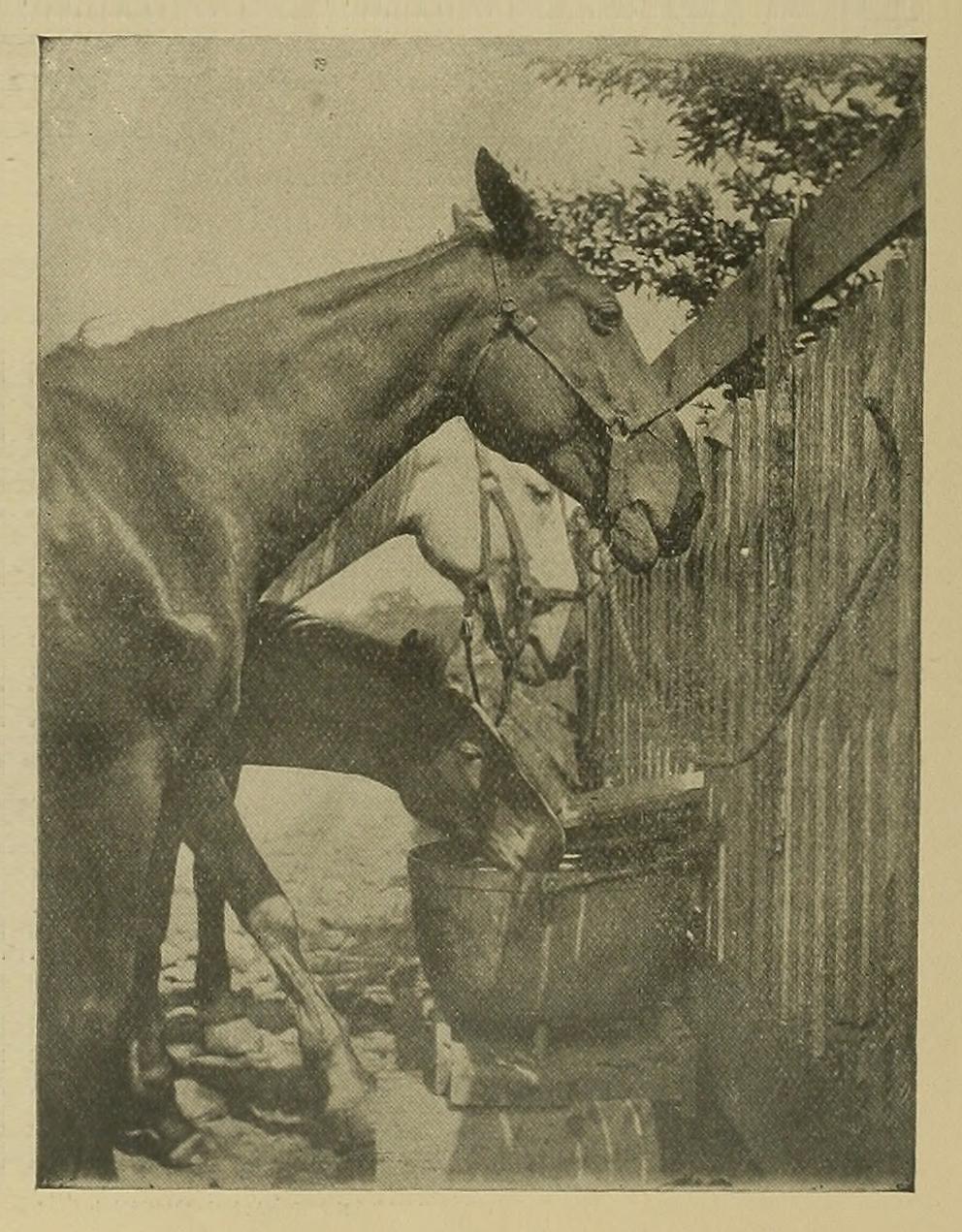
AFTER WORK
The sights and sounds of the farm are not only full of interest, but that interest is deepened by their constant recurrence. The horses at the trough; the sheep beside the stream as placid as themselves, or on the green uplands; the cows stolidly biding the coming of afternoon under the trees, or standing knee-deep in the cool brooks; the clucking of hens and their bustling leisure; the going out of the workers, with implements, seed, machines, wagons, and their return at sunset; the stir of the morning, the hush of the evening; what a world of homely, wholesome life is revealed in these old-time doings and happenings of the seasons and the life on the farm.
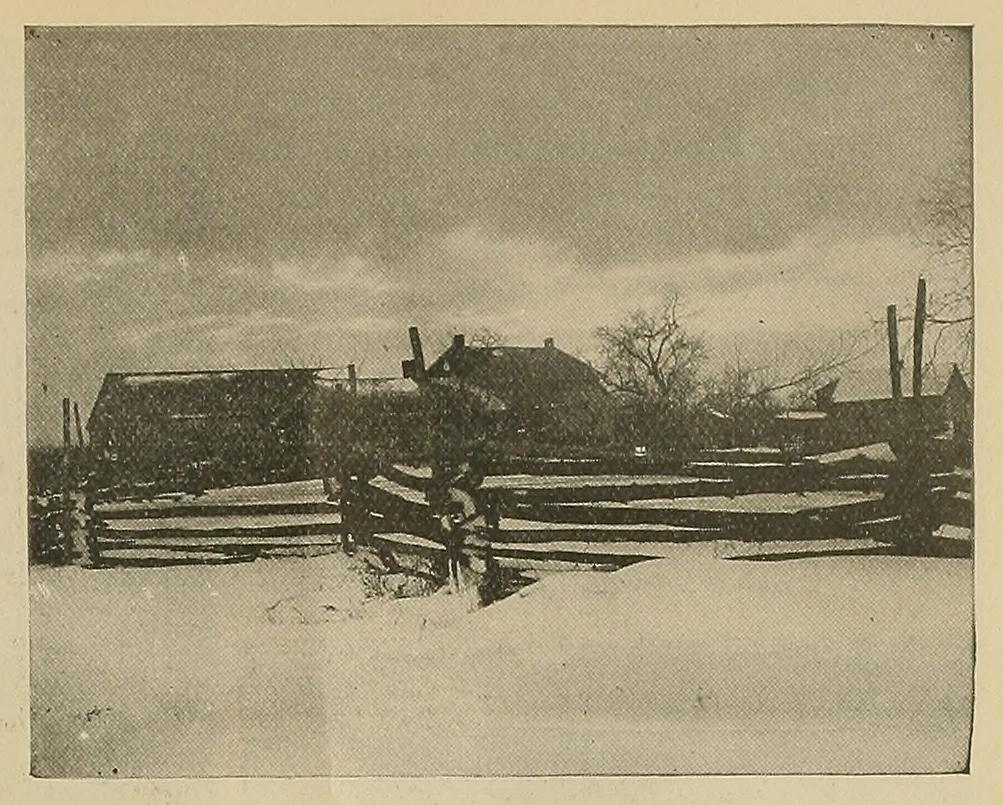
A WINTER EVENING ON THE FARM
But the farm is often only a unit of measurement, a term of individual possession; there is something greater; there is the country. Beyond the fields there is the landscape, and above them there is the sky; and every farm fits into these wider relations and is part of the larger whole. The woods, cool and silent; the spring hidden from the sun by overhanging trees and from strange feet by moss-grown rocks; the brook where it runs noiselessly in a shadow so deep at noon that one bathes his eyes in it after the glare of the world; the old mill, deserted by man but loyally served by the stream that flows through the decaying sluice and over the wheel that turns no more; the quiet hilltop, above which the whole country sleeps on summer afternoons;—these are all simply extensions of the farm.
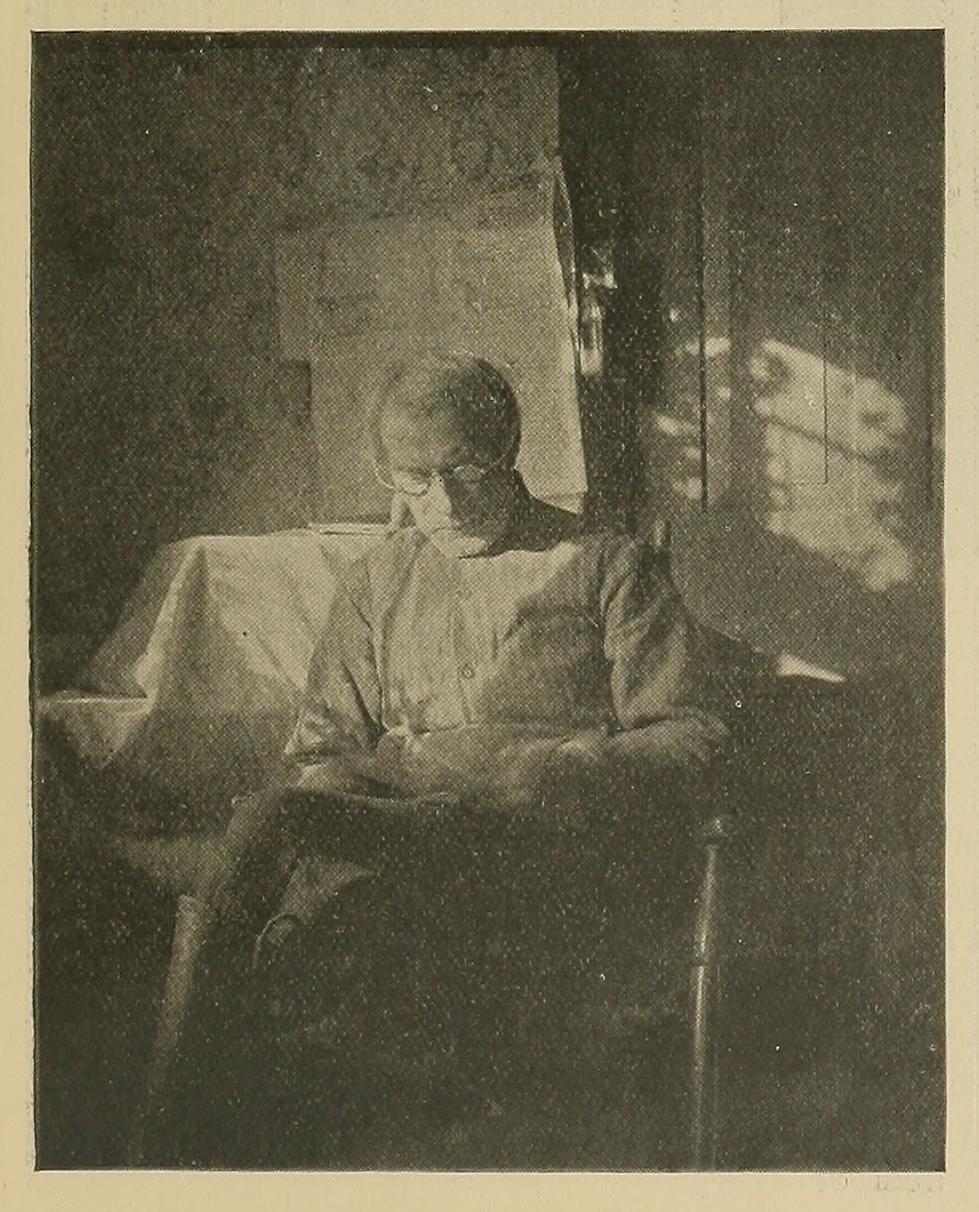
SUNDAY AFTERNOON
The boys know them on holidays; the older people are drawn to them in those infrequent hours when the pressure of work is lightened; the man who is getting city sights and sounds out of head and heart knows and loves them. The very thought of them brings refreshment and repose; for they are, one and all, places of silence and solitude.
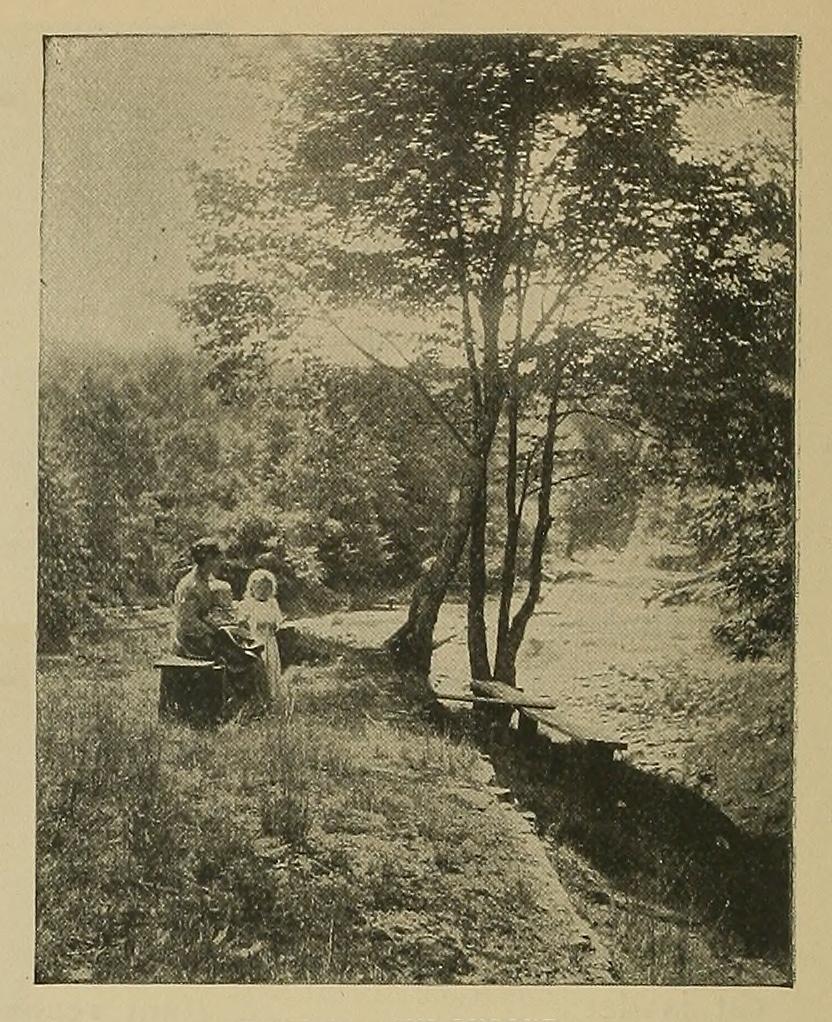
A SUNNY PLAY-GROUND
The fever of this our life, and the tumult of it, vanish on the invisible boundaries of these ancient sanctuaries of nature. It is not difficult to understand the charm of these places for tired and worn souls; for it is to such places that exhausted men and women invariably turn. No one with a rich intellectual and spiritual nature, can keep in perfect health without a good deal of solitude and silence.
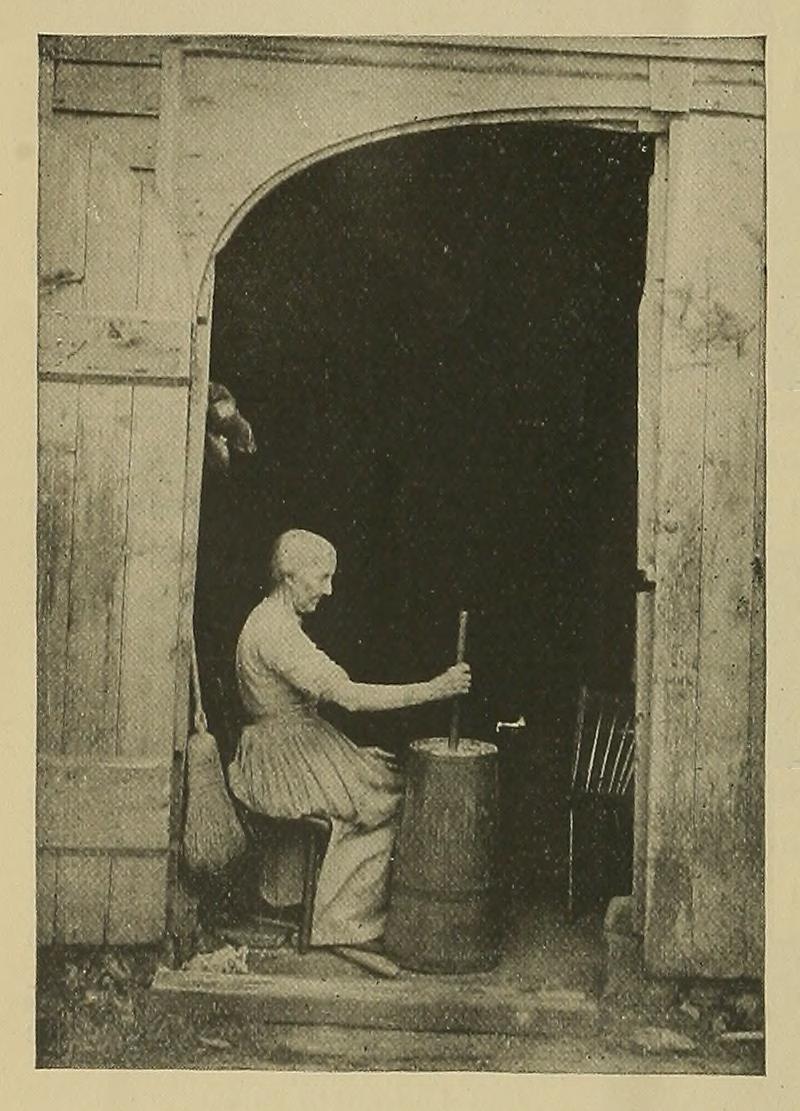
CHURNING IN THE BARN
We come to know ourselves and the world in the deeper ways only when we are apart from the rush of things. It is only when traffic ceases and the dust is laid that the landscape becomes clear and complete to the pedestrian. The quiet of the woods, the cool note of the mountain streams, the silence of the summits, represent, not the luxuries and pleasures of a rich life, but its necessities. To the townsman these outlying provinces of the farm are even more important than are the well-tilled acres.
THE OLD MILL
Some day some man or woman will write a luminous book on the education of country life; the training of the eye, the ear, the hand, the unconscious enrichment of the senses and of the mind which are effected by its sights and sounds. There has never been in the long history of education, a better school for the open-minded, imaginative boy or girl than the farm. Every day sets its tasks, every task teaches its lessons; and nature stands looking over the student’s shoulder and quietly whispering some of her deepest secrets to her fortunate child.
AFTER A WET SNOW-STORM
For surely it is a great piece of good fortune to grow up in a wise, generous home in the country; to be young with all manner of four-footed beasts and fowls of the air, and grow up with them; to stumble over the roots of trees when one is beginning to walk; to hear the brooks chatter before one knows how to chatter himself; to awake in the stir of the morning, when the whole world seems to be going to work, and to fall asleep when the world comes trooping home, dusty and tired.
MAPLE-SUGAR TIME
To see and hear these outdoor sights and sounds is to be born into vital relations with man’s natural background and to come unconsciously into possession of some of the greatest truths which life has to teach. It is also to be born on intimate terms with bluebirds and cherries!
THE BLACK SHEEP
“If you want to know where the biggest cherries are to be found,” said Goethe, “consult the boys and the blackbirds.” There is a natural affinity between the two, and the boy who does not grow up in natural relationship with birds and trees suffers a loss of privilege which can never be entirely made up. For it is a great deal easier to make the acquaintance of nature in childhood than in those later years which bring “the philosophic mind,” but which leave the senses untrained for that instinctive observation which enables the boy to see without knowing that he sees.
THE MILL-POND
John Burroughs has given us a charming description of the joys of boyhood on a farm, and has perhaps unconsciously betrayed the secret of his own extraordinary familiarity with the out-of-doors world. No knowledge is quite so much a part of ourselves as that which we gain without conscious effort; which we breathe in with the morning air of life.
NOON IN THE SHEEP-LOT
The Hindoos have an idiomatic word or phrase for a walk before breakfast, which may be translated, “eating the morning air.”
The boy on the farm sees nature before breakfast, when senses and mind and heart are on the alert, when experience has not brought sophistication with it, and when sensation still keeps its pristine freshness.
FEEDING THE CHICKENS
The healthy boy is one great appetite for sights and sounds, and nothing escapes him. He knows every path through the woods, every pool in the brook, every cavern in the hills, every sequestered hollow where the noise of the world is softened into the silence of rustling leaves and murmuring streams. One of the most erudite of American scholars, whose large learning has not smothered the instincts of his youth, declares that he is never entirely happy until he stands barefooted in the old fields.