FAMOUS WOMEN NOVELISTS.
Reading edition
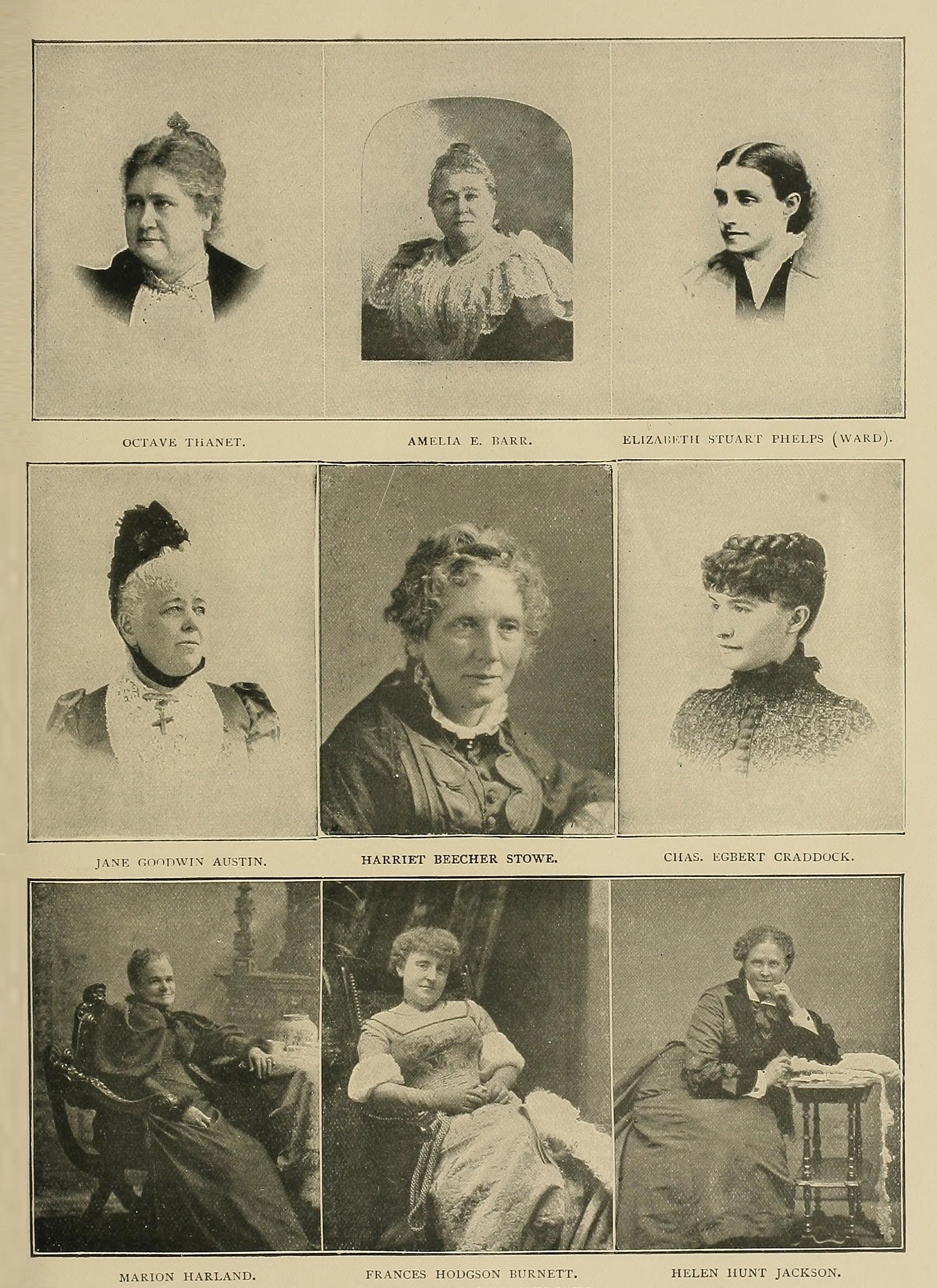
NOTED WOMEN NOVELISTS.
OCTAVE THANET • AMELIA E. BARR • ELIZABETH STUART PHELPS (WARD) JANE GOODWIN AUSTIN • HARRIET BEECHER STOWE • CHAS. EGBERT CRADDOCK MARION HARLAND • FRANCES HODGSON BURNETT • HELEN HUNT JACKSON
HARRIET BEECHER STOWE.
AUTHOR OF “UNCLE TOM’S CABIN.”
EW names are more indelibly written upon our country’s history than that of Harriet Beecher Stowe. “No book,” says George William Curtis, “was ever more a historical event than ‘Uncle Tom’s Cabin.’ ... It was the great happiness of Mrs. Stowe not only to have written many delightful books, but to have written one book which will always be famous not only as the most vivid picture of an extinct evil system, but as one of the most powerful influences in overthrowing it.... If all whom she has charmed and quickened should unite to sing her praises, the birds of summer would be outdone.”
Harriet Beecher Stowe was the sixth child of Reverend Lyman Beecher,—the great head of that great family which has left so deep an impress upon the heart and mind of the American people. She was born in Litchfield, Connecticut, in June, 1811,—just two years before her next younger brother, Henry Ward Beecher. Her father was pastor of the Congregational Church in Litchfield, and her girlhood was passed there and at Hartford, where she attended the excellent seminary kept by her elder sister, Catharine E. Beecher. In 1832 her father accepted a call to the presidency of Lane Theological Seminary, at Cincinnati, and moved thither with his family. Catharine Beecher went also, and established there a new school, under the name of the Western Female Institute, in which Harriet assisted.
In 1833 Mrs. Stowe first had the subject of slavery brought to her personal notice by taking a trip across the river from Cincinnati into Kentucky in company with Miss Dutton, one of the associate teachers in the Western Institute. They visited the estate that afterward figured as that of Mr. Shelby, in “Uncle Tom’s Cabin,” and here the young authoress first came into personal contact with the slaves of the South.
Among the professors in Lane Seminary was Calvin E. Stowe, whose wife, a dear friend of Miss Beecher, died soon after Dr. Beecher’s removal to Cincinnati. In 1836 Professor Stowe and Harriet Beecher were married. They were admirably suited to each other. Professor Stowe was a typical man of letters,—a learned, amiable, unpractical philosopher, whose philosophy was like that described by Shakespeare as “an excellent horse in the stable, but an arrant jade on a journey.” Her practical ability and cheerful, inspiring courage were the unfailing support of her husband.
The years from 1845 to 1850 were a time of severe trial to Mrs. Stowe. She and her husband both suffered from ill health, and the family was separated. Professor Stowe was struggling with poverty, and endeavoring at the same time to lift the Theological Seminary out of financial difficulties. In 1849, while Professor Stowe was ill at a water-cure establishment in Vermont, their youngest child died of cholera, which was then raging in Cincinnati. In 1850 it was decided to remove to Brunswick, Maine, the seat of Bowdoin College, where Professor Stowe was offered a position.
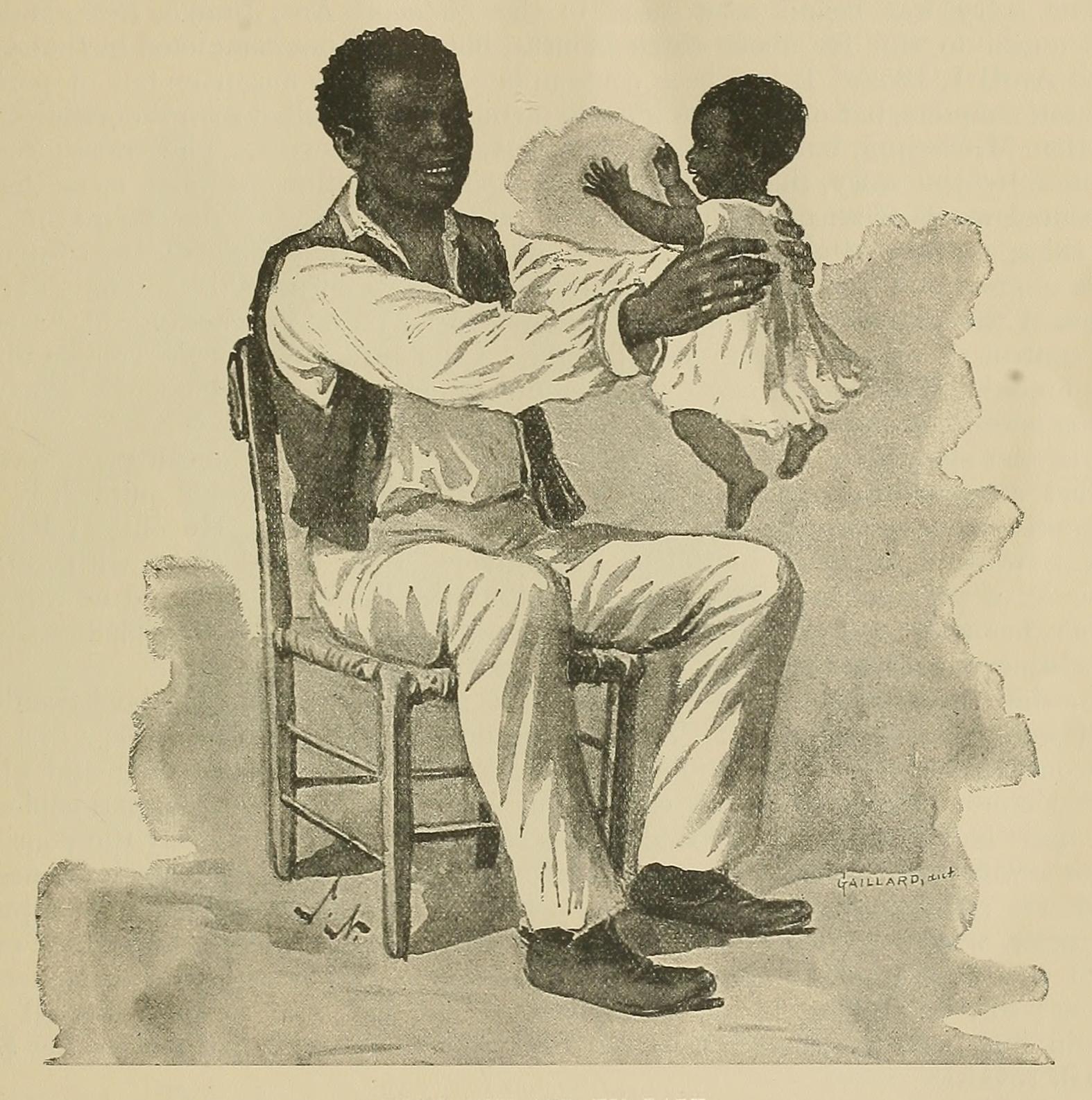
UNCLE TOM AND HIS BABY.
“’Ain’t she a peart young ’un?’”
The year 1850 is memorable in the history of the conflict with slavery. It was the year of Clay’s compromise measures, as they were called, which sought to satisfy the North by the admission of California as a free State, and to propitiate the South by the notorious “Fugitive Slave Law.” The slave power was at its height, and seemed to hold all things under its feet; yet in truth it had entered upon the last stage of its existence, and the forces were fast gathering for its final overthrow. Professor Cairnes and others said truly, “The Fugitive Slave Law has been to the slave power a questionable gain. Among its first fruits was ‘Uncle Tom’s Cabin.’”
The story was begun as a serial in the National Era, June 5, 1851, and was announced to run for about three months, but it was not completed in that paper until April 1, 1852. It had been contemplated as a mere magazine tale of perhaps a dozen chapters, but once begun it could no more be controlled than the waters of the swollen Mississippi, bursting through a crevasse in its levees. The intense interest excited by the story, the demands made upon the author for more facts, the unmeasured words of encouragement to keep on in her good work that poured in from all sides, and, above all, the ever-growing conviction that she had been intrusted with a great and holy mission, compelled her to keep on until the humble tale had assumed the proportions of a large volume. Mrs. Stowe repeatedly said, “I could not control the story, it wrote itself;” and, “I the author of ‘Uncle Tom’s Cabin’? No, indeed. The Lord himself wrote it, and I was but the humblest of instruments in his hand. To him alone should be given all the praise.”
For the story as a serial the author received $300. In the meantime, however, it had attracted the attention of Mr. John P. Jewett, a Boston publisher, who promptly made overtures for its publication in book form. He offered Mr. and Mrs. Stowe a half share in the profits, provided they would share with him the expense of publication. This was refused by the Professor, who said he was altogether too poor to assume any such risk; and the agreement finally made was that the author should receive a ten per cent. royalty upon all sales.
In the meantime the fears of the author as to whether or not her book would be read were quickly dispelled. Three thousand copies were sold the very first day, a second edition was issued the following week, a third a few days later; and within a year one hundred and twenty editions, or over three hundred thousand copies, of the book had been issued and sold in this country. Almost in a day the poor professor’s wife had become the most talked-of woman in the world; her influence for good was spreading to its remotest corners, and henceforth she was to be a public character, whose every movement would be watched with interest, and whose every word would be quoted. The long, weary struggle with poverty was to be hers no longer; for, in seeking to aid the oppressed, she had also so aided herself that within four months from the time her book was published it had yielded her $10,000 in royalties.
In 1852 Professor Stowe received a call to the professorship of Sacred Literature in Andover Theological Seminary, and the family soon removed to their Massachusetts home. They were now relieved from financial pressure; but Mrs. Stowe’s health was still delicate; and in 1853 she went with her husband and brother to England, where she received, much to her surprise, a universal welcome. She made many friends among the most distinguished people in Great Britain, and on the continent as well. On her return she wrote the “Key to Uncle Tom’s Cabin,” and began “Dred, a Tale of the Dismal Swamp.” In fact, her literary career was just beginning. With “Uncle Tom’s Cabin” her powers seemed only to be fairly awakened. One work after another came in quick succession. For nearly thirty years after the publication of “Uncle Tom,” her pen was never idle. In 1854 she published “Sunny Memories of Foreign Lands,” and then, in rapid succession, “The Minister’s Wooing,” “The Pearl of Orr’s Island,” “Agnes of Sorrento,” “House and Home Papers,” “Little Foxes,” and “Oldtown Folks.” These, however, are but a small part of her works. Besides more than thirty books, she has written magazine articles, short stories, and sketches almost without number. She has entertained, instructed, and inspired a generation born long after the last slave was made free, and to whom the great question which once convulsed our country is only a name. But her first great work has never been surpassed, and it will never be forgotten.
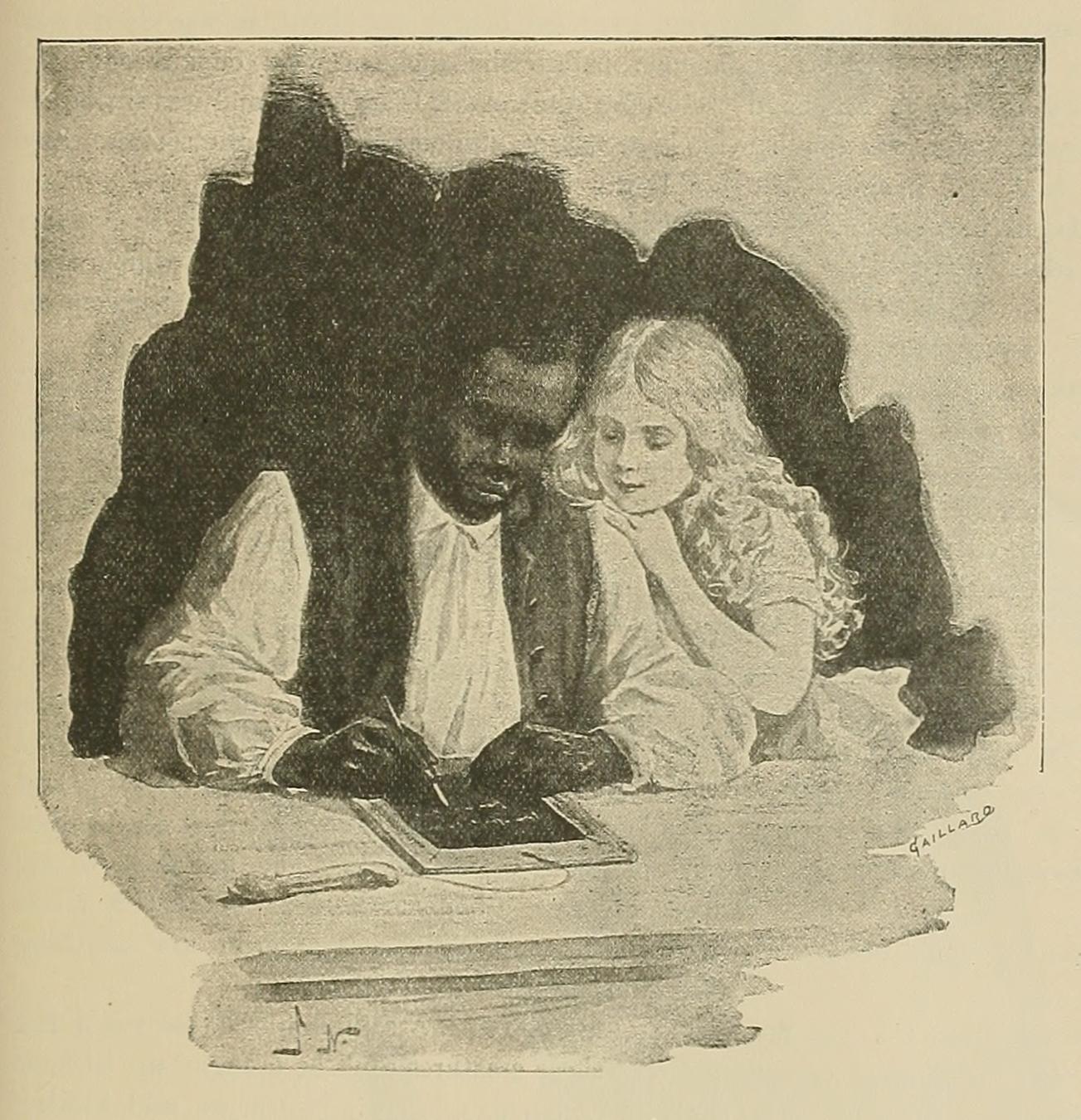
A SCENE IN UNCLE TOM’S CABIN.
Little Eva.—“‘Oh, Uncle Tom! what funny things you are making there.’”
After the war which accomplished the abolition of slavery, Mrs. Stowe lived in Hartford, Connecticut, in summer, and spent the winters in Florida, where she bought a luxurious home. Her pen was hardly ever idle; and the popularity of her works seemed to steadily increase. She passed away on the 1st of July, 1896, amid the surroundings of her quiet, pretty home at Hartford, Connecticut. The whole reading world was moved at the news of her death, and many a chord vibrated at the remembrance of her powerful, and we may even say successful, advocacy of the cause of the slave. The good which “Uncle Tom’s Cabin” achieved can never be estimated, and the noble efforts of its author have been interwoven in the work of the world.
THE LITTLE EVANGELIST.
FROM “UNCLE TOM’S CABIN.”
T was Sunday afternoon. St. Clare was stretched on a bamboo lounge in the verandah, solacing himself with a cigar. Marie lay reclined on a sofa, opposite the window opening on the verandah, closely secluded under an awning of transparent gauze from the outrages of the mosquitoes, and languidly holding in her hand an elegantly-bound prayer-book. She was holding it because it was Sunday, and she imagined she had been reading it—though, in fact, she had been only taking a succession of short naps with it open in her hand.
Miss Ophelia, who, after some rumaging, had hunted up a small Methodist meeting within riding distance, had gone out, with Tom as driver, to attend it, and Eva accompanied them.
“I say, Augustine,” said Marie, after dozing awhile, “I must send to the city after my old doctor, Posey; I’m sure I’ve got the complaint of the heart.”
“Well; why need you send for him? This doctor that attends Eva seems skillful.”
“I would not trust him in a critical case,” said Marie; “and I think I may say mine is becoming so! I’ve been thinking of it these two or three nights past; I have such distressing pains and such strange feelings.”
“Oh, Marie, you are blue! I don’t believe it’s heart-complaint.”
“I daresay you don’t,” said Marie; “I was prepared to expect that. You can be alarmed enough if Eva coughs, or has the least thing the matter with her; but you never think of me.”
“If it’s particularly agreeable to you to have heart-disease, why, I’ll try and maintain you have it,” said St. Clare; “I didn’t know it was.”
“Well, I only hope you won’t be sorry for this when it’s too late!” said Marie. “But, believe it or not, my distress about Eva, and the exertions I have made with that dear child, have developed what I have long suspected.”
What the exertions were which Marie referred to it would have been difficult to state. St. Clare quietly made this commentary to himself, and went on smoking, like a hard-hearted wretch of a man as he was, till a carriage drove up before the verandah, and Eva and Miss Ophelia alighted.
Miss Ophelia marched straight to her own chamber, to put away her bonnet and shawl, as was always her manner, before she spoke a word on any subject; while Eva came at St. Clare’s call, and was sitting on his knee, giving him an account of the services they had heard.
They soon heard loud exclamations from Miss Ophelia’s room (which, like the one in which they were sitting, opened to the verandah), and violent reproof addressed to somebody.
“What new witchcraft has Tops been brewing?” asked St. Clare. “That commotion is of her raising, I’ll be bound!”
And in a moment after, Miss Ophelia, in high indignation, came dragging the culprit along.
“Come out here, now!” she said. “I will tell your master!”
“What’s the case now?” asked Augustine.
“The case is, that I cannot be plagued with this child any longer! It’s past all bearing; flesh and blood cannot endure it! Here, I locked her up, and gave her a hymn to study and what does she do but spy out where I put my key, and has gone to my bureau and got a bonnet-trimming and cut it all to pieces to make dolls’ jackets! I never saw anything like it in my life.”
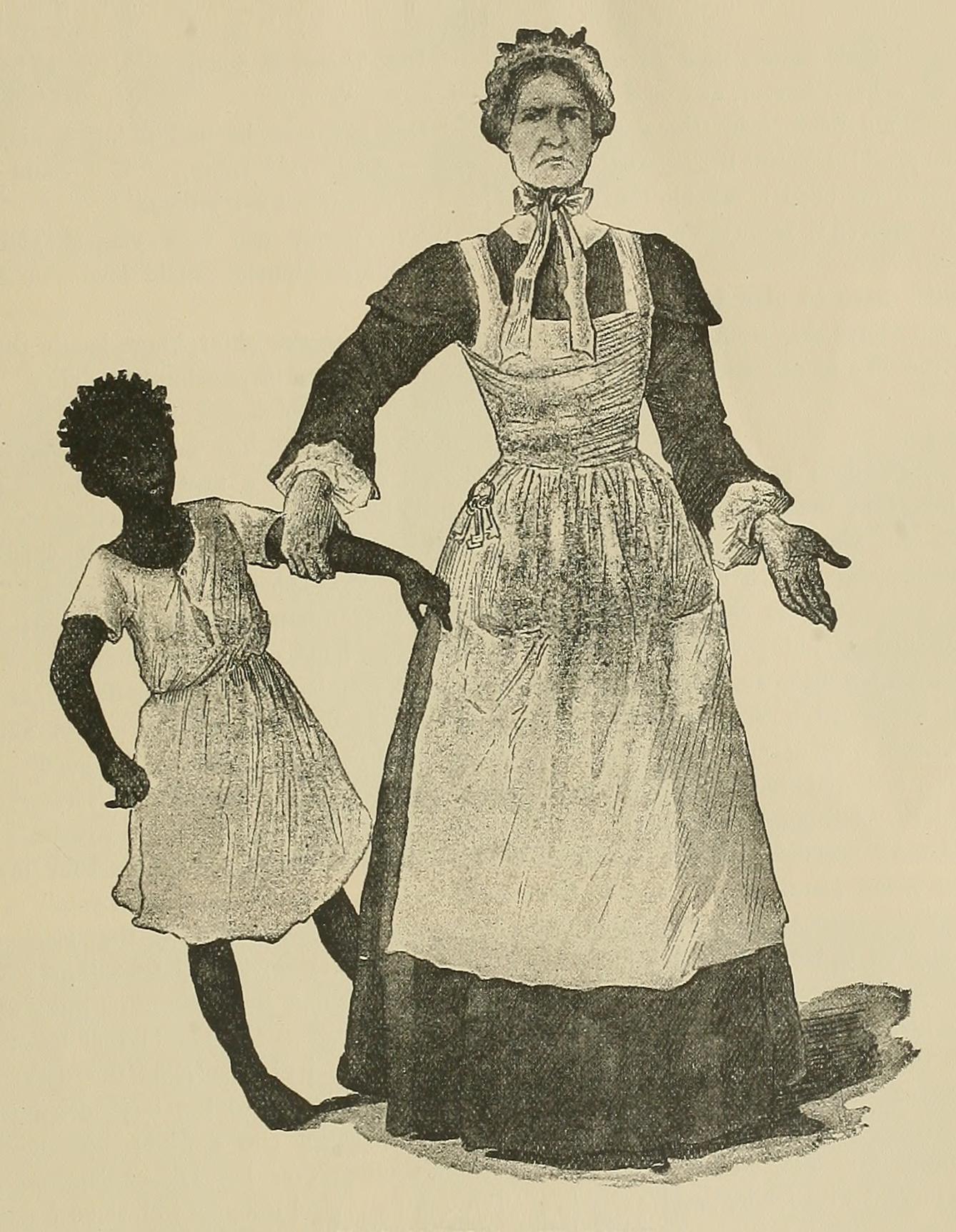
MISS OPHELIA AND TOPSY.
“I cannot be plagued with this child any longer!”
“I told you, cousin,” said Marie, “that you’d find out that these creatures can’t be brought up without severity. If I had my way, now,” she said, looking reproachfully at St. Clare, “I’d send that child out and have her thoroughly whipped; I’d have her whipped till she couldn’t stand!”
“I don’t doubt it,” said St. Clare. “Tell me of the lovely rule of woman! I never saw above a dozen women that wouldn’t half kill a horse, or a servant either, if they had their own way with them—let alone a man.”
“There is no use in this shilly-shally way of yours, St. Clare!” said Marie. “Cousin is a woman of sense, and she sees it now as plain as I do.”
Miss Ophelia had just the capability of indignation that belongs to the thorough-paced housekeeper, and this had been pretty actively roused by the artifice and wastefulness of the child; in fact, many of my lady readers must own that they would have felt just so in her circumstances; but Marie’s words went beyond her, and she felt less heat.
“I wouldn’t have the child treated so for the world,” she said; “but I am sure, Augustine, I don’t know what to do. I’ve taught and taught, I’ve talked till I’m tired, I’ve whipped her, I’ve punished her in every way I can think of; and still she’s just what she was at first.”
“Come here, Tops, you monkey!” said St. Clare, calling the child up to him.
Topsy came up; her round, hard eyes glittering and blinking with a mixture of apprehensiveness and their usual odd drollery.
“What makes you behave so?” said St. Clare who could not help being amused with the child’s expression.
“’Spects it’s my wicked heart,” said Topsy, demurely; “Miss Feely says so.”
“Don’t you see how much Miss Ophelia has done for you? She says, she has done everything she can think of.”
“Lor, yes, mas’r! old missis used to say so, too. She whipped me a heap harder, and used to pull my ha’r, and knock my head agin the door; but it didn’t do me no good! I ’spects if they’s to pull every spear o’ ha’r out o’ my head it wouldn’t do no good neither—I’s so wicked! Laws! I’s nothin’ but a nigger, no ways!”
“Well, I shall have to give her up,” said Miss Ophelia; “I can’t have that trouble any longer.”
“Well, I’d just like to ask one question,” said St. Clare.
“What is it?”
“Why, if your Gospel is not strong enough to save one heathen child, that you can have at home here, all to yourself, what’s the use of sending one or two poor missionaries off with it among thousands of just such? I suppose this child is about a fair sample of what thousands of your heathen are.”
Miss Ophelia did not make an immediate answer; and Eva, who had stood a silent spectator of the scene thus far, made a silent sign to Topsy to follow her. There was a little glass-room at the corner of the verandah, which St. Clare used as a sort of reading-room; and Eva and Topsy disappeared into this place.
“What’s Eva going about now?” said St. Clare; “I mean to see.”
And, advancing on tiptoe, he lifted up a curtain that covered the glass-door, and looked in. In a moment, laying his finger on his lips, he made a silent gesture to Miss Ophelia to come and look. There sat the two children on the floor, with their side faces towards them—Topsy with her usual air of careless drollery and unconcern; but, opposite to her, Eva, her whole face fervent with feeling, and tears in her large eyes.
“What does make you so bad, Topsy? Why won’t you try and be good? Don’t you love anybody, Topsy?”
“Dun no nothin’ ’bout love; I loves candy and sich, that’s all,” said Topsy.
“But you love your father and mother?”
“Never had none, ye know. I telled ye that, Miss Eva.”
“Oh, I know,” said Eva, sadly; “but hadn’t you any brother, or sister, or aunt, or――”
“No, none on ’em—never had nothing nor nobody.”
“But, Topsy, if you’d only try to be good, you might――”
“Couldn’t never be nothin’ but a nigger, if I was ever so good,” said Topsy. “If I could be skinned, and come white, I’d try then.”
“But people can love you, if you are black, Topsy. Miss Ophelia would love you if you were good.”
Topsy gave the short, blunt laugh that was her common mode of expressing incredulity.
“Don’t you think so?” said Eva.
“No; she can’t b’ar me, ’cause I’m a nigger!—she’d’s soon have a toad touch her. There can’t nobody love niggers, and niggers can’t do nothin’. I don’t care,” said Topsy, beginning to whistle.
“Oh, Topsy, poor child, I love you!” said Eva, with a sudden burst of feeling, and laying her little thin, white hand on Topsy’s shoulder. “I love you because you haven’t had any father, or mother, or friends—because you’ve been a poor, abused child! I love you, and I want you to be good. I am very unwell, Topsy, and I think I sha’n’t live a great while; and it really grieves me to have you be so naughty. I wish you would try to be good for my sake; it’s only a little while I shall be with you.”
The round, keen eyes of the black child were overcast with tears; large, bright drops rolled heavily down, one by one, and fell on the little white hand. Yes, in that moment a ray of real belief, a ray of heavenly love, had penetrated the darkness of her heathen soul! She laid her head down between her knees, and wept and sobbed; while the beautiful child, bending over her, looked like the picture of some bright angel stooping to reclaim a sinner.
“Poor Topsy!” said Eva, “don’t you know that Jesus loves all alike? He is just as willing to love you as me. He loves you just as I do, only more, because He is better. He will help you to be good, and you can go to heaven at last, and be an angel for ever, just as much as if you were white. Only think of it, Topsy, you can be one of those ’spirits bright’ Uncle Tom sings about.”
“Oh, dear Miss Eva! dear Miss Eva!” said the child, “I will try! I will try! I never did care nothin’ about it before.”
St. Clare at this moment dropped the curtain. “It puts me in mind of mother,” he said to Miss Ophelia. “It is true what she told me: if we want to give sight to the blind, we must be willing to do as Christ did—call them to us and put our hands on them.”
“I’ve always had a prejudice against negroes,” said Miss Ophelia; “and it’s a fact, I never could bear to have that child touch me; but I didn’t think she knew it.”
“Trust any child to find that out,” said St. Clare: “there’s no keeping it from them. But I believe that all the trying in the world to benefit a child, and all the substantial favors you can do them, will never excite one emotion of gratitude while that feeling of repugnance remains in the heart; it’s a queer kind of fact, but so it is.”
“I don’t know how I can help it,” said Miss Ophelia; “they are disagreeable to me—this child in particular. How can I help feeling so?”
“Eva does, it seems.”
“Well, she’s so loving! After all, though, she’s no more than Christ-like,” said Miss Ophelia: “I wish I were like her. She might teach me a lesson.”
“It wouldn’t be the first time a little child had been used to instruct an old disciple, if it were so,” said St. Clare.
THE OTHER WORLD.
T lies around us like a cloud,
The world we do not see;
Yet the sweet closing of an eye
May bring us there to be.
Its gentle breezes fan our cheek,
Amid our worldly cares;
Its gentle voices whisper love,
And mingle with our prayers.
Sweet hearts around us throb and beat,
Sweet helping hands are stirred;
And palpitates the veil between,
With breathings almost heard.
The silence, awful, sweet, and calm,
They have no power to break;
For mortal words are not for them
To utter or partake.
So thin, so soft, so sweet they glide,
So near to press they seem,
They lull us gently to our rest,
They melt into our dream.
And, in the hush of rest they bring,
’Tis easy now to see,
How lovely and how sweet to pass
The hour of death may be;—
To close the eye and close the ear,
Wrapped in a trance of bliss,
And, gently drawn in loving arms,
To swoon from that to this:—
Scarce knowing if we wake or sleep,
Scarce asking where we are,
To feel all evil sink away,
All sorrow and all care!


MARY VIRGINIA TERHUNE.
(MARION HARLAND.)
Popular Novelist and Domestic Economist.
ARION HARLAND combines a wide variety of talent. She is probably the first writer to excel in the line of fiction and also to be a leader in the direction of domestic economy. She is one of the most welcomed contributors to the periodicals, and her books on practical housekeeping, common sense in the household, and several practical cookery books have smoothed the way for many a young housekeeper and probably promoted the cause of peace in numerous households.

Mary Virginia Hawes was the daughter of a native of Massachusetts who was engaged in business in Richmond, Virginia. She was born in 1831, and received a good education. She began in early childhood to display her literary powers. She wrote for the magazines in her sixteenth year and her first contribution, “Marrying Through Prudential Motives,” was so widely read that it was published in nearly every journal in England, was translated and published throughout France, found its way back to England through a retranslation, and finally appeared in a new form in the United States.
In 1856 she became the wife of Rev. Edward P. Terhune, afterwards pastor of the Puritan Congregational Church in Brooklyn, where in recent years they have lived. Mrs. Terhune has always been active in charitable and church work, and has done an amount of writing equal to that of the most prolific authors. She has been editor or conducted departments of two or three different magazines and established and successfully edited the “Home Maker.” Some of her most noted stories are “The Hidden Path;” “True as Steel;” “Husbands and Homes;” “Phemie’s Temptation;” “Ruby’s Husband;” “Handicap;” “Judith;” “A Gallant Fight;” and “His Great Self.” Besides these books and a number of others, she has written almost countless essays on household and other topics. Her book, “Eve’s Daughters,” is a standard work of counsel to girls and young women. She takes an active part in the literary and philanthropic organizations of New York City, and has been prominent in the Woman’s Councils held under the auspices of a Chautauquan association. She was the first to call attention to the dilapidated condition of the grave of Mary Washington and started a movement to put the monument in proper condition. For the benefit of this movement, she wrote and published “The Story of ♦Mary Washington.”
A MANLY HERO.¹
(FROM “A GALLANT FIGHT.”)
FTER donning velvet jacket and slippers he sat down, and, lighting his cigar, leaned back to watch the fire and dream of Salome and their real home.
Not until the weed was half consumed did he observe an envelope on the table at his elbow. It was sealed and addressed to him in a “back-hand” he did not recognize:
“In the Library. Nine O’clock, P. M.
“My Own Love—You say in your letter (burned as soon as I had committed the contents to memory) that I must never call you that again. There is a higher law than that of man’s appointment, binding our hearts together, stronger even than that of your sweet, wise lips. Until you are actually married to the man whom you confess you do not love, you will, according to that divine law, be my own Marion—”
With a violent start, the young man shook the sheet from his fingers as he would a serpent.
This was what he had promised not to read, or so much as to touch! The veins stood out high and dark on his forehead; he drew in the air hissingly. Had a basilisk uncoiled from his bosom and thrust a forked tongue in his face the shock would not have been greater. This was “the letter written to Marion!” He had thrown away six of the best years of his life upon the woman whom another man called his “own love;” the man to whom she had confessed that she did not love her betrothed husband! Who was he?
“If they are genuine, respect for the dead and mercy to the living require that they should be suppressed and destroyed,” Mrs. Phelps had said of “papers written a little while before Marion’s death.” His word was pledged. But what name would he see if he reversed the sheet before destroying it? With a bound of the heart that would have assured him, had proof been needed, what his bonnie living girl-love was to him, he put away all tender memories of the dead, false betrothed. He had worshipped and mourned the thinnest of shadows. He might owe respect—abstractly—to the dead, but no reverence to a wild dream from which he had been awakened. Who was the “living” to whom he was entreated to show mercy? Where was the man who had first robbed him, then let him play the sad-visaged dupe and fool, while the heyday of youth slipped forever beyond his reach?
To learn that—to remember the name with execration—to despise with the full force of a wronged and honest soul—perhaps to brand him as a cur and blackguard, should he ever cross his path—would not break his word. Was it not his right—the poor rag of compensation he might claim for the incalculable, the damnable evil the traitor had wrought? He would confess to Salome’s mother to-morrow—but this one thing he would do.
He stooped for the letter.
“Peace! let him rest! God knoweth best!
And the flowing tide comes in!
And the flowing tide comes in!”
It was only his beloved stepmother on her nightly round of nursery and Gerald’s chamber, singing to her guileless self in passing her stepson’s door to prove her serenity of spirit; but Rex staggered back into his seat, put his elbows on his knees and covered his face with his hands.
He smelled the balsam-boughs slanting to the water, the trailing arbutus Salome wore in her belt; heard the waves lapping the prow and sides of the bounding boat. God’s glorious heaven was over them, and the sun was rising, after a long, long night, in his heart. The fresh, tender young voice told the tale of love and loss and patient submission....
Aye, and could not he, affluent in heaven’s best blessings, loving and beloved by the noble, true daughter of the Christian heroine who expected her “son” to stand fast by his plighted word—the almost husband of a pure, high-souled woman—afford to spare the miserable wretch whose own mind and memory must be a continual hell?
He pitied, he almost forgave him, as he took up the sheets from the floor, the scrap of paper from the table, and, averting his eyes lest the signature might leap out at him from the twisting flame, laid them under the forestick and did not look that way again until nothing was left of them but cinder and ashes.
MARY ABIGAIL DODGE.
THE FAMOUS ESSAYIST, CRITIC, AND NOVELIST, “GAIL HAMILTON.”
MONG the female writers of America, perhaps there is no one who has covered a more diversified field and done her work more thoroughly, in the several capacities of essayist, philosopher, political writer, child-writer and novelist, than has Miss Mary Abigail Dodge, widely known by her pen-name, “Gail Hamilton.” Miss Dodge commanded a terse, vigorous and direct style; and with a courage manifested by few contemporaneous authors, she cut right through shams and deceits with an easy and convincing blow that left no room for doubt.
Mary Abigail Dodge was born in Hamilton, Massachusetts, in the year 1830. Her pen-name is composed of the last syllable of the word “Abigail” and her native city, “Hamilton.” Her education was thorough, and in 1857 she was made instructor of physical science in the High School of Hartford, Connecticut. Some years after she became a governess in the family of Doctor Bailey the editor of the “National Era,” in Washington, D. C., and begun her career as a writer by contributing to his journal. For two years, from 1865 to 1867, she was one of the editors of “Our Young Folks,” and from that time to the close of her life she was a constant contributor to prominent magazines and newspapers—the name “Gail Hamilton” attached to an essay was always a guarantee that it was full of wit and aggressiveness.
The published volumes of this author in order of their publication are as follows: “Country Living and Country Thinking” (1862); “Gala-Days” (1863); “Stumbling Blocks” and “A New Atmosphere” (1864); “Skirmishes and Sketches” (1865); “Summer Rest” and “Red-letter Days in Applethorpe” (1866); “Wool Gathering,” (1867); “Woman’s Wrongs, a Counter-Irritant” (1868); “Battle of the Books” (1870); “Woman’s Worth and Worthlessness” (1871). For a period of three years Miss Dodge devoted herself to the little folks, producing in 1872 “Little Folk Life,” and the next year two other volumes, entitled “Child World.” In the same year, 1873, came her humorous book, entitled “Twelve Miles from a Lemon,” and in 1874 “Nursery Noonings,” another book for and about children. In 1875 appeared two volumes very unlike, but both of which attracted considerable attention. The first was entitled “Sermons to the Clergy,” in which she gave some wholesome advice and pointed out many of the shortcomings of ministers. The other book was entitled “First Love Is Best.” In 1876 Miss Dodge’s mind seemed to take on a more religious, moral and still more practical turn as evinced by the title of the following books: “What Think Ye of Christ?” (1876); “Our Common School System” (1880); “Divine Guidance” (1881); “The Insuppressible Book” (1885); and “The Washington Bible Class” (1891).
Miss Dodge was a cousin to the distinguished statesman, James G. Blaine, of whom she was very fond. Much of her time during the last few years of his life was spent with his family at Washington, and when Mr. Blaine died in January, 1893, she undertook, in the interest of the family, to write his life, which work she finished and the book was published in 1894. It is the only authoritative life of the statesman endorsed by the family. This was Miss Hamilton’s last book. It was a congenial theme to which she devoted perhaps the most painstaking and best work of her life. The last years of the busy author were marked by failing health. She died at Washington in 1896.
FISHING.
(FROM “GALA DAYS.”)
OME people have conscientious scruples about fishing. I respect them. I had them myself. Wantonly to destroy, for mere sport, the innocent life in lake or river, seemed to me a cruelty and a shame. But people must fish. Now, then, how shall your theory and practice be harmonized? Practice can’t yield. Plainly, theory must. A year ago I went out on a rock in the Atlantic Ocean, held a line—just to see how it seemed—and caught eight fishes; and every time a fish came up, a scruple went down. * * * * Which facts will partially account for the eagerness with which I, one morning, seconded a proposal to go a-fishing in a river about fourteen miles away.
They go to the woods, I hang my prospective trout on my retrospective ♣rod and march riverward. Halicarnassus, according to the old saw, “leaves this world and climbs a tree,” and, with ♦jackknife, cord and perseverance, manufactures a fishing-rod, which he courteously offers to me, which I succinctly decline, informing him in no ambiguous phrase that I consider nothing beneath the best as good enough for me. Halicarnassus is convinced by my logic, overpowered by my rhetoric, and meekly yields up the best rod, though the natural man rebels. The bank of the river is rocky, steep, shrubby, and difficult of ascent or descent. Halicarnassus bids me tarry on the bridge, while he descends to reconnoitre. I am acquiescent, and lean over the railing awaiting the result of investigation. Halicarnassus picks his way over rocks, sideways and zigzaggy along the bank, and down the river in search of fish. I grow tired of playing leasa-bianca and steal behind the bridge, and pick my way over the rocks sidewise and zigzaggy along the bank and up the river, in search of “fun;” practice irregular and indescribable gymnastics with variable success for half an hour or so. Shout from the bridge. I look up. Too far off to hear the words, but see Halicarnassus gesticulating furiously, and evidently laboring under great excitement. Retrograde as rapidly as circumstances will permit. Halicarnassus makes a speaking trumpet of his hands and roars, “I’ve found—a fish! Left—him for—you—to catch! come quick!”—and plunging headlong down the bank disappears. I am touched to the heart by this sublime instance of self-denial and devotion, and scramble up to the bridge, and plunge down after him. Heel of boot gets entangled in hem of dress every third step—fishing-line in tree-top every second; progress therefore not so rapid as could be desired. Reach the water at last. Step cautiously from rock to rock to the middle of the stream—balance on a pebble just large enough to plant both feet on, and just firm enough to make it worth while to run the risk—drop my line into the spot designated—a quiet, black little pool in the rushing river—see no fish, but have faith in ♠Halicarnassus.
“Bite?” asks Halicarnassus eagerly.
“Not yet,” I answer sweetly. Breathless expectation. Lips compressed. Eyes fixed. Five minutes gone.
“Bite?” calls Halicarnassus from down the river.
“Not yet,” hopefully.
“Lower your line a little. I’ll come in a minute.” Line is lowered. Arms begin to ache. Rod suddenly bobs down. Snatch it up. Only an old stick. Splash it off contemptuously.
“Bite?” calls Halicarnassus from afar.
“No,” faintly responds Marius, amid the ruins of Carthage.
“Perhaps he will by and by,” suggests Halicarnassus encouragingly. Five minutes more. Arms breaking. Knees trembling. Pebble shaky. Brain dizzy. Everything seems to be sailing down stream. Tempted to give it up, but look at the empty basket, think of the expectant party, and the eight cod-fish, and possess my soul in patience.
“Bite?” comes the distant voice of Halicarnassus, disappearing by a bend in the river.
“No!” I moan, trying to stand on one foot to rest the other, and ending by standing on neither; for the pebble quivers, convulses, and finally rolls over and expires; and only a vigorous leap and a sudden conversion of the fishing-rod into a balancing-pole save me from an ignominious bath. Weary of the world, and lost to shame, I gather all my remaining strength, wind the line about the rod, poise it on high, hurl it out in the deepest and most unobstructed part of the stream, * * * lie down upon the rock, pull my hat over my face, and dream, to the furling of the river, the singing of the birds, and the music of the wind in the trees, of another river, far, far, away.
“Hullo! how many?”
I start up wildly, and knock my hat off into the water. Jump after it, at the imminent risk of going in myself, catch it by one of the strings, and stare at Halicarnassus.
“Asleep, I fancy?” says Halicarnassus, interrogatively.
We walk silently towards the woods. We meet a small boy with a tin pan and thirty-six fishes in it. We accost him.
“Are these fishes for sale?” asks Halicarnassus.
“Bet they be!” says small boy with energy.
Halicarnassus looks meaningly at me. I look meaningly at Halicarnassus, and both look meaningly at our empty basket. “Won’t you tell?” says Halicarnassus. “No; won’t you?” Halicarnassus whistles, the fishes are transferred from pan to basket, and we walk away “chirp as a cricket,” reach the sylvan party, and are speedily surrounded.
“O what beauties! Who caught them? How many are there?”

HELEN MARIA FISKE HUNT JACKSON.
“THE FRIEND OF THE RED MAN.”
NE of the sights pointed out to a traveler in the West is Cheyenne Canyon, a wild and weird pass in the Rocky Mountains a short distance from Colorado Springs. Some years ago the writer, in company with a party of tourists, drove as far as a vehicle could pass up the mountain-road that wound along a little stream which came tumbling down the narrow ravine splitting the mountain in twain. Soon we were compelled to abandon the wagon, and on foot we climbed the rugged way, first on one side and then on the other of the rushing rivulet where the narrow path could find space enough to lay its crooked length along. Suddenly a little log-cabin in a clump of trees burst on our view. A boy with a Winchester rifle slung over his shoulder met us a few rods from the door and requested a fee of twenty-five cents each before permitting us to pass.

“What is it?” inquired one of the party pointing at the cabin. “This is the house Helen Hunt lived in and away above there is where she is buried,” answered the boy. We paid the fee, inspected the house, and then, over more rocky steeps, we climbed to the spot indicated near a falling cataract and stood beside a pile of stones thrown together by hundreds of tourists who had preceded us. It was the lonely grave of one of the great literary women of our age. We gathered some stones and added them to the pile and left her alone by the singing cataract, beneath the sighing branches of the firs and pines which stood like towering sentinels around her on Mount Jackson—for this peak was named in her honor. “What a monument!” said one, “more lasting than hammered bronze!” “But not moreso,” said another, “than the good she has done. Her influence will live while this mountain shall stand, unless another dark age should sweep literature out of existence.” “I wonder the Indians don’t convert this place into a shrine and come here to worship,” ventured a third person. “Her ‘Romona,’ written in their behalf, must have been produced under a divine inspiration. She was among all American writers their greatest benefactor.”
Helen Maria Fiske was born in Amherst, Mass., October 18, 1831. She was the daughter of Professor Nathan Fiske of Amherst College, and was educated at ♦Ipswich (Mass.) Female Seminary. In 1852 she married Captain Edward B. Hunt of the U. S. Navy, and lived with him at various posts until 1863, when he died. After this she removed to Newport, R. I., with her children, but one by one they died, until 1872 she was left alone and desolate. In her girlhood she had contributed some verses to a Boston paper which were printed. She wrote nothing more until two years after the death of her husband, when she sent a number of poems to New York papers which were signed H. H. and they attracted wide and favorable criticism. These poems were collected and published under the title of “Verses from H. H.” (1870). After the death of her children she decided to devote herself to literature, and from that time to the close of her life—twelve years later—her books came in rapid succession and she gained wide distinction as a writer of prose and verse. Both her poetry and prose works are characterized by deep thoughtfulness and a rare grace and beauty of diction.
In 1873 Mrs. Hunt removed to Colorado for the benefit of her health, and in 1875 became the wife of Wm. S. Jackson, a merchant of Colorado Springs; and it was in this beautiful little city, nestling at the foot of Pike’s Peak, with the perpetual snow on its summit always in sight, that she made her home for the remainder of her life, though she spent considerable time in traveling in New Mexico, California and the Eastern States gathering material for her books.
Briefly catalogued, the works of Helen Hunt Jackson are: “Verses by H. H.” (1870); “Bits of Travel” (1873); “Bits of Talk About Home Matters” (1873); “Sonnets and Lyrics” (1876); “Mercy Philbrick’s Choice” (1876); “Hettie’s Strange History” (1877); “A Century of Dishonor” (1881); “Romona” (1884).
Besides the above, Mrs. Jackson wrote several juvenile books and two novels in the “No Name” series; and that powerful series of stories, published under the pen-name of “Saxe Holme,” has also been attributed to her, although there is no absolute proof that she wrote them. “A Century of Dishonor” made its author more famous than anything she produced up to that time, but critics now generally agree that “Romona,” her last book, is her most powerful work, both as a novel and in its beneficent influence. It was the result of a most profound and exhaustive study of the Indian problem, to which she devoted the last and best years of her life. It was her most conscientious and sympathetic work. It was through Helen Hunt Jackson’s influence that the government instituted important reforms in the treatment of the red men.
In June, 1884, Mrs. Jackson met with a painful accident, receiving a bad fracture of her leg. She was taken to California while convalescing and there contracted malaria, and at the same time developed cancer. The complication of her ailments resulted in death, which occurred August 12, 1885. Her remains were carried back to Colorado, and, in accordance with her expressed wish, buried on the peak looking down into the Cheyenne Canyon. The spot was dear to her. The cabin below had been built for her as a quiet retreat, where, when she so desired, she could retire with one or two friends, and write undisturbed, alone with the primeval forest and the voices which whispered through nature, and the pure, cool mountain-air.
CHRISTMAS NIGHT AT SAINT PETER’S.
OW on the marble floor I lie:
I am alone:
Though friendly voices whisper nigh,
And foreign crowds are passing by,
I am alone.
Great hymns float through
The shadowed aisles. I hear a slow Refrain,
“Forgive them, for they know
Not what they do!”
With tender joy all others thrill;
I have but tears:
The false priest’s voices, high and shrill,
Reiterate the “Peace, good will;”
I have but tears.
I hear anew
The nails and scourge; then come the low
Sad words, “Forgive them, for they know
Not what they do!”
Close by my side the poor souls kneel;
I turn away;
Half-pitying looks at me they steal;
They think, because I do not feel,
I turn away;
Ah! if they knew,
How following them, where’er they go,
I hear, “Forgive them, for they know
Not what they do!”
Above the organ’s sweetest strains
I hear the groans
Of prisoners, who lie in chains,
So near and in such mortal pains,
I hear the groans.
But Christ walks through
The dungeon of St. Angelo,
And says, “Forgive them, for they know
Not what they do!”
And now the music sinks to sighs;
The lights grow dim:
The Pastorella’s melodies
In lingering echoes float and rise;
The lights grow dim;
More clear and true,
In this sweet silence, seem to flow
The words, “Forgive them, for they know
Not what they do!”
The dawn swings incense, silver gray;
The night is past;
Now comes, triumphant, God’s full day;
No priest, no church can bar its way:
The night is past:
How on this blue
Of God’s great banner, blaze and glow
The words, “Forgive them, for they know
Not what they do!”
CHOICE OF COLORS.
HE other day, as I was walking on one of the oldest and most picturesque streets of the old and picturesque town of Newport, R. I., I saw a little girl standing before the window of a milliner’s shop.
It was a very rainy day. The pavement of the sidewalks on this street is so sunken and irregular that in wet weather, unless one walks with very great care, he steps continually into small wells of water. Up to her ankles in one of these wells stood the little girl, apparently as unconscious as if she were high and dry before a fire. It was a very cold day too. I was hurrying along, wrapped in furs, and not quite warm enough even so. The child was but thinly clothed. She wore an old plaid shawl and a ragged knit hood of scarlet worsted. One little red ear stood out unprotected by the hood, and drops of water trickled down over it from her hair. She seemed to be pointing with her finger at articles in the window, and talking to some one inside. I watched her for several moments, and then crossed the street to see what it all meant. I stole noiselessly up behind her, and she did not hear me. The window was full of artificial flowers, of the cheapest sort, but of very gay colors. Here and there a knot of ribbon or a bit of lace had been tastefully added, and the whole effect was really remarkably gay and pretty. Tap, tap, tap, went the small hand against the window-pane; and with every tap the unconscious little creature murmured, in a half-whispering, half-singing voice, “I choose that color.” “I choose that color.” “I choose that color.”
I stood motionless. I could not see her face; but there was in her whole attitude and tone the heartiest content and delight. I moved a little to the right, hoping to see her face, without her seeing me; but the slight movement caught her ear, and in a second she had sprung aside and turned toward me. The spell was broken. She was no longer the queen of an air-castle, decking herself in all the rainbow hues which pleased her eye. She was a poor beggar child, out in the rain, and a little frightened at the approach of a stranger. She did not move away, however; but stood eyeing me irresolutely, with that pathetic mixture of interrogation and defiance in her face which is so often seen in the prematurely developed faces of poverty-stricken children. “Aren’t the colors pretty?” I said. She brightened instantly.
“Yes’m. I’d like a goon av thit blue.”
“But you will take cold standing in the wet,” said I. “Won’t you come under my umbrella?”
She looked down at her wet dress suddenly, as if it had not occurred to her before that it was raining. Then she drew first one little foot and then the other out of the muddy puddle in which she had been standing, and, moving a little closer to the window, said, “I’m not jist goin’ home, mem. I’d like to stop here a bit.”
So I left her. But, after I had gone a few blocks, the impulse seized me to return by a cross street, and see if she were still there. Tears sprang to my eyes as I first caught sight of the upright little figure, standing in the same spot, still pointing with the rhythmic finger to the blues and reds and yellows, and half chanting under her breath, as before, “I choose that color.” “I choose that color.” “I choose that color.”
I went quietly on my way, without disturbing her again. But I said in my heart, “Little Messenger, Interpreter, Teacher! I will remember you all my life.”
Why should days ever be dark, life ever be colorless? There is always sun; there are always blue and scarlet and yellow and purple. We cannot reach them, perhaps, but we can see them, if it is only “through a glass,” and “darkly,”—still we can see them. We can “choose” our colors. It rains, perhaps; and we are standing in the cold. Never mind. If we look earnestly enough at the brightness which is on the other side of the glass, we shall forget the wet and not feel the cold. And now and then a passer-by, who has rolled himself up in furs to keep out the cold, but shivers nevertheless,—who has money in his purse to buy many colors, if he likes, but, nevertheless, goes grumbling because some colors are too dear for him,—such a passer-by, chancing to hear our voice, and see the atmosphere of our content, may learn a wondrous secret,—that pennilessness is not poverty, and ownership is not possession; that to be without is not always to lack, and to reach is not to attain; that sunlight is for all eyes that look up, and color for those who “choose.”

FRANCES HODGSON BURNETT.
FAMOUS AUTHOR OF “LITTLE LORD FAUNTLEROY.”
F Mrs. Burnett were not a native of England, she might be called a typical American woman. As all Americans, however, are descended at very few removes from foreign ancestors, it may, nevertheless, be said of the young English girl, who crossed the ocean with her widowed mother at the age of sixteen, that she has shown all the pluck, energy and perseverance usually thought of as belonging to Americans. She settled with her mother and sisters on a Tennessee farm; but soon began to write short stories, the first of which was published in a Philadelphia magazine in 1867. Her first story to achieve popularity was “That Lass o’ Lowrie’s,” published in “Scribner’s Magazine” in 1877. It is a story of a daughter of a miner, the father a vicious character, whose neglect and abuse render all the more remarkable the virtue and real refinement of the daughter. Mrs. Burnett delights in heroes and heroines whose characters contrast strongly with their circumstances, and in some of her stories, especially in “A Lady of Quality,” published in 1895, she even verges on the sensational.
In 1873 Miss Hodgson was married to Doctor Burnett, of Knoxville, Tennessee. After a two years’ tour in Europe, they took up their residence in the city of Washington, where they have since lived.
Mrs. Burnett’s longest novel, “Through One Administration,” is a story of the political and social life of the Capital. “Pretty Polly Pemberton,” “Esmeralda,” “Louisiana,” “A Fair Barbarian,” and “Haworth’s” are, after those already mentioned, her most popular stories. “That Lass o’ Lowrie’s” has been dramatized. Mrs. Hodgson is most widely known, however, by her Children Stories, the most famous of which, “Little Lord Fauntleroy,” appeared as a serial in “St. Nicholas” in 1886, and has since been dramatized and played in both England and America.
Since 1885 her health has not permitted her to write so voluminously as she had previously done, but she has, nevertheless, been a frequent contributor to periodicals. Some of her articles have been of an auto-biographical nature, and her story “The One I Knew Best of All” is an account of her life. She is very fond of society and holds a high place in the social world. Her alert imagination and her gift of expression have enabled her to use her somewhat limited opportunity of observation to the greatest advantage, as is shown in her successful interpretation of the Lancashire dialect and the founding of the story of Joan Lowrie on a casual glimpse, during a visit to a mining village, of a beautiful young woman followed by a cursing and abusive father.
PRETTY POLLY P.¹
FROM “PRETTY POLLY PEMBERTON.”
RAMLEIGH,” ventured little Popham, “you haven’t spoken for half an hour, by Jupiter!”
Framleigh—Captain Gaston Framleigh, of the Guards—did not move. He had been sitting for some time before the window, in a position more noticeable for ease than elegance, with his arms folded upon the back of his chair; and he did not disturb himself, when he condescended to reply to his youthful admirer and ally.
“Half an hour?” he said, with a tranquil half-drawl, which had a touch of affectation in its coolness, and yet was scarcely pronounced enough to be disagreeable, or even unpleasant. “Haven’t I?”
“No, you have not,” returned Popham, encouraged by the negative amiability of his manner. “I am sure it is half an hour. What’s up?”
“Up?” still half-abstractedly. “Nothing! Fact is, I believe I have been watching a girl!”
Little Popham sprang down, for he had been sitting on the table, and advanced toward the window, hurriedly, holding his cigar in his hand.
“A girl!” he exclaimed. “Where? What sort of a girl?”
“As to sort,” returned Framleigh, “I don’t know the species. A sort of girl I never saw before. But, if you wait, you may judge for yourself. She will soon be out there in the garden again. She has been darting in and out of the house for the last twenty minutes.”
“Out of the house?” said Popham, eagerly, “Do you mean the house opposite?”
“Yes.”
“By Jupiter!” employing his usual mild expletive, “look here, old fellow, had she a white dress on, and geranium-colored bows, and—”
“Yes,” said Framleigh. “And she is rather tall for such a girl; and her hair is cut, on her round white forehead, Sir Peter Lely fashion (they call it banging, I believe), and she gives you the impression, at first, of being all eyes, great dark eyes, with—”
“Long, curly, black lashes,” interpolated Popham, with enthusiasm. “By Jupiter! I thought so! It’s pretty Polly P.”
He was so evidently excited that Framleigh looked up with a touch of interest, though he was scarcely a man of enthusiasm himself.
“Pretty Polly P.!” he repeated. “Rather familiar mode of speech, isn’t it? Who is pretty Polly P.?”
Popham, a good-natured, sensitive little fellow, actually colored.
“Well,” he admitted, somewhat confusedly, “I dare say it does sound rather odd, to people who don’t know her; but I can assure you, Framleigh, though it is the name all our fellows seem to give her with one accord, I am sure there is not one of them who means it to appear disrespectful, or—or even cheeky,” resorting, in desperation, to slang. “She is not the sort of a girl a fellow would ever be disrespectful to, even though she is such a girl—so jolly and innocent. For my part, you know, I’d face a good deal, and give up a good deal any day, for pretty Polly P.; and I’m only one of a many.”
Framleigh half smiled, and then looked out of the window again, in the direction of the house opposite.
“Daresay,” he commented, placidly. “And very laudably, too. But you have not told me what the letter P. is intended to signify. ‘Pretty Polly P.’ is agreeable and alliterative, but indefinite. It might mean Pretty Polly Popham.”
“I wish it did, by Jupiter!” cordially, and with more color; “but it does not. It means Pemberton?”
“Pemberton!” echoed Framleigh, with an intonation almost savoring of disgust. “You don’t mean to say she is that Irish fellow’s daughter?”
“She is his niece,” was the answer, “and that amounts to the same thing, in her case. She has lived with old Pemberton ever since she was four years old, and she is as fond of him as if he was a woman, and her mother; and he is as fond of her as if she was his daughter; but he couldn’t help that. Every one is fond of her.”
“Ah!” said Framleigh. “I see. As you say, ‘She is the sort of girl.’”
“There she is, again!” exclaimed Popham, suddenly.
And there she was, surely enough, and they had a full view of her, geranium-colored bows and all. She seemed to be a trifle partial to the geranium-colored bows. Not too partial, however, for they were very nicely put on. Here and there, down the front of her white morning dress, one prettily adjusted on the side of her hair, one on each trim, slim, black kid slipper. If they were a weakness of hers, they were by no means an inartistic one. And as she came down the garden-walk, with a little flower-pot in her hands—a little earthen-pot, with some fresh gloss-leaved little plant in it—she was pleasant to look at, pretty Polly P.—very pleasant; and Gaston Framleigh was conscious of the fact.
It was only a small place, the house opposite and the garden was the tiniest of gardens, being only a few yards of ground, surrounded by iron railings. Indeed, it might have presented anything but an attractive appearance, had pretty Polly P. not so crowded it with bright blooms. Its miniature-beds were full of brilliantly-colored flowers, blue-eyed lobelia, mignonette, scarlet geraniums, a thrifty rose or so, and numerous nasturtiums, with ferns, and much pleasant, humble greenery. There were narrow boxes of flowers upon every window-ledge, a woodbine climbed round the door, and, altogether, it was a very different place from what it might have been, under different circumstances.
And down the graveled path, in the midst of all this flowery brightness, came Polly with her plant to set out, looking not unlike a flower herself. She was very busy in a few minutes, and she went about her work almost like an artist, flourishing her little trowel, digging a nest for her plant, and touching it, when she transplanted it, as tenderly as if it had been a day-old baby. She was so earnest about it, that, before very long, Framleigh was rather startled by hearing her begin to whistle, softly to herself, and, seeing that the sound had grated upon him, Popham colored and ♦laughed half-apologetically.
“It is a habit of hers,” he said. “She hardly knows when she does it. She often does things other girls would think strange. But she is not like other girls.”
Framleigh made no reply. He remained silent, and simply looked at the girl. He was not in the most communicative of moods, this morning; he was feeling gloomy and depressed, and not a little irritable, as he did, now and then. He had good reason, he thought, to give way to these fits of gloom, occasionally; they were not so much an unamiable habit as his enemies fancied; he had some ground for them, though he was not prone to enter into particulars concerning it. Certainly he never made innocent little Popham, “Lambkin Popham,” as one of his fellow-officers had called him, in a brilliant moment, his confidant. He liked the simple, affectionate little fellow, and found his admiration soothing; but the time had not yet arrived, when the scales not yet having fallen from his eyes, he could read such guileless, almost insignificant problems as “Lambkin” Popham clearly.
So his companion, only dimly recognizing the outward element of his mood, thought it signified a distaste for that soft, scarcely unfeminine, little piping of pretty Polly’s, and felt bound to speak a few words in her favor.
“She is not a masculine sort of a girl at all, Framleigh,” he said. “You would be sure to like her. The company fairly idolize her.”
“Company!” echoed Framleigh. “What company?”
“Old Buxton’s company,” was the reply. “The theatrical lot at the Prince’s, you know, where she acts.”
Framleigh had been bending forward, to watch Polly patting the mould daintily, as she bent over her flower-bed; but he drew back at this, conscious of experiencing a shock, far stronger and more disagreeable than the whistling had caused him to feel.
“An actress!” he exclaimed, in an annoyed tone.
“Yes, and she works hard enough, too, to support herself, and help old Pemberton,” gravely.
“The worse for her,” with impatience. “And the greater rascal old Pemberton, for allowing it.”
It was just at this moment that Polly looked up. She raised her eyes carelessly to their window, and doing so, caught sight of them both. Young Popham blushed gloriously, after his usual sensitive fashion, and she recognized him at once. She did not blush at all herself, however; she just gave him an arch little nod, and a delightful smile, which showed her pretty white teeth.

MARY NOAILLES MURFREE.
(CHARLES EGBERT CRADDOCK.)
Author of the “Prophet of the Smoky Mountains.”
HE pen name of Charles Egbert Craddock has become familiarly known throughout the English-speaking world in connection with the graphic delineations of character in the East Tennessee Mountains, to which theme the writings of this talented author have been devoted. Until long after the name had become famous the writer was supposed to be a man, and the following amusing story is told of the way in which the secret leaked out. Her works were published by a Boston editor, and the heavy black handwriting, together with the masculine ring of her stories, left no suspicion that their author was a delicate woman. Thomas Baily Aldrich, who was editor of the “Atlantic Monthly,” to which her writings came, used to say, after an interval had elapsed subsequent to her last contribution, “I wonder if Craddock has taken in his winter supply of ink and can let me have a serial.” One day a card came to Mr. Aldrich bearing the well-known name in the well-known writing, and the editor rushed out to greet his old contributor, expecting to see a rugged Tennessee mountaineer. When the slight, delicate little woman arose to answer his greeting it is said that Mr. Aldrich put his hands to his face and simply spun round on his heels without a word, absolutely bewildered with astonishment.

Miss Murfree was born in Murfreesboro, Tennessee, in 1850, and is the great-granddaughter of Colonel Hardy Murfree of Revolutionary fame, for whom the city of Murfreesboro was named. Her father was a lawyer and a literary man, and Mary was carefully educated. Unfortunately in her childhood a stroke of paralysis made her lame for life. After the close of the war, the family being left in destitute circumstances, they moved to St. Louis, Missouri, and Miss Murfree contributed largely to their pecuniary aid by her fruitful pen. Her volumes include “In the Tennessee Mountains” (1884), “Where the Battle was Fought” (1884), “Down the Ravine” (1885), “The Prophet of the Great Smoky Mountains” (1885), “In the Clouds” (1886), “The Story of Keedon Bluffs” (1887), “The Despot of Broomsedge Cove” (1888), all of which works have proven their popularity by a long-continued sale, and her subsequent works will no doubt achieve equal popularity. She has contributed much matter to the leading magazines of the day. She is a student of humanity and her portraitures of Tennessee mountaineers have great historic value aside from the entertainment they furnish to the careless reader. It is her delineation of mountain character and her description of mountain scenery that have placed her works so prominently to the front in this critical and prolific age of novels. “Her style,” says a recent reviewer, “is bold, full of humor, yet as delicate as a bit of lace, to which she adds great power of plot and a keen wit, together with a homely philosophy bristling with sparkling truths. For instance, “the little old woman who sits on the edge of a chair” in one of her novels, and remarks “There ain’t nothin’ so becomin’ to fools as a shet mouth,” has added quite an original store to America’s already proverbial literature.
THE CONFESSION.¹
(FROM “THE PROPHET OF THE GREAT SMOKY MOUNTAINS.”)
HE congregation composed itself to listen to the sermon. There was an expectant pause. Kelsey remembered ever after the tumult of emotion with which he stepped forward to the table and opened the book. He turned to the New Testament for his text,—and the leaves with a familiar hand. Some ennobling phase of that wonderful story which would touch the tender, true affinity of human nature for the higher things,—from this he would preach to-day. And yet, at the same moment, with a contrariety of feeling from which he shrank aghast, there was sulking into his mind that gruesome company of doubts. In double file they came: fate and free agency, free-will and fore-ordination, infinite mercy and infinite justice, God’s loving kindness and man’s intolerable misery, redemption and damnation. He had evolved them all from his own unconscious logical faculty, and they pursued him as if he had, in some spiritual necromancy, conjured up a devil—nay, a legion of devils. Perhaps if he had known how they had assaulted the hearts of men in times gone past; how they had been combated and baffled, and yet have risen and pursued again; how in the scrutiny of science and research men have passed before their awful presence, analyzed them, philosophized about them, and found them interesting; how others, in the levity of the world, having heard of them, grudged the time to think upon them,—if he had known all this, he might have felt some courage in numbers. As it was, there was no fight left in him. He closed the book with a sudden impulse, “My frien’s,” he said, “I stan’ not hyar ter preach ter day, but fur confession.”
There was a galvanic start among the congregation, then intense silence.
“I hev los’ my faith!” he cried out, with a poignant despair. “God ez’ gin it—ef thear is a God—he’s tuk it away. You-uns kin go on. You-uns kin b’lieve. Yer paster b’lieves, an’ he’ll lead ye ter grace,—leastwise ter a better life. But fur me thar’s the nethermost depths of hell, ef”—how his faith and his unfaith now tried him!—“ef thar be enny hell. Leastwise—Stop, brother,” he held up his hand in deprecation, for Parson Tobin had risen at last, and with a white, scared face. Nothing like this had ever been heard in all the length and breadth of the Great Smoky Mountains. “Bear with me a little; ye’ll see me hyar no more. Fur me thar is shame, ah! an’ trial, ah! an’ doubt, ah! an’ despair, ah! The good things o’ heaven air denied. My name is ter be er byword an’ a reproach ’mongst ye. Ye’ll grieve ez ye hev ever learn the Word from me, ah! Ye’ll be held in derision! An’ I hev hed trials,—none like them es air comin’, comin’ down the wind. I hev been a man marked fur sorrow, an’ now fur shame.” He stood erect; he looked bold, youthful. The weight of his secret, lifted now, had been heavier than he knew. In his eyes shone that strange light which was frenzy or prophecy, or inspiration; in his voice rang a vibration they had never before heard. “I will go forth from ’mongst ye,—I that am not of ye. Another shall gird me an’ carry me where I would not. Hell an’ the devil hev prevailed agin me. Pray fur me, brethren, ez I cannot pray fur myself. Pray that God may yet speak ter me—speak from out o’ the whirlwind.”
ELIZABETH STUART PHELPS WARD.
AUTHOR OF “GATES AJAR!”
HIS is said to be a practical age and there is much talk about the materialistic tendencies of the time and the absorption of the people in affairs of purely momentary and transient importance. It is nevertheless true that the books which attract the most attention are the most widely read, and best beloved are those which deal with the great questions of life and of eternity. It was upon “The Gates Ajar” that Elizabeth Stuart Phelps founded her reputation. It dealt entirely with the questions of the future life treating them in a way remarkably fresh and vigorous, not to say daring, and its reception was so favorable that it went through twenty editions during its first year.
Elizabeth Stuart Phelps was the daughter of a professor in the Andover Theological Seminary. She had been christened with another name; but on the death of her mother, in 1852, she took her name in full. She had been publishing sketches and stories since her thirteenth year, her writings being largely related to charitable, temperance and other reform work. She has written a long series of books beginning with “Ellen’s Idol” in 1864, and including a number of series—“The Tiny Series,” “The Gypsy Series,” etc., intended for Sunday-school libraries, and some fifteen or twenty stories and books of poems. Besides these, she has written sketches, stories and poems in large numbers for the current magazines.
In 1888 she became the wife of Rev. Herbert D. Ward. Their summer home is at East Gloucester, Massachusetts, while in winter they live at Newton Highlands. Thoughtfulness and elevation of spirit mark all Mrs. Ward’s literary work. The philanthropic purpose is evident in every one of them, and she contributes to the cause of humanity, not only through her books, but in the time, labor and money which she freely bestows. Mrs. Ward may be taken as a practical example of that noble type of American women who combine literary skill, broad intelligence, and love of mankind with a high degree of spirituality and whose work for humanity is shown in the progress of our people. Her purpose has always been high and the result of her work ennobling. In her books the thought of man and the thought of God blend in a harmony very significant of the spirit of the time, a spirit which she has done much to awaken and to promote.
THE HANDS AT HAYLE AND KELSO’S.¹
(FROM “THE SILENT PARTNER.”)
F you are one of the “hands,” then in Hayle and Kelso you have a breakfast of bread and molasses probably; you are apt to eat it while you dress. Somebody is heating the kettle, but you cannot wait for it. Somebody tells you that you have forgotten your shawl; you throw it over one shoulder and step out, before it is fastened, into the sudden raw air. You left lamplight indoors, you find moonlight without. The night seems to have overslept itself; you have a fancy for trying to wake it—would like to shout at it or cry through it, but feel very cold, and leave that for the bells to do by-and-by.
You and the bells are the only waking things in life. The great brain of the world is in serene repose; the great heart of the world lies warm to the core with dreams; the great hands of the world, the patient, the perplexed—one almost fancies at times, just for fancy—seeing you here by the morning moon, the dangerous hands alone are stirring in the dark.
You hang up your shawl and your crinoline, and understand, as you go shivering by gaslight to your looms, that you are chilled to the heart, and that you were careless about your shawl, but do not consider carefulness worth your while by nature or by habit; a little less shawl means a few less winters in which to require shawling. You are a godless little creature, but you cherish a stolid learning, in those morning moons, towards making an experiment of death and a wadded coffin.
By the time the gas is out, you cease perhaps—though you cannot depend upon that—to shiver, and incline less and less to the wadded coffin, and more to a chat with your neighbor in the alley. Your neighbor is of either sex and any description as the case may be. In any event—warming a little with the warming day—you incline more and more to chat.
If you chance to be a cotton weaver, you are presently warm enough. It is quite warm enough in the weaving-room. The engines respire into the weaving-room; with every throb of their huge lungs you swallow their breath. The weaving-room stifles with steam. The window-sills are gutted to prevent the condensed ♦steam from running in streams along the floor; sometimes they overflow, and the water stands under the looms. The walls perspire profusely; on a damp day drops will fall from the roof. The windows of the weaving-room are closed. They must be closed; a stir in the air will break your threads. There is no air to stir; you inhale for a substitute a motionless hot moisture. If you chance to be a cotton weaver, it is not in March that you think most about your coffin.
Being a “hand” in Hayle and Kelso, you are used to eating cold luncheon in the cold at noon; or you walk, for the sake of a cup of soup or coffee, half-a-mile, three-quarters, a mile and a-half, and back. You are allowed three-quarters of an hour to do this. You go and come upon the jog-trot.
From swearing you take to singing; both perhaps, are equal relief—active and diverting. There is something curious about that singing of yours. The tune, the place, the singers, characterize it sharply; the waning light, the rival din, the girls with tired faces. You start some little thing with a refrain, and a ring to it. A hymn, it is not unlikely; something of a River and of Waiting, and of Toil and Rest, or Sleep, or Crowns, or Harps, or Home, or Green Fields, or Flowers, or Sorrow, or Repose, or a dozen other things; but always, it will be noticed, of simple spotless things, such as will surprise the listener who caught you at your oath of five minutes past. You have other songs, neither simple nor spotless, it may be; but you never sing them at your work when the waning day is crawling out from spots beneath your loom, and the girls lift up their tired faces to catch and keep the chorus in the rival din.
You are singing when the bell strikes, and singing still when you clatter down the stairs. Something of the simple spotlessness of the little song is on your face when you dip into the wind and dusk.

AMELIA E. BARR.
THE POPULAR NOVELIST.
ERHAPS no other writer in the United States commands so wide a circle of readers, both at home and abroad, as does Mrs. Barr. She is, however, personally, very little known, as her disposition is somewhat shy and retiring, and most of her time is spent at her home on the Storm King Mountain at Cornwall-on-the-Hudson, New York.
Mrs. Barr’s life has been an eventful one, broken in upon by sorrow, bereavement and hardship, and she has risen superior to her trials and made her way through difficulties in a manner which is possible only to an individual of the strongest character.
Amelia E. Huddleston was born at Ulverstone, in the northwest of England, in 1832. She early became a thorough student, her studies being directed by her father, who was an eloquent and learned preacher. When she was seventeen, she went to a celebrated school in Scotland; but her education was principally derived from the reading of books to her father.
When about eighteen she was married to Robert Barr, and soon after came to America, traveling in the West and South. They were in New Orleans in 1856 and were driven out by the yellow fever, and settled in Austin, Texas, where Mr. Barr received an appointment in the comptroller’s office. Removing to Galveston after the Civil War, Mr. Barr and his four sons died in 1876 of yellow fever. As soon as she could safely do so, Mrs. Barr took her three daughters to New York, where she obtained an appointment to assist in the education of the three sons of a prominent merchant. When she had prepared these boys for college, she looked about for other means of livelihood, and, by the assistance of Henry Ward Beecher and Doctor Lyman Abbott, she was enabled to get some contributions accepted by Messrs. Harper & Brothers, for whose periodicals she wrote for a number of years. An accident which happened to her in 1884 changed her life and conferred upon the world a very great benefit. She was confined to her chair for a considerable time, and, being compelled to abandon her usual methods of work, she wrote her first novel, “Jan Vedder’s Wife.” It was instantly successful, running through many editions, and has been translated into one or two European languages. Since that time she has published numerous stories. One of the most successful was “Friend Olivia,” a study of Quaker character which recalls the closing years of the Commonwealth in England, and which her girlhood’s home at Ulverstone, the scene of the rise of Quakerism, gave her special advantages in preparing. It is an unusually powerful story; and the pictures of Cromwell and George Fox are not only refreshingly new and bright but remarkably just and appreciative. Some of her other stories are “Feet of Clay,” the scene of which is laid on the Isle of Man; “The Bow of Orange Ribbon,” a study of Dutch life in New York; “Remember the Alamo,” recalling the revolt of Texas; “She Loved a Sailor,” which deals with sea life and which draws its scenes from the days of slavery; “The Last of the MacAllisters;” “A Sister of Esau;” and “A Rose of a Hundred Leaves.” Only a slight study of Mrs. Barr’s books is necessary to show the wide range of her sympathies, her quick and vivid imagination, and her wonderful literary power; and her career has been an admirable illustration of the power of some women to win success even under the stress of sorrow, disaster and bereavement.
LITTLE JAN’S TRIUMPH.¹
(FROM ♦“JAN VEDDER’s WIFE.”)
S she approached her house, she saw a crowd of boys, and little Jan walking proudly in front of them. One was playing “Miss Flora McDonald’s Reel” on a violin, and the gay strains were accompanied by finger-snapping, whistling, and occasional shouts. “There is no quiet to be found anywhere, this morning,” thought Margaret, but her curiosity was aroused, and she went towards the children. They saw her coming, and with an accession of clamor hastened to meet her. Little Jan carried a faded, battered wreath of unrecognizable materials, and he walked as proudly as Pompey may have walked in a Roman triumph. When Margaret saw it, she knew well what had happened, and she opened her arms, and held the boy to her heart, and kissed him over and over, and cried out, “Oh, my brave little Jan, brave little Jan! How did it happen then? Thou tell me quick.”
“Hal Ragner shall tell thee, my mother;” and Hal eagerly stepped forward:
“It was last night, Mistress Vedder, we were all watching for the ‘Arctic Bounty;’ but she did not come, and this morning as we were playing, the word was passed that she had reached Peter Fae’s pier. Then we all ran, but thou knowest that thy Jan runs like a red deer, and so he got far ahead, and leaped on board, and was climbing the mast first of all. Then Bor Skade, he tried to climb over him, and Nichol Sinclair, he tried to hold him back, but the sailors shouted, ‘Bravo, little Jan Vedder!’ and the skipper shouted ‘Bravo!’ and thy father, he shouted higher than all the rest. And when Jan had cut loose the prize, he was like to greet for joy, and he clapped his hands, and kissed Jan, and he gave him five gold sovereigns,—see, then, if he did not!” And little Jan proudly put his hand in his pocket, and held them out in his small soiled palm.
The feat which little Jan had accomplished is one which means all to the Shetland boy that his first buffalo means to the Indian youth. When a whaler is in Arctic seas, the sailors on the first of May make a garland of such bits of ribbons, love tokens, and keepsakes, as have each a private history, and this they tie to the top of the mainmast. There it swings, blow high or low, in sleet and hail, until the ship reaches her home-port. Then it is the supreme emulation of every lad, and especially of every sailor’s son, to be first on board and first up the mast to cut it down, and the boy who does it is the hero of the day, and has won his footing on every Shetland boat.
What wonder, then, that Margaret was proud and happy? What wonder that in her glow of delight the thing she had been seeking was made clear to her? How could she go better to Suneva than with this crowd of happy boys? If the minister thought she ought to share one of her blessings with Suneva, she would double her obedience, and ask her to share the mother’s as well as the wife’s joy.
“One thing I wish, boys,” she said happily, “let us go straight to Peter Fae’s house, for Hal Ragner must tell Suneva Fae the good news also.” So, with a shout, the little company turned, and very soon Suneva, who was busy salting some fish in the cellar of her house, heard her name called by more than fifty shrill voices, in fifty different keys.
She hurried upstairs, saying to herself, “It will be good news, or great news, that has come to pass, no doubt; for when ill-luck has the day, he does not call any one like that; he comes sneaking in.” Her rosy face was full of smiles when she opened the door, but when she saw Margaret and Jan standing first of all, she was for a moment too amazed to speak.
Margaret pointed to the wreath: “Our Jan took it from the topmast of the ‘Arctic Bounty,’” she said. “The boys brought him home to me, and I have brought him to thee, Suneva. I thought thou would like it.”
“Our Jan!” In those two words Margaret cancelled everything remembered against her. Suneva’s eyes filled, and she stretched out both her hands to her step-daughter.
“Come in, Margaret! Come in, my brave, darling Jan! Come in, boys, everyone of you! There is cake, and wheat bread, and preserved fruit enough for you all; and I shall find a shilling for every boy here, who has kept Jan’s triumph with him.”
THE OLD PIANO.
OW still and dusky is the long-closed room!
What lingering shadows and what faint perfume
Of Eastern treasures!—sandal wood and scent
With nard and cassia and with roses blent.
Let in the sunshine.
Quaint cabinets are here, boxes and fans,
And hoarded letters full of hopes and plans.
I pass them by. I came once more to see
The old piano, dear to memory,
In past days mine.
Of all sad voices from forgotten years,
Its is the saddest; see what tender tears
Drop on the yellow keys as, soft and slow,
I play some melody of long ago.
How strange it seems!
The thin, weak notes that once were rich and strong
Give only now the shadow of a song—
The dying echo of the fuller strain
That I shall never, never hear again,
Unless in dreams.
What hands have touched it! Fingers small and white,
Since stiff and weary with life’s toil and fight;
Dear clinging hands that long have been at rest,
Folded serenely on a quiet breast.
Only to think,
O white sad notes, of all the pleasant days,
The happy songs, the hymns of holy praise,
The dreams of love and youth, that round you cling!
Do they not make each sighing, trembling string
A mighty link?
The old piano answers to my call,
And from my fingers lets the lost notes fall.
O soul! that I have loved, with heavenly birth
Wilt thou not keep the memory of earth,
Its smiles and sighs?
Shall wood and metal and white ivory
Answer the touch of love with melody,
And thou forget? Dear one, not so.
I move thee yet (though how I may not know)
Beyond the skies.


MISS ALICE FRENCH.
(Octave Thanet).
THE REPRESENTATIVE NOVELIST OF THE SOUTHWEST.
S one of the most prominent among our modern women novelists stands the name of Octave Thanet. The real owner of this widely known pen-name is Miss Alice French. Though Miss French is recognized as the representative novelist of Missouri, Arkansas, and the Southwest generally, where she has lived for many years, she is by birth and education a genuine Yankee woman, and on both sides a descendant from old Puritan stock. Her ancestors came over in the Mayflower. They count among them many Revolutionary heroes and not a few persecutors of the witches one hundred and fifty and two hundred years ago, and they, also, number to themselves some of the modern rulers and prominent ministers of Massachusetts.
Mr. French, the father of the authoress, was during his life a loyal Westerner, but it is said never lost his fondness for the East and went there regularly every summer, and his daughter still maintains the custom. While Mr. French was a thorough business man, he was, moreover, an enthusiastic lover of books and the fine arts, and instilled into Miss Alice during her early training a love for reading, and encouraged her to write.
Shortly after her graduation at Abbott Academy, Andover, Massachusetts, Miss French sent a manuscript for publication, but the editors to whom she sent it advised her to wait until her judgment was more mature and her reading more extensive. She accepted their advice and remained silent for several years, and then sent her first book, “The Communist’s Wife,” to a New York publisher, who declined it, whereupon she forwarded it to other publishers, and it was finally brought out by Lippincotts of Philadelphia, and made such a success that assured easy access for her subsequent works, through any publisher to whom she would send them, to the reading world. The royalty on her various books now brings her a handsome and steady income.
Among the most prominent publications of Octave Thanet’s are “Knitters in the Sun” (Boston, 1887); “Otto the Knight” (1888); “Expiated” and “We All,” issued from New York in 1890. Since that date she has written several other volumes of equal merit, each new book adding to her well-established reputation and popularity. She has also edited the best “Letters of Lady Montague.”
The pen-name of this writer was the result of chance. When in school she had a room-mate, Octavia, who was familiarly known as Octave. The word Thanet she saw by chance printed on a passing freight car. It struck her fancy and she adopted it; hence the pseudonym “Octave Thanet.” It is said that she regrets having adopted a nom-de-plume, but since she has made her fame under that name she continues to use it. Miss French is something of a philosopher and artist as well as a novelist, and is deeply read in historical studies as well as the English-German philosophers. She is one of the most domestic of women and declares that she is a great deal better cook than a writer, and that it is a positive delight to her to arrange a dinner. Most prominent women have a fad, and that of Miss French is for collecting china. She is also fond of outdoor sports and takes considerable interest in politics. While not an advocate of woman’s suffrage, she declares herself to be a moderate free-trade Democrat, and a firm believer in honest money. Whether the latter term implies a single gold standard or the free coinage of silver, the writer is unable to ascertain.
The strength of Octave Thanet’s writing is largely due to the fact that she studies her subjects assiduously, going to original sources for her pictures of bygone times, and getting both facts and impressions so far as possible from the fountain-head. She is regarded not only as the best delineator of the life of the middle Western States, but the most careful student of human nature, and, perhaps the best storyteller among our modern short-story writers. She lives a simple life on a farm and draws her characters from the people around about her.
TWO LOST AND FOUND.¹
[FROM “KNITTERS IN THE SUN.”]
HEY rode along, Ruffner furtively watching Bud, until finally the elder man spoke with the directness of primitive natures and strong excitement:
“Whut’s come ter ye, Bud Quinn? Ye seem all broke up ’beout this yere losin’ yo’ little trick (child); yet ye didn’t useter set no gre’t store by ’er—least, looked like—”
“I knaw,” answered Bud, lifting his heavy eyes, too numb himself with weariness and misery to be surprised,—“I knaw, an’ ’t are curi’s ter me too. I didn’t set no store by ’er w’en I had ’er. I taken a gredge agin ’er kase she hadn’t got no good sense, an’ you all throwed it up to me fur a jedgment. An’ knowin’ how I hadn’t done a thing to hurt Zed, it looked cl’ar agin right an’ natur’ fur the Lord ter pester me that a-way; so someways I taken the notion ’twar the devil, and that he got inter Ma’ Bowlin’, an’ I mos’ cudn’t b’ar the sight ’er that pore little critter. But the day she got lost kase ’er tryin’ ter meet up with me, I ’lowed mabbe he tolled ’er off, an’ I sorter felt bad fur ’er, an’ w’en I seen them little tracks ’er her’n, someways all them mean feelin’s I got they jes broked off short insider me like a string mought snap. They done so. An’ I wanted thet chile bader’n I ever wanted anything.”
“Law me!” said Ruffner, quite puzzled. “But, say, Bud, ef ye want ’er so bad ’s all thet, ye warn’t wanter mad the Lord by lyin’, kase He are yo’ on’y show now. Bud Quinn, did ye hurt my boy?” He had pushed his face close to Bud’s, and his mild eyes were glowing like live coals.
“Naw, Mr. Ruffner,” answered Bud, quietly. “I never teched a ha’r ’er ’is head!”
Ruffner kept his eager and almost fierce scrutiny a moment, then he drew a long gasping sigh, crying,
“Blame my skin ef I don’ b’lieve ye! I’ve ’lowed, fur a right smart, we all used ye mighty rough.”
“’Tain’t no differ,” said Bud, dully. Nothing mattered now, the poor fellow thought; Ma’ Bowlin’ was dead, and Sukey hated him.
Ruffner whistled slowly and dolefully; that was his way of expressing sympathy; but the whistle died on his lips, for Bud smote his shoulder, then pointed toward the trees.
“Look a-thar!” whispered Bud, with a ghastly face and dilating eyeballs. “Oh, Lord A’mighty, thar’s her—an’ him!”
Ruffner saw a boat leisurely propelled by a long pole approaching from the river-side, a black-haired young man in the bow with the pole, a fair-haired little girl in the stern. The little girl jumped up, and at the same instant a shower of water from light flying heels blinded the young man.
“Paw! Paw!” screamed the little girl. “Maw tole Ma’ Bowlin’—meet up—paw!”
Just as the big clock in the store struck the last stroke of six, Sukey Quinn, who had been cowering on the platform steps, lifted her head and put her hand to her ear. Then everybody heard it, the long peal of a horn. The widow from Georgia ran quickly up to Sukey and threw her arms about her shoulders. For a second the people held their breath. It had been arranged that whoever found the lost child should give the signal by blowing his horn, once if the searchers came too late, three times if the child should be alive. Would the horn blow again?
“It are Bud’s horn!” sobbed Sukey. “He’d never blow fur onst. Hark! Thar’t goes agin! Three times! An’ me wouldn’t hev no truck with ’im, but she set store by Ma’ Bowlin’ all the time.”
Horn after horn caught up the signal joyfully, and when the legitimate blowing was over, two enterprising boys exhausted themselves on a venerable horn which was so cracked that no one would take it. In an incredibly short time every soul within hearing distance, not to mention a herd of cattle and a large number of swine, had run to the store, and when at last two horses’ heads appeared above the hill, and the crowd could see a little pink sun-bonnet against Bud Quinn’s brown jean, an immense clamor rolled out.


JANE GOODWIN AUSTIN.
THE STORY-TELLER OF THE PILGRIMS.
HIS famous daughter of the Pilgrims has become a specialist in their behalf, and has pledged her remaining years to develop their story. Every summer she visits Plymouth, where she constantly studies not only the written records of the Pilgrim Fathers, but the crumbling gravestones and the oral traditions which have come down among their descendants. Her contribution to the literature of early New England possesses a rare value, found, perhaps, in no other writer, enriched from her intimate knowledge of the pioneers of the Eastern Colonists gained from her long study, thorough reading, and a careful investigation of their history and traditions.
Mrs. Austin was born at Worcester, Massachusetts, in 1831. Her parents were from Plymouth, and counted their lineage back to the Mayflower Pilgrims in no less than eight distinct lines. She also claims a descent from Francis le Baron; thus, believers in heredity will recognize in this the root of Mrs. Austin’s remarkable devotion to Pilgrim stories and traditions. Her father, Isaac Goodwin, was a lawyer of considerable prominence, and had also devoted much study to genealogy. Her brother, the Honorable John A. Goodwin, was the author of “The Pilgrim Republic,” which is considered the best history of the settlement of Plymouth. Her mother, besides being a poet and song-writer, was also a lover of the traditions and anecdotes of her native region, and many of the stories embodied in Mrs. Austin’s later works she has heard as a child at her mother’s knee, especially those relating to “The Nameless Nobleman,” “Francis le Baron and His Family.”
Among the best of Mrs. Austin’s Pilgrim story-books are “The Nameless Nobleman” (1881); “Standish of Standish” (1889); “Doctor le Baron and His Daughters” (1890); and “Betty Alden” (1891). These cover the ground from the landing of the Pilgrims upon Plymouth Rock in 1620 to the days of the Revolution in 1775. Aside from these books, Mrs. Austin has produced in addition to a number of magazine stories and some poems, “Fairy Dream” (1859); “Dora Darling” (1865); “Outpost” (1866); “Taylor Boy” (1867); “Cypher” (1869); “The Shadow of Moloch Mountains” (1870); “Moon-Folk” (1874); “Mrs. Beauchamp Brown” (1880); and “Nantucket Scraps” (1882). Since 1891 Mrs. Austin has added a fifth volume to her “Pilgrim Stories,” completing the series. All of her writings are in a finished style, remarkable alike for delicacy, purity and clearness of expression, and her work is distinctly American.