NOTED JOURNALISTS AND MAGAZINE CONTRIBUTORS
Reading edition
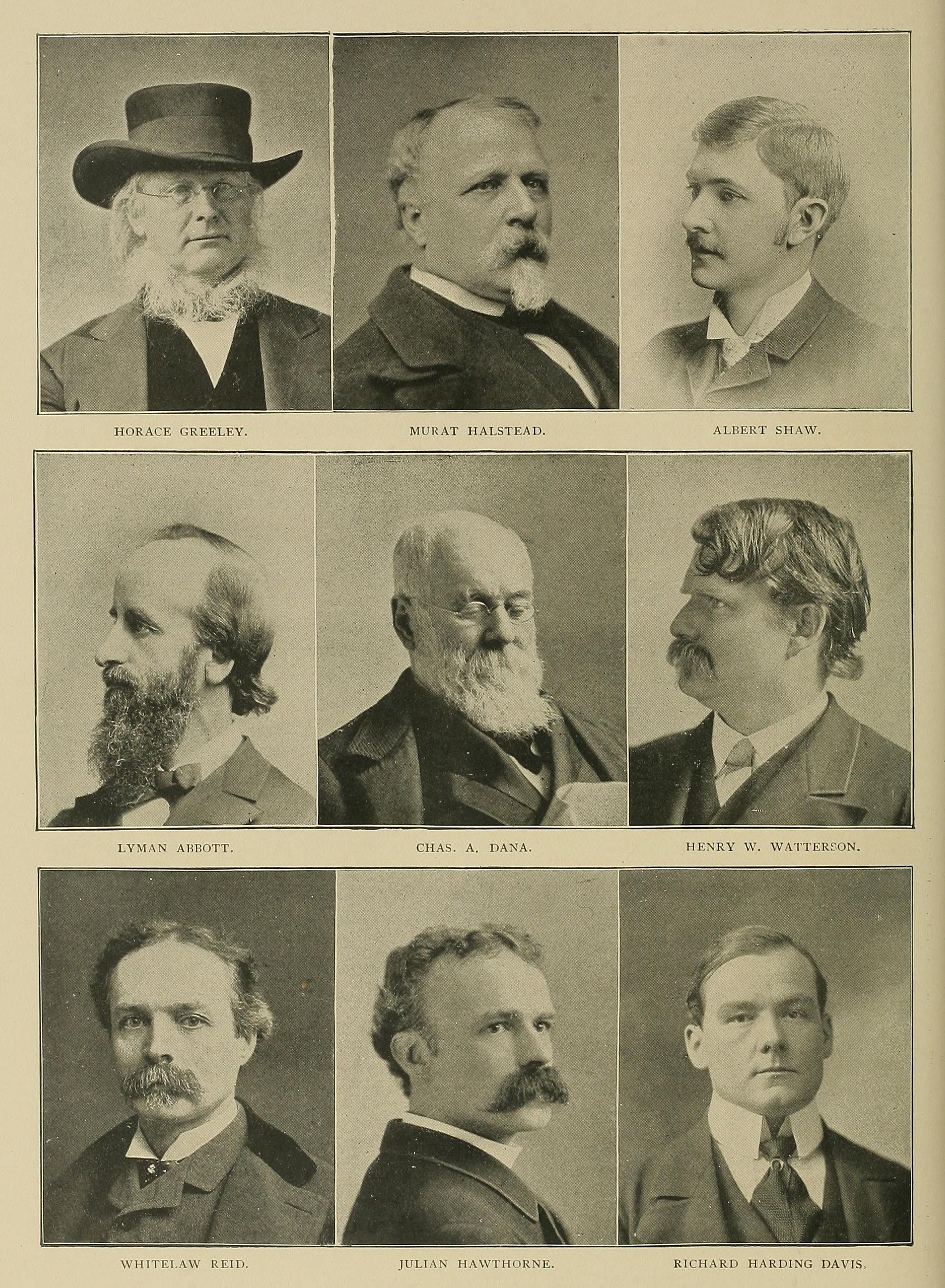
NOTED AMERICAN JOURNALISTS AND MAGAZINE CONTRIBUTORS.
HORACE GREELEY • MURAT HALSTEAD • ALBERT SHAW LYMAN ABBOTT • CHAS. A. DANA • HENRY W. WATTERSON WHITELAW REID • JULIAN HAWTHORNE • RICHARD HARDING DAVIS

HORACE GREELEY.
THE FOUNDER OF MODERN JOURNALISM.
HE men of whom we love to read are those who stand for some great principle, whose lives and deeds exemplify its power. When we think of patriotism, the figure of Washington rises before us, as the man whose life, above all others, was controlled by pure love of country. Practical wisdom, shrewdness, and thrift are embodied in Benjamin Franklin. Astor and Girard represent the power of accumulation; Stewart, Carnegie, and Pullman, the power of organization; and so, when we consider the power of the press, the image which comes up before our mental view is that of Horace Greeley. In almost every personal quality there have been men who far surpassed him,—men who were greater as politicians, as organizers, as statesmen, as speakers, as writers,—but in the one respect of influencing public opinion through the press, of “making his mind the mind of other men,” no man in America has ever wielded such power as the great editor and founder of the New York “Tribune.”

Horace Greeley was one of the poor country boys who have afterward become the bone and sinew of the Republic. He was born in Amherst, New Hampshire, in 1811. His father, Zaccheus Greeley, was a struggling farmer. He moved to Vermont in 1821, and a few years later to the western part of Pennsylvania. Horace was a precocious child; and his mother, Mary Woodburn, who was of Scotch-Irish stock, used to recite to him ballads and stories, so that he really acquired a taste for literature before the age at which many children conquer the alphabet.
In his fifteenth year Horace felt that he could endure farming no longer, and at last procured from his father a reluctant consent that he should definitely seek employment as a printer. He found the longed-for opportunity at East Poultney, Vermont, in the office of the “Northern Spectator.”
In 1830, before Horace’s apprenticeship ended, the “Spectator” collapsed, and he was again set adrift. His father had removed to Western Pennsylvania, and the boy turned his face in that direction. After working for a few months on different country papers, he resolved to try his fortune in New York, and went to that city in August, 1831.
After two years of labor as a printer, so arduous that during much of the time it extended to fourteen hours a day, Mr. Greeley commenced his first editorial work upon a weekly paper called the “New Yorker” of which he was part owner and which lasted until March, 1841, when it went under, with a credit on its books of $10,000 due to Mr. Greeley for editing the paper, all of which was sunk with the wreck.
In the famous campaign of 1840, when Harrison was “sung and shouted into the presidential chair,” Greeley started a small weekly called the “Log Cabin.” He threw all his spirit and energy into it; he made it lively, crisp, and cheap. It attained an almost unheard-of success, reaching editions of eighty and ninety thousand. It was continued for several months after the triumphant election of Harrison, and then merged into the New York “Tribune,” which Greeley started at this time, the first issue appearing April 10, 1841.
The new enterprise soon became successful. It was helped at the start by a bitter attack from the “Sun,” then in the hands of Moses Y. Beach. The defense and rejoinders were equally pungent and amusing. Mr. Greeley always throve best upon opposition. His spicy retorts, and especially his partisan enthusiasm, forced the attention of the public, and the subscription-list of the “Tribune” soon rose from hundreds to thousands; by the third week in May it had 10,000 names on its books.
One thing in particular gave the “Tribune” eminence; that was Greeley’s policy of employing as contributors the best writers of the time. To name all the able men and women who thus won fame for both themselves and the “Tribune,” would make a list too long to print; but among them may be mentioned Bayard Taylor, whose “Views Afoot” first appeared in the form of letters to the “Tribune;” Margaret Fuller, whose articles gave her a wide reputation; George Ripley, Moncure D. Conway, Sydney Howard Gay, and George W. Smalley; and for years Thomas Hughes, the popular author of “Tom Brown at Oxford,” sent frequent and able letters from London. The result of this liberal policy was to make the “Tribune” indispensable to people of intelligence, even though utterly opposed to its political views.
In 1848 Mr. Greeley was elected to Congress, but his strength was as a journalist, not as a legislator. At the close of his brief term he retired from Congress, and during the stormy decade preceding the Civil War he made the “Tribune” a mighty power. He warmly espoused the cause of freedom, and denounced the Fugitive Slave Law, the Kansas-Nebraska Bill, and the endless aggressions of the slave power with a vigor and pertinacity which made him one of the best-hated men in America. His course was not always consistent; and he often brought upon his head the wrath of friends as well as enemies. Moreover, in the conduct of a great daily paper much must be left to the judgment of subordinates; and all their mistakes were, of course, laid to the charge of their chief. Many of the old readers of the “Tribune” supposed that every line in the paper was actually written by Horace Greeley. He rarely took the trouble to justify or explain; and, therefore, while in one sense one of the best-known men in the country, he was one of the most misunderstood. Mr. Greeley had no time or thought for personal explanations; he was bent upon saving the country,—individuals could take care of themselves.
During the war Mr. Greeley’s course was somewhat erratic and unstable, but he kept a hold upon a large class of readers who believed in him, to whom he was a mental and moral lawgiver, who refused to believe any evil of him; and, if some visitor to the city—for a large proportion of “Tribune” readers were country, and particularly Western, people—on coming back, reported that in an interview with Mr. Greeley the editor had indulged in unlimited profanity, the unlucky individual was incontinently discredited and voted a calumniator.
In the years following the war, Greeley’s pen was more busy than ever. Beside his editorial writing in the “Tribune,” he prepared the second volume of his war history, “The American Conflict,” and his delightful autobiography, “Recollections of a Busy Life.” He was always intensely interested in the growth of the West, where he had made a memorable tour in 1859, extending to Salt Lake City; and now he unceasingly advocated western emigration. His terse advice, “Go West, young man, and grow up with the country,” became a sort of national watchword, and many thousands of Eastern people resolved to turn their faces toward the empire of the West.
In 1872 a curious political combination was made. Probably such a surprise was never sprung upon the country as the nomination of Horace Greeley for the Presidency, by a convention of “Liberal Republicans” and bolting Democrats. That he should be defeated at the polls was inevitable. He worked hard through the canvass, traveling and addressing meetings; body and mind suffered from the fatigue and excitement. To add to his troubles, Mrs. Greeley, who had been out of health for a considerable time, died at this period; his health gave way; he became unable to sleep; and sleeplessness was followed by inflammation of the brain, which soon ended his life.
Horace Greeley sleeps in Greenwood Cemetery, Long Island, on a hill overlooking the beautiful bay of New York, and within sight of the great city where his busy life was spent.
A DEBTOR’S SLAVERY.
(FROM “RECOLLECTIONS OF A BUSY LIFE.”)
HE New Yorker was issued under my supervision, its editorials written, its selections made for the most part by me, for seven years and a half from March 22, 1834. Though not calculated to enlist partisanship, or excite enthusiasm, it was at length extensively liked and read. It began with scarcely a dozen subscribers; these steadily increased to 9,000; and it might under better business management (perhaps I should add, at a more favorable time), have proved profitable and permanent. That it did not was mainly owing to these circumstances: 1. It was not extensively advertised at the start, and at least annually thereafter, as it should have been. 2. It was never really published, though it had half-a-dozen nominal publishers in succession. 3. It was sent to subscribers on credit, and a large share of them never paid for it, and never will, while the cost of collecting from others ate up the proceeds. 4. The machinery of railroads, expresses, news companies, news offices, etc., whereby literary periodicals are now mainly disseminated, did not then exist. I believe that just such a paper issued to-day, properly published and advertised, would obtain a circulation of 100,000 in less time than was required to give the New Yorker scarcely a tithe of that aggregate, and would make money for its owners, instead of nearly starving them, as mine did. I was worth at least $1,500 when it was started; I worked hard and lived frugally throughout its existence; it subsisted for the first two years on the profits of our job-work; when I, deeming it established, dissolved with my partner, he taking the jobbing business and I the New Yorker, which held its own pretty fairly thenceforth till the commercial revulsion of 1837 swept over the land, whelming it and me in the general ruin.

I had married in 1836, deeming myself worth $5,000, and the master of a business which would thenceforth yield me for my labor at least $1,000 per annum; but, instead of that, or of any income at all, I found myself obliged throughout 1837 to confront a net loss of about $100 per week—my income averaging $100, and my inevitable expenses $200. It was in vain that I appealed to delinquents to pay up; many of them migrated; some died; others were so considerate as to order the paper stopped, but very few of these paid; and I struggled on against a steadily rising tide of adversity that might have appalled a stouter heart. Often did I call on this or that friend with intent to solicit a small loan to meet some demand that could no longer be postponed nor evaded, and, after wasting a precious hour, leave him, utterly unable to broach the loathsome topic. I have borrowed $500 of a broker late on Saturday, and paid him $5 for the use of it till Monday morning, when I somehow contrived to return it. Most gladly would I have terminated the struggle by a surrender; but, if I had failed to pay my notes continually falling due, I must have paid money for my weekly supply of paper—so that would have availed nothing. To have stopped my journal (for I could not give it away) would have left me in debt, beside my notes for paper, from fifty cents to two dollars each, to at least three thousand subscribers who had paid in advance; and that is the worst kind of bankruptcy. If anyone would have taken my business and debts off my hands, upon my giving him my note for $2,000, I would have jumped at the chance, and tried to work out the debt by setting type, if nothing better offered. If it be suggested that my whole indebtedness was at no time more than $5,000 to $7,000, I have only to say that even $1,000 of debt is ruin to him who keenly feels his obligation to fulfil every engagement yet is utterly without the means of so doing, and who finds himself dragged each week a little deeper into hopeless insolvency. To be hungry, ragged, and penniless is not pleasant; but this is nothing to the horrors of bankruptcy. All the wealth of the Rothschilds would be a poor recompense for a five years’ struggle with the consciousness that you had taken the money or property of trusting friends—promising to return or pay for it when required—and had betrayed this confidence through insolvency.
I dwell on this point, for I would deter others from entering that place of torment. Half the young men in the country, with many old enough to know better, would “go into business”—that is, into debt—to-morrow, if they could. Most poor men are so ignorant as to envy the merchant or manufacturer whose life is an incessant struggle with pecuniary difficulties, who is driven to constant “shinning,” and who, from month to month, barely evades that insolvency which sooner or later overtakes most men in business; so that it has been computed that but one in twenty of them achieve a pecuniary success. For my own part—and I speak from sad experience—I would rather be a convict in a State prison, a slave in a rice swamp, than to pass through life under the harrow of debt.
Let no young man misjudge himself unfortunate, or truly poor, so long as he has the full use of his limbs and faculties, and is substantially free from debt. Hunger, cold, rags, hard work, contempt, suspicion, unjust reproach, are disagreeable; but debt is infinitely worse than them all. And, if it had pleased God to spare either or all of my sons to be the support and solace of my declining years, the lesson which I should have most earnestly sought to impress upon them is—“Never run into debt! Avoid pecuniary obligation as you would pestilence or famine. If you have but fifty cents, and can get no more for a week, buy a peck of corn, parch it, and live on it, rather than owe any man a dollar!” Of course I know that some men must do business that involves risks, and must often give notes and other obligations, and I do not consider him really in debt who can lay his hands directly on the means of paying, at some little sacrifice, all that he owes; I speak of real debt—which involves risk or sacrifice on the one side, obligation and dependence on the other—and I say, from all such, let every youth humbly pray God to preserve him evermore.
THE PRESS.

ONG slumbered the world in the darkness of error,
And ignorance brooded o’er earth like a pall;
To the sceptre and crown men abased them in terror,
Though galling the bondage, and bitter the thrall;
When a voice, like the earthquake’s, revealed the dishonor—
A flash, like the lightning’s, unsealed every eye,
And o’er hill-top and glen floated liberty’s banner,
While round it men gathered to conquer or die!
’Twas the voice of the Press, on the startled ear breaking,
In giant-born prowess, like Pallas of old;
’Twas the flash of intelligence, gloriously waking
A glow on the cheek of the noble and bold;
And tyranny’s minions, o’erawed and affrighted,
Sought a lasting retreat from its powerful control,
And the chains which bound nations in ages benighted,
Were cast to the haunts of the bat and the mole.
Then hail to the Press! chosen guardian of Freedom!
Strong sword-arm of justice! bright sunbeam of truth;
We pledge to her cause (and she has but to need them),
The strength of our manhood, the fire of our youth;
Should despots e’er dare to impede her free soaring,
Or bigot to fetter her flight with his chain,
We pledge that the earth shall close o’er our deploring,
Or view her in gladness and freedom again.
But no!—to the day-dawn of knowledge and glory,
A far brighter noontide-refulgence succeeds,
And our art shall embalm, through all ages, in story,
Her champion who triumphs—her martyr who bleeds,
And proudly her sons shall recall their devotion,
While millions shall listen to honor and bless,
Till there bursts a response from the heart’s strong emotion,
And the earth echoes deep with “Long Life to the Press!”


CHARLES A. DANA.
THE FAMOUS EDITOR OF THE “SUN.”
HE man who with Greeley made the New York “Tribune” one of the greatest powers in the land, and who, from 1868 to 1897, was the chief and managing editor of the New York “Sun,” is certainly entitled to rank among our foremost men. Charles A. Dana lived a remarkable life, a life of strenuous effort and of continuous and notable achievement. He was born at Hinsdale, New Hampshire, in 1819, but his early life was passed at the village of Gaines, in Western New York, in Buffalo, and at Guildhall, Vermont. One of his earliest recollections was of being tied to a post with his mother’s garter because he had run away and gotten himself very muddy, thus displaying, at three years old, the restless spirit of enterprise which did much to make him the man he was. When he was eleven years old he returned to Buffalo to be a clerk in his uncle’s dry goods store. He was very successful as a salesman, and remained in the establishment until the failure of the business, in 1837, when he determined to prepare himself for college. He said that he found the elements of Latin very hard and disagreeable work, and he had the greatest difficulty in remembering the paradigms. Two winter terms at a country school, in his early boyhood, and two years at Harvard completed Mr. Dana’s systematic education, as too close application affected his eyesight, and he was obliged to withdraw from college at the end of his sophomore year. He had cultivated such a taste for languages, however, that no year since passed which he did not devote in part to serious study, and he became master of most spoken languages except the Slavonic and Oriental, and he began, at the age of seventy-five, the study of Russian. Harvard College afterward conferred upon him the degree which he was prevented from earning in the regular way, and is proud to count him among her most honored sons.
After leaving college Mr. Dana joined that remarkable body of men and women who conducted the Brook Farm experiment. He distinguished himself as one of the very few practical men among that band of philosophers, and gained, while at Brook Farm, a little experience in the newspaper business in conducting a publication known as “The Harbinger,” which was the organ of the association.
In 1844 his eyes had sufficiently recovered to enable him to do regular work, and he obtained employment under Elizur Wright, better known as an insurance actuary than as an editor, but who then conducted “The Chronotype,” an orthodox newspaper, which was a great favorite with the Congregational ministers of New England. Mr. Wright used to enjoy telling how “Dana always had a weakness for giving people with fixed convictions something new to think about,” and how he illustrated this weakness during the absence of his chief by writing strong editorials against the doctrine of a bill. This piece of enterprise involved the editor-in-chief in the labor of writing a personal letter to each of his ministerial subscribers, and to many others explaining how the paper “had been left in charge of a young man without mellow journalistic experience.” Mr. Dana’s compensation was five dollars per week, and at this amount it remained until 1847, when he joined the staff of the New York “Tribune” at ten dollars, a figure which was gradually increased to fifty dollars, which was the highest salary he ever received on the “Tribune.” Many delightful stories are told of the intercourse of Dana and Greeley. The part they took in politics, the fight against slavery, the organization of the Republican Party, Mr. Dana’s loyal support of Greeley’s aspirations for political preferment, all these are a part of the political history of our country. Just before joining the “Tribune” staff Mr. Dana was married to Miss Eunice MacDaniel, of New York. Of his delight in family life no testimony can be stronger than his own words written during a brief interval of leisure: “I have been busy with my children, drawing them about in old Bradley’s one-horse wagon, rowing and sailing with them on the bay and sound, gathering shells on the shore with them, picking cherries, lounging on the grass with the whole tribe about me. There’s no delight like that in a pack of young children of your own.... A house without a baby is inhuman.”
During these busy years Mr. Dana, together with Mr. Ripley, edited “The American Cyclopedia,” a work which is a monument of his care and learning and patient labor; and he also prepared and published a “Household Book of Poetry,” one of the very best collections of its kind, and one which has found its way into a very large number of American homes and contributed in no small measure to further the cause of good literature. In 1862 there came about a radical difference between Mr. Greeley and Mr. Dana as to the proper policy of the “Tribune” in regard to the war. The result was Mr. Dana’s withdrawal from the paper. He was immediately asked by Mr. Stanton to audit a large number of disputed claims in the quartermaster’s office at Cairo. This led to his appointment as Assistant Secretary of War, which position he held until the end of the Rebellion. About one-third of his time during this period was spent with the armies at the front. In this way he served as the confidential agent of the administration, and was once styled by Mr. Lincoln “the eyes of the Government at the front.” His reports were remarkable for their unconventional form, their brevity, and the completeness and accuracy with which they placed Stanton and Lincoln in possession of the exact facts. “Miles of customary military reports,” says a recent writer, “were worth less to Lincoln than half a dozen of Dana’s vivid sentences.”
After the close of the war Mr. Dana spent one year in Chicago as editor of “The Republican.” He had been deceived about the financial basis of the enterprise, and was in no way responsible for its failure. Returning to New York, he organized the company which purchased the old “Sun” property, and started the paper on a long career of success and of influence. He was probably the most independent man who ever managed a great newspaper. He possessed the power of working without that conscious effort which characterizes the activity of most men, and which seems to be the source of so many early break-downs. He was not easily disturbed. At the “Sun” office, they like to tell a doubtful story of the old days when the work of the paper was conducted in four small rooms. The city editor came hurriedly in exclaiming, “Mr. Dana, there’s a man out there with a cocked revolver. He is very much excited. He insists on seeing the editor-in-chief.” “Is he very much excited?” said Mr. Dana, hardly looking up from his work, “if you think it worth the space, ask Amos Cummings if he will kindly see the gentleman and write him up.” A noted sensational clergyman once volunteered to write, under an assumed name, for the “Sun.” He foolishly tried to adapt himself to what he imagined was the irresponsible tone of a Sunday paper, and there can be no doubt that Mr. Dana enjoyed writing in blue pencil across the back of his first article, “This is too wicked.”
During the winter the great editor occupied his house on Madison Avenue and Sixtieth Street, but his summer house was on a little island, two or three miles from Glen Cove, which his wide knowledge of trees and fruits and flowers enabled him to make a singularly delightful spot. In the summer of 1897, when Mr. Dana was approaching his eightieth year, and still continued to manage his great newspaper, surrounded by a corps of trained and efficient men, he was attacked with a serious illness, and passed away on the afternoon of October 17th. It is doubted whether any other man has left his mark more deeply on the nineteenth century than has the famous editor of the “Sun.”
ROSCOE CONKLING.
(THE NEW YORK “SUN,” APRIL 18, 1888.)
HE most picturesque, striking, and original figure of American politics disappears in the death of Roscoe Conkling. Alike powerful and graceful in person, he towered above the masses of men in the elasticity of his talents and the peculiarities and resources of his mental constitution as much as he did in form and bearing. Yet his career cannot be called a great success, and he was not a great man.
But he was an object of great love and admiration to an extraordinary circle of friends, including not alone those who shared his opinions, but many who were utterly opposed to them. He was by nature a zealous partisan, and it was his inclination to doubt the good sense and the disinterestedness of those who were on the other side; but, nevertheless, the strongest instinct of his nature was friendship, and his attachments stood the test of every trial except such as trenched upon his own personality. This he guarded with the swift jealousy of most intense selfhood, and no one could in any way impinge upon it and remain his friend. Then, his resentments were more lasting and more unchangeable than his friendships. This, in our judgment, was the great weakness of the man. Who can say that in his innermost heart Conkling did not deplore it? At any rate, the candid observer who sums up his history must deplore it for him. “And the recording angel, as he wrote it down, dropped a tear upon the word and blotted it out forever.”
For a long period Mr. Conkling was a great political power in New York and in the country. This was during the culmination of General Grant. Originally Conkling was not friendly to Grant, and when the latter appointed his first Cabinet, the Senator’s condemnation was unreserved and stinging. This attitude was maintained during nearly the whole of Grant’s first year in the Presidency. At that time Senator Fenton stood near the President and dispensed the political bounty of the Administration. This Conkling could not endure, and when Congress met in December, 1869, he was full of war. But it soon got abroad that Fenton was a candidate for the Presidency. This settled the difficulty and brought the rival Senator into intimate relations with the President. This position he ever afterwards maintained, and it formed the most successful and to him the most satisfactory portion of his life. When Grant was finally defeated at Chicago in 1880, and all hopes of his restoration to the White House was obliterated, the Senator soon abandoned the field of his renown, and went back to the disappointments and struggles of private life.
As we have said, friendship was the greatest positive force in Mr. Conkling’s character, and there never was any hesitation or any meanness in his bestowal of it. In this respect he was the most democratic of men. He was just as warmly devoted to persons holding low places in the social scale as to the great and powerful, and he was just as scrupulous in his observation of all the duties of a friend toward the one kind of people as toward the other. There was nothing snobbish about him. He would go as far and exert himself as greatly to serve a poor man who was his friend as to serve one who was rich and mighty. This disposition he carried into politics. He had very little esteem for office-giving as a political method; but if a friend of his wanted a place, he would get it for him if he could. But no important politician in New York ever had fewer men appointed on the ground that they were his friends or supporters. His intense and lofty pride could not thus debase itself.
It is esteemed a high thing that with all the powers he wielded and the opportunities opened to him under a President the least scrupulous ever known in our history as regards jobbery and corruption, Mr. Conkling never pocketed a copper of indecent and dishonorable gain in the course of his public life. It is a high thing, indeed, and his bitterest enemies cannot diminish the lustre of the fact. The practice of public robbery was universal. Thievery was rampant everywhere in the precincts of the Administration. The Secretary of the Navy plundered millions. The Secretary of War sold public places and put the swag in his pocket. The Secretary of the Interior was forced by universal indignation to resign his ill-used office. The private secretaries of the President dealt in whiskey and defrauded the revenue. The vast gambling scheme of Black Friday had its fulcrum within the portals of the White House, and counted the President’s own family among its conspirators. It was a period of shameless, ineffable, unblushing villainy pervading the highest circles of public power. And while all Republican statesmen, leaders, and journalists knew it, condoned it, defended it even, the best they could, Mr. Conkling was the special spokesman, advocate, and orator of the Administration which was the creator of a situation so unprecedented and revolting. But while he thus lived and moved in the midst of corruption, he was not touched by it himself. The protector of brigands and scoundrels before the tribunal of public opinion, he had no personal part in their crimes and no share in their spoils. As the poet went through hell without a smutch upon his garments, so the proud Senator, bent chiefly upon the endurance of the Republican party, came out of that epoch of public dishonesty as honest and as stainless as he entered it.
In the records of the higher statesmanship it can be said that there is very much to the credit of Mr. Conkling’s account. As a parliamentary champion he had perhaps no superior; but others appear to have originated and perfected the measures to which in either House of Congress he gave the support of potent logic, fertile illustration, aggressive repartee, and scathing sarcasm. We do not recall a single one of the great and momentous acts of Congress which were passed in his time, of which he can certainly be pronounced the author. Yet his activity was prodigious, and it was a strange freak of his complicated character to bring before the House or Senate, through others, propositions which he thought essential. His hand could often be recognized in motions and resolutions offered on all sides of the chamber, and often by members with whom he was not known to be familiar.
The courage of Mr. Conkling, moral as well as personal, was of a heroic strain. After his mind was made up, he feared no odds, and he asked no favor. He dared to stand out against his own party, and he, a Republican, had the nerve to confront and defy the utmost power of a Republican administration. There was something magnanimous, too, in the way he bore misfortune. After the death of a distinguished man, with whom he had been very intimate, it was ascertained that his estate instead of being wealthy, was bankrupt. Mr. Conkling was an endorser of his notes for a large sum of money, and saying calmly, “He would have done as much for me,” he set himself to the laborious task of earning the means to pay off the debt. He paid it in no long time, and we don’t believe that any man ever heard him murmur at the necessity.
In social life Mr. Conkling endeared himself to his intimates, not only by the qualities which we have endeavored to describe and indicate, but by the richness of his conversation, and the wit and humor—sometimes rather ponderous—with which it was seasoned, and by the stores of knowledge which he revealed. His reading had been extensive, especially in English literature, and his memory was surprisingly tenacious. Many of the most impressive passages of oratory and of literature he could repeat by heart. He was fond of social discussion on all sorts of questions, and liked no one the less who courteously disagreed with him.
As a lawyer, we suppose that his great ability was in cross-examination and with juries. The exigencies and the discussive usage of political life prevented that arduous, persevering application to pure law which is necessary to make a great jurist; but his intellectual powers were so vigorous and so accurate that he made up the deficiency of training and habit and no one can doubt that, if he had given himself to the law alone, he would have gained a position of the very highest distinction. As it was, the most eminent counsel always knew that he had a formidable antagonist when Mr. Conkling was against him; and every court listened to his arguments, not merely with respect, but with instruction.
We shall be told, of course, that the supreme fault of this extraordinary mind was in perfection of judgment; and when we consider how largely his actions were controlled by pride and passion, and especially by resentment, we must admit that the criticism is not wholly without foundation. There was also in his manner that which might justify the belief that often he was posing for effect, like an actor on the stage; and we shall not dispute that so at times it may have been. But there are so few men who are entirely free from imperfection, and so many who inherit from their ancestors characteristics which ought to be disapproved, that we may well overlook them when they are combined with noble and admirable gifts. And after all has been said, even those whom he opposed most strenuously, and scorned or resisted most unrelentingly, may remember that we are all human, while they let fall a tear and breathe a prayer to heaven as the bier of Roscoe Conkling passes on its way to the grave.

LYMAN ABBOTT.
PASTOR OF PLYMOUTH CHURCH, EDITOR OF “THE OUTLOOK.”
IDE sympathies and broad Christian charity are potent factors in the uplifting of men, and there have been many in America who have exhibited these characteristics, but few possess them to a greater degree than the present pastor of the Plymouth Church, Brooklyn, Lyman Abbott. He comes of good New England stock, and was born December 18, 1835, at Roxbury, Massachusetts. He is the third son of Jacob Abbott, so dear to the children of the past generation, as the author of those books which were the delight of the childhood of many still living—the “Rollo Books,” the “Jonas Books,” and the “Lucy Books.” The plain, practical, broad common sense in Jacob Abbott, which dictated the composition of these attractive realistic stories, has been inherited in large measure by his son. Lyman Abbott was graduated from the University of the City of New York, in 1853, then studied law and was admitted to the bar. He soon found that the ministry had greater attraction for him than the law, and after studying theology with his uncle, John S. C. Abbott, so well-known as the author of the “Life of Napoleon Bonaparte,” he was ordained in 1860, a minister of the Congregational Church. He went the same year to take charge of a congregation at Terre Haute, Indiana. After five years’ work he became discouraged, for there seemed to be little or no fruit from his labors. He came to the conclusion that, after all, he had mistaken his calling, and so in 1865 he accepted the position of Secretary to the American Freedman’s Commission, an office which took him to New York. Returning to Terre Haute on a visit, he saw that his previous labors had not been in vain, but had brought forth abundant fruit in the lives of former members of his congregation. It was perhaps this fact that induced him to re-enter the ministry, and for three years to be the pastor of the New England Church in New York. He did not, however, lay aside the literary work he had taken up while connected with the Freedman’s Association. He conducted the “Literary Record” in “Harper’s Monthly,” and became editor of “The Illustrated Christian Weekly” in 1871. Resigning his connection with other papers he became joint editor with Henry Ward Beecher of the “Christian Union” in 1876, and its chief editor in 1881. After some years the name of the paper was changed to “The Outlook,” as indicating more nearly the character of the journal. In October, 1887, after the death of Henry Ward Beecher, he was chosen temporary Pastor of the Plymouth Church in Brooklyn, and later he was invited to remain permanently at the head of that large congregation. He has written much, and has published a number of volumes, nearly all upon religious subjects, but his influence has been chiefly exerted through the pulpit, and especially through the columns of the “Christian Union” and “The Outlook,” one of the most ably conducted weeklies in the country. Popular in its presentation, trenchant in its comments upon contemporary men and events, clear and unmistakable in its position, few papers have a more decided influence upon their readers. Its tone is high, and its view of what is going on in the world is wide and comprehensive. All subjects are treated fearlessly and independently, and truth, purity, and earnestness in religion and politics are insisted upon. Not the least interesting columns of the paper are those devoted to “Notes and Queries,” where, in a few well-chosen words, the difficulties of correspondents are answered, and at the same time valuable lessons are enforced. Lyman Abbott is one of the leaders of liberal Christian thought, is sympathetic with every movement for the advancement of mankind, a strong believer in practical Christianity, and a hater of all kinds of cant.

As a speaker differing widely from his great predecessor in the Plymouth pulpit, Lyman Abbott’s success is due to the clearness with which he presents his subject, to his earnestness, and to his practical way of putting things.
THE JESUITS.¹
(FROM “DICTIONARY OF RELIGIOUS KNOWLEDGE.”)
ESUITS is the popular name of a Society more properly entitled “The Society of Jesus”—of all the Religious Orders of the Roman Catholic Church the most important. The Society of Jesus was founded in 1554 by Ignatius Loyola. He was a Spanish cavalier; was wounded in battle; was by his wounds, which impaired the use of one of his legs, deprived of his military ambition, and during his long confinement found employment and relief in reading a Life of Christ, and Lives of the Saints. This enkindled a new ambition for a life of religious glory and religious conquest. He threw himself, with all the ardor of his old devotion, into his new life; carried his military spirit of austerity and self-devotion into his religious career; exchanged his rich dress for a beggar’s rags; lived upon alms; practiced austerities which weakened his iron frame, but not his military spirit; and thus he prepared his mind for those diseased fancies which characterized this period of his ♦extraordinary career.

He possessed none of the intellectual requirements which seemed necessary for the new leadership which he proposed to himself. The age despised learning, and left it to the priests; and this Spanish cavalier, at the age of thirty-three, could do little more than read and write. He commenced at once, with enthusiasm, the acquisition of those elements of knowledge which are ordinarily acquired long before that age. He entered the lowest class of the College of Barcelona, where he was persecuted and derided by the rich ecclesiastics, to whose luxury his self-denial was a perpetual reproach. He fled at last from their machinations to Paris, where he continued his studies under more favorable auspices. Prominent among his associates here was Francis Xavier, a brilliant scholar, who at first shrunk from the ill-educated soldier; yet gradually learned to admire his intense enthusiasm, and then to yield allegiance to it and its possessor. Several other Spaniards were drawn around the ascetic. At length, in 1534, Loyola, and five associates, in a subterranean chapel in Paris, pledged themselves to a religious life, and with solemn rites made sacred their mutual pledges to each other and to God.
Loyola introduced into the new order of which he was the founder, the principle of absolute obedience which he had acquired in his military career. The name given to its chief was the military title of “General.” The organization was not perfected, so as to receive the sanction of the Pope, until 1541. Its motto was Ad Majorem Dei Gloriam—“To the greater Glory of God.” Its vows embraced not only the obligations of Chastity, Poverty, and Obedience, but also a pledge on the part of every member to go as missionary to any country which the Pope might designate. Loyola was himself the first General of the new Order. Its Constitution, due to him, is practically that of an Absolute Monarchy. The General is elected by a General Congregation, selected for the purpose by the whole body of professed members in the various Provinces. He holds his office for life. A Council of Assistants aid him, but he is not bound by their vote. He may not alter the Constitution of the Society; and he is subject to deposition in certain contingencies; but no instance of the deposition of a General has ever occurred. Practically his will is absolute law, from which there is no appeal.
The Jesuits are not distinguished by any particular dress or peculiar practices. They are permitted to mingle with the world, and to conform to its habits, if necessary for the attainment of their ends. Their widest influence has been exhibited in political circles, where, as laymen, they have attained the highest political positions without exciting any suspicion of their connection with the Society of Jesus; and in education they have been employed as teachers, in which position they have exercised an incalculable influence over the Church.... It should be added that the enemies of the Order allege that, in addition to the public and avowed Constitution of the Society, there is a secret code, called Monita Secreta—“Secret Instructions”—which is reserved exclusively for the private guidance of the more advanced members. But as this Secret Code is disavowed by the Society—and since its authority is at least doubtful—it is not necessary to describe it here in detail.
THE DESTRUCTION OF THE CITIES OF THE PLAIN.¹
(FROM “OLD TESTAMENT SHADOWS.”)
HE story of Sodom and Gomorrah epitomizes the Gospel. Every act in the great, the awful drama of life is here foreshadowed. The analogy is so perfect that we might almost be tempted to believe that the story is a prophetic allegory, did not nature itself witness its historic truthfulness. The fertile plain contained, imbedded in its own soil, the elements of its own destruction. There is reason to believe that this is true of this world on which we live. A few years ago an unusually brilliant star was observed in a certain quarter of the heavens. At first it was thought to be a newly discovered sun; more careful examination resulted in a different hypothesis. Its evanescent character indicated combustion. Its brilliancy was marked for a few hours—a few nights at most—then it faded, and was gone. Astronomers believe that it was a burning world. Our own earth is a globe of living fire. Only a thin crust intervenes between us and this fearful interior. Ever and anon, in the rumbling earthquake, or the sublime volcano, it gives us warning of its presence. These are themselves gospel messengers. They say if we would but hear them—“Prepare to meet thy God.” The intimations of science confirm those of Revelation: “The heavens and the earth ... are kept in store, reserved unto the fire against the Day of Judgment and perdition of ungodly men.” What was true of Sodom and Gomorrah—what was true of the earth we live on—is true of the human soul. It contains within itself the instruments of its own punishment. There is a fearful significance in the words of the Apostle: “After thy hardness and impenitent heart treasureth up to thyself wrath against the day of wrath.” Men gather, with their own hands, the fuel to feed the flame that is not quenched; they nurture in their own bosoms the worm that dieth not. In habits formed never to be broken; in words spoken, incapable of recall; in deeds committed, never to be forgotten; in a life wasted and cast away that can never be made to bloom again, man prepares for himself his own deserved and inevitable chastisement. “Son, remember!”—to the soul who has spent its all in riotous living, there can be no more awful condemnation.

HENRY WATTERSON.
EDITOR OF THE LOUISVILLE “COURIER-JOURNAL.”
EW men connected with modern journalism have wider influence than Henry Watterson. He was born in Washington, D. C., in 1850, and because of defective eyesight, was educated chiefly by a private tutor. Entering journalism, at first in Washington and later in Tennessee, he made his reputation as editor of the “Republican Banner,” in Nashville. He served in the Confederate Army in various capacities, being a staff officer at one time and Chief of Scouts in General Joseph E. Johnston’s army in 1864. After the war he returned to Nashville, but soon removed to Louisville, Kentucky, where he succeeded George D. Prentice as editor of the “Journal.” In the following year he succeeded in uniting with the “Journal,” the “Courier” and the “Times,” thus founding the “Courier-Journal,” of which he has since been editor, and which, under his management, has come to be one of the foremost papers of the country.

Mr. Watterson has taken a prominent part in politics, having been a member of every Presidential convention beginning with 1876. He was a personal friend and a resolute follower of Samuel J. Tilden. He has often appeared as a public speaker, particularly in political campaigns, and his judgment has had great weight in the councils of the Democratic party. Mr. Watterson is a pronounced “free-trader,” but has had no sympathy with the political movements under the leadership of Grover Cleveland.
He has been a frequent contributor to periodicals and has edited one or two books, notably that entitled “Oddities of Southern Life and Character.” The sustained vigor of his mind, the force of his personality and the wide-spread admiration for his abilities, make Mr. Watterson one of the leading men, not only of his party, but of the country.
THE NEW SOUTH.
(FROM “SPEECH AT THE NATIONAL BANKERS’ CONVENTION, LOUISVILLE, KY., OCTOBER 11, 1883.”)
T was not, however, to hear of banks and bankers and banking that you did me the honor to call me before you. I am told that to-day you are considering that problem which has so disturbed the politicians—the South—and that you wish me to talk to you about the South. The South! The South! It is no problem at all. I thank God that at last we can say with truth, it is simply a geographic expression. The whole story of the South may be summoned up in a sentence: She was rich, and she lost her riches; she was poor and in bondage; she was set free, and she had to go to work; she went to work, and she is richer than ever before. You can see it was a groundhog case. The soil was here, the climate was here, but along with them was a curse, the curse of slavery. God passed the rod across the land and smote the people. Then, in His goodness and mercy, He waved the wand of enchantment, and lo, like a flower, His blessing burst forth! Indeed, may the South say, as in the experience of men it is rare for any to say with perfect sincerity:

“Sweet are the uses of adversity.”
The South never knew what independence meant until she was taught by subjection to subdue herself. She lived from hand to mouth. We had our debts and our niggers. Under the old system we paid our debts and walloped our niggers. Under the new we pay our niggers and wallop our debts. We have no longer any slaves, but we have no longer any debts, and can exclaim with the old darkey at the camp-meeting, who, whenever he got happy, went about shouting, “Bless the Lord! I’m gettin’ fatter an’ fatter!”
The truth is, that behind the great ruffle the South wore to its shirt, there lay concealed a superb manhood. That this manhood was perverted, there is no doubt. That it wasted its energies upon trifles, is beyond dispute. That it took a pride in cultivating what it called “the vices of a gentleman,” I am afraid must be admitted. But, at heart, it was sound; from that heart flowed honest Anglo-Saxon blood; and, when it had to lay aside its “store-clothes” and put on its homespun, it was equal to the emergency. And the women of the South took their place by the side of the men of the South, and, with spinning-wheel and ploughshare, together they made a stand against the wolf at the door. That was fifteen years ago, and to-day there is not a reward offered in a single Southern State for wolf-skins. The fact is, the very wolves have got ashamed of themselves and gone to work.
I beg you to believe that, in saying this, my purpose is neither to amuse nor mislead you. Although my words may seem to carry with them an unbusiness-like levity, I assure you that my design is wholly business-like. You can see for yourselves what the South has done; what the South can do. If all this has been achieved without credit, and without your powerful aid—and I am now addressing myself to the North and East, which have feared to come South with their money—what might not be achieved if the vast aggregations of capital in the fiscal centres should add this land of wine, milk and honey to their fields of investment, and give us the same chief rates which are enjoyed by nearer, but not safer, borrowers? The future of the South is not a whit less assured than the future of the West. Why should money which is freely loaned to Iowa and Illinois be refused to Alabama and Mississippi? I perfectly understand that business is business, and that capital is as unsectional as unsentimental. I am speaking from neither spirit. You have money to loan. We have a great country to develop.
We need the money. You can make a profit off the development. When I say that we need money, I do not mean the sort of money once demanded by an old Georgia farmer, who, in the early days, came up to Milledgeville to see General Robert Toombs, at the time a director of the State Bank. “Robert,” says he, “the folks down our way air in need of more money.” The profane Robert replied: “Well, how in ―― are they going to get it?” “Why,” says the farmer, “can’t you stomp it?” “Suppose we do stomp it, how are we going to redeem it?” “Exactly, Robert, exactly. That was just what I was coming to. You see the folks down our way air agin redemption.” We want good money, honest money, hard money, money that will redeem itself.
We have given hostages to fortune and our works are before you. I know that the capital is proverbially timid. But what are you afraid of? Is it our cotton that alarms you, or our corn, or our sugar? Perhaps it is our coal and iron. Without you, in truth, many of these products must make slow progress, whilst others will continue to lie hid in the bowels of the earth. With you the South will bloom as a garden and sparkle as a gold-mine; for, whether you tickle her fertile plains with a straw or apply a more violent titillation to her fat mountain-sides, she is ready to laugh a harvest of untold riches.

MURAT HALSTEAD.
JOURNALIST AND POLITICIAN.
HE editor of “The Cincinnati Commercial Gazette” may be ranked as one of the greatest living journalists. He has directed the policy first of “The Commercial” and then of “The Commercial Gazette” for a space of forty years, and has wielded an influence over the people of the vast region in which his paper circulates, and, indeed, upon the whole nation, hardly second to that of any other single man. Sometimes mistaken, but always honest, fearless and persistent, his work as a journalist may be cited as a model of excellence, and he may well be described as typical of the highest form of American manhood. He is now sixty-seven years of age, but he bears his years with such buoyancy and retains so fully his powers of mind and body that he distinguished himself in 1896 by going as special correspondent to the scene of the rebellion in Cuba, writing from that island, not only a daily letter to “The New York Journal” on the military and political situation, but also a series of daily articles in “The Standard-Union,” describing the manners and customs of Havana, and relating incidents of life in the tropics in a delightfully characteristic manner.
Mr. Halstead is a native of Butler County, Ohio, a locality which has produced its full share of the notable men of our time. As the inhabitants of the neighborhood were of Welsh extraction, with no one of Irish descent among them, the name, “Paddy’s Run,” borne by their Post Office, was a cause of great offence to them. A strong party, however, among whom was Mr. Halstead, made consistent opposition to every effort to change the name, but, though the struggle was long, the whimsical title which referred to an almost forgotten incident in General Wayne’s expedition had finally to be abandoned, and the fastidious inhabitants now have their mail addressed to “Shandon.” The Halstead family came from North Carolina at the time when so many of her noble sons bore practical testimony to their belief in free institutions by refusing to remain longer in a slave state, and making, in many cases, the greatest sacrifices in order to live on free soil in the Northwest Territory.
Murat Halstead grew up on a farm and made his way through the Farmer’s College, at College Hill, Ohio, as so many men of his class have done, by alternating college work with teaching a district school. He went immediately from college into newspaper life, contributing a great variety of articles to the Cincinnati papers, and in 1853 joined the staff of “The Commercial.” He soon became part owner and controlling editor. The success of his paper has been continuous from that time, and the fact is due in greatest measure to the foresight, energy and skill of Mr. Halstead. He became prominent in a national sense during the presidential campaign of 1856, and he was probably the only man who was present at all the national conventions of 1860, and one of the very few who foresaw the terrible conflict which was to follow. He had seen the hanging of John Brown, and reported it in vigorous fashion for his paper, and he was the Washington correspondent of “The Commercial” during the trying sessions of Congress which followed. He served as correspondent at the front during a part of the war, and “The Commercial” was no small factor in the national councils during that stormy time. His independence of mind is shown in his frequent criticism of the policy of the government. On one occasion he wrote a long letter to Secretary Stanton censuring in the strongest terms the measures which had been taken and outlining those which, in his opinion, would result in success. The document was afterwards filed away in the archives of the war department, bearing an inscription characteristic of the grim humor of the great war secretary: “How to Conduct the War—Halstead, M.”
He went to Europe in 1870 with the purpose of joining the French armies, but not succeeding, managed to attach himself to those of the Germans. The experiences thus obtained not only furnished the basis of his newspaper correspondence at the time, but supplied the material for a number of delightfully instructive magazine articles. He has since visited Europe on several occasions, and in 1874 formed one of a distinguished company which made a journey to Iceland and took part in the celebration of the thousandth anniversary of its settlement. In 1872 Mr. Halstead again demonstrated his independence by breaking loose from the regular organization of the Republican party and taking part in the bolt which resulted in the nomination of Greeley for the Presidency. He was not long, however, in getting back into the ranks, but his unwillingness to submit to party discipline and his persistence in criticising men and measures when he considered that they were opposed to the public interest, has probably been the means of preventing him from election on at least one occasion to the United States Senate. When he was nominated by President Harrison to be Minister to Germany, it was undoubtedly the same cause which insured his rejection in the Senate.
For many years the “Cincinnati Gazette” and the “Commercial” had continued an energetic rivalry. Their political attitude was very much the same, and there was everything to gain and little to lose by the consolidation of the two papers which occurred early in the eighties, with Mr. Halstead as editor-in-chief, and Mr. Richard Smith, of the “Gazette,” as business Manager. Since 1884 Mr. Halstead has made his headquarters in Washington or New York; his editorial contributions going by telegraph to his paper and for several years past he has been editor of the Brooklyn “Standard Union,” and has contributed very largely to other papers, his signed articles upon the money question in “The New York Herald” being notable examples of his ability as a writer and of his grasp of the great questions of the time. The amount of work turned off by such a writer is prodigious. He says that he has undoubtedly written and published an average of more than a million words a year for forty years. If put in book form this would make in the aggregate some five hundred volumes of good size.
Mr. Halstead was married in 1857 to Miss Mary Banks. They have four grown sons, all engaged in journalism; three younger ones, and three daughters. Their family life has been all that such life should be, and the present generation of the Halsteads bears every promise of maintaining the high standard of honest thought and persistent effort set by the florid faced man, whose large figure and massive head—hair and beard long since snow white—seem likely to be conspicuous in many presidential conventions yet to come, as they have been in almost every one for nearly half a century.
TO THE YOUNG MAN AT THE DOOR.
(FROM ADDRESS ON “THE MAXIMS, MARKETS, AND MISSIONS OF THE PRESS,” DELIVERED BEFORE THE WISCONSIN PRESS ASSOCIATION, 1889.)
E need to guard against ways of exclusiveness—against the assumption that for some mysterious reason the press has rights that the people have not; that there are privileges of the press in which the masses and classes do not participate. The claim of privilege is a serious error. One either gains or loses rights in a profession. We have the same authority to speak as editors that we have as citizens. If we use a longer “pole to knock the persimmons,” it is because we have a larger constituency for our conversational ability; that doesn’t affect rights. It simply increases responsibility. One can say of a meritorious man or enterprise, or of a rascally schemer or scheme, as an editor the same that he could as a citizen, a tax-payer, a lawyer, minister, farmer, or blacksmith. It conduces to the better understanding of our business to know that we are like other folks, and not set apart, baptized, anointed, or otherwise sanctified, for an appointed and exclusive and unique service.

It is in our line of occupation to buy white paper, impress ink upon it in such form as may be expressive of the news and our views, and agreeable to our friends or disagreeable to our foes, and sell the sheet when the paper becomes, by the inking thereof, that peculiar manufactured product, a newspaper, for a margin of profit. We are as gifted and good as anybody, so far as our natural rights are concerned, and are better or worse according to our behavior. It is our position to stand on the common ground with the people, and publish the news, and tell the truth about it as well as we can; and we shall, through influences certain in their operation, find the places wherein we belong. No one can escape the logic of his labor.
Communications from young gentlemen in, or fresh from college, or active in other shops, who propose to go into journalism or newspaperdom, and want to know how to do it, are a common experience, for there is a popular fascination about our employment. There is nothing one could know—neither faculty to perform nor ability to endure—perfection of recollection, thoroughness in history, capacity to apply the lessons of philosophy, comprehension of the law, or cultivated intuition of the Gospel—that would not be of servicegoing into newspaperdom. But it is beyond me to prescribe a course of study. It is easier, when you have the knack, to do than to tell.
When the young man comes to say that he would be willing to undertake to run a newspaper—and we know that young man as soon as we see his anxious face at the door—and we sympathize with him, for we may remember to have been at the door instead of the desk, and willing to undertake the task of the gentleman who sat at the desk and asked what was wanted—when, perhaps, the youth at the door had in his pocket an essay on the “Mound Builders” that he believed was the news of the day—and we don’t like to speak unkindly to the young man. But there are so many of him. He is so numerous that he is monotonous, and it is not always fair to utter the commonplaces of encouragement. It is well to ask the young man, who is willing to come in and do things, what he has done (and often he hasn’t done anything but have his being). What is it that he knows how to do better than anyone else can do it? If there be anything, the question settles itself, for one who knows how to do right well something that is to do, has a trade. The world is under his feet, and its hardness is firm footing. We must ask what the young man wants to do? and he comes back with the awful vagueness that he is willing to do anything; and that always means nothing at all. It is the intensity of the current of electricity that makes the carbon incandescent and illuminating. The vital flame is the mystery that is immortal in the soul and in the universe.
Who can tell the young man how to grasp the magic clew of the globe that spins with us? There is no turnpike or railroad that leads into journalism. There are vacancies for didactic amateurs. Nobody is wanted. And yet we are always looking out for somebody, and once in awhile he comes. He does not ask for a place, but takes that which is his. Do not say to the young man there are no possibilities. There certainly are more than ever before. Young man, if you want to get into journalism, break in. Don’t ask how. It is the finding of it out that will educate you to do the essential thing. The young man must enter the newspaper office by main strength and awkwardness, and make a place for himself.
The machines upon which we impress the sheets we produce for the market—and we all know how costly they are in their infinite variety of improvements, for the earnings of the editor are swept away by the incessant, insatiable requirements of the pressmaker—this facile mechanism is not more changeable than the press itself, in its larger sense—and the one thing needful, first and last, is man. With all the changes, the intelligence of the printer and the personal force of the editor are indispensable.


WHITELAW REID.
EDITOR OF THE NEW YORK “TRIBUNE.”
HERE is an old adage which declares “fortune favors the brave.” This seems to be eminently true in the case of Whitelaw Reid, than whose life few in American literature are more inspiring to the ambitious but poor youth struggling upward for recognition among his fellow-men; for it was by dint of hard work, heroic energy and unflagging perseverance that he has worked himself from the ranks of obscurity to one of the most prominent and honorable positions in modern journalism.
Whitelaw Reid was born near Xenia, Ohio, October 27, 1837. The principle of industry was early inculcated in his life; and, besides doing his share in the work of the family, he found so much time for study that he graduated from the Miami University before he was twenty years of age and was actively engaged in journalism and politics before his majority,—making speeches in the Fremont campaign on the Republican side,—and was made editor of the “Xenian News” when only twenty-one years of age. When the Civil War began, he had attained such a reputation as a newspaper writer that the “Cincinnati Gazette” sent him to the field as its special correspondent. He made his headquarters at Washington, and his letters concerned not only the war, but dwelt as well on the current politics. These attracted attention by their thorough information and pungent style. He made excursions to the army wherever there was prospect of active operation, was aide-de-camp to General Rosecrans and was present at the battles of Shiloh and Gettysburg. In 1863, he was elected Librarian of the House of Representatives at Washington, in which capacity he served until 1866. After the war, he engaged for one year in a cotton plantation in Louisiana and embodied the result of his observations in his first book entitled “After the War” (1867).
One of the most important of all the State histories of the Civil War is Mr. Reid’s “Ohio in the War,” which was issued in two volumes in 1868. It contained elaborate biographies of the chief Ohio participants of the army and a complete history of that State from 1861 to 1865. This work so attracted Horace Greeley, of the New York “Tribune,” that he employed Mr. Reid as an editorial writer upon his paper, and the latter removed to New York City in 1868, and after Mr. Greeley’s death, in 1872, ♦succeeded as editor-in-chief and principal owner of the “Tribune.” “Schools of Journalism” appeared in 1871, and “Scholars in Politics” in 1873.
The Legislature of New York in 1878 manifested the popular esteem in which Mr. Reid was held by electing him to be a regent of the State University for life. He was also offered by President Hayes the post of Minister to Germany and a similar appointment by President Garfield, both of which he declined, preferring rather to devote his attention to his paper, which was one of the leading organs of the Republican Party in the United States. In 1879, Mr. Reid published a volume entitled “Some Newspaper Tendencies,” and in 1881 appeared his book, “Town Hall Suggestions.” During President Harrison’s administration, though he had already twice declined a foreign portfolio, he accepted, in 1889, the United States mission to France. At the Republican Convention which met at Chicago in 1892, he was nominated for Vice-President of the United States and ran on the ticket with President Harrison.
Mr. Reid has a magnificent home in the vicinity of New York, where he delights with his charming family, consisting of a wife and several children, to entertain his friends. He has traveled extensively in foreign countries and many of the celebrities of Europe have enjoyed the hospitality of his palatial home. In 1897, Whitelaw Reid was appointed a special envoy to represent the United States at the celebration of the Queen’s Jubilee. His wife attended him on this mission, and, in company with the United States Ambassador, Colonel John Hay, they were the recipients of many honors, among which was an invitation to Mr. and Mrs. Reid to visit the Queen on the afternoon of July 6, when they dined with Her Majesty, and, at her special request, slept that night in Windsor Castle. It may be of interest to state in this connection that, though Mr. Reid was the United States’ special envoy, he and his secretaries are said to have paid their own expenses. This statement, if it be true, notwithstanding the fact that Mr. Reid is a very wealthy man, evinces a liberality in the service of the government which should not pass unnoticed.
“PICTURES OF A LOUISIANA PLANTATION.”¹
(FROM “SOME SOUTHERN REMINISCENCES.”)
SPENT a year or two, after the close of the war in the Southern States, mostly on Louisiana and Alabama cotton-plantations; and I shall try to revive some recollections of that experience.
It was one of those perfect days which Louisianians get in February, instead of waiting, like poor Massachusetts Yankees, till June for them, when I crossed from Natchez to take possession of two or three river plantations on which I dreamed of making my fortune in a year. The road led directly down the levee. On the right rolled the Mississippi, still far below its banks, and giving no sign of the flood that a few months later was to drown our hopes. To the left stretched westward for a mile the unbroken expanse of cotton land, bounded by the dark fringe of cypress and the swamp. Through a drove of scrawny cattle and broken-down mules, pasturing on the rich Bermuda grass along the levee, under the lazy care of the one-armed “stock-minder,” I made my way at last down a grassy lane to the broad-porched, many-windowed cottage propped up four or five feet from the damp soil by pillars of cypress, which the agent had called the “mansion.” It looked out pleasantly from the foliage of a grove of China and pecan trees, and was flanked, on the one hand by a beautifully cultivated vegetable garden, several acres in extent, and on the other by the “quarters,”—a double row of cabins, each with two rooms and a projecting roof, covering an earthen-floored porch. A street, overgrown with grass and weeds, ran from the “mansion” down between the rows of cabins, and stopped at the plantation blacksmith and carpenter shop. Behind each cabin was a little garden, jealously fenced off from all the rest with the roughest of cypress pickets, and its gate guarded by an enormous padlock. “Niggers never trust one another about their gardens or hen-houses,” explained the overseer, who was making me acquainted with my new home.
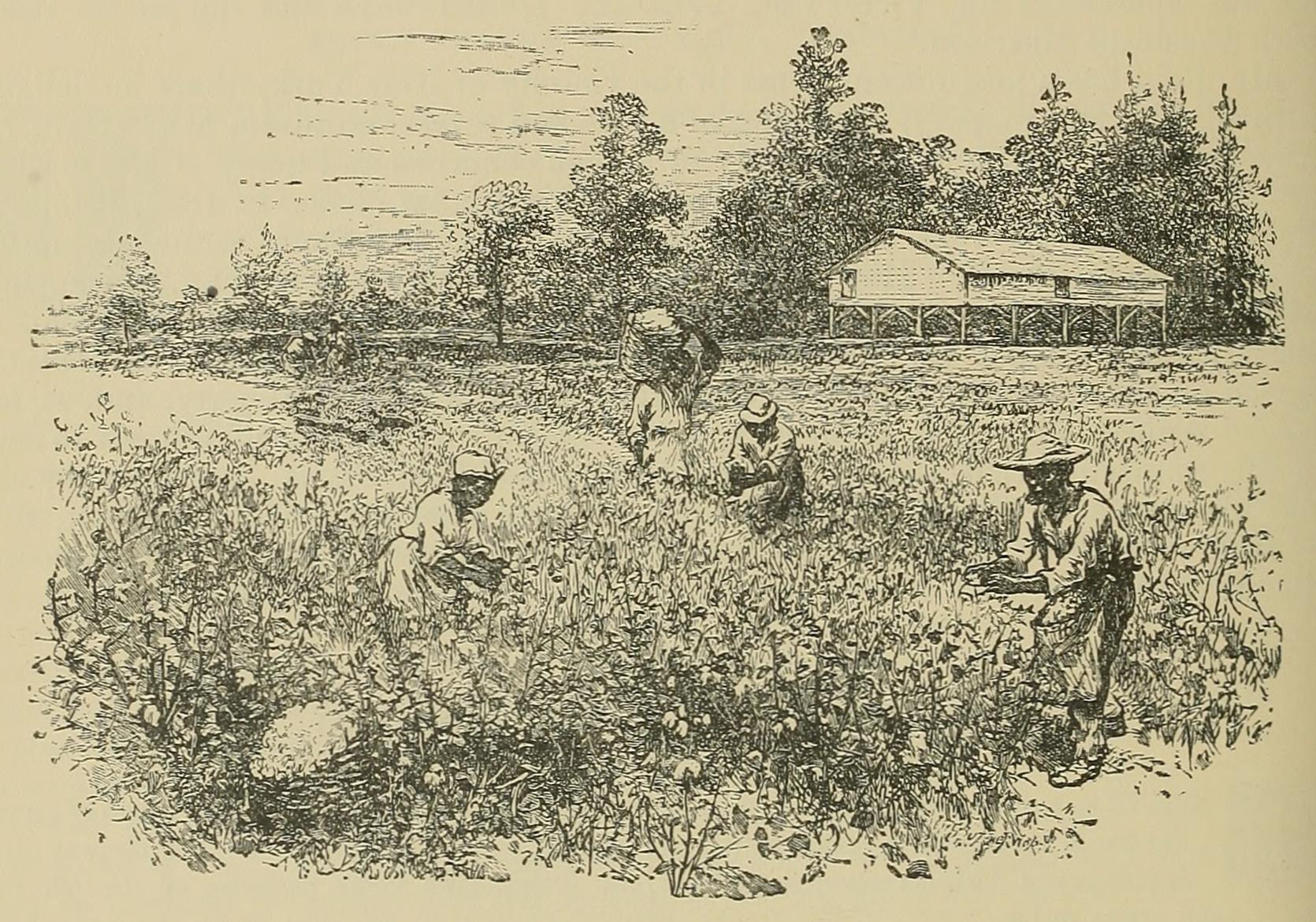
A COTTON FIELD IN LOUISIANA.
I rode out first, that perfect day, among the gang of a hundred and fifty negroes, who, on these plantations, were for the year to compromise between their respect and their newborn spirit of independence by calling me Mistah instead of Massa, there were no forebodings. Two “plough-gangs” and two “hoe-gangs” were slowly measuring their length along the two-mile front. Among each rode its own negro driver, sometimes lounging in his saddle with one leg lodged on the pommel, sometimes shouting sharp, abrupt orders to the delinquents. In each plough-gang were fifteen scrawny mules, with corn-husk collars, gunny-bags, and bedcord plough-lines. The Calhoun ploughs (the favorite implement through all that region, then, and doubtless still, retaining the name given it long before war was dreamed of) were rather lazily managed by the picked hands of the plantation. Among them were several women, who proved among the best laborers of the gang. A quarter of a mile ahead a picturesque sight presented itself. A great crowd of women and children, with a few aged or weakly men among them, were scattered along the old cotton-rows, chopping down weeds, gathering together the trash that covered the land, and firing little heaps of it, while through the clouds of smoke came an incessant chatter of the girls, and an occasional snatch of a camp-meeting hymn from the elders. “Gib me some backey, please,” was the first salutation I received. They were dressed in a stout blue cottonade, the skirts drawn up to the knees, and reefed in a loose bunch at the waists; brogans of incredible sizes covered their feet, and there was a little waste of money on the useless decency of stockings, but gay bandannas were wound in profuse splendor around their heads.
The moment the sun disappeared every hoe was shouldered. Some took up army-blouses or stout men’s overcoats, and drew them on; others gathered fragments of bark to kindle their evening fires, and balanced them nicely on their heads. In a moment the whole noisy crowd was filing across the plantation towards the quarters, joining the plough-gang, pleading for rides on the mules, or flirting with the drivers, and looking as much like a troop flocking to a circus or rustic fair as a party of weary farm-laborers. At the house the drivers soon reported their grievances. “Dem women done been squabblin ’mong dei’ selves dis a’ternoon, so I’s hardly git any wuck at all out of ’em.” “Fanny and Milly done got sick to-day; an’ Sally heerd dat her husban’s mustered out ob de army, an’ she gone up to Natchez to fine him.” “Dem sucklers ain’t jus’ wuf nuffin at all. ’Bout eight o’clock dey goes off to de quarters of deir babies, an’ I don’ nebber see nuffin mo’ ob ’em till ’bout elebben. Den de same way in de a’ternoon, till I’s sick ob de hull lot. De moody (Bermuda grass) mighty tough ’long heah, an’ I could’nt make dem women put in deir hoes to suit me nohow.” Presently men and women trooped up for the ticket representing their day’s work. The women were soon busy preparing their supper of mess pork and early vegetables; while the plough-gang gathered about the overseer. “He’d done promise dem a drink o’ wiskey, if dey’d finish dat cut, and dey’d done it.” The whiskey was soon forthcoming, well watered with a trifle of Cayenne pepper to conceal the lack of spirit, and a little tobacco soaked in it to preserve the color. The most drank it down at a gulp from the glass into which, for one after another, the overseer poured “de lowance.” A few, as their turns came, passed up tin cups and went off with their treasure, chuckling about “de splendid toddy we’s hab to-night.” Then came a little trade with the overseer at “the store.” Some wanted a pound or two of sugar; others, a paper of needles or a bar of soap; many of the young men, “two bits’ wuf” of candy or a brass ring. In an hour trade was over, and the quarters were as silent as a churchyard. But, next morning, at four o’clock, I was aroused by the shrill “driber’s horn.” Two hours later it was blown again, and, looking from my window just as the first rays of light came level across the field, I saw the women filing out, with their hoes, and the ploughmen leisurely sauntering down to the stables, each with corn-husk collar and bedcord plough-lines in his hands. The passion for whiskey among the negroes seemed universal. I never saw a man, woman or child, reckless young scapegrace or sanctimonious old preacher, among them, who would refuse it; and the most had no hesitancy in begging it whenever they could. Many of them spent half their earnings buying whiskey. That sold on any of the plantations I ever visited or heard of was always watered down at least one-fourth. Perhaps it was owing to this fact, though it seemed rather an evidence of unexpected powers of self-restraint, that so few were to be seen intoxicated.
During the two or three years in which I spent most of my time among them, seeing scores and sometimes hundreds in a day, I do not remember seeing more than one man absolutely drunk. He had bought a quart of whiskey, one Saturday night, at a low liquor shop in Natchez. Next morning early he attacked it, and in about an hour the whiskey and he were used up together. Hearing an unusual noise in the quarters, I walked down that way and found the plough-driver and the overseer both trying to quiet Horace. He was unable to stand alone, but he contrived to do a vast deal of shouting. As I approached, the driver said, “Horace, don’t make so much noise; don’t you see Mr. R.?” He looked around as if surprised at learning it.
“Boss, is dat you?”
“Yes.”
“Boss, I’s drunk; boss, I’s ’shamed o’ myself! but I’s drunk! I ’sarve good w’ipping. Boss,—boss, s-s-slap me in de face, boss.”
I was not much disposed to administer the “slapping;” but Horace kept repeating, with a drunken man’s persistency, “Slap me in de face, boss; please, boss.” Finally I did give him a ringing cuff on the ear. Horace jerked off his cap, and ducked down his head with great respect, saying, “T’ank you, boss.” Then, grinning his maudlin smile, he threw open his arms as if to embrace me, and exclaimed, “Now kiss me, boss!” Next morning Horace was at work with the rest, and though he bought many quarts of whiskey afterwards, I never saw him drunk again.
ALBERT SHAW.
EDITOR OF THE “REVIEW OF REVIEWS.”
T seems, sometimes, that the influence of the editor has departed, and that notwithstanding the survival of a few men like Halstead and Reid, who helped to make the papers which moulded public opinion thirty years ago, the newspaper fills no such place as it did in the day of their prime, but a different place, not a lower or a less important one. Among the men who through the medium of the press are doing most to promote the spread of intelligence, and particularly to further the cause of good government and to elevate the civic life of our country, Albert Shaw fills a prominent place.

Dr. Shaw is a young man of Western birth, tall and slender in figure, with a keen eye, a quick and rather nervous manner, and features expressing in an unusual degree intelligence, energy, and character. Born in Ohio, the central West, Dr. Shaw represents a catholicity of feeling and knowledge which very few Americans possess. He knows the whole country. He is not distinctly an Eastern man, a Western man, or a man of the Pacific slope: he is a man of America. He knows the characteristics of each section, its strength and its weakness. With New England blood in his veins, but with the energizing influences of the West about his boyhood, Dr. Shaw graduated at Iowa College, the oldest institution of its class west of the Mississippi. During his college life the future journalist and writer devoted a great deal of time to the study of literature and of literary style, disclosing very early two qualities which are pre-eminently characteristic of him to-day, lucidity and directness. After graduation Dr. Shaw began his professional life as editor of “The Grinnell Herald,” a position which enabled him to master all the mechanical and routine work of journalism.
His aims were not the aims of the ordinary journalist. He saw with unusual clearness the possibilities of his profession, and he saw also that he needed a wider educational basis. His interest in social and political topics was the interest of a man of philosophic mind, eager to learn the principles and not simply to record the varying aspects from day to day. In order the better to secure the equipment of which he felt the need, he entered the Johns Hopkins University and took a post-graduate course. It was during his residence in Baltimore that he met Professor Bryce, who recognized his rare ability and intelligence, and who used his unusually large knowledge of social and political conditions in the country. While carrying on his special studies at the Johns Hopkins University, Dr. Shaw joined the editorial staff of the Minneapolis daily “Tribune.” After receiving the degree of Ph.D. in 1884, he removed permanently to Minneapolis, and took his place at the head of the staff of the “Tribune.” His work almost at once attracted attention. Its breadth, its thoroughness, its candor, and its ability were of a kind which made themselves recognized on the instant. Four years later Dr. Shaw spent a year and a half studying social and political conditions in Europe, traveling extensively and devoting much time to the examination of the condition of municipalities. It was this study which has borne fruit in the two volumes on Municipal Government which have come from the press of the Century Company, and which have given Dr. Shaw the first rank as an authority on these matters. When the “Review of Reviews” was established in this country in 1891, Dr. Shaw became its editor, and his success in the management of this very important periodical has justified the earlier expectations entertained by his friends, for he has given the “Review of Reviews” a commanding position. He is one of the very few journalists in this country who treat their work from the professional standpoint, who are thoroughly equipped for it, and who regard themselves as standing in a responsible relation to a great and intelligent public. Dr. Shaw’s presentation of news is pre-eminently full, candid, and unpartisan; his discussion of principles is broad-minded, rational, and persuasive. He is entirely free from the short-sighted partisanship of the great majority of newspaper editors, and he appreciates to the full the power of intelligent, judicial statement. His opinions, for this reason, carry great weight, and it is not too much to say that he has not his superior in the field of American journalism.
RECENT DEVELOPMENT OF THE WEST.
ET us imagine a man from the East who has visited the Northwestern States and Territories at some time between the years 1870 and 1875, and who retains a strong impression of what he saw, but who has not been west of Chicago since that time, until, in the World’s Fair year he determines upon a new exploration of Iowa, Nebraska, the Dakotas, Minnesota and Wisconsin. However well informed he had tried to keep himself through written descriptions and statistical records of Western progress, he would see what nothing but the evidence of his own eyes could have made him believe to be possible. Iowa in 1870 was already producing a large crop of cereals, and was inhabited by a thriving, though very new, farming population. But the aspect of the country was bare and uninviting, except in the vicinity of the older communities on the Mississippi River. As one advanced across the State the farmhouses were very small, and looked like isolated dry-goods boxes; there were few well-built barns or farm buildings; and the struggling young cottonwood and soft-maple saplings planted in close groves about the tiny houses were so slight an obstruction to the sweep of vision across the open prairie that they only seemed to emphasize the monotonous stretches of fertile, but uninteresting plain. Now the landscape is wholly transformed. A railroad ride in June through the best parts of Iowa reminds one of a ride through some of the pleasantest farming districts of England. The primitive “claim shanties” of thirty years ago have given place to commodious farm-houses flanked by great barns and hay-ricks, and the well-appointed structures of a prosperous agriculture. In the rich, deep meadows herds of fine-blooded cattle are grazing. What was once a blank, dreary landscape is now garden-like and inviting. The poor little saplings of the earlier days, which seemed to be apologizing to the robust corn-stalks in the neighboring fields, have grown on that deep soil into great, spreading trees. One can easily imagine, as he looks off in every direction and notes a wooded horizon, that he is—as in Ohio, Indiana, or Kentucky—in a farming region which has been cleared out of primeval forests. There are many towns I might mention which twenty-five years ago, with their new, wooden shanties scattered over the bare face of the prairie, seemed the hottest place on earth as the summer sun beat upon their unshaded streets and roofs, and seemed the coldest places on earth when the fierce blizzards of winter swept unchecked across the prairie expanses. To-day the density of shade in those towns is deemed of positive detriment to health, and for several years past there has been a systematic thinning out and trimming up of the great, clustering elms. Trees of from six to ten feet in girth are found everywhere by the hundreds of thousands. Each farm-house is sheltered from winter winds by its own dense groves. Many of the farmers are able from the surplus growth of wood upon their estates to provide themselves with a large and regular supply of fuel. If I have dwelt at some length upon this picture of the transformation of the bleak, grain-producing Iowa prairies of thirty years ago into the dairy and live-stock farms of to-day, with their fragrant meadows and ample groves, it is because the picture is one which reveals so much as to the nature and meaning of Northwestern progress.
The tendency to rely upon united public action is illustrated in the growth of Northwestern educational systems. The universities of these commonwealths are State universities. Professional education is under the State auspices and control. The normal schools and the agricultural schools belong to the State. The public high school provides intermediate instruction. The common district school, supported jointly by local taxation and State subvention, gives elementary education to the children of all classes. As the towns grow the tendency to graft manual and technical courses upon the ordinary public school curriculum is unmistakably strong. The Northwest, more than any other part of the country, is disposed to make every kind of education a public function.
Radicalism has flourished in the homogeneous agricultural society of the Northwest. In the anti-monopoly conflict there seemed to have survived some of the intensity of feeling that characterized the anti-slavery movement; and a tinge of this fanatical quality has always been apparent in the Western and Northwestern monetary heresies. But it is in the temperance movement that this sweep of radical impulse has been most irresistible. It was natural that the movement should become political and take the form of an agitation for prohibition. The history of prohibition in Iowa, Kansas and the Dakotas, and of temperance legislation in Minnesota and Nebraska, reveals—even better perhaps than the history of the anti-monopoly movement—the radicalism, homogeneity, and powerful socializing tendencies of the Northwestern people. Between these different agitations there has been in reality no slight degree of relationship; at least their origin is to be traced to the same general condition of society.
The extent to which a modern community resorts to State action depends in no small measure upon the accumulation of private resources. Public or organized initiative will be relatively strongest where the impulse to progress is positive but the ability of individuals is small. There are few rich men in the Northwest. Iowa, great as is the Hawkeye State, has no large city and no large fortunes. Of Kansas the same thing may be said. The Dakotas have no rich men and no cities. Minnesota has Minneapolis and St. Paul, and Nebraska has Omaha; but otherwise these two States are farming communities, without large cities or concentrated private capital. Accordingly the recourse to public action is comparatively easy. South Dakota farmers desire to guard against drought by opening artesian wells for irrigation. They resort to State legislation and the sale of county bonds. North Dakota wheat growers are unfortunate in the failure of crops. They secure seed-wheat, through State action and their county governments. A similarity of condition fosters associated action, and facilitates the progress of popular movements.
In such a society the spirit of action is intense. If there are few philosophers, there is remarkable diffusion of popular knowledge and elementary education. The dry atmosphere and the cold winters are nerve-stimulants, and life seems to have a higher tension and velocity than in other parts of the country.

JULIAN HAWTHORNE.
THE POPULAR NOVELIST AND CONTRIBUTOR.
ULIAN HAWTHORNE has inherited much of his father’s literary ability. His recent celebrity has been largely due to his success in portraying to the readers of popular magazines facts of world-wide interest like the famine in India, but to the special power of vivid statement which belongs to the newspaper reporter, he joins the imaginative power which enables him to recognize the materials of romance and the gift of clear and graceful expression. He is the son of Nathaniel Hawthorne, and was born in Boston in 1846. He traveled abroad with his parents, returning and entering Harvard in 1863. His college life seems to have been devoted more to athletics than to serious learning. He took up the study of civil engineering and went to Dresden to carry it on, but the Franco-Prussian war breaking out while he was visiting at home, he found employment as an engineer under General George B. McClellan in the department of docks in New York. He began soon after to write stories and sketches for the magazines, and losing his position in 1872, he determined to devote himself to literature. He now went abroad, living for several years, first in England and then in Dresden, and again in England, where he remained until 1881, and then after a short stay in Ireland, returned to New York. A number of his stories were published while he was abroad. Of these the most important were “Bressant” and “Idolatry.” For two years he was connected with the London “Spectator,” and he contributed to the “Contemporary Review” a series of sketches called “Saxon Studies,” which were afterwards published in book form. The novel “Garth” followed and collections of stories and novelettes entitled “The Laughing Mill;” “Archibald Malmaison;” “Ellice Quentin;” “Prince Saroni’s Wife;” and the “Yellow Cap” fairy stories. These were all published abroad, but a part of them were afterward reprinted in America. Later he published “Sebastian Strome;” “Fortune’s Fool,” and in 1884 “Dust” and “Noble Blood.” On his return to America he edited his father’s posthumous romance “Dr. Grimshaw’s Secret,” and prepared the biography of his father and mother. Since that time he has contributed a large number of stories and sketches to magazines. His most recent work has been an expedition to India to write for American periodicals an account of the famine in that country. One of our extracts is taken from this account and will very adequately illustrate his power of telling things so that his readers can see them with his eyes. Mr. ♦Hawthorne’s activity does not abate and his friends and admirers expect from him even better work than he has yet done.

THE WAYSIDE AND THE WAR.¹
(FROM “NATHANIEL HAWTHORNE AND HIS WIFE.”)
T was a hot day towards the close of June, 1860, when Hawthorne alighted from a train at Concord station, and drove up in the railway wagon to the Wayside. The fields looked brown, the trees were dusty, and the sun white and brilliant. At certain seasons in Concord the heat stagnates and simmers, until it seems as if nothing but a grasshopper could live. The water in the river is so warm that to bathe in it is merely to exchange one kind of heat for another. The very shadow of the trees is torrid; and I have known the thermometer to touch 112° in the shade. No breeze stirs throughout the long sultry day; and the feverish nights bring mosquitoes, but no relief. To come from the salt freshness of the Atlantic into this living oven is a startling change, especially when one has his memory full of cool, green England. Such was America’s first greeting to Hawthorne, on his return from a seven years’ absence; it was to this that he had looked forward so lovingly and so long. As he passed one little wooden house after another, with their white clap boards and their green blinds, perhaps he found his thoughts not quite so cloudless as the sky. It is dangerous to have a home; too much is required of it.
The Wayside, however, was not white, it was painted a dingy buff color. The larches and Norway pines, several hundred of which had been sent out from England, were planted along the paths, and were for the most part doing well. The well-remembered hillside, with its rude terraces, shadowed by apple-trees, and its summit green with pines, rose behind the house; and in front, on the other side of the highway, extended a broad meadow of seven acres, bounded by a brook, above which hung drooping willows. It was, upon the whole, as pleasant a place as any in the village, and much might be done to enhance its beauty. It had been occupied, during our absence, by a brother of Mrs. Hawthorne; and the house itself was in excellent order, and looked just the same as in our last memory of it. A good many alterations have been made since then; another story was added to the western wing, the tower was built up behind, and two other rooms were put on in the rear. These changes, together with some modifications about the place, such as opening up of paths, the cutting down of some trees, and the planting of others, were among the last things that engaged Hawthorne’s attention in this life.
FIRST MONTHS IN ENGLAND.¹
FROM “NATHANIEL HAWTHORNE AND HIS WIFE.”
E are told, truly enough, that goodness does not always command good fortune in this world, that just hopes are often deferred until it is too late to enjoy their realization, that fame and honor only discover a man after he has ceased to value them; and a large and respectable portion of modern fiction is occupied in impressing these sober lessons upon us. It is pleasant, nevertheless, to believe that sometimes fate condescends not to be so unmitigable, and that a cloudy and gusty morning does occasionally brighten into a sunny and genial afternoon. Too long a course of apparently perverse and unreasonable accidents bewilders the mind, and the few and fleeting gleams of compensation seem a mockery. One source of the perennial charm of Goldsmith’s “Vicar of Wakefield” is, I think, that in it the dividing line between the good and the bad fortune is so distinctly drawn. Just when a man has done his utmost, and all seems lost, Providence steps in, brings aid from the most unexpected quarter, and kindles everything into brighter and ever brighter prosperity. The action and reaction are positive and complete, and we arise refreshed and comforted from the experience.