GREAT POETS OF AMERICA. (continued 3)
Reading edition
He of the mighty limb!
“These to the printer,” I exclaim’d,
And, in my humorous way,
I added (as a trifling jest),
“There’ll be the devil to pay.”
He took the paper, and I watch’d,
And saw him peep within;
At the first line he read, his face
Was all upon the grin.
He read the next; the grin grew broad,
And shot from ear to ear;
He read the third; a chuckling noise
I now began to hear.
The fourth; he broke into a roar;
The fifth, his waistband split;
The sixth, he burst five buttons off,
And tumbled in a fit.
Ten days and nights, with sleepless eye,
I watch’d that wretched man,
And since, I never dare to write
As funny as I can.
THE CHAMBERED NAUTILUS.
HIS is the ship of pearl, which, poets feign,
Sails the unshadow’d main,—
The venturous bark that flings
On the sweet summer wind its purpled wings
In gulfs enchanted, where the siren sings,
And coral reefs lie bare,
Where the cold sea-maids rise to sun their streaming hair.
Its webs of living gauze no more unfurl;
Wreck’d is the ship of pearl!
And every chamber’d cell,
Where its dim dreaming life was wont to dwell,
As the frail tenant shaped his growing shell,
Before thee lies reveal’d,—
Its iris’d ceiling rent, its sunless crypt unseal’d!
Year after year beheld the silent toil
That spread his lustrous coil;
Still, as the spiral grew,
He left the past year’s dwelling for the new,
Stole with soft step its shining archway through,
Built up its idle door,
Stretch’d in his last-found home, and knew the old no more.
Thanks for the heavenly message brought by thee,
Child of the wandering sea,
Cast from her lap, forlorn!
From thy dead lips a clearer note is born
Than ever Triton blew from wreathed horn!
While on mine ear it rings,
Through the deep caves of thought I hear a voice that sings:—
Build thee more stately mansions, O my soul,
As the swift seasons roll!
Leave thy low-vaulted past!
Let each new temple, nobler than the last,
Shut thee from heaven with a dome more vast,
Till thou at length art free,
Leaving thine outgrown shell by life’s unresting sea!
OLD AGE AND THE PROFESSOR.
Mr. Holmes is as famous for his prose as for his poetry. The following sketches are characteristic of his happy and varied style.
LD AGE, this is Mr. Professor; Mr. Professor, this is Old Age.
Old Age.—Mr. Professor, I hope to see you well. I have known you for some time, though I think you did not know me. Shall we walk down the street together?
Professor (drawing back a little).—We can talk more quietly, perhaps, in my study. Will you tell me how it is you seem to be acquainted with everybody you are introduced to, though he evidently considers you an entire stranger?
Old Age.—I make it a rule never to force myself upon a person’s recognition until I have known him at least five years.
Professor.—Do you mean to say that you have known me so long as that?
Old Age.—I do. I left my card on you longer ago than that, but I am afraid you never read it; yet I see you have it with you.
Professor.—Where?
Old Age.—There, between your eyebrows,—three straight lines running up and down; all the probate courts know that token,—“Old Age, his mark.” Put your forefinger on the inner end of one eyebrow, and your middle finger on the inner end of the other eyebrow; now separate the fingers, and you will smooth out my sign manual; that’s the way you used to look before I left my card on you.
Professor.—What message do people generally send back when you first call on them?
Old Age.—Not at home. Then I leave a card and go. Next year I call; get the same answer; leave another card. So for five or six—sometimes ten—years or more. At last, if they don’t let me in, I break in through the front door or the windows.
We talked together in this way some time. Then Old Age said again,—Come, let us walk down the street together,—and offered me a cane,—an eye-glass, a tippet, and a pair of overshoes.—No, much obliged to you, said I. I don’t want those things, and I had a little rather talk with you here, privately, in my study. So I dressed myself up in a jaunty way and walked out alone;—got a fall, caught a cold, was laid up with a lumbago, and had time to think over this whole matter.
THE BRAIN.
UR brains are seventy-year clocks. The Angel of Life winds them up once for all, then closes the case, and gives the key into the hands of the Angel of the Resurrection.
Tic-tac! tic-tac! go the wheels of thought; our will cannot stop them; they cannot stop themselves; sleep cannot still them; madness only makes them go faster; death alone can break into the case, and, seizing the ever-swinging pendulum, which we call the heart, silence at last the clicking of the terrible escapement we have carried so long beneath our wrinkled foreheads.
MY LAST WALK WITH THE SCHOOL-MISTRESS.
CAN’T say just how many walks she and I had taken before this one. I found the effect of going out every morning was decidedly favorable on her health. Two pleasing dimples, the places for which were just marked when she came, played, shadowy, in her freshening cheeks when she smiled and nodded good-morning to me from the schoolhouse steps.
The schoolmistress had tried life. Once in a while one meets with a single soul greater than all the living pageant that passes before it. As the pale astronomer sits in his study with sunken eyes and thin fingers, and weighs Uranus or Neptune as in a balance, so there are meek, slight women who have weighed all which this planetary life can offer, and hold it like a bauble in the palm of their slender hands. This was one of them. Fortune had left her, sorrow had baptized her; the routine of labor and the loneliness of almost friendless city-life were before her. Yet, as I looked upon her tranquil face, gradually regaining a cheerfulness which was often sprightly, as she became interested in the various matters we talked about and places we visited, I saw that eye and lip and every shifting lineament were made for love,—unconscious of their sweet office as yet, and meeting the cold aspect of Duty with the natural graces which were meant for the reward of nothing less than the Great Passion.
It was on the Common that we were walking. The mall, or boulevard of our Common, you know, has various branches leading from it in different directions. One of these runs downward from opposite Joy Street southward across the whole length of the Common to Boylston Street. We called it the long path, and were fond of it.
I felt very weak indeed (though of a tolerably robust habit) as we came opposite the head of this path on that morning. I think I tried to speak twice without making myself distinctly audible. At last I got out the question,—Will you take the long path with me? Certainly,—said the schoolmistress,—with much pleasure. Think,—I said,—before you answer: if you take the long path with me now, I shall interpret it that we are to part no more! The schoolmistress stepped back with a sudden movement, as if an arrow had struck her.
One of the long granite blocks used as seats was hard by,—the one you may still see close by the Gingko-tree. Pray, sit down,—I said. No, no,—she answered softly,—I will walk the long path with you!
The old gentleman who sits opposite met us walking, arm in arm, about the middle of the long path, and said, very charmingly,—“Good-morning, my dears!”
A RANDOM CONVERSATION
ON OLD MAXIMS, BOSTON AND OTHER TOWNS.
(From “The Autocrat of the Breakfast Table.”)
IN has many tools, but a lie is the handle which fits them all.
I think Sir,—said the divinity student,—you must intend that for one of the sayings of the Seven Wise men of Boston you were speaking of the other day.
I thank you, my young friend,—was the reply,—but I must say something better than that, before I could pretend to fill out the number.
The schoolmistress wanted to know how many of these sayings there were on record, and what, and by whom said.
Why, let us see,—there is that one of Benjamin Franklin, “the great Bostonian,” after whom this land was named. To be sure, he said a great many wise things,—and I don’t feel sure he didn’t borrow this,—he speaks as if it were old. But then he applied it so neatly!—
“He that has once done you a kindness will be more ready to do you another than he whom you yourself have obliged.”
Then there is that glorious Epicurean paradox, uttered by my friend, the Historian, in one of his flashing moments:—
“Give us the luxuries of life, and we will dispense with its necessaries.”
To these must certainly be added that other saying of one of the wittiest of men:—
“Good Americans, when they die, go to Paris.”
The divinity student looked grave at her, but said nothing.
The schoolmistress spoke out, and said she didn’t think the wit meant any irreverence. It was only another way of saying, Paris is a heavenly place after New York or Boston.
A jaunty looking person, who had come in with the young fellow they call John,—evidently a stranger,—said there was one more wise man’s saying that he had heard; it was about our place, but he didn’t know who said it.—A civil curiosity was manifested by the company to hear the fourth wise saying. I heard him distinctly whispering to the young fellow who brought him to dinner, Shall I tell it? To which the answer was, Go ahead!—Well,—he said,—this was what I heard:—
“Boston State-House is the hub of the solar system. You couldn’t pry that out of a Boston man, if you had the tire of all creation straightened out for a crow-bar.”
Sir,—said I,—I am gratified with your remark. It expresses with pleasing vivacity that which I have sometimes heard uttered with malignant dullness. The satire of the remark is essentially true of Boston,—and of all other considerable—and inconsiderable—places with which I have had the privilege of being acquainted. Cockneys think London is the only place in the world. Frenchmen—you remember the line about Paris, the Court, the World, etc.—I recollect well, by the way, a sign in that city which ran thus: “Hotel de l’Univers et des États Unis;” and as Paris is the universe to a Frenchman, of course the United States are outside of it. “See Naples and then die.” It is quite as bad with smaller places. I have been about lecturing, you know, and have found the following propositions to hold true of all of them.
1. The axis of the earth sticks out visibly through the center of each and every town or city.
2. If more than fifty years have passed since its foundation, it is affectionately styled by the inhabitants the “good old town of ――” (whatever its name may happen to be).
3. Every collection of its inhabitants that comes together to listen to a stranger is invariably declared to be a “remarkably intelligent audience.”
4. The climate of the place is particularly favorable to longevity.
5. It contains several persons of vast talent little known to the world. (One or two of them, you may perhaps chance to remember, sent short pieces to the “Pactolian” some time since, which were “respectfully declined.”)
Boston is just like other places of its size—only, perhaps, considering its excellent fish-market, paid fire department, superior monthly publications, and correct habit of spelling the English language, it has some right to look down on the mob of cities. I’ll tell you, though, if you want to know it, what is the real offense of Boston. It drains a large water-shed of its intellect, and will not itself be drained. If it would only send away its first-rate men instead of its second-rate ones (no offense to the well-known exceptions, of which we are always proud), we should be spared such epigrammatic remarks as that the gentleman has quoted. There can never be a real metropolis in this country until the biggest centre can drain the lesser ones of their talent and wealth. I have observed, by the way, that the people who really live in two great cities are by no means so jealous of each other, as are those of smaller cities situated within the intellectual basin, or suction range, of one large one, of the pretensions of any other. Don’t you see why? Because their promising young author and rising lawyer and large capitalist have been drained off to the neighboring big city,—their prettiest girls have exported to the same market; all their ambition points there, and all their thin gilding of glory comes from there. I hate little, toad-eating cities.
Would I be so good as to specify any particular example?—Oh,—an example? Did you ever see a bear trap? Never? Well, shouldn’t you like to see me put my foot into one? With sentiments of the highest consideration I must beg leave to be excused.
Besides, some of the smaller cities are charming. If they have an old church or two, a few stately mansions of former grandees, here and there an old dwelling with the second story projecting (for the convenience of shooting the Indians knocking at the front-door with their tomahawks)—if they have, scattered about, those mighty square houses built something more than half a century ago, and standing like architectural boulders dropped by the former diluvium of wealth, whose refluent wave has left them as its monument,—if they have gardens with elbowed apple-trees that push their branches over the high board-fence and drop their fruit on the sidewalk,—if they have a little grass in their side-streets, enough to betoken quiet without proclaiming decay,—I think I could go to pieces, after my life’s tranquil places, as sweetly as in any cradle that an old man may be rocked to sleep in. I visit such spots always with infinite delight. My friend, the Poet, says, that rapidly growing towns are most unfavorable to the imaginative and reflective faculties. Let a man live in one of these old quiet places, he says, and the wine of his soul, which is kept thick and turbid by the rattle of busy streets, settles, and as you hold it up, you may see the sun through it by day and the stars by night.
Do I think that the little villages have the conceit of the great towns? I don’t believe there is much difference. You know how they read Pope’s line in the smallest town in our State of Massachusetts? Well, they read it,—
“All are but parts of one stupendous Hull!”
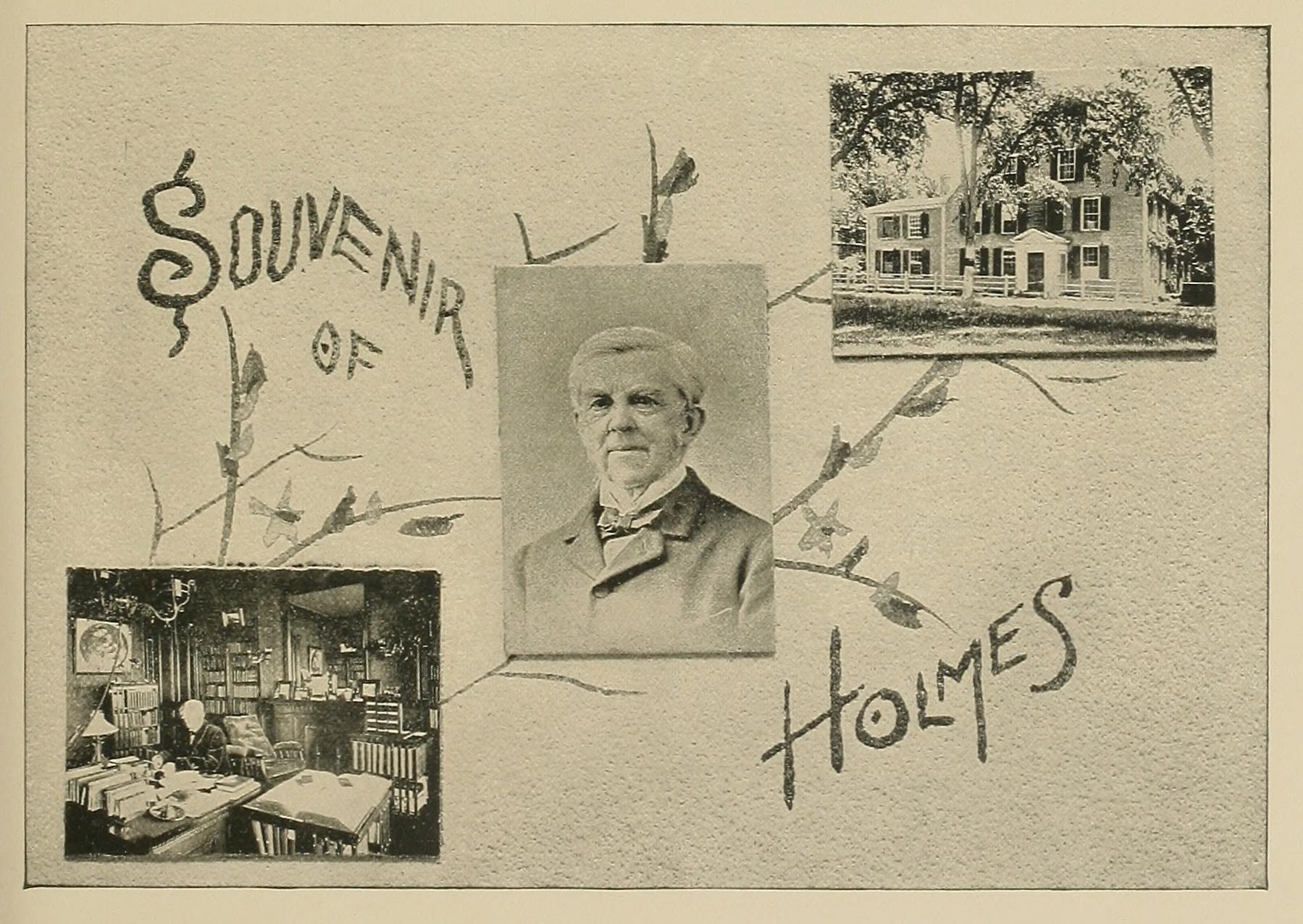
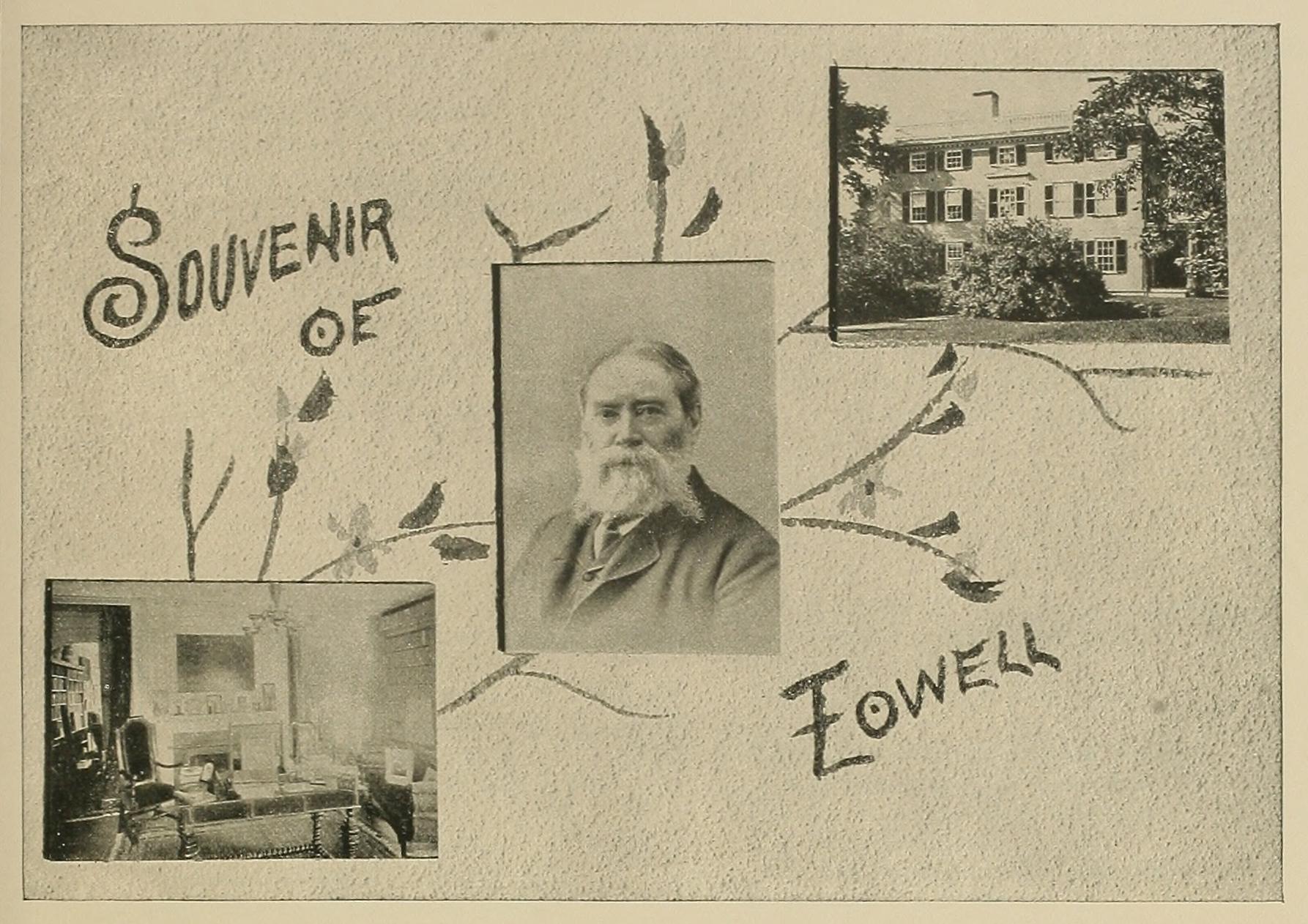
Souvenir of Holmes
JAMES RUSSELL LOWELL.
POET, CRITIC, AND ESSAYIST.
HILE the popularity of Lowell has not been so great as that of Whittier, Longfellow or Holmes, his poetry expresses a deeper thought and a truer culture than that of any one of these; or, indeed, of any other American poet, unless the exception be the “transcendental philosopher,” Emerson. As an anti-slavery poet, he was second only to Whittier.

James Russell Lowell was born in Cambridge, Mass., February 22, 1819, and died in the same city on August 12, 1891, in the seventy-third year of his age. He was the youngest son of the Rev. Charles Lowell, an eminent Congregational clergyman, and was descended from the English settlers of 1639. He entered Harvard in his seventeenth year and graduated in 1838, before he was twenty. He began to write verses early. In his junior year in college he wrote the anniversary poem, and, in his senior year, was editor of the college magazine. Subsequently, he studied law and was admitted to the bar in 1840; but, it seems, never entered upon the practice of his profession. If he did it is doubtful if he ever had even that first client whom he afterwards described in a humorous sketch.
His first appearance in literature was the publication, in 1839, of the class poem which he had written, but was not permitted to recite on account of his temporary suspension from College for neglect of certain studies in the curriculum for which he had a distaste. In this poem he satirized the Abolitionists, and the transcendental school of writers, of which Emerson was the prophet and leader. This poem, while faulty, contained much sharp wit and an occasional burst of feeling which portended future prominence for its author.
Two years later, in 1841, the first volume of Lowell’s verse appeared, entitled “A Year’s Life.” This production was so different from that referred to above that critics would have regarded it as emanating from an entirely different mind had not the same name been attached to both. It illustrated entirely different feelings, thoughts and habits, evinced a complete change of heart and an entire revolution in his mode of thinking. His observing and suggestive imagination had caught the tone and spirit of the new and mystical philosophy, which his first publication had ridiculed. Henceforth, he aimed to make Nature the representative and minister of his feelings and desires. Lowell was not alone, however, in showing how capricious a young author’s character may be. A notable parallel is found in the great Englishman, Carlyle whose “Life of Schiller” and his “Sator Resartus,” are equally as unlike himself as were Lowell’s first two publications. In 1844, came another volume of poems, manifesting a still further mark of advancement. The longest in this collection—“The Legend of Brittany”—is, in imagination and artistic finish, one of his best and secured the first general consent for the author’s admission into the company of men of genius.
During this same year (1844) Mr. Lowell married the poetess, Maria White, an ardent Abolitionist, whose anti-slavery convictions influenced his after career. Two of Mrs. Lowell’s poems, “The Alpine Sheep” and the “Morning Glory” are especially popular. Lowell was devotedly attached to his singularly beautiful and sympathetic poet wife and made her the subject of some of his most exquisite verses. They were both contributors to the “Liberty Bell” and “Anti-slavery Standard,” thus enjoying companionship in their labors.
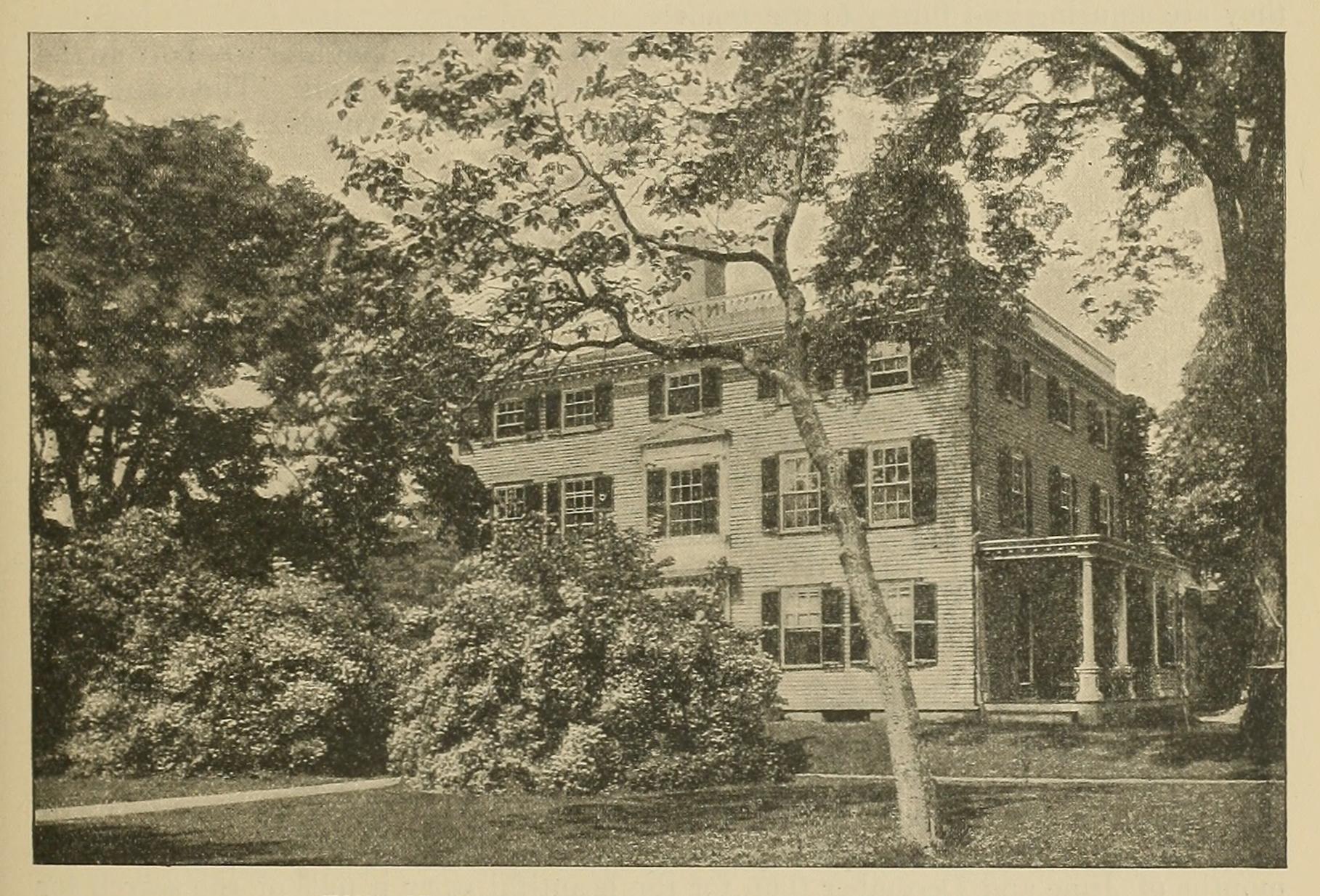
HOME OF JAMES RUSSELL LOWELL, CAMBRIDGE, MASS.
In 1845, appeared Lowell’s “Conversation on Some Old Poets,” consisting of a series of criticisms, and discussions which evince a careful and delicate study. This was the beginning of the critical work in which he afterward became so famous, that he was styled “The First Critic of America.”
Lowell was also a humorist by nature. His irrepressible perception of the comical and the funny find expression everywhere, both in his poetry and prose. His “Fable for Critics” was a delight to those whom he both satirized and criticised in a good-natured manner. Bryant, Poe, Hawthorne and Whittier, each are made to pass in procession for their share of criticism—which is as excellent as amusing—and Carlyle and Emerson are contrasted admirably. This poem, however, is faulty in execution and does not do its author justice. His masterpiece in humor is the famous “Biglow Papers.” These have been issued in two parts; the first being inspired by the Mexican War, and the latter by the Civil War between the states. Hosea Biglow, the country Yankee philosopher and supposed author of the papers, and the Rev. Homer Wilber, his learned commentator and pastor of the first church at Jaalem, reproduce the Yankee dialect, and portray the Yankee character as faithfully as they are amusing and funny to the reader.
In 1853, Mrs. Lowell died, on the same night in which a daughter was born to the poet Longfellow, who was a neighbor and a close friend to Lowell. The coincident inspired Longfellow to write a beautiful poem, “The Two Angels,” which he sent to Mr. Lowell with his expression of sympathy:
“’Twas at thy door, O friend, and not at mine
The angel with the amaranthine wreath,
Pausing, descended, and with voice divine
Uttered a word that had a sound like death.
“Then fell upon the house a sudden gloom,
A ♦shaddow on those features fair and thin,
And slowly, from that hushed and darkened room,
Two angels issued, where but one went in.
“Angels of life and death alike are His;
Without His leave, they pass no threshold o’er:
Who then would wish, or dare, believing this,
Against His messengers to shut the door?”
Quite in contrast with Lowell, the humorist, is Lowell, the serious and dignified author. His patriotic poems display a courage and manliness in adhering to the right and cover a wide range in history. But it is in his descriptions of nature that his imagination manifests its greatest range of subtilty and power. “The Vision of Sir Launfal” is, perhaps, more remarkable for its descriptions of the months of June and December than for the beautiful story it tells of the search for the “Holy Grail” (the cup) which held the wine which Christ and the Apostles drank at the last supper.
Lowell’s prose writings consist of his contributions to magazines, which were afterwards gathered in book form, and his public addresses and his political essays. He was naturally a poet, and his prose writings were the outgrowth of his daily labors, rather than a work of choice. As a professor of modern languages in Harvard College (in which position he succeeded the poet Longfellow); as editor of the “Atlantic Monthly,” on which duty he entered at the beginning of that magazine, in 1857, his editorial work on the “North American Review” from 1863 to 1872, together with his political ministry in Spain and England, gave him, he says, “quite enough prosaic work to do.”
It was to magazines that he first contributed “Fireside Travels,” “Among My Books,” and “My Study Window,” which have been since published in book form. These publications cover a wide field of literature and impress the reader with a spirit of inspiration and enthusiasm. Lowell, like Emerson and Longfellow, was an optimist of the most pronounced type. In none of his writing does he express a syllable of discontent or despair. His “Pictures from Appledore” and “Under the Willows” are not more sympathetic and spontaneous than his faith in mankind, his healthful nature, and his rosy and joyful hope of the future.
In 1877, Mr. Lowell was appointed minister to Spain by President Hayes, and, in 1880, was transferred, in the same capacity to London. This position he resigned in 1885 and returned to America to resume his lectures in Harvard University. While in England, Mr. Lowell was lionized as no other minister at that time had been and was in great demand as a public lecturer and speaker. Oliver Wendell Holmes thus writes of his popularity with the “British Cousins:”
By what enchantment, what alluring arts,
Our truthful James led captive British hearts,—
Like honest Yankees we can simply guess;
But that he did it, all must needs confess.
He delivered a memorial address at the unveiling of the bust of the poet Coleridge in Westminster Abbey. On his return to America, this oration was included with others in his volume entitled “Democracy and Other Addresses.” (1887).
As a public man, a representative of the United States Government, in foreign ports, he upheld the noblest ideals of the republic. He taught the purest lessons of patriotism—ever preferring his country to his party—and has criticised, with energy, and indignation, political evils and selfishness in public service, regarding these as the most dangerous elements threatening the dignity and honor of American citizenship.
Among scholars, Lowell, next to Emerson, is regarded the profoundest of American poets; and, as the public becomes more generally educated, it is certain that he will grow in popular favor. To those who understand and catch the spirit of the man, noticeable characteristics of his writings are its richness and variety. He is at once, a humorist, a philosopher, and a dialectic verse writer, an essayist, a critic, and a masterful singer of songs of freedom as well as of the most majestic memorial odes.
Unlike Longfellow and Holmes, Lowell never wrote a novel; but his insight into character and ability to delineate it would have made it entirely possible for him to assay, successfully, this branch of literature. This power is seen especially in his “Biglow Papers” as well as in other of his character sketches. The last of Lowell’s works published was “Latest Literary Essays and Addresses,” issued in 1892, after his death.
THE GOTHIC GENIUS.
FROM “THE CATHEDRAL.”
SEEM to have heard it said by learned folk,
Who drench you with æsthetics till you feel
As if all beauty were a ghastly bore,
The faucet to let loose a wash of words,
That Gothic is not Grecian, therefore worse;
But, being convinced by much experiment
How little inventiveness there is in man,
Grave copier of copies, I give thanks
For a new relish, careless to inquire
My pleasure’s pedigree, if so it please—
Nobly I mean, nor renegade to art.
The Grecian gluts me with its perfectness,
Unanswerable as Euclid, self-contained,
The one thing finished in this hasty world—
For ever finished, though the barbarous pit,
Fanatical on hearsay, stamp and shout
As if a miracle could be encored.
But ah! this other, this that never ends,
Still climbing, luring Fancy still to climb,
As full of morals half divined as life,
Graceful, grotesque, with ever-new surprise
Of hazardous caprices sure to please;
Heavy as nightmare, airy-light as fern,
Imagination’s very self in stone!
With one long sigh of infinite release
From pedantries past, present, or to come,
I looked, and owned myself a happy Goth.
Your blood is mine, ye architects of dream,
Builders of aspiration incomplete,
So more consummate, souls self-confident,
Who felt your own thought worthy of record
In monumental pomp! No Grecian drop
Rebukes these veins that leap with kindred thrill,
After long exile, to the mother tongue.
THE ROSE.
I.
N his tower sat the poet
Gazing on the roaring sea,
“Take this rose,” he sighed, “and throw it
Where there’s none that loveth me.
On the rock the billow bursteth,
And sinks back into the seas,
But in vain my spirit thirsteth
So to burst and be at ease.
Take, O sea! the tender blossom
That hath lain against my breast;
On thy black and angry bosom
It will find a surer rest,
Life is vain, and love is hollow,
Ugly death stands there behind,
Hate, and scorn, and hunger follow
Him that toileth for his kind.”
Forth into the night he hurled it,
And with bitter smile did mark
How the surly tempest whirled it
Swift into the hungry dark.
Foam and spray drive back to leeward,
And the gale, with dreary moan,
Drifts the helpless blossom seaward,
Through the breaking, all alone.
II.
Stands a maiden, on the morrow,
Musing by the wave-beat strand,
Half in hope, and half in sorrow
Tracing words upon the sand:
“Shall I ever then behold him
Who hath been my life so long,—
Ever to this sick heart fold him,—
Be the spirit of his song?
“Touch not, sea, the blessed letters
I have traced upon thy shore,
Spare his name whose spirit fetters
Mine with love forever more!”
Swells the tide and overflows it,
But with omen pure and meet,
Brings a little rose and throws it
Humbly at the maiden’s feet.
Full of bliss she takes the token,
And, upon her snowy breast,
Soothes the ruffled petals broken
With the ocean’s fierce unrest.
“Love is thine, O heart! and surely
Peace shall also be thine own,
For the heart that trusteth purely
Never long can pine alone.”
III.
In his tower sits the poet,
Blisses new, and strange to him
Fill his heart and overflow it
With a wonder sweet and dim.
Up the beach the ocean slideth
With a whisper of delight,
And the moon in silence glideth
Through the peaceful blue of night.
Rippling o’er the poet’s shoulder
Flows a maiden’s golden hair,
Maiden lips, with love grown bolder,
Kiss his moonlit forehead bare.
“Life is joy, and love is power,
Death all fetters doth unbind,
Strength and wisdom only flower
When we toil for all our kind.
Hope is truth, the future giveth
More than present takes away,
And the soul forever liveth
Nearer God from day to day.”
Not a word the maiden muttered,
Fullest hearts are slow to speak,
But a withered rose-leaf fluttered
Down upon the poet’s cheek.
THE HERITAGE.
HE rich man’s son inherits lands,
And piles of brick, and stone, and gold,
And he inherits soft white hands,
And tender flesh that fears the cold,
Nor dares to wear a garment old;
A heritage, it seems to me,
One scarce would wish to hold in fee.
The rich man’s son inherits cares;
The bank may break, the factory burn,
A breath may burst his bubble shares,
And soft, white hands could hardly earn
A living that would serve his turn;
A heritage, it seems to me,
One scarce would wish to hold in fee.
The rich man’s son inherits wants.
His stomach craves for dainty fare;
With sated heart he hears the pants
Of toiling hinds with brown arms bare,
And wearies in his easy chair;
A heritage, it seems to me,
One scarce would wish to hold in fee.
What doth the poor man’s son inherit?
Stout muscles and a sinewy heart,
A hardy frame, a hardier spirit;
King of two hands, he does his part
In every useful toil and art;
A heritage, it seems to me,
A king might wish to hold in fee.
What doth the poor man’s son inherit?
Wishes o’erjoy’d with humble things,
A rank adjudged by toil-worn merit,
Content that from employment springs,
A heart that in his labor sings;
A heritage, it seems to me,
A king might wish to hold in fee.
What doth the poor man’s son inherit?
A patience learn’d of being poor,
Courage, if sorrow come, to bear it,
A fellow-feeling that is sure
To make the outcast bless his door;
A heritage, it seems to me,
A king might wish to hold in fee.
O rich man’s son! there is a toil,
That with all others level stands;
Large charity doth never soil,
But only whiten, soft, white hands,—
This is the best crop from thy lands;
A heritage, it seems to me,
Worth being rich to hold in fee.
O poor man’s son! scorn not thy state;
There is worse weariness than thine,
In merely being rich and great;
Toil only gives the soul to shine,
And makes rest fragrant and benign;
A heritage, it seems to me,
Worth being poor to hold in fee.
Both, heirs to some six feet of sod,
Are equal in the earth at last;
Both, children of the same dear God,
Prove title to your heirship vast
By record of a well-fill’d past;
A heritage, it seems to me,
Well worth a life to hold in fee.
ACT FOR TRUTH.
HE busy world shoves angrily aside
The man who stands with arms akimbo set,
Until occasion tells him what to do;
And he who waits to have his task mark’d out
Shall die and leave his errand unfulfill’d.
Our time is one that calls for earnest deeds;
Reason and Government, like two broad seas,
Yearn for each other with outstretched arms
Across this narrow isthmus of the throne,
And roll their white surf higher every day.
One age moves onward, and the next builds up
Cities and gorgeous palaces, where stood
The rude log huts of those who tamed the wild,
Rearing from out the forests they had fell’d
The goodly framework of a fairer state;
The builder’s trowel and the settler’s axe
Are seldom wielded by the selfsame hand;
Ours is the harder task, yet not the less
Shall we receive the blessing for our toil
From the choice spirits of the after-time.
The field lies wide before us, where to reap
The easy harvest of a deathless name,
Though with no better sickles than our swords.
My soul is not a palace of the past,
Where outworn creeds, like Rome’s gray senate, quake,
Hearing afar the Vandal’s trumpet hoarse,
That shakes old systems with a thunder-fit.
The time is ripe, and rotten-ripe, for change;
Then let it come: I have no dread of what
Is call’d for by the instinct of mankind;
Nor think I that God’s world will fall apart
Because we tear a parchment more or less.
Truth is eternal, but her effluence,
With endless change, is fitted to the hour:
Her mirror is turn’d forward, to reflect
The promise of the future, not the past.
He who would win the name of truly great
Must understand his own age and the next,
And make the present ready to fulfil
Its prophecy, and with the future merge
Gently and peacefully, as wave with wave.
The future works out great men’s destinies;
The present is enough for common souls,
Who, never looking forward, are indeed
Mere clay wherein the footprints of their age
Are petrified forever: better those
Who lead the blind old giant by the hand
From out the pathless desert where he gropes,
And set him onward in his darksome way.
I do not fear to follow out the truth,
Albeit along the precipice’s edge.
Let us speak plain: there is more force in names
Than most men dream of; and a lie may keep
Its throne a whole age longer if it skulk
Behind the shield of some fair-seeming name.
Let us all call tyrants tyrants, and maintain
That only freedom comes by grace of God,
And all that comes not by His grace must fall;
For men in earnest have no time to waste
In patching fig-leaves for the naked truth.
THE FIRST SNOW-FALL.
HE snow had begun in the gloaming,
And busily all the night
Had been heaping field and highway
With a silence deep and white.
Every pine and fir and hemlock
Wore ermine too dear for an earl,
And the poorest twig on the elm-tree
Was ridged inch deep with pearl.
From sheds new-roofed with Carrara
Came Chanticleer’s muffled crow,
The stiff rails were softened to swan’s down,
And still fluttered down the snow.
I stood and watched by the window
The noiseless work of the sky,
And the sudden flurries of snow-birds,
Like brown leaves whirling by.
I thought of a mound in sweet Auburn
Where a little headstone stood;
How the flakes were folding it gently,
As did robins the babes in the wood.
Up spoke our own little Mabel,
Saying, “Father, who makes it snow?”
And I told of the good All-father
Who cares for us here below.
Again I looked at the snow-fall
And thought of the leaden sky
That arched o’er our first great sorrow,
When that mound was heaped so high.
I remembered the gradual patience
That fell from that cloud like snow,
Flake by flake, healing and hiding
The scar of our deep-plunged woe.
And again to the child I whispered,
“The snow that husheth all,
Darling, the merciful Father
Alone can make it fall!”
Then, with eyes that saw not, I kissed her;
And she, kissing back, could not know
That my kiss was given to her sister,
Folded close under deepening snow.
FOURTH OF JULY ODE.
I.
UR fathers fought for liberty,
They struggled long and well,
History of their deeds can tell—
But did they leave us free?
II.
Are we free from vanity,
Free from pride, and free from self,
Free from love of power and pelf,
From everything that’s beggarly?
III.
Are we free from stubborn will,
From low hate and malice small,
From opinion’s tyrant thrall?
Are none of us our own slaves still?
IV.
Are we free to speak our thought,
To be happy, and be poor,
Free to enter Heaven’s door,
To live and labor as we ought?
V.
Are we then made free at last
From the fear of what men say,
Free to reverence To-day,
Free from the slavery of the Past?
VI.
Our fathers fought for liberty,
They struggled long and well,
History of their deeds can tell—
But ourselves must set us free.
THE DANDELION.
EAR common flower, that grow’st beside the way,
Fringing the dusty road with harmless gold,
First pledge of blithesome May,
Which children pluck, and, full of pride, uphold,
High-hearted buccaneers, o’erjoyed that they
An Eldorado in the grass have found,
Which not the rich earth’s ample round
May match in wealth—thou art more dear to me
Than all the prouder summer-blooms may be.
Gold such as thine ne’er drew the Spanish prow
Through the primeval hush of Indian seas,
Nor wrinkled the lean brow
Of age, to rob the lover’s heart of ease;
’Tis the Spring’s largess, which she scatters now
To rich and poor alike, with lavish hand,
Though most hearts never understand
To take it at God’s value, but pass by
The offer’d wealth with unrewarded eye.
Thou art my trophies and mine Italy;
To look at thee unlocks a warmer clime;
The eyes thou givest me
Are in the heart, and heed not space or time;
Not in mid June the golden-cuirass’d bee
Feels a more summer-like, warm ravishment
In the white lily’s breezy tint,
His conquer’d Sybaris, than I, when first
From the dark green thy yellow circles burst.
Then think I of deep shadows on the grass—
Of meadows where in sun the cattle graze,
Where, as the breezes pass,
The gleaming rushes lean a thousand ways—
Of leaves that slumber in a cloudy mass,
Or whiten in the wind—of waters blue
That from the distance sparkle through
Some woodland gap—and of a sky above,
Where one white cloud like a stray lamb doth move.
My childhood’s earliest thoughts are link’d with thee;
The sight of thee calls back the robin’s song,
Who, from the dark old tree
Beside the door, sang clearly all day long,
And I, secure in childish piety,
Listen’d as if I heard an angel sing
With news from heaven, which he did bring
Fresh every day to my untainted ears,
When birds and flowers and I were happy peers.
How like a prodigal doth Nature seem,
When thou, for all thy gold, so common art!
Thou teachest me to deem
More sacredly of every human heart,
Since each reflects in joy its scanty gleam
Of heaven, and could some wondrous secret show,
Did we but pay the love we owe,
And with a child’s undoubting wisdom look
On all these living pages of God’s book.
THE ALPINE SHEEP.
It is proper, in connection with the writings of Lowell, to insert the following poem by his wife, Maria White Lowell, a singularly accomplished and beautiful woman, born July 8, 1821, married to the poet Lowell in 1844, died on the 22d of October, 1853. In 1855 her husband had a volume of her poetry privately printed, the character of which may be judged from the following touching lines addressed to a friend after the loss of a child.
HEN on my ear your loss was knell’d,
And tender sympathy upburst,
A little spring from memory well’d,
Which once had quench’d my bitter thirst,
And I was fain to bear to you
A portion of its mild relief,
That it might be a healing dew,
To steal some fever from your grief.
After our child’s untroubled breath
Up to the Father took its way,
And on our home the shade of Death
Like a long twilight haunting lay,
And friends came round, with us to weep
Her little spirit’s swift remove,
The story of the Alpine sheep
Was told to us by one we love.
They, in the valley’s sheltering care,
Soon crop the meadow’s tender prime,
And when the sod grows brown and bare,
The shepherd strives to make them climb
To airy shelves of pasture green,
That hang along the mountain’s side,
Where grass and flowers together lean,
And down through mists the sunbeams slide.
But naught can tempt the timid things
The steep and rugged path to try,
Though sweet the shepherds calls and sings,
And sear’d below the pastures lie,
Till in his arms his lambs he takes,
Along the dizzy verge to go:
Then, heedless of the rifts and breaks,
They follow on o’er rock and snow.
And in these pastures, lifted fair,
More dewy-soft than lowland mead,
The shepherd drops his tender care,
And sheep and lambs together feed.
This parable, by Nature breathed,
Blew on me as the south wind free
O’er frozen brooks that flow unsheathed
From icy thraldom to the sea.
A blissful vision through the night
Would all my happy senses sway
Of the Good Shepherd on the height,
Or climbing up the starry way,
Holding our little lamb asleep,
While, like the murmur of the sea,
Sounded that voice along the deep,
Saying, “Arise and follow me.”
Souvenir of Lowell

BAYARD TAYLOR.
RENOWNED POET, TRAVELER AND JOURNALIST.
HE subject of this sketch ♦began life as a farmer boy. He was born in Chester county, Pennsylvania, January 11th, 1825. After a few years study in country schools he was apprenticed to a West Chester printer, with whom he remained until he learned that trade. In his boyhood he wrote verses, and before he was twenty years of age published his first book entitled, “Ximena and other Poems.” Through this book he formed the acquaintance of Dr. Griswold, editor of “Graham’s Magazine,” Philadelphia, who gave him letters of recommendation to New York, where he received encouragement from N. P. Willis and Horace Greeley, the latter agreeing to publish his letters from abroad in the event of his making a journey, contemplated, to the old world.
Thus encouraged he set out to make a tour of Europe, having less than one hundred and fifty dollars to defray expenses. He was absent two years, during which time he traveled over Europe on foot, supporting himself entirely by stopping now and then in Germany to work at the printer’s trade and by his literary correspondence, for which he received only $500.00. He was fully repaid for this hardship, however, by the proceeds of his book (which he published on his return in 1846), “Views Afoot, or Europe as Seen with Knapsack and Staff.” This was regarded as one of the most delightful books of travel that had appeared up to that time, and six editions of it were sold within one year. It is still one of the most popular of the series of eleven books of travel written during the course of his life. In 1848 he further immortalized this journey and added to his fame by publishing “Rhymes of Travel,” a volume of verse.
Taylor was an insatiable nomad, visiting in his travels the remotest regions. “His wandering feet pressed the soil of all the continents, and his observing eyes saw the strange and beautiful things of the world from the equator to the frozen North and South;” and wherever he went the world saw through his eyes and heard through his ears the things he saw and heard. Europe, India, Japan, Central Africa, the Soudan, Egypt, Palestine, Iceland and California contributed their quota to the ready pen of this incessant traveler and rapid worker. He was a man of buoyant nature with an eager appetite for new experiences, a remarkable memory, and a talent for learning languages. His poetry is full of glow and picturesqueness, in style suggestive of both Tennyson and Shelly. His famous “Bedouin Song” is strongly imitative of Shelly’s “Lines to an Indian Air.” He was an admirable parodist and translator. His translation of “Faust” so closely adheres to Goethe’s original metre that it is considered one of the proudest accomplishments in American letters. Taylor is generally considered first among our poets succeeding the generation of Poe, Longfellow and Lowell.
The novels of the traveler, of which he wrote only four, the scenes being laid in Pennsylvania and New York, possess the same eloquent profusion manifest in his verse, and give the reader the impression of having been written with the ease and dash which characterize his stories of travel. In fact, his busy life was too much hurried to allow the spending of much time on anything. His literary life occupied only thirty-four years and in that time he wrote thirty-seven volumes. He entered almost every department of literature and always displayed high literary ability. Besides his volumes of travel and the four novels referred to he was a constant newspaper correspondent, and then came the greatest labor of all, poetry. This he regarded as his realm, and it was his hope of fame. Voluminous as were the works of travel and fiction and herculean the efforts necessary to do the prose writing he turned off, it was, after all, but the antechamber to his real labors. It was to poetry that he devoted most thought and most time.
In 1877 Bayard Taylor was appointed minister to Berlin by President Hayes, and died December 19th, 1878, while serving his country in that capacity.
THE BISON-TRACK.
TRIKE the tent! the sun has risen; not a cloud has ribb’d the dawn,
And the frosted prairie brightens to the westward, far and wan;
Prime afresh the trusty rifle—sharpen well the hunting-spear—
For the frozen sod is trembling, and a noise of hoofs I hear!
Fiercely stamp the tether’d horses, as they snuff the morning’s fire,
And their flashing heads are tossing, with a neigh of keen desire;
Strike the tent—the saddles wait us! let the bridle-reins be slack,
For the prairie’s distant thunder has betray’d the bison’s track!
See! a dusky line approaches; hark! the onward-surging roar,
Like the din of wintry breakers on a sounding wall of shore!
Dust and sand behind them whirling, snort the foremost of the van,
And the stubborn horns are striking, through the crowded caravan.
Now the storm is down upon us—let the madden’d horses go!
We shall ride the living whirlwind, though a hundred leagues it blow!
Though the surgy manes should thicken, and the red eyes’ angry glare
Lighten round us as we gallop through the sand and rushing air!
Myriad hoofs will scar the prairie, in our wild, resistless race,
And a sound, like mighty waters, thunder down the desert space:
Yet the rein may not be tighten’d, nor the rider’s eye look back—
Death to him whose speed should slacken on the madden’d bison’s track!
Now the trampling herds are threaded, and the chase is close and warm
For the giant bull that gallops in the edges of the storm:
Hurl your lassoes swift and fearless—swing your rifles as we run!
Ha! the dust is red behind him; shout, my brothers, he is won!
Look not on him as he staggers—’tis the last shot he will need;
More shall fall, among his fellows, ere we run the bold stampede—
Ere we stem the swarthy breakers—while the wolves, a hungry pack,
Howl around each grim-eyed carcass, on the bloody bison-track!
THE SONG OF THE CAMP.
IVE us a song!” the soldiers cried,
The outer trenches guarding,
When the heated guns of the camps allied
Grew weary of bombarding.
The dark Redan, in silent scoff,
Lay, grim and threatening, under;
And the tawny mound of the Malakoff
No longer belched its thunder.
There was a pause. A guardsman said,
“We storm the forts to-morrow,
Sing while we may, another day
Will bring enough of sorrow.”
There lay along the battery’s side,
Below the smoking cannon,
Brave hearts, from Severn and from Clyde,
And from the banks of Shannon.
They sang of love, and not of fame;
Forgot was Britain’s glory;
Each heart recalled a different name
But all sang “Annie Lawrie.”
Voice after voice caught up the song,
Until its tender passion
Rose like an anthem, rich and strong,—
Their battle-eve confession.
Dear girl, her name he dared not speak,
But, as the song grew louder,
Something on the soldier’s cheek
Washed off the stains of powder.
Beyond the darkening ocean burned
The bloody sunset’s embers,
While the Crimean valleys learned
How English love remembers.
And once again a fire of hell
Rained on the Russian quarters,
With scream of shot, and burst of shell,
And bellowing of the mortars!
And Irish Nora’s eyes are dim
For a singer, dumb and gory;
And English Mary mourns for him
Who sang of “Annie Lawrie.”
Sleep, soldier! still in honored rest
Your truth and valor wearing;
The bravest are the tenderest,—
The loving are the daring.
BEDOUIN SONG.
ROM the Desert I come to thee
On a stallion shod with fire;
And the winds are left behind
In the speed of my desire.
Under thy window I stand,
And the midnight hears my cry:
I love thee, I love but thee,
With a love that shall not die
Till the sun grows cold,
And the stars are old,
And the leaves of the Judgment
Book unfold!
Look from thy window and see
My passion and my pain;
I lie on the sands below,
And I faint in thy disdain.
Let the night-winds touch thy brow
With the heat of my burning sigh,
And melt thee to hear the vow
Of a love that shall not die
Till the sun grows cold,
And the stars are old,
And the leaves of the Judgment
Book unfold!
My steps are nightly driven,
By the fever in my breast,
To hear from thy lattice breathed
The word that shall give me rest.
Open the door of thy heart,
And open thy chamber door,
And my kisses shall teach thy lips
The love that shall fade no more
Till the sun grows cold,
And the stars are old,
And the leaves of the Judgment
Book unfold!
THE ARAB TO THE PALM.
EXT to thee, O fair gazelle,
O Beddowee girl, beloved so well;
Next to the fearless Nedjidee,
Whose fleetness shall bear me again to thee;
Next to ye both I love the Palm,
With his leaves of beauty, his fruit of balm;
Next to ye both I love the Tree
Whose fluttering shadow wraps us three
With love, and silence, and mystery!
Our tribe is many, our poets vie
With any under the Arab sky;
Yet none can sing of the Palm but I.
The marble minarets that begem
Cairo’s citadel-diadem
Are not so light as his slender stem.
He lifts his leaves in the sunbeam’s glance
As the Almehs lift their arms in dance—
A slumberous motion, a passionate sign,
That works in the cells of the blood like wine.
Full of passion and sorrow is he,
Dreaming where the beloved may be.
And when the warm south-winds arise,
He breathes his longing in fervid sighs—
Quickening odors, kisses of balm,
That drop in the lap of his chosen palm.
The sun may flame and the sands may stir,
But the breath of his passion reaches her.
O Tree of Love, by that love of thine,
Teach me how I shall soften mine!
Give me the secret of the sun,
Whereby the wooed is ever won!
If I were a King, O stately Tree,
A likeness, glorious as might be,
In the court of my palace I’d build for thee!
With a shaft of silver, burnished bright,
And leaves of beryl and malachite.
With spikes of golden bloom a-blaze,
And fruits of topaz and chrysoprase:
And there the poets, in thy praise,
Should night and morning frame new lays—
New measures sung to tunes divine;
But none, O Palm, should equal mine!
LIFE ON THE NILE.
――“The life thou seek’st
Thou’lt find beside the eternal Nile.”
—Moore’s Alciphron.
HE Nile is the Paradise of travel. I thought I had already fathomed all the depths of enjoyment which the traveler’s restless life could reach—enjoyment more varied and exciting, but far less serene and enduring, than that of a quiet home; but here I have reached a fountain too pure and powerful to be exhausted. I never before experienced such a thorough deliverance from all the petty annoyances of travel in other lands, such perfect contentment of spirit, such entire abandonment to the best influences of nature. Every day opens with a jubilate, and closes with a thanksgiving. If such a balm and blessing as this life has been to me, thus far, can be felt twice in one’s existence, there must be another Nile somewhere in the world.
Other travelers undoubtedly make other experiences and take away other impressions. I can even conceive circumstances which would almost destroy the pleasure of the journey. The same exquisitely sensitive temperament, which in our case has not been disturbed by a single untoward incident, might easily be kept in a state of constant derangement by an unsympathetic companion, a cheating dragoman, or a fractious crew. There are also many trifling desagrémens, inseparable from life in Egypt, which some would consider a source of annoyance; but, as we find fewer than we were prepared to meet, we are not troubled thereby.
Our manner of life is simple, and might even be called monotonous; but we have never found the greatest variety of landscape and incident so thoroughly enjoyable. The scenery of the Nile, thus far, scarcely changes from day to day, in its forms and colors, but only in their disposition with regard to each other. The shores are either palm-groves, fields of cane and dourra, young wheat, or patches of bare sand blown out from the desert. The villages are all the same agglomerations of mud walls, the tombs of the Moslem saints are the same white ovens, and every individual camel and buffalo resembles its neighbor in picturesque ugliness. The Arabian and Libyan Mountains, now sweeping so far into the foreground that their yellow cliffs overhang the Nile, now receding into the violet haze of the horizon, exhibit little difference of height, hue, or geological formation. Every new scene is the turn of a kaleidoscope, in which the same objects are grouped in other relations, yet always characterized by the most perfect harmony. These slight yet ever-renewing changes are to us a source of endless delight. Either from the pure atmosphere, the healthy life we lead, or the accordant tone of our spirits, we find ourselves unusually sensitive to all the slightest touches, the most minute rays, of that grace and harmony which bathes every landscape in cloudless sunshine. The various groupings of the palms, the shifting of the blue evening shadows on the rose-hued mountain-walls, the green of the wheat and sugar-cane, the windings of the great river, the alternations of wind and calm,—each of these is enough to content us, and to give every day a different charm from that which went before. We meet contrary winds, calms, and sand-banks, without losing our patience; and even our excitement in the swiftness and grace with which our vessel scuds before the north wind, is mingled with a regret that our journey is drawing so much the more swiftly to its close. A portion of the old Egyptian repose seems to be infused into our natures; and lately, when I saw my face in a mirror, I thought I perceived in its features something of the patience and resignation of the sphinx.
My friend, the Howadji, in whose “Nile Notes” the Egyptian atmosphere is so perfectly reproduced, says that “conscience falls asleep on the Nile.” If by this he means that artificial quality which bigots and sectarians call conscience, I quite agree with him, and do not blame the Nile for its soporific powers. But that simple faculty of the soul, native to all men, which acts best when it acts unconsciously, and leads our passions and desires into right paths without seeming to lead them, is vastly strengthened by this quiet and healthy life. There is a cathedral-like solemnity in the air of Egypt; one feels the presence of the altar, and is a better man without his will. To those rendered misanthropic by disappointed ambition, mistrustful by betrayed confidence, despairing by unassuageable sorrow, let me repeat the motto which heads this chapter.


NATHANIEL PARKER WILLIS.
POET, AND THE MOST NOTED MAGAZINIST OF HIS DAY.
T is perhaps unfortunate for Willis that he was such a devotee of fashion and form as to attain a reputation for “foppishness.” Almost all men of genius have some habit or besetting sin which renders them personally more or less unpopular and sometimes even odious to the public eye. The noted poet, Coleridge, of England, had the opium habit, and many people who know this cannot divest their minds of a certain loathing for the man when they come to read his poems. The drink habit of Edgar Allen Poe and other unfortunate facts in his personal life have created a popular prejudice also against this brilliant but erratic genius. A like prejudice exists against the poet naturalist, Thoreau, whose isolation from men and attempt to live on a mere pittance has prejudiced many minds against the reading of his profitable productions; for it has been said that no man ever lived closer to the heart of nature than did this friend of the birds, the insects, animals, flowers, mountains and rivers. It is doubtful if any man in literature has lived a purer life or possessed in his sphere a more exalted genius, given us so close an insight into nature, or awakened a more enthusiastic study of the subject.
Therefore let us look with a deserving charity upon the personal pride, or “foppishness,” if we may call it such, of the poet, Willis. He certainly deserves more general reputation as a poet than modern critics are disposed to accord him. Many of his pieces are of an extraordinary grade of merit, signifying a most analytical and poetic mind, and evincing a marked talent and facility for versification and prose writing executed in a style of peculiar grace and beauty.
Nathaniel Parker Willis was born in Portland, January 20th 1806. The family traces its ancestry back to the fifteenth century in England, and for more than two hundred years prior to his birth both his paternal and maternal ancestors had lived in New England. The poet’s father was for several years publisher and editor of the Easton “Argus,” a political paper established at Portland, Maine, in 1803. He founded a religious paper, the Boston “Recorder,” in 1816, which he conducted for twenty years, and he was also the founder of the first child’s newspaper in the world, which is the now famous and widely circulated “Youth’s Companion.” Willis was six years old when his father removed to Boston. He had the best educational facilities from private tutors and select schools, completing his course at Yale College, where he graduated in 1827. While in college he published several religious poems ♦under the signature of “Roy,” gaining in one instance a prize of fifty dollars for the best poem. After his graduation Willis became the editor of a series of volumes published by S. G. Goodrich, entitled “The Legendary.” He next established the “American Monthly Magazine” which he merged after two years into the New York “Mirror,” to which paper his “Pencilings by the Way” were contributed during a four year’s tour in Europe, on which journey he was attached to the American legation at Paris, and with a diplomatic passport visited the various capitals of Europe and the East. During this sojourn, in 1835, he married Miss Mary Stace, daughter of a Waterloo officer.
After his marriage Mr. Willis returned to this country with his wife and established a home on the Susquehanna River, which he called Glenmary, the latter part of the word being in honor of his wife. Here he hoped to spend the remainder of his days quietly in such literary work as pleased his taste, but the resources from which his support came were swept away in a financial disaster and he was forced to return to active life. He disposed of his country seat, removed to New York, and in connection with Dr. Porter established the “Corsair,” a weekly journal. In the interest of this publication Mr. Willis made a second journey to England, engaging Mr. Thackeray and other well-known writers as contributors. While absent he published a miscellany of his magazine stories with the title of “Loiterings of Travel” and also two of his plays. On returning to New York he found that Dr. Porter had suddenly abandoned their project in discouragement and he formed a new connection with the “Evening Mirror.” Soon after this the death of his wife occurred, his own health failed, and he went abroad determining to spend his life in Germany. On reaching Berlin he was attached to the American legation, but went away on a leave of absence to place his daughter in school in England. In the meantime his health grew so precarious that instead of returning to Berlin he sailed for America, where he spent the remainder of his life in contributing to various magazines. He established a home, “Idlewild,” in the highlands of the Hudson beyond West Point, where he died in 1867 on his sixty-first birthday.
Throughout his life Mr. Willis was an untiring worker and his days were no doubt ended much earlier than if he had taken proper rest. “The poetry of Mr. Willis,” says Duyckinck, “is musical and original. His religious poems belong to a class of composition which critics might object to did not experience show them to be pleasing and profitable interpreters to many minds. The versification of these poems is of remarkable smoothness. Indeed they have gained the author’s reputation where his nicer poems would have failed to be appreciated. On the other hand his novel in rhyme, ‘Lady Jane,’ is one of the very choicest of the numerous poems cast in the model of ‘Don Juan;’ while his dramas are delicate creations of sentiment and passion with a relic of the old poetic Elizabethan stage.” As a traveler Mr. Willis has no superior in representing the humors and experiences of the world. He is sympathetic, witty, observant, and at the same time inventive. That his labors were pursued through broken health with unremitting diligence is another claim to consideration which the public should be prompt to acknowledge.
DAVID’S LAMENT FOR ABSALOM.
HE waters slept. Night’s silvery veil hung low
On Jordan’s bosom, and the eddies curled
Their glassy rings beneath it, like the still,
Unbroken beating of the sleeper’s pulse.
The reeds bent down the stream: the willow leaves
With a soft cheek upon the lulling tide,
Forgot the lifting winds; and the long stems
Whose flowers the water, like a gentle nurse
Bears on its bosom, quietly gave way,
And leaned, in graceful attitude, to rest.
How strikingly the course of nature tells
By its light heed of human suffering,
That it was fashioned for a happier world.
King David’s limbs were weary. He had fled
From far Jerusalem: and now he stood
With his faint people, for a little space,
Upon the shore of Jordan. The light wind
Of morn was stirring, and he bared his brow,
To its refreshing breath; for he had worn
The mourner’s covering, and had not felt
That he could see his people until now.
They gathered round him on the fresh green bank
And spoke their kindly words: and as the sun
Rose up in heaven, he knelt among them there,
And bowed his head upon his hands to pray.
Oh! when the heart is full,—when bitter thoughts
Come crowding thickly up for utterance,
And the poor common words of courtesy,
Are such a very mockery—how much
The bursting heart may pour itself in prayer!
He prayed for Israel: and his voice went up
Strongly and fervently. He prayed for those,
Whose love had been his shield: and his deep tones
Grew tremulous. But, oh! for Absalom,—
For his estranged, misguided Absalom.—
The proud bright being who had burst away
In all his princely beauty, to defy
The heart that cherished him—for him he poured
In agony that would not be controlled
Strong supplication, and forgave him there,
Before his God, for his deep sinfulness.
The pall was settled. He who slept beneath
Was straightened for the grave: and as the folds
Sank to the still proportions, they betrayed
The matchless symmetry of Absalom.
His hair was yet unshorn, and silken curls
Were floating round the tassels as they swayed
To the admitted air, as glossy now
As when in hours of gentle dalliance, bathing
The snowy fingers of Judea’s girls.
His helm was at his feet: his banner soiled
With trailing through Jerusalem, was laid,
Reversed, beside him; and the jeweled hilt
Whose diamonds lit the passage of his blade,
Rested like mockery on his covered brow.
The soldiers of the king trod to and fro,
Clad in the garb of battle; and their chief,
The mighty Joab, stood beside the bier,
And gazed upon the dark pall steadfastly,
As if he feared the slumberer might stir.
A slow step startled him. He grasped his blade
As if a trumpet rang: but the bent form
Of David entered, and he gave command
In a low tone to his few followers,
And left him with his dead. The King stood still
Till the last echo died: then, throwing off
The sackcloth from his brow, and laying back
The pall from the still features of his child,
He bowed his head upon him, and broke forth
In the resistless eloquence of woe:
“Alas! my noble boy! that thou should’st die,—
Thou who wert made so beautifully fair!
That death should settle in thy glorious eye,
And leave his stillness in this clustering hair—
How could he mark thee for the silent tomb;
My proud boy, Absalom!
“Cold is thy brow, my son! and I am chill
As to my bosom I have tried to press thee—
How was I wont to feel my pulses thrill,
Like a rich harp string, yearning to caress thee—
And hear thy sweet ‘My father,’ from these dumb
And cold lips, Absalom!
“The grave hath won thee. I shall hear the gush
Of music, and the voices of the young:
And life will pass me in the mantling blush,
And the dark tresses to the soft winds flung,—
But thou no more with thy sweet voice shall come
To meet me, Absalom!
“And, oh! when I am stricken, and my heart
Like a bruised reed, is waiting to be broken,
How will its love for thee, as I depart,
Yearn for thine ear to drink its last deep token!
It were so sweet, amid death’s gathering gloom,
To see thee, Absalom!
“And now farewell. ’Tis hard to give thee up,
With death so like a gentle slumber on thee;
And thy dark sin—oh! I could drink the cup
If from this woe its bitterness had won thee.
May God have called thee, like a wanderer, home,
My lost boy, Absalom!”
He covered up his face, and bowed himself
A moment on his child; then giving him
A look of melting tenderness, he clasped
His hands convulsively, as if in prayer:
And as if strength were given him of God,
He rose up calmly and composed the pall
Firmly and decently,—and left him there,
As if his rest had been a breathing sleep.
THE DYING ALCHEMIST.
HE night-wind with a desolate moan swept by,
And the old shutters of the turret swung
Creaking upon their hinges; and the moon,
As the torn edges of the clouds flew past,
Struggled aslant the stained and broken panes
So dimly, that the watchful eye of death
Scarcely was conscious when it went and came.
The fire beneath his crucible was low,
Yet still it burned: and ever, as his thoughts
Grew insupportable, he raised himself
Upon his wasted arm, and stirred the coals
With difficult energy; and when the rod
Fell from his nerveless fingers, and his eye
Felt faint within its socket, he shrank back
Upon his pallet, and, with unclosed lips,
Muttered a curse on death!
The silent room,
From its dim corners, mockingly gave back
His rattling breath; the humming in the fire
Had the distinctness of a knell; and when
Duly the antique horologe beat one,
He drew a phial from beneath his head,
And drank. And instantly his lips compressed,
And, with a shudder in his skeleton frame,
He rose with supernatural strength, and sat
Upright, and communed with himself:
“I did not think to die
Till I had finished what I had to do;
I thought to pierce th’ eternal secret through
With this my mortal eye;
I felt,—Oh, God! it seemeth even now—
This cannot be the death-dew on my brow;
Grant me another year,
God of my spirit!—but a day,—to win
Something to satisfy this thirst within!
I would know something here!
Break for me but one seal that is unbroken!
Speak for me but one word that is unspoken!
“Vain,—vain,—my brain is turning
With a swift dizziness, and my heart grows sick,
And these hot temple-throbs come fast and thick,
And I am freezing,—burning,—
Dying! Oh, God! if I might only live!
My phial――Ha! it thrills me,—I revive.
“Aye,—were not man to die,
He were too mighty for this narrow sphere!
Had he but time to brood on knowledge here,—
Could he but train his eye,—
Might he but wait the mystic word and hour,—
Only his Maker would transcend his power!
“This were indeed to feel
The soul-thirst slacken at the living stream,—
To live, Oh, God! that life is but a dream!
And death――Aha! I reel,—
Dim,—dim,—I faint, darkness comes o’er my eye,—
Cover me! save me!――God of heaven! I die!”
’Twas morning, and the old man lay alone.
No friend had closed his eyelids, and his lips,
Open and ashy pale, th’ expression wore
Of his death struggle. His long silvery hair
Lay on his hollow temples, thin and wild,
His frame was wasted, and his features wan
And haggard as with want, and in his palm
His nails were driven deep, as if the throe
Of the last agony had wrung him sore.
The storm was raging still. The shutter swung,
Creaking as harshly in the fitful wind,
And all without went on,—as aye it will,
Sunshine or tempest, reckless that a heart
Is breaking, or has broken, in its change.
The fire beneath the crucible was out.
The vessels of his mystic art lay round,
Useless and cold as the ambitious hand
That fashioned them, and the small rod,
Familiar to his touch for threescore years,
Lay on th’ alembic’s rim, as if it still
Might vex the elements at its master’s will.
And thus had passed from its unequal frame
A soul of fire,—a sun-bent eagle stricken.
From his high soaring, down,—an instrument
Broken with its own compass. Oh, how poor
Seems the rich gift of genius, when it lies,
Like the adventurous bird that hath outflown
His strength upon the sea, ambition wrecked,—
A thing the thrush might pity, as she sits
Brooding in quiet on her lowly nest.
THE BELFRY PIGEON.
N the cross-beam under the Old South bell
The nest of a pigeon is builded well,
In summer and winter that bird is there,
Out and in with the morning air.
I love to see him track the street,
With his wary eye and active feet;
And I often watch him as he springs,
Circling the steeple with easy wings,
Till across the dial his shade has passed,
And the belfry edge is gained at last.
’Tis a bird I love, with its brooding note,
And the trembling throb in its mottled throat;
There’s a human look in its swelling breast.
And the gentle curve of its lowly crest;
And I often stop with the fear I feel,
He runs so close to the rapid wheel.
Whatever is rung on that noisy bell,
Chime of the hour or funeral knell,
The dove in the belfry must hear it well.
When the tongue swings out to the midnight moon,
When the sexton cheerily rings for noon,
When the clock strikes clear at morning light,
When the child is waked with “nine at night,”
When the chimes play soft in the Sabbath air,
Filling the spirit with tones of prayer,
Whatever tale in the bell is heard,
He broods on his folded feet, unstirred,
Or, rising half in his rounded nest,
He takes the time to smooth his breast;
Then drops again, with filmed eyes,
And sleeps as the last vibration dies.
Sweet bird! I would that I could be
A hermit in the crowd like thee!
With wings to fly to wood and glen,
Thy lot, like mine, is cast with men;
And daily, with unwilling feet,
I tread, like thee, the crowded street;
But, unlike me, when day is o’er,
Thou canst dismiss the world, and soar;
Or, at a half-felt wish for rest,
Canst smooth the feathers on thy breast,
And drop, forgetful, to thy nest.
I would that in such wings of gold,
I could my weary heart up-fold;
I would I could look down unmoved,
(Unloving as I am unloved,)
And while the world throngs on beneath,
Smooth down my cares, and calmly breathe;
And never sad with others’ sadness,
And never glad with others’ gladness,
Listen, unstirred, to knell or chime,
And, lapped in quiet, bide my time.

RICHARD HENRY STODDARD.
POET AND JOURNALIST.
ITH no commanding antecedents to support him, Richard Henry Stoddard has, step by step, fought his way to a position which is alike creditable to his indomitable energy and his genius. Stoddard was born July 2, 1825, at Hingham, Mass. His father was a sea-captain, who, while the poet was yet in his early youth, sailed for Sweden. Tidings of his vessel never came back,—this was in 1835. The mother removed, the same year, with her son to New York, where he attended the public schools of the city. Necessity compelled the widow, as soon as his age permitted, to put young Stoddard to work, and he was placed in an iron foundry to learn this trade. “Here he worked for some years,” says one of his biographers, “dreaming in the intervals of his toil, and even then moulding his thoughts into the symmetry of verse while he moulded the moulten metal into shapes of grace.” At the same time he pursued a course of private reading and study, and began to write poems and sketches for his own pleasure.
It was in 1847 that the earliest blossoms of his genius appeared in the “Union Magazine,” which gave evidence that his mind as well as his body was toiling. In 1848 he issued a small volume of poems entitled, “Footprints,” which contained some pieces of merit; but he afterwards suppressed the entire edition. About this time his health failed and, to recuperate, he gave up, temporarily, his mechanical vocation; but literature took such possession of him that he never returned to the foundry.
In 1852 he issued his second volume entitled, “Poems,” and became a regular contributor to the magazines. In 1860 he was made literary editor of the “New York World,” which position he retained until 1870, and since 1880 he has held a similar position on the “New York Mail and Express.” He, also, from 1853 to 1873 held a government position in the Custom House of New York. During this time Mr. Stoddard also edited a number of works with prefaces and introductions by himself, among which may be mentioned the “Bric-a-Brac Series.” Prominent titles of the author’s own books are “Songs of Summer,” which appeared in 1856; “The King’s Bell,” a series of most delicate suggestive pictures, (1862); “Abraham Lincoln, A Horatian Ode,” (1865); “The Book of the East,” poems, (1871); a collective edition entitled, “Poems,” (1880), and “The Lion’s Cub,” poems, (1890).
One of our most eminent literary critics declares: “Mr. Stoddard’s mind is essentially poetical. All his works are stamped with earnestness. His style is characterized by purity and grace of expression. He is a master of rythmical melody and his mode of treating a subject is sometimes exquisitely subtle. In his poems there is no rude writing. All is finished and highly glazed. The coloring is warm, the costumes harmonious, the grouping symmetrical. His poetry always possesses a spiritual meaning. Every sound and sight in nature is to him a symbol which strikes some spiritual chord. The trees that wave at his window, and the moon that silvers his roof are to him things that play an intimate part in his existence. Thus in all his poems will be found an echo from an internal to an external nature, the harmony resulting from the intimate union of both.”
Mrs. Elizabeth Stoddard, the wife of the author, has shared heartily in the literary labors of her husband, assisting him in his compilations, and is, herself, author of numerous contributions to the magazines and a number of pleasing poems. She has also written several novels.
A dinner was given to Mr. Stoddard by the Author’s Club at the Hotel Savoy on March 25th, 1897, at which more than one hundred and fifty persons gathered to do honor to the venerable poet. Mr. E. C. Stedman, the poet, presided, and good talk abounded. It is impossible in this space to give any extended note of the addresses. Letters of regret were received from many friends of Mr. Stoddard who were unable to be present, including Bishop Potter, Professor Charles Eliot Norton, Dr. Andrew D. White, William Allen Butler, Donald G. Mitchell, James Whitcomb Riley and others.
The admirable letter of Donald G. Mitchell (the famous Ik Marvel), closed in these words:
“There is not one of you who has a truer relish for the charming ways in which that favorite poet can twist our good mother-English into resonant shapes of verse. I pray you to tell him so, and that only the weakness of age—quickened by this wintry March—keeps me from putting in an ‘Adsum,’ at the roll-call of your guests.”
The “Hoosier Poet” sent these lines to represent him:
O princely poet! kingly heir
Of gifts divinely sent—
Your own—nor envy anywhere,
Nor voice of discontent.
Though, of ourselves, all poor are we,
And frail and weak of wing,
Your height is ours—your ecstasy,
Your glory, where you sing.
Most favored of the gods and great
In gifts beyond our store,
We covet not your rich estate,
But prize our own the more.
The gods give as but gods may do;
We count our riches thus—
They gave their richest gifts to you,
And then gave you to us.
James Whitcomb Riley.
Mr. Stoddard responded to Mr. Riley and others in the poem quoted below, which shows the vigor of mind and spirit enjoyed by this venerable poet of three score years and ten and five, on whom the snows of three-quarters of a century have fallen so lightly that they seem but to have mellowed rather than weakened his powers.
A CURTAIN CALL.
ENTLEMEN: If I have any right
To
come before you here to-night
It is conferred on me by you,
And more for what I tried to do
Than anything that I have done.
A start, perhaps, a race not won!
But ’tis not wholly lost, I see,
For you, at least, believe in me.
Comrades, nay, fellows, let me say,
Since life at most is but a play,
And we are players, one and all,
And this is but a curtain call,
If I were merely player here,
And this assumption of his part,
I might pretend to drop a tear,
And lay my hand upon my heart
And say I could not speak, because
I felt so deeply your applause!
I cannot do this, if I would;
I can but thank you, as I should,
And take the honors you bestow—
A largess, not a lawful claim;
My share thereof is small, I know,
But from your hands to-night is fame—
A precious crown in these pert days
Of purchased or of self-made bays;
You give it—I receive it, then,
Though rather for your sake than mine.
A long and honorable line
Is yours—the Peerage of the Pen,
Founded when this old world was young,
And need was to preserve for men
(Lost else) what had been said and sung,
Tales our forgotten fathers told,
Dimly remembered from of old,
Sonorous canticles and prayers,
Service of elder gods than theirs
Which they knew not; the epic strain
Wherein dead peoples lived again!
A long, unbroken line is ours;
It has outlived whole lines of kings,
Seen mighty empires rise and fall,
And nations pass away like flowers—
Ruin and darkness cover all!
Nothing withstands the stress and strain,
The endless ebb and flow of things,
The rush of Time’s resistless wings!
Nothing? One thing, and not in vain,
One thing remains: Letters remain!
Your art and mine, yours more than mine,
Good fellows of the lettered line,
To whom I owe this Curtain Call,
I thank you all, I greet you all.
Noblesse oblige! But while I may,
Another word, my last, maybe:
When this life-play of mine is ended,
And the black curtain has descended,
Think kindly as you can of me,
And say, for you may truly say,
“This dead player, living, loved his part,
And made it noble as he could,
Not for his own poor personal good,
But for the glory of his art!”
HYMN TO THE BEAUTIFUL.
Y heart is full of tenderness and tears,
And tears are in mine eyes, I know not why;
With all my grief, content to live for years,
Or even this hour to die.
My youth is gone, but that I heed not now;
My love is dead, or worse than dead can be;
My friends drop off like blossoms from a bough,
But nothing troubles me,
Only the golden flush of sunset lies
Within my heart like fire, like dew within my eyes!
Spirit of Beauty! whatsoe’er thou art,
I see thy skirts afar, and feel thy power;
It is thy presence fills this charméd hour,
And fills my charmed heart;
Nor mine alone, but myriads feel thee now,
That know not what they feel, nor why they bow;
Thou canst not be forgot,
For all men worship thee, and know it not;
Nor men alone, but babes with wondrous eyes,
New-comers on the earth, and strangers from the skies!
We hold the keys of Heaven within our hands,
The gift and heirloom of a former state,
And lie in infancy at Heaven’s gate,
Transfigured in the light that streams along the lands!
Around our pillows golden ladders rise,
And up and down the skies,
With winged sandals shod,
The angels come, and go, the messengers of God!
Nor do they, fading from us, e’er depart,—
It is the childish heart;
We walk as heretofore,
Adown their shining ranks, but see them nevermore!
Not Heaven is gone, but we are blind with tears,
Groping our way along the downward slope of years!
From earliest infancy my heart was thine;
With childish feet I trod thy temple aisle;
Not knowing tears, I worshipped thee with smiles,
Or if I ever wept, it was with joy divine!
By day, and night, on land, and sea, and air,—
I saw thee everywhere!
A voice of greeting from the wind was sent;
The mists enfolded me with soft white arms;
The birds did sing to lap me in content,
The rivers wove their charms,
And every little daisy in the grass
Did look up in my face, and smile to see me pass!
Not long can Nature satisfy the mind,
Nor outward fancies feed its inner flame;
We feel a growing want we cannot name,
And long for something sweet, but undefined;
The wants of Beauty other wants create,
Which overflow on others soon or late;
For all that worship thee must ease the heart,
By Love, or Song, or Art:
Divinest Melancholy walks with thee,
Her thin white cheek forever leaned on thine;
And Music leads her sister Poesy,
In exultation shouting songs divine!
But on thy breast Love lies,—immortal child!—
Begot of thine own longings, deep and wild:
The more we worship him, the more we grow
Into thy perfect image here below;
For here below, as in the spheres above,
All Love is Beauty, and all Beauty, Love!
Not from the things around us do we draw
Thy light within; within the light is born;
The growing rays of some forgotten morn,
And added canons of eternal law.
The painter’s picture, the rapt poet’s song,
The sculptor’s statue, never saw the Day;
Not shaped and moulded after aught of clay,
Whose crowning work still does its spirit wrong;
Hue after hue divinest pictures grow,
Line after line immortal songs arise,
And limb by limb, out-starting stern and slow,
The statue wakes with wonder in its eyes!
And in the master’s mind
Sound after sound is born, and dies like wind,
That echoes through a range of ocean caves,
And straight is gone to weave its spell upon the waves!
The mystery is thine,
For thine the more mysterious human heart,
The temple of all wisdom, Beauty’s shrine,
The oracle of Art!
Earth is thine outer court, and Life a breath;
Why should we fear to die, and leave the earth?
Not thine alone the lesser key of Birth,—
But all the keys of Death;
And all the worlds, with all that they contain
Of Life, and Death, and Time, are thine alone;
The universe is girdled with a chain,
And hung below the throne
Where Thou dost sit, the universe to bless,—
Thou sovereign smile of God, eternal loveliness!
A DIRGE.
FEW frail summers had touched thee,
As they touch the fruit;
Not so bright as thy hair the sunshine,
Not so sweet as thy voice the lute.
Hushed the voice, shorn the hair, all is over:
An urn of white ashes remains;
Nothing else save the tears in our eyes,
And our bitterest, bitterest pains!
We garland the urn with white roses,
Burn incense and gums on the shrine,
Play old tunes with the saddest of closes,
Dear tunes that were thine!
But in vain, all in vain;
Thou art gone—we remain!
THE SHADOW OF THE HAND.
OU were very charming, Madam,
In your silks and satins fine;
And you made your lovers drunken,
But it was not with your wine!
There were court gallants in dozens,
There were princes of the land,
And they would have perished for you
As they knelt and kissed your hand—
For they saw no stain upon it,
It was such a snowy hand!
But for me—I knew you better,
And, while you were flaunting there,
I remembered some one lying,
With the blood on his white hair!
He was pleading for you, Madam,
Where the shriven spirits stand;
But the Book of Life was darkened,
By the Shadow of a Hand!
It was tracing your perdition,
For the blood upon your hand!
A SERENADE.
HE moon is muffled in a cloud,
That folds the lover’s star,
But still beneath thy balcony
I touch my soft guitar.
If thou art waking, Lady dear,
The fairest in the land,
Unbar thy wreathed lattice now,
And wave thy snowy hand.
She hears me not; her spirit lies
In trances mute and deep;—
But Music turns the golden key
Within the gate of Sleep!
Then let her sleep, and if I fail
To set her spirit free!
My song shall mingle in her dream,
And she will dream of me!
WALT WHITMAN.
AUTHOR OF “LEAVES OF GRASS.”
ERHAPS the estimates of critics differ more widely respecting the merits or demerits of Whitman’s verse than on that of any other American or English poet. Certain European critics regard him as the greatest of all modern poets. Others, both in this country and abroad, declare that his so called poems are not poems at all, but simply a bad variety of prose. One class characterizes him the “poet of democracy; the spokesman of the future; full of brotherliness and hope, loving the warm, gregarious pressure of the crowd and the touch of his comrade’s elbow in the ranks.” The other side, with equal assurance, assert that the Whitman culte is the passing fad of a few literary men, and especially of a number of foreign critics like Rosetti, Swinburne and Buchanan, who were determined to find something unmistakably American—that is, different from anything else—and Whitman met this demand both in his personality and his verse. They further declared that his poetry was superlatively egotistical, his principal aim being always to laud himself. This criticism they prove by one of his own poems entitled “Walt Whitman,” in which he boldly preaches his claim to the love of the masses by declaring himself a “typical average man” and therefore “not individual” but “universal.”
Perhaps it is better in the scope of this article to leave Walt Whitman between the fires of his laudators on one side and of his decriers on the other. Certainly the canons of poetic art will never consent to the introduction of some things that he has written into the treasure-house of the muses. For instance,—
“And (I) remember putting plasters on the galls of his neck and ankles;
He stayed with me a week before he was recuperated and passed North.”
These worse than prosaic lines do not require a critic to declare them devoid of any element of poetry. But on the other hand, that Whitman had genius is undeniable. His stalwart verse was often beautifully rhythmic and the style which he employed was nobly grand. Time will sift the wheat from the chaff, consuming the latter and preserving the golden grains of true poetry to enrich the future garners of our great American literature. No one of the many tributes to Lincoln, not even Lowell’s noble eulogy, is more deeply charged with exalted feeling than is Whitman’s dirge for Abraham Lincoln written after the death of the President, in which the refrain “O Captain, my Captain,” is truly beautiful. Whitman was no mean master in ordinary blank verse, to which he often reverted in his most inspiring passages.
One of the chief charms of Whitman’s poetry consists in the fact that the author seems to feel, himself, always happy and cheerful, and he writes with an ease and abandon that is pleasant to follow. Like one strolling about aimlessly amid pleasing surroundings, he lets his fancy and his senses play and records just what they see or dictate. This characteristic, perhaps, accounts for the fact that his single expressions are often unsurpassed for descriptive beauty and truth, such as the reference to the prairies, “where herds of buffalo make a crawling spread of the square miles.” Whoever used a more original and striking figure? Many of his poems strikingly remind one in their constructions (but not in religious fervor) to the Psalms of David. There is also often a depth of passion and an intoxication in his rhythmic chant that is found perhaps in no other writer, as this specimen, personifying night, will illustrate:
“Press close, bare-bosomed night! Press close, magnetic, nourishing night!
Night of the South wind! Night of the few larger stars! still, nodding night! Mad, naked, summer night!”
Again, Whitman was always hopeful. Like Emerson, he renounced all allegiance to the past, and looked confidently to the future. And this reminds us that Emerson wrote the introductory to the first edition of “Leaves of Grass,” which suggests that that writer may have exerted no small influence in forming Whitman’s style, for the vagueness of his figures, his disconnected sentences, and occasionally his verbiage, are not unlike those of the “Concord Prophet.” Again, the question arises, did he not seek, like Emerson, to be the founder of a school of authorship? His friendliness toward young authors and his treatment of them indicate this, and the following he has raised up attests the success he attained, whether sought or unsought. But the old adage, “like king like people,” has a deal of truth in it; and as Whitman was inferior to Emerson in the exaltation of his ideals, and the unselfishness and sincerity of his nature, so his followers must fall short of the accomplishments of those who sat at the feet of “the good and great Emerson.”
Walt Whitman was born at West Hills, Long Island, May 31, 1819, and was educated at the public schools of Brooklyn and New York. Subsequently he followed various occupations, among which were those of printer, teacher, carpenter, journalist, making in the meantime extended tours in Canada and the United States. During the Civil War he served as a volunteer nurse in the army hospitals, and at the close was appointed as government clerk at Washington. In 1873 he had a severe paralytic attack, which was followed by others, and he took up his residence in Camden, New Jersey, where he died in 1892. He was never married.
Mr. Whitman’s principal publications are “Leaves of Grass,” issued first in 1855, but he continued to add to and revise it, the “finished edition,” as he called it, appearing in 1881. Succeeding this came “Drum Taps,” “Two Rivulets,” “Specimen Days and Collect,” “November Boughs,” “Sands at Seventy.” “Democratic Vista” was a prose work appearing in 1870. “Good-Bye, My Fancy,” was his last book, prepared between 1890 and his death. His complete poems and prose have also been collected in one volume.
Two recent biographies of the poet have been published: one by John Burroughs, entitled “Walt Whitman, a Study;” the other, “Walt Whitman, the Man,” by Thomas Donaldson. The titles indicate the difference in the two treatments. Both biographers are great admirers of Whitman.
DAREST THOU NOW, O SOUL.
The following poems are from “Leaves of Grass” and are published by special permission of Mr. Horace L. Trauble, Mr. Whitman’s literary executor.
AREST thou now, O soul,
Walk out with me toward the unknown region,
Where neither ground is for the feet nor any path to follow?
No map there, nor guide,
Nor voice sounding, nor touch of human hand,
Nor face with blooming flesh, nor lips, nor eyes, are in that land.
I know it not, O soul,
Nor dost thou, all is a blank before us,
All waits undream’d of in that region, that inaccessible land.
Till when the ties loosen,
All but the ties eternal, Time and Space,
Nor darkness, gravitation, sense, nor any bounds bounding us.
Then we burst forth, we float,
In Time and Space, O soul, prepared for them,
Equal, equipt at last, (O joy! O fruit of all!) them to fulfil, O soul.
O CAPTAIN! MY CAPTAIN!
CAPTAIN! my Captain! our fearful trip is done,
The ship has weather’d every rack, the prize we sought is won,
The port is near, the bells I hear, the people all exulting,
While follow eyes the steady keel, the vessel grim and daring;
But O heart! heart! heart!