FAMOUS WOMEN ORATORS AND REFORMERS
Reading edition
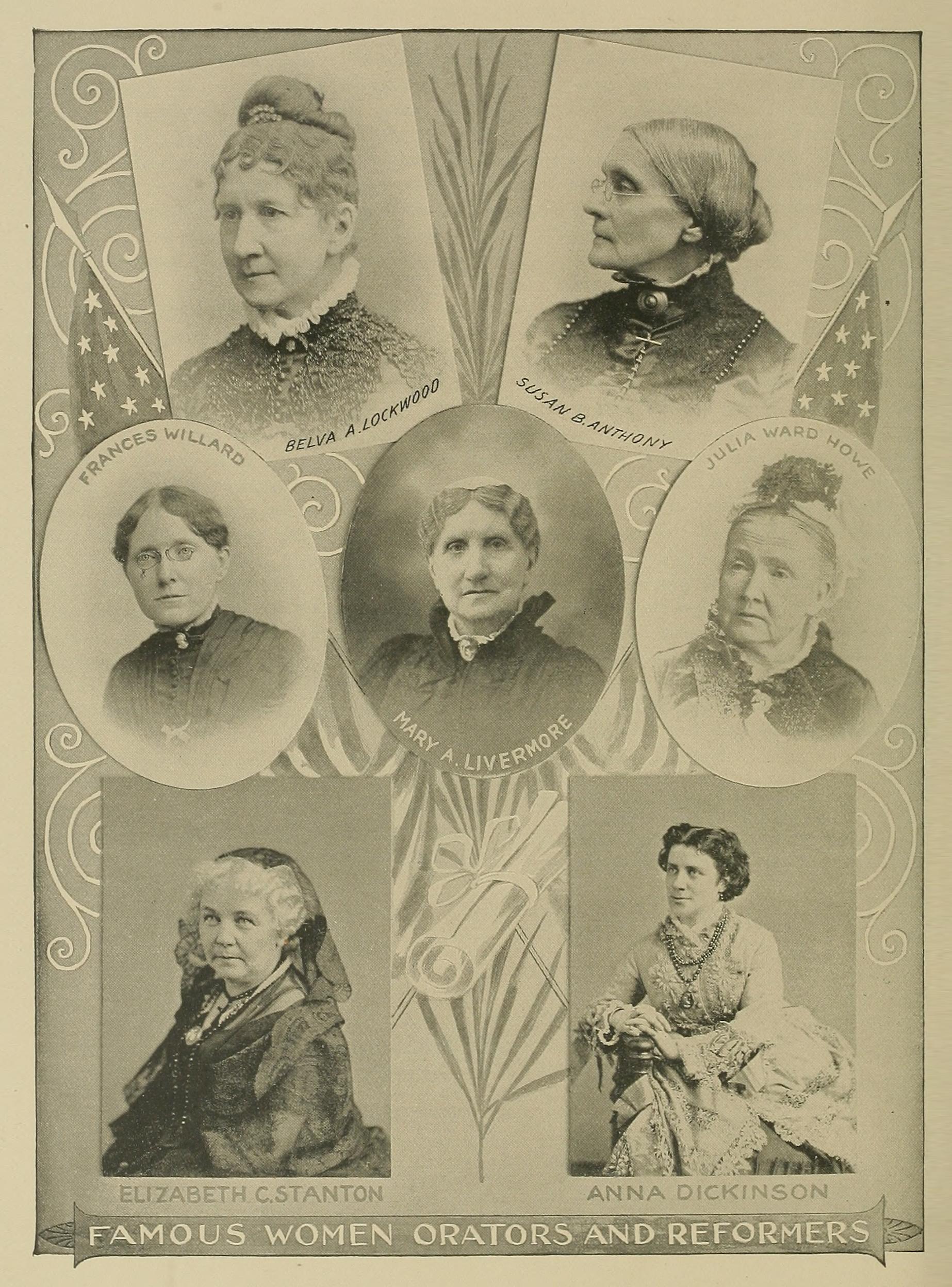
FAMOUS WOMEN ORATORS AND REFORMERS
BELVA A. LOCKWOOD • SUSAN B. ANTHONY FRANCES WILLARD • MARY A. LIVERMORE • JULIA WARD HOWE ELIZABETH C. STANTON • ANNA DICKINSON

JULIA WARD HOWE.
AUTHOR OF THE “BATTLE HYMN OF THE REPUBLIC.”
N Beacon Street, Boston, in an old-fashioned home, lives a woman mingling the twilight of her eventful life with the evening of the closing century, who has been a potent factor in its progress and developments. In her unpretentious little home have sat and talked the greatest men of America, and many of the European celebrities who have visited this country. Even the casual visitor to the home of this aged woman feels in the atmosphere of the place, with its mementoes of great men and women, some indefinable flavor, like a lingering perfume which tells him there has been high thinking and noble speech within the walls which surround him.

This noted poet, author, and philanthropist was born in New York City on May 27, 1819. Her father was Samuel Ward, and she numbers among her ancestors the famous General Marion, of South Carolina; Governor Samuel Ward, of Rhode Island; and Roger Williams, the apostle of religious tolerance. F. Marion Crawford, the novelist, is the son of her sister, who married Mr. Crawford, the artist. Mrs. Howe’s mother died when she was only five years of age, and her father five years later. But he had been a prosperous banker and provided to give her every advantage of a liberal education, which provision was carried out—her instructions including music, German, Greek, and French. She began to write verses while very young.
In 1843 Miss Ward was married to Doctor Samuel G. Howe. They went abroad on their wedding tour, spending a year in the Old World. Again, in 1850, she went to Europe, passing the winter in Rome with her two youngest children. The next year she returned to Boston, and in 1852 and 1853 published her first volume of poems, entitled “Passion Flowers,” which attracted much attention. At the same time her “Words for the Hour, a Drama in Blank Verse,” was produced in a leading theatre in New York and also in Boston. Her interest in the anti-slavery question began in 1851. In 1857 she visited Havana, and published her observations in a book, entitled “A Trip to Cuba,” which so vigorously attacked the degrading institutions of the Spanish rule that its sale has since been prohibited on that island. In 1861 appeared her famous “Battle Hymn of the Republic” with the chorus “John Brown’s Body, etc.,” which was published in her third volume, entitled “Later Lyrics.” The song and chorus at once became known throughout the country and was sung everywhere. In 1867 Mrs. Howe and her husband visited Greece, and won the gratitude of that nation by aiding them in the effort they were making for national independence. Her book “From Oak to Olive” was written after her visit to Athens. In 1868 Mrs. Howe joined the Woman Suffrage Movement, and the next year, before the Legislature in Boston, made her first speech urging its principles; and from that time forward has been officially connected with the movement.
Mrs. Howe visited England in 1872, where she lectured in favor of arbitration as the means of settling national and international disputes. At the same time she held, in London, a series of Sunday-evening services, devoted to Christian missionary work. During the same year she attended, as a delegate, the Congress for Prison Reform, held in London. On her return to the United States she organized or instituted the Woman’s Peace Festival, which still meets every year on the twenty-second of June.
Since her husband’s death, in 1876, Mrs. Howe has preached, lectured and traveled much in all parts of the United States, the most popular of her lectures being “Is Polite Society, Polite?” “Greece Revisited,” and “Reminiscences of Longfellow and Emerson.” In 1878 Mrs. Howe made another journey abroad, and spent over two years in travel in England, France, Italy, and Palestine. She was one of the presiding officers of the Woman’s Rights Congress, which met at Paris, and she lectured in that city and in Athens on the work of the various women’s associations in America. She has served as President in the Association of Advancement for Women for several years, and, notwithstanding her advanced age, retains her connection with this organization, and is an earnest promoter of their interest. She has formed a number of social Women’s Clubs, having for their object, mental improvement, in which the members study Latin, French, German, literature, botany, political economy and many other branches. She has been a profound student of philosophy, and has written numerous essays on philosophical themes.
Mrs. Howe’s three living daughters, all of whom are married, have been followers of her theories concerning woman’s freedom. One of them, Mrs. Laura Richards, is a well-known writer of stories for children, some of them being classics of their kind. “Captain January” is her best-known book. Mrs. Maud Howe Elliot, the third daughter, is a successful lecturer and also a novelist. Mrs. Florence Howe Hall, another daughter of Mrs. Howe, is a writer of acknowledged ability on social topics.
BATTLE HYMN OF THE REPUBLIC.

INE eye hath seen the glory of the coming of the Lord;
He is trampling out the vintage where the grapes of wrath are stored:
He hath loosed the fateful lightning of his terrible swift sword;
His truth is marching on.
I have seen Him in the watch-fires of a hundred circling camps;
They have builded Him an altar in the evening dews and damps;
I can read His righteous sentence by the dim and flaring lamps,
His day is marching on.
I have read a fiery gospel writ in rows of burnished steel;
“As ye deal with my contemners, so with you my grace shall deal;”
Let the Hero born of woman, crush the serpent with his heel,
Since God is marching on.
He has sounded forth the trumpet that shall never call retreat;
He is sifting out the hearts of men before His judgment seat;
Oh, be swift, my soul, to answer Him! be jubilant, my feet!
Our God is marching on.
In the beauty of the lilies Christ was born across the sea,
With a glory in His bosom that transfigures you and me;
As He died to make men holy, let us die to make men free,
While God is marching on.
OUR COUNTRY.

N primal rocks she wrote her name,
Her towers were reared on holy graves,
The golden seed that bore her came
Swift-winged with prayer o’er ocean waves.
The Forest bowed his solemn crest,
And open flung his sylvan doors;
Meek Rivers led the appointed Guest
To clasp the wide-embracing shores;
Till, fold by fold, the broidered Land
To swell her virgin vestments grew,
While Sages, strong in heart and hand,
Her virtue’s fiery girdle drew.
O Exile of the wrath of Kings!
O Pilgrim Ark of Liberty!
The refuge of divinest things,
Their record must abide in thee.
First in the glories of thy front
Let the crown-jewel Truth be found:
Thy right hand fling with generous wont
Love’s happy chain to furthest bound.
Let Justice with the faultless scales
Hold fast the worship of thy sons,
Thy commerce spread her shining sails
Where no dark tide of rapine runs.
So link thy ways to those of God,
So follow firm the heavenly laws,
That stars may greet thee, warrior-browed,
And storm-sped angels hail thy cause.
O Land, the measure of our prayers,
Hope of the world, in grief and wrong!
Be thine the blessing of the years,
The gift of faith, the crown of song.
THE UNSPEAKABLE PANG.
(FROM “A TRIP TO CUBA, 1860.”)
HO are these that sit by the long dinner-table in the forward cabin, with a most unusual lack of interest in the bill of fare? Their eyes are closed, mostly, their cheeks are pale, their lips are quite bloodless, and to every offer of good cheer, their “No, thank you,” is as faintly uttered as are marriage-vows by maiden lips. Can they be the same that, an hour ago, were so composed, so jovial, so full of dangerous defiance to the old man of the sea? The officer who carves the roast beef offers at the same time a slice of fat; this is too much; a panic runs through the ranks, and the rout is instantaneous and complete....

To what but to Dante’s Inferno can we liken this steamboat-cabin, with its double row of pits, and its dismal captives? What are those sighs, groans, and despairing noises, but the alti guai rehearsed by the poet? Its fiends are the stewards who rouse us from our perpetual torpor with offers of food and praises of shadowy banquets,—“Nice mutton-chop, sir? roast-turkey? plate of soup?” Cries, of “No, no!” resound, and the wretched turn again and groan. The philanthropist has lost the movement of the age,—keeled up in an upper ♦berth, convulsively embracing a blanket—what conservative more immovable than he? The great man of the party refrains from his large theories, which, like the circles made by the stone thrown into the water, begin somewhere and end nowhere. As we have said, he expounds himself no more, the significant forefinger is down, the eye no longer imprisons yours. But if you ask him how he does, he shakes himself as if like Farinata—
“averse l’inferno in gran dispetto,”
“he had a very contemptible opinion of hell.”
Let me not forget to add, that it rains every day, that it blows every night, and that it rolls through the twenty-four hours till the whole world seems as if turned bottom upwards, clinging with its nails to chaos, and fearing to launch away.... But all things have an end, and most things have two. After the third day, a new development manifests itself. Various shapeless masses are carried up-stairs and suffered to fall like snow-flakes on the deck, and to lie there in shivering heaps. From these larvæ gradually emerge features and voices,—the luncheon-bell at last stirs them with the thrill of returning life. They look up, they lean up, they exchange pensive smiles of recognition,—the steward comes, no fiend this time, but a ministering angel; and lo! the strong man eats broth, and the weak woman clamors for pickled oysters.

MRS. MARY ASHTON RICE LIVERMORE.
FAMOUS SCHOLAR, TEACHER, ARMY NURSE, EDITRESS, LECTURER, ABOLITIONIST AND WOMAN’S SUFFRAGIST.
T seems almost incredible,” says a writer, “that a woman now so famous made mud pies in her childhood, was often sent supperless to bed, and was frequently bounced down into a kitchen chair with an emphasis that caused her to see stars.” When a young girl, struggling to support herself, she took in shop-work, made shirts, and subsequently learned the trade of a dressmaker, at which she worked for twenty-five cents a day. At eighteen she ran away from home like a boy, and spent three eventful years on a Southern plantation—years full of comedy and tragedy, and packed with thrilling experiences. Here were nearly five hundred slaves, with whom, and with their white masters, she was brought face to face daily. Here she witnessed scenes as tragic as any described in “Uncle Tom’s Cabin.” Her description of the whipping of negro Matt, the cooper; his agonizing but unavailing plea for mercy; her subsequent visit alone to his cabin, when she entreated him to “run away, Matt, I’ll help you,” and his lonely death, will bring tears to the eyes of every reader.
Mrs. Livermore was the daughter of Timothy Rice, and was born in Boston, December 19, 1821. Notwithstanding the above reference to her early experiences, Mrs. Livermore had and improved all the advantages of the time for a thorough education. She graduated from the public schools of Boston at the age of fourteen, receiving a medal for good scholarship, and afterwards completed a four years’ course in the seminary at Charleston, Mass., in two years, and was elected a member of the faculty as a teacher of Latin and French. While performing these duties she continued the study of Greek and metaphysics under private tutors, and at the age of eighteen, as above suggested, she left home and went South to take charge of a family school on a plantation in Southern Virginia, remaining there nearly thee years. Her experiences in the South made her a most radical abolitionist, and on her return North she actively seconded every movement for the freedom of the slaves. She opened a select school for young ladies from fourteen to twenty years, at Duxbury, Mass., but relinquished it in 1845 on her marriage to Dr. D. P. Livermore, a Universalist minister, in Falls River, Mass. She made a most excellent minister’s wife, organizing literary clubs among the membership, and wrote many hymns and songs for church and Sunday-school books. She was also an active temperance worker, organizing a cold-water army of 1500 boys and girls, whom she delighted with temperance stories which she wrote and read to them. These stories were published in 1844 under the title of the “Children’s Army.” In 1857 she removed with her husband to Chicago, where Mr. Livermore became the editor of the Universalist organ for the Northwest, with his wife as assistant editor. During her husband’s absence in his church work she had charge of the entire establishment, paper, printing office and publishing house included, and wrote for every department of the paper except the theological, at the same time furnishing stories and sketches to Eastern publications, and was also active and untiring in Sunday-school, church and charitable work. At the convention in 1860, when Abraham Lincoln was nominated, she was the only woman reporter who had a place among the hundred or more of men. During the Civil War she made her name famous by resigning all positions, save that on her husband’s paper, even securing a governess for her children, and devoting herself entirely to the work of relief and assistance to the soldiers through the United States Sanitary Commission. She organized Soldiers’ Aid Societies, delivered public addresses, wrote circulars, bulletins and reports, and made trips to the front with sanitary stores, giving personal attention to the distribution of the same, and bringing back numbers of invalid soldiers, accompanying many of them in person to their homes. She organized and conducted Sanitary Fairs, detailed nurses for the hospitals and accompanied them to their posts, and at the close of the war published her reminiscences, entitled “My Story of the War,” which is regarded as the most complete record of the hospital and sanitary work in the Northern army during this great fratricidal struggle.
Returning home after the war Mrs. Livermore became an ardent supporter of the Woman’s Suffrage movement as the best means not only of improving the condition of women, but with the broad, philanthropic idea of giving them a greater opportunity for doing good. Before the war she had opposed the placing of the ballot in the hands of women, but her experiences in the army taught her differently. She arranged for the first Woman’s Suffrage Convention in Chicago, elicited the aid of the leading clergymen of the city, and secured the attendance of the most prominent advocates of the cause from various parts of the country. The association was duly organized with Mrs. Livermore as its first president. “The Agitator,” a Woman’s Suffragist paper, was started by her in 1869 at her own expense and risk, in which she espoused the temperance cause, as well as woman’s suffrage. In 1870 she became the editor of the “Woman’s Journal” of Boston, and the family removed to Melrose, Massachusetts. Mrs. Livermore, however, retained the editorship but two years, resigning it, in 1872, that she might give her more undivided time to the lecture field.
During the last quarter century she has been heard in the lyceum courses of this country, visiting almost every State in the Union, and also lecturing at many points in Europe. The volume “What Shall We Do with Our Daughters and Other Lectures,” published in 1883, and a subsequent of the same character comprise her most important published discourses. The charm of Mrs. Livermore’s manner and the eloquence of her delivery have been equalled by few modern speakers. “At her feet,” writes one of her eulogists, “millions of people have sat and listened in admiration and wonder. The rich and poor, the high and low, the learned and unlearned, have been alike thrilled and moved by her burning words. She has swayed brilliant audiences of fashion; has spoken in State prisons, jails and penitentiaries; to audiences composed of outcasts; and to audiences numbering thousands of children. With untold wealth of mental resources, and a brain teeming with soul-stirring thoughts, these lectures overflow with grand principles; while the extraordinary scenes, thrilling stories, and remarkable facts given in them illustrate those principles with great clearness and force. Throughout her public speeches, whatever the theme, the listener never tires, but is rather uplifted by the ‘golden thoughts’ and ‘living truths’ that enrich them from beginning to end.”
During this period her pen was not idle. Her articles have appeared in the “North American Review,” the “Arena,” the “Chautauquan,” “Independent,” “Youth’s Companion,” “Christian Advocate,” “Woman’s Journal” and other high-class periodicals. She is identified with the Woman’s Christian Temperance Union, for ten years being president of the Massachusetts branch of that organization. She is also president of the American Woman’s Suffrage Association, of the Beneficent Society of the New England Conservatory of Music, and was the first president for two years of the Woman’s Congress. Mrs. Livermore, notwithstanding her advanced age, keeps steadily at work with voice, pen and influence. After she was seventy-five years of age, at the earnest request of many prominent friends and admirers throughout the United States, she wrote her autobiography, a large volume of over 700 pages, issued in 1897.
We cannot better close this article than by quoting, from Mrs. Livermore herself, a retrospective paragraph with a prospective closing which is beautiful to witness in one standing, as she now does, in the twilight of a long and eventful career: “I cannot say that I would gladly accept the permission to run my earthly race once more from beginning to end. I am afraid it would prove wearisome—‘a twice-told tale.’ And so while rejoicing in the gains of the past and in the bright outlook into the future, I prefer to go forward into the larger life that beckons me further on, where I am sure it will be better than here. And when the summons comes, although the world has dealt kindly with me, I shall not be sorry to lift the latch and step out into ‘that other chamber of the King, larger than this and lovelier.’”
USEFUL WOMEN.¹
(FROM “WHAT SHALL WE DO WITH OUR DAUGHTERS,” 1883. LECTURES ON “Superfluous Women.”)
OSA BONHEUR has achieved world-wide fame and pecuniary independence as one of the most skilful painters of animals; the boldness and independence of her own character inspiring her pencil, and her faithfulness to nature giving great force to her work. The whole civilized world does homage to her genius; and, during the siege of Paris in the Franco-Prussian War, the Crown Prince of Prussia gave orders that her studio and residence at Fontainebleau should be spared and respected.

Florence Nightingale, well born, highly educated, and brilliantly accomplished, gave herself to the study of hospitals, and of institutions for the diseased, helpless, and infirm. Appreciating the work of the Sisters of Charity in the Catholic Church, she felt the need of an institution which should be its counterpart in the Protestant Communion. She visited civil and military hospitals all over Europe, studied with the Sisters of Charity in Paris their system of nursing and hospital management, and went into training as a nurse in the House of the Protestant Deaconesses at Kaiserwerth on the Rhine. For ten years she served an apprenticeship, preparing for the great work of her life. Her opportunity came during the war in the Crimea, when through incompetence, and utter disregard of sanitary laws, the rate of mortality in the English hospitals surpassed that of the fiercest battles. Horror and indignation were felt throughout England. Miss Nightingale offered her services to the government with a corps of trained nurses, was accepted, and went to Constantinople.
The disorder, the want—while storehouses were bursting with the needed hospital supplies—the incompetence, the uncleanliness, the suffering and death created general dismay. Unappalled by the shocking chaos, Miss Nightingale ordered the storehouses at Scutari to be broken open, when want gave place to abundance; and soon her executive skill and rare knowledge transformed the hospitals into models of order and comfort. She spared herself no labor, sometimes standing twenty hours in succession giving directions, and refusing to leave her post, even when she broke down with hospital-fever. Sadly overworked, her patience and cheerfulness were unfailing, winning the love of the roughest soldiers; and, as she walked the wards, men too weak to speak plucked her gown with feeble fingers, or kissed her shadow as it fell athwart their pillow. She expended her own vitality in this work, and returned to England an invalid for life. But not an idle invalid, for from her sick-room there have gone plans for the improvement of hospitals and the training of nurses wrought out by her busy brain and pen.
Caroline Herschel, sister of the great astronomer, was his constant helper and faithful assistant, in this character receiving a salary from the king. In addition she found time to make her own independent observations, discovering comets, remarkable nebulæ, and clusters of stars, and receiving from the Royal Society a gold medal in recognition of her work.
Charlotte Bronté’s portion in life was pain and toil and sorrow. Her experience was a long struggle with every unkindness of fate, and she lacked every advantage supposed necessary to literary work. Her force of character and undismayed persistence triumphed over all hindrances. She put heart and conscience into books that held the literary world in fascination. In them she rent the shams of society by her keen analyses. She depicted life as she had known it, shorn of every illusion, and then beautified it by unflinching loyalty to duty, and unwavering fidelity to conscience. The publication of “Jane Eyre” marked an era in the literary world not soon to be forgotten.


BELVA ANN LOCKWOOD.
FIRST WOMAN LAWYER BEFORE THE SUPREME COURT OF THE UNITED STATES.
OR heroic perseverance, strength of intellect, dignity and power of mind, logic and eloquence,—and withal true womanliness of character, the sisterhood of the world perhaps could present no counterpart in any single woman, of any age, to Belva A. Lockwood. Had she devoted her life to literature the profoundness of her writings must have impressed the world. The fragments of her speeches which remain are worthy to live. She has had one idea in life—to enfranchise woman—and while earning her living in a profession, for recognition in which she had to fight and conquer the United States, she has, from every advanced step, held back the helping hand to her more timid sisters. If her ideal is ever realized, she will live in future history as one of the emancipators and greatest benefactors of her sex.

Belva Ann Bennett was born in Niagara County, New York, October 24, 1830, on her father’s farm. Her early education was received at a district school and in the academy of her native town. At fourteen years of age she began to teach in summer, attending school in winter. At eighteen she married a young farmer, Uriah H. McNall, who died in 1853, leaving one daughter. The young widow entered Genesee College in Lima, New York, the same year, from which she graduated with the degree of A. B. four years later. She was immediately elected to a position in the Lockport Academy, where she manifested her progressive principles by introducing declamation and gymnastics for young ladies, conducting the classes herself. This was in addition to her duties as professor of higher mathematics, logic, rhetoric, and botany. Four years later she became proprietor of McNall Seminary in Oswego, New York, which she conducted until the close of the Civil War, at which time she removed to Washington, D. C., and in March, 1868, married Rev. Ezekiel Lockwood, a Baptist minister and chaplain during the war. Dr. Lockwood died in 1877. At this late date Mrs. Lockwood resumed her studies, entering the Syracuse University at New York, from which she graduated with the degree of A. M. She had previous to this studied law in Washington, graduating from the National University Law School with the degree of D. C. L. in May, 1873. In the same year she was admitted to practice in the highest court of the District, and in 1875 applied for admission to the Court of Claims, which was refused; first, on the ground that she was a woman, and afterwards that she was a married woman. In 1876 she applied for admission to the Supreme Court of the United States. This was denied her because there was no English precedent. It was in vain that she pleaded that Queens Eleanor and Elizabeth had both been supreme chancellors of the realm, that Countess Ann had sat with the judges on the bench at the Assizes of Appleby. Finally she drafted a bill and secured its introduction into both houses of Congress, which was passed in 1879, admitting women to the Court, by which means she accomplished her purpose, and since that time she has enjoyed an active and lucrative practice, being privileged to appear before any Court in the United States. Nine other women have since been admitted to practice in the Supreme Court under the above Act.
Among the services which Mrs. Lockwood has rendered her sex may be mentioned the bill passed by Congress in 1870, giving to the women employees of the government, of whom there are many thousands, the same pay as men receive for similar work. She also secured the passage of a bill appropriating $50,000 for the aid of sailors and mariners. She has frequently appeared before congressional committees in the cause of women, her arguments always looking to the final enfranchisement of woman. An extract from one of these addresses succeeds this article. Mrs. Lockwood is also an intense advocate of temperance and labor reform.
When President Garfield died in 1881, he was considering her application for appointment as minister to Brazil. In 1884 and again in 1888, she was nominated for President of the United States by the Equal Rights Party of San Francisco, California, and though knowing that her candidacy would only subject her to the ridicule of the masses, it afforded an opportunity for the preaching of her theory of woman suffrage, and she accepted the nomination, and made a canvass that awakened the people of the United States to no small consideration of the subject. The popularity given her by these several movements has called her largely to the lecture platform and into newspaper correspondence during the last fifteen years. She was a delegate to the International Congress of Peace in Paris, and made one of the opening speeches, and presented a paper in the French language on “International Arbitration,” which was well received. In 1890 she was again a delegate to the same convention in London, and her paper there on “Disarmament” was widely commented upon. Even at this late date her thirst for knowledge again evinced itself, for she remained in London to take a course of University Extension lectures at Oxford. In 1891 she was again a delegate to the Peace Congress at Rome, where her influence was equally as conspicuous as before.
Of late years Mrs. Lockwood, in addition to her law practice, has acted as assistant editor of the “Peacemaker,” a Philadelphia magazine, all the time pursuing her studies and contributing no small modicum of encouragement, both by her pen and lectures, to the furtherance of the University Extension idea. It may be said, however, that her interest and labor in all forward movements are mainly due to her confidence in the aid they will contribute toward the final enfranchisement of woman.
ADDRESS BEFORE THE COMMITTEE OF THE HOUSE OF DELEGATES WASHINGTON, IN SUPPORT OF WOMAN’S SUFFRAGE.
ENTLEMEN of the Committee: We come before you to-day, not with any studied eloquence, far-fetched erudition, or new theories for the metamorphosis of our government, or the overthrow of our social economy and relations, but we come, asking for our whole commonwealth, for the fathers who begat us, and the brothers at our side—for the mothers who bore us, and the sisters who go hand in hand with us; for the orphan and the widow unprotected; for the wretched inebriate and the outcast Magdalene; for the beggars who throng our streets and the inmates of our jails and asylums—for these we ask you that we too may have a hand and a voice, a share in this matter which so nearly concerns not only our temporal but even our eternal salvation. We ask you that we may have an interest that shall awaken from its apathy fully one-half of the moral and intellectual resources of the country, fully one-half of its productive interest—an interest which contains in the germ the physical power and vital force of the whole nation. Weakness cannot beget power, ignorance cannot beget wisdom, disease cannot produce health. Look at our women of to-day, with their enfeebled bodies, dwarfed intellects, laxness of moral force, without enough of healthy stimulus to incite to action, and compare them with our grandmothers of the Revolution and the Martha Washington school. Here you find a woman who dared to control her own affairs; who superintended a farm of six hundred acres; giving personal instructions to the workmen, writing her own bills and receipts, and setting an example of industry and frugality to the neighboring women who called to see her.

I need not, gentlemen, enumerate to you to prove what I wish to prove to-day, the countless numbers of women who have participated creditably in government from the days of our Saviour until the present time. You know that Victoria rules in England; and the adoration of the English heart to-day for its Queen, found expression but a few weeks since in one of our popular lecture halls, when the audience, composed partly of Englishmen, were asked to sing “God Save the Queen.” The wisdom of the reign of Elizabeth, “good Queen Bess,” as she has been called, gave to England her prestige—the proud pre-eminence which she holds to-day among the nations of the earth. Isabella I. of Spain, the patron saint of America, without whose generosity our country to-day might have been a wilderness, was never nobler than when after Ferdinand’s refusal, after the refusal of the crowned authority of England, the disapproval of the wise men of her own kingdom, she rose in her queenly majesty, and said, “I undertake it for my own crown of Castile, and will pledge my jewels to raise the necessary funds.” Maria Theresa, of Austria, who assumed the reins of government with her kingdom divided and disturbed, found herself equal to the emergency, brought order out of chaos, and prosperity to her kingdom. Christine, of Sweden, brought that kingdom to the zenith of its power. Eugenie, Empress of the French, in the late disastrous revolution, assumed the regency of the Empire in defiance of her ministry, and, when forced to flee, covered her flight with a shrewdness that would have done credit to Napoleon himself. Florence Nightingale brought order and efficiency into the hospitals of the Crimea, and Clara Barton, with her clear head and generous heart, has lifted up the starving women of Strassburg, and made it possible for them to be self-sustaining. I need not cite to you Catharine, of Russia, Cleopatra, or the Queen of Sheba, who came to admire the wisdom of Solomon; or the Roman matrons, Zenobia, Lucretia, Tullia; or revert to the earliest forms of government when the family and the church were lawgivers; remind you of Lydia, the seller of purple and fine linen, who ruled her own household, called to the church; of Aquilla and Priscilla, whom Paul took with him and left to control the church at Ephesus, after they had been banished from Rome by the decree of Claudius; or of Phebe, the deaconess. It is a well-known fact that women have been sent as ministers and ambassadors, the latter a power fuller than our country grants, to treat on important State matters between the crowned heads of Europe. In many cases they have represented the person of the monarch or emperor himself. France, since the beginning of the reign of Louis XIV., through the period of the ascendency of Napoleon I. down to the reign of Napoleon III., has employed women in diplomacy. Instances may be found recorded in a work entitled “Napoleon and His Court,” by Madame Junot, and also in our own consular works. The late Empress of France has been said to be especially gifted in this respect. It has been the custom of Russia for the past century, and still continues to be, to send women on diplomatic errands. In this empire, also, where the voting is done by households, a woman is often sent to represent the family.
Women are now writing a large proportion of the books and newspapers of the country, are editing newspapers and commanding ships. They are admitted to law schools, medical schools, and the higher order of colleges, and are knocking at Amherst and Yale. Yea, more, they are admitted to the practice of law, as in Iowa, Missouri, Kansas, Wyoming and Utah; admitted to the practice of medicine everywhere, and more recently to consultation. One hundred women preachers are already ordained and are preaching throughout the land. Women are elected as engrossing and enrolling clerks in Legislatures, as in Wisconsin, Missouri and Indiana; appointed as justices of the peace, as in Maine, Wyoming and Connecticut; as bankers and brokers, as in New York and St. Louis. They are filling as school teachers three-fourths of the schools of the land.
This is more than true of our own city. Shall we not then have women school trustees and superintendents? Already they are appointed in the East and in the West, and women are permitted to vote at the school elections. Who has a deeper interest in the schools than the mothers.
Look at the hundreds of women clerks in the government departments. They are all eligible, since the passage of the Arnell bill, to the highest clerkships. Look at the postmistresses throughout the land. Each one a bonded officer of the government, appointed by the President and confirmed by the Senate, the highest executive power in the land. “The power of the President to appoint, and of the Senate to confirm, has never been questioned by our highest courts. Being bonded officers, they must necessarily qualify before a judicial officer.”
And now, gentlemen of the Committee on Laws and Judiciary, whatever may be your report on these bills for justice and equality to women, committed to your trust, I hope you will bear in mind that you have mothers, wives, sisters, daughters, who will be affected by your decision. They may be amply provided for to-day, and be beggared to-morrow. Remember that “life is short and time is fleeting,” but principles never die. You hold in your hands a power and an opportunity to-day to render yourselves immortal—an opportunity that comes but once in a lifetime. Shakespeare says, “There is a tide in the affairs of men which, taken at the flood, leads on to fortune.” Gentlemen, the flood-tide is with you! Shall this appeal be in vain? I hold in my hands the names of hundreds of men and women of our city pledged to this work, and they will not relax their efforts until it is accomplished.
“Truth crushed to earth will rise again;
The eternal years of God are hers;
But ♦Error, wounded, writhes in pain
And dies amid her worshippers.”


SUSAN B. ANTHONY.
FOUNDER OF THE FIRST WOMEN’S TEMPERANCE ORGANIZATION.
MONG the famous names of our time, history will, no doubt, record that of Susan B. Anthony with the greatest of reformers and progressive thinkers. Once held in derision, she now enjoys the reward of being esteemed and loved by her fellow men, while she is looked up to, by those of her own sex who believe in woman suffrage as one of the pioneers whose herculean efforts will eventually place the ballot in the hands of the women of the United States.
Miss Anthony was born in South Adams, Mass., February 15, 1820. She was brought up in New York under the most religious influence of a Baptist mother and a Quaker father. From her childhood her character has been strongly marked by individuality and native strength.
Mr. Anthony was a manufacturer and a wealthy man. He fitted his daughters and sons for teachers, and at the age of fifteen Susan began to teach in a Quaker family, her salary being one dollar per week and board. In 1837, a financial crash caused the failure of her father, who was, after this, aided in his efforts to retrieve his fortune by his children. Susan was particularly successful and progressive in her work, and identified herself actively with the New York Teachers’ Association, rendering herself conspicuous by pleading in the conventions for higher wages and equal rights for women in all the honors and responsibilities of the association. The women teachers throughout America owe her a debt of gratitude for their improved position and compensation to-day.
The subject of temperance also claimed Miss Anthony’s attention from the time of her childhood. In 1852, she organized the New York State Women’s Temperance Association, which was the first open temperance organization of women, and the foundation for the modern society known as the Women’s Christian Temperance Union. Mrs. Elizabeth Cady Stanton was president, and Miss Anthony for several years secretary, of this first organization. It was in this work that Miss Anthony discovered the impotency of women to advance the cause of temperance without the ballot, and she at once became an ardent woman suffragist. She was also a pronounced and active abolitionist; and, during the war, with her friend and co-worker, Mrs. Stanton, and others, she presented a petition to Congress for the abolition of slavery, bearing nearly 400,000 signatures from all parts of the country. These petitions were so powerful in arousing the people, and also Congress, that Charles Sumner urged Miss Anthony to continue in the work. “Send on the petitions,” he wrote, “they furnish the only background for my demands.”
The most dramatic event of Miss Anthony’s life was her arrest and trial for voting at the presidential election of 1872. When asked by the judge, “You voted as a woman, did you not?” she replied, “No, sir, I voted as a citizen of the United States.” Before the date set for the trial Miss Anthony thoroughly canvassed her county and instructed the people in citizen’s rights, intending in this way to have the jurors, whoever they might be, well instructed in advance. To her chagrin change of venue was ordered to another county, setting the date three weeks ahead. Miss Anthony was equal to the emergency; in twenty-four hours dates were set and appointments made for a series of meetings in that county, and the country was thoroughly aroused in Miss Anthony’s behalf. The jury would no doubt have acquitted her, but the judge took the case out of their hands saying it was a question of law and not of fact, and pronounced Miss Anthony guilty and fined her $100.00 and costs. “I shall never pay a penny of this unjust claim,” she said. “Resistance to tyranny is obedience to God.” She intended to take the case to the Supreme Court, and further to help her cause did not desire to give bond, preferring to be imprisoned, but her counsel gave bond and thus frustrated her purpose of carrying it to the Supreme Court. The inspectors who received the ballot from her and her friends were fined and imprisoned, but were pardoned by President Grant. Miss Anthony steadfastly adhered to her vow and never paid the fine.
Miss Anthony has always been in great demand on the platform and has lectured in almost every city and hamlet in the North. She has made constitutional arguments before congressional committees and spoken impromptu in all sorts of places. Wherever a good word in introducing a speaker, or a short speech to awaken a convention, or a closing appeal to set people to work was needed she always knew how to say the right thing, and never wearied her audience. There was no hurry, no superfluity in her discourse, and it was equally devoid of sentiment or poetry. She was remarkably self-forgetful and devoted to the noblest principles. A fine sense of humor, however, pervaded her logical arguments. She had the happy faculty of disarming and winning her opponents. She possessed a most wonderful memory, carrying in her mind the legislative history of each state, the formation and progress of political parties, and the public history of prominent men in our national life, and in fact whatever has been done the world over to ameliorate the condition of women. She is said to be a most congenial and instructive companion, and her unfailing sympathy makes her as good a listener as talker.
It must be consolingly comforting and pleasant for this ardent worker, who has stemmed a violent tide of opposition throughout a long life, to have the tide of popular esteem turn so favorably toward her last years. Once it was the fashion of the press to ridicule and jeer, but at last the best reporters were sent to interview her and to put her sentiments before the world with the most respectful and laudatory personal comment. Society, too, threw open its doors, and into many distinguished gatherings she carried a refreshing breath of sincerity and earnestness. Her seventieth birthday was celebrated by the National Woman Suffrage Association with an outburst of gratitude which is perhaps unparalleled in the history of any living woman. In 1892 she was elected president of this association, at which time, though seventy-two years of age, she was still of undiminished vigor and activity. Standing at the head of this organization, of which she was forty years before among the founders, Susan B. Anthony is one of the most heroic figures in American history.
WOMAN’S RIGHT TO SUFFRAGE.
After its delivery, this address was printed and distributed in Monroe and Ontario counties prior to her trial, in June, 1873, the charge against her being that she had violated the law by voting in the presidential election in November, 1872. This address is necessarily argumentative; but it contains occasional passages which exhibit the power of her oratory.
Copied from an account of the trial published in Rochester, New York, 1874.
RIENDS AND FELLOW-CITIZENS: I stand before you to-night, under indictment for the alleged crime of having voted at the last Presidential election, without having a lawful right to vote. It shall be my work this evening to prove to you that in thus voting, I not only committed no crime, but, instead, simply exercised my citizen’s right, guaranteed to me and all United States citizens by the National Constitution, beyond the power of any State to deny.

The preamble of the federal constitution says:
“We, the people of the United States, in order to form a more perfect union, establish justice, insure domestic tranquility, provide for the common defence, promote the general welfare and secure the blessings of liberty to ourselves and our posterity, do ordain and establish this constitution for the United States of America.”
It was we, the people, not we, the white male citizens, nor yet we, the male citizens; but we, the whole people, who formed the Union. And we formed it, not to give the blessings of liberty, but to secure them; not to the half of ourselves and the half of our posterity, but to the whole people—women as well as men. And it is a downright mockery to talk to women of their enjoyment of the blessings of liberty while they are denied the use of the only means of securing them provided by this democratic-republican government—the ballot.
The early journals of Congress show that when the committee reported to that body the original articles of confederation, the very first article which became the subject of discussion was that respecting equality of suffrage. Article IV. said:
“The better to secure and perpetuate mutual friendship and intercourse between the people of the different States of the Union, the free inhabitants of each of the States, (paupers, vagabonds and fugitives from justice excepted,) shall be entitled to all the privileges and immunities of the free citizens of the several States.”
Thus, at the very beginning, did the fathers see the necessity of the universal application of the great principle of equal rights to all—in order to produce the desired result—a harmonious union and a homogeneous people.
B. Gratz Brown, of Missouri, in the three days’ discussion in the United States Senate in 1866, on Senator Cowan’s motion to strike male from the District of Columbia suffrage bill, said:
“Mr. President, I say here on the floor of the American Senate, I stand for universal suffrage; and as a matter of fundamental principle, do not recognize the right of society to limit it on any ground of race or sex.”
Charles Sumner, in his brave protests against the fourteenth and fifteenth amendments, insisted that, so soon as by the thirteenth amendment the slaves became free men, the original powers of the United States Constitution guaranteed to them equal rights—the right to vote and to be voted for.
Article 1 of the New York State Constitution says:
“No member of this State shall be disfranchised or deprived of the rights or privileges secured to any citizen thereof, unless by the law of the land or the judgment of his peers.”
And so carefully guarded is the citizen’s right to vote that the Constitution makes special mention of all who may be excluded. It says:
“Laws may be passed excluding from the right of suffrage all persons who have been or may be convicted of bribery, larceny or any infamous crime.”
“The law of the land” is the United States Constitution, and there is no provision in that document that can be fairly construed into a permission to the States to deprive any class of their citizens of their right to vote. Hence, New York can get no power from that source to disfranchise one entire half of her members. Nor has “the judgment of their peers” been pronounced against women exercising their right to vote; no disfranchised person is allowed to be judge or juror, and none but disfranchised persons can be women’s peers; nor has the Legislature passed laws excluding them on account of idiocy or lunacy; nor yet the courts convicted them of bribery, larceny or any infamous crime. Clearly, then, there is no constitutional ground for the exclusion of women from the ballot-box in the State of New York. No barriers whatever stand to-day between women and the exercise of their right to vote save those of precedent and prejudice.
For any State to make sex a qualification that must ever result in the disfranchisement of one entire half of the people is to pass a bill of attainder, or an ex post facto law, and is therefore a violation of the supreme law of the land. By it the blessings of liberty are forever withheld from women and their female posterity. To them this government has no just powers derived from the consent of the governed. To them this government is not a democracy. It is not a republic. It is an odious aristocracy; a hateful oligarchy of sex; the most hateful aristocracy ever established on the face of the globe; an oligarchy of wealth, where the rich govern the poor. An oligarchy of learning, where the educated govern the ignorant, or even an oligarchy of race, where the Saxon rules the African, might be endured; but this oligarchy of sex, which makes father, brothers, husband, sons the oligarchs over the mother and sisters, the wife and daughters of every household; which ordains all men sovereigns, all women subjects; carries dissension, discord and rebellion into every home of the nation.
Webster, Worcester and Bouvier all define a citizen to be a person, in the United States, entitled to vote and hold office.
Prior to the adoption of the thirteenth amendment, by which slavery was forever abolished, and black men transformed from property to persons, the judicial opinions of the country had always been in harmony with these definitions. To be a person was to be a citizen, and to be a citizen was to be a voter.
The only question left to be settled now is: Are women persons? And I hardly believe any of our opponents will have the hardihood to say they are not. Being persons, then, women are citizens, and no State has a right to make any new law, or to enforce any old law, that shall abridge their ♦privileges or immunities. Hence, every discrimination against women in the constitutions and laws of the several States is to-day null and void, precisely as is every one against negroes.


ELIZABETH CADY STANTON.
FOUNDER OF THE WOMAN-SUFFRAGE MOVEMENT.
MONG the few women who have shown themselves the polemic equals of the most trained and brilliant men of their times, the subject of this sketch stands prominently with the first. Mrs. Stanton was always a vigorous woman of commanding size with the mental force of a giant. In public debates and private arguments, she has shown herself to be an orator, forceful, logical, witty, sarcastic and eloquent. Like all great orators, she is imbued with one great idea which presses to the front in all she says or does and has been the moving force of her life. She believes that social and national safety lies alone in the purity of individuals and in the full and free bestowal upon every individual, regardless of sex, of all the rights and privileges of citizenship. In other words, whatever other excellencies or merits she may possess, she is primarily a Woman Suffragist.
Elizabeth Cady was the daughter of Judge Daniel Cady and was born in Johnstown, N. Y., November 12, 1815. She was a child of marked intelligence and was thoroughly educated by her parents and graduated in Troy, N. Y., in 1832. She was learned in Latin and Greek, was a great lover of sports and, it is said that in early life she frequently complained that she had been born a girl instead of a boy. She used to discuss law in her father’s office and always insisted that no law was just which denied to women an equal right with men. She was anxious to complete her education in Union College where her brother had been educated, and her indignation was unbounded when she was refused entrance because girls were not admitted to that institution. Thus it will be seen how she became a Woman’s Rights believer, and with her strong and cultured mind it was only natural that she should become one of its chief advocates. At the age of twenty-five, in 1840, she married Henry B. Stanton, an Anti-slavery orator, journalist and author. Thus she became an Abolitionist and entered, with her usual force and zeal, into that movement. She was a delegate to the World’s Anti-slavery Convention, which met the next year in London. With Lucretia Mott, she signed the first call for a Woman’s Rights Convention, which met in Seneca Falls, N. Y., on the 19th of July, 1848. Mrs. Stanton received and cared for the visitors, wrote the resolutions, declarations and aims of the organization, and had the satisfaction of being ridiculed throughout the United States. Even her father, Judge Cady, imagined that she had gone crazy and journeyed all the way to Seneca Falls in order to endeavor to reason her out of her position; but she remained unshaken. Since that convention, Mrs. Stanton has been one of the leaders of the movement in the United States.
In 1854, Mrs. Stanton addressed the New York Legislature, endeavoring to bring about such a change in the constitution as would enfranchise women, an extract from which, we insert in this volume. She delivered another address to the same body in 1860 and again in 1867. In Kansas and in Michigan in ’67 and ’74, when those states were submitting the question of “Woman’s Suffrage” to the people, she did heroic work by canvassing and speaking throughout both of these Commonwealths. Until the year of 1890, she was President of the National Woman’s Suffrage Association. In 1868, she ventured to run as candidate for Congress and, in her speech to the electors of the district, she announced her creed to be “Free speech, free press, free men and free trade.”
The “New York Herald” ventured to support her in this effort; but of course she was defeated, as she expected, her object being only to emphasize and advertise the principle of “Woman Suffrage.”
The literary works of Mrs. Stanton consist of her contributions to “The Revolution,” a magazine published in New York City, of which she became editor in 1868, Susan B. Anthony being the publisher. She was also joint-author of the “History of Woman’s Suffrage” of which three volumes have appeared. She has, also, lectured much and contributed to the secular press.
Mrs. Stanton, with all her public works, has been a thoroughly domestic woman. She has a family of seven children, five sons and two daughters, all of whom were living up to a recent date and some of them have inherited the talents of their mother and bid fair to become famous. Mrs. Stanton possesses conversational powers of the highest order. In the light of recent developments, the retrospect of her long career must afford her unusual pleasure. She was met with bitterness, ridicule and misrepresentation at the beginning of her crusade. She has lived down all of this and has seen her cherished ambition fruited here and there, while many of the leading men of the age in all sections of the country have been brought to look upon “Woman Suffrage” as something to be desired; while in the minds of the public generally, the seed of thoughts sown by her are so fast rooting themselves and springing up, that she looks with confidence forward to the early realization of her hopes—the enfranchisement of woman.
A PLEA FOR EQUAL RIGHTS.
Delivered at Seneca Falls, N. Y., on the assembling of the first Woman-Suffragist Convention, July 19, 1848. Mrs. Stanton begins by saying:
SHOULD feel exceedingly diffident to appear before you at this time, having never before spoken in public, were I not nerved by a sense of right and duty.
[After delivering a masterly and eloquent argument of nearly two hours length announcing the principles and setting forth the arguments which have since signalized the movement, Mrs. Stanton closed in the following eloquent strain:]
Our churches are multiplying on all sides, our missionary societies, Sunday Schools, and prayer meetings and innumerable charitable and reform organizations are all in operation, but still the tide of vice is swelling, and threatens the destruction of everything, and the battlements of righteousness are weak against the raging elements of sin and death. Verily the world waits the coming of some new element, some purifying power, some spirit of mercy and love. The voice of woman has been silenced in the state, the church, and the home, but man cannot fulfill his destiny alone, he cannot redeem his race unaided. There are deep and tender cords of sympathy and love in the hearts of the down-fallen and oppressed that woman can touch more skilfully than man. The world has never yet seen a truly great and virtuous nation, because in the degradation of woman the very fountains of life are poisoned at their source. It is vain to look for silver and gold from the mines of copper and lead. It is the wise mother that has the wise son. So long as your women are slaves you may throw your colleges and churches to the winds. You can’t have scholars and saints so long as your mothers are ground to powder between the upper and nether millstone of tyranny and lust. How seldom, now, is a father’s pride gratified, his fond hopes realized, in the budding genius of his son. The wife is degraded, made the mere creature of caprice, and the foolish son is heaviness to his heart. Truly are the sins of the father visited upon the children to the third and fourth generation. God, in his wisdom, has so linked the whole human family together, that any violence done at one end of the chain is felt throughout its length, and here, too, is the law of restoration, as in woman all have fallen, so in her elevation shall the race be recreated. “Voices” were the visitors and advisers of Joan of Arc. Do not “voices” come to us daily from the haunts of poverty, sorrow, degradation and despair, already too long unheeded. Now is the time for the women of this country, if they would save our free institutions, to defend the right, to buckle on the armor that can best resist the keenest weapons of the enemy—contempt and ridicule. The same religious enthusiasm that nerved Joan of Arc to her work nerves us to ours. In every generation God calls some men and women for the utterance of the truth, a heroic action, and our work to-day is the fulfilling of what has long since been foretold by the prophet—Joel ii. 28, “And it shall come to pass afterward, that I will pour out my spirit upon all flesh, and your sons and your daughters shall prophesy.” We do not expect our path will be strewn with the flowers of popular applause, but over the thorns of bigotry and prejudice will be our way, and on our banners will beat the dark storm-clouds of opposition from those who have entrenched themselves behind the stormy bulwarks of custom and authority, and who have fortified their position by every means, holy and unholy. But we will steadfastly abide the result. Unmoved we will bear it aloft. Undauntedly we will unfurl it to the gale, for we know that the storm cannot rend from it a shred, that the electric flash will but more clearly show to us the glorious words inscribed upon it, “Equality of Rights.”
“Then fear not thou to wind thy horn,
Though elf and gnome thy courage scorn.
Ask for the Castle’s King and Queen,
Though rabble rout may rush between,
Beat thee senseless to the ground,
And in the dark beset thee round,
Persist to ask and it will come,
Seek not for rest in humbler home,
So shalt thou see what few have seen;
The palace home of King and Queen.”
MRS. STANTON’S ADDRESS TO THE LEGISLATURE OF NEW YORK.
UNDER THE SANCTION OF THE STATE WOMAN’S RIGHTS CONVENTION. FEBRUARY 14, 1854.
To the Legislature of the State of New York:
HE tyrant, Custom, has been summoned before the bar of Common Sense. His majesty no longer awes the multitude—his sceptre is broken—his crown is trampled in the dust—the sentence of death is pronounced upon him. All nations, ranks and classes have, in turn, questioned and repudiated his authority; and now, that the monster is chained and caged, timid woman, on tiptoe, comes to look him in the face, and to demand of her brave sires and sons, who have struck stout blows for liberty, if, in this change of dynasty, she, too, shall find relief.
Yes, gentlemen, in republican America, in the nineteenth century, we, the daughters of the revolutionary heroes of ’76, demand at your hands the redress of our grievances—a revision of your state constitution—a new code of laws.... We demand the full recognition of all our rights as citizens of the Empire State. We are persons; native, free-born citizens; property-holders, tax-payers; yet we are denied the exercise of our right to the elective franchise. We support ourselves, and, in part, your schools, colleges, churches, your poor-houses, jails, prisons, the army, the navy, the whole machinery of government, and yet we have no voice in your councils. We have every qualification required by the constitution, necessary to the legal voter; but the one of sex. We are moral, virtuous and intelligent, and in all respects quite equal to the proud white man himself, and yet by your laws we are classed with idiots, lunatics and negroes;... in fact, our legal position is lower than that of either; for the negro can be raised to the dignity of a voter if he possess himself of $250; the lunatic can vote in his moments of sanity, and the idiot, too, if he be a male one, and not more than nine-tenths a fool; but we, who have guided great movements of charity, established missions, edited journals, published works on history, economy and statistics; who have governed nations, led armies, filled the professor’s chair, taught philosophy and mathematics to the savants of our age, discovered planets, piloted ships across the sea, are denied the most sacred rights of citizens, because, forsooth, we came not into this republic crowned with the dignity of manhood!... Now, gentlemen, we would fain know by what authority you have disfranchised one-half of the people of this state?... Would that the men who can sanction a constitution so opposed to the genius of this government, who can enact and execute laws so degrading to womankind, had sprung, Minerva-like, from the brains of their fathers, that the matrons of this republic need not blush to own their sons!... Again we demand in criminal cases, that most sacred of all rights, trial by a jury of our own peers. The establishment of trial by jury is of so early a date that its beginning is lost in antiquity; but the right of trial by a jury of one’s own peers is a great, progressive step of advanced civilization.... Would it not, in woman’s hour of trial at the bar, be some consolation to see that she was surrounded by the wise and virtuous of her own sex; by those who had known the depth of a mother’s love and the misery of a lover’s falsehood; to know that to these she could make her confession, and from them receive her sentence? If so, then listen to our just demands and make such a change in your laws as will secure to every woman tried in your courts, an impartial jury. At this moment among the hundreds of women who are shut up in the prisons of this state, not one has enjoyed that most sacred of all her rights—that right which you would die to defend for yourselves—trial by a jury of one’s peers.
(After referring to the law relating to woman’s inability to make contracts; to own property and to control the property of her children after her husband’s death (except by special provision in his will); the inability of the wife to protect the family property against the drunken husband; her inability to prevent her children from being bound out for a term of years against her express wishes,—Mrs. Stanton closes her address in the following words:)
For all these, then, we speak. If to this long list you add all the laboring women, who are loudly demanding remuneration for their unending toil—those women who teach in our seminaries, academies and common schools for a miserable pittance, the widows, who are taxed without mercy; the unfortunate ones in our work-houses, poor-houses and prisons; who are they that we do not now represent? But a small class of fashionable butterflies, who, through the short summer days, seek the sunshine and the flowers; but the cool breezes of autumn and the hoary frosts of winter will soon chase all these away; then; they too will need and seek protection, and through other lips demand, in their turn, justice and equity at your hands.

FRANCES E. WILLARD.
THE ORGANIZER AND HEAD OF THE W. C. T. U.
ITH the latter years of this century a new power has made itself felt in the world—the power of organized womanhood. Fifty years ago such a body as the Woman’s Christian Temperance Union was not only unknown, but impossible; and fifty years ago the woman who has done more than any other to bring it into being was a bright, healthy child of five years, living at Oberlin, Ohio, whither her father and mother had moved from Monroe County, New York, where she was born in September, 1839. In 1846 there was another move westward, this time to Forest Home, near Janesville, Wisconsin. Here Miss Willard spent twelve years, in which she grew from a child to a woman. She had wise parents, who gave free rein to the romping, freedom-loving girl, and let her grow up “near to nature’s heart.” She could ride a horse or fight a prairie fire “just as well as a man.”

After twelve years of life on Wisconsin prairies, the Willard family moved to Evanston, on the shore of Lake Michigan, just north of Chicago. Here Miss Willard began her work as a teacher, which she pursued in different institutions until 1870, when she was chosen president of Evanston College for Ladies. This place she filled until 1874, when she finally gave up teaching to enter upon a new and still larger work.
In 1873 occurred in Ohio the memorable “Women’s Crusade” against the rum shops. Bands of devoted women besieged the saloons for days and weeks together, entreating the saloon-keepers to cease selling liquor, praying and singing hymns incessantly in bar-rooms or on the sidewalks, until the men who kept them agreed to close them up, and in many cases emptied barrels of liquor into the gutters. This movement at once arrested Miss Willard’s attention. She saw in it the germ of a mighty power for good. She resigned her position as president of the college at Evanston, and threw all her energies into the anti-liquor movement. With her customary thoroughness she entered upon a systematic study of the subject of intemperance and the sale of liquor, and of the different measures which had been undertaken to abate this mighty evil. She sought the counsel of Neal Dow and other leaders in the temperance cause. She joined in the crusade against liquor-selling in Pittsburgh, kneeling in prayer on the sawdust-covered floors of the saloons, and leading the host in singing “Jesus, Lover of My Soul,” and “Rock of Ages,” in strains which awed and melted the hearts of the multitude thronging the streets. The result of her work was a determination to combine in one mighty organization the many separate bands of women temperance workers which had sprung up over the country; and this was achieved in the autumn of 1874, in the organization at Cleveland of that wonderful body, the National Woman’s Christian Temperance Union. The resolution which was adopted at that meeting, written by Miss Willard herself, beautifully expresses the spirit in which they entered upon the work. It read as follows:—
“Resolved, That, recognizing that our cause is and will be contested by mighty, determined, and relentless forces, we will, trusting in Him who is the Prince of Peace, meet argument with argument, misjudgment with patience, denunciation with kindness, and all our difficulties and dangers with prayer.”
From that time Miss Willard’s life is the history of the Woman’s Christian Temperance Union. Like the “handful of corn in the tops of the mountains,” all over this and in other lands it has taken root and grown until the fruit does indeed “shake like Lebanon.” In almost every corner of the United States is a subordinate organization of some sort, a local union, a children’s band, a young woman’s circle, or perhaps all of these. It has built the great “Temperance Temple,” one of the largest of the immense business buildings in Chicago. It has organized a large publishing business, from whose busy presses temperance literature is constantly being circulated in all parts of the country. It has by its political power made and unmade governors, senators, and representatives; and it has done much to hasten the time when women shall take an equal share in the government of church and state. In all this work the head and guiding spirit has been Frances E. Willard.
Overwork has of late somewhat impaired her health, and made travel and rest abroad necessary. But in whatever corner of the world she may dwell, there is always a warm corner kept for her in the many thousand hearts and homes that have been cheered and brightened by her work “for God and home and native land.”
Miss Willard’s friend and co-worker, Hannah Whitall Smith, says of her: “Miss Willard has been to me the embodiment of all that is lovely and good and womanly and strong and noble and tender in human nature. She has done more to enlarge our sympathies, widen our outlook, and develop our gifts, than any man or any other woman of our time.”
HOME PROTECTION.
(FROM AN ADDRESS DELIVERED IN PHILADELPHIA, 1876.)
ONGER ago than I shall tell, my father returned one night to the far-off Wisconsin home where I was reared, and sitting by my mother’s chair, with a child’s attentive ear I listened to their words. He told us of the news that day had brought about Neal Dow, and the great fight for Prohibition down in Maine, and then he said: “I wonder if poor, rum-cursed Wisconsin will ever get a law like that?” And mother rocked awhile in silence, in the dear old chair I love, and then she gently said: “Yes, Josiah, there’ll be such a law all over the land some day, when women vote.”

My father had never heard her say as much before. He was a great conservative; so he looked tremendously astonished, and replied, in his keen, sarcastic voice: “And pray, how will you arrange it so that women shall vote?” Mother’s chair went to and fro a little faster for a minute, and then, looking not into his face, but into the flickering flames of the grate, she slowly answered: “Well, I say to you, as the Apostle Paul said to his jailor: ‘You have put us into prison, we being Romans, and you must come and take us out.’”
That was a seed-thought in a girl’s brain and heart. Years passed on, in which nothing more was said upon this dangerous theme. My brother grew to manhood, and soon after he was twenty-one years old he went with father to vote. Standing by the window, a girl of sixteen years, a girl of simple, homely fancies, not at all strong-minded, and altogether ignorant of the world, I looked out as they drove away, my father and brother, and as I looked I felt a strange ache in my heart, and tears sprang to my eyes. Turning to my sister Mary, who stood beside me, I saw that the dear little innocent seemed wonderfully sober, too. I said, “Don’t you wish that we could go with them when we are old enough? Don’t we love our country just as well as they do?” and her little frightened voice piped out: “Yes, of course we ought. Don’t I know that; but you mustn’t tell a soul—not mother, even; we should be called strong-minded.”
In all the years since then, I have kept those things, and many others like them, and pondered them in my heart; but two years of struggle in this temperance reform have shown me, as they have ten thousand other women, so clearly and so impressively, my duty, that I have passed the Rubicon of Silence, and am ready for any battle that shall be involved in this honest declaration of the faith that is within me. “Fight behind masked batteries a little longer,” whisper good friends and true. So I have been fighting hitherto; but it is a style of warfare altogether foreign to my temperament and mode of life. Reared on the prairies, I seemed pre-determined to join the ♦cavalry force in this great spiritual war, and I must tilt a free lance henceforth on the splendid battlefield of this reform; where the earth shall soon be shaken by the onset of contending hosts, where legions of valiant soldiers are deploying; where to the grand encounter marches to-day a great army, gentle of mien and mild of utterance, but with hearts for any fate; where there are trumpets and bugles calling strong souls onward to a victory which Heaven might envy, and
“Where, behind the dim Unknown,
Standeth God within the shadow,
Keeping watch above His own.”
I thought that women ought to have the ballot as I paid the hard-earned taxes upon my mother’s cottage home—but I never said as much—somehow the motive did not command my heart. For my own sake, I had not courage, but I have for thy sake, dear native land, for thy necessity is as much greater than mine as thy transcendant hope is greater than the personal interest of thy humble child. For love of you, heart-broken wives, whose tremulous lips have blessed me; for love of you, sweet mothers, who in the cradle’s shadow kneel this night, beside your infant sons; and you, sorrowful little children, who listen at this hour, with faces strangely old, for him whose footsteps frighten you; for love of you, have I thus spoken.
Ah, it is women who have given the costliest hostages to fortune. Out into the battle of life they have sent their best beloved, with fearful odds against them, with snares that men have legalized and set for them on every hand. Beyond the arms that held them long, their boys have gone forever. Oh! by the danger they have dared; by the hours of patient watching over beds where helpless children lay; by the incense of ten thousand prayers wafted from their gentle lips to Heaven, I charge you give them power to protect, along life’s treacherous highway, those whom they have so loved. Let it no longer be that they must sit back among the shadows, hopelessly mourning over their strong staff broken, and their beautiful rod; but when the sons they love shall go forth to life’s battle, still let their mothers walk beside them, sweet and serious, and clad in the garments of power.

LYDIA MARIA CHILD.
AUTHOR OF “AN APPEAL IN BEHALF OF THAT CLASS OF AMERICANS CALLED AFRICANS.”
EXT to Harriet Beecher Stowe, no woman, perhaps, has contributed more to the liberation of the black man than has the subject of this sketch. It was Lydia Maria Child who wrote the famous reply to Governor Wise, of Virginia, after the hanging of John Brown, and it was to her that the wife of the Senator from Massachusetts, the author of the “Fugitive Slave Law,” wrote, threatening her with future damnation for her activity against the operation of that law. Mrs. Child’s reply to Governor Wise, of Virginia, and Mrs. Mason was published with their letters in pamphlet form, and three hundred thousand copies were quickly distributed throughout the North. On the altars of how many thousand hearts they kindled the fires of universal liberty of person can never be known; but it is certain that after the appearance of this pamphlet, and Mrs. Stowe’s immortal book, the fate of slavery in the United States was sealed, and the rising star of the black man’s liberty and the setting sun of the accursed institution simultaneously rose and fell.
But Lydia M. Child was more than an abolitionist. She was one of the most prolific and varied writers of the second and third quarters of the nineteenth century, as subsequent reference to her books and letters will show.
Lydia M. Francis was born in Medford, Massachusetts, February 11, 1802, and was the daughter of David Francis. Her early education was received at the hands of an odd, old woman and her brother, Converse Francis, afterwards Professor of Theology in Harvard College. After leaving private instruction, she studied in public schools, and subsequently spent a year in the seminary. From 1814 to 1820 she lived with her married sister in Maine. At the age of eighteen she returned to Watertown, Massachusetts, to live with her brother. He discovered her literary ability and encouraged her to study and write. In 1823 “Hobomok,” her first story, was published. This proved to be successful, and she issued another book, under the title of “Rebels,” which was also well received. She then brought out, in rapid succession, “The Mother’s Book,” “The Girl’s Book,” “The History of Women,” and “The Frugal Housewife.” The first passed through twelve English and one German editions, while the last reached thirty-five editions. In 1826 she began to write for children, and published her “Juvenile Miscellanies.” In 1828 she became the wife of David Lee Child, a lawyer, and removed to Boston, Massachusetts, where they settled. In 1831 both wife and husband became interested in the then new “Anti-Slavery Movement.” Mr. Child became the leader of the Anti-Slavery Party; and, in 1833, Mrs. Child published her famous book, entitled “An Appeal in Behalf of that Class of Americans Called Africans.” When this work appeared, Dr. Channing, it is said, was so delighted with it that he at once walked from Boston to Roxbury to see the author, though a stranger to him, and thank her for it. This was nearly twenty years before “Uncle Tom’s Cabin” appeared, and, so far as the writer is aware, was the first book ever published—in America at least—opposing the institution of slavery.
There were at this time in the North very few people who were openly opposed to slavery, and the appearance of the book cut Mrs. Child loose from the friends of her youth. Both social and literary circles, which had formerly welcomed her, now shut their doors against her entrance. She was at this time editing a magazine, which had a large subscription, and her books were selling well. Suddenly, the sale of her books fell off, subscriptions were withdrawn from her paper, and her life became one of ostracized isolation and a battle for existence. The effect of this, was, however, to stimulate rather than intimidate her zeal in the cause which she espoused. Through it all she bore her trouble with the patience and courage worthy of a heroine, and in the midst of her disappointment and labors found time to produce the “Life of Madame Roland” and “Baroness de Staël,” and also her Greek romance “Philothea.” At the same time, with her husband, she editorially supervised the “Anti-Slavery Standard,” in which was published those admirable “Letters from New York,” and, during the same troublous times, prepared her three-volumed work on “The Progress of Religious Ideas,” which evinces a depth of study and inquiry into the history of various religions from the most ancient Hindoo records to recent times that perhaps no woman in more modern times has approached. In 1840 Mr. and Mrs. Child removed to New York City, where they resided until 1844, when they removed to Wayland, Massachusetts, where she continued to reside for the next thirty-six years of her life, dying there October 20, 1880, in the seventy-eighth year of her age. She lived to see a reversal of the opinions that greeted her first plea for the personal liberty of all mankind, and became once more the honored centre of a wide circle of influential friends.
The books of Mrs. Child are numerous. We mention beside those referred to above “Flowers for Children,” three volumes (1844–1846); “Fact and Fiction” (1846); “The Power of Kindness” (1851); “A True Life of Isaac P. Hopper” (1853); “Autumnal Leaves” (1856); “Looking Toward Sunset” (1864); “The Freedman’s Book” (1865); “Maria” (1867); and “Aspirations of the World” (1878), which was the last work of the long and busy life of the grand, old woman—issued just three years before her death. In 1882, two years after her demise, a volume of her letters was published with an introduction by the Anti-Slavery poet, Whittier, and an appendix by the Anti-Slavery orator, Wendell Phillips.
A LITTLE WAIF.
(FROM “LETTERS FROM NEW YORK.”)
HE other day I went forth for exercise merely, without other hope of enjoyment than a farewell to the setting sun, on the now deserted Battery, and a fresh kiss from the breezes of the sea, ere they passed through the polluted city, bearing healing on their wings. I had not gone far, when I met a little ragged urchin, about four years old, with a heap of newspapers, “more big than he could carry,” under his little arm, and another clenched in his small red fist. The sweet voice of childhood was prematurely cracked into shrillness by screaming street cries, at the top of his lungs, and he looked blue, cold and disconsolate. May the angels guard him! How I wanted to warm him in my heart.
I stood looking after him as he went shivering along. Imagination followed him to the miserable cellar where he probably slept on dirty straw. I saw him flogged after his day of cheerless toil, because he had failed to bring home pence enough for his parents’ grog; I saw wicked ones come muttering, and beckoning between his young soul and heaven; they tempted him to steal to avoid the dreaded beating. I saw him years after, bewildered and frightened, in the police-office surrounded by hard faces. Their law-jargon conveyed no meaning to his ear, awakened no slumbering moral sense, taught him no clear distinction between right and wrong; but from their cold, harsh tones, and heartless merriment, he drew the inference that they were enemies; and as such he hated them. At that moment, one tone like a mother’s voice might have wholly changed his earthly destiny; one kind word of friendly counsel might have saved him—as if an angel, standing in the genial sunlight, had thrown to him one end of a garland, and gently diminishing the distance between them, had drawn him safely out of the deep and tangled labyrinth, where false echoes and winding paths conspired to make him lose his way. But watchmen and constables were around him, and they have small fellowship with angels. The strong impulses that might have become overwhelming love for his race are perverted to the bitterest hatred. He tries the universal resort of weakness against force; if they are too strong for him, he will be too cunning for them. Their cunning is roused to detect his cunning; and thus the gallows-game is played, with interludes of damnable merriment from police reports, whereat the heedless multitude laugh; while angels weep over the slow murder of a human soul. God grant the little shivering carrier-boy a brighter destiny than I have foreseen for him.
TO WHITTIER ON HIS SEVENTIETH BIRTHDAY.
THANK thee, friend, for words of cheer,
That made the path of duty clear,
When thou and I were young and strong
To wrestle with a mighty wrong.
And now, when lengthening shadows come,
And this world’s work is nearly done,
I thank thee for thy genial ray
That prophesies a brighter day
When we can work, with strength renewed,
In clearer light, for surer good.
God bless thee, friend, and give thee peace,
Till thy fervent spirit finds release;
And may we meet, in worlds afar,
My Morning and my Evening Star!
POLITENESS.
N politeness, as in many other things connected with the formation of character, people in general begin outside, when they should begin inside; instead of beginning with the heart, and trusting that to form the manners, they begin with the manners, and trust the heart to chance influences. The golden rule contains the very life and soul of politeness. Children may be taught to make a graceful courtesy or a gentlemanly bow; but unless they have likewise been taught to abhor what is selfish, and always prefer another’s comfort and pleasure to their own, their politeness will be entirely artificial, and used only when it is their interest to use it. On the other hand, a truly benevolent, kind-hearted person will always be distinguished for what is called native politeness, though entirely ignorant of the conventional forms of society.
FLOWERS.
OW the universal heart of man blesses flowers! They are wreathed round the cradle, the marriage-altar, and the tomb. The Persian in the far East delights in their perfume, and writes his love in nosegays; while the Indian child of the far West clasps his hands with glee, as he gathers the abundant blossoms,—the illuminated scripture of the prairies. The Cupid of the ancient Hindoos tipped his arrows with flowers; and orange-buds are the bridal crown with us, a nation of yesterday. Flowers garlanded the Grecian altar, and they hang in votive wreaths before the Christian shrine.

All these are appropriate uses. Flowers should deck the brow of the youthful bride; for they are in themselves a lovely type of marriage. They should twine round the tomb; for their perpetually renewed beauty is a symbol of the resurrection. They should festoon the altar; for their fragrance and their beauty ascend in perpetual worship before the Most High.
UNSELFISHNESS.
(From: “Letters from New York.”)
FOUND the Battery unoccupied, save by children, whom the weather made as merry as birds. Every thing seemed moving to the vernal tune of
“Oh, Brignall banks are wild and fair,
And Greta woods are green.”—Scott’s Rokeby.
To one who was chasing her hoop, I said, smiling, “You are a nice little girl.” She stopped, looked up in my face, so rosy and happy, and, laying her hand on her brother’s shoulder, exclaimed, earnestly, “And he is a nice little boy, too!” It was a simple, childlike act, but it brought a warm gush into my heart. Blessings on all unselfishness! on all that leads us in love to prefer one another! Here lies the secret of universal harmony; this is the diapason which would bring us all into tune. Only by losing ourselves can we find ourselves. How clearly does the divine voice within us proclaim this, by the hymn of joy it sings, whenever we witness an unselfish deed or hear an unselfish thought. Blessings on that loving little one! She made the city seem a garden to me. I kissed my hand to her, as I turned off in quest of the Brooklyn ferry. The sparkling waters swarmed with boats, some of which had taken a big ship by the hand, and were leading her out to sea, as the prattle of childhood often guides wisdom into the deepest and broadest thought.

ANNA ELIZABETH DICKINSON.
N 1861, a young girl of nineteen years, sprang like a Minerva fully armed into the moral and political arena, and for a time stirred the hearts of those who fell under her influence, as few other speakers have done. From the day she first appeared before the public, she feared not to utter the boldest truths and most scathing rebukes of sin in high places. Whether the principle for which she strove is right or wrong the world of course will judge for itself, but that this woman was honest, logical, sincere, and eloquent in advocacy, no one who ever listened to her earnest appeals or read what she wrote could for one moment doubt.
Anna E. Dickinson was born October 28, 1842, in the city of Philadelphia. When she was two years old her father died, leaving the family in straightened circumstances. Her parents belonged to the Society of Friends, and Anna was sent in her early years to the Friends’ Free School. At the same time she had little ways of her own in earning money, which she carefully husbanded and spent for books. When fourteen years old she made her appearance before the public by writing an article on slavery, which was published in “The Liberator,” and in 1857 made her debut as a public speaker by replying to a man who had delivered a tirade against women. From that time she spoke frequently on the subjects of slavery and temperance. In 1859 and 1860 she taught a country school, and in 1861 became an employee in the Philadelphia Mint, from which position she was soon dismissed, because in a speech in West Chester she declared the battle of Ball’s Bluff had been lost through the treason of General McClellan. Thus cast upon the world she entered immediately the lecture platform. William Lloyd Garrison heard one of her addresses and named her “The Girl Orator.” He invited her to speak in Boston, Massachusetts, where she delivered a famous address on the “National Crisis” in Music Hall. From there she entered upon a lecture tour, speaking in New Hampshire, Connecticut, New York, and Pennsylvania, and until the close of the war devoted her time to lecturing. In Washington, D. C., in 1864, the proceeds of one of her lectures, amounting to a thousand dollars, she devoted to the Freedmen’s Relief Society. She was frequently called to the hospitals and the camps, where she addressed the soldiers. After the war she took up the cudgel in favor of woman’s suffrage. She visited Utah to inquire into the condition of women there, and returning delivered her famous lecture on the “Whited Sepulchres.” Other prominent lectures were entitled “Demagogues and Workingmen,” “Joan of Arc,” “Between Us Be Truth,” “Platform and Stage.”
Miss Dickinson made the mistake of her life when she deserted the platform for the stage in 1877. She wrote a play entitled “A Crown of Thorns,” in which she attempted to “star.” She next assayed Shakespearian tragic roles, including “Hamlet” and others, and afterwards gave dramatic readings. In all of these attempts she was out of her element, therefore, unsuccessful, and returned to the lecture platform, but continued to write plays. The only one of these, however, which was even moderately popular with the masses was entitled “The American Girl,” played by Fanny Davenport. The noted actor, John McCullough, was preparing to produce her “Aurelian,” when the failure of his powers came and it was never put upon the stage. Miss Dickinson also wrote a number of books. Among them we mention the novel “What Answer;” “A Paying Investment,” and “A Ragged Register of People, Places and Opinions,” the latter being a sort of diary, and perhaps the most valuable of the lot.
The last ten years added other mistakes and misfortunes which have tended to detract from the well-earned fame of her earlier life. These difficulties began with a suit brought against the Republican managers in 1888 for services rendered in the Harrison presidential campaign. Following this came family difficulties. Her health failed and she was placed by her relatives for a time in an insane asylum, from which she was eventually released, but was involved in further law-suits. Let it be said to her credit, however, that while she acquired an ample fortune from her lectures, she has given away the bulk of it to all kinds of charities, and it is from the money that she has made and her liberal disposition to dispose of it for the benefit of humanity, rather than to her relatives, which has involved her in much of the family trouble.
As an orator Miss Dickinson was a woman of singular powers. Together with a most excellent judgment, and a keen, analytic mind, enabling her to dissect theories and motives, she was a mistress of sarcasm, pathos and wit, and possessed that rare eloquence and dramatic fervor which go to make the great orator, and which can be understood only by those who have heard her on the platform. In her work she was always unique, and while as a whole her books and plays were not popular successes they contain passages of undisputed marks of genius.
WHY COLORED MEN SHOULD ENLIST IN THE ARMY.
Extract from speech delivered at a mass meeting held in Philadelphia, July 6, 1863, for the promotion of enlistment of colored men in the Union Army. The efficiency of colored troops having been demonstrated by recent battles in the Southwest, several hundred gentlemen of Philadelphia addressed a memorial to the Secretary of War, asking authority to raise three regiments for three years of the war, from among the colored population of Pennsylvania. Permission to this effect was promptly given. Accordingly a mass meeting was called to arouse the colored people to prompt action. Judge Kelly and Frederick Douglass spoke at the same meeting, but Miss Dickinson’s appeal was the oratorical feature of the occasion. We quote the extract below as a specimen of her eloquence.
RUE, through the past we have advocated the use of the black man. For what end? To save ourselves. We wanted them as shields, as barriers, as walls of defence. We would not even say to them, fight beside us. We would put them in the front; their brains contracted, their souls dwarfed, their manhood stunted; mass them together; let them die! That will cover and protect us. Now we hear the voice of the people, solemn and sorrowful, saying, “We have wronged you enough; you have suffered enough; we ask no more at your hands; we stand aside, and let you fight for your own manhood, your future, your race.” (Applause.) Anglo-Africans, we need you; yet it is not because of this need that I ask you to go into the ranks of the regiments forming to fight in this war. My cheeks would crimson with shame, while my lips put the request that could be answered, “Your soldiers? why don’t you give us the same bounty, and the same pay as the rest?” I have no reply to that. (Sensation.)
But for yourselves; because, after ages of watching and agony, your day is breaking; because your hour is come; because you hold the hammer which, upheld or falling, decides your destiny for woe or weal; because you have reached the point from which you must sink, generation after generation, century after century, into deeper depths, into more absolute degradation; or mount to the heights of glory and fame.
The cause needs you. This is not our war, not a war for territory; not a war for martial power, for mere victory; it is a war of the races, of the ages; the stars and stripes is the people’s flag of the world; the world must be gathered under its folds, the black man beside the white. (Cheers and applause.)
Thirteen dollars a month and bounty are good; liberty is better. Ten dollars a month and no bounty are bad; slavery is worse. The two alternatives are put before you; you make your own future. The to be will, in a little while, do you justice. Soldiers will be proud to welcome as comrades, as brothers, the black men of Port Hudson and Milliken’s Bend. Congress, next winter, will look out through the fog and mist of Washington, and will see how, when Pennsylvania was invaded and Philadelphia threatened, while white men haggled over bounty and double pay to defend their own city, their own homes, with the tread of armed rebels almost heard in their streets; black men, without bounty, without pay, without rights or the promise of any, rushed to the ♦beleaguered capital, and were first in their offers of life or of death. (Cheers and applause.) Congress will say, “These men are soldiers; we will pay them as such; these men are marvels of loyalty, self-sacrifice, courage; we will give them a chance of promotion.” History will write, “Behold the unselfish heroes; the eager martyrs of this war.” (Applause.) You hesitate because you have not all. Your brothers and sisters of the South cry out, “Come to help us, we have nothing.” Father! you hesitate to send your boy to death; the slave father turns his face of dumb entreaty to you, to save his boy from the death in life; the bondage that crushes soul and body together. Shall your son go to his aid? Mother! you look with pride at the young manly face and figure, growing and strengthening beside you! he is yours; your own. God gave him to you. From the lacerated hearts, the wrung souls of other mothers, comes the wail, “My child, my child; give me back my child!” The slave-master heeds not; the government is tardy; mother! the prayer comes to you; will you falter?