GREAT ORATORS AND POPULAR LECTURERS
Reading edition
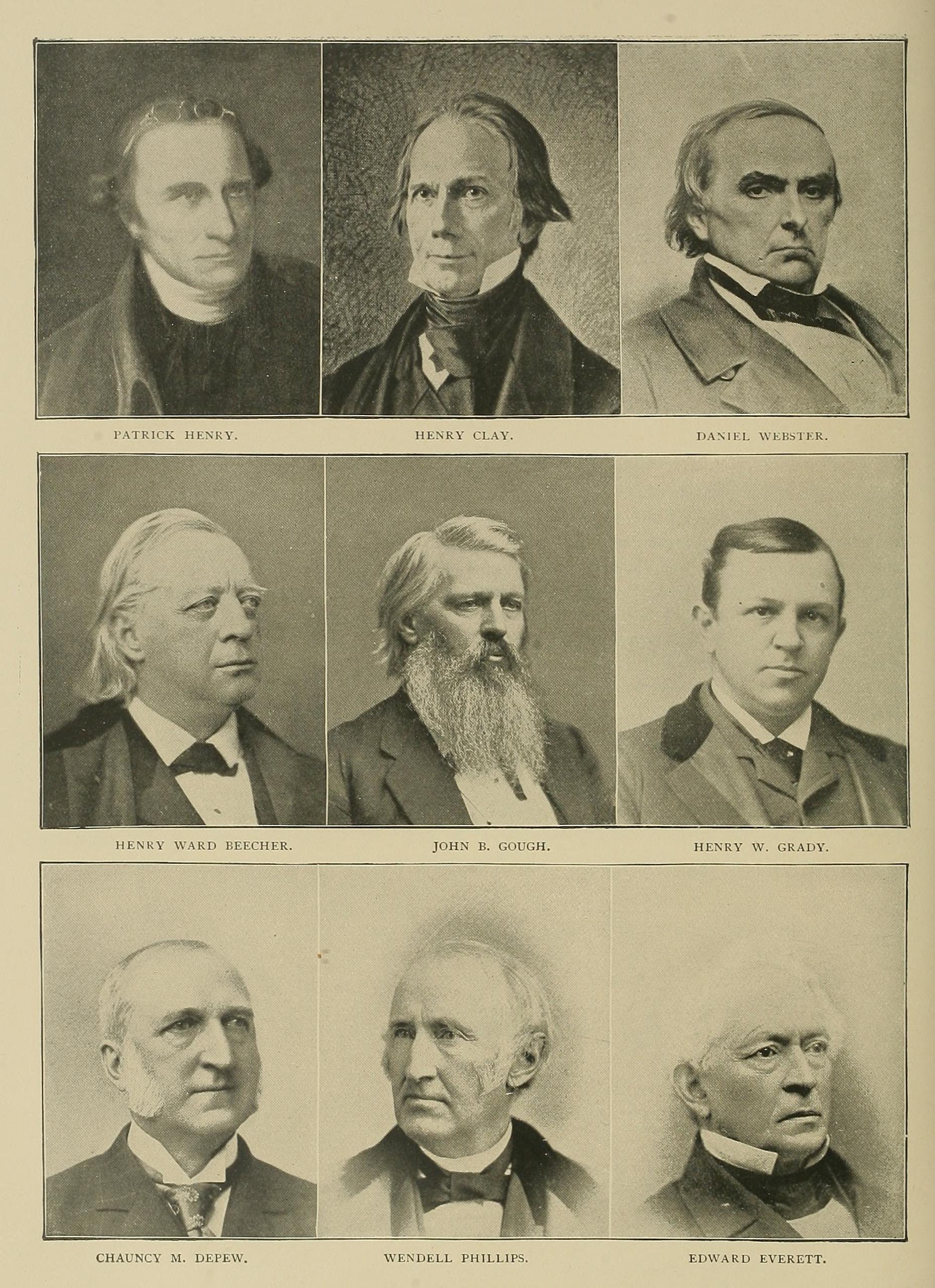
GREAT AMERICAN ORATORS AND POPULAR LECTURERS.
PATRICK HENRY • HENRY CLAY • DANIEL WEBSTER HENRY WARD BEECHER • JOHN B. GOUGH • HENRY W. GRADY CHAUNCY M. DEPEW • WENDELL PHILLIPS • EDWARD EVERETT

PATRICK HENRY.
THE GREATEST ORATOR OF COLONIAL TIMES.
HEARD the splendid display of Mr. Henry’s talents as a popular orator,” wrote Thomas Jefferson, “they were great indeed, such as I have never heard from any other man. He appeared to me to speak as Homer wrote.”
Few men in the history of the world have possessed in a degree equal to that of Patrick Henry, the power to move men’s minds and to influence their actions, but it was not until he was twenty-seven years old that his oratorical powers became known. He was a native Virginian of distinguished parentage and good education. He married very young, and tried farming and merchandising before he decided to become a lawyer, when he came at once into a large practice. He was engaged in 1763 to defend the Colony against the suit of a minister of the Established Church, brought to recover his salary which had been fixed at sixteen thousand pounds of tobacco. A failure of the crop had made the tobacco exceedingly valuable, and the Colonial Legislature had passed a law requiring the ministers to take money payment at the rate of two pence per pound. This act had not been approved by the King, and in his speech on this occasion, Mr. Henry boldly proclaimed the principles which afterward led to the Declaration of Independence, declaring that “the King by disallowing acts of a salutary nature, from being the father of his people, degenerates into a tyrant and forfeits all rights to his subjects’ obedience.” From that day the fame of Patrick Henry, as a popular orator, spread throughout the Colonies. His famous speech, two years later, in the House of Burgesses, resulted in the passing of resolutions defining the rights of the Colonies and pronouncing the “Stamp Act” unconstitutional. The public mind was so inflamed that open resistance was everywhere made and the enforcement of the tax became impossible. Mr. Henry was now the leader of his Colony. He was concerned in all the principal movements during the trying times until 1774, when he was foremost in the movement which resulted in the calling of the Continental Congress. Being a delegate to the Congress, he opened its deliberations by a speech in which he declared: “I am not a Virginian, but an American,” and this broad patriotism characterized his speech and actions throughout his life. On the outbreak of the war, he was made Commander of the forces raised in Virginia; but when these troops became a part of the Continental Army, his lack of military experience prevented his continuance in so high a command and he retired to civil life.
He became the first Governor of Virginia and was re-elected several times. Among his distinguished services was the sending out of the expedition which conquered the territory northwest of the Ohio, which territory now embraces the great States of Ohio, Indiana, Illinois, Michigan and Wisconsin. He early saw the defects in the Articles of Confederation and favored the formation of a stronger government. He thought the plan of the Constitution gave too much power to the general government; but his objections were largely removed by the first eleven amendments and he gave a hearty support to the administration of President Washington. When the Alien and Sedition Laws were meeting with great opposition and there was danger of an attempt on the part of Virginia to resist their further execution, he strongly opposed such action, and, although he did not approve of the laws, and urged the use of every possible means to effect their repeal, he secured his election to the Legislature for the purpose of advocating submission to the authority of the general government. Before he had taken his seat, his life came to a close.
Mr. Henry was a devoted Christian and lived a life consistent with that high profession. His services to the cause of civil liberty can hardly be overstated. His powers have been testified to by many men of great culture and ability, and John Randolph, of Roanoke, declared that he was the greatest orator that ever lived and spoke of him as “Shakespeare and Garrick combined.”
RESISTANCE TO BRITISH AGGRESSION.
Delivered before the Virginia Convention, March 23, 1775, in support of resolutions he had introduced, providing that the colony should immediately be put in a state of defence against British aggression. Of the effect of this speech, Mr. Wirt says, that, when Henry took his seat, at its close, “No murmur of applause was heard. The effect was too deep. After the trance of a moment, several members started from their seats. The cry to arms! seemed to quiver on every lip, and gleam from every eye. They became impatient of speech. Their souls were on fire for action.”
R. PRESIDENT, it is natural to man to indulge in the illusions of hope. We are apt to shut our eyes against a painful truth, and listen to the song of that siren, till she transforms us into beasts. Is this the part of wise men, engaged in a great and arduous struggle for liberty? Are we disposed to be of the number of those who, having eyes, see not, and having ears, hear not, the things which so nearly concern our temporal salvation? For my part, whatever anguish of spirit it may cost, I am willing to know the whole truth,—to know the worst, and to provide for it!

I have but one lamp, by which my feet are guided; and that is the lamp of experience. I know of no way of judging of the future but by the past. And, judging by the past, I wish to know what there has been in the conduct of the British ministry, for the last ten years, to justify those hopes with which gentlemen have been pleased to solace themselves and the House? Is it that insidious smile with which our petition has been lately received? Trust it not, sir; it will prove a snare to your feet! Suffer not yourselves to be betrayed with a kiss! Ask yourselves how this gracious reception of our petition comports with those warlike preparations which cover our waters and darken our land. Are fleets and armies necessary to a work of love and reconciliation? Have we shown ourselves so unwilling to be reconciled, that force must be called in to win back our love?
Let us not deceive ourselves, sir. These are the implements of war and subjugation,—the last arguments to which kings resort. I ask gentlemen, sir, what means this martial array, if its purpose be not to force us to submission? Can gentlemen assign any other possible motive for it? Has Great Britain any enemy in this quarter of the world, to call for all this accumulation of navies and armies? No, sir, she has none. They are meant for us; they can be meant for no other. They are sent over to bind and rivet upon us those chains which the British ministry have been so long forging. And what have we to oppose to them? Shall we try argument? Sir, we have been trying that, for the last ten years. Have we anything new to offer upon the subject? Nothing. We have held the subject up in every light of which it is capable; but it has been all in vain.
Shall we resort to entreaty and humble supplication? What terms shall we find which have not already been exhausted? Let us not, I beseech you, sir, deceive ourselves longer. Sir, we have done everything that could be done, to avert the storm which is now coming on. We have petitioned, we have remonstrated, we have supplicated, we have prostrated ourselves before the throne, and have implored its interposition to arrest the tyrannical hands of the Ministry and Parliament. Our petitions have been slighted, our remonstrances have produced additional violence and insult, our supplications have been disregarded, and we have been spurned, with contempt, from the foot of the throne.
In vain, after these things, may we indulge the fond hope of peace and reconciliation. There is no longer any room for hope. If we wish to be free,—if we mean to preserve inviolate those inestimable privileges for which we have been so long contending,—if we mean not basely to abandon the noble struggle in which we have been so long engaged, and which we have pledged ourselves never to abandon until the glorious object of our contest shall be obtained,—we must fight; I repeat it, sir, we must fight! An appeal to arms, and to the God of Hosts, is all that is left us!
THE WAR INEVITABLE, MARCH, 1775.
(Continuation of the foregoing.)
HEY tell us, sir, that we are weak,—unable to cope with so formidable an adversary. But when shall we be stronger? Will it be the next week, or the next year? Will it be when we are totally disarmed, and when a British guard shall be stationed in every house? Shall we gather strength by irresolution and inaction? Shall we acquire the means of effectual resistance by lying supinely on our backs, and hugging the delusive phantom of hope, until our enemies shall have bound us hand and foot? Sir, we are not weak, if we make a proper use of those means which the God of nature hath placed in our power.
Three millions of people, armed in the holy cause of liberty, and in such a country as that which we possess, are invincible by any force which our enemy can send against us. Besides, sir, we shall not fight our battles alone. There is a just God who presides over the destinies of nations, and who will raise up friends to fight our battles for us. The battle, sir, is not to the strong alone; it is to the vigilant, the active, the brave. Besides, sir, we have no election. If we were base enough to desire it, it is now too late to retire from the contest. There is no retreat but in submission and slavery! Our chains are forged! Their clanking may be heard on the plains of Boston! The war is inevitable; and let it come! I repeat it, sir, let it come!
It is in vain, sir, to extenuate the matter. Gentlemen may cry, peace, peace!—but there is no peace. The war is actually begun! The next gale that sweeps from the North will bring to our ears the clash of resounding arms! Our brethren are already in the field! Why stand we here idle? What is it that gentlemen wish? What would they have? Is life so dear, or peace so sweet, as to be purchased at the price of chains and slavery? Forbid it, Almighty God! I know not what course others may take; but as for me, give me liberty or give me death!
HENRY CLAY.
“THE GREAT PACIFICATOR.”
T is impossible within the necessary limits of this article to give anything like a satisfactory account of the life and services of the “Great Pacificator.” For nearly fifty years he took a prominent part in the discussion of every public question. In a time whose dangers and difficulties were so great that the most far-seeing statesmen almost despaired of the future of our country, it was to Henry Clay that all eyes were turned, and it was to him that we owe the postponement of the great conflict of 1861 almost for a generation.
Clay was a native of Hanover County, Virginia; born in 1777. His father dying when he was four years old, the future statesman lived a life of great hardship, toil and poverty. He had almost no education, and at fourteen he was placed in a drug store in Richmond, where he served for a year as errand boy. His mother having remarried, her husband obtained for Henry a clerkship in the office of the Court of Chancery. While here he studied law, and, believing that his chances of success would be better in the West, he followed his mother and stepfather to Kentucky, and opened an office in Lexington. His success was immediate, and he was soon possessed of a lucrative practice and of a position of great influence.
In 1799 Clay married Miss Lucretia Hart, the daughter of a gentleman of prominent standing in the State. His prosperity rapidly increased, and he was soon able to purchase “Ashland,” an estate of some six hundred acres near Lexington, which afterwards became famous as the home of Henry Clay. In 1806 Mr. Clay was elected to fill a vacancy in the Senate of the United States. Returning to Kentucky, he became a member of the Kentucky Legislature, where he took a leading part. Again, in 1809, he was sent to the United States Senate, but it may be said that his public life properly began in 1811 as a member of the House of Representatives. He was immediately elected Speaker, and so distinguished himself in that office that it is sometimes said that he was the best presiding officer that any deliberative body in America has ever known, even down to the present time. It was to him more than to any other individual that we owe the War of 1812, and when President Madison, discouraged at the failures of the National armies in the first year of that war, was about to appoint Clay commander-in-chief of the land forces, he was persuaded not to do so because he could not be spared from the House of Representatives. In 1814 Mr. Clay was one of the commissioners to arrange the terms of peace with England. Returning from Europe, he remained Speaker of the House of Representatives until 1825, when he became Secretary of State under John Quincy Adams. During this time the great conflict over slavery began. The introduction of the cotton-gin had made slavery profitable, and the sentiment of the South, which at the time of the Revolutionary War had apparently favored the gradual doing away with that system, now insisted upon its extension; but while Southern sentiment had progressed in this way, the feelings of the North had grown in the opposite direction, and the increasing importance of the North and its approaching predominance in the government, made Southern politicians anxious about the future of their peculiar institution. The conflict broke forth in 1818, when Missouri asked to be admitted to the Union. “It was,” said Thomas Jefferson, describing the suddenness with which the danger appeared, “like the ringing of a fire-bell in the night.” It was the most dangerous crisis which had yet occurred in the history of the government. It was to the genius of Henry Clay that the ship of State was successfully steered out of these waters. The famous “Missouri Compromise” admitting one free State—Maine—and one slave State—Missouri—at the same time and enacting that no other slave State should be formed north of latitude thirty-six degrees, thirty minutes, which was the southern boundary line of Missouri, seemed likely to solve the difficult question, and certainly postponed the conflict.
The disappointment of Henry Clay’s life was his failure to be elected President. He was a candidate in 1824, but with little hope of success, and when his party, in 1840, found conditions favorable for the election of their candidate, the popularity of General Jackson had convinced the party managers that success demanded a military hero as a candidate, and accordingly General Harrison took the place which belonged by right to Clay. When he was again nominated, 1844, the slavery question had again assumed so dangerous a form that it prevented his election. He was a slave-holder, and so could not receive the votes of the Liberty Party; he was opposed to the extension of slavery, and, therefore, not satisfactory to the South. Although the situation was evident to the party managers, a large majority of the people expected Clay to be elected, and when the news of his defeat came the public sorrow was greater than has ever been manifested for such a cause.
Returning to the Senate, Mr. Clay completed his public services by accomplishing the famous “Compromise of 1850,” which is believed to have postponed for ten years the Civil War. He was now an old man, but his labors for the preservation of the Union were untiring. On the morning when he began the great speech of that session, he was so weak that he had to be assisted to climb the steps of the Capitol. He was aware that the exertion would probably shorten his life; but under the fear that if he did not complete the speech at that time he would never be able to resume it, he determined to continue. He spoke for two days with the force, pathos and the grandeur possible only to the greatest orators. The underlying thought of his speech was the unity of the nation and the paramount allegiance owed by her citizens, not to a single State; but to the country. Although he lived two years longer, he never recovered from the effort.
Probably no man was ever more fondly loved, probably no man was so nearly worshipped. An Englishwoman, traveling in America, in 1844, wrote that three-quarters of all the boys born in that year must have been named Henry Clay. “Whatever Clay’s weakness of character and errors in statesmanship may have been,” says Carl Schurz, “almost everything he said or did was illumined by a grand conception of the destinies of his country, a glowing national spirit, a lofty patriotism.” It was a just judgment which he pronounced upon himself when he wrote, “If anyone desires to know the leading and paramount object of my public life, the preservation of the Union will furnish him the key.”
DEFENCE OF JEFFERSON, 1813.
EXT to the notice which the opposition has found itself called upon to bestow upon the French emperor, a distinguished citizen of Virginia, formerly President of the United States, has never for a moment failed to receive their kindest and most respectful attention. An honorable gentleman from Massachusetts, of whom I am sorry to say, it becomes necessary for me, in the course of my remarks, to take some notice, has alluded to him in a remarkable manner. Neither his retirement from public office, his eminent services, nor his advanced age, can exempt this patriot from the coarse assaults of party malevolence. No, sir! In 1801, he snatched from the rude hand of usurpation the violated Constitution of his country,—and that is his crime. He preserved that instrument, in form, and substance, and spirit, a precious inheritance for generations to come, and for this he can never be forgiven. How vain and impotent is party rage, directed against such a man! He is not more elevated by his lofty residence, upon the summit of his own favorite mountain, than he is lifted, by the serenity of his mind and the consciousness of a well-spent life, above the malignant passions and bitter feelings of the day. No! his own beloved Monticello is not less moved by the storms that beat against its sides, than is this illustrious man, by the howlings of the whole British pack, let loose from the Essex kennel. When the gentleman to whom I have been compelled to allude shall have mingled his dust with that of his abused ancestors,—when he shall have been consigned to oblivion, or, if he lives at all, shall live only in the treasonable annals of a certain junto,—the name of Jefferson will be hailed with gratitude, his memory honored and cherished as the second founder of the liberties of the people, and the period of his administration will be looked back to as one of the happiest and brightest epochs in American history!

REPLY TO JOHN RANDOLPH.
(FROM SPEECH IN THE HOUSE OF REPRESENTATIVES, 1834.)
IR, I am growing old. I have had some little measure of experience in public life, and the result of that experience has brought me to this conclusion, that when business, of whatever nature, is to be transacted in a deliberate assembly, or in private life, courtesy, forbearance, and moderation, are best calculated to bring it to a successful conclusion. Sir, my age admonishes me to abstain from involving myself in personal difficulties; would to God that I could say, I am also restrained by higher motives. I certainly never sought any collision with the gentleman from Virginia. My situation at this time is peculiar, if it be nothing else, and might, I should think, dissuade, at least, a generous heart from any wish to draw me into circumstances of personal altercation. I have experienced this magnanimity from some quarters of the House. But I regret that from others it appears to have no such consideration.

The gentleman from Virginia was pleased to say that in one point, at least, he coincided with me—in an humble estimate of my grammatical and philological acquirements. I know my deficiencies. I was born to no proud patrimonial estate; from my father I inherited only infancy, ignorance, and indigence. I feel my defects; but, so far as my situation in early life is concerned, I may, without presumption, say they are more my misfortune than my fault. But, however, I regret my want of ability to furnish to the gentleman a better specimen of powers of verbal criticism, I will venture to say, it is not greater than the disappointment of this committee as to the strength of his argument. It is not a few abstractions engrossed on parchment, that make free governments. No, sir; the law of liberty must be inscribed on the heart of the citizen: THE WORD, if I must use the expression without irreverence, MUST BECOME FLESH. You must have a whole people trained, disciplined, bred,—yea, and born,—as our fathers were, to institutions like ours.
Before the Colonies existed, the Petition of Rights, that Magna Charta of a more enlightened age, had been presented, in 1628, by Lord Coke and his immortal compeers. Our founders brought it with them, and we have not gone one step beyond them. They brought these maxims of civil liberty, not in their libraries, but in their souls; not as philosophical prattle, not as barren generalities, but as rules of conduct; as a symbol of public duty and private right, to be adhered to with religious fidelity; and the very first pilgrim that set his foot upon the rock of Plymouth stepped forth a LIVING CONSTITUTION, armed at all points to defend and to perpetuate the liberty to which he had devoted his whole being.
ON RECOGNIZING THE INDEPENDENCE OF GREECE, 1824.
RE we so low, so base, so despicable, that we may not express our horror, articulate our detestation, of the most brutal and atrocious war that ever stained the earth, or shocked high Heaven, with the ferocious deeds of a brutal soldiery, set on by the clergy and followers of a fanatical and inimical religion, rioting in excess of blood and butchery, at the mere details of which the heart sickens; if the great mass of Christendom can look coolly and calmly on, while all this is perpetuated on a Christian people, in their own vicinity, in their very presence, let us, at least, show that, in this distant extremity, there is still some sensibility and sympathy for Christian wrongs and sufferings; that there are still feelings which can kindle into indignation at the oppression of a people endeared to us by every ancient recollection, and every modern tie.
But, sir, it is not first and chiefly for Greece that I wish to see this measure adopted. It will give them but little aid,—that aid purely of a moral kind. It is, indeed, soothing and solacing, in distress, to hear the accents of a friendly voice. We know this as a People. But, sir, it is principally and mainly for America herself, for the credit and character of our common country, that I hope to see this resolution pass; it is for our own unsullied name that I feel.
What appearance, sir, on the page of history, would a record like this make:—“In the month of January in the year of our Lord and Saviour 1824, while all European Christendom beheld with cold, unfeeling apathy the unexampled wrongs and inexpressible misery of Christian Greece, a proposition was made in the Congress of the United States,—almost the sole, the last, the greatest repository of human hope and of human freedom, the representatives of a nation capable of bringing into the field a million of bayonets,—while the freemen of that nation were spontaneously expressing its deep-toned feeling, its fervent prayer for Grecian success; while the whole Continent was rising, by one simultaneous motion, solemnly and anxiously supplicating and invoking the aid of Heaven to spare Greece, and to invigorate her arms; while temples and senate-houses will be resounding with one burst of generous sympathy;—in the year of our Lord and Saviour,—that Saviour alike of Christian Greece and of us, a proposition was offered in the American Congress to send a messenger to Greece, to inquire into her state and condition, with an expression of our good wishes and our sympathies;—and it was rejected!”
Go home, if you dare,—go home, if you can,—to your constituents, and tell them that you voted it down! Meet, if you dare, the appalling countenances of those who sent you here, and tell them that you shrank from the declaration of your own sentiments; that, you cannot tell how, but that some unknown dread, some indescribable apprehension, some indefinable danger, affrighted you; that the spectres of scimitars and crowns, and crescents, gleamed before you, and alarmed you; and that you suppressed all the noble feelings prompted by religion, by liberty, by national independence, and by humanity! I cannot bring myself to believe that such will be the feeling of a majority of this House.

DANIEL WEBSTER.
THE DEFENDER OF NATIONAL UNION.
MONG the men who may properly be called the makers of the nation, Daniel Webster holds a foremost place. If Washington was “the father of his country,” and Lincoln its “saviour,” it may also be said that it was Webster, more than any other one man, who laid down the principles upon which it was made possible for the nation to endure; for it was he who maintained that the Federal Constitution created not a league, but a nation, thus enunciating far in advance the theories which were wrought into our constitutional law at the expense of a long and bloody Civil War.
The life of Daniel Webster extended from 1782 until 1852. His father was one of the brave men who fought at Lexington, and Daniel was the youngest of ten children who were compelled very early in life to share in the labor of supporting the family on a rocky New Hampshire farm. Working in his father’s sawmill, he used the time while the saw was going through the log in devouring a book. His abilities were very remarkable and the fame of “Webster’s boy” was known far and wide. His memory was very extraordinary. In a competition between the boys of his school in committing to memory verses in the Bible, the teacher heard him repeat some sixty or seventy which he had committed between Saturday and Monday and was then obliged to give up as Webster declared that there were several chapters more that he had learned. By means of great sacrifice on the part of the entire family, Daniel was sent to Phillips Exeter Academy, and, by teaching school in vacations, made his way through Dartmouth College. He took up the study of law and was admitted to practice in 1805.
There was something in Mr. Webster’s appearance and bearing which must have been very majestic. He seemed to everyone to be a giant; but as his proportions were not those of an unusually large man, his majestic appearance must have been due to something within which shone out through his piercing eyes and spoke in his finely cut and noble features. It is said that he never punished his children, but, when they did wrong, he would send for them and silently look at them, and the sorrow or the anger of the look was reproach enough.
Webster was a lawyer, an orator and a statesman. As a lawyer, his most famous arguments are those in the “Dartmouth College Case,” the “White Murder Case” and the “Steamboat Case,” as they are called. A part of his speech in the “Murder Case” is still printed in the school readers. The “Dartmouth College Case” is very famous. It was a suit whose success would have destroyed the college, and, after trial in the State Courts, it was appealed to the United States Supreme Court, before which Mr. Webster made his argument. The interest was very great and the details of the trial are among the most interesting in the history of our jurisprudence. The eloquence with which Mr. Webster described the usefulness of the institution, his love for it, and the consequences which the precedent sought to be established would involve, all contributed to make this one of the greatest oratorical efforts of which we have any record.
“Sir,” said he, “you may destroy this little institution; it is weak; it is in your hands! I know it is one of the lesser lights in the literary horizon of our country. You may put it out, but, if you do so, you must carry through your work! You must extinguish, one after another, all those great lights of science which, for more than a century, have thrown their radiance over our land.
“It is, sir, as I have said, a small college. And yet, there are those who love it――”
Here the feelings which he had thus far succeeded in keeping down broke forth. His lips quivered; his firm cheeks trembled with emotion; his eyes were filled with tears; his voice choked, and he seemed struggling to the utmost simply to gain that mastery over himself which might save him from an unmanly burst of feeling.
The court room, during these two or three minutes, presented an extraordinary spectacle. Chief Justice Marshall, with his tall, gaunt figure bent over as if to catch the slightest whisper, the deep furrows of his cheeks expanded with emotion, and eyes suffused with tears; Mr. Justice Washington at his side, with his small and emaciated frame, and countenance like marble, leaning forward with an eager, troubled look; and the remainder of the court, at the two extremities, pressing, as it were, toward a single point, while the audience below were wrapping themselves round in closer folds beneath the bench to catch each look, and every movement of the speaker’s face. If the painter could give us the scene on canvas—those forms and countenances, and Daniel Webster as he then stood in the midst—it would be one of the most touching pictures in the history of eloquence.
As an orator, Mr. Webster’s most famous speeches are the “Plymouth Rock Address” in 1820, on the Two Hundredth Anniversary of the Landing of the Pilgrims, the “Bunker Hill Monument Address,” and his speech in the Senate in reply to Hayne in 1830, and on “Clay’s Compromise Bill of 1850.”
Upon Mr. Harrison’s inauguration in 1841, Mr. Webster became Secretary of State, which office he held until 1843. During this time, he negotiated the famous treaty with Lord Ashburton which settled a long-standing dispute with England over the boundary of Maine. He supported Clay for the presidency in 1804 and opposed the annexation of Texas. In the debate on the “Compromise of 1850,” Mr. Webster advocated the acceptance of the provisions for extending slavery into the territory purchased from Mexico, and for the “Fugitive Slave Law,” and in so doing gave great offense to his supporters in the North. In 1850, he was appointed Secretary of State, which office he held until his death.
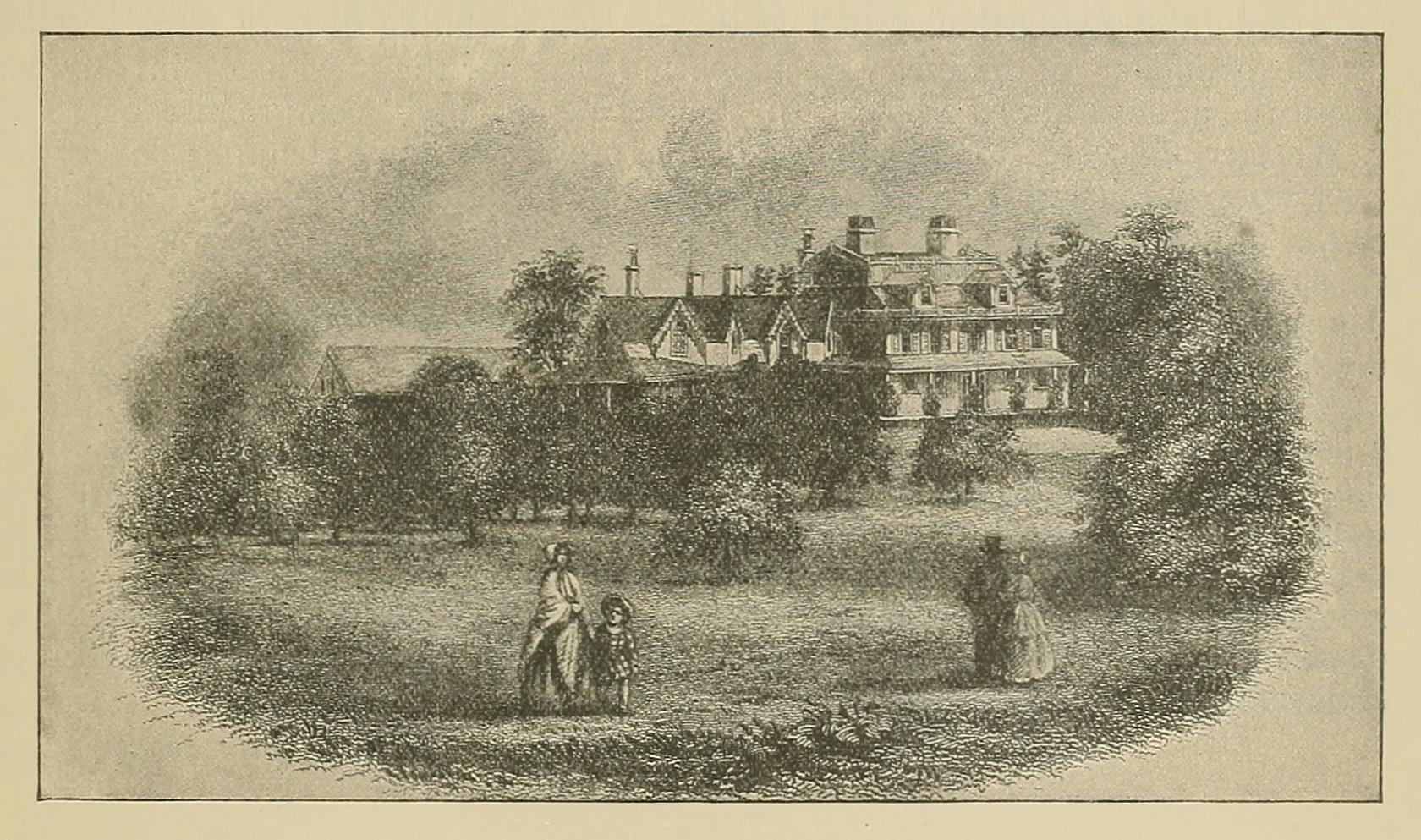
DANIEL WEBSTER’S HOME, MARSHFIELD, MASSACHUSETTS.
He took great interest in the operations of his farm at Marshfield, near Plymouth, Massachusetts, and delightful stories are told of the pleasure he took in his cattle—how he might be seen breaking ears of corn to feed to his oxen on the right and left declaring that he would rather be there than in the Senate, and adding with a smile, “I think it better company.” It was here, in 1852, that he was thrown from his carriage and received severe injuries from which he did not recover. In his last words, he manifested a desire to be conscious of the approach of death and his last words were, “I still live.” In the vast concourse which gathered at his funeral was a plain farmer who was heard to say, as he turned from the grave, “Daniel Webster, without you the world will seem lonely.”
SOUTH CAROLINA AND MASSACHUSETTS, JANUARY, 1830.
An extract from a speech by Mr. Webster, in reply to Mr. Hayne, of South Carolina, in the Senate of the United States, January, 1830. This was probably the most remarkable speech ever made in the American Congress. His peroration, comprised in the last paragraph, under the succeeding heading, “Union and Liberty,” for patriotic eloquence has not a counterpart, perhaps, in all history. The speech is the more remarkable for the fact that Mr. Webster had but a single night in which to make preparation.
HE eulogium pronounced on the character of the State of South Carolina, by the honorable gentleman, for her Revolutionary and other merits, meets my hearty concurrence. I shall not acknowledge that the honorable member goes before me in regard for whatever of distinguished talent or distinguished character South Carolina has produced. I claim part of the honor, I partake in the pride of her great names. I claim them for countrymen, one and all. The Laurenses, the Rutledges, the Pinckneys, the Sumpters, the Marions,—Americans all,—whose fame is no more to be hemmed in by State lines, than their talents and patriotism were capable of being circumscribed within the same narrow limits. In their day and generation, they served and honored the country, and the whole country; and their renown is of the treasures of the whole country. Him whose honored name the gentleman himself bears,—does he suppose me less capable of gratitude for his patriotism, or sympathy for his sufferings, than if his eyes had first opened upon the light in Massachusetts, instead of South Carolina? Sir, does he suppose it is in his power to exhibit a Carolina name so bright as to produce envy in my bosom? No, sir; increased gratification and delight, rather.
Sir, I thank God, that, if I am gifted with little of the spirit which is said to be able to raise mortals to the skies, I have yet none, as I trust, of that other spirit, which would drag angels down. When I shall be found, sir, in my place here, in the Senate, or elsewhere, to sneer at public merit, because it happened to spring up beyond the little limits of my own State or neighborhood; when I refuse, for any such cause, or for any cause, the homage due to American talent, to elevated patriotism, to sincere devotion to liberty and the country; or, if I see an uncommon endowment of heaven,—if I see extraordinary capacity and virtue in any son of the South,—and if, moved by local prejudice, or gangrened by State jealousy, I get up here to abate the tithe of a hair from his just character and just fame, may my tongue cleave to the roof of my mouth!
Sir, let me recur to pleasing recollections; let me indulge in refreshing remembrance of the past; let me remind you that, in early times, no States cherished greater harmony, both of principle and feeling, than Massachusetts and South Carolina. Would to God that harmony might again return! Shoulder to shoulder they went through the Revolution, hand in hand they stood round the administration of Washington, and felt his own great arm lean on them for support. Unkind feeling, if it exist,—alienation and distrust,—are the growth, unnatural to such soils, of false principles since sown. They are weeds, the seeds of which that same great arm never scattered.
Mr. President, I shall enter on no encomium upon Massachusetts;—she needs none. There she is,—behold her, and judge for yourselves. There is her history,—the world knows it by heart. The past, at least, is secure. There is Boston, and Concord, and Lexington, and Bunker Hill,—and there they will remain forever. The bones of her sons, fallen in the great struggle for Independence, now lie mingled with the soil of every State from New England to Georgia,—and there they will lie forever. And, sir, where American liberty raised its first voice, and where its youth was nurtured and sustained, there it still lives, in the strength of its manhood, and full of its original spirit. If discord and disunion shall wound it,—if party strife and blind ambition shall hawk at and tear it,—if folly and madness, if uneasiness under salutary and necessary restraints, shall succeed to separate it from that Union by which alone its existence is made sure,—it will stand, in the end, by the side of that cradle in which its infancy was rocked; it will stretch forth its arm, with whatever vigor it may still retain, over the friends who gather round it; and it will fall at last, if fall it must, amidst the proudest monuments of its own glory, and on the very spot of its origin!
LIBERTY AND UNION, 1830.
(Continuation of the foregoing.)
PROFESS, sir, in my career hitherto, to have kept steadily in view the prosperity and honor of the whole country, and the preservation of our Federal Union. It is to that Union we owe our safety at home, and our consideration and dignity abroad. It is to that Union we are chiefly indebted for whatever makes us most proud of our country. That Union we reached only by the discipline of our virtues, in the severe school of adversity. It had its origin in the necessities of disordered finance, prostrate commerce, and ruined credit. Under its benign influences, these great interests immediately awoke, as from the dead, and sprang forth with newness of life. Every year of its duration has teemed with fresh proofs of its utility and its blessings; and although our territory has stretched out wider and wider, and our population spread further and further, they have not outrun its protection, or its benefits. It has been to us all a copious fountain of national, social, personal happiness.

I have not allowed myself, sir, to look beyond the Union to see what might lie hidden in the dark recess behind. I have not coolly weighed the chances of preserving liberty, when the bonds that unite us together shall be broken asunder. I have not accustomed myself to hang over the precipice of disunion to see whether, with my short sight, I can fathom the depth of the abyss below; nor could I regard him as a safe counsellor in the affairs of this government whose thoughts should be mainly bent on considering, not how the Union should be best preserved, but how tolerable might be the condition of the people when it shall be broken up and destroyed.
While the Union lasts, we have high, exciting, gratifying prospects spread out before us and our children. Beyond that I seek not to penetrate the veil. God grant that, in my day, at least, that curtain may not rise! God grant that on my vision never may be opened what lies behind! When my eyes shall be turned to behold, for the last time, the Sun in Heaven, may I not see him shining on the broken and dishonored fragments of a once glorious Union; on States severed, discordant, belligerent; on a land rent with civil feuds, or drenched, it may be, in fraternal blood! Let their last feeble and lingering glance, rather, behold the gorgeous Ensign of the Republic, now known and honored throughout the earth, still full high advanced, its arms and trophies streaming in their original lustre, not a stripe erased or polluted, nor a single star obscured, bearing, for its motto, no such miserable interrogatory as—What is all this worth?—nor those other words of delusion and folly—Liberty first and Union afterwards,—but everywhere, spread all over in characters of living light, blazing on all its ample folds, as they float over the sea and over the land, and in every wind under the whole heavens, that other sentiment, dear to every true American heart, Liberty and Union, now and ♦forever, one and inseparable!
THE ELOQUENCE OF ACTION.
HEN public bodies are to be addressed on momentous occasions, when great interests are at stake and strong passions excited, nothing is valuable in speech, further than it is connected with high intellectual and moral endowments. Clearness, force, and earnestness are the qualities which produce conviction. True eloquence, indeed, does not consist in speech. It cannot be brought from far. Labor and learning may toil for it, but they will toil in vain. Words and phrases may be marshalled in every way, but they cannot compass it. It must exist in the man, in the subject, and in the occasion. Affected passion, intense expression the pomp of declamation, all may aspire after it,—they cannot reach it. It comes, if it come at all, like the outbreaking of a fountain from the earth, or the bursting forth of volcanic fires, with spontaneous, original, native force. The graces taught in the schools, the costly ornaments and studied contrivances of speech, shock and disgust men when their own lives, and the fate of their wives, their children, and their country hang on the decision of the hour. Then, words have lost their power, rhetoric is vain, and all elaborate oratory contemptible. Even genius itself then feels rebuked and subdued, as in the presence of higher qualities. Then, patriotism is eloquent; then, self-devotion is eloquent. The clear conception, outrunning the deductions of logic, the high purpose, the firm resolve, the dauntless spirit, speaking on the tongue, beaming from the eye, informing every feature, and urging the whole man onward, right onward, to his object,—this, this is eloquence; or, rather, it is something greater and higher than all eloquence,—it is action, noble, sublime, godlike action.

THE TWENTY-SECOND OF FEBRUARY.
(SUITED TO WASHINGTON’S BIRTHDAY CELEBRATION.)
ENTLEMEN, a most auspicious omen salutes and cheers us this day. This day is the anniversary of the birth of Washington. Washington’s birthday is celebrated from one end of this land to the other. The whole atmosphere of the country is this day redolent of his principles,—the hills, the rocks, the groves, the vales, and the rivers shout their praises and resound with his fame. All the good, whether learned or unlearned, high or low, rich or poor, feel this day that there is one treasure common to them all; and that is the fame of Washington. They all recount his deeds, ponder over his principles and teachings, and resolve to be more and more guided by them in the future.

To the old and the young, to all born in this land, and to all whose preferences have led them to make it the home of their adoption, Washington is an exhilarating theme. Americans are proud of his character; all exiles from foreign shores are eager to participate in admiration of him; and it is true that he is, this day, here, everywhere, all over the world, more an object of regard than on any former day since his birth.
Gentlemen, by his example, and under the guidance of his precepts, will we and our children uphold the Constitution? Under his military leadership, our fathers conquered their ancient enemies; and, under the outspread banner of the political and constitutional principles, will we conquer now? To that standard we shall adhere, and uphold it, through evil report and good report. We will sustain it, and meet death itself, if it come; we will ever encounter and defeat error, by day and by night, in light or in darkness—thick darkness—if it come, till
“Danger’s troubled night is o’er,
And the star of peace return.”
AMERICA’S GIFTS TO EUROPE.
MERICA has furnished to Europe proof of the fact that popular institutions, founded on equality and the principle of representation, are capable of maintaining governments, able to secure the rights of person, property, and reputation. America has proved that it is practicable to elevate the mass of mankind—that portion which in Europe is called the laboring or lower class—to raise them to self-respect, to make them competent to act a part in the great right and great duty of self-government; and she has proved that this may be done by education and the diffusion of knowledge. She holds out an example, a thousand times more encouraging than ever was presented before, to those nine-tenths of the human race who are born without hereditary fortune or hereditary rank.
America has furnished to the world the character of Washington; and if our American institutions had done nothing else, that alone would have entitled them to the respect of mankind. Washington! “First in war, first in peace, and first in the hearts of his countrymen,” Washington is all our own! The enthusiastic veneration and regard in which the people of the United States hold him, prove them to be worthy of such a country, while his reputation abroad reflects the highest honor on his country.
I would cheerfully put the question to-day to the intelligence of Europe and the world, “What character of the century, upon the whole, stands out, in the relief of history, most pure, most respectable, most sublime?” and I doubt not that, by a suffrage approaching to unanimity, the answer would be, Washington!


EDWARD EVERETT.
THE GREAT CLASSIC ORATOR OF NEW ENGLAND.
EORGE S. HILLARD, himself an orator of no slight renown, has spoken with much critical insight and appreciation of the mental characteristic and oratorical style of Edward Everett, the great classic orator of Massachusetts: “The great charm of Mr. Everett’s orations consists not so much in any single and strongly developed intellectual trait as in that symmetry and finish which, on every page, give token to the richly endowed and thorough scholar. The natural movements of his mind are full of grace; and the most indifferent sentence which falls from his pen has that simple elegance which it is as difficult to define as it is easy to perceive. His style, with matchless flexibility, rises and falls with his subject and is alternately easy, vivid, elevated, ornamented, picturesque, ♦adapting itself to the dominant mood of the mind, as an instrument responds to the touch of a master’s hand. His knowledge is so extensive and the field of his allusion so wide, that the most familiar views, in passing through his hands, gather such a halo of luminous illustrations that their likeness seems transformed, and we entertain doubts of their identity.”

He was born in Dorchester, Mass., April 11, 1794, and was graduated from Harvard College with the highest honors in 1811. He entered the ministry, and at the age of nineteen he was installed as pastor of the Unitarian Church in Brattle Square, Boston, and only six years later he preached a sermon in the Hall of Representatives at Washington, which made a marvelous impression on all who heard it, and won him great fame for eloquence.
He was chosen at the age of twenty to fill the Chair of Greek Literature at Harvard College, and he spent four years abroad to qualify himself for this position, and Victor Cousin said of him at this period that he was one of the best Grecians he ever knew.
In 1820, crowded with honors and distinguished in many fields, he became editor of the “North American Review;” during the four years of his editorship he contributed fifty articles to this magazine.
He sat in Congress as Representative from Massachusetts from 1824 to 1834. In 1835, and for three years following, he was Governor of Massachusetts, and in the election following he was defeated by one vote.
While traveling abroad he received the appointment as Minister to England, and during this period of sojourn he received from Oxford the degree of D.C.L., and from Cambridge and Dublin that of LL.D.
For three years, from 1846 to 1849, he was President of Harvard College, and in 1852 he succeeded Daniel Webster as Secretary of State, becoming in the year following a member of the United States Senate, which position he filled with great dignity, and rendered his country honorable service. It was largely through his efforts that the money was raised to purchase Mount Vernon. For this purpose the great orator delivered one hundred and twenty-two times his oration on “Washington,” from which more than $58,000 was realized, and he secured $10,000 from a series of articles in the New York “Ledger.”
His lecture on the “Early Days of Franklin,” and other lectures for charitable purposes, brought in no less than $90,000.
His orations have been collected and published, and form one of the most remarkable collections of graceful and eloquent addresses ever produced in this country. They are as follows: “Orations and Speeches on Various Occasions” (Boston, 1836); “Orations and Speeches on Various Occasions from 1826 to 1850” (2 Vols., Boston, 1850); “Orations and Speeches” (Boston, 1859). He is also the author of two stirring poems, “Alaric the Visigoth” and “Santa Croce.”
Despite the fact that he and Daniel Webster were often on opposite sides of great questions and issues, and frequently crossed swords in the debate of the giants, they were life-long friends, and Mr. Webster wrote to him three months before the death of the former in the following touching words: “We now and then see stretching across the heavens a clear, blue, cerulean sky, with no cloud or mist or haze. And such appears to me our acquaintance from the time when I heard you for a week recite your lessons in the little schoolhouse in Short Street to the date hereof” [July 21, 1852].
In 1860, much against his will, Mr. Everett became the candidate for the Vice-Presidency on the ticket of the Constitutional-Union Party, which polled thirty-nine electoral votes.
He died at his home in Boston, January 15, 1865.
TWENTY-FIVE YEARS OF PEACE.
hile we act, sir, upon the maxim, “In peace prepare for war,” let us also remember that the best preparation for war is peace. This swells your numbers; this augments your means; this knits the sinews of your strength; this covers you all over with a panoply of might. And, then, if war must come in a just cause, no foreign state—no, sir, not all combined—can send forth an adversary that you need fear to encounter.
But, sir, give us these twenty-five years of peace. I do believe, sir, that this coming quarter of a century is to be the most important in our whole history. I do beseech you to let us have these twenty-five years, at least, of peace. Let these fertile wastes be filled up with swarming millions; let this tide of emigration from Europe go on; let the steamer, the canal, the railway, and especially let this great Pacific railway, subdue these mighty distances, and bring this vast extension into a span.
Let us pay back the ingots of California gold with bars of Atlantic iron; let agriculture clothe our vast wastes with waving plenty; let the industrial and mechanic arts erect their peaceful fortresses at the waterfalls; and then, sir, in the train of this growing population, let the printing office, the lecture-room, the village schoolhouse, and the village church, be scattered over the country. And in these twenty-five years we shall exhibit a spectacle of national prosperity such as the world has never seen on so large a scale, and yet within the reach of a sober, practical contemplation.
THE FATHER OF THE REPUBLIC.
O be cold and breathless, to feel not and speak not—this is not the end of existence to the men who have breathed their spirits into the institutions of their country, who have stamped their characters on the pillars of the age, who have poured their heart’s blood into the channels of the public prosperity.
Tell me, ye who tread the sods of yon sacred height, is Warren dead? Can you not still see him—not pale and prostrate, the blood of his gallant heart pouring out of his ghastly wound, but moving resplendent over the field of honor, with the rose of heaven upon his cheek and the fire of liberty in his eye?
Tell me, ye who make your pious pilgrimage to the shades of Vernon, is Washington indeed shut up in that cold and narrow house? That which made these men, and men like these, cannot die.
The hand that traced the charter of independence is, indeed, motionless; the eloquent lips that sustained it are hushed; but the lofty spirits that conceived, resolved and maintained it, and which alone, to such men, make it life to live—these cannot expire.
THE LAND OF OUR FOREFATHERS.
OR myself, I can truly say that, after my native land, I feel a tenderness and a reverence for that of my fathers. The pride I take in my own country makes me respect that from which we are sprung. The sound of my native language beyond the sea is a music to my ears beyond the richest strains of Tuscan softness or Castilian majesty.

I am not—I need not say I am not—the panegyrist of England. I am not dazzled by her riches nor awed by her power. The sceptre, the mitre and the coronet, stars, garters and ribbons, seem to me poor things for great men to contend for.
But England is the cradle and the refuge of free principles, though often persecuted; the school of religious liberty, the more precious for the struggles through which it has passed; she holds the tombs of those who have reflected honor on all who speak the English tongue; she is the birthplace of our fathers, the home of the Pilgrims; it is these which I love and venerate in England.
I should feel ashamed of an enthusiasm for Italy and Greece did I not also feel it for a land like this. In an American it would seem to me degenerate and ungrateful to hang with passion upon the traces of Homer and Virgil, and follow without emotion the nearer and plainer footsteps of Shakespeare and Milton. I should think him cold in love for his native land who felt no melting in his heart for that other native country which holds the ashes of his forefathers.

WENDELL PHILLIPS.
THE DEMOSTHENES OF AMERICA.
O MORE majestic figure in the anti-slavery struggle for thirty years—1835 to 1865—appeared on the American rostrum than the “silvery tongued orator,” Wendell Phillips.

In 1830, William Lloyd Garrison wrote in the “Liberator,”—a journal founded primarily by the abolitionists for the sole purpose of freeing the slaves—“I will be as harsh as truth and as uncompromising as justice. I am in earnest; I will not equivocate; I will not excuse; I will not retreat a single inch, and I will be heard.” But the abolitionists remained many years a small and despised faction, and, with all of Garrison’s determination, might never have amounted to anything had he not enlisted in his cause such men and masters as Wendell Phillips on the platform, Henry Ward Beecher in the pulpit, Charles Sumner in the United States Senate, and Harriet Beecher Stowe among novelists. It was a great day of promise when such educated talent caught the spirit of Garrison’s zeal.
In 1835, an angry pro-slavery mob dragged William Lloyd Garrison through the streets of Boston. A young man of twenty-four witnessed this cruel treatment and determined to abandon the practice of law and devote his life to the same cause. That man was Wendell Phillips. He first came into prominence by his impassioned address in Faneuil Hall, Boston, in 1837, at an indignation meeting called to condemn the killing of Lovejoy, at Alton, Illinois, while defending his anti-slavery newspaper office against a pro-slavery mob. The direct and impassioned eloquence of the orator on this occasion was the key-note to the forward movement toward the liberation of the black man. It was the bugle-blast which cheered the pioneers in the movement, and awoke the slumbering spirits in sympathy with it, but whose timid hopes had not dared to dream of its possible ultimate success.
As Demosthenes aroused and fired the Athenians, so Phillips’ appeals carried like an avalanche everything before them. The only way to prevent his influence was to prevent his speaking, and accordingly when he went to New York in 1847, there was such a prejudice against the abolitionists, and such a predominant pro-slavery sentiment, that he could not procure a hall in either of these cities in which to speak. Finally, Henry Ward Beecher, who had recently become pastor of Plymouth Church, prevailed upon his congregation to allow Phillips to address the people from their pulpit.
From this memorable occasion Beecher, himself, it is said, became a flaming torch, second only to Phillips in his efforts in the same cause, while Plymouth Congregation seconded him with all its mighty influence, a further account of which may be found under the treatment of Henry Ward Beecher in this volume.
Wendell Phillips was born in Boston, Massachusetts, on the 29th day of November, 1811, and died there February 2, 1884. His parents were prominent in Boston society, his father at one time being Mayor of the city. Phillips was educated at Harvard College, graduating in 1831, after which he studied law at Cambridge and was admitted to the bar in 1833; but his gift as an orator, in which he is regarded as second only to Daniel Webster, and his overmastering zeal in the abolitionist movement, required so much of his time that he did little practice before the court. He was a most fascinating platform speaker outside of politics, and was in constant demand as a lecturer. His most celebrated addresses were “Toussaint l’Ouverture” and “The Lost Arts,” the former being used as an argument of the native ability, intelligence, and possibility of progress on the part of the negro under proper opportunities.
The eloquence of Phillips was impassioned and direct, but his manner was so pleasingly polished as not to give personal offence to his most antagonistic hearers, while his English was singularly pure and simple, and his delivery was characterized by a nervous sympathy that was peculiarly magnetic.
Like most other great orators, Wendell Phillips has left behind him in literature only his public speeches and letters. One volume of these was published in Boston in 1862, another (largely a revision of the first, with additions to the same) in 1869.
POLITICAL AGITATION.
LL hail, Public Opinion! To be sure, it is a dangerous thing under which to live. It rules to-day in the desire to obey all kinds of laws, and takes your life. It rules again in the love of liberty, and rescues Shadrach from Boston Court House. It rules to-morrow in the manhood of him who loads the musket to shoot down—God be praised!—the man-hunter Gorsuch. It rules in Syracuse, and the slave escapes to Canada. It is our interest to educate this people in humanity, and in deep reverence for the rights of the lowest and humblest individual that makes up our numbers. Each man here, in fact, holds his property and his life dependent on the constant presence of an agitation like this of anti-slavery. Eternal vigilance is the price of liberty; power is ever stealing from the many to the few. The manna of popular liberty must be gathered each day, or it is rotten. The living sap of to-day outgrows the dead rind of yesterday. The hand intrusted with power becomes, either from human depravity or esprit de corps, the necessary enemy of the people. Only by continual oversight can the democrat in office be prevented from hardening into a despot; only by unintermitted agitation can a people be kept sufficiently awake to principle not to let liberty be smothered in material prosperity.
All clouds, it is said, have sunshine behind them, and all evils have some good result; so slavery, by the necessity of its abolition, has saved the freedom of the white race from being melted in the luxury or buried beneath the gold of its own success. Never look, therefore, for an age when the people can be quiet and safe. At such times Despotism, like a shrouding mist, steals over the mirror of Freedom. The Dutch, a thousand years ago, built against the ocean their bulwarks of willow and mud. Do they trust to that? No. Each year the patient, industrious peasant gives so much time from the cultivation of his soil and the care of his children to stop the breaks and replace the willow which insects have eaten, that he may keep the land his fathers rescued from the water, and bid defiance to the waves that roar above his head, as if demanding back the broad fields man has stolen from their realm.
TOUSSAINT L’OUVERTURE.
[Toussaint L’Ouverture, who has been pronounced one of the greatest statesmen and generals of the nineteenth century, saved his master and family by hurrying them on board a vessel at the insurrection of the negroes of Hayti. He then joined the negro army, and soon found himself at their head. Napoleon sent a fleet with French veterans, with orders to bring him to France at all hazards. But all the skill of the French soldiers could not subdue the negro army; and they finally made a treaty, placing Toussaint L’Ouverture governor of the island. The negroes no sooner disbanded their army, than a squad of soldiers seized Toussaint by night, and taking him on board a vessel, hurried him to France. There he was placed in a dungeon, and finally starved to death.]
F I were to tell you the story of Napoleon, I should take it from the lips of French men, who find no language rich enough to paint the great captain of the nineteenth century. Were I to tell you the story of Washington, I should take it from your hearts,—you, who think no marble white enough on which to carve the name of the Father of his country. But I am to tell you the story of a negro, Toussaint L’Ouverture, who has left hardly one written line. I am to glean it from the reluctant testimony of his enemies, men who despised him because he was a negro and a slave, hated him because he had beaten them in battle.
Cromwell manufactured his own army. Napoleon, at the age of twenty-seven, was placed at the head of the best troops Europe ever saw. Cromwell never saw an army till he was forty; this man never saw a soldier till he was fifty. Cromwell manufactured his own army—out of what? Englishmen,—the best blood in Europe. Out of the middle class of Englishmen,—the best blood of the island. And with it he conquered what? Englishmen,—their equals. This man manufactured his army out of what? Out of what you call the despicable race of negroes, debased, demoralized by two hundred years of slavery, one hundred thousand of them imported into the island within four years, unable to speak a dialect intelligible even to each other. Yet out of this mixed, and, as you say, despicable mass he forged a thunderbolt and hurled it at what? At the proudest blood in Europe, the Spaniard, and sent him home conquered; at the most warlike blood in Europe, the French, and put them under his feet; at the pluckiest blood in Europe, the English, and they skulked home to Jamaica. Now, if Cromwell was a general, at least this man was a soldier.
Now, blue-eyed Saxon, proud of your race, go back with me to the commencement of the century, and select what statesman you please. Let him be either American or European; let him have a brain the result of six generations of culture; let him have the ripest training of university routine; let him add to it the better education of practical life; crown his temples with the silver locks of seventy years, and show me the man of Saxon lineage for whom his most sanguine admirer will wreathe a laurel, rich as embittered foes have placed on the brow of this negro,—rare military skill, profound knowledge of human nature, content to blot out all party distinctions, and trust a state to the blood of its sons,—anticipating Sir Robert Peel fifty years, and taking his station by the side of Roger Williams, before any Englishman or American had won the right; and yet this is the record which the history of rival States makes up for this inspired black of St. Domingo.
Some doubt the courage of the negro. Go to Hayti, and stand on those fifty thousand graves of the best soldiers France ever had, and ask them what they think of the negro’s sword.
I would call him Napoleon, but Napoleon made his way to empire over broken oaths and through a sea of blood. This man never broke his word. I would call him Cromwell, but Cromwell was only a soldier, and the state he founded went down with him into his grave. I would call him Washington, but the great Virginian held slaves. This man risked his empire rather than permit the slave-trade in the humblest village of his dominions.
You think me a fanatic, for you read history, not with your eyes but with your prejudices. But fifty years hence, when Truth gets a hearing, the Muse of history will put Phocion for the Greek, Brutus for the Roman, Hampden for England, Fayette for France, choose Washington as the bright consummate flower of our earlier civilization, then, dipping her pen in the sunlight, will write in the clear blue, above them all, the name of the soldier, the stateman, the martyr, Toussaint L’Ouverture.
HENRY WARD BEECHER.
THE GREATEST PULPIT ORATOR OF AMERICA.
T may be safely said that as a pulpit and platform orator, Beecher has had no superior. Nothing is studied or artificial about his delivery. Naturalness, frankness, cordiality, fearlessness, clearness, and depth of thought, expressed in the simplicity and beauty of diction, and enlivened by a rich vein of pungent humor, were marked characteristics of his speech.
Those familiar with the public career of this great orator and reformer can scarcely conceive of him at four years of age sitting in the Widow Kilbourn’s school occupied in saying his A B C’s twice a day, and putting in the intervals between recitations in hemming towels and aprons; yet such is the story told of Henry Ward Beecher’s first school-days.
His father, Dr. Lyman Beecher, was a Congregational minister, a profound thinker and scholar, stationed at Litchfield, Connecticut, where, on the then large salary of eight hundred dollars per year, he and his wife and ten children lived. Henry Ward was born on the 24th of June, 1813—the eighth child in the family.
Beecher tells many interesting stories of his childhood. Among others are his accounts of the Sabbath-day struggles with the Catechism. He declared it was a day of terror. Once on referring to it in his Plymouth pulpit he said: “I think that to force childhood to associate religion with such dry morsels is to violate the spirit not only of the New Testament, but of common sense as well. I know one thing, that if I am lax and latitudinarian, the Sunday Catechism is to blame for part of it. The dinners I have lost because I could not go through ‘sanctification,’ and ‘justification,’ and ‘adoption,’ and all such questions, lie heavily on my memory. One Sunday afternoon with my Aunt Esther did me more good than forty Sunday mornings in church with my father. He thundered over my head. She sweetly instructed me down in my heart. The promise that she would read Joseph’s history to me on Sunday was enough to draw a silver thread through the entire week.”
Dr. Beecher received a call to preach in Boston in 1825, and removed his family there. The ships, the sea, and the stories Beecher here saw and read of Lord Nelson and other naval heroes, and of Captain Cook’s marvelous voyages and discoveries in new countries, determined him to make a sailor of himself. He was at this time a shy boy with a thick tongue and very indistinct speech. His father, while secretly opposing his project to go to sea, apparently encouraged it by suggesting that he go to Amherst College, where he would learn mathematics and navigation, preparing himself to be a commander instead of a “common Jack Tar.” Henry Ward readily consented to this.
At Amherst he studied elocution, and became not only an easy reader and talker, but showed promise of distinction. This opened a new world to him. The spirit of oratory found lodgment in his soul and he forgot his old longing for the sea. Shortly after this, during a religious revival in the college, Beecher determined to be a Christian, and, as a biographer says of him, “Made a joyful consecration of himself to the Lord. It was no doleful giving up to live a life of gloom and sadness. He believed that a Christian life ought to be of all lives the most joyful, and if he could not be a joyful Christian, he should not be one at all.” These convictions followed him through life. Mrs. Stowe, his sister, wrote of him: “He was never found sitting in solemnized meditations in the depth of pine trees like the owl.”
Dr. Beecher was elected President of Lane Seminary, Cincinnati, Ohio, in 1832, and removed to that city, whither Henry Ward followed him after graduation at Amherst in 1836, and took his theological course under his father and Prof. Stowe (who afterwards married his sister, Harriet Beecher, the author of “Uncle Tom’s Cabin”). After completing his theological course he entered upon his first pastorate at Lawrenceburg, Indiana, at a salary of three hundred dollars per annum, where, he said: “I did all the work of both sexton and pastor; in fact, everything except come to hear myself preach—that much the congregation had to do.”
One of his first steps after securing this position was to go back to Massachusetts and marry Miss ―― Bullard, his boyhood’s sweetheart, to whom he had been engaged for many years. The young couple started bravely in two rooms over a stable as their first home, and it is doubtful if any young prince and princess have been more truly happy than were these poor but true lovers in their humble nest in the stable loft. Mrs. Beecher’s “Recollections of Henry Ward Beecher,” written just before her death in 1897, furnishes a most delightful description of these early days of privation and poverty, chills and ague, but withal of such cheerfulness we almost envy them. Space forbids that we dwell upon Beecher’s private life, interesting and inspiring as it was. From Lawrenceburg he went to Indianapolis, where he preached for eight years with great success and growing fame, until August 24, 1847, when he was installed as pastor of Plymouth Church, Brooklyn, New York.
From this point Beecher becomes a national figure, and until the day of his death—a period of forty years—he was ever prominent in the public eye. There was a time when the escutcheon of his moral character was sullied by scandal,—but it was only scandal—which he met boldly, his church standing by him, and before the most scrutinizing investigation he remained steadfast, and in time the world exonerated him—while his accuser fled to Paris, where he spent his life in exile. Few people in the world now believe Beecher was guilty of the charges Theodore Tilton brought against him.
Beecher early espoused the cause of the abolition of slavery and of temperance. He considered both these doctrines a part of the gospel of Christ, and preached them boldly from his pulpit. Thus Plymouth Church rose grandly to the need of the age. Wendell Phillips, who in 1847 could find no audience room in New York or Brooklyn, was cordially invited to Beecher’s church, and “from the day that Phillips made his great anti-slavery speech from that pulpit until the Emancipation Proclamation—nearly twenty years later—the Plymouth preacher became a flaming advocate for liberty of speech and action on the question of the national evil. If there was anything on earth to which he was sensitive up to the day of his death, it was any form of denial to liberty either in politics, religion, or literature.” With pen and voice he ceased not to labor until the shackles fell from the black man’s hands.
A number of slaves were sold from Plymouth pulpit, purchased by public contributions and given their liberty, Mr. Beecher himself acting as auctioneer. The dramatic scenes on such occasions have been vividly recounted in Mrs. Beecher’s “Recollections,” and some of Mr. Beecher’s auction speeches have been preserved.
When Fort Sumter’s guns announced the beginning of war, Beecher sent back the echo from Plymouth pulpit in no uncertain sounds. His church organized and equipped a regiment which he was pleased to call “My own boys.” Mr. Beecher was in such constant demand as a public speaker that early in 1862 his voice failed and his health gave way, and he went to Europe and traveled in France and Switzerland. On invitation, after regaining his health, he went to England, where he delivered speeches—though England was in sympathy with the South—at Manchester, Glasgow, London and Edinburgh. The opposition which he met in these efforts would have completely overcome a man of less rugged physique, or discouraged one of less imperious will. But Beecher—confident in his own mind that he was right and his soul afire with patriotism—faced, spoke to, and quieted the most vicious and howling mobs into which he went often at personal peril. He describes his experiences as being “like driving a team of runaway horses and making love to a lady at the same time.”
After the war was over, Beecher preached as earnestly for forgiveness and reconciliation toward the South as he had preached to abolish slavery and retain the Southern States in the Union. His actions throughout had been purely patriotic and from no hatred of the people whose institution of slavery he fought. These principles made him unpopular for a time at the North and even in his own church. But he was ever the champion of the right, and did much toward the restoration of harmony between the sections. He delivered the oration at Charleston, South Carolina, in 1865, when the flag of the Union was again raised over Fort Sumter, and in 1879 made a tour of the Southern States, delivering lectures on popular topics, one of which was entitled “The Reign of the Common People.”
Henry Ward Beecher died March 8, 1887. He retired on the evening of March 3d apparently in usual health and fell into a sleep from which he never awoke, but merged into an unconscious condition in which he lingered until the morning of March 8th, when it is said as “a ray of sunlight flashed full and strong into the room and fell upon the face of the sufferer, who was surrounded by his family, calmly and without a struggle the regular breathing ceased and the great preacher was gone.” The eloquent tongue was silent forever.
The remains of Beecher were viewed by thousands, and many came who could not see the bier for the crowds that thronged the house and streets. It is doubtful if any private citizen’s funeral was ever so largely attended. One of his admirers in writing of the occasion said: “He loved the multitude, and the multitude came to his funeral; he loved the flowers, and ten thousand buds breathed their fragrance and clad his resting-place in beauty; he loved music, and the voice of the organ rose, and the anthems which had delighted him again rolled their harmonies to the rafters; he loved the sunshine, and it streamed through the windows and was a halo around him.”
Within the beauty of this halo we would leave the memory of this great man, hung as a portrait in a frame of gold from which his benign and cheerful face shall continue to look down upon succeeding generations. And as we read his encouraging “Lectures to Young Men;” his broad and profound sermons from “Plymouth Pulpit;” his inspiring “Patriotic Addresses;” his editorials in the “Christian Union;” his “Yale Lectures on Preaching;” his “Star Papers;” his “Evolution and Religion;” his novel “Norwood,” or his “Life of Jesus Christ: Earlier Scenes,” on which he was engaged when he died (which are his chief contributions to literature), we will often look up at the picture and exclaim, “Oh! that those lips might speak again!”
PUBLIC DISHONESTY.
CORRUPT public sentiment produces dishonesty. A public sentiment in which dishonesty is not disgraceful; in which bad men are respectable, are trusted, are honored, are exalted, is a curse to the young. The fever of speculation, the universal derangement of business, the growing laxness of morals is, to an alarming extent, introducing such a state of things.
If the shocking stupidity of the public mind to atrocious dishonesties is not aroused; if good men do not bestir themselves to drag the young from this foul sorcery; if the relaxed bands of honesty are not tightened, and conscience tutored to a severer morality, our night is at hand—our midnight not far off. Woe to that guilty people who sit down upon broken laws, and wealth saved by injustice! Woe to a generation fed by the bread of fraud, whose children’s inheritance shall be a perpetual memento of their father’s unrighteousness; to whom dishonesty shall be made pleasant by association with the revered memories of father, brother and friend!
But when a whole people, united by a common disregard of justice, conspire to defraud public creditors, and States vie with States in an infamous repudiation of just debts, by open or sinister methods; and nations exert their sovereignty to protect and dignify the knavery of the commonwealth, then the confusion of domestic affairs has bred a fiend before whose flight honor fades away, and under whose feet the sanctity of truth and the religion of solemn compacts are stamped down and ground into the dirt. Need we ask the cause of growing dishonesty among the young, the increasing untrustworthiness of all agents, when States are seen clothed with the panoply of dishonesty, and nations put on fraud for their garments?
Absconding agents, swindling schemes, and defalcations, occurring in such melancholy abundance, have at length ceased to be wonders, and rank with the common accidents of fire and flood. The budget of each week is incomplete without its mob and runaway cashier—its duel and defaulter, and as waves which roll to the shore are lost in those which follow on, so the villainies of each week obliterate the record of the last.
Men of notorious immorality, whose dishonesty is flagrant, whose private habits would disgrace the ditch, are powerful and popular. I have seen a man stained with every sin, except those which required courage; into whose head I do not think a pure thought has entered for forty years; in whose heart an honorable feeling would droop for very loneliness; in evil, he was ripe and rotten; hoary and depraved in deed, in word, in his present life and in all his past; evil when by himself, and viler among men; corrupting to the young; to domestic fidelity, recreant; to common honor, a traitor; to honesty, an outlaw; to religion, a hypocrite—base in all that is worthy of man and accomplished in whatever is disgraceful, and yet this wretch could go where he would—enter good men’s dwellings and purloin their votes. Men would curse him, yet obey him; hate him, and assist him; warn their sons against him, and lead them to the polls for him. A public sentiment which produces ♦ignominious knaves cannot breed honest men.
We have not yet emerged from a period in which debts were insecure; the debtor legally protected against the rights of the creditor; taxes laid, not by the requirements of justice, but for political effect, and lowered to a dishonest inefficiency, and when thus diminished, not collected; the citizens resisting their own officers; officers resigning at the bidding of the electors; the laws of property paralyzed; bankrupt laws built up, and stay-laws unconstitutionally enacted, upon which the courts look with aversion, yet fear to deny them lest the wildness of popular opinion should roll back disdainfully upon the bench to despoil its dignity and prostrate its power. General suffering has made us tolerant of general dishonesty, and the gloom of our commercial disaster threatens to become the pall of our morals.
EULOGY ON GENERAL GRANT.
Part I.
NOTHER name is added to the roll of those whom the world will not willingly let die. A few years since, storm-clouds filled his heaven, and obloquy, slander and bitter lies rained down upon him. The clouds are all blown away; under a serene sky General Grant laid down his life and the whole nation wept. The path to his tomb is worn by the feet of innumerable pilgrims.
The mildewed lips of slander are silent, and even criticism hesitates lest some incautious word should mar the history of the modest, gentle, magnanimous warrior. The whole nation watched his passage through humiliating misfortunes with unfeigned sympathy—the whole world sighed when his life ended. At his burial the unsworded hands of those whom he had fought lifted his bier and bore him to his tomb with love and reverence.
The South had laid the foundation of her industry, her commerce, and her very commonwealth upon slavery.
It was slavery that inspired her councils, that engorged her philanthropy, that corrupted her political economy and theology, that disturbed all the ways of active politics—broke up sympathy between North and South. The hand that fired upon Sumter exploded the mine under the Flood Rock of slavery and opened the way to civilization. The spark that was there kindled fell upon the North like fire upon autumnal prairies. Men came together in the presence of this universal calamity with sudden fusion; the whole land became a military school. But the Northern armies once organized, an amiable folly of conciliation began to show itself. Some peaceable way out of the war was hoped for. Generals seemed to fight so that no one should be hurt. The South had smelted into a glowing mass; it believed in its course with an infatuation that would have been glorious if the cause had been better; it put its whole soul into it and struck hard. For two years the war lingered, unmarked by great deeds. Lincoln, sad and sorrowful, felt the moderation of his generals and longed for a man of iron mould, who had but two words in his military vocabulary—victory or annihilation. He was coming; he was heard from at Henry and Donelson. Three great names were rising to sight,—Sherman, Thomas, Sheridan, and, larger than any, Grant.
At the opening of the war his name was almost unknown. It was with difficulty he could obtain a command. Once set forward, Donelson, Shiloh, Vicksburg, Chattanooga, the Wilderness, Spottsylvania, Petersburg, Appomattox—these were his footsteps! In four years he had risen, without political favor, from the bottom to the very highest command—not second to any living commander in all the world. His plans were large, his undiscouraged will was patient to obduracy. He was not fighting for reputation, nor for the display of generalship, nor for a future Presidency. He had but one motive, and that as intense as life itself—the subjugation of the rebellion and the restoration of the broken Union. He embodied the feelings of the common people; he was their perfect representative.
Part II.
The tidings of his death, long expected, gave a shock to the whole world. Governments, rulers, eminent statesmen, and scholars from all civilized nations gave sincere tokens of sympathy. For the hour sympathy rolled as a wave over all our own land. It closed the last furrow of war, it extinguished the last prejudice, it effaced the last vestige of hatred, and cursed shall be the hand that shall bring them back.
Johnson and Buckner on one side, Sherman and Sheridan upon the other, of his bier, he went to the tomb, a silent symbol that liberty had conquered slavery; patriotism, rebellion; and peace, war. He rests in peace. No drum or cannon shall disturb his rest. Sleep, hero, until another trumpet shall shake the heavens and the earth—then come forth to glory and immortality!
FROM “THE SPARKS OF NATURE.”
ATRIOTISM, in our day, is made to be an argument for all public wrong and all private meanness. For the sake of country a man is told to yield everything that makes the land honorable. For the sake of country a man must submit to every ignominy that will lead to the ruin of the State through disgrace of the citizen. There never was a man so unpatriotic as Christ was. Old Jerusalem ought to have been everything to Him. The laws and institutions of His country ought to have been more to Him than all the men in His country. They were not, and the Jews hated Him; but the common people, like the ocean waters, moved in tides towards His heavenly attraction wherever He went.
When men begin their prayers with, “O thou omnipotent, omnipresent, all-seeing, ever-living, blessed Potentate, Lord God Jehovah!” I should think they would take breath. Think of a man in his family, hurried for his breakfast, praying in such a strain. He has a note coming due, and it is going to be paid to-day, and he feels buoyant; and he goes down on his knees like a cricket on the hearth, and piles up these majestically moving phrases about God. Then he goes on to say that he is a sinner; he is proud to say that he is a sinner. Then he asks for his daily bread. He has it; and he can always ask for it when he has it. Then he jumps up, and goes over to the city. He comes back at night, and goes through a similar wordy form of “evening prayers;” and he is called “a praying man!” A ♦praying man? I might as well call myself an ornithologist, because I eat chicken once in awhile for my dinner.
When I see how much has been written of those who have lived; how the Greeks preserved every saying of Plato’s; how Boswell followed Johnson, gathering up every leaf that fell from that rugged old oak, and pasting it away,—I almost regret that one of the disciples had not been a recording angel, to preserve the odor and richness of every word of Christ. When John says, “And there are also many other things which Jesus did, the which, if they should be written every one, I suppose that even the world itself could not contain the books that would be written,” it affects me more profoundly than when I think of the destruction of the Alexandrian Library, or the perishing of Grecian art in Athens or Byzantium. The creations of Phidias were cold stone, overlaid by warm thought; but Christ described His own creations when He said, “The words that I speak unto you, they are life.” The leaving out of these things from the New Testament, though divinely wise, seems, to my yearning, not so much the unaccomplishment of noble things as the destruction of great treasures, which had already had oral life, but failed of incarnation in literature.

JOHN B. GOUGH.
O one who ever heard this great natural orator of the Temperance cause can forget the impression he made. It was not simply “a voice crying,” it was a whole man speaking, out of his very life, and every part of him contributed something to the effect. His face, his hands, his body, all joined together with his voice to give expression to his thoughts. Without education, with no elocutionary training, he was, nevertheless, an orator of the first rank, for he knew how to play on all the keys of human nature, and he moved all classes of listeners. He was born in England in 1817. Having lost his father at the age of twelve, he came to America to make his way. He was at first successful, but later troubles heaped up on him, and he drifted into a life of hopeless dissipation. He made a wretched living by going from one drinking house to another, singing songs and giving comic impersonations. He tried to get on the stage, for which he had a passion, but his dissolute life made such a career impossible. In 1839 he married, and tried to work, but his old habits were too strong for him, and a few years later he lost his wife and child and sank into a woeful condition. He used to describe how, in the delirium which came upon him at this period, the tools with which he tried to work became serpents and crawled in his hands. In 1842, when at the lowest point of dissipation, he received some kindness from a Quaker, who induced him to sign the pledge. Once he broke it through the influence of old companions, but he immediately recovered control and made a public confession.
Possessed henceforth with a great desire to devote himself to the cause of Temperance, he started out at once as a lecturer and tramped from place to place, holding meetings and stirring his listeners with his eloquence, which was of an unusual sort.
During the first year of his travels he spoke 386 times on the one subject which lay at his heart. He possessed a remarkable power of imitation, and he could move the audience to bursts of laughter, or go down to the depths of pathos and draw tears from the hardest hearts. His power on the platform steadily increased and he soon had a national reputation.
Ten years after his change of life, he was invited to visit England in the interests of Temperance Reform, and his first lecture in Exeter Hall produced a sensation. The call for lectures came from all the cities, and he spent two years in that country.
No event of his life showed his power more clearly than did his address at Oxford, where his voice was at first drowned by the hisses and cat-calls of the students. He, however, held his own and conquered his audience and came through triumphantly, so that at a subsequent visit at Oxford he was received with distinction. He addressed over 5,000 audiences during the first seventeen years of his lecture travels, and he always succeeded in carrying deep conviction. He was not a constructive reformer, but he used all his powers to reform individuals by reaching their consciences and wills. In this work he was eminently successful. Later in his life he also lectured on other subjects, and became one of the most popular attractions for lyceums. He always chose subjects which would give full scope for his powers of eloquence, and he was almost certain to touch upon his great life-theme. His most frequent lectures were on “Eloquence and Orators” and “Peculiar People,” and he never failed to give a fund of anecdotes, told with rare skill and imitation.
He lived for years at West Boylston, Massachusetts, and as he prospered through his lecture-work he gathered books about him and lived a joyous, happy life, writing and talking with his many friends.
His published works (some of which have been translated into French, Dutch, Scandinavian and Tamil) are “Autobiography” (1846); “Orations” (1854); “Temperance Addresses” (1870); “Temperance Lectures” (1879), and “Sunlight and Shadow; or, Gleanings from My Life-Work” (1880).
While lecturing at Frankford, Pennsylvania, February 18, 1886, he was stricken down with cerebral apoplexy and lapsed into unconsciousness, soon followed by death. He had just uttered the words “Young man, keep your record clean.”
WATER AND RUM.
The following apostrophe on Water and execration on Rum, by Mr. John B. Gough, was never published in full till after his death. He furnished it to a young friend many years ago, who promised not to publish it while he was on the lecture platform.
ATER! There is no poison in that cup; no fiendish spirit dwells beneath those crystal drops to lure you and me and all of us to ruin; no spectral shadows play upon its waveless surface; no widows’ groans or orphans’ tears rise to God from those placid fountains; misery, crime, wretchedness, woe, want, and rags come not within the hallowed precincts where cold water reigns supreme. Pure now as when it left its native heaven, giving vigor to our youth, strength to our manhood, and solace to our old age. Cold water is beautiful and bright and pure everywhere. In the moonlight fountains and the sunny rills; in the warbling brook and the giant river; in the deep tangled wildwood and the cataract’s spray; in the hand of beauty or on the lips of manhood—cold water is beautiful everywhere.
Rum! There is a poison in that cup. There is a serpent in that cup whose sting is madness and whose embrace is death. There dwells beneath that smiling surface a fiendish spirit which for centuries has been wandering over the earth, carrying on a war of desolation and destruction against mankind, blighting and mildewing the noblest affections of the heart, and corrupting with its foul breath the tide of human life and changing the glad, green earth into a lazar house. Gaze on it! But shudder as you gaze! Those sparkling drops are murder in disguise; so quiet now, yet widows’ groans and orphans’ tears and maniacs’ yells are in that cup. The worm that dieth not and the fire that is not quenched are in that cup.
Peace and hope and love and truth dwell not within that fiery circle where dwells that desolating monster which men call rum. Corrupt now as when it left its native hell, giving fire to the eye, madness to the brain, and ruin to the soul. Rum is vile and deadly and accursed everywhere. The poet would liken it in its fiery glow to the flames that flicker around the abode of the damned. The theologian would point you to the drunkard’s doom, while the historian would unfold the dark record of the past and point you to the fate of empires and kingdoms lured to ruin by the siren song of the tempter, and sleeping now in cold obscurity, the wrecks of what once were great, grand and glorious. Yes, rum is corrupt and vile and deadly, and accursed everywhere. Fit type and semblance of all earthly corruption!