GREAT AMERICAN HISTORIANS AND BIOGRAPHERS.
Reading edition
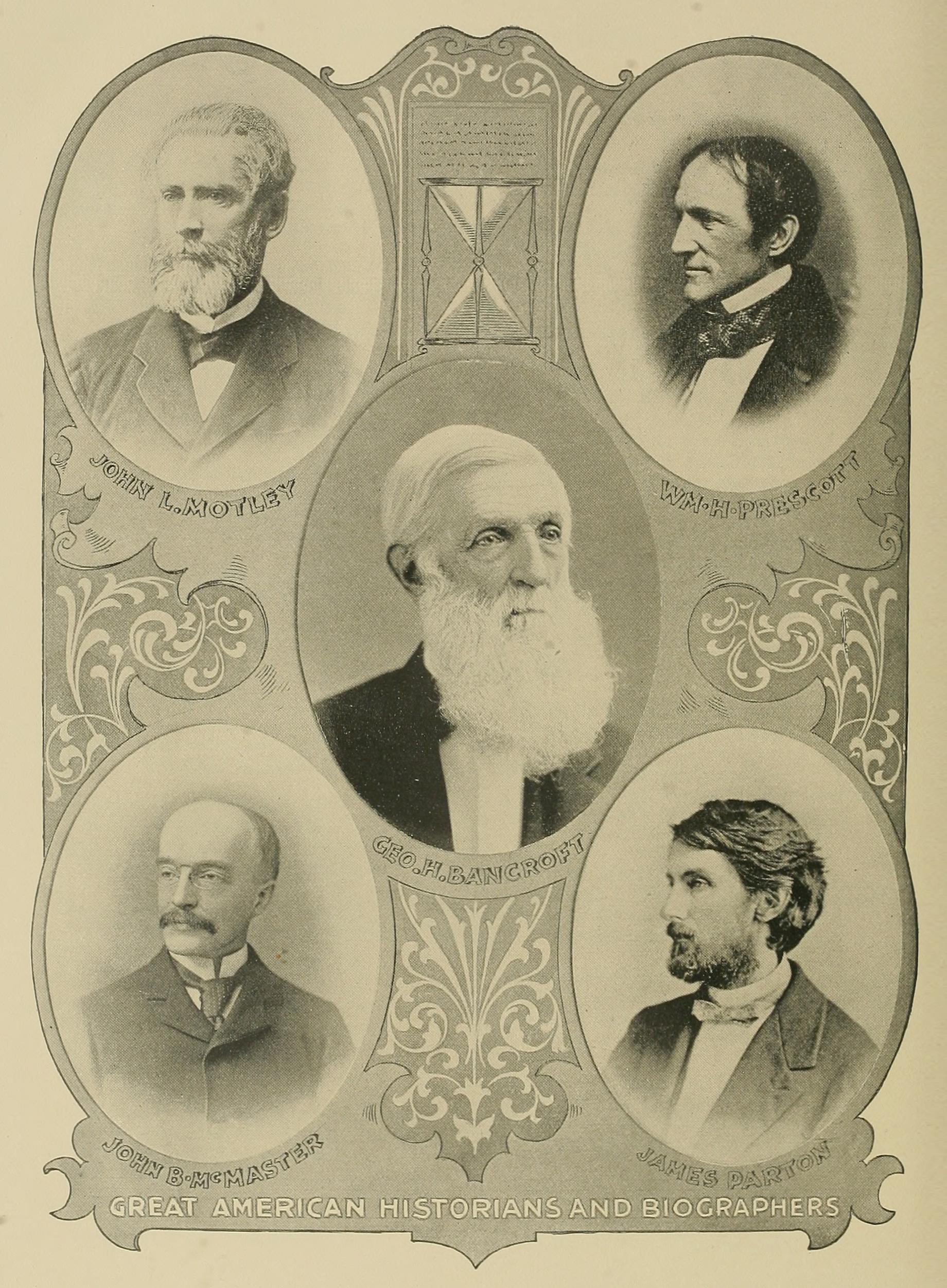
GREAT AMERICAN HISTORIANS AND BIOGRAPHERS
JOHN L. MOTLEY • WM. H. PRESCOTT GEO. H. BANCROFT JOHN B. McMASTER • JAMES PARTON

GEORGE BANCROFT.
“THE MOST FAMOUS AMERICAN HISTORIAN.”
HE chief historians who have added lustre to American literature during the nineteenth century are Bancroft, Prescott, Motley, Parkman, McMaster and John Fiske; and, when we add to these James Parton, the American biographer, we present an array of talent and scholarship on which any nation might look with patriotic pride. They have been excelled by the historians of no other nation of our time, if, indeed—taken from a national standpoint—they have not produced the best historical literature of the present century.

Though Prescott is the oldest, George Bancroft, in the estimation of the great majority, stands first, perhaps, among all the American historians. This eminent writer was born at Worcester, Massachusetts, in October, 1800, the same month and year in which ♦Macaulay, the great English historian, first saw the light, and,—after living one of the most laborious public and literary lives in the history of the world,—died at the ripe old age of ninety-one years (1891). His father, the Reverend Aaron Bancroft, was a minister of the Congregational Church in Worcester for more than a half century and had the highest reputation as a theologian of learning and piety.
At the early age of thirteen, George Bancroft entered Harvard College from which he graduated at the age of seventeen with the highest honors of his class. His first inclinations were to study theology; but in 1818, he went to Germany where he spent two years in the study of history and philology, and it was there that he obtained his degree of Doctor of Philosophy. During the next two years, he visited in succession, Berlin, Heidelberg, Rome, Paris, and London, returning home in 1822, the most accomplished scholar for his age which our country, at that time, had produced.
Soon after his return to the United States, Mr. Bancroft was appointed to the chair of Greek in Harvard College and those who had the benefit of his instruction spoke of his zeal, faithfulness and varied learning as a teacher. He afterward established, in conjunction with Joseph G. Cogswell, a school of high classical character at ♦Northampton, Massachusetts. While engaged here, he prepared a number of Latin text books for schools, which were far in advance of anything then used in the country. In the meantime, he had given some attention to politics and had been engaged for several years, incidentally, upon his “History of the United States.”
In 1828 Mr. Bancroft joined the Democratic Party, having formerly been a Whig, and began to take an active interest in politics, where his great historic learning and broad statesmanship placed him quickly on the high road to political preferment. He was elected to the Massachusetts Legislature in 1830, but declined, as he was then so much engaged upon his “History of the United States” that he was unwilling to turn aside, at least until the first volume was issued, which appeared in 1834. The first and second and third volumes of this work, comprising the Colonial history of the country, were received with great satisfaction by the public on both sides of the Atlantic, being in brilliancy of style, picturesque sketches of character and incidents, compass of learning and generally fair reasoning far in advance of anything that had been written on the subject.
“Bancroft, the Historian,” was now the recognition he was accorded, and his fame began to spread. He was made Collector of the Port of Boston in 1838 by President Van Buren, which position he held until 1841. In 1844 he ran as Democratic candidate for Governor of Massachusetts, but was defeated. During 1845 and 1846 he served his country as Secretary of the Navy under President Polk, and while in this office he planned and established the Naval Academy at Annapolis and issued the orders by which California was annexed to the United States. In 1846 President Polk further honored the historian by appointing him Minister-Plenipotentiary to Great Britain, where he represented the United States until 1849. The first three volumes of Mr. Bancroft’s histories had preceded him to England. “The London Monthly Review” spoke in the highest terms of his quality as a historian, praising the sustained accuracy and dignity of his style, referring to him as a philosopher, a legislator, and a historian. He was also honored with the degree of D. C. L., by Oxford University in 1849, and was enrolled as a member of many learned societies.
Thus laden with honors, he returned this same year to his country, made New York his place of residence, and resumed, with renewed energy, the prosecution of his historical labors. The fourth volume of his “History of the United States” appeared in 1852, and the next year the fifth volume was published, which was succeeded by the sixth and seventh, the latter appearing in 1858, bringing the history of our country down into the stirring scenes of the Revolution.
President Andrew Johnson made Mr. Bancroft United States Minister to Russia in 1867, and he was our national representative at the North German Confederation in 1868. General Grant appointed him as our Minister to the German Empire from 1871 to 1874, during which time he enjoyed the closest friendship of Prince Bismarck. Bismarck declares that Bancroft was the foremost representative of American grit that he had ever met. “Think,” said he to Minister Phelps many years afterwards, “of a Secretary of the Navy, a literary man by profession, taking it upon himself to issue orders for the occupation of a vast foreign territory as Bancroft did in the case of California. Again he caused the earliest seizure of Texas by the United States troops, while temporarily holding the portfolio of Minister of War. Only a really great man would undertake such responsibilities.”
Bancroft’s “History of the United States” was completed in 1874; but the last and final revised edition of it was published in 1885, fifty-one years after the first volume had been issued. This great work comprises ten volumes and comes down only to the close of the Revolution. It is a monumental work within itself—a fit monument to the greatest of American historians. The patriotism and eloquence of its author are manifest in nearly every page, and the work has been criticised as a Fourth-of-July oration in ten volumes. It is generally regarded as a standard history of America up to the time of the Constitution.
Other works of Mr. Bancroft are “The Necessity, the Reality, and the Promises of the Human Race” (1854); “Literary and Historical Miscellanies” (1855), and “A Plea for the Constitution of the United States of America, Wounded in the House of its Guardians” (1886), written when the author was eighty-six years of age.
Mr. Bancroft was an orator as well as a historian and politician, one of the best-known of his addresses being the famous oration on Lincoln, delivered before Congress in 1866. During the latter part of his life he had a winter home in Washington, where the national archives and the Library of Congress were always at his hand, and a summer home at Newport, where he had a wonderful garden of roses, which was a great attraction. Rose-growing and horseback riding were his recreations, and the erect and striking form of the historian, with his long gray beard, mounted on a fine horse, was for years a familiar figure at Newport and on the streets of Washington.
It is beautiful to contemplate so long and useful a life as that of George Bancroft. When the old historian was nearly ninety years of age, he journeyed all the way from his northern home to Nashville, Tennessee, to make certain investigations, for historical data, among the private papers of President Polk. The writer of this sketch had the pleasure of witnessing the meeting between him and the venerable wife of James K. Polk at the old mansion which stands near the Capitol. It was a beautiful and impressive sight to see this grand old woman, who had been the first lady of the land forty-five years before, conducting this venerable historian, who had been her husband’s Secretary of War, about the premises. President Polk’s library with all the papers piled upon the table had remained just as he had left it, and into its sacred precincts Mr. Bancroft was admitted, with perfect liberty to select and take away whatever would be of service in his historical labors. What he did with these papers is unknown to the writer. Perhaps his death occurred too soon after to render them of practical service; but that the old historian died in the harness may well be supposed from the following extract taken from a letter written when he was more than eighty years of age: “I was trained to look upon life here as a season for labor. Being more than fourscore years old, I know the time for my release will soon come. Conscious of being near the shore of eternity, I wait without impatience and without dread the beckoning of the hand which will summon me to rest.”
The beckoning hand appeared several years later—in 1891—and he passed quietly “over the river,” only nine years in advance of the death of the century with which he was born, having spent altogether one of the busiest, one of the most honorable, one of the most useful and the very longest life of all the celebrities in American literature. His fame is secure. His works will live after him—a proud and lasting monument.
CHARACTER OF ROGER WILLIAMS.
HILE the State was thus connecting by the closest bonds the energy of its faith with its form of government, there appeared in its midst one of those clear minds which sometimes bless the world by their power of receiving moral truth in its purest light, and of reducing the just conclusions of their principles to a happy and consistent practice. In February of the first year of the colony, but a few months after the arrival of Winthrop, and before either Cotton or Hooker had embarked for New England, there arrived at Nantasket, after a stormy passage of sixty-six days, “a young minister, godly and zealous, having precious” gifts. It was Roger Williams. He was then but a little more than thirty years of age; but his mind had already matured a doctrine which secures him an immortality of fame, as its application has given religious peace to the American world. He was a Puritan, and a fugitive from English persecution; but his wrongs had not clouded his accurate understanding; in the capacious recesses of his mind he had revolved the nature of intolerance, and he, and he alone, had arrived at the great principle which is its sole effectual remedy. He announced his discovery under the simple proposition of the sanctity of conscience. The civil magistrate should restrain crime, but never control opinion; should punish guilt, but never violate the freedom of the soul. The doctrine contained within itself an entire reformation of theological jurisprudence; it would blot from the statute-book the felony of non-conformity; would quench the fires that persecution had so long kept burning; would repeal every law compelling attendance on public worship; would abolish tithes and all forced contributions to the maintenance of religion; would give an equal protection to every form of religious faith; and never suffer the authority of the civil government to be enlisted against the mosque of the Mussulman or the altar of the fire-worshipper, against the Jewish synagogue or the Roman cathedral. It is wonderful with what distinctness Roger Williams deduced these inferences from his great principle; the consistency with which, like Pascal and Edwards,—those bold and profound reasoners on other subjects,—he accepted every fair inference from his doctrines; and the circumspection with which he repelled every unjust imputation. In the unwavering assertion of his views he never changed his position; the sanctity of conscience was the great tenet which, with all its consequences, he defended, as he first trod the shores of New England; and in his extreme old age it was the last pulsation of his heart. But it placed the young emigrant in direct opposition to the whole system on which Massachusetts was founded; and, gentle and forgiving as was his temper, prompt as he was to concede everything which honesty permitted, he always asserted his belief with temperate firmness and unbending benevolence.

DESTRUCTION OF THE TEA IN BOSTON HARBOR.
On the 28th day of November, 1773, the ship Dartmouth appeared in Boston Harbor, with one hundred and fourteen chests of tea. The ship was owned by Mr. Rotch, a Quaker merchant. In a few days after, two more tea-ships arrived. They were all put under strict guard by the citizens, acting under the lead of a committee of correspondence, of which Samuel Adams was the controlling spirit. The people of the neighboring towns were organized in a similar manner, and sustained the spirit of Boston. The purpose of the citizens was to have the tea sent back without being landed; but the collector and comptroller refused to give the ships a clearance unless the teas were landed, and Governor Hutchinson also refused his permit, without which they could not pass the “Castle,” as the fort at the entrance of Boston Harbor was called. The ships were also liable to seizure if the teas were not landed on the twentieth day after their arrival, and the 16th day of December was the eighteenth day after.
HE morning of Thursday, the 16th of December, 1773, dawned upon Boston,—a day by far the most momentous in its annals. Beware, little town; count the cost, and know well if you dare defy the wrath of Great Britain, and if you love exile, and poverty, and death, rather than submission. At ten o’clock, the people of Boston, with at least two thousand men from the country, assembled in the Old South. A report was made that Rotch had been refused a clearance from the collector. “Then,” said they to him, “protest immediately against the custom-house, and apply to the Governor for his pass, so that your vessel may this very day proceed on her voyage to London.”
The Governor had stolen away to his country-house at Milton. Bidding Rotch make all haste, the meeting adjourned to three in the afternoon. At that hour Rotch had not returned. It was incidentally voted, as other towns had done, to abstain wholly from the use of tea; and every town was advised to appoint its committee of inspection, to prevent the detested tea from coming within any of them. Then, since the governor might refuse his pass, the momentous question recurred, whether it be the sense and determination of this body to abide by their former resolutions with respect to not suffering the tea to be landed. On this question, Samuel Adams and Young¹ addressed the meeting, which was become far the most numerous ever held in Boston, embracing seven thousand men. There was among them a patriot of fervent feeling; passionately devoted to the liberty of his country; still young, his eye bright, his cheek glowing with hectic fever. He knew that his strength was ebbing. The work of vindicating American freedom must be done soon, or he will be no party to the great achievement. He rises, but it is to restrain; and, being truly brave and truly resolved, he speaks the language of moderation: “Shouts and hosannas will not terminate the trials of this day, nor popular resolves, harangues, and acclamations vanquish our foes. We must be grossly ignorant of the value of the prize for which we contend, of the power combined against us, of the inveterate malice and insatiable revenge which actuate our enemies, public and private, abroad and in our bosom, if we hope that we shall end this controversy without the sharpest conflicts. Let us consider the issue before we advance to those measures which must bring on the most trying and terrible struggle this country ever saw.” Thus spoke the younger Quincy. “Now that the hand is to the plough,” said others, “there must be no looking back;” and the whole assembly of seven thousand voted unanimously that the tea should not be landed.
It had been dark for more than an hour. The church in which they met was dimly lighted; when, at a quarter before six, Rotch appeared, and satisfied the people by relating that the governor had refused him a pass, because his ship was not properly cleared. As soon as he had finished his report, Samuel Adams rose and gave the word: “This meeting can do nothing more to save the country.” On the instant, a shout was heard at the porch; the war-whoop resounded; a body of men, forty or fifty in number, disguised as Indians, passed by the door, and, encouraged by Samuel Adams, Hancock, and others, repaired to Griffin’s Wharf, posted guards to prevent the intrusion of spies, took possession of the three tea-ships, and in about three hours, three hundred and forty chests of tea—being the whole quantity that had been imported—were emptied into the bay, without the least injury to other property. “All things were conducted with great order, decency, and perfect submission to government.” The people around, as they looked on, were so still that the noise of breaking open the tea-chests was distinctly heard. A delay of a few hours would have placed the tea under the protection of the admiral at the Castle. After the work was done, the town became as still and calm as if it had been holy time. The men from the country that very night carried back the great news to their villages.
CHIVALRY AND PURITANISM.
ISTORIANS have loved to eulogize the manners and virtues, the glory and the benefits, of chivalry. Puritanism accomplished for mankind far more. If it had the sectarian crime of intolerance, chivalry had the vices of dissoluteness. The knights were brave from gallantry of spirit; the Puritans, from the fear of God. The knights were proud of loyalty; the Puritans, of liberty. The knights did homage to monarchs, in whose smile they beheld honor, whose rebuke was the wound of disgrace; the Puritans, disdaining ceremony, would not bow at the name of Jesus, nor bend the knee to the King of kings. Chivalry delighted in outward show, favored pleasure, multiplied amusement, and degraded the human race by an exclusive respect for the privileged classes; Puritanism bridled the passions, commanded the virtues of self-denial, and rescued the name of man from dishonor. The former valued courtesy; the latter, justice. The former adorned society by graceful refinements; the latter founded national grandeur on universal education. The institutions of chivalry were subverted by the gradually increasing weight, and knowledge, and opulence of the industrious classes; the Puritans, rallying upon those classes, planted in their hearts the undying principles of democratic liberty.

THE POSITION OF THE PURITANS.
O the colonists the maintenance of their unity seemed essential to their cordial resistance to English attempts at oppression. And why, said they, should we not insist upon this union? We have come to the outside of the world for the privilege of living by ourselves: why should we open our asylum to those in whom we can repose no confidence? The world cannot call this persecution. We have been banished to the wilderness: is it an injustice to exclude our oppressors, and those whom we dread as their allies, from the place which is to shelter us from their intolerance? Is it a great cruelty to expel from our abode the enemies of our peace, or even the doubtful friend? Will any man complain at being driven from among banished men, with whom he has no fellowship? of being refused admittance to a gloomy place of exile? The wide continent of America invited colonization; they claimed their own narrow domains for “the brethren.” Their religion was their life: they welcomed none but its adherents; they could not tolerate the scoffer, the infidel, or the dissenter; and the presence of the whole people was required in their congregation. Such was the system inflexibly established and regarded as the only adequate guarantee of the rising liberties of Massachusetts.


JAMES PARTON.
WRITER OF BIOGRAPHY.
HERE can be no higher public service than that of the man who gives to his fellows, and particularly to the rising generation, good biographies of noble men. If this be true, then James Parton must be ranked among those who have done most for Americans, for the series of books which began many years ago with a life of Horace Greeley and which ended, only two months before the author’s death with the biography of Andrew Jackson, has made the heroes of American history real live men for thousands of readers, has stirred the patriotism and aroused the ambition of many a boyish student, and has won for himself the respect and esteem which belong to literary achievements.
The ancestry of James Parton was French; his family having emigrated to England after the revocation of the Edict of Nantes in 1685.
He was born in Canterbury, England, in 1822, and could just remember walking across the fields, in black clothes, at his father’s funeral. The solemn memory which thus took a strong hold upon his mind, was, perhaps, partly responsible for his dislike for ecclesiastical forms and particularly for the practice of formal “mourning.” His mother brought her little family to New York a year after her husband’s death, and James was educated in the schools of that city and at White Plains, New York. At the latter place he was in a boarding school where so much attention was paid to religion that nearly every boy who passed through it was a member of the church. He seems to have found something repellent in the manner of presenting Christianity, and although he became a teacher in the school and later held for some years a similar position in Philadelphia, he sympathized less and less with it until he came avowedly to give up all belief in supernatural religion. He was a very successful teacher and took great delight in his work and would probably have devoted his life to the schoolroom, had he not found himself unable to continue the custom of opening the sessions of school with prayer and on this account been compelled to give up his position. Returning to New York he became associated with N. P. Willis in conducting the “Home Journal” and thus began his career as a literary man. While so employed he remarked one day to a New York publisher, that a most interesting book could be made of the career of Horace Greeley, then at the summit of his power and fame as an editor.
The suggestion resulted in his being commissioned to prepare such a biography, the publisher advancing the funds which enabled Mr. Parton to spend several months in collecting materials among the people in New Hampshire and Vermont, who had known Mr. Greeley in his early life. The book made a great sensation and at once gave its author high standing in the literary world. He began to contribute to a number of leading periodicals on political and literary topics, and soon appeared as a public lecturer and found himself one of the most notable men of the day.
Mr. Parton was married in 1856 to Mrs. Sara Payson Willis Eldredge, whose brother, the poet, N. P. Willis, was his former associate. Mrs. Willis was a popular contributor to “The New York Ledger” and other papers, under the pen-name of “Fanny Fern,” and Mr. Parton was soon engaged in similar work, and later became a member of the editorial staff of the “Ledger” and closely associated with Mr. Robert Bonner. This was of the greatest advantage to him, as it furnished a steady income, while allowing him leisure in which to devote himself to the more serious works which were his real contribution to literature and upon which his fame rests. His next book was “The Life and Times of Aaron Burr,” which was prepared from original sources, and which made Burr a somewhat less offensive character than he was at that time generally thought to be. He next prepared a “Life of Andrew Jackson,” which finally met with great success, but which, being published at the beginning of the War of the Rebellion and being subscribed for largely in the South, involved both author and publisher in considerable immediate loss. For twenty years he labored upon a “Life of Voltaire,” giving to the study of the great European Liberal of the last century all the time and energy he could spare from the contributions which he must regularly supply to the “Ledger” and “The Youth’s Companion.” The “Life of Voltaire” was his only biography of a European character, and while he thought it his best work, and while it is a wonderful picture, not only of the life and character of the great Frenchman, but of manners and morals in Europe in the eighteenth century, the public interest in its subject was not so great, and its success by no means so complete as that which greeted his American biographies. He was greatly interested in the robust character of Gen. Benjamin Butler, and his next book was the story of the administration of the city of New Orleans, by him. He then offered to the public the first comprehensive study of the “Life and Times of Benjamin Franklin” that had appeared. This is, by many, thought to be his best book. It was followed by a “Life of Jefferson,” and later by three books drawn from his contributions to periodicals, “Famous Americans of Recent Times,” “Noted Women of Europe and America,” and “Captains of Industry.” His last work was a volume upon “Andrew Jackson” for the “Great Commanders” series.
After the death of “Fanny Fern” Mr. Parton took up his residence in Newburyport, Massachusetts, with Miss Eldredge, his wife’s daughter, who was charged with the care of an orphaned niece. This child had for several years been a member of his family, and had closely engaged his affection. The relations thus established resulted presently in the marriage of Mr. Parton to Miss Eldredge, a union, which, until his death in 1892, filled his life with joy and happiness. Mr. Parton took an active interest in the social life about him, joining frankly in every village enterprise and gradually acquiring very great influence in the community.
OLD VIRGINIA.
HEN John Rolfe, not yet husband of Pocahontas, planted the first tobacco seed in Jamestown, in 1612, good tobacco sold in London docks at five shillings a pound, or two hundred and fifty pounds sterling for a hogshead of a thousand pounds’ weight. Fatal facility of money-making! It was this that diverted all labor, capital and enterprise into one channel, and caused that first ship-load of Negroes in the James to be so welcome. The planter could have but one object,—to get more slaves in order to raise more tobacco. Hence the price was ever on the decline, dropping first from shillings to pence, and then going down the scale of pence, until it remained for some years at an average of about two pence a pound in Virginia and three pence in London. In Virginia it often fell below two pence; as, during brief periods of scarcity, it would rise to six and seven pence.
Old Virginia is a pathetic chapter in political economy. Old Virginia, indeed! She reached decrepitude while contemporary communities were enjoying the first vigor of youth; while New York was executing the task which Virginia’s George Washington had suggested and foretold, that of connecting the waters of the great West with the sea; while New England was careering gayly over the ocean, following the whale to his most distant retreat, and feeding belligerent nations with her superabundance. One little century of seeming prosperity; three generations of spendthrifts; then the lawyer and sheriff! Nothing was invested, nothing saved for the future. There were no manufactures, no commerce, no towns, no internal trade, no great middle class. As fast as that virgin richness of soil could be converted into tobacco, and sold in the London docks, the proceeds were spent in vast, ugly mansions, heavy furniture, costly apparel, Madeira wine, fine horses, huge coaches, and more slaves. The planters lived as though virgin soil were revenue, not capital. They tried to maintain in Virginia the lordly style of English grandees, WITHOUT any Birmingham, ♦Staffordshire, Sheffield or London docks to pay for it. Their short-lived prosperity consisted of three elements,—virgin soil, low-priced slaves, high-priced tobacco. The virgin soil was rapidly exhausted; the price of negroes was always on the increase; and the price of tobacco was always tending downward. Their sole chance of founding a staple commonwealth was to invest the proceeds of their tobacco in something that would absorb their labor and yield them profit when the soil would no longer produce tobacco.
But their laborers were ignorant slaves, the possession of whom destroyed their energy, swelled their pride, and dulled their understandings. Virginia’s case was hopeless from the day on which that Dutch ship landed the first twenty slaves; and, when the time of reckoning came, the people had nothing to show for their long occupation of one of the finest estates in the world, except great hordes of negroes, breeding with the rapidity of rabbits; upon whose annual increase Virginia subsisted, until the most glorious and beneficial of all wars set the white race free and gave Virginia her second opportunity.
All this was nobody’s fault. It was a combination of circumstances against which the unenlightened human nature of that period could not possibly have made head.
Few men saw anything wrong in slavery. No man knew much about the laws that control the prosperity of States. No man understood the science of agriculture. Every one with whom those proud and thoughtless planters dealt plundered them, and the mother country discouraged every attempt of the colonists to manufacture their own supplies. There were so many charges upon tobacco, in its course from the planter’s packing-house to the consumer’s pipe, that it was no very uncommon thing, in dull years, for the planter to receive from his agent in London, in return for his hogsheads of tobacco, not a pleasant sum of money, nor even a box of clothes, but a bill of charges which the price of the tobacco had not covered. One of the hardships of which the clergy complained was, that they did not “dare” to send their tobacco to London, for fear of being brought into debt by it, but had to sell it on the spot to speculators much below the London price. The old Virginia laws and records so abound in tobacco information that we can follow a hogshead of tobacco from its native plantation on the James to the shop of the tobacconist in London.
In the absence of farm vehicles—many planters who kept a coach had no wagon—each hogshead was attached to a pair of shafts with a horse between them, and “rolled” to a shed on the bank of the stream. When a ship arrived in the river from London, it anchored opposite each plantation which it served, and set ashore the portion of the cargo belonging to it, continuing its upward course until the hold was empty. Then, descending the river, it stopped at the different plantations, taking from each its hogsheads of tobacco, and the captain receiving long lists of articles to be bought in London with the proceeds of the tobacco. The rivers of Virginia, particularly the James and the Potomac, are wide and shallow, with a deep channel far from either shore, so that the transfer of the tobacco from the shore to the ship, in the general absence of landings, was troublesome and costly. To this day, as readers remember, the piers on the James present to the wondering passenger from the North a stretch of pine planks from an eighth to half a mile long. The ship is full at length, drops down past Newport News, salutes the fort upon Old Point Comfort, and glides out between the capes into the ocean.
How little the planters foresaw the desolation of their Province is affectingly attested by many of the relics of their brief affluence. They built their parish churches to last centuries, like the churches to which they were accustomed “at home.” In neighborhoods where now a congregation of fifty persons could not be collected, there are ruins of churches that were evidently built for the accommodation of numerous and wealthy communities; a forest, in some instances, has grown up all around them, making it difficult to get near the imperishable walls. Sometimes the wooden roof has fallen in, and one huge tree, rooted among the monumental slabs of the middle aisle, has filled all the interior. Other old churches long stood solitary in old fields, the roof sound, but the door standing open, in which the beasts found nightly shelter, and into which the passing horseman rode and sat on his horse before the altar till the storm passed. Others have been used by farmers as wagon-houses, by fishermen to hang their seines in, by gatherers of turpentine as storehouses. One was a distillery, and another was a barn. A poor drunken wretch reeled for shelter into an abandoned church of Chesterfield County—the county of the first Jeffersons—and he died in a drunken sleep at the foot of the reading-desk, where he lay undiscovered until his face was devoured by rats. An ancient font was found doing duty as a tavern punch-bowl; and a tombstone, which served as the floor of an oven, used to print memorial words upon loaves of bread. Fragments of richly-colored altar-pieces, fine pulpit-cloths, and pieces of old carving used to be preserved in farm-houses and shown to visitors. When the late Bishop Meade began his rounds, forty years ago, elderly people would bring to him sets of communion-plate and single vessels which had once belonged to the parish church, long deserted, and beg him to take charge of them.


FRANCIS PARKMAN.
HISTORIAN OF THE FRENCH AND INDIAN CONFLICT.
O FRANCIS PARKMAN, as much as to any one man, we owe the revival of interest in American history. His story of “The Pioneers of France in the New World,” “The Jesuits in North America,” “La Salle and the Discovery of the Great West,” “The Old Régime in Canada,” “Frontenac and New France under Louis XIV.” “A Half-Century of Conflict,” “Montcalm and Wolf,” and “The Conspiracy of Pontiac,” form a connected account of the rise and fall of the French power in America. They may well be described as one work, almost as one book. It was a great design formed when he was still a Harvard student, and held so tenaciously that no trials or disappointments could discourage him and no mountain of labor be too great for his untiring powers.
He was born in Boston in 1823, and was so fortunate as to inherit wealth which not only set him free to devote himself to his vocation, but enabled him to command an amount and kind of assistance absolutely essential to his peculiar work, and in his peculiar circumstances, and which could be secured only by large expenditure. He had traveled a year abroad before he graduated in 1844 and had made himself master of the French language and familiar with French history and institutions. By repeated summer journeys into the wilderness of northern New England, he had acquainted himself with the conditions of pioneer life and, to some extent of Indian warfare. He pursued the study of law for two years, but it may well be supposed that these studies yielded larger results in a knowledge of the history of Europe during the sixteenth and seventeenth centuries and of the facts in that history bearing upon the great conflict in the new world, than in any definite grasp of the intricacies of the law itself.
In the spring of 1846, he joined his cousin, Quincy A. Shaw, in the hazardous experiment of spending the summer with the Dacotah Indians, then living in an entirely savage condition east of the Rocky mountains. The two young men carried out their undertaking at the continuous risk of their lives, but it supplied Parkman with a minute knowledge of Indian thoughts and Indian ways which equipped him, as probably no other man was ever equipped, for writing the history in which Indians were among the chief actors. But the cost was very great. While among the Indians he was attacked by serious illness and it was one of the savage customs of his Indian companions that he who confessed sickness was to be immediately tomahawked. There was nothing for it, therefore, but to fight off his disease as best he could and make what show was possible, of health and vigor. He succeeded, but the strain was so great that it left him apparently disabled. His physicians assured him that he could not live, and for three years he was compelled to suspend all intellectual work and live a life as absolutely quiet as was possible. The remainder of his life was devoted to the books which we have named. For the greater portion of this fifty years he could not use his eyes for more than five continuous minutes, and he was compelled to exercise the greatest care not to bring on final collapse by exceeding the few hours per day which he could safely devote to mental labor. Every one of his books was dictated to a relative, who cared for every detail of its preparation for the press. In gathering the materials for his histories he visited Europe seven times, and constantly employed a number of experts in copying important documents for his use. He very early became master of everything that had been printed which bore upon his subject, and realized that his main dependence must be upon manuscripts—private letters, public documents, official reports—scattered through public and private libraries in Europe and America, often unknown and frequently almost inaccessible. An interesting example of his persistency is in his continuing to search for fifteen years for a volume of letters from Montcalm in Canada, which Montcalm had requested to have burned, but which Parkman believed to exist, and which was finally discovered in a private collection of manuscripts.
The Massachusetts Historical Society possesses an oaken cabinet in which are stored some two hundred folio volumes of manuscript copies of important documents, the gift of Mr. Parkman; to Harvard College he gave a most interesting collection of fac-simile maps.
Mr. Parkman was not a recluse, but on the contrary delighted in society, and indulged his liking as far as was possible with a due regard to saving his strength for his beloved work. He took the most lively interest in public affairs, and for a number of years was one of the corporation of Harvard University.
An interesting side of Mr. Parkman’s life was his interest in horticulture. He became the owner in 1854 of a property on the shore of Jamaica Pond, and in this beautiful place devoted himself in the intervals of literary labor, and during the several periods of two or three years when he was absolutely compelled to abstain, to the culture of flowers. He made long continued and careful experiments in hybridizing lillies and other flowers and produced a number of new varieties one of which, a magnificent lilly was given his name by the English horticulturist who undertook to put the beautiful plant upon the market. He published “The Book of Roses,” held a professorship in the Bussey Institution, and was in 1886 president of the Massachusetts Horticultural Society. But his principal workshop was a plain, comfortable room at the top of his sister’s house on Beacon Hill, in Boston, where with an open fire and convenient bookshelves and the willing help of friends and relatives he completed his task in 1892. It was at his suburban home which had supplied occupation and entertainment when driven from his work and whose beauties were so largely his own creation, that, two years later, he passed away.
This, in brief, is the life of the man who has made La Salle and Montcalm live again for delighted thousands of nineteenth century readers. The study of our nation’s history is coming to take its proper position in our colleges and schools, our libraries are compelled to set apart more and more shelf-room for books which tell the story of the making of America and of our national life. There is no chapter in all this history more vivid, more full of action, more crowded with the conflict between high and ignoble purpose, nor one which bears a more important relation to our national development than that which tells how the Frenchman came, how he made friends with the Indian, how he contended for empire and was defeated. And no one of these chapters has been written with more absolute fidelity to the actual facts in their proper relation. It is written in a style whose grace and elegance of diction, clearness and dignity of expression, completeness and accuracy of statement bring back the Indian and the Frenchman, the priest and the voyageur and make them live and move before our eyes. It was a field unoccupied, a period of history interesting, inviting, and complete in itself. Few historians have embraced such an opportunity, of still fewer can it be said that their work is so well done that it need never be done again.
He was half a century at his work, untiringly; as has been well said, “Nowhere can we find a better illustration of the French critic’s definition of a great life—a thought conceived in youth and realized in later years.”
THE NEW ENGLAND COLONIES.
HE four northern colonies were known collectively as New England; Massachusetts may serve as a type of all. It was a mosaic of little village republics, firmly cemented together, and formed into a single body politic through representatives sent to the “General Court,” at Boston. Its government, originally theocratic, now tended towards democracy, ballasted as yet by strong traditions of respect for established worth and ability, as well as by the influence of certain families prominent in affairs for generations. Yet there were no distinct class-lines, and popular power, like popular education, was widely diffused.
Practically Massachusetts was almost independent of the Mother Country. Its people were purely English, of good ♦yeoman stock, with an abundant leaven drawn from the best of the Puritan gentry; but their original character had been somewhat modified by changed conditions of life. A harsh and exacting creed, with its stiff formalism, and its prohibition of wholesome recreation; excess in the pursuit of gain—the only resource left to energies robbed of their natural play; the struggle for existence on a hard and barren soil; and the isolation of a narrow village life—joined to produce in the meaner sorts qualities which were unpleasant, and sometimes repulsive.
Puritanism was not an unmixed blessing. Its view of human nature was dark, and its attitude was one of repression. It strove to crush out not only what is evil, but much that is innocent and salutary. Human nature so treated will take its revenge, and for every vice that it loses find another instead. Nevertheless, while New England Puritanism bore its peculiar crop of faults, it also produced many sound and good fruits. An uncommon vigor, joined to the hardy virtues of a masculine race, marked the New England type. The sinews, it is true, were hardened at the expense of blood and flesh—and this literally as well as figuratively; but the staple of character was a sturdy conscientiousness, an understanding courage, ♦patriotism, public sagacity and a strong good sense.
The New England Colonies abounded in high examples of public and private virtue, though not always under prepossessing forms. There were few New Englanders, however personally modest, who could divest themselves of the notion that they belonged to a people in an especial manner the object of divine approval; and thus self-righteousness—along with certain other traits—failed to commend the Puritan colonies to the favor of their fellows. Then, as now, New England was best known to her neighbors by her worst side.
THE HEIGHTS OF ABRAHAM.¹
(FROM MONTCALM AND WOLFE, 1884.)
OR full two hours the procession of boats, borne on the current, steered silently down the St. Lawrence. The stars were visible, but the night was moonless and sufficiently dark. The General was in one of the foremost boats, and near him was a young midshipman, John Robinson, afterwards professor of natural philosophy in the University of Edinburgh. He used to tell in his later life how Wolfe, with a low voice, repeated Gray’s “Elegy in a Country Church-yard” to the officers about him. Probably it was to relieve the intense strain of his thoughts. Among the rest was the verse which his own fate was soon to illustrate.—“The paths of glory lead but to the grave.”

“Gentlemen,” he said, as his recital ended, “I would rather have written those lines than take Quebec.” None were there to tell him that the hero is greater than the poet.
Montcalm had passed a troubled night. Through all the evening the cannon bellowed from the ships of Saunders, and the boats of the fleet hovered in the dusk off Beauport shore, threatening every moment to land. Troops lined the entrenchments till day, while the general walked the field that adjoined his headquarters till one in the morning, accompanied by the Chevalier Johnstone and Colonel Poulariez. Johnstone says that he was in great agitation, and took no rest all night. At daybreak he heard the sound of cannon above the town. It was the battery at Samos firing on the English ships. He had sent an officer to the headquarters of Vaudreuil, which was much nearer Quebec, with orders to bring him word at once should anything unusual happen. But no word came, and about six o’clock he mounted and rode thither with Johnstone. As they advanced, the country behind the town opened more and more upon their sight; till at length, when opposite Vaudreuil’s house, they saw across the St. Charles, some two miles away, the red ranks of British soldiers on the heights beyond.
“This is a serious business,” Montcalm said, and sent off Johnstone at full gallop to bring up the troops from the centre and left of the camp. Those on the right were in motion already, and doubtless by the Governor’s order. Vaudreuil came out of the house. Montcalm stopped for a few words with him; then set spurs to his horse, and rode over the bridge of the St. Charles to the scene of danger. He rode with a fixed look, uttering not a word.
Montcalm was amazed at what he saw. He had expected to see a detachment, and he found an army. Full in sight before him stretched the lines of Wolfe; the close ranks of English infantry, stretched a silent wall of red, and the wild array of Highlanders, with their waving tartans, and bagpipes screaming defiance. Vaudreuil had not come; but not the less was felt the evil of divided authority and the jealousy of the rival chiefs. Montcalm waited long for the forces he had ordered to join him from the left wing of the army. He waited in vain. It is said the Governor had detained them lest the English should attack the Beauport shore. Even if they did so, and succeeded, the French might defy them, could they but put Wolfe to route on the Plains of Abraham. Neither did the garrison of Quebec come to the aid of Montcalm. He sent to Ramesay, its commander, for twenty-five field-pieces which were on the palace battery. Ramesay would give him only three, saying that he wanted them for his own defence. There were orders and counter-orders; misunderstandings, haste, delay, perplexity.
Montcalm and his chief officers held a council of war. It is said that he and they alike were for immediate attack. His enemies declared that he was afraid lest Vaudreuil should arrive and take command; but the Governor was not the man to assume responsibility at such a crisis. Others say his impetuosity overcame his better judgment; and of this charge it is hard to acquit him. Bougainville was but a few miles distant and some of his troops were much nearer; a messenger sent by way of Old Lorette could have reached him in an hour and a-half at most, and a combined attack in front and rear might have been concerted with him. If, moreover, Montcalm could have come to an understanding with Vaudreuil, his own forces might have been strengthened by two or three thousand additional men from the town and the camp of Beauport; but he felt that there was no time to lose, for he imagined that Wolfe would soon be reinforced, which was no less an error. He has been blamed not only for fighting too soon, but for fighting at all. In this he could not choose. Fight he must, for Wolfe was now in a position to cut off all his supplies. His men were full of ardor, and he resolved to attack before their ardor cooled. He spoke a few words to them in his keen, vehement way. “I remember very well how he looked,” one of the Canadians, then a boy of eighteen, used to say in his old age. “He rode a black or dark bay horse along the front of our lines, brandishing his sword, as if to excite us to do our duty. He wore a coat with wide sleeves, which fell back as he raised his arm, and showed the white linen of the wristband.”
The English waited the result with a composure which, if not quite real, was well feigned. The three field-pieces sent by Ramesay plied them with canister-shot, and fifteen hundred Canadians and Indians fusilladed them in front and flank.
Wolfe was everywhere. How cool he was, and why his followers loved him is shown by the following incident that happened in the course of the morning. One of his captains was shot through the lungs; and on recovering consciousness he saw the general standing by his side. Wolfe pressed his hand, told him not to despair, praised his services, promised him early promotion, and sent an aide-de-camp to Monckton to beg that officer to keep the promise if he himself should fall.
It was toward ten o’clock when, from the high ground on the right of the line, Wolfe saw that the crisis was near. The French on the ridge had formed themselves into three bodies, regulars in the centre, regulars and Canadians on right and left. Two field-pieces, which had been dragged up the heights at Anse du Foulon, fired on them with grapeshot, and the troops, rising from the ground, prepared to receive them. In a few moments more they were in motion. They came on rapidly, uttering loud shouts, and firing as soon as they were within range. Their ranks, ill-ordered at best, were further confused by a number of Canadians who had been mixed among the regulars, and who, after hastily firing, threw themselves on the ground to reload. The British advanced a few rods; then halted and stood still. When the French were within forty paces the word of command rang out, and a crash of musketry answered all along the line. The volley was delivered with remarkable precision. In the battalions of the centre, which had suffered least from the enemy’s bullets, the simultaneous explosion was afterwards said by French officers to have sounded like a cannon-shot.
Another volley followed, and then a furious clattering fire that lasted but a minute or two. When the smoke rose, a miserable sight was revealed: the ground cumbered with dead and wounded; the advancing masses stopped short and turned into a frantic mob, shouting, cursing, gesticulating. The order was given to charge. Then over the field rose the British cheer, mixed with the fierce yell of the Highland slogan. Some of the corps pushed forward with the bayonet; some advanced firing. The clansmen drew their broadswords and dashed on, keen and swift as blood-hounds. At the English right, though the attacking column was broken to pieces, a fire was still kept up, chiefly, it seems, by sharpshooters from the bushes and cornfields, where they had lain for an hour or more. Here Wolfe himself led the charge at the head of the Louisbourg Grenadiers. A shot shattered his wrist. He wrapped his handkerchief about it and kept on. Another shot struck him and he still advanced, when a third lodged in his breast. He staggered, and sat on the ground. Lieutenant Brown, of the Grenadiers, one Henderson, a volunteer in the same company, and a private soldier, aided by an officer of artillery who ran to join them, carried him in their arms to the rear. He begged them to lay him down. They did so, and asked if he would have a surgeon. “There’s no need,” he answered; “it’s all over with me.” A moment after, one of them cried out: “They run, see how they run!” “Who run?” Wolfe demanded, like a man roused from sleep. “The enemy, sir. Egad, they give way everywhere!”
“Go, one of you, to Colonel Burton,” returned the dying man, “tell him to march Webb’s Regiment down to Charles River to cut off their retreat from the bridge.” Then, turning on his side, he murmured: “Now, God be praised, I will die in peace!” and in a few moments his gallant soul had fled.

WILLIAM HICKLING PRESCOTT.
HISTORIAN OF THE CONQUEST OF MEXICO AND PERU.
T MAY well be doubted whether any other historian was ever so loved both by those who knew him personally and by those who counted themselves fortunate in knowing him through his books as was William H. Prescott. Indeed that love promises to be perennial, for “The Conquest of Mexico” and “The Conquest of Peru” continue to be the delight of the intelligent schoolboy and bid fair to maintain their hold upon public interest in succeeding generations.
Prescott was a native of Salem, Massachusetts, having been born in that city on the 4th of May, 1796. His father was a lawyer, and he inherited from him literary tastes, love of learning and great mental vigor. He was accidentally struck, while a Junior at Harvard, by a piece of hard bread, thrown by a fellow student, and the blow deprived him forever of the use of his left eye, gave him many months of tedious suffering in darkened rooms, and resulted in such serious damage to the other eye as to make it of little and constantly decreasing use to him. He had intended to be a lawyer, but this accident made another choice necessary. He deliberately resolved upon a literary career and prepared himself for it in the most thorough and painstaking way imaginable. A memorandum dated October, 1821, lays out a course of study which one might think unnecessary for a graduate of Harvard College, but which he undertook for the purpose of perfecting his style, and with what degree of success the universal admiration of his works well testifies. It was as follows:
“1. Principles of Grammar, correct writing, etc.
2. Compendious history of North America.
3. Fine prose-writers of English.
4. Latin classics one hour a day.”
This course, omitting the American history, he faithfully pursued for about a year, when he took up the study of French and, later, of German. His study of Spanish and consequently his choice of the topics of his great works came about almost accidentally. He had found the study of German very difficult, so much so that he was in despair. His friend George Ticknor had delivered to the Senior Class at Harvard a series of lectures on Spanish literature, and, to divert and entertain him during a period of discouragement and of suffering from his eyes, proposed to read the lectures to him. He was so delighted with the subject that he immediately began the study of the language with the result that the remainder of his life was devoted to Spanish subjects. Prescott had married, in 1820, to Miss Susan Amory, the daughter of a cultivated and successful Boston merchant, and of the marriage he said, near the close of his life, “contrary to the assertion of a French philosopher who says that the most fortunate husband finds reason to regret his condition at least once in twenty-four hours,—I may truly say that I have found no such day in the quarter of a century that Providence has spared us to each other.” Mrs. Prescott was devoted to her husband, and until his death in 1859, was his continual support, adviser and assistant.
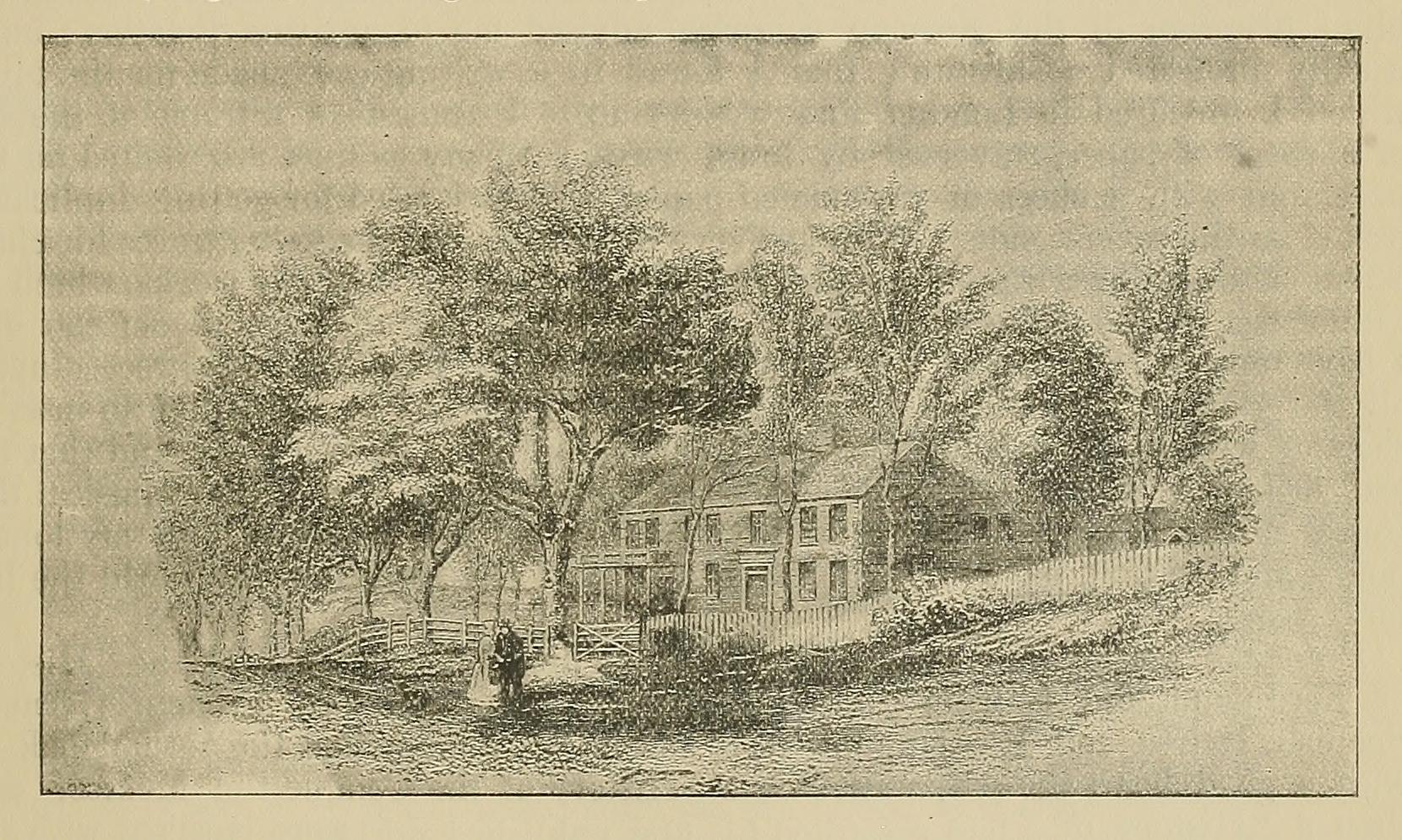
MR. PRESCOTT’S HOUSE AT PEPPERETT, MASS.
The account of his method of composition is told in one of his letters: “In the Christmas of 1837 my first work, ‘The History of Ferdinand and Isabella,’ was given to the world. I obtained the services of a reader who knew no language but his own, (English). I taught him to pronounce Castilian in a manner suited, I suspect, more to my ear than to that of a Spaniard, and we began our wearisome journey through Mariana’s noble (Spanish) history. I cannot even now call to mind without a smile the tedious hours in which, seated under some old trees in my country residence, we pursued our slow and melancholy way over pages which afforded no glimmering of light to him, and from which the light came dimly struggling to me through a half intelligible vocabulary. But in a few weeks the light became stronger, and I was cheered by the consciousness of my own improvement, and when we had toiled our way through seven quartos, I found I could understand the book when read about two-thirds as fast as ordinary English. My reader’s office required the more patience; he had not even this result to cheer him in his labor. I now felt that the great difficulty could be overcome, and I obtained the services of a reader whose acquaintance with modern and ancient tongues supplied, as far as it could be supplied, the deficiency of eyesight on my part. But though in this way I could examine various authorities, it was not easy to arrange in my mind the results of my reading drawn from different and often contradictory accounts. To do this I dictated copious notes as I went along, and when I had read enough for a chapter (from thirty to forty, and sometimes fifty pages in length), I had a mass of memoranda in my own language, which would easily bring before me in one view, the fruit of my researches. These notes were carefully read to me, and while my recent studies were fresh in my recollection, I ran over the whole of any intended chapter in my mind. This process I repeated at least half a dozen times, so that when I finally put my pen to paper it ran off pretty glibly for it was an effort of memory rather than composition.
Writing presented me a difficulty even greater than reading. Thierry, the famous blind historian of the Norman conquest, advised me to cultivate dictation; but I usually preferred a substitute that I found in a writing-case made for the blind which I procured in London, forty years since. It consists of a frame of the size of a sheet of paper, traversed by brass wires, as many as lines are wanted on the page, and with a sheet of carbonated paper, such as is used for getting duplicates, pasted on the reverse side. With an ivory or agate stylus the writer traces his characters between the wires on the carbonated sheet, making indelible marks, which he cannot see, on the white page below. This treadmill operation has its defects; and I have repeatedly supposed I had accomplished a good page, and was proceeding in all the glow of composition to go ahead, when I found I had forgotten to insert a sheet of writing-paper below, that my labor had all been thrown away, and that the leaf looked as blank as myself. Notwithstanding these and other whimsical distresses of the kind, I have found my writing-case my best friend in my lonely hours, and with it have written nearly all that I have sent into the world the last forty years.”
Prescott’s writings were successful from the first. Translations of the “History of Ferdinand and Isabella” appeared within a few years in French, German, Spanish, Italian and Russian, and it is surely no wonder that the author took up with a good heart the preparation of a “History of the Conquest of Mexico,” and then a “History of the Conquest of Peru,” both of which were received with the same appreciation that had rewarded his first published work.
He had spent some time abroad before his marriage, partly in the hope of benefitting his eyesight. In 1850 he again visited England and spent some time on the continent. He wrote a number of miscellaneous articles for magazines and reviews, and published in 1855, two, and in 1858 the third volume of his uncompleted “History of the Reign of Philip II., King of Spain.” This, had he lived to complete it, would doubtless have been his greatest work. It was received with such favor that six months after the publication of the first two volumes, eight thousand copies had been sold and the sales of his other works had been so stimulated as to bring the total up to thirty thousand volumes during that time, which yielded the author the substantial royalty of seventeen thousand dollars.
A slight stroke of paralysis had already enfeebled him, and a second terminated his life on the 28th of January, 1859. His wife, one daughter, and two sons survived him.
Few men have combined so many engaging qualities. His blindness had made no change in his appearance, and he was thought to be one of the handsomest men of his time. His cheerfulness of disposition was so great that at the time of his most intense suffering he addressed those who cared for him with such brightness and consideration that one might have thought their positions reversed. The personal friends who were won by his grace of manner and by the sterling worth of his character have nearly all passed away, but the hope that he early expressed, “to produce something which posterity would not willingly let die,” was most abundantly realized.
THE GOLDEN AGE OF TEZCUCO.
(FROM HISTORY OF CONQUEST OF MEXICO, 1843.)
HE first measure of Nezahualcoyotl, on returning to his dominions, was a general amnesty. It was his maxim “that a monarch might punish, but revenge was unworthy of him.” In the present instance he was averse even to punish, and not only freely pardoned his rebel nobles, but conferred on some, who had most deeply offended, posts of honor and confidence. Such conduct was doubtless politic, especially as their alienation was owing probably, much more to fear of the usurper than to any disaffection towards himself. But there are some acts of policy which a magnanimous spirit only can execute.
The restored monarch next set about repairing the damages sustained under the late misrule, and reviving, or rather remodelling, the various departments of government. He framed a concise, but comprehensive, code of laws, so well suited, it was thought, to the exigencies of the times, that it was adopted as their own by the two other members of the triple alliance. It was written in blood, and entitled the author to be called the Draco rather than “the Solon of Anahuac,” as he is fondly styled by his admirers. Humanity is one of the best fruits of refinement. It is only with increasing civilization that the legislator studies to economize human suffering, even for the guilty; to devise penalties not so much by way of punishment for the past as of reformation for the future.
He divided the burden of the government among a number of departments, as the council of war, the council of finance, the council of justice. This last was a court of supreme authority, both in civil and criminal matters, receiving appeals from the lower tribunals of the provinces, which were obliged to make a full report, every four months, or eighty days, of their own proceedings to this higher judicature. In all these bodies, a certain number of citizens were allowed to have seats with the nobles and professional dignitaries. There was, however, another body, a council of state, for aiding the king in the dispatch of business, and advising him in matters of importance, which was drawn altogether from the highest order of chiefs. It consisted of fourteen members; and they had seats provided for them at the royal table. Lastly, there was an extraordinary tribunal, called the council of music, but which differing from the import of its name, was devoted to the encouragement of science and art. Works on astronomy, chronology, history or any other science, were required to be submitted to its judgment, before they could be made public. This censorial power was of some moment, at least with regard to the historical department, where the wilful perversion of truth was made a capital offence by the bloody code of Nezahualcoyotl. Yet a Tezcucan author must have been a bungler, who could not elude a conviction under the cloudy veil of hieroglyphics. This body, which was drawn from the best instructed persons in the kingdom, with little regard to rank, had supervision of all the productions of art, and the nicer fabrics. It decided on the qualifications of the professors in the various branches of science, on the fidelity of their instructions to their pupils, the deficiency of which was severely punished, and it instituted examinations of these latter. In short, it was a general board of education for the country. On stated days, historical compositions, and poems treating of moral or traditional topics, were recited before it by their authors. Seats were provided for the three crowned heads of the empire, who deliberated with the other members on the respective merits of the pieces, and distributed prizes of value to the successful competitors.
The influence of this academy must have been most propitious to the capital, which became the nursery not only of such sciences as could be compassed by the scholarship of the period, but of various useful and ornamental arts. Its historians, orators, and poets were celebrated throughout the country. Its archives, for which accommodations were provided in the royal palaces, were stored with the records of primitive ages. Its idiom, more polished than the Mexican, was, indeed, the purest of all the Nahuatlac dialects, and continued, long after the Conquest, to be that in which the best productions of the native races were composed. Tezcuco claimed the glory of being the Athens of the Western world.
Among the most illustrious of her bards was the emperor himself,—for the Tezcucan writers claim this title for their chief, as head of the imperial alliance. He doubtless appeared as a competitor before that very academy where he so often sat as a critic. Many of his odes descended to a late generation, and are still preserved, perhaps, in some of the dusty repositories of Mexico or Spain. The historian Ixtlilxochitl has left a translation, in Castilian, of one of the poems of his royal ancestor. It is not easy to render his version into corresponding English rhyme, without the perfume of the original escaping in this double filtration. They remind one of the rich breathings of Spanish-Arab poetry, in which an ardent imagination is tempered by a not unpleasing and moral melancholy. But, though sufficiently florid in diction, they are generally free from the meretricious ornaments and hyperbole with which the minstrelsy of the East is usually tainted. They turn on the vanities and mutability of human life,—a topic very natural for a monarch who had himself experienced the strangest mutations of fortune. There is mingled in the lament of the Tezcucan bard, however, an Epicurean philosophy, which seeks relief from the fears of the future in the joys of the present. “Banish care,” he says: “if there are bounds to pleasure, the saddest of life must also have an end. Then weave the chaplet of flowers, and sing thy songs in praise of the all-powerful God; for the glory of this world soon fadeth away. Rejoice in the green freshness of thy spring; for the day will come when thou shalt sigh for these joys in vain; when the sceptre shall pass from thy hands, thy servants shall wander desolate in thy courts, thy sons, and the sons of thy nobles, shall drink the dregs of distress, and all the pomp of thy victories and triumphs shall live only in their recollection. Yet the remembrance of the just shall not pass away from the nations, and the good thou hast done shall ever be held in honor. The goods of this life, its glories and its riches, are but lent to us, its substance is but an illusory shadow, and the things of to-day shall change on the coming of the morrow. Then gather the fairest flowers from thy gardens, to bind round thy brow, and seize the joys of the present ere they perish.”
But the hours of the Tezcucan monarch were not all passed in idle dalliance with the Muse, nor in the sober contemplations of philosophy, as at a later period. In the freshness of youth and early manhood he led the allied armies in their annual expeditions, which were certain to result in a wider extent of territory to the empire. In the intervals of peace he fostered those productive arts which are the surest sources of public prosperity. He encouraged agriculture above all; and there was scarcely a spot so rude, or a steep so inaccessible, as not to confess the power of cultivation. The land was covered with a busy population, and towns and cities sprang up in places since deserted or dwindled into miserable villages.
THE BANQUET OF THE DEAD.
(FROM “HISTORY OF THE CONQUEST OF PERU,” 1847.)
HE wealth displayed by the Peruvian princes was only that which each had amassed individually for himself. He owed nothing to inheritance from his predecessors. On the decease of an Inca, his palaces were abandoned; all his treasures, except what were employed in his obsequies, his furniture and apparel, were suffered to remain as he had left them, and his mansions, save one, were closed up forever. The new sovereign was to provide himself with everything new for his royal state. The reason of this was the popular belief that the soul of the departed monarch would return after a time to reanimate his body on earth; and they wished that he should find everything to which he had been used in life prepared for his reception.
When an Inca died, or, to use his own language, “was called home to the mansions of his father, the Sun,” his obsequies were celebrated with great pomp and solemnity. The bowels were taken from the body and deposited in the temple of Tampu, about five leagues from the capital. A quantity of his plate and jewels was buried with them, and a number of his attendants and favorite concubines, amounting sometimes, it is said, to a thousand, were immolated on his tomb. Some of them showed the natural repugnance to the sacrifice occasionally manifested by the victims of a similar superstition in India. But these were probably the menials and more humble attendants; since the women have been known, in more than one instance, to lay violent hands on themselves, when restrained from testifying their fidelity by this act of conjugal martyrdom. This melancholy ceremony was followed by a general mourning throughout the empire. At stated intervals, for a year, the people assembled to renew the expressions of their sorrow; processions were made, displaying the banner of the departed monarch; bards and minstrels were appointed to chronicle his achievements, and their songs continued to be rehearsed at high festivals in the presence of the reigning monarch, thus stimulating the living by the glorious example of the dead.
The body of the deceased Inca was skilfully embalmed, and removed to the great temple of the Sun at Cuzco. There the Peruvian sovereign, on entering the awful sanctuary, might behold the effigies of his royal ancestors, ranged in opposite files, the men on the right, and their queens on the left of the great luminary which blazed in refulgent gold on the walls of the temple. The bodies, clothed in the princely attire which they had been accustomed to wear, were placed on chairs of gold, and sat with their heads inclined downward, their hands placidly crossed over their bosoms, their countenances exhibiting their natural dusky hue—less liable to change than the fresher coloring of an European complexion—and their hair of raven black, or silvered over with age, according to the period at which they died! It seemed like a company of solemn worshippers fixed in devotion, so true were the forms and lineaments to life. The Peruvians were as successful as the Egyptians in the miserable attempt to perpetuate the existence of the body beyond the limits assigned by nature.
They cherished a still stranger illusion in the attentions which they continued to pay to those insensible remains, as if they were instinct with life. One of the houses belonging to the deceased Inca was kept open and occupied by his guard and attendants with all the state appropriate to royalty. On certain festivals the revered bodies of the sovereigns were brought out with great ceremony into the public square of the capital. Invitations were sent by the captains of the guard of the respective Incas to the different nobles and officers of the court; and entertainments were provided in the names of their masters, which displayed all the profuse magnificence of their treasures, and “such a display,” says an ancient chronicler, “was there in the great square of Cuzco, on this occasion, of gold and silverplate and jewels, as no other city in the world ever witnessed.” The banquet was served by the menials of the respective households, and the guests partook of the melancholy cheer in the presence of the royal phantom with the same attention to the forms of courtly etiquette as if the living monarch had presided!
JOHN LOTHROP MOTLEY.
HISTORIAN AND DIPLOMATIST.
OTLEY’S history of the “Rise of the Dutch Republic” is, in some important respects, America’s greatest contribution to historical literature. Its author was the son of a New England merchant of literary tastes, and inherited through both parents some of the best blood of New England. He was born in Dorchester, Massachusetts, now a part of Boston, April 15, 1814. He was a delicate boy, but vigorous, vivacious, fond of outdoor sports and intellectual contests. He was a boyish friend of Wendell Phillips, and was early associated with many of that group of New England scholars who have done so much for American literature during the past half-century. Motley was educated at good schools near Boston, and entered Harvard at what would now seem the ridiculously early age of thirteen. He cared too much for general and voluminous reading to do thorough work in the prescribed college course, but his wit, his brilliant mind and his impulsive generosity made him a general favorite. After graduating from Harvard he studied in Germany, becoming acquainted at Göttingen with Bismarck, between whom and himself there sprang up an intimate friendship which was renewed at every opportunity throughout his life. Bismarck said of him that “The most striking feature of his handsome and delicate appearance was uncommonly large and beautiful eyes. He never entered a drawing-room without exciting the curiosity and sympathy of the ladies.” He was married in 1837 to Mary, sister of Park Benjamin, a most attractive and beautiful woman, and two years later he published an historical novel called “Morton’s Hope.” Neither this book nor another called “Merry Mount” proved a success, and both Motley and his friends were convinced that his real field of work was that of the historian. His first attempt in this direction was an essay published in the “North American Review” on the “Polity of the Puritans,” which not only demonstrated his skill and ability but gave expression to his intense love of liberty and to his lofty patriotism.

An interesting episode in Motley’s life was his election in 1849 to the Massachusetts House of Representatives. He does not seem to have been well adapted for a legislator and never sought a re-election. The incident which he most vividly remembered in this connection was his careful preparation of a report from the Committee on Education, of which he was chairman, proposing measures which he had convinced himself were for the best, and the apparent ease with which a country member, Geo. S. Boutwell, who afterwards distinguished himself in the field of national politics, demolished his arguments, and convinced everybody, including the author of the report of the opposite view.
Mr. Motley began the collection of materials for his “History of Holland” about 1846. He devoted ten years to its preparation, making careful researches at Berlin, Dresden, the Hague and Brussels. When finally he had brought it to a conclusion he did not find it easy to make satisfactory arrangements for its publication. The leading house in London declined it, and it was finally published at the expense of the author. It was another and most marked example of the occasional lack of insight on the part of the wisest and best trained publishers, for the book which had gone begging to be printed was received everywhere with acclamations. Guizot, perhaps the foremost historian of modern times, personally supervised the translation into French, and wrote the introduction. The book had a large sale on both sides of the Atlantic, and Mr. Motley was at once recognized as a great historian. Mr. Froude has very justly said that this history is as “complete as industry and genius can make it,” and “one which will take its place among the finest stories in this or any other language.” Motley lived for the next two years in Boston, taking much interest in the “Atlantic Monthly,” though he was too much engaged with historical study to contribute very frequently to its columns. In 1858 he returned to England, where he lived for most of his remaining life, visiting America only three times, and making on each occasion a comparatively short stay. He found residence abroad more convenient for historical research. His position in English society was an enviable one, and his daughters were all married to Englishmen, one of them to Sir William Vernon Harcourt. This residence in England, however, did not wean his heart from America or its institutions or make him any less an ardent patriot, and perhaps he never rendered his country a more signal service than when, on finding that the higher classes in England sympathized with the South, he addressed two letters to the London “Times,” which did much to bring about a change of sentiment, and which remained as monuments to his loyalty and to his ability as an advocate.
Mr. Motley had been appointed Secretary of the American Legation at St. Petersburg in 1841, but had found the climate too rigorous and had continued at his post only a few months before tendering his resignation. He was now to undertake a more serious task in diplomacy. President Lincoln appointed him, in 1861, Minister to Austria. He was so absorbed in the great struggle going on in his own country that he gave up for the time the historical studies which made so large a part of his ordinary life, and “lived only in the varying fortunes of the day, his profound faith and enthusiasm sustaining him and lifting him above the natural influence of a by no means sanguine temperament.” He continued Minister to Austria, performing the difficult service of that office with discretion and with credit until 1867, when, in consequence of a letter received by President Johnson from some obscure source, inquiries were made which Mr. Motley considered insulting, and he at once tendered his resignation.
He had published in 1860 two volumes of his “History of the United Netherlands,” and they had been received with all the favor that had greeted his former great work. The American war had delayed the completion of the book, but in 1868 he published the other two volumes. An article from the “Edinburgh Review” discussing the first two volumes says: “Mr. Motley combines as an historian two qualifications seldom found united—to a great capacity for historical research he adds much power of pictorial representation.”
This is the secret of his great success. Men who excel in the use of language are too often unwilling to undertake the drudgery which research entails, while those who are able and willing to read voluminous correspondence and con over numberless dispatches in order to establish some historical fact, are frequently unable to clothe the fact in words which will so illumine and illustrate the truth as to make it really live in the mind of the reader. That Motley possessed both of these abilities along with those others which made him to a very wide circle in both Europe and America a much loved man, is sufficient reason for the place that has been given him in the history of men of letters.
Probably, at the request of Senator Sumner, Mr. Motley was in 1869 appointed Minister to England. The position was in many respects most agreeable to him. It gave him a post of great influence in a society in which he was known and admired, and opened possibilities of high service to the country which he loved with an ardor that amounted to enthusiasm. The Alabama claims were being urged upon the British Government, and the difficulties and responsibilities were very great. He was suddenly recalled in 1870 under circumstances that wounded him so deeply that it may be said he never recovered from the cruel surprise. The most probable explanation of President Grant’s course seems to be that it was the outcome of his difficulty with Mr. Sumner over his San Domingo policy, and that Mr. Motley’s tastes and the pursuits to which he had devoted his life made him a man with whom the President could not in any large measure sympathize. When, therefore, the President found his favorite measure defeated largely by the influence of Mr. Sumner, he ceased to have cause to retain Mr. Sumner’s friend in so responsible a post. The whole matter looks, at this distance, discreditable, but it was probably the system of political favoritism then in vogue rather than either the President or his Secretary of State that was to blame.
Mr. Motley had intended to devote his last years to a “History of the Thirty Years’ War,” but before undertaking it he wrote “The Life and Death of John of Barneveld, Advocate of Holland, with a View of the Primary Causes and Movements of the Thirty Years’ War,” which has been recognized as the most classical of his productions. It was his last work. Even before the death of Mrs. Motley in 1874, he was in somewhat feeble health, and while he did not abandon literary labor, he gave up at this time any hope of being able to engage in protracted effort. He spent a part of the year 1875 in Boston, returning to his daughter’s residence in Devonshire, where he died in 1877. Dean Stanley spoke of him as “one of the brightest lights of the Western Hemisphere, the high-spirited patriot, the faithful friend of England’s best and purest spirits; the brilliant, the indefatigable historian.” A distinguished countryman of his own had once introduced him to an audience as one “whose name belongs to no single country and to no single age: as a statesman and diplomatist and patriot, ♦he belongs to America; as a scholar, to the world of letters; as a historian, all ages will claim him in the future.”
BISMARCK.¹
GLIMPSES OF NOTED PEOPLE FROM THE CORRESPONDENCE OF JOHN LOTHROP MOTLEY, D.C.L. EDITED BY GEORGE WILLIAM CURTIS, 1889.
HEN I called, Bismarck was at dinner, so I left my card and said I would come back in half an hour. As soon as my card had been carried to him (as I learned afterwards) he sent a servant after me to the hotel, but I had gone another way. When I came back I was received with open arms. I can’t express to you how cordially he received me. If I had been his brother, instead of an old friend, he could not have shown more warmth and affectionate delight in seeing me. I find I like him even better than I thought I did, and you know how high an opinion I always expressed of his talents and disposition. He is a man of very noble character and of very powerful mind. The prominent place which he now occupies as a statesman sought him. He did not seek it, or any other office. The stand which he took in the Assembly from conviction, on the occasion of the outbreak of 1848, marked him at once to all parties as one of the leading characters of Prussia. Of course, I don’t now go into the rights and wrongs of the matter, but I listened with great interest, as you may suppose, to his detailed history of the revolutionary events of that year, and his share in them, which he narrated to me in a long conversation which we had last night. He wanted me to stay entirely in his house, but as he has his wife’s father and mother with him, and as I saw that it was necessary to put up a bed in a room where there was none, I decidedly begged off. I breakfasted there this morning, and am to dine there, with a party, to-day. To-morrow, I suppose, I shall dine there en famille. I am only afraid that the landlord here will turn me into the streets for being such a poor consommateur for him, and all I can do is to order vast quantities of seltzer water.
The principal change in Bismarck is that he has grown stouter, but, being over six feet, this is an improvement. His voice and manner are singularly unchanged. His wife I like very much indeed; very friendly, intelligent and perfectly unaffected, and treats me like an old friend. In short, I can’t better describe the couple than by saying that they are as unlike M. and Mme. de ―― as it is possible to be.
In the summer of 1851 he told me that the Minister, Manteuffel, asked him one day abruptly if he would accept the post of Ambassador at Frankfort, to which (although the proposition was as unexpected a one to him as if I should hear by the next mail that I had been chosen Governor of Massachusetts) he answered, after a moment’s deliberation, yes, without another word. The King, the same day, sent for him, and asked him if he would accept the place, to which he made the same brief answer, “Ja.” His Majesty expressed a little surprise that he made no queries or conditions, when Bismarck replied that anything the King felt strong enough to propose to him he felt strong enough to accept. I only write these details that you may have an idea of the man. Strict integrity and courage of character, a high sense of honor, a firm religious belief, united with remarkable talents, make up necessarily a combination which cannot be found any day in any court, and I have no doubt that he is destined to be Prime Minister, unless his obstinate truthfulness, which is apt to be a stumbling-block for politicians, stands in his way....
Well, he accepted the post, and wrote to his wife next day, who was preparing for a summer’s residence in a small house on the sea-coast, that he could not come because he was already Minister in Frankfort. The result, as he said, was three days of tears on her part. He had previously been leading the life of a plain country ’squire, with a moderate income, had never held any position in the government or in diplomacy, and had hardly ever been to court. He went into the office with a holy horror of the mysterious nothings of diplomacy, but soon found how little there was in the whole “galimatias.” Of course, my politics are very different from his, although not so antipodal as you might suppose, but I can talk with him as frankly as I could with you, and I am glad of an opportunity of hearing the other side put by a man whose talents and character I esteem, and who so well knows le dessous des cartes.
THE SIEGE OF LEYDEN.¹
EANTIME, the besieged city was at its last gasp. The burghers had been in a state of uncertainty for many days; being aware that the fleet had set forth for their relief, but knowing full well the thousand obstacles which it had to surmount. They had guessed its progress by the illumination from the blazing villages; they had heard its salvos of artillery on its arrival at North Aa; but since then all had been dark and mournful again, hope and fear, in sickening alternation, distracting every breast. They knew that the wind was unfavorable, and at the dawn of each day every eye was turned wistfully to the vanes of the steeples. So long as the easterly breeze prevailed, they felt, as they anxiously stood on towers and housetops, that they must look in vain for the welcome ocean. Yet, while thus patiently waiting, they were literally starving; for even the misery endured at Harlem had not reached that depth and intensity of agony to which Leyden was now reduced. Bread, malt-cake, horseflesh, had entirely disappeared; dogs, cats, rats and other vermin were esteemed luxuries. A small number of cows, kept as long as possible for their milk, still remained; but a few were killed from day to day, and distributed in minute proportions, hardly sufficient to support life among the famishing population. Starving wretches swarmed daily around the shambles where these cattle were slaughtered, contending for any morsel which might fall, and lapping eagerly the blood as it ran along the pavement; while the hides, chopped and boiled, were greedily devoured. Women and children, all day long, were seen searching gutters and dunghills for morsels of food, which they disputed fiercely with the famishing dogs. The green leaves were stripped from the trees, every living herb was converted into human food; but these expedients could not avert starvation. The daily mortality was frightful; infants starved to death on the maternal breasts which famine had parched and withered; mothers dropped dead in the streets, with their dead children in their arms. In many a house the watchmen, in their rounds, found a whole family of corpses—father, mother, children, side by side; for a disorder called the plague, naturally engendered of hardship and famine, now came, as if in kindness, to abridge the agony of the people. The pestilence stalked at noonday through the city, and the doomed inhabitants, fell like grass beneath its scythe. From six thousand to eight thousand human beings sank before this scourge alone; yet the people resolutely held out,—women and men mutually encouraging each other to resist the entrance of their foreign foe,—an evil more horrible than pest or famine.

Leyden was sublime in its despair. A few murmurs were, however, occasionally heard at the steadfastness of the magistrates, and a dead body was placed at the door of the burgomaster, as a silent witness against his inflexibility. A party of the more faint-hearted even assailed the heroic Adrian Van der Werf with threats and reproaches as he passed through the streets. A crowd had gathered around him as he reached a triangular place in the centre of the town, into which many of the principal streets emptied themselves, and upon one side of which stood the church of Saint Pancras. There stood the burgomaster, a tall, haggard, imposing figure, with dark visage and a tranquil but commanding eye. He waved his broad-leaved felt hat for silence, and then exclaimed, in language which has been almost literally preserved, “What would ye, my friends? Why do ye murmur that we do not break our vows and surrender the city to the Spaniards?—a fate more horrible than the agony which she now endures. I tell you I have made an oath to hold the city; and may God give me strength to keep my oath! I can die but once, whether by your hands, the enemy’s, or by the hand of God. My own fate is indifferent to me; not so that of the city intrusted to my care. I know that we shall starve if not soon relieved; but starvation is preferable to the dishonored death which is the only alternative. Your menaces move me not; my life is at your disposal; here is my sword, plunge it into my breast, and divide my flesh among you. Take my body to appease your hunger, but expect no surrender so long as I remain alive.”...
On the 28th of September a dove flew into the city, bringing a letter from Admiral Boisot. In this dispatch the position of the fleet at North Aa was described in encouraging terms, and the inhabitants were assured that, in a very few days at furthest, the long-expected relief would enter their gates. The tempest came to their relief. A violent equinoctial gale on the night of the 1st and 2d of October came storming from the northwest, shifting after a few hours full eight points, and then blowing still more violently from the southwest. The waters of the North Sea were piled in vast masses upon the southern coast of Holland, and then dashed furiously landward, the ocean rising over the earth and sweeping with unrestrained power across the ruined dykes. In the course of twenty-four hours the fleet at North Aa, instead of nine inches, had more than two feet of water.... On it went, sweeping over the broad waters which lay between Zoeterwoude and Zwieten; as they approached some shallows which led into the great mere, the Zealanders dashed into the sea, and with sheer strength shouldered every vessel through.... On again the fleet of Boisot still went, and, overcoming every obstacle entered the city on the morning of the 3d of October. Leyden was relieved.
ASSASSINATION OF WILLIAM OF ORANGE.
(FROM “RISE OF THE DUTCH REPUBLIC.”)
N Tuesday, the 10th of July, 1584, at about half-past twelve, the Prince, with his wife on his arm, and followed by the ladies and gentlemen of his family, was going to the dining-room. William the Silent was dressed upon that day, according to his usual custom, in a very plain fashion. He wore a wide-leaved hat of dark felt, with a silken cord round the crown, such as had been worn by the “Beggars” in the early days of the revolt. A high ruff encircled his neck from which also depended one of the Beggars’ medals with the motto, “Fidèle jusqu’ à la besace;” while a loose surcoat of gray frieze cloth, over a tawny leather doublet, with wide-slashed underclothes, completed his costume. Gérard presented himself at the doorway, and demanded a passport, which the Prince directed his secretary to make out for him....