GREAT POETS OF AMERICA.
Reading edition
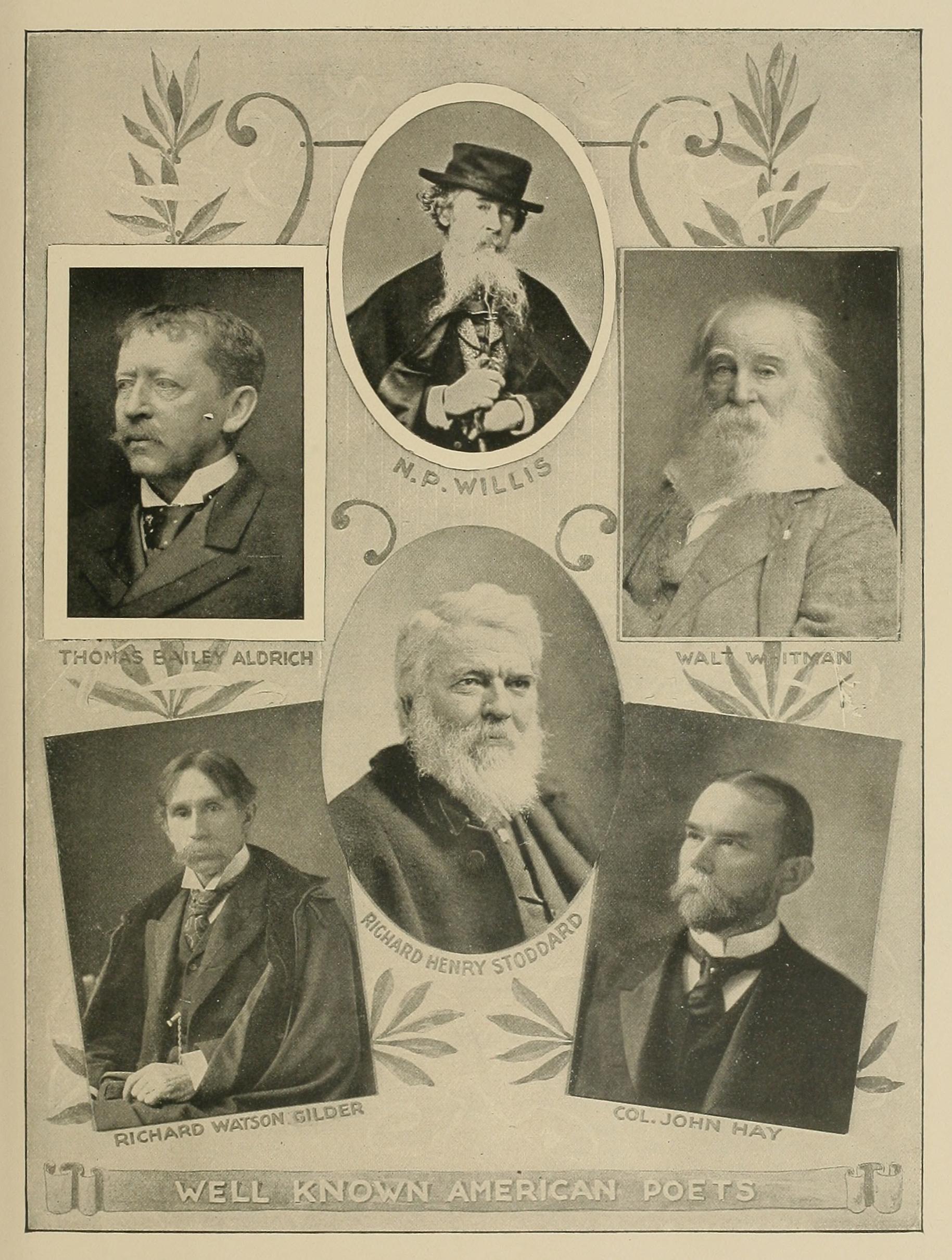
WELL KNOWN AMERICAN POETS
N. P. WILLIS THOMAS BAILEY ALDRICH • WALT WHITMAN RICHARD HENRY STODDARD RICHARD WATSON GILDER • COL. JOHN HAY

WILLIAM CULLEN BRYANT.
THE POET OF NATURE.
T is said that “genius always manifests itself before its possessor reaches manhood.” Perhaps in no case is this more true than in that of the poet, and William Cullen Bryant was no exception to the general rule. The poetical fancy was early displayed in him. He began to write verses at nine, and at ten composed a little poem to be spoken at a public school, which was published in a newspaper. At fourteen a collection of his poems was published in 12 mo. form by E. G. House of Boston. Strange to say the longest one of these, entitled “The Embargo” was political in its character setting forth his reflections on the Anti-Jeffersonian Federalism prevalent in New England at that time. But it is said that never after that effort did the poet employ his muse upon the politics of the day, though the general topics of liberty and independence have given occasion to some of his finest efforts. Bryant was a great lover of nature. In the Juvenile Collection above referred to were published an “Ode to Connecticut River” and also the lines entitled “Drought” which show the characteristic observation as well as the style in which his youthful muse found expression. It was written July, 1807, when the author was thirteen years of age, and will be found among the succeeding selections.
“Thanatopsis,” one of his most popular poems, (though he himself marked it low) was written when the poet was but little more than eighteen years of age. This production is called the beginning of American poetry.
William Cullen Bryant was born at Cummington, Hampshire Co., Mass., November 3rd, 1784. His father was a physician, and a man of literary culture who encouraged his son’s early ability, and taught him the value of correctness and compression, and enabled him to distinguish between true poetic enthusiasm and the bombast into which young poets are apt to fall. The feeling and reverence with which Bryant cherished the memory of his father whose life was
“Marked with some act of goodness every day,”
is touchingly alluded to in several of his poems and directly spoken of with pathetic eloquence in the “Hymn to Death” written in 1825:
Alas! I little thought that the stern power
Whose fearful praise I sung, would try me thus
Before the strain was ended. It must cease—
For he is in his grave who taught my youth
The art of verse, and in the bud of life
Offered me to the Muses. Oh, cut off
Untimely! when thy reason in its strength,
Ripened by years of toil and studious search
And watch of Nature’s silent lessons, taught
Thy hand to practise best the lenient art
To which thou gavest thy laborious days,
And, last, thy life. And, therefore, when the earth
Received thee, tears were in unyielding eyes,
And on hard cheeks, and they who deemed thy skill
Delayed their death-hour, shuddered and turned pale
When thou wert gone. This faltering verse, which thou
Shalt not, as wont, o’erlook, is all I have
To offer at thy grave—this—and the hope
To copy thy example.
Bryant was educated at Williams College, but left with an honorable discharge before graduation to take up the study of law, which he practiced one year at Plainfield and nine years at Great Barrington, but in 1825 he abandoned law for literature, and removed to New York where in 1826 he began to edit the “Evening Post,” which position he continued to occupy from that time until the day of his death. William Cullen Bryant and the “Evening Post” were almost as conspicuous and permanent features of the city as the Battery and Trinity Church.
In 1821 Mr. Bryant married Frances Fairchild, the loveliness of whose character is hinted in some of his sweetest productions. The one beginning
“O fairest of the rural maids,”
was written some years before their marriage; and “The Future Life,” one of the noblest and most pathetic of his poems, is addressed to her:—
“In meadows fanned by Heaven’s life-breathing wind,
In the resplendence of that glorious sphere
And larger movements of the unfettered mind,
Wilt thou forget the love that joined us here?
“Will not thy own meek heart demand me there,—
That heart whose fondest throbs to me were given?
My name on earth was ever in thy prayer,
And wilt thou never utter it in heaven?”
Among his best-known poems are “A Forest Hymn,” “The Death of the Flowers,” “Lines to a Waterfowl,” and “The Planting of the Apple-Tree.” One of the greatest of his works, though not among the most popular, is his translation of Homer, which he completed when seventy-seven years of age.
Bryant had a marvellous memory. His familiarity with the English poets was such that when at sea, where he was always too ill to read much, he would beguile the time by reciting page after page from favorite authors. However long the voyage, he never exhausted his resources. “I once proposed,” says a friend, “to send for a copy of a magazine in which a new poem of his was announced to appear. ‘You need not send for it,’ said he, ‘I can give it to you.’ ‘Then you have a copy with you?’ said I. ‘No,’ he replied, ‘but I can recall it,’ and thereupon proceeded immediately to write it out. I congratulated him upon having such a faithful memory. ‘If allowed a little time,’ he replied, ‘I could recall every line of poetry I have ever written.’”
His tenderness of the feelings of others, and his earnest desire always to avoid the giving of unnecessary pain, were very marked. “Soon after I began to do the duties of literary editor,” writes an associate, “Mr. Bryant, who was reading a review of a little book of wretchedly halting verse, said to me: ‘I wish you would deal very gently with poets, especially the weaker ones.’”
Bryant was a man of very striking appearance, especially in age. “It is a fine sight,” says one writer, “to see a man full of years, clear in mind, sober in judgment, refined in taste, and handsome in person.... I remember once to have been at a lecture where Mr. Bryant sat several seats in front of me, and his finely-sized head was especially noticeable.... The observer of Bryant’s capacious skull and most refined expression of face cannot fail to read therein the history of a noble manhood.”
The grand old veteran of verse died in New York in 1878 at the age of eighty-four, universally known and honored. He was in his sixth year when George Washington died, and lived under the administration of twenty presidents and had seen his own writings in print for seventy years. During this long life—though editor for fifty years of a political daily paper, and continually before the public—he had kept his reputation unspotted from the world, as if he had, throughout the decades, continually before his mind the admonition of the closing lines of “Thanatopsis” written by himself seventy years before.

THANATOPSIS.¹
The following production is called the beginning of American poetry.
That a young man not yet 19 should have produced a poem so lofty in conception, so full of chaste language and delicate and striking imagery, and, above all, so pervaded by a noble and cheerful religious philosophy, may well be regarded as one of the most remarkable examples of early maturity in literary history.
O him who, in the love of Nature, holds
Communion with her visible forms, she speaks
A various language; for his gayer hours
She has a voice of gladness, and a smile
And eloquence of beauty, and she glides
Into his darker musings with a mild
And healing sympathy, that steals away
Their sharpness, ere he is aware. When thoughts
Of the last bitter hour come like a blight
Over thy spirit, and sad images
Of the stern agony, and shroud, and pall,
And breathless darkness, and the narrow house,
Make thee to shudder, and grow sick at heart;—
Go forth, under the open sky, and list
To Nature’s teachings, while from all around—
Earth and her waters, and the depths of air—
Comes a still voice.—Yet a few days, and thee
The all-beholding sun shall see no more
In all his course; nor yet in the cold ground,
Where thy pale form was laid, with many tears,
Nor in the embrace of ocean, shall exist
Thy image. Earth, that nourish’d thee, shall claim
Thy growth, to be resolved to earth again;
And, lost each human trace, surrendering up
Thine individual being, shalt thou go
To mix forever with the elements,
To be a brother to the insensible rock
And to the sluggish clod, which the rude swain
Turns with his share, and treads upon. The oak
Shall send his roots abroad, and pierce thy mould.
Yet not to thine eternal resting-place
Shalt thou retire alone,—nor couldst thou wish
Couch more magnificent. Thou shalt lie down
With patriarchs of the infant world,—with kings,
The powerful of the earth—the wise, the good,
Fair forms, and hoary seers of ages past,
All in one mighty sepulchre. The hills
Rock-ribb’d and ancient as the sun,—the vales
Stretching in pensive quietness between;
The venerable woods,—rivers that move
In majesty, and the complaining brooks
That make the meadows green; and, pour’d round all,
Old ocean’s gray and melancholy waste,—
Are but the solemn decorations all
Of the great tomb of man. The golden sun,
The planets, all the infinite host of heaven,
Are shining on the sad abodes of death,
Through the still lapse of ages. All that tread
The globe are but a handful to the tribes
That slumber in its bosom. Take the wings
Of morning, traverse Barca’s desert sands,
Or lose thyself in the continuous woods
Where rolls the Oregon, and hears no sound
Save its own dashings,—yet—the dead are there,
And millions in those solitudes, since first
The flight of years began, have laid them down
In their last sleep,—the dead reign there alone.
So shalt thou rest; and what if thou withdraw
In silence from the living, and no friend
Take note of thy departure? All that breathe
Will share thy destiny. The gay will laugh
When thou art gone, the solemn brood of care
Plod on, and each one, as before, will chase
His favorite phantom; yet all these shall leave
Their mirth and their employments, and shall come
And make their bed with thee. As the long train
Of ages glides away, the sons of men—
The youth in life’s green spring, and he who goes
In the full strength of years, matron and maid,
And the sweet babe, and the gray-headed man—
Shall, one by one, be gather’d to thy side,
By those who in their turn shall follow them.
So live that, when thy summons comes to join
The innumerable caravan, which moves
To that mysterious realm where each shall take
His chamber in the silent halls of death,
Thou go not, like the quarry-slave at night,
Scourged to his dungeon; but, sustain’d and soothed
By an unfaltering trust, approach thy grave
Like one who wraps the drapery of his couch
About him, and lies down to pleasant dreams.
WAITING BY THE GATE.
ESIDES the massive gateway built up in years gone by,
Upon whose top the clouds in eternal shadow lie,
While streams the evening sunshine on the quiet wood and lea,
I stand and calmly wait until the hinges turn for me.
The tree tops faintly rustle beneath the breeze’s flight,
A soft soothing sound, yet it whispers of the night;
I hear the woodthrush piping one mellow descant more,
And scent the flowers that blow when the heat of day is o’er.
Behold the portals open and o’er the threshold, now,
There steps a wearied one with pale and furrowed brow;
His count of years is full, his ♦allotted task is wrought;
He passes to his rest from a place that needs him not.
In sadness, then, I ponder how quickly fleets the hour
Of human strength and action, man’s courage and his power.
I muse while still the woodthrush sings down the golden day,
And as I look and listen the sadness wears away.
Again the hinges turn, and a youth, departing throws
A look of longing backward, and sorrowfully goes;
A blooming maid, unbinding the roses from her hair,
Moves wonderfully away from amid the young and fair.
Oh, glory of our race that so suddenly decays!
Oh, crimson flush of morning, that darkens as we gaze!
Oh, breath of summer blossoms that on the restless air
Scatters a moment’s sweetness and flies we know not where.
I grieve for life’s bright promise, just shown and then withdrawn;
But still the sun shines round me; the evening birds sing on;
And I again am soothed, and beside the ancient gate,
In this soft evening sunlight, I calmly stand and wait.
Once more the gates are opened, an infant group go out,
The sweet smile quenched forever, and stilled the sprightly shout.
Oh, frail, frail tree of life, that upon the greensward strews
Its fair young buds unopened, with every wind that blows!
So from every region, so enter side by side,
The strong and faint of spirit, the meek and men of pride,
Steps of earth’s greatest, mightiest, between those pillars gray,
And prints of little feet, that mark the dust away.
And some approach the threshold whose looks are blank with fear,
And some whose temples brighten with joy are drawing near,
As if they saw dear faces, and caught the gracious eye
Of Him, the Sinless Teacher, who came for us to die.
I mark the joy, the terrors; yet these, within my heart,
Can neither wake the dread nor the longing to depart;
And, in the sunshine streaming of quiet wood and lea,
I stand and calmly wait until the hinges turn for me.
“BLESSED ARE THEY THAT MOURN.”
DEEM not they are blest alone
Whose lives a peaceful tenor keep;
The Power who pities man has shown
A blessing for the eyes that weep.
The light of smiles shall fill again
The lids that overflow with tears;
And weary hours of woe and pain
Are promises of happier years.
There is a day of sunny rest
For every dark and troubled night;
And grief may bide an evening guest,
But joy shall come with early light.
And thou, who, o’er thy friend’s low bier,
Sheddest the bitter drops like rain,
Hope that a brighter, happier sphere
Will give him to thy arms again.
Nor let the good man’s trust depart,
Though life its common gifts deny,—
Though with a pierced and bleeding heart,
And spurned of men, he goes to die.
For God hath marked each sorrowing day,
And numbered every secret tear,
And heaven’s long age of bliss shall pay
For all his children suffer here.
THE ANTIQUITY OF FREEDOM.
ERE are old trees, tall oaks, and gnarled pines,
That stream with gray-green mosses; here the ground
Was never touch’d by spade, and flowers spring up
Unsown, and die ungather’d. It is sweet
To linger here, among the flitting birds
And leaping squirrels, wandering brooks and winds
That shake the leaves, and scatter as they pass
A fragrance from the cedars thickly set
With pale blue berries. In these peaceful shades—
Peaceful, unpruned, immeasurably old—
My thoughts go up the long dim path of years,
Back to the earliest days of Liberty.
O Freedom! thou art not, as poets dream,
A fair young girl, with light and delicate limbs,
And wavy tresses gushing from the cap
With which the Roman master crown’d his slave,
When he took off the gyves. A bearded man,
Arm’d to the teeth, art thou: one mailed hand
Grasps the broad shield, and one the sword; thy brow,
Glorious in beauty though it be, is scarr’d
With tokens of old wars; thy massive limbs
Are strong and struggling. Power at thee has launch’d
His bolts, and with his lightnings smitten thee;
They could not quench the life thou hast from Heaven.
Merciless Power has dug thy dungeon deep,
And his swart armorers, by a thousand fires,
Have forged thy chain; yet while he deems thee bound,
The links are shiver’d, and the prison walls
Fall outward; terribly thou springest forth,
As springs the flame above a burning pile,
And shoutest to the nations, who return
Thy shoutings, while the pale oppressor flies.
Thy birth-right was not given by human hands:
Thou wert twin-born with man. In pleasant fields,
While yet our race was few, thou sat’st with him,
To tend the quiet flock and watch the stars,
And teach the reed to utter simple airs.
Thou by his side, amid the tangled wood,
Didst war upon the panther and the wolf,
His only foes: and thou with him didst draw
The earliest furrows on the mountain side,
Soft with the Deluge. Tyranny himself,
The enemy, although of reverend look,
Hoary with many years, and far obey’d,
Is later born than thou; and as he meets
The grave defiance of thine elder eye,
The usurper trembles in his fastnesses.
Thou shalt wax stronger with the lapse of years,
But he shall fade into a feebler age;
Feebler, yet subtler; he shall weave his snares,
And spring them on thy careless steps, and clap
His wither’d hands, and from their ambush call
His hordes to fall upon thee. He shall send
Quaint maskers, forms of fair and gallant mien,
To catch thy gaze, and uttering graceful words
To charm thy ear; while his sly imps, by stealth,
Twine round thee threads of steel, light thread on thread,
That grow to fetters; or bind down thy arms
With chains conceal’d in chaplets. Oh! not yet
Mayst thou unbrace thy corslet, nor lay by
Thy sword, nor yet, O Freedom! close thy lids
In slumber; for thine enemy never sleeps.
And thou must watch and combat, till the day
Of the new Earth and Heaven. But wouldst thou rest
Awhile from tumult and the frauds of men,
These old and friendly solitudes invite
Thy visit. They, while yet the forest trees
Were young upon the unviolated earth,
And yet the moss-stains on the rock were new,
Beheld thy glorious childhood, and rejoiced.
TO A WATERFOWL.
HITHER, ’midst falling dew,
While glow the heavens with the last steps of day,
Far, through their rosy depths, dost thou pursue
Thy solitary way?
Vainly the fowler’s eye
Might mark thy distant flight to do thee wrong,
As, darkly limn’d upon the crimson sky,
Thy figure floats along.
Seek’st thou the plashy brink
Of weedy lake, or marge of river wide,
Or where the rocking billows rise and sink
On the chafed ocean side?
There is a Power whose care
Teaches thy way along that pathless coast,—
The desert and illimitable air,—
Lone wandering, but not lost.
All day thy wings have fann’d,
At that far height, the cold, thin atmosphere,
Yet stoop not, weary, to the welcome land,
Though the dark night is near.
And soon that toil shall end;
Soon shalt thou find a summer home, and rest,
And scream among thy fellows; reeds shall bend,
Soon, o’er thy shelter’d nest.
Thou’rt gone; the abyss of heaven
Hath swallow’d up thy form; yet on my heart
Deeply hath sunk the lesson thou hast given,
And shall not soon depart.
He who, from zone to zone,
Guides through the boundless sky thy certain flight,
In the long way that I must tread alone,
Will lead my steps aright.
ROBERT OF LINCOLN.
ERRILY swinging on brier and weed,
Near to the nest of his little dame,
Over the mountain-side or mead,
Robert of Lincoln is telling his name:
Bob-o’-link, bob-o’-link,
Spink, spank, spink;
Snug and safe is that nest of ours,
Hidden among the summer flowers.
Chee, chee, chee.
Robert of Lincoln is gayly dressed,
Wearing a bright black wedding coat;
White are his shoulders and white his crest,
Hear him call in his merry note:
Bob-o’-link, bob-o’-link,
Spink, spank, spink;
Look what a nice new coat is mine,
Sure there was never a bird so fine.
Chee, chee, chee.
Robert of Lincoln’s Quaker wife,
Pretty and quiet, with plain brown wings,
Passing at home a patient life,
Broods in the grass while her husband sings,
Bob-o’-link, bob-o’-link,
Spink, spank, spink;
Brood, kind creature; you need not fear
Thieves and robbers, while I am here.
Chee, chee, chee.
Modest and shy as a nun is she,
One weak chirp is her only note,
Braggart and prince of braggarts is he,
Pouring boasts from his little throat:
Bob-o’-link, bob-o’-link,
Spink, spank, spink;
Never was I afraid of man;
Catch me, cowardly knaves if you can.
Chee, chee, chee.
Six white eggs on a bed of hay,
Flecked with purple, a pretty sight
There as the mother sits all day,
Robert is singing with all his might:
Bob-o’-link, bob-o’-link,
Spink, spank, spink;
Nice good wife, that never goes out,
Keeping house while I frolic about.
Chee, chee, chee.
Soon as the little ones chip the shell
Six wide mouths are open for food;
Robert of Lincoln bestirs him well,
Gathering seed for the hungry brood.
Bob-o’-link, bob-o’-link,
Spink, spank, spink;
This new life is likely to be
Hard for a gay young fellow like me.
Chee, chee, chee.
Robert of Lincoln at length is made
Sober with work and silent with care;
Off is his holiday garment laid,
Half-forgotten that merry air,
Bob-o’-link, bob-o’-link,
Spink, spank, spink;
Nobody knows but my mate and I
Where our nest and our nestlings lie.
Chee, chee, chee.
Summer wanes; the children are grown;
Fun and frolic no more he knows;
Robert of Lincoln’s a humdrum crone;
Off he flies, and we sing as he goes:
Bob-o’-link, bob-o’-link,
Spink, spank, spink;
When you can pipe that merry old strain,
Robert of Lincoln, come back again.
Chee, chee, chee.
DROUGHT.
LUNGED amid the limpid waters,
Or the cooling shade beneath,
Let me fly the scorching sunbeams,
And the southwind’s sickly breath!
Sirius burns the parching meadows,
Flames upon the embrowning hill,
Dries the foliage of the forest,
And evaporates the rill.
Scarce is seen the lonely floweret,
Save amid the embowering wood;
O’er the prospect dim and dreary,
Drought presides in sullen mood!
Murky vapours hung in ether,
Wrap in gloom, the sky serene;
Nature pants distressful—silence
Reigns o’er all the sultry scene.
Then amid the limpid waters,
Or beneath the cooling shade,
Let me shun the scorching sunbeams
And the sickly breeze evade.
THE PAST.
No poet, perhaps, in the world is so exquisite in rhythm, or classically pure and accurate in language, so appropriate in diction, phrase or metaphor as Bryant.
He dips his pen in words as an inspired painter his pencil in colors. The following poem is a fair specimen of his deep vein in his chosen serious themes. Pathos is pre-eminently his endowment but the tinge of melancholy in his treatment is always pleasing.
HOU unrelenting Past!
Strong are the barriers round thy dark domain,
And fetters, sure and fast,
Hold all that enter thy unbreathing reign.
Far in thy realm withdrawn
Old empires sit in sullenness and gloom,
And glorious ages gone
Lie deep within the shadow of thy womb.
Childhood, with all its mirth,
Youth, Manhood, Age that draws us to the ground,
And, last, Man’s Life on earth,
Glide to thy dim dominions, and are bound.
Thou hast my better years,
Thou hast my earlier friends—the good—the kind,
Yielded to thee with tears,—
The venerable form—the exalted mind.
My spirit yearns to bring
The lost ones back;—yearns with desire intense,
And struggles hard to wring
Thy bolts apart, and pluck thy captives thence.
In vain:—thy gates deny
All passage save to those who hence depart;
Nor to the streaming eye
Thou giv’st them back,—nor to the broken heart.
In thy abysses hide
Beauty and excellence unknown;—to thee
Earth’s wonder and her pride
Are gather’d, as the waters to the sea;
Labors of good to man,
Unpublish’d charity, unbroken faith,—
Love, that midst grief began,
And grew with years, and falter’d not in death.
Full many a mighty name
Lurks in thy depths, unutter’d, unrevered;
With thee are silent fame,
Forgotten arts, and wisdom disappear’d.
Thine for a space are they:—
Yet shalt thou yield thy treasures up at last;
Thy gates shall yet give way,
Thy bolts shall fall, inexorable Past!
All that of good and fair
Has gone into thy womb from earliest time,
Shall then come forth, to wear
The glory and the beauty of its prime.
They have not perish’d—no!
Kind words, remember’d voices once so sweet,
Smiles, radiant long ago,
And features, the great soul’s apparent seat,
All shall come back; each tie
Of pure affection shall be knit again;
Alone shall Evil die,
And Sorrow dwell a prisoner in thy reign.
And then shall I behold
Him by whose kind paternal side I sprung,
And her who, still and cold,
Fills the next grave,—the beautiful and young.
THE MURDERED TRAVELER.
HEN spring, to woods and wastes around,
Brought bloom and joy again;
The murdered traveler’s bones were found,
Far down a narrow glen.
The fragrant birch, above him, hung
Her tassels in the sky;
And many a vernal blossom sprung,
And nodded careless by.
The red bird warbled, as he wrought
His hanging nest o’erhead;
And fearless, near the fatal spot,
Her young the partridge led.
But there was weeping far away,
And gentle eyes, for him,
With watching many an anxious day,
Were sorrowful and dim.
They little knew, who loved him so,
The fearful death he met,
When shouting o’er the desert snow,
Unarmed and hard beset;
Nor how, when round the frosty pole,
The northern dawn was red,
The mountain-wolf and wild-cat stole
To banquet on the dead;
Nor how, when strangers found his bones,
They dressed the hasty bier,
And marked his grave with nameless stones,
Unmoistened by a tear.
But long they looked, and feared, and wept,
Within his distant home;
And dreamed, and started as they slept,
For joy that he was come.
Long, long they looked—but never spied
His welcome step again.
Nor knew the fearful death he died
Far down that narrow glen.
THE BATTLEFIELD.
Soon after the following poem was written, an English critic, referring to the stanza ♦beginning—“Truth crushed to earth shall rise again,”—said: “Mr. Bryant has certainly a rare merit for having written a stanza which will bear comparison with any four lines as one of the noblest in the English language. The thought is complete, the expression perfect. A poem of a dozen such verses would be like a row of pearls, each beyond a king’s ransom.”
NCE this soft turf, this rivulet’s sands,
Were trampled by a hurrying crowd,
And fiery hearts and armed hands
Encounter’d in the battle-cloud.
Ah! never shall the land forget
How gush’d the life-blood of her brave,—
Gush’d, warm with hope and courage yet,
Upon the soil they fought to save.
Now all is calm, and fresh, and still,
Alone the chirp of flitting bird,
And talk of children on the hill,
And bell of wandering kine, are heard.
No solemn host goes trailing by
The black-mouth’d gun and staggering wain;
Men start not at the battle-cry:
Oh, be it never heard again!
Soon rested those who fought; but thou
Who minglest in the harder strife
For truths which men receive not now,
Thy warfare only ends with life.
A friendless warfare! lingering long
Through weary day and weary year;
A wild and many-weapon’d throng
Hang on thy front, and flank, and rear.
Yet nerve thy spirit to the proof,
And blench not at thy chosen lot;
The timid good may stand aloof,
The sage may frown—yet faint thou not,
Nor heed the shaft too surely cast,
The foul and hissing bolt of scorn;
For with thy side shall dwell, at last,
The victory of endurance born.
Truth, crush’d to earth, shall rise again;
The eternal years of God are hers;
But Error, wounded, writhes in pain,
And dies among his worshippers.
Yea, though thou lie upon the dust,
When they who help’d thee flee in fear,
Die full of hope and manly trust,
Like those who fell in battle here.
Another hand thy sword shall wield,
Another hand the standard wave,
Till from the trumpet’s mouth is peal’d
The blast of triumph o’er thy grave.
THE CROWDED STREETS.
ET me move slowly through the street,
Filled with an ever-shifting train,
Amid the sound of steps that beat
The murmuring walks like autumn rain.
How fast the flitting figures come;
The mild, the fierce, the stony face—
Some bright, with thoughtless smiles, and some
Where secret tears have left their trace.
They pass to toil, to strife, to rest—
To halls in which the feast is spread—
To chambers where the funeral guest
In silence sits beside the bed.
And some to happy homes repair,
Where children pressing cheek to cheek,
With mute caresses shall declare
The tenderness they cannot speak.
And some who walk in calmness here,
Shall shudder as they reach the door
Where one who made their dwelling dear,
Its flower, its light, is seen no more.
Youth, with pale cheek and tender frame,
And dreams of greatness in thine eye,
Go’st thou to build an early name,
Or early in the task to die?
Keen son of trade, with eager brow,
Who is now fluttering in thy snare,
Thy golden fortunes tower they now,
Or melt the glittering spires in air?
Who of this crowd to-night shall tread
The dance till daylight gleams again?
To sorrow o’er the untimely dead?
Who writhe in throes of mortal pain?
Some, famine struck, shall think how long
The cold, dark hours, how slow the light;
And some, who flaunt amid the throng,
Shall hide in dens of shame to night.
Each where his tasks or pleasure call,
They pass and heed each other not;
There is one who heeds, who holds them all
In His large love and boundless thought.
These struggling tides of life that seem
In wayward, aimless course to tend,
Are eddies of the mighty stream
That rolls to its appointed end.
NOTICE OF FITZ-GREEN HALLECK.
As a specimen of Mr. Bryant’s prose, of which he wrote much, and also as a sample of his criticism, we reprint the following extract from a Commemorative Address which he delivered before the New York Historical Society in February 1869. This selection is also valuable as a character sketch and a literary estimate of Mr. Halleck.
HEN I look back upon Halleck’s literary life, I cannot help thinking that if his death had happened forty years earlier, his life would have been regarded as a bright morning prematurely overcast. Yet Halleck’s literary career may be said to have ended then. All that will hand down his name to future years had already been produced. Who shall say to what cause his subsequent literary inaction was owing? It was not the decline of his powers; his brilliant conversation showed that it was not. Was it then indifference to fame? Was it because he put an humble estimate on what he had written, and therefore resolved to write no more? Was it because he feared lest what he might write would be unworthy of the reputation he had been so fortunate as to acquire?
“I have my own way of accounting for his literary silence in the latter half of his life. One of the resemblances which he bore to Horace consisted in the length of time for which he kept his poems by him, that he might give them the last and happiest touches. Having composed his poems without committing them to paper, and retaining them in his faithful memory, he revised them in the same manner, murmuring them to himself in his solitary moments, recovering the enthusiasm with which they were first conceived, and in this state of mind heightening the beauty of the thought or of the expression....
“In this way I suppose Halleck to have attained the gracefulness of his diction, and the airy melody of his numbers. In this way I believe that he wrought up his verses to that transparent clearness of expression which causes the thought to be seen through them without any interposing dimness, so that the thought and the phrase seem one, and the thought enters the mind like a beam of light. I suppose that Halleck’s time being taken up by the tasks of his vocation, he naturally lost by degrees the habit of composing in this manner, and that he found it so necessary to the perfection of what he wrote that he adopted no other in its place.”
A CORN-SHUCKING IN SOUTH CAROLINA.
From “The Letters of a Traveler.”
In 1843, during Mr. Bryant’s visit to the South, he had the pleasure of witnessing one of those antebellum southern institutions known as a Corn-Shucking—one of the ideal occasions of the colored man’s life, to which both men and women were invited. They were free to tell all the jokes, sing all the songs and have all the fun they desired as they rapidly shucked the corn. Two leaders were usually chosen and the company divided into two parties which competed for a prize awarded to the first party which finished shucking the allotted pile of corn. Mr. Bryant thus graphically describes one of these novel occasions:
Barnwell District, South Carolina, March 29, 1843.
UT you must hear of the corn-shucking. The one at which I was present was given on purpose that I might witness the humors of the Carolina negroes. A huge fire of light-wood was made near the corn-house. Light-wood is the wood of the long-leaved pine, and is so called, not because it is light, for it is almost the heaviest wood in the world, but because it gives more light than any other fuel.
The light-wood-fire was made, and the negroes dropped in from the neighboring plantations, singing as they came. The driver of the plantation, a colored man, brought out baskets of corn in the husk, and piled it in a heap; and the negroes began to strip the husks from the ears, singing with great glee as they worked, keeping time to the music, and now and then throwing in a joke and an extravagant burst of laughter. The songs were generally of a comic character; but one of them was set to a singularly wild and plaintive air, which some of our musicians would do well to reduce to notation. These are the words:
Johnny come down de hollow.
Oh hollow!
Johnny come down de hollow.
Oh hollow!
De nigger-trader got me.
Oh hollow!
De speculator bought me.
Oh hollow!
I’m sold for silver dollars.
Oh hollow!
Boys, go catch the pony.
Oh hollow!
Bring him round the corner.
Oh hollow!
I’m goin’ away to Georgia.
Oh hollow!
Boys, good-by forever!
Oh hollow!
The song of “Jenny gone away,” was also given, and another, called the monkey-song, probably of African origin, in which the principal singer personated a monkey, with all sorts of odd gesticulations, and the other negroes bore part in the chorus, “Dan, dan, who’s the dandy?” One of the songs commonly sung on these occasions, represents the various animals of the woods as belonging to some profession or trade. For example—
De cooter is de boatman—
The cooter is the terrapin, and a very expert boatman he is.
De cooter is de boatman.
John John Crow.
De red-bird de soger.
John John Crow.
De mocking-bird de lawyer.
John John Crow.
De alligator sawyer.
John John Crow.
The alligator’s back is furnished with a toothed ridge, like the edge of a saw, which explains the last line.
When the work of the evening was over the negroes adjourned to a spacious kitchen. One of them took his place as musician, whistling, and beating time with two sticks upon the floor. Several of the men came forward and executed various dances, capering, prancing, and drumming with heel and toe upon the floor, with astonishing agility and perseverance, though all of them had performed their daily tasks and had worked all the evening, and some had walked from four to seven miles to attend the corn-shucking. From the dances a transition was made to a mock military parade, a sort of burlesque of our militia trainings, in which the words of command and the evolutions were extremely ludicrous. It became necessary for the commander to make a speech, and confessing his incapacity for public speaking, he called upon a huge black man named Toby to address the company in his stead. Toby, a man of powerful frame, six feet high, his face ornamented with a beard of fashionable cut, had hitherto stood leaning against the wall, looking upon the frolic with an air of superiority. He consented, came forward, demanded a bit of paper to hold in his hand, and harangued the soldiery. It was evident that Toby had listened to stump-speeches in his day. He spoke of “de majority of Sous Carolina,” “de interests of de state,” “de honor of ole Ba’nwell district,” and these phrases he connected by various expletives, and sounds of which we could make nothing. At length he began to falter, when the captain with admirable presence of mind came to his relief, and interrupted and closed the harangue with an hurrah from the company. Toby was allowed by all the spectators, black and white, to have made an excellent speech.
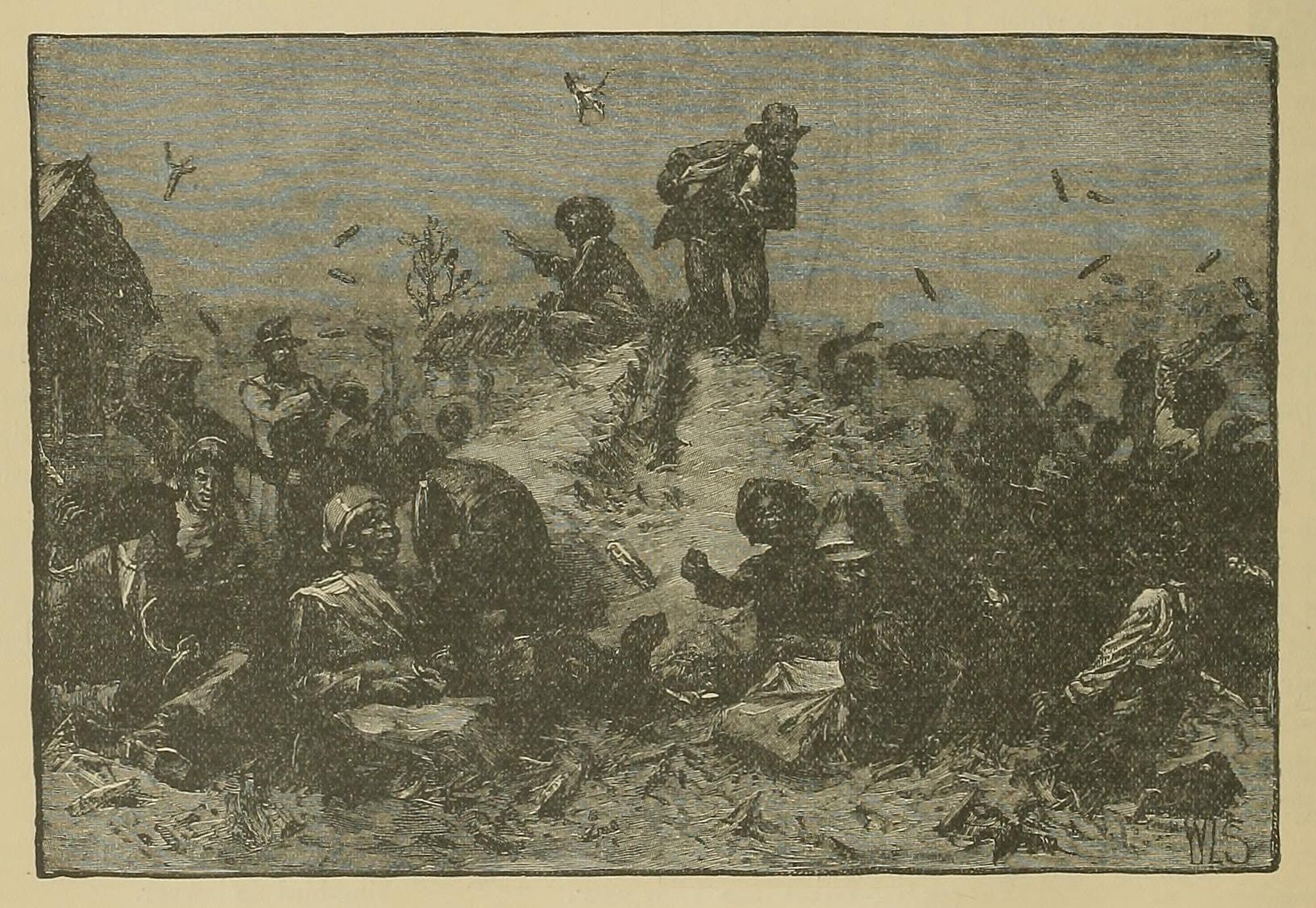
CORN-SHUCKING IN SOUTH CAROLINA.
EDGAR ALLEN POE.
THE WEIRD AND MYSTERIOUS GENIUS.
DGAR Allen Poe, the author of “The Raven,” “Annabel Lee,” “The Haunted Palace,” “To One in Paradise,” “Israfel” and “Lenore,” was in his peculiar sphere, the most brilliant writer, perhaps, who ever lived. His writings, however, belong to a different world of thought from that in which Bryant, Longfellow, Emerson, Whittier and Lowell lived and labored. Theirs was the realm of nature, of light, of human joy, of happiness, ease, hope and cheer. Poe spoke from the dungeon of depression. He was in a constant struggle with poverty. His whole life was a tragedy in which sombre shades played an unceasing role, and yet from out these weird depths came forth things so beautiful that their very sadness is charming and holds us in a spell of bewitching enchantment. Edgar Fawcett says of him:—

“He loved all shadowy spots, all seasons drear;
All ways of darkness lured his ghastly whim;
Strange fellowships he held with goblins grim,
At whose demoniac eyes he felt no fear.
By desolate paths of dream where fancy’s owl
Sent long lugubrious hoots through sombre air,
Amid thought’s gloomiest caves he went to prowl
And met delirium in her awful lair.”
Edgar Poe was born in Boston February 19th, 1809. His father was a Marylander, as was also his grandfather, who was a distinguished Revolutionary soldier and a friend of General Lafayette. The parents of Poe were both actors who toured the country in the ordinary manner, and this perhaps accounts for his birth in Boston. Their home was in Baltimore, Maryland.
When Poe was only a few years old both parents died, within two weeks, in Richmond, Virginia. Their three children, two daughters, one older and one younger than the subject of this sketch, were all adopted by friends of the family. Mr. John Allen, a rich tobacco merchant of Richmond, Virginia, adopted Edgar (who was henceforth called Edgar Allen Poe), and had him carefully educated, first in England, afterwards at the Richmond Academy and the University of Virginia, and subsequently at West Point. He always distinguished himself in his studies, but from West Point he was dismissed after one year, it is said because he refused to submit to the discipline of the institution.
In common with the custom in the University of Virginia at that time, Poe acquired the habits of drinking and gambling, and the gambling debts which he contracted incensed Mr. Allen, who refused to pay them. This brought on the beginning of a series of quarrels which finally led to Poe’s disinheritance and permanent separation from his benefactor. Thus turned out upon the cold, unsympathetic world, without business training, without friends, without money, knowing not how to make money—yet, with a proud, imperious, aristocratic nature,—we have the beginning of the saddest story of any life in literature—struggling for nearly twenty years in gloom and poverty, with here and there a ray of sunshine, and closing with delirium tremens in Baltimore, October 7th, 1849, at forty years of age.
To those who know the full details of the sad story of Poe’s life it is little wonder that his sensitive, passionate nature sought surcease from disappointment in the nepenthe of the intoxicating cup. It was but natural for a man of his nervous temperament and delicacy of feeling to fall into that melancholy moroseness which would chide even the angels for taking away his beautiful “Annabel Lee;” or that he should wail over the “Lost Lenore,” or declare that his soul should “nevermore” be lifted from the shadow of the “Raven” upon the floor. These poems and others are but the expressions of disappointment and despair of a soul alienated from happy human relations. While we admire their power and beauty, we should remember at what cost of pain and suffering and disappointment they were produced. They are powerful illustrations of the prodigal expense of human strength, of broken hopes and bitter experiences through which rare specimens of our literature are often grown.
To treat the life of Edgar Allen Poe, with its lessons, fully, would require the scope of a volume. Both as a man and an author there is a sad fascination which belongs to no other writer, perhaps, in the world. His personal character has been represented as pronouncedly double. It is said that Stevenson, who was a great admirer of Poe, received the inspiration for his novel, “Dr. Jekyll and Mr. Hyde” from the contemplation of his double character. Paul Hamilton Hayne has also written a poem entitled, “Poe,” which presents in a double shape the angel and demon in one body. The first two stanzas of which we quote:—
“Two mighty spirits dwelt in him:
One, a wild demon, weird and dim,
The darkness of whose ebon wings
Did shroud unutterable things:
One, a fair angel, in the skies
Of whose serene, unshadowed eyes
Were seen the lights of Paradise.
To these, in turn, he gave the whole
Vast empire of his brooding soul;
Now, filled with strains of heavenly swell,
Now thrilled with awful tones of hell:
Wide were his being’s strange extremes,
’Twixt nether glooms, and Eden gleams
Of tender, or majestic dreams.”
It must be said in justice to Poe’s memory, however, that the above idea of his being both demon and angel became prevalent through the first biography published of him, by Dr. Rufus Griswold, who no doubt sought to avenge himself on the dead poet for the severe but unanswerable criticisms which the latter had passed upon his and other contemporaneous authors’ writings. Later biographies, notably those of J. H. Ingram and Mrs. Sarah Ellen Whitman, as well as published statements from his business associates, have disproved many of Griswold’s damaging statements, and placed the private character of Poe in a far more favorable light before the world. He left off gambling in his youth, and the appetite for drink, which followed him to the close of his life, was no doubt inherited from his father who, before him, was a drunkard.
It is natural for admirers of Poe’s genius to contemplate with regret akin to sorrow those circumstances and characteristics which made him so unhappy, and yet the serious question arises, was not that character and his unhappy life necessary to the productions of his marvelous pen? Let us suppose it was, and in charity draw the mantle of forgetfulness over his misguided ways, covering the sad picture of his personal life from view, and hang in its place the matchless portrait of his splendid genius, before which, with true American pride, we may summon all the world to stand with uncovered heads.
As a writer of short stories Poe had no equal in America. He is said to have been the originator of the modern detective story. The artful ingenuity with which he works up the details of his plot, and minute attention to the smallest illustrative particular, give his tales a vivid interest from which no reader can escape. His skill in analysis is as marked as his power of word painting. The scenes of gloom and terror which he loves to depict, the forms of horror to which he gives almost actual life, render his mastery over the reader most exciting and absorbing.
As a poet Poe ranks among the most original in the world. He is pre-eminently a poet of the imagination. It is useless to seek in his verses for philosophy or preaching. He brings into his poetry all the weirdness, subtlety, artistic detail and facility in coloring which give the charm to his prose stories, and to these he adds a musical flow of language which has never been equalled. To him poetry was music, and there was no poetry that was not musical. For poetic harmony he has had no equal certainly in America, if, indeed, in the world. Admirers of his poems are almost sure to read them over and over again, each time finding new forms of beauty or charm in them, and the reader abandons himself to a current of melodious fancy that soothes and charms like distant music at night, or the rippling of a nearby, but unseen, brook. The images which he creates are vague and illusive. As one of his biographers has written, “He heard in his dreams the tinkling footfalls of angels and seraphim and subordinated everything in his verse to the delicious effect of musical sound.” As a literary critic Poe’s capacities were of the greatest. “In that large part of the critic’s perceptions,” says Duyckinck, “in knowledge of the mechanism of composition, he has been unsurpassed by any writer in America.”
Poe was also a fine reader and elocutionist. A writer who attended a lecture by him in Richmond says: “I never heard a voice so musical as his. It was full of the sweetest melody. No one who heard his recitation of the ‘Raven’ will ever forget the beauty and pathos with which this recitation was rendered. The audience was still as death, and as his weird, musical voice filled the hall its effect was simply indescribable. It seems to me that I can yet hear that long, plaintive ‘nevermore.’”
Among the labors of Poe, aside from his published volumes and contributions to miscellaneous magazines, should be mentioned his various positions from 1834 to 1848 as critic and editor on the “Literary Messenger” of Richmond, Virginia, the “Gentleman’s Magazine” of Philadelphia, “Graham’s Magazine” of Philadelphia, the “Evening Mirror” of New York, and the “Broadway Journal” of New York, which positions he successively held. The last he gave up in 1848 with the idea of starting a literary magazine of his own, but the project failed, perhaps on account of his death, which occurred the next year. His first volume of poems was published in 1829. In 1833 he won two prizes, one for prose and one for poetic composition, offered by the Baltimore “Saturday Visitor,” his “Manuscript Found in a Bottle” being awarded the prize for prose and the poem “The Coliseum” for poetry. The latter, however, he did not ♦receive because the judges found the same author had won them both. In 1838 Harper Brothers published his ingenious fiction, “The Narrative of Arthur Gordon Pym of Nantucket.” In 1840 “Tales of the Grotesque and Arabesque” were issued in Philadelphia. In 1844 he took up his residence at Fordham, New York, where his wife died in 1847, and where he continued to reside for the balance of his life. His famous poem the “Raven” was published in 1845, and during 1848 and 1849 he published “Eureka” and “Elalume,” the former being a prose poem. It is the crowning work of his life, to which he devoted the last and most matured energies of his wonderful intellect. To those who desire a further insight into the character of the man and his labors we would recommend the reading of J. H. Ingram’s “Memoir” and Mrs. Sarah Ellen Whitman’s “Edgar Poe and His Critics,” the latter published in 1863.

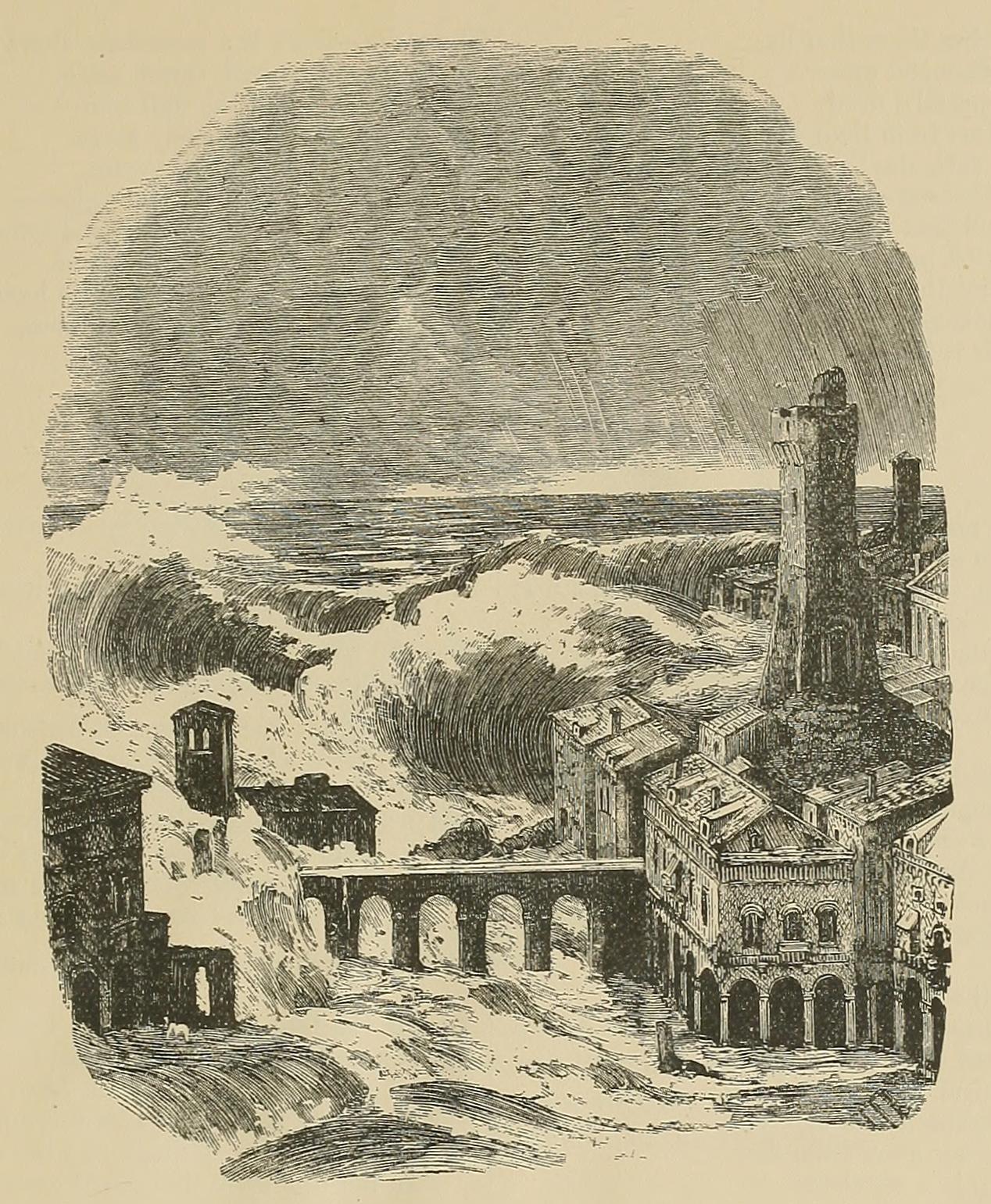
THE CITY IN THE SEA.
THE CITY IN THE SEA.
O! Death has rear’d himself a throne
In a strange city lying alone
Far down within the dim west,
Where the good and the bad and the worst and the best
Have gone to their eternal rest.
There shrines, and palaces, and towers,
(Time-eaten towers that tremble not!)
Resemble nothing that is ours.
Around, by lifting winds forgot,
Resignedly beneath the sky
The melancholy waters lie.
No rays from the holy heaven come down
On the long night-time of that town;
But light from out the lurid sea
Streams up the turrets silently—
Gleams up the pinnacles far and free—
Up domes—up spires—up kingly halls—
Up fanes—up Babylon-like walls—
Up shadowy, long-forgotten bowers
Of sculptured ivy and stone flowers—
Up many and many a marvellous shrine
Whose wreathed friezes intertwine
The viol, the violet, and the vine.
Resignedly beneath the sky
The melancholy waters lie.
So blend the turrets and shadows there
That all seem pendulous in air,
While from a proud tower in the town
Death looks gigantically down.
There open fanes and gaping graves
Yawn level with the luminous waves;
But not the riches there that lie
In each idol’s diamond eye—
Not the gayly-jewell’d dead
Tempt the waters from their bed;
For no ripples curl, alas!
Along that wilderness of glass—
No swellings tell that winds may be
Upon some far-off happier sea—
No heavings hint that winds have been
On seas less hideously serene.
But lo, a stir is in the air!
The wave—there is a movement there!
As if the towers had thrust aside,
In slightly sinking, the dull tide—
As if their tops had feebly given
A void within the filmy heaven.
The waves have now a redder glow—
The hours are breathing faint and low—
And when, amid no earthly moans,
Down, down that town shall settle hence,
Hell, rising from a thousand thrones,
Shall do it reverence.
ANNABEL LEE.
T was many and many a year ago,
In a kingdom by the sea,
That a maiden there lived whom you may know
By the name of Annabel Lee;
And this maiden she lived with no other thought
Than to love and be loved by me.
I was a child and she was a child,
In this kingdom by the sea;
But we loved with a love that was more than love—
I and my Annabel Lee—
With a love that the winged seraphs of heaven
Coveted her and me.
And this was the reason that, long ago,
In this kingdom by the sea,
A wind blew out of a cloud, chilling
My beautiful Annabel Lee;
So that her highborn kinsman came
And bore her away from me,
To shut her up in a sepulchre,
In this kingdom by the sea.
The angels, not half so happy in heaven,
Went envying her and me—
Yes!—that was the reason (as all men know,
In this kingdom by the sea),
That the wind came out of the cloud by night,
Chilling and killing my Annabel Lee.
But our love it was stronger by far than the love
Of those who were older than we—
Of many far wiser than we—
And neither the angels in heaven above,
Nor the demons down under the sea,
Can ever dissever my soul from the soul
Of the beautiful Annabel Lee:
For the moon never beams, without bringing me dreams
Of the beautiful Annabel Lee;
And the stars never rise, but I feel the bright eyes
Of the beautiful Annabel Lee:
And so, all the night-tide, I lie down by the side
Of my darling—my darling—my life and my bride,
In her sepulchre there by the sea—
In her tomb by the sounding sea.
TO HELEN.
The following poem was published first “To ――,” afterwards the title was changed, “To Helen.” It seems to have been written by Poe to Mrs. Sarah Ellen Whitman whom many years afterwards he was engaged to marry. The engagement was, however, broken off. The poem was no doubt written before his acquaintance with the lady; even before his marriage or engagement to his wife, and at a time perhaps when he did not expect to be recognized as a suitor by the unknown woman who had completely captured his heart, in the chance meeting which he here so beautifully describes.
SAW thee once—once only—years ago:
I must not say how many—but not many.
It was a July midnight; and from out
A full-orbed moon that, like thine own soul, soaring,
Sought a precipitant pathway up through heaven,
There fell a silvery-silken veil of light,
With quietude, and sultriness, and slumber,
Upon the upturned faces of a thousand
Roses that grew in an enchanted garden,
Where no wind dared to stir, unless on tiptoe—
Fell on the upturned faces of these roses
That gave out, in return for the love-light,
Their odorous souls in an ecstatic death—
Fell on the upturned faces of these roses
That smiled and died in this parterre, enchanted
By thee and by the poetry of thy presence.
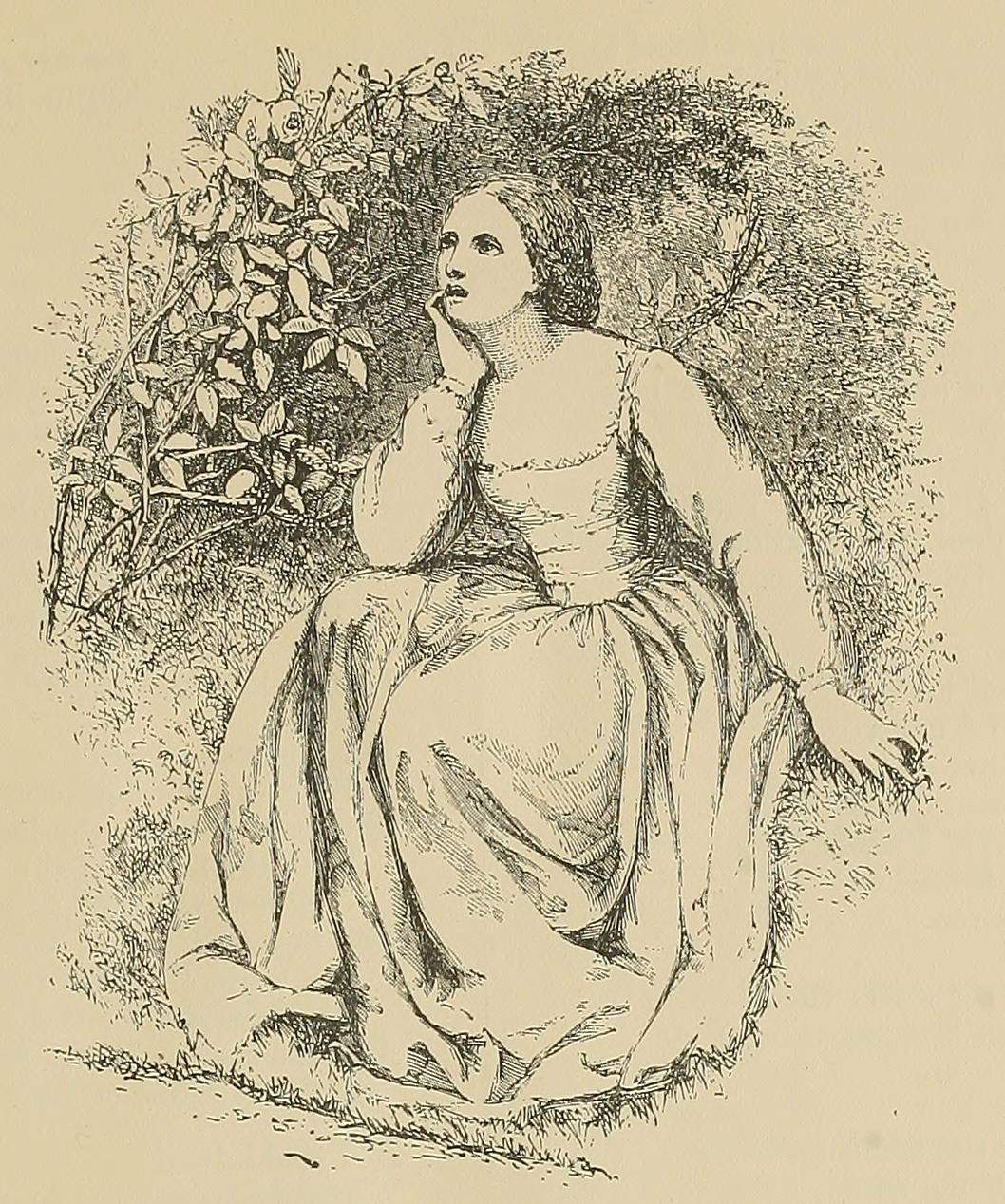
CLAD ALL IN WHITE, UPON A VIOLET BANK
I SAW THEE HALF RECLINING; WHILE THE MOON
FELL ON THE UPTURNED FACES OF THE ROSES,
AND ON THINE OWN, UPTURNED—ALAS! IN SORROW.
Was it not Fate that, on this July midnight—
Was it not Fate (whose name is also Sorrow)
That bade me pause before that garden-gate
To breathe the incense of those slumbering roses?
No footstep stirred: the hated world all slept,
Save only thee and me. I paused—I looked—
And in an instant all things disappeared.
(Ah, bear in mind this garden was enchanted!)
The pearly lustre of the moon went out:
The mossy banks and the meandering paths,
The happy flowers and the repining trees,
Were seen no more: the very roses’ odors
Died in the arms of the adoring airs.
All, all expired save thee—save less than thou:
Save only the divine light in thine eyes—
Save but the soul in thine uplifted eyes.
I saw but them—they were the world to me.
I saw but them—saw only them for hours—
Saw only them until the moon went down.
What wild heart-histories seemed to lie enwritten
Upon those crystalline, celestial spheres!
How dark a wo, yet how sublime a hope!
How silently serene a sea of pride!
How daring an ambition! yet how deep—
How fathomless a capacity for love!
But now, at length, dear Dian sank from sight
Into a western couch of thunder-cloud,
And thou, a ghost, amid the entombing trees
Didst glide away. Only thine eyes remained.
They would not go—they never yet have gone.
Lighting my lonely pathway home that night,
They have not left me (as my hopes have) since.
They follow me, they lead me through the years;
They are my ministers—yet I their slave.
Their office is to illumine and enkindle—
My duty, to be saved by their bright light,
And purified in their electric fire—
And sanctified in their elysian fire.
They fill my soul with beauty (which is hope),
And are far up in heaven, the stars I kneel to
In the sad, silent watches of my night;
While even in the meridian glare of day
I see them still—two sweetly scintillant
Venuses, unextinguished by the sun!
ISRAFEL.¹
N heaven a spirit doth dwell
“Whose heart-strings are a lute;”
None sing so wildly well
As the angel Israfel,
And the giddy stars (so legends tell)
Ceasing their hymns, attend the spell
Of his voice, all mute.
Tottering above
In her highest noon,
The enamour’d moon
Blushes with love,
While, to listen, the red levin
(With the rapid Pleiads, even,
Which were seven)
Pauses in heaven.
And they say (the starry choir
And the other listening things)
That Israfeli’s fire
Is owing to that lyre
By which he sits and sings—
The trembling living wire
Of those unusual strings.
But the skies that angel trod,
Where deep thoughts are a duty—
Where Love’s a grown-up god—
Where the Houri glances are
Imbued with all the beauty
Which we worship in a star.
Therefore, thou art not wrong,
Israfeli, who despisest
An unimpassion’d song;
To thee the laurels belong,
Best bard, because the wisest!
Merrily live, and long!
The ecstasies above
With thy burning measures suit—
Thy grief, thy joy, thy hate, thy love,
With the fervor of thy lute—
Well may the stars be mute!
Yes, heaven is thine; but this
Is a world of sweets and sours;
Our flowers are merely—flowers,
And the shadow of thy perfect bliss
Is the sunshine of ours.
If I could dwell
Where Israfel
Hath dwelt, and he where I,
He might not sing so wildly well
A mortal melody,
While a bolder note than this might swell
From my lyre within the sky.
TO ONE IN PARADISE.
HOU wast all that to me, love,
For which my soul did pine—
A green isle in the sea, love,
A fountain and a shrine,
All wreath’d with fairy fruits and flowers,
And all the flowers were mine.
Ah, dream too bright to last!
Ah, starry Hope! that didst arise
But to be overcast!
A voice from out the Future cries,
“On! on!”—but o’er the Past
(Dim gulf!) my spirit hovering lies
Mute, motionless, aghast!
For, alas! alas! with me
The light of life is o’er!
No more—no more—no more—
(Such language holds the solemn sea
To the sands upon the shore)
Shall bloom the thunder-blasted tree,
Or the stricken eagle soar!
And all my days are trances,
And all my nightly dreams
Are where thy dark eye glances,
And where thy footstep gleams—
In what ethereal dances,
By what eternal streams.
LENORE.
Mrs. Whitman, in her reminiscences of Poe, tells us the following incident which gave rise to the writing of these touching lines. While Poe was in the Academy at Richmond, Virginia,—as yet a boy of about sixteen years,—he was invited by a friend to visit his home. The mother of this friend was a singularly beautiful and withal a most kindly and sympathetic woman. Having learned that Poe was an orphan she greeted him with the motherly tenderness and affection shown toward her own son. The boy was so overcome that it is said he stood for a ♦minute unable to speak and finally with tears he declared he had never before known his loss in the love of a true and devoted mother. From that time forward he was frequently a visitor, and the attachment between him and this kind-hearted woman continued to grow. On Poe’s return from Europe when he was about twenty years of age, he learned that she had died a few days before his arrival, and was so overcome with grief that he went nightly to her grave, even when it was dark and rainy, spending hours in fancied communion with her spirit. Later he idealized in his musings the embodiment of such a spirit in a young and beautiful woman, whom he made his lover and whose untimely death he imagined and used as the inspiration of this poem.
H, broken is the golden bowl,
The spirit flown forever!
Let the bell toll!
A saintly soul
Floats on the Stygian river;
And, Guy de Vere,
Hast thou no tear?
Weep now or never more!
See, on yon drear
And rigid bier
Low lies thy love, Lenore!
Come, let the burial-rite be read—
The funeral-song be sung!—
An anthem for the queenliest dead
That ever died so young—
A dirge for her the doubly dead,
In that she died so young!
“Wretches! ye loved her for her wealth,
And hated her for her pride;
And when she fell in feeble health,
Ye bless’d her—that she died!
How shall the ritual, then, be read?
The requiem how be sung
By you—by yours, the evil eye—
By yours the slanderous tongue
That did to death the innocence
That died, and died so young?”
Peccavimus;
But rave not thus!
And let a sabbath song
Go up to God so solemnly, the dead may feel no wrong!
The sweet Lenore
Hath “gone before,”
With Hope, that flew beside,
Leaving thee wild
For the dear child
That should have been thy bride—
For her, the fair
And debonair,
That now so lowly lies,
The life upon her yellow hair
But not within her eyes—
The life still there,
Upon her hair—
The death upon her eyes.
“Avaunt! to-night
My heart is light.
No dirge will I upraise,
But waft the angel on her flight
With a pæan of old days!
Let no bell toll!—
Lest her sweet soul,
Amid its hallow’d mirth,
Should catch the note,
As it doth float—
Up from the damned earth.
To friends above, from fiends below,
The indignant ghost is riven—
From hell unto a high estate
Far up within the heaven—
From grief and groan,
To a golden throne,
Beside the King of Heaven.”
THE BELLS.
This selection is a favorite with reciters. It is an excellent piece for voice culture. The musical flow of the metre and happy selection of the words make it possible for the skilled speaker to closely imitate the sounds of the ringing bells.
EAR the sledges with the bells—
Silver bells!
What a world of merriment their melody foretells!
How they tinkle, tinkle, tinkle,
In the icy air of night!
While the stars that oversprinkle
All the heavens, seem to twinkle
With a crystalline delight;
Keeping time, time, time,
In a sort of Runic rhyme,
To the tintinnabulation that so musically wells
From the bells, bells, bells, bells,
Bells, bells, bells—
From the jingling and the tinkling of the bells.
Hear the mellow wedding bells—
Golden bells!
What a world of happiness their harmony foretells!
Through the balmy air of night
How they ring out their delight!
From the molten-golden notes,
And all in tune,
What a liquid ditty floats
To the turtle-dove that listens, while she gloats
On the moon!
Oh, from out the sounding cells,
What a gush of euphony voluminously wells!
How it swells!
How it dwells.
On the future! how it tells
Of the rapture that impels
To the swinging and the ringing
Of the bells, bells, bells,—
Of the bells, bells, bells, bells,
Bells, bells, bells—
To the rhyming and the chiming of the bells!
Hear the loud alarum bells—
Brazen bells!
What a tale of terror, now, their turbulency tells
In the startled ear of night
How they scream out their affright!
Too much horrified to speak,
They can only shriek, shriek,
Out of tune,
In a clamorous appealing to the mercy of the fire,
In a mad expostulation with the deaf and frantic fire
Leaping higher, higher, higher,
With a desperate desire,
And a resolute endeavor,
Now—now to sit or never,
By the side of the pale-faced moon.
Oh, the bells, bells, bells!
What a tale their terror tells
Of despair!
How they clang, and clash, and roar!
What a horror they outpour
On the bosom of the palpitating air!
Yet the ear it fully knows,
By the twanging,
And the clanging,
How the danger ebbs and flows;
Yet the ear distinctly tells,
In the jangling
And the wrangling,
How the danger sinks and swells,
By the sinking or the swelling in the anger of the bells—
Of the bells—
Of the bells, bells, bells, bells,
Bells, bells, bells—
In the clamor and the clangor of the bells!
Hear the tolling of the bells—
Iron bells!
What a world of solemn thought their monody compels!
In the silence of the night,
How we shiver with affright,
At the melancholy menace of their tone!
For every sound that floats
From the rust within their throats
Is a groan.
And the people—ah, the people—
They that dwell up in the steeple,
All alone,
And who tolling, tolling, tolling,
In that muffled monotone,
Feel a glory in so rolling
On the human heart a stone—
They are neither man nor woman—
They are neither brute nor human—
They are ghouls:
And their king it is who tolls;
And he rolls, rolls, rolls, rolls,
A pæan from the bells!
And his merry bosom swells
With the pæan of the bells!
And he dances and he yells;
Keeping time, time, time,
In a sort of Runic rhyme,
To the pæan of the bells—
Of the bells;
Keeping time, time, time,
In a sort of Runic rhyme,
To the throbbing of the bells—
Of the bells, bells, bells,
To the sobbing of the bells;
Keeping time, time, time.
As he knells, knells, knells,
In a happy Runic rhyme,
To the rolling of the bells,—
Of the bells, bells, bells,—
To the tolling of the bells,
Of the bells, bells, bells, bells,—
Bells, bells, bells,—
To the moaning and the groaning of the bells.
THE RAVEN.
This poem is generally allowed to be one of the most remarkable examples of a harmony of sentiment with rhythmical expression to be found in any language. While the poet sits musing in his study, endeavoring to win from books “surcease of sorrow for the lost Lenore,” a raven—the symbol of despair—enters the room and perches upon a bust of Pallas. A colloquy follows between the poet and the bird of ill omen with its haunting croak of “Nevermore.”
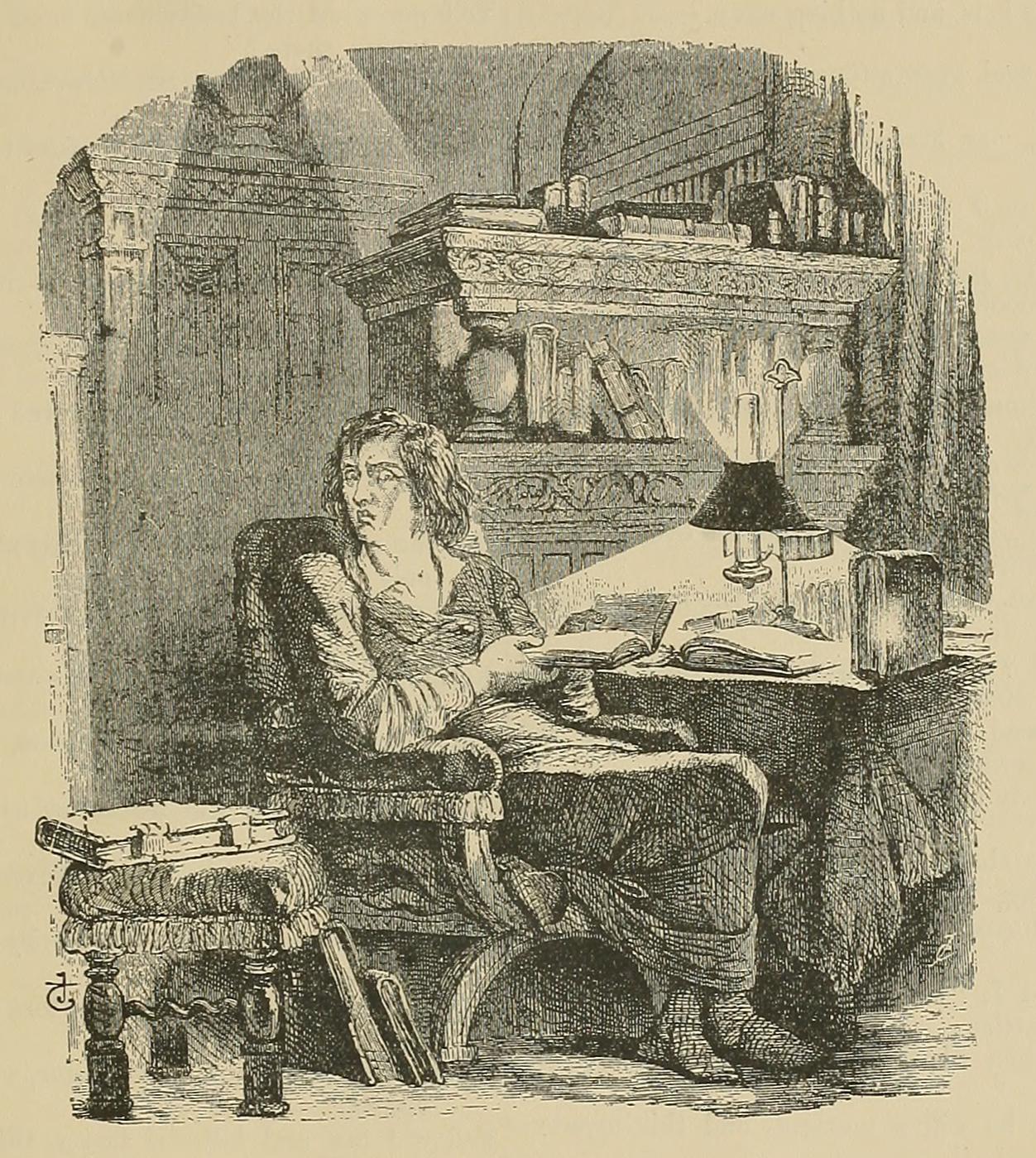
THE RAVEN.
NCE upon a midnight dreary, while I pondered, weak and weary,
Over many a quaint and curious volume of ♦forgotten lore,—
While I nodded, nearly napping, suddenly there came a tapping,
As of some one gently rapping, rapping at my chamber-door.
“’Tis some visitor,” I mutter’d, “tapping at my chamber-door—
Only this and nothing more.”
Ah, distinctly I remember, it was in the bleak December,
And each separate dying ember wrought its ghost upon the floor.
Eagerly I wished the morrow; vainly I had sought to borrow
From my books surcease of sorrow—sorrow for the lost Lenore,—
For the rare and ♣radiant maiden whom the angels name Lenore,—
Nameless here forevermore.
And the silken, sad, uncertain rustling of each purple curtain,
Thrilled me,—filled me with fantastic terrors never felt before;
So that now, to still the beating of my heart, I stood repeating,
“’Tis some visitor entreating entrance at my chamber-door,—
Some late visitor entreating entrance at my chamber-door;
That it is, and nothing more.”
Presently my soul grew stronger: hesitating then no longer,
“Sir,” said I, “or Madam, truly your forgiveness I implore;
But the fact is, I was napping, and so gently you came rapping,
And so faintly you came tapping, tapping at my chamber-door,
That I scarce was sure I heard you”—here I opened wide the door:
Darkness there, and nothing more.
Deep into that darkness peering, long I stood there, wondering, fearing,
Doubting, dreaming dreams no mortals ever dared to dream before;
But the silence was unbroken, and the stillness gave no token,
And the only word there spoken was the whispered word, “Lenore!”
This I whispered, and an echo murmured back the word, “Lenore!”
Merely this, and nothing more.
Back into the chamber turning, all my soul within me burning,
Soon again I heard a tapping, something louder than before.
“Surely,” said I, “surely that is something at my window-lattice;
Let me see then what thereat is and this mystery explore,—
Let my heart be still a moment, and this mystery explore;—
’Tis the wind, and nothing more.”
Open here I flung the shutter, when, with many a flirt and flutter,
In there stepped a stately raven of the saintly days of yore.
Not the least obeisance made he; not a minute stopped or stayed he;
But, with mien of lord or lady, perched above my chamber-door,—
Perched upon a bust of Pallas, just above my chamber-door—
Perched, and sat, and nothing more.
Then this ebon bird beguiling my sad fancy into smiling,
By the grave and stern decorum of the countenance it wore,
“Though thy crest be shorn and shaven, thou,” I said, “art sure no craven;
Ghastly, grim, and ancient raven, wandering from the nightly shore,
Tell me what thy lordly name is on the night’s Plutonian shore?”
Quoth the raven, “Nevermore!”
Much I marveled this ungainly fowl to hear discourse so plainly,
Though its answer little meaning, little relevancy bore;
For we cannot help agreeing that no living human being
Ever yet was blessed with seeing bird above his chamber-door,
Bird or beast upon the sculptured bust above his chamber-door
With such name as “Nevermore!”
But the raven, sitting lonely on that placid bust, spoke only
That one word, as if his soul in that one word he did outpour.
Nothing further then he uttered; not a feather then he fluttered—
Till I scarcely more than muttered, “Other friends have flown before,
On the morrow he will leave me, as my hopes have flown before.”
Then the bird said, “Nevermore!”
Startled at the stillness broken by reply so aptly spoken,
“Doubtless,” said I, “what it utters is its only stock and store,
Caught from some unhappy master, whom unmerciful disaster
Follow’d fast and follow’d faster, till his songs one burden bore,
Till the dirges of his hope that melancholy burden bore,
Of—‘Never—nevermore!’”
But the raven still beguiling all my sad soul into smiling,
Straight I wheeled a cushioned seat in front of bird and bust and door,
Then, upon the velvet sinking, I betook myself to linking
Fancy unto fancy, thinking what this ominous bird of yore—
What this grim, ungainly, ghastly, gaunt, and ominous bird of yore
Meant in croaking “Nevermore!”
This I sat engaged in guessing, but no syllable expressing
To the fowl whose fiery eyes now burned into my bosom’s core;
This and more I sat divining, with my head at ease reclining
On the cushion’s velvet lining that the lamp-light gloated o’er,
But whose velvet violet lining with the lamp-light gloating o’er
She shall press—ah! nevermore!
Then methought the air grew denser, perfumed from an unseen censer
Swung by seraphim, whose foot-falls tinkled on the tufted floor,
“Wretch,” I cried, “thy God hath lent thee,—by these angels he hath sent thee
Respite—respite and nepenthe from thy memories of Lenore!
Quaff, oh, quaff this kind nepenthe, and forget the lost Lenore!”
Quoth the raven, “Nevermore!”
“Prophet!” cried I, “thing of evil!—prophet still, if bird or devil!
Whether tempter sent, or whether tempest tossed thee here ashore,
Desolate, yet all undaunted, on this desert land enchanted—
On this home by horror haunted—tell me truly, I implore,—
Is there—is there balm in Gilead?—tell me—tell me, I implore!”
Quoth the raven, “Nevermore!”
“Prophet!” cried I, “thing of evil!—prophet still, if bird or devil!
By that heaven that bends above us, by that God we both adore,
Tell this soul, with sorrow laden, if within the distant Aidenn,
It shall clasp a sainted maiden, whom the angels name Lenore;
Clasp a rare and radiant maiden, whom the angels name Lenore!”
Quoth the raven, “Nevermore!”
“Be that word our sign of parting, bird or fiend!” I shrieked, upstarting,—
“Get thee back into the tempest and the night’s Plutonian shore!
Leave no black plume as a token of that lie thy soul hath spoken!
Leave my loneliness unbroken!—quit the bust above my door!
Take thy beak from out my heart, and take thy form from off my door!”
Quoth the raven, “Nevermore!”
And the raven, never flitting, still is sitting, still is sitting
On the pallid bust of Pallas, just above my chamber-door;
And his eyes have all the seeming of a demon’s that is dreaming,
And the lamp-light o’er him streaming throws his shadow on the floor;
And my soul from out that shadow that lies floating on the floor
Shall be lifted—nevermore!


HENRY WADSWORTH LONGFELLOW.
THE POET OF THE PEOPLE.
“He who sung to one clear harp in divers tones.”
N an old square wooden house upon the edge of the sea” the most famous and most widely read of all American poets was born in Portland, Maine, February 7th, 1807.
In his personality, his wide range of themes, his learning and his wonderful power of telling stories in song, Henry Wadsworth Longfellow stood in his day and still stands easily in front of all other poets who have enriched American literature. Admitting that he was not rugged and elemental like Bryant and did not possess the latter’s feelings for the colossal features of wild scenery, that he was not profoundly thoughtful and transcendental like Emerson, that he was not so earnestly and passionately sympathetic as Whittier, nevertheless he was our first artist in poetry. Bryant, Emerson and Whittier commanded but a few stops of the grand instrument upon which they played; Longfellow understood perfectly all its capabilities. Critics also say that “he had not the high ideality or dramatic power of Tennyson or Browning.” But does he not hold something else which to the world at large is perhaps more valuable? Certainly these two great poets are inferior to him in the power to sweep the chords of daily human experiences and call forth the sweetness and beauty in common-place every day human life. It is on these themes that he tuned his harp without ever a false tone, and sang with a harmony so well nigh perfect that the universal heart responded to his music. This common-place song has found a lodgement in every household in America, “swaying the hearts of men and women whose sorrows have been soothed and whose lives raised by his gentle verse.”
“Such songs have power to quiet
The restless pulse of care,
And come like the benediction
That follows after prayer.”
Longfellow’s life from the very beginning moved on even lines. Both he and William Cullen Bryant were descendants of John Alden, whom Longfellow has made famous in “The Courtship of Miles Standish.” The Longfellows were a family in comfortable circumstances, peaceful and honest, for many generations back. The poet went to school with Nathaniel P. Willis and other boys who at an early age were thinking more of verse making than of pleasure. He graduated at Bowdoin College in 1825 with Nathaniel Hawthorne, John S. C. Abbott, and others who afterwards attained to fame. Almost immediately after his graduation he was requested to take the chair of Modern Languages and Literature in his alma mater, which he accepted; but before entering upon his duties spent three years in Germany, France, Spain and Italy to further perfect himself in the languages and literature of those nations. At Bowdoin College Longfellow remained as Professor of Modern Languages and Literature until 1835, when he accepted a similar position in Harvard University, which he continued to occupy until 1854, when he resigned, devoting the remainder of his life to literary work and to the enjoyment of the association of such friends as Charles Sumner the statesman, Hawthorne the romancer, Louis Agassiz the great naturalist, and James Russell Lowell, the brother poet who succeeded to the chair of Longfellow in Harvard University on the latter’s resignation.
The home of Longfellow was not only a delightful place to visit on account of the cordial welcome extended by the companionable poet, but for its historic associations as well; for it was none other than the old “Cragie House” which had been Washington’s headquarters during the Revolutionary War, the past tradition and recent hospitality of which have been well told by G. W. Curtis in his “Homes of American Authors.” It was here that Longfellow surrounded himself with a magnificent library, and within these walls he composed all of his famous productions from 1839 until his death, which occurred there in 1882 at the age of seventy-five. The poet was twice married and was one of the most domestic of men. His first wife died suddenly in Europe during their sojourn in that country while Longfellow was pursuing his post graduate course of study before taking the chair in Bowdoin College. In 1843 he married Miss Frances Appleton, whom he had met in Europe and who figures in the pages of his romance “Hyperion.” In 1861 she met a most tragic death by stepping on a match which set fire to her clothing, causing injuries from which she died. She was buried on the 19th anniversary of their marriage. By Longfellow’s own direction she was crowned with a wreath of orange blossoms commemorative of the day. The poet was so stricken with grief that for a year afterwards he did practically no work, and it is said neither in conversation nor in writing to his most intimate friends could he bear to refer to the sad event.
Longfellow was one of the most bookish men in our literature. His knowledge of others’ thoughts and writings was so great that he became, instead of a creator in his poems, a painter of things already created. It is said that he never even owned a style of his own like Bryant and Poe, but assimilated what he saw or heard or read from books, reclothing it and sending it out again. This does not intimate that he was a plagiarist, but that he wrote out of the accumulated knowledge of others. “Evangeline,” for instance, was given him by Hawthorne, who had heard of the young people of Acadia and kept them in mind, intending to weave them into a romance. The forcible deportation of 18,000 French people touched Hawthorne as it perhaps never could have touched Longfellow except in literature, and also as it certainly never would have touched the world had not Longfellow woven the woof of the story in the threads of his song.
“Evangeline” was brought out the same year with Tennyson’s “Princess” (1847), and divided honors with the latter even in England. In this poem, and in “The Courtship of Miles Standish” and other poems, the pictures of the new world are brought out with charming simplicity. Though Longfellow never visited Acadia or Louisiana, it is the real French village of Grand Pré and the real Louisiana, not a poetic dream that are described in this poem. So vivid were his descriptions that artists in Europe painted the scenes true to nature and vied with each other in painting the portrait of Evangeline, among several of which there is said to be so striking a resemblance as to suggest the idea that one had served as a copy for the others. The poem took such a hold upon the public, that both the poor man and the rich knew Longfellow as they knew not Tennyson their own poet. It was doubtless because he, though one of the most scholarly of men, always spoke so the plainest reader could understand.
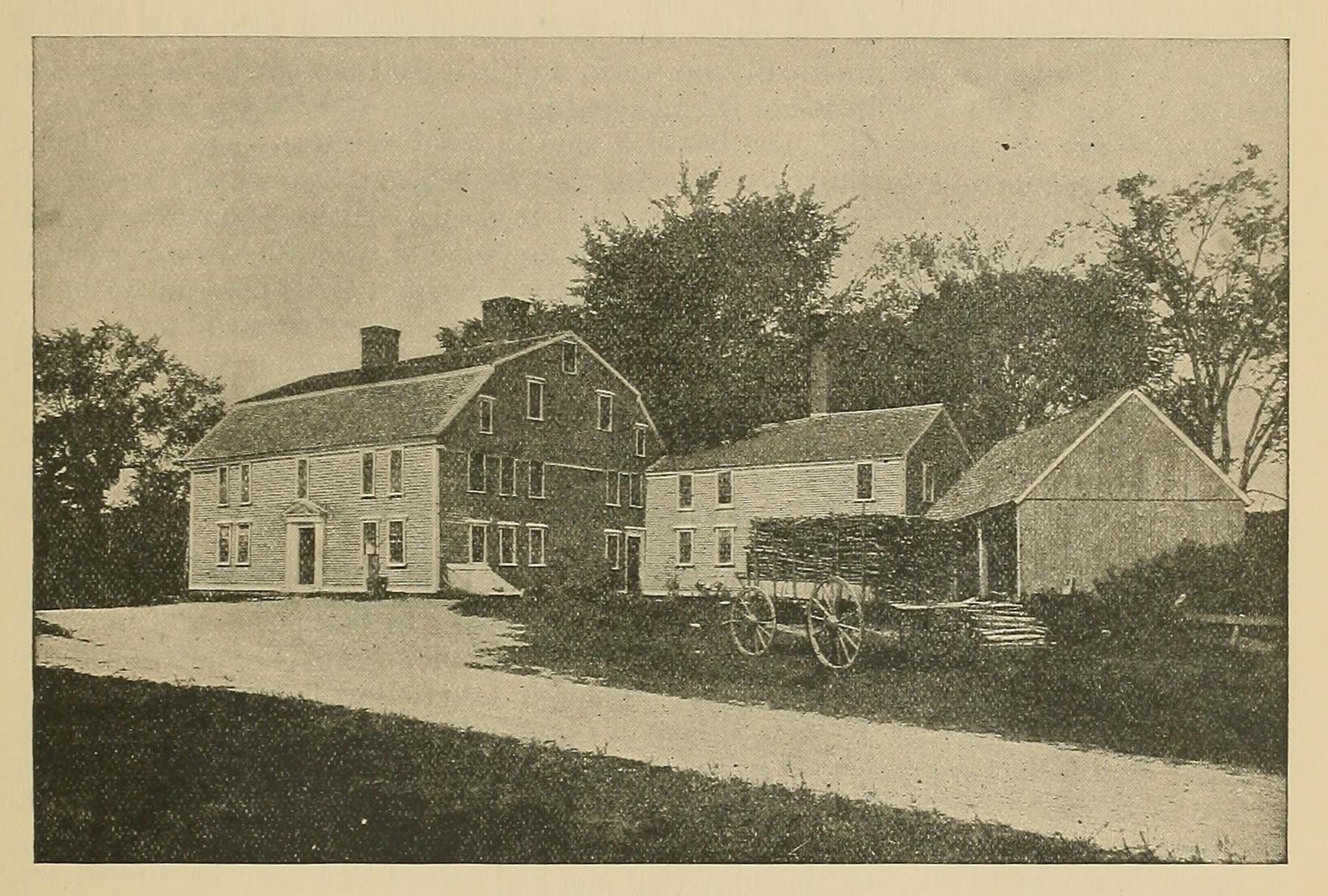
THE WAYSIDE INN.
Scene of Longfellow’s Famous “Tales of the Wayside Inn.”
In “The Tales of a Wayside Inn” (1863), the characters were not fictions, but real persons. The musician was none other than the famous violinist, Ole Bull; Professor Luigi Monte, a close friend who dined every Sunday with Longfellow, was the Sicilian; Dr. Henry Wales was the youth; the poet was Thomas W. Parsons, and the theologian was his brother, Rev. S. W. Longfellow. This poem shows Longfellow at his best as a story teller, while the stories which are put into the mouth of these actual characters perhaps could have been written by no other living man, for they are from the literature of all countries, with which Longfellow was so familiar.
Thus, both “The Tales of a Wayside Inn” and “Evangeline”—as many other of Longfellow’s poems—may be called compilations or rewritten stories, rather than creations, and it was these characteristics of his writings which Poe and Margaret Fuller, and others, who considered the realm of poetry to belong purely to the imagination rather than the real world, so bitterly criticised. While they did not deny to Longfellow a poetic genius, they thought he was prostituting it by forcing it to drudge in the province of prosaic subjects; and for this reason Poe predicted that he would not live in literature.
It was but natural that Longfellow should write as he did. For thirty-five years he was an instructor in institutions of learning, and as such believed that poetry should be a thing of use as well as beauty. He could not agree with Poe that poetry was like music, only a pleasurable art. He had the triple object of stimulating to research and study, of impressing the mind with history or moral truths, and at the same time to touch and warm the heart of humanity. In all three directions he succeeded to such an extent that he has probably been read by more people than any other poet except the sacred Psalmist; and despite the predictions of his distinguished critics to the contrary, such poems as “The Psalm of Life,” (which Chas. Sumner allowed, to his knowledge, had saved one man from suicide), “The Children’s Hour,” and many others touching the every day experiences of the multitude, will find a glad echo in the souls of humanity as long as men shall read.
THE PSALM OF LIFE.
WHAT THE HEART OF THE YOUNG MAN SAID TO THE PSALMIST.
This poem has gained wide celebrity as one of Mr. Longfellow’s most popular pieces, as has also the poem “Excelsior,” (hereafter quoted). They strike a popular chord and do some clever preaching and it is in this their chief merit consists. They are by no means among the author’s best poetic productions from a critical standpoint. Both these poems were written in early life.
ELL me not, in mournful numbers,
Life is but an empty dream!
For the soul is dead that slumbers,
And things are not what they seem.
Life is real! Life is earnest!
And the grave is not its goal;
Dust thou art, to dust returnest,
Was not spoken of the soul.
Not enjoyment, and not sorrow,
Is our destined end or way;
But to act, that each to-morrow
Find us farther than to-day.
Art is long, and Time is fleeting,
And our hearts, though stout and brave,
Still, like muffled drums, are beating
Funeral marches to the grave.
In the world’s broad field of battle,
In the bivouac of Life,
Be not like dumb, driven cattle!
Be a hero in the strife!
Trust no Future, howe’er pleasant!
Let the dead Past bury its dead!
Act,—act in the living Present!
Heart within, and God o’erhead!
Lives of great men all remind us
We can make our lives sublime,
And, departing, leave behind us
Footprints on the sands of time;
Footprints, that perhaps another,
Sailing o’er life’s solemn main,
A forlorn and shipwreck’d brother,
Seeing, shall take heart again.
Let us, then, be up and doing,
With a heart for any fate;
Still achieving, still pursuing,
Learn to labor and to wait.
THE VILLAGE BLACKSMITH.
NDER a spreading chestnut tree
The village smithy stands;
The smith, a mighty man is he,
With large and sinewy hands;
And the muscles of his brawny arms
Are strong as iron bands.
His hair is crisp, and black, and long;
His face is like the tan;
His brow is wet with honest sweat;
He earns whate’er he can,
And looks the whole world in the face,
For he owes not any man.
Week in, week out, from morn till night,
You can hear his bellows blow;
You can hear him swing his heavy sledge,
With measured beat and slow,
Like a sexton ringing the village bell
When the evening sun is low.
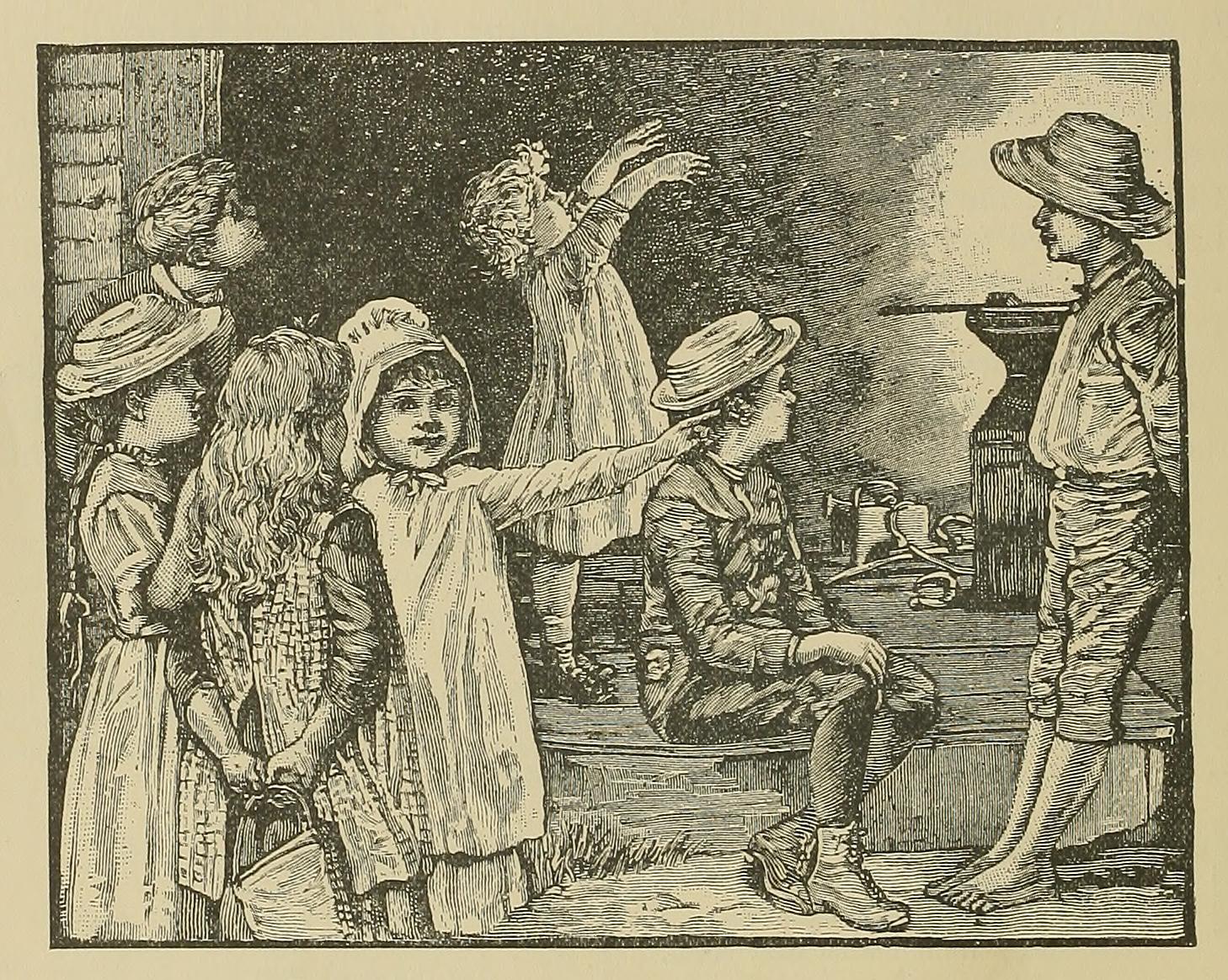
They love to see the flaming forge,
And hear the bellows roar,
And catch the burning sparks that fly
Like chaff from the threshing floor.
And children coming home from school
Look in at the open door;
They love to see the flaming forge,
And hear the bellows roar,
And catch the burning sparks that fly
Like chaff from a threshing-floor.
He goes on Sunday to the church,
And sits among his boys;
He hears the parson pray and preach,
He hears his daughter’s voice,
Singing in the village choir,
And it makes his heart rejoice.
It sounds to him like her mother’s voice,
Singing in Paradise!
He needs must think of her once more,
How in the grave she lies;
And with his hard, rough hand he wipes
A tear out of his eyes.
Toiling—rejoicing—sorrowing—
Onward through life he goes:
Each morning sees some task begin,
Each evening sees it close;
Something attempted—something done,
Has earned a night’s repose.
Thanks, thanks to thee, my worthy friend
For the lesson thou hast taught!
Thus at the flaming forge of Life
Our fortunes must be wrought,
Thus on its sounding anvil shaped
Each burning deed and thought.
THE BRIDGE.
A favorite haunt of Longfellow’s was the bridge between Boston and Cambridge, over which he had to pass, almost daily. “I always stop on the bridge,” he writes in his journal. “Tide waters are beautiful,” and again, “We leaned for a while on the wooden rails and enjoyed the silvery reflections of the sea, making sundry comparisons.” Among other thoughts, we have these cheering ones, that “The old sea was flashing with its heavenly light, though we saw it only in a single track; the dark waves are dark provinces of God; illuminous though not to us.”
The following poem was the result of one of Longfellow’s reflections, while standing on this bridge at midnight.
stood on the bridge at midnight,
As the clocks were striking the hour,
And the moon rose o’er the city,
Behind the dark church tower;
And like the waters rushing
Among the wooden piers,
A flood of thought came o’er me,
That filled my eyes with tears.
How often, O how often,
In the days that had gone by,
I had stood on that bridge at midnight,
And gazed on that wave and sky!
How often, O how often,
I had wished that the ebbing tide
Would bear me away on its bosom
O’er the ocean wild and wide!
For my heart was hot and restless,
And my life was full of care,
And the burden laid upon me,
Seemed greater than I could bear.
But now it has fallen from me,
It is buried in the sea;
And only the sorrow of others
Throws its shadow over me.
Yet whenever I cross the river
On its bridge with wooden piers,
Like the odor of brine from the ocean
Comes the thought of other years.
And I think how many thousands
Of care-encumbered men,
Each having his burden of sorrow,
Have crossed the bridge since then.
I see the long procession
Still passing to and fro,
The young heart hot and restless,
And the old, subdued and slow!
And forever and forever,
As long as the river flows,
As long as the heart has passions,
As long as life has woes;
The moon and its broken reflection
And its shadows shall appear,
As the symbol of love in heaven,
And its wavering image here.
RESIGNATION.
HERE is no flock, however watched and tended,
But one dead lamb is there!
There is no fireside, howsoe’r defended,
But has one vacant chair!
The air is full of farewells to the dying
And mournings for the dead;
The heart of Rachel, for her children crying,
Will not be comforted!
Let us be patient! These severe afflictions
Not from the ground arise,
But oftentimes celestial benedictions
Assume this dark disguise.
We see but dimly through the mists and vapors;
Amid these earthly damps
What seem to us but sad, funereal tapers
May be heaven’s distant lamps.
There is no Death! What seems so is transition:
This life of mortal breath
Is but a suburb of the life elysian,
Whose portal we call Death.
She is not dead,—the child of our affection,—
But gone unto that school
Where she no longer needs our poor protection,
And Christ himself doth rule.
In that great cloister’s ♦stillness and seclusion,
By guardian angels led,
Safe from temptation, safe from sin’s pollution,
She lives whom we call dead.
Day after day we think what she is doing
In those bright realms of air;
Year after year, her tender steps pursuing,
Behold her grown more fair.
Thus do we walk with her, and keep unbroken
The bond which nature gives,
Thinking that our remembrance, though unspoken,
May reach her where she lives.
Not as a child shall we again behold her;
For when with raptures wild
In our embraces we again enfold her,
She will not be a child:
But a fair maiden, in her Father’s mansion,
Clothed with celestial grace;
And beautiful with all the soul’s expansion
Shall we behold her face.
And though, at times, impetuous with emotion
And anguish long suppressed,
The swelling heart heaves moaning like the ocean
That cannot be at rest,—
We will be patient, and assuage the feeling
We may not wholly stay;
By silence sanctifying, not concealing
The grief that must have way.
GOD’S ACRE.
like that ancient Saxon phrase which calls
The burial-ground God’s acre! It is just;
It consecrates each grave within its walls,
And breathes a benison o’er the sleeping dust.
God’s Acre! Yes, that blessed name imparts
Comfort to those who in the grave have sown
The seed that they had garnered in their hearts,
Their bread of life, alas! no more their own.
Into its furrows shall we all be cast,
In the sure faith that we shall rise again
At the great harvest, when the archangel’s blast
Shall winnow, like a fan the chaff and grain.
Then shall the good stand in immortal bloom,
In the fair gardens of that second birth;
And each bright blossom mingle its perfume
With that of flowers which never bloomed on earth.
With thy rude ploughshare, Death, turn up the sod,
And spread the furrow for the seed we sow;
This is the field and Acre of our God!
This is the place where human harvests grow!
EXCELSIOR.
HE shades of night were falling fast,
As through an Alpine village passed
A youth, who bore, ’mid snow and ice,
A banner with the strange device,
Excelsior!
His brow was sad; his eye beneath,
Flashed like a falchion from its sheath,
And like a silver clarion rung
The accents of that unknown tongue,
Excelsior!
In happy homes he saw the light
Of household fires gleam warm and bright;
Above, the spectral glaciers shone,
And from his lips escaped a groan,
Excelsior!
“Try not to Pass!” the old man said;
“Dark lowers the tempest overhead,
The roaring torrent is deep and wide!”
And loud that clarion voice replied,
Excelsior!
“O, stay,” the maiden said, “and rest
Thy weary head upon this breast!”
A tear stood in his bright blue eye,
But still he answered, with a sigh,
Excelsior!
“Beware the pine-tree’s withered branch!
Beware the awful avalanche!”
This was the peasant’s last Good-night;
A voice replied, far up the height,
Excelsior!
At break of day, as heavenward
The pious monks of Saint Bernard
Uttered the oft-repeated prayer,
A voice cried through the startled air,
Excelsior!
A traveler, by the faithful hound,
Half-buried in the snow was found,
Still grasping in his hand of ice
That banner with the strange device,
Excelsior!
There, in the twilight cold and gray,
Lifeless, but beautiful, he lay,
And from the sky, serene and far,
A voice fell, like a falling star,
Excelsior!
THE RAINY DAY.
HE day is cold, and dark and dreary;
It rains, and the wind is never weary;
The vine still clings to the mouldering wall,
But at every gust the dead leaves fall,
And the day is dark and dreary.
My life is cold, and dark, and dreary;
It rains, and the wind is never weary;
My thoughts still cling to the mouldering Past,
But the hopes of youth fall thick in the blast,
And the days are dark and dreary.
Be still, sad heart! and cease repining;
Behind the clouds is the sun still shining;
Thy fate is the common fate of all,
Into each life some rain must fall,
Some days must be dark dreary.
THE WRECK OF THE HESPERUS.
The writing of the following poem, “The Wreck of the Hesperus,” was occasioned by the news of a ship-wreck on the coast near Gloucester, and by the name of a reef—“Norman’s Woe”—where many disasters occurred. It was written one night between twelve and three o’clock, and cost the poet, it is said, hardly an effort.
T was the schooner Hesperus
That sailed the wintry sea;
And the skipper had taken his little daughter,
To bear him company.
Blue were her eyes as the fairy flax,
Her cheeks like the dawn of day,
And her bosom white as the hawthorn buds
That ope in the month of May.
The skipper he stood beside the helm,
His pipe was in his mouth,
And watched how the veering flaw did blow
The smoke now west, now south.
Then up and spake an old sailor,
Had sailed the Spanish main:
“I pray thee put into yonder port,
For I fear a hurricane.
“Last night the moon had a golden ring,
And to-night no moon we see!”
The skipper he blew a whiff from his pipe,
And a scornful laugh laughed he.
Colder and colder blew the wind,
A gale from the north-east;
The snow fell hissing in the brine,
And the billows frothed like yeast.
Down came the storm and smote amain
The vessel in its strength;
She shuddered and paused, like a frighted steed,
Then leaped her cable’s length.
“Come hither! come hither! my little daughter,
And do not tremble so,
For I can weather the roughest gale
That ever wind did blow.”
He wrapped her warm in his seaman’s coat,
Against the stinging blast;
He cut a rope from a broken spar,
And bound her to the mast.
“Oh father! I hear the church-bells ring,
Oh say what may it be?”
“’Tis a fog-bell on a rock-bound coast;”
And he steered for the open sea.
“Oh father! I hear the sound of guns,
Oh, say, what may it be?”
“Some ship in distress, that cannot live
In such an angry sea.”
“O father! I see a gleaming light,
Oh, say, what may it be?”
But the father answered never a word—
A frozen corpse was he.
Lashed to the helm, all stiff and stark,
With his face to the skies,
The lantern gleamed, through the gleaming snow,
On his fixed and glassy eyes.
Then the maiden clasped her hands, and prayed
That saved she might be;
And she thought of Christ, who stilled the waves
On the lake of Galilee.
And fast through the midnight dark and drear,
Through the whistling sleet and snow,
Like a sheeted ghost, the vessel swept,
Towards the reef of Norman’s Woe.
And ever, the fitful gusts between,
A sound came from the land;
It was the sound of the trampling surf