OUR MOST NOTED NOVELISTS. (continued 2)
Reading edition
“O Malinche, I hear you, and your words make dying easy,” answered Montezuma, smiling faintly.
With an effort he sought Cortes’ hand, and looking at Acatlan and Tecalco, continued:
“Let me intrust these women and their children to you and your lord. Of all that which was mine but now is yours—lands, people, empire,—enough to save them from want and shame were small indeed. Promise me; in the hearing of all these, promise, Malinche.”
Taint of anger was there no longer on the soul of the great Spaniard.
“Rest thee, good king!” he said, with feeling. “Thy queens and their children shall be my wards. In the hearing of all these, I so swear.”
The listener smiled again; his eyes closed, his hand fell down; and so still was he that they began to think him dead. Suddenly he stirred, and said faintly, but distinctly,—
“Nearer, uncles, nearer.” The old men bent over him, listening.
“A message to Guatamozin,—to whom I give my last thought, as king. Say to him, that this lingering in death is no fault of his; the aim was true, but the arrow splintered upon leaving the bow. And lest the world hold him to account for my blood, hear me say, all of you, that I bade him do what he did.
“And in sign that I love him, take my sceptre, and give it to him—”
His voice fell away, yet the lips moved; lower the accents stooped,—
“Tula and the empire go with the sceptre,” he murmured, and they were his last words,—his will. A wail from the women pronounced him dead.
DESCRIPTION OF VIRGIN MARY.¹
(FROM “BEN HUR.”)
HE was not more than fifteen. Her form, voice and manner belonged to the period of transition from girlhood. Her face was perfectly oval, her complexion more pale than fair. The nose was faultless; the lips, slightly parted, were full and ripe, giving to the lines of the mouth warmth, tenderness and trust; the eyes were blue and large, and shaded by drooping lids and long lashes, and, in harmony with all, a flood of golden hair, in the style permitted to Jewish brides, fell unconfined down her back to the pillion on which she sat. The throat and neck had the downy softness sometimes seen which leaves the artist in doubt whether it is an effect of contour or color. To these charms of feature and person were added others more indefinable—an air of purity which only the soul can impart, and of abstraction natural to such as think much of things impalpable. Often, with trembling lips, she raised her eyes to heaven, itself not more deeply blue; often she crossed her hands upon her breast, as in adoration and prayer; often she raised her head like one listening eagerly for a calling voice. Now and then, midst his slow utterances, Joseph turned to look at her, and, catching the expression kindling her face as with light, forgot his theme, and with bowed head, wondering, plodded on.



EDWARD EGGLESTON.
“THE HOOSIER SCHOOL-BOY.”
ERDER says with truth that “one’s whole life is but the interpretation of the oracles of his childhood,” and those who are familiar with the writings of Edward Eggleston see in his pictures of country life in the Hoosier State the interpretation and illustration of his own life with its peculiar environment in “the great interior valley” nearly a half-century ago. The writers who have interpreted for us and for future generations the life and the characteristic manners which prevailed in the days when our country was new and the forests were yielding to give place to growing cities and expanding farms have done a rare and peculiar service, and those sections which have found expression through the genius and gifts of novelist or poet are highly favored above all others.

Edward Eggleston has always counted it a piece of good-fortune to have been born in a small village of Southern Indiana, for he believes that the formative influences of such an environment, the intimate knowledge of simple human nature, the close acquaintance with nature in woods and field and stream, and the sincere and earnest tone of the religious atmosphere which he breathed all through his youth, are better elements of culture than a city life could have furnished.
He was born in 1837 in Vevay, Indiana, and his early life was spent amid the “noble scenery” on the banks of the Ohio River. His father died while he was a young boy, and he himself was too delicate to spend much time at school, so that he is a shining example of those who move up the inclined plane of self-culture and self-improvement.
As he himself has forcefully said, through his whole life two men have struggled within him for the ascendency, the religious devotee and the literary man. His early training was “after the straitest sect of his religion”—the fervid Methodism of fifty years ago, and he was almost morbidly scrupulous as a boy, not even allowing himself to read a novel, though from this early period he always felt in himself a future literary career, and the teacher who corrected his compositions naively said to him: “I have marked your composition very severely because you are destined to become an author.”
At first the religious element in his nature decidedly held sway and he devoted himself to the ministry, mounting a horse and going forth with his saddle-bags as a circuit preacher in a circuit of ten preaching places. This was followed by a still harder experience in the border country of Minnesota, where in moccasins he tramped from town to town preaching to lumbermen and living on a meagre pittance, eating crackers and cheese, often in broken health and expecting an early death.
But even this earnest life of religious devotion and sacrifice was interspersed with attempts at literary work and he wrote a critical essay on “Beranger and his Songs” while he was trying to evangelize the red-shirted lumbermen of St. Croix. It was in such life and amid such experiences that Eggleston gained his keen knowledge of human nature which has been the delight and charm of his books.
He began his literary career as associate editor of the “Little Corporal” at Evanston, Illinois, in 1866, and in 1870 he rose to the position of literary editor of the New York “Independent,” of which he was for a time superintending editor. For five years, from 1874 to 1879, he was pastor of the Church of Christian Endeavor in Brooklyn, but failing health compelled him to retire, and he made his home at “Owl’s Nest,” on Lake George, where he has since devoted himself to literary work.
His novels depict the rural life of Southern Indiana, and his own judgment upon them is as follows: “I should say that what distinguishes my novels from other works of fiction is the prominence which they give to social conditions; that the individual characters are here treated to a greater degree than elsewhere as parts of a study of a society, as in some sense the logical result of the environment. Whatever may be the rank assigned to these stories as works of literary art, they will always have a certain value as materials for the student of social history.”
His chief novels and stories are the following: “Mr. Blake’s Walking Stick” (Chicago, 1869); “The Hoosier School-master” (New York, 1871); “End of the World” (1872); “The Mystery of Metropolisville” (1873); “The Circuit Rider” (1874); “School-master’s Stories for Boys and Girls” (1874); and “The Hoosier School-boy” (1883). He has written in connection with his daughter an interesting series of biographical tales of famous American Indians, and during these later years of his life he has largely devoted himself to historical work which has had an attraction for him all his life.
In his historical work as in his novels he is especially occupied with the evolution of society. His interest runs in the line of unfolding the history of life and development rather than in giving mere facts of political history.
His chief works in this department are: “Household History of the United States and its People” (New York, 1893); and “The Beginners of a Nation” (New York, 1897).
Though possessed of a weak and ailing body and always on the verge of invalidism, he has done the work of a strong man. He has always preserved his deep and earnest religious and moral tone, but he has woven with it a joyous and genuine humor which has warmed the hearts of his many readers.
SPELLING DOWN THE MASTER.¹
(FROM “THE HOOSIER SCHOOLMASTER.”) (ORANGE JUDD CO., PUBLISHERS.)
VERY family furnished a candle. There were yellow dips and white dips, burning, smoking, and flaring. There was laughing, and talking, and giggling, and simpering, and ogling, and flirting, and courting. What a dress party is to Fifth Avenue, a spelling-school is to Hoophole County. It is an occasion which is metaphorically inscribed with this legend, “Choose your partners.” Spelling is only a blind in Hoophole County, as is dancing on Fifth Avenue. But as there are some in society who love dancing for its own sake, so in Flat Creek district there were those who loved spelling for its own sake, and who, smelling the battle from afar, had come to try their skill in this tournament, hoping to freshen the laurels they had won in their school-days.

“I ’low,” said Mr. Means, speaking as the principal school trustee, “I ’low our friend the Square is jest the man to boss this ere consarn to-night. Ef nobody objects, I’ll appint him. Come, Square, don’t be bashful. Walk up to the trough, fodder or no fodder, as the man said to his donkey.”
There was a general giggle at this, and many of the young swains took occasion to nudge the girls alongside them, ostensibly for the purpose of making them see the joke, but really for the pure pleasure of nudging.
The squire came to the front.
“Ladies and gentlemen,” he began, shoving up his spectacles, and sucking his lips over his white teeth to keep them in place, “ladies and gentlemen, young men and maidens, raley I’m obleeged to Mr. Means fer this honor,” and the Squire took both hands and turned the top of his head round several inches. Then he adjusted his spectacles. Whether he was obliged to Mr. Means for the honor of being compared to a donkey, was not clear. “I feel in the inmost compartments of my animal spirits a most happyfying sense of the success and futility of all my endeavors to sarve the people of Flat Creek deestrick, and the people of Tomkins township, in my weak way and manner.” This burst of eloquence was delivered with a constrained air and an apparent sense of danger that he, Squire Hawkins, might fall to pieces in his weak way and manner, and of the success and futility (especially the latter) of all attempts at reconstruction. For by this time the ghastly pupil of the left eye, which was black, was looking away round to the left while the little blue one on the right twinkled cheerfully toward the front. The front teeth would drop down so that the Squire’s mouth was kept nearly closed, and his words whistled through.
“I feel as if I could be grandiloquent on this interesting occasion,” twisting his scalp round, “but raley I must forego any such exertions. It is spelling you want. Spelling is the corner-stone, the grand, underlying subterfuge of a good eddication. I put the spellin’-book prepared by the great Daniel Webster alongside the Bible. I do raley. The man who got up, who compounded this little work of inextricable valoo was a benufactor to the whole human race or any other.” Here the spectacles fell off. The Squire replaced them in some confusion, gave the top of his head another twist, and felt for his glass eye, while poor Shocky stared in wonder, and Betsy Short rolled from side to side at the point of death from the effort to suppress her giggle. Mrs. Means and the other old ladies looked the applause they could not speak.
“I appint Larkin Lanham and Jeems Buchanan fer captings,” said the Squire. And the two young men thus named took a stick and tossed it from hand to hand to decide who should have the “first chice.” One tossed the stick to the other, who held it fast just where he happened to catch it. Then the first placed his hand above the second, and so the hands were alternately changed to the top. The one who held the stick last without room for the other to take hold had gained the lot. This was tried three times. As Larkin held the stick twice out of three times, he had the choice. He hesitated a moment. Everybody looked toward tall Jim Phillips. But Larkin was fond of a venture on unknown seas, and so he said, “I take the master,” while a buzz of surprise ran round the room, and the captain of the other side, as if afraid his opponent would withdraw the choice, retorted quickly, and with a little smack of exultation and defiance in his voice: “And I take Jeems Phillips.”
And soon all present, except a few of the old folks, found themselves ranged in opposing hosts, the poor spellers lagging in, with what grace they could at the foot of the two divisions. The Squire opened his spelling-book and began to give out the words to the two captains, who stood up and spelled against each other. It was not long before Larkin spelled “really” with one l, and had to sit down in confusion, while a murmur of satisfaction ran through the ranks of the opposing forces. His own side bit their lips. The slender figure of the young teacher took the place of the fallen leader, and the excitement made the house very quiet. Ralph dreaded the loss of influence he would suffer if he should be easily spelled down. And at the moment of rising he saw in the darkest corner the figure of a well-dressed young man sitting in the shadow. It made him tremble. Why should his evil genius haunt him? But by a strong effort he turned his attention away from Dr. Small, and listened carefully to the words which the Squire did not pronounce very distinctly, spelling them with extreme deliberation. This gave him an air of hesitation which disappointed those on his own side. They wanted him to spell with a dashing assurance. But he did not begin a word until he had mentally felt his way through it. After ten minutes of spelling hard words, Jeems Buchanan, the captain of the other side, spelled “atrocious” with an s instead of a c, and subsided, his first choice, Jeems Phillips, coming up against the teacher. This brought the excitement to fever-heat. For though Ralph was chosen first, it was entirely on trust, and most of the company were disappointed. The champion who now stood up against the school-master was a famous speller.
Jim Phillips was a tall, lank, stoop-shouldered fellow, who had never distinguished himself in any other pursuit than spelling. Except in this one art of spelling he was of no account. He could neither catch a ball well nor bat well. He could not throw well enough to make his mark in that famous Western game of Bull-pen. He did not succeed well in any study but that of Webster’s Elementary. But in that—to use the usual Flat Creek locution—he was “a hoss.” The genius for spelling is in some people a sixth sense, a matter of intuition. Some spellers are born and not made, and their facility reminds one of the mathematical prodigies that crop out every now and then to bewilder the world. Bud Means, foreseeing that Ralph would be pitted against Jim Phillips, had warned his friend that Jim could spell “like thunder and lightning,” and that it “took a powerful smart speller” to beat him, for he knew “a heap of spelling-book.” To have “spelled down the master” is next thing to having whipped the biggest bully in Hoophole County, and Jim had “spelled down” the last three masters. He divided the hero-worship of the district with Bud Means.
For half an hour the Squire gave out hard words. What a blessed thing our crooked orthography is. Without it there could be no spelling-schools. As Ralph discovered his opponent’s mettle he became more and more cautious. He was now satisfied that Jim would eventually beat him. The fellow evidently knew more about the spelling-book than old Noah Webster himself. As he stood there, with his dull face and long sharp nose, his hands behind his back, and his voice spelling infallibly, it seemed to Hartsook that his superiority must lie in his nose. Ralph’s cautiousness answered a double purpose; it enabled him to tread surely, and it was mistaken by Jim for weakness. Phillips was now confident that he should carry off the scalp of the fourth school-master before the evening was over. He spelled eagerly, confidently, brilliantly. Stoop-shouldered as he was, he began to straighten up. In the minds of all the company the odds were in his favor. He saw this, and became ambitious to distinguish himself by spelling without giving the matter any thought.
Ralph always believed that he would have been speedily defeated by Phillips had it not been for two thoughts which braced him. The sinister shadow of young Dr. Small sitting in the dark corner by the water-bucket nerved him. A victory over Phillips was a defeat to one who wished only ill to the young school-master. The other thought that kept his pluck alive was the recollection of Bull. He approached a word as Bull approached the raccoon. He did not take hold until he was sure of his game. When he took hold, it was with a quiet assurance of success. As Ralph spelled in this dogged way for half an hour the hardest words the Squire could find, the excitement steadily rose in all parts of the house, and Ralph’s friends even ventured to whisper that “maybe Jim had cotched his match after all!”
But Phillips never doubted of his success.
“Theodolite,” said the Squire.
“T-h-e, the, o-d, od, theod, o, theodo, l-y-t-e, theodolite,” spelled the champion.
“Next,” said the Squire, nearly losing his teeth in his excitement.
Ralph spelled the word slowly and correctly, and the conquered champion sat down in confusion. The excitement was so great for some minutes that the spelling was suspended. Everybody in the house had shown sympathy with one or other of the combatants, except the silent shadow in the corner. It had not moved during the contest, and did not show any interest now in the result.
“Gewhilliky crickets! Thunder and lightning! Licked him all to smash!” said Bud, rubbing his hands on his knees. “That beats my time all holler!”
And Betsy Short giggled until her tuck-comb fell out, though she was on the defeated side.
Shocky got up and danced with pleasure.
But one suffocating look from the aqueous eyes of Mirandy destroyed the last spark of Ralph’s pleasure in his triumph, and sent that awful below-zero feeling all through him.
“He’s powerful smart is the master,” said old Jack to Mr. Pete Jones. “He’ll beat the whole kit and tuck of ’em afore he’s through. I know’d he was smart. That’s the reason I tuck him,” proceeded Mr. Means.
“Yaas, but he don’t lick enough. Not nigh,” answered Pete Jones. “No lickin’, no larnin’, says I.”
It was now not so hard. The other spellers on the opposite side went down quickly under the hard words which the Squire gave out. The master had mowed down all but a few, his opponents had given up the battle, and all had lost their keen interest in a contest to which there could be but one conclusion, for there were only the poor spellers left. But Ralph Hartsook ran against a stump where he was least expecting it. It was the Squire’s custom, when one of the smaller scholars or poorer spellers rose to spell against the master, to give out eight or ten easy words that they might have some breathing spell before being slaughtered, and then to give a poser or two which soon settled them. He let them run a little, as a cat does a doomed mouse. There was now but one person left on the opposite side, and as she rose in her blue calico dress, Ralph recognized Hannah, the bound girl at old Jack Means’s. She had not attended school in the district, and had never spelled in spelling-school before, and was chosen last as an uncertain quantity. The Squire began with easy words of two syllables, from that page of Webster, so well-known to all who ever thumbed it, as “Baker,” from the word that stands at the top of the page. She spelled these words in an absent and uninterested manner. As everybody knew that she would have to go down as soon as this preliminary skirmishing was over, everybody began to get ready to go home, and already there was a buzz of preparation. Young men were timidly asking girls if they could “see them safe home,” which is the approved formula, and were trembling in mortal fear of “the mitten.” Presently the Squire, thinking it time to close the contest, pulled his scalp forward, adjusted his glass eye, which had been examining his nose long enough, and turned over the leaves of the book to the great words at the place known to spellers as “Incomprehensibility,” and began to give out those “words of eight syllables with the accent on the sixth.” Listless scholars now turned round, and ceased to whisper, in order to be in the master’s final triumph. But to their surprise, “ole Miss Meanses’ white nigger,” as some of them called her, in allusion to her slavish life, spelled these great words with as perfect ease as the master. Still, not doubting the result, the Squire turned from place to place and selected all the hard words he could find. The school became utterly quiet, the excitement was too great for the ordinary buzz. Would “Meanses’ Hanner” beat the master? Beat the master that had laid out Jim Phillips? Everybody’s sympathy was now turned to Hannah. Ralph noticed that even Shocky had deserted him, and that his face grew brilliant every time Hannah spelled a word. In fact, Ralph deserted himself. If he had not felt that a victory given would insult her, he would have missed intentionally.
“Daguerreotype,” sniffled the Squire. It was Ralph’s turn.
“D-a-u, dau――”
“Next.”
And Hannah spelled it right.
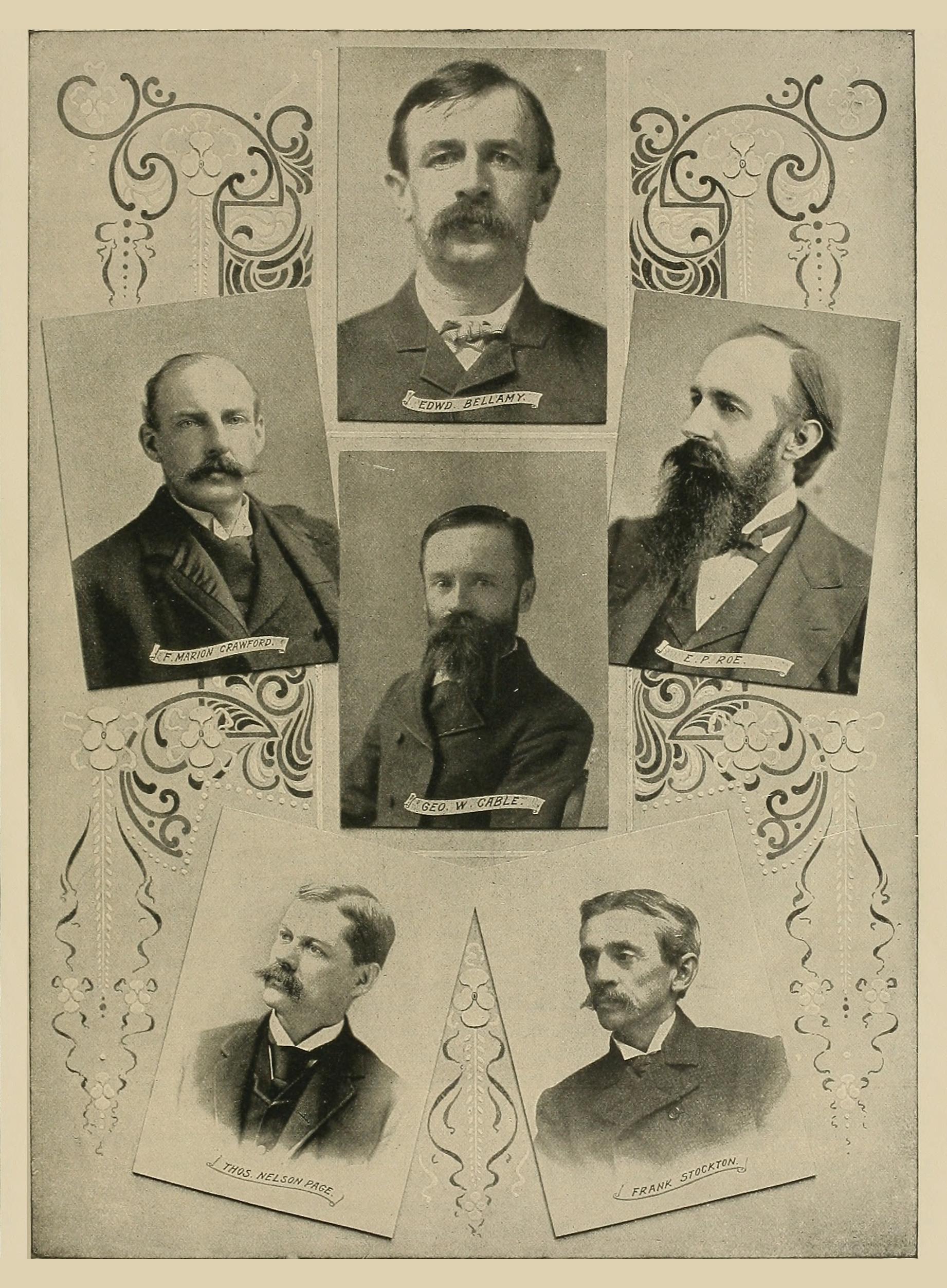
POPULAR AMERICAN NOVELISTS.
EDWD. BELLAMY. F. MARION CRAWFORD. • GEO. W. CABLE. • E. P. ROE. THOS. NELSON PAGE. • FRANK STOCKTON.

THOMAS NELSON PAGE.
AUTHOR OF “IN OLE VIRGINIA.”
N old adage declares it “an ill wind that blows nobody good;” and certainly the world may take whatever consolation it can find out of the fact that the long and bloody war between the North and South has at least afforded the opportunity for certain literary men and women to rise upon the ruins which it wrought, and win fame to themselves as well as put money in their purses by embalming in literature the story of times and social conditions that now exist only in the history of the past.
Thomas Nelson Page was born in Oakland, Hanover county, Virginia, on the twenty-third day of April, 1853, consequently, he was only eight years old when Fort Sumter was fired upon, and, during the imaginative period of the next few years, he lived in proximity to the battle fields of the most fiercely contested struggles of the war. His earliest recollections were of the happiest phases of life on the old slave plantations. That he thoroughly understands the bright side of such a life, as well as the Negro character and dialect, is abundantly established by the charming books which he has given to the world.
His childhood was passed on the estate which was a part of the original grant of his maternal ancestor, General Thomas Nelson, a signer of the Declaration of Independence, for whom he was named. His early education was received in the neighborhood “subscription” schools (there were no free public schools in the South at that time), and at the hand of a gentle old aunt of whom Mr. Page tells in one of his stories. The war interfered with his regular studies but filled his mind with a knowledge schools cannot give, and, as stated above, it was out of this knowledge that his stories have grown. After the war, young Page entered the Washington and Lee University and later studied law, taking his degree in this branch from the University of Virginia, in 1874, and after graduating, practiced his profession in Richmond, Virginia, until 1884, when his first story of Virginia life “Marse Chan,” a tale of the Civil War, was printed in the “Century Magazine.” He had previously written dialectic poetry, but the above story was his first decided success, and attracted such wide attention that he forsook law for literature. In 1887, a volume of his stories was brought out under the title “In Ole Virginia,” which was followed in 1888 by “Befo’ de War; Echoes in Negro Dialect,” which was written in ♦collaboration with Mr. A. C. Gordon. The next year a story for boys entitled, “Two Little Confederates,” appeared in the “St. Nicholas Magazine,” and was afterward published in book form. A companion volume to this is “Among the Camps or Young People’s Stories of the War.”
Mr. Page has been a frequent contributor to the current magazines for many years, and has also lectured extensively throughout the country. In 1897 he went abroad for a tour of England and the Continent of Europe. It is announced that on his return he will issue a new novel which we understand, he has been engaged upon for some time and expects to make the most pretentious work of his life up to this date.
OLD SUE.¹
(FROM “PASTIME STORIES.”)
UST on the other side of Ninth Street, outside of my office window, was the stand of Old Sue, the “tug-mule” that pulled the green car around the curve from Main Street to Ninth and up the hill to Broad. Between her and the young bow-legged negro that hitched her on, drove her up, and brought her back down the hill for the next car, there always existed a peculiar friendship. He used to hold long conversations with her, generally upbraiding her in that complaining tone with opprobrious terms which the negroes employ, which she used to take meekly. At times he petted her with his arm around her neck, or teased her, punching her in the ribs and walking about around her quarters, ostentatiously disregardful of her switching stump of a tail, backed ears, and uplifted foot, and threatening her with all sorts of direful punishment if she “jis dyarred to tetch” him.

“Kick me—heah, kick me; I jis dyah you to lay you’ foot ’g’inst me,” he would say, standing defiantly against her as she appeared about to let fly at him. Then he would seize her with a guffaw. Or at times, coming down the hill, he would “hall off” and hit her, and “take out” with her at his heels her long furry ears backed, and her mouth wide open as if she would tear him to pieces; and just as she nearly caught him he would come to a stand and wheel around, and she would stop dead, and then walk on by him as sedately as if she were in a harrow. In all the years of their association she never failed him; and she never failed to fling herself on the collar, rounding the sharp curve at Ninth, and to get the car up the difficult turn.
Last fall, however, the road passed into new hands, and the management changed the old mules on the line, and put on a lot of new and green horses. It happened to be a dreary, rainy day in November when the first new team was put in. They came along about three o’clock. Old Sue had been standing out in the pouring rain all day with her head bowed, and her stubby tail tucked in, and her black back dripping. She had never failed nor faltered. The tug-boy in an old rubber suit and battered tarpauling hat, had been out also, his coat shining with the wet. He and old Sue appeared to mind it astonishingly little. The gutters were running brimming full, and the cobble-stones were wet and slippery. The street cars were crowded inside and out, the wretched people on the platforms vainly trying to shield themselves with umbrellas held sideways. It was late in the afternoon when I first observed that there was trouble at the corner. I thought at first that there was an accident, but soon found that it was due to a pair of new, balking horses in a car. Old Sue was hitched to the tug, and was doing her part faithfully; finally she threw her weight on the collar, and by sheer strength bodily dragged the car, horses and all, around the curve and on up the straight track, until the horses, finding themselves moving, went off with a rush, I saw the tug-boy shake his head with pride, and heard him give a whoop of triumph. The next car went up all right; but the next had a new team, and the same thing occurred. The streets were like glass; the new horses got to slipping and balking, and old Sue had to drag them up as she did before. From this time it went from bad to worse: the rain changed to sleet, and the curve at Ninth became a stalling-place for every car. Finally, just at dark, there was a block there, and the cars piled up. I intended to have taken a car on my way home, but finding it stalled, I stepped into my friend Polk Miller’s drug-store, just on the corner, to get a cigar and to keep warm. I could see through the blurred glass of the door the commotion going on just outside, and could hear the shouts of the driver and of the tug-boy mingled with the clatter of horses’ feet as they reared and jumped, and the cracks of the tug-boy’s whip as he called to Sue, “Git up, Sue, git up, Sue.” Presently, I heard a shout, and then the tones changed, and things got quiet.
A minute afterwards the door slowly opened, and the tug-boy came in limping, his old hat pushed back on his head, and one leg of his wet trousers rolled up to his knee, showing about four inches of black, ashy skin, which he leaned over and rubbed as he walked. His wet face wore a scowl, half pain, half anger. “Mist’ Miller, kin I use you’ telephone?” he asked, surlily. (The company had the privilege of using it by courtesy.)
“Yes; there ’tis.”
He limped up, and still rubbing his leg with one hand, took the ’phone off the hook with the other and put it to his ear.
“Hello, central—hello! Please gimme fo’ hund’ an’ sebenty-three on three sixt’-fo’—fo’ hund’ an’ sebent’-three on three sixt’-fo’.
“Hello! Suh? Yas, suh; fo’ hund’ an’ sebent’-three on three sixt’-fo’. Street-car stables on three sixt’-fo’. Hello! Hello! Hello! Dat you, streetcar stables? Hello! Yas. Who dat? Oh! Dat you, Mist’ Mellerdin? Yas, suh; yes, suh; Jim; Jim; dis Jim. G-i-m, Jim. Yas, suh; whar drive Ole Sue, in Mist’ Polk Miller’ drug-sto’—. Yas, suh. ‘Matter’?—Ole Sue—she done tu’n fool; done gone ’stracted. I can’t do nuttin’ ’tall wid her. She ain’ got no sense. She oon pull a poun’. Suh? Yas, suh. Nor, suh. Yas, suh. Nor, suh; I done try ev’ything. I done beg her, done cuss her, done whup her mos’ to death. She ain’ got no reasonment. She oon do nuttin’. She done haul off, an’ leetle mo’ knock my brains out; she done kick me right ’pon meh laig—’pon my right laig.” (He stooped over and rubbed it again at the reflection.) “Done bark it all up. Suh? Yas, suh. Tell nine o’clock? Yas, suh; reckon so; ’ll try it leetle longer. Yas, suh; yas, suh. Good-night—good-bye!”
He hung the ’phone back on the hook, stooped and rolled down the leg of his breeches. “Thankee, Mist’ Miller! Good-night.”
He walked to the door, and opened it. As he passed slowly out, without turning his head, he said, as if to himself, but to be heard by us, “I wish I had a hundred an’ twenty-five dollars. I boun’ I’d buy dat durned ole mule, an’ cut her dog-goned th’oat.”


EDWARD PAYSON ROE.
AUTHOR OF “BARRIERS BURNED AWAY.”
R. ROE is not considered as one of the strongest of American novelists; but that he was one of the most popular among the masses of the people, from 1875 to the time of his death, goes without saying. His novels were of a religious character, and while they were doubtless lacking in the higher arts of the fictionist, he invariably told an interesting story and pointed a healthy moral. “Barriers Burned Away” is, perhaps, his best novel, and it has been declared by certain critics to be at once one of the most vivid portrayals and correct pictures of the great Chicago fire that occurred in 1871 which has up to this time been written.

Edward Payson Roe was born at New Windsor, New York, in 1838, and died, when fifty years of age, at Cornwall, the same State, in 1888. He was being educated at Williams College, but had to leave before graduating owing to an affection of the eyes. In consequence of his literary work, however, the college in after years gave him the degree of A. B. In 1862, he volunteered his services in the army and served as chaplain throughout the Civil War. From 1865 to 1874 he was pastor of the Presbyterian Church at Highland Falls, New York. In 1874 he resigned his pastorate, and, to the time of his death, gave himself to literature and to the cultivation of a small fruit farm.
Other works of this author, after “Barriers Burned Away,” are “Play and Profit in my Garden” (1873); “What Can She Do?” (1873); “Opening a Chestnut Burr” (1874); “From Jest to Earnest” (1875); “Near to Nature’s Heart” (1876); “A Knight of the Nineteenth Century” (1877); “A Face Illumined” (1878); “A Day of Fate” (1880); “Success with Small Fruits” (1880); “Without a Home” (1880); “His Sombre Rivals” (1883); “A Young Girl’s Wooing” (1884); “Nature’s Serial Story” (1884); “An Original Belle” (1885); “Driven Back to Eden” (1885); “He Fell in Love with His Wife” (1886); “The Earth Trembled” (1887); “Miss Lou” (1888); “The Home Acre” (1889) and “Taken Alive” (1889), the two last mentioned being published after the death of the author.
CHRISTINE, AWAKE FOR YOUR LIFE!¹
OR a block or more Dennis was passively borne along by the rushing mob. Suddenly a voice seemed to shout almost in his ear, “The north side is burning!” and he started as from a dream. The thought of Christine flashed upon him, perishing, perhaps, in the flames. He remembered that now she had no protector, and that he for the moment had forgotten her; though in truth he had never imagined that she could be imperiled by the burning of the north side.

In an agony of fear and anxiety he put forth every effort of which he was capable, and tore through the crowd as if mad. There was no way of getting across the river now save by the La Salle street tunnel. Into this dark passage he plunged with multitudes of others. It was indeed as near Pandemonium as any earthly condition could be. Driven forward by the swiftly pursuing flames, hemmed in on every side, a shrieking, frenzied, terror-stricken throng rushed into the black cavern. Every moral grade was represented there. Those who led abandoned lives were plainly recognizable, their guilty consciences finding expression in their livid faces. These jostled the refined and delicate lady, who, in the awful democracy of the hour, brushed against thief and harlot. Little children wailed for their lost parents, and many were trampled underfoot. Parents cried for their children, women shrieked for their husbands, some praying, many cursing with oaths as hot as the flames that crackled near. Multitudes were in no other costumes than those in which they had sprung from their beds. Altogether it was a strange, incongruous, writhing mass of humanity, such as the world had never looked upon, pouring into what might seem, in its horrors, the mouth of hell.
As Dennis entered the utter darkness, a confused roar smote his ear that might have appalled the stoutest heart, but he was now oblivious to everything save Christine’s danger. With set teeth he put his shoulder against the living mass and pushed with the strongest till he emerged into the glare of the north side. Here, escaping somewhat from the throng, he made his way rapidly to the Ludolph mansion, which to his joy he found was still considerably to the windward of the fire. But he saw that from the southwest another line of flame was bearing down upon it.
The front door was locked, and the house utterly dark. He rang the bell furiously, but there was no response. He walked around under the window and shouted, but the place remained as dark and silent as a tomb. He pounded on the door, but its massive thickness scarcely admitted of a reverberation.
“They must have escaped,” he said; “but merciful heaven! there must be no uncertainty in this case. What shall I do?”
The windows of the lower story were all strongly guarded and hopeless, but one opening on the balcony of Christine’s studio seemed practicable, if it could be reached. A half-grown elm swayed its graceful branches over the balcony, and Dennis knew the tough and fibrous nature of this tree. In the New England woods of his early home he had learned to climb for nuts like a squirrel, and so with no great difficulty he mounted the trunk and dropped from an overhanging branch to the point he sought. The window was down at the top, but the lower sash was fastened. He could see the catch by the light of the fire. He broke the pane of glass nearest it, hoping that the crash might awaken Christine, if she were still there. But, after the clatter died away, there was no sound. He then noisily raised the sash and stepped in....
There was no time for sentiment. He called loudly: “Miss Ludolph, awake! awake! for your life!”
There was no answer. “She must be gone,” he said. The front room, facing toward the west, he knew to be her sleeping-apartment. Going through the passage, he knocked loudly, and called again; but in the silence that followed he heard his own watch tick, and his heart beat. He pushed the door open with the feeling of one profaning a shrine, and looked timidly in....
She lay with her face toward him. Her hair of gold, unconfined, streamed over the pillow; one fair, round arm, from which her night-robe had slipped back, was clasped around her head, and a flickering ray of light, finding access at the window, played upon her face and neck with the strangest and most weird effect.
So deep was her slumber that she seemed dead, and Dennis, in his overwrought state, thought she was. For a moment his heart stood still, and his tongue was paralyzed. A distant explosion aroused him. Approaching softly he said, in an awed whisper (he seemed powerless to speak louder), “Miss Ludolph!—Christine!”
But the light of the coming fire played and flickered over the still, white face, that never before had seemed so strangely beautiful.
“Miss Ludolph!—O Christine, awake!” cried Dennis, louder.
To his wonder and unbounded perplexity, he saw the hitherto motionless lips wreathe themselves into a lovely smile, but otherwise there was no response....
A louder and nearer explosion, like a warning voice, made him wholly desperate, and he roughly seized her hand.
Christine’s blue eyes opened wide with a bewildered stare; a look of the wildest terror came into them, and she started up and shrieked, “Father! father!”
Then, turning toward the as yet unknown invader, she cried piteously: “Oh, spare my life! Take everything; I will give you anything you ask, only spare my life!”
She evidently thought herself addressing a ruthless robber.
Dennis retreated towards the door the moment she awakened; and this somewhat reassured her.
In the firm, quiet tone that always calms excitement, he replied, “I only ask you to give me your confidence, Miss Ludolph, and to join with me, Dennis Fleet, in my effort to save your life.”
“Dennis Fleet! Dennis Fleet! save my life! O ye gods, what does it all mean?” and she passed her hand in bewilderment across her brow, as if to brush away the wild fancies of a dream.
“Miss Ludolph, as you love your life, arouse yourself and escape! The city is burning!”
When Dennis returned, he found Christine panting helplessly on a chair.
“Oh, dress! dress!” he cried. “We have not a moment to spare.”
The sparks and cinders were falling about the house, a perfect storm of fire. The roof was already blazing, and smoke was pouring down the stairs.
At his suggestion she had at first laid out a heavy woolen dress and Scotch plaid shawl. She nervously sought to put on the dress, but her trembling fingers could not fasten it over her wildly throbbing bosom. Dennis saw that in the terrible emergency he must act the part of a brother or husband, and, springing forward, he assisted her with the dexterity he had learned in childhood.
Just then a blazing piece of roof, borne on the wings of the gale, crashed through the window, and in a moment the apartment, that had seemed like a beautiful casket for a still more exquisite jewel, was in flames.
Hastily wrapping Christine in the blanket shawl, he snatched her, crying and wringing her hands, into the street.
Holding his hand she ran two or three blocks with all the speed her wild terror prompted; then her strength began to fail, and she pantingly cried that she could run no longer. But this rapid rush carried them out of immediate peril, and brought them into the flying throng pressing their way northward and westward.

FRANCIS MARION CRAWFORD.
(OUR MOST COSMOPOLITAN NOVELIST.)
NDREW Lang has pronounced Marion Crawford “the most versatile of modern novelists.” It may also be truly said that he is the most cosmopolitan of all our American authors. One feels after reading his stories of life and society in India, Italy, England and America that the author does not belong anywhere in particular, but is rather a citizen of the world in general.
He drew from nearly every country of culture for his education, and the result is clearly apparent in his voluminous and varied works. He is one of the rare and favored few who have stumbled almost by accident upon fame and who have increased their early fame by later labors.
Marion Crawford was born in Italy in 1854. His father was a native of Ireland, a sculptor of repute, and his mother was an American, a sister of Julia Ward Howe. His father died when he was three years old, and he was put with relatives on a farm in Bordentown, N. J., where he had a French governess. At a suitable age he was sent to St. Paul’s School in New Hampshire, and later he studied with a country clergyman in England. He entered Trinity College, Cambridge, where he showed an aptitude for mathematics.
After studying in the Universities of Heidelberg, Carlesruhe and Rome, he went to India to make a thorough study of Sanscrit. Here his funds gave out and left him nearly stranded with no prospects of improvement.
Just as he was on the point of joining the Anglo-Indian army, he was offered the position of editor on the “Allahabad Herald,” in an unhealthy town a thousand miles from Bombay. The work was extremely difficult and absorbing for one who had never had previous connection with a newspaper, requiring sixteen hours of daily work in a climate of excessive heat.
After resigning this position he returned to Italy and took passage on a “tramp” steamer for America. He was wrecked, after a six weeks’ voyage, and thrown on the coast of Bermuda. With these varied experiences he had stored up in a fertile memory material for his numerous novels. It was his first intention to continue his Sanscrit studies at Harvard, but a circumstance of the simplest nature revealed to him and to the world his remarkable powers as a story-teller.
He has himself told how he came to write “Mr. Isaacs,” his first novel.
“On May 5, 1882, Uncle Sam (Samuel Ward) asked me to dine with him at the New York Club, which was then in the building on Madison Square now called the Madison Square bank building. We had dined rather early and were sitting in the smoking-room, while it was still light. As was natural we began to exchange stories while smoking, and I told him with a good deal of detail my recollections of an interesting man whom I had met in Sinila. When I finished he said to me, ‘That is a good two-part magazine story, and you must write it out immediately.’ He took me round to his apartments, and that night I began to write the story of ‘Mr. Isaacs.’ I kept at it from day to day, getting more and more interested in the work as I proceeded. I was so amused with the writing of it that it occurred to me that I might as well make Mr. Isaacs fall in love with an English girl, and then I kept on writing to see what would happen. By and by I remembered a mysterious Buddhist whom I had once met, so I introduced him to still further complicate matters.”
He was in Canada working on “Dr. Claudius” when “Mr. Isaacs” was issued by the publisher. When he reached Boston on his return he found the news-stands covered with posters announcing the famous story of “Mr. Isaacs,” and he himself was “interviewed,” and solicited by magazine publishers to give them a new story at once. “Dr. Claudius,” was soon ready and though less romantic found a host of readers. His constructive powers increased as he devoted himself to his art and books came from his pen in rapid succession. In 1883 he went to Italy and in the following year he married the daughter of General Berdan and established himself in a lovely villa at Sorrento where he has since lived, writing either in his villa or on board his yacht.
His third book, a tragic tale of Roman society, is called “To Leeward.” His most popular novels is the trilogy, describing the fortunes of a noble Italian family, woven in with the history of Modern Rome, from 1865 to 1887. They are in their order “Saracinesca,” “Sant’ Ilario” and “Don Orsino.” This historical trilogy depicts with much power the last struggle of the papacy for temporal power.
In 1885 he issued “Zoroaster,” a story of ancient Persia, with King Darius and the prophet Daniel for characters.
“Marzio’s Crucifix” (1887) was written in ten days. Marion Crawford had studied silver carving with a skilful workman and the idea suggested itself to him to write a story of an atheist who should put his life and soul into the carving of a crucifix.
“The Lonely Parish” was written in twenty-four days. The author had promised a novel at a certain date and the imperious publisher held him to his promise. He had studied with a clergyman in the little English village of Hatfield Regis, and to make his story he simply lifted that little village bodily out of his memory and put it into his novel, even to the extent of certain real names and localities. His other chief works are: “Witch of Prague” (1892), “Greifenstein,” “Paul Patoff” (1887), “The Three Fates,” “Katherine Lauterdale,” “The Ralstones,” and “Pietro Ghisleri.”
HORACE BELLINGHAM.¹
(FROM “DR. CLAUDIUS.”)
Y, but he was a sight to do good to the souls of the hungry and thirsty, and of the poor and in misery!...
There are some people who turn gray, but who do not grow hoary, whose faces are furrowed but not wrinkled, whose hearts are sore wounded in many places, but are not dead. There is a youth that bids defiance to age, and there is a kindness which laughs at the world’s rough usage. These are they who have returned good for evil, not having learned it as a lesson of righteousness, but because they have no evil in them to return upon others. Whom the gods love die young because they never grow old. The poet, who, at the verge of death, said this, said it of and to this very man.
IN THE HIMALAYAS.¹
(FROM “MR. ISAACS.”)
HE lower Himalayas are at first extremely disappointing. The scenery is enormous but not grand, and at first hardly seems large. The lower parts are at first sight a series of gently undulating hills and wooded dells; in some places it looks as if one might almost hunt the country. It is long before you realize that it is all on a gigantic scale; that the quick-set hedges are belts of rhododendrons of full growth, the water-jumps rivers, and the stone walls mountain-ridges; that to hunt a country like that you would have to ride a horse at least two hundred feet high. You cannot see at first, or even for some time, that the gentle-looking hill is a mountain of five or six thousand feet above the level of the Rhigi Kulm in Switzerland. Persons who are familiar with the aspect of the Rocky Mountains are aware of the singular lack of dignity in those enormous elevations. They are merely big, without any superior beauty until you come to the favored spots of nature’s art, where some great contrast throws into appalling relief the gulf between the high and the low. It is so in the Himalayas. You may travel for hours and days amidst vast forests and hills without the slightest sensation of pleasure or sense of admiration for the scene, till suddenly your path leads you out on to the dizzy brink of an awful precipice—a sheer fall, so exaggerated in horror that your most stirring memories of Mont Blanc, the Jungfrau, and the hideous arête of the Pitz Bernina, sink into vague insignificance. The gulf that divides you from the distant mountain seems like a huge bite taken bodily out of the world by some voracious god; far away rise snow-peaks such as were not dreamt of in your Swiss tour; the bottomless valley at your feet is misty and gloomy with blackness, streaked with mist, while the peaks above shoot gladly to the sun and catch his broadside rays like majestic white standards. Between you, as you stand leaning cautiously against the hill behind you, and the wonderful background far away in front, floats a strange vision, scarcely moving, but yet not still. A great golden shield sails steadily in vast circles, sending back the sunlight in every tint of burnished glow. The golden eagle of the Himalayas hangs in mid-air, a sheet of polished metal to the eye, pausing sometimes in the full blaze of reflection, as ages ago the sun and the moon stood still in the valley of the Ajalon; too magnificent for description, as he is too dazzling to look at. The whole scene, if no greater name can be given to it, is on a scale so Titanic in its massive length and breadth and depth, that you stand utterly trembling and weak and foolish as you look for the first time. You have never seen such masses of the world before.

FRANCIS RICHARD STOCKTON.
OPULAR among the writers of lighter fiction in modern times, who have delighted the multitudes from the realms of childhood to almost every walk of life, few authors have been more prolific and generally popular than the illustrator of “Vanity Fair” and the author of “The Lady or the Tiger.”

Frank Stockton (for with the masses he is plain “Frank”) was born in Philadelphia, Pa., April 5, 1834. He had the benefit of only such educational training as the public schools and the Central High School of that city afforded. Originally, his ambition was to be an engraver, and he devoted a number of years to that calling,—engraving and designing on wood for the comic paper published in New York City, before the war, under the title of “Vanity Fair.” He also made pictures for other illustrated periodicals; and at the same time he also did literary and journalistic work, his first connection being with the Philadelphia “Post.” In 1872 he abandoned his engraving altogether to accept an editorial position on the New York “Hearthstone,” and later he joined the staff of “Scribner’s Monthly,” which has since been converted into the “Century Magazine.” He was also made assistant editor of “St. Nicholas Magazine,” when it was established in 1873, in connection with Mary Mapes Dodge, the famous child writer. In 1880 Mr. Stockton resigned his editorial position to devote himself to purely literary work. Since that time he has been before the world as a contributor to magazines on special topics and as a writer of books.
Few authors have been more industrious than Frank Stockton. During the last thirty years his fertile imagination and busy pen have contributed at least one new book almost every year, frequently two volumes and sometimes three coming out in the course of twelve months. His first published volume was a collection of stories for children issued in 1869 under the title of “Ting-a-Ling Stories.” Then came “Round About Rambles;” “What Might Have Been Expected;” “Tales Out of School;” “A Jolly Fellowship;” “The Floating Prince;” “The Story of Viteau;” and “Personally Conducted.” The above are all for young people and were issued between 1869 and 1889. Many now grown-up men and women look back with pleasant recollections to the happy hours spent with these books when they were boys and girls.
Of the many other volumes of novels and short stories which Mr. Stockton has written, the following are, perhaps, the best known: “Rudder Grange” (1879); “Lady or the Tiger and Other Stories” (1884); “The Late Mrs. Mull” (1886); “The Christmas Wreck and Other Tales” (1887); “The Great War Syndicates” (1889); “Stories of Three Burglars” (1890); “The Merry Chanter” (1890); and following this came “Ardis ♦Claverden,” and since that several other serial novels have been published in the magazines.
Mr. Stockton has also written some poetry; but he is pre-eminently a story-teller, and it is to his prose writings that he is indebted for the popularity which he enjoys. His stories are direct and clear in method and style, while their humor is quiet, picturesque and quaint.
THE END OF A CAREER.¹
(FROM “THE MERRY CHANTER.”)
OR two years Doris and I had been engaged to be married. The first of these years appeared to us about as long as any ordinary year, but the second seemed to stretch itself out to the length of fifteen or even eighteen months. There had been many delays and disappointments in that year.
We were both young enough to wait and both old enough to know we ought to wait; and so we waited. But, as we frequently admitted to ourselves, there was nothing particularly jolly in this condition of things. Every young man should have sufficient respect for himself to make him hesitate before entering into a matrimonial alliance in which he would have to be supported by his wife. This would have been the case had ♦Doris and I married within those two years.
I am by profession an analyzer of lava. Having been from my boyhood an enthusiastic student of mineralogy and geology, I gradually became convinced that there was no reason why precious metals and precious stones should not be found at spots on the earth where nature herself attended to the working of her own mines. That is to say, that I can see no reason why a volcano should not exist at a spot where there were valuable mineral deposits; and this being the case, there is no reason why those deposits should not be thrown out during eruptions in a melted form, or unmelted and mixed with the ordinary lava.
Hoping to find proof of the correctness of my theory, I have analyzed lava from a great many volcanoes. I have not been able to afford to travel much, but specimens have been sent to me from various parts of the world. My attention was particularly turned to extinct volcanoes; for should I find traces of precious deposits in the lava of one of these, not only could its old lava beds be worked, but by artificial means eruptions of a minor order might be produced, and fresher and possibly richer material might be thrown out.
But I had not yet received any specimen of lava which encouraged me to begin workings in the vicinity in which it was found.
My theories met with little favor from other scientists, but this did not discourage me. Should success come it would be very great.
Doris had expectations which she sometimes thought might reasonably be considered great ones, but her actual income was small. She had now no immediate family, and for some years lived with what she called “law kin.” She was of a most independent turn of mind, and being of age could do what she pleased with her own whenever it should come to her.
My own income was extremely limited, and what my actual necessities allowed me to spare from it was devoted to the collection of the specimens on the study of which I based the hopes of my fortunes.
In regard to our future alliance, Doris depended mainly upon her expectations, and she did not hesitate, upon occasion, frankly and plainly to tell me so. Naturally I objected to such dependence, and anxiously looked forward to the day when a little lump of lava might open before me a golden future which I might honorably ask any woman to share. But I do not believe that anything I said upon this subject influenced the ideas of Doris.
The lady of my love was a handsome girl, quick and active of mind and body, nearly always of a lively mood, and sometimes decidedly gay. She had seen a good deal of the world and the people in it, and was “up,” as she put it, in a great many things. Moreover, she declared that she had “a heart for any fate.” It has sometimes occurred to me that this remark would better be deferred until the heart and the fate had had an opportunity of becoming acquainted with each other.
We lived not far apart in a New England town, and calling upon her one evening I was surprised to find the lively Doris in tears. Her tears were not violent, however, and she quickly dried them; and, without waiting for any inquiries on my part, she informed me of the cause of her trouble.
“The Merry Chanter has come in,” she said.
“Come in!” I ejaculated.
“Yes,” she answered, “and that is not the worst of it; it has been in a long time.”
I knew all about the Merry Chanter. This was a ship. It was her ship which was to come in. Years ago this ship had been freighted with the ventures of her family, and had sailed for far-off seas. The results of those ventures, together with the ship itself, now belonged to Doris. They were her expectations.
“But why does this grieve you?” I asked. “Why do you say that the coming of the ship, to which you have been looking forward with so much ardor, is not the worst of it?”
“Because it isn’t,” she answered. “The rest is a great deal worse. The whole affair is a doleful failure. I had a letter to-day from Mooseley, a little town on the sea-coast. The Merry Chanter came back there three years ago with nothing in it. What has become of what it carried out, or what it ought to have brought back, nobody seems to know. The captain and the crew left it the day after its arrival at Mooseley. Why they went away, or what they took with them, I have not heard, but a man named Asa Cantling writes me that the Merry Chanter has been lying at his wharf for three years; that he wants to be paid the wharfage that is due him; and that for a long time he has been trying to find out to whom the ship belongs. At last he has discovered that I am the sole owner, and he sends to me his bill for wharfage, stating that he believes it now amounts to more than the vessel is worth.”
“Absurd!” I cried. “Any vessel must be worth more than its wharfage rates for three years. This man must be imposing upon you.”
Doris did not answer. She was looking drearily out of the window at the moonlighted landscape. Her heart and her fate had come together, and they did not appear to suit each other.
I sat silent, also, reflecting. I looked at the bill which she had handed to me, and then I reflected again, gazing out of the window at the moonlighted landscape.
It so happened that I then had on hand a sum of money equal to the amount of this bill, which amount was made up not only of wharfage rates, but of other expenses connected with the long stay of the vessel at Asa Cantling’s wharf.
My little store of money was the result of months of savings and a good deal of personal self-denial. Every cent of it had its mission in one part of the world or another. It was intended solely to carry on the work of my life, my battle for fortune. It was to show me, in a wider and more thorough manner than had ever been possible before, what chance there was for my finding the key which should unlock for me the treasures in the storehouse of the earth.
I thought for a few minutes longer, and then I said, “Doris, if you should pay this bill and redeem the vessel, what good would you gain?”
She turned quickly towards me. “I should gain a great deal of good,” she said. “In the first place I should be relieved of a soul-chilling debt. Isn’t that a good? And of a debt, too, which grows heavier every day. Mr. Cantling writes that it will be difficult to sell the ship, for it is not the sort that the people thereabout want. And if he breaks it up he will not get half the amount of his bill. And so there it must stay, piling wharfage on wharfage, and all sorts of other expenses on those that have gone before, until I become the leading woman bankrupt of the world.”
“But if you paid the money and took the ship,” I asked, “what would you do with it?”
“I know exactly what I would do with it,” said Doris. “It is my inheritance, and I would take that ship and make our fortunes. I would begin in a humble way just as people begin in other businesses. I would carry hay, codfish, ice, anything, from one port to another. And when I had made a little money in this way I would sail away to the Orient and come back loaded with rich stuffs and spices.”
“Did the people who sailed the ship before do that?” I asked.
“I have not the slightest doubt of it,” she answered; “and they ran away with the proceeds. I do not know that you can feel as I do,” she continued. “The Merry Chanter is mine. It is my all. For years I have looked forward to what it might bring me. It has brought me nothing but a debt, but I feel that it can be made to do better than that, and my soul is on fire to make it do better.”
It is not difficult to agree with a girl who looks as this one looked and who speaks as this one spoke.
“Doris,” I exclaimed, “if you go into that sort of thing I go with you. I will set the Merry Chanter free.”
“How can you do it?” she cried.
“Doris,” I said, “hear me. Let us be cool and practical.”
“I think neither of us is very cool,” she said, “and perhaps not very practical. But go on.”
“I can pay this bill,” I said, “but in doing it I shall abandon all hope of continuing what I have chosen as my life work; the career which I have marked out for myself will be ended. Would you advise me to do this? And if I did it would you marry me now with nothing to rely upon but our little incomes and what we could make from your ship? Now, do not be hasty. Think seriously, and tell me what you would advise me to do.”
She answered instantly, “Take me, and the Merry Chanter.”
I gave up my career.


EDWARD BELLAMY.
THE AUTHOR OF “LOOKING BACKWARD.”
HE most remarkable sensation created by any recent American author was perhaps awakened by Edward Bellamy’s famous book, “Looking Backward,” of which over a half million copies have been sold in this country alone, and more than as many more on the other side of the Atlantic. This book was issued from the press in 1887, and maintained for several years an average sale of 100,000 copies per year in America alone. In 1897 a demand for sociological literature in England called for the printing of a quarter of a million copies in that country within the space of a few months, and the work has been translated into the languages of almost every civilized country on the earth. Its entire sale throughout the world is probably beyond two million copies.

Mr. Bellamy’s ideal as expressed in this book is pure communism, and the work is no doubt the outgrowth of the influence of Emersonian teaching, originally illustrated in the Brook Farm experiment. As for Mr. Bellamy’s dream, it can never be realized until man’s heart is entirely reformed and the promised millennium shall dawn upon the earth; but that such an ideal state is ♦pleasant to contemplate is evinced by the great popularity and enormous sale of his book. In order to give his theory a touch of human sympathy and to present the matter in a manner every way appropriate, Mr. Bellamy causes his hero to go to sleep, at the hands of a mesmerist, in an underground vault and to awake, undecayed, in the perfect vigor of youth, one hundred years later, to find if not a new heaven, at least a new earth so far as its former social conditions were concerned. Selfishness was all gone from man, universal peace and ♠happiness reigned over the earth, and all things were owned in common. The story is well constructed and well written, and captivates the reader’s imagination.
Edward Bellamy was born in Boston, ♦Massachusetts, on March 26th, 1850. He attended Union College, but did not graduate. After studying in Germany he read law and was admitted to the bar in 1871 and has since practiced his profession, at the same time doing journalistic and literary work. For several years he was assistant editor of the “Springfield (Mass.) Union” and an editorial writer for the New York “Evening Post.” He has also contributed a number of articles to the magazines. His books are “Six to One, a Nantucket Idyl” (1877); “Dr. Heidenhoff’s Process” (1879); “Miss ♠Ludington’s Sister: a romance of Immortality” (1884); “Looking Backward” (1887); “Equality: a Romance of the future” (1897). The last named is a continuation of the same theme as “Looking Backward,” being more argumentative and entering into the recent conditions of society and new phases of politics and industrial questions. It is a larger book and a deeper study than its predecessor. The work was issued simultaneously in the United States, Great Britain, France, Germany, Switzerland, Belgium, Spain, and other countries. Owing to the recent interest in sociological literature it is believed by Mr. Bellamy and his publishers that this book will attain as wide a popularity as his other work on the subject. Mr. Bellamy’s writings have caused the founding of nationalist and communistic clubs throughout the United States, and his influence for the last few years has been powerfully felt in European countries. If this movement should continue to grow there is little doubt but Mr. Bellamy will be honored in the future for the impetus his books have given to communistic doctrines.
The home of this author, near Boston, is said to be an ideal one, presided over by a most amiable wife, who is in hearty sympathy with her literary husband, both in his ideals and in his work. They have several bright children, and their home has been pointed out by reviewers as a remarkably happy one, constituting within itself something of a miniature illustration of the ideal community which his theory portrays, if, indeed, it may not be said to heartily advocate.
MUSIC IN THE YEAR 2000.
(FROM “LOOKING BACKWARD.”)
By Permission of Messrs. Houghton, Mifflin & Co.
HEN we arrived home, Dr. Leete had not yet returned, and Mrs. Leete was not visible. “Are you fond of music, Mr. West?” Edith asked.

I assured her that it was half of life, according to my notion. “I ought to apologize for inquiring,” she said. “It is not a question we ask one another nowadays; but I have read that in your day, even among the cultured class, there were some who did not care for music.”
“You must remember, in excuse,” I said, “that we had some rather absurd kinds of music.”
“Yes,” she said, “I know that; I am afraid I should not have fancied it all myself. Would you like to hear some of ours now, Mr. West?”
“Nothing would delight me so much as to listen to you,” I said.
“To me!” she exclaimed, laughing. “Did you think I was going to play or sing to you?”
“I hoped so, certainly,” I replied.
Seeing that I was a little abashed, she subdued her merriment and explained. “Of course, we all sing nowadays as a matter of course in the training of the voice, and some learn to play instruments for their private amusement; but the professional music is so much grander and more perfect than any performance of ours, and so easily commanded when we wish to hear it, that we don’t think of calling our singing or playing music at all. All the really fine singers and players are in the musical service, and the rest of us hold our peace for the main part. But would you really like to hear some music?”
I assured her once more that I would.
“Come, then, into the music-room,” she said, and I followed her into an apartment finished, without hangings, in wood, with a floor of polished wood. I was prepared for new devices in musical instruments, but I saw nothing in the room which by any stretch of imagination could be conceived as such. It was evident that my puzzled appearance was affording intense amusement to Edith.
“Please look at to-day’s music,” she said, handing me a card, “and tell me what you would prefer. It is now five o’clock, you will remember.”
The card bore the date “September 12, 2000,” and contained the longest programme of music I had ever seen. It was as various as it was long, including a most extraordinary range of vocal and instrumental solos, duets, quartettes, and various orchestral combinations. I remained bewildered by the prodigious list until Edith’s pink finger-tip indicated a peculiar section of it, where several selections were bracketed, with the words “5 P. M.” against them; then I observed that this prodigious programme was an all-day one, divided into twenty-four sections answering to the hours. There were but a few pieces of music in the “5 P. M.” section, and I indicated an organ piece as my preference.
“I am so glad you like the organ,” said she.
“I think there is scarcely any music that suits my mood oftener.”
She made me sit down comfortably, and, crossing the room, so far as I could see, merely touched one or two screws, and at once the room was filled with the music of a grand organ anthem; filled, not flooded, for, by some means, the volume of melody had been perfectly graduated to the size of the department. I listened, scarcely breathing, to the close. Such music, so perfectly rendered, I had never expected to hear.
“Grand!” I cried, as the last great wave of the sound broke and ebbed away into silence. “Bach must be at the keys of that organ; but where is the organ?”
“Wait a moment, please,” said Edith; “I want to have you listen to this waltz before you ask any questions. I think it is perfectly charming;” and as she spoke the sound of violins filled the room with the witchery of a summer night. When this also ceased, she said: “There is nothing in the least mysterious about the music, as you seem to imagine. It is not made by fairies or genii, but by good, honest, and exceedingly clever good hands. We have simply carried the idea of labor-saving by co-operation into our musical service as into everything else. There are a number of music rooms in the city, perfectly adapted acoustically to the different sorts of music. These halls are connected by telephone with all the houses of the city whose people care to pay the small fee, and there are none, you may be sure, who do not. The corps of musicians attached to each hall is so large that, although no individual performer, or group of performers, has more than a brief part, each day’s programme lasts through the twenty-four hours. There are on that card for to-day, as you will see if you observe closely, distinct programmes of four of these concerts, each of a different order of music from the others, being now simultaneously performed, and any one of the four pieces now going on that you prefer, you can hear by merely pressing the button which will connect your house-wire with the hall where it is being rendered. The programmes are so co-ordinated that the pieces at any one time simultaneously proceeding in the different halls usually offer a choice, not only between instrumental and vocal, and between different sorts of instruments; but also between different motives from grave to gay, so that all tastes and moods can be suited.”


GEORGE W. CABLE.
“THE DEPICTOR OF CREOLE LIFE IN THE SOUTH.”
T is said “Circumstances make the man;” and, again, “Seeming misfortunes are often blessings in disguise.” Whether this is generally true or not, at least in the case of George W. Cable, it has so turned out; for it was poverty and necessity that drove him through a vicissitude of circumstances which stored his mind with observations and facts that enabled him to open a new field of fiction, introducing to the outside world a phase of American life hitherto unsuspected save by those who have seen it. His rendering of the Creole dialect with its French and Spanish variations and mixtures is full of originality. He has depicted the social life of the Louisiana lowlands, with its Creole and negro population, so vividly that many whose portraits he has drawn have taken serious offence at his books. But it is no doubt the truth that hurts, and if so, it should be borne for the sake of history, and it is to the credit of Mr. Cable’s integrity as an author that he has not sacrificed the truth to please his friends. His books have also been the means of effecting wholesome changes in the contract system of convict labor in several Southern States.

George W. Cable was born October 12, 1844, in New Orleans, Louisiana. His father was a Virginian and his mother a New Englander. They removed to New Orleans in 1837. In 1859 Mr. Cable failed in business and died soon after, leaving the family in a straightened condition, and the son—then fifteen years of age—was compelled to leave school and take a clerkship in a store. This he retained until, at the age of nineteen, he volunteered in the service of the Confederate Army, joining the Fourth Mississippi Cavalry, and followed the fortunes of the Southern cause until it was lost. He was said to have been a gallant soldier, was once wounded and narrowly escaped with his life. All his spare moments in camp were given to study.
After the surrender of General Lee, Cable—a young man of twenty-one—returned to New Orleans, penniless, and took employment as an errand boy in a store. From there he drifted to Kosciusko, Mississippi, where he studied civil engineering, and joined a surveying party on bayous Têche and Atchafalaya—the native heath of the Creole—and it was here that his keen observation gathered the material which has since done him so much service.
Cable first began writing to the “New Orleans Picayune” under the nom-de-plume of “Drop Shot,” and his articles evinced a power which soon opened the way to a regular place on the editorial staff of the paper. This position he retained until he was asked to write a theatrical criticism. Cable had rigid religious scruples—piety being one of his marked characteristics—always avoided attendance of the theatre, and he now refused to go, and resigned his position rather than violate his conscience.
Leaving the editorial rooms of the “Picayune,” Cable secured a position as accountant in a cotton-dealer’s office, which he retained until 1879, when the death of his employer threw him out of position. Meantime his sketches of Creole life had been appearing in “Scribner’s Monthly,” and were received with so much favor that he determined to leave business and devote his life to literature. Accordingly, in 1885, he removed North, living at Simsbury, Connecticut, Northampton, Massachusetts, and New York, which he has since made his headquarters, with a continual growing popularity, his books bringing him an ample competency.
Among the published works of this author we mention as the most prominent: “Old Creole Days” (1879–1883); “The Grandissimes” (1880); “Madame Delphine” (1881); “Dr. Sevier” (1883); “The Creoles of Louisiana” (1884); “The Silent South” (1885); “Bonaventure” (1888); “Strange True Stories of Louisiana” (1889); “The Negro Question” and “Life of William Gilmore Sims” (1890); “John March Southerner,” and some later works which the author continues to add at the rate of one book a year.
Mr. Cable has also successfully entered the lecture field, in common with other modern authors, and never fails to interest Northern audiences with his readings or recitations, from his writings or the strange wild melodies and peculiar habits of life current among the French speaking negroes of the lower Mississippi.
THE DOCTOR.¹
(FROM “DR. SEVIER.”)
HE main road to wealth in New Orleans has long been Carondelet Street. There you see the most alert faces; noses—it seems to one—with more and sharper edge, and eyes smaller and brighter and with less distance between them than one notices in other streets. It is there that the stock and bond brokers hurry to and fro and run together promiscuously—the cunning and the simple, the headlong and the wary—at the four clanging strokes of the Stock Exchange gong. There rises the tall façade of the Cotton Exchange. Looking in from the sidewalk as you pass, you see its main hall, thronged but decorous, the quiet engine-room of the surrounding city’s most far-reaching occupation, and at the hall’s farther end you descry the “Future Room,” and hear the unearthly ramping and bellowing of the bulls and bears. Up and down the street, on either hand, are the ship-brokers and insurers, and in the upper stories foreign consuls among a multitude of lawyers and notaries.
In 1856 this street was just assuming its present character. The cotton merchants were making it their favorite place of commercial domicile. The open thoroughfare served in lieu of the present exchanges; men made fortunes standing on the curbstone, and during bank hours the sidewalks were perpetually crowded with cotton factors, buyers, brokers, weighers, reweighers, classers, pickers, pressers, and samplers, and the air was laden with cotton quotations and prognostications.
Number 3½, second floor, front, was the office of Dr. Sevier. This office was convenient to everything. Immediately under its windows lay the sidewalks where congregated the men who, of all in New Orleans, could best afford to pay for being sick, and least desired to die. Canal Street, the city’s leading artery, was just below, at the near left-hand corner. Beyond it lay the older town, not yet impoverished in those days,—the French quarter. A single square and a half off at the right, and in plain view from the front windows, shone the dazzling white walls of the St. Charles Hotel, where the nabobs of the river plantations came and dwelt with their fair-handed wives in seasons of peculiar anticipation, when it is well to be near the highest medical skill. In the opposite direction a three minutes’ quick drive around the upper corner and down Common Street carried the Doctor to his ward in the great Charity Hospital, and to the school of medicine, where he filled the chair set apart to the holy ailments of maternity. Thus, as it were, he laid his left hand on the rich and his right on the poor; and he was not left-handed.
Not that his usual attitude was one of benediction. He stood straight up in his austere pure-mindedness, tall, slender, pale, sharp of voice, keen of glance, stern in judgment, aggressive in debate, and fixedly untender everywhere, except—but always except—in the sick chamber. His inner heart was all of flesh; but his demands for the rectitude of mankind pointed out like the muzzles of cannon through the embrasures of his virtues. To demolish evil!—that seemed the finest of aims; and even as a physician, that was, most likely, his motive until later years and a better self-knowledge had taught him that to do good was still finer and better. He waged war—against malady. To fight; to stifle; to cut down; to uproot; to overwhelm,—these were his springs of action. That their results were good proved that his sentiment of benevolence was strong and high; but it was well-nigh shut out of sight by that impatience of evil which is very fine and knightly in youngest manhood, but which we like to see give way to kindlier moods as the earlier heat of the blood begins to pass.
He changed in later years; this was in 1856. To “resist not evil” seemed to him then only a rather feeble sort of knavery. To face it in its nakedness, and to inveigh against it in high places and low, seemed the consummation of all manliness; and manliness was the key-note of his creed. There was no other necessity in this life.
“But a man must live,” said one of his kindred, to whom, truth to tell, he had refused assistance.
“No, sir; that is just what he can’t do. A man must die! So, while he lives, let him be a man!”
How inharmonious a setting, then, for Dr. Sevier, was 3½ Carondelet Street! As he drove each morning, down to that point, he had to pass through long, irregular files of fellow-beings thronging either sidewalk—a sadly unchivalric grouping of men whose daily and yearly life was subordinated only and entirely to the getting of wealth, and whose every eager motion was a repetition of the sinister old maxim that “Time is money.”
“It’s a great deal more, sir, it’s life!” the Doctor always retorted.
Among these groups, moreover, were many who were all too well famed for illegitimate fortune. Many occupations connected with the handling of cotton yielded big harvests in perquisites. At every jog of the Doctor’s horse, men came to view whose riches were the outcome of semi-respectable larceny. It was a day of reckless operation; much of the commerce that came to New Orleans was simply, as one might say, beached in Carondelet Street. The sight used to keep the long, thin, keen-eyed doctor in perpetual indignation.
“Look at the wreckers!” he would say.
It was breakfast at eight, indignation at nine, dyspepsia at ten.
So his setting was not merely inharmonious; it was damaging. He grew sore on the whole matter of money-getting.
“Yes, I have money. But I don’t go after it. It comes to me, because I seek and render service for the service’s sake. It will come to anybody else the same way; and why should it come any other way?”
He not only had a low regard for the motives of most seekers of wealth, he went further, and fell into much disbelief of poor men’s needs. For instance, he looked upon a man’s inability to find employment, or upon a poor fellow’s run of bad luck, as upon the placarded woes of a hurdy-gurdy beggar.
“If he wants work he will find it. As for begging, it ought to be easier for any true man to starve than to beg.”
The sentiment was ungentle, but it came from the bottom of his belief concerning himself, and a longing for moral greatness in all men.
“However,” he would add, thrusting his hand into his pocket and bringing out his purse, “I’ll help any man to make himself useful. And the sick—well, the sick, as a matter of course. Only I must know what I’m doing.”
Have some of us known want? To have known her—though to love her was impossible—is “a liberal education.” The Doctor was learned; but this acquaintanceship, this education, he had never got. Hence his untenderness. Shall we condemn the fault? Yes. And the man? We have not the face. To be just, which he never knowingly failed to be, and at the same time to feel tenderly for the unworthy, to deal kindly with the erring—it is a double grace that hangs not always in easy reach even of the tallest. The Doctor attained to it—but in later years; meantime, this story—which, I believe, had he ever been poor would never have been written.
He had barely disposed of the three or four waiting messengers that arose from their chairs against the corridor wall, and was still reading the anxious lines left in various handwritings on his slate, when the young man entered. He was of fair height, slenderly built, with soft auburn hair, a little untrimmed, neat dress, and a diffident, yet expectant and courageous, face.
“Dr. Sevier?”
“Yes, sir.”
“Doctor, my wife is very ill; can I get you to come at once and see her?”
“Who is her physician?”
“I have not called any; but we must have one now.”
“I don’t know about going at once. This is my hour for being in the office. How far is it, and what’s the trouble?”
“We are only three squares away, just here in Custom-house Street.” The speaker began to add a faltering enumeration of some very grave symptoms. The Doctor noticed that he was slightly deaf; he uttered his words as though he did not hear them.
“Yes,” interrupted Dr. Sevier, speaking half to himself as he turned around to a standing case of cruel-looking silver-plated things on shelves; “that’s a small part of the penalty women pay for the doubtful honor of being our mothers. I’ll go. What is your number? But you had better drive back with me if you can.” He drew back from the glass case, shut the door, and took his hat.
“Narcisse!”
On the side of the office nearest the corridor a door let into a hall-room that afforded merely good space for the furniture needed by a single accountant. The Doctor had other interests besides those of his profession, and, taking them altogether, found it necessary, or at least convenient, to employ continuously the services of a person to keep his accounts and collect his bills. Through the open door the bookkeeper could be seen sitting on a high stool at a still higher desk—a young man of handsome profile and well-knit form. At the call of his name he unwound his legs from the rounds of the stool and leaped into the Doctor’s presence with a superlatively highbred bow.
“I shall be back in fifteen minutes,” said the Doctor. “Come, Mr. ――,” and went out with the stranger.
Narcisse had intended to speak. He stood a moment, then lifted the last half inch of a cigarette to his lips, took a long, meditative inhalation, turned half round on his heel, dashed the remnant with fierce emphasis into a spittoon, ejected two long streams of smoke from his nostrils, and, extending his fist toward the door by which the Doctor had gone out, said:—
“All right, ole hoss!” No, not that way. It is hard to give his pronunciation by letter. In the word “right” he substituted an a for the r, sounding it almost in the same instant with the i, yet distinct from it: “All a-ight, ole hoss!”
Then he walked slowly back to his desk, with that feeling of relief which some men find in the renewal of a promissory note, twined his legs again among those of the stool, and, adding not a word, resumed his pen.