GREAT POETS OF AMERICA. (continued 4)
Reading edition
O the bleeding drops of red,
Where on the deck my Captain lies,
Fallen cold and dead.
O Captain! my Captain! rise up and hear the bells;
Rise up—for you the flag is flung—for you the bugle trills,
For you bouquets and ribbon’d wreaths—for you the shores a-crowding,
For you they call, the swaying mass, their eager faces turning;
Here Captain! dear father!
This arm beneath your head!
It is some dream that on the deck,
You’ve fallen cold and dead.
My Captain does not answer, his lips are pale and still,
My father does not feel my arm, he has no pulse nor will,
The ship is anchor’d safe and sound, its voyage closed and done,
From fearful trip the victor ship comes in with object won;
Exult O shores, and ring O bells!
But I with mournful tread,
Walk the deck my Captain lies,
Fallen cold and dead.
IN ALL, MYSELF.
FROM “SONG OF MYSELF.”
The following lines have been commented upon as presenting a strange and erratic combination of the most commonplace prose with passionate and sublime poetic sentiment.
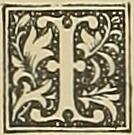
AM the poet of the Body and I am the poet of the Soul,
The pleasures of heaven are with me and the pains of hell are with me;
The first I graft and increase upon myself, the latter I translate into a new tongue.
I am the poet of the woman the same as the man,
And I say it is as great to be a woman as to be a man,
And I say there is nothing greater than the mother of men.
I chant the chant of dilation or pride,
We have had ducking and deprecation about enough,
I show that size is only development.
Have you outstript the rest? are you the President?
It is a trifle, they will more than arrive there everyone, and still pass on.
I am he that walks with the tender and growing night,
I call to the earth and sea, half-held by the night.
Press close bare-blossom’d night—press close magnetic nourishing night!
Night of the South winds—night of the large few stars!
Still nodding night—mad naked summer night.
Smile, O voluptuous cool-breath’d earth!
Earth of the slumbering and liquid trees!
Earth of the departed sunset—earth of the mountain misty-topt!
Earth of the vitreous pour of the full moon just tinged with blue!
Earth of the shine and dark mottling the tide of the river!
Earth of the limpid gray of clouds brighter and clearer for my sake!
Far-swooping elbow’d earth—rich apple-blossom’d earth!
Smile, for your lover comes.
Prodigal, you have given me love—therefore I to you give love!
O unspeakable, passionate love.
OLD IRELAND.
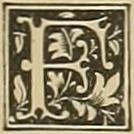
AR hence amid an isle of wondrous beauty,
Crouching over a grave an ancient sorrowful mother,
Once a queen, now lean and tatter’d seated on the ground,
Her old white hair drooping dishevel’d round her shoulders,
At her feet fallen an unused royal harp,
Long silent, she too long silent, mourning her shrouded hope and heir,
Of all the earth her heart most full of sorrow because most full of love.
Yet a word, ancient mother,
You need crouch there no longer on the cold ground with forehead between your knees;
O you need not sit there veil’d in your old white hair so dishevel’d,
For know you the one you mourn is not in that grave;
It was an illusion, the son you love was not really dead;
The Lord is not dead, he is risen again, young and strong, in another country,
Even while you wept there by your fallen harp by the grave,
What you wept for was translated, pass’d from the grave;
The winds favor’d and the sea sail’d it;
And now, with rosy and new blood,
Moves to-day in a new country.
PÆAN OF JOY.
FROM “THE MYSTIC TRUMPETER.”
Reference has been made to the similarity in style manifested in some of Whitman’s poems to the style of the Psalmist. Certain parts of the two selections following justify the criticism.
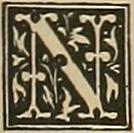
OW trumpeter for thy close,
Vouchsafe a higher strain than any yet,
Sing to my soul, renew its languishing faith and hope,
Rouse up my slow belief, give me some vision of the future,
Give me for once its prophecy and joy.
O glad, exulting, culminating song!
A vigor more than earth’s is in thy notes,
Marches of victory—man disenthral’d—the conqueror at last,
Hymns to the universal God from universal man—all joy!
A reborn race appears—a perfect world, all joy!
Women and men in wisdom, innocence and health—all joy!
Riotous, laughing bacchanals fill’d with joy!
War, sorrow, suffering gone—the rank earth purged—nothing but joy left!
The ocean fill’d with joy—the atmosphere all joy!
Joy! joy! in freedom, worship, love! joy in the ecstasy of life!
Enough to merely be! enough to breathe!
Joy! joy! all over joy!

JAMES MAURICE THOMPSON.
POET AND SCIENTIST.
URING the past forty years Indiana has been prolific in producing prominent men. General Lew Wallace, James Whitcomb Riley, Joaquin Miller and Maurice Thompson are among the prominent men of letters who are natives of the “Hoosier State.”

Maurice Thompson is claimed as belonging to both the North and South, and his record, perhaps, justifies this double claim. He was born at Fairfield, Indiana, September 9th, 1844, but his parents removed to Kentucky during his childhood and subsequently to Northern Georgia. He grew up in the latter state, and was so thoroughly Southern in sentiment that he enlisted and fought in the Confederate Army. At the end of the war, however, he returned to Indiana, where he engaged with a Railway Surveying Party in which he proved himself so efficient that he was raised from a subordinate to the head position in that work, which he followed for some years. After a course of study in law, he began his practice in Crawfordsville, Indiana, the same town in which General Lew Wallace lived. It was from this section that he was elected to the legislature in 1879.
Maurice Thompson is not only a man of letters, but is a scientist of considerable ability. In 1885, he was appointed chief of the State Geological Survey. He was also a Naturalist devoting much attention to ornithology. Many of his poems and most delightful prose sketches are descriptive of bird life.
Mr. Thompson has traveled much in the United States, and his writings in various periodicals as well as his books have attracted wide attention for their original observation and extensive information while they are excelled by few modern writers for poetic richness and diction.
The first book published by this author was entitled “Hoosier Mosaics” which appeared in 1875. Since then he has issued quite a number of volumes among which are “The Witchery of Archey;” “The Tallahassee Girl;” “His Second Campaign;” “Songs of Fair Weather;” “At Loves Extremes;” “By Ways and Bird Notes;” “The Boy’s Book of Sports;” “A Banker of Bankersville;” “Sylvan Secrets;” “The Story of Louisiana;” “A Fortnight of Folly.”
In 1890 Mr. Thompson published “Bankers of Boonville” and the same year became a staff writer for the New York Independent.
CERES.¹
(THE GODDESS OF GRAIN.)
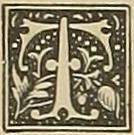
HE wheat was flowing ankle-deep
Across the field from side to side;
And dipping in the emerald waves,
The swallows flew in circles wide.
The sun, a moment flaring red,
Shot level rays athwart the world,
Then quenched his fire behind the hills,
With rosy vapors o’er him curled.
A sweet, insinuating calm,—
A calm just one remove from sleep,
Such as a tranquil watcher feels,
Seeing mild stars at midnight sweep
Through splendid purple deeps, and swing
Their old, ripe clusters down the west
To where, on undiscovered hills,
The gods have gathered them to rest,—
A calm like that hung over all
The dusky groves, and, filtered through
The thorny hedges, touched the wheat
Till every blade was bright with dew.
Was it a dream? We call things dreams
When we must needs do so, or own
Belief in old, exploded myths,
Whose very smoke has long since flown.
Was it a dream? Mine own eyes saw,
And Ceres came across the wheat
That, like bright water, dimpled round
The golden sandals of her feet.
DIANA.¹
(THE GODDESS OF THE CHASE.)
HE had a bow of yellow horn
Like the old moon at early morn.
She had three arrows strong and good,
Steel set in feathered cornel wood.
Like purest pearl her left breast shone
Above her kirtle’s emerald zone;
Her right was bound in silk well-knit,
Lest her bow-string should sever it.
Ripe lips she had, and clear gray eyes,
And hair pure gold blown hoyden-wise.
Across her face like shining mist
That with dawn’s flush is faintly kissed.
Her limbs! how matched and round and fine!
How free like song! how strong like wine!
And, timed to music wild and sweet,
How swift her silver-sandalled feet!
Single of heart and strong of hand,
Wind-like she wandered through the land.
No man (or king or lord or churl)
Dared whisper love to that fair girl.
And woe to him who came upon
Her nude, at bath, like Acteon!
So dire his fate, that one who heard
The flutter of a bathing bird,
What time he crossed a breezy wood,
Felt sudden quickening of his blood;
Cast one swift look, then ran away
Far through the green, thick groves of May;
Afeard, lest down the wind of spring
He’d hear an arrow whispering!

THOMAS BAILEY ALDRICH.
ITHOUT the rich imagination of Stoddard, or the versatility of Stedman, Mr. Aldrich surpasses them both in delicate and artistic skill. His jewelled lines, exquisitely pointed, express a single mood or a dainty epigram with a pungent and tasteful beauty that places him easily at the head of our modern lyrical writers.

Thomas Bailey Aldrich was born at Portsmouth, New Hampshire, November 11, 1836. In childhood he was taken to Louisiana, where he remained a number of years, his father being a merchant at New Orleans. After returning to Portsmouth, he was preparing for college when his father suddenly died, making it necessary for him to relinquish this design, to take a position of immediate remuneration, which he found in his uncle’s counting house in New York. This pursuit he found so far removed from the bent of his mind, however, that he gave it up after three years to take a situation as a reader in a New York publishing house. During his mercantile career he contributed to the current press, and afterwards became attached to various periodicals as contributor or in an editorial capacity. Among others, he worked on N. P. Willis’ “Home Journal,” the “Illustrated News,” and the “New York Evening Mirror.” During the Civil War he was for a time with the Army of the Potomac, as a newspaper correspondent. In 1865, he married, and removed to Boston, where he edited “The Weekly Journal” every Saturday. He remained with this paper until 1874. In 1881 he succeeded William Dean Howells as editor of the “Atlantic Monthly.” This position he resigned in 1890 in order to devote himself to personal literary work and travel. The degree of A. M. was conferred upon him in 1883 by Yale, and in 1896 by Harvard University.
Mr. Aldrich had published one volume of verse, “The Bells” (1854), a collection of juvenile verses, before the “Ballad of Baby Bell and Other Poems” appeared in 1858, and made his reputation as a poet. Other volumes of his poetry issued at the following dates are entitled: “Pampinea and Other Poems” (1861), “Cloth of Gold and Other Poems” (1873), “Flower and Thorn” (1876), “Friar Jerome’s Beautiful Book” (1881), “Mercedes and Later Lyrics” (1883), “Wyndham Towers” (1889), “Judith and Holofernes, a Poem” (1896).
Among the prose works of the author we mention “Out of His Head, a Romance” (1862), “The Story of a Bad Boy” (1869),—which became at once a favorite by its naturalness and purity of spirit,—“♦Marjorie Daw and Other People” (1873), “Prudence Palfrey” (1874), “The Queen of Sheba” (1877), “The Stillwater Tragedy” (1880), “From Ponkapog to Pesth” (1883),“The Sisters Tragedy” (1890), “An Old Town by the Sea;” and “Two Bites at a Cherry and other Tales” (1893), “Unguarded Gates” (1895). “Complete Works,” in eight volumes, were published in 1897. Mr. Aldrich is said to be a man of the world as well as a man of letters and his personal popularity equals his literary reputation. We cannot better illustrate his companionable nature and close this sketch than by presenting the following pen picture of an incident, clipped from a recent magazine:
During a visit to England, upon one occasion, Mr. Aldrich was the guest of William Black, with a number of other well known people. An English journalist of some distinction, who had no time to keep in touch with the personality of poets, met Mr. Aldrich, and they became excellent friends. They went on long shooting expeditions together, and found each other more than good companions. The last night of their stay came, and after dinner Mr. Black made a little speech, in which he spoke of Mr. Aldrich’s poetry in a graceful fashion. The London journalist gave a gasp, and looked at Mr. Aldrich, who rose to make a response, as if he had never seen him before. As the poet sat down he leaned over him, and said:—
“Say, Aldrich, are you the man who writes books?”
“Yes,” Mr. Aldrich said. “I am glad you don’t know, for I am sure you liked me for myself.”
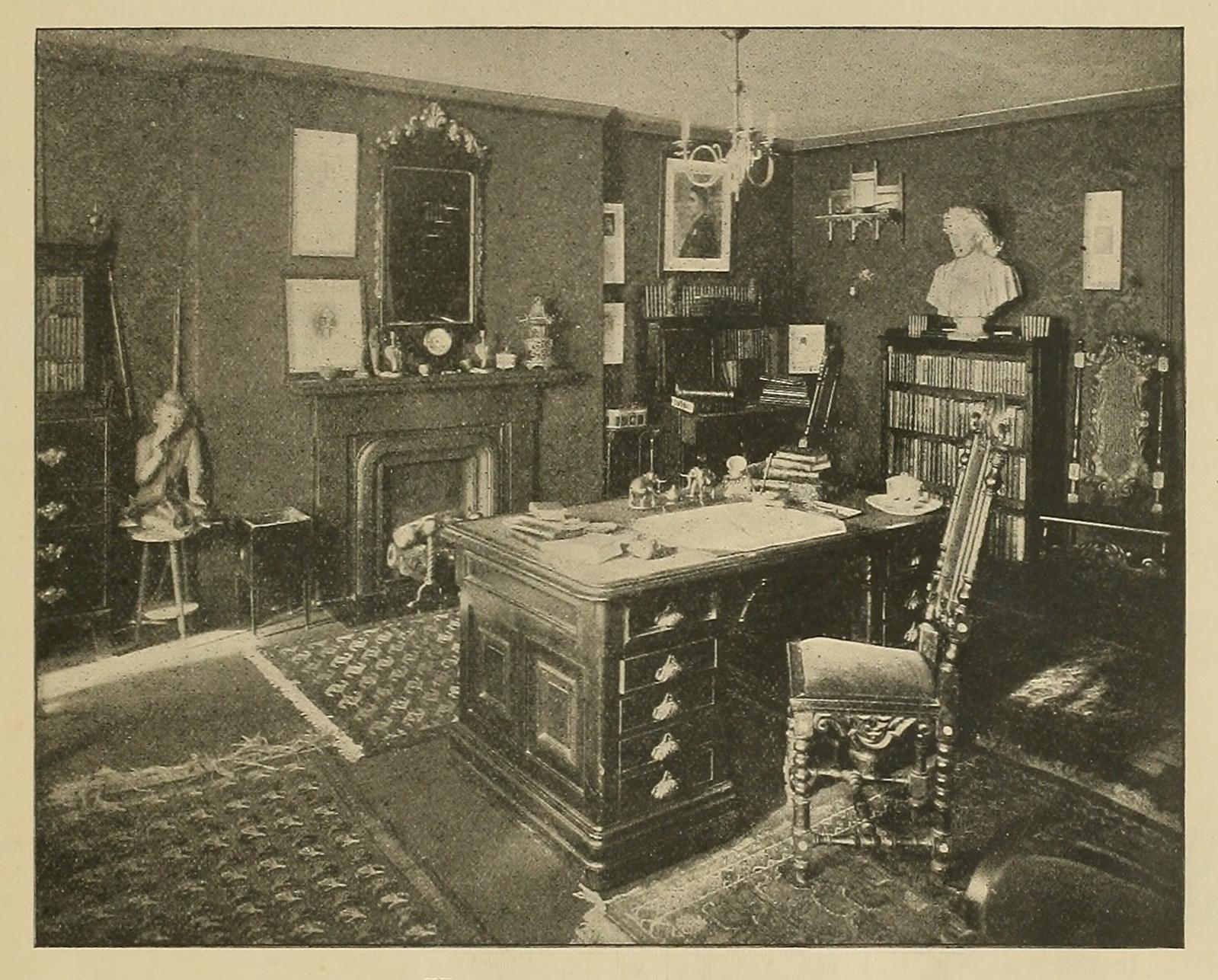
THOMAS B. ALDRICH’S STUDY.
ALEC YEATON’S SON.¹
GLOUCESTER, AUGUST, 1720.
HE wind it wailed, the wind it moaned,
And the white caps flecked the sea;
“An’ I would to God,” the skipper groaned,
“I had not my boy with me!”
Snug in the stern-sheets, little John
Laughed as the scud swept by;
But the skipper’s sunburnt cheek grew wan
As he watched the wicked sky.
“Would he were at his mother’s side!”
And the skipper’s eyes were dim.
“Good Lord in heaven, if ill betide,
What would become of him!
“For me—my muscles are as steel,
For me let hap what may:
I might make shift upon the keel
Until the break o’ day.
“But he, he is so weak and small,
So young, scarce learned to stand—
O pitying Father of us all,
I trust him in thy hand!
“For Thou, who markest from on high
A sparrow’s fall—each one!—
Surely, O Lord, thou’lt have an eye
On Alec Yeaton’s son!”
Then, steady, helm! Right straight he sailed
Towards the headland light:
The wind it moaned, the wind it wailed,
And black, black fell the night.
Then burst a storm to make one quail
Though housed from winds and waves—
They who could tell about that gale
Must rise from watery graves!
Sudden it came, as sudden went;
Ere half the night was sped,
The winds were hushed, the waves were spent,
And the stars shone overhead.
Now, as the morning mist grew thin,
The folk on Gloucester shore
Saw a little figure floating in
Secure, on a broken oar!
Up rose the cry, “A wreck! a wreck!
Pull, mates, and waste no breath!”—
They knew it, though ’t was but a speck
Upon the edge of death!
Long did they marvel in the town
At God His strange decree,
That let the stalwart skipper drown
And the little child go free!
ON LYNN TERRACE.¹
LL day to watch the blue wave curl and break,
All night to hear it plunging on the shore—
In this sea-dream such draughts of life I take,
I cannot ask for more.
Behind me lie the idle life and vain,
The task unfinished, and the weary hours;
That long wave softly bears me back to Spain
And the Alhambra’s towers!
Once more I halt in Andalusian Pass,
To list the mule-bells jingling on the height;
Below, against the dull esparto grass,
The almonds glimmer white.
Huge gateways, wrinkled, with rich grays and browns,
Invite my fancy, and I wander through
The gable-shadowed, zigzag streets of towns
The world’s first sailors knew.
Or, if I will, from out this thin sea-haze
Low-lying cliffs of lovely Calais rise;
Or yonder, with the pomp of olden days,
Venice salutes my eyes.
Or some gaunt castle lures me up its stair;
I see, far off, the red-tiled hamlets shine,
And catch, through slits of windows here and there,
Blue glimpses of the Rhine.
Again I pass Norwegian fjord and fjeld,
And through bleak wastes to where the sunset’s fires
Light up the white-walled Russian citadel,
The Kremlin’s domes and spires.
And now I linger in green English lanes,
By garden plots of rose and heliotrope;
And now I face the sudden pelting rains
On some lone Alpine slope.
Now at Tangier, among the packed bazars,
I saunter, and the merchants at the doors
Smile, and entice me: here are jewels like stars,
And curved knives of the Moors;
Cloths of Damascus, strings of amber dates;
What would Howadji—silver, gold, or stone?
Prone on the sun-scorched plain outside the gates
The camels make their moan.
All this is mine, as I lie dreaming here,
High on the windy terrace, day by day;
And mine the children’s laughter, sweet and clear,
Ringing across the bay.
For me the clouds; the ships sail by for me;
For me the petulant sea-gull takes its flight;
And mine the tender moonrise on the sea,
And hollow caves of night.
SARGENT’S PORTRAIT OF EDWIN BOOTH AT “THE PLAYERS.”
By Permission of the Author.
HAT face which no man ever saw
And from his memory banished quite,
With eyes in which are Hamlet’s awe
And Cardinal Richelieu’s subtle light
Looks from this frame. A master’s hand
Has set the master-player here,
In the fair temple¹ that he planned
Not for himself. To us most dear
This image of him! “It was thus
He looked; such pallor touched his cheek;
With that same grace he greeted us—
Nay, ’tis the man, could it but speak!”
Sad words that shall be said some day—
Far fall the day! O cruel Time,
Whose breath sweeps mortal things away,
Spare long this image of his prime,
That others standing in the place
Where, save as ghosts, we come no more,
May know what sweet majestic face
The gentle Prince of Players wore!

RICHARD WATSON GILDER.
“POET, EDITOR AND REFORMER.”
MONG the current poets of America, few, perhaps, deserve more favorable mention than the subject of this sketch. His poetry is notable for its purity of sentiment and delicacy of expression. The story of his life also is one to stimulate the ambition of youth, who, in this cultured age, have not enjoyed the benefits of that college training which has come to be regarded as one of the necessary preliminaries to literary aspiration. This perhaps is properly so, that the public may not be too far imposed upon by incompetent writers. And while it makes the way very hard for him who attempts to scale the walls and force his passage into the world of letters—having not this passport through the gateway—it is the more indicative of the “real genius” that he should assay the task in an heroic effort; and, if he succeeds in surmounting them, the honor is all the greater, and the laurel wreath is placed with more genuine enthusiasm upon the victor’s brow by an applauding public.
Richard Watson Gilder does not enjoy the distinction of being a college graduate. He received his education principally in Bellevue Seminary, Bordentown, New Jersey (where he was born February 8, 1844), under the tutelage of his father, Rev. Wm. H. Gilder. Mr. Gilder’s intention was to become a lawyer and began to study for that profession in Philadelphia; but the death of his father, in 1864, made it necessary for him to abandon law to take up something that would bring immediate remuneration. This opportunity was found on the staff of the Newark, New Jersey, “Daily Advertiser,” with which he remained until 1868, when he resigned and founded the “Newark Morning Register,” with Newton Crane as joint editor. The next year, Mr. Gilder, then twenty-five years of age, was called to New York as editor of “Hours at Home,” a monthly journal.
His editorials in “Hours at Home” attracted public attention, and some of his poems were recognized as possessing superior merit. Dr. G. Holland, editor of “Scribner’s Monthly,” was especially drawn to the rising young poet and when, in 1870, it became the “Century Magazine,” Dr. Holland chose Mr. Gilder as his associate editor. On the death of Dr. Holland, in 1881, Mr. Gilder became editor-in-chief. Under his able management of its columns the popularity of the “Century” has steadily advanced, the contribution of his pen and especially his occasional poems adding no small modicum to its high literary standing. His poetic compositions have been issued from time to time in book form and comprised several volumes of poems, among which are “The New Day;” “The Poet and His Master’; “Lyrics;” and “The Celestial Passion.”
Aside from his literary works, Mr. Gilder has been, in a sense, a politician and reformer. By the word politician we do not mean the “spoils-hunting partisan class,” but, like Bryant, from patriotic motives he has been an independent champion of those principles which he regards to be the interest of his country and mankind at large. He comes by his disposition to mix thus in public affairs honestly. His father, before him, was an editor and writer as well as a clergyman. Thus “he was born,” as the saying goes, “with printer’s ink in his veins.” When sixteen years of age (1860) he set up and printed a little paper in New Jersey, which became the organ of the Bell and Everett party in that section. Since that date he has manifested a lively interest in all public matters, where he considered the public good at stake. It was this disposition which forced him to the front in the movement for the betterment of the condition of tenement-houses in New York. He was pressed into the presidency of the Tenement-House Commission in 1894, and through his zeal a thorough inspection was made—running over a period of eight months—vastly improving the comfort and health of those who dwell in the crowded tenements of New York City. The influence of the movement has done much good also in other cities.
Mr. Gilder also takes a deep interest in education, and our colleges have no stauncher friend than he. His address on “Public Opinion” has been delivered by invitation before Yale, Harvard and Johns Hopkins Universities. We quote a paragraph from this address which clearly sets forth his conception of public duty as it should be taught by our institutions of learning:—
“Who will lift high the standard of a disinterested and righteous public opinion if it is not the institutions of learning, great and small, private and public, that are scattered throughout our country? They are the responsible press, and the unsensational but fearless pulpit—it is these that must discriminate; that must set the standard of good taste and good morals, personal and public. They together must cultivate fearless leaders, and they must educate and inspire the following that makes leadership effectual and saving.”
As appears from the above Mr. Gilder is a man of exalted ideals. He despises sham, hypocrisy and all “wickedness in high places.” He regards no man with so much scorn as he who uses his office or position to defend or shield law-breakers and enemies of the public. In his own words,—
“He, only, is the despicable one
Who lightly sells his honor as a shield
For fawning knaves, to hide them from the sun.
Too nice for crime yet, coward, he doth yield
For crime a shelter. Swift to Paradise
The contrite thief, not Judas with his price!”
SONNET.
(AFTER THE ITALIAN.)
From the “Five Books of Song.” (1894.) The Century Co.
KNOW not if I love her overmuch;
But this I know, that when unto her face
She lifts her hand, which rests there, still, a space,
Then slowly falls—’tis I who feel that touch.
And when she sudden shakes her head, with such
A look, I soon her secret meaning trace.
So when she runs I think ’tis I who race.
Like a poor cripple who has lost his crutch
I am if she is gone; and when she goes,
I know not why, for that is a strange art—
As if myself should from myself depart.
I know not if I love her more than those
Who long her light have known; but for the rose
She covers in her hair, I’d give my heart.
THE LIFE MASK OF ABRAHAM LINCOLN.
From “For the Country.” (1897.) The Century Co.
HIS bronze doth keep the very form and mold
Of our great martyr’s face. Yes, this is he:
That brow all wisdom, all benignity;
That human, humorous mouth; those cheeks that hold
Like some harsh landscape all the summer’s gold;
That spirit fit for sorrow, as the sea
For storms to beat on; the lone agony
Those silent, patient lips too well foretold.
Yes, this is he who ruled a world of men
As might some prophet of the elder day—
Brooding above the tempest and the fray
With deep-eyed thought, and more than mortal ken.
A power was his beyond the touch of art
Or armed strength—his pure and mighty heart.
SHERIDAN.
From “For the Country.” (1897.) The Century Co.
UIETLY, like a child
That sinks in slumber mild,
No pain or troubled thought his well-earned peace to mar,
Sank into endless rest our thunder-bolt of war.
Though his the power to smite
Quick as the lightning’s light,—
His single arm an army, and his name a host,—
Not his the love of blood, the warrior’s cruel boast.
But in the battle’s flame
How glorious he came!—
Even like a white-combed wave that breaks and tears the shore,
While wreck lies strewn behind, and terror flies before.
’Twas he,—his voice, his might,—
Could stay the panic flight,
Alone shame back the headlong, many-leagued retreat,
And turn to evening triumph morning’s foul defeat.
He was our modern Mars;
Yet firm his faith that wars
Ere long would cease to vex the sad, ensanguined earth,
And peace forever reign, as at Christ’s holy birth.
Blest land, in whose dark hour
Arise to loftiest power
No dazzlers of the sword to play the tyrant’s part,
But patriot-soldiers, true and pure and high of heart!
Of such our chief of all;
And he who broke the wall
Of civil strife in twain, no more to build or mend;
And he who hath this day made Death his faithful friend.
And now above his tomb
From out the eternal gloom
“Welcome!” his ♦chieftain’s voice sounds o’er the cannon’s knell;
And of the three one only stays to say “Farewell!”
SUNSET FROM THE TRAIN.¹
From “Five Books of Song” (1894).
UT then the sunset smiled,
Smiled once and turned toward dark,
Above the distant, wavering line of trees that filed
Along the horizon’s edge;
Like hooded monks that hark
Through evening air
The call to prayer;—
Smiled once, and faded slow, slow, slow away;
When, like a changing dream, the long cloud-wedge,
Brown-gray,
Grew saffron underneath and, ere I knew,
The interspace, green-blue—
The whole, illimitable, western, skyey shore,
The tender, human, silent sunset smiled once more.
Thee, absent loved one, did I think on now,
Wondering if thy deep brow
In dreams of me were lifted to the skies,
Where, by our far sea-home, the sunlight dies;
If thou didst stand alone,
Watching the day pass slowly, slow, as here,
But closer and more dear,
Beyond the meadow and the long, familiar line
Of blackening pine;
When lo! that second smile;—dear heart, it was thine own.
“O SILVER RIVER FLOWING TO THE SEA.”¹
From “Five Books of Song” (1894).
SILVER river flowing to the sea,
Strong, calm, and solemn as thy mountains be!
Poets have sung thy ever-living power,
Thy wintry day, and summer sunset hour;
Have told how rich thou art, how broad, how deep,
What commerce thine, how many myriads reap
The harvest of thy waters. They have sung
Thy moony nights, when every shadow flung
From cliff or pine is peopled with dim ghosts
Of settlers, old-world fairies, or the hosts
Of savage warriors that once plowed thy waves—
Now hurrying to the dance from hidden graves;
The waving outline of thy wooded mountains,
Thy populous towns that stretch from forest fountains
On either side, far to the salty main,
Like golden coins alternate on a chain.
Thou pathway of the empire of the North,
Thy praises through the earth have traveled forth!
I hear thee praised as one who hears the shout
That follows when a hero from the rout
Of battle issues, “Lo, how brave is he,
How noble, proud, and beautiful!” But she
Who knows him best—“How tender!” So thou art
The river of love to me!
—Heart of my heart,
Dear love and bride—is it not so indeed?—
Among your treasures keep this new-plucked reed.
“THERE IS NOTHING NEW UNDER THE SUN.”¹
From “Five Books of Song” (1894).
HERE is nothing new under the sun;
There is no new hope or despair;
The agony just begun
Is as old as the earth and the air.
My secret soul of bliss
Is one with the singing stars,
And the ancient mountains miss
No hurt that my being mars.
I know as I know my life,
I know as I know my pain,
That there is no lonely strife,
That he is mad who would gain
A separate balm for his woe,
A single pity and cover;
The one great God I know
Hears the same prayer over and over.
I know it because at the portal
Of Heaven I bowed and cried,
And I said: “Was ever a mortal
Thus crowned and crucified!
My praise thou hast made my blame;
My best thou hast made my worst;
My good thou hast turned to shame;
My drink is a flaming thirst.”
But scarce my prayer was said
Ere from that place I turned;
I trembled, I hung my head,
My cheek, shame-smitten, burned;
For there where I bowed down
In my boastful agony,
I thought of thy cross and crown—
O Christ! I remembered thee.
MEMORIAL DAY.¹
From “Five Books of Song” (1894).
HE saw the bayonets flashing in the sun,
The flags that proudly waved; she heard the bugles calling;
She saw the tattered banners falling
About the broken staffs, as one by one
The remnant of the mighty army passed;
And at the last
Flowers for the graves of those whose fight was done.
She heard the tramping of ten thousand feet
As the long line swept round the crowded square;
She heard the incessant hum
That filled the warm and blossom-scented air—
The shrilling fife, the roll and throb of drum,
The happy laugh, the cheer. Oh glorious and meet
To honor thus the dead,
Who chose the better part,
Who for their country bled!
—The dead! Great God! she stood there in the street,
Living, yet dead in soul and mind and heart—
While far away
His grave was decked with flowers by strangers’ hands to-day.
A WOMAN’S THOUGHT.¹
From “Five Books of Song” (1894).
AM a woman—therefore I may not
Call him, cry to him,
Fly to him,
Bid him delay not!
And when he comes to me, I must sit quiet;
Still as a stone—
All silent and cold.
If my heart riot—
Crush and defy it!
Should I grow bold,
Say one dear thing to him,
All my life fling to him,
Cling to him—
What to atone
Is enough for my sinning!
This were the cost to me,
This were my winning—
That he were lost to me.
Not as a lover
At last if he part from me,
Tearing my heart from me,
Hurt beyond cure—
Calm and demure
Then must I hold me,
In myself fold me,
Lest he discover;
Showing no sign to him
By look of mine to him
What he has been to me—
How my heart turns to him,
Follows him, yearns to him,
Prays him to love me.
Pity me, lean to me,
Thou God above me!

JOHN HAY.
AUTHOR OF “LITTLE BREECHES.”
SIDE from General Lew Wallace and Edmund Clarence Stedman few business men or politicians have made a brighter mark in literature than the subject of this sketch.
John Hay was born at Salem, Indiana, October 8th, 1838. He was graduated at Brown’s University at the age of twenty, studied law and began to practice at Springfield, Illinois, in 1861. Soon after this he was made private secretary of President Lincoln, which position he filled throughout the latter’s administration. He also acted as Lincoln’s adjutant and aid-de-camp, and it was in consequence of this that he was brevetted colonel. He also saw service under Generals Hunter and Gilmore as major and assistant adjutant general. After the close of the war Mr. Hay was appointed United States ♦Secretary of Legation at Paris, serving in this capacity from 1865 to 1867, when he was appointed charge d’affaires, where he served for two years, being removed to take a position as Secretary of Legation at Madrid, where he remained until 1870, at which time he returned to the United States and accepted an editorial position on the “New York Tribune.” This he resigned and removed to Cleveland, Ohio, in 1875, where he entered politics, taking an active part in the presidential campaigns of 1876, 1880 and 1884. Under President Hayes he was appointed as first assistant Secretary of State, which position he filled for nearly three years, and has made his home at Washington since that date. On March 17th, Mr. Hay was appointed by President McKinley as ambassador to Great ♣Britain, where he was accorded the usual hearty welcome tendered by the British to American ambassadors, many of whom during the past fifty years having been men of high literary attainment. Shortly after Mr. Hay’s arrival he was called upon to deliver an address at the unveiling of the Walter Scott monument, in which he did his country credit and maintained his own reputation as an orator and a man of letters.
As an author Mr. Hay’s first published works were the “Pike County Ballads and Other Pieces” (1871), “Castilian Days” (1871), “Poems” (1890), and, (in conjunction with Mr. Nicolay), “Abraham Lincoln: a History,” which is regarded as the authoritative biography of Mr. Lincoln. This was first published in serial form in the “Century Magazine” from 1887 to 1889. Colonel Hay has also been a frequent contributor to high class periodicals, and to him has been ascribed the authorship of the anonymous novel “The Bread Winners,” which caused such agitation in labor circles a few years ago.
Like many authors, Mr. Hay came into popularity almost by accident. Certainly he had no expectation of becoming prominent when he wrote his poem “Little Breeches;” yet that poem caused him to be remembered by a wider class of readers, perhaps, than anything else he has contributed to literature. The following account of how this poem came to be written was published after Mr. Hay’s appointment to the Court of St. James in 1897. The statement is given as made by Mr. A. L. Williams, an acquaintance of Mr. Hay, who lives in Topeka, Kansas, and knows the circumstances. “The fact is,” says Mr. Williams, “the poem ‘Little Breeches’ and its reception by the American people make it one of the most humorous features of this day. It was written as a burlesque, and for no other purpose. Bret Harte had inaugurated a maudlin literature at a time when the ‘litery’ people of the United States were affected with hysteria. Under the inspiration of his genius, to be good was commonplace, to be virtuous was stupid—only gamblers, murderers and women of ill fame were heroic. Crime had reached its apotheosis. John Hay believed that ridicule would help cure this hysteria, and thus believing, wrote the burlesque, ‘Little Breeches.’ Wanting to make the burlesque so broad that the commonest intellect could grasp it, he took for his hero an unspeakably wretched brat whom no angel would touch unless to drop over the walls into Tophet, and made him the object of a special angelic miracle.
“Well, John sprung his ‘Little Breeches’ and then sat back with his mouth wide open to join in the laugh which he thought it would evoke from his readers. To his intense astonishment, people took it seriously, and instead of laughing Bret Harte out of the field, immediately made John Hay a formidable rival to that gentleman.”
Next to “Little Breeches” the poem “Jim Bludso,” perhaps, contributed most to Mr. Hay’s reputation. Both of these selections will be found in the succeeding pages.
LITTLE BREECHES.
DON’T go much on religion,
I never ain’t had no show;
But I’ve got a middlin’ tight grip, sir,
On the handful o’ things I know.
I don’t pan out on the prophets
And free-will, and that sort of thing—
But I b’lieve in God and the angels,
Ever sence one night last spring.
I come into town with some turnips,
And my little Gabe come along—
No four-year-old in the county
Could beat him for pretty and strong,
Peart and chipper and sassy,
Always ready to swear and fight—
And I’d learnt him to chaw terbacker
Jest to keep his milk-teeth white.
The snow come down like a blanket
As I passed by Taggart’s store;
I went in for a jug of molasses
And left the team at the door.
They scared at something and started—
I heard one little squall,
And hell-to-split over the prairie
Went team, Little Breeches and all.
Hell-to-split over the prairie;
I was almost froze with skeer;
But we rousted up some torches,
And searched for ’em far and near.
At last we struck hosses and wagon,
Snowed under a soft white mound,
Upsot—dead beat—but of little Gabe
No hide nor hair was found.
And here all hope soured on me,
Of my fellow-critters’ aid,
I jest flopped down on my marrowbones,
Crotch deep in the snow, and prayed.
By this, the torches was played out,
And me and Isrul Parr
Went off for some wood to a sheepfold
That he said was somewhar thar.
We found it at last, and a little shed
Where they shut up the lambs at night,
We looked in and seen them huddled thar,
So warm and sleepy and white;
And thar sot Little Breeches and chirped,
As peart as ever you see,
“I want a chaw of terbacker,
An’ that’s what’s the matter of me.”
How did he git thar? Angels.
He could never have walked in that storm;
They jest scooped down and toted him
To whar it was safe and warm.
And I think that saving a little child,
An’ fotching him to his own,
Is a derned sight better business
Than loafing around the Throne.
JIM BLUDSO.¹
OF “THE PRAIRIE BELLE.”
ALL, no; I can’t tell you whar he lives,
Because he don’t live, you see;
Leastways, he’s got out of the habit
Of livin’ like you and me.
Whar have you been for the last three year
That you haven’t heard folks tell
How Jimmy Bludso passed in his checks
The night of the Prairie Belle?
He weren’t no saint—them engineers
Is all pretty much alike—
One wife in Natchez-under-the-Hill,
And another one here, in Pike;
A keerless man in his talk was Jim,
And an awkward hand in a row,
But he never flunked, and he never lied—
I reckon he never knowed how.
And this was all the religion he had—
To treat his engine well;
Never be passed on the river;
To mind the pilot’s bell;
And if ever the Prairie Belle took fire—
A thousand times he swore,
He’d hold her nozzle agin the bank
Till the last soul got ashore.
All boats has their day on the Mississip,
And her day come at last—
The Movastar was a better boat,
But the Belle she wouldn’t be passed,
And so she come tearin’ along that night—
The oldest craft on the line—
With a nigger squat on her safety-valve,
And her furnace crammed, rosin and pine.
A fire burst out as she cl’ared the bar,
And burnt a hole in the night,
And quick as a flash she turned, and made
For that willer-bank on the right.
There was runnin’, and cursin’, but Jim yelled out,
Over all the infernal roar,
“I’ll hold her nozzle agin the bank
Till the last galoot’s ashore.”
Through the hot black breath of the burnin’ boat
Jim Bludso’s voice was heard,
And they all had trust in his cussedness,
And knowed he would keep his word,
And, sure’s you’re born, they all got off
Afore the smokestacks fell—
And Bludso’s ghost went up alone
In the smoke of the Prairie Belle.
He weren’t no saint; but at judgment
I’d run my chance with Jim,
’Longside some pious gentlemen
That wouldn’t shook hands with him.
He seen his duty—a dead-sure thing—
And went for it thar and then;
And Christ ain’t a-going to be too hard
On a man that died for men.
HOW IT HAPPENED.¹
PRAY your pardon, Elsie,
And smile that frown away
That dims the light of your lovely face
As a thunder-cloud the day,
I really could not help it,—
Before I thought, it was done,—
And those great grey eyes flashed bright and cold,
Like an icicle in the sun.
I was thinking of the summers
When we were boys and girls,
And wandered in the blossoming woods,
And the gay wind romped with her curls.
And you seemed to me the same little girl
I kissed in the alder-path,
I kissed the little girl’s lips, and alas!
I have roused a woman’s wrath.
There is not so much to pardon,—
For why were your lips so red?
The blonde hair fell in a shower of gold
From the proud, provoking head.
And the beauty that flashed from the splendid eyes
And played round the tender mouth,
Rushed over my soul like a warm sweet wind
That blows from the fragrant South.
And where after all is the harm done?
I believe we were made to be gay,
And all of youth not given to love
Is vainly squandered away,
And strewn through life’s low labors,
Like gold in the desert sands,
Are love’s swift kisses and sighs and vows
And the clasp of clinging hands.
And when you are old and lonely,
In memory’s magic shrine
You will see on your thin and wasting hands,
Like gems, these kisses of mine.
And when you muse at evening
At the sound of some vanished name,
The ghost of my kisses shall touch your lips
And kindle your heart to flame.
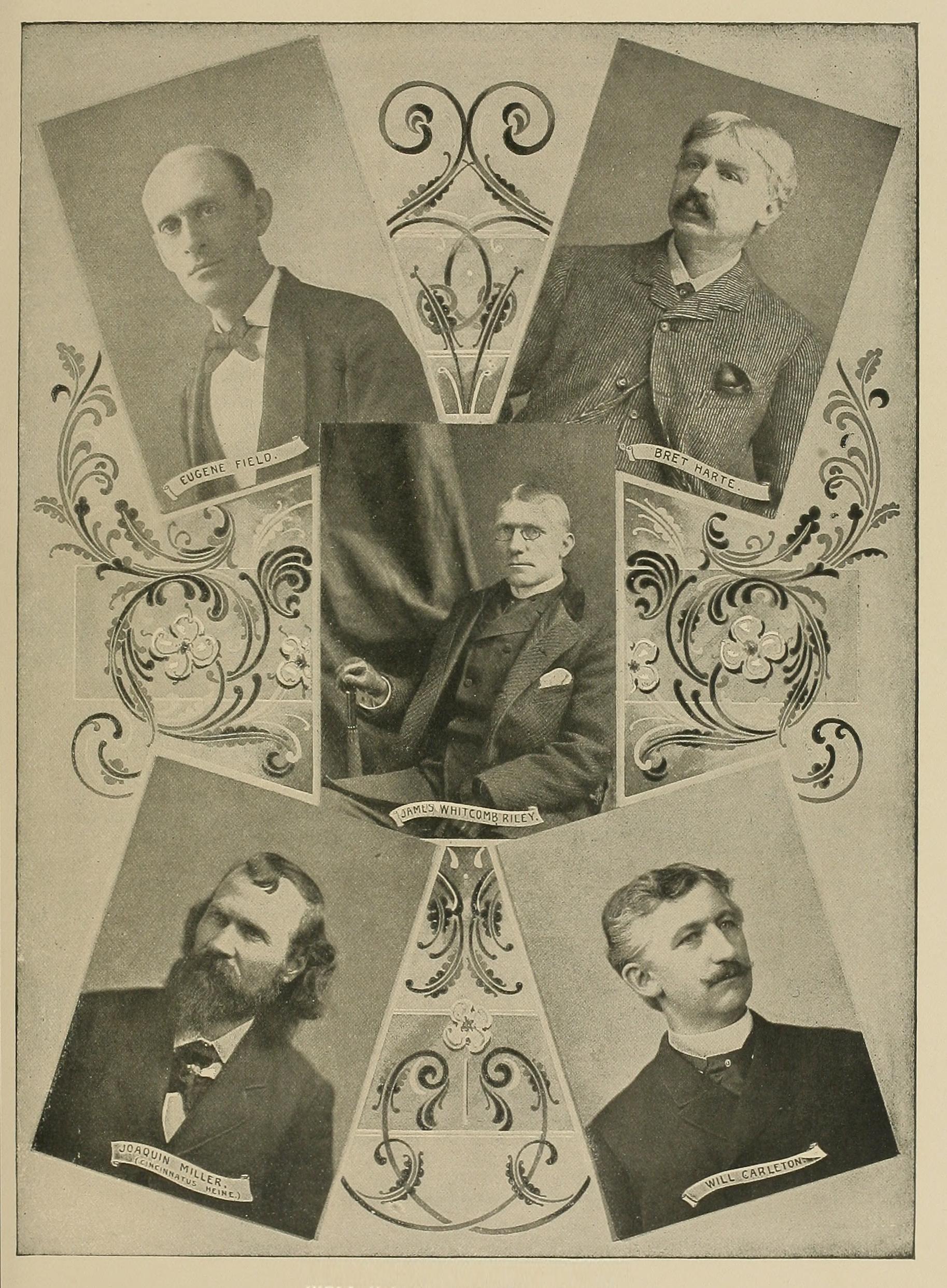
WELL-KNOWN WESTERN POETS.
EUGENE FIELD • BRET HARTE JAMES WHITCOMB RILEY JOAQUIN MILLER (CINCINNATUS HEINE) • WILL CARLETON

JAMES WHITCOMB RILEY.
“THE HOOSIER POET.”
O poet of the modern times has obtained a greater popularity with the masses than the Indianian, James Whitcomb Riley, who has recently obtained the rank of a National Poet, and whose temporary hold upon the people equals, if it does not exceed, that of any living verse writer. The productions of this author have crystallized certain features of life that will grow in value as time goes by. In reading “The Old Swimmin’ Hole,” one almost feels the cool refreshing water touch the thirsty skin. And such poems as “Griggsby’s Station,” “Airly Days,” “When the Frost is on the Punkin,” “That Old Sweetheart of Mine,” and others, go straight to the heart of the reader with a mixture of pleasant recollections, tenderness, humor, and sincerity, that is most delightful in its effect.
Mr. Riley is particularly a poet of the country people. Though he was not raised on a farm himself, he had so completely imbibed its atmosphere that his readers would scarcely believe he was not the veritable Benjamin F. Johnston, the simple-hearted Boone County farmer, whom he honored with the authorship of his early poems. To every man who has been a country boy and “played hookey” on the school-master to go swimming or fishing or bird-nesting or stealing water-melons, or simply to lie on the orchard grass, many of Riley’s poems come as an echo from his own experiences, bringing a vivid and pleasingly melodious retrospect of the past.
Mr. Riley’s “Child Verses” are equally as famous. There is an artless catching sing-song in his verses, not unlike the jingle of the “Mother Goose Melodies.” Especially fine in their faithfulness to child-life, and in easy ♦rhythm, are the pieces describing “Little Orphant Allie” and “The Ragged Man.”
An’ Little Orphant Allie says, when the blaze is blue,
An’ the lampwick sputters, an’ the wind goes woo-oo!
An’ you hear the crickets quit, an’ the moon is gray,
An’ the lightnin’-bug in dew is all squenched away,—
You better mind yer parents and yer teacher fond an’ dear,
An’ cherish them ’at loves you and dry the orphant’s tear,
An’ he’p the poor an’ needy ones ’at cluster all about,
Er the gobble-uns ’ll git you
Ef you—don’t—watch—out.
James Whitcomb Riley was born in Greenfield, Indiana, in 1853. His father was a Quaker, and a leading attorney of that place, and desired to make a lawyer of his son; but Mr. Riley tells us, “Whenever I picked up ‘Blackstone’ or ‘Greenleaf,’ my wits went to wool-gathering, and my father was soon convinced that his hopes of my achieving greatness at the bar were doomed to disappointment.” Referring to his education, the poet further says, “I never had much schooling, and what I did get, I believe did me little good. I never could master mathematics, and history was a dull and juiceless thing to me; but I always was fond of reading in a random way, and took naturally to the theatrical. I cannot remember when I was not a declaimer, and I began to rhyme almost as soon as I could talk.”
Riley’s first occupation was as a sign painter for a patent-medicine man, with whom he traveled for a year. On leaving this employment he organized a company of sign painters, with whom he traveled over the country giving musical entertainments and painting signs. In referring to this he says, “All the members of the company were good musicians as well as painters, and we used to drum up trade with our music. We kept at it for three or four years, made plenty of money, had lots of fun, and did no harm to ourselves or any one else. Of course, during this sign painting period, I was writing verses all the time, and finally after the Graphic Company’s last trip I secured a position on the weekly paper at Anderson.” For many years Riley endeavored to have his verses published in various magazines, “sending them from one to another,” he says, “to get them promptly back again.” Finally, he sent some verses to the poet Longfellow, who congratulated him warmly, as did also Mr. Lowell, to whose “New England Dialectic Poems” Mr. Riley’s “Hoosier Rhymes” bore a striking resemblance. From this time forward his success was assured, and, instead of hunting publishers, he has been kept more than busy in supplying their eager demands upon his pen.
Mr. Riley’s methods of work are peculiar to himself. His poems are composed as he travels or goes about the streets, and, once they are thought out, he immediately stops and transfers them to paper. But he must work as the mood or muse moves him. He cannot be driven. On this point he says of himself, “It is almost impossible for me to do good work on orders. If I have agreed to complete a poem at a certain time, I cannot do it at all; but when I can write without considering the future, I get along much better.” He further says, with reference to writing dialect, that it is not his preference to do so. He prefers the recognized poetic form; “but,” he adds, “dialectic verse is natural and gains added charm from its very commonplaceness. If truth and depiction of nature are wanted, and dialect is a touch of nature, then it should not be disregarded. I follow nature as closely as I can, and try to make my people think and speak as they do in real life, and such success as I have achieved is due to this.”
The first published work of the author was “The Old Swimmin’ Hole” and “’Leven More Poems,” which appeared in 1883. Since that date he published a number of volumes. Among the most popular may be mentioned, “Armazindy,” which contains some of his best dialect and serious verses, including the famous Poe Poem, “Leonainie,” written and published in early life as one of the lost poems of Poe, and on which he deceived even Poe’s biographers, so accurate was he in mimicking the style of the author of the “Raven;” “Neighborly Poems;” “Sketches in Prose,” originally published as “The Boss Girl and Other Stories;” “Afterwhiles,” comprising sixty-two poems and sonnets, serious, pathetic, humorous and dialectic; “Pipes O’ Pan,” containing five sketches and fifty poems; “Rhymes of Childhood;” “Flying Islands of the Night,” a weird and grotesque drama in verse; “Green Fields and Running Brooks,” comprising one hundred and two poems and sonnets, dialectic, humorous and serious.
The poet has never married. He makes his home in Indianapolis, Indiana, with his sister, where his surroundings are of the most pleasant nature; and he is scarcely less a favorite with the children of the neighborhood than was the renowned child poet, Eugene Field, at his home. The devotion of Mr. Riley to his aged parents, whose last days he made the happiest and brightest of their lives, has been repeatedly commented upon in the current notices of the poet. Mr. Riley has personally met more of the American people, perhaps, than any other living poet. He is constantly “on the wing.” For about eight months out of every twelve for the past several years he has been on the lecture platform, and there are few of the more intelligent class of people in the leading cities of America, who have not availed themselves, at one time or another, to the treat of listening to his inimitable recitation of his poems. His short vacation in the summer—“his loafing days,” as he calls them—are spent with his relatives, and it is on these occasions that the genial poet is found at his best.
A BOY’S MOTHER.¹
FROM “POEMS HERE AT HOME.”
Y mother she’s so good to me,
Ef I wuz good as I could be,
I couldn’t be as good—no, sir!—
Can’t any boy be good as her!
She loves me when I’m glad er sad;
She loves me when I’m good er bad;
An’, what’s a funniest thing, she says
She loves me when she punishes.
I don’t like her to punish me.—
That don’t hurt,—but it hurts to see
Her cryin’.—Nen I cry; an’ nen
We both cry an’ be good again.
She loves me when she cuts an’ sews
My little cloak an’ Sund’y clothes;
An’ when my Pa comes home to tea,
She loves him most as much as me.
She laughs an’ tells him all I said,
An’ grabs me an’ pats my head;
An’ I hug her, an’ hug my Pa,
An’ love him purt’-nigh much as Ma.
THOUGHTS ON THE LATE WAR.¹
FROM “POEMS HERE AT HOME.”
WAS for Union—you, ag’in’ it.
’Pears like, to me, each side was winner,
Lookin’ at now and all ’at ’s in it.
Le’ ’s go to dinner.
Le’ ’s kind o’ jes’ set down together
And do some pardnership forgittin’—
Talk, say, for instance, ’bout the weather,
Or somepin’ fittin’.
The war, you know, ’s all done and ended,
And ain’t changed no p’ints o’ the compass;
Both North and South the health’s jes’ splendid
As ’fore the rumpus.
The old farms and the old plantations
Still ockipies the’r old positions.
Le’ ’s git back to old situations
And old ambitions.
Le’ ’s let up on this blame’, infernal
Tongue-lashin’ and lap-jacket vauntin’
And git back home to the eternal
Ca’m we’re a-wantin’.
Peace kind o’ sort o’ suits my diet—
When women does my cookin’ for me,
Ther’ wasn’t overly much pie et
Durin’ the army.
OUR HIRED GIRL.¹
FROM “POEMS HERE AT HOME.”
UR hired girl, she’s ’Lizabuth Ann;
An’ she can cook best things to eat!
She ist puts dough in our pie-pan,
An’ pours in somepin’ ’at ’s good an’ sweet;
An’ nen she salts it all on top
With cinnamon; an’ nen she’ll stop
An’ stoop an’ slide it, ist as slow,
In th’ old cook-stove, so ’s ’t wont slop
An’ git all spilled; nen bakes it, so
It’s custard-pie, first thing you know!
An’ nen she’ll say,
“Clear out o’ my way!
They’s time fer work, an’ time fer play!
Take yer dough, an’ run, child, run!
Er I cain’t git no cookin’ done!”
When our hired girl ’tends like she’s mad,
An’ says folks got to walk the chalk
When she’s around, er wisht they had!
I play out on our porch an’ talk
To th’ Raggedy Man ’t mows our lawn;
An’ he says, “Whew!” an’ nen leans on
His old crook-scythe, and blinks his eyes,
An’ sniffs all ’round an’ says, “I swawn!
Ef my old nose don’t tell me lies,
It ’pears like I smell custard-pies!”
An’ nen he’ll say,
“Clear out o’ my way!
They’s time fer work, an’ time fer play!
Take yer dough, an’ run, child, run!
Er she cain’t git no cookin’ done!”
Wunst our hired girl, when she
Got the supper, an’ we all et,
An’ it wuz night, an’ Ma an’ me
An’ Pa went wher’ the “Social” met,—
An’ nen when we come home, an’ see
A light in the kitchen-door, an’ we
Heerd a maccordeun, Pa says, “Lan’-
O’-Gracious! who can her beau be?”
An’ I marched in, an’ ’Lizabuth Ann
Wuz parchin’ corn fer the Raggedy Man!
Better say,
“Clear out o’ the way!
They’s time fer work, an’ time fer play!
Take the hint, an’ run, child, run!
Er we cain’t git no courtin’ done!”
THE RAGGEDY MAN.¹
FROM “POEMS HERE AT HOME.”
THE Raggedy Man! He works fer Pa;
An’ he’s the goodest man ever you saw!
He comes to our house every day,
An’ waters the horses, an’ feeds ’em hay;
An’ he opens the shed—an’ we all ist laugh
When he drives out our little old wobble-ly calf;
An’ nen—ef our hired girl says he can—
He milks the cow fer ’Lizabuth Ann.—
Ain’t he a’ awful good Raggedy Man?
Raggedy! Raggedy! Raggedy Man!
W’y, the Raggedy Man—he ’s ist so good,
He splits the kindlin’ an’ chops the wood;
An’ nen he spades in our garden, too,
An’ does most things ’t boys can’t do.—
He clumbed clean up in our big tree
An’ shooked a’ apple down fer me—
An’ ’nother ’n’, too, fer ’Lizabuth Ann—
An’ ’nother ’n’, too, fer the Raggedy Man.—
Ain’t he a’ awful kind Raggedy Man?
Raggedy! Raggedy! Raggedy Man!
An’ the Raggedy Man, he knows most rhymes,
An’ tells ’em, ef I be good, sometimes:
Knows ’bout Giunts, an’ Griffuns, an’ Elves,
An’ the Squidgicum-Squees ’at swallers therselves!
An’, wite by the pump in our pasture-lot,
He showed me the hole ’at the Wunks is got,
’At lives ’way deep in the ground, an’ can
Turn into me, er ’Lizabuth Ann!
Ain’t he a funny old Raggedy Man?
Raggedy! Raggedy! Raggedy Man!
The Raggedy Man—one time, when he
Wuz makin’ a little bow’-n’-orry fer me,
Says, “When you’re big like your Pa is,
Air you go’ to keep a fine store like his—
An’ be a rich merchunt—an’ wear fine clothes?—
Er what air you go’ to be, goodness knows?”
An’ nen he laughed at ’Lizabuth Ann,
An’ I says, “’M go’ to be a Raggedy Man!—
I’m ist go’ to be a nice Raggedy Man!”
Raggedy! Raggedy! Raggedy Man!
FRANCIS BRET HARTE.
THE POET OF THE MINING CAMP AND THE WESTERN MOUNTAINS.
HE turbulent mining camps of California, with their vicious hangers-on, have been embalmed for future generations by the unerring genius of Bret Harte, who sought to reveal the remnants of honor in man, and loveliness in woman, despite the sins and vices of the mining towns of our Western frontier thirty or forty years ago. His writings have been regarded with disfavor by a religious class of readers because of the frequent occurrence of rough phrases and even profanity which he employs in his descriptions. It should be remembered, however, that a faithful portrait of the conditions and people which he described could hardly have been presented in more polite language than that employed.
Bret Harte was born in Albany, New York, in 1839. His father was a scholar of ripe culture, and a teacher in the Albany Female Seminary. He died poor when Bret was quite young, consequently the education of his son was confined to the common schools of the city. When only seventeen years of age, young Harte, with his widowed mother, emigrated to California. Arriving in San Francisco he walked to the mines of Sonora and there opened a school which he taught for a short time. Thus began his self-education in the mining life which furnished the material for his early literature. After leaving his school he became a miner, and at odd times learned to set type in the office of one of the frontier papers. He wrote sketches of the strange life around him, set them up in type himself, and offered the proofs to the editor, believing that in this shape they would be more certain of acceptance. His aptitude with his pen secured him a position on the paper, and in the absence of the editor he once controlled the journal and incurred popular wrath for censuring a little massacre of Indians by the leading citizens of the locality, which came near bringing a mob upon him.
The young adventurer,—for he was little else at this time,—also served as mounted messenger of an express company and as express agent in several mountain towns, which gave him a full knowledge of the picturesque features of mining life. In 1857 he returned to San Francisco and secured a position as compositor on a weekly literary journal. Here again he repeated his former trick of setting up and submitting several spirited sketches of mining life in type. These were accepted and soon earned him an editorial position on the “Golden Era.” After this he made many contributions to the daily papers and his tales of Western life began to attract attention in the East. In 1858, he married, which put an end to his wanderings. He attempted to publish a newspaper of his own, “The Californian,” which was bright and worthy to live, but failed for want of proper business management.
In 1864 Mr. Harte was appointed Secretary of the United States Branch Mint at San Francisco, and during his six years of service in this position found leisure to write some of his popular poems, such as “John Burns, of Gettysburg,” “How Are You, Sanitary?” and others, which were generally printed in the daily newspapers. He also became editor of the “Overland Monthly” when it was founded in 1868, and soon made this magazine as great a favorite on the Atlantic as on the Pacific Coast, by his contribution to its columns of a series of sketches of California life which have won a permanent place in literature. Among these sketches are “The Luck of Roaring Camp,” telling how a baby came to rule the hearts of a rough, dissolute gang of miners. It is said that this masterpiece, however, narrowly escaped the waste-basket at the hands of the proofreader, a woman, who, without noticing its origin, regarded it as utter trash. “The Outcast of Poker Flat,” “Miggles,” “Tennessee’s Partner,” “An Idyl of Red Gulch,” and many other stories which revealed the spark of humanity remaining in brutalized men and women, followed in rapid succession.
Bret Harte was a man of the most humane nature, and sympathized deeply with the Indian and the Chinaman in the rough treatment they received at the hands of the early settlers, and his literature, no doubt, did much to soften and mollify the actions of those who read them—and it may be safely said that almost every one did, as he was about the only author at that time on the Pacific Slope and very popular. His poem, “The Heathen Chinee,” generally called “Plain Language from Truthful James,” was a masterly satire against the hue and cry that the Chinese were shiftless and weak-minded settlers. This poem appeared in 1870 and was wonderfully popular.
In the spring of 1871 the professorship of recent literature in the University of California was offered to Mr. Harte, on his resignation of the editorship of the “Overland Monthly,” but he declined the proffer to try his literary fortunes in the more cultured East. He endeavored to found a magazine in Chicago, but his efforts failed, and he went to Boston to accept a position on the “Atlantic Monthly,” since which time his pen has been constantly employed by an increasing demand from various magazines and literary journals. Mr. Harte has issued many volumes of prose and poetry, and it is difficult to say in which field he has won greater distinction. Both as a prose writer and as a poet he has treated similar subjects with equal facility. His reputation was made, and his claim to fame rests upon his intuitive insight into the heart of our common humanity. A number of his sketches have been translated into French and German, and of late years he has lived much abroad, where he is, if any difference, more lionized than he was in his native country.
From 1878 to 1885 Mr. Harte was United States Consul successively to Crefield and Glasgow. Ferdinand Freiligraph, one of his German translators, and himself a poet, pays this tribute to his peculiar excellence:
“Nevertheless he remains what he is—the Californian and the gold-digger. But the gold for which he has dug, and which he found, is not the gold in the bed of rivers—not the gold in veins of mountains; it is the gold of love, of goodness, of fidelity, of humanity, which even in rude and wild hearts—even under the rubbish of vices and sins—remains forever uneradicated from the human heart. That he there searched for this gold, that he found it there and triumphantly exhibited it to the world—that is his greatness and his merit.”
His works as published from 1867 to 1890 include “Condensed Novels,” “Poems,” “The Luck of Roaring Camp and Other Sketches,” “East and West Poems,” “Poetical Works,” “Mrs. Skaggs’ Husbands,” “Echoes of the Foothills,” “Tales of the Argonauts,” “Gabriel Conroy,” “Two Men of Sandy Bar,” “Thankful Blossom,” “Story of a Mine,” “Drift from Two Shores,” “The Twins of Table Mountain and Other Stories,” “In the Carquinez Woods,” “On the Frontier,” “By Shore and Ledge,” “Snowbound at Eagles,” “The Crusade of the Excelsior,” “A Phyllis of the Sierras.” One of Mr. Harte’s most popular late novels, entitled “Three Partners; or, The Big Strike on Heavy Tree Hill,” was published as a serial in 1897. Though written while the author was in Europe, the vividness of the description and the accurate delineations of the miner character are as strikingly real as if it had been produced by the author while residing in the mining country of his former Western home.
SOCIETY UPON THE STANISLAUS.
reside at Table Mountain, and my name is Truthful James;
I am not up to small deceit or any sinful games;
And I’ll tell in simple language what I know about the row
That broke up our Society upon the Stanislow.
But first, I would remark, that it is not a proper plan
For any scientific gent to whale his fellow-man,
And, if a member don’t agree with his peculiar whim,
To lay for that same member for to “put a head” on him.
Now nothing could be finer or more beautiful to see
Than the first six months’ proceedings of that same Society,
Till Brown of Calaveras brought a lot of fossil bones
That he found within a tunnel near the tenement of Jones.
Then Brown, he read a paper, and he reconstructed there,
From those same bones, an animal that was extremely rare;
And Jones then asked the Chair for a suspension of the rules,
Till he could prove that those same bones was one of his lost mules.
Then Brown he smiled a bitter smile, an’ said he was at fault,
It seems he had been trespassing on Jones’s family vault;
He was a most sarcastic man, this quiet Mr. Brown,
And on several occasions he had cleaned out the town.
Now, I hold it is not decent for a scientific gent
To say another is an ass,—at least, to all intent;
Nor should the individual who happens to be meant
Reply by heaving rocks at him, to any great extent.
Then Abner Dean, of Angel’s, raised a point of order, when
A chunk of old red sandstone took him in the abdomen;
And he smiled a kind of sickly smile, and curled up on the floor,
And the subsequent proceedings interested him no more;
For, in less time than I write it, every member did engage
In a warfare with the remnants of the palæozoic age;
And the way they heaved those fossils, in their anger, was a sin,
’Till the skull of an old mammoth caved the head of Thompson in.
And this is all I have to say of these improper games,
For I live at Table Mountain, and my name is Truthful James;
And I’ve told in simple language what I knew about the row
That broke up our society upon the Stanislow.
DICKENS IN CAMP.
BOVE the pines the moon was slowly drifting,
The river sang below;
The dim Sierras, far beyond, uplifting
Their minarets of snow.
The roaring camp-fire, with rude humor, painted
The ruddy tints of health
On haggard face and form, that drooped and fainted
In the fierce race for wealth
’Till one arose, and from his pack’s scant treasure
A hoarded volume drew,
And cards were dropped from hands of listless leisure
To hear the tale anew.
And then, while shadows ’round them gathered faster,
And as the firelight fell,
He read aloud the book wherein the Master
Had writ of “Little Nell.”
Perhaps ’twas boyish fancy,—for the reader
Was the youngest of them all,—
But, as he read, from clustering pine and cedar
A silence seemed to fall.
The fir-trees, gathering closer in the shadows,
Listened in every spray,
While the whole camp with “Nell” on English meadows
Wandered and lost their way.
And so, in mountain solitudes, o’ertaken
As by some spell divine,
Their cares drop from them like the needles shaken
From out the gusty pine.
Lost is that camp, and wasted all its fire,
And he who wrought that spell;
Ah! towering pine and stately Kentish spire,
Ye have one tale to tell!
Lost is that camp! but let its fragrant story
Blend with the breath that thrills
With hop-vines’ incense, all the pensive glory
That thrills the Kentish hills;
And on that grave, where English oak and holly,
And laurel-wreaths entwine,
Deem it not all a too presumptuous folly,
This spray of Western pine!

EUGENE FIELD.
THE CHILDREN’S FRIEND AND POET.
N the fourth day of November, 1895, there was many a sad home in the city of Chicago and throughout America. It was on that day that Eugene Field, the most congenial friend young children ever had among the literary men of America, died at the early age of forty-five. The expressions of regard and regret called out on all sides by this untimely death, made it clear that the character in which the public at large knew and loved Mr. Field best was that of the “Poet of Child Life.” What gives his poems their unequaled hold on the popular heart is their simplicity, warmth and genuineness. This quality they owe to the fact that Mr. Field almost lived in the closest and fondest intimacy with children. He had troops of them for his friends and it is said he wrote his child-poems directly under their suggestions and inspiration.

We might fill far more space than is at our command in this volume relating incidents which go to show his fondness for little ones. It is said that on the day of his marriage, he delayed the ceremony to settle a quarrel between some urchins who were playing marbles in the street. So long did he remain to argue the question with them that all might be satisfied, the time for the wedding actually passed and when sent for, he was found squatted down among them acting as peace-maker. It is also said that on one occasion he was invited by the noted divine, Dr. Gunsaulus, to visit his home. The children of the family had been reading Field’s poems and looked forward with eagerness to his coming. When he arrived, the first question he asked the children, after being introduced to them, was, “Where is the kitchen?” and expressed his desire to see it. Child-like, and to the embarrassment of the mother, they led him straight to the cookery where he seized upon the remains of a turkey which had been left from the meal, carried it into the dining-room, seated himself and made a feast with his little friends, telling them quaint stories all the while. After this impromptu supper, he spent the remainder of the evening singing them lullabies and reciting his verses. Naturally before he went away, the children had given him their whole hearts and this was the way with all children with whom he came into contact.
The devotion so unfailing in his relation to children would naturally show itself in other relations. His devotion to his wife was most pronounced. In all the world she was the only woman he loved and he never wished to be away from her. Often she accompanied him on his reading tours, the last journey they made together being in the summer of ’95 to the home of Mrs. Field’s girlhood. While his wife was in the company of her old associates, instead of joining them as they expected, he took advantage of her temporary absence, hired a carriage and visited all of the old scenes of their early associations during the happy time of their love-making.
His association with his fellow-workers was equally congenial. No man who had ever known him felt the slightest hesitancy in approaching him. He had the happy faculty of making them always feel welcome. It was a common happening in the Chicago newspaper office for some tramp of a fellow, who had known him in the days gone by, to walk boldly in and blurt out, as if confident in the power of the name he spoke—“Is ’Gene Field here? I knew ’Gene Field in Denver, or I worked with ’Gene Field on the ‘Kansas City Times.’” These were sufficient passwords and never failed to call forth the cheery voice from Field’s room—“That’s all right, show him in here, he’s a friend of mine.”
One of Field’s peculiarities with his own children was to nickname them. When his first daughter was born he called her “Trotty,” and, although she is a grown-up woman now, her friends still call her “Trotty.” The second daughter is called “Pinny” after the child opera “Pinafore,” which was in vogue at the time she was born. Another, a son, came into the world when everybody was singing “Oh My! Ain’t She a Daisy.” Naturally this fellow still goes by the name of “Daisy.” Two other of Mr. Field’s children are known as “Googhy” and “Posy.”
Eugene Field was born in St. Louis, Missouri, September 2, 1850. Part of his early life was passed in Vermont and Massachusetts. He was educated in a university in Missouri. From 1873 to 1883 he was connected with various newspapers in Missouri and Colorado. He joined the staff of the Chicago “Daily News” in 1883 and removed to Chicago, where he continued to reside until his death, twelve years later. Of Mr. Field’s books, “The Denver Tribune Primer” was issued in 1882; “Culture Garden” (1887); “Little Book of Western Friends” (1889); and “Little Book of Profitable Tales” (1889).
Mr. Field was not only a writer of child verses, but wrote some first-class Western dialectic verse, did some translating, was an excellent newspaper correspondent, and a critic of no mean ability; but he was too kind-hearted and liberal to chastise a brother severely who did not come up to the highest literary standard. He was a hard worker, contributing daily, during his later years, from one to three columns to the “Chicago News,” besides writing more or less for the “Syndicate Press” and various periodicals. In addition to this, he was frequently traveling, and lectured or read from his own writings. Since his death, his oldest daughter, Miss Mary French Field (“Trotty”), has visited the leading cities throughout the country, delivering readings from her father’s works. The announcement of her appearance to read selections from the writings of her genial father is always liberally responded to by an appreciative public.
OUR TWO OPINIONS.¹
S two wuz boys when we fell out—
Nigh to the age uv my youngest now;
Don’t rec’lect what ’twuz about,
Some small diff’rence, I’ll allow,
Lived next neighbors twenty years,
A-hatin’ each other, me ’nd Jim—
He havin’ his opinyin uv me
’Nd I havin’ my opinyin uv him!
Grew up together, ’nd wouldn’t speak,
Courted sisters, and marr’d ’em, too
’Tended same meetin’ house oncet a week,
A-hatin’ each other, through ’nd through.
But when Abe Linkern asked the West
F’r soldiers, we answered—me ’nd Jim—
He havin’ his opinyin uv me
’Nd I havin’ my opinyin uv him!
Down in Tennessee one night,
Ther was sound uv firin’ fur away,
’Nd the sergeant allowed ther’d be a fight
With the Johnnie Rebs some time next day;
’Nd as I was thinkin’ of Lizzie ’nd home,
Jim stood afore me, long ’nd slim—
He havin’ his opinyin uv me
’Nd I havin’ my opinyin uv him!
Seemed like we knew there wuz goin’ to be
Serious trouble f’r me ’nd him—
Us two shuck hands, did Jim ’nd me,
But never a word from me or Jim!
He went his way, and I went mine,
’Nd into the battle’s roar went we—
I havin’ my opinyin uv Jim
’Nd he havin’ his opinyin uv me!
Jim never come back from the war again,
But I haint forgot that last, last night
When waitin’ f’r orders, us two men
Made up and shuck hands, afore the fight;
’Nd, after it all, it’s soothin’ to know
That here I be, ’nd yonder’s Jim—
He havin’ his opinyin uv me
’Nd I havin’ my opinyin uv him!
LULLABY.¹
AIR is the castle up on the hill—
Hushaby, sweet my own!
The night is fair and the waves are still,
And the wind is singing to you and me
In this lowly home beside the sea—
Hushaby, sweet my own!
On yonder hill is store of wealth—
Hushaby, sweet my own!
And revellers drink to a little one’s health;
But you and I bide night and day
For the other love that has sailed away—
Hushaby, sweet my own!
See not, dear eyes, the forms that creep
Ghostlike, O my own!
Out of the mists of the murmuring deep;
Oh, see them not and make no cry,
’Till the angels of death have passed us by—
Hushaby, sweet my own!
Ah, little they reck of you and me—
Hushaby, sweet my own!
In our lonely home beside the sea;
They seek the castle up on the hill,
And there they will do their ghostly will—
Hushaby, O my own!
Here by the sea, a mother croons
“Hushaby, sweet my own;”
In yonder castle a mother swoons
While the angels go down to the misty deep,
Bearing a little one fast asleep—
Hushaby, sweet my own!
A DUTCH LULLABY.¹
YNKEN, Blynken, and Nod one night
Sailed off in a wooden shoe—
Sailed on a river of misty light
Into a sea of dew.
“Where are you going, and what do you wish?”
The old moon asked the three.
“We have to come to fish for the herring-fish
That live in this beautiful sea:
Nets of silver and gold have we,”
Said Wynken,
Blynken,
And Nod.
The old moon laughed and sung a song,
And they rocked in the wooden shoe,
And the wind that sped them all night long
Ruffled the waves of dew;
The little stars were the herring-fish
That lived in the beautiful sea;
“Now cast your nets wherever you wish,
But never afeared are we”—
So cried the stars to the fishermen three,
Wynken,
Blynken,
And Nod.
All night long their nets they threw
For the fish in the twinkling foam,
Then down from the sky came the wooden shoe,
Bringing the fishermen home.
’Twas all so pretty a sail, it seemed
As if it could not be;
And some folks thought ’twas a dream they’d dreamed
Of sailing that beautiful sea.
But I shall name you the fishermen three:
Wynken,
Blynken,
And Nod.
Wynken and Blynken are two little eyes,
And Nod is a little head,
And the wooden shoe that sailed the skies
Is a wee one’s trundle-bed;
So shut your eyes while mother sings
Of wonderful sights that be,
And you shall see the beautiful things
As you rock in the misty sea,
Where the old shoe rocked the fishermen three—
Wynken,
Blynken,
And Nod.
THE NORSE LULLABY.¹
From “A Little Book of Western Verse” (1889).
HE sky is dark and the hills are white
As the storm-king speeds from the north to-night,
And this is the song the storm-king sings,
As over the world his cloak he flings:
“Sleep, sleep, little one, sleep!”
He rustles his wings and gruffly sings:
“Sleep, little one, sleep!”
On yonder mountain-side a vine
Clings at the foot of a mother pine;
The tree bends over the trembling thing
And only the vine can hear her sing:
“Sleep, sleep, little one, sleep—
What shall you fear when I am here?
Sleep, little one, sleep.”
The king may sing in his bitter flight,
The tree may croon to the vine to-night,
But the little snowflake at my breast
Liketh the song I sing the best:
“Sleep, sleep, little one, sleep;
Weary thou art, anext my heart,
Sleep, little one, sleep.”

WILL CARLETON.
AUTHOR OF “BETSY AND I ARE OUT.”
EW writers of homely verse have been more esteemed than Will Carleton. His poems are to be found in almost every book of selections for popular reading. They are well adapted to recitation and are favorites with general audiences. With few exceptions they are portraitures of the humorous side of rural life and frontier scenes; but they are executed with a vividness and truth to nature that does credit to the author and insures their preservation as faithful portraits of social conditions and frontier scenes and provincialisms which the advance of education is fast relegating to the past.

Will Carleton was born in Hudson, Michigan, October 21, 1845. His father was a pioneer settler who came from New Hampshire. Young Carleton remained at home on the farm until he was sixteen years of age, attending the district school in the winters and working on the farm during the summers. At the age of sixteen he became a teacher in a country school and for the next four years divided his time between teaching, attending school and working as a farm-hand, during which time he also contributed articles in both prose and verse to local papers. In 1865 he entered Hillsdale College, Michigan, from which he graduated in 1869. Since 1870 he has been engaged in journalistic and literary work and has also lectured frequently in the West. It was during his early experiences as a teacher in “boarding round” that he doubtless gathered the incidents which are so graphically detailed in his poems.
There is a homely pathos seldom equalled in the two selections “Betsy and I Are Out” and “How Betsy and I Made Up” that have gained for them a permanent place in the affections of the reading public. In other of his poems, like “Makin’ an Editor Outen Him,” “A Lightning Rod Dispenser,” “The Christmas Baby,” etc., there is a rich vein of humor that has given them an enduring popularity. “The First Settler’s Story” is a most graphic picture of pioneer life, portraying the hardships which early settlers frequently endured and in which the depressing homesickness often felt for the scenes of their childhood and the far-away East is pathetically told.
Mr. Carleton’s first volume of poems appeared in 1871, and was printed for private distribution. “Betsy and I Are Out” appeared in 1872 in the “Toledo Blade.” It was copied in “Harper’s Weekly,” and illustrated. This was really the author’s first recognition in literary circles. In 1873 appeared a collection of his poems entitled “Farm Ballads,” including the now famous selections, “Out of the Old House, Nancy,” “Over the Hills to the Poorhouse,” “Gone With a Handsomer Man,” and “How Betsy and I Made Up.” Other well-known volumes by the same author are entitled “Farm Legends,” “Young Folk’s Centennial Rhymes,” “Farm Festivals,” and “City Ballads.”
In his preface to the first volume of his poems Mr. Carleton modestly apologizes for whatever imperfections they may possess in a manner which gives us some insight into his literary methods. “These poems,” he writes, “have been written under various, and in some cases difficult, conditions: in the open air, with team afield; in the student’s den, with ghosts of unfinished lessons hovering gloomily about; amid the rush and roar of railroad travel, which trains of thought are not prone to follow; and in the editor’s sanctum, where the dainty feet of the muses do not often deign to tread.”
But Mr. Carleton does not need to apologize. He has the true poetic instinct. His descriptions are vivid, and as a narrative versifier he has been excelled by few, if indeed any depicter of Western farm life.
Will Carleton has also written considerable prose, which has been collected and published in book form, but it is his poetical works which have entitled him to public esteem, and it is for these that he will be longest remembered in literature.
BETSY AND I ARE OUT.¹
RAW up the papers, lawyer, and make ’em good and stout,
For things at home are cross-ways, and Betsy and I are out,—
We who have worked together so long as man and wife
Must pull in single harness the rest of our nat’ral life.
“What is the matter,” says you? I swan it’s hard to tell!
Most of the years behind us we’ve passed by very well;
I have no other woman—she has no other man;
Only we’ve lived together as long as ever we can.
So I have talked with Betsy, and Betsy has talked with me;
And we’ve agreed together that we can never agree;
Not that we’ve catched each other in any terrible crime;
We’ve been a gatherin’ this for years, a little at a time.
There was a stock of temper we both had for a start;
Although we ne’er suspected ’twould take us two apart;
I had my various failings, bred in the flesh and bone,
And Betsy, like all good women, had a temper of her own.
The first thing, I remember, whereon we disagreed,
Was somethin’ concerning heaven—a difference in our creed;
We arg’ed the thing at breakfast—we arg’ed the thing at tea—
And the more we arg’ed the question, the more we couldn’t agree.
And the next that I remember was when we lost a cow;
She had kicked the bucket, for certain—the question was only—How?
I held my opinion, and Betsy another had;
And when we were done a talkin’, we both of us was mad.
And the next that I remember, it started in a joke;
But for full a week it lasted and neither of us spoke.
And the next was when I fretted because she broke a bowl;
And she said I was mean and stingy, and hadn’t any soul.
And so the thing kept workin’, and all the self-same way;
Always somethin’ to ar’ge and something sharp to say,—
And down on us came the neighbors, a couple o’ dozen strong,
And lent their kindest sarvice to help the thing along.
And there have been days together—and many a weary week—
When both of us were cross and spunky, and both too proud to speak;
And I have been thinkin’ and thinkin’, the whole of the summer and fall,
If I can’t live kind with a woman, why, then I won’t at all.
And so I’ve talked with Betsy, and Betsy has talked with me;
And we have agreed together that we can never agree;
And what is hers shall be hers, and what is mine shall be mine;
And I’ll put it in the agreement, and take it to her to sign.
Write on the paper, lawyer—the very first paragraph—
Of all the farm and live stock, she shall have her half;
For she has helped to earn it through many a weary day,
And it’s nothin’ more than justice that Betsy has her pay.
Give her the house and homestead; a man can thrive and roam,
But women are wretched critters, unless they have a home.
And I have always determined, and never failed to say,
That Betsy never should want a home, if I was taken away.
There’s a little hard money besides, that’s drawin’ tol’rable pay,
A couple of hundred dollars laid by for a rainy day,—
Safe in the hands of good men, and easy to get at;
Put in another clause there, and give her all of that.
I see that you are smiling, sir, at my givin’ her so much;
Yes, divorce is cheap, sir, but I take no stock in such;
True and fair I married her, when she was blythe and young,
And Betsy was always good to me exceptin’ with her tongue.
When I was young as you, sir, and not so smart, perhaps,
For me she mittened a lawyer, and several other chaps;
And all of ’em was flustered, and fairly taken down,
And for a time I was counted the luckiest man in town.
Once when I had a fever—I won’t forget it soon—
I was hot as a basted turkey and crazy as a loon—
Never an hour went by me when she was out of sight;
She nursed me true and tender, and stuck to me day and night.
And if ever a house was tidy, and ever a kitchen clean,
Her house and kitchen was tidy as any I ever seen,
And I don’t complain of Betsy or any of her acts,
Exceptin’ when we’ve quarreled, and told each other facts.
So draw up the paper, lawyer; and I’ll go home to-night,
And read the agreement to her, and see if it’s all right;
And then in the morning I’ll sell to a tradin’ man I know—
And kiss the child that was left to us, and out in the world I’ll go.
And one thing put in the paper, that first to me didn’t occur;
That when I am dead at last she will bring me back to her,
And lay me under the maple we planted years ago,
When she and I was happy, before we quarreled so.
And when she dies, I wish that she would be laid by me;
And lyin’ together in silence, perhaps we’ll then agree;
And if ever we meet in heaven, I wouldn’t think it queer
If we loved each other the better because we’ve quarreled here.
GONE WITH A HANDSOMER MAN.¹
(FROM “FARM BALLADS.”)
John.
’VE worked in the field all day, a plowin’ the “stony streak;”
I’ve scolded my team till I’m hoarse; I’ve tramped till my legs are weak;
I’ve choked a dozen swears, (so’s not to tell Jane fibs,)
When the plow-pint struck a stone, and the handles punched my ribs.
I’ve put my team in the barn, and rubbed their sweaty coats;
I’ve fed ’em a heap of hay and half a bushel of oats;
And to see the way they eat makes me like eatin’ feel,
And Jane won’t say to-night that I don’t make out a meal.
Well said! the door is locked! out here she’s left the key,
Under the step, in a place known only to her and me;
I wonder who’s dyin’ or dead, that she’s hustled off pell-mell;
But here on the table’s a note, and probably this will tell.
Good God! my wife is gone! my wife is gone astray!
The letter it says, “Good-bye, for I’m a going away;
I’ve lived with you six months, John, and so far I’ve been true;
But I’m going away to-day with a handsomer man than you.”
A han’somer man than me! Why, that ain’t much to say;
There’s han’somer men than me go past here every day.
There’s han’somer men than me—I ain’t of the han’some kind;
But a loven’er man than I was, I guess she’ll never find.
Curse her! curse her! I say, and give my curses wings!
May the words of love I’ve spoken be changed to scorpion stings!
Oh, she filled my heart with joy, she emptied my heart of doubt,
And now, with a scratch of a pen, she lets my heart’s blood out!
Curse her! curse her! say I, she’ll some time rue this day;
She’ll some time learn that hate is a game that two can play;
And long before she dies she’ll grieve she ever was born,
And I’ll plow her grave with hate, and seed it down to scorn.
As sure as the world goes on, there’ll come a time when she
Will read the devilish heart of that han’somer man than me;
And there’ll be a time when he will find, as others do,
That she who is false to one, can be the same with two.
And when her face grows pale, and when her eyes grow dim,
And when he is tired of her and she is tired of him,
She’ll do what she ought to have done, and coolly count the cost;
And then she’ll see things clear, and know what she has lost.
And thoughts that are now asleep will wake up in her mind,
And she will mourn and cry for what she has left behind;
And maybe she’ll sometimes long for me—for me—but no!
I’ve blotted her out of my heart, and I will not have it so.
And yet in her girlish heart there was somethin’ or other she had
That fastened a man to her, and wasn’t entirely bad;
And she loved me a little, I think, although it didn’t last;
But I mustn’t think of these things—I’ve buried ’em in the past.
I’ll take my hard words back, nor make a bad matter worse;
She’ll have trouble enough; she shall not have my curse;
But I’ll live a life so square—and I well know that I can,—
That she always will sorry be that she went with that han’somer man.
Ah, here is her kitchen dress! it makes my poor eyes blur;
It seems when I look at that, as if ’twas holdin’ her.
And here are her week-day shoes, and there is her week-day hat,
And yonder’s her weddin’ gown; I wonder she didn’t take that.
’Twas only this mornin’ she came and called me her “dearest dear,”
And said I was makin’ for her a regular paradise here;
O God! if you want a man to sense the pains of hell,
Before you pitch him in just keep him in heaven a spell!
Good-bye! I wish that death had severed us two apart.
You’ve lost a worshiper here, you’ve crushed a lovin’ heart.
I’ll worship no woman again; but I guess I’ll learn to pray,
And kneel as you used to kneel, before you run away.
And if I thought I could bring my words on Heaven to bear,
And if I thought I had some little influence there,
I would pray that I might be, if it only could be so,
As happy and gay as I was a half-hour ago.
Jane (entering).
Why, John, what a litter here! you’ve thrown things all around!
Come, what’s the matter now? and what have you lost or found?
And here’s my father here, a waiting for supper, too;
I’ve been a riding with him—he’s that “handsomer man than you.”
Ha! ha! Pa, take a seat, while I put the kettle on,
And get things ready for tea, and kiss my dear old John.
Why, John, you look so strange! come, what has crossed your track?
I was only a joking, you know; I’m willing to take it back.
John (aside).
Well, now, if this ain’t a joke, with rather a bitter cream!
It seems as if I’d woke from a mighty ticklish dream;
And I think she “smells a rat,” for she smiles at me so queer,
I hope she don’t; good gracious! I hope that they didn’t hear!
’Twas one of her practical drives—she thought I’d understand!
But I’ll never break sod again till I get the lay of the land.
But one thing’s settled with me—to appreciate heaven well,
’Tis good for a man to have some fifteen minutes of hell.


JOAQUIN MILLER.
“THE POET OF THE SIERRAS.”
N the year 1851, a farmer moved from the Wabash district in Indiana to the wilder regions of Oregon. In his family was a rude, untaught boy of ten or twelve years, bearing the unusual name of Cincinnatus Hiner Miller. This boy worked with his father on the farm until he was about fifteen years of age, when he abandoned the family log-cabin in the Willamette Valley of his Oregon home to try ♦his fortune as a gold miner.
A more daring attempt was seldom if ever undertaken by a fifteen year old youth. It was during the most desperate period of Western history, just after the report of the discovery of gold had caused the greatest rush to the Pacific slope. A miscellaneous and turbulent population swarmed over the country; and, “armed to the teeth” prospected upon streams and mountains. The lawless, reckless life of these gold-hunters—millionaires to-day and beggars to-morrow—deeming it a virtue rather than a crime to have taken life in a brawl—was, at once, novel, picturesque and dramatic.—Such conditions furnished great possibilities for a poet or novelist.—It was an era as replete with a reality of thrilling excitement as that furnished by the history and mythology of ancient Greece to the earlier ♦Greek poets.