OUR MOST NOTED NOVELISTS.
Reading edition

JAMES FENIMORE COOPER.
THE WALTER SCOTT OF AMERICA.
UR first American novelist, and to the present time perhaps the only American novelist whose fame is permanently established among foreigners, is James Fenimore Cooper. While Washington Irving, our first writer of short stories, several years Cooper’s senior, was so strikingly popular in England and America, Cooper’s “Spy” and “Pilot” and the “Last of the Mohicans” went beyond the bounds of the English language, and the Spaniard, the Frenchman, the German, the Italian and others had placed him beside their own classics and were dividing honors between him and Sir Walter Scott; and it was they who first called him the Walter Scott of America. Nor was this judgment altogether wrong. For six or seven years Scott’s Waverly Novels had been appearing, and his “Ivanhoe,” which was first published in 1820—the first historical novel of the world—had given the clue to Cooper for “The Spy,” which appeared in 1821, the first historical novel of America. Both books were translated into foreign languages by the same translators, and made for their respective authors quick and lasting fame.

James Fenimore Cooper was born in Burlington, New Jersey, September 15, 1789—the same year that George Washington was inaugurated President of the United States. His father owned many thousand acres of wild land on the head waters of the Susquehanna River in New York, and while James was an infant removed thither and built a stately mansion on Otsego Lake, near the point where the little river issues forth on its journey to the sea. Around Otsego Hall, as it was called, the village of Cooperstown grew up. In this wilderness young Cooper passed his childhood, a hundred miles beyond the advancing lines of civilization. Along the shores of the beautiful lake, shut in by untouched forests, or in the woods themselves, which rose and fell unbroken—except here and there by a pioneer’s hut or a trapper’s camp—he passed his boyhood days and slept at night among the solemn silence of nature’s primeval grandeur. All the delicate arts of the forest, the craft of the woodsman, the trick of the trapper, the stratagem of the Indian fighter, the wiley shrewdness of the tawny savage, the hardships and dangers of pioneer life were as familiar to Cooper as were the legends of North Britain and the stirring ballads of the highlands and the lowlands to Walter Scott. But for this experience we should never have had the famous Leather Stocking Tales.
From this wilderness the boy was sent at the age of thirteen to Yale College, where he remained three years, but was too restless and adventurous to devote himself diligently to study and was dismissed in disgrace at sixteen. For one year he shipped before the mast as a common sailor and for the next five years served as a midshipman in the United States Navy, making himself master of that knowledge and detail of nautical life which he afterwards employed to so much advantage in his romances of the sea.
In 1811 Cooper resigned his post as midshipman, and married Miss Delancey, with whom he lived happily for forty years. The first few years of his married life were spent in quiet retirement. For some months he resided in Westchester County, the scene of his book “The Spy.” Then he removed to his old home at Cooperstown and took possession of the family mansion, to which he had fallen heir through the death of his father. Here he prepared to spend his life as a quiet country gentleman, and did so until a mere accident called him into authorship. Up to that date he seems never to have touched a pen or even thought of one except to write an ordinary letter. He was, however, fond of reading, and often read aloud to his wife. One day while reading a British novel he looked up and playfully said: “I could write a better book than that myself.” “Suppose you try,” replied his wife, and retiring to his library he wrote a chapter which he read to Mrs. Cooper. She was pleased with it and suggested that he continue, which he did, and published the book, under the title of “Precaution,” in 1820.
No one at that time had thought of writing a novel with the scene laid in America, and “Precaution,” which had an English setting, was so thoroughly English that it was reviewed in London with no suspicion of its American authorship. The success which it met, while not great, impressed Cooper that as he had not failed with a novel describing British life, of which he knew little, he might succeed with one on American life, of which he knew much. It was a happy thought. Scott’s “Ivanhoe” had just been read by him and it suggested an American historical theme, and he wrote the story of “The Spy,” which he published in 1821. It was a tale of the Revolution, in which the central figure, Harvey Birch, the spy, is one of the most interesting and effective characters in the realm of romantic literature. It quickly followed Scott’s “Ivanhoe” into many languages.
Encouraged by the plaudits from both sides of the Atlantic Cooper wrote another story, “The Pioneers” (1823), which was the first attempt to put into fiction the life of the frontier and the character of the backwoodsman. Here Cooper was in his element, on firm ground, familiar to him from his infancy, but the book was a revelation to the outside world. It is in this work that one of the greatest characters in fiction, the old backwoodsman Natty Bumpo—the famous Leather-Stocking—appeared and gave his name to a series of tales, comprised, in five volumes, which was not finally completed for twenty years. Strange to say, this famous series of books was not written in regular order. To follow the story logically the reader is recommended to read first the “Deerslayer,” next the “Last of the Mohicans,” followed by “The Pathfinder,” then “The Pioneers,” and last “The Prairie,” which ends with the death of Leather-Stocking.
The sea tales of Cooper were also suggested by Walter Scott, who published the “Pirate” in 1821. This book was being discussed by Cooper and some friends. The latter took the position that Scott could not have been its author since he was a lawyer and therefore could not have the knowledge of sea life which the book displayed. Cooper, being himself a mariner, declared that it could not have been written by a man familiar with the sea. He argued that it lacked that detail of information which no mariner would have failed to exhibit. To prove this point he determined to write a sea tale, and in 1823 his book “The Pilot” appeared, which was the first genuine salt-water novel ever written and to this day is one of the best. Tom Coffin, the hero of this novel, is the only one of all Cooper’s characters worthy to take a place beside Leather-Stocking, and the two books were published within two years of each other. In 1829 appeared “The Red Rover,” which is wholly a tale of the ocean, as “The Last of the Mohicans” is wholly a tale of the forest. In all, Cooper wrote ten sea tales, which with his land stories established the fact that he was equally at home whether on the green billows or under the green trees.
In 1839 Cooper published his “History of the United States Navy,” which is to this day the only authority on the subject for the period of which it treats. He also wrote many other novels on American subjects and some eight or ten like “Bravo,” “The Headsman” and others on European themes; but it is by “The Spy,” the five Leather-Stocking tales, and four or five of his sea tales that his fame has been secured and will be maintained.
In 1822, after “The Spy” had made Cooper famous, he removed to New York, where he lived for a period of four years, one of the most popular men in the metropolis. His force of character, big-heartedness, and genial, companionable nature—notwithstanding the fact that he was contentious and frequently got into the most heated discussions—made him unusually popular with those who knew him. He had many friends, and his friends were the best citizens of New York. He founded the “Bread and Cheese Lunch,” to which belonged Chancellor Kent, the poets Fitz-Green Halleck and Wm. Cullen Bryant, Samuel Morse, the inventor of the telegraph, and many other representatives of science, literature, and the learned professions. In 1826 he sailed for Europe, in various parts of which he resided for a period of six years. Before his departure he was tendered a dinner in New York, which was attended by many of the most prominent men of the nation. Washington Irving had gone to the Old World eleven years before and traveled throughout Great Britain and over the Continent, but Cooper’s works, though it was but six years since his first volume was published, were at this time more widely known than those of Irving; and with the author of the “Sketchbook” he divided the honors which the Old World so generously showered upon those two brilliant representatives of the New.
Many pleasant pages might be filled with the records of Cooper’s six years in Europe, during which time he enjoyed the association and respect of the greatest literary personages of the Old World. It would be interesting to tell how Sir Walter Scott sought him out in Paris and renewed the acquaintance again in London; how he lived in friendship and intimacy with General Lafayette at the French capital; to tell of his associations with Wordsworth and Rogers in London; his intimate friendship with the great Italian Greenough, and his fondness for Italy, which country he preferred above all others outside of America; of the delightful little villa where he lived in Florence, where he said he could look out upon green leaves and write to the music of the birds; to picture him settled for a summer in Naples; living in Tasso’s villa at Sarento, writing his stories in the same house in which the great Latin author had lived, with the same glorious view of the sea and the bay, and the surf dashing almost against its walls. But space forbids that we should indulge in recounting these pleasant reminiscences. Let it be said that wherever he was he was thoroughly and pronouncedly an American. He was much annoyed by the ignorance and prejudice of the English in all that related to his country. In France he vigorously defended the system of American government in a public pamphlet which he issued in favor of General Lafayette, upon whom the public press was making an attack. He was equally in earnest in bringing forward the claims of our poets, and was accustomed at literary meetings and dinner parties to carry volumes of Bryant, Halleck, Drake and others, from which he read quotations to prove his assertions of their merits. Almost every prominent American who visited Europe during his seven years’ sojourn abroad brought back pleasant recollections of his intercourse with the great and patriotic novelist.
Cooper returned to America in 1833, the same year that Washington Irving came back to his native land. He retired to his home at Cooperstown, where he spent the remaining nineteen years of his life, dying on the 14th day of September, 1852, one day before the sixty-second anniversary of his birth. His palatial home at Cooperstown, as were also his various places of residence in New York and foreign lands, were always open to his deserving countrymen, and many are the ambitious young aspirants in art, literature and politics who have left his hospitable roof with higher ideals, loftier ambitions and also with a more exalted patriotism.
A few days after his death a meeting of prominent men was held in New York in honor of their distinguished countryman. ♦Washington Irving presided and William Cullen Bryant delivered an oration paying fitting tribute to the genius of the first great American novelist, who was first to show how fit for fiction were the scenes, the characters, and the history of his native land. Nearly fifty years have passed since that day, but Cooper’s men of the sea and his men of the forest and the plain still survive, because they deserve to live, because they were true when they were written, and remain to-day the best of their kind. Though other fashions in fiction have come and gone and other novelists have a more finished art nowadays, no one of them all has succeeded more completely in doing what he tried to do than did James Fenimore Cooper.
If we should visit Cooperstown, New York, the most interesting spot we should see would be the grave of America’s first great novelist; and the one striking feature about it would be the marble statue of Leather Stocking, with dog and gun, overlooking the last resting-place of his great creator. Then we should visit the house and go into the library and sit in the chair and lean over the table where he was created. Then down to the beautiful Otsego Lake, and as the little pleasure steamer comes into view we peer to catch the gilded name painted on its side. Nearer it comes, and we read with delight “Natty Bumpo,” the real name of Leather Stocking. Otsego Hall, the cemetery and the lake alike, are a shrine to the memory of Cooper and this greatest hero of American fiction. And we turn away determined to read again the whole of the Leather Stocking Tales.
ENCOUNTER WITH A PANTHER.
(FROM “THE PIONEERS.”)
Y this time they had gained the summit of the mountain, where they left the highway, and pursued their course under the shade of the stately trees that crowned the eminence. The day was becoming warm, and the girls plunged more deeply into the forest, as they found its invigorating coolness agreeably contrasted to the excessive heat they had experienced in the ascent. The conversation, as if by mutual consent, was entirely changed to the little incidents and scenes of their walk, and every tall pine, and every shrub or flower called forth some simple expression of admiration. In this manner they proceeded along the margin of the precipice, catching occasional glimpses of the placid Otsego, or pausing to listen to the rattling of wheels and the sounds of hammers that rose from the valley, to mingle the signs of men with the scenes of nature, when Elizabeth suddenly started and exclaimed:

“Listen! There are the cries of a child on this mountain! Is there a clearing near us, or can some little one have strayed from its parents?”
“Such things frequently happen,” returned Louisa. “Let us follow the sounds; it may be a wanderer starving on the hill.”
Urged by this consideration, the females pursued the low, mournful sounds, that proceeded from the forest, with quick impatient steps. More than once the ardent Elizabeth was on the point of announcing that she saw the sufferer, when Louisa caught her by the arm, and pointing behind them, cried, “Look at the dog!”
Brave had been their companion from the time the voice of his young mistress lured him from his kennel, to the present moment. His advanced age had long before deprived him of his activity; and when his companions stopped to view the scenery, or to add to their bouquets, the mastiff would lay his huge frame on the ground and await their movements, with his eyes closed, and a listlessness in his air that ill accorded with the character of a protector. But when, aroused by this cry from Louisa, Miss Temple turned, she saw the dog with his eyes keenly set on some distant object, his head bent near the ground, and his hair actually rising on his body, through fright or anger. It was most probably the latter, for he was growling in a low key, and occasionally showing his teeth in a manner that would have terrified his mistress, had she not so well known his good qualities.
“Brave!” she said, “be quiet, Brave! what do you see, fellow?”
At the sound of her voice, the rage of the mastiff, instead of being at all diminished, was very sensibly increased. He stalked in front of the ladies, and seated himself at the feet of his mistress, growling louder than before, and occasionally giving vent to his ire by a short, surly barking.
“What does he see?” said Elizabeth; “there must be some animal in sight.”
Hearing no answer from her companion, Miss Temple turned her head, and beheld Louisa, standing with her face whitened to the color of death, and her finger pointing upward, with a sort of flickering, convulsed motion. The quick eye of Elizabeth glanced in the direction indicated by her friend, where she saw the fierce front and glaring eyes of a female panther, fixed on them in horrid malignity, and threatening to leap.
“Let us fly,” exclaimed Elizabeth, grasping the arm of Louisa, whose form yielded like melting snow.
There was not a single feeling in the temperament of Elizabeth Temple that could prompt her to desert a companion in such an extremity. She fell on her knees, by the side of the inanimate Louisa, tearing from the person of her friend, with instinctive readiness, such parts of her dress as might obstruct her respiration, and encouraging their only safeguard, the dog, at the same time, by the sounds of her voice.
“Courage, Brave!” she cried, her own tones beginning to tremble, “courage, courage, good Brave!”
A quarter-grown cub, that had hitherto been unseen, now appeared, dropping from the branches of a sapling that grew under the shade of the beech which held its dam. This ignorant, but vicious creature, approached the dog, imitating the actions and sounds of its parent, but exhibiting a strange mixture of the playfulness of a kitten with the ferocity of its race. Standing on its hind-legs, it would rend the bark of a tree with its forepaws, and play the antics of a cat; and then, by lashing itself with its tail, growling and scratching the earth, it would attempt the manifestations of anger that rendered its parent so terrific. All this time Brave stood firm and undaunted, his short tail erect, his body drawn backward on its haunches, and his eyes following the movements of both dam and cub. At every gambol played by the latter, it approached nigher to the dog, the growling of the three becoming more horrid at each moment, until the younger beast, overleaping its intended bound, fell directly before the mastiff. There was a moment of fearful cries and struggles, but they ended almost as soon as commenced, by the cub appearing in the air, hurled from the jaws of Brave, with a violence that sent it against a tree so forcibly as to render it completely senseless.
Elizabeth witnessed the short struggle, and her blood was warming with the triumph of the dog when she saw the form of the old panther in the air, springing twenty feet from the branch of the beech to the back of the mastiff. No words of ours can describe the fury of the conflict that followed. It was a confused struggle on the dry leaves, accompanied by loud and terrific cries. Miss Temple continued on her knees, bending over the form of Louisa, her eyes fixed on the animals, with an interest so horrid, and yet so intense, that she almost forgot her own stake in the result. So rapid and vigorous were the bounds of the inhabitant of the forest, that its active frame seemed constantly in the air, while the dog nobly faced his foe at each successive leap. When the panther lighted on the shoulders of the mastiff, which was its constant aim, old Brave, though torn with her talons, and stained with his own blood, that already flowed from a dozen wounds, would shake off his furious foe like a feather, and rearing on his hind-legs, rush to the fray again, with jaws distended and a dauntless eye. But age, and his pampered life, greatly disqualified the noble mastiff for such a struggle. In everything but courage he was only the vestige of what he had once been. A higher bound than ever raised the wary and furious beast far beyond the reach of the dog, who was making a desperate but fruitless dash at her, from which she alighted in a favorable position, on the back of her aged foe. For a single moment only could the panther remain there, the great strength of the dog returning with a convulsive effort. But Elizabeth saw, as Brave fastened his teeth in the side of his enemy, that the collar of brass around his neck, which had been glittering throughout the fray, was of the color of blood, and directly, that his frame was sinking to the earth, where it soon lay prostrate and helpless. Several mighty efforts of the wild-cat to extricate herself from the jaws of the dog followed, but they were fruitless, until the mastiff turned on his back, his lips collapsed, and his teeth loosened, when the short convulsions and stillness that succeeded announced the death of poor Brave.
Elizabeth now lay wholly at the mercy of the beast. There is said to be something in the front of the image of the Maker that daunts the hearts of the inferior beings of his creation; and it would seem that some such power in the present instance suspended the threatened blow. The eyes of the monster and the kneeling maiden met for an instant, when the former stooped to examine her fallen foe; next to scent her luckless cub. From the latter examination it turned, however, with its eyes apparently emitting flashes of fire, its tail lashing its sides furiously, and its claws projecting inches from her broad feet.
Miss Temple did not or could not move. Her hands were clasped in the attitude of prayer, but her eyes were still drawn to her terrible enemy—her cheeks were blanched to the whiteness of marble, and her lips were slightly separated with horror. The moment seemed now to have arrived for the fatal termination, and the beautiful figure of Elizabeth was bowing meekly to the stroke, when a rustling of leaves behind seemed rather to mock the organs than to meet her ears.
“Hist! hist!” said a low voice, “stoop lower, gal! your bonnet hides the creature’s head.”
It was rather the yielding of nature than a compliance with this unexpected order, that caused the head of our heroine to sink on her bosom; when she heard the report of the rifle, the whiz of the bullet, and the enraged cries of the beast, who was rolling over on the earth, biting its own flesh, and tearing the twigs and branches within its reach. At the next instant the form of Leather-Stocking rushed by her, and he called aloud:
“Come in, Hector, come in old fool; ’tis a hard-lived animal, and may jump agin.”
Natty fearlessly maintained his position in front of the females, notwithstanding the violent bounds and threatening aspect of the wounded panther, which gave several indications of returning strength and ferocity until his rifle was again loaded, when he stepped up to the enraged animal, and, placing the muzzle close to its head, every spark of life was extinguished by the discharge.
THE CAPTURE OF A WHALE.
OM,” cried Barnstable, starting, “there is the blow of a whale.”
“Ay, ay, sir,” returned the cockswain, with undisturbed composure; “here is his spout, not half a mile to seaward; the easterly gale has driven the creater to leeward, and he begins to find himself in shoal water. He’s been sleeping, while he should have been working to windward!”
“The fellow takes it coolly, too! he’s in no hurry to get an offing.”
“I rather conclude, sir,” said the cockswain, rolling over his tobacco in his mouth very composedly, while his little sunken eyes began to twinkle with pleasure at the sight, “the gentleman has lost his reckoning, and don’t know which way to head, to take himself back into blue water.”
“’Tis a fin back!” exclaimed the lieutenant; “he will soon make headway, and be off.”
“No, sir; ’tis a right whale,” answered Tom; “I saw his spout; he threw up a pair of as pretty rainbows as a Christian would wish to look at. He’s a raal oil-butt, that fellow!”
Barnstable laughed, and exclaimed, in joyous tones—
“Give strong way, my hearties! There seems nothing better to be done; let us have a stroke of a harpoon at that impudent rascal.”
The men shouted spontaneously, and the old cockswain suffered his solemn visage to relax into a small laugh, while the whaleboat sprang forward like a courser for the goal. During the few minutes they were pulling towards their game, long Tom arose from his crouching attitude in the stern sheets, and transferred his huge frame to the bows of the boat, where he made such preparation to strike the whale as the occasion required.
The tub, containing about half of a whale line, was placed at the feet of Barnstable, who had been preparing an oar to steer with, in place of the rudder, which was unshipped in order that, if necessary, the boat might be whirled around when not advancing.
Their approach was utterly unnoticed by the monster of the deep, who continued to amuse himself with throwing the water in two circular spouts high into the air, occasionally flourishing the broad flukes of his tail with graceful but terrific force, until the hardy seamen were within a few hundred feet of him, when he suddenly cast his head downwards, and, without apparent effort, reared his immense body for many feet above the water, waving his tail violently, and producing a whizzing noise, that sounded like the rushing of winds. The cockswain stood erect, poising his harpoon, ready for the blow; but, when he beheld the creature assuming his formidable attitude, he waved his hand to his commander, who instantly signed to his men to cease rowing. In this situation the sportsmen rested a few moments, while the whale struck several blows on the water in rapid succession, the noise of which re-echoed along the cliffs like the hollow reports of so many cannon. After the wanton exhibition of his terrible strength, the monster sunk again into his native element, and slowly disappeared from the eyes of his pursuers.
“Which way did he head, Tom?” cried Barnstable, the moment the whale was out of sight.
“Pretty much up and down, sir,” returned the cockswain, whose eye was gradually brightening with the excitement of the sport; “he’ll soon run his nose against the bottom, if he stands long on that course, and will be glad enough to get another snuff of pure air; send her a few fathoms to starboard, sir, and I promise we shall not be out of his track.”
The conjecture of the experienced old seaman proved true, for in a few minutes the water broke near them, and another spout was cast into the air, when the huge animal rushed for half his length in the same direction, and fell on the sea with a turbulence and foam equal to that which is produced by the launching of a vessel, for the first time, into its proper element. After the evolution, the whale rolled heavily, and seemed to rest from further efforts.
His slightest movements were closely watched by Barnstable and his cockswain, and, when he was in a state of comparative rest, the former gave a signal to his crew to ply their oars once more. A few long and vigorous strokes sent the boat directly up to the broadside of the whale, with its bows pointing toward one of the fins, which was, at times, as the animal yielded sluggishly to the action of the waves, exposed to view.
The cockswain poised his harpoon with much precision and then darted it from him with a violence that buried the iron in the body of their foe. The instant the blow was made, long Tom shouted, with singular earnestness,—
“Starn all!”
“Stern all!”, echoed Barnstable; when the obedient seamen, by united efforts, forced the boat in a backward direction, beyond the reach of any blow from their formidable antagonist. The alarmed animal, however, meditated no such resistance; ignorant of his own power, and of the insignificance of his enemies, he sought refuge in flight. One moment of stupid surprise succeeded the entrance of the iron, when he cast his huge tail into the air with a violence that threw the sea around him into increased commotion, and then disappeared, with the quickness of lightning, amid a cloud of foam.
“Snub him!” shouted Barnstable; “hold on, Tom; he rises already.”
“Ay, ay, sir,” replied the composed cockswain, seizing the line, which was running out of the boat with a velocity that rendered such a manœuvre rather hazardous.
The boat was dragged violently in his wake, and cut through the billows with a terrific rapidity, that at moments appeared to bury the slight fabric in the ocean. When long Tom beheld his victim throwing his spouts on high again, he pointed with exultation to the jetting fluid, which was streaked with the deep red of blood, and cried,—
“Ay, I’ve touched the fellow’s life! It must be more than two foot of blubber that stops my iron from reaching the life of any whale that ever sculled the ocean.”
“I believe you have saved yourself the trouble of using the bayonet you have rigged for a lance,” said his commander, who entered into the sport with all the ardor of one whose youth had been chiefly passed in such pursuits; “feel your line, Master Coffin; can we haul alongside of our enemy? I like not the course he is steering, as he tows us from the schooner.”
“’Tis the creater’s way, sir,” said the cockswain; “you know they need the air in their nostrils when they run, the same as a man; but lay hold, boys, and let us haul up to him.”
The seaman now seized their whale-line, and slowly drew their boat to within a few feet of the tail of the fish, whose progress became sensibly less rapid as he grew weak with the loss of blood. In a few minutes he stopped running, and appeared to roll uneasily on the water, as if suffering the agony of death.
“Shall we pull in and finish him, Tom?” cried Barnstable; “a few sets from your bayonet would do it.”
The cockswain stood examining his game with cool discretion, and replied to this interrogatory,—
“No, sir, no; he’s going into his flurry; there’s no occasion for disgracing ourselves by using a soldier’s weapon in taking a whale. Starn off, sir, starn off! the creater’s in his flurry.”
The warning of the prudent cockswain was promptly obeyed, and the boat cautiously drew off to a distance, leaving to the animal a clear space while under its dying agonies. From a state of perfect rest, the terrible monster threw its tail on high as when in sport, but its blows were trebled in rapidity and violence, till all was hid from view by a pyramid of foam, that was deeply dyed with blood. The roarings of the fish were like the bellowings of a herd of bulls, and, to one who was ignorant of the fact, it would have appeared as if a thousand monsters were engaged in deadly combat behind the bloody mist that obstructed the view. Gradually these efforts subsided, and, when the discolored water again settled down to the long and regular swell of the ocean, the fish was seen exhausted, and yielding passively to its fate. As life departed, the enormous black mass rolled to one side; and when the white and glistening skin of the belly became apparent, the seamen well knew that their victory was achieved.

NATHANIEL HAWTHORNE.
“THE GREATEST OF AMERICAN ROMANCERS.”
O black knight in Sir Walter Scott’s novels, nor the red Indians of Cooper, nor his famous pioneer, Leather Stocking of the forest, nor his long Tom of the ocean, ever seemed more truly romantic than do Hawthorne’s stern and gloomy Calvinists of “The Scarlet Letter,” and “The House of Seven Gables,” or his Italian hero of “The Marble Faun.”

We have characterized Hawthorne as the greatest of American romancers. We might have omitted the word American, for he has no equal in romance perhaps in the world of letters. An eminent critic declares: “His genius was greater than that of the idealist, Emerson. In all his mysticism his style was always clear and exceedingly graceful, while in those delicate, varied and permanent effects which are gained by a happy arrangement of words in their sentences, together with that unerring directness and unswerving force which characterize his writings, no author in modern times has equalled him. To the rhetorician, his style is a study; to the lay reader, a delight that eludes analysis. He is the most eminent representative of the American spirit in literature.”
It was in the old town of Salem, Massachusetts—where his Puritan ancestors had lived for nearly two hundred years—with its haunted memories of witches and strange sea tales; its stories of Endicott and the Indians, and the sombre traditions of witchcraft and Puritan persecution that Nathaniel Hawthorne was born July 4, 1804. And it was in this grim, ancient city by the sea that the life of the renowned romancer was greatly bound up. In his childhood the town was already falling to decay, and his lonely surroundings filled his young imagination with a ♦weirdness that found expression in the books of his later life, and impressed upon his character a seriousness that clung to him ever after. His father was a sea-captain,—but a most melancholy and silent man,—who died when Nathaniel was four years old. His mother lived a sad and secluded life, and the boy thus early learned to exist in a strange and imaginative world of his own creation. So fond of seclusion did he become that even after his graduation from college in 1825, he returned to his old haunt at Salem and resumed his solitary, dreamy existence. For twelve years, from 1825 to 1837, he went nowhere, he saw no one; he worked in his room by day, reading and writing; at twilight he wandered out along the shore, or through the darkened streets of the town. Certainly this was no attractive life to most young men; but for Hawthorne it had its fascination and during this time he was storing his mind, forming his style, training his imagination and preparing for the splendid literary fame of his later years.
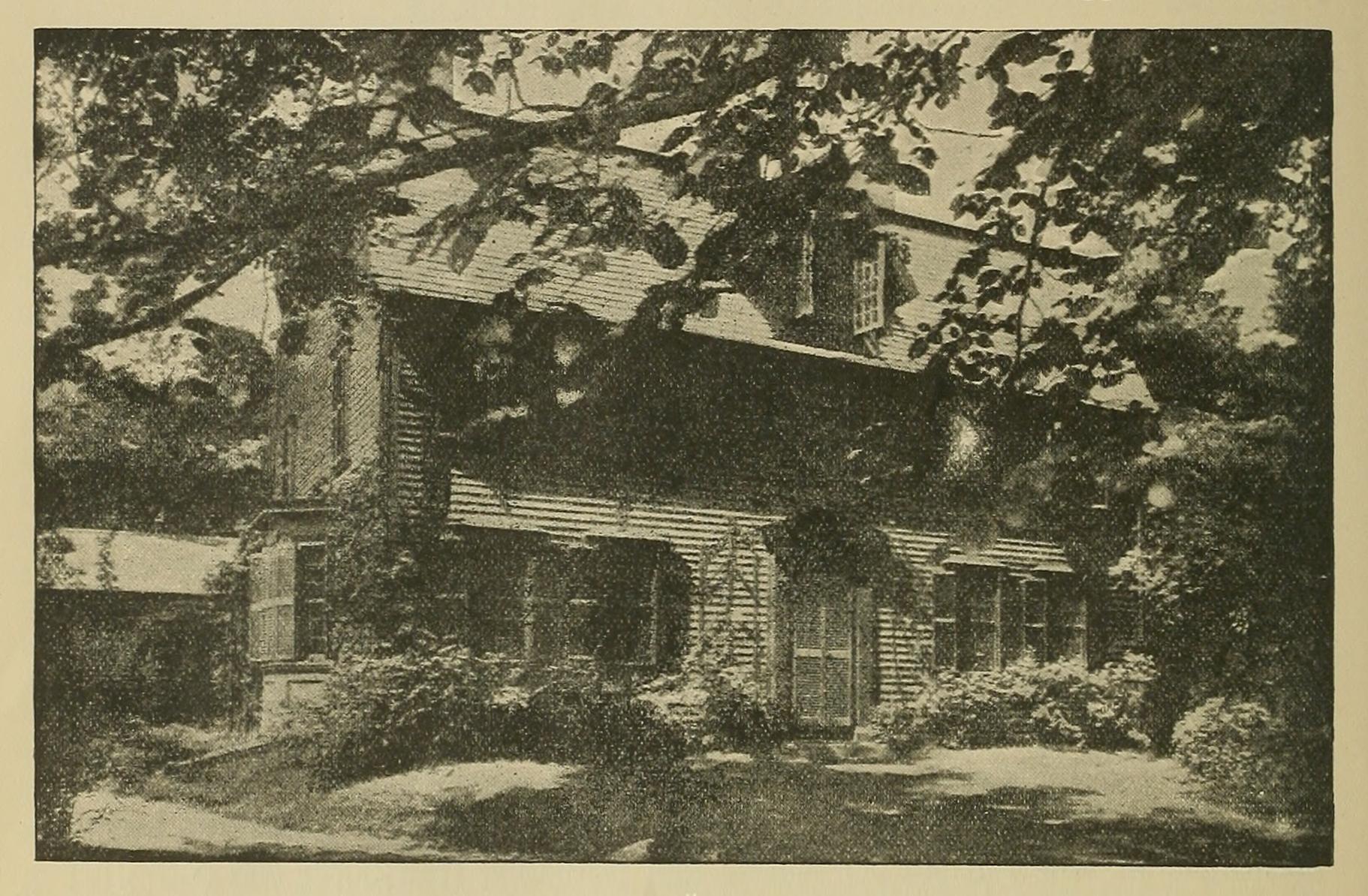
“THE OLD MANSE,” CONCORD, MASS.
Built for Emerson’s grandfather. In this house Ralph Waldo Emerson dwelt for ten years, and, here, in the same room where Emerson wrote “Nature” and other philosophic essays, Hawthorne prepared his “Twice Told Tales,” and “Mosses from an Old Manse.” He declares the four years (1842–1846) spent in this house were the happiest of his life.
Hawthorne received his early education in Salem, partly at the school of Joseph E. Worcester, the author of “Worcester’s Dictionary.” He entered Bowdoin College in 1821. The poet, Longfellow, and John S. C. Abbott were his classmates; and Franklin Pierce—one class in advance of him—was his close friend. He graduated in 1825 without any special distinction. His first book, “Fanshawe,” a novel, was issued in 1826, but so poor was its success that he suppressed its further publication. Subsequently he placed the manuscript of a collection of stories in the hands of his publisher, but timidly withdrew and destroyed them. His first practical encouragement was received from Samuel G. Goodrich, who published four stories in the “Token,” one of the annuals of that time, in 1831. Mr. Goodrich also engaged Hawthorne as editor of the “American Magazine of Useful and Entertaining Knowledge,” which position he occupied from 1836 to 1838. About this time he also contributed some of his best stories to the “New England Magazine,” “The Knickerbocker,” and the “Democratic Review.” It was a part of these magazine stories which he collected and published in 1837 in the volume entitled, “Twice Told Tales,” embodying the fruits of his twelve years’ labor.
This book stamped the author as a man of stronger imagination and deeper insight into human nature than Washington Irving evinced in his famous sketches of the Hudson or Cooper in his frontier stories, for delightful as was Irving’s writings and vivid as were Cooper’s pictures, it was plain to be seen that Hawthorne had a richer style and a firmer grasp of the art of fiction than either of them. Longfellow, the poet, reviewed the book with hearty commendation, and Poe predicted a brilliant future for the writer if he would abandon allegory. Thus encouraged, Hawthorne came out from his seclusion into the world again, and mixed once more with his fellow-men. His friend, the historian, Bancroft, secured him a position in the Custom House at Salem, in 1839, which he held for two years. This position he lost through political jobbery on a trumped-up charge. For a few months he then joined in the Brook Farm settlement, though he was never in sympathy with the movement; nor was he a believer in the transcendental notions of Emerson and his school. He remained a staunch Democrat in the midst of the Abolitionists. His note-books were full of his discontent with the life at the Brook Farm. His observations of this enterprise took shape in the “Blythedale Romance” which is the only literary memorial of the association. The heroine of this novel was Margaret Fuller, under the name of “Zenobia,” and the description of the drowning of Zenobia—a fate which Margaret Fuller had met—is the most tragic passage in all the writings of the author.
In 1842 Hawthorne married Miss Sophia Peabody—a most fortunate and happy marriage—and the young couple moved to Concord where they lived in the house known as the “Old Manse,” which had been built for Emerson’s grandfather, and in which Emerson himself dwelt ten years. He chose for his study the same room in which the philosopher had written his famous book “Nature.” Hawthorne declares that the happiest period of his life were the four years spent in the “Old Manse.” While living there he collected another lot of miscellaneous stories and published them in 1845 as a second volume of “Twice-Told Tales,” and the next year came his “Mosses from an Old Manse,” being also a collection from his published writings. In 1846 a depleted income and larger demands of a growing family made it necessary for him to seek a business engagement. Through a friend he received an appointment as Surveyor of Customs at Salem, and again removed to the old town where he was born forty-two years before. It was during his engagement here, from 1846 to 1849, that he planned and wrote his famous book “The Scarlet Letter,” which was published in 1850.
A broader experience is needed to compose a full-grown novel than to sketch a short tale. Scott was more than fifty when he published “Waverly.” Cooper wrote the “Spy” when thirty-three. Thackeray, the author of “Vanity Fair,” was almost forty when he finished that work. “Adam Bede” appeared when George Elliot was in her fortieth year; and the “Scarlet Letter,” greater than them all, did not appear until 1850, when its author was in his forty-seventh year. All critics readily agree that this romance is the masterpiece in American fiction. The only novel in the United States that can be compared with it is Mrs. Stowe’s “Uncle Tom’s Cabin,” and, as a study of a type of life—Puritan life in New England—“The Scarlet Letter” is superior to Mrs. Stowe’s immortal work. One-half a century has passed since “The Scarlet Letter” was written; but it stands to-day more popular than ever before.
Enumerated briefly, the books written by Hawthorne in the order of their publication are as follows: “Fanshawe,” a novel (1826), suppressed by the author; “Twice-Told Tales” (1837), a collection of magazine stories; “Twice-Told Tales” (second volume, 1845) “Mosses from an Old Manse” (1846), written while he lived at the “Old Manse”; “The Scarlet Letter” (1850), his greatest book; “The House of Seven Gables” (1851), written while he lived at Lenox, Massachusetts; “The Wonder Book” (1851), a volume of classic stories for children; “The Blythedale Romance” (1852); “Life of Franklin Pierce” (1852), which was written to assist his friend Pierce, who was running for President of the United States; “Tanglewood Tales” (1853), another work for children, continuing the classic legends of his “Wonder Book,” reciting the adventures of those who went forth to seek the “Golden Fleece,” to explore the labyrinth of the “Minotaur” and sow the “Dragon’s Teeth.” Pierce was elected President in 1853 and rewarded Hawthorne by appointing him Consul to Liverpool. This position he filled for four years and afterwards spent three years in traveling on the Continent, during which time he gathered material for the greatest of his books—next to “The Scarlet Letter”—entitled “The Marble Faun,” which was brought out in England in 1860, and the same year Mr. Hawthorne returned to America and spent the remainder of his life at “The Wayside” in Concord. During his residence here he wrote for the “Atlantic Monthly” the papers which were collected and published in 1863 under the title of “Our Old Home.” After Mr. Hawthorne’s death, his unpublished manuscripts, “The Dolliver Romance,” “Septimius Felton” and “Dr. Grimshawe’s Secret,” were published. Mrs. Hawthorne, also, edited and published her husband’s “American and English Note-Books” and his “French and Italian Note-Books” in 1869. The best life of the author is perhaps that written by his son, Julian Hawthorne, which appeared in 1885, entitled “Nathaniel Hawthorne and His Wife; a Biography.”
A new and complete edition of Hawthorne’s works has been lately issued in twenty volumes; also a compact and illustrated library edition in seven volumes.
Nathaniel Hawthorne died May 18, 1864, while traveling with his friend and college-mate, Ex-President Pierce, in the White Mountains, and was buried near where Emerson and Thoreau were later placed in Concord Cemetery. Emerson, Longfellow, Lowell and Whittier were at the funeral. His publisher, Mr. Field, was also there and wrote: “We carried him through the blossoming orchards of Concord and laid him down in a group of pines on the hillside, the unfinished romance which had cost him such anxiety laid upon his coffin.” Mr. Longfellow, in an exquisite poem describes the scene, and referring to the uncompleted romance in the closing lines says:
“Ah, who shall lift that wand of magic power,
And the lost clue regain?
The unfinished window in Alladin’s tower
Unfinished must remain.”
The noble wife, who had been the inspiration and practical stimulus of the great romancer, survived her distinguished husband nearly seven years. She died in London, aged sixty, February 26, 1871, and was buried in Kensal Green Cemetery, near the grave of Leigh Hunt.
EMERSON AND THE EMERSONITES.
(FROM “MOSSES FROM AN OLD MANSE.”)
HERE were circumstances around me which made it difficult to view the world precisely as it exists; for severe and sober as was the Old Manse, it was necessary to go but a little way beyond its threshold before meeting with stranger moral shapes of men than might have been encountered elsewhere in a circuit of a thousand miles. These hobgoblins of flesh and blood were attracted thither by the wide spreading influence of a great original thinker who had his earthly abode at the opposite extremity of our village. His mind acted upon other minds of a certain constitution with wonderful magnetism, and drew many men upon long pilgrimages to speak with him face to face.
Young visionaries, to whom just so much of insight had been imparted as to make life all a labyrinth around them, came to seek the clew which should guide them out of their self-involved bewilderment. Gray-headed theorists, whose systems—at first air—had finally imprisoned them in a fiery framework, traveled painfully to his door, not to ask deliverance, but to invite the free spirit into their own thralldom. People that had lighted upon a new thought—or thought they had fancied new—came to Emerson as a finder of a glittering gem hastens to a lapidary to ascertain its quality and value. Uncertain, troubled, earnest wanderers through the midnight of the moral world beheld his intellectual fire as a beacon burning upon a hill-top, and climbing the difficult ascent, looked forth into the surrounding obscurity more hopefully than hitherto. The light revealed objects unseen before:—mountains, gleaming lakes, glimpses of creation among the chaos: but also, as was unavoidable, it attracted bats and owls and the whole host of night-birds, which flapped their dusty wings against the gazer’s eyes, and sometimes were mistaken for fowls of angelic feather. Such delusions always hover nigh whenever a beacon-fire of truth is kindled.
For myself there had been epochs of my life when I too might have asked of this prophet the master-word that should solve me the riddle of the universe; but now, being happy, I felt as if there were no question to be put; and therefore admired Emerson as a poet of deep beauty and austere tenderness, but sought nothing from him as a philosopher. It was good, nevertheless, to meet him in the wood-paths, or sometimes in our avenue, with that pure intellectual gleam diffused about his presence, like the garment of a shining one; and he so quiet, so simple, so without pretension, encountering each man alive as if expecting to receive more than he could impart. And in truth, the heart of many a man had, perchance, inscriptions which he could not read. But it was impossible to dwell in his vicinity without inhaling more or less the mountain atmosphere of his lofty thought, which in the brains of some people wrought a singular giddiness—new truth being as heady as new wine.
Never was a poor country village infected with such a variety of queer, strangely-dressed, oddly-behaved mortals, most of whom took upon themselves to be important agents of this world’s destiny, yet were simply bores of the first water. Such, I imagine, is the invariable character of persons who crowd so closely about an original thinker as to draw in his unuttered breath, and thus become imbued with a false originality. This triteness of noveltry is enough to make any man of common sense blaspheme at all ideas of less than a century’s standing, and pray that the world may be petrified and rendered immovable in precisely the worst moral and physical state that it ever yet arrived at, rather than be benefitted by such schemes of such philosophers.
PEARL.
(THE SCARLET LETTER. A ROMANCE. 1850.)
E have as yet hardly spoken of the infant; that little creature, whose innocent life had sprung, by the inscrutable decree of Providence, a lovely and immortal flower, out of the rank luxuriance of a guilty passion. How strange it seemed to the sad woman, as she watched the growth, and the beauty that became every day more brilliant, and the intelligence that threw its quivering sunshine over the tiny features of this child! Her Pearl!—For so had Hester called her; not as a name expressive of her aspect, which had nothing of the calm, white, unimpassioned lustre that would be indicated by the comparison. But she named the infant “Pearl,” as being of great price,—purchased with all she had,—her mother’s only treasure! How strange, indeed! Men had marked this woman’s sin by a scarlet letter, which had such potent and disastrous efficacy that no human sympathy could reach her, save it were sinful like herself. God, as a direct consequence of the sin which was thus punished, had given her a lovely child, whose place was on that same dishonored bosom, to connect her parent forever with the race and descent of mortals, and to be finally a blessed soul in heaven! Yet these thoughts affected Hester Prynne less with hope than apprehension. She knew that her deed had been evil; she could have no faith, therefore, that its result would be good. Day after day, she looked fearfully into the child’s expanding nature, ever dreading to detect some dark and wild peculiarity, that should correspond with the guiltiness to which she owed her being.

Certainly, there was no physical defect. By its perfect shape, its vigor, and its natural dexterity in the use of all its untried limbs, the infant was worthy to have been brought forth in Eden; worthy to have been left there, to be the plaything of the angels, after the world’s first parents were driven out. The child had a native grace which does not invariably coexist with faultless beauty; its attire, however simple, always impressed the beholder as if it were the very garb that precisely became it best. But little Pearl was not clad in rustic weeds. Her mother, with a morbid purpose that may be better understood hereafter, had bought the richest tissues that could be procured, and allowed her imaginative faculty its full play in the arrangement and decoration of the dresses which the child wore before the public eye. So magnificent was the small figure, when thus arrayed, and such was the splendor of Pearl’s own proper beauty, shining through the gorgeous robes which might have extinguished a paler loveliness, that there was an absolute circle of radiance around her, on the darksome cottage floor. And yet a russet gown, torn and soiled with the child’s rude play, made a picture of her just as perfect. Pearl’s aspect was imbued with a spell of infinite variety; in this one child there were many children, comprehending the full scope between the wild-flower prettiness of a peasant-baby, and the pomp, in little, of an infant princess. Throughout all, however, there was a trait of passion, a certain depth of hue, which she never lost; and if, in any of her changes she had grown fainter or paler, she would have ceased to be herself,—it would have been no longer Pearl!
One peculiarity of the child’s deportment remains yet to be told. The very first thing which she had noticed, in her life, was—what?—not the mother’s smile, responding to it, as other babies do, by that faint embryo smile of the little mouth, remembered so doubtfully afterwards, and with such fond discussion whether it were indeed a smile. By no means! But that first object of which Pearl seemed to become aware was—shall we say it?—the scarlet letter on Hester’s bosom! One day, as the mother stooped over the cradle, the infant’s eyes had been caught by the glimmering of the gold embroidery about the letter; and, putting up her little hand, she grasped at it, smiling, not doubtfully, but with a decided gleam, that gave her face the look of a much older child. Then, gasping for breath, did Hester Prynne clutch the fatal token, instinctively endeavoring to tear it away; so infinite was the torture inflicted by the intelligent touch of Pearl’s baby-hand. Again, as if her mother’s agonized gesture were meant only to make sport of her, did little Pearl look into her eyes, and smile! From that epoch, except when the child was asleep, Hester had never felt a moment’s safety; not a moment’s calm enjoyment of her. Weeks, it is true, would sometimes elapse, during which Pearl’s gaze might never once be fixed upon the scarlet letter; but then, again, it would come at unawares, like the stroke of sudden death, and always with that peculiar smile and odd expression of the eyes.
SIGHTS FROM A STEEPLE.
OW various are the situations of the people covered by the roofs beneath me, and how diversified are the events at this moment befalling them! The new-born, the aged, the dying, the strong in life, and the recent dead, are in the chambers of these many mansions. The full of hope, the happy, the miserable, and the desperate, dwell together within the circle of my glance. In some of the houses over which my eyes roam so coldly, guilt is entering into hearts that are still tenanted by a debased and trodden virtue—guilt is on the very edge of commission, and the impending deed might be averted; guilt is done, and the criminal wonders if it be irrevocable. There are broad thoughts struggling in my mind, and, were I able to give them distinctness, they would make their way in eloquence. Lo! the rain-drops are descending.

The clouds, within a little time, have gathered over all the sky, hanging heavily, as if about to drop in one unbroken mass upon the earth. At intervals the lightning flashes from their brooding hearts, quivers, disappears, and then comes the thunder, traveling slowly after its twin-born flame. A strong wind has sprung up, howls through the darkened streets, and raises the dust in dense bodies, to rebel against the approaching storm. All people hurry homeward—all that have a home; while a few lounge by the corners, or trudge on desperately, at their leisure.
And now the storm lets loose its fury. In every dwelling I perceive the faces of the chambermaids as they shut down the windows, excluding the impetuous shower, and shrinking away from the quick, fiery glare. The large drops descend with force upon the slated roofs, and rise again in smoke. There is a rush and roar, as of a river through the air, and muddy streams bubble majestically along the pavement, whirl their dusky foam into the kennel, and disappear beneath iron grates. Thus did Arethusa sink. I love not my station here aloft, in the midst of the tumult which I am powerless to direct or quell, with the blue lightning wrinkling on my brow, and the thunder muttering its first awful syllables in my ear. I will descend. Yet let me give another glance to the sea, where the foam breaks in long white lines upon a broad expanse of blackness, or boils up in far-distant points, like snowy mountain-tops in the eddies of a flood; and let me look once more at the green plain, and little hills of the country, over which the giant of the storm is riding in robes of mist, and at the town, whose obscured and desolate streets might beseem a city of the dead; and turning a single moment to the sky, now gloomy as an author’s prospects, I prepare to resume my station on lower earth. But stay! A little speck of azure has widened in the western heavens; the sunbeams find a passage, and go rejoicing through the tempest; and on yonder darkest cloud, born, like hallowed hopes, of the glory of another world, and the trouble and tears of this, brightens forth the Rainbow!
A REMINISCENCE OF EARLY LIFE.
(FROM AMERICAN NOTE BOOKS.)
Salem, Oct. 4th.
Union Street, [Family Mansion.]
... Here I sit in my old accustomed chamber, where I used to sit in days gone by.... Here I have written many tales,—many that have been burned to ashes, many that doubtless deserved the same fate. This claims to be called a haunted chamber, for thousands upon thousands of visions have appeared to me in it; and some few of them have become visible to the world. If ever I should have a biographer, he ought to make great mention of this chamber in my memoirs, because so much of my lonely youth was wasted here, and here my mind and character were formed; and here I have been glad and hopeful, and here I have been despondent. And here I sat a long, long time, waiting patiently for the world to know me, and sometimes wondering why it did not know me sooner, or whether it would ever know me at all,—at least, till I were in my grave. And sometimes it seemed as if I were already in the grave, with only life enough to be chilled and benumbed. But oftener I was happy,—at least, as happy as I then knew how to be, or was aware of the possibility of being. By and by, the world found me out in my lonely chamber, and called me forth,—not, indeed, with a loud roar of acclamation, but rather with a still, small voice,—and forth I went, but found nothing in the world that I thought preferable to my old solitude till now.... And now I begin to understand why I was imprisoned so many years in this lonely chamber, and why I could never break through the viewless bolts and bars; for if I had sooner made my escape into the world, I should have grown hard and rough, and been covered with earthly dust, and my heart might have become callous by rude encounters with the multitude.... But living in solitude till the fulness of time was come, I still kept the dew of my youth, and the freshness of my heart.... I used to think that I could imagine all passions, all feelings, and states of the heart and mind; but how little did I know!... Indeed, we are but shadows; we are not endowed with real life, and all that seems most real about us is but the thinnest substance of a dream,—till the heart be touched. That touch creates us,—then we begin to be,—thereby we are beings of reality and inheritors of eternity....
When we shall be endowed with our spiritual bodies, I think that they will be so constituted that we may send thoughts and feelings any distance in no time at all, and transfuse them, warm and fresh, into the consciousness of those whom we love.... But, after all, perhaps it is not wise to intermix fantastic ideas with the reality of affection. Let us content ourselves to be earthly creatures, and hold communion of spirit in such modes as are ordained to us.
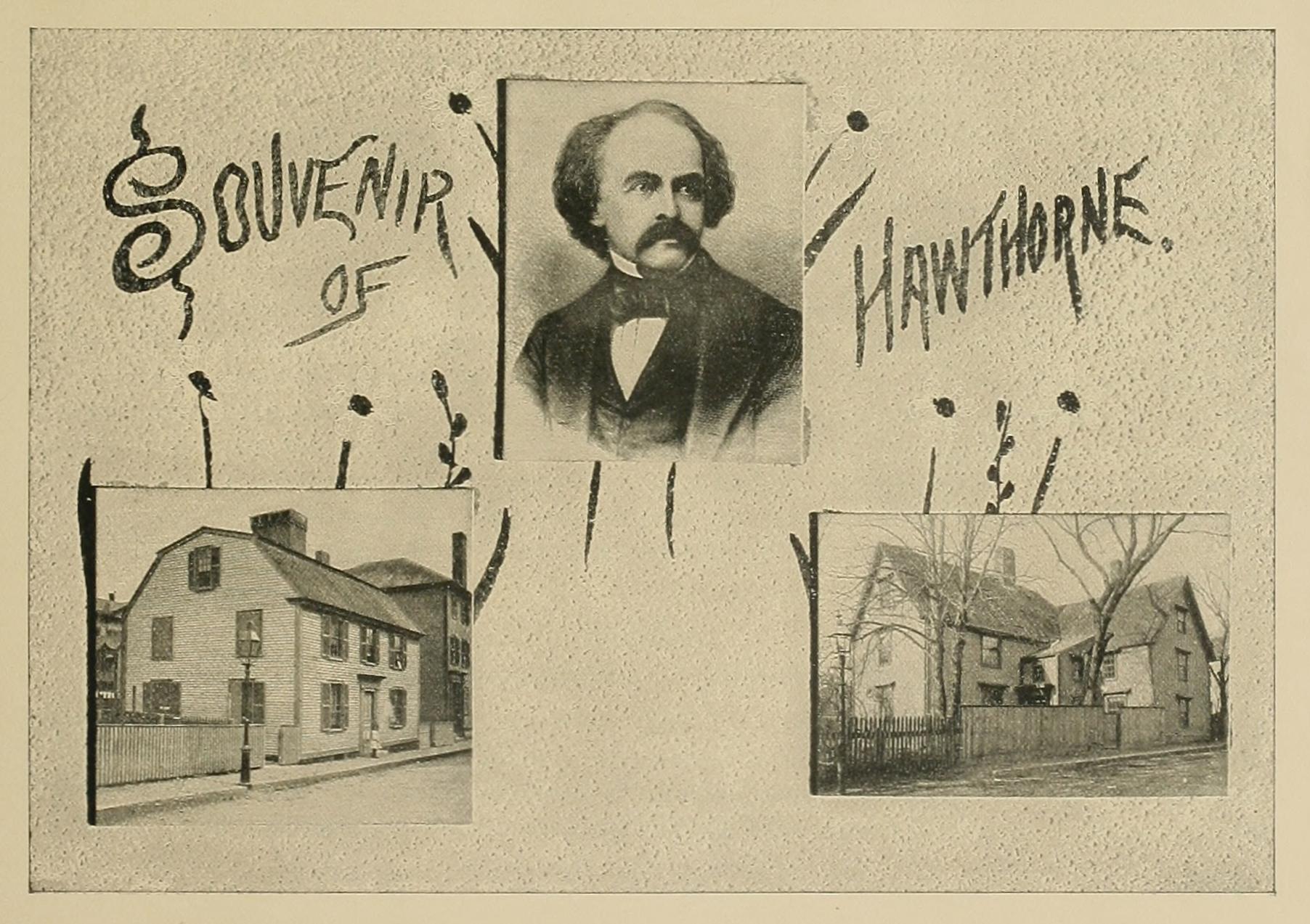
Souvenir of Hawthorne

EDWARD EVERETT HALE.
“THE ROBINSON CRUSOE OF AMERICA.”
DWARD EVERETT HALE is to-day one of the best known and most beloved of American authors. He is also a lecturer of note. He has probably addressed as many audiences as any man in America. His work as a preacher, as a historian and as a story-teller, entitles him to fame; but his life has also been largely devoted to the formation of organizations to better the moral, social and educational conditions of the young people of his own and other lands. Recently he has been deeply interested in the great Chatauqua movement, which he has done much to develop.

His name is a household word in American homes, and the keynote of his useful life may be expressed by the motto of one of his most popular books, “Ten Times One is Ten:”—“Look up and not down! Look forward and not backward! Look out and not in! Lend a hand!”
Edward Everett Hale was born in Boston, Massachusetts, April 3, 1822. He graduated at Harvard University in 1839, at the age of seventeen years. He took a post graduate course for two years in a Latin school and read theology and church history. It was in 1842 that he was licensed to preach by the Boston Association of Congregational Ministers. During the winter of 1844–45 he served a church in Washington, but removed the next year to Worcester, Massachusetts, where he remained for ten years. In 1856 he was called to the South Congregational (Unitarian) Church in Boston, which he has served for more than three decades.
When a boy young Hale learned to set type in his father’s printing office, and afterwards served on the “Daily Advertiser,” it is said, in every capacity from reporter up to editor-in-chief. Before he was twenty-one years old he wrote a large part of the “Monthly Chronicle” and “Boston Miscellany,” and from that time to the present has done an immense amount of newspaper and magazine work. He at one time edited the “Christian Examiner” and also the “Sunday School Gazette.” He founded a magazine entitled “The Old and the New” in 1869, which was afterwards merged into “Scribner’s Monthly.” In 1866 he began the publication of “Lend a Hand, a Record of Progress and Journal of Organized Charity.”
As a writer of short stories, no man of modern times, perhaps, is his superior, if indeed he has any equals. “My Double and How He Undid Me,” published in 1859, was the first of his works to strike strongly the popular fancy; but it was “The Man Without a Country,” issued in 1863, which entitled its author to a prominent place among the classic short story-tellers of America, and produced a deep impression on the public mind. His “Skeleton in a Closet” followed in 1866; and, since that time his prolific pen has sent forth in the form of books and magazine articles, a continuous stream of the most entertaining literature in our language. He has the faculty of De Foe in giving to his stories the appearance of reality, and thus has gained for himself the title of “The Robinson Crusoe of America.”
Mr. Hale is also an historical writer and a student of great attainment, and has contributed many papers of rare value to the historical and antiquarian societies of both Europe and America. He is, perhaps, the greatest of all living authorities on Spanish-American affairs. He is the editor of “Original Documents from the State Paper Office, London, and the British Museum; illustrating the History of Sir Walter Raleigh’s First American Colony at Jamestown,” and other historical works.
Throughout his life, Mr. Hale has always taken a patriotic interest in public affairs for the general good of the nation. While he dearly loves his native New England hills, his patriotism is bounded by no narrow limits; it is as wide as his country. His voice is always the foremost among those raised in praise or in defence of our national institutions and our liberties. His influence has always been exerted to make men and women better citizens and better Americans.
LOST.¹
(FROM “PHILIP NOLAN’S FRIENDS.”)
UT as she ran, the path confused her. Could she have passed that flaming sassafras without so much as noticing it? Any way she should recognize the great mass of bays where she had last noticed the panther’s tracks. She had seen them as she ran on, and as she came up. She hurried on; but she certainly had returned much farther than she went, when she came out on a strange log flung up in some freshet, which she knew she had not seen before. And there was no clump of bays. Was this being lost? Was she lost? Why, Inez had to confess to herself that she was lost just a little bit, but nothing to be afraid of; but still lost enough to talk about afterwards she certainly was.
Yet, as she said to herself again and again, she could not be a quarter of a mile, nor half a quarter of a mile from camp. As soon as they missed her—and by this time they had missed her—they would be out to look for her. How provoking that she, of all the party, should make so much bother to the rest! They would watch her now like so many cats all the rest of the way. What a fool she was ever to leave the knoll! So Inez stopped again, shouted again, and listened and listened, to hear nothing but a swamp-owl.
If the sky had been clear, she would have had no cause for anxiety. In that case they would have light enough to find her in. She would have had the sunset glow to steer by; and she would have had no difficulty in finding them. But with this horrid gray over everything she dared not turn round, without fearing that she might lose the direction in which the theory of the moment told her she ought to be faring. And these openings which she had called trails—which were probably broken by wild horses and wild oxen as they came down to the bayou to drink—would not go in one direction for ten paces. They bent right and left, this way and that; so that without some sure token of sun or star, it was impossible, as Inez felt, to know which way she was walking.
And at last this perplexity increased. She was conscious that the sun must have set, and that the twilight, never long, was now fairly upon her. All the time there was this fearful silence, only broken by her own voice and that hateful owl. Was she wise to keep on in her theories of this way or that way? She had never yet come back, either upon the fallen cottonwood tree, or upon the bunch of bays which was her landmark; and it was doubtless her wisest determination to stay where she was. The chances that the larger party would find her were much greater than that she alone would find them; but by this time she was sure that, if she kept on in any direction, there was an even chance that she was going farther and farther wrong.
But it was too cold for her to sit down, wrap herself never so closely in her shawl. The poor girl tried this. She must keep in motion. Back and forth she walked, fixing her march by signs which she could not mistake even in the gathering darkness. How fast that darkness gathered! The wind seemed to rise, too, as the night came on, and a fine rain, that seemed as cold as snow to her, came to give the last drop to her wretchedness. If she were tempted for a moment to abandon her sentry-beat, and try this wild experiment or that, to the right or left, some odious fallen trunk, wet with moss and decay, lay just where she pressed into the shrubbery, as if placed there to reveal to her her absolute powerlessness. She was dead with cold, and even in all her wretchedness knew that she was hungry. How stupid to be hungry when she had so much else to trouble her! But at least she would make a system of her march. She would walk fifty times this way, to the stump, and fifty times that way; then she would stop and cry out and sound her war-whoop; then she would take up her sentry-march again. And so she did. This way, at least, time would not pass without her knowing whether it was midnight or no.
“Hark! God be praised, there is a gun! and there is another! and there is another! They have come on the right track, and I am safe!” So she shouted again, and sounded her war-whoop again, and listened,—and then again, and listened again. One more gun! but then no more! Poor Inez! Certainly they were all on one side of her. If only it was not so piteously dark! If she could only walk half the distance in that direction which her fifty sentry-beats made put together! But when she struggled that way through the tangle, and over one wet log and another, it was only to find her poor wet feet sinking down into mud and water! She did not dare keep on. All that was left for her was to find her tramping-ground again, and this she did.
“Good God, take care of me! My poor dear father—what would he say if he knew his child was dying close to her friends? Dear mamma, keep watch over your little girl!”—


WM. DEAN HOWELLS.
(THE REALISTIC NOVELIST OF AMERICA.)
HE West has contributed many notable men to our nation within the last half of the present century. There seems to be something in the spirit of that developing section to stimulate the aspirations and ambitions of those who grow up in its atmosphere. Progress, Enterprise, “Excelsior” are the three words written upon its banner as the motto for the sons of the middle West. It is there we go for many of our leading statesmen. Thence we draw our presidents more largely than from any other section, and the world of modern literature is also seeking and finding its chiefest leaders among the sons and daughters of that region. True they are generally transplanted to the Eastern centres of publication and commercial life, but they were born and grew up in the West.

Notably among the examples which might be cited, we mention William Dean Howells, one of the greatest of modern American novelists, who was born at Martin’s Ferry, Ohio, March 1st, 1837. Mr. Howells did not enjoy the advantage of a collegiate education. At twelve years of age he began to set type in his father’s printing office, which he followed until he reached manhood, employing his odd time in writing articles and verses for the newspapers, and while quite young did editorial work for a leading daily in Cincinnati. At the age of twenty-one, in 1858, he became the editor of the “Ohio State Journal” at Columbus. Two years later he published in connection with John James Piatt a small volume of verse entitled “Poems of two Friends.” These youthful effusions were marked by that crystal like clearness of thought, grace and artistic elegance of expression which characterize his later writings. Mr. Howells came prominently before the public in 1860 by publishing a carefully written and most excellent “Life of Abraham Lincoln” which was extensively sold and read during that most exciting presidential campaign, and no doubt contributed much to the success of the candidate. Mr. Lincoln, in furnishing data for this work, became well acquainted with the young author of twenty-three and was so impressed with his ability in grasping and discussing state affairs, and good sense generally, that he appointed him as ♦consul to Venice.
During four years’ residence in that city Mr. Howells, in addition to his official duties, learned the Italian language and studied its literature. He also here gathered, the material for two books, “Venitian Life” and “Italian Journeys.” He arranged for the publication of the former in London as he passed through that city in 1865 on his way home. The latter was brought out in America on his return, appearing in 1867. Neither of these works are novels. “Venetian Life” is a delightful description of the manners and customs of real life in Venice. “Italian Journeys” is a charming portrayal—almost a kinetoscopic view—of his journey from Venice to Rome by the roundabout way of Genoa and Naples, with a visit to Pompeii and Herculaneum, including artistic etchings of notable scenes.
The first attempt of Mr. Howells at story-telling, “Their Wedding Journey,” appeared in 1871. This, while ranking as a novel, was really a description of an actual bridal tour across New York. “A Chance Acquaintance” (1873) was a more complete novel, but evidently it was a venture of the imagination upon ground that had proven fruitful in real life. It was modeled after “The Wedding Journey,” but described a holiday season spent in journeying up the St. Lawrence River, stopping at Quebec and Saguenay.
Since 1874 Mr. Howells has published one or more novels annually, among which are the following: “A Foregone Conclusion” (1874), “A Counterfeit Presentment” (1877), “The Lady of the Aroostook” (1878), “The Undiscovered Country” (1880), “A Fearful Responsibility” (1882), “A Modern Instance” and “Dr. Breen’s Practice” (1883), “A Woman’s Reason” (1884), “Tuscan Cities” and “The Rise of Silas Lapham” (1885), “The Minister’s Charge” and “Indian Summer” (1886), “April Hopes” (1887), “Annie Kilburn” (1888), “Hazard of New Fortune” (1889). Since 1890 Mr. Howells has continued his literary activity with increased, rather than abating, energy. Among his noted later novels are “A Traveler from Altruria” and “The Landlord at Lion’s Head” (the latter issued in 1897). Other notable books of his are “Stops at Various Quills,” “My Literary Passion,” “Library of Universal Adventure,” “Modern Italian Poets,” “Christmas Every Day” and “A Boy’s Town,” the two last mentioned being for juvenile readers, with illustrations.
Mr. Howells’ accurate attention to details gives to his stories a most realistic flavor, making his books seem rather photographic than artistic. He shuns imposing characters and thrilling incidents, and makes much of interesting people and ordinary events in our social life. A broad grasp of our national characteristics and an intimate acquaintance with our institutions gives him a facility in producing minute studies of certain aspects of society and types of character, which no other writer in America has approached. For instance, his “Undiscovered Country” was an exhaustive study and presentation of spiritualism, as it is witnessed and taught in New England. And those who admire Mr. Howells’ writings will find in “The Landlord at Lion’s Head” a clear-cut statement of the important sociological problem yet to be solved, upon the other; which problem is also characteristic of other of his books. Thoughtful readers of Mr. Howells’ novels gain much information on vital questions of society and government, which broaden the mind and cannot fail to be of permanent benefit.
From 1872 to 1881 Mr. Howells was editor of the “Atlantic Monthly,” and since 1886 he has conducted the department known as the “Editor’s Study” in “Harper’s Magazine,” contributing much to other periodicals at the same time. He is also well known as a poet, but has so overshadowed this side of himself by his greater power as a novelist, that he is placed with that class of writers. In 1873 a collection of his poems was published. While in Venice he wrote “No Love Lost; a Romance of Travel,” which was published in 1869, and stamped him as a poet of ability.
THE FIRST BOARDER.
(FROM “THE LANDLORD AT LION’S HEAD.” 1897.)
By Permission of Messrs. Harper & Brothers, Publishers.
HE table was set for him alone, and it affected him as if the family had been hurried away from it that he might have it to himself. Everything was very simple; the iron forks had two prongs; the knives bone handles; the dull glass was pressed; the heavy plates and cups were white, but so was the cloth, and all were clean. The woman brought in a good boiled dinner of corned beef, potatoes, turnips and carrots, from the kitchen, and a teapot, and said something about having kept them hot on the stove for him; she brought him a plate of biscuit fresh from the oven; then she said to the boy, “You come out and have your dinner with me, Jeff,” and left the guest to make his meal unmolested.
The room was square, with two north windows that looked down the lane he had climbed to the house. An open door led into the kitchen in an ell, and a closed door opposite probably gave access to a parlor or a ground-floor chamber. The windows were darkened down to the lower sash by green paper shades; the walls were papered in a pattern of brown roses; over the chimney hung a large picture, a life-size pencil-drawing of two little girls, one slightly older and slightly larger than the other, each with round eyes and precise ringlets, and with her hand clasped in the other’s hand.
The guest seemed helpless to take his gaze from it, and he sat fallen back in his chair gazing at it, when the woman came in with a pie.
“Thank you, I believe I don’t want any dessert,” he said. “The fact is, the dinner was so good that I haven’t left any room for pie. Are those your children?”
“Yes,” said the woman, looking up at the picture with the pie in her hand. “They’re the last two I lost.”
“Oh, excuse me!” the guest began.
“It’s the way they appear in the spirit life. It’s a spirit picture.”
“Oh! I thought there was something strange about it.”
“Well, it’s a good deal like the photographs we had taken about a year before they died. It’s a good likeness. They say they don’t change a great deal, at first.”
She seemed to refer the point to him for his judgment; but he answered wide of it:
“I came up here to paint your mountain, if you don’t mind, Mrs. Durgin—Lion’s Head, I mean.”
“Oh, yes. Well I don’t know as we could stop you, if you wanted to take it away.” A spare glimmer lighted up her face.
The painter rejoined in kind. “The town might have something to say, I suppose.”
“Not if you was to leave a good piece of intervale in place of it. We’ve got mountains to spare.”
“Well, then, that’s arranged. What about a week’s board?”
“I guess you can stay, if you’re satisfied.”
“I’ll be satisfied if I can stay. How much do you want?”
The woman looked down, probably with an inward anxiety between the fear of asking too much and the folly of asking too little. She said, tentatively, “Some of the folks that come over from the hotels say they pay as much as twenty dollars a week.”
“But you don’t expect hotel prices?”
“I don’t know as I do. We’ve never had any body before.”
The stranger relaxed the frown he had put on at the greed of her suggestion; it might have come from ignorance or mere innocence, “I’m in the habit of paying five dollars for farm board, where I stayed several weeks. What do you say to seven for a single week?”
“I guess that’ll do,” said the woman, and she went out with the pie, which she had kept in her hand.
IMPRESSIONS ON VISITING POMPEII.¹
FROM “ITALIAN JOURNEYS.” 1867.
HE cotton whitens over two-thirds of Pompeii yet interred: happy the generation that lives to learn the wondrous secrets of that sepulchre! For, when you have once been at Pompeii, this phantasm of the past takes deeper hold on your imagination than any living city, and becomes and is the metropolis of your dream-land forever. O marvellous city! who shall reveal the cunning of your spell? Something not death, something not life,—something that is the one when you turn to determine its essence as the other! What is it comes to me at this distance of that which I saw in Pompeii? The narrow and curving, but not crooked streets, with the blazing sun of that Neapolitan November falling into them, or clouding their wheel-worn lava with the black, black shadows of the many-tinted walls; the houses, and the gay columns of white, yellow, and red; the delicate pavements of mosaic; the skeletons of dusty cisterns and dead fountains; inanimate garden-spaces with pygmy statues suited to their littleness; suites of fairy bed-chambers, painted with exquisite frescos; dining-halls with joyous scenes of hunt and banquet on their walls; the ruinous sites of temples; the melancholy emptiness of booths and shops and jolly drinking-houses; the lonesome tragic theatre, with a modern Pompeian drawing water from a well there; the baths with their roofs perfect yet, and the stucco bass-reliefs all but unharmed; around the whole, the city wall crowned with slender poplars; outside the gates, the long avenue of tombs, and the Appian Way stretching on to Stabiæ; and, in the distance, Vesuvius, brown and bare, with his fiery breath scarce visible against the cloudless heaven; these are the things that float before my fancy as I turn back to look at myself walking those enchanted streets, and to wonder if I could ever have been so blest. For there is nothing on the earth, or under it, like Pompeii....
THE HOUSES OF POMPEII AND THEIR PAINTED WALLS.
From “Italian Journeys.”
The plans of nearly all the houses in the city are alike: the entrance-room next the door; the parlor or drawing-room next that; then the impluvium, or unroofed space in the middle of the house, where the rains were caught and drained into the cistern, and where the household used to come to wash itself, primitively, as at a pump; the little garden, with its painted columns, behind the impluvium, and, at last, the dining-room.
After referring to the frescos on the walls that have remained for nearly two thousand years and the wonder of the art by which they were produced, Mr. Howells thus continues:
Of course the houses of the rich were adorned by men of talent; but it is surprising to see the community of thought and feeling in all this work, whether it be from cunninger or clumsier hands. The subjects are nearly always chosen from the fables of the gods, and they are in illustration of the poets, Homer and the rest. To suit that soft, luxurious life which people led in Pompeii, the themes are commonly amorous, and sometimes not too chaste: there is much of Bacchus and Ariadne, much of Venus and Adonis, and Diana bathes a good deal with her nymphs,—not to mention frequent representations of the toilet of that beautiful monster which the lascivious art of the time loved to depict. One of the most pleasing of all the scenes is that in one of the houses, of the Judgment of Paris, in which the shepherd sits upon a bank in an attitude of ineffable and flattered importance, with one leg carelessly crossing the other, and both hands resting lightly on his shepherd’s crook, while the goddesses before him await his sentence. Naturally, the painter has done his best for the victress in this rivalry, and you see
“Idalian Aphrodite beautiful,”
as she should be, but with a warm and piquant spice of girlish resentment in her attitude, that Paris should pause for an instant, which is altogether delicious.
“And I beheld great Here’s angry eyes.”
Awful eyes! How did the painter make them? The wonder of all these pagan frescos is the mystery of the eyes,—still, beautiful, unhuman. You cannot believe that it is wrong for those tranquil-eyed men and women to do evil, they look so calm and so unconscious in it all; and in the presence of the celestials, as they bend upon you those eternal orbs, in whose regard you are but a part of space, you feel that here art has achieved the unearthly. I know of no words in literature which give a sense (nothing gives the idea) of the stare of these gods, except that magnificent line of Kingsley’s, describing the advance over the sea toward Andromeda of the oblivious and unsympathizing Nereids. They floated slowly up and their eyes
“Stared on her, silent and still, like the eyes in the house of the idols.”
VENETIAN VAGABONDS.¹
(FROM “VENETIAN LIFE.” 1867.)
HE lasagnone is a loafer, as an Italian can be a loafer, without the admixture of ruffianism, which blemishes lost loafers of northern race. He may be quite worthless, and even impertinent, but he cannot be a rowdy—that pleasing blossom on the nose of our fast, high-fed, thick-blooded civilization. In Venice he must not be confounded with other loiterers at the café; not with the natty people who talk politics interminably over little cups of black coffee; not with those old habitués, who sit forever under the Procuratie, their hands folded upon the top of their sticks, and stare at the ladies who pass with a curious steadfastness and knowing skepticism of gaze, not pleasing in the dim eyes of age; certainly, the last persons who bear any likeness to the lasagnone are the Germans, with their honest, heavy faces comically anglicized by leg-of-mutton whiskers. The truth is, the lasagnone does not flourish in the best café; he comes to perfection in cheaper resorts, for he is commonly not rich.
It often happens that a glass of water, flavored with a little anisette, is the order over which he sits a whole evening. He knows the waiter intimately, and does not call him “Shop!” (Bottéga) as less familiar people do, but Gigi, or Beppi, as the waiter is pretty sure to be named. “Behold!” he says, when the servant places his modest drink before him, “who is that loveliest blonde there?” Or to his fellow-lasagnone: “She regards me! I have broken her heart!” This is his sole business and mission, the cruel lasagnone—to break the ladies’ hearts. He spares no condition—neither rank nor wealth is any defence against him. I often wonder what is in that note he continually shows to his friend. The confession of some broken heart, I think. When he has folded it and put it away, he chuckles, “Ah, cara!” and sucks at his long, slender Virginia cigar. It is unlighted, for fire consumes cigars. I never see him read the papers—neither the Italian papers nor the Parisian journals, though if he can get “Galignani” he is glad, and he likes to pretend to a knowledge of English, uttering upon the occasion, with great relish, such distinctively English words as “Yes” and “Not,” and to the waiter, “A-little-fire-if-you-please.” He sits very late in the café, he touches his hat—his curly French hat—to the company as he goes out with a mild swagger, his cane held lightly in his left hand, his coat cut snugly to show his hips, and genteely swaying with the motion of his body. He is a dandy, of course—all Italians are dandies—but his vanity is perfectly harmless, and his heart is not bad. He would go half an hour to put you in the direction of the Piazza. A little thing can make him happy—to stand in the pit at the opera, and gaze at the ladies in the lower boxes—to attend the Marionette or the Malibran Theatre, and imperil the peace of pretty seamstresses and contadinas—to stand at the church doors and ogle the fair saints as they pass out. Go, harmless lasagnone, to thy lodging in some mysterious height, and break hearts if thou wilt. They are quickly mended.

GENERAL LEWIS WALLACE.
AUTHOR OF “BEN HUR.”
HERE is an old adage which declares “without fame or fortune at forty, without fame or fortune always.” This, however is not invariably true. Hawthorne became famous when he wrote “Scarlet Letter” at forty-six, Sir Walter Scott produced the first Waverly Novel after he was forty; and we find another exception in the case of the soldier author who is made the subject of this sketch. Perhaps no writer of modern times has gained so wide a reputation on so few books or began his literary career so late in life as the author of “The Fair God;” “Ben Hur” and “The Prince of India.” It was not until the year 1873 that General Lewis Wallace at the age of forty-six became known to literature. Prior to this he had filled the double position of lawyer and soldier, and it was his observations and experiences in the Mexican War, no doubt, which inspired him to write “The Fair God,” his first book, which was a story of the conquest of that country.
Lew. Wallace was horn at Brookville, Indiana, in 1827. After receiving a common school education, he began the study of law; but on the breaking out of the Mexican War, he volunteered in the army as a lieutenant in an Indiana company. On his return from the war, in 1848, he took up the practice of his profession in his native state and also served in the legislature. Near the beginning of the Civil War he became colonel of a volunteer regiment. His military service was of such a character that he received special mention from General Grant for meritorious conduct and was made major-general in March, 1862. He was mustered out of service when the war closed in 1865 and resumed his practice of law at his old home in Crawfordsville. In 1873, as stated above, his first book, “The Fair God,” was published; but it met with only moderate success. In 1878, General Wallace was made Territorial Governor of Utah and in 1880, “Ben Hur; a Tale of The Christ” appeared. The scene was laid in the East and displayed such a knowledge of the manners and customs of that country and people that General Garfield—that year elected President—considered its author a fitting person for the Turkish Ministry, and accordingly, in 1881, he was appointed to that position. It is said that when President Garfield gave General Wallace his appointment, he wrote the words “Ben Hur” across the corner of the document, and, as Wallace was coming away from his visit of acknowledgement at the White House, the President put his arm over his friend’s shoulder and said, “I expect another book out of you. Your duties will not be too onerous to allow you to write it. Locate the scene in Constantinople.” This suggestion was, no doubt, General Wallace’s reason for writing “The Prince of India,” which was published in 1890 and is the last book issued by its author. He had in the mean time, however, published “The Boyhood of Christ” (1888).
None of the other books of the author have been so popular or reached the great success attained by “Ben Hur,” which has had the enormous sale of nearly one-half million copies without at any time being forced upon the market in the form of a cheap edition. It is remarkable also to state that the early circulation of “Ben Hur,” while it was appreciated by a certain class, was too small to warrant the author in anticipating the fortune which he afterwards harvested from this book. Before General Wallace was made Minister to Turkey, the book-sellers bought it in quantities of two, three or a dozen at a time, and it was not until President Garfield had honored the author with this ♦significant portfolio that the trade commenced to call for it in thousand lots.
DESCRIPTION OF CHRIST.¹
(FROM “BEN HUR.” 1880.)
HE head was open to the cloudless light, except as it was draped with long hair and slightly waved, and parted in the middle, and auburn in tint, with a tendency to reddish golden where most strongly touched by the sun. Under a broad, low forehead, under black well-arched brows, beamed eyes dark blue and large, and softened to exceeding tenderness by lashes of great length sometimes seen on children, but seldom, if ever, on men. As to the other features, it would have been difficult to decide whether they were Greek or Jewish. The delicacy of the nostrils and mouth was unusually to the latter type, and when it was taken into account with the gentleness of the eyes, the pallor of the complexion, the fine texture of the hair and the softness of the beard, which fell in waves over His throat to His breast, never a soldier but would have laughed at Him in encounter, never a woman who would not have confided in Him at sight, never a child that would not, with quick instinct, have given Him its hand and whole artless trust, nor might any one have said He was not beautiful.
The features, it should be further said, were ruled by a certain expression which, as the viewer chose, might with equal correctness have been called the effect of intelligence, love, pity or sorrow, though, in better speech, it was a blending of them all—a look easy to fancy as a mark of a sinless soul doomed to the sight and understanding of the utter sinfulness of those among whom it was passing; yet withal no one could have observed the face with a thought of weakness in the man; so, at least, would not they who know that the qualities mentioned—love, sorrow, pity—are the results of a consciousness of strength to bear suffering oftener than strength to do; such has been the might of martyrs and devotees and the myriads written down in saintly calendars; and such, indeed, was the air of this one.
THE PRINCE OF INDIA TEACHES REINCARNATION.¹
(FROM THE “PRINCE OF INDIA.” 1890.)
HE Holy Father of Light and Life,” the speaker went on, after a pause referable to his consummate knowledge of men, “has sent His Spirit down to the world, not once, merely, or unto one people, but repeatedly, in ages sometimes near together, sometimes wide apart, and to races diverse, yet in every instance remarkable for genius.”
There was a murmur at this, but he gave it no time.
“Ask you now how I could identify the ♦Spirit so as to be able to declare to you solemnly, as I do in fear of God, that in several repeated appearances of which I speak it was the very same Spirit? How do you know the man you met at set of sun yesterday was the man you saluted and had salute from this morning? Well, I tell you the Father has given the Spirit features by which it may be known—features distinct as those of the neighbors nearest you there at your right and left hands. Wherever in my reading Holy Books, like these, I hear of a man, himself a shining example of righteousness, teaching God and the way to God; by those signs I say to my soul: ‘Oh, the Spirit, the Spirit! Blessed ♠is the man appointed to carry it about!’”
Again the murmur, but again he passed on.
“The Spirit dwelt in the Holy of Holies set apart for it in the Tabernacle; yet no man ever saw it here, a thing of sight. The soul is not to be seen; still less is the Spirit of the Most High; or if one did see it, its brightness would kill him. In great mercy, therefore, it has come and done its good works in the world veiled; now in one form, now in another; at one time, a voice in the air; at another, a vision in sleep; at another, a burning bush; at another, an angel; at another, a descending dove”—
“Bethabara!” shouted a cowled brother, tossing both hands up.
“Be quiet!” the Patriarch ordered.
“Thus always when its errand was of quick despatch,” the Prince continued. “But if its coming were for residence on earth, then its habit has been to adopt a man for its outward form, and enter into him, and speak by him; such was Moses, such Elijah, such were all the Prophets, and such”—he paused, then exclaimed shrilly—“such was Jesus Christ!”
THE PRAYER OF THE WANDERING JEW.¹
(FROM THE “PRINCE OF INDIA.”)
OD of Israel—my God!” he said, in a tone hardly more than speaking to himself. “These about me, my fellow-creatures, pray thee in the hope of life, I pray thee in the hope of death. I have come up from the sea, and the end was not there; now I will go into the Desert in search of it. Or if I must live, Lord, give me the happiness there is in serving thee.

“Thou hast need of instruments of good: let me henceforth be one of them, that by working for thy honor, I may at last enjoy the peace of the blessed—Amen.”
DEATH OF MONTEZUMA.¹
(FROM “THE FAIR GOD.”)
HE king turned his pale face and fixed his gazing eyes upon the conqueror; and such power was there in the look that the latter added, with softening manner, “What I can do for thee I will do. I have always been thy true friend.”