GREAT POETS OF AMERICA. (continued 2)
Reading edition
On the rocks and hard sea-sand.
The breakers were right beneath her bows,
She drifted a dreary wreck,
And a whooping billow swept the crew
Like icicles from her deck.
She struck where the white and fleecy waves
Looked soft as carded wool,
But the cruel rocks, they gored her side
Like the horns of an angry bull.
Her rattling shrouds, all sheathed in ice,
With the masts, went by the board;
Like a vessel of glass she stove and sank—
Ho! ho! the breakers roared.
At daybreak on the bleak sea-beach,
A fisherman stood aghast,
To see the form of a maiden fair
Lashed close to a drifting mast.
The salt sea was frozen on her breast,
The salt tears in her eyes;
And he saw her hair, like the brown seaweed,
On the billows fall and rise.
Such was the wreck of the Hesperus,
In the midnight and the snow;
Christ save us all from a death like this,
On the reef of Norman’s Woe
THE OLD CLOCK ON THE STAIRS.
OMEWHAT back from the village street
Stands the old-fashioned country seat;
Across its antique portico
Tall poplar trees their shadows throw;
And, from its station in the hall,
An ancient timepiece says to all,
“Forever—never!
Never—forever!”
Half-way up the stairs it stands,
And points and beckons with its hands,
From its case of massive oak,
Like a monk who, under his cloak,
Crosses himself, and sighs, alas!
With sorrowful voice to all who pass,
“Forever—never!
Never—forever!”
By day its voice is low and light;
But in the silent dead of night,
Distinct as a passing footstep’s fall,
It echoes along the vacant hall,
Along the ceiling, along the floor,
And seems to say at each chamber door,
“Forever—never!
Never—forever!”
Through days of sorrow and of mirth,
Through days of death and days of birth,
Through every swift vicissitude
Of changeful time, unchanged it has stood,
And as if, like God, it all things saw,
It calmly repeats those words of awe,
“Forever—never!
Never—forever!”
In that mansion used to be
Free-hearted Hospitality;
His great fires up the chimney roared;
The stranger feasted at his board;
But, like the skeleton at the feast,
That warning timepiece never ceased
“Forever—never!
Never—forever!”
There groups of merry children played;
There youths and maidens dreaming strayed;
Oh, precious hours! oh, golden prime
And affluence of love and time!
Even as a miser counts his gold,
Those hours the ancient timepiece told,—
“Forever—never!
Never—forever!”
From that chamber, clothed in white,
The bride came forth on her wedding night;
There, in that silent room below,
The dead lay, in his shroud of snow;
And, in the hush that followed the prayer,
Was heard the old clock on the stair,—
“Forever—never!
Never—forever!”
All are scattered now, and fled,—
Some are married, some are dead:
And when I ask, with throbs of pain,
“Ah!” when shall they all meet again?
As in the days long since gone by,
The ancient timepiece makes reply,
“Forever—never!
Never—forever!”
Never here, forever there,
Where all parting, pain, and care
And death, and time shall disappear,—
Forever there, but never here!
The horologe of Eternity
Sayeth this incessantly,
“Forever—never!
Never—forever!”
THE SKELETON IN ARMOR.
The writing of this famous ballad was suggested to Mr. Longfellow by the digging up of a mail-clad skeleton at Fall-River, Massachusetts—a circumstance which the poet linked with the traditions about the Round Tower at Newport, thus giving to it the spirit of a Norse Viking song of war and of the sea. It is written in the swift leaping meter employed by Drayton in his “Ode to the Cambro Britons on their Harp.”
PEAK! speak! thou fearful guest!
Who, with thy hollow breast
Still in rude armor drest,
Comest to daunt me!
Wrapt not in Eastern balms,
But with thy fleshless palms
Stretch’d, as if asking alms,
Why dost thou haunt me?”
Then, from those cavernous eyes
Pale flashes seemed to rise,
As when the Northern skies
Gleam in December;
And, like the water’s flow
Under December’s snow,
Came a dull voice of woe
From the heart’s chamber.
“I was a Viking old!
My deeds, though manifold,
No Skald in song has told,
No Saga taught thee!
Take heed, that in thy verse
Thou dost the tale rehearse,
Else dread a dead man’s curse!
For this I sought thee.
“Far in the Northern Land,
By the wild Baltic’s strand,
I, with my childish hand,
Tamed the ger-falcon;
And, with my skates fast-bound,
Skimm’d the half-frozen Sound,
That the poor whimpering hound
Trembled to walk on.
“Oft to his frozen lair
Track’d I the grizzly bear,
While from my path the hare
Fled like a shadow;
Oft through the forest dark
Followed the were-wolf’s bark,
Until the soaring lark
Sang from the meadow.
“But when I older grew,
Joining a corsair’s crew,
O’er the dark sea I flew
With the marauders.
Wild was the life we led;
Many the souls that sped,
Many the hearts that bled,
By our stern orders.
“Many a wassail-bout
Wore the long winter out;
Often our midnight shout
Set the cocks crowing,
As we the Berserk’s tale
Measured in cups of ale,
Draining the oaken pail,
Fill’d to o’erflowing.
“Once as I told in glee
Tales of the stormy sea,
Soft eyes did gaze on me,
Burning out tender;
And as the white stars shine
On the dark Norway pine,
On that dark heart of mine
Fell their soft splendor.
“I woo’d the blue-eyed maid,
Yielding, yet half afraid,
And in the forest’s shade
Our vows were plighted.
Under its loosen’d vest
Flutter’d her little breast,
Like birds within their nest
By the hawk frighted.
“Bright in her father’s hall
Shields gleam’d upon the wall,
Loud sang the minstrels all,
Chanting his glory;
When of old Hildebrand
I ask’d his daughter’s hand,
Mute did the minstrel stand
To hear my story.
“While the brown ale he quaff’d
Loud then the champion laugh’d,
And as the wind-gusts waft
The sea-foam brightly,
So the loud laugh of scorn,
Out of those lips unshorn,
From the deep drinking-horn
Blew the foam lightly.
“She was a Prince’s child,
I but a Viking wild,
And though she blush’d and smiled,
I was discarded!
Should not the dove so white
Follow the sea-mew’s flight,
Why did they leave that night
Her nest unguarded?
“Scarce had I put to sea,
Bearing the maid with me,—
Fairest of all was she
Among the Norsemen!—
When on the white sea-strand,
Waving his armed hand,
Saw we old Hildebrand,
With twenty horsemen.
“Then launch’d they to the blast,
Bent like a reed each mast,
Yet we were gaining fast,
When the wind fail’d us;
And with a sudden flaw
Came round the gusty Skaw,
So that our foe we saw
Laugh as he hail’d us.
“And as to catch the gale
Round veer’d the flapping sail,
Death! was the helmsman’s hail,
Death without quarter!
Mid-ships with iron keel
Struck we her ribs of steel;
Down her black hulk did reel
Through the black water.
“As with his wings aslant,
Sails the fierce cormorant,
Seeking some rocky haunt,
With his prey laden.
So toward the open main,
Beating to sea again,
Through the wild hurricane,
Bore I the maiden.
“Three weeks we westward bore,
And when the storm was o’er,
Cloud-like we saw the shore
Stretching to lee-ward;
There for my lady’s bower
Built I the lofty tower,
Which, to this very hour,
Stands looking sea-ward.
“There lived we many years;
Time dried the maiden’s tears;
She had forgot her fears,
She was a mother;
Death closed her mild blue eyes,
Under that tower she lies;
Ne’er shall the sun arise
On such another!
“Still grew my bosom then,
Still as a stagnant fen!
Hateful to me were men,
The sun-light hateful!
In the vast forest here,
Clad in my warlike gear,
Fell I upon my spear,
O, death was grateful!
“Thus, seam’d with many scars
Bursting these prison bars,
Up to its native stars
My soul ascended!
There from the flowing bowl
Deep drinks the warrior’s soul,
Skål! to the Northland! skål!”¹
—Thus the tale ended.
KING WITLAF’S DRINKING-HORN.
ITLAF, a king of the Saxons,
Ere yet his last he breathed,
To the merry monks of Croyland
His drinking-horn bequeathed,—
That, whenever they sat at their revels,
And drank from the golden bowl,
They might remember the donor,
And breathe a prayer for his soul.
So sat they once at Christmas,
And bade the goblet pass;
In their beards the red wine glistened
Like dew-drops in the grass.
They drank to the soul of Witlaf,
They drank to Christ the Lord,
And to each of the Twelve Apostles,
Who had preached his holy word.
They drank to the Saints and Martyrs
Of the dismal days of yore,
And as soon as the horn was empty
They remembered one Saint more.
And the reader droned from the pulpit,
Like the murmur of many bees,
The legend of good Saint Guthlac
And Saint Basil’s homilies;
Till the great bells of the convent,
From their prison in the tower,
Guthlac and Bartholomæus,
Proclaimed the midnight hour.
And the Yule-log cracked in the chimney
And the Abbot bowed his head,
And the flamelets flapped and flickered,
But the Abbot was stark and dead.
Yet still in his pallid fingers
He clutched the golden bowl,
In which, like a pearl dissolving,
Had sunk and dissolved his soul.
But not for this their revels
The jovial monks forbore,
For they cried, “Fill high the goblet!
We must drink to one Saint more!”
EVANGELINE ON THE PRAIRIE.
EAUTIFUL was the night. Behind the black wall of the forest,
Tipping its summit with silver, arose the moon. On the river
Fell here and there through the branches a tremulous gleam of the moonlight,
Like the sweet thoughts of love on a darkened and devious spirit.
Nearer and round about her, the manifold flowers of the garden
Poured out their souls in odors, that were their prayers and confessions
Unto the night, as it went its way, like a silent Carthusian.
Fuller of fragrance than they, and as heavy with shadows and night dews,
Hung the heart of the maiden. The calm and the magical moonlight
Seemed to inundate her soul with indefinable longings,
As, through the garden gate, and beneath the shade of the oak-trees,
Passed she along the path to the edge of the measureless prairie.
Silent it lay, with a silvery haze upon it, and fire-flies
Gleaming and floating away in mingled and infinite numbers.
Over her head the stars, the thoughts of God in the heavens,
Shone on the eyes of man, who had ceased to marvel and worship,
Save when a blazing comet was seen on the walls of that temple,
As if a hand had appeared and written upon them, “Upharsin.”
And the soul of the maiden, between the stars and the fire-flies,
Wandered alone, and she cried, “O Gabriel! O my beloved!
Art thou so near unto me, and yet I cannot behold thee?
Art thou so near unto me, and yet thy voice does not reach me?
Ah! how often thy feet have trod this path to the prairie!
Ah! how often thine eyes have looked on the woodlands around me!
Ah! how often beneath this oak, returning from labor,
Thou hast lain down to rest, and to dream of me in thy slumbers.
When shall these eyes behold, these arms be folded about thee?”
Loud and sudden and near the note of a whippoorwill sounded
Like a flute in the woods; and anon, through the neighboring thickets,
Farther and farther away it floated and dropped into silence.
“Patience!” whispered the oaks from oracular caverns of darkness;
And, from the moonlit meadow, a sigh responded, “To-morrow!”
LITERARY FAME.
As a specimen of Mr. Longfellow’s prose style we present the following extract from his “Hyperion,” written when the poet was comparatively a young man.
IME has a Doomsday-Book, upon whose pages he is continually recording illustrious names. But, as often as a new name is written there, an old one disappears. Only a few stand in illuminated characters never to be effaced. These are the high nobility of Nature,—Lords of the Public Domain of Thought. Posterity shall never question their titles. But those, whose fame lives only in the indiscreet opinion of unwise men, must soon be as well forgotten as if they had never been. To this great oblivion must most men come. It is better, therefore, that they should soon make up their minds to this: well knowing that, as their bodies must ere long be resolved into dust again, and their graves tell no tales of them, so must their names likewise be utterly forgotten, and their most cherished thoughts, purposes, and opinions have no longer an individual being among men; but be resolved and incorporated into the universe of thought.
Yes, it is better that men should soon make up their minds to be forgotten, and look about them, or within them, for some higher motive, in what they do, than the approbation of men, which is Fame; namely, their duty; that they should be constantly and quietly at work, each in his sphere, regardless of effects, and leaving their fame to take care of itself. Difficult must this indeed be, in our imperfection; impossible, perhaps, to achieve it wholly. Yet the resolute, the indomitable will of man can achieve much,—at times even this victory over himself; being persuaded that fame comes only when deserved, and then is as inevitable as destiny, for it is destiny.
It has become a common saying, that men of genius are always in advance of their age; which is true. There is something equally true, yet not so common; namely, that, of these men of genius, the best and bravest are in advance not only of their own age, but of every age. As the German prose-poet says, every possible future is behind them. We cannot suppose that a period of time will ever arrive, when the world, or any considerable portion of it, shall have come up abreast with these great minds, so as fully to comprehend them.
And, oh! how majestically they walk in history! some like the sun, “with all his traveling glories round him;” others wrapped in gloom, yet glorious as a night with stars. Through the else silent darkness of the past, the spirit hears their slow and solemn footsteps. Onward they pass, like those hoary elders seen in the sublime vision of an earthly paradise, attendant angels bearing golden lights before them, and, above and behind, the whole air painted with seven listed colors, as from the trail of pencils!
And yet, on earth, these men were not happy,—not all happy, in the outward circumstance of their lives. They were in want, and in pain, and familiar with prison-bars, and the damp, weeping walls of dungeons. Oh, I have looked with wonder upon those who, in sorrow and privation, and bodily discomfort, and sickness, which is the shadow of death, have worked right on to the accomplishment of their great purposes; toiling much, enduring much, fulfilling much;—and then, with shattered nerves, and sinews all unstrung, have laid themselves down in the grave, and slept the sleep of death,—and the world talks of them, while they sleep!
It would seem, indeed, as if all their sufferings had but sanctified them! As if the death-angel, in passing, had touched them with the hem of his garment, and made them holy! As if the hand of disease had been stretched out over them only to make the sign of the cross upon their souls! And as in the sun’s eclipse we can behold the great stars shining in the heavens, so in this life-eclipse have these men beheld the lights of the great eternity, burning solemnly and forever!
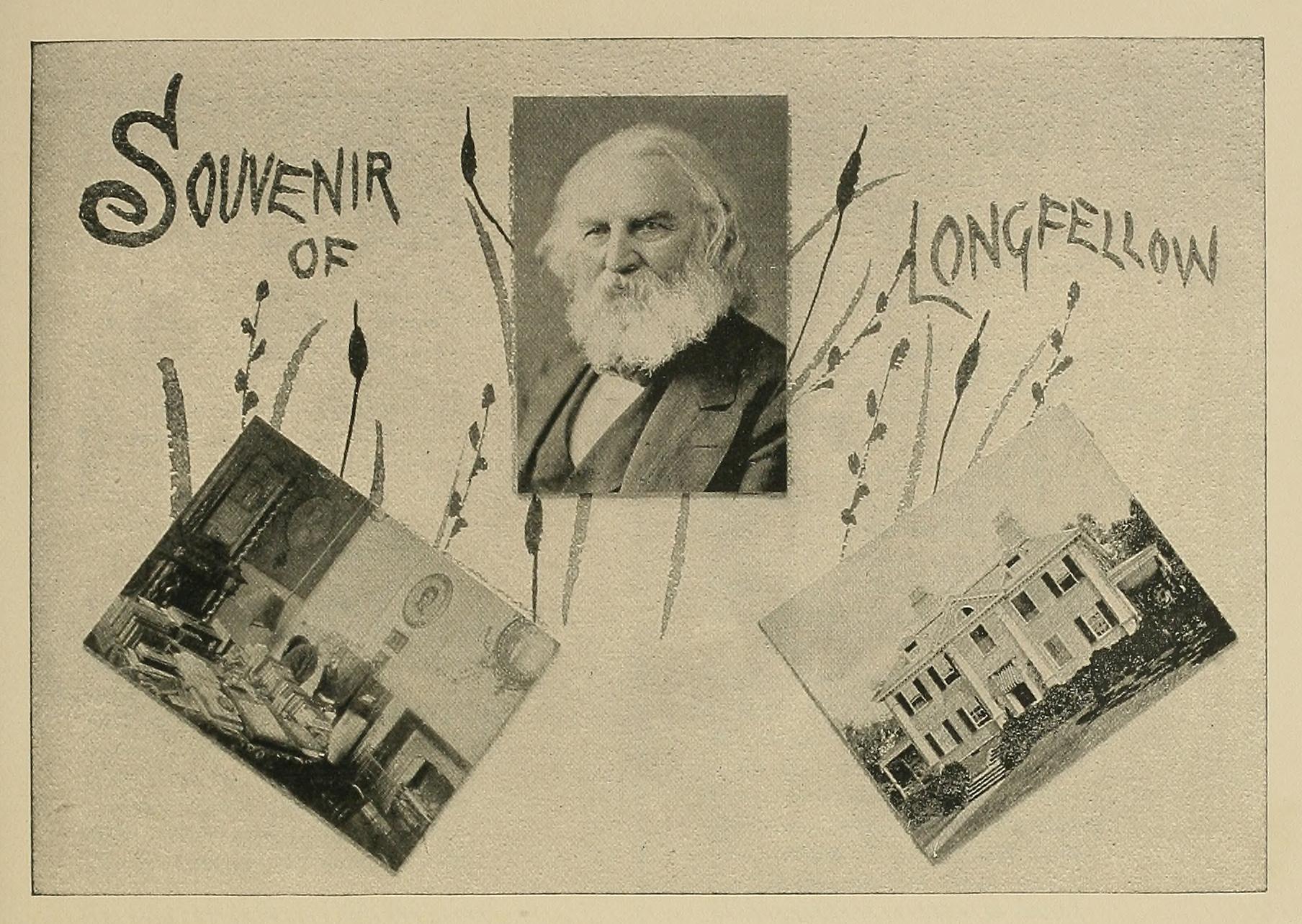
Souvenir of Longfellow
RALPH WALDO EMERSON.
THE LIBERATOR OF AMERICAN LITERATURE.
O classify Emerson is a matter of no small difficulty. He was a philosopher, he was an essayist, he was a poet—all three so eminently that scarcely two of his friends would agree to which class he most belonged. Oliver Wendell Holmes asks:
“Where in the realm of thought whose air is song
Does he the Buddha of the west belong?
He seems a winged Franklin sweetly wise,
Born to unlock the secret of the skies.”
But whatever he did was done with a poetic touch. Philosophy, essay or song, it was all pregnant with the spirit of poetry. Whatever else he was, Emerson was pre-eminently a poet. It was with this golden key that he unlocked the chambers of original thought, that liberated American letters.
Until Emerson came, American authors had little independence. James Russell Lowell declares, “We were socially and intellectually bound to English thought, until Emerson cut the cable and gave us a chance at the dangers and glories of blue waters. He was our first optimistic writer. Before his day, Puritan theology had seen in man only a vile nature and considered his instincts for beauty and pleasure, proofs of his total depravity.” Under such conditions as these, the imagination was fettered and wholesome literature was impossible. As a reaction against this Puritan austerity came Unitarianism, which aimed to establish the dignity of man, and out of this came the further growth of the idealism or transcendentalism of Emerson. It was this idea and these aspirations of the new theology that Emerson converted into literature. The indirect influence of his example on the writings of Longfellow, Holmes, Whittier and Lowell, and its direct influence on Thoreau, Hawthorne, Chas. A. Dana, Margaret Fuller, G. W. Curtis and others, formed the very foundation for the beautiful structure of our representative American literature.
Emerson was profoundly a thinker who pondered the relation of man to God and to the universe. He conceived and taught the noblest ideals of virtue and a spiritual life. The profound study which Emerson devoted to his themes and his philosophic cast of mind made him a writer for scholars. He was a prophet who, without argument, announced truths which, by intuition, he seems to have perceived; but the thought is often so shadowy that the ordinary reader fails to catch it. For this reason he will never be like Longfellow or Whittier, a favorite with the masses. Let it not be understood, however, that all of Emerson’s writings are heavy or shadowy or difficult to understand. On the contrary, some of his poems are of a popular character and are easy of comprehension. For instance, “The Hymn,” sung at the completion of the Concord Monument in 1836, was on every one’s lips at the time of the Centennial celebration, in 1876. His optimistic spirit is also beautifully and clearly expressed in the following stanza of his “Voluntaries:”
So nigh is grandeur to our dust,
So near is God to man,
When duty whispers low, “Thou must,”
The youth replies, “I can.”
These are but two instances of many that may be cited. No author is, perhaps, more enjoyed by those who understand him. He was a master of language. He never used the wrong word. His sentences are models. But he was not a logical or methodical writer. Every sentence stands by itself. His paragraphs might be arranged almost at random without essential loss to the essays. His philosophy consists largely in an array of golden sayings full of vital suggestions to help men make the best and most of themselves. He had no compact system of philosophy.
Ralph Waldo Emerson was born in Boston, May 25, 1803, within “A kite-string of the birth place of Benjamin Franklin” with whom he is frequently compared. The likeness, however, consists only in the fact that they were both decidedly representative Americans of a decidedly different type. Franklin was prose, Emerson poetry; Franklin common sense, real; Emerson imaginative, ideal. In these opposite respects they both were equally representative of the highest type. Both were hopeful, kindly and shrewd. Both equally powerful in making, training and guiding the American people.
In his eighth year young Emerson was sent to a grammar school, where he made such rapid progress, that he was soon able to enter a higher department known as a Latin school. His first attempts at writing were not the dull efforts of a school boy; but original poems which he read with real taste and feeling. He completed his course and graduated from Harvard College at eighteen. It is said that he was dull in mathematics and not above the average in his class in general standing; but he was widely read in literature, which put him far in advance, perhaps, of any young man of his age. After graduating, he taught school for five years in connection with his brother; but in 1825, gave it up for the ministry. For a time he was pastor of a Unitarian Congregation in Boston; but his independent views were not in accordance with the doctrine of his church, therefore, he resigned in 1835, and retired to Concord, where he purchased a home near the spot on which the first battle of the Revolution was fought in 1775, which he commemorated in his own verse:—
“There first the embattled farmers stood,
And fired the shot heard round the world.”
In this city, Emerson resided until the day of his death, which occurred in Concord, April 27, 1882, in the seventy-eighth year of his age.
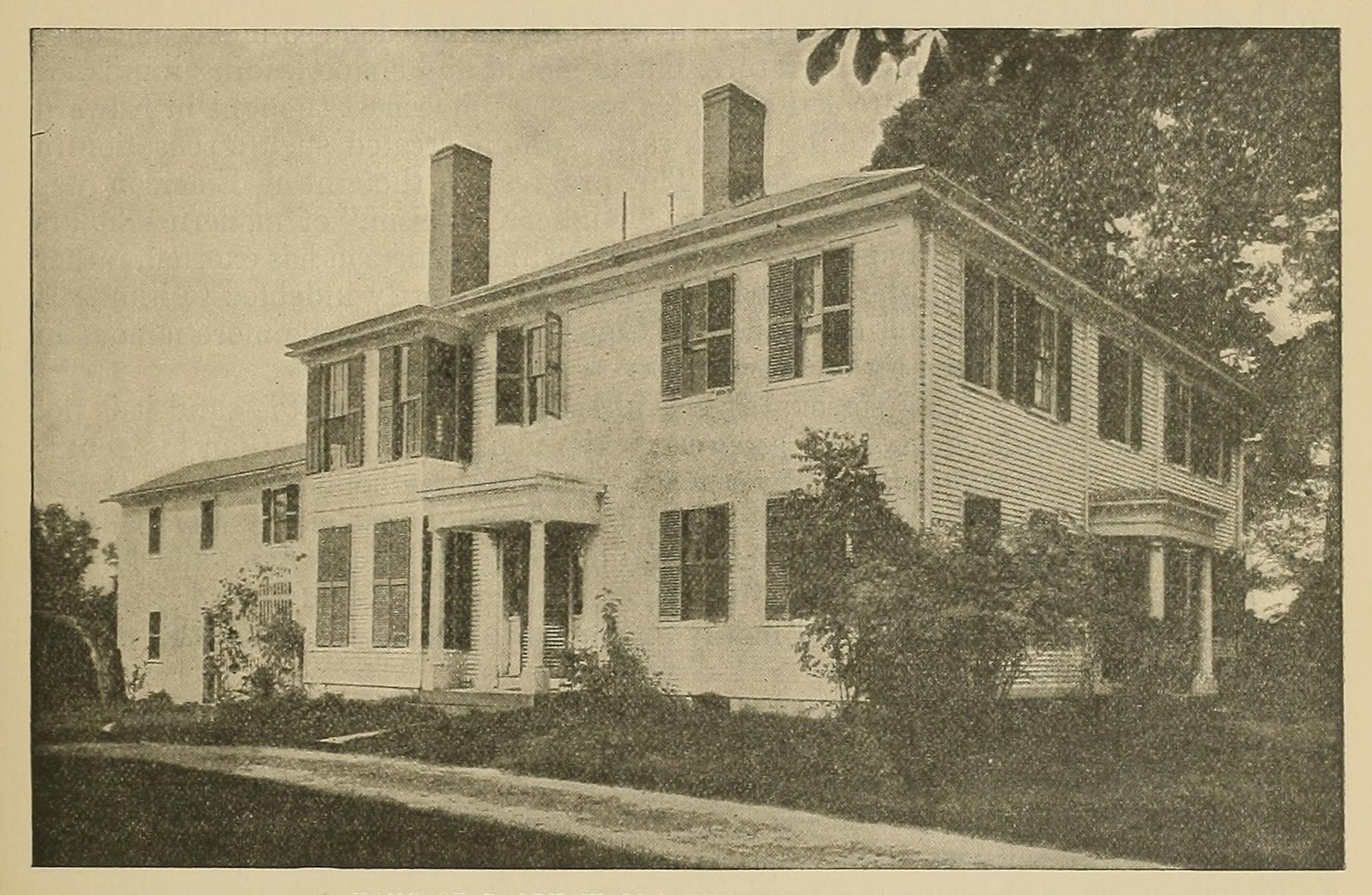
HOME OF RALPH WALDO EMERSON, CONCORD, MASS.
It was in Concord that the poet and essayist, as the prophet of the advanced thought of his age, gathered around him those leading spirits who were dissatisfied with the selfishness and shallowness of existing society, and, who had been led by him to dream of an ideal condition in which all should live as one family. Out of this grew the famous “Brook Farm Community.” This was not an original idea of Emerson’s, however. Coleridge and Southey, of England, had thought of founding such a society in Pennsylvania, on the Susquehanna River. Emerson regarded this community of interests as the clear teachings of Jesus Christ; and, to put into practical operation this idea, a farm of about two hundred acres was bought at Roxbury, Mass., and a stock company was formed under the title of “The Brook Farm Institution of Agriculture and Education.” About seventy members joined in the enterprise. The principle of the organization was coöperative, the members sharing the profits. Nathaniel Hawthorne, the greatest of romancers, Chas. A. Dana, of the New York Tribune, Geo. W. Curtis, of Harper’s Monthly, Henry D. Thoreau, the poet naturalist, Amos Bronson Alcott, the transcendental dreamer and writer of strange shadowy sayings, and Margaret Fuller, the most learned woman of her age, were prominent members who removed to live on the farm. It is said that Emerson, himself, never really lived there; but was a member and frequent visitor, as were other prominent scholars of the same school. The project was a failure. After five years of experience, some of the houses were destroyed by fire, the enterprise given up, and the membership scattered.
But the Brook Farm served its purpose in literature by bringing together some of the best intellects in America, engaging them for five years in a common course of study, and stimulating a commerce of ideas. The breaking up of the community was better, perhaps, than its success would have been. It dispersed and scattered abroad the advanced thoughts of Emerson, and the doctrine of the society into every profession. Instead of being confined to the little paper, “The Dial,” (which was the organ of the society) its literature was transferred into a number of widely circulated national mediums.
Thus, it will be seen how Emerson, the “Sage of Concord,” gathered around him and dominated, by his charming personality, his powerful mind, and his wholesome influence, some of the brightest minds that have figured in American literature; and how, through them, as well as his own writings, he has done so much, not only to lay the foundation of a new literature, but to mould and shape leading minds for generations to come. The Brook Farm idea was the uppermost thought in Edward Bellamy’s famous novel, “Looking Backward,” which created such a sensation in the reading world a few years since. The progressive thought of Emerson was father to the so-called “New Theology,” or “Higher Criticism,” of modern scholars and theologians. It is, perhaps, for the influence which Emerson has exerted, rather than his own works, that the literature of America is mostly indebted to him. It was through his efforts that the village of Concord has been made more famous in American letters than the city of New York.
The charm of Emerson’s personality has already been referred to,—and it is not strange that it should have been so great. His manhood, no less than his genius was worthy of admiration and of reverence. His life corresponded with his brave, cheerful and steadfast teachings. He “practiced what he preached.” His manners were so gentle, his nature so transparent, and his life so singularly pure and happy, that he was called, while he lived, “the good and great Emerson;” and, since his death, the memory of his life and manly example are among the cherished possessions of our literature.
The reverence of his literary associates was little less than worship. Amos Bronson Alcott,—father of the authoress, Louisa M. Alcott,—one of the Brook Farm members, though himself a profound scholar and several years Emerson’s senior, declared that it would have been his great misfortune to have lived without knowing Emerson, whom he styled, “The magic minstrel and speaker! whose rhetoric, voiced as by organ stops, delivers the sentiment from his breast in cadences peculiar to himself; now hurling it forth on the ear, echoing them; then,—as his mood and matter invite it—dying like
Music of mild lutes
Or silver coated flutes.
... such is the rhapsodist’s cunning in its structure and delivery.”
Referring to his association with Emerson, the same writer acknowledges in a poem, written after the sage’s death:
Thy fellowship was my culture, noble friend:
By the hand thou took’st me, and did’st condescend
To bring me straightway into thy fair guild;
And life-long hath it been high compliment
By that to have been known, and thy friend styled,
Given to rare thought and to good learning bent;
Whilst in my straits an angel on me smiled.
Permit me, then, thus honored, still to be
A scholar in thy university.
HYMN SUNG AT THE COMPLETION OF THE CONCORD MONUMENT, 1836.
Y the rude bridge that arched the flood,
Their flag to April’s breeze unfurled,
Here once the embattled farmers stood,
And fired the shot heard round the world.
The foe long since in silence slept;
Alike the conqueror silent sleeps;
And Time the ruined bridge has swept
Down the dark stream which seaward creeps.
On this green bank, by this soft stream,
We set to day a votive stone,
That memory may their deed redeem
When, like our sires, our sons are gone.
Spirit that made those heroes dare
To die or leave their children free,
Bid Time and Nature gently spare
The shaft we raise to them and thee.
THE RHODORA.
N May, when sea-winds pierced our solitudes,
I found the fresh Rhodora in the woods,
Spreading its leafless blooms in a damp nook,
To please the desert and the sluggish brook;
The purple petals fallen in the pool
Made the black waters with their beauty gay;
Young Raphael might covet such a school;
The lively show beguiled me from my way.
Rhodora! if the sages ask thee why
This charm is wasted on the marsh and sky,
Dear tell them, that if eyes were made for seeing,
Then beauty is its own excuse for being.
Why, thou wert there, O, rival of the rose!
I never thought to ask, I never knew,
But in my simple ignorance suppose
The selfsame Power that brought me there, brought you.
THE TRUE HERO.
AN EXTRACT FROM “VOLUNTARIES.”
The following story is told of the manner in which the poem, “Voluntaries,” obtained its title. In 1863, Mr. Emerson came to Boston and took a room in the Parker House, bringing with him the unfinished sketch of a few verses which he wished Mr. Fields, his publisher, to hear. He drew a small table to the centre of the room and read aloud the lines he proposed giving to the press. They were written on separate slips of paper which were flying loosely about the room. (Mr. Emerson frequently wrote in such independent paragraphs, that many of his poems and essays might be rearranged without doing them serious violence.) The question arose as to title of the verses read, when Mr. Fields suggested ♦“Voluntaries,” which was cordially accepted by Mr. Emerson.
WELL for the fortunate soul
Which Music’s wings unfold,
Stealing away the memory
Of sorrows new and old!
Yet happier he whose inward sight,
Stayed on his subtle thought,
Shuts his sense on toys of time,
To vacant bosoms brought;
But best befriended of the God
He who, in evil times,
Warned by an inward voice,
Heeds not the darkness and the dread,
Biding by his rule and choice,
Telling only the fiery thread,
Leading over heroic ground
Walled with immortal terror round,
To the aim which him allures,
And the sweet heaven his deed secures.
Peril around all else appalling,
Cannon in front and leaden rain,
Him duty through the clarion calling
To the van called not in vain.
Stainless soldier on the walls,
Knowing this,—and knows no more,—
Whoever fights, whoever falls,
Justice conquers evermore,
Justice after as before;—
And he who battles on her side,
God, though he were ten times slain,
Crowns him victor glorified,
Victor over death and pain
Forever: but his erring foe,
Self-assured that he prevails,
Looks from his victim lying low,
And sees aloft the red right arm
Redress the eternal scales.
He, the poor for whom angels foil,
Blind with pride and fooled by hate,
Writhes within the dragon coil,
Reserved to a speechless fate.
MOUNTAIN AND SQUIRREL.
HE mountain and the squirrel
Had a quarrel;
And the former called the latter “Little Prig.”
Bun replied:
“You are doubtless very big;
But all sorts of things and weather
Must be taken in together,
To make up a year
And a sphere.
And I think it no disgrace
To occupy my place.
If I’m not so large as you,
You are not so small as I,
And not half so spry.
I’ll not deny you make
A very pretty squirrel track;
Talents differ; all is well and wisely put;
If I cannot carry forests on my back,
Neither can you crack a nut.”
THE SNOW STORM.
NNOUNCED by all the trumpets of the sky
Arrives the snow, and driving o’er the fields,
Seems nowhere to alight: the whited air
Hides hills and woods, the river, and the heaven,
And veils the farm-house at the garden’s end.
The sled and traveler stopp’d, the courier’s feet
Delay’d, all friends shut out, the housemates sit
Around the radiant fire-place, enclosed
In a tumultuous privacy of storm.
Come see the north-wind’s masonry.
Out of an unseen quarry evermore
Furnish’d with tile, the fierce artificer
Curves his white bastions with projected roof
Round every windward stake, or tree, or door.
Speeding, the myriad-handed, his wild work
So fanciful, so savage, nought cares he
For number or proportion. Mockingly
On coop or kennel he hangs Parian wreaths;
A swan-like form invests the hidden thorn;
Fills up the farmer’s lane from wall to wall,
Maugre the farmer’s sighs, and at the gate
A tapering turret overtops the work.
And when his hours are number’d, and the world
Is all his own, retiring, as he were not,
Leaves, when the sun appears, astonish’d Art
To mimic in slow structures, stone by stone,
Built in an age, the mad wind’s night-work,
The frolic architecture of the snow.
THE PROBLEM.
LIKE a church, I like a cowl,
I love a prophet of the soul,
And on my heart monastic aisles
Fall like sweet strains or pensive smiles,
Yet not for all his faith can see
Would I that cowled churchman be.
Why should the vest on him allure,
Which I could not on me endure?
Not from a vain or shallow thought
His awful Jove young Phidias brought;
Never from lips of cunning fell
The thrilling Delphic oracle;
Out from the heart of nature roll’d
The burdens of the Bible old;
The litanies of nations came,
Like the volcano’s tongue of flame,
Up from the burning core below,—
The canticles of love and wo.
The hand that rounded Peter’s dome,
And groin’d the aisles of Christian Rome,
Wrought in a sad sincerity.
Himself from God he could not free;
He builded better than he knew,
The conscious stone to beauty grew.
Know’st thou what wove yon wood-bird’s nest
Of leaves, and feathers from her breast;
Or how the fish outbuilt her shell,
Painting with morn each annual cell;
Or how the sacred pine tree adds
To her old leaves new myriads?
Such and so grew these holy piles,
Whilst love and terror laid the tiles.
Earth proudly wears the Parthenon
As the best gem upon her zone;
And morning opes with haste her lids
To gaze upon the Pyramids;
O’er England’s Abbeys bends the sky
As on its friends with kindred eye;
For, out of Thought’s interior sphere
These wonders rose to upper air,
And nature gladly gave them place,
Adopted them into her race,
And granted them an equal date
With Andes and with Ararat.
These temples grew as grows the grass,
Art might obey but not surpass.
The passive Master lent his hand
To the vast Soul that o’er him plann’d,
And the same power that rear’d the shrine
Bestrode the tribes that knelt within.
Ever the fiery Pentacost
Girds with one flame the countless host,
Trances the heart through chanting choirs,
And through the priest the mind inspires.
The word unto the prophet spoken,
Was writ on tables yet unbroken;
The word by seers or sybils told
In groves of oak or fanes of gold,
Still floats upon the morning wind,
Still whispers to the willing mind.
One accent of the Holy Ghost
The heedless world hath never lost
I know what say the Fathers wise,—
The book itself before me lies,—
Old Chrysostom, best Augustine,
And he who blent both in his line,
The younger Golden Lips or mines,
Taylor, the Shakespeare of divines;
His words are music in my ear,
I see his cowled portrait dear.
And yet, for all his faith could see,
I would not the good bishop be.
TRAVELING.
HAVE no churlish objection to the circumnavigation of the globe, for the purposes of art, of study, and benevolence, so that the man is first domesticated, or does not go abroad with the hope of finding somewhat greater than he knows. He who travels to be amused, or to get somewhat which he does not carry, travels away from himself, and grows old even in youth among old things. In Thebes, in Palmyra, his will and mind have become old and dilapidated as they. He carries ruins to ruins.
Traveling is a fool’s paradise. We owe to our first journeys the discovery that place is nothing. At home I dream that at Naples, at Rome, I can be intoxicated with beauty and lose my sadness. I pack my trunk, embrace my friends, and embark on the sea, and at last wake up at Naples, and there beside me is the stern fact, the sad self, unrelenting, identical that I fled from. I seek the Vatican and the palaces. I affect to be intoxicated with sights and suggestions; but I am not intoxicated. My giant goes with me wherever I go.
But the rage of traveling is itself only a symptom of a deeper unsoundness affecting the whole intellectual action. The intellect is vagabond, and the universal system of education fosters restlessness. Our minds travel when our bodies are forced to stay at home. We imitate; and what is imitation but the traveling of the mind? Our houses are built with foreign taste; our shelves are garnished with foreign ornaments; our opinions, our tastes, our whole minds, lean to and follow the past and the distant as the eyes of a maid follow her mistress. The soul created the arts wherever they have flourished. It was in his own mind that the artist sought his model. It was an application of his own thought to the thing to be done and the conditions to be observed. And why need we copy the Doric or the Gothic model? Beauty, convenience, grandeur of thought and quaint expression are as near to us as to any, and if the American artist will study with hope and love the precise thing to be done by him, considering the climate, the soil, the length of the day, the wants of the people, the habit and form of the government, he will create a house in which all these will find themselves fitted, and taste and sentiment will be satisfied also.
THE COMPENSATION OF CALAMITY.
E cannot part with our friends. We cannot let our angels go. We do not see that they only go out that archangels may come in. We are idolaters of the old. We do not believe in the riches of the soul, in its proper eternity and omnipresence. We do not believe there is any force in to-day to rival or recreate that beautiful yesterday. We linger in the ruins of the old tent, where once we had bread and shelter and organs, nor believe that the spirit can feed, cover and nerve us again. We cannot find aught so dear, so sweet, so graceful. But we sit and weep in vain. The voice of the Almighty saith, “Up and onward for evermore!” We cannot stay amid the ruins, neither will we rely on the new; and so we walk ever with reverted eyes, like those monsters who look backwards.
And yet the compensations of calamity are made apparent to the understanding also, after long intervals of time. A fever, a mutilation, a cruel disappointment, a loss of wealth, a loss of friends, seems at the moment unpaid loss, and unpayable. But the sure years reveal the deep remedial force that underlies all facts. The death of a dear friend, wife, brother, lover, which seemed nothing but privation, somewhat later assumes the aspect of a guide or genius; for it commonly operates revolutions in our way of life, terminates an epoch of infancy or of youth which was waiting to be closed; breaks up a wonted occupation, or a household, or style of living, and allows the formation of new ones more friendly to the growth of character. It permits or constrains the formation of new acquaintances, and the reception of new influences that prove of the first importance to the next years; and the man or woman who would have remained a sunny garden-flower, with no room for its roots and too much sunshine for its head, by the falling of the walls and the neglect of the gardener, is made the banian of the forest, yielding shade and fruit to wide neighborhoods of men.
SELF-RELIANCE.
NSIST on yourself; never imitate. Your own gift you can present every moment with the cumulative force of a whole life’s cultivation; but of the adopted talent of another you have only an extemporaneous, half possession. That which each can do best, none but his Maker can teach him. No man yet knows what it is, nor can, till that person has exhibited it. Where is the master who could have taught Shakspeare? Where is the master who could have instructed Franklin, or Washington, or Bacon or Newton? Every great man is a unique. The Scipionism of Scipio is precisely that part he could not borrow. If anybody will tell me whom the great man imitates in the original crisis when he performs a great act, I will tell him who else than himself can teach him. Shakspeare will never be made by the study of Shakspeare. Do that which is assigned thee, and thou canst not hope too much or dare too much.
FROM “NATURE.”
O go into solitude a man needs to retire as much from his chamber as from society. I am not solitary whilst I read and write, though nobody is with me. But if a man would be alone, let him look at the stars. The rays that come from those heavenly worlds will separate between him and vulgar things. One might think the atmosphere was made transparent with this design, to give man, in the heavenly bodies, the perpetual presence of the sublime. Seen in the streets of cities, how great they are!
If the stars should appear one night in a thousand years, how would men believe and adore and preserve for many generations the remembrance of the city of God which had been shown! But every night come out these preachers of beauty and light the universe with their admonishing smile.
The stars awaken a certain reverence, because, always present, they are always inaccessible; but all natural objects make kindred impression when the mind is open to their influence. Nature never wears a mean appearance. Neither does the wisest man extort all her secrets and lose his curiosity by finding out all her perfection. Nature never became a toy to a wise spirit. The flowers, the animals, the mountains reflected all the wisdom of his best hour as much as they had delighted the simplicity of his childhood.
When we speak of Nature in this manner, we have a distinct but most poetical sense in the mind. We mean the integrity of impression made by manifold Nature objects. It is this which distinguishes the stick of timber of the wood-cutter from the tree of the poet. The charming landscape which I saw this morning is indubitably made up of some twenty or thirty farms. Miller owns this field, Locke that, and Manning the woodland beyond. But none of them owns the landscape. There is a property in the horizon which no man has but he whose eye can integrate all the parts—that is, the poet. This is the best part of these men’s farms, yet to this their land-deeds give them no title.
To speak truly, few adult persons can see Nature. Most persons do not see the sun. At least they have a very superficial seeing. The sun illuminates only the eye of the man, but shines into the eye and the heart of the child. The lover of Nature is he whose inward and outward senses are still truly adjusted to each other—who has retained the spirit of infancy even into the era of manhood. His intercourse with heaven and earth becomes part of his daily food. In the presence of Nature a wild delight runs through the man in spite of real sorrows. Nature says, He is my creature, and, maugre all his impertinent griefs, he shall be glad with me. Not the sun nor the summer alone, but every hour and season, yields its tribute of delight; for every hour and change corresponds to and authorizes a different state of the mind, from breathless noon to grimmest midnight. Nature is a setting that fits equally well a comic or a mourning piece. In good health the air is a cordial of incredible virtue. Crossing a bare common in snow-puddles at twilight under a clouded sky, without having in my thoughts any occurrence of special good-fortune, I have enjoyed a perfect exhilaration. Almost I fear to think how glad I am. In the woods, too, a man casts off his years as the snake his slough, and at what period soever of his life is always a child. In the woods is perpetual youth. Within these plantations of God a decorum and sanctity reign, a perennial festival is dressed, and the guest sees not how he should tire of them in a thousand years. In the woods we return to reason and faith. There I feel that nothing can befall me in life—no disgrace, no calamity (leaving me my eyes)—which Nature cannot repair.
The greatest delight which the fields and woods minister is the suggestion of an occult relation between man and the vegetable. I am not alone and unacknowledged. They nod to me and I to them. The waving of the boughs in the storm is new to me and old.
It takes me by surprise, and yet is not unknown. Its effect is like that of a higher thought or a better emotion coming over me when I deemed I was thinking justly or doing right.
Yet it is certain that the power to produce this delight does not reside in Nature, but in man or in a harmony of both. It is necessary to use these pleasures with great temperance. For Nature is not always tricked in holiday attire, but the same scene which yesterday breathed perfume and glittered as for the frolic of the nymphs is overspread with melancholy to-day. Nature always wears the colors of the spirit. To a man laboring under calamity the heat of his own fire hath sadness in it. Then there is a kind of contempt of the landscape felt by him who has just lost by death a dear friend. The sky is less grand as it shuts down over less worth in the population.
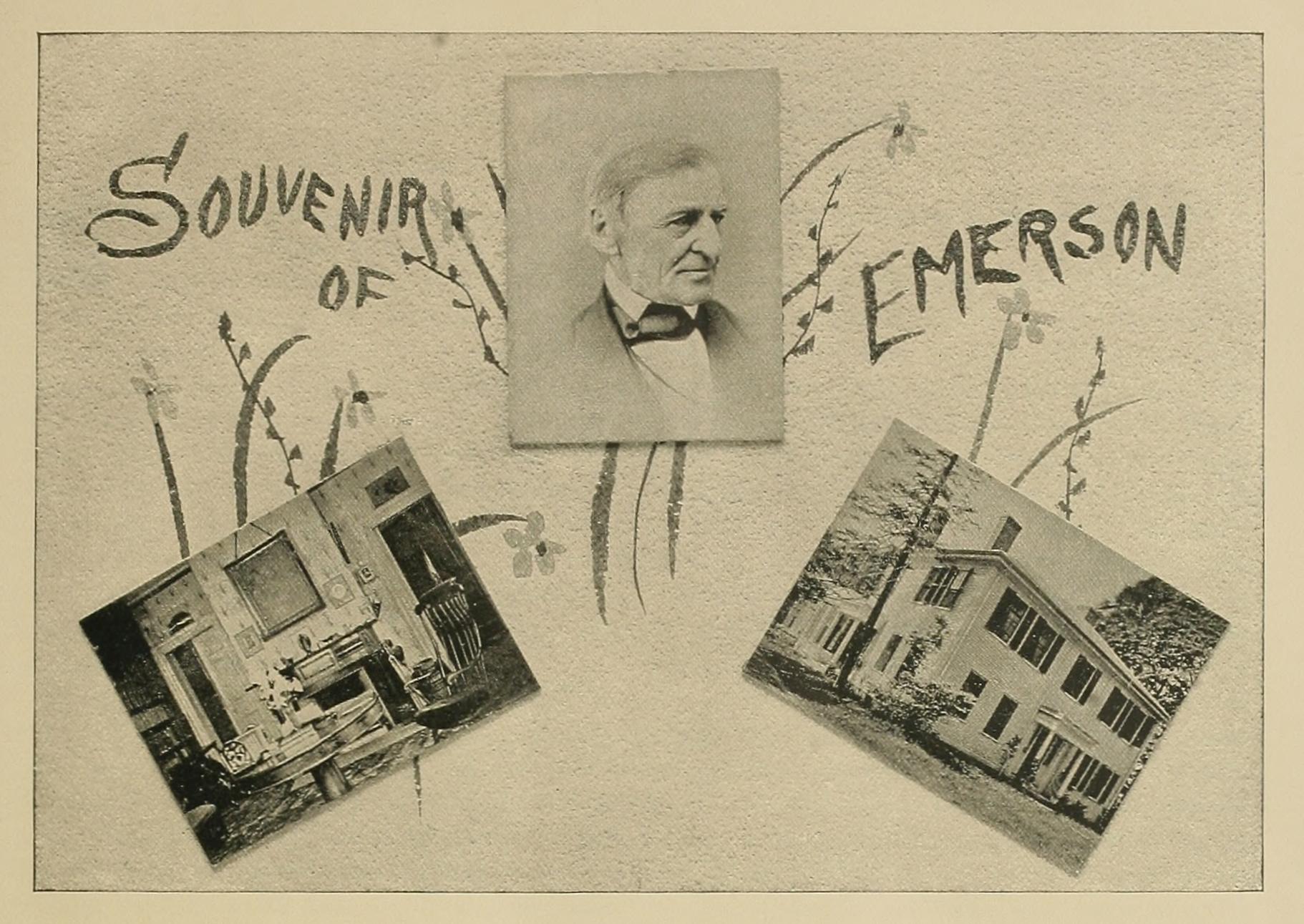
Souvenir of Emerson
JOHN GREENLEAF WHITTIER.
“THE POET OF FREEDOM.”
N a solitary farm house near Haverhill, Massachusetts, in the valley of the Merrimac, on the 17th day of December, 1807, John Greenleaf Whittier was born. Within the same town, and Amesbury, nearby, this kind and gentle man, whom all the world delights to honor for his simple and beautiful heart-songs, spent most of his life, dying at the ripe old age of nearly eighty-five, in Danvers, Massachusetts, September 7th, 1892. The only distinguishing features about his ancestors were that Thos. Whittier settled at Haverhill in 1647, and brought with him from Newberry the first hive of bees in the settlement, that they were all sturdy Quakers, lived simply, were friendly and freedom loving. The early surroundings of the farmer boy were simple and frugal. He has pictured them for us in his masterpiece, “Snowbound.” Poverty, the necessity of laboring upon the farm, the influence of Quaker traditions, his busy life, all conspired against his liberal education and literary culture. This limitation of knowledge is, however, at once to the masses his charm, and, to scholars, his one defect. It has led him to write, as no other poet could, upon the dear simplicity of New England farm life. He has written from the heart and not from the head; he has composed popular pastorals, not hymns of culture. Only such training as the district schools afforded, with a couple of years at Haverhill Academy comprised his advantages in education.
In referring to this alma mater in after years, under the spell of his muse, the poet thus writes:—
“Still sits the school house by the road,
A ragged beggar sunning;
Around it still the sumachs grow
And black-berry vines are running.
Within, the master’s desk is seen,
Deep-scarred by raps official;
The warping floor, the battered seats,
The jack-knife carved initial.”
It was natural for Whittier to become the poet of that combination of which Garrison was the apostle, and Phillips and Sumner the orators. His early poems were published by Garrison in his paper, “The Free Press,” the first one when Whittier was nineteen years of age and Garrison himself little more than a boy. The farmer lad was elated when he found the verses which he had so timidly submitted in print with a friendly comment from the editor and a request for more. Garrison even visited Whittier’s parents and urged the importance of giving him a finished education. Thus he fell early under the spell of the great abolitionist and threw himself with all the ardor of his nature into the movement. His poems against slavery and disunion have a ringing zeal worthy of a Cromwell. “They are,” declares one writer, “like the sound of the trumpets blown before the walls of Jericho.”
As a Quaker Whittier could not have been otherwise than an abolitionist, for that denomination had long since abolished slavery within its own communion. Most prominent among his poems of freedom are “The Voice of Freedom,” published in 1849, “The Panorama and Other Poems,” in 1856, “In War Times,” in 1863, and “Ichabod,” a pathetically kind yet severely stinging rebuke to Daniel Webster for his support of the Fugitive Slave Law. Webster was right from the standpoint of law and the Constitution, but Whittier argued from the standpoint of human right and liberty. “Barbara Frietchie,”—while it is pronounced purely a fiction, as is also his poem about John Brown kissing the Negro baby on his way to the gallows,—is perhaps the most widely quoted of his famous war poems.
Whittier also wrote extensively on subjects relating to New England history, witchcraft and colonial traditions. This group includes many of his best ballads, which have done in verse for colonial romance what Hawthorne did in prose in his “Twice-Told Tales” and “Scarlet Letter.” It is these poems that have entitled Whittier to be called “the greatest of American ballad writers.” Among them are to be found “Mabel Martin,” “The Witch of Wenham,” “Marguerite” and “Skipper Ireson’s Ride.” But it is perhaps in the third department of his writings, namely, rural tales and idyls, that the poet is most widely known. These pastoral poems contain the very heart and soul of New England. They are faithful and loving pictures of humble life, simple and peaceful in their subject and in their style. The masterpieces of this class are “Snowbound,” “Maud Muller,” “The Barefoot Boy,” “Among the Hills,” “Telling the Bees,” etc. The relation of these simple experiences of homely character has carried him to the hearts of the people and made him, next to Longfellow, the most popular of American poets. There is a pleasure and a satisfaction in the freshness of Whittier’s homely words and homespun phrases, which we seek in vain in the polished art of cultivated masters. As a poet of nature he has painted the landscapes of New England as Bryant has the larger features of the continent.
Whittier was never married and aside from a few exquisite verses he has given the public no clew to the romance of his youth. His home was presided over for many years by his sister Elizabeth, a most lovely and talented woman, for whom he cherished the deepest affection, and he has written nothing more touching than his tribute to her memory in “Snowbound.” The poet was shy and diffident among strangers and in formal society, but among his friends genial and delightful, with a fund of gentle and delicate humor which gave his conversation a great charm.
Aside from his work as a poet Whittier wrote considerable prose. His first volume was “Legends of New England,” published in 1831, consisting of prose and verse. Subsequent prose publications consisted of contributions to the slave controversy, biographical sketches of English and American reformers, studies of scenery and folk-lore of the Merrimac valley. Those of greatest literary interest were the “Supernaturalisms of New England,” (1847,) and “Literary Recreations and Miscellanies,” (1852.)
In 1836 Whittier became secretary of the American Anti-Slavery Society, and he was all his life interested in public affairs, and wrote much for newspapers and periodicals. In 1838 he began to edit the “Pennsylvania Freeman” in Philadelphia, but in the following year his press was destroyed and his office burned by a pro-slavery mob, and he returned to New England, devoting the larger part of his life, aside from his anti-slavery political writings, to embalming its history and legends in his literature, and so completely has it been done by him it has been declared: “If every other record of the early history and life of New England were lost the story could be constructed again from the pages of Whittier. Traits, habits, facts, traditions, incidents—he holds a torch to the dark places and illumines them every one.”
Mr. Whittier, perhaps, is the most peculiarly American poet of any that our country has produced. The woods and waterfowl of Bryant belong as much to one land as another; and all the rest of our singers—Emerson, Longfellow, Lowell, and their brethren—with the single exception of Joaquin Miller, might as well have been born in the land of Shakespeare, Milton and Byron as their own. But Whittier is entirely a poet of his own soil. All through his verse we see the elements that created it, and it is interesting to trace his simple life, throughout, in his verses from the time, when like that urchin with whom he asserts brotherhood, and who has won all affections, he ate his
* * * “milk and bread,
Pewter spoon and bowl of wood,
On the door-stone gray and rude.
O’er me, like a regal tent,
Cloudy-ribbed, the sunset bent,
Purple curtains fringed with gold
Looped in many a wind-swung fold;”
and, when a little older his fancy dwelt upon the adventures of Chalkley—as
“Following my plough by Merrimac’s green shore
His simple record I have pondered o’er
With deep and quiet joy.”
In these reveries, “The Barefoot Boy” and others, thousands of his countrymen have lived over their lives again. Every thing he wrote, to the New Englander has a sweet, warm familiar life about it. To them his writings are familiar photographs, but they are also treasury houses of facts over which the future antiquarian will pour and gather all the close details of the phase of civilization that they give.
The old Whittier homestead at Amesbury is now in charge of Mrs. Pickard, a ♦niece of the poet. She has recently made certain changes in the house; but this has been done so wisely and cautiously that if the place some day becomes a shrine—as it doubtless will—the restoration of the old estate will be a simple matter. The library is left quite undisturbed, just as it was when Whittier died.
MY PLAYMATE.
HE pines were dark on Ramoth Hill,
Their song was soft and low;
The blossoms in the sweet May wind
Were falling like the snow.
The blossoms drifted at our feet,
The orchard birds sang clear;
The sweetest and the saddest day
It seemed of all the year,
For more to me than birds or flowers,
My playmate left her home,
And took with her the laughing spring,
The music and the bloom.
She kissed the lips of kith and kin,
She laid her hand in mine:
What more could ask the bashful boy
Who fed her father’s kine?
She left us in the bloom of May:
The constant years told o’er
The seasons with as sweet May morns,
But she came back no more.
I walk with noiseless feet the round
Of uneventful years;
Still o’er and o’er I sow the Spring
And reap the Autumn ears.
She lives where all the golden year
Her summer roses blow;
The dusky children of the sun
Before her come and go.
There haply with her jeweled hands
She smooths her silken gown,—
No more the homespun lap wherein
I shook the walnuts down.
The wild grapes wait us by the brook,
The brown nuts on the hill,
And still the May-day flowers make sweet
The woods of Follymill.
The lilies blossom in the pond,
The birds build in the tree,
The dark pines sing on Ramoth Hill
The slow song of the sea.
I wonder if she thinks of them,
And how the old time seems,—
If ever the pines of Ramoth wood
Are sounding in her dreams.
I see her face, I hear her voice;
Does she remember mine?
And what to her is now the boy
Who fed her father’s kine?
What cares she that the orioles build
For other eyes than ours,—
That other hands with nuts are filled,
And other laps with flowers?
O playmate in the golden time!
Our mossy seat is green,
Its fringing violets blossom yet,
The old trees o’er it lean.
The winds so sweet with birch and fern
A sweeter memory blow;
And there in spring the veeries sing
The song of long ago.
And still the pines of Ramoth wood
Are moaning like the sea,—
The moaning of the sea of change
Between myself and thee!
THE CHANGELING.
OR the fairest maid in Hampton
They needed not to search,
Who saw young Anna Favor
Come walking into church,—
Or bringing from the meadows,
At set of harvest-day,
The frolic of the blackbirds,
The sweetness of the hay.
Now the weariest of all mothers,
The saddest two-years bride,
She scowls in the face of her husband,
And spurns her child aside.
“Rake out the red coals, goodman,
For there the child shall lie,
Till the black witch comes to fetch her,
And both up chimney fly.
“It’s never my own little daughter,
It’s never my own,” she said;
“The witches have stolen my Anna,
And left me an imp instead.
“O, fair and sweet was my baby,
Blue eyes, and ringlets of gold;
But this is ugly and wrinkled,
Cross, and cunning, and old.
“I hate the touch of her fingers,
I hate the feel of her skin;
It’s not the milk from my bosom,
But my blood, that she sucks in.
“My face grows sharp with the torment;
Look! my arms are skin and bone!—
Rake open the red coals, goodman,
And the witch shall have her own.
“She’ll come when she hears it crying,
In the shape of an owl or bat,
And she’ll bring us our darling Anna
In place of her screeching brat.”
Then the goodman, Ezra Dalton,
Laid his hand upon her head:
“Thy sorrow is great, O woman!
I sorrow with thee,” he said.
“The paths to trouble are many,
And never but one sure way
Leads out to the light beyond it:
My poor wife, let us pray.”
Then he said to the great All-Father,
“Thy daughter is weak and blind;
Let her sight come back, and clothe her
Once more in her right mind.
“Lead her out of this evil shadow,
Out of these fancies wild;
Let the holy love of the mother,
Turn again to her child.
“Make her lips like the lips of Mary,
Kissing her blessed Son;
Let her hands, like the hands of Jesus,
Rest on her little one.
“Comfort the soul of thy handmaid,
Open her prison door,
And thine shall be all the glory
And praise forevermore.”
Then into the face of its mother,
The baby looked up and smiled;
And the cloud of her soul was lifted,
And she knew her little child.
A beam of slant west sunshine
Made the wan face almost fair,
Lit the blue eyes’ patient wonder
And the rings of pale gold hair.
She kissed it on lip and forehead,
She kissed it on cheek and chin;
And she bared her snow-white bosom
To the lips so pale and thin.
O, fair on her bridal morning
Was the maid who blushed and smiled
But fairer to Ezra Dalton
Looked the mother of his child.
With more than a lover’s fondness
He stooped to her worn young face
And the nursing child and the mother
He folded in one embrace.
“Now mount and ride, my goodman
As lovest thine own soul!
Woe’s me if my wicked fancies
Be the death of Goody Cole!”
His horse he saddled and bridled,
And into the night rode he,—
Now through the great black woodland;
Now by the white-beached sea.
He rode through the silent clearings,
He came to the ferry wide,
And thrice he called to the boatman
Asleep on the other side.
He set his horse to the river,
He swam to Newburg town,
And he called up Justice Sewall
In his nightcap and his gown.
And the grave and worshipful justice,
Upon whose soul be peace!
Set his name to the jailer’s warrant
For Goody Cole’s release.
Then through the night the hoof-beats
Went sounding like a flail:
And Goody Cole at cock crow
Came forth from Ipswich jail.
THE WORSHIP OF NATURE.
HE ocean looketh up to heaven,
As ’twere a living thing;
The homage of its waves is given
In ceaseless worshiping.
They kneel upon the sloping sand,
As bends the human knee,
A beautiful and tireless band,
The priesthood of the sea!
They pour the glittering treasures out
Which in the deep have birth,
And chant their awful hymns about
The watching hills of earth.
The green earth sends its incense up
From every mountain-shrine,
From every flower and dewy cup
That greeteth the sunshine.
The mists are lifted from the rills,
Like the white wing of prayer;
They lean above the ancient hills,
As doing homage there.
The forest-tops are lowly cast
O’er breezy hill and glen,
As if a prayerful spirit pass’d
On nature as on men.
The clouds weep o’er the fallen world,
E’en as repentant love;
Ere, to the blessed breeze unfurl’d,
They fade in light above.
The sky is as a temple’s arch,
The blue and wavy air
Is glorious with the spirit-march
Of messengers at prayer.
The gentle moon, the kindling sun,
The many stars are given,
As shrines to burn earth’s incense on
The altar-fires of Heaven!
THE BAREFOOT BOY.
LESSINGS on thee, little man,
Barefoot boy, with cheek of tan!
With thy turned up pantaloons,
And thy merry whistled tunes;
With thy red lip, redder still
Kissed by strawberries on the hill;
With the sunshine on thy face,
Through thy torn brim’s jaunty grace!
From my heart I give thee joy;
I was once a barefoot boy.
Prince thou art—the grown-up man,
Only is republican.
Let the million-dollared ride!
Barefoot, trudging at his side,
Thou hast more than he can buy,
In the reach of ear and eye:
Outward sunshine, inward joy,
Blessings on the barefoot boy.
O! for boyhood’s painless play,
Sleep that wakes in laughing day,
Health that mocks the doctor’s rules,
Knowledge never learned of schools:
Of the wild bee’s morning chase,
Of the wild flower’s time and place,
Flight of fowl, and habitude
Of the tenants of the wood;
How the tortoise bears his shell,
How the woodchuck digs his cell,
And the ground-mole sinks his well;
How the robin feeds her young,
How the oriole’s nest is hung;
Where the whitest lilies blow,
Where the freshest berries grow,
Where the ground-nut trails its vine,
Where the wood-grape’s clusters shine;
Of the black wasp’s cunning way,
Mason of his walls of clay,
And the architectural plans
Of gray hornet artisans!
For, eschewing books and tasks,
Nature answers all he asks;
Hand in hand with her he walks,
Part and parcel of her joy,
Blessings on the barefoot boy.
O for boyhood’s time of June,
Crowding years in one brief moon,
When all things I heard or saw,
Me, their master, waited for!
I was rich in flowers and trees,
Humming-birds and honey-bees;
For my sport the squirrel played,
Plied the snouted mole his spade;
For my taste the blackberry cone
Purpled over hedge and stone;
Laughed the brook for my delight,
Through the day, and through the night:
Whispering at the garden wall,
Talked with me from fall to fall;
Mine the sand-rimmed pickerel pond,
Mine the walnut slopes beyond,
Mine, on bending orchard trees,
Apples of Hesperides!
Still, as my horizon grew,
Larger grew my riches too,
All the world I saw or knew
Seemed a complex Chinese toy,
Fashioned for a barefoot boy!
O, for festal dainties spread,
Like my bowl of milk and bread,
Pewter spoon and bowl of wood,
On the door-stone, gray and rude!
O’er me like a regal tent,
Cloudy ribbed, the sunset bent,
Purple-curtained, fringed with gold,
Looped in many a wind-swung fold;
While for music came the play
Of the pied frogs’ orchestra;
And, to light the noisy choir,
Lit the fly his lamp of fire.
I was monarch; pomp and joy
Waited on the barefoot boy!
Cheerily, then, my little man!
Live and laugh as boyhood can;
Though the flinty slopes be hard,
Stubble-speared the new-mown sward,
Every morn shall lead thee through
Fresh baptisms of the dew;
Every evening from thy feet
Shall the cool wind kiss the heat;
All too soon these feet must hide
In the prison cells of pride,
Lose the freedom of the sod,
Like a colt’s for work be shod,
Made to tread the mills of toil,
Up and down in ceaseless moil,
Happy if their track be found
Never on forbidden ground;
Happy if they sink not in
Quick and treacherous sands of sin.
Ah! that thou couldst know thy joy,
Ere it passes, barefoot boy!
MAUD MULLER.
AUD MULLER, on a summer’s day,
Raked the meadow sweet with hay.
Beneath her torn hat glowed the wealth
Of simple beauty and rustic health.
Singing, she wrought, and her merry glee
The mock-bird echoed from his tree.
But, when she glanced to the far off town,
White from its hill-slope looking down,
The sweet song died, and a vague unrest
And a nameless longing filled her breast—
A wish, that she hardly dared to own,
For something better than she had known.
The Judge rode slowly down the lane,
Smoothing his horse’s chestnut mane.
He drew his bridle in the shade
Of the apple-trees, to greet the maid.
And ask a draught from the spring that flowed
Through the meadow across the road.
She stooped where the cool spring bubbled up,
And filled for him her small tin cup,
And blushed as she gave it, looking down
On her feet so bare, and her tattered gown.
“Thanks!” said the Judge, “a sweeter draught
From a fairer hand was never quaffed.”
He spoke of the grass and flowers and trees,
Of the singing birds and the humming bees;
Then talked of the haying, and wondered whether
The cloud in the west would bring foul weather.
And Maud forgot her briar-torn gown,
And her graceful ankles bare and brown;
And listened, while a pleased surprise
Looked from her long-lashed hazel eyes.
At last, like one who for delay
Seeks a vain excuse, he rode away.
Maud Muller looked and sighed: “Ah me!
That I the Judge’s bride might be!
“He would dress me up in silks so fine,
And praise and toast me at his wine.
“My father should wear a broadcloth coat;
My brother should sail a painted boat.
“I’d dress my mother so grand and gay,
And the baby should have a new toy each day.
“And I’d feed the hungry and clothe the poor,
And all should bless me who left our door.”
The Judge looked back as he climbed the hill,
And saw Maud Muller standing still.
“A form more fair, a face more sweet,
Ne’er hath it been my lot to meet.
“And her modest answer and graceful air
Show her wise and good as she is fair.
“Would she were mine, and I to-day,
Like her, a harvester of hay:
“No doubtful balance of rights and wrongs,
Nor weary lawyers with endless tongues,
“But low of cattle, and song of birds,
And health, and quiet, and loving words.”
But he thought of his sisters, proud and cold,
And his mother, vain of her rank and gold.
So, closing his heart, the Judge rode on,
And Maud was left in the field alone.
But the lawyers smiled that afternoon,
When he hummed in court an old love-tune;
And the young girl mused beside the well,
Till the rain on the unraked clover fell.
He wedded a wife of richest dower,
Who lived for fashion, as he for power.
Yet oft, in his marble hearth’s bright glow,
He watched a picture come and go;
And sweet Maud Muller’s hazel eyes
Looked out in their innocent surprise.
Oft when the wine in his glass was red,
He longed for the wayside well instead;
And closed his eyes on his garnished rooms,
To dream of meadows and clover-blooms.
And the proud man sighed, with a secret pain,
“Ah, that I were free again!
“Free as when I rode that day,
Where the barefoot maiden raked her hay.”
She wedded a man unlearned and poor,
And many children played round her door.
But care and sorrow, and child-birth pain,
Left their traces on heart and brain.
And oft, when the summer sun shone hot
On the new mown hay in the meadow lot,
And she heard the little spring brook fall
Over the roadside, through the wall,
In the shade of the apple-tree again
She saw a rider draw his rein,
And gazing down with timid grace,
She felt his pleased eyes read her face.
Sometimes her narrow kitchen walls
Stretched away into stately halls;
The weary wheel to a spinnet turned,
The tallow candle an astral burned;
And for him who sat by the chimney lug,
Dozing and grumbling o’er pipe and mug,
A manly form at her side she saw,
And joy was duty and love was law.
Then she took up her burden of life again,
Saying only, “It might have been.”
Alas for maiden, alas for Judge,
For rich repiner and household drudge!
God pity them both! and pity us all,
Who vainly the dreams of youth recall;
For of all sad words of tongue or pen,
The saddest are these: “It might have been!”
Ah, well! for us all some sweet hope lies
Deeply buried from human eyes;
And, in the hereafter, angels may
Roll the stone from its grave away!
MEMORIES.
BEAUTIFUL and happy girl
With step as soft as summer air,
And fresh young lip and brow of pearl
Shadow’d by many a careless curl
Of unconfined and flowing hair:
A seeming child in every thing
Save thoughtful brow, and ripening charms,
As nature wears the smile of spring
When sinking into summer’s arms.
A mind rejoicing in the light
Which melted through its graceful bower,
Leaf after leaf serenely bright
And stainless in its holy white
Unfolding like a morning flower:
A heart, which, like a fine-toned lute
With every breath of feeling woke,
And, even when the tongue was mute,
From eye and lip in music spoke.
How thrills once more the lengthening chain
Of memory at the thought of thee!—
Old hopes which long in dust have lain,
Old dreams come thronging back again,
And boyhood lives again in me;
I feel its glow upon my cheek,
Its fulness of the heart is mine,
As when I lean’d to hear thee speak,
Or raised my doubtful eye to thine.
I hear again thy low replies,
I feel thy arm within my own,
And timidly again uprise
The fringed lids of hazel eyes
With soft brown tresses overblown.
Ah! memories of sweet summer eves,
Of moonlit wave and willowy way,
Of stars and flowers and dewy leaves,
And smiles and tones more dear than they!
Ere this thy quiet eye hath smiled
My picture of thy youth to see,
When half a woman, half a child,
Thy very artlessness beguiled,
And folly’s self seem’d wise in thee.
I too can smile, when o’er that hour
The lights of memory backward stream,
Yet feel the while that manhood’s power
Is vainer than my boyhood’s dream.
Years have pass’d on, and left their trace
Of graver care and deeper thought;
And unto me the calm, cold face
Of manhood, and to thee the grace
Of woman’s pensive beauty brought,
On life’s rough blasts for blame or praise
The schoolboy’s name has widely flown;
Thine in the green and quiet ways
Of unobtrusive goodness known.
And wider yet in thought and deed
Our still diverging thoughts incline,
Thine the Genevan’s sternest creed,
While answers to my spirit’s need
The Yorkshire peasant’s simple line.
For thee the priestly rite and prayer,
And holy day and solemn psalm,
For me the silent reverence where
My brethren gather, slow and calm.
Yet hath thy spirit left on me
An impress time has not worn out,
And something of myself in thee,
A shadow from the past, I see
Lingering even yet thy way about;
Not wholly can the heart unlearn
That lesson of its better hours,
Not yet has Time’s dull footstep worn
To common dust that path of flowers.
Thus, while at times before our eye
The clouds about the present part,
And, smiling through them, round us lie
Soft hues of memory’s morning sky—
The Indian summer of the heart,
In secret sympathies of mind,
In founts of feeling which retain
Their pure, fresh flow, we yet may find
Our early dreams not wholly vain!
THE PRISONER FOR DEBT.
OOK on him—through his dungeon-grate,
Feebly and cold, the morning light
Comes stealing round him, dim and late,
As if it loathed the sight.
Reclining on his strawy bed,
His hand upholds his drooping head—
His bloodless cheek is seam’d and hard,
Unshorn his gray, neglected beard;
And o’er his bony fingers flow
His long, dishevell’d locks of snow.
No grateful fire before him glows,—
And yet the winter’s breath is chill:
And o’er his half-clad person goes
The frequent ague-thrill!
Silent—save ever and anon,
A sound, half-murmur and half-groan,
Forces apart the painful grip
Of the old sufferer’s bearded lip:
O, sad and crushing is the fate
Of old age chain’d and desolate!
Just God! why lies that old man there?
A murderer shares his prison-bed,
Whose eyeballs, through his horrid hair,
Gleam on him fierce and red;
And the rude oath and heartless jeer
Fall ever on his loathing ear,
And, or in wakefulness or sleep
Nerve, flesh, and fibre thrill and creep,
Whene’er that ruffian’s tossing limb,
Crimson’d with murder, touches him!
What has the gray-hair’d prisoner done?
Has murder stain’d his hands with gore?
Not so: his crime’s a fouler one:
God made the old man poor!
For this he shares a felon’s cell—
The fittest earthly type of hell!
For this—the boon for which he pour’d
His young blood on the invader’s sword,
And counted light the fearful cost—
His blood-gain’d liberty is lost!
And so, for such a place of rest,
Old prisoner, pour’d thy blood as rain
On Concord’s field, and Bunker’s crest,
And Saratoga’s plain?
Look forth, thou man of many scars,
Through thy dim dungeon’s iron bars!
It must be joy, in sooth, to see
Yon monument uprear’d to thee—
Piled granite and a prison cell—
The land repays thy service well!
Go, ring the bells and fire the guns,
And fling the starry banner out;
Shout “Freedom!” till your lisping ones
Give back their cradle-shout:
Let boasted eloquence declaim
Of honor, liberty, and fame;
Still let the poet’s strain be heard,
With “glory” for each second word,
And everything with breath agree
To praise, “our glorious liberty!”
And when the patriot cannon jars
That prison’s cold and gloomy wall,
And through its grates the stripes and stars
Rise on the wind, and fall—
Think ye that prisoner’s aged ear
Rejoices in the general cheer!
Think ye his dim and failing eye
Is kindled at your pageantry?
Sorrowing of soul, and chain’d of limb,
What is your carnival to him?
Down with the law that binds him thus!
Unworthy freemen, let it find
No refuge from the withering curse
Of God and human kind!
Open the prisoner’s living tomb,
And usher from its brooding gloom
The victims of your savage code,
To the free sun and air of God!
No longer dare as crime to brand,
The chastening of the Almighty’s hand!
THE STORM.
FROM “SNOW-BOUND.”
Snow-bound is regarded as Whittier’s master-piece, as a descriptive and reminiscent poem. It is a New England Fireside Idyl, which in its faithfulness recalls, “The Winter Evening,” of Cowper, and Burns’ “Cotter’s Saturday Night”; but in sweetness and animation, it is superior to either of these. Snow-bound is a faithful description of a winter scene, familiar in the country surrounding Whittier’s home in Connecticut. The complete poem is published in illustrated form by Messrs. Houghton, Mifflin & Co., by whose ♦permission this extract is here inserted.
NWARNED by any sunset light
The gray day darkened into night,
A night made hoary with the swarm
And whirl-dance of the blinding storm,
As zigzag wavering to and fro
Crossed and recrossed the winged snow;
And ere the early bedtime came
The white drift piled the window-frame,
And through the glass the clothes-line posts
Looked in like tall and sheeted ghosts.
So all night long the storm roared on:
The morning broke without a sun;
In tiny spherule traced with lines
Of Nature’s geometric signs,
In starry flake, and pellicle,
All day the hoary meteor fell;
And, when the second morning shone,
We looked upon a world unknown,
On nothing we could call our own.
Around the glistening wonder bent
The blue walls of the firmament,
No cloud above, no earth below,—
A universe of sky and snow!
The old familiar sight of ours
Took marvelous shapes; strange domes and towers
Rose up where sty or corn-crib stood,
Or garden wall, or belt of wood;
A smooth white mound the brush-pile showed,
A fenceless drift what once was road;
The bridle-post an old man sat
With loose-flung coat and high cocked hat;
The well-curb had a Chinese roof;
And even the long sweep, high aloof,
In its slant splendor, seemed to tell
Of Pisa’s leaning miracle.
A prompt, decisive man, no breath
Our father wasted: “Boys, a path!”
Well pleased, (for when did farmer boy
Count such a summons less than joy?)
Our buskins on our feet we drew;
With mittened hands, and caps drawn low,
To guard our necks and ears from snow,
We cut the solid whiteness through,
And, where the drift was deepest, made
A tunnel walled and overlaid
With dazzling crystal: we had read
Of rare Aladdin’s wondrous cave,
And to our own his name we gave,
With many a wish the luck were ours
To test his lamp’s supernal powers.
ICHABOD.
The following poem was written on hearing of Daniel Webster’s course in supporting the “Compromise Measure,” including the “Fugitive Slave Law”. This speech was delivered in the United States Senate on the 7th of March, 1850, and greatly incensed the Abolitionists. Mr. Whittier, in common with many New Englanders, regarded it as the certain downfall of Mr. Webster. The lines are full of tender regret, deep grief and touching pathos.
O fallen! so lost! the light withdrawn
Which once he wore!
The glory from his gray hairs gone
For evermore!
Revile him not,—the Tempter hath
A snare for all!
And pitying tears, not scorn and wrath,
Befit his fall.
Oh! dumb be passion’s stormy rage,
When he who might
Have lighted up and led his age
Falls back in night.
Scorn! would the angels laugh to mark
A bright soul driven,
Fiend-goaded, down the endless dark,
From hope and heaven?
Let not the land, once proud of him,
Insult him now,
Nor brand with deeper shame his dim
Dishonor’d brow.
But let its humbled sons, instead,
From sea to lake,
A long lament, as for the dead,
In sadness make.
Of all we loved and honor’d, nought
Save power remains,—
A fallen angel’s pride of thought
Still strong in chains.
All else is gone; from those great eyes
The soul has fled:
When faith is lost, when honor dies,
The man is dead!
Then pay the reverence of old days
To his dead fame;
Walk backward with averted gaze,
And hide the shame!
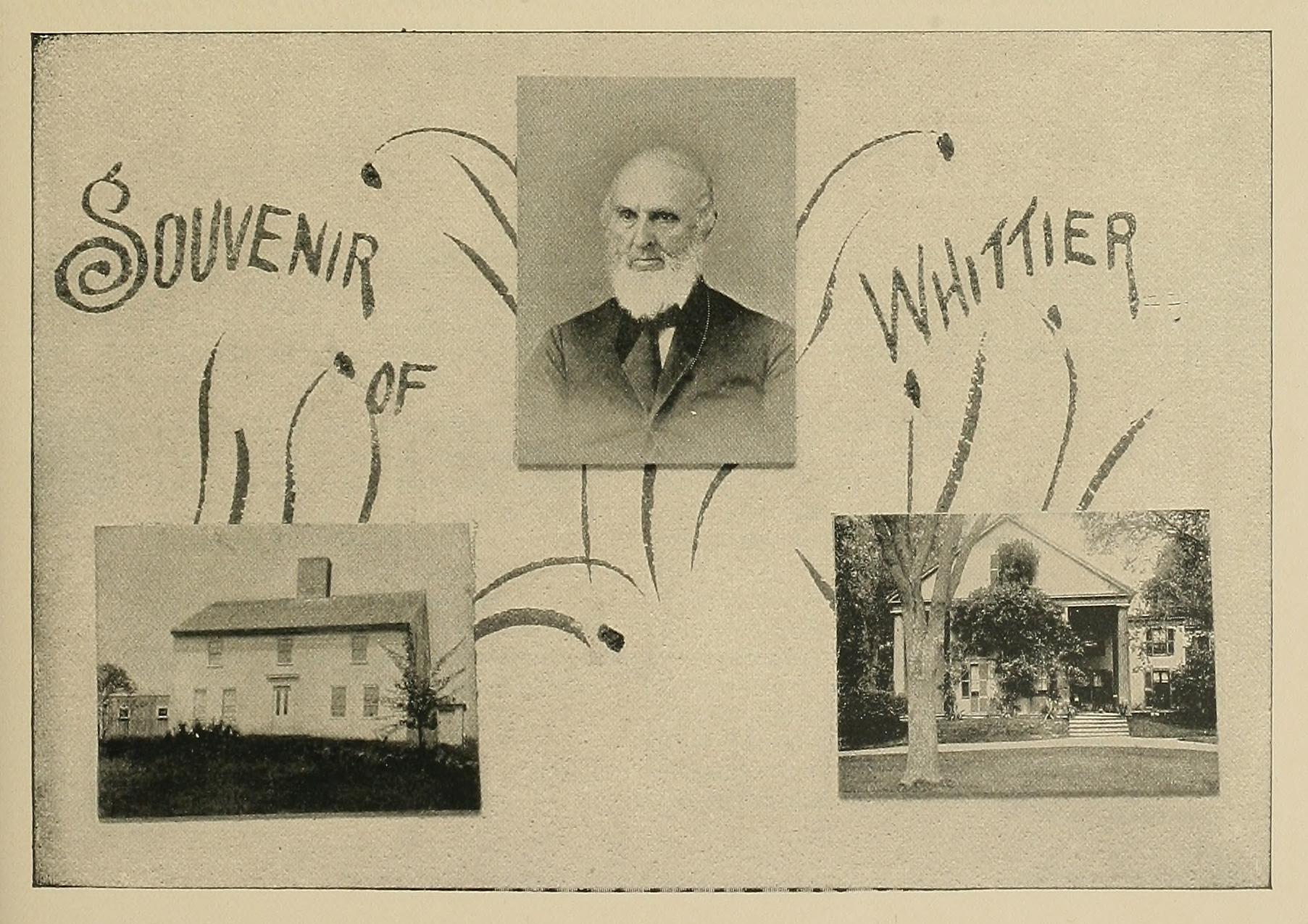
Souvenir of Whittier

OLIVER WENDELL HOLMES.
POET, ESSAYIST AND HUMORIST.
HIS distinguished author, known and admired throughout the English speaking world for the rich vein of philosophy, good fellowship and pungent humor that runs through his poetry and prose, was born in Cambridge, Massachusetts, August 29th, 1809, and died in Boston, October 27th, 1894, at the ripe old age of eighty-five—the “last leaf on the tree” of that famous group, Whittier, Longfellow, Lowell, Emerson, Bryant, Poe, Willis, Hawthorne, Richard Henry Dana, Thoreau, Margaret Fuller and others who laid the foundation of our national literature, and with all of whom he was on intimate terms as a co-laborer at one time or another.
Holmes graduated at Harvard College in 1829. His genial disposition made him a favorite with his fellows, to whom some of his best early poems are dedicated. One of his classmates said of him:—“He made you feel like you were the best fellow in the world and he was the next best.” Benjamin Pierce, the astronomer, and Rev. Samuel F. Smith, the author of our National Hymn, were his class-mates and have been wittily described in his poem “The Boys.” Dr. Holmes once humorously said that he supposed “the three people whose poems were best known were himself, one Smith and one Brown. As for himself, everybody knew who he was; the one Brown was author of ‘I love to Steal a While Away,’ and the one Smith was author of ‘My Country ’Tis of Thee.’”
After graduation Holmes studied medicine in the schools of Europe, but returned to finish his course and take his degree at Harvard. For nine years he was Professor of Physiology and Anatomy at Dartmouth College, and in 1847 he accepted a similar position in Harvard University, to which his subsequent professional labors were devoted. He also published several works on medicine, the last being a volume of medical essays, issued in 1883.
Holmes’ first poetic publication was a small volume published in 1836, including three poems which still remain favorites, namely, “My Aunt,” “The height of the Ridiculous” and “The Last Leaf on the Tree.” Other volumes of his poems were issued in 1846, 1850, 1861, 1875 and 1880.
Dr. Holmes is popularly known as the poet of society, this title attaching because most of his productions were called forth by special occasions. About one hundred of them were prepared for his Harvard class re-unions and his fraternity (Phi Beta Kappa) social and anniversary entertainments. The poems which will preserve his fame, however, are those of a general interest, like “The Deacon’s Masterpiece,” in which the Yankee spirit speaks out, “The Voiceless,” “The Living Temple,” “The Chambered Nautilus,” in which we find a truly exalted treatment of a lofty theme; “The Last Leaf on the Tree,” which is a remarkable combination of pathos and humor; “The Spectre Pig” and “The Ballad of an Oysterman,” showing to what extent he can play in real fun. In fact, Dr. Holmes was a many-sided man, and equally presentable on all sides. It has been truthfully said of him, “No other American versifier has rhymed so easily and so gracefully.” We might further add, no other in his personality, has been more universally esteemed and beloved by those who knew him.
As a prose writer Holmes was equally famous. His “Autocrat at the Breakfast Table,” “Professor at the Breakfast Table” and “Poet at the Breakfast Table,” published respectively in 1858, 1859 and 1873, are everywhere known, and not to have read them is to have neglected something important in literature. The “Autocrat” is especially a masterpiece. An American boarding house with its typical characters forms the scene. The Autocrat is the hero, or rather leader, of the sparkling conversations which make up the threads of the book. Humor, satire and scholarship are skilfully mingled in its graceful literary formation. In this work will also be found “The Wonderful One Horse Shay” and “The Chambered Nautilus,” two of the author’s best poems.
Holmes wrote two novels, “Elsie Venner” and “The Guardian Angel,” which in their romance rival the weirdness of Hawthorne and show his genius in this line of literature. “Mechanism in Thought and Morals” (1871), is a scholarly essay on the function of the brain. As a biographer Dr. Holmes has also given us excellent memoirs of John Lothrop Motley, the historian, and Ralph Waldo Emerson. Among his later products may be mentioned “A Mortal Antipathy,” which appeared in 1885, and “One Hundred Days in Europe” (1887).
Holmes was one of the projectors of “The Atlantic Monthly,” which was started in 1857, in conjunction with Longfellow, Lowell and Emerson, Lowell being its editor. It was to this periodical that the “Autocrat” and “The Professor at the Breakfast Table” were contributed. These papers did much to secure the permanent fame of this magazine. It is said that its name was suggested by Holmes, and he is also credited with first attributing to Boston the distinction of being the “Hub of the solar system,” which he, with a mingling of humor and local pride, declared was “located exactly at the Boston State House.”
Unlike other authors, the subject of this sketch was very much himself at all times and under all conditions. Holmes the man, Holmes the professor of physiology, the poet, philosopher, and essayist, were all one and the same genial soul. His was the most companionable of men, whose warm flow of fellowship and good cheer the winters of four score years and five could not chill,—“The last Leaf on the Tree,” whose greenness the frost could not destroy. He passed away at the age of eighty-five still verdantly young in spirit, and the world will smile for many generations good naturedly because he lived. Such lives are a benediction to the race.
Finally, to know Holmes’ writings well, is to be made acquainted with a singularly lovable nature. The charms of his personality are irresistible. Among the poor, among the literary, and among the society notables, he was ever the most welcome of guests. His geniality, humor, frank, hearty manliness, generosity and readiness to amuse and be amused, together with an endless store of anecdotes, his tact and union of sympathy and originality, make him the best of companions for an hour or for a lifetime. His friendship is generous and enduring. All of these qualities of mind and heart are felt as the reader runs through his poems or his prose writings. We feel that Holmes has lived widely and found life good. It is precisely for this reason that the reading of his writings is a good tonic. It sends the blood more courageously through the veins. After reading Holmes, we feel that life is easier and simpler and a finer affair altogether and more worth living for than we had been wont to regard it.
The following paragraph published in a current periodical shortly after the death of Mr. Holmes throws further light upon the personality of this distinguished author:
“Holmes himself must have harked back to forgotten ancestors for his brightness. His father was a dry as dust Congregational preacher, of whom some one said that he fed his people sawdust out of a spoon. But from his childhood Holmes was bright and popular. One of his college friends said of him at Harvard, that ‘he made you think you were the best fellow in the world, and he was the next best.’”
Dr. Holmes was first and foremost a conversationalist. He talked even on paper. There was never the dullness of the written word. His sentences whether in prose or verse were so full of color that they bore the charm of speech.
One of his most quoted poems “Dorothy Q,” is full of this sparkle, and carries a suggestion of his favorite theme:
Grandmother’s mother: her age I guess
Thirteen summers, or something less;
Girlish bust, but womanly air;
Smooth, square forehead with uprolled hair;
Lips that lover has never kissed;
Taper fingers and slender wrist;
Hanging sleeves of stiff brocade;
So they painted the little maid.
What if a hundred years ago
Those close shut lips had answered No,
When forth the tremulous question came
That cost the maiden her Norman name,
And under the folds that looked so still
The bodice swelled with the bosom’s thrill?
Should I be I, or would it be
One tenth another to nine tenths me?
BILL AND JOE.
OME, dear old comrade, you and I
Will steal an hour from days gone by—
The shining days when life was new,
And all was bright as morning dew,
The lusty days of long ago,
When you were Bill and I was Joe.
Your name may flaunt a titled trail,
Proud as a cockerel’s rainbow tail:
And mine as brief appendix wear
As Tam O’Shanter’s luckless mare;
To-day, old friend, remember still
That I am Joe and you are Bill.
You’ve won the great world’s envied prize,
And grand you look in people’s eyes,
With HON. and LL.D.,
In big brave letters, fair to see—
Your fist, old fellow! off they go!—
How are you, Bill? How are you, Joe?
You’ve worn the judge’s ermined robe;
You’ve taught your name to half the globe;
You’ve sung mankind a deathless strain;
You’ve made the dead past live again;
The world may call you what it will,
But you and I are Joe and Bill.
The chaffing young folks stare and say,
“See those old buffers, bent and gray;
They talk like fellows in their teens!
Mad, poor old boys! That’s what it means”—
And shake their heads; they little know
The throbbing hearts of Bill and Joe—
How Bill forgets his hour of pride,
While Joe sits smiling at his side;
How Joe, in spite of time’s disguise,
Finds the old schoolmate in his eyes—
Those calm, stern eyes that melt and fill
As Joe looks fondly up at Bill.
Ah, pensive scholar! what is fame?
A fitful tongue of leaping flame;
A giddy whirlwind’s fickle gust,
That lifts a pinch of mortal dust;
A few swift years, and who can show
Which dust was Bill, and which was Joe?
The weary idol takes his stand,
Holds out his bruised and aching hand,
While gaping thousands come and go—
How vain it seems, this empty show—
Till all at once his pulses thrill:
’Tis poor old Joe’s “God bless you, Bill!”
And shall we breathe in happier spheres
The names that pleased our mortal ears,—
In some sweet lull of harp and song,
For earth-born spirits none too long,
Just whispering of the world below,
Where this was Bill, and that was Joe?
No matter; while our home is here
No sounding name is half so dear;
When fades at length our lingering day,
Who cares what pompous tombstones say?
Read on the hearts that love us still
Hic jacet Joe. Hic jacet Bill.
UNION AND LIBERTY.
LAG of the heroes who left us their glory,
Borne through their battle-fields’ thunder and flame,
Blazoned in song and illuminated in story,
Wave o’er us all who inherit their fame.
Up with our banner bright,
Sprinkled with starry light,
Spread its fair emblems from mountain to shore,
While through the sounding sky
Loud rings the Nation’s cry—
Union and Liberty! One Evermore!
Light of our firmament, guide of our Nation,
Pride of her children, and honored afar,
Let the wide beams of thy full constellation
Scatter each cloud that would darken a star!
Empire unsceptred! What foe shall assail thee
Bearing the standard of Liberty’s van?
Think not the God of thy fathers shall fail thee,
Striving with men for the birthright of man!
Yet if, by madness and treachery blighted,
Dawns the dark hour when the sword thou must draw,
Then with the arms to thy million united,
Smite the bold traitors to Freedom and Law!
Lord of the universe! shield us and guide us,
Trusting Thee always, through shadow and sun!
Thou hast united us, who shall divide us?
Keep us, O keep us the Many in One!
Up with our banner bright,
Sprinkled with starry light,
Spread its fair emblems from mountain to shore,
While through the sounding sky
Loud rings the Nation’s cry—
Union and Liberty! One Evermore!
OLD IRON SIDES.
The following poem has become a National Lyric. It was first printed in the “Boston Daily Advertiser,” when the Frigate “Constitution” lay in the navy-yard at Charlestown. The department had resolved upon breaking her up; but she was preserved from this fate by the following verses, which ran through the newspapers with universal applause; and, according to “Benjamin’s American Monthly Magazine,” of January, 1837, it was printed in the form of hand-bills, and circulated in the city of Washington.
Y, tear her tatter’d ensign down!
Long has it waved on high,
And many an eye has danced to see
That banner in the sky;
Beneath it rung the battle-shout,
And burst the cannon’s roar;
The meteor of the ocean air
Shall sweep the clouds no more!
Her deck, once red with heroes’ blood,
Where knelt the vanquish’d foe,
When winds were hurrying o’er the flood,
And waves were white below,
No more shall feel the victor’s tread,
Or know the conquer’d knee;
The harpies of the shore shall pluck
The eagle of the sea!
O, better that her shatter’d hulk
Should sink beneath the wave;
Her thunders shook the mighty deep,
And there should be her grave;
Nail to the mast her holy flag,
Set every threadbare sail,
And give her to the god of storms,—
The lightning and the gale!
MY AUNT.
Y aunt! my dear unmarried aunt!
Long years have o’er her flown;
Yet still she strains the aching clasp
That binds her virgin zone;
I know it hurts her,—though she looks
As cheerful as she can:
Her waist is ampler than her life,
For life is but a span.
My aunt, my poor deluded aunt!
Her hair is almost gray;
Why will she train that winter curl
In such a spring-like way?
How can she lay her glasses down,
And say she reads as well,
When, through a double convex lens,
She just makes out to spell?
Her father—grandpapa! forgive
This erring lip its smiles—
Vow’d she would make the finest girl
Within a hundred miles.
He sent her to a stylish school;
’Twas in her thirteenth June;
And with her, as the rules required,
“Two towels and a spoon.”
They braced my aunt against a board,
To make her straight and tall;
They laced her up, they starved her down,
To make her light and small;
They pinch’d her feet, they singed her hair,
They screw’d it up with pins,—
Oh, never mortal suffer’d more
In penance for her sins.
So, when my precious aunt was done,
My grandsire brought her back
(By daylight, lest some rabid youth
Might follow on the track);
“Ah!” said my grandsire, as he shook
Some powder in his pan,
“What could this lovely creature do
Against a desperate man!”
Alas! nor chariot, nor barouche,
Nor bandit cavalcade
Tore from the trembling father’s arms
His all-accomplish’d maid.
For her how happy had it been!
And Heaven had spared to me
To see one sad, ungather’d rose
On my ancestral tree.
THE HEIGHT OF THE RIDICULOUS.
WROTE some lines once on a time
In wondrous merry mood,
And thought, as usual, men would say
They were exceeding good.
They were so queer, so very queer,
I laugh’d as I would die;
Albeit, in the general way,
A sober man am I.
I call’d my servant, and he came:
How kind it was of him,
To mind a slender man like me,