OUR NATIONAL HUMORISTS
Reading edition
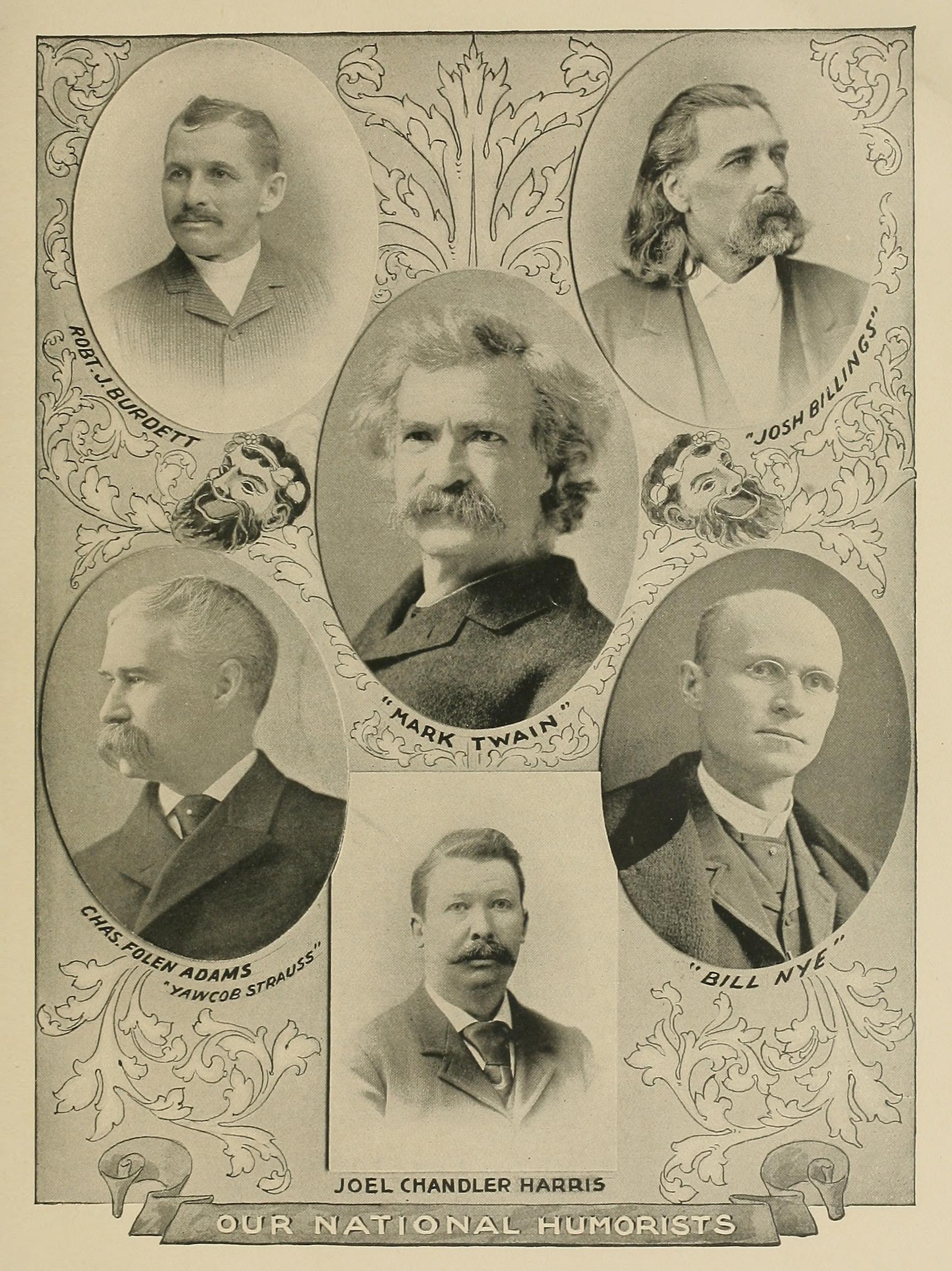
OUR NATIONAL HUMORISTS
ROBT. J. BURDETT • “JOSH BILLINGS” “MARK TWAIN” CHAS. FOLEN ADAMS • “BILL NYE” JOEL CHANDLER HARRIS
FRANCES MIRIAM WHITCHER.
THE “WIDOW BEDOTT” AND “WIDOW SPRIGGINS.”
T was back in the early forties in “Neal’s Gazette” that the “Widow Bedott Table Talk” series of articles began to attract attention, and the question arose, Who is the Widow Bedott? for no one knew at that time that Mrs. Whitcher was the real author behind this nom-de-plume. James Neal himself—the well-known author of “Charcoal Sketches” and publisher of the magazine above referred to—was so struck with the originality and clearness of the first of the series when submitted that he sought a correspondence with the author, thinking it was a man, and addressed her as “My dear Bedott.” Mrs. Whitcher often insisted that she must cease to write, as her humorous sketches were not relished by some of her neighbors whom they touched, but Mr. Neal would not hear to it. In a letter of September 10, 1846, he wrote: “It is a theory of mine that those gifted with truly humorous genius like yourself are more useful as moralists, philosophers and teachers than whole legions of the gravest preachers. They speak more effectually to the general ear and heart, even though they who hear are not aware of the fact that they are imbibing wisdom.” Further on he adds: ‘I would add that Mr. Godey called on me to inquire as to the authorship of the “Bedott Papers,” wishing evidently to obtain you for a correspondent to the “Ladies’ Book.”’
For richness of humor and masterly handling of the Yankee dialect, certainly, the “Widow Bedott” and the “Widow Spriggins” occupy a unique space in humorous literature, and the influence she has exercised on modern humorists is more in evidence than most readers are aware of. Her husband, “Hezekiah Bedott,” is a character who will live alongside of “Josiah Allen” as one of the prominent heroes of the humorous literature of our country. In fact, no reader of both these authors will fail to suspect that Miss Marietta Holley used “Hezekiah” as a model for her “Josiah;” while the redoubtable widow herself was enough ♦similar to “Samantha Allen” to have been her natural, as she, perhaps, was her literary, grandmother. Nor was Miss Holley alone in following her lead. Ever since the invention of “Hezekiah Bedott” by Mrs. Whitcher, an imaginary person of some sort, behind whom the author might conceal his own identity, has seemed to be a necessity to our humorists, as witness the noms-de-plume of “Artemus Ward,” “Josh Billings,” “Mark Twain,” etc., under which our greatest American humorists have written.
Mrs. Whitcher was the daughter of Mr. Lewis Berry, and was born at Whitesboro, New York, 1811, and died there in 1852. As a child she was unusually precocious. Before she learned her letters, even before she was four years old, she was making little rhymes and funny stories, some of which are preserved by her relatives. Her education was obtained in the village school of Whitesboro, and she began to contribute at an early age stories and little poems to the papers. After she had won considerable literary fame she was married, in 1847, to the Rev. Benjamin W. Whitcher, pastor of the Protestant Episcopal Church at Elmira, New York, where she resided with her husband for a period of three years, continuing to contribute her humorous papers to the magazine, and taking as her models her acquaintances at Elmira, as she had been accustomed to do at Whitesboro. The people of Elmira, however, were not so ready to be victimized, and turned against her such shafts of persecution and even insult for her ludicrous pictures of them as to destroy her happiness and her husband’s usefulness as a minister to an extent that they were compelled to leave Elmira, and they removed to Whitesboro in 1850, where, as stated above, she died two years later.
Mrs. Whitcher was something of an artist as well as a writer and illustrated certain of her sketches with her own hands. During her life none of her works were published except in magazines and periodicals, but after her death these contributions were collected and published in book form; the first entitled “The Widow Bedott Papers,” appearing in 1855, with an introduction by Alice B. Neal. In 1857 came “The Widow Spriggins, Mary Allen and Other Sketches,” edited by Mrs. M. L. Ward Whitcher with a memoir of the author. We publish in connection with this sketch the poem “Widow Bedott to Elder Sniffles” and also her own humorous comments on some of her poetry, about her husband Hezekiah, which she wrote to a friend, pausing as the various stanzas suggest, to throw in amusing side lights on neighborhood character and gossip.
WIDOW BEDOTT TO ELDER SNIFFLES.
(FROM THE “WIDOW BEDOTT PAPERS.”)
REVEREND sir, I do declare
It drives me most to frenzy,
To think of you a lying there
Down sick with influenzy.
A body’d thought it was enough
To mourn your wife’s departer,
Without sich trouble as this ere
To come a follerin’ arter.
But sickness and affliction, are
Sent by a wise creation,
And always ought to be underwent
By patience and resignation.
O I could to your bedside fly,
And wipe your weeping eyes,
And do my best to cheer you up,
If’t wouldn’t create surprise.
It’s a world of trouble we tarry in,
But, Elder, don’t despair;
That you may soon be movin’ again
Is constantly my prayer.
Both sick and well, you may depend
You’ll never be forgot
By your faithful and affectionate friend,
Priscilla Pool Bedott.
THE WIDOW’S POETRY ABOUT HEZEKIAH AND HER COMMENTS ON THE SAME.
(FROM “WIDOW BEDOTT PAPERS.”)
ES,—he was one o’ the best men that ever trod shoe-leather, husband was, though Miss Jenkins says (she ’twas Poll Bingham), she says, I never found it out till after he died, but that’s the consarndest lie that ever was told, though it’s jest a piece with everything else she says about me. I guess if everybody could see the poitry I writ to his mem’ry, nobody wouldn’t think I dident set store by him. Want to hear it? Well, I’ll see if I can say it; it ginerally affects me wonderfully, seems to harrer up my feelin’s; but I’ll try. It begins as follers:—
He never jawed in all his life,
He never was onkind,—
And (tho’ I say it that was his wife)
Such men you seldom find.
(That’s as true as the Scripturs; I never knowed him to say a harsh word.)
I never changed my single lot,—
I thought ’twould be a sin—
(Though widder Jinkins says it’s because I never had a chance.) Now ’tain’t for me to say whether I ever had a numerous number o’ chances or not, but there’s them livin’ that might tell if they wos a mind to; why, this poitry was writ on account of being joked about Major Coon, three years after husband died. I guess the ginerality o’ folks knows what was the nature o’ Majors Coon’s feelin’s towards me, tho’ his wife and Miss Jinkins does say I tried to ketch him. The fact is, Miss Coon feels wonderfully cut up ’cause she knows the Major took her “Jack at a pinch,”—seein’ he couldent get such as he wanted, he took such as he could get,—but I goes on to say—
I never changed my single lot,
I thought ’twould be a sin,—
For I thought so much o’ Deacon Bedott,
I never got married agin.
If ever a hasty word he spoke,
His anger dident last,
But vanished like tobacker smoke
Afore the wintry blast.
And since it was my lot to be
The wife of such a man,
Tell the men that’s after me
To ketch me if they can.
If I was sick a single jot,
He called the doctor in—
That’s a fact,—he used to be scairt to death if anything ailed me. Now only jest think,—widder Jinkins told Sam Pendergrasses wife (she ’twas Sally Smith) that she guessed the deacon dident set no great store by me, or he wouldent went off to confrence meetin’, when I was down with the fever. The truth is, they couldent git along without him no way. Parson Potter seldom went to confrence meetin’, and when he wa’n’t there, who was ther’, pray tell, that knowed enough to take the lead if husband dident do it? Deacon Kenipe hadent no gift, and Deacon Crosby hadent no inclination, and so it all come onto Deacon Bedott,—and he was always ready and willin’ to do his duty, you know; as long as he was able to stand on his legs he continued to go to confrence meetin’; why, I’ve knowed that man to go when he couldent scarcely crawl on account o’ the pain in the spine of his back.
He had a wonderful gift, and he wa’n’t a man to keep his talents hid up in a napkin,—so you see ’twas from a sense o’ duty he went when I was sick, whatever Miss Jinkins may say to the contrary. But where was I? Oh!—
If I was sick a single jot,
He called the doctor in—
I sot so much store by Deacon Bedott
I never got married agin.
A wonderful tender heart he had,
That felt for all mankind,—
It made him feel amazin’ bad
To see the world so blind.
Whiskey and rum he tasted not—
That’s as true as the Scripturs,—but if you’ll believe it, Betsy, Ann Kenipe told my Melissy that Miss Jinkins said one day to their house how’t she’d seen Deacon Bedott high, time and agin! did you ever! Well, I’m glad nobody don’t pretend to mind anything she says. I’ve knowed Poll Bingham from a gal, and she never knowed how to speak the truth—besides she always had a partikkeler spite against husband and me, and between us tew I’ll tell you why if you won’t mention it, for I make it a pint never to say nothin’ to injure nobody. Well, she was a ravin’-distracted after my husband herself, but it’s a long story, I’ll tell you about it some other time, and then you’ll know why widder Jinkins is etarnally runnin’ me down. See,—where had I got to? Oh, I remember now,—
Whisky and rum he tasted not,—
He thought it was a sin,—
I thought so much o’ Deacon Bedott
I never got married agin.
But now he’s dead! the thought is killin’,
My grief I can’t control—
He never left a single shillin’
His widder to console.
But that wa’n’t his fault—he was so out o’ health for a number o’ year afore he died, it ain’t to be wondered at he dident lay up nothin’—however, it dident give him no great oneasiness,—he never cared much for airthly riches, though Miss Pendergrass says she heard Miss Jinkins say Deacon Bedott was as tight as the skin on his back,—begrudged folks their vittals when they come to his house! did you ever! why, he was the hull-souldest man I ever see in all my born days. If I’d such a husband as Bill Jinkins was, I’d hold my tongue about my neighbors’ husbands. He was a dretful mean man, used to git drunk every day of his life, and he had an awful high temper,—used to swear like all possest when he got mad,—and I’ve heard my husband say (and he wa’n’t a man that ever said anything that wa’n’t true),—I’ve heard him say Bill Jinkins would cheat his own father out of his eye teeth if he had a chance. Where was I? Oh! “His widder to console,”—ther ain’t but one more verse, ’tain’t a very lengthy poim. When Parson Potter read it, he says to me, says he,—“What did you stop so soon for?”—but Miss Jinkins told the Crosby’s she thought I’d better a’ stopt afore I’d begun,—she’s a purty critter to talk so, I must say. I’d like to see some poitry o’ hern,—I guess it would be astonishin’ stuff; and mor’n all that, she said there wa’n’t a word o’ truth in the hull on’t,—said I never cared tuppence for the deacon. What an everlastin’ lie! Why, when he died, I took it so hard I went deranged, and took on so for a spell they was afraid they should have to send me to a Lunatic Arsenal. But that’s a painful subject, I won’t dwell on’t.
I conclude as follers:—
I’ll never change my single lot,—
I think ’twould be a sin,—
The inconsolable widder o’ Deacon Bedott
Don’t intend to git married agin.
Excuse my cryin’—my feelin’s always overcomes me so when I say that poitry—O-o-o-o-o-o!

CHARLES F. BROWNE.
(ARTEMUS WARD).
RTEMUS WARD first revealed to the world that humor is a characteristic trait of the Yankee, and he was the first to succeed in producing a type of comic literature distinctively American, purely the product of his original genius.
It is impossible to analyze his jokes or to tell why they are irresistibly funny, but it would be generally admitted that his best things are as much creations of genius as masterpieces of art are.
He was one of the kindest and most generous of men; he used his keen wit to smite evil customs and to satirize immoral deeds, and he went through his short life enjoying above everything to make people laugh and to laugh himself, but with all his play of wit there was a tinge of melancholy in his nature and a tendency to do the most unexpected things, a tendency which he never tried to control. He was born in Waterford, Maine, in 1834, and he came honestly by a view of humor from his father’s side. He had only a most meagre school education, and at fourteen he set himself to learn the printer’s trade, becoming one of the best typesetters in the country.
He drifted from place to place and finally became one of the staff of the “Commercial” at Toledo, Ohio, where he first displayed his peculiar richness of humor in his news reports. In 1857 he became local editor of the “Plain-Dealer” in Cleveland, and it was here his sketches were first signed Artemus Ward, a name which he took from a peculiar character who called on him once in his Cleveland office. He is described at this time as being in striking degree gawky and slouchy, with yellowish, straight hair, a loose swaggering gait, and strangely ill-fitting clothes, though as his popularity and position rose he took on more cultivated manners and grew very particular regarding his dress.
His first attempts at lecturing were not marked with success and he was forced to explain his jokes to his audiences to make the desired laugh come, but he soon attracted attention and multitudes flocked to hear the “grate showman,” with his “moral wax figgers.” In 1863 he crossed the continent and on this trip he collected material for his most humorous lectures and for the best of his chapters.
The Mormons furnished him with the material for his most telling lecture, and it was a mark of his genius that he was irresistibly drawn to Utah to study this peculiar type of American society.
He went to England in 1866, where, though in failing health, ending in premature death, he created almost a sensation and had flattering successes. The “Mormons” never failed to fill a hall and always carried his audiences by storm.
Some of his most brilliant articles were written for “Punch,” and the American humorist was recognized as a typical genius; but he was a dying man while he was making his London audiences laugh at his spontaneous wit, and his life came to an end at Southampton, January 23, 1867.
He provided in his will for the establishment of an asylum for printers and for the education of their orphan children, an action which revealed, as many acts of his life had done, the kindly human spirit of the humorist.
His published books, which owe much of their charm to his characteristic spelling, are as follows: “Artemus Ward, His Book,” and “Artemus Ward, His Travels” (1865), “Artemus Ward in London” (1867), “Artemus Ward’s Lecture, as delivered in Egyptian Hall, London,” edited by T. W. Robertson and E. P. Hingston (1869), and “Artemus Ward, His Works Complete,” with biographical sketch by Melville D. Landon (1875).
ARTEMUS WARD VISITS THE SHAKERS.
R. SHAKER,” sed I, “you see before you a Babe in the Woods, so to speak, and he axes a shelter of you.”
“Yay,” said the Shaker, and he led the way into the house, another bein’ sent to put my horse and wagon under kiver.
A solum female, lookin’ somewhat like a last year’s bean-pole stuck into a long meal-bag, cum in and axed me was I athirst and did I hunger? To which I asserted, “A few.” She went orf, and I endeavored to open a conversation with the old man.
“Elder, I spect,” sed I.
“Yay,” he said.
“Health’s good, I reckon?”
“Yay.”
“What’s the wages of a Elder, when he understands his bizness—or do you devote your sarvices gratooitous?”
“Yay.”
“Storm nigh, sir?”
“Yay.”
“If the storm continues there’ll be a mess underfoot, hay?”
“Yay.”
“If I may be so bold, kind sir, what’s the price of that pecooler kind of wesket you wear, includin’ trimmin’s?”
“Yay.”
I pawsed a minit, and, thinkin’ I’d be faseshus with him and see how that would go, I slapt him on the shoulder, burst into a hearty larf, and told him that as a yayer he had no livin’ ekel.
He jumped up as if bilin’ water had been squirted into his ears, groaned, rolled his eyes up tords the sealin’ and sed:
“You’re a man of sin!”
He then walked out of the room.
Directly thar cum in two young Shakeresses, as putty and slick lookin’ galls as I ever met. It is troo they was drest in meal-bags like the old one I’d met previsly, and their shiny, silky hair was hid from sight by long, white caps, such as I spose female gosts wear; but their eyes sparkled like diamonds, their cheeks was like roses, and they was charmin’ enuff to make a man throw stuns at his grandmother, if they axed him to. They commenst clearing away the dishes, casting shy glances at me all the time. I got excited. I forget Betsey Jane in my rapter, and sez I:
“My pretty dears, how air you?”
“We air well,” they solumly sed.
“Where is the old man?” said I, in a soft voice.
“Of whom dost thou speak—Brother Uriah?”
“I mean that gay and festive cuss who calls me a man of sin. Shouldn’t wonder if his name wasn’t Uriah.”
“He has retired.”
“Wall, my pretty dears,” sez I, “let’s have some fun. Let’s play puss in the corner. What say?”
“Air you a ♦Shaker, sir?” they asked.
“Wall, my pretty dears, I haven’t arrayed my proud form in a long weskit yet, but if they wus all like you perhaps I’d jine ’em. As it is, I am willing to be Shaker protemporary.”
They was full of fun. I seed that at fust, only they was a little skeery. I tawt ’em puss in the corner, and sich like plase, and we had a nice time, keepin’ quiet of course, so that the old man shouldn’t hear. When we broke up, sez I:
“My pretty dears, ear I go, you have no objections have you? to a innersent kiss at partin’?”
“Yay,” they said, and I—yayed.
ARTEMUS WARD AT THE TOMB OF SHAKESPEARE.
’VE been lingerin’ by the tomb of the lamented Shakespeare.
It is a success.
I do not hes’tate to pronounce it as such.
You may make any use of this opinion that you see fit. If you think its publication will subswerve the cause of literatoor, you may publicate.
I told my wife Betsey, when I left home, that I should go to the birthplace of the orthur of Otheller and other Plays. She said that as long as I kept out of Newgate she didn’t care where I went. “But,” I said, “don’t you know he was the greatest Poit that ever lived? Not one of these common poits, like that young idyit who writes verses to our daughter, about the roses as groses, and the breezes as blowses—but a Boss poit—also a philosopher, also a man who knew a great deal about everything.”
Yes. I’ve been to Stratford onto the Avon, the Birth-place of Shakespeare. Mr. S. is now no more. He’s been dead over three hundred (300) years. The peple of his native town are justly proud of him. They cherish his mem’ry, and them as sell picturs of his birth-place, &c., make it prof’tible cherishin’ it. Almost everybody buys a pictur to put into their Albiom.
“And this,” I said, as I stood in the old churchyard at Stratford, beside a Tombstone, “this marks the spot where lies William W. Shakespeare. Alars! and this is the spot where—”
“You’ve got the wrong grave,” said a man—a worthy villager; “Shakespeare is buried inside the church.”
“Oh,” I said, “a boy told me this was it.” The boy larfed and put the shillin’ I’d given him into his left eye in a inglorious manner, and commenced moving backwards towards the street.
I pursood and captered him, and, after talking to him a spell in a sarkastic stile, I let him went.
William Shakespeare was born in Stratford in 1564. All the commentators, Shakesperian scholars, etsetry, are agreed on this, which is about the only thing they are agreed on in regard to him, except that his mantle hasn’t fallen onto any poet or dramatist hard enough to hurt said poet or dramatist much. And there is no doubt if these commentators and persons continner investigatin’ Shakespeare’s career, we shall not in doo time, know anything about it at all. When a mere lad little William attended the Grammar School, because, as he said, the Grammar School wouldn’t attend him. This remarkable remark coming from one so young and inexperunced, set peple to thinkin’ there might be something in this lad. He subsequently wrote Hamlet and George Barnwell. When his kind teacher went to London to accept a position in the offices of the Metropolitan Railway, little William was chosen by his fellow-pupils to deliver a farewell address. “Go on, sir,” he said, “in a glorous career. Be like a eagle, and soar, and the soarer you get the more we shall be gratified! That’s so.”

HENRY WHEELER SHAW.
(“JOSH BILLINGS.”)
T is astonishing what effect is produced by peculiarities of form or manner. It may be true that the writings of Thomas Carlyle owe much of their force and vigor to his disregard for grammatical rules and his peculiar arrangement of words and sentences; but one of the most surprising instances of this kind is in the fact that the “Essay on the Mule, by Josh Billings,” received no attention whatever, while the same contribution transformed into the “Essa on the Muel, bi Josh Billings,” was eagerly copied by almost every paper in the country. Josh Billings once said that “Chaucer was a great poit, but he couldn’t spel,” and apparently it was Mr. Shaw’s likeness, in this respect, to the author of “Canterbury Tales” which won him much of his fame.
He was the son of a member of the Massachusetts Legislature, born in 1818, and entered Hamilton College; but being captivated by stories of Western life and adventure, abandoned college to seek his fortune in the West. The fortune was slow in coming, and he worked as a laborer on steamboats on the Ohio, and as a farmer, and finally drifted back to Poughkeepsie, New York, as an auctioneer. Here he wrote his first contribution to a periodical, “The Essa on the Muel,” which has been above mentioned.
The popularity of the revised form of this classic of poor spelling induced him to publish “Josh Billings’ Farmers’ Allminax,” which continued for ten years, having during a part of the time a circulation of one hundred and twenty-seven thousand copies per annum. In 1863 Mr. Shaw entered the lecture-field. His lectures being a series of pithy sayings without care or order, delivered in an apparently awkward manner. The quaintness and drollery of his discourse won very great popularity. For twenty years he was a regular contributor of “The New York Weekly,” and it is said that the articles which appeared in “The Century Magazine,” under the signature of “Uncle Esek,” were his. His published books are “Josh Billings, His Sayings;” “Josh Billings on Ice;” “Everybody’s Friend;” “Josh Billings’ Complete Works,” and “Josh Billings’ Spice Box.”
Mr. Shaw died in Monterey, California, in 1885.
JOSH BILLING’S ADVERTISEMENT.
(FROM “JOSH BILLINGS, HIS WORKS.” 1876.)
KAN sell for eighteen hundred and thirty-nine dollars a pallas, a sweet and pensive retirement, lokated on the virgin banks ov the Hudson, kontaining eighty-five acres. The land is luxuriously divided by the hand of natur and art into pastor and tillage, into plain and deklivity, into stern abruptness, and the dallianse ov moss-tufted medder; streams ov sparkling gladness (thick with trout) danse through this wilderness ov buty tew the low musik ov the kricket and grasshopper. The evergreen sighs as the evening sephir flits through its shadowy buzzum, and the aspen trembles like the luv-smitten harte ov a damsell. Fruits ov the tropicks, in golden buty, melt on the bows, and the bees go heavy and sweet from the fields to their garnering hives. The manshun is ov Parian marble; the porch iz a single diamond, set with rubiz and the mother ov pearl; the floors are ov rosewood, and the ceilings are more butiful than the starry vault of heaven. Hot and cold water bubbles and quirts in evry apartment, and nothing is wanting that a poet could pra for, or art could portray. The stables are worthy of the steeds ov Nimrod or the studs ov Akilles, and its hennery waz bilt expressly for the birds of paradice; while sombre in the distance, like the cave ov a hermit, glimpses are caught ov the dorg-house. Here poets hav cum and warbled their laze—here skulptors hav cut, here painters hav robbed the scene ov dreamy landscapes, and here the philosopher diskovered the stun which made him the alkimist ov natur. Next, northward ov this thing ov buty, sleeps the residence and domain ov the Duke, John Smith, while southward, and nearer the spice-breathing tropicks, may be seen the barronial villy ov Earl Brown and the Duchess, Widder Betsy Stevens. Walls ov primitiff rock, laid in Roman cement, bound the estate, while upward and downward the eye catches the magesta and slow grander ov the Hudson. As the young moon hangs like a cutting ov silver from the blue brest ov the ski, an angel may be seen each night dansing with golden tiptoes on the green. (N. B.—This angel goes with the place.)
MANIFEST DESTINY.
ANIFESS destiny iz the science ov going tew bust, or enny other place before yu git thare. I may be rong in this centiment, but that iz the way it strikes me; and i am so put together that when enny thing strikes me i immejiately strike back. Manifess destiny mite perhaps be blocked out agin as the condishun that man and things find themselfs in with a ring in their nozes and sumboddy hold ov the ring. I may be rong agin, but if i am, awl i have got tew sa iz i don’t kno it, and what a man don’t kno ain’t no damage tew enny boddy else. The tru way that manifess destiny had better be sot down iz the exact distance that a frog kan jump down hill with a striped snake after him; i don’t kno but i may be rong onst more, but if the frog don’t git ketched the destiny iz jist what he iz a looking for.
When a man falls into the bottom ov a well and makes up hiz minde tew stay thare, that ain’t manifess destiny enny more than having yure hair cut short iz; but if he almost gits out and then falls down in agin 16 foot deeper and brakes off hiz neck twice in the same plase and dies and iz buried thare at low water, that iz manifess destiny on the square. Standing behind a cow in fly time and gitting kicked twice at one time must feel a good deal like manifess destiny. Being about 10 seckunds tew late tew git an express train, and then chasing the train with yure wife, and an umbreller in yure hands, in a hot day, and not getting as near tew the train az you waz when started, looks a leetle like manifess destiny on a rale rode trak. Going into a tempranse house and calling for a leetle old Bourbon on ice, and being told in a mild way that “the Bourbon iz jist out, but they hav got sum gin that cost 72 cents a gallon in Paris,” sounds tew me like the manifess destiny ov most tempranse houses.
Mi dear reader, don’t beleave in manifess destiny until yu see it. Thare is such a thing az manifess destiny, but when it occurs it iz like the number ov rings on the rakoon’s tale, ov no great consequense onla for ornament. Man wan’t made for a machine, if he waz, it was a locomotiff machine, and manifess destiny must git oph from the trak when the bell rings or git knocked higher than the price ov gold. Manifess destiny iz a disseaze, but it iz eazy tew heal; i have seen it in its wust stages cured bi sawing a cord ov dri hickory wood. i thought i had it onse; it broke out in the shape ov poetry; i sent a speciment ov the disseaze tew a magazine; the magazine man wrote me next day az follers:
“Dear Sur: You may be a phule, but you are no poeck. Yures, in haste.”
LETTERS TO FARMERS.
ELOVED FARMERS: Agrikultur iz the mother ov farm produce; she is also the step-mother ov gardin sass.
Rize at half-past 2 o’clock in the morning, bild up a big fire in the kitchen, burn out two pounds ov kandles, and grease yure boots. Wait pashuntly for dabrake. When day duz brake, then commence tew stir up the geese and worry the hogs.
Too mutch sleep iz ruinous tew geese and tew hogs. Remember yu kant git rich on a farm, unless yu rize at 2 o’clock in the morning, and stir up the hogs and worry the geese.
The happyest man in the world iz the farmer; he rizes at 2 o’clock in the morning, he watches for da lite tew brake, and when she duz brake, he goes out and stirs up the geese and worrys the hogs.
What iz a lawyer!—What iz a merchant?—What iz a doktor?—What iz a minister?—I answer, nothing!
A farmer is the nobless work ov God; he rizes at 2 o’clock in the morning, and burns out a half a pound ov wood and two kords of kandles, and then goes out tew worry the geese and stir up the hogs.
Beloved farmers, adew.
Josh Billings.

SAMUEL L. CLEMENS.
(MARK TWAIN).
ARK TWAIN has a world wide reputation as the great American humorist, a reputation which has been steadily growing at home and abroad since the publication of “Innocents Abroad” in 1869, and he is undoubtedly one of the most popular authors in the United States. The story of his life is the record of a career which could have been possible in no other country in the world.
He was born in Florida in 1835, though most of his boyhood was passed at ♦Hannibal, Mo., where he attended the village school until he was thirteen, which was his only opportunity for educational training. At this early age he was apprenticed to a printer and worked at this trade in St. Louis, ♠Cincinnati, Philadelphia and New York. During his boyhood his great ambition, his one yearning, had been to become one day a pilot on a Mississippi steamboat. He realized this ambition in 1851 and the experiences of this pilot life are told in his “Life on the Mississippi.” His pen-name was suggested by the expression used in Mississippi navigation where in sounding a depth of two fathoms, the leadsman calls out, “Mark Twain!”
After serving in 1861 in Nevada as private secretary to his brother who was at this time secretary of the Territory, he became city editor of the Virginia City “Enterprise,” and here his literary labors began, and the pseudonym now so familiar was first used.
In 1865, he was reporter on the staff of the San Francisco “Morning Call,” though his newspaper work was interspersed with unsuccessful attempts at gold digging and a six months’ trip to Hawaii.
This was followed by a lecture trip through California and Nevada, which gave unmistakable evidence that he had the “gift” of humor.
His fame, however, was really made by the publication of “Innocents Abroad” (Hartford, 1869), 125,000 copies of which were sold in three years. This book is a brilliant, humorous account of the travels, experiences and opinions of a party of tourists to the Mediterranean, Egypt, Palestine, France and Italy.
His next literary work of note was the publication of “Roughing It” (Hartford, 1872), which shook the sides of readers all over the United States. This contained inimitable sketches of the rough border life and personal experiences in California, Nevada and Utah. In fact all Mark Twain’s literary work which bears the stamp of permanent worth and merit is personal and autobiographical. He is never so successful in works that are purely of an imaginative character.
In 1873, in conjunction with Charles Dudley Warner, he produced a story entitled the “Gilded Age” which was dramatized and had a marked success on the stage. His other well-known works are: “Sketches Old and New;” “Adventures of Tom Sawyer” (1876), a story of boy life in Missouri and one of his best productions, “Punch, Brothers, Punch” (1878); “A Tramp Abroad” (1880), containing some of his most humorous and successful descriptions of personal experiences on a trip through Germany and Switzerland; “The Stolen White Elephant” (1882); “Prince and the Pauper” (1882); “Life on the Mississippi” (1883); “Adventures of Huckleberry Finn” (1885), a sequel to “Tom Sawyer;” “A Yankee at King Arthur’s Court” and “Personal Recollections of Joan of Arc” (1896).
In 1884, he established in New York City the publishing house of C. L. Webster & Co., which issued in the following year the “Memoirs” of U. S. Grant, the profits from which publication to the amount of $350,000 were paid to Mrs. Grant in accordance with an agreement previously signed with General Grant.
By the unfortunate failure of this company in 1895, Mark Twain found himself a poor man and morally, though not legally, responsible for large sums due the creditors. Like Sir Walter Scott, he resolved to wipe out the last dollar of the debt and at once entered upon a lecturing trip around the world, which effort is proving financially a success. He is also at work upon a new book soon to be published. His home is at Hartford, Connecticut, where he has lived in delightful friendship and intercourse with Charles Dudley Warner, Harriet Beecher Stowe and other literary characters of that city. His writings have been translated into German and they have met with large sales both in England and on the continent.
JIM SMILEY’S FROG.
ELL, this yer Smiley had rat-tarriers, and chicken-cocks, and all them kind of things, till you couldn’t rest, and you couldn’t fetch nothing for him to bet on but he’d match you. He ketched a frog one day, and took him home, and said he cal’klated to edercate him; and so he never done nothing for three months but set in his back yard and learn that frog to jump. And you bet he did learn him, too. He’d give him a little punch behind, and the next minute you’d see that frog whirling in the air like a doughnut,—see him turn one summerset, or maybe a couple, if he got a good start, and come down flat-footed and all right, like a cat. He got him up so in the matter of catching flies, and kept him in practice so constant, that he’d nail a fly every time as far as he could see him. Smiley said all a frog wanted was education, and he could do most anything; and I believe him. Why, I’ve seen him set Dan’l Webster down here on this floor,—Dan’l Webster was the name of the frog,—and sing out, “Flies, Dan’l, flies,” and quicker’n you could wink he’d spring straight up, and snake a fly off’n the counter there, and flop down on the floor again, as solid as a gob of mud, and fall to scratching the side of his head with his hind foot as indifferent as if he hadn’t no idea he’d been doing any more’n any frog might do. You never see a frog so modest and straightfor’ard as he was, for all he was so gifted. And when it came to fair and square jumping on a dead level, he could get over more ground at one straddle than any animal of his breed you ever see. Jumping on a dead level was his strong suit, you understand; and when it come to that, Smiley would ante up money on him as long as he had a red. Smiley was monstrous proud of his frog, and well he might be, for fellers that had traveled and been everywhere, all said he laid over any frog that ever they see.
Well, Smiley kept the beast in a little lattice box, and he used to fetch him down town sometimes, and lay for a bet. One day a feller,—a stranger in the camp he was,—came across him with his box, and says:
“What might it be that you’ve got in the box?”
And Smiley says sorter indifferent like, “It might be a parrot, or it might be a canary, may be, but it ain’t,—it’s only just a frog.”
And the feller took it, and looked at it careful, and turned it round this way and that, and says, “H’m! so ’tis. Well, what’s he good for?”
“Well,” Smiley says, easy and careless, “he’s good enough for one thing, I should judge—he can outjump any frog in Calaveras County.”
The feller took the box again, and took another long particular look, and gave it back to Smiley, and says, very deliberate, “Well, I don’t see no p’ints about that frog that’s any better’n any other frog.”
“May be you don’t,” Smiley says. “May be you understand frogs, and may be you don’t understand ’em; may be you’ve had experience, and may be you an’t only a amature, as it were. Anyways, I’ve got my opinion, and I’ll risk forty dollars that he can outjump any frog in Calaveras County.”
And the feller studied a minute, and then says, kinder sad like, “Well, I’m only a stranger here, and I ain’t got no frog; but if I had a frog, I’d bet you.”
And then Smiley says, “That’s all right, that’s all right; if you’ll hold my box a minute, I’ll go and get you a frog.” And so the feller took the box, and put up his forty dollars along with Smiley’s and set down to wait. So he set there a good while, thinking and thinking to hisself, and then he got the frog out and prized his mouth open, and took a teaspoon and filled him full of quail shot,—filled him pretty near up to his chin,—and set him on the floor. Smiley he went to the swamp, and slopped around in the mud for a long time, and finally he ketched a frog, and fetched him in, and give him to this feller, and says:
“Now, if you’re ready, set him alongside of Dan’l, with his fore-paws just even with Dan’l, and I’ll give the word.” Then he says, “One—two—three—jump;” and him and the feller touched up the frogs from behind, and the new frog hopped off, but Dan’l gave a heave and hysted up his shoulders,—so,—like a Frenchman, but it wasn’t no use,—he couldn’t budge; he was planted as solid as an anvil, and he couldn’t no more stir than if he was anchored out. Smiley was a good deal surprised, and he was disgusted, too, but he didn’t have no idea what the matter was, of course.
The feller took the money and started away; and when he was going out at the door, he sorter jerked his thumb over his shoulders,—this way,—at Dan’l, and says again, very deliberate, “Well, I don’t see no p’ints about that frog that’s any better’n any other frog.”
Smiley he stood scratching his head and looking down at Dan’l a long time, and at last he says, “I do wonder what in the nation that frog throwed off for; I wonder if there an’t something the matter with him, he ’pears to look mighty baggy, somehow.” And he ketched Dan’l by the nap of the neck, and lifted him up, and says, “Why, blame my cats, if he don’t weigh five pound!” and turned him upside down, and he belched out a double handful of shot. And then he see how it was, and he was the maddest man. He set the frog down, and took out after that feller, but he never ketched him.
UNCLE DAN’L’S APPARITION AND PRAYER.
(FROM “THE GILDED AGE” OF CLEMENS AND WARNER.)
DEEP coughing sound troubled the stillness, way toward a wooded cape that jutted into the stream a mile distant. All in an instant a fierce eye of fire shot out from behind the cape and sent a long brilliant pathway quivering athwart the dusky water. The coughing grew louder and louder, the glaring eye grew larger and still larger, glared wilder and still wilder. A huge shape developed itself out of the gloom, and from its tall duplicate horns dense volumes of smoke, starred and spangled with sparks, poured out and went tumbling away into the farther darkness. Nearer and nearer the thing came, till its long sides began to glow with spots of light which mirrored themselves in the river and attended the monster like a torchlight procession.
“What is it? Oh, what is it, Uncle Dan’l!”
With deep solemnity the answer came:
“It’s de Almighty! Git down on yo’ knees!”
It was not necessary to say it twice. They were all kneeling in a moment. And then while the mysterious coughing rose stronger and stronger and the threatening glare reached farther and wider, the negro’s voice lifted up its supplications:
“O Lord, we’s ben mighty wicked, an’ we knows dat we ’zerve to go to de bad place, but good Lord, deah Lord, we ain’t ready yit, we ain’t ready—let these po’ chil’en hab one mo’ chance, jes’ one mo’ chance. Take de old niggah if you’s got to hab somebody. Good Lord, good deah Lord, we don’t know whah you’s a gwine to, we don’t know who you’s got yo’ eye on, but we knows by de way you’s a comin’, we knows by the way you’s a tiltin’ along in yo’ charyot o’ fiah dat some po’ sinner’s a gwine to ketch it. But, good Lord, dese chil’en don’ b’long heah, dey’s f’m Obedstown whah dey don’t know nuffin, an’ yo’ knows, yo’ own sef, dat dey ain’t ’sponsible. An’ deah Lord, good Lord, it ain’t like yo’ mercy, it ain’t like yo’ pity, it ain’t like yo’ long-sufferin’ lovin’-kindness for to take dis kind o’ ’vantage o’ sich little chil’en as dese is when dey’s so many onery grown folks chuck full o’ cussedness dat wants roastin’ down dah. O Lord, spah de little chil’en, don’t tar de little chil’en away f’m dey frens, jes’ let ’em off dis once, and take it out’n de ole niggah. Heah I is, Lord, heah I is! De ole niggah’s ready, Lord, de ole――”
The flaming and churning steamer was right abreast the party, and not twenty steps away. The awful thunder of a mud-valve suddenly burst forth, drowning the prayer, and as suddenly Uncle Dan’l snatched a child under each arm and scoured into the woods with the rest of the pack at his heels. And then, ashamed of himself, he halted in the deep darkness and shouted (but rather feebly):
“Heah I is, Lord, heah I is!”
There was a moment of throbbing suspense, and then, to the surprise and comfort of the party, it was plain that the august presence had gone by, for its dreadful noises were receding. Uncle Dan’l headed a cautious reconnoissance in the direction of the log. Sure enough “the Lord” was just turning a point a short distance up the river, and while they looked the lights winked out and the coughing diminished by degrees and presently ceased altogether.
“H’wsh! Well, now, dey’s some folks says dey ain’t no ’ficiency in prah. Dis chile would like to know whah we’d a ben now if it warn’t fo’ dat prah! Dat’s it. Dat’s it!”
“Uncle Dan’l, do you reckon it was the prayer that saved us?” said Clay.
“Does I reckon? Don’t I know it! Whah was yo’ eyes? Warn’t de Lord jes’ a comin’ chow! chow! CHOW! an’ a goin’ on turrible—an’ do de Lord carry on dat way ’dout dey’s sumfin don’t suit him? An’ warn’t he a lookin’ right at dis gang heah, an’ warn’t he jes’ a reachin’ fer ’em? An’ d’you spec’ he gwine to let ’em off ’dout somebody ast him to do it? No indeedy!”
“Do you reckon he saw us, Uncle Dan’l?”
“De law sakes, chile, didn’t I see him a lookin’ at us?”
“Did you feel scared, Uncle Dan’l?”
“No sah! When a man is ’gaged in prah he ain’t ’fraid o’ nuffin—dey can’t nuffin tech him.”
“Well, what did you run for?”
“Well, I—I—Mars Clay, when a man is under de influence ob de sperit, he do-no what he’s ’bout—no sah; dat man do-no what he’s ’bout. You might take an’ tah de head off’n dat man an’ he wouldn’t scasely fine it out. Dah’s de Hebrew chil’en dat went frough de fiah; dey was burnt considable—ob coase dey was; but dey did’nt know nuffin ’bout it—heal right up agin; if dey’d been gals dey’d missed dey long haah (hair), maybe, but dey wouldn’t felt de burn.”
“I don’t know but what they were girls. I think they were.”
“Now, Mars Clay, you knows better’n dat. Sometimes a body can’t tell whedder you’s a sayin’ what you means or whedder you’s a saying what you don’t mean, ’case you says ’em bofe de same way.”
“But how should I know whether they were boys or girls?”
“Goodness sakes, Mars Clay, don’t de good book say? ’Sides don’t it call ’em de He-brew chil’en? If dey was gals wouldn’t dey be de she-brew chil’en? Some people dat kin read don’t ’pear to take no notice when dey do read.”
“Well, Uncle Dan’l, I think that―― My! here comes another one up the river! There can’t be two.”
“We gone dis time—we done gone dis time sho’! Dey ain’t, two, Mars Clay, dat’s de same one. De Lord kin ’pear everywhah in a second. Goodness, how de fiah an’ de smoke do belch up! Dat means business, honey. He comin’ now like he forgot sumfin. Come ’long, chil’en, time you’s gone to roos’. Go ’long wid you—ole Uncle Dan’l gwine out in de woods to rastle in prah—de ole niggah gwine to do what he kin to sabe you agin!”
He did go to the woods and pray; but he went so far that he doubted himself if the Lord heard him when he went by.
THE BABIES.
From a speech of Mark Twain at the banquet given in honor of Gen. Grant, by the Army of the Tennessee, at the Palmer House, Chicago, Nov. 14, 1879.
OAST:—“The Babies—As they comfort us in our sorrows, let us not forget them in our festivities.”
I like that. We haven’t all had the good fortune to be ladies; we haven’t all been generals, or poets, or statesmen; but when the toast works down to the babies, we stand on common ground, for we have all been babies. It is a shame that for a thousand years the world’s banquets have utterly ignored the baby—as if he didn’t amount to anything! If you gentlemen will stop and think a minute,—if you will go back fifty or a hundred years, to your early married life, and recontemplate your first baby, you will remember that he amounted to a good deal, and even something over. You soldiers all know that when that little fellow arrived at family head-quarters you had to hand in your resignation. He took entire command. You became his lackey, his mere body-servant, and you had to stand around, too. He was not a commander who made allowances for time, distance, weather, or anything else. You had to execute his order whether it was possible or not. And there was only one form of marching in his manual of tactics, and that was the double-quick. He treated you with every sort of insolence and disrespect, and the bravest of you didn’t dare to say a word. You could face the death-storm of Donelson and Vicksburg, and give back blow for blow; but when he clawed your whiskers, and pulled your hair, and twisted your nose, you had to take it. When the thunders of war were sounding in your ears, you set your faces toward the batteries and advanced with steady tread; but when he turned on the terrors of his war-whoop, you advanced in the other direction—and mighty glad of the chance, too. When he called for soothing syrup, did you venture to throw out any side remarks about certain services unbecoming an officer and a gentleman? No,—you got up and got it. If he ordered his bottle, and it wasn’t warm, did you talk back? Not you,—you went to work and warmed it. You even descended so far in your menial office as to take a suck at that warm, insipid stuff yourself, to see if it was right,—three parts water to one of milk, a touch of sugar to modify the colic, and a drop of peppermint to kill those immortal hiccups. I can taste that stuff yet. And how many things you learned as you went along; sentimental young folks still took stock in that beautiful old saying that when the baby smiles in his sleep, it is because the angels are whispering to him. Very pretty, but “too thin,”—simply wind on the stomach, my friends! If the baby proposed to take a walk at his usual hour, 2:30 in the morning, didn’t you rise up promptly and remark—with a mental addition which wouldn’t improve a Sunday-school book much—that that was the very thing you were about to propose yourself! Oh, you were under good discipline! And as you went fluttering up and down the room in your “undress uniform” you not only prattled undignified baby-talk, but even tuned up your martial voices and tried to sing “Rockaby baby in a tree-top,” for instance. What a spectacle for an Army of the Tennessee! And what an affliction for the neighbors, too,—for it isn’t everybody within a mile around that likes military music at three in the morning. And when you had been keeping this sort of thing up two or three hours, and your little velvet-head intimated that nothing suited him like exercise and noise,—“Go on!”—what did you do? You simply went on, till you disappeared in the last ditch.
MISS MARIETTA HOLLEY.
(“JOSIAH ALLEN’S WIFE.”)
HE poetic declaration that “genius unbidden rises to the top” is fully verified in the now famous “Josiah Allen’s Wife.” Miss Holley commenced to write at an early age both verses and sketches, but was so timid that she jealously hid them away from every eye until she had accumulated quite a collection of manuscript. This most famous humorist among women was born in a country place near Adams, New York, where she still lives, and where five generations of her ancestors have resided. Her first appearance in print was in a newspaper published in Adams. The editor of the paper, it is said, praised her article, and she was also encouraged by Charles J. Peterson, for whom she wrote later. She wrote also for “The Independent” and other journals. Most of her early articles were poems, and were widely copied both in America and Europe.
Miss Holley’s first pen-name was ♦“Jemyma.” It was not until she wrote a dialectic sketch for “Peterson’s Magazine” that she began to sign her name as “Josiah Allen’s Wife.” This sketch brought her into prominence, and ♠Elijah Bliss, President of The American Publishing Company, of Hartford, Connecticut, it is said, against the protests of his company, published “Josiah Allen’s Wife” in book form, and encouraged her to write another book, which he issued under the name of “My Opinions and Betsy Bobbet’s” (1872). Since this Miss Holley’s fame has steadily increased, and she has issued a book every few years. “Samantha at the Centennial” appeared in 1877, describing the experiences of herself and Josiah at that great international exhibition. It is extremely humorous and added to her already great fame. “My Wayward Pardner” appeared in 1880. In 1882 she published “Miss Richards’ Boy,” a book of stories, but not written in dialect. All of the above works were issued by her Hartford publisher, as was also her illustrated poem entitled “The Mormon Wife.” In 1885 “Sweet Cicely, or Josiah Allen’s Wife as a Politician,” appeared in New York. In 1887 her famous book, “Samantha at Saratoga,” was issued in Philadelphia, for the manuscript of which she was paid $10,000 in cash, in addition to which sum she also received a considerable amount from the “Ladies’ Home Journal” for parts of the work published in serial form in that magazine. Nearly a quarter of a million copies of her “Samantha at Saratoga” have already been sold. During the same year she issued a book of poems in New York, and further popularized her nom-de-plume by “Samantha Among the Brethren” in 1891. In 1893 “Samantha on the Race Problem” created considerable amusement by the mixture of grotesque humor and philosophy on this much discussed and serious problem, the illustrations in the work adding no small quota to its popularity. In 1894 appeared “Samantha at the World’s Fair” in which the experiences of herself and her partner, Josiah, are even more amusing than those at the Centennial in 1876.
Through all of Miss Holley’s works there runs a vein of homely philosophy and practical common sense. It is in a most delightfully good-humored manner that she takes off the foibles and follies of “racin’ after fashion.” Her humor is remarkably wholesome, and while it is not remiss in laughter-provoking quality, is always clear, and above all things pure. Her books have been widely circulated both in America and in Europe, and some of them have been translated into other languages.
JOSIAH ALLEN’S WIFE CALLS ON THE PRESIDENT.¹
Josiah Alien has a violent attack of political fever and his wife being greatly exercised over it finally concludes to visit Washington, and take the advice of the President on the disturbing question. This interview with the President is a fair example of the author’s style.
ND so we wended our way down the broad, beautiful streets towards the White House. Handsomer streets I never see. I had thought Jonesville streets wus middlin’ handsome and roomy. Why, two double wagons can go by each other with perfect safety, right in front of the grocery-stores, where there is lots of boxes too; and wimmen can be a-walkin’ there too at the same time, hefty ones.
But, good land! loads of hay could pass each other here, and droves of dromedaries, and camels, and not touch each other, and then there would be lots of room for men and wimmen, and for wagons to rumble, and perioguers to float up and down—if perioguers could sail on dry land.
Roomier, handsomer, well-shadeder streets I never want to see, nor don’t expect to. Why Jonesville streets are like tape compared with ’em; and Loontown and Toad Holler, they are like thread, No. 50 (allegory).
Bub Smith wus well acquainted with the President’s hired man, so he let us in without parlay.
I don’t believe in talkin’ big as a general thing. But think’es I, Here I be, a-holdin’ up the dignity of Jonesville: and here I be, on a deep, heart-searchin’ errent to the Nation. So I said, in words and axents a good deal like them I have read of in “Children of the Abbey” and “Charlotte Temple,”—
“Is the President of the United States within?”
He said he was, but said sunthin’ about his not receiving calls in the mornings.
But I says in a very polite way,—for I like to put folks at their ease, presidents or peddlers or anything,—
It hain’t no matter at all if he hain’t dressed up; of course he wuzn’t expectin’ company. Josiah don’t dress up mornin’s.”
And then he says something about “he didn’t know but he was engaged.”
Says I, “That hain’t no news to me, nor the Nation. We have been a-hearin’ that for three years, right along. And if he is engaged, it hain’t no good reason why he shouldn’t speak to other wimmen,—good, honorable married ones too.”
“Well,” says he, finally, “I will take up your card.”
“No, you won’t!” says I, firmly. “I am a Methodist! I guess I can start off on a short tower without takin’ a pack of cards with me. And if I had ’em right here in my pocket, or a set of dominoes, I shouldn’t expect to take up the time of the President of the United States a-playin’ games at this time of the day.” Says I, in deep tones, “I am a-carrien’ errents to the President that the world knows not of.”
He blushed up red; he was ashamed; and he said, “he would see if I could be admitted.”
I was jest a-thinkin’ this when the hired man came back, and said,—
“The President would receive me.”
“Wall,” says I, calmly, “I am ready to be received.”
So I follered him; and he led the way into a beautiful room, kinder round, and red-colored, with lots of elegant pictures and lookin’-glasses and books.
He then shook hands with me, and I with him. I, too, am a perfect lady. And then he drawed up a chair for me with his own hands (hands that grip holt of the same hellum that G. W. had gripped holt of. O soul! be calm when I think on’t), and asked me to set down; and consequently I sot.
I leaned my umberell in a easy, careless position against a adjacent chair, adjusted my long green veil in long, graceful folds,—I hain’t vain, but I like to look well,—and then I at once told him of my errents. I told him—
“I had brought three errents to him from Jonesville,—one for myself, and two for Dorlesky Burpy.”
He bowed, but didn’t say nothin’: he looked tired. Josiah always looks tired in the mornin’ when he has got his milkin’ and barn-chores done, so it didn’t surprise me. And havin’ calculated to tackle him on my own errent first, consequently I tackled him.
I told him how deep my love and devotion to my pardner wuz.
And he said “he had heard of it.”
And I says, “I s’pose so. I s’pose such things will spread, bein’ a sort of a rarity. I’d heard that it had got out, ’way beyend Loontown, and all round.”
“Yes,” he said, “it was spoke of a good deal.”
“Wall,” says I, “the cast-iron love and devotion I feel for that man don’t show off the brightest in hours of joy and peace. It towers up strongest in dangers and troubles.” And then I went on to tell him how Josiah wanted to come there as a senator, and what a dangerous place I had always heard Washington wuz, and how I had felt it was impossible for me to lay down on my goose-feather pillow at home, in peace and safety, while my pardner was a-grapplin’ with dangers of which I did not know the exact size and heft. Then, says I, solemnly, “I ask you, not as a politician, but as a human bein’, would you dast to let Josiah come?”
The President didn’t act surprised a mite. And finally he told me, what I had always mistrusted, but never knew, that Josiah had wrote to him all his political views and aspirations, and offered his help to the government. And says he, “I think I know all about the man.”
“Then,” says I, “you see he is a good deal like other men.”
And he said, sort o’ dreamily, “that he was.”
And then again silence rained. He was a-thinkin’, I knew, on all the deep dangers that hedged in Josiah Allen and America if he come. And a-musin’ on all the probable dangers of the Plan. And a-thinkin’ it over how to do jest right in the matter,—right by Josiah, right by the nation, right by me.
Finally the suspense of the moment wore onto me too deep to bear, and I says, in almost harrowin’ tones of anxiety and suspense,—
“Would it be safe for my pardner to come to Washington? Would it be safe for Josiah, safe for the nation?” Says I, in deeper, mournfuller tones,—
“Would you—would you dast to let him come?”
Pity and good feelin’ then seemed to overpower for a moment the statesman and courteous diplomat.
And he said, in gentle, gracious tones, “If I tell you just what I think, I would not like to say it officially, but would say it in confidence, as from an Allen to an Allen.”
“Says I, “It shan’t go no further.”
And so I would warn everybody that it must not be told.
Then says he, “I will tell you. I wouldn’t dast.”
Says I, “That settles it. If human efforts can avail, Josiah Allen will not be United States Senator.” And says I, “You have only confirmed my fears. I knew, feelin’ as he felt, that it wuzn’t safe for Josiah or the nation to have him come.”
Agin he reminded me that it was told to me in confidence, and agin I want to say that it must be kep’.
CHARLES FOLLEN ADAMS.
AUTHOR OF “LEEDLE YAWCOB STRAUSS.”
HE humorous and dialectic literature of America owes more to Charles Follen Adams perhaps than to any other contributor who has not made literature a business or depended upon his pen for his livelihood. There is not a pretentious book of humorous readings or popular selections of late years which has not enriched its pages from this pleasingly funny man who delineates the German-American character and imitates its dialect with an art that is so true to nature as to be well-nigh perfection. “The Puzzled Dutchman;” “Mine Vamily;” “Mine Moder-in-Law;” “Der Vater Mill;” “Der Drummer,” and, above all, “Dot Leedle Yawcob Strauss,” have become classics of their kind and will not soon suffer their author to be forgotten.
Charles Follen Adams was born in Dorchester, Mass., April 21, 1842, where he received a common school education, leaving school at fifteen years of age to take a position in a business house in Boston. This place he occupied until August, 1862, when he enlisted, at the age of twenty, in the Thirteenth Massachusetts Regiment of Volunteers, and saw service in a number of hard-fought battles. At Gettysburg, in 1863, he was wounded and held a prisoner for three days until the Union forces recaptured the town. After the close of the war he resumed business, and succeeded in placing himself at the head of a large business house in Boston, where he has continued to reside.
It was not until 1870 that Mr. Adams wrote his first poem, and it was two years later that his first dialectic effort, “The Puzzled Dutchman,” appeared and made his name known. From that time he begun to contribute “as the spirit moved him” to the local papers, “Oliver Optic’s Magazine,” and, now and then, to “Scribner’s.” In 1876 he became a regular contributor to the “Detroit Free Press,” his “Leedle Yawcob Strauss” being published in that paper in June, 1876. For many years all his productions were published in that journal, and did much to enhance its growing popularity as a humorous paper.
As a genial, companionable man in business and social circles, Mr. Adams has as great distinction among his friends as he holds in the literary world as a humorist. His house is one of marked hospitality where the fortunate guest always finds a cordial welcome.
DER DRUMMER.¹
HO puts oup at der pest hotel,
Und dakes his oysders on der schell,
Und mit der frauleins cuts a schwell?
Der drummer.
Who vas it gomes indo mine schtore,
Drows down his pundles on der vloor,
Und nefer schtops to shut der door?
Der drummer.
Who dakes me py der handt, und say,
“Hans Pfeiffer, how you vas to-day?”
Und goes vor peeseness righdt avay?
Der drummer.
Who shpreads his zamples in a trice,
Und dells me, “Look, und see how nice?”
Und says I get “der bottom price?”
Der drummer.
Who dells how sheap der goods vas bought,
Mooch less as vot I gould imbort,
But lets dem go as he vas “short?”
Der drummer.
Who says der tings vas eggstra vine,—
“Vrom Sharmany, ubon der Rhine,”—
Und sheats me den dimes oudt off nine?
Der drummer.
Who varrants all der goots to suit
Der gustomers ubon his route,
Und ven dey gomes dey vas no goot?
Der drummer.
Who gomes aroundt ven I been oudt,
Drinks oup mine bier, and eats mine kraut,
Und kiss Katrina in der mout’?
Der drummer.
Who, ven he gomes again dis vay,
Vill hear vot Pfeiffer has to say,
Und mit a plack eye goes avay?
Der drummer.
HANS AND FRITZ.¹
ANS and Fritz were two Deutschers who lived side by side,
Remote from the world, its deceit and its pride:
With their pretzels and beer the spare moments were spent,
And the fruits of their labor were peace and content.
Hans purchased a horse of a neighbor one day,
And, lacking a part of the Geld,—as they say,—
Made a call upon Fritz to solicit a loan
To help him to pay for his beautiful roan.
Fritz kindly consented the money to lend,
And gave the required amount to his friend;
Remarking,—his own simple language to quote,—
“Berhaps it vas bedder ve make us a note.”
The note was drawn up in their primitive way,—
“I, Hans, gets from Fritz feefty tollars to-day;”
When the question arose, the note being made,
“Vich von holds dot baper until it vas baid?”
“You geeps dot,” says Fritz, “und den you vill know
You owes me dot money.” Says Hans, “Dot ish so:
Dot makes me remempers I half dot to bay,
Und I prings you der note und der money some day.”
A month had expired, when Hans, as agreed,
Paid back the amount, and from debt he was freed.
Says Fritz, “Now dot settles us.” Hans replies, “Yaw:
Now who dakes dot baper accordings by law?”
“I geeps dot now, aind’t it?” says Fritz; “den you see,
I alvays remempers you paid dot to me.”
Says Hans, “Dot ish so: it vas now shust so blain,
Dot I knows vot to do ven I porrows again.”
YAWCOB STRAUSS.¹
HAF von funny leedle poy,
Vot gomes schust to mine knee;
Der queerest schap, der createst rogue,
As efer you dit see,
He runs, und schumps, und schmashes dings
In all barts off der house:
But vot off dot? he vas mine son,
Mine leedle Yawcob Strauss.
He get der measles und der mumbs,
Und eferyding dot’s oudt;
He sbills mine glass off lager bier,
Poots schnuff indo mine kraut,
He fills mine pipe mit Limburg cheese.—
Dot vas der roughest chouse:
I’d dake dot vrom no oder poy
But leedle Yawcob Strauss.
He dakes der milk-ban for a dhrum,
Und cuts mine cane in dwo,
To make der schticks to beat it mit.—
Mine cracious dot vas drue!
I dinks mine hed vas schplit abart,
He kicks oup sooch a touse:
But nefer mind; der poys vas few
Like dot young Yawcob Strauss.
He asks me questions sooch as dese:
Who baints mine nose so red?
Who vas it cut dot schmoodth blace oudt
Vrom der hair ubon mine hed?
Und vhere der plaze goes vrom der lamp
Vene er der glim I douse.
How gan I all dose dings eggsblain
To dot schmall Yawcob Strauss?
I somedimes dink I schall go vild
Mit sooch a grazy poy,
Und vish vonce more I gould haf rest,
Und beaceful dimes enshoy;
But ven he vas ashleep in ped,
So guiet as a mouse,
I prays der Lord, “Dake anyding,
But leaf dot Yawcob Strauss.”
MINE MODER-IN-LAW.¹
HERE vas many qveer dings in dis land of der free,
I neffer could qvite understand;
Der beoples dhey all seem so deefrent to me
As dhose in mine own faderland.
Dhey gets blendy droubles, und indo mishaps
Mitout der least bit off a cause;
Und vould you pelief it? dhose mean Yangee shaps
Dhey fights mit dheir moder-in-laws?
Shust dink off a vhite man so vicked as dot!
Vhy not gife der oldt lady a show?
Who vas it gets oup, ven der nighdt id vas hot,
Mit mine baby, I shust like to know?
Und dhen in dher vinter vhen Katrine vas sick
Und der mornings vas shnowy und raw,
Who made righdt avay oup dot fire so quick?
Vhy, dot vas mine moder-in-law.
Id vas von off dhose voman’s righdts vellers I been
Dhere vas noding dot’s mean aboudt me;
Vhen der oldt lady vishes to run dot masheen,
Vhy, I shust let her run id, you see.
Und vhen dot shly Yawcob vas cutting some dricks
(A block off der oldt chip he vas, yaw!)
Ef he goes for dot shap like some dousand off bricks,
Dot’s all righdt! She’s mine moder-in-law.
Veek oudt und veek in, id vas always der same,
Dot vomen vas boss off der house;
But, dehn, neffer mindt! I vas glad dot she came
She vas kind to mine young Yawcob Strauss.
Und ven dhere vas vater to get vrom der spring
Und firevood to shplit oup und saw
She vas velcome to do it. Dhere’s not anyding
Dot’s too good for mine moder-in-law.
YAWCOB’S DRIBULATIONS.¹
(SEQUEL TO “LEEDLE YAWCOB STRAUSS.”)
AYBE dot you don’d rememper,
Eighdeen—dwendy years ago,
How I dold aboudt mine Yawcob—
Dot young rashkell, don’t you know,
Who got schicken-box und measles;
Filled mine bipe mit Limburg sheeze;
Cut mine cane oup indo dhrum-schticks,
Und blay all sooch dricks as dhese.
Vell! dhose times dhey vas been ofer,
Und dot son off mine, py shings!
Now vas taller as hees fader,
Und vas oup to all sooch dhings
Like shimnasdic dricks und pase pall;
Und der oder day he say
Dot he boxes mit “adthledics,”
Somevheres ofer on Back Bay.
Times vas deeferent, now, I dold you,
As vhen he vas been a lad;
Dhen Katrine she make hees drowsers
Vrom der oldt vones off hees dad;
Dhey vas cut so full und baggy,
Dot id dook more as a fool
To find oudt eef he vas going,
Or vas coming home vrom school.
Now, dhere vas no making ofer
Off mine clothes to make a suit
For dot poy—der times vas schanged;
“Der leg vas on der oder boot;”
For vhen hees drowsers dhey gets dhin,
Und sort off “schlazy” roundt der knee,
Dot Mrs. Strauss she dake der sceessors
Und she cuts dhem down for me.
Shust der oder day dot Yawcob
Gife me von electric shock,
Vhen he say he vants fife-hundord
To invesht in railroadt schtock.
Dhen I dell him id vas beddher
Dot he leaf der schtocks alone,
Or some fellar dot vas schmardter
Dake der meat und leaf der bone.
Und vhen I vas got oxcited,
Und say he get “schwiped” und fooled,
Dhen he say he haf a “pointer”
Vrom soom frendts off Sage und Gould;
Und dot he vas on “rock bottom;”
Had der “inside drack” on “Atch—”
Dot vas too mooch fur hees fader,
Und I coom oup to der scratch.
Dhen in bolitics he dabbles,
Und all qvesdions, great und schmall,
Make no deeferent to dot Yawcob—
For dot poy he knows id all.
Und he say dot dhose oldt fogies
Must be laid oup on der shelf,
Und der governors und mayors
Should pe young men—like himself.
Vell! I vish I vas dransborted
To dhose days of long ago,
Vhen dot schafer beat der milk-ban,
Und schkydoodled droo der schnow.
I could schtand der mumbs und measles,
Und der ruckshuns in der house;
Budt mine presendt dribulations
Vas too mooch for Meester Strauss.
THE PUZZLED DUTCHMAN.¹
The copy for this selection was forwarded to us by the author himself with the notation on the side, “My First Dialect Poem.”
’M a broken-hearted Deutscher,
Vots villed mit crief unt shame.
I dells you vot der drouble ish—
I doesn’t know my name.
You dinks it ferry vunny, eh?
Ven you der story hear,
You vill not wonder den so mooch,
It vas so shtrange und queer.
Mein mudder had dwo liddle dwins—
Dey vas me und mein brudder;
Ve lookt so very mooch alike
No von knew vich from toder.
Von of der poys was Yawcob
Und Hans der oder’s name;
But den it made no different—
Ve both got called der same.
Vell, von of us got tead—
Yaw, Mynheer, dat is so;
But vedder Hans or Yawcob,
Mein mudder she don’t know.
Und so I am in droubles;
I gan’t git droo mein hed
Vedder I’m Hans vot’s living,
Or Yawcob vot is tead.
DER OAK AND DER VINE.¹
DON’D vas preaching voman’s righdts,
Or anyding like dot,
Und I likes to see all beoples
Shust gondented mit dheir lot;
Budt I vants to gondradict dot shap
Dot made dis leedle shoke;
“A voman vas der glinging vine,
Und man, der shturdy oak.”
Berhaps, somedimes, dot may be drue;
Budt, den dimes oudt off nine,
I find me oudt dot man himself
Vas peen der glinging vine;
Und ven hees friendts dhey all vas gone,
Und he vas shust “tead proke,”
Dot’s vhen der voman shteps righdt in,
Und peen der shturdy oak.
Shust go oup to der paseball groundts
Und see dhose “shturdy oaks”
All planted roundt ubon der seats—
Shust hear dheir laughs and shokes!
Dhen see dhose vomens at der tubs,
Mit glothes oudt on der lines;
Vhich vas der shturdy oaks, mine friendts,
Und vhich der glinging vines?
Ven sickness in der householdt comes,
Und veeks und veeks he shtays,
Who vas id fighdts him mitoudt resdt,
Dhose veary nighdts und days?
Who beace und gomfort alvays prings,
Und cools dot fefered prow?
More like id vas der tender vine
Dot oak he glings to, now.
“Man vants budt leedle here below,”
Der boet von time said;
Dhere’s leedle dot man he don’d vant,
I dink id means, inshted;
Und ven der years keep rolling on,
Dheir cares und droubles pringing,
He vants to pe der shturdy oak,
Und, also, do der glinging.
Maype, vhen oaks dhey gling some more,
Und don’d so shturdy peen,
Der glinging vines dhey haf some shance
To helb run life’s masheen.
In helt und sickness, shoy und pain,
In calm or shtormy veddher,
’Twas beddher dot dhose oaks und vines
Should alvays gling togeddher.


EDGAR WILSON NYE.
(BILL NYE.)
MONG those who have shaken the sides of the fun-loving citizens of the United States and many in the old world with genuine wit and droll humor, our familiar and purely American “Bill Nye” must be numbered.
Edgar Wilson Nye was a born “funny man” whose humor was as irrepressible as his disposition to breathe air. The very face of the man, while far from being homely, as is frequently judged from comic pictures of him, was enough to provoke the risibility of the most sedate and unsmiling citizens in any community. When Mr. Nye walked out on the platform to exhibit in his plain manner a few samples of his “Baled Hay,” or offer what he was pleased to term a few “Remarks,” or to narrate one or more of the tales told by those famous creatures of his imagination known as “The Forty Liars,”—before a word was uttered an infectious smile often grew into a roaring laugh.
Edgar Wilson Nye was born at Shirley, Maine, 1850. His parents removed to Wisconsin, and thence to Wyoming Territory when he was but a boy, and he grew up amid the hardships and humorous aspects of frontier life, which he has so amusingly woven into the warp and the woof of his early “yarns.” Mr. Nye studied law and was admitted to the bar in 1876; but practiced his profession only one year. Afterwards he reported for the newspapers, and, in 1878, began to write regularly a weekly humorous letter for the Sunday papers in the West. This he continued to do for several years, receiving good compensation therefor, and his reputation as a humorous writer grew steadily and rapidly.
In 1884, Mr. Nye came to New York and organized the Nye Trust, or Syndicate, through which a weekly letter from him should simultaneously appear in the journals of the principal cities of the Union. This increased his fame; and during the later years of his life he was engaged much of his time on the lecture platform, sometimes alone, and sometimes in company with other prominent authors. He and the poet, James Whitcomb Riley, did considerable touring together and were enthusiastically welcomed wherever they went, the people invariably turning out in large numbers to enjoy a feast of fun and good feeling which this pair of prominent and typical Westerners never failed to treat them to.
Among the most humorous of Mr. Nye’s recent writings were his famous letters from Buck’s Shoals, North Carolina, where, in his imagination, he established himself as a southern farmer, and dealt out his rural philosophy and comments on current events to the delight, not only of the farmers—many of whom imagined that he was really one of them—but of every class of readers throughout the country.
In 1894 Mr. Nye turned his attention to another branch of humor, and brought out “Bill Nye’s History of the United States.” The drollery and humor of this work is unsurpassed—the interest and delight of the reader being greatly enhanced by the fact that he followed the chronological thread of the real historic narrative on which he pours the sidelights of his side-splitting humor. The success of this book was so great that Mr. Nye was preparing to go abroad to write humorous histories of England and other European countries when he suddenly died in 1896, in the 47th year of his age.
After his death Mrs. Nye went abroad, stopping in Berlin for the education of her children. The royalty on “Bill Nye’s” books brings an ample support for his family.
THE WILD COW.
(CLIPPING FROM NEWSPAPER.)
HEN I was young and used to roam around over the country, gathering water-melons in the light of the moon, I used to think I could milk anybody’s cow, but I do not think so now. I do not milk a cow now unless the sign is right, and it hasn’t been right for a good many years. The last cow I tried to milk was a common cow, born in obscurity; kind of a self-made cow. I remember her brow was low, but she wore her tail high and she was haughty, oh, so haughty.
I made a common-place remark to her, one that is used in the very best of society, one that need not have given offence anywhere. I said, “So”—and she “soed.” Then I told her to “hist” and she histed. But I thought she overdid it. She put too much expression in it.
Just then I heard something crash through the window of the barn and fall with a dull, sickening thud on the outside. The neighbors came to see what it was that caused the noise. They found that I had done it in getting through the window.
I asked the neighbors if the barn was still standing. They said it was. Then I asked if the cow was injured much. They said she seemed to be quite robust. Then I requested them to go in and calm the cow a little, and see if they could get my plug hat off her horns.
I am buying all my milk now of a milkman. I select a gentle milkman who will not kick, and feel as though I could trust him. Then, if he feels as though he could trust me, it is all right.
MR. WHISK’S TRUE LOVE.
O she said to him: “Oh, darling, I fear that my wealth hath taught thee to love me, and if it were to take wings unto itself thou wouldst also do the same.”
“Nay, Gwendolin,” said Mr. Whisk, softly, as he drew her head down upon his shoulder and tickled the lobe of her little cunning ear with the end of his moustache, “I love not thy dollars, but thee alone. Also elsewhere. If thou doubtest me, give thy wealth to the poor. Give it to the World’s Fair. Give it to the Central Pacific Railroad. Give it to any one who is suffering.”
“No,” she unto him straightway did make answer, “I could not do that, honey.”
“Then give it to your daughter,” said Mr. Whisk, “if you think I am so low as to love alone your yellow dross.” He then drew himself up to his full height.
She flew to his arms like a frightened dove that has been hit on the head with a rock. Folding her warm round arms about his neck, she sobbed with joy and gave her entire fortune to her daughter.
Mr. Whisk then married the daughter, and went on about his business. I sometimes think that, at the best, man is a great coarse thing.
THE DISCOVERY OF NEW YORK.
FROM “BILL NYE’S HISTORY OF THE UNITED STATES, 1894.”
By Permission of J. B. Lippincott Co.
HE author will now refer to the discovery of the Hudson River and the town of New York via Fort Lee and the 125th Street Ferry.
New York was afterwards sold for twenty-four dollars,—the whole island. When I think of this I go into my family gallery, which I also use as a swear room, and tell those ancestors of mine what I think of them. Where were they when New York was sold for twenty-four dollars? Were they having their portraits painted by Landseer, or their disposition taken by Jeffreys, or having their Little Lord Fauntleroy clothes made?
Do not encourage them to believe that they will escape me in future years. Some of them died unregenerate, and are now, I am told, in a country where they may possibly be damned; and I will attend to the others personally.
Twenty-four dollars for New York! Why, my Croton-water tax on one house and lot with fifty feet four and one-fourth inches front is fifty-nine dollars and no questions asked. Why, you can’t get a voter for that now.
Henry—or Hendrik—Hudson was an English navigator, of whose birth and early history nothing is known definitely, hence his name is never mentioned in many of the best homes of New York.
In 1607 he made a voyage in search of the North West Passage. In one of his voyages he discovered Cape Cod, and later on the Hudson River.
This was one hundred and seventeen years after Columbus discovered America; which shows that the discovering business was not pushed as it should have been by those who had it in charge.
Hudson went up the river as far as Albany, but, finding no one there whom he knew, he hastened back as far as 209th Street West, and anchored.
He discovered Hudson Bay and Hudson Strait, and made other journeys by water, though aquatting was then in its infancy. Afterwards his sailors became mutinous, and set Hendrik and his son, with seven infirm sailors, afloat.
Ah! Whom have we here?
It is Hendrik Hudson, who discovered the Hudson River.
Here he has just landed at the foot of 209th Street, New York, where he offered the Indians liquor, but they refused.
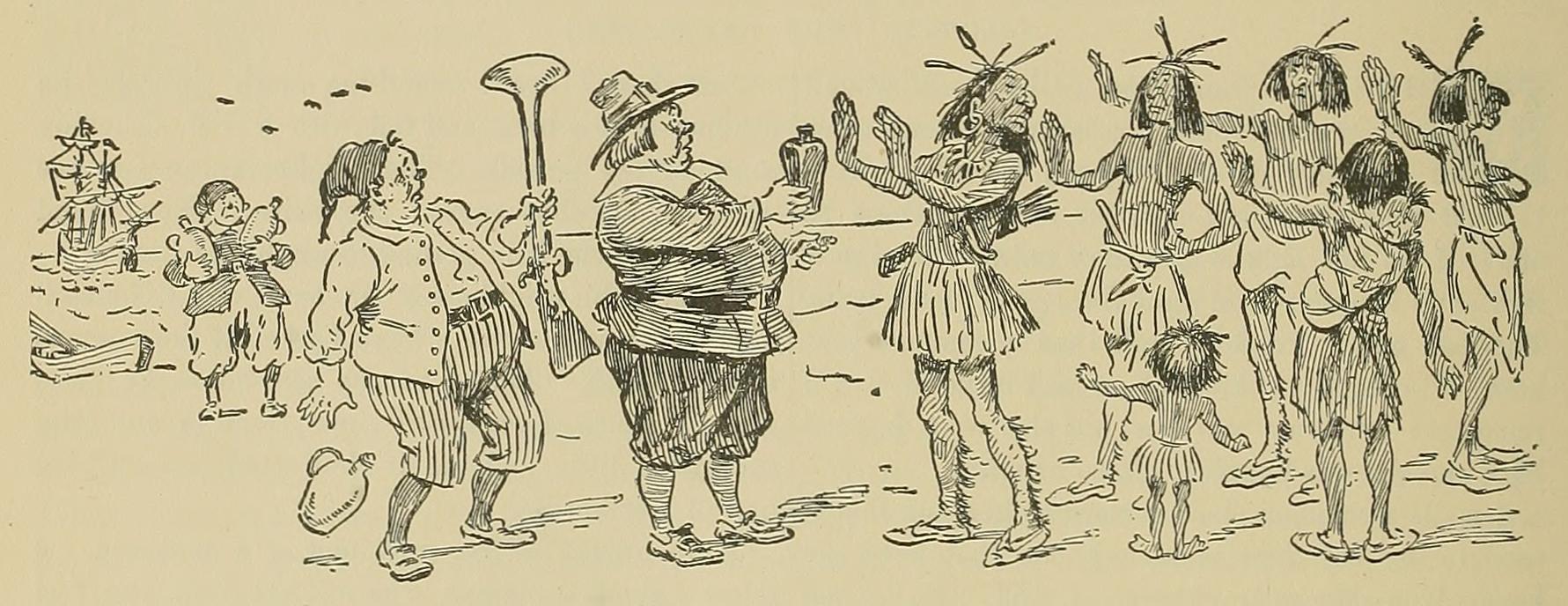
How 209th Street has changed!
The artist has been fortunate in getting the expression of the Indians in the act of refusing. Mr. Hudson’s great reputation lies in the fact that he discovered the river which bears his name; but the thinking mind will at once regard the discovery of an Indian who does not drink as far more wonderful.
Some historians say that this special delegation was swept away afterwards by a pestilence, whilst others, commenting on the incident, maintain that Hudson lied.
It is the only historical question regarding America not fully settled by this book.
Nothing more was heard by him till he turned up in a thinking part in “Rip Van Winkle.”
Many claims regarding the discovery of various parts of the United States had been previously made. The Cabots had discovered Labrador; the Spaniards the southern part of the United States; the Norsemen had discovered Minneapolis; and Columbus had discovered San Salvador and had gone home to meet a ninety-day note due in Palos for the use of the Pinta, which he had hired by the hour.
But we are speaking of the discovery of New York.
About this time a solitary horseman might have been seen at West 209th Street, clothed in a little brief authority, and looking out to the west as he petulantly spoke in the Tammany dialect, then in the language of the blank-verse Indian. He began: “Another day of anxiety has passed, and yet we have not been discovered! The Great Spirit tells me in the thunder of the surf and the roaring cataract of the Harlem that within a week we will be discovered for the first time.”
As he stands there aboard of his horse one sees that he is a chief in every respect, and in life’s great drama would naturally occupy the middle of the stage. It was at this moment that Hudson slipped down the river from Albany past Fort Lee, and, dropping a nickle in the slot at 125th Street, weighed his anchor at that place. As soon as he had landed and discovered the city, he was approached by the chief, who said: “We gates. I am on the committee to show you our little town. I suppose you have a power of attorney, of course, for discovering us?”
“Yes,” said Hudson. “As Columbus used to say when he discovered San Salvador, ‘I do it by the right vested in me by my sovereigns.’ ‘That oversizes my pile by a sovereign and a half,’ says one of the natives; and so, if you have not heard it, there is a good thing for one of your dinner-speeches here.”
“Very good,” said the chief, as they jogged downtown on a swift Sixth Avenue elevated train towards the wigwams on 14th Street, and going at the rate of four miles an hour. “We do not care especially who discovers us so long as we hold control of the city organization. How about that, Hank?”
“That will be satisfactory,” said Mr. Hudson, taking a package of imported cheese and eating it, so that they could have the car to themselves.
“We will take the departments, such as Police, Street-cleaning, etc., etc., etc., while you and Columbus get your pictures on the currency and have your graves mussed up on anniversaries. We get the two-moment horses and the country châteaux on the Bronx. Sabe?”
“That is, you do not care whose portrait is on the currency,” said Hudson, “so you get the currency.”
Said the man, “That is the sense of the meeting.”
Thus was New York discovered via Albany and Fort Lee, and five minutes after the two touched glasses, the brim of the schoppin and the Manhattan cocktail tinkled together, and New York was inaugurated.

JOEL CHANDLER HARRIS.
(“UNCLE REMUS.”)
OEL CHANDLER HARRIS has called himself “an accidental author,” for while living on a plantation as a typesetter on a country newspaper he became familiar with the curious myths and animal stories of the negroes, and some time in the seventies he printed a magazine article on these folk-lore stories, giving at the same time some of the stories as illustration.
This article attracted attention and revealed to the writer the fact that the stories had a decided literary value, and his main literary work has been the elaboration of these myths.
The stories of “Uncle Remus” are, as almost everyone knows, not creations of the author’s fancy, but they are genuine folk-lore tales of the negroes, and strangely enough many of these stories are found in varying forms among the American Indians, among the Indians along the Amazon and in Brazil, and they are even found in India and Siam, which fact has called out learned discussions of the origin and antiquity of the stories and the possible connection of the races.
Our author was born in Eatonton, a little village in Georgia, December 9, 1848, in very humble circumstances. He was remarkably impressed, while still very young, with the “Vicar of Wakefield,” and he straightway began to compose little tales of his own.
In 1862 he went to the office of the “Countryman,” a rural weekly paper in Georgia, to learn typesetting. It was edited and published on a large plantation, and the negroes of this and the adjoining plantations furnished him with the material out of which the “Uncle Remus” stories came.
While learning to set type the young apprentice occasionally tried his hand at composing, and not infrequently he slipped into the “Countryman” a little article, composed and printed, without ever having been put in manuscript form.
The publication of an article on the folk-lore of the negroes in “Lippincott’s Magazine” was the beginning of his literary career, and the interest this awakened stimulated him to develop these curious animal stories.
Many of the stories were first printed as articles in the Atlanta “Constitution,” and it was soon seen by students of myth-literature that these stories were very significant and important in their bearing on general mythology.
For the child they have a charm and an interest as “good stories,” and they are told with rare skill and power, but for the student of ethnology they have special value as throwing some light on the probable relation of the negroes with other races which tell similar folk-tales.
Mr. Harris has studied and pursued the profession of law, though he has now for many years been one of the editors of the Atlanta “Constitution,” for which many of his contributions have been originally written.
He is also a frequent contributor both of prose and poetry to current literature, and he is the author of the following books: “Uncle Remus, His Songs and His Sayings; the Folk-lore of the Old Plantation” (New York, 1880), “Nights With Uncle Remus” (Boston, 1883), “Mingo and Other Sketches” (1883).
MR. RABBIT, MR. FOX, AND MR. BUZZARD.¹
(FROM “UNCLE REMUS.”)
NE evening when the little boy whose nights with Uncle Remus are as entertaining as those Arabian ones of blessed memory, had finished supper and hurried out to sit with his venerable patron, he found the old man in great glee. Indeed, Uncle Remus was talking and laughing to himself at such a rate that the little boy was afraid he had company. The truth is, Uncle Remus had heard the child coming, and when the rosy-cheeked chap put his head in at the door, was engaged in a monologue, the burden of which seemed to be—
“Ole Molly Har’,
W’at you doin’ dar,
Settin’ in de cornder
Smokin’ yo’ seegyar?”
As a matter of course this vague allusion reminded the little boy of the fact that the wicked Fox was still in pursuit of the Rabbit, and he immediately put his curiosity in the shape of a question.
“Uncle Remus, did the Rabbit have to go clean away when he got loose from the Tar-Baby?”
“Bless grashus, honey, dat he didn’t. Who? Him? You dunno nuthin’ ’tall ’bout Brer Rabbit ef dat’s de way you puttin’ ’im down. Wat he gwine ’way fer? He mouter stayed sorter close twel the pitch rub off’n his ha’r, but twern’t menny days ’fo’ he wuz loping up en down de naberhood same as ever, en I dunno ef he wern’t mo’ sassier dan befo’.
“Seem like dat de tale ’bout how he got mixt up wid de Tar-Baby got ’roun’ mongst de nabers. Leas’ways, Miss Meadows en de girls got win’ un’ it, en de nex’ time Brer Rabbit paid um a visit, Miss Meadows tackled ’im ’bout it, en de gals sot up a monstus gigglement. Brer Rabbit, he sot up des ez cool ez a cowcumber, he did, en let ’em run on.”
“Who was Miss Meadows, Uncle Remus?” inquired the little boy.
“Don’t ax me, honey. She wuz in de tale, Miss Meadows en de gals wuz, en de tale I give you like hi’t wer’ gun ter me. Brer Rabbit, he sot dar, he did, sorter lam’ like, en den bimeby he cross his legs, he did, and wink his eye slow, en up en say, sezee:
“‘Ladies, Brer Fox wuz my daddy’s ridin’-hoss for thirty year; maybe mo’, but thirty year dat I knows un,’ sezee; en den he paid um his specks, en tip his beaver, en march off, he did, dez ez stiff en ez stuck up ez a fire-stick.
“Nex’ day, Brer Fox cum a callin’, and w’en he gun fer to laff ’bout Brer Rabbit, Miss Meadows en de gals, dey ups and tells im ’bout w’at Brer Rabbit say. Den Brer Fox grit his toof sho’ nuff, he did, en he look mighty dumpy, but when he riz fer to go he up en say, sezee;
“‘Ladies, I ain’t ’sputing w’at you say, but I’ll make Brer Rabbit chaw up his words en spit um out right yer whar you kin see ’im,’ sezee, en wid dat off Brer Fox marcht.