WIRE ROPE SPLICING
Reading edition
In splicing wire rope great care must be taken to prevent kinks getting into the rope or strands. Once a kink is made no amount of strain can take it out, and the rope is unsafe to work. If possible a turntable should be employed (an old cart wheel mounted on a spindle makes an excellent one)—the rope will then lead off perfectly straight without kinks.
With steel wire rope, always before working it put a stop on at the place to which you intend to unlay, and put a good whipping of twine at the end of each strand. In splicing wire all tucks are made against the lay of the rope.
In making an eye splice the rope is handled better if hung up in a convenient position, so that when standing up the eye will be at about the level of the chest of the person working.
A long, tapering steel marlinespike is required and after placing it under a strand do not withdraw it until the tuck is made and all the slack of the strand drawn through.
To make a neat splice do not haul the part of the rope that has not been unlaid too close to the neck of the splice, and in tucking the strands never take a short nip, but take long lays.
In unlaying for a long splice always unlay two strands simultaneously to keep the rope in its original lay. For a fair-sized rope unlay about 9 feet of each end.
Proceed as in rope splicing and after the three pairs of strands are in their places, single them and continue to unlay and lay in until the six meeting places of the strands are equidistant.
To finish off the ends properly can only be learned by observation and actual practice. By using two marlinespikes the hempen heart is removed and the ends of the wire strands forced into the place it occupied, making a very neat job when finished.
Wire splices should be parcelled with oily canvas and served.
Short Splice.—The same procedure is gone through as for splicing hemp rope, only care must be taken to place a good whipping on where the ends marry, and that each strand prior to unlaying is whipped. The number of tucks taken should never be less than three whole and one-half and one-third, so as to taper the splice off. The number of tucks to be taken off varies according to the work required of the rope or strop, but as a rule the more the better.
In tucking wire strands the strand should be entered in front of the marlinespike, which should not be withdrawn until this has been done, care being taken not to kink the strand.
Eye Splice.—Make the crown of the eye, take half the girth of the thimble and rope to be used and put a good stout whipping on to the wire, break the wire into shape of the thimble and heave both parts of the wire together by means of the rigging screws supplied for this purpose. Put a good seizing of spun yarn around both sides of the wire and thimble at the ends of the latter. Then remove the rigging screws and unlay the end of the wire as far as the whipping, open each strand and remove the hemp heart by cutting it off. Then put a whipping on the ends of the six strands, commence the splice by tucking the right-hand strand first, then the others in succession, each strand under one. The left-hand strand being the last is tucked under two. This ensures that each strand takes a fair strain. Care should be taken to keep the strands straight. When all have been tucked once, beat well down with an iron hammer and put on a good seizing of spun yarn. Then tuck each strand a second time. Wire 2½ inches and over should be tucked three times full and tapered to a third.
Steel Wire Hawsers.—The splices of the wire are made against the lay of the rope tucked three times with the full size of the strand and a fourth time with the strand reduced one-half; to make a more suitable taper, each tuck is drawn tightly in the direction of the lay of the rope. The center core of the rope is removed on opening out the strands for splicing, and the cores of the strands removed after the first tuck has been made. The first tuck is taken at one and a half times the girth of the thimble plus the circumference of the rope. The splice is then parcelled and served, the thimble tightly seized in with flat seizing crossed.
Splicing Wire Rope into an Endless Band.—This can be done either by the long or short splice, but the former is recommended, as the short splice, though equally strong, leaves a thick place in the rope. In the long splice, if properly made, no such inequality exists; indeed the spliced part should be difficult to locate.
To make a long splice a rope say 3½-inch circumference should have a splice not less than 60 feet to be safe, and smaller sizes in proportion down to 1½-inch circumference, for which size 25 feet will do. Take the 3½-inch rope as an example.
Measure 30 feet off each end of the rope and put a sound marline serving at those points. Then cut off the end servings and tie the strands together in twos and interlock, as shown in the diagram.
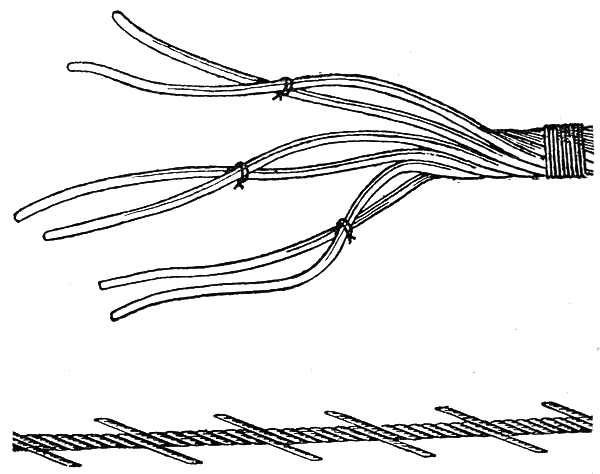
SPLICING INTO AN ENDLESS BAND
Lashings should only be cut off when parts are quite close together, otherwise rope has a tendency to open out further back and thus throw the length wrong. Then open strands out singly and snip off short six of the ends, three on either side, alternately. That is to say, leave a long end in each case opposite one of the snipped ends. Take each of the short ends in turn and carefully unlay them, at the same time laying in its place the corresponding long end.
This should be done with all the strands, and reckoning from the center on each side, the first one should be taken away 25 feet, the second 15 feet, and the third 5 feet. This will divide the splice up equally as shown in the lower diagram.
Then commence at the first strand at either end. First put the marlinespike through the center of the rope where the ends cross, cut and remove the hemp heart for about a foot. Then by the aid of the two spikes force the strand into place of heart just removed and follow up to the end of the strand, pulling out the heart a few inches at a time.
Repeat with all twelve ends, taking care that no empty space is left in the center of the rope by cutting of the hemp core further away than the strand end will reach. It is a good plan to marl or wrap each end with parcelling before it is put into the center of the rope, as this tends to give parts of the splice a good grip of one another. To finish off and remove inequalities, lay the splice on deck and hammer with a heavy wooden mallet.
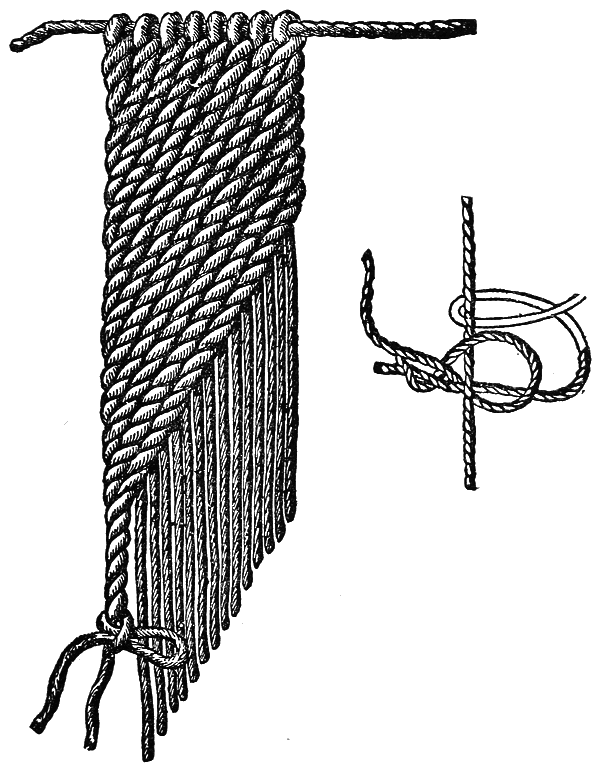
A PAUNCH MAT