LASHINGS, SEIZINGS, ETC.
Reading edition
A practical knowledge of the proper way to lash a rope is necessary to anyone who has anything to do with a vessel no matter what its character. Occasions constantly occur on sea and on land, in fair weather and foul, to unite ropes on the bight or that are fitted with eyes or with other loops.
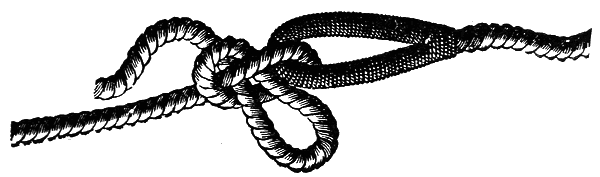
RUNNING KNOT IN THE EYE OF A ROPE
A Running knot fastened in the eye of a rope is the simplest of these knots. The diagram shows how this is made.
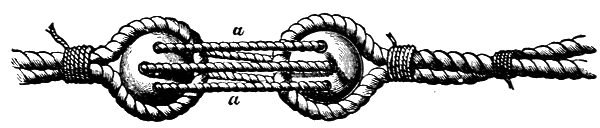
DEAD-EYE LASHING
The Dead-Eye Lashing is one of frequent use on board full-rigged ships. It admits of easy adjustment to the strain of the ropes. The ram blocks are fastened in the eyes, which are made by simple lashings and tightened by the lanyards, A, A, which pass through holes on the dead-eye, so as to tighten or slacken the rope at will. The ends of the lanyard are fastened to the main rope.

BELAYING-PIN SPLICE
The Belaying-Pin Splice as shown in the diagram really illustrates three methods of joining cordage. The belaying pin is marked A. It is stoppered on the end of the rope and served with yarn, passed through the eye of the rope and at the other end a loop is formed. Through this loop or bend a button secured to the rope, B, by a single knot is passed, and the double junction is complete.
The Wedding Knot or Rose Lashing is one to join two rope ends both having eyes. The lashing is passed successively through both eyes and then tied in the center.
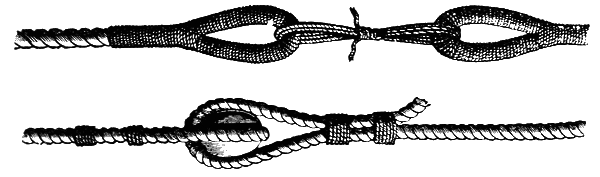
WEDDING KNOT (UPPER)
SHELL LASHING
The Shell Lashing is made by looping two ends of rope around a spherical shell and seizing the end to the standing parts.

A CROSS LASHING
A Cross Lashing is used when a lever is used to a rope. After several turns round the rope, the lashing is crossed round the lever and fastened with a reef knot.
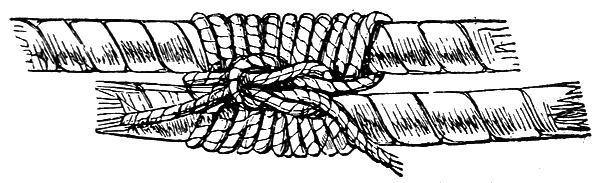
PORTUGUESE KNOT OR NECKLACE TIE
The Portuguese Knot or Necklace Tie is made by taking several turns round the spars to be joined, then two turns round the lashings and secured with a reef knot.
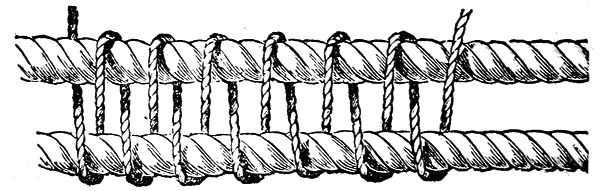
NIPPERING OR PACKING
Nippering or Packing is a method for securing two ropes together with cross turns. These are hauled taut and further secured by round turns over all after the ropes have been jammed together. The ends are fastened with a reef knot.
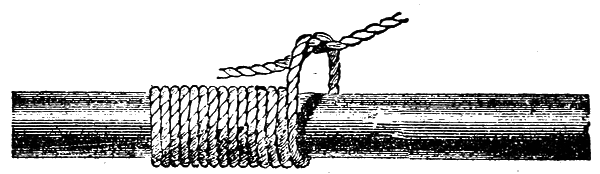
WEST COUNTRY WHIPPING
A West Country Whipping is formed by middling the twine around the part of the rope to be marked and half-knotting it at every half turn so that each knot will be on opposite sides. When a sufficient number of turns are passed finish it off with a reef knot.
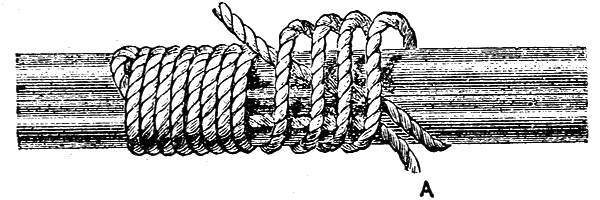
FINISHING A WHIPPING
To finish off a whipping without showing a knot lay one end forward as at A in the diagram, then pass the other end round and round a sufficient number of times, hauling taut each time. Three or four loose turns are then made and the end passed under these backwards. These ends are worked down into their places and when they are hauled taut are cut off.
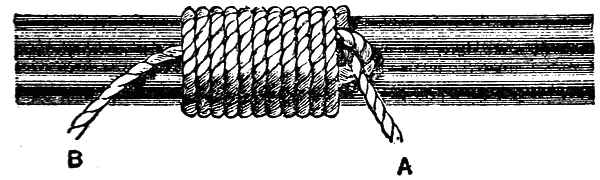
FINISHING A WHIPPING
Another method is, instead of having a single end, a bight of the seizing is laid along the part to be whipped and the turns passed over it. When these are completed the end is passed through the bight at A. The end B is then hauled upon to bring the bight and the end of the rope snug under the coils. There are now two loops interlacing at the center of the work and these cannot come undone. When the ends are cut off close to the turns the whole is fair and smooth.
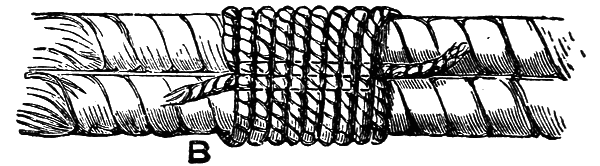
A USEFUL BAND
A useful band is shown in the diagram above. The second end B is drawn through by a turn—a very useful method of securing a ligature or a fractured fishing rod.
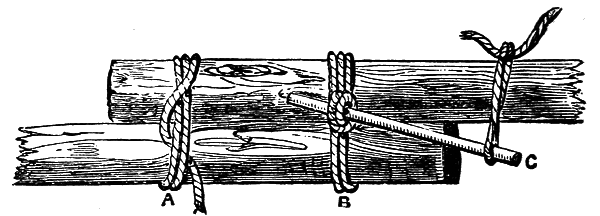
PACKING KNOT
The Packing Knot is used for binding timbers together. The first diagram shows it started at A and B shows it completed. It is tightened by means of a packing-stick, C, which is twisted under the knot and then twisted round and secured as shown. A quicker plan is two toggles shown in the second diagram. After twisting the sticks round tie the two ends of the sticks together.
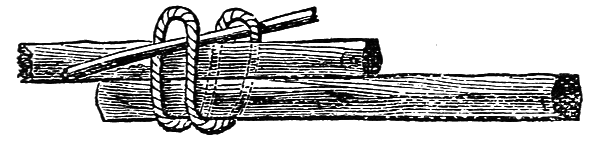
SIMPLE PACKING KNOT
A Toggle is a piece of wood turned to shape and having a groove in the center round which the end of a rope is spliced. An eye is made in another rope by any method and the toggle is slipped into it. To unfasten it the ropes are slackened. Another form of toggle is a round piece of wood shaped like a button. It has a hole in the center through which a rope is passed and the end knotted.
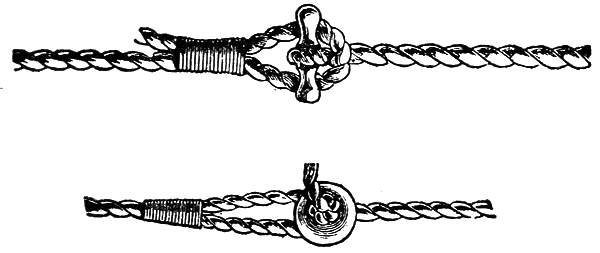
TOGGLES
The Jury, or Double Pitcher Knot as it is sometimes called, is useful when a jury mast has to be rigged, as the loops form a means of attaching the necessary supports to the mast. The center K in the second diagram is slipped over the masthead and the weight brought on the stays tightens it and holds it in its position on the mast.
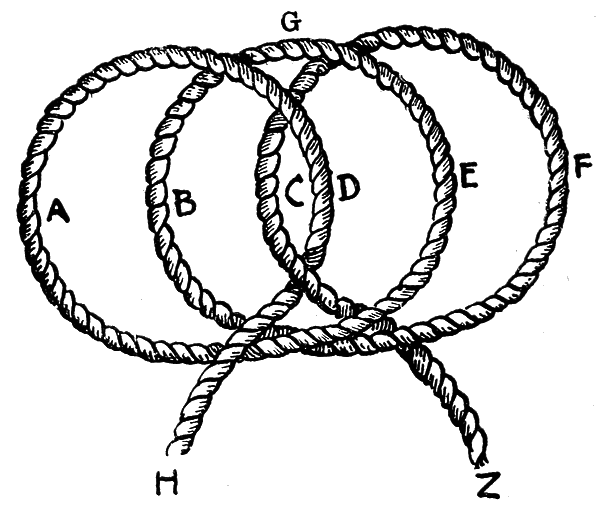
JURY KNOT, FIRST STAGE
It is formed by three ordinary half hitches each placed behind the other with the loop of the last laid over the first. Keep the hitches together with the right hand and with the left take A and dip it under B and pull C through A and B.
Then, holding the knot with the left hand, place F over E and pull D between E and F. Take G in the teeth and pull on the parts G, F and A. The ends H and Z may be either knotted or spliced.
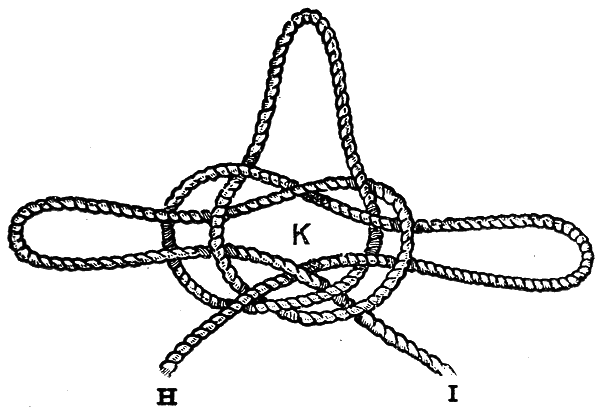
JURY KNOT, COMPLETED
Racking Seizing is used where the strain is on only one part of the rope. An eye splice is formed in one end of racking and the first turn is passed round both parts of the rope like a round seizing; it is then dipped between both parts and the remaining turns are passed as racking turns, over and under, leaving sufficient space between each racking turn for a roundabout turn to lie, the usual number taken being thirteen. After these are passed the end is dipped down inside the last turn and the roundabout turns are passed from the end towards the eye between the racking turns. When the last roundabout turn is passed, the end is passed up between both parts of the shroud, ready for passing the cross turns, which are passed by taking the end along the seizing and passing it down between the seventh and sixth turns along the seizing, again towards the eye, up between the two parts of the shroud, as before, and again drawn between the seventh and sixth turns so as to form a clove hitch. Then finish off with a crown and wall as in other seizings.
To make the racking neater after passing the last roundabout turn, the end is taken outside all parts of the racking instead of between the six and seven turns, and clove formed at the same time.
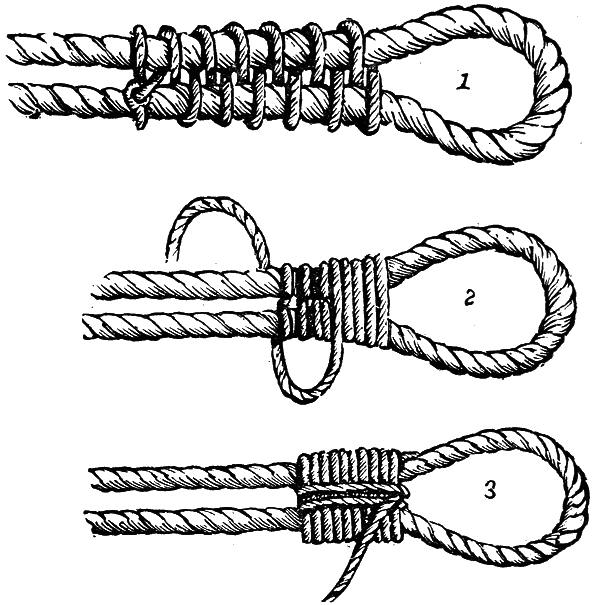
RACKING SEIZING