BENDS AND HITCHES
Reading edition
It is rather difficult to say where knots end and bends begin, because a tie made in a particular way and under certain circumstances may be called a knot, but differently constructed and under other conditions it is called a bend or a hitch. The result is the same in each case. A single hitch may be merely a loop formed in a rope.
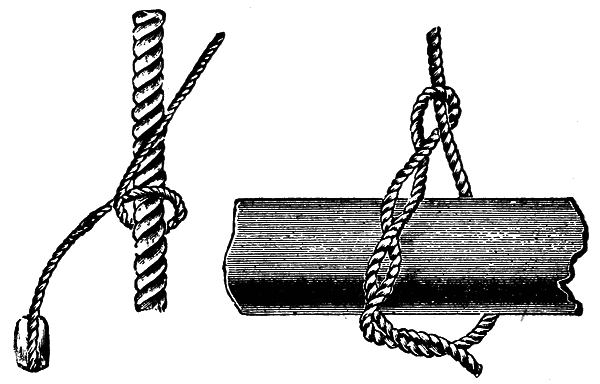
HALF HITCH TIMBER HITCH
A Half Hitch is used generally in conjunction with other hitches. Its formation is easily seen from the diagram.
The Timber Hitch is used to secure the end of a rope to a spar, also for bending a rope round light cases, bales, etc., when provisioning ships. It is formed by making a half hitch with rather a long end and expanding the end backwards round its own part. It is used also with a half hitch for towing spars, as shown in the diagram below.
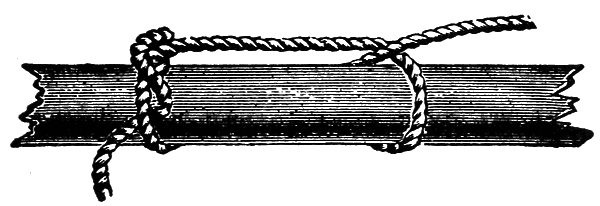
TIMBER HITCH FOR TOWING SPARS
The Crabber’s Eye Knot is not well known but is one that is not likely to part when strained. To make it bring the end back to form a loop, taking it first under and then over the standing part, up through the main loop, over the standing bight again and up through its own bight. Before the turns are hauled into their places, the knot will slip on the part A, as in an ordinary knot. If the part B is hauled upon the strand, A, which passes through the center knot, rises and the coil which goes round it jambs, making the knot secure so that it may be used as a running knot or otherwise, as desired.
A Buntline Hitch is commenced as in making an outside clinch but instead of putting on a seizing, the end is passed over and through the bight, as clearly shown in the diagram.
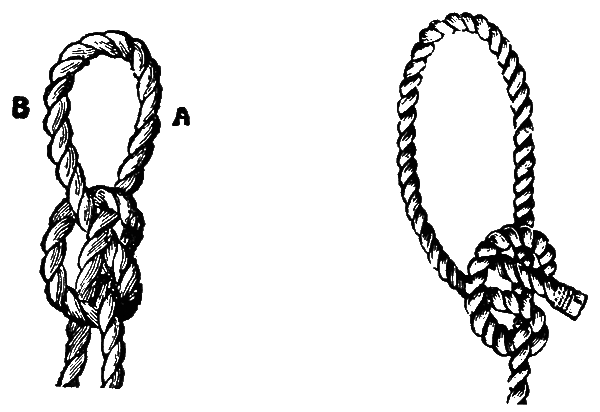
CRABBER’S EYE KNOT BUNTLINE HITCH
The Clove Hitch is really a jamming of two half hitches and is generally used when a small rope has to be secured to a larger one and the end kept free for use for further purposes, as in securing ratlines to the shrouds, and used also for securing the end of butt slings. Its formation can be followed very easily in the diagrams.
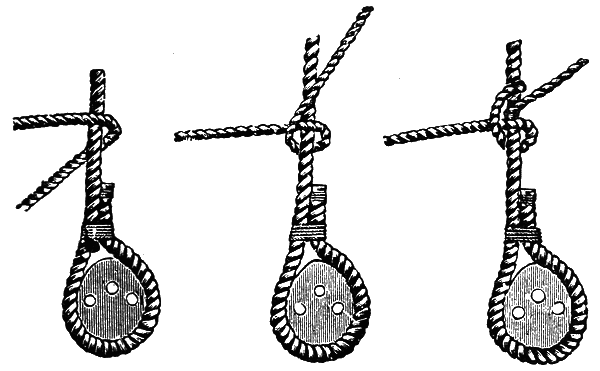
CLOVE HITCH
The Roband Hitch is very useful when a tackle, hook, ring or another rope is to be fastened to a beam or spar. This is another simple hitch, clearly illustrated in the diagram.
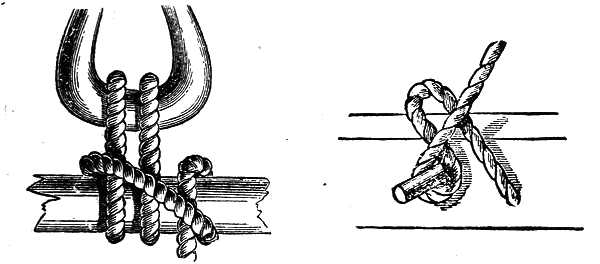
ROBAND HITCH SLIPPERY HITCH
The Slippery Hitch is valuable because of the ease with which it can be cast off in an emergency. It will hold securely while there is a strain on the rope.
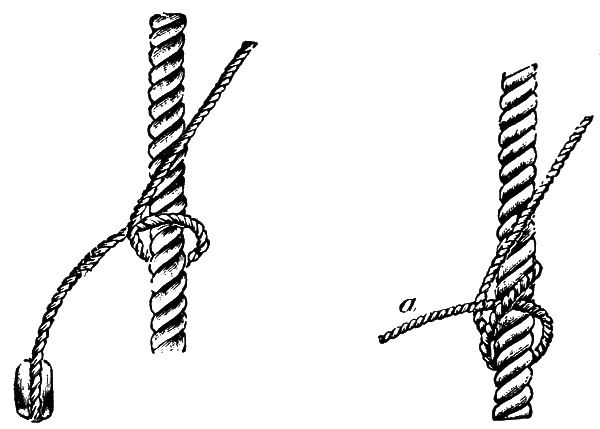
FIG. 1 FIG. 2
ROLLING HITCH
The Rolling Hitch is commenced and finished like a clove hitch, but, as can be seen from the figures, there is an intermediate round turn between the first and last hitches. It will be seen that the round turn in Fig. 2 is taken around both the standing part, A, and the larger rope B. The great value of this hitch is that it does not slip, and this can be rendered doubly sure by backing the end, C, round the part, D, and securing the end with a strop. It is used for bending a small rope to a larger one, for putting a tail jigger on a rope, and for securing hammocks to gantlines.
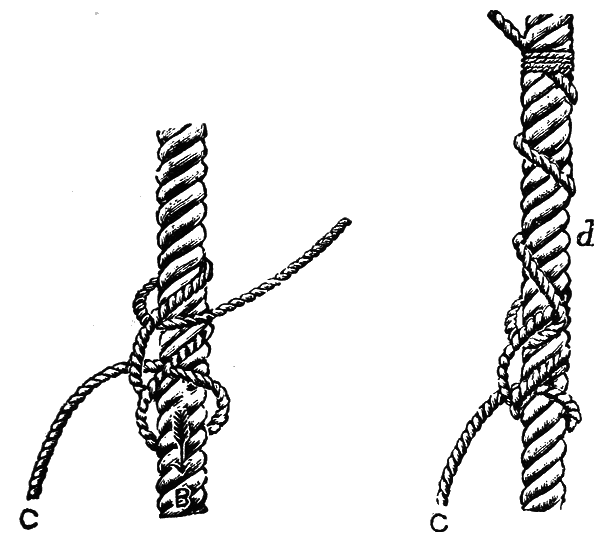
FIG. 3 FIG. 4
ROLLING HITCH
The Double Blackwall Hitch is made by taking the bight of the rope and placing it across the neck of the strop of the block, crossing it behind, then placing the under part over the hook and crossing the upper part on top of it. It holds better than the two preceding hitches.
The Marling Hitch is for lashing up hammocks or putting temporary seizing on two ropes or spars. It is also used when making swabs.
The Midshipman’s Hitch is used at times instead of a Blackwall Hitch and it will hold better if the rope is at all greasy. It is made by first forming a Blackwall hitch and then taking the underneath part and placing it over the bill of the hook.
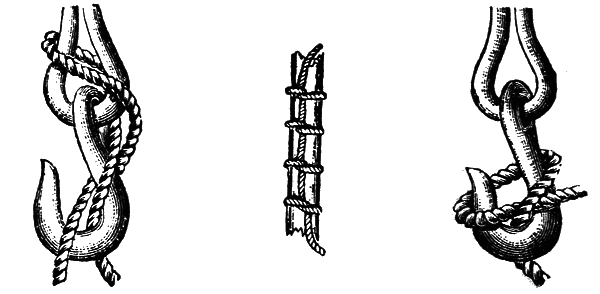
DOUBLE BLACKWALL HITCH MARLING HITCH MIDSHIPMAN’S HITCH
The Killick Hitch is a modification of the timber hitch. After making a timber hitch and hauling it taut, a single hitch is made and slipped over the end of a stone. This makes a secure anchor on fishing grounds on rocky coasts where an anchor will not hold.
The Magnus Hitch is a method of securing a rope to a spar. Take the end of the rope twice round a spar in front of the standing part, round the spar again and then pass it through the last bight.
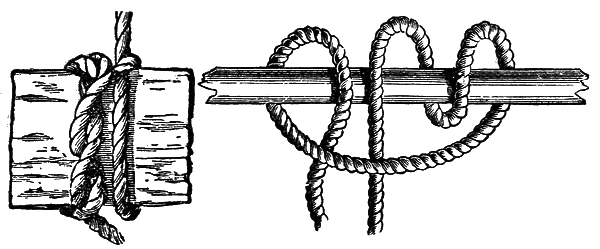
KILLICK HITCH MAGNUS HITCH
The Round Turn with Two Half Hitches is used to secure a hawser to the ring of a buoy and the rope in this case should be parcelled as shown in the diagram.
The Marlinespike Hitch is used for heaving the turns of a seizing taut with a marlinespike or hooking the hook of tackle to any rope where a small pull is required. It is formed by the standing part being picked through a loop laid over it, so that the spike lays under the standing part and over the sides of the loop. Its advantage is that it never jams.
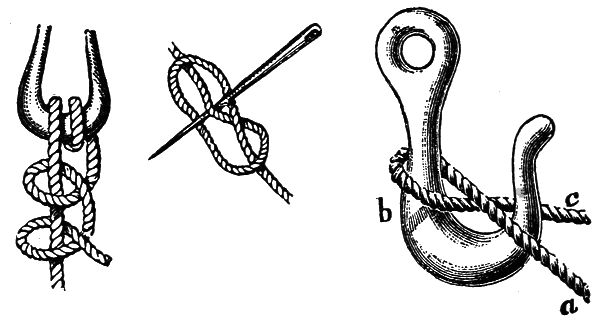
ROUND TURN WITH TWO HALF HITCHES MARLINESPIKE HITCH BLACKWALL HITCH
The Blackwall Hitch is used for hooking a tackle to a rope and bringing the fall of one jigger to the double block of another. It consists of a half hitch, and as soon as any strain comes on it the standing part, A, jambs the end part, C. By taking another round turn at B, before passing C under A, it will hold more securely.
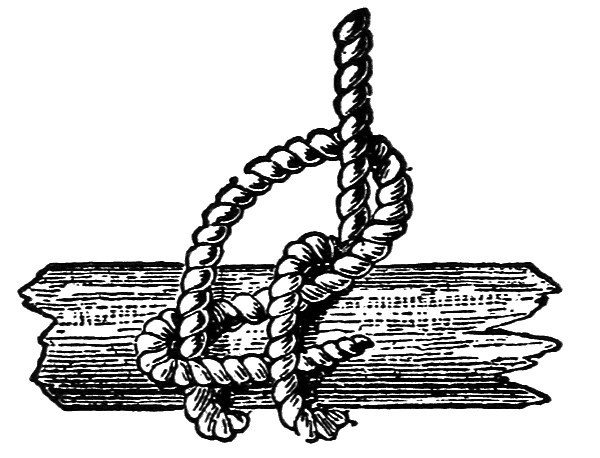
STUN’SAIL HALYARD BEND
A Stun’sail Halyard Bend is simply a Fisherman’s bend with the end backed again over the last round and under the first.
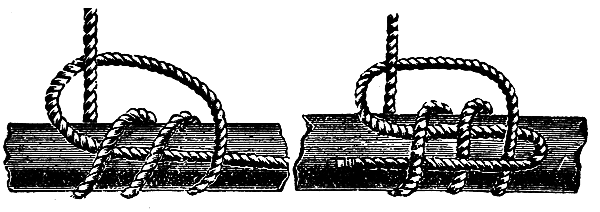
TOPSAIL HALYARD BEND
The Topsail Halyard Bend is made by bringing the rope twice round the spar, back over the standing part, under all turns, over two turns and under the last. Then jamb all the coils close and haul taut.
SHEET BEND
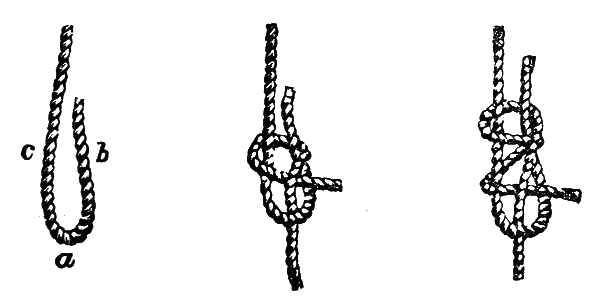
The Sheet Bend, as its name implies, is the method of attaching the sheet to the clew of the sail. It is also used for securing boats’ lazy painters to the Jacob’s ladders of the lower booms. In making a bend the ends of the two ropes are not used simultaneously as in forming reef knots, but an eye or loop is first formed in the end of one of the ropes as seen in the first diagram and the other rope’s end is then rove through it in the various ways required. To form a Sheet Bend pass the second rope’s end underneath the eye at point A and bring up through the loop, then form with it a half hitch round C and B. It will hold still better and is less likely to jamb, if the end is passed round again as in the third diagram. This is called a Double Sheet Bend.
FISHERMAN’S BEND
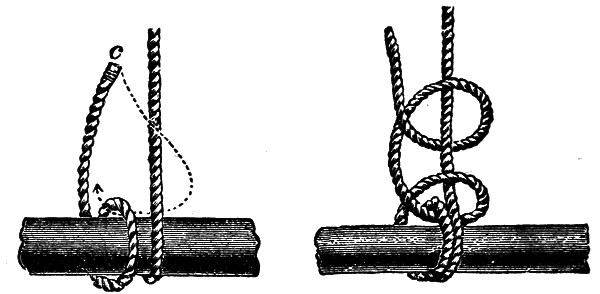
The Fisherman’s Bend is formed by taking two round turns around the object to which the rope is to be secured and then backing the end round in the form of a half hitch under both the standing part and the second round turn. The end may be further secured by taking a half hitch around its own part or by stopping it to it. The dotted line in the first diagram shows the direction the end C must take. This bend is used for bending a hawser to the ring of an anchor or a rope’s end to a bucket.
SIMPLE HAWSER BEND
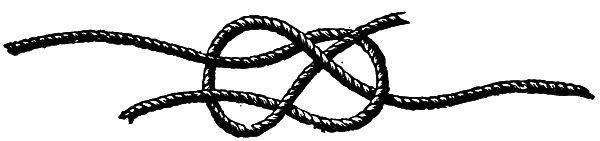
The Hawser Bend is so easy as to be constantly used when only a temporary purpose has to be served.
BOWLINE BEND (UPPER)
HALF HITCH AND SEIZING BEND
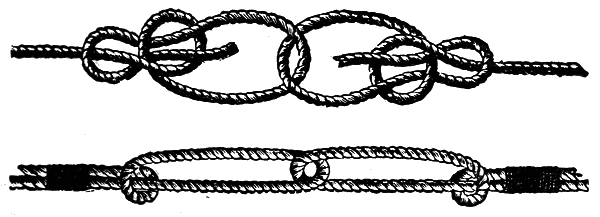
The Bowline Bend is the strongest of all knotted hawsers. It is formed of two Bowline knots, one crossing the loop of the other as shown in the diagram.
The Half Hitch and Seizing Bend is used on hawsers which are to be joined for a long period. Its formation is shown in the illustration clearly.
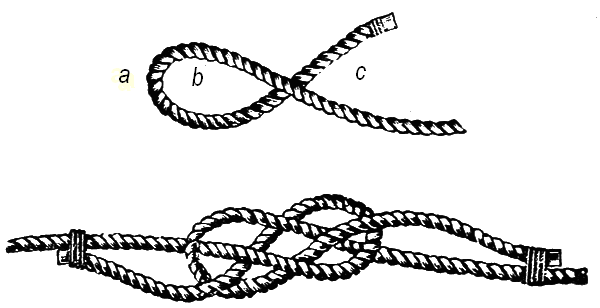
CARRICK BEND
The Carrick Bend is for bending two hawsers together when required to go around a capstan. First form with hawser No. 1 a loop as in the upper diagram. Pass the second hawser under the first at A, bring up through the eye B, back it over the cross at C and bring up again towards you through the eye B, and then stop the ends of each hawser to their own respective parts as shown in the lower diagram.
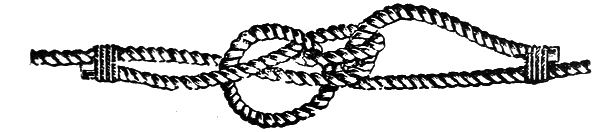
DOUBLE CARRICK BEND
A Double Carrick Bend is formed in precisely the same way, but a complete round turn is taken around the cross of the first hawser and then led up again through the eye and finished off.
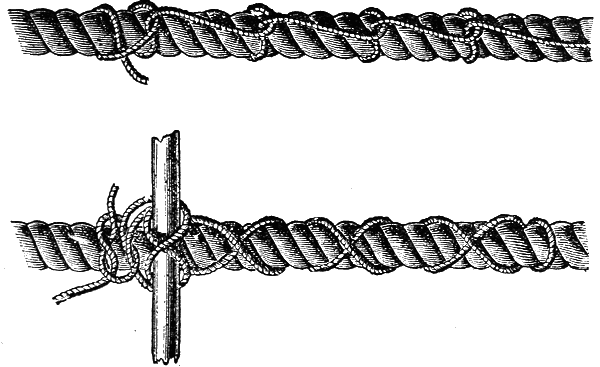
CHAIN HITCH
The Chain Hitch is used to attach a small rope to aid in pulling a larger. When it is necessary to use a lever as a handspike the fastening in the lower diagram is used. First a clove hitch is formed to the spar and as many single hitches as required are then made. It may be finished off with any secure knot.