SHORTENINGS
Reading edition
Shortenings are, as the term implies, knots that take up the surplus cord and keep the ends from being in the way. A piece of rope or cord is often too long and to cut it would be waste, so a shortening knot is used. Sometimes the tie, four, five or six-fold knots are used for this purpose.
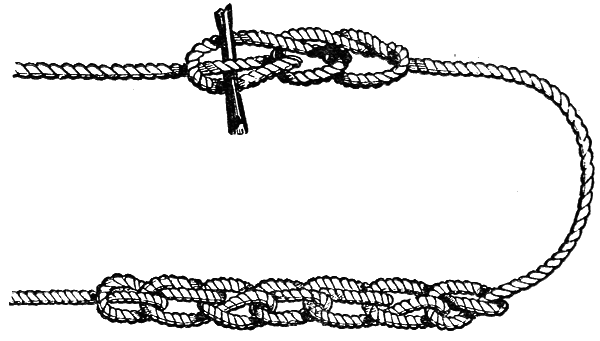
SINGLE PLAIT OR CHAIN KNOT
The Single Plait, or as the sailor terms it, the Chain Knot, is the commonest of all these knots. First make a running loop and then draw the loose end through the loop and repeat this operation until all excess of cord has been taken up. The end may be secured by bringing the end of the rope through the loop or by passing a belaying pin through the loop. These two methods are illustrated in the diagram.
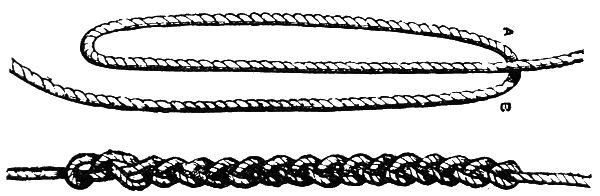
TWIST KNOT
The Twist Knot is an ordinary three plait, although it is formed with one piece of rope. It is more useful than when formed of three separate pieces, for the ends are fastened and it cannot come undone. To make this twist hold the double loop in the left hand; the side A is then brought over to B, with a half turn B is crossed over to A and the process of an ordinary three plait is continued until the end of the rope is reached, when the loose end is passed through the bight and the knot is fastened and completed.
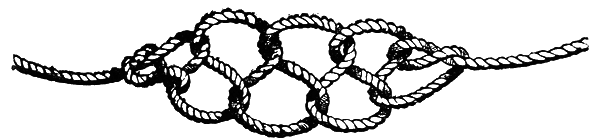
DOUBLE CHAIN KNOT
The Double Chain Knot is very easily made, if the first loop is made secure by a twist in the rope as shown in the diagram, and then pass the loose end through the preceding loop right and left until the knot is finished.
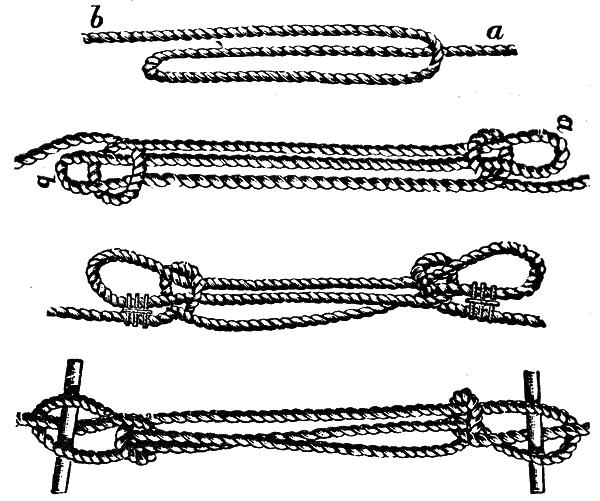
SHEEP SHANK OR DOG SHANK
The Sheep Shank, or Dog Shank as it is sometimes called, is an old-fashioned method of shortening a rope and can be used on any sized cordage. It is used for shortening a rope which requires lengthening again. Gather up the amount to be shortened in the form of the upper illustration. Then with parts A and B form a half hitch round the two parts of the bight as in the second figure.
To render it still more dependable the bights A and B may be seized or toggled to the standing parts as in the third and fourth figures.

BEND SHORTENING
Bend Shortening or Simple Loop is a plain, useful expedient for stout rope and has the merit of not injuring the ropes by an unnecessary strain, or crossing the fibres of the hemp. It will not, however, stand any great strain.
BOW SHORTENING
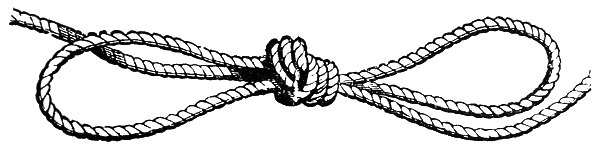
The Bow or Knot Shortening is very quickly made. It is simply an ordinary knot in the middle of a rope in which a double bend has previously been made. It is not adapted to heavy ropes nor will it stand a heavy strain.
CATSPAW
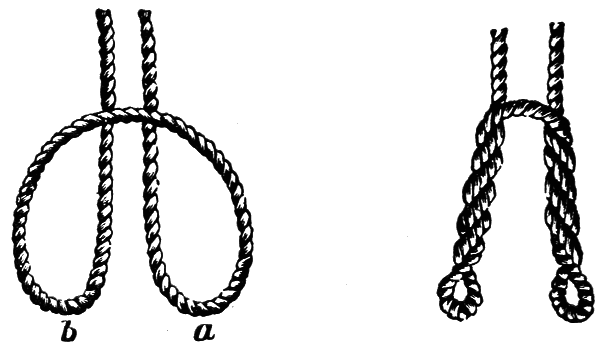
The Catspaw is one of the easiest made loops to be used for hooking on the block of a tackle or shortening up a bale sling stop. First throw back a bight as shown in the first diagram. Then taking hold of A and B, one in each hand, twist them up as in the second diagram. Bring the two eyes A and B together and hook in the tackle.