TIES
Reading edition
When the many varieties of knots and ties are analyzed it will be found that ties used in trades are all taken first from the mariner. The sailor learned to fasten ropes so that they were able to take up all strains evenly and to hold without chafing or without any undue strain being put on any one part of the rope. Consequently when builders erect scaffolding they use the ties and knots long known at sea. The Clove Hitch is also known as the Builder’s Knot because it is used to hold the scaffolding. The Clove Hitch is used by surgeons in cases of dislocation. The Reef Knot is also used by surgeons to tie arteries when performing operations. So it is with many other knots and because of their uses for other than nautical work they have often received other names.
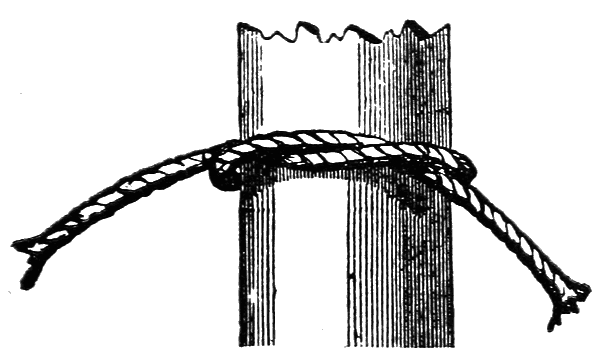
SIMPLE KNOT
The Simple Knot is the foundation for many ties. In the illustration this knot is seen made around a mast or other solid substance. This simple knot can at once become a clove hitch or the builder’s knot which is illustrated on page 39.
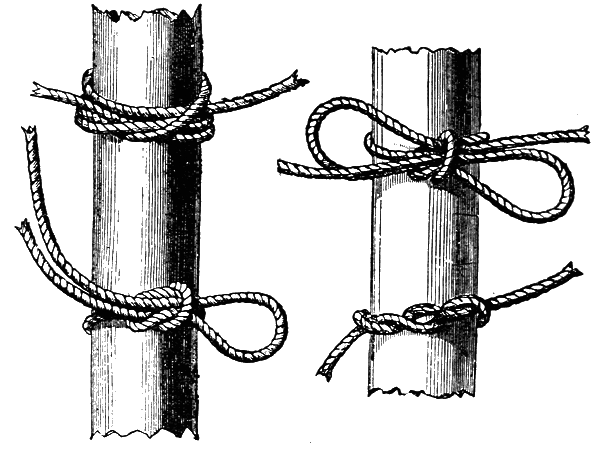
DOUBLE BUILDER’S KNOT SINGLE BOW KNOT DOUBLE BOW KNOT SINGLE TWIST KNOT
The Double Builder’s Knot is shown in the diagram above, upper left. It is made in the same way as the clove hitch or builder’s knot except that the end goes around again as before and underneath its own part so making it much stronger.
The Single Bow Knot is one of the most common of the knots in general use. It is commenced with the simple knot and made by doubling one of the loose ends as shown in the diagram.
The Double Bow Knot or rosette knot is begun in the same way. Care must be taken to keep the simple knot taut until the bow knot is completed. The ends must lie straight as in the reef knot or it will become the false knot.
The Double Twist Knot is useful when small cords are used and tightness is required. The diagram below, upper left, shows how it is made.
The Tent Pole Knot, below, lower left, is one that can be used to advantage by all who have to occupy tents or to travel much. It is a simple loop made by joining the two ends of a rope with a fisherman’s knot. This admits a short cross-bar or wooden pin and it will enable the traveler to suspend clothes or other articles around a tent pole. The cord may also be used for a toggle when two pieces of wood have to be joined together.
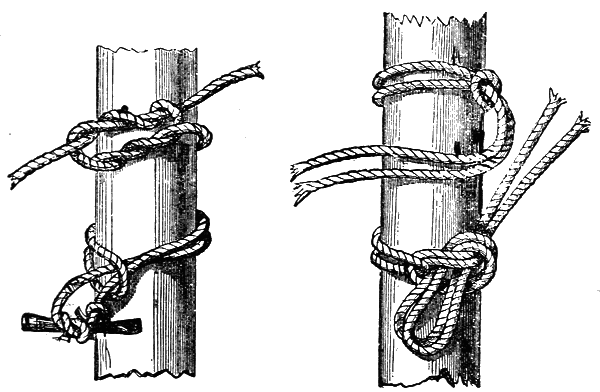
DOUBLE TWIST KNOT TENT POLE KNOT RUNNING KNOT RUNNING KNOT CHECKED
A Running Knot with two ends is used when it is inconvenient to divide the rope. Unless the ends are at liberty it could not be used round a mast, but it can be easily slipped round a pier.
This knot is frequently checked by a bow as shown in the diagram above, lower right.
It is sometimes checked by a Flemish Knot or by a Check Knot. These two knots cannot be tied unless the ends are loose. They cannot be untied without assistance from a marlinespike or some similar contrivance.
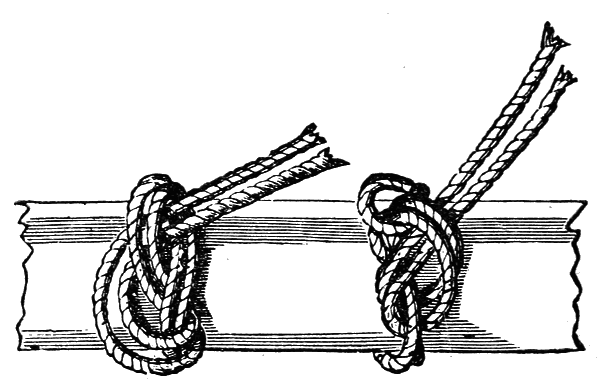
RUNNING KNOT CHECKED BY A FLEMISH KNOT (LEFT) AND BY A CHECK KNOT (RIGHT)
The Stationer’s Knot is handy for tying a parcel as it can be made rapidly and undone with ease. Make a running noose at the end of a piece of twine and bring it to the center of the parcel. Take the twine round the parcel at right angles, round the noose and making a bight slip it under as illustrated. A pull at the end releases the knot instantly.
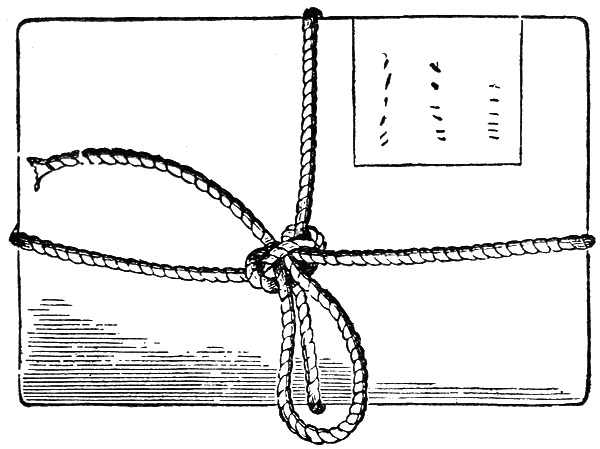
STATIONER’S KNOT