FASTENINGS, MOORINGS AND RING KNOTS
Reading edition
A landsman is always fascinated by the ease with which the sailor will handle big ropes and the way in which he will warp a vessel in or out of a dock or moor it to a pier by the simple twisting of the cable round a post or cleat which are on the vessels themselves or on the pier-head.
The Simple Stoppered Loop is familiar to all and when the end of the rope can be constantly used no other fastening is required.
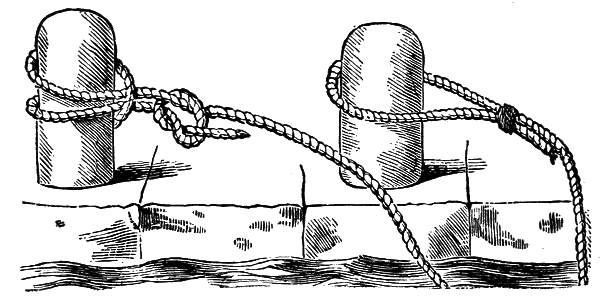
LARK’S HEAD SIMPLE STOPPERED LOOP
A Lark’s Head can easily be made over a post when there is a running noose or knot. This is clearly shown in the diagram.
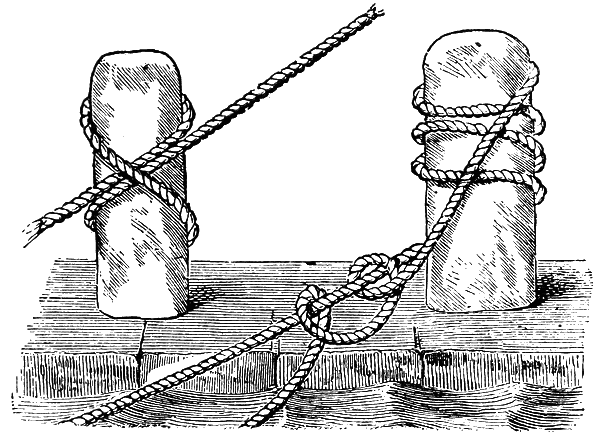
WATERMAN’S KNOT TWISTED ROPE FASTENING
The Waterman’s Knot is used when the end of the rope is not stoppered or when the middle of the rope must be used. This is similar to the clove hitch. It can very quickly be made by placing two loops on the rope as shown in the diagram.
The holding power of a twisted rope is illustrated clearly in the diagram to the right of the Waterman’s Knot.
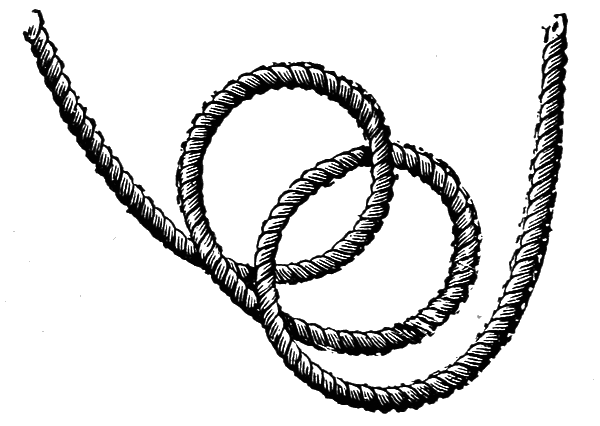
TWO LOOPS OF A WATERMAN’S KNOT
The Chain Fastening is of a more permanent character, and is used when a vessel is to be moored for any length of time.
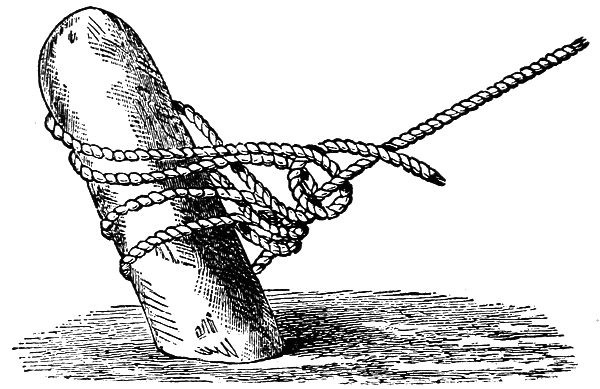
CHAIN FASTENING
Square moorings or sheaves are occasionally used for the mooring of vessels. In these instances the fastenings vary. The diagram shows a double fastening to sheaves.
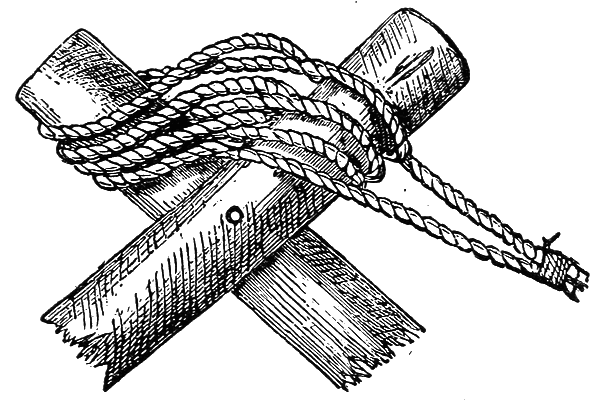
DOUBLE CHAIN FASTENING TO SHEAVES
A loop fastening to sheaves may be tied or untied without untying the loop itself. It is made by passing the loops, A, B, C, D, and E as shown and then placing the loop F over the head of the right-hand post of the sheaves. When slackened the loop of the cable F will again slip over the head of the post and the turns and then reversed. There is a more simple fastening by wrapping the cable round the angle of the sheaves.
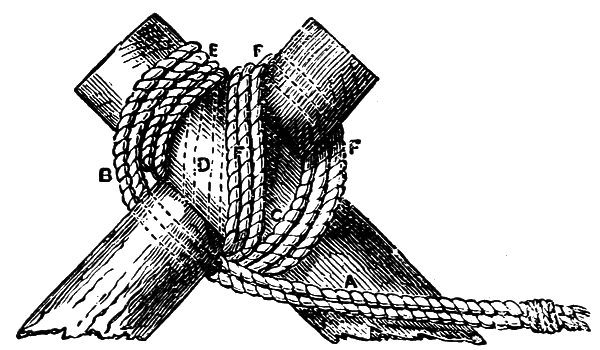
LOOP FASTENING TO SHEAVES
The crossed and square fastenings as shown in the diagrams need no explanation. The ends are secured by being stoppered to the cable.
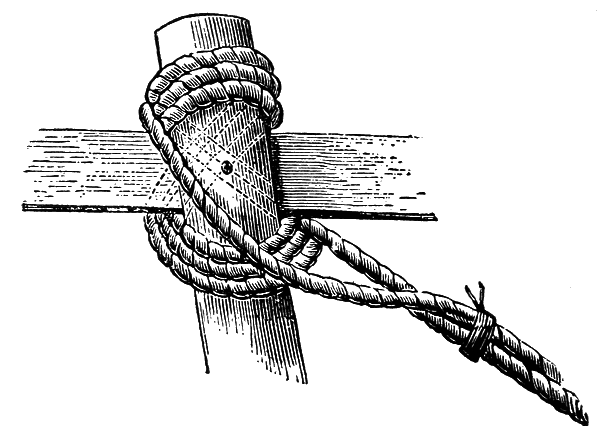
CROSSED AND SQUARE FASTENING
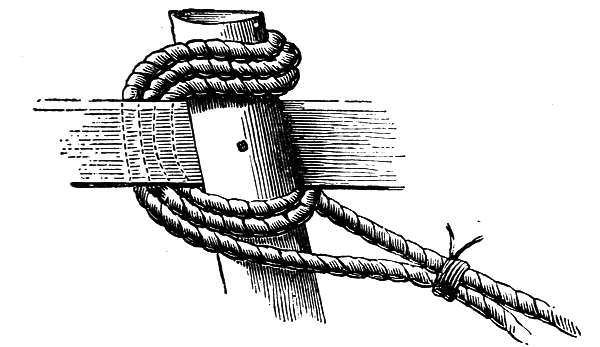
SQUARE FASTENING
To secure a rope round a cleat first take a round turn, then a figure of 8 knot is made round the cleat pin and repeated twice. On no account should a half hitch be made over the pin or cleat afterwards. The main object is to insure that the rope will not jamb.
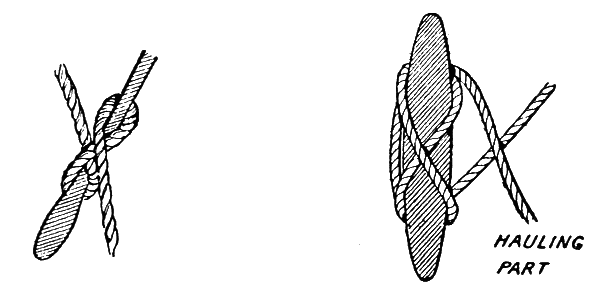
TO SECURE A ROPE ROUND A BELAYING PIN OR ROUND A CLEAT
A study of the many knots used for fastenings or moorings show that they are only practical applications of many of the knots, bends or hitches that have already been illustrated in preceding chapters of this book.
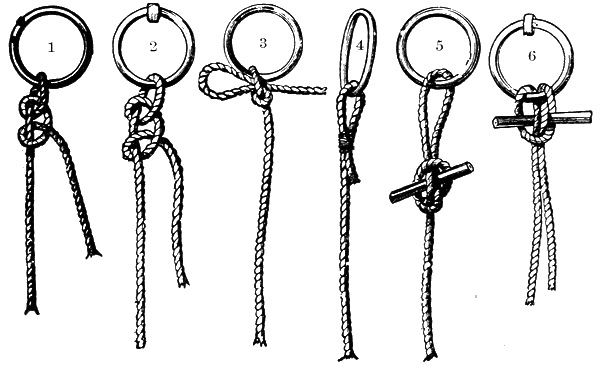
FIGS. 1 to 6
The Sailor’s Knot is a very simple mooring knot for the painter of a small boat. It is shown on Figs. 1 and 2. This knot shows one line straight while the end is twisted round in two hitches.
The Slippery Ring Knot is shown in Fig. 3. It can be cast off at any moment. Fig. 4 shows the same knot but it is made permanent by being stoppered as seen in Fig. 4. The slippery ring knot has one turn in the ring.
The Simple Boat Knot, Fig. 5, has an advantage for rapidity of unmooring. It is made with only one turn in the ring. The loose end is left longer than in the diagram but as it sometimes catches in the ring it is not very popular with sailors.
The Lark Boat Knot, Fig. 6, is really a double boat knot. It differs from the boat knot in that a bight instead of a single end of rope is put through the ring and a thole used to fasten it.
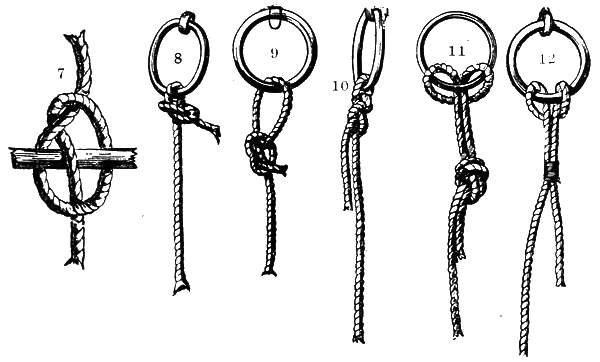
FIGS. 7 to 12
The Boat Knot, Fig. 7, is made in the same way as the marlinespike hitch, the only difference being that a thole pin or other small piece of wood is put through the center of the knot instead of a marlinespike. By withdrawing the pin the knot comes adrift of its own accord.
Simple and Crossed Running Knots are shown in Figs. 8 and 9. The simple fastening, Fig. 8, is not so secure, but chafes less than the crossed running knot, Fig. 9.
The Capstan Knot, Fig. 10, is an application of the figure of 8 knot. To make this cross the end of the rope after it is through the ring, bring it round the standing part, through the first bight and through its own bight.
The Lark’s Head Knot, Fig. 11, is somewhat like the lark boat knot but instead of the ends being brought down outside the bight after being passed through the ring, they are put through it. This is seen in the ring part of Fig. 11. The whole illustration shows a Lark’s Head stoppered.
The Lark’s Head Stoppered may be made by passing a bight through the ring and drawing the two parts of the rope through the bight. Where this is not practical by reason of one end of the rope being fast, the end may be passed up through the ring behind the standing part and drawn down through the right and bight again. Sometimes instead of being stoppered with an overhand knot as seen in Fig. 11 the end is seized to the standing part with twine, as shown in Fig. 12.
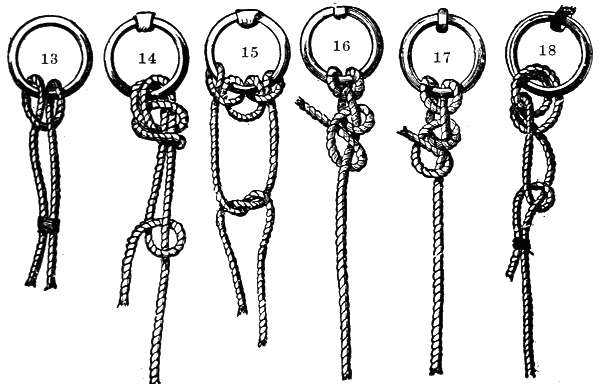
FIGS. 13 to 18
The Lark’s Head with Crossed Ends in Fig. 13 is made in the same way as the Lark’s head except that the end comes over instead of through the bight. If the standing part is taken in one hand and the end in the other and drawn apart this knot is the clove hitch or builder’s knot.
The Double Lark’s Head, Fig. 14, is easily followed in the diagram. A bight is first made and the ends passed through it, the ends are then put through the ring and through the loop already made and hauled taut.
The Treble Lark’s Head, Fig. 15, is not as difficult as it appears in the diagram. First bring the bight of the rope up through the ring, then take one of the ends and pass it through the bight and up through the ring. Then put it down through its own bight. Do the same with the other part and the knot is formed.
Back-Handed Sailors’ Knots are shown in Figs. 16 and 17. This knot is made by passing an end through the ring round at the back of the standing part and through the ring again, finishing with two half hitches round the standing part.
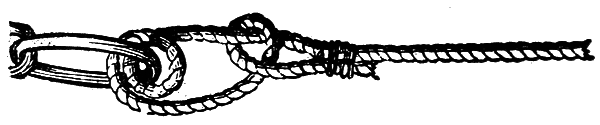
A SLIP KNOT STOPPERED
Slip Knots stoppered as shown in Fig. 18 and above are easily made and the diagrams show their formation clearly.
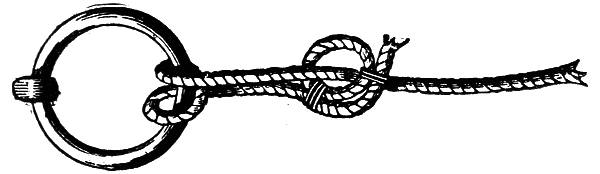
SLIP KNOT AND SLIP CLINCH
Slip Knot secured by a slip clinch is another simple knot and easily followed in the diagram.
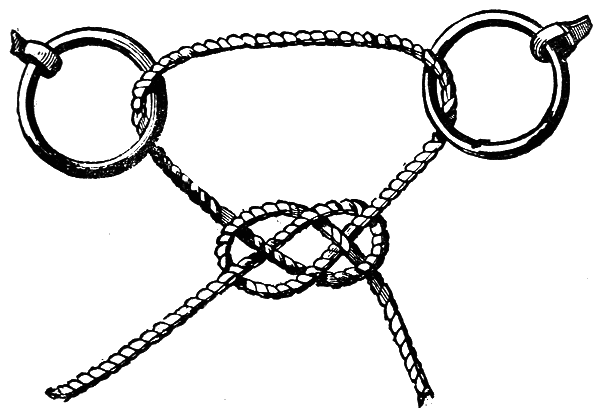
GUNNER’S OR DELAY KNOT
The Gunner’s Knot is simply a carrick bend made with the two ends of a rope after it has been passed through two rings. This is sometimes called a delay knot.

LEAD LINE AND LEAD
Securing Lead Line to Lead.—The lead is fitted with a good wire grommet parcelled over. The lead line should have a long eye spliced in it and is secured by passing the eye through the grommet and over the lead.
Hawsers are bent together by two half hitches and seizing the ends in addition to methods already explained.
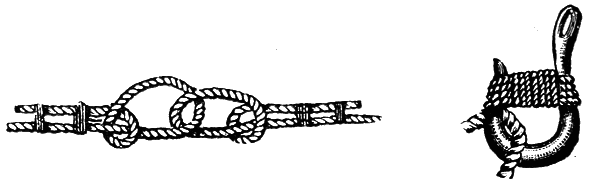
BEND HAWSERS MOUSING A HOOK
Mousing a hook is to prevent a chain or rope from slipping off or to prevent it becoming unhooked. A few turns of a rope yarn are passed round the ends of the hook and the standing part, the ends are brought round the middle a few times and fastened with a reef knot.