PURCHASES AND SLINGS
Reading edition
Single Whip—rope rove through a single block fixed in any position. It is used for light work. No power is gained.
Double Whip—rope rove through two single blocks—upper block a tail block, lower one movable hook block. The standing part of the fall is secured close to the tail block. The power gained is double.
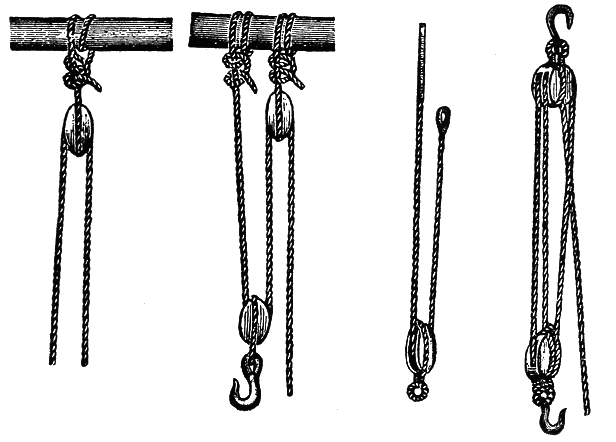
SINGLE WHIP DOUBLE WHIP RUNNER GUN TACKLE
Runner—a piece of rope rove through a single block with a standing eye in one end and pointed at the other. The power gained is double.
Gun Tackle—two single blocks. Power gained—twice or three times according to which is the movable block.
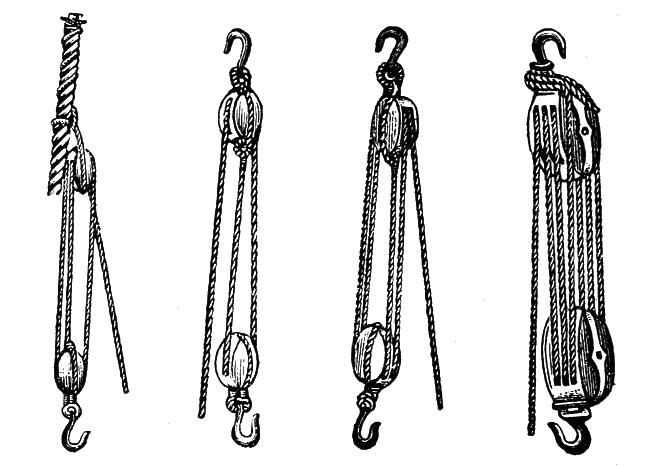
HANDY BILLY OR JIGGER WATCH OR LUFF TACKLE DOUBLE LUFF THREE-FOLD PURCHASE
Jigger—a small tackle for general use; a double block with a tail called a jigger and a single block with a hook. The standing part of the fall is spliced into the strop of the single block. Power gained—three or four times.
Handy Billy is a small tackle for general use.
Up and Down Tackle—a double and single block. The double block is fitted with a thimble, the single block is a hook block, fitted with a long strop. The standing part of the fall is spliced in the strop of the single block. Power gained—three times.
Luff Tackle—two hook blocks, one double and one single. The standing part of the fall of this tackle is spliced into a strop of the single block. It is sometimes rove through a becket in the single block and secured by being spliced round the strop at the neck of it. Power gained—three or four times.
Double Luff Tackle—two double blocks.
Three-fold Purchase—two three-fold blocks. Power gained—six or seven times.
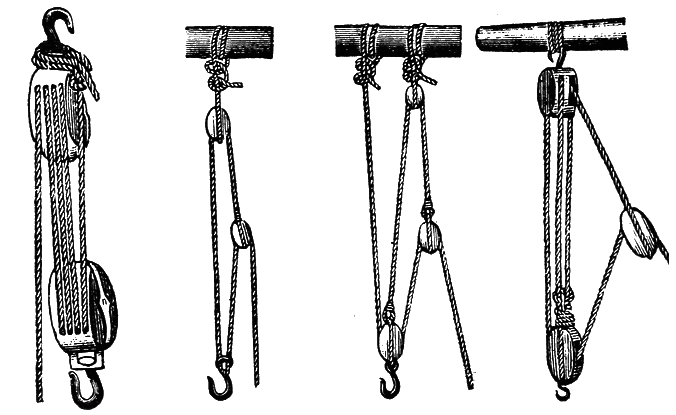
FOUR-FOLD PURCHASE SINGLE SPANISH BURTON DOUBLE SPANISH BURTON
Four-fold Purchase—two four-fold blocks. Power gained—eight times.
Single Spanish Burton—two blocks and a hook. Power gained—three times. It is not in general use.
Burton—a double hook block and a single hook block, fitted with a long strop, the standing part being spliced round the strop and hook of the single block. Power gained—three times.
Runner and Tackle—consists of three blocks, one double and two single. One of the single blocks is fitted with a thimble, as a lashing or shackling block, through which the runner is rove. The double block of the tackle is turned in one end of the runner. The standing part of the tackle is spliced in the seat of the single block which is fitted with a long strop and hook. Power gained—eight times.
Double Spanish Burton—There are two forms of this purchase. One by using three single blocks and the other by using one double and two single blocks. Power gained—five times.
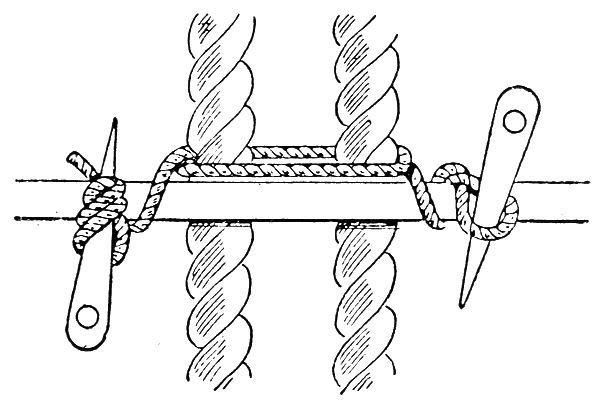
SPANISH WINDLASS
A Spanish Windlass—To rig a Spanish windlass take a good strand well greased in the center. Place the strand over the two parts of the rope that are to be hove together and bringing the ends of the strand up again, place a bolt close to the strand. Take the ends of the strand and lay them up with their own parts so as to form two eyes. Take a round turn with this round the bolt, put a marlinespike in each eye and heave around.
A Parbuckle is used for hauling up or lowering down a cask, or any cylindrical object where there is no crane or tackle. Middle the rope to be used for the parbuckle, place the bight over a post or pin as most convenient; the two ends are then passed under the two quarters of the cask, bring the ends back again over it and they both being hauled taut or slackened together either raise or lower the cask as may be required. Care must be taken to keep an equal strain on both parts to prevent the cask slipping out.
There are several methods of slinging a cask, viz., with butt slings, bale slings and head up, also by means of can hooks.
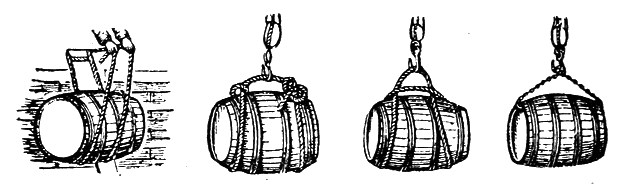
PARBUCKLE BUTT SLINGS BALE SLINGS CAN HOOKS
A Butt Sling is a single piece of rope fitted with an eye splice in one end and the other end pointed or whipped. To sling the cask, the cask is placed on its bilge bung up; reeve the end of the sling through the eye splice and place the loop thus formed over one end of the cask between the first and second hoops and haul well taut, the eye splice being in line with the bungs; then take the end of the sling round the other end of the cask between the first and second hoops and clove-hitch it to its own part in line with the bung.
A Bale Sling is a single piece of rope short spliced together. To sling a cask, the cask is placed on its bilge bung up, the slings passed underneath both ends of the cask between the first and second hoops; the bights are then taken over the cask, and one bight passed through the other, taking care the cross is in line with the bung.
Can Hooks are used for breaking off a cask, that is for lifting out the first cask of a tier where there is not room to put on a butt or bale sling. Casks are never hoisted up with can hooks.
To pass a life line dip the end under the slings and over the davit and take two or three turns round all parts and hold on to the end.
To pass a life line for a “full due” proceed as above but substitute half hitches for round turns and tuck the end in.
To sling a cask head up the cask is placed on its end, pass a rope under the bottom fairly in the center, then form an overhand knot with both ends of the rope on the top of the cask, open the knot out and place bights over the head between the first and second loops, haul them well taut, then reef-knot both ends together on top.
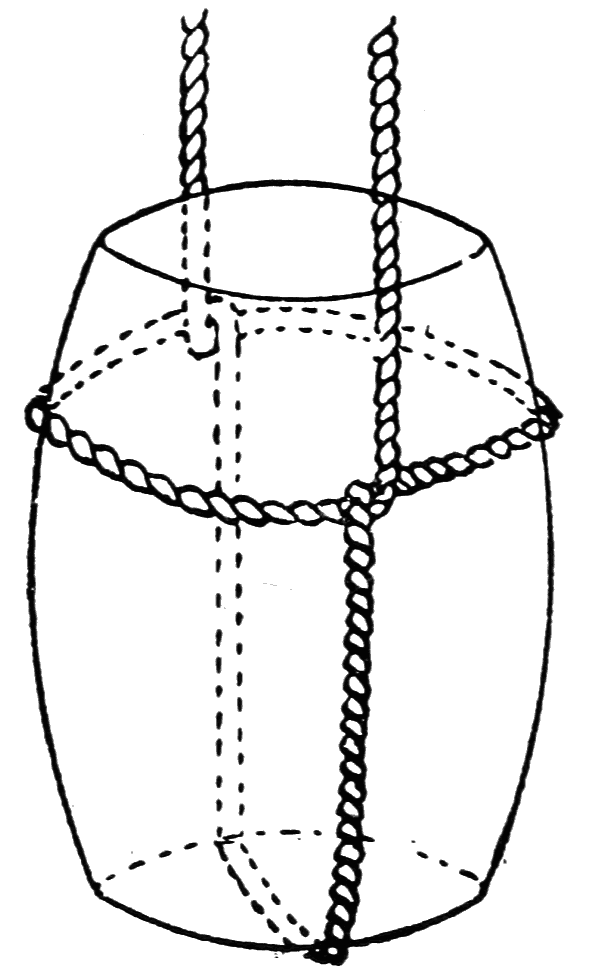
SLING A CASK ON END
A Stropper is used for securing a rope while it is being belayed. Take the stropper in the left hand, make a half hitch against the lay, dog the end with the lay of the rope and seize it. With left-handed rope the end of the stropper should be passed under the rope from left to right. To put a strop on a hemp rope, center the bight of the strop and place it over the rope, then dog the ends opposite ways under and over, and hook on the tackle to both bights.
To put a strop on a Spar use the ordinary bale sling strop.
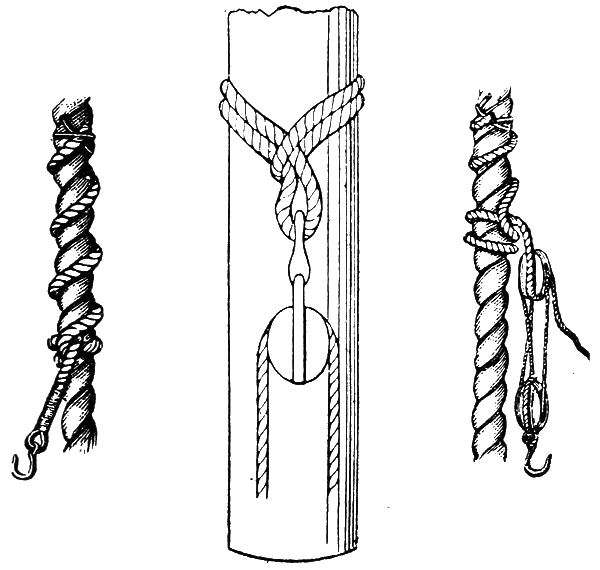
TO PAN A STROPPER TO PUT A STROP ON A SPAR TAIL JIGGER
A Tail Jigger is similar to a stropper but with an additional turn. To put on a tail jigger take the first two parts of a rolling hitch, dog the end with the lay and seize it.