SPLICING AND ROPE WORK
Reading edition
It is sometimes necessary to unite hawsers, cables and even ropes in such a manner that there is no obvious difference in their diameter and no substantial weakening of their strength. This can be done only by splicing, that is, putting the ends together by opening the strands and placing them into one another, or if equal diameter is not essential by putting strands of the end of a rope between those of a bight. When ropes are knotted they cannot be run through a block. In driving ropes, too, knotting is out of the question. It is calculated that a splice will weaken the strength of a rope about one-eighth.
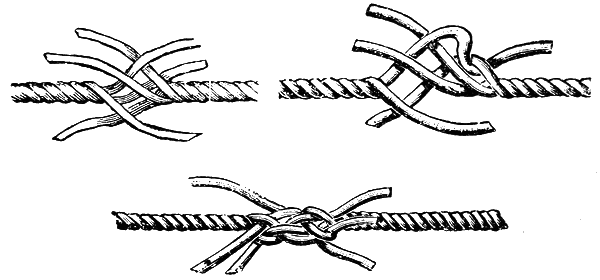
SHORT SPLICE
A short splice is used for joining any rope not needed to travel through a block.
To make a short splice unlay the rope to the required length which is twice the circumference of the rope for the long ends and one and a half times the circumference for the short ends. When this is done whip all the ends with yarn. The ends are then placed together as shown in the first diagram, the strands of one rope alternately between the strands of the other. The two ropes are then jammed closely together. The end of one rope with the strands of the other rope are now held firmly in the left hand. Sometimes it is better to put a lashing round the strands to keep them down to the rope on which they lie. The long ends are tucked in twice and the short ends once. Pass the left hand over the first strand next to it and underneath the second strand. Haul it taut in the lay of the rope. Then enter the right-hand strand and lastly the middle strand in a similar manner to the first or left-hand strand. Haul them taut along the lay of the rope. Put the long ends in again as before, cut the stop off the fork and put the short ends in once in a similar way. Stretch the splice, whip the ends and cut them off. If it is intended to serve over the splice, put the strands in once and a half each way, take a few of the underneath yarns from each strand to fill up the lay of the rope for worming, scrape the ends and marl them down ready for serving.
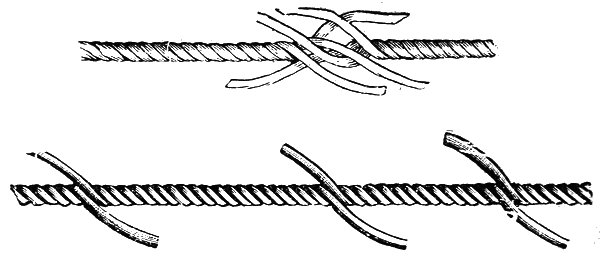
LONG SPLICE
The Long Splice has many advantages over the short one. To make it unlay the ends of two ropes to the length of five and a half times the circumference of the rope. Crutch them together as for the short splice. Unlay one strand and fill up the vacant space which it leaves with the opposite strand next to it. Then turn the rope round and lay hold of the two next strands that will come opposite their respective lays. Unlay one filling up the vacant space, as before, with the other. Take one-third out of each strand, knot the opposite strands together and heave them well in place. Stick all six ends once under one strand. Having stretched the splice well cut off the ends.
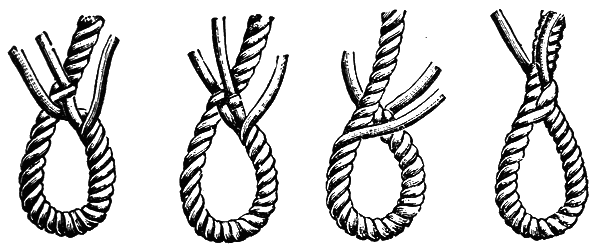
EYE SPLICE
An Eye Splice is used by seafarers to splice round a block, dead-eye or thimble and is formed by unlaying the end of a rope for a short distance and then laying three strands upon the standing part so as to form an eye. Put one end in the strand next to it in the same manner as for the short splice. Then put the next end over that strand and through the second and put the remaining end through the third strand on the other side of the rope. Taper them, divide the strands and put them in again. To finish off split the strands and take half of each, seizing them together, and cut the ends off. When serving is used the strands should be tapered off.
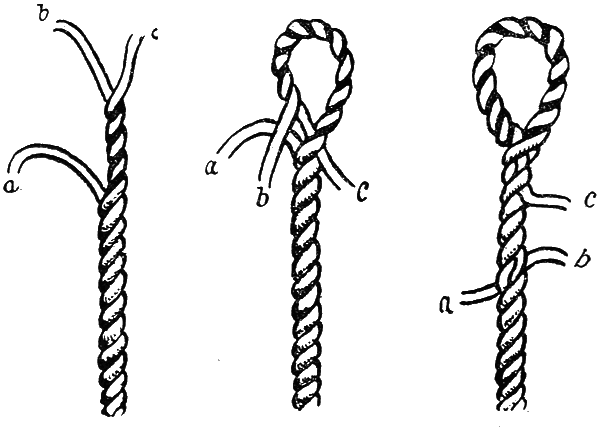
CHAIN SPLICE
A Chain Splice is used for splicing hemp tails into chain when required to travel through a block or fairlead, such as earrings and outhauls for forecastle and quarterdeck awnings. To make a chain splice unlay strands rather more than for an eye splice, then unlay the strand, A, for a few inches. Reeve the two remaining strands, B and C, through the link in the end of the chain; continue unlaying the strand, A, and lay up strand, B, in its place for about a foot, then half knot it and tuck as for a long splice. Then tuck the strand C as for an eye splice.
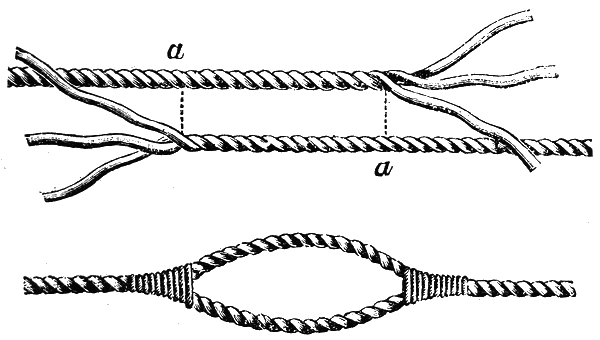
CUT SPLICE
A Cut Splice is made by laying two ropes in the position indicated in the upper diagram. Leaving the ropes between A, A, to form an oblong loop, tuck the strands of one rope into the other as done in the eye splice. Splices are often wormed, parcelled and served.
It is rather difficult to force apart the twisted strands of ropes. For this purpose a marlinespike is used for large ropes. This is made of iron, copper or hard wood. Copper is preferable as it does not rust like iron or break like wood. A steel pricker is used for small stuff. For very large ropes a fid, which is a tapered wooden pin usually made of lignum vitæ, is used.
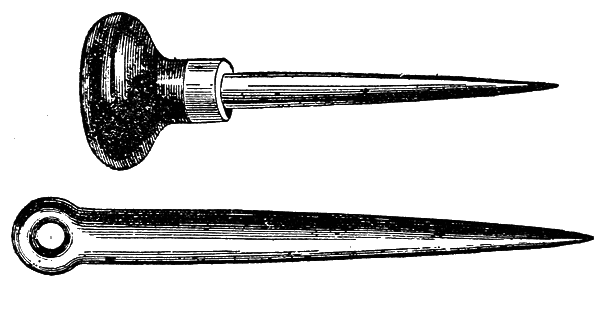
MARLINESPIKE
PRICKER (ABOVE)
A Grommet is a ring of rope. To make it cut a strand about three and one-half times the length of the grommet required. Unlay the rope carefully and keep the turns of the strand in. Close up the strand in the form of a ring as shown in the first diagram and then pass the ends round and round in their original lay until all the intervals are filled up as shown in the second diagram. Then finish off the two ends as in a long splice.
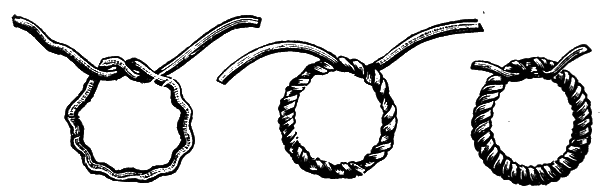
GROMMET
An Artificial Eye is made somewhat like a long splice. Take the end of a rope and unlay one strand; lay the two strands back to the standing part of the rope; pass the strand which has been unlaid over the end and in the intervals round the eye, until it returns down the standing part and lies under the eye with strands. Then divide the strands, taper them down and serve them over with spunyarn.
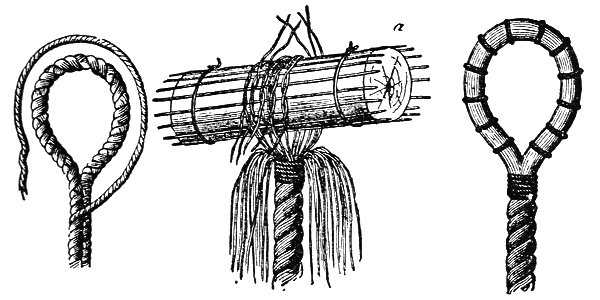
ARTIFICIAL EYE FLEMISH EYE
The Flemish Eye is a little more difficult to make. The rope is first whipped and the strands unlaid to the whipping and opened out, separating each rope yarn. Take a piece of wood the size of the intended eye, A, between and along it lay three or more stops, hitch over the yarns and tie with the overhand knot crossing them somewhat; seize the ends and worm them between the strands at the shoulder. Then marl all down, parcel and serve the ends.
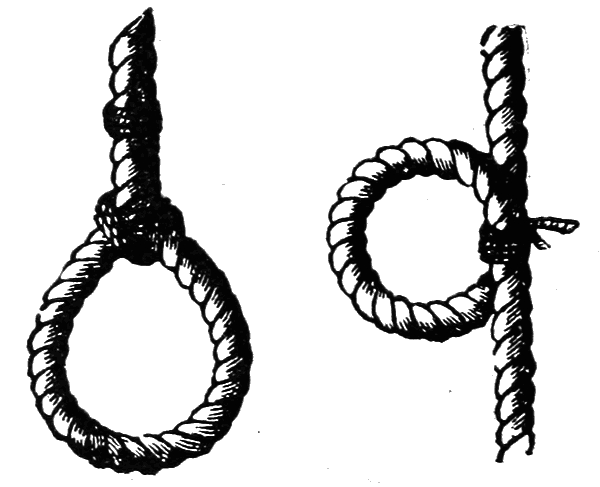
THROAT SEIZING
Throat Seizing is made by opening the end slightly and lashing it to the standing part. The ring shown in the diagram is one of a variety occasionally used. It is useful to pass other ropes through in the rigging. Another ring is formed by lashing the two ends of a short piece of rope to the side of a long one, looping the short piece to give the requisite ring.

SELVAGEE
A Selvagee is used to form a neat stropping for blocks or to go round a spar to which a hook is to be fastened. To make a selvagee strop drive a couple of bolts or large nails into a piece of plank, or any convenient place, or else seize a couple of hooks which will answer the same purpose. Put the nails or hooks at the required distance apart, according to the length of strop needed. Take the end of a ball of rope yarn and make it fast to one of the spikes or hooks. Pass it round the other spike and keep passing roundabout turns, taking care to have every turn well taut until the strop is the required thickness. If it is to be a very large strop marl it down with spunyarn; if a small strop use two-rope yarn.
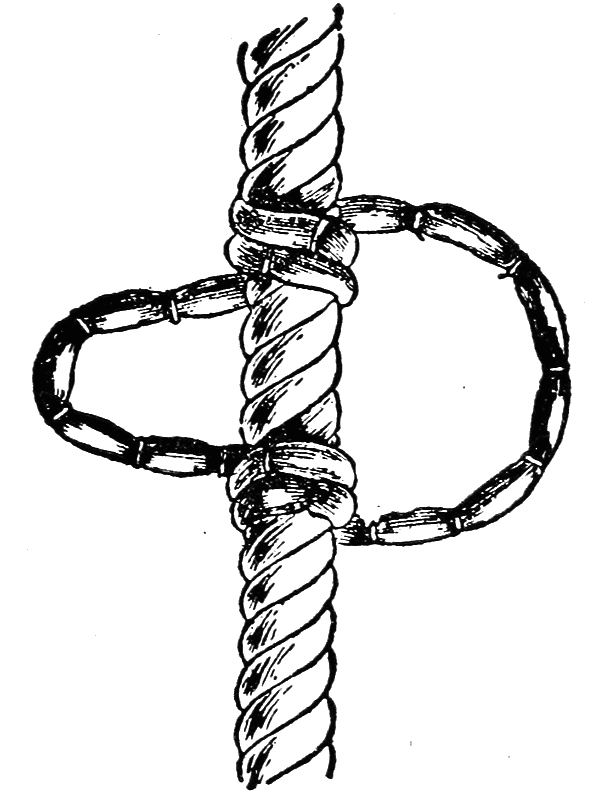
SELVAGEE FASTENING BLOCK TO ROPE
To Lengthen a Rope of a Sail with a Single Strand.—To do this is necessary when a sail is increased by the addition of, say, one cloth. Then the foot rope must be lengthened. Suppose the width of the cloth is 2 feet and the size of the rope 3 inches. After ripping the rope off four cloths, first cut the strand at the distance 2 feet 6 inches from each other, as shown in the diagram below.
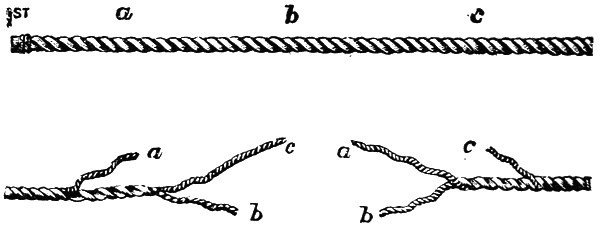
Cut one strand at A and unlay it to C, then cut one of the remaining strands at C and unlay it to B, laying the strand A up again as far as B. Then cut the remaining strand at B, which will be the center, and the rope will be in two parts, as seen in the diagram above.
Now marry the long end A to the end B, then lay up the long strand A and marry it to the other strand B, as in the diagram below.
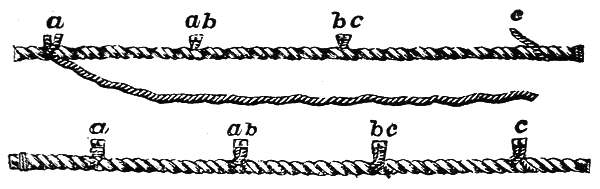
Take a strand about 10 feet in length of the same size rope and marry one end to the short strand A, as shown in the diagram. Fill up the space left from A to C by laying in the new strand and marry the other end to the short strand C. There will then be four splices to finish off as ordinary long splices.
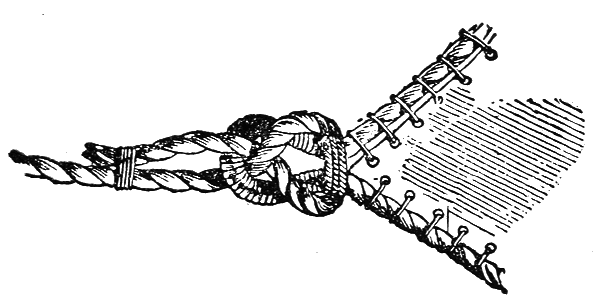
BENDING SHEET TO CLEW OF SAIL
A rope is wormed, parcelled or served to preserve it from wet or chafe.
Worming is done to fill up the space between the strands of the rope with spunyarn or small rope, to render the surface smooth and round for parcelling and serving.
Parcelling a rope is laying round it with the lay of the rope strips of clad canvas, tarred, from 2 to 3 inches wide according to the size of the rope, before serving it, the upper turn of the parcelling overlapping the upper edge of the turn below it.
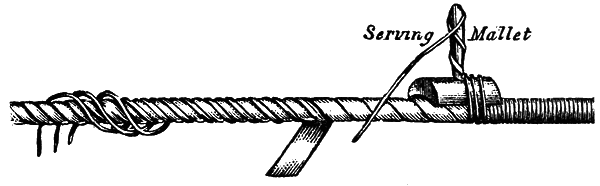
WORMING PARCELLING SERVING
Serving is covering the rope with coils of spunyarn or other small stuff laid on quite close. The spunyarn is put, or, hove on by a serving mallet which has a score in the underpart according to the size of the rope. Service is always laid on against the lay of the rope. The sailor’s adage says:
Worm and parcel with the lay. And serve the rope the other way.
The end of the yarn is first secured by placing it under the first two or three coils. The serving mallet after being placed against the rope has two or three turns passed round its body and another turn or two on the handle. This enables the coils to be pulled taut as the mallet is worked round the rope by its handle. An extra man is needed for passing the ball of serving stuff. When the required length of service is put on, the end is put under the last two turns, hauled taut and cut off.
To make a cringle unlay a single strand from the rope the size the cringle is required to be. Whip both ends, reeve the strand through the left-hand eyelet-hole in the sail, keeping one end nearly a third longer than the other, keeping the roping of the sail toward you. If a thimble is to be put in the cringle, lay up the two parts of the strand together, counting three lays. Commence with the short end of the strands toward you, through the right-hand eyelet-hole, taking it through the cringle and it will be in right position to lay up in the vacant space left in the cringle. When done the one end will hand down inside the right-hand eyelet-hole and the other end outside the left-hand one. The ends are then hitched by being rove through their respective eyelet-holes and passed over the leech rope and under their own part, one hitch being towards you and the other from you. Then take the ends down under one strand on the right and two on the left of the cringle nearest to it. Tuck the ends under the first two strands nearest the hitch leaving them well in place. The cringle is then fidded out and the thimble is put in on the forward of the sail. The ends of the strands are then tucked back left-handed, under one strand, again under two right-handed as in the first place. Heave them taut in place at each tuck, whip the ends with two of their own yarns and cut off. If a large cringle is needed count an extra number of lays, 5, 7, 9, etc., always an odd number.
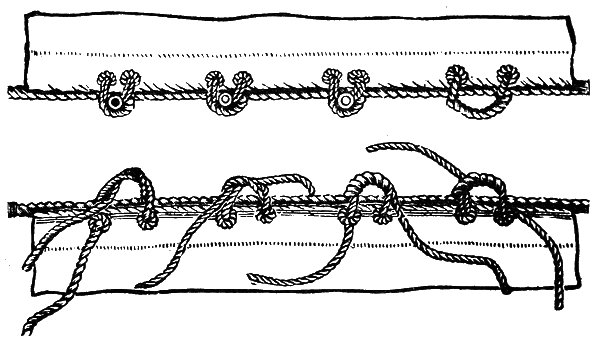
A CRINGLE
To finish a cringle off on a crown commence as already told. After laying up the strand together instead of forming a hitch with each end, the ends are rove through their respective eyelet-holes and tucked back under two strands of the cringle and again laid up as far as the crown forming a four-stranded cringle. It is finished off by tucking the ends under two strands and crossing them under the crown of the cringle and cut off close.
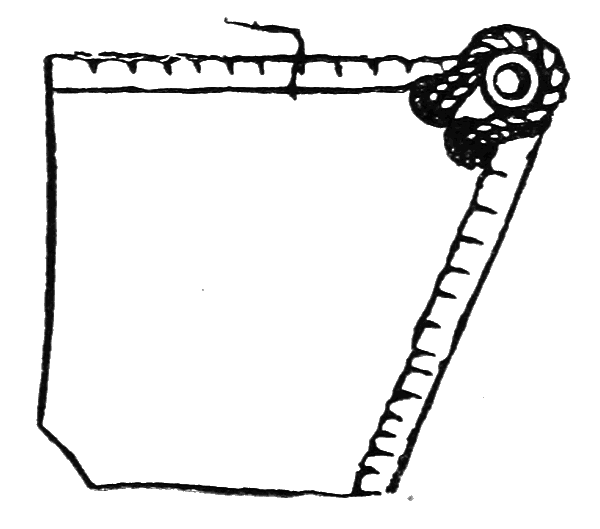
CRINGLE ON A CROWN