CORDAGE
Reading edition
Rope is a word that is taken to mean almost every pliable material. Technically a rope is a cord one inch or more in diameter. It is generally made of hemp, manila, coir, cotton, steel, iron or copper wire. In studying the nature and uses of knots, particularly those which come under the designation of splices, some knowledge of the mode and of the principles on which ropes are made, is essentially necessary. The simplest and most effectual mode of obtaining the united strength of fibres composing the rope would be to lay them side by side and fasten them together at each end as in the selvagee, which is described on page 120. This plan, even if the fibres of hemp were of the necessary length, would be open to many objections; hence it was necessary to devise some plan which would give unlimited length to the rope and at the same time preserve its torsion and portability. This has been achieved by the compression and twisting of the fibres in different directions, until they produce a compact, hard and strong rope, neither breaking the fibres on the one hand nor leaving them so loose as to be easily drawn out from the mass on the other—either extreme would be equally fatal in its results and injurious to the stability of the rope. This is achieved by the modern processes of rope making.
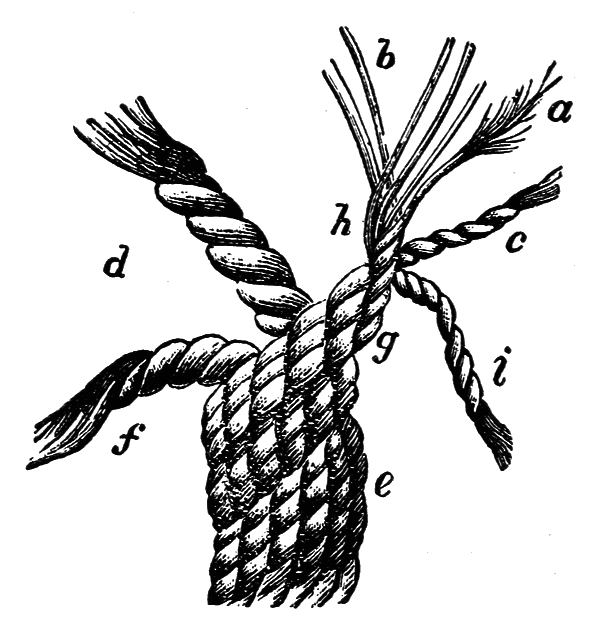
FIBRES TO CABLE
First the fibres of hemp are loosely twisted together, right-handed, and form what is technically known as yarn. Two or three yarns twisted together form a strand; three strands form a rope and three ropes a cable. The diagram illustrates this clearly. A is a yarn teased out to show the original fibre; B shows the yarn forming the strand; the strands C, H, and J form the rope D; the ropes D, F, and G form the cable E.
A hawser rope is composed of three strands laid up generally right-handed—that is, the direction taken by the strands in forming the rope always runs from left to right.
A shroud-laid rope, also laid right-handed, consists of four strands with a heart in the center.
A cable-laid rope is composed of three right-handed hawser-laid ropes laid up together left-handed, so that it may be said to consist of nine strands, or it may be formed by three left-handed ropes laid up right-handed.
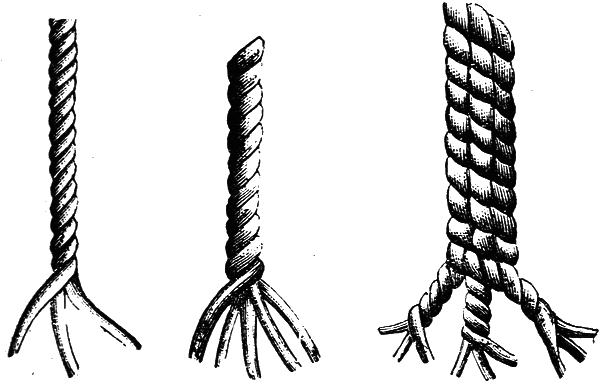
HAWSER ROPE SHROUD-LAID ROPE CABLE-LAID ROPE
Spun yarn is a number of yarns twisted up right-handed. The number varies from two to eight.
Nettle stuff is made of two or three yarns laid together and is used for making clews of hammocks, harbor gaskets, etc.
Sennit is made of a number of yarns plaited up into square, round or flat sennit as required and used for various purposes.
Junk consists of lengths of condemned cordage 4 inches and above.
Oakum is old rope unlaid and the yarns picked into hemp for caulking the seams in ships’ decks or sides.
Boltrope is cordage tarred and white, made of Italian hemp from ½ inch to 6 inches. It is soft laid and well stretched and is used for roping sails and awnings.
Hammock lashings and lanyards are of white Italian hemp 1¼ inch.
Coir rope is three-stranded right-handed rope. The yarn is spun from the fibres of the cocoanut tree. It is one-third lighter than hemp but not nearly so durable. It soon rots after being wet, if not well dried before being stowed away. As it floats so light it is very useful for warps and is about a quarter the strength of hemp rope.
Twine is made from very fine hemp.