MATTING
Reading edition
A Paunch Mat is used as a protection from chafe on shipboard. Stretch a piece of rope according to the size of the mat required in a horizontal position and fasten each end. Across this hanging by their middles, foxes are placed. Foxes are two or more rope yarns twisted together by hand and each rubbed down with tarred canvas or a handful of rope yarn. Beginning with the fox nearest the left hand twist a turn in the two parts and give one part to the man opposite. The next fox has a turn twisted in its two parts and one part is given to the opposite man. The other part is twisted round the first which is given to the partner and then again round its own part with the other foxes until the required breadth is reached. Then as no more foxes are added and the outside on the right is brought over from time to time, a selvage is formed as on the left side. There is a little difficulty in starting but afterwards all will go along very easily. Each fox from the right passes over the next one to it on the left and is pushed back. The one that has been passed over being taken up first over the next and pushed back as before. Each twist should be pressed tight as it is made. When the mat is deep enough a selvage is made by straining another piece of cord along the bottom securing both ends. As each fox comes down it is half hitched to this and the next fox is laid at the back of it and so on alternately.
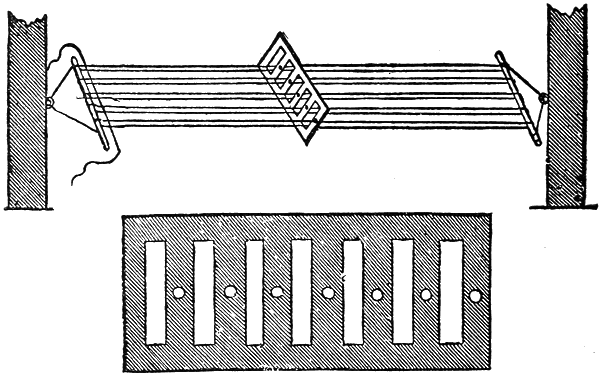
SWORD MATTING WARP AND LOOM
Sword Matting is used for boats, gripes, etc. Two iron bars are slung in a horizontal position at the required distance apart for warping the mat off. Hitch one end of the warp which is of spunyarn to the bar at the end of which it is intended to finish the mat. The other end is then rove through the first hole in the loom over and under the other bar back through the first slit, over and under the other bar and so on until as many parts as are required for the breadth needed have been laid out. The last end is rove through a slit and secured to the bar at the end the mat is to be finished. When this is done lift the loom up, middle the fittings and lay it between the upper and lower parts. Then lower the loom and the parts that were lowest will rise in the slits and become the uppermost and thus put a cross in the warp.
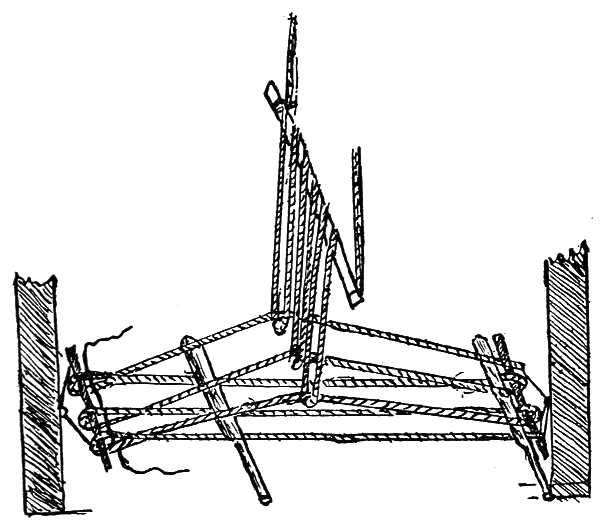
SWORD MATTING
A piece of wood made in the shape of a knife, called a sword, is then inserted between the alternate parts of the warp and the crossing is driven close to the head against the bar over which the warp for weaving the mat is passed. Then turn of filling is passed to secure the crossing, reeving the ends through contraryways. Haul it taut, take out the sword, lift up the loom and continue to pass the filling. Half knot it with two turns. To finish off splice the mat. The loom is usually made of a piece of copper sheet with alternate holes and slits in it.
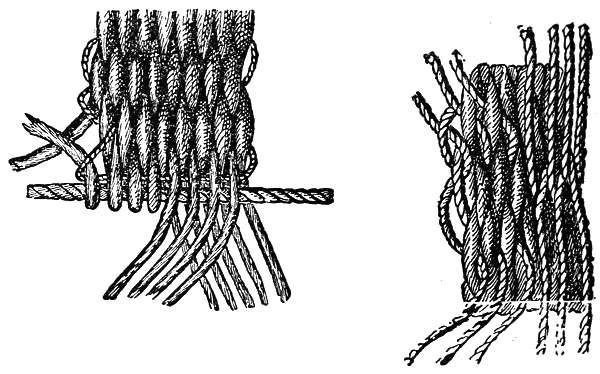
SPLICING A SWORD MAT
To Splice a Sword Mat unlay 6 or 7 inches of the mat, open the ends out, marry them together laying one up and one down flat along the mat. Withdraw the nettles on one side of one mat and point the nettles of the other mat through the holes they will come out of. All ends will then disappear from that side and there will be four rows of ends on the other. Turn the mats over, pick out the proper nettles of the side which have been married together, withdraw the ends belonging to one mat and introduce the corresponding ends of the other mat through the holes. Perform this operation on each mat and on each side there will be two rows of ends. Marry these ends together on each side laying one up and one down and go on splicing by withdrawing and reeving for two or three rows more in each mat. Leave off with the ends all out on the same side and finish off as with selvaging.
A cobbler’s stitch is used for joining the sides of sword mats together. Take a filling of roping twine, middle it and reeve each end through two bights in each mat (if a heavy mat through three bights at each side). Then reeve the lowermost end back through the same bights as the upper end which will bring the ends out at opposite sides. Draw the mats together and reeve both ends through two turns in each mat again, passing each other through the same hole opposite ways. Keep on doing this like stitching the sole of a shoe, hence the reason for calling it a cobbler’s stitch. Finish off each end by taking a hitch through a bight in the mat of the next lay above and cut off the ends.
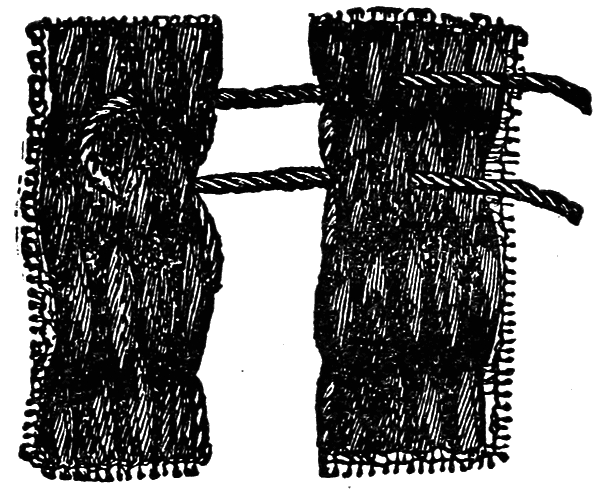
A THRUM MAT
A Thrum Mat is made of canvas and short yarns of equal length. These yarns are rove through holes stabbed in the canvas, both ends of the yarns being on the same side.
A Common Sennit is made by taking three or four nettles according to the need required. Middle them over a belaying pin and plait three or four together the length it is intended to make the eye. Then work both parts together to form an eye and plait them by bringing the outside nettles on each side alternately over to the middle. The outside one is laid with the right hand and the remainder held firmly with the left hand. Work the whole together adding a nettle when necessary. After the eye is properly formed drop a yarn and continue to the end with an odd number. When it is of sufficient length lessen it by dropping a nettle at regular intervals. To finish it lay one end up, leaving its bight down and plait the other ends through this bight until they are all worked through it. Then haul on the end till the bight is taut. To secure all parts cut off the ends and whip it.
SQUARE SENNIT ROUND FENDER
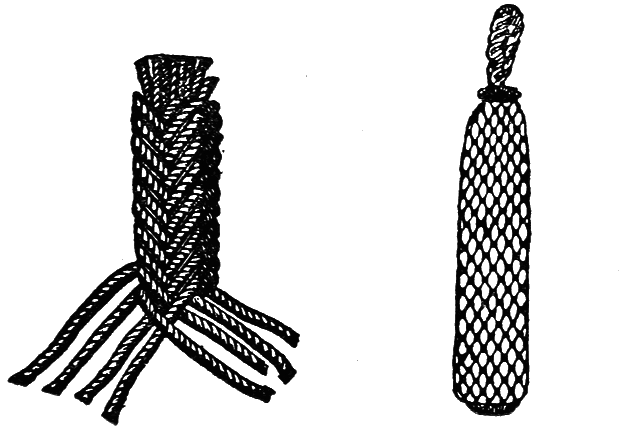
A Square Sennit is made somewhat in the same manner as the round sennit but without a heart. Nettles are used in the same ratio increasing by fours. Having put a whipping round the (eight) ends divide the nettles, and lay half on each side. Bring the uppermost left-handed nettle round underneath all and up inside two and over two of the right-handed ones. Cross over the latter ones to the left and make four on each side again. Then take the uppermost to the right-handed nettles, pass it underneath and under two and over two of the left-handed ones, still keeping four on a side, because the nettle taken up always comes round to its own side again. To proceed take the upper nettle on each side alternately and finish off as the round sennit is finished.
A FENDER
A Fender is used to protect the sides of a boat. Sometimes it is made of wood but more often is of canvas stuffed with oakum and painted.
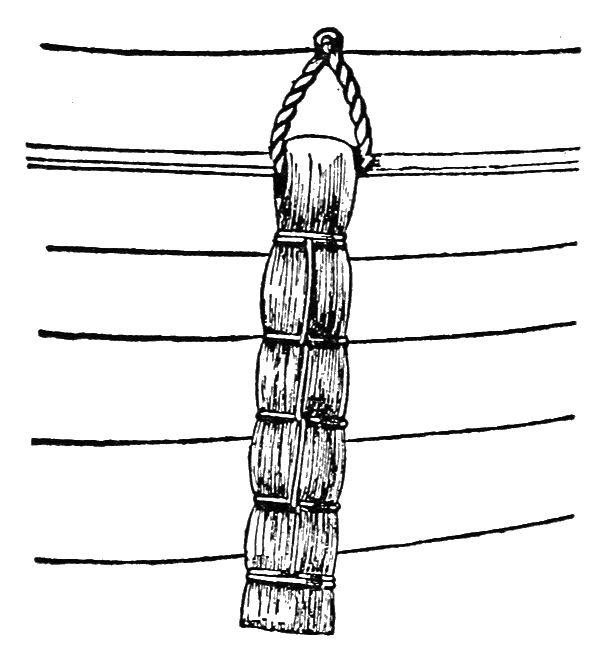
To make a soft fender take a piece of Manilla rope double the length of the fender. Unlay it, open the strands and comb them until all the yarns lie straight. Double it and clap an eye-seizing on it, marling it down as shown in the diagram. A lanyard of small cords, such as log-line, is then spliced into the eye.
A Round or Pudding Fender is made of a center or heart of rope yarn worked over a grafted with short pieces of rope yarn nettles. The nettles are first cut to the proper length and the middle part slightly twisted. They are then brought snugly round a thimble and a seizing put on. The heart or pudding may be of any old stuff such as old strands, spunyarn, etc. This is put into its place and the nettles laid evenly over it. Half the nettles taken alternately are turned back over the eye and the other left lying down the heart. Pass a turn or two of twine or marline called the warp or filling round the fender where the nettles separate and hitch it. The nettles turned back must now be brought down and those that are down turned over the eye. The warp is now passed again and hitched as before. This must be repeated until the whole of the fender is covered with a woven coat as shown in the diagram. The ends of the nettles are brought round last turn of the warp and interlaced in the grafting.
SIMPLE WEAVING
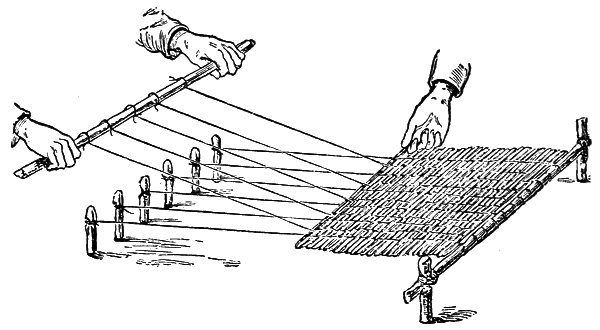
A simple weaving apparatus is shown in the diagram by which mats may easily be made. Take two pegs about 15 to 18 inches long, and drive them into the ground or attach them to a board so as to be firm.
These should stand about a foot out of the ground. Then take a stick or a piece of wood and lash it across the upright stakes. Next drive a row of pegs into the ground. These pegs should be at equal distances apart, not to exceed 6 inches, and parallel with the lashed stick. Two sets of strings are then tied to the cross stick. The ends of one set are fastened to the sticks and the ends of the other set to a staff held in the hands, as shown in the diagram. If there are a dozen strings, then the odd numbered should be fastened to the sticks and the even numbered to the staff. By alternately raising and depressing the staff, placing a handful of straw or rushes between the strings at each movement and making them lie close, a good mat is made. These mats may be joined together with the cobbler’s stitch or by tying the string ends together.
MALAY HITCH
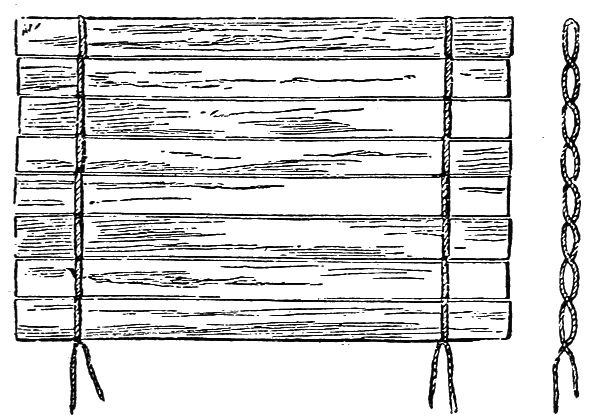
The Malay Hitch is a name given by Captain Galton, a noted traveler, to a method for fastening boards or planks together to make a shelter. The cord is twisted once and then as each board is inserted this twist holds them sufficiently tight for temporary purposes.