SIMPLE KNOTS AND LOOPS
Reading edition
All knots are begun with loops or hitches. These may be single or double as required. The simple hitch is self-explanatory, as are the underhand and the overhand loops. The illustrations explain them clearly.
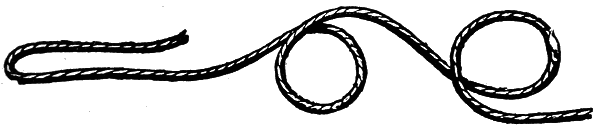
SIMPLE HITCH UNDERHAND LOOP OVERHAND LOOP
The Simple Knot begins with one of these loops by passing the loose end through the loop and then drawing it taut as shown in the diagram.

SIMPLE KNOT FIGURE OF 8 KNOT
The Figure of 8 Knot is known as the perfect knot. It is formed by an overhand and an underhand loop overlapping each other and the loose end passed through the loop. When drawn tight it bears a close resemblance to the Arabic numeral 8, hence its name.
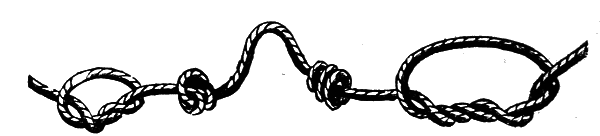
DOUBLE KNOT NIPPED TREBLE KNOT OPEN
The Double, Treble, Four-Fold, or Six-Fold Knots may be called compound knots. They are used often when it is necessary to shorten a rope a few inches or to increase the size or strength of a holding knot to prevent it passing through an eye or a block. These knots are made by passing the end of a rope twice, three times, or as many times as may be necessary, through a loop as shown in the Simple Knot. The diagrams show a double knot loosely formed and when nipped or drawn taut, and a treble knot in its open formation and pulled taut.
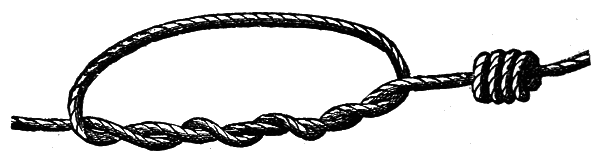
FIVE-FOLD KNOT OPEN NIPPED
The Five and Six-Fold Knots present handsome coils and are useful to travelers who do not wish to cut the precious cords of their baggage.
From Simple knots the student passes to loops, nooses and running knots. The Bight of a rope is the loop formed when a rope is bent back on itself. The Standing Part is the principal portion or longest part of the rope and the end is that part used in forming the knot or hitch.
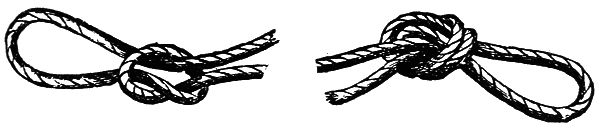
SIMPLE RUNNING KNOT LOOP KNOT
The Simple Running Knot is made by passing a hitch instead of the end of a rope when making a simple knot. The variations of this knot are numerous. When the loose end is knotted with a simple perfect or double knot it forms one of the most useful and easily made loops.
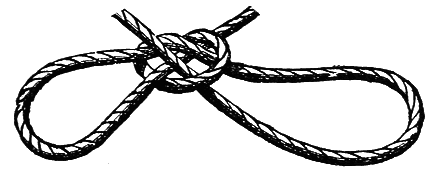
TOMFOOL KNOT
The Tomfool Knot is a double loop through a simple knot. This knot is also known as the Single Pitcher Knot. It is said that this knot has baffled many experts who profess to be able to break any knot. It is made like the running knot. The firm end is then passed through the open, simple knot so as to form a double loop or bow. If the wrists are passed within the loops, the loops then drawn taut and the loose ends tied firmly around the central part a pair of very good handcuffs is furnished.
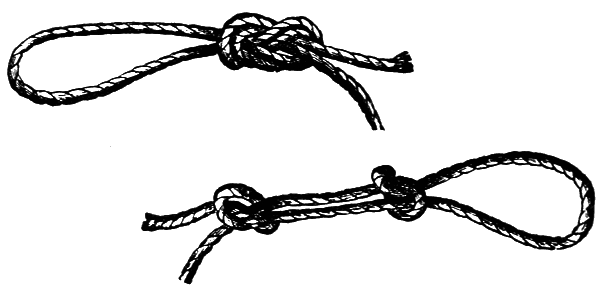
LOOP KNOT FOR LARGE CORDAGE
The Loop Knot is the ordinary useful loop of everyday life and it forms the foundation for many more elaborate knots and for shortenings. A more ornamental and even stronger loop, which is well adapted for large cordage, is made by the figure 8 knot. This loop, like the common loop knot, when once made and has been subjected to a lengthened strain, is very difficult to untie. In this case there is nothing better than a running knot with a check knot, which is a modification of the fisherman’s knot. A simple knot is tied over the running line as shown in the figure. After use it may be easily drawn apart, the loop slipped and the knot untied in very short time.
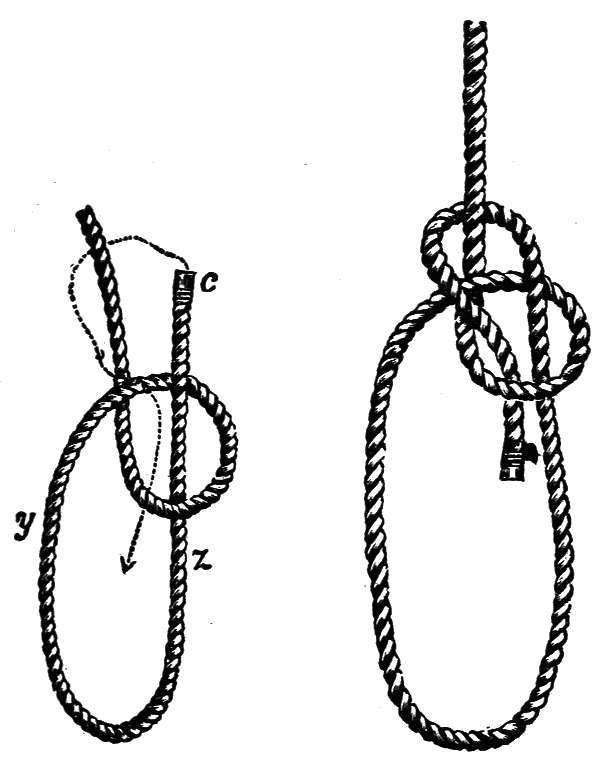
BOWLINE KNOT
The Bowline Knot cannot slip and is therefore always used for slinging a man for the purpose of doing some particular piece of work; the workman sits in the sling. First take the part Z in the right hand with Y in the left hand, place Z on Y, and, turning the left hand over from you to the left, form a loop and reeve C as shown by the dotted line and haul taut.
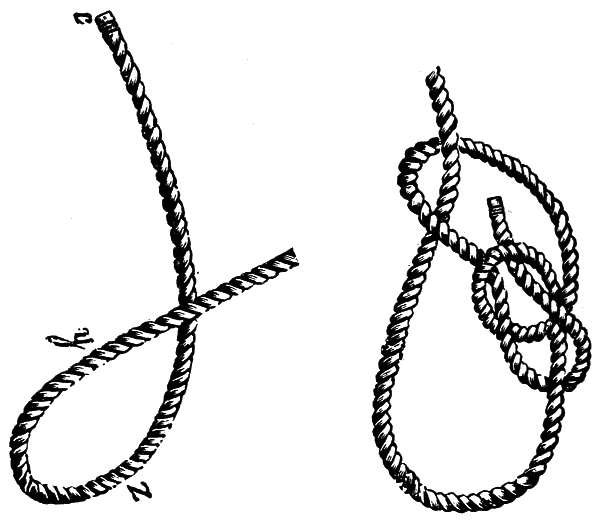
FIG. 1 FIG. 2
RUNNING BOWLINE KNOT
The Running Bowline is used whenever a running noose is required. Form a loop with a long end C lying underneath the standing part as shown in Fig. 1. Now bring end C over part Y and with it form the bowline knot on part Z as in the previous case it was formed on its own part, when it will appear as in Fig. 2.
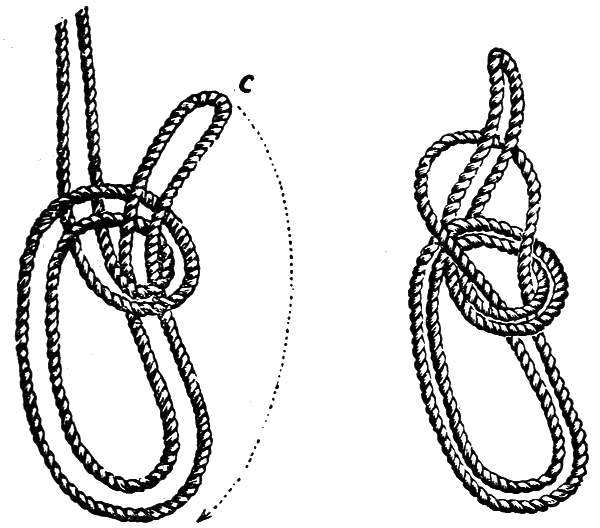
FIG. 1 FIG. 2
BOWLINE ON THE BIGHT
The Bowline on the Bight is used for lowering a man from aloft or slinging a man over the ship’s side. Using both parts of the rope together, commence as in making an ordinary bowline. To finish off, open out bight C, taking it in the direction indicated by the dotted line, pass the whole knot through it and haul taut when it will appear as in Fig. 2.
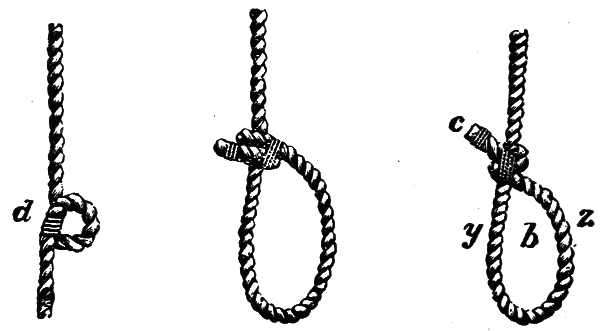
A Simple Clinch is formed by closing up the initial loop to form a small ring and securing, by a seizing, a small lashing at D.
SIMPLE CLINCH RUNNING OR INSIDE CLINCH OUTSIDE CLINCH
A Running or Inside Clinch is formed by the end of a rope on its own standing part and is often used for securing buntlines to the foot of a sail.
An Outside Clinch is formed in a similar way but the end, C, is brought round on top; that is, away from the bight.
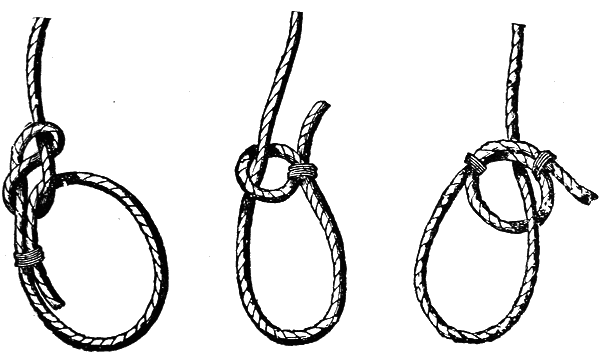
The Standing Bowline Knot is formed by passing the loose end through the lower loop of a figure 8 knot and seizing or tying the end with small cord or marline.
Slip Clinches are very easily made. They are really open running knots seized instead of tied.
STANDING BOWLINE AND SLIP CLINCHES SEIZED
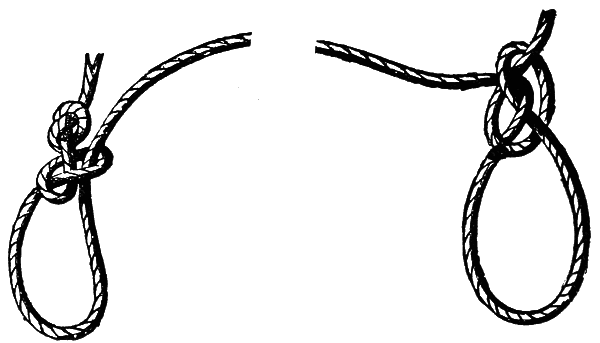
The Running Noose is one of the most common and useful of running knots used in commerce but it is only applicable to small cords. A simple knot is made on the end of the cord which is then simply knotted round.
The Crossed Running Knot is useful in packing heavy goods as well as a useful anchor fastening.
RUNNING NOOSE CROSSED RUNNING KNOT