KNOTS FOR UNITING ROPES
Reading edition
The most common knots, those used in everyday life, are to unite the ends of two separate pieces of cord or rope.
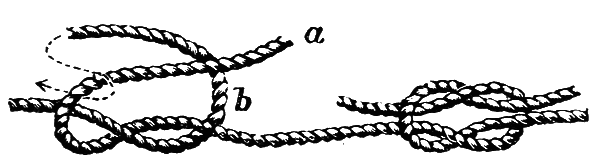
FIG. 1 FIG. 2
REEF KNOT
The Reef Knot is the simplest of all knots and always used when a common tie is required. The two illustrations show how this knot is made. Having constructed the knot as far as Fig. 1, be sure part A is kept in front of part B as shown, and the end led in according to the direction of the dotted line.
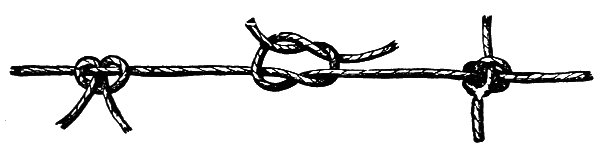
FIG. 1 FIG. 2 FIG. 3
FALSE OR GRANNY KNOT
If the cords be of unequal thickness the knot will slip, form a loop and part company, as shown in Fig. 1 above. If the ends are not parallel to the rope it becomes the False Knot or Granny Knot. Figs. 2 and 3 show the difference.
A better way to fasten two ropes of unequal size is to tie or seize the ends (Fig. 1 below) and when this is done as shown the square knot or reef can be made as usual.
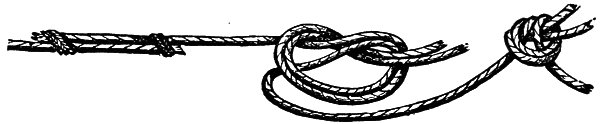
FIG. 1 FIG. 2 FIG. 3 OPEN-HAND KNOT
The Open-Hand Knot is a good one for joining two ropes of unequal diameter. It is very quickly made and has the recommendation of never slipping or untying. If, however, a great strain is put on the rope it is apt to break at the knot. The illustrations above, one showing the open formation (Fig. 2), and the other its back view when drawn taut (Fig. 3), explain the process of making.
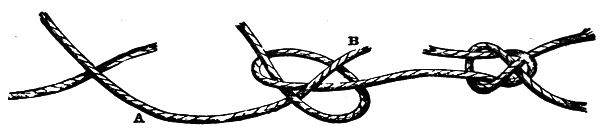
FIG. 1 FIG. 2 FIG. 3
WEAVER’S KNOT
The Weaver’s Knot is very useful in joining small cord or twine and is the best for thread. The ends are crossed as in Fig. 1 and both cords are held between the thumb and forefinger of the left hand. The right end, A, is then looped back over the left end and brought under the thumb, where it is held fast, while the right-hand end, B, is slipped through the loop. The knot (Fig. 3) is then formed by tightening the right-hand cord. If cord thicker than thread is used, the end, B, must be held between the thumb and finger of the left hand while the knot is being drawn taut, as in Fig. 4 (below).

FIG. 4 FIG. 5 FIG. 6
FISHERMAN’S KNOT
The Fisherman’s or Englishman’s Knot is of quite another character. It is formed by two simple knots (Fig. 7) slipped over each cord as in Fig. 5, and when drawn taut its front appearance is seen in Fig. 6. It is used by anglers, as it may be separated by taking the ends A and B in Fig. 6 so as to admit a third line.

FIG. 7 FIG. 8 FIG. 9
ORDINARY KNOT OR TIE
The Ordinary Knot or Tie for uniting large ropes is shown in Fig. 8. It has all the advantages of the open-hand knot, with the additional recommendations that it is easy to make, very strong and does not strain the fibres of the rope. First make the simple knot (Fig. 7) and then interlace the other cord in the manner shown in Fig. 8. When drawn taut it has the appearance of Fig. 9. If the ends are whipped it is really a neat and handsome as well as useful knot.

SHORTENING TIE
The Shortening Tie is used when there is too much rope and where it is necessary to use a large knot for the purpose of preventing its running too far through the eye, ring or loop. It is formed by making the figure of 8 knot at the end of a rope, then interlacing it with another rope, and when drawn taut it has the appearance of the third diagram.
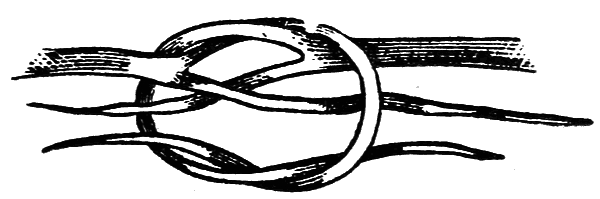
A ROPE YARN KNOT
A Rope Yarn Knot is for joining two yarns together and is clearly shown in the diagram.