Chapter I · JOURNEY FROM DARJILING TO TASHILHUNPO.
Reading edition
I rode on silently, and, to my great relief, unnoticed by any one, save one or two Bhutias on their way towards Darjiling, and in the stillness of the night we could hear the songs of the workwomen of Takvar and the music of their pipes and drums. Coming to the river, which was rather broad at this season of the year, I met lama Ugyen-gyatso, who was waiting to help me across. Three or four bamboos loosely laid over the main stream enabled us to cross, though with some difficulty, and with the help of an intelligent Bhutia attendant I was able to push on over the narrow slippery path till half-past one, when I reached Gok, now a deserted village, where, in place of the dozen shops and pretty Buddhist shrine which formerly marked the place, I found but a cow-shed where a Nepali was snoring fast asleep. It was here that the up-country grain-sellers used to come to buy large quantities of Indian corn and cardamom seed to resell in the Darjiling bazar.
Spreading our rugs in the long grass near the cow-shed, we tried to rest for a while; but what with the unevenness of the ground, insects creeping over me, the prickly points of brambles and weeds penetrating the thin rug on which I lay, and a shower of rain which wetted us through, we could get no sleep, so we started again at four in the morning. The path, hardly a foot broad, was choked with weeds and long grass. Lighting my lantern, I followed Phurchung, my shot-gun tied across the top of the load he carried, and with many a slip and tumble we reached the valley of the Rummam at daybreak.
Crossing the range we entered a richer country, as was evidenced by the vegetation and the abundance of trees. We saw long canes growing luxuriantly, and there was quite a large grove of plantation trees, showing the warm climate the country enjoys.
November 10.—The sky was cloudy and the atmosphere filled with fog when we set out. Along the banks of the streams we had to cross grew tall pines and giant ferns, while thick brushwood, ferns and rattans lined the banks, the water dashing down from the hill-tops in cascades. Pushing our way through the dense forests of the Hi range, the sky scarcely visible through the lofty oaks, pines and magnolias, we reached after an hour’s hard ascent the Rishi chorten, near which is a moss-covered mendong. The Hi La commences here, and from it one commands an excellent view of South-Western Sikkim, including Tonglo and Singli, and the hills of Darjiling. In the thickets roundabout were to be seen the tracks of wild pigs, and the woods were alive with monkeys which feed on acorns.
The Kalai is overhung on both sides by lofty trees growing on steep banks apparently inaccessible when looked at from the river bank. The river is bridged by two long, stout bamboos resting on a huge boulder in the middle of the stream, and weighted down with slabs of stone.
The Phedangba enjoy the privilege of conducting the religious ceremonies, and of dealing in omens and fortune-telling. The Bijua are trained to the Shamanic worship, of which fantastic dances are the characteristic feature. The third order practice witchcraft exclusively, and are said to be able to expel evil spirits through the mouth. The fourth class, called Baidang, are physicians, the name Baidang being undoubtedly derived from the Sanskrit Baidya. The fifth, which is the most important of the five orders, has the exclusive privilege of interpreting the religious books, and of studying religious observances and rites. My informant, though a Srijanga, combined in his person the qualifications of the other four orders; hence his great reputation among the Limbus, who considered him endowed with divine attributes.
November 12.—We continued to ascend by a hardly discernible trail, passing patches of Indian corn and a few miserable Limbu houses: one woman we saw was carrying a basketful of wild apricots. At 2 p.m. we reached the top of the ridge, on the furthest extremity of which to our right was the Sangnag Choiling (pronounced Changachelling) monastery, while near the path we were following was an old moss-covered chorten.
November 13.—Our way led us through the village of Tale to the Ringbi river, a stream as rapid as the Kalai. There is a strong bamboo bridge over it, but we crossed by some bamboos laid side by side where the river was narrowest. To the north-west of the village, on a parallel ridge trending northward from the same range of hills, is the village of Nambura. We followed the stream up for 5 miles by a circuitous trail, and then crossed over again to the right bank, a little below Nambura. The path led along the side of a cliff, and we had great difficulty in making our way along its slippery side, placing our feet in fissures of rocks and holding fast by creepers and grass. Then, following the course of the river, we ascended towards the village of Ringbi, and looking back we saw Tale, Nambura, and many other villages perched high up on the mountain sides several thousand feet above us.
Passing under a huge rock, below which the stream had cut gullies, we crossed over by means of bamboos and wooden ladders. Looking up once I saw some stuffed pheasants and a Tibetan shirt of red cloth hidden in a fissure of the rock, evidently by some bird-shikaris. Birds of various hues, especially several varieties of pheasants, abound in these woods, which are frequented by shikaris who earn a livelihood by selling stuffed birds at Darjiling.
As soon as Phurchung had laid his load on the ground, he ran off to the house of an acquaintance to buy for me some bottles of beer, and presently returned with three, of which he well knew one would be given him. Our tent was pitched on the flat near the river, and my rugs being spread, I stretched myself at my ease, forgetting the fatigues of the journey. The servants had dispersed, some to collect firewood, some to pick edible wild plants, others to buy vegetables for our evening meal—nothing broke the silence save the sound of the rushing torrent below. I slept soundly, my mind more occupied with the future than the past.
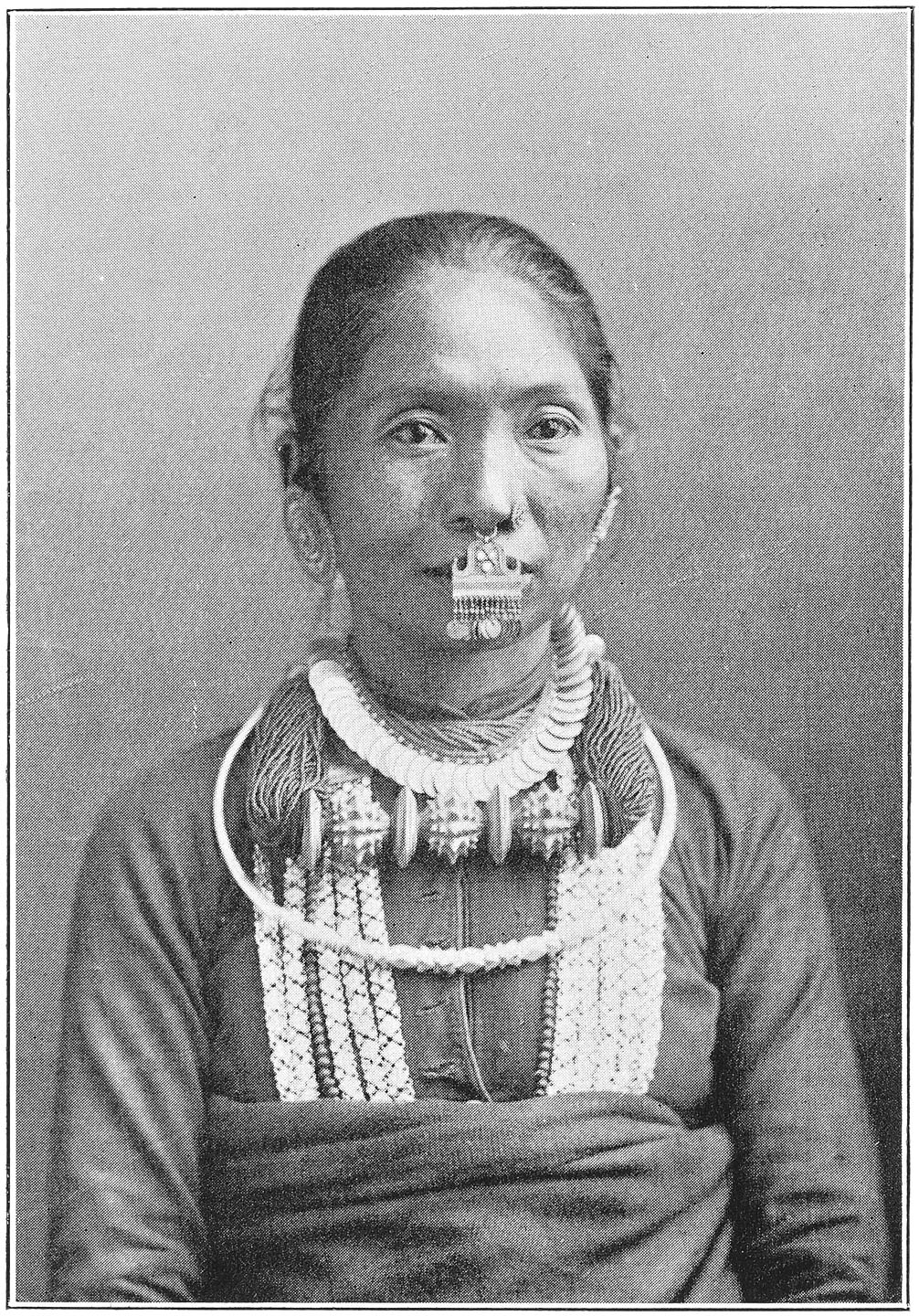
A KIRATI WOMAN OF THE LIMBU TRIBE.
November 14.—The morning was clear, the view on all sides superb, and, though familiar with mountain scenery, my eye never tired of its wild grandeur. We waited and waited for hours for Phurchung, whom I had sent to Nambura to buy provisions; but, as he had not appeared by noon, we had to give up all thoughts of travelling that day. In the afternoon he made his appearance, loaded with rice, maize, murwa, eggs, vegetables, etc., and leading a ewe, which he said had cost him Rs. 4. He was very drunk, but conscious of his condition. He begged to be excused, and, after numerous salams and lollings of the tongue after the Tibetan fashion, he vanished from our sight.
Phurchung much regretted that one of his best friends among the Limbus of this place had gone to a distant village to attend a marriage, for he might have rendered great assistance in many ways.
The marriage customs of this people are very curious and interesting. Some among them at the time of marriage consult astrologers. When a man and a girl think of marrying, they meet, without consulting their parents, at some place—a market, if there be one near—in order to sing witty songs, in which test the man is required to excel his fair rival. If he is beaten in this contest by the maiden whose hand he covets, he runs away in deep shame at his defeat; but if he wins, he seizes her by the hand and takes her to his home without further ceremony, but usually accompanied by a female companion. If the man has had some previous knowledge of the girl’s superior attainment in singing, he sometimes bribes the maiden’s companion to declare him the winner in the singing competition.
Another means of wife-winning is by courting her in the house of her parents, to which free access is readily gained by presenting the girl’s nearest relative living in the house with a pig’s carcass, a present called in their language phudang. When the marriage ceremony takes place, the bridegroom, if rich enough, kills a buffalo or a pig, which is presented to the bride’s parents, a native coin fixed on its forehead. Among the lower people, the parents of the bride seldom know anything about the marriage till the return of the girl from her captor’s house. Then the marriage ceremony takes place. The friends and relatives assemble in some spacious courtyard, each bringing a present of a basket of rice, a bottle of murwa or arrack. The bridegroom then beats a drum, to the music of which the bride dances, outsiders also taking part in the dance. This over, a Phedangba priest conducts certain religious ceremonies beginning with the following mantra: “According to the commands handed down to us from ancient times and the doings of the patriarchs, we bind our son and daughter to-day in marriage.”
As the priest repeats the formula, the bridegroom places his palm on that of the bride, holding at the same time a cock, and she a hen, which they afterwards hand over to the Phedangba. When the above formula has been recited, the fowls’ throats are cut, and they are thrown away for any one to pick up and keep, and the blood is collected on a plantain leaf, and from it omens are drawn. In another leaf is some vermilion paint, in which the bridegroom dips his middle finger, which he passes across the forehead of the priest to the tip of the bride’s nose. The bridegroom then says, “Henceforth, maiden, thou art my wife;” and shouting repeatedly, “Maiden, thou art my wife,” he puts a vermilion mark on her brow.
The following morning the priest invokes some friendly spirit, and says to the newly married couple, “You two should henceforth live as husband and wife as long as you remain on this earth;” to which the parties suitably reply, “We will do as you command.” Unless this period of a lifetime is mentioned, the marriage is held to be unlucky; and to make it fortunate further ceremonies, which open new sources of profit for the priest, are considered necessary.
At the marriage feast, where first murwa is served to each guest, the meat is generally pork, and finally a dish of rice is presented to every one of the party.
This present is known in Limbu as turayimbag, meaning satisfaction to the parents for stealing their daughter; and though it is really due to the bride’s parents, it is nowadays appropriated by the village officials.
November 15.—The villagers tried to dissuade us from attempting to cross the passes where the paths were hidden by the snow, saying that it would be more convenient to stay at Ringbi, where provisions were easily procurable. If I remained here, however, various reports would be spread to prejudice the frontier guards of Tibet against us, and we would, moreover, be unable to ascertain when the snow should have hardened sufficiently to admit of our setting out on our journey, as the passes were three or four days’ march from the village. We determined to try the Yampung la, which still remained free from snow. Our coolies gave the villagers to understand that we shikaris (for Phurchung, with his fowling-piece and load of cartridges, was enabled to pass us off as such) had very little to do with the passes, except for going to Kangpa-chan, where game was more abundant: if we failed entering Namga-tsal, we should most probably return by Jongri to Darjiling.
By one o’clock we reached Paongtang, where, in a wretched shed for travellers (dong-khang), we made our camp. A light rain was falling, so we had to cook our food in the miserable shed, where we could not stand erect, where ants and centipedes were creeping over everything, and the smoke and dust raised by the bellows nearly suffocated us. Though we had a tent, the obstinacy of my servants compelled me to forego the comfort it afforded, for to them the dong-khang was a comfortable dwelling, and they insisted that I should enjoy it too.
Phurchung bought some milk, cheese, murwa, and excellent fish from one of the neighbouring herdsmen, a cousin of his; and when we had refreshed ourselves with the beer, we sat listening to two of our companions, Jordan and Tonzang, as they sang and declaimed over their drink. Though these men carried our loads, they were men of much respectability in their own country, and had been induced to do menial work only to oblige me, as I did not care to trust outsiders with the secret of my movements. I amused myself listening to Jordan, and really wondered that even among the uncivilized dwellers of the hills wine could inspire such eloquence. Among the volleys of his eloquence were quotations from a book called ‘Rinchen Tenwa,’ or ‘The Precious Rosary.’
“All here assembled, pray attend.
“The eagle is the king of birds; when he rises, all rise.
“The lion is the king of beasts; when he leaps, all leap.
“He who drinks is the prince of speech; when he speaks, all hear.”
November 16.—After having started Jordan and Tonzang to Darjiling with letters and my Indian clothing, we resumed our journey, and after a mile along the course of the Ringbi we climbed the Lungmo la, which is thickly covered with dwarf bamboos and mossy oaks of immense size.
At 2 p.m. we came to Chonjom, the junction of the two head-streams of the Ringbi, where there is a well-made bridge across the river with strong boulder-made buttresses; its bed is here covered with thick green moss. A little later on we halted at a place called Keta, in the midst of dark woods, the abode of bears, pigs, and Sikkim leopards. As I had sent my tent back, we had to make a shelter against the inclemency of the weather by a contrivance made with our bed-clothes, and on the branches of a neighbouring tree we hung our meat and fish, which attracted owls and mice during the night.
November 17.—Our hearts quaked as we continued our way through the dense wood and thick undergrowth, for a man-eater was reported to have killed two Nepalese wood-cutters in the Singli la. The year before last a tiger came up to Jongri, where it killed a dozen yaks, and we feared lest now it might have come back to make havoc on the Yampung yaks. While crossing one of the numerous fences dividing different pieces of property, we found a pheasant caught by the neck in a hair-trap. The way was steep and stony, and the cold piercing.
At noon we reached the zone of rhododendrons, and, passing through the pines, where we startled pheasants and some other birds of beautiful plumage, we came to a snow-covered ridge. Then we began the ascent of a steep spur, where we were told the Lepcha troops of Sikkim had repelled the Gurkha invaders, shooting their arrows at them, and then rolling rocks down on the enemy. After this difficult piece of road, the ascent became more gradual and easier. On the way we saw some beehives, which differ in shape from those of the plains, being like great white fungi projecting from the rock.
At 2 p.m. we reached the Dok of Yampung, situated on the lee side of the range. Long mendong mark the approach to the village, and flying flags show the whereabouts of the yak-sheds and houses; patches of snow and ice glistening in the sun gave, from a distance, a fine appearance to the village, but, on approaching, the beauty vanished, as we perceived the forlorn and deserted condition of the place. Not a living being, not a yak, nor a dog, only some hungry crows perched on the flag-poles and the roofs. The village is composed of a dozen houses built very rudely of loose stone slabs, the roofs made of long pine planks kept in their places by stones. The larger houses were locked up, and the doors of those without locks were sealed by strings. Heaps of red dye-creepers were in every house, which the people exchange for salt brought here from Eastern Nepal in the summer months and in November after the first snows. The Limbus and Lepchas of Western Sikkim come here annually to buy salt, wool, tea, and Tibetan earthenware, in exchange for murwa, maize, dye-creepers, and other little commodities of the Darjiling bazar.
November 18.—The Yampung la, though not lofty, presented much difficulty in the ascent, the vegetation on its sides not so luxuriant as that on the Jongri la, which is nearly of equal height. To the north the range skirts the snows of the famous Kangchan, the dreaded Khumba Karna of the hillmen. The eye, on all sides but the east, met only snow, and as I descended to the south-western flank of the Du la, “Demon Mount,” I looked down towards the deep gorge through which the Ringbi leaps with ceaseless roar. The snow-streams from the Yampung la flow into a lake some half-mile in circumference, called Tama chu, on account of its crescent shape; the Nepalese call it Lampokri.
With the Du la the difficulties of the ascent began. Ugyen complained of headache and shortness of breath, and said he was sick with la dug (mountain-sickness); and to add to our troubles, such a gale was blowing that I was thrown to the ground several times. One of the coolies fell helpless to the ground, his feet frost-bitten. I gave him my shoes and Kabul socks, putting on myself a new pair of Tibetan boots. The direct way to Gumo tang was blocked with snow, so we had to make a detour by the northern and western flanks of the pass. The snow was frozen, and walking became very dangerous. I made my way as best I could, using both hands and feet. The gorge along which we advanced was so deep that the eye tired of following its windings. The snows from the pass supply the headwater of the Yong-dso chu, which runs past the Jongri (la). The descent was even more dangerous than the ascent; my coolies, used to such work, had soon left me far behind.
Leaving the snows of the Du la, we again came in sight of deep gorges filled with pines, with here and there bits of pasture-land overhung by rugged cliffs.
Again we had to cross a spur, beyond which lay Gumo tang, our next halting-place, in a deep gorge, some 2000 feet below us. We followed a glacier, and by six in the evening I reached the beautifully wooded Gumo tang gorge, and found it flooded by a torrent coming from the melting snows to the north-east. On the other side of the precipice which overhangs Gumo tang is Lachmi pokri, “The Lake of Fortune,” said to contain gold and precious stones. It is a mile in circumference, deep black in colour, and in its depths are water-elephants, the people say.
Reduced for the last few days to a miserable diet of rice and tea, we were but ill prepared to go through the exertion of climbing up to such high altitudes. I pushed on for half a mile, my head aching violently and with continual retching; I finally fell to the ground, and lay there breathless and utterly exhausted. The coolies suffered even more than I, for while I had only my heavy clothing to carry, they had their loads besides. The wind was piercingly cold, and clouds scudded across the sky. One of the men prepared some tea; I drank a little, but I had no desire for food, though Phurchung insisted on my eating a frozen egg and a little dried fruit. Wrapped in all my blankets, I lay prostrate, my feet resting against one of the loads to prevent me rolling into the abyss. I passed the night in a troubled sleep, while close by me my companions were snoring in deep slumber.
November 20.—The sky was overcast and a gentle breeze was blowing, and the guide, who saw signs of a snowstorm, took up his load reluctantly, after chanting some mantras, and, leaving this dreadful place, called the Noga slope, we began the ascent of the pass.
A few hundred yards of ascent brought us to the Tso-nag tso, a lakelet now frozen to the bottom, of oval shape, and about 400 yards long and 200 broad; passing this we crossed from ridge to ridge, each covered with sheets of ice, the scenery of the wildest grandeur, the solitude appalling, no sound of water, not even the fall of an occasional avalanche was heard, no one spoke, all were intent on making their way over the slippery surface.
After a mile ascent we reached another frozen lake. The guide ran forward, and, collecting some snow and pieces of ice, he sprinkled them across the lake to show us the path and prevent us from slipping. This lakelet, of about the same size as the one just referred to, is held in the sacred books of the Sikkimese to be an object of special sanctity. It is called Tso dom-dongma, “The Lake of Peacock’s Spots,” and the eye of the enchanted devotee can see something like spots in the bubbles in the icy sheets of the lake. The glorious peak of Chum-bok la rose right before us. Clouds now swept swiftly across the sun, and within half an hour the whole vault of heaven was hidden from our view. Courage then failed our hitherto intrepid guide. “Why proceed further up, sir?” said he. “Death awaits us in this desolate place. One hour more and we shall be gone.” “What do you mean by this, Phurchung?” said I. “Where see you death?” “Sir, look at the sky; those clouds will shortly fall in heavy snow on us, from which no human means can enable us to escape. If you escape the snows on this side of the path, you cannot do so on the other.” He trembled and looked pale and depressed. He cried, and said, “Oh, sir, we pon-yog [master and servant] will perish if we go not back to Bogto. The skies are ominous, and tell you to return towards the Bogto la.” He repeated his entreaties with childish tears, but in vain. I told him and the coolies that I was determined not to retrace a single step, and that all his entreaties were to no purpose. In an hour’s time we could scarcely reach Bogto, and if the snow began falling in the mean time, we could hardly escape; besides, such a course would not lessen our troubles, as we should have the risk of recrossing the distance we had now travelled over. There might be a second snowfall, when we should again have to turn back.
Ceding finally to my arguments, Phurchung pushed forward. I took the lead, and with fresh energy clambered on, till after an hour we stood on the pass. The skies had cleared up, the azure heavens again smiled on us, and the welcome reappearance of the brilliant sun dispelled all our fears. To our left was Sundub phug, to the right the towering pinnacles of Kangla jang-ma, while the rounded form of the lofty Lap-chyi in the Shar-Khambu district of Nepal rose above the haze. The valley of the Chum-bok la is called Chu lonkyok, “The Water-spoon,” because it receives the waters of the surrounding mountains in a spoon-like basin.
I had hardly time to congratulate myself on having reached the summit, when our guide, now smiling, put his arms in the straps (nambo) of his load, and uttering the usual prayer (lha sol), resumed his journey. The descent was fraught with immense dangers, for it lay through trackless snows. The guide sounded the snow everywhere for a path, and not finding one, he took a circuitous direction which seemed practicable to his experienced eye.
November 21.—Though I still felt, when I awakened, greatly exhausted, I had to start without breakfast, as the coolies had left early, fearing lest the fine morning might be followed by a bad afternoon. Dressed very lightly in order to be able to climb more easily, I set out, following in Phurchung’s footsteps. The trail at first presented no great difficulty, though it was continually up and down over mountain ridges five or six hundred feet high; but our previous day’s experience made us think little of such a road. After a few miles we reached a kind of gateway lying between two rocky cliffs, where began the region of scanty vegetation that invariably is found just below the snow-line. Here we halted for a while and drank some tea; then, resuming our journey, we reached the summit of Semarum after a couple of hours of most trying climbing over ice and melting snow. The pass is protected to the south and west by a very rugged cliff resembling the outspread wings of an eagle both in colour and shape, and inspired me with a strange feeling of dread. Sitting on the summit of the pass, I enjoyed, though tired and unwell, the grandeur and sublimity of the scene. No poet could adequately describe Nature’s exploits in this part of the world, no pencil could delineate these romantic scenes.
Legend has it that many years ago, on this very pass, a certain cunning and designing Limbu of Tambur Khola concealed under the rocks a red earthen jar filled with charcoal, with the object of establishing his heirs’ right over the whole easternmost part of Nepal, called Yangoro, which includes Singli la, and in his will he made mention of this bequest. A few years later hostilities broke out between the Limbus of Tambur Khola and Yangoro, which lasted for nearly twelve years, during which time the Gurung were the chief sufferers. Pasturing their cattle on the disputed land, both parties stole them as a rent for the right of pasture. Finally the Chambisi Rajah, who ruled at Bhatgaong, settled the dispute in favour of the Yangoro Limbus, the trick of the Tambur Khola Limbus having been found out.
From the Semarum pass I saw the Choma Kankar, or “Lord of Snows,” the famous sacred mountain of the Buddhists which overhangs Lap-chyi, the highest of its three peaks, dome-shaped, the two others standing side by side, of truncated cone shape; then to the north-west of these appeared the Shar Khambu Mountains, half lost in the rising mist; to the west, beyond the great chasm formed by the Tambur valley, were the valleys of Feylep, Yalung, Dhunkota, all indistinct in the general haze.
By 4 p.m. we were clear of the snow, and once more found vegetation. After a short rest we resumed our journey along the gentle rill which leaps down from here with a pleasant murmur, and is known as the second headwater of the Kabili, although the brook which we followed empties into the Namga stream which rises in the Kangla Nangmo pass near Jongri. The snow, reaching several miles below the Kangla pass on either side of the Namga, showed us that this pass was inaccessible. These early snows are called shingsa pahmo. The road led through dwarf rhododendrons, bushy junipers, and prickly shrubs bearing a red fruit. The river was frozen over, except in the narrow parts. In the distance the pine-clad flanks of Juonga, through which the Yalung dashes, were seen resplendent in the rays of the setting sun. We plodded on to 6 p.m., when we reached a broad flat called Namga tsal, “The Grove of Joy,” and shortly after crossed the river by a wooden bridge of the East Nepalese type, and some forty feet long, and came to the halting-place under the widespread branches of a high dung shing or cedar. Namga tsal received its name, I was told, from Lha-tsun, the great Buddhist patriarch of Sikkim, having spent a few days here to rest from his fatigue when travelling for the first time from Tibet to convert the Lhopas (Southerners). He so enjoyed his rest here that he ordered his disciples to hold the place sacred, and to celebrate their annual inaugural religious ceremonies at the cavern in which he had spent a few days. We could see the cave from where we were camped, and were told that the Buddhists of Sikkim and Eastern Nepal still resort to this place on pilgrimage.
Passing by the two lakelets of Tso chung donka, we ascended the mountains of the same name, and finally reached by the Nango la the summit of Chunjorma, which name applies to the portion of the pass between the Nango la and the Mirkan la, where the road from Nepal by Khan-do-phug joins it.
From Mirkan la we passed some lofty crags, called Ta-miran kukyab, the principal of which is said to be the image of the horrible deity Tamdrin, or Hayagriva. In shape it resembles a horse’s head (Ta-mgrin) facing towards Kanchanjinga. Descending, we found grass growing on the Pangbo la, and on the Zinan la were junipers and rhododendrons. At about 7 p.m. we reached Mudang phug, Phurchung carrying me on his back for part of the way,
November 23.—Our way led along an extensive moraine, the huge reddish boulders of which were covered with creeping tamarisks and dwarf junipers. After about a mile we reached Manda phug, a hollow between two gigantic boulders, the one inclined towards the other; and here we took our breakfast of rice and buttered tea. The vegetation improved as we neared Manda la, and the sight of thick forest growth in the deep glens refreshed our eyes, so long tired with looking on barren rocks. From Tama la, where we saw some shepherds tending their flocks and some yaks, one descends the Yamatari valley, the top of the slope being held sacred to the dreaded Mamo goddesses; on the rhododendron bushes were white and red flags offered to them by wayfarers. From this point I obtained a good view of the Kangpa-chan valley.
At about 2 p.m. we reached the Yamata ri, formed by the streams which issue from Kanchanjinga. The gorge in which this river flows is singularly beautiful. Above the steep crags on either side were blue glaciers, and at their feet forests of native firs and larches, covered with pendant mosses waving like feathers in the breeze. Just before reaching Kangpa-chan (Gyunsar) village, the Yamata ri river is crossed by a little bridge, and then the village with its wooden huts comes in view. Some of the houses were empty; a few old hags with goitre sat on their thresholds basking in the sun and spinning.
Our host advised me not to attempt to go by Wallung, as I would be sure to meet with much difficulty, but rather to enter Tibet by Yangma and the Kangla chen pass, which was still possible, he said, even at this advanced season of the year.
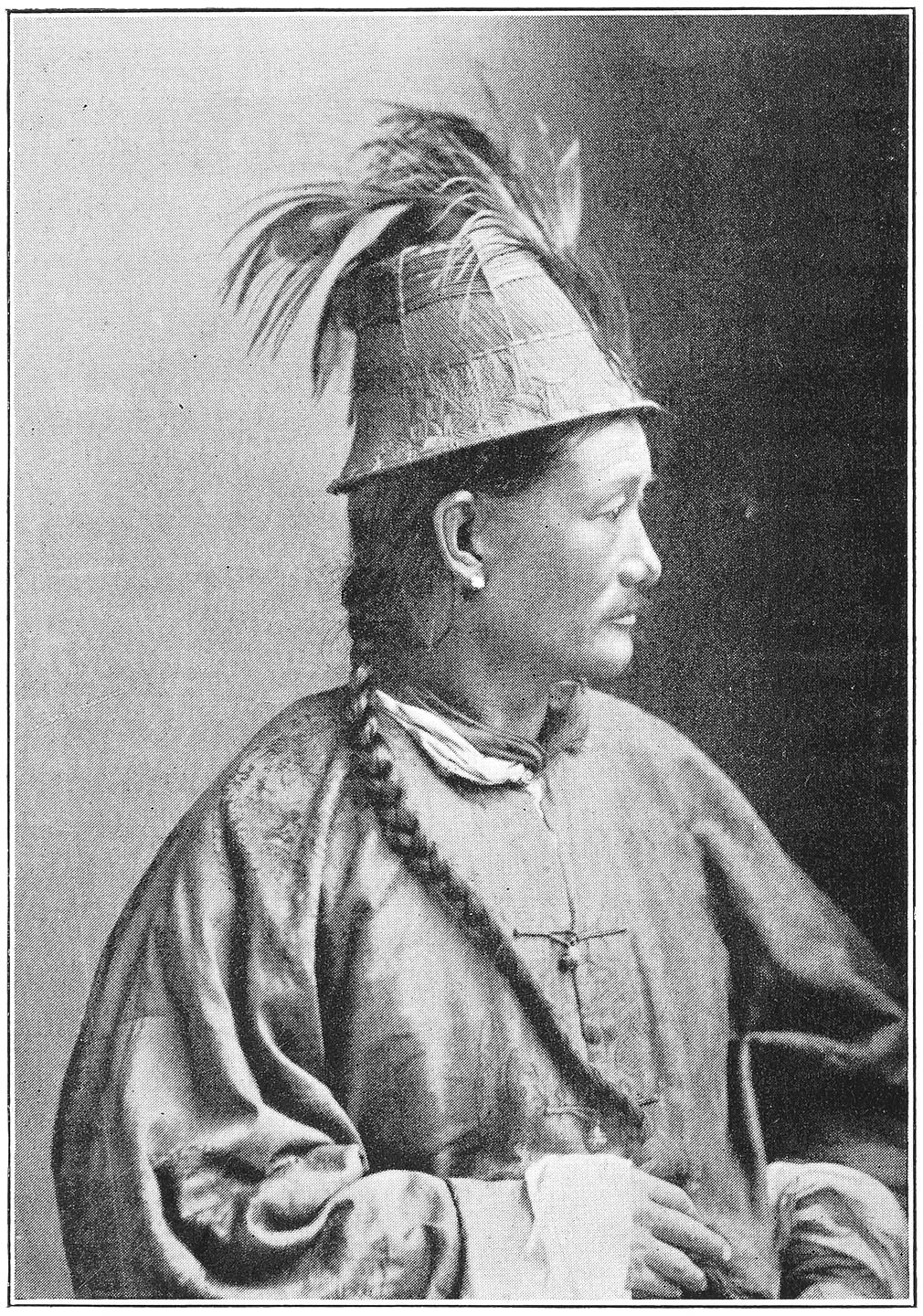
SIKKIM SOLDIER.
Returning to our lodgings, we found that the lock of the bag in which I kept my money had been tampered with, but I did not open it, as six other persons were living in the room we occupied, and I feared lest they might see the contents. Whatever the loss might be, I made up my mind to bear it silently, and keep my suspicions to myself.
November 25.—Phurchung’s brother, Dao Namgyal, brought me a quantity of presents—potatoes, murwa, millet, butter, and last, but not least, a kid, for which I gave him a return present of five rupees. The poor people of the village all followed with various presents, not that they had any great respect for me, but solely with an eye to return presents, which they hoped would be greater than the value of theirs. Fortunately there were but few people in the village, otherwise they would have drained me of all my cash.
The few who escaped carried the news to Tibet, and soon returned with a large army to wage war against the Magars. The queen shut herself up in one of her castles, and, though ill-prepared to stand a siege, she and her people defended it for three months. The Tibetans decided to reduce the place by famine and by cutting off the water-supply. Then the queen, to deceive them, opened the reservoir in the castle and let the water flow towards the Tibetan camp; and the enemy, thinking that she must have a great store of it and that their attempt was vain, raised the siege, and withdrew to a distance. The queen now attacked them in turn, but fell in the first skirmish, fighting valiantly. The Tibetans finally expelled the Magars from the Kangpa-chan and Tambur valleys, and restored them to their former possessors.
It was among the Kangpa-chan tribe that I had found Phurchung, the most devoted and faithful of all the men I ever came across in the Himalayas. Although Ugyen distrusted him, and he abhorred Ugyen, yet I placed implicit confidence in his loyalty and ability, and his devotion and fidelity to me were boundless.
November 26.—We left Kangpa-chan, our party now comprising four coolies. Phurchung marched along with my gun as a sign of his importance, but its red cloth cover, its principal beauty, had been stolen the night before; his younger brother, Sonam-dorj, carried his pack. Ugyen-gyatso and I rode ponies, hired for eight annas each, to take us halfway up the Nango la. The old women (ama) of the village waited our approach at the east end of the bridge to give us the stirrup cup (chang kyel) (a custom invariably observed in Tibet at the parting of friends setting out on a long journey), with bowls of wine in their right hand, and plates full of parched barley flour (tsamba) in their left. Each of the old women poured a little wine into a china cup, to which a pinch of flour was added, and we were asked to take a sip, with the wish of “May we offer you the like on your return.” We thanked them for their kindness, and put a couple of rupees in one of their plates, to be divided amongst them.
November 27.—We followed down the Lungkyong chu (the only way of communication between Kangpa-chan, Yangma, and Wallung), the mountains on our left nearly hidden in the morning mists. For part of the way our road led along a steep path through thick woods of firs, feathery larches, and deodars, amidst which I saw many pheasants and other kinds of birds, and the coolies told me that musk deer and wild sheep were also found there.
About two miles above the junction of the Yangma with the Lungkyong, we crossed the former stream by a wooden bridge, and finally arrived at the village of Tingugma, where we rested a while and ate a light meal.
Shortly after starting again we met a party of Yangma natives driving before them a few sheep and a dozen yaks laden with blankets, yak hides, barley, and salt. They were going to a village called Chaini, in the Tambur valley, to exchange their goods for rice and Indian corn. Phurchung asked them if the Kangla chen pass was still open. Some said we could easily cross it; others expressed doubts about it, for they said three feet of snow had fallen on it a few days previously.
Ugyen had been suffering most of the day with violent pains in the bowels; he now wrapped himself in all the blankets I could spare, and lay groaning and crying, “Achi-che apa-ouh!” so that I felt grave apprehensions for him, and feared that his illness might oblige us to stop over in this wretched place.
The Manding gomba, or Nub Man-ding gomba, “The Western Flying-Medicine Monastery,” owes its name to the fact that lama Lha-tsun once lived for three years in a cave close by called the Zimphug, to discover medicines of wonderful potency, and that he there obtained three wonderful pills. One came to him through the air, falling on the spot where the lamasery now stands. The second pill fell a little above the monastery, where the people of the village now burn their dead; and the third alighted on the spot where the great chorten now stands.
Manding gomba is held in great sanctity, for it is one of the first cis-Himalayan lamaseries founded by the great red-hat Lama Lha-tsun; but Wallung ranks first, and Kangpa-chan second, in point of wealth and power. Manding possesses a fine copy of the Kahgyur in 125 volumes.
The Lha-khang, or temple, has massive and neatly painted walls and doors, after the manner of the Sikkim donpa. The huts or cells of the monks in its immediate vicinity, all painted red with clay obtained from the adjacent mountains, are of irregular and ugly style, the doors, windows, and cornices being roughly made; each house has around it a low stone wall, inside of which the sheep and yak find shelter.
After a little while Phurchung and Puntso came back to me in high spirits over the result of their conference with the village elders. They had told them that I was only a pilgrim (nakorpa) who spoke Tibetan and dressed in Tibetan fashion. The head lama said that he knew of no order from the Nepalese Government for stopping pilgrims on their way to Tibet, and that he would certainly not prevent me doing so, as I spoke Tibetan with greater fluency and accuracy than many Nepalese. The headman (gopa) asked that Phurchung should give bond, holding himself personally responsible for my character as a traveller, and a custom duty of eight annas a head was levied on our party. Phurchung also told me that the headman and head lama were coming to bid me farewell, and that I must not forget, after exchanging compliments with them, to say sangpoi ja chog, “May we meet again next year.”
In a little while the big men arrived. The headman, conspicuous by his earring, boots, and red serge robe, nodded to me slightly, and took off his hat. He asked me why I had chosen such a bad season for going to Tibet. I told him that I did so in obedience to the command of our holy and learned chief lama (Tsawai), and not by my own wish. His object in coming to see me was to find out if I spoke Tibetan and understood the Buddhist religion. My fluency in Tibetan, and the citing of one or two proverbial sayings in course of conversation, made him form a high opinion of my knowledge of the sacred texts and histories, as well as of my character and holiness. “Laso, laso” (yes, yes), he said, and then he apologized for not having brought me some presents; but I answered him that our acquaintance was only just begun, and there would be time in the future to cultivate it, and, handing him a scarf (khatag), I expressed the hope that we might meet the next year (sangpoi ja chog). Many of the bystanders made wishes for our welfare, but some one in the crowd said that I was certainly not a Tibetan. Then another swore I was an Indian; and a third said that they would soon have news of me: “That Hindu will surely die in the snows, and his servants will soon return here with the news of his death.”
It was past noon when the coolies picked up their loads, and I set out in excellent spirits, having now escaped the much-feared obstruction from the Yangma people, on whose mercy and good-will our success entirely depended.
The male part of the population is idle in the extreme, but the women are correspondingly busy; some I saw were threshing corn, some gathering fuel, others engaged in various kinds of household work.
By 5 p.m. we got off from this wretched valley, where Phurchung and the coolies, by the way, were most desirous to remain to continue drinking chang, though Phurchung showed unmistakable signs of having already imbibed too much. After an hour’s march we reached Ki phug, where we found, under an overhanging rock, a bit of ground free from snow on which to camp; but Phurchung remained behind in Yangma, in a helplessly drunken condition.
November 29.—The way lay along the Yangma, which was scarcely visible, snow and ice covering entirely its bed. There was nothing to give life to the scenery; the river flowed in a deep gorge, or else opened out into lake-like expanses; on either side the mountains seemed to reach to the sky; not a bird, not even a cloud in the heaven, not a sound save that of our feet crushing the light dry snow. It was 11 a.m. when we came to an unfrozen pool, by which we ate our breakfast of tea and meal. This place, which is in a broad portion of the valley, is a favourite summer pasture-ground (tser chan) for the Dokpas, who, from July to September, bring their herds of yaks here.
Here we began climbing a huge glacier, a quarter of a mile wide and more than three miles long, the Chyang-chub gya-lam, or “Highway to Holiness,” over which I was carried on Phurchung’s back wherever the snow lay deep. Then we climbed a huge mass of bare black rocks (Dsama nagmo), and darkness had overtaken us before we reached the “White Cavern” (Phugpa karpo), where we proposed passing the night. The fog added to the obscurity of the night, our feet were benumbed by the cold, and we frequently slipped into crevasses or between the clefts of rocks. Finding it impossible to reach the cavern, we scraped away the snow from between some rocks, and there I sat, my knees drawn up, hugging myself during the long night.
How exhausted we were with the fatigue of the day’s journey, how overcome by the rarefication of the air, the intensity of the cold, and how completely prostrated by hunger and thirst, is not easy to describe. The very remembrance of the sufferings of that dreadful night makes me shudder even now, but I quickly recover under the inexpressible delight I feel at the consciousness of my great success. This was the most trying night I ever passed in my life. There was a light breeze blowing, attended with sleet, which fortunately weighed my blankets down and made them cover me closer than they otherwise would have done. And so with neither food nor drink, placed as if in the grim jaws of death in the bleak and dreary regions of snow, where death alone dwells, we spent this most dismal night.
November 30.—The coolies once more picked up their loads, and our guide began in his gravest tones to recite his Pema-jung-ne samba duba and other mantras. The morning was gloriously radiant, and the great Kangla chen glittered before us, bathed in a glory of golden light. Fortunately for us, there was no fresh snow on the ground; for, had there been any, we could not possibly have advanced. We found that we had stopped not more than a furlong from the Phugpa karpo, which, by the way, is not a cave at all, but only a crevasse between two detached rocks. Our guide, leaving his load in charge of his brother, took the lead, driving his long stick into the snow at each step, and digging footholds in the soft snow. From the White Cavern the top of the pass bore due east, and was distant about two miles. Just at the base of the final ascent there is a little sandy plain, in the middle of which is a huge boulder: this is the “Place of Salvation” (Tarpa gang), thus called because, when once this point is reached, travellers may be confident of attaining the summit of the pass.
I steadily followed in the footsteps of the guide, and would not let him take me on his back; for if I succeeded in ascending to the highest summit of Kangla chen without any help, I could look to the achievement with greater pride. Ugyen here gave out, and it was with difficulty that I persuaded Phurchung to carry him on his back, for they were far from being on the best of terms. An hour’s hard climbing brought us to the summit of the pass. The sky was cloudless and of the deepest blue; against it a snow-clad world of mountains stood out in bold relief. Far beyond the maze of snow-clad peaks we saw in the north-west the mountains of Pherug, in Tibet, while those of Shar Khambu stood gloriously out to the west.
The summit of Kangla chen is a plateau, some two miles from east to west, and one mile and a quarter from north-west to north-east; it inclines towards the west, while to the north-west it is bounded by a mountain of considerable height. Our snowshoes (kyar) now stood us in good need; unfortunately we had but three pairs, so Phurchung and I had to wade through the deep snow in the footsteps of the others, with many slips and more than one narrow escape from falling into the deep crevasses. On all sides there was nothing visible but an ocean of snow. Innumerable snowy peaks touched with their white heads the pale leaden skies, where stars were shining. The rattling roar of distant avalanches was frequently heard; but, after having succeeded in crossing the loftiest of snowy passes, I felt too transported with joy to be frightened by their thunder.
These splendid scenes of wonderland, the grandest, the most sublime my eyes have ever beheld, which bewildered me so that even now my pen finds no words to describe them, inspired me with feelings of deep gratitude to Heaven, by whose mercy my life had been spared thus far.
We camped on a rock bare of snow, and passed another miserable night with nothing to drink, and but a couple of dry biscuits to stave off our hunger. To add to my misery, Ugyen was still suffering, and I had to give him half my covering, for he had none of his own; and so, with not even enough room to lie down, we passed the night huddled together, the loads placed on the lower side of the rock so as to prevent our falling off in our sleep.
December 1.—’Twas not yet dawn when all were on foot and busy packing up. The track was hardly visible; below our path lay the great glacier, extending for miles, which feeds the Tashi-rabka river. The snowy sides of the mountains beyond this were furrowed by glacial streams, very noticeable in their varied shades of blue and green, and on the surface of the glacier itself rose huge rounded surfaces, or hummocks, evidently produced by boulders concealed under the ice.
Following carefully in the footsteps of Phurchung, we crossed some six spurs of the Dorjetagh range, and then came to an easy path down the central moraine of a former glacier, now only a huge heap of boulders and débris. The mountains lost, as we advanced, the whitish colour peculiar to the Indian ranges, and assumed the blackish or ochre colour distinctive of the Tibetan region. ’Twas with a feeling of intense relief that we finally discerned vegetation and heard the babbling of a little brook, near which flew birds feeding on rhododendron and juniper berries, and a little way off we saw some herds of yaks grazing, and smoke rising from a camp fire. Here we stopped at the foot of a great rock, and enjoyed, after our long fast of two days, a meal of rice and buttered tea.
We continued down the course of the stream, passing with some apprehension near a huge bull-yak or shalu, though low stone walls separated us from him and kept him away from the she-yaks (di) in the adjacent pasturage. This part of the valley is frequently visited by packs of wolves, which kill large numbers of yaks, but the bulls are able to drive them off with their long sharp horns.
About 30 yards beyond the house we came to the bridge, a rough structure of logs and stone slabs. The Tashi-rabka river was partly frozen, and its swift current was sweeping down blocks of ice. We crossed over unnoticed, and I then broke the silence with thanks to merciful God who had enabled us to overcome this the most dreaded of all difficulties, one which had frightened my staunch friend Phurchung, that the snows of the Kangla chen had not daunted.
December 5.—Our arrangements being completed and the ponies at the door, we hastened to finish our breakfast. From the sheep-pen close by the house we saw some fifty sheep led to the slaughtering-place behind the village. The butchers mutter some mantras over each one before killing it, and they receive as their perquisite the heads.
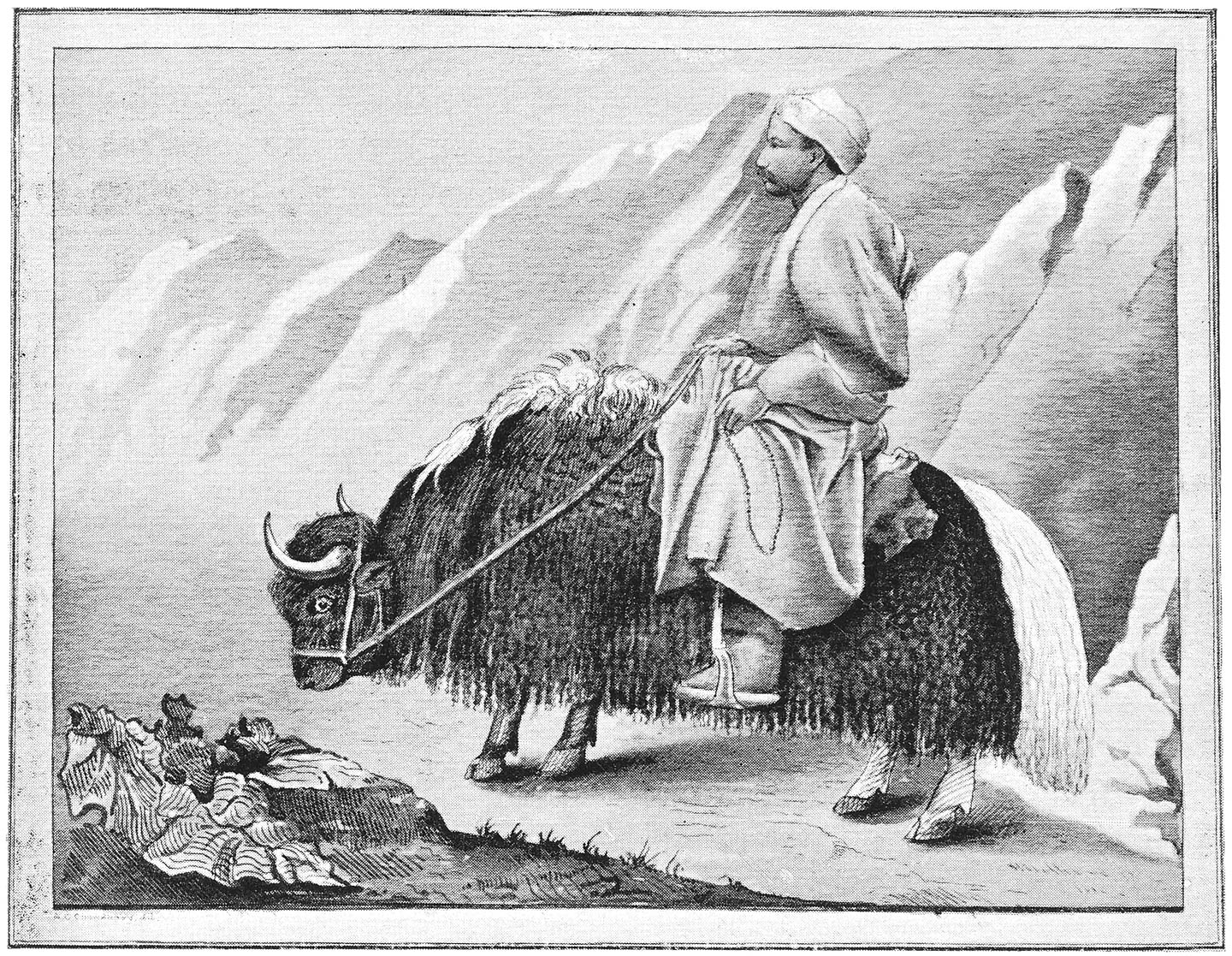
SARAT CHANDRA CROSSING THE DONKHYA PASS.