Chapter IX · FUNERAL OF THE PANCHEN RINPOCHE.—VISIT TO THE GREAT LAMASERY OF SAMYE AND TO YARLUNG.
Reading edition
On September 19 the minister left Dongtse, and I despatched Ugyen once more to the Rigyal Shendar monastery to obtain further information on the Bonbos and their religion. I myself went to Gyantse, where I was most kindly received by the Chyag-dso-pa and his family.
The people employed in this factory are kept under the strictest discipline. One day one of the women who was late beginning her work, was whipped by order of the Chyag-dso-pa. A boy caught stealing wool was also punished in the same way and imprisoned for a fortnight. I was rather surprised at seeing the Chyag-dso-pa thus taking the law in his own hands; but he told me that the Government allowed great landholders like his master, the Shape Phala, judicial power over their own serfs. I may here note that the pastoral tenants on this, and probably all other estates, pay the owners every year two pounds of butter for every she yak they own, and two pounds of wool for every sheep.
On September 25, corresponding to the 13th of the 8th moon, harvest began. This day was selected as it was a very lucky one. All the people turned out for the work, and I went to the roof of the castle to watch the reapers. While working they sang hymns and offered the gods bunches of barley, peas, and wheat, as first-fruit offerings.
Ugyen returned from his trip on the 1st of October.
The same day the period of summer retirement (yar-nas) for monks came to an end. It was observed as a holiday by the people: there was racing and other sports, and all the people, lamas, men, women, and children bathed together in the Nyang chu. The only sign of mourning still observed this day was keeping the windows of the houses in town and at Tashilhunpo shut.
On the 17th Ugyen reached Shendar ding, where he put up in the house of a man whose wife had just been confined. A woman in Tibet, as in India, is held to be unclean (kyedib) for a month after her confinement, at the expiration of which time certain religious ceremonies are performed for her purification.
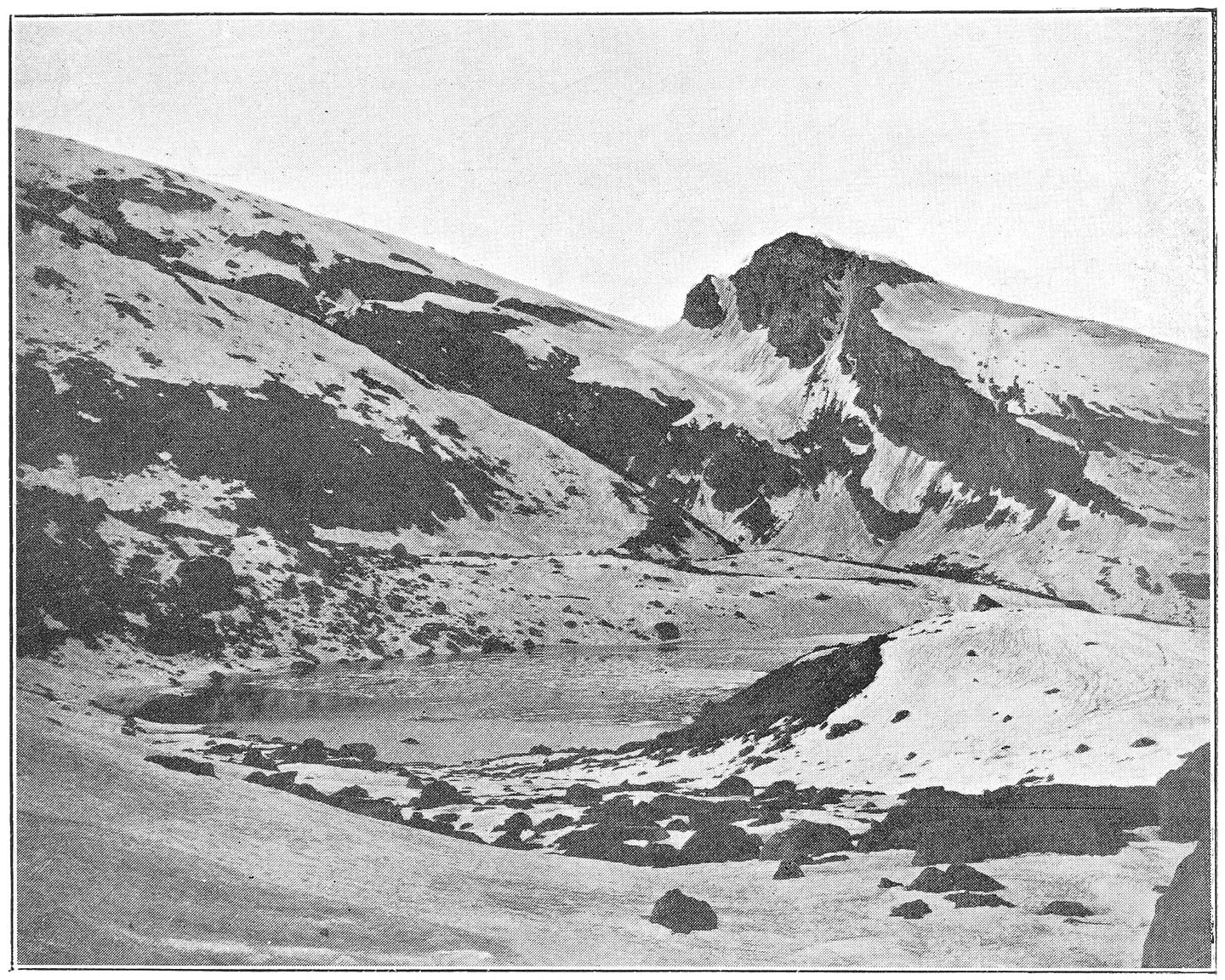
GLACIERS OF KANGLACHAN PASS.
Having been prevented when at Lhasa, as previously narrated, from going to the celebrated monastery of Samye, the most ancient and famous, probably, of all Tibetan lamaseries, I now endeavoured to make arrangements for this much longed-for trip. I sent Ugyen to Dongtse, after his return from his trip to Shendar ding, to try and get a guide; but he failed, as rumours had got abroad that I was a British employé, and Phurchung was accused of having brought me into Tibet in violation of the express orders of the Nepal Durbar.
In view of these disturbing rumours, I left Gyantse on October 4, and returned to Tashilhunpo, where I was rejoined on the 13th by Phurchung, who had been sent with letters to India in August.
I now decided to send Ugyen back to India with the botanical and other collections he had made, while I would visit Samye, and the Lhokha country south of it. He bought ten yaks for a hundred rupees, and pack saddles, and engaged Lachung men to accompany him to Khamba djong. He started on the 17th, while Phurchung and I returned to Gyantse, arriving there on the 18th.
The people were now busy threshing their barley—cows, their muzzles covered with wicker baskets, treaded it out, and were kept to their work by two boys.
The Chyag-dso-pa lent me a man to guide me to Samye and the south country (Lhokha); his name was Gopon. He told me he was ready to start at any time, for his brother (namdo pun, “joint brother”), as he called him, had now returned from Shigatse, and he could leave his wife. These two men had, though not related, one wife between them, and the three of them got on very well together.
On October 21 I finally started for Samye, and followed, as far as the ruined village of Ring-la, the high road to Lhasa I had travelled over earlier in the year. There is but one family now living in this once prosperous place. These poor people earn a precarious livelihood by making pottery. A concave wooden pan is used for the purpose, in which the pots are shaped with a piece of wood or the fingers, by turning the pan or mould around with the hand. This is the usual method employed in Tibet.
We at first failed to secure a night’s lodgings in any of the houses of the village, for the people took us for Lhopa or Bhutia, of whom they stand in great dread, as they frequently make raids on this district; but we were so fortunate in the end as to secure the good-will of a lama of the monastery, who got a friend of his to admit us to his house.
We stopped at the village of Shari, prettily situated between the Yamdo and a little sweet-water lakelet, and put up in the mani lha khang, the centre of which was taken up by a great prayer-wheel about six feet high and three feet in diameter. An old man lived here whose sole occupation was to turn the wheel.
After a short halt at Melung, we resumed our march, the country opening a little as we advanced, and villages and hamlets becoming more numerous. That night we stopped at Khamedo, where there live about a hundred families.
The difficulties attending the descent of the Tib la were infinitely greater than those of the ascent, and the violence of the wind made it difficult even to stand erect. By five o’clock we reached the village of Tib, where there are about ten houses, around which grow a few stunted willows. The villagers were busy treading out their harvest with their cattle, and their merry songs, wafted by the night wind, fell pleasantly on my ears till I dropped asleep.
Tib is under the authority of the Gongkhar Djongpon, who, with his two lama assistants, or Tse-dung, usually resides in the neighbouring town of Tosnam-gyaling.
October 27.—Our road led us down the course of the Tib chu. The valley was covered with willows (here called nyamyam shing, or “mourning trees”), cypresses, junipers, and a species of silver fir, and though the way was stony, it was pleasant on account of the forest growth through which it led.
Before reaching the town we passed by the little nunnery of Peru, and shortly after leaving it we came to the large lamasery of Toi Suduling, with about five hundred monks of the Gelugpa sect.
It seemed to be a prosperous place; there were flower gardens and groves of trees, and in nearly every window and doorway flowers were growing in pots. Two Nyerpa are stationed here, who administer the town and supervise the manufacture of serge and cloth for the Dalai lama and Panchen rinpoche.
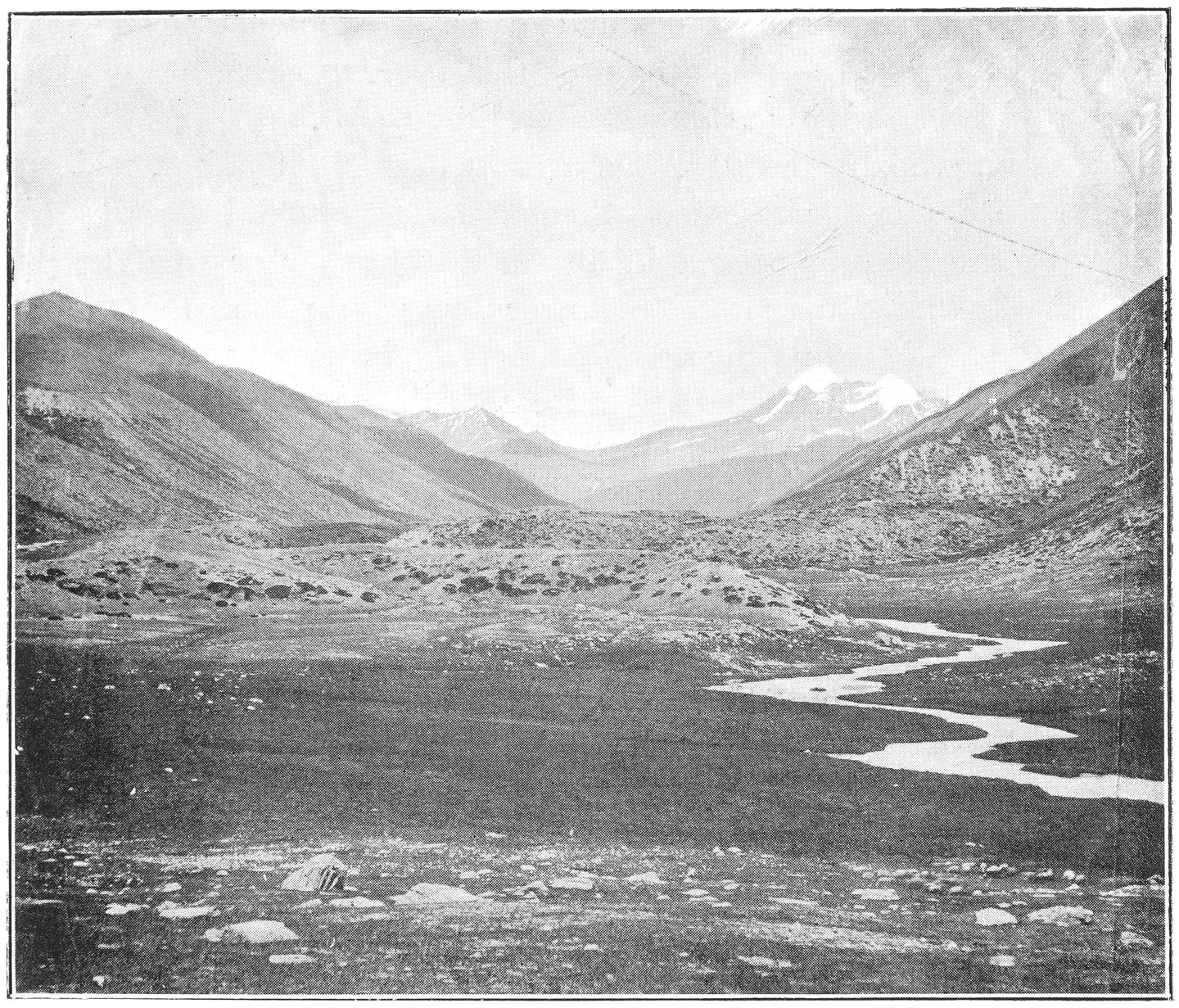
RIVER ZEMU, CHATANGLA PASS.
We stopped for tiffin on the river bank, where I noticed the ground covered with fish-bones and shells. Gopon told me that all the small fry which the people of this country catch are used to manure the fields with, as they are too bony to eat.
The road now led over sand hillocks and spurs of rock, in some places close to the edge of the river, where great care was necessary in getting the ponies along.
We stopped at Tag, behind which rise the forest-covered mountains, and where we got quarters in a fine new house, and were made most comfortable by the owners.
Phurchung was delighted with Samye; he had not only reached the holiest of Tibetan sanctuaries, but a place where chang was extraordinarily good and cheap; what more could he ask for?
After taking tea I went with my two companions to visit the chief temple of Wu-tse (Amitabha). I inquired of the beadle (ku-nyer) the whereabouts of the celebrated library with the famous Indian books which Atisha had found here when he came to this monastery eight hundred years ago. I was told, to my great disappointment, that “for our sins the great library was destroyed by fire about sixty years ago, and there are at present but modern reprints in it.”
In the great congregation hall the Dalai lama’s throne occupies the north-eastern corner of the chapel of the Jo-vo. Near this latter is an image representing the first Dalai and statues of the principal disciples of the Buddha.
In the second story of this building are images of Tsepamed (Amitayus) and of the historic Buddha, besides many others of minor interest. In the third or upper story are images of the three Buddhas of the present cycle. From this story I had a splendid view of the Tsang-po, which is very wide here.
The next day (October 30) I visited the four ling, or minor temples built around the Wu-tse, and the eight ling-ten or lesser shrines. In some of the smaller chapels were life-size images of Indian sages who had visited Tibet in the early ages of Buddhism in this country, and these images are said to have been made by Hindu artists. I also noticed growing in some of the court-yards some stunted bamboos and Indian shrubs.
After visiting the white chorten, we went outside the temple walls to see the chapel built by the wives of King Tisrong detsan, which resembles in style the Wu-tse, though much smaller than it.
We made an excursion the next day to the famous cave called Chim phug, where Padma Sambhava and other worthies gave themselves up for a period to abstraction.
We passed through the village of Samye, in which there are probably a thousand people and a few Chinese and Nepalese shops, and then for a few miles travelled through cultivated fields, with here and there a little village, till we came to the foot of the Chim phug hill. The range of which it forms a part is a thousand feet or so high, well covered with fine timber, and inhabited, so some of the numerous woodcutters we met told us, by wild goats, sheep, deer, and snow leopards.
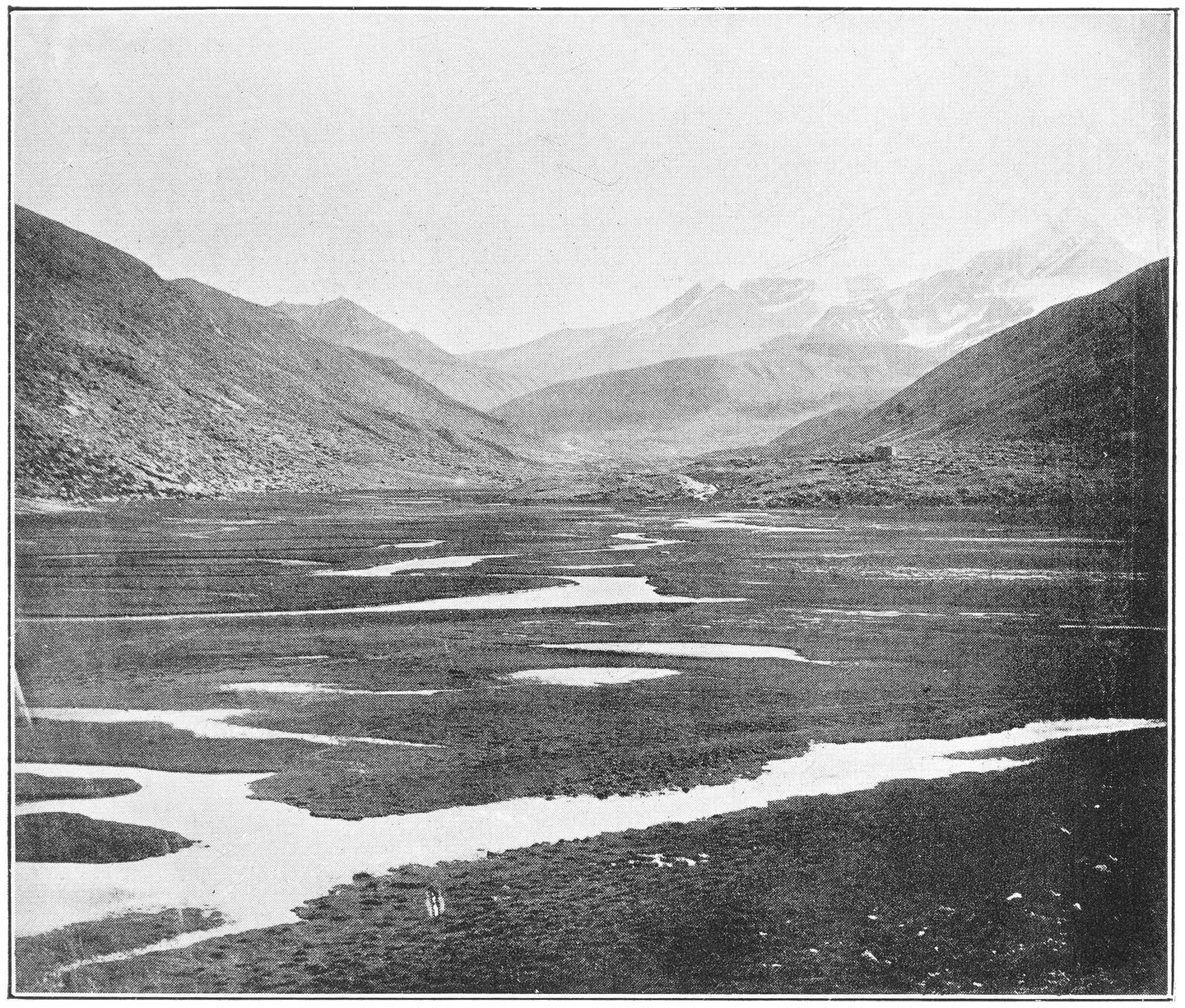
GLACIAL LAKE AND MORAINES AT THE SOURCE OF THE ZENNI (?).
We reached the temple before noon. It is a two-storied, flat-roofed building built on the rock. In the rock underneath the temple there is a fissure about fifteen feet long and six feet broad, and varying in height from three to six feet. In this there is a little chapel where the image of Padma Sambhava, flanked by two female attendants, is to be seen. In the building above are images of a host of deities and saints, as also that of King Tisrong. The books I looked at in the temple belonged to the Nyingma sect, and were of no special interest.
Leaving Chim phug after a couple of hours’ rest, we returned to Samye by another road, passing three little temples, or rather hermitages, where Indian pundits are said to have lived in times of yore. Flocks of pigeons were hovering about them, and walnut and willow trees grew around, giving them a peaceful and secluded appearance.
The sands are slowly but surely burying Samye, and a large portion of the town, including some of the temples, is already lost under them. There is a prophecy attributed to Padma Sambhava, to the effect that Samye will be engulfed in the sands, and it is in a fair way of being accomplished.
A few notes on the famous lamasery of Samye and Padma Sambhava find place here.
Both Santa Rakshita and Padma Sambhava were unable, on account of the open hostility of the Bonbo, to remain long in Tibet. It is said by some that the latter sage remained there six years, others make his sojourn there eighteen years, after which he returned to India; but, however long he stayed, he firmly implanted mysticism in Tibet.
King Tisrong gathered together at Samye sacred images and treasures from India and the borderlands of China; but of all the collections made here the most valuable was the great library of Indian works, of which Atisha, who visited Samye in the eleventh century, said that there were more Indian books here than in the great Indian convents of Buddhagaya, Vikramashila, and Odantapura united.
On November 2 I left Samye for a visit to Yarlung, the early home of the first Tibetan kings, if tradition is to be believed.
This temple differs somewhat from all other buildings of this kind I have seen in Tibet, the plan of it approaching rather that of a modern public building in Bengal. I noticed here eighteen beautiful silver and copper chorten, the finest specimens of such metal work I have seen. Six tablets of gold, each six feet long and six inches broad, hung from the ceiling, besides six piles of similar but smaller tablets in a corner.
All the way to Samdub phodang, the capital of the Phagmodu kings, was a gentle descent over gravel and mica-schist rock. Crossing a fine wooden bridge about fifty yards long, with railings running along either side, we found ourselves in the principal street of the town, in which a large number of Dokpa traders were camped under some walnut trees.
The three-storied castle, once a royal residence, is now occupied by the Djongpon and the two Tsedung from Lhasa. Samdub phodang is now a gon-shi, or “Crown Demesne” of Lhasa.
I soon began to feel excessively nervous, and told my men that we had better leave Tse-tang as soon as possible; but Phurchung assured me that I need have no fear, that furthermore the ponies absolutely required rest, so that we must stay here a few days.
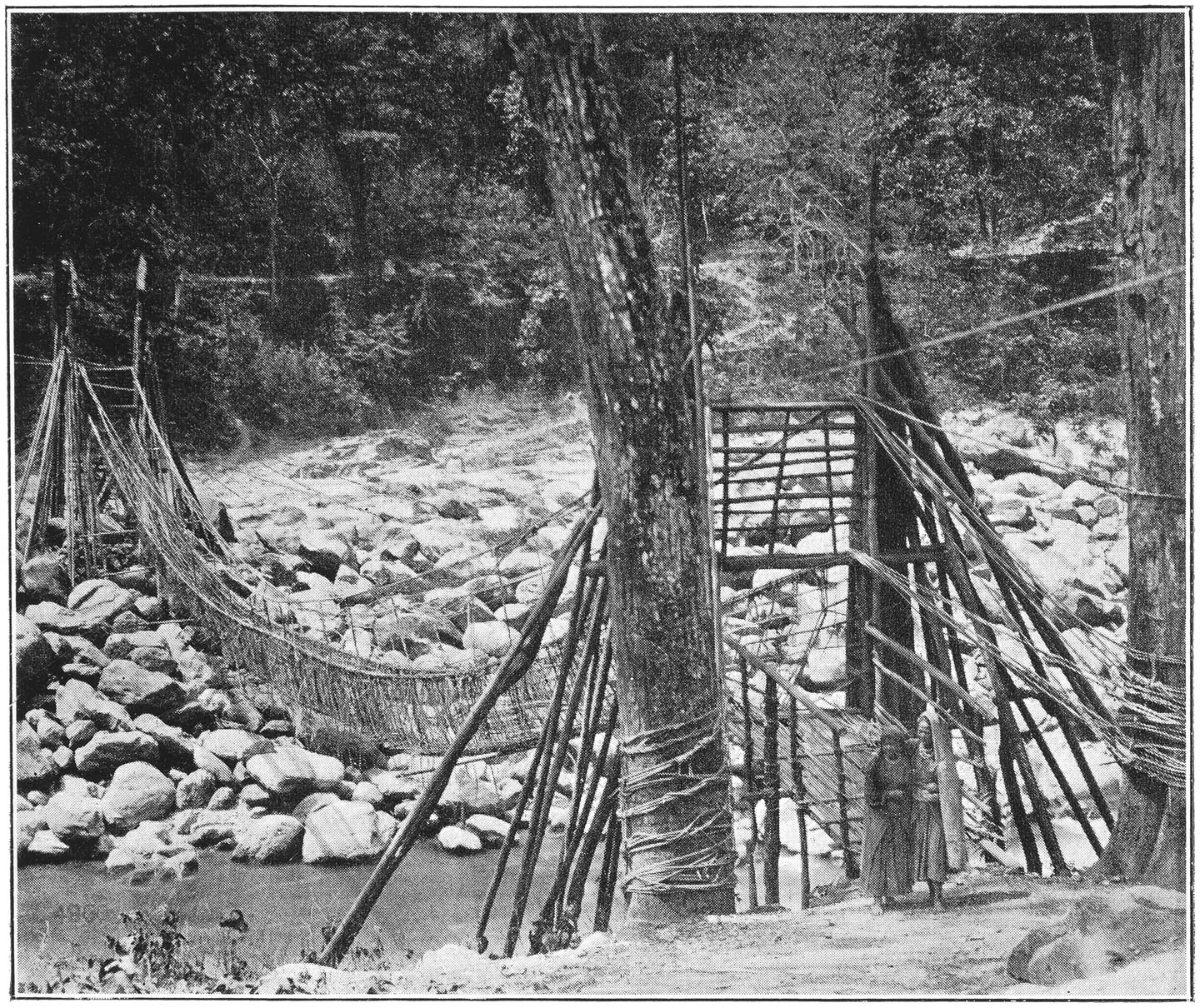
CANE BRIDGE ON THE RUNGIT RIVER.
There are four lamaseries around Tse-tang, and in the town are some fifteen Nepalese, twenty Chinese, and ten Kashmiri shops, besides native traders from all parts of Tibet. Mutton and butter were abundant, but barley, though cheap, is of inferior quality.
I left Tse-tang on November 17 for a visit to the Yarlung valley and its monuments.
A short distance to the south of Tse-tang we passed through Ne-dong djong, where resides the Djongpon of this district, and which used to be a royal city of the Phagmodu kings. Save the lamasery of Benja, little remains but ruins to attest its past importance.
Following up the course of the Yarlung river, we came after a few miles to the temple of Tandub, one of those said to have been built in the seventh century by King Srong-btsan gambo, and to which a monastery was later on added by Tisrong detsan. It is a copy, on a small scale, of the Jo khang of Lhasa, and contains many objects of interest to the pious pilgrim.
After taking our lunch under a tamarisk tree, we remounted our ponies and rode on to Phodang djong, the most ancient town in Tibet. As all the kings of the dynasty which sprang from this place bore the title of Chos-gyal, or “Catholic majesty,” this town is also called Chos-gyal phodang. The present chief of this place claims descent from this very ancient line, but even his own people do not believe much in his pretended genealogy.
We rested here for a while, and then went to the village of Rachung at the foot of the hill, where we found good lodgings for the night in the house of an old acquaintance of our guide, Gopon.
Formerly this broad valley of Yarlung, or Gondang-tangme, was covered with innumerable populous villages, and in no other part of Tibet was there such opulence. But one day the snows melting on the Yarlha-shampo and torrential rains caused a mighty flood which submerged the whole plain for many days. The villages were utterly destroyed, and the people all perished, and when the waters had retired a deep deposit of sand covered everything. In course of time the country was reclaimed, and has now reached a certain degree of prosperity, but it has never recovered its primitive flourishing state.
Beyond this lamasery the trail led along the edge of a precipice where we passed a number of little cells occupied by hermits (or tsampa), who, as we passed, stretched out their hands for alms through the little opening left in the front of their dens. Some of these men had been immured five years, and many of them had also made vows of silence.
A little way beyond this point, and about 500 feet below the summit of the hill, we reached the cell of Padma Sambhava, near which is a chapel called the Upper Lha-khang of Shetag. The keeper led us to a heavy door under a huge rock; unlocking it we entered the cavern, which is held the most sacred shrine of the Nyingma sect. In it I saw a silver reliquary in which is kept a silver image of the saint, representing him as a boy of twelve. There was a plate before the image filled with rings, earrings, turquoises, pieces of amber, gold and silver coins, the offerings of pilgrims.
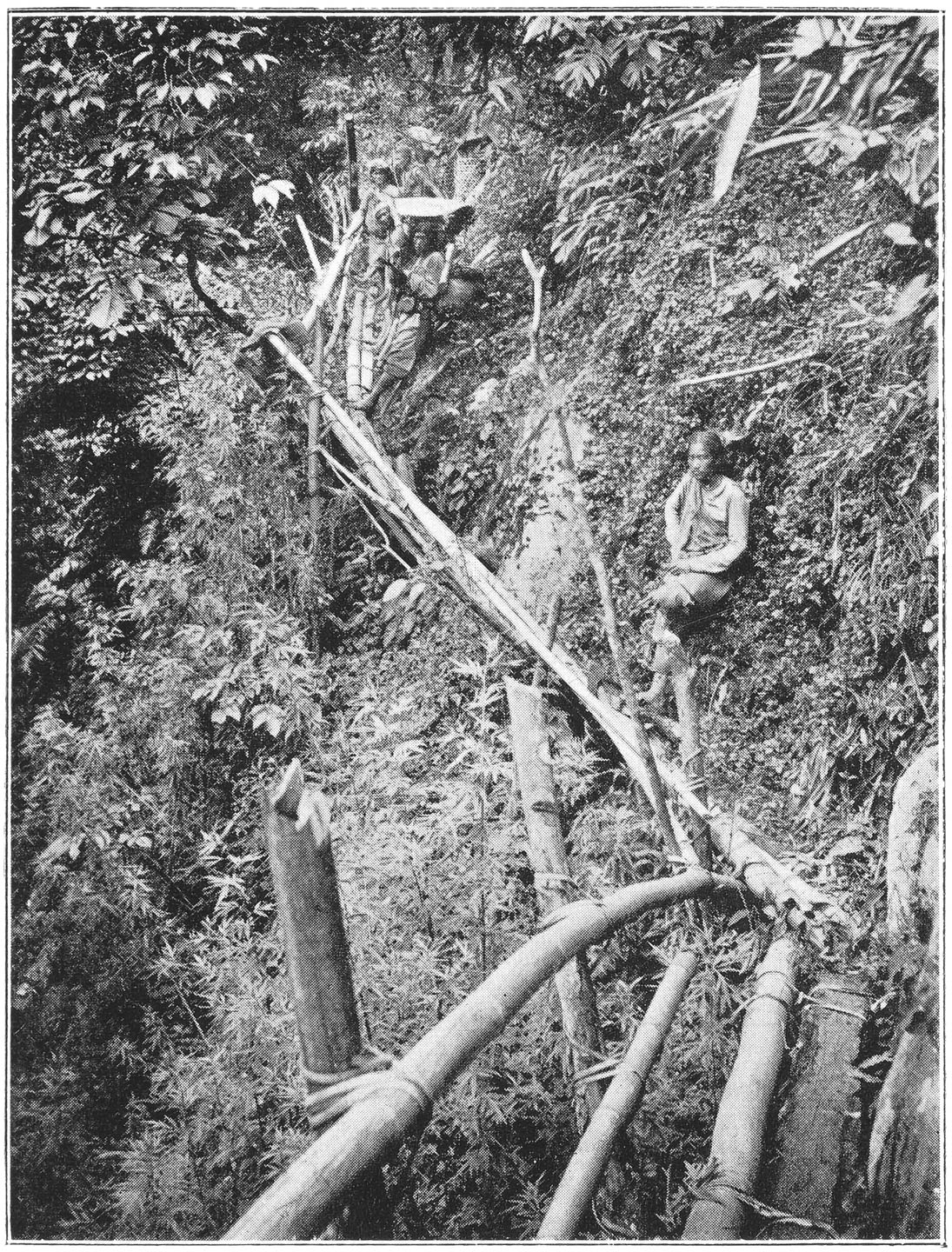
BRIDGE AT BRI, NEAR YANGYANG.
Leaving this interesting spot behind, we rode on across the fields which the peasants were ploughing and irrigating for the autumn crops, and came, after a few hours, to the sanctuary of Gadan namgyal-ling, where Tsongkhapa took his final vows of monkhood. It is a fine building in the midst of a grove of trees, through which flows a brook.
From this point we retraced our steps to Tse-tang, which we reached the same day, recrossing the Yarlung chu by a long stone bridge near the monastery of Tse-chog-pa, where we saw a number of the monks bathing in the river.
The Yarlung valley appeared to me to be a most prosperous one, the people gentle and good-natured. The soil produces grain and fruit in greater abundance than any other part of Tibet; chang, butter, meat, oil, barley, wheat, and fuel were everywhere plentiful.
On November 10 we left Tse-tang, on the return journey to Tashilhunpo.
Following the bank of the Tsang-po, through heavy sands or over low hills, we came towards evening to Chincho-ling, a secluded and desolate little hamlet, the houses surrounded by low walls of stone to keep off the drifting sands, and here we put up for the night.
I left Mindol-ling on November 12, returned to the Tsang-po, and reached the village of Cho by dusk. Quite early the next morning we entered Khede-sho, where our route joined that we had taken when going to Samye.
We resumed our journey at 4 in the morning, and pushed on slowly and with considerable difficulty, for the path was over rocks, in places overhanging the roaring river. At daybreak we passed by the village of Shyati-ling, and shortly after the sun pierced the fog which had enveloped us. A low col, called Yab la, was next passed, and we joined the high-road between Lhasa and Shigatse, which I have previously described. We stopped for the night at Tamalung.
The next day (November 16) we reached Palti djong.
On the 18th, a mile or so to the west of Oma-tang, where we had passed the night, we fell in with the Chinese Amban and his train on their way to Lhasa. First came numerous parties on horseback, then about three hundred men on foot carrying all the paraphernalia common to Chinese processions, and finally the Amban’s chair carried by Chinese and sixteen Tibetans, the latter only holding strings attached to the poles to show that they were assisting in the work. Two Chinese armed with whips kept the way clear.
On November 24 I found myself once more at Tashilhunpo, and immediately set to work to prepare for a trip to Sakya, from whence it was my intention to proceed directly to India. A day or so after my arrival I was delighted at the receipt of a passport from the new Shape of Shigatse, permitting me to proceed to India and return to Tibet. It had been obtained at the instance of my friend, the minister.