Chapter XI · SOCIAL DIVISIONS—MARRIAGE—FUNERALS—MEDICINE—FESTIVALS.
Reading edition
First, or highest class, Rab:—
1.—Rab-kyi rab. The king, members of the royal family, and incarnate lamas who have appeared many times on earth.
2.—Rab-kyi ding. The Desi, or regent, ordinary incarnate lamas, ministers and councillors of state, learned lamas, or abbots, professors at important monasteries.
3.—Rab-kyi tama. Secretaries to the Government, Dahpon, Djongpon, and inferior lamas, or abbots.
Middle classes, Ding:—
1.—Ding-kyi rab, or “upper middle class,” including families who have for generations possessed great wealth, landlords who do not claim descent from illustrious ministers or warriors; Dungkhor, old families and men who have personally contributed in a marked degree to the welfare of the country; and lastly, the Don-nyer.
2.—Ding-kyi ding. This class includes the Dung-yig, or clerks, stewards, chamberlains, head grooms, head cooks, and other petty officers.
Lowest class, Tama:—
1.—Tamai rab. Grooms, menials engaged in domestic service, and other hired servants.
2.—Tamai ding. Those who have no fixed homes, men who keep concubines, but no wives, loose women, professional beggars, vagabonds, and paupers.
3.—Tamai tama. The lowest of the low are butchers, scavengers, disposers of dead bodies, blacksmiths, and goldsmiths.
In Tibet there are no caste restrictions with regard to marriage as in India. The rich may bestow their daughters on the poor, the daughter of a poor man may become the bride of the proudest noble of the country. But the girls of the royal family and those of high rank are not generally bestowed on the low classes; but in the event of their not finding a suitable match, they are sent to convents. The daughters of commoners do, however, occasionally become the wives of nobles.
The nuptial ceremonies are alike for all classes, the only difference being in the amount of money expended in the festivities. In the first place, the friends of the bridegroom employ a go-between to make the first overtures to the parents or guardians of the girl. Should the latter entertain the proposal, the parents of the would-be bridegroom either take or send presents to them, consisting of khatag and wine (called long chang, “proposal wine”), and formally make an offer of marriage. The girl’s parents make excuses, saying that she is neither handsome nor accomplished, and will be of no service to the suitor. The go-betweens thereupon more and more earnestly press their suit. After these conventional phrases have been exchanged, the girl’s parents say, “If you are really in earnest, and believe that she will be of service to you, we shall consult with our friends and relatives, and let you know our decision.”
A few days later their consent to the union is formally conveyed to the suitor’s parents, when the latter, taking with them twenty or thirty gallons of wine, proceed to the home of the bride, where they entertain not only all her relatives, but also the servants and neighbours, and present each with a scarf. The purchase-money (rin) is then paid, which, for the middle classes is usually five or six doche (625 to 750 rupees), and about fifty gallons of wine. Another scarf is then presented to each of the elder members of the bride’s family, and also to prominent persons among her friends and neighbours.
After an auspicious day has been fixed for the wedding, the parties make the arrangements necessary for the occasion. On the appointed day the bridegroom’s parents depute some seven or eight respectable men to go as their representatives to bring home the bride. They remain at her father’s house three days, during which they are engaged in making negotiations and in assuring their hosts, by whom they are provided during this period with all necessaries, that their daughter will be happy in her new home. At the end of the three days the bride is told by her parents to go to the bridegroom’s house. They give her a good milch-cow or yak, a pony, four or five oxen, two suits of summer and winter dress, a complete set of jewellery according to the custom of the country, a piece of stuffed carpet and a small dining-table, cups, plates, cooking vessels, and other articles for domestic use, fifty ounces of silver, and a female attendant. All those who have received scarves now come to present her in return with a scarf and a piece of money. The nearest relatives and friends of the parents, the chief of the country, and other people of position, present her with scarves, clothes, blankets, etc., and silver coins.
On the third day the bride exchanges the clothes and jewellery she wore on her arrival, for others supplied by the bridegroom. After a short prayer to the gods the pair are left together, for the first time, and on the following morning the bride begins to apply herself to her household duties. Her brothers and relatives who have accompanied her, return home at the expiration of seven days.
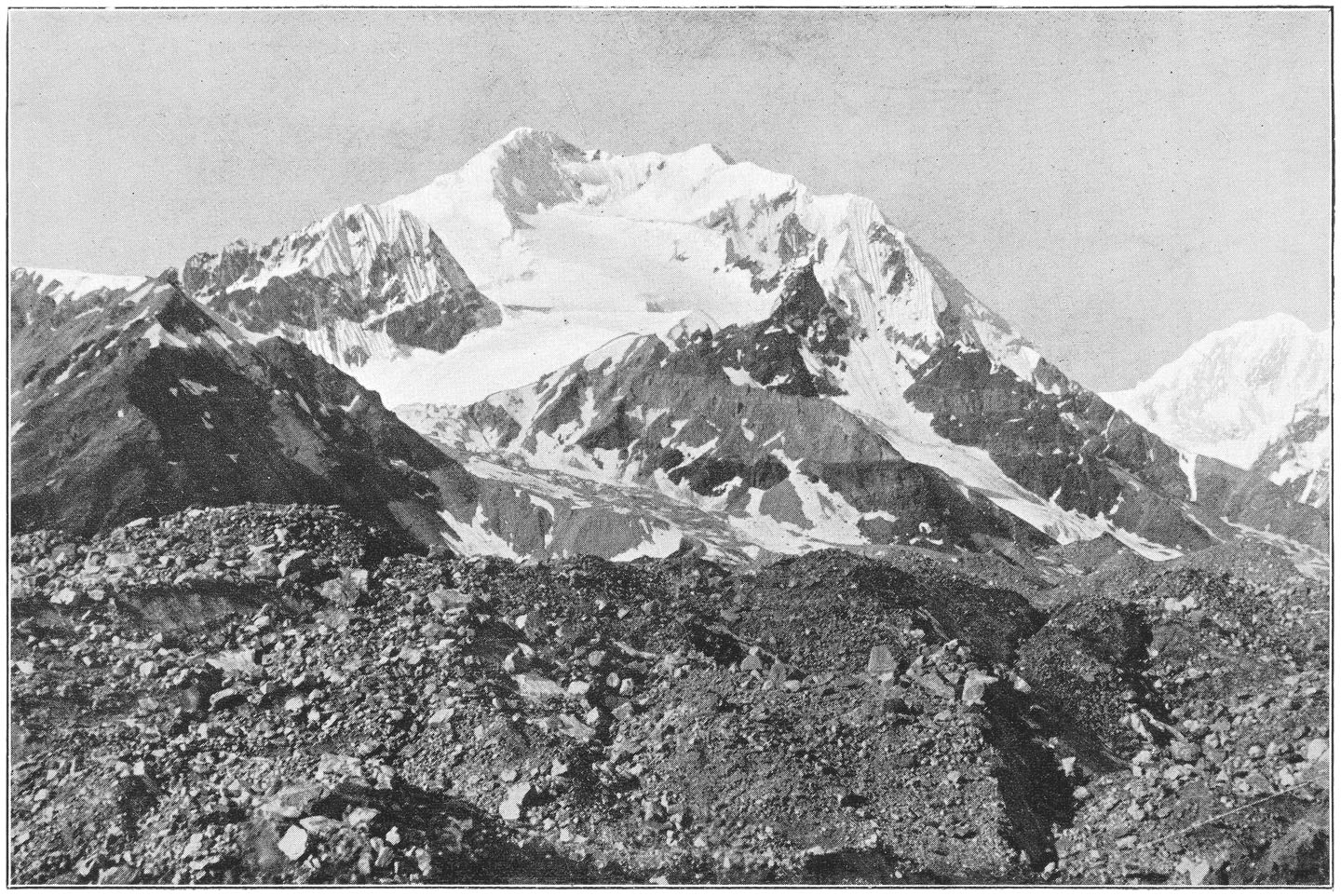
SEMARINU AND ADJOINING SNOWY MOUNTAIN.
Some three months after the wedding her parents, accompanied by the chief men among their friends and by servants, arrive with presents of food, and request that their daughter may pay them a visit. After being entertained for ten or twelve days, they return home, and are followed some weeks later by the young couple, who are accompanied by a number of female servants bearing presents of scarves, provisions, wine, etc. They remain a month, and on their departure the bride receives from her father a new costume and jewellery, and the husband a complete suit of clothes and the inevitable scarf.
Among the very poor the proceedings are much simplified, the negotiations being conducted by the parents in person.
There is no fixed limit of marriageable age in Tibet. The average age, however, for both sexes, is from fifteen to twenty-five, and frequently the bride is older than the bridegroom.
On the other hand, if a wife be found perfectly innocent, and willing to live with her husband, but the husband be resolved to divorce her for no fault of hers, he is required to pay to her twelve gold sho, equal to ninety rupees, as divorce fine, and also yog la, “service wage,” amounting to six pounds of barley for every day and six for every night which she has spent with him from the day of marriage to the date of separation. The husband is also required to return the price of all the clothes and other gifts made to the wife by her friends since the time of their marriage. The divorced woman also takes away with her all jewellery given her by her relatives, but not that given to her by her husband. The wife cannot demand the “innocence fine.” If there be children at the time of separation, the father takes the boys, and the mother the girls. If the husband be a man of property, the court may order him to give the divorced wife a certain share of his possessions for the maintenance of the girls. On the other hand, if the wife be possessed of property, she may be required to give something for the maintenance of her sons.
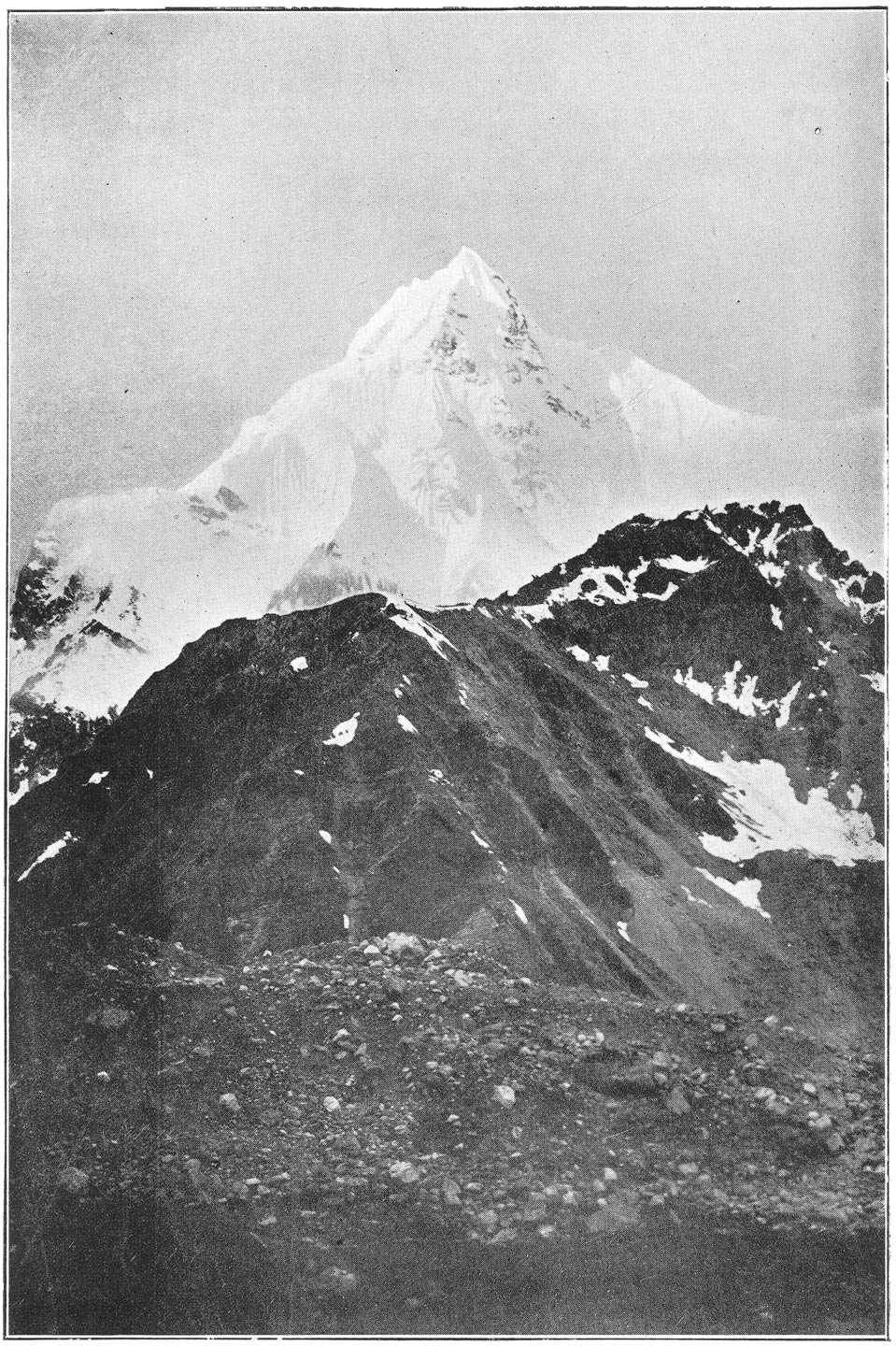
SINIOLCHUM OR D2.
Before the dead body is removed from the house, an astrologer notes the dates of birth of the friends and relations present. If any among them were born under the same constellation and planet as the dead person, they are said to incur the risk of being ridden by his ghost, and are consequently not allowed to attend the funeral. The astrologer also receives his reward in money or kind. Then the corpse, tightly wrapped in clothes, is placed on a stretcher facing the direction which has been declared auspicious by the astrologer, and is placed in a corner of the house. Five butter lamps are lighted near the head, and a screen is drawn round it, within which his usual food and drink, together with a lamp, are placed. Early on the morning of the day appointed for the disposal of the body, it is carried to the nearest cemetery. At the time of its removal the relations make profound salutations to it. Two men carrying wine or tea, together with a dishful of tsamba, follow the bier. The family priest, or lama, of the deceased throws a khatag on the litter and walks behind at a slow pace, holding a corner of another scarf tied to it. As he proceeds he mutters funeral mantra, turning a hand-drum (damaru) with his right hand, and with his left ringing a bell. It is inauspicious to place the litter on the ground before its arrival at the cemetery. If by accident this should happen, the body must be disposed of at that spot, instead of in the cemetery. In the neighbourhood of Lhasa there are two sacred cemeteries, Phabongka and Serashar. Those who dispose of dead bodies at the former pay two or three tanka for tea to the monks of Phabongka monastery; and at the latter they pay one tanka to the cemetery keeper, who also gets the bedding and clothes of corpses.
During this period of bardo, as the interval between death and regeneration is called, the departed spirit is believed to wander, and in order to prevent its being subject to misery, on the forty-ninth day some of the clothes, shoes, head-dress, coins, etc., which belonged to the deceased, after being washed and sprinkled with saffron-water, are presented to some incarnate lama for his blessing. The last service is conducted by a Tantrik lama, with a view to expelling all the evil spirits and hungry ghosts which haunt the house of the departed.
On the seventh day after death, prayers are moreover offered for the deceased’s well-being, and alms in coin, food, tea, gold, and silver are distributed among religious men. This is repeated on every consecutive seventh day until the forty-ninth day, when a grand feast is given to the congregation of lamas. Nowadays, however, the rich people of Lhasa generally distribute alms, at the rate of one tanka each to the monks of Sera, Dabung, and Gadan, dispensing with the other costly ceremonies. They also present the clothes belonging to the deceased to the professors and heads of those monasteries. Some bequeath the whole of their property to these monastic institutions or to Lamas of great repute.
The practice of making wills has been followed by the Tibetans from very remote times. Every man of property leaves a will bequeathing his movable property to his children or friends, and leaving instructions for the performance of his funeral obsequies and other pious works.
The cutting up and distributing of a corpse is a practical illustration of the Tibetan belief that charity is the highest of all the moral virtues. That man is said to be most virtuous whose funeral is attended by the largest number of vultures, while if his corpse attracts but a small company, the very dogs not deigning to touch his defiled remains, he is judged to have led a sinful life.
The dead bodies of pregnant and barren women, and also of lepers, are packed in leather bags and thrown into the waters of the great Tsang-po. A Tibetan proverb says, “She whose son dies after birth is white barren (rab-cha karpo); she whose daughter dies after birth is partly barren (rab-cha tavo); she who has borne no children is black barren (rab-cha nagpo).” The corpses of such and of lepers are considered particularly unclean, and should not be kept within the limits of the country, but must either be thrown beyond nine hills and dales, or packed in horse’s or ox’s skins and thrown into the river.
The dead bodies of incarnate lamas are occasionally burnt, and their ashes and bones deposited in chorten. The remains of saintly personages, such as pretend to have emanated from Bodhisattvas and Buddhas, are preserved like the Egyptian mummies, being embalmed or salted and placed within gold, silver, or copper chorten, where they are seated in a meditative posture, like the conventional image of Buddha. These incarnate lamas, at the time of death, mention the time when and the place and the family where their souls will subsequently find re-embodiment, and also the name and race of the family, and instruct their friends to perform rites and ceremonies for their well-being after death.
On the demise of the Dalai and Tashi lamas, the work in all the public and private offices, all business, and market gatherings are suspended for seven days. For thirty days women are forbidden to put on their jewellery, and men or women may not wear new apparel. Lamas and monks must, on such occasions, mourn for ten days, during which they must not shave their heads, or wear their church head-dresses during services, All classes of people refrain from amusements and festivities, and from going into groves for pleasure, sports, or love-making. It is only in honour of the death of these two great hierarchs of Tibet that the whole country goes into mourning. The mourning for abbots of other monasteries and heads of families is confined to the friends and monks who are near to them. Rich and respectable men do not, within a year after the death of their parents, take part in marriage ceremonies and festivities; and do not undertake journeys to a distance.
Hydrophobia is very prevalent in Tibet, Mongolia, and China, and its effects are considered to manifest themselves, according to the colour of the dog, at periods varying from seven days to eighteen months, and also according to the time of day at which the bite was received. The remedies are, however, sufficiently practical. As soon as possible tie a ligature four fingers above the wound; draw out the poison by means of the sucking apparatus, called rnyabs-ras, similar to the cupping-glasses of the Indians, and then bleed the wounded part. If the patient presents himself to the physician a day after having been bitten, the latter should only cauterize the wound, and then apply an ointment made of butter, turmeric, a poisonous bulb called bon-nya, and musk.
In Lower Kongbo, Pobo, Pemakyod, and other mountainous districts of Southern Tibet, and in Nepal, Sikkim, and Bhutan on this side of the Himalayas, goitre is the most prevalent disease. It owes its origin to the calcareous nature of the water drunk by the natives. Six varieties of goitre are recognized by Tibetan physicians, which are variously treated by cauterization, bleeding the jugular vein behind the ear, and also the swollen muscle of the goitre, and the administration of nostrums composed of the dried gullet of the yak or sheep, dried fish, different kinds of salts, Piper longum and pepper, and powdered conch-shell, burnt in a hermetically closed vessel.
During the months of January and February, when the great mon-lam (or prayer-meeting) fair takes place at Lhasa, the city is occasionally visited by a highly infectious disease which causes great havoc among the people when the crowd is great. When the disease is not properly treated the patient generally dies before the tenth day, but those cases which have passed the thirteenth day are considered hopeful. Tibetan physicians, by watching this disease in its different phases, have achieved remarkable success in treating it with their indigenous drugs.
Dyspepsia (pad-kau) is one of the commonest diseases in Tibet, and forty-three different varieties of this malady have been observed by native physicians.
Toothache is also a very general complaint of the people of Tibet, due to the extreme rigour of the climate and the coldness of the water. The inhabitants of the remote province of Chang-tang usually lose their teeth before reaching the age of thirty.
At midsummer the people and nobility dress tents, and for several days amuse themselves under them, picnicking, dancing, and singing.
The birthdays of the Dalai and Tashi lamas are also kept as holidays, and on their reaching the age of three, twenty-five, forty-nine, sixty-one, seventy-three, or eighty-five, there are also great festivities.
When eclipses of the sun or moon occur, the Tibetans hold religious ceremonies similar to those of the Hindus.
Of all feasts, that of the New Year is probably the most popular. At Lhasa the State makes arrangements for the celebrations, beginning them about a month beforehand.
The kitchen of the Grand Lama is in a large yellow building called the Phodang serpo, or Jag-ming khang (ljags-ming khang), situated to the east of the palace. The cooking-stoves are ornamented with gold, silver, and precious stones, estimated to be worth Rs. 20,000, and all the cooking utensils are of solid gold. All the butter and milk used here is obtained from the herd of five hundred jomos (half-breed yaks) belonging to the Dalai lama, which herd the people salute as it passes, taking off their hats or kotowing to the animals. Twenty Tse-dung (lama officials) herd these cattle, milk them, and churn the butter.
Here, when New Year is approaching, five lamas prepare cakes and dainties for the Grand Lama, their mouths covered with eight thicknesses of silk, so that the food may not be polluted by their breath. In the village at the foot of Potala, called the Shedo khang, two or three hundred men make cakes and biscuits for the officials, lamas, and people; and every one, whether rich or poor, has some prepared for the festival.
On the 15th of the 12th moon two hundred workmen begin white-washing the walls of Potala, which work occupies them for three days; and then, but only then, people are at liberty to have the walls of their houses whitened, and there is no one so poor that he does not at this season renovate the exterior of his dwelling.
On the 18th all public offices are closed for fifty days. Booths are erected to supply the crowds which assemble for the mon-lam chenpo, or “grand prayer-meeting,” which, beginning on New Year’s day, lasts for a month, and many of the officials visit Tse-dung linga, a beautiful park to the south of the city, where there is a Chinese restaurant and singing and dancing girls, called Tung-shema, or “drinking ladies.”
On the 22nd in all lamaseries and in many houses of the people torma offerings are made, to be offered the following day to the household gods. Then the people bathe and get themselves ready to make visits of congratulations, which they begin doing on the 27th. On the 29th each householder has a general house cleaning, and the dust and dirt is thrown in a cross-road, and thus all impending misfortunes are got rid of with the rubbish.
The dancers are eighty in number, and their gowns are made of white, red, and green satin. Each one holds in his left hand a wooden skull, and in his right a short club, from which hang five silk scarfs of different colours. They prance about, wildly waving their arms, for half an hour or so, when suddenly there is heard wild shrieking, and a second set of dancers, or masks called Kambab, come in. They are dressed to represent the various gods, most of them extraordinarily hideous to look at. These continue the wild dance to the music of cymbals, drums, and flutes for a couple of hours.
When the Kambab have stopped, four skeleton-like figures appear: they are the Durdag, or “lords of cemeteries,” and they dance in their turn. These are followed by sixteen figures representing Indian atsaras, who, by their dress and contortions, excite wild mirth among the people. A number of dancers wearing stag heads then appear, and finally the “black hat” dancers come out once more, each with a cymbal or a drum in his hand, and the dance comes to an end.
At the termination of the dance the lamas who performed the religious service earlier in the day form in a procession and proceed to throw away the torma offering.
Five hundred soldiers and twenty-four flag-bearers accompany the procession. Three lamas carry on an iron tripod the tsamba torma, which is of pyramidal shape, about ten feet high and painted red, with projecting edges to represent flames, and frequently surmounted by a skull moulded in tsamba. Three other lamas bear on a large iron tray supported by a tripod a skeleton also made of tsamba. The procession goes to about a mile from the temple to where a shed, or hom khang, of straw or brush has been made, in which the torma and the skeleton are placed and then set on fire.
On the thirtieth day of the moon, New Year’s eve, all house decorations and furniture are renewed or cleaned, and offerings and oblations made in every domestic chapel. The walls, pillars, posts, lintels, etc., are washed with whey. A lotus, finger-marks or marks of animals’ claws are painted on the wooden floors of the rooms, or a sheep’s head is scorched, and its eyes, ears, and nose painted with the five colours mixed with butter: this is said to be a certain means of insuring good luck, and is believed to be a pre-Buddhist custom of the country.
In the evening the whole city is illuminated, and this is kept up for three successive nights.
In the mean time “the good luck dance” (tra-shi-gi gar) is going on outside the hall, in which some twenty little boys, of eight years of age, take part, the lower officials, such as the Dungkhor, forming the audience.
In every house of any importance the master, his wife, and children are offered the compliments of the season by all their relatives, dependents, and friends, who, in their turn, are treated with wine by them. When the New Year’s wine has been drunk, the misser (serfs) sing some hymns or glees.
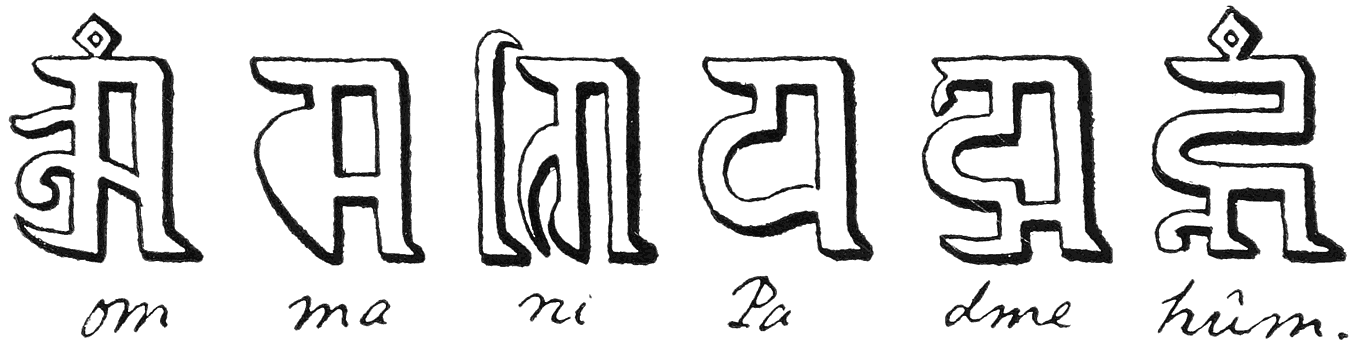
om ma ni Pa dme hûm.