Chapter II · RESIDENCE AT TASHILHUNPO.
Reading edition
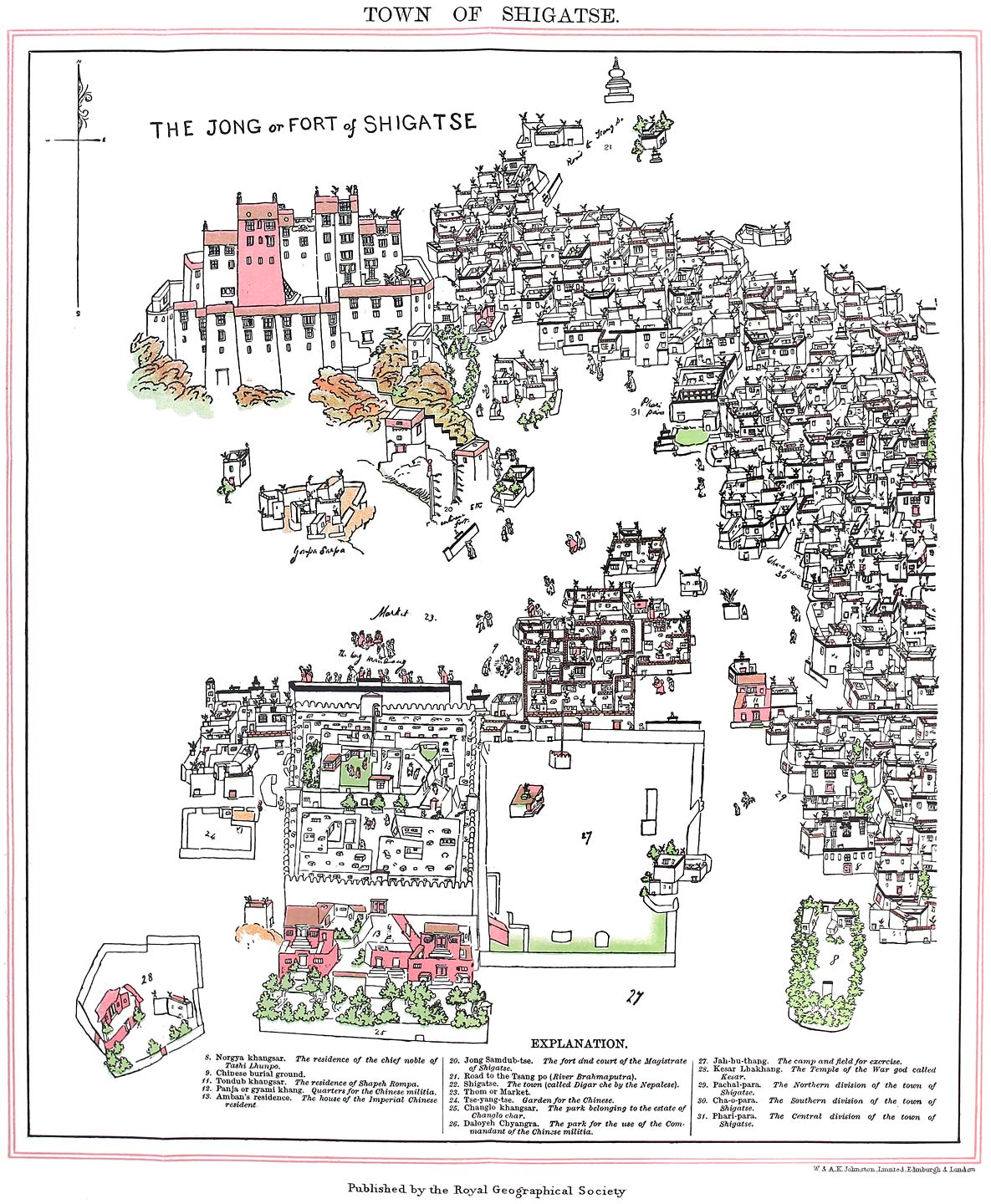
TOWN OF SHIGATSE.
THE JONG or FORT of SHIGATSE
EXPLANATION.
3. Norgya khangsar. The residence of the chief noble of Tashi Lhunpo.
9. Chinese burial ground.
11. Tondub khangsar. The residence of Shapeh Rompa.
12. Panja or gyami khang. Quarters for the Chinese militia.
13. Amban’s residence. The house of the Imperial Chinese resident.
20. Jong Samdub-tse. The fort and court of the Magistrate of Shigatse.
21. Road to the Tsang po (River Brahmaputra).
22. Shigatse. The town (called Digar che by the Nepalese).
23. Thom or Market.
24. Tse-yang-tse. Garden for the Chinese.
25. Changlo khangsar. The park belonging to the estate of Changlo char.
26. Daloyeh Chyangra. The park for the use of the Commandant of the Chinese militia.
27. Jah-hu-thang. The camp and field for exercise.
28. Kesar Lhakhang. The Temple of the War god called Kesar.
29. Pachal-para. The Northern division of the town of Shigatse.
30. Cha-o-para. The Southern division of the town of Shigatse.
31. Phari-para. The General division of the town of Shigatse.
W. & A. K. Johnston, Limited, Edinburgh & London
Published by the Royal Geographical Society
The Nerpa told me that we were to be lodged here by the minister’s order, but if we did not like the place we might write to him on the subject, and he would have the letter forwarded to Dongtse. The remoteness of the house, with only that of the minister near it, and, above all, its location near the western gate, gave it peculiar advantages, which appeared to me very essential for my purposes, and we had every reason to be delighted at the forethought of our patron, who had shown himself so anxious about our safe arrival and comfort.
When the Nerpa and Machen had left us, I consulted with Ugyen about making presents to the servants of the minister and to our former acquaintances. Money, being very scarce in Tibet, is valued above all things, so that for the renewal of our former acquaintance we could do nothing better than to make presents of silver coin and scarves (khatag).
Later on in the evening we returned the visits of the steward and his comrades, and presented them with rupees, eight-anna or four-anna pieces, according to the importance of their respective offices. With difficulty we persuaded them to accept the presents, for they feared lest the minister might be vexed at their taking money from me.
In the market-place my men saw several parties of prisoners loaded with chains weighing twenty pounds and upwards. Some had their hands manacled, others their arms passed through blocks of wood, not a few had their eyes put out. The Government does not provide these miserable wretches with food, but lets them beg their sustenance in the market-place. They are more troublesome than even the Ragyabas, and pour out curses and vile abuse on all who do not at once give them alms. At 4 p.m. I was told that the minister’s secretary, the Kusho Tung-chen, had arrived, and wanted to see me; so I dressed myself in my lama costume, and, accompanied by Ugyen carrying a few coins and some khatag, I went to the Puntso Khangsar.
Being conducted into his presence, I presented him with a scarf and a couple of rupees, and Ugyen did the same. We were then given fine khatag, and asked, with an air of genuine cordiality and kindness which greatly pleased me, to be seated beside him. A stuffed raised seat, covered with a Chinese rug, was given me, and a small table placed before me. Ugyen occupied a lower seat, and the table given him was also lower than mine, to show the difference of rank between us. Plates of dried and boiled mutton, together with bowls of tsamba, were served us. An attendant then brought from the minister’s shelves handsome china cups, and, filling them with tea, asked me to drink with “Pundib la, sol-ja-she” (“Please drink, Mr. Pundit”), at which I drank about a third of the contents; for it is customary in Tibet not to drink more than this at first, while to drink less would be a reflection on the cook or the host. After a short conversation of no importance I returned to my dwelling.
December 12.—The secretary sent to inform us that he would be despatching a messenger to Dongtse in the evening, and that if we had any letters to send they should be ready before noon. We at once applied ourselves to drafting a letter to the minister, which was no easy matter, as the form of the paper, the margin to be left at the top and bottom of the sheet, and the choice of complimentary words at the beginning, had all to be carefully weighed. We tried to convey to the minister how sorry we were in not having had the honour and pleasure of meeting him at Tashilhunpo, and how thankful we felt to him for his great kindness in arranging for our comfort and accommodation. We begged him, if possible, to return to the capital for the good of all living beings, and particularly for ourselves, who depended solely on his mercy for the security of our lives. We also told him that the lithographic press he had ordered me on my first visit to buy for him in India had arrived at Lachan, where it was held by the prefect of Khamba djong. Ugyen wrote a separate letter to the minister, and then we took them to the secretary, who added a few lines to our notes, asking his master to vouchsafe his sacred protection and mercy to us who had come so far and had encountered such incredible hardships and dangers.
Returning home, I found Lupa gyantsaan (gyaltsan?), a former acquaintance, awaiting me. He presented me some provisions and other things, and offered his services to buy what I might require, and see that I was not cheated. He also agreed to send me a good servant.
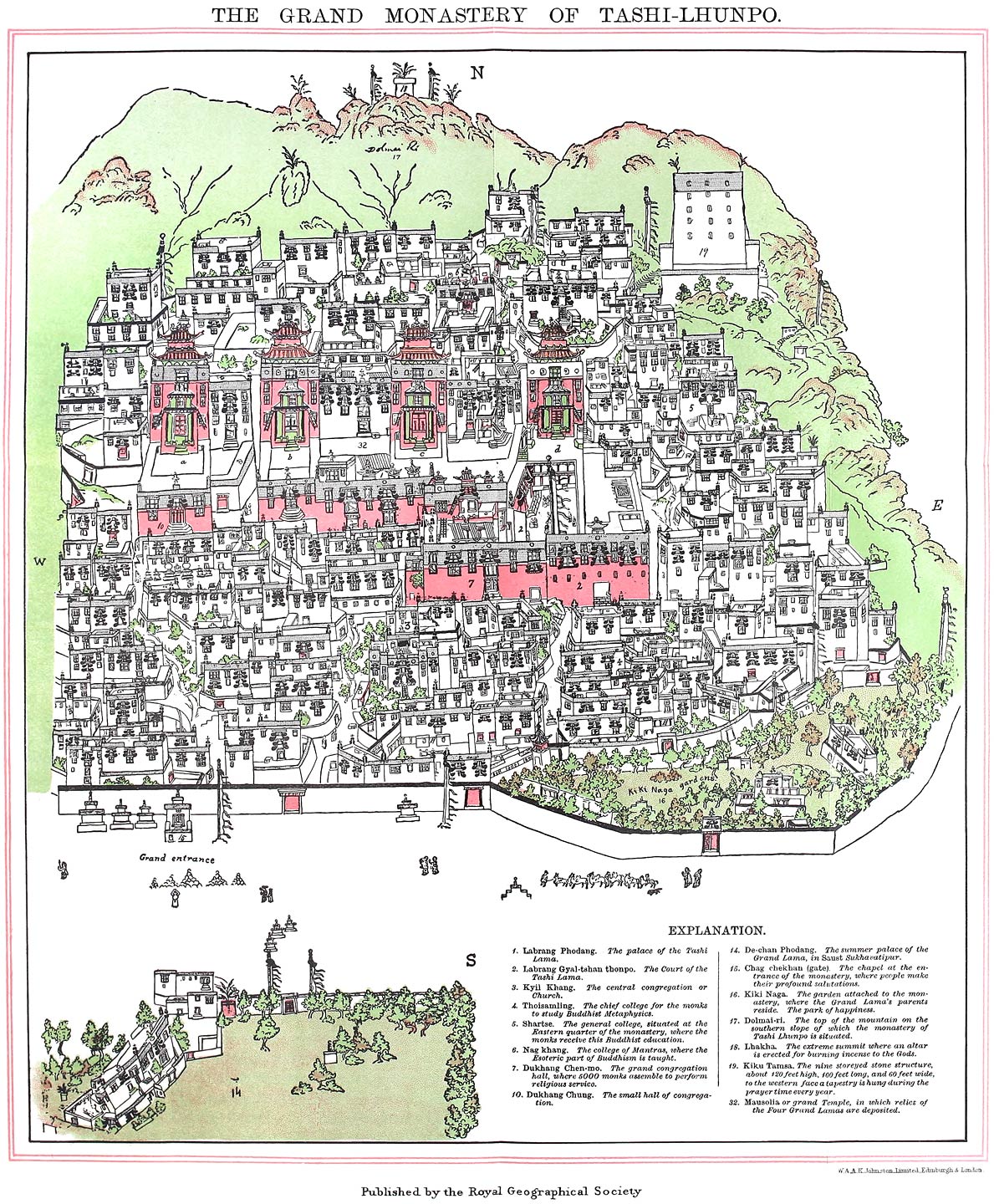
THE GRAND MONASTERY OF TASHI-LHUNPO.
EXPLANATION.
1. Labrang Phodang. The palace of the Tashi Lama.
2. Labrang Gyal-tshan thonpo. The Court of the Tashi Lama.
3. Kyil Khang. The central congregation or Church.
4. Thoisamling. The chief college for the monks to study Buddhist Metaphysics.
5. Shartse. The general college, situated at the Eastern quarter of the monastery, where the monks receive this Buddhist education.
6. Nag khang. The college of Mantras, where the Esoteric part of Buddhism is taught.
7. Dukhang Chen-mo. The grand congregation hall, where 5000 monks assemble to perform religious service.
10. Dukhang Chung. The small hall of congregation.
14. De-chan Phodang. The summer palace of the Grand Lama, in Saust Sukhavatipur.
15. Chag chekhan (gate). The chapel at the entrance of the monastery, where people make their profound salutations.
16. Kiki Naga. The garden attached to the monastery, where the Grand Lama’s parents reside. The park of happiness.
17. Dolmai-ri. The top of the mountain on the southern slope of which the monastery of Tashi Lhunpo is situated.
18. Lhakha. The extreme summit where an altar is erected for burning incense to the Gods.
19. Kiku Tamsa. The nine storeyed stone structure, about 120 feet high, 100 feet long, and 60 feet wide, to the western face a tapestry is hung during the prayer time every year.
32. Mausolea or grand Temple, in which relics of the Four Grand Lamas are deposited.
W. & A. K. Johnston, Limited, Edinburgh & London
Published by the Royal Geographical Society
Returning to Shigatse on his way back to Lhasa, the Amban stopped there several days, during which he insisted on a daily allowance of Rs. 750, which, the people protesting they could not pay, the Chinese soldiery, by various oppressive means, tried to squeeze out of them. The Tsipon tried to resign his commission, and then the Amban visited his anger on him. In the mean time the people combined in a body to resist the exaction, and, with the connivance of the two prefects (Djongpon) of Shigatse, openly refused payment of the Amban’s unjust demands. The Amban, furious, ordered his Chinese soldiers to arrest the Djongpon and put the Tsipon in irons; but the former fled, and the soldiery were stoned by the mob. The next day the Tsipon was tied to a pillar of the Amban’s house and flogged. After he had received some fifteen cuts, volleys of stones were thrown, and the Amban severely hurt before he could escape into the house, and he was only saved from the infuriated populace by the prompt arrival of the Tibetan general (Dah-pon) with the troops under his command. Then it was that a messenger was sent post-haste to Lhasa, and the senior Amban, the ministers (Shape) Rampa and Lhalu having arrived, formed, with the temporal minister of the Tashi lama (Kyab-dvang chenpo) and the paymaster of the forces, a commission to investigate the matter.
Their judgment in the case was made known on the 12th. It bore that the two Djongpon of Shigatse should be degraded from the third to the fourth class of Chinese official rank, losing also their position as Djongpon for that of Djongnyer under new Djongpon; and that, furthermore, each of them should receive two hundred blows with the bamboo. The village headmen (tsog-pon) were to receive four hundred blows with the bamboo, and be imprisoned for two months in the jails of Re and Khamba djong. Eight elders (gampo) were to receive fifty blows of the bamboo, and wear the cangue for six months.
December 13.—To-day some 15,000 persons assembled at noon in the market-place to see the arrival of the Kashmir Envoy with his guards and escort in military dress. All the alleys of Shigatse, the courtyard of Kesar Lhakhang, and the adjacent gardens were filled with people all eagerly waiting for the temo (sight). There was the Envoy of the Maharaja with some fifty sowars, all in uniform, besides a hundred mounted followers of various nationalities, some Sikhs, Mohammedans with flowing beards and white turbans, Ladakis in clumsy lambskin dresses, Murmis from Nepal, Dokpas from Chang, a few Nepalese, and some Tibetans from Kirong. There were also with the Envoy a number of merchants dressed in princely style, and attended by servants in liveries of silk and broadcloth. Some of their ponies were also richly caparisoned with ornaments of silver and brocade of gold. The Kashmir Government, I learnt, sends an envoy to Lhasa every three years with presents (called tribute) to the Grand Lama. The Tibetan Government, on receiving notice of the proposed setting out of the mission, has relays (ta-u) of ponies and mules, about 500 head, and also coolies, prepared at all the towns and post-stations along the road from the Ladak frontier to Lhasa. Although so large a number of ponies and men is hardly necessary for the Envoy, who only brings presents of precious things of little bulk, the party avails itself of the privilege for the carriage of personal property and merchandise to and from Lhasa. As the mission passed by, we heard the people remark that all this splendour and ostentation was at the expense of the Government of Lhasa, and to the ruin of the poor people of Tibet.
Talking with the Kusho Tung-chen of the severity of the punishment inflicted yesterday on the Djongpon of Shigatse and the circle headmen (tsog-pon), he told me that, besides those mentioned above, the Djongpon had had the flesh and skin stripped off their hands. The tsog-pon had offered to pay the mandarin Rs. 2000 a-piece to escape the 400 blows of the bamboo, but the Chinese had been inexorable.
December 14.—The Tung-chen sent me one of his acquaintances, Norpu Tondub, a Donnyer of Dongtse, with a request that I would let him have some medicine, as he was suffering from dyspepsia. At first I refused, as I had but very few drugs with me, and only in quantity sufficient for myself; but, the Tung-chen insisting, I took my medicine-chest with me and went to his house. Lifting up the lid, I displayed the various bottles with their sparkling contents, the secretary, his friends, and the servants all looking on with amazement, while Norpu Tondub, at the very sight of the bottles, seemed to become certain of recovery, and said he would pay as much money as I might ask. I replied that even then I could not let him have any medicine, as no amount of money could get me a fresh supply of drugs from India once these finished, for the passes were all closed by the Tibetan Government. At this the Tung-chen looked anxious, so I opened one of the bottles and called for a china cup, and three or four persons ran to the kitchen and brought me half a dozen large and small ones. I weighed the medicine in my brass balance; the drams and scruples, which glittered like gold coins, perplexed them much, as they thought I was a miracle-worker who used gold coins for weights. I now told them that the two medicines when mixed would boil. The very announcement of this filled the spectators with mute amazement, and made the patient tremble with fear; he looked at the Tung-chen and then to heaven with anxiety, evidently repenting him for having pressed me for medicine, and seemed anxious to escape from my hands. The secretary, too, looked aghast; but the medicines were mixed, and to his mind they were too valuable to be thrown away; so, having examined if the two mixtures were hot, and finding that they were not, he encouraged the patient, saying that I was a great physician, and he had no cause to apprehend danger from my hands. I told the patient that he could depend on me that I was not going to administer poison to him, and to be ready to take the draught as soon as it frothed up. All waited with eager expectation to see the phenomenon, when lo! the mixture foamed with a hissing noise, which made the patient shrink back. I told him to dip his finger in the boiling mixture; and when he found it cold he uttered the mystic sentence, “Om mani padme hum,” and swallowed it, and said it was agreeable and refreshing. He then drew from the breast of his gown a khatag and a few coins, and offered them to me, laying the scarf on the ground before me. “Great physician,” he said, “accept this little token of my gratitude, though it is not worthy of your acceptance. Considering, however, that you are a pious man to whom money is of no value, I venture to hope you will accept it.” I declined the money, but at the request of the Tung-chen accepted the scarf. With looks of open-mouthed astonishment and feelings of endless admiration for the marvellous properties of the medicine and for the wonderful amchi (physician) who disdained money, the little circle of spectators returned to their houses and work.
The punishment of the Djongpon had filled the people with fear of the Chinese. They apprehended new insults at the hands of the Chinese swaggering about the streets of Shigatse. People who had come to the market from a distance to sell their goods were packing them up to hurry off home. No provisions could be had, no purchases could be made. Ugyen met some grain-dealers whom he knew, and begged them to sell him some rice, but none would acknowledge even that they had any for sale. An old woman who had sold us rice on our first visit here said, “Do not talk of rice before the Chinese and their friends, for they will come and take what I have away and throw some bad coins in my cloth. Come in an hour or two, when the rascals have gone away, and I will let you have what you want.” On one side of the market-place is a large zakhang, or restaurant, where Phurchung and Ugyen went to appease their hunger. While they were busy with their chopsticks the proprietor came in. He was a nobleman of Tashilhunpo, head of the Tondub Khangsar family, and held the office of Chyangjob of the Tashi lama. He asked Ugyen whence he had come, where he had put up, and what merchandise (chong) he had for sale. The lady, under whose immediate supervision this establishment is, is no less a personage than the wife of this dignitary. Her manners were gentle and dignified, and she spoke in a sweet and polite manner. Her head-dress was covered with innumerable strings of pearls, worth certainly not less than Rs. 3000, and besides these there were on it coral beads, rubies, turquoises, and other precious stones. Although she belongs to one of the richest and noblest families in Tsang (Ulterior Tibet), besides being connected with the family from which the Tashi lama has sprung, yet she does not feel it beneath her dignity to keep the accounts of the inn and superintend the work of the servants.
Late in the afternoon the Mongol monk Lobzang tanzing, to whom I have previously referred, came to pay me his respects, and presented me a long khatag and the carcass of a large sheep. He had only a few days before been released from a two-months’ imprisonment, under suspicion of being implicated in a case of forgery, and had been repeatedly flogged. His tutor had been sentenced to three years of imprisonment, and had been sent to the prison of Khamba djong.
In the evening the monks of Tashilhunpo busied themselves illuminating their chapels. Hundreds of butter-lamps were tastefully placed in rows on the roof of every building in the lamasery. The Government supplies butter to every house in the town and to every resident monk, to enable them to contribute towards the illumination. From the roof of my house I saw the illuminations to great advantage. The fantastic roofs of the four tombs (gyophig) of the Tashi lamas were beautifully lit up. The mitre-shaped spires, the upturned eaves of the temple looked most gorgeous, and resembled the illuminated tajiahs in a mohurum procession in India. The great monastery of Tashilhunpo, situated as it is at the foot of a hill, presented a magnificent appearance. For an hour the illumination was beautiful, but towards 7.30 o’clock the wind began to blow a gale, and had soon extinguished all the lights and driven me into my house shivering with cold.
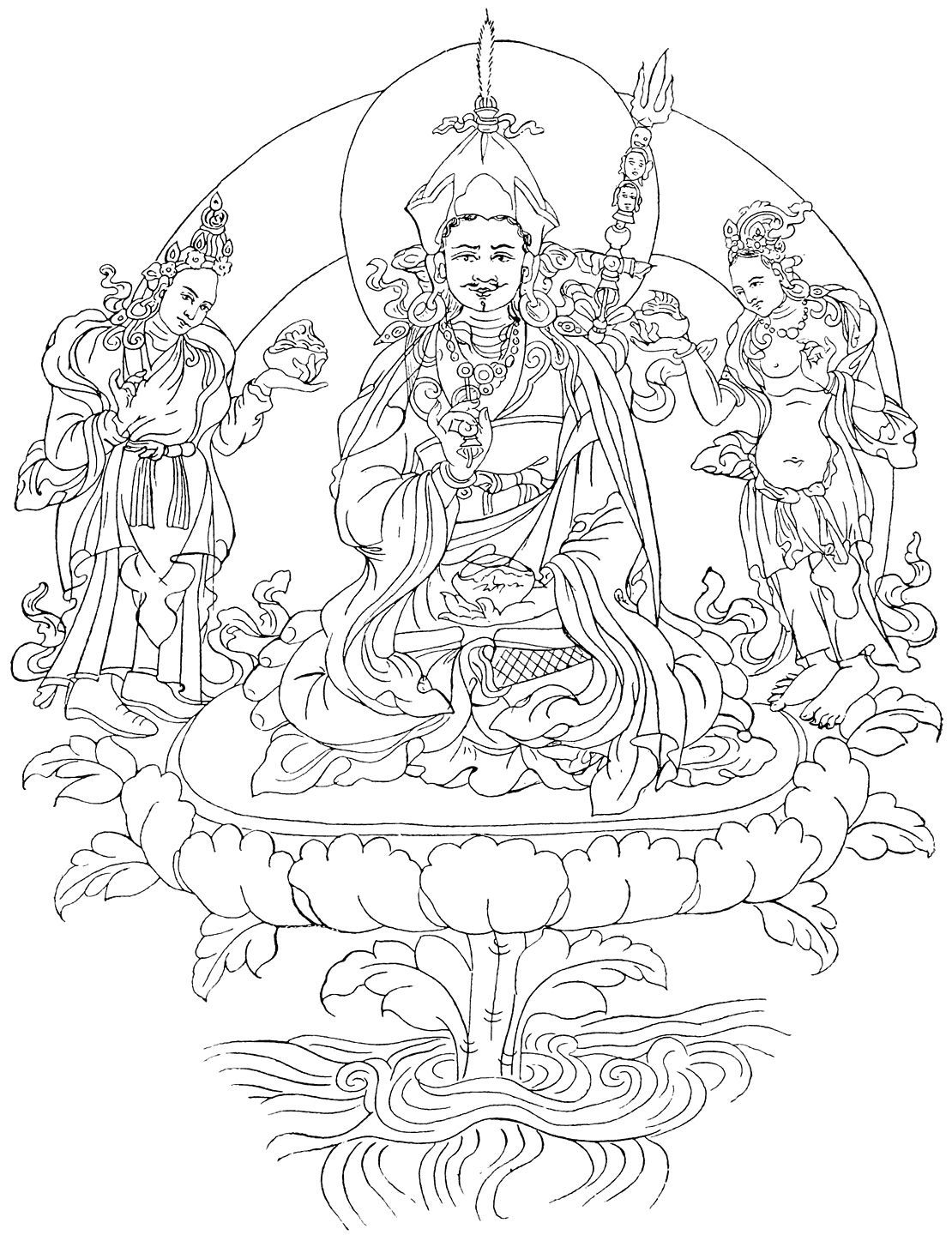
KANDRO YE-SHES. PADMA SAMBHAVA. LHA-CHAM MANDARASA.
Phurchung and Ugyen, whom I had sent out to buy books for me, returned towards 2 o’clock with a quantity, and later on, while I was sitting making my choice of volumes, the bookseller’s son came in to carry back those I did not require. I had a talk with him about different books, and he gave me some very interesting information.
I engaged also, to-day, a new cook in place of Phurchung, whom I proposed sending to Khamba djong to arrange for the conveyance from the Lachan barrier to Khamba of the lithographic press bought for the minister.
December 16.—Getting up from bed at 7 a.m., I spread two mattresses on the third floor, opened the shutters, and, while basking in the sun and sipping tea placed on a little table before me, began to turn over the leaves of one of my newly purchased volumes. The residents of the neighbouring houses peeped out from their windows to observe my manners and habits. Henceforth I was careful to conduct myself like a good gelong (priest). Reading attentively, writing and making notes was the chief occupation of my days. It was not my habit to chant mantras, or hymns, or say my beads, for in the former practice I was never proficient, and with my beads I could only separate one bead from another without any knowledge of the prayers meant to accompany that mechanical action.
December 17.—A messenger arrived from Dongtse with a letter from the minister asking Ugyen and me to come to Dongtse, a distance of about 40 miles, which town he was unable to leave, for various reasons, for some time to come. Before leaving I was anxious to start off Phurchung for Khamba djong, and also to get winter clothes for myself, as the cold was getting keener every day. Our house, like all houses in Tibet, had no chimney, and as the ceiling was covered with fine Chinese satin, dung-fuel was most objectionable, so I had charcoal burnt in the room in nicely made earthen stoves (jalang), paying about a rupee four annas a maund weight.
December 19.—Tsering-tashi was despatched again after the passport. The delay in securing it was occasioned by the Tung-chen not having tipped the clerks and officials who had charge of the matter. The senior Amban started to-day for Lhasa viâ Gyantse and Nangartse djong. All the ponies of Shigatse had been requisitioned to supply his numerous retinue with riding and pack animals, so the junior Amban and the Shape could not get off for want of ula, and the local authorities of Gyantse were ordered to supply what they could to them as soon as the senior Amban reached their place. In the meanwhile the Chinese were strolling about the Shigatse market, carrying off the best of everything, paying nothing, or only a nominal price for the things they took. People coming into town saw their ponies seized by the ta-u officers for the Amban’s service, and started off with loads to Gyantse. My men could buy nothing, for most of the people had packed up their wares and fled; but they managed to purchase some mutton and rice inside the monastery, and we found out that good things could be had there at comparatively moderate prices.
December 21.—To-day is the new moon (nam-gang, or “full night”), one of the holiest days of the month. The conch-shells called loudly the lamas to prayers. From break of day to an hour after sunset large numbers of men and women circumambulated the monastery, some carrying strings of beads, others prayer-wheels. Early in the morning the Nepalese, beating cymbals and chanting Sanskrit mantras, walked around the great monastery.
Towards 10 o’clock my attention was attracted by an unusual scene to the east of the monastery, where the entire space between the great mendong of the market-place and the eastern gateway of Tashilhunpo was filled with beggars, both men and women. Among them were people from Amdo and Khams, whose eyes had been put out for crimes such as murdering lamas; some were cripples and walked with crutches, some in heavy chains and drawn on wheelbarrows, some maimed, others deaf and dumb, others, again, still bearing traces of the torture to which they had been subjected—a vast concourse of misery and pain. In their midst stood the well-known Lhagpa-tsering distributing alms, an anna to each one. For ten years past he had done thus on the first of every moon. The circumstances which led this worthy man to undertake giving alms to the indigent is very remarkable and instructive.
Lhagpa-tsering had been a silversmith, and had by patient work amassed such wealth that he established himself as a jeweller and banker. His business prospered; in his shop were all kinds of goods—fine china, besides pearls, coral, turquoises, and jade; and here came all the great men of the country. He became noted also for his munificent gifts to the lamasery of Tashilhunpo. Some ten years ago there lived at Shang a saintly lama called Chyabtam lama; the purity of his life and his vast learning had made him an object of worship for all classes of people in Tsang. The jeweller Lhagpa, believing that if he made offering to so holy a personage his profits in trade would increase a hundred-fold, went to Shang and offered the lama Rs. 1250, besides numerous objects of value. The saint refused them all, telling him that they represented dishonest earnings, and were the property of a dishonest man. “In a previous existence you were a great sinner, and in your next you will be a crocodile.”
On the following morning Lhagpa, filled with horror at his impending fate, came and begged the sage to tell him how he might avert the horrible punishment—what acts of charity, what good deeds would save him; but the lama made no reply. Again the next day he came, and the saint looked in his magic mirror, and said, “If henceforth you give alms to the poor and helpless, of whatever station, creed, or country they may be, on every new moon throughout the year till your death, you will surely get immense wealth, as well as escape from rebirth as a crocodile. There are no other means to save you;” and he sent Lhagpa away without accepting his gifts. Since then he has been in the habit of distributing alms on the first day of the moon. His example has produced a wholesome influence on the merchants of Khams, who now show some hesitation in cheating. A trader, when he cheats others, thinks, as a general rule, if he is a Buddhist, that the amount thus gained was due to him in a previous existence. This is a dangerous principle.
Close to the cemetery of Shigatse, called Kega tsal, is the Chinese graveyard, where there are about three hundred tombs of varying size and very rude construction. At a short distance from this is the parade-ground, about half a mile square, called Jah-hu-tang, and touching it a walled enclosure, used for target practice with bow and gun, in the centre of which is a large house used by the Ambans. On the sides are high towers for the drum-beaters and trumpet-blowers. The headmen of the whole country had assembled here to-day to muster the porters and pack-ponies required by the junior Amban and the Tibetan officials returning to Lhasa. Three hundred ponies were ready, and it was decided that one man should accompany each horse. Orders had been given by the Amban to requisition all the ponies in the province, no matter whether they belonged to subjects, traders, or pilgrims.
December 22.—To-day, at 9 a.m., the junior Amban, with a retinue of 300 men on horseback, left for Lhasa. The owners of the relay ponies followed them on foot, keeping pace with the ponies, or if they lagged behind they were whipped by the men on horseback; so that some dropped out and disappeared, abandoning their property to the Chinese rather than undergo their ill treatment. Of the six village headmen exiled to Re and Khamba djong for their share in the recent trouble, I learnt to-day that one had died on the road, and another is hanging between life and death.
December 23.—To-day the Shape Lhalu and 100 followers, all on horseback, left for Lhasa. The ponies and the men who have to accompany them on the ula are treated with great hardship. They have to carry their food with them, as well as provender for their beasts. In the present case they had received but short notice, and are ill prepared for the long journey. This forced service is, however, patiently borne by the people, as it is a recognized custom of the country.
There were on the market-place many wildly dressed Dokpas of the Chang province. The women wore such heavy and fantastic apparel that one who had not before seen them might well be taken aback. From a distance these savages looked as if they wished to imitate the peacock’s gaudy plumes in their costume; they had so many beads of glass, coral, amber, and turquoise suspended from their headdress that one could hardly see their faces.
In the evening Tsering-tashi brought us the passport from the Tondub Khangar, to enable us to bring our things from Lachan to Tashilhunpo. Though it is customary to issue passports in open covers, this one was enclosed in a letter to the Djongpon of Khamba, and we were therefore unable to know its wording, but feared from this fact that some orders, probably to examine closely our packages, were contained in it. The Tung-chen, however, did not apprehend that any trouble would arise from this fact, but we could not share his confidence.
He said he was sorry that he was unable to copy the manuscript of the Dsam-ling-gyeshe, but recommended Dungyig Phurching; and the latter agreed to do the copying at the rate of six leaves for a tanka, exclusive of ink and paper.
To-day news arrived of the death of the Tsopon Shanku, one of the six headmen, and the richest among them, punished on account of the late riot. I saw several monks and laymen carrying from the monastery to Shigatse three huge copper caldrons, about five feet in diameter, and I learnt that tea and tugpa (a soup of tsamba, minced meat, and radishes) were to be prepared in them for the entertainment of upwards of a thousand beggars in honour of the deceased. The caldrons belong to the lamasery, and were loaned for the occasion.
Later on in the day the Tung-chen’s men came and told us of the arrangements made for our journey to Dongtse, and that we were to be ready to start on the following morning. As we would only remain at Dongtse a very short while—for the minister was expected to return in a few days to Tashilhunpo—we were told not to take many things with us, and were not to hire donkeys, as we had intended, to carry our luggage. I passed the evening writing letters to send home by Phurchung, who was to start at the same time as we did for the Sikkim frontier.