Chapter V · FROM TASHILHUNPO TO YAMDO SAMDING, AND THENCE TO LHASA.
Reading edition
On Wednesday, April 26, 1882, being the eighth day of the third moon of the water-horse year of the Tibetan cycle, I left Tashilhunpo for Dongtse, there to make my final arrangements for the journey to Lhasa.
The cook, Dao-sring, nicknamed Aku chya-rog, or “Uncle Daw,” on account of the dirt and soot which always covered his face, now turned out with well-washed face and hands, in new leather boots and fur cap, and helped me to mount my pony.
I tied up my medicine-case in one of my saddle-bags, and in the other I put my clothes, and at 2 o’clock we started. There were five of us in the party, all mounted, and riding in single file: first came the Tung-chen, then I, then came Tsering-tashi, and the cook and a groom brought up the rear. We followed the same road I had already gone over on several occasions, and stopped the first night at Chyang-chu, where we put up in the house of our friend the Deba Shikha.
We were detained at Chyang-chu all day, waiting for Tsering-tashi, who had been obliged to stop over at Tashi-gyantsa to make some purchases.
We reached Dongtse at 4 p.m. on the 29th, and took up our lodgings in the Choide; but in the evening the Deba Chola came and invited us to put up at the castle, where the minister was still staying.
The Tung-chen took an early opportunity to inform the minister that his presence was anxiously expected at Tashilhunpo, where hundreds of lamas were awaiting his return to be ordained gelong (priests). He also told him that the Mirkan Pandita, a Mongol Kutuketu who had come to Tibet for the sole purpose of studying under the minister, now intended coming to Dongtse, and had begged that arrangements might be made for his accommodation in the minister’s residence. While the minister recognized the necessity for his returning to Tashilhunpo, he said he could not leave until the services for the propitiation of the Lord of death, Dorje jig-je, to be undertaken for the recovery of the Dahpon’s wife, were finished.
May 8.—News arrived to-day that small-pox was raging at Lhasa and other places of Central Tibet. Several persons had also died of it at Gyantse, and three or four localities between that town and Lhasa were infected. The Lhacham was in so great dread of the disease that she confined herself to her sitting-room, refusing to see any one.
At the foot of the ladder in the courtyard a white pony, with handsome housings of embroidered cloth and a Tartar saddle, awaited the Lhacham. With her pearl-studded headdress, her gold and ruby charm-boxes, her necklaces of coral and amber, and her clothes of satin and kinkab, she looked like a heroine of romance or a goddess.
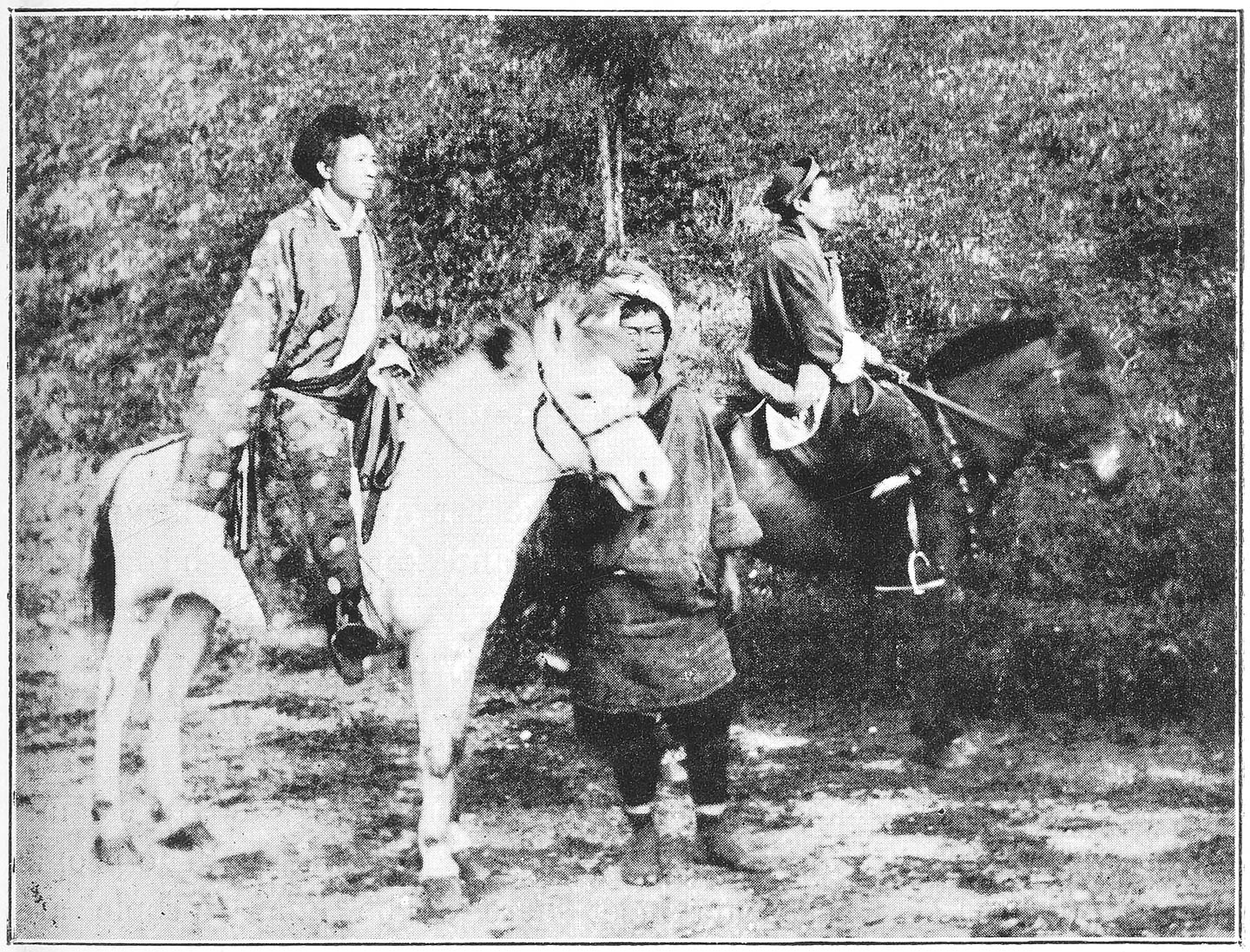
TIBETAN NOBLEMAN.
May 11.—A messenger arrived to-day to inform us that the Lhacham would leave Gyantse the next morning, and that we would do well to see her at Gyankhar before she started; so, though I was feeling very poorly, I made up my mind to start at once.
At an early hour the next day I went with Tsering-tashi to see the minister, ask his protection (kyab ju), and beg to be favoured with his advice as to the conduct of our journey, or sung-ta, as it is called.
As is usual on such occasions, each of us presented him with a khatag, in the corner of which were tied up a few tankas in a bit of paper, on which was written our request.
After saying good-bye to the members of the minister’s household, presenting and receiving khatag and various other little presents, and drinking tea, I mounted my pony and set out for Gyantse. Thus did I start on a journey to a hostile, inhospitable, and unknown country with only two men as my companions, and they strangers to me.
At a huge willow stump I waited a while for Tsering-tashi to join me, for Pador, with the pack-pony, had gone to his home to get his lance. As Tsering-tashi came up, he was delighted to see water flowing from a pool in the direction we were to follow; this he took for a most auspicious sign. On reaching chorten, about a mile from the town, we alighted and waited for Pador, who shortly after made his appearance with a lance full 12 feet long in his hand.
By noon we reached Gyantse, and, passing rapidly through the market-place, where I feared to be recognized, we entered the Gyankhar, or castle of Gyantse.
At 1 p.m. the Lhacham and her sons started for Lhasa, and as she passed by me she told me to meet her at Gobshi that evening.
I was now surrounded by the Chyag-dso-pa and his family, all curious to see the Indian physician of whom they had heard so much of late. From what the Chyag-dso-pa told me, I concluded he had chronic bronchitis, which might end in consumption. I gave him a few grains of quinine and some doses of elixir of paregoric, and directed him also as to his diet.
After partaking of some gyatug, rice, and boiled mutton with the family, I asked permission to leave, and was escorted to the gate, where, mounting my pony, I bade them farewell.
The Lhasa high-road I found very similar to a rough Indian cross-road; in some places it is more than 20 feet wide, in others a mere trail, while in many places, where it runs between fields, it is also made to serve the purpose of an irrigation ditch. The Tibetan Government pays very little, if any, attention to road-making, though, in such a dry climate, it would be easy to construct good ones, and it would be little trouble to keep them in repair. Thus far on my travels in Tibet I had seen no wheeled conveyances, and I now learnt that such things are unknown throughout the country.
May 13.—Gobshi, or “four gates,” is a large village of about fifty houses, half of it belonging to the Lhacham’s father-in-law. There are a few poplar and pollard willow trees growing in front of the village, and terraced fields planted with barley extend along the river banks. A little to the east of the village, in the hills beyond the confluence of the Nyang and Niro chu, there is a very ancient Bonbo lamasery, called Khyung-nag, or “Black Eagle” monastery, which in the fifteenth century was a place of pilgrimage famous throughout Tibet.
After leaving Gobshi, we passed by Kavo gomba, a Ningma religious establishment, and Tsering-tashi called my attention to the blue and red bands painted on the walls of the temple and dwellings of the lamas, telling me that these coloured stripes are characteristic of this sect.
May 14.—We left without even waiting for a cup of tea, as the Lhacham was desirous of reaching Nangartse the same day, and, in spite of my enfeebled condition, I was anxious to keep up with her party, for the country we had to traverse is infested by brigands.
A short way down the other side of the pass we came to a little hut made of loose stones, where we rested and partook of some refreshments. In conversation with the Lhacham, I mentioned the superiority of sedan chairs (shing-chyam) over saddle-horses, especially for women when travelling. But she held that it was degrading men to make them serve as beasts of burden, and that if it should be tried in Tibet the people would certainly resent it as an indignity. “There are only the two Great Lamas, the Amban and the Regent, who are allowed to use sedan chairs in Tibet,” she went on to say; “no other persons, however great they may be, can make use of them.”
About six miles down the valley we came to the hamlet of Ring-la, where the Kharnang-phu chu turns north to empty into the Yamdo-yum-tso. At this village the Nangartse plain begins, and the monastery of Samding becomes faintly visible.
The road now became good, and the ponies quickened their pace, and by 5 o’clock we came in view of the town of Nangartse.
The houses of the fishermen and common people (misser) are perched on the hillside overlooking the prefect’s house (djong), and the broad blue expanse of Lake Palti’s waters spreads out beyond. The party stopped, and the Lhacham changed her garments for finer ones, and put on her jewelled headdress (patug). On arriving at the gate of the house where we were to stop, there was a raised platform covered with soft blankets; here the Lhacham alighted, while her sons and the rest of the party got down near by.
I passed a miserable night, with a raging fever and violent cough racking my whole frame. My two companions sat beside me and did what they could, but concluded that it was impossible in my present state for me to keep up with the Lhacham’s party all the way to Lhasa.
The next morning I was no better, the fits of coughing were more violent. The sons of the Lhacham and her attendants came to see me, and expressed their sorrow at having to leave me. The host said that the best thing for me to do was to go to the Samding monastery, where there were two skilful physicians who had recently successfully treated a case similar to mine. Hearing this, one of the Lhacham’s maids suggested that her mistress might give me a letter of introduction to the lady abbess of this convent, the Dorje Phagmo, with whom she was related and on the most friendly terms; the only danger was that she might not allow me to enter her convent, as, on account of the epidemic of small-pox, she had closed it to pilgrims.
I followed the advice of those around me, and the Lhacham kindly wrote to the Dorje Phagmo to take care of me and look to my wants; and after taking an affectionate farewell, and telling me to come straight to her house at Lhasa as soon as I recovered, she recommended me to the people of the house and rode off.
After taking a little breakfast, I made up my mind to go at once to the Samding gomba, which I learnt could be reached in two hours’ ride.
In the evening I was led to a house in the western end of the lamasery belonging to a monk called Gelegs namgyal, where I had to accommodate myself as best I could under the portico.
Tsing-ta, as Tsering-tashi was usually called, told me that he had asked the Dorje Phagmo to tell my fortune, and that she had made out that my illness would prove very severe but not fatal, but the performance of certain religious ceremonies was most urgently needed to hasten my recovery. She sent me word that, in view of the letter of introduction from the Lhacham I had brought with me, she would shortly be pleased to see me, and that we might have all we required while stopping in Samding.
The next day my companions asked me to give a “general tea” (mang ja) to the eighty odd monks of the convent, and to distribute alms to them at the rate of a karma (two annas) a head. I gave my consent, and at the same time my companions made, in my name, presents to the Dorje Phagmo and to the deities that were pointed out to them as best able to drive away the fiends of disease which surrounded me.
The Amchi advised me to carefully abstain from drinking cold water, especially as the water of the lake was injurious to many persons even when in good health. He also forbade me drinking buttered tea.
By agreeing to pay my host a daily sum of four annas, I managed to rent his two miserable rooms. They were about six feet by eight, and six feet high. In the bedroom were a couple of little tables, half a dozen books, and a couple of boxes; in a corner there was a little altar and two images of gods.
At the conclusion of the ceremonies Tsing-ta again saw the Dorje Phagmo, and, presenting her with a khatag and a couple of tanka, obtained another sacred pill. The doctor and his assistant impressed upon me the importance of only taking such medicines as experience had shown were efficacious in the Yamdo country. They also insisted that it was essential to my recovery that I should not sleep in the daytime. I felt so weak and ill that towards midnight I called my companions to my side, and wrote my will in my notebook. Later on some medicine given me by the doctor’s assistant, Jerung, brought me some relief.
May 18.—Tsing-ta again gave the lamas a mang ja and money to read the sacred books to my intent, and got still another sacred pill from the Dorje Phagmo. On his way back to our quarters he saw the ex-incarnate lama of the Tse-chog ling of Lhasa. He had been degraded for having committed adultery.
Seeing no pronounced improvement in my condition, my faithful follower went again in the afternoon to see the Dorje Phagmo, presented her a khatag and ten tanka, and got her to perform the ceremony known as “propitiating the gods of life” (tse dub). She also gave him a long list of religious rites, which, according to her, it was imperative that I should immediately get learned lamas to perform to insure my speedy recovery.
By the following morning there was a marked improvement in my condition, and I was able to sit propped up on my blankets. The news of the favourable change was at once reported to the Dorje Phagmo, who advised Tsing-ta to have performed the ceremony for propitiating Tamdrin, Dorje Phagmo, and Khyung-mo (the Garuda); especially of the first-named. Tsing-ta made her a further present of seven tanka and a khatag, and she agreed to perform these ceremonies herself.
May 24.—Early this morning the old doctor visited me. “The danger is over,” he said; “the fatal stage is passed; you can take a little food, some tsamba, a little soup and meat.” In truth, I felt so much better to-day that I took some exercise, and the fresh, bracing air did me a world of good.
The next day I was able to visit the shrines of Samding, on which tour my two companions accompanied me, carrying a bowl of butter, a bundle of incense-sticks, and about fifty khatag.
We first went to visit the kind old physician and his assistant, and I was much struck by the neat appearance of the floors of his rooms, made of pebbles very evenly laid in mortar, and beautifully polished. In the doctor’s sitting-room the walls were frescoed with Buddhist symbols, trees, and hideous figures of guardian deities. The furniture comprised of four painted chests of drawers, half a dozen small low tables, some painted bowls for tsamba, two little wooden altars covered with images of gods, and some rugs spread on the top of large mattresses. On the walls hung some religious pictures covered with silk curtains, and in a corner there were a sword and shield.
On leaving the physician’s house I entered the courtyard of the monastery, which I found more than 150 feet long, and 100 broad. There were buildings on three sides, and broad ladders, each step covered with brass and iron plates, leading to the main floor; the middle ladder is used by the Dorje Phagmo alone. On inquiring for her holiness, we learnt that she was engaged in certain religious duties, and would see me later.
In the meanwhile I visited various chapels and shrines. In the gong-khang (upper rooms) are lodged the most terrifying of the demons and genii; their appearance is so awful that they are usually kept veiled. Almost all the images were dressed in armour, and held various weapons in their hands. To each of the images Tsing-ta presented a khatag and a stick of incense, and Pador poured a little butter in the brass or silver lamps kept continually burning before them.
It is due, by the way, to the Dorje Phagmo’s spiritual influence that the waters of the inner lake or Dumo tso (“Demons’ Lake”), of the Yamdo tso, are held in bounds, for otherwise they would overflow and inundate the whole of Tibet. ’Twas for this that the Samding lamasery was originally built.
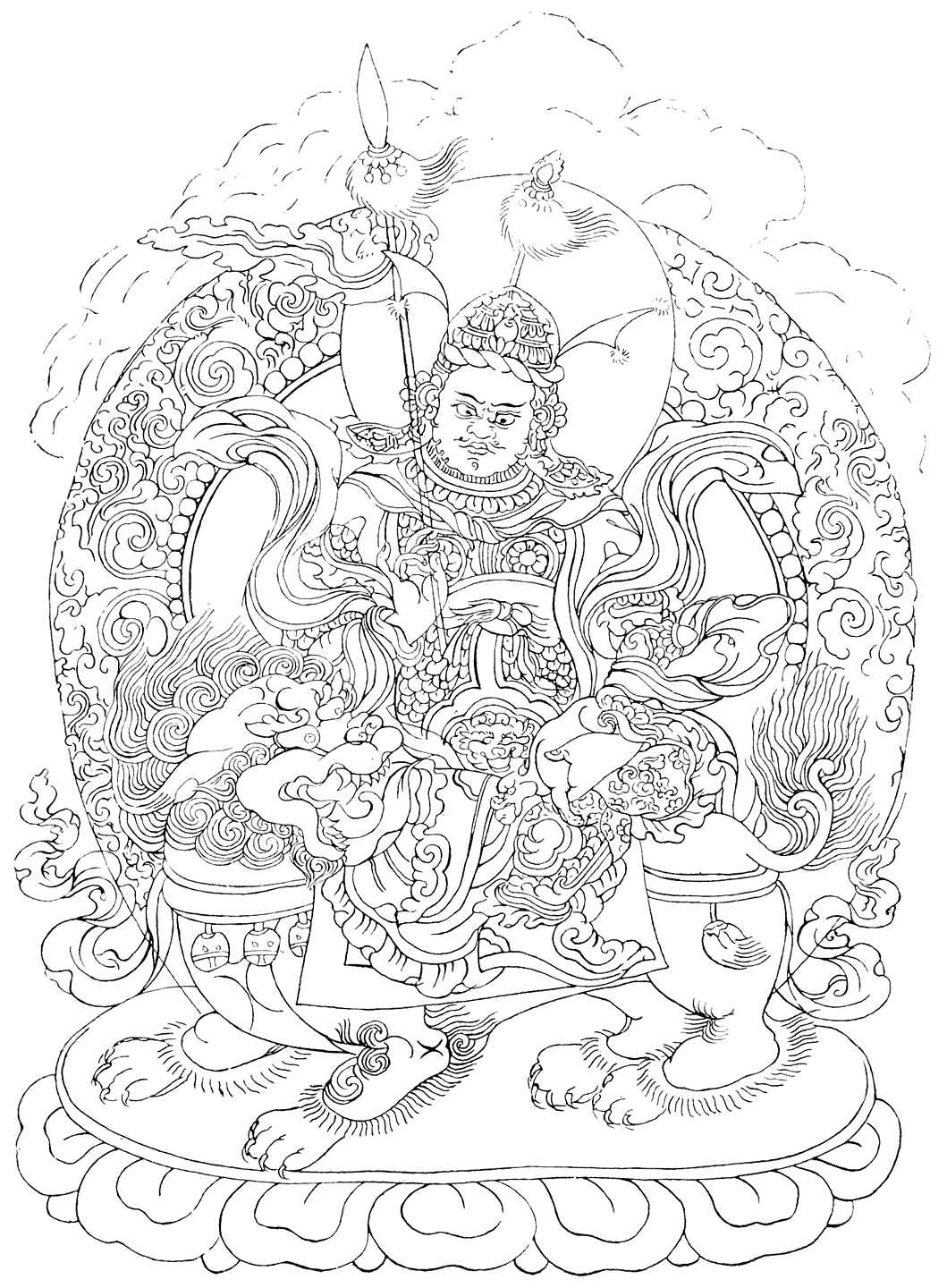
NAM TOS-SRAS (VAISRAVANA), THE GUARDIAN KING OF THE NORTH.
In another room, not open to the public, however, are the mortal remains of the former incarnations of Dorje Phagmo. I was told that each incarnation of this goddess visits this hall once in her life to make obeisance to the remains of her predecessors.
After visiting all the shrines we returned to the Dorje Phagmo’s apartments, where I was most kindly received. She occupied a raised seat, and I was given a place on her left, while the ex-incarnate lama, of whom I have previously spoken, occupied one a little behind her, but his seat was higher than mine. The ceremony of propitiating Tamdrin (Hayagriva) was proceeding, and twelve lamas in full canonicals were acting as assistants. A number of respectably dressed men and women who had come to be blessed were also seated about on rugs.
At the termination of the service sugared tsamba balls, about the size of bullets, most of them painted red, were distributed among those present. Before each person received any he prostrated himself before her holiness, who then gave them to him.
When all the spectators had left, the Dorje Phagmo told me that she took great interest in my recovery on account of the Lhacham, who was not only her friend, but her half-sister. I besought her to allow me to proceed on my journey to Lhasa, as I was most desirous of reaching the sacred city by the 15th of the present moon (June 1), the birthday of the Buddha, and she graciously gave me leave to start as soon as I was strong enough to bear the fatigue of travelling.
On taking leave, she gave me three more sacred pills, and directed her valet (gzim-dpon) to show me through her residence, where there was great store of handsomely carved and painted furniture, images of gold, silver, and copper neatly arranged on little altars. There was also a library with about 3000 volumes of printed and manuscript books. One work, in 118 volumes, was by Podong-chogleg namgyal, the founder of the sect to which the Dorje Phagmo belongs.
I learnt that the Dorje Phagmo, or the “Diamond Sow,” is an incarnation of Dolma (Tara), the divine consort of Shenrezig. In days of old, before the time when the Buddha Gautama appeared, there was a hideous monster called Matrankaru, who spread ruin and terror over all the world. He was the chief of all the legions of demons, goblins, and other evil spirits; even the devils (raksha) of Ceylon had to become his subjects. He subdued to his rule not only this world, but the eight planets, the twenty-four constellations, the eight Nagas, and the gods. By his miraculous power he could lift Mount Rirab (Sumeru) on the end of his thumb.
Finally the Buddha and gods held council to compass about Matrankaru’s destruction, and it was decided that Shenrezig should take the form of Tamdrin (“Horse-neck”), and his consort, Dolma, that of Dorje Phagmo (“the Diamond Sow”). When the two had assumed these forms they went to the summit of the Malaya mountains, and Tamdrin neighed three times, to fill the demon with terror, and Dorje Phagmo grunted five times, to strike terror into the heart of Matrankaru’s wife, and soon both were lying prostrate at the feet of the two divinities. But their lives were spared them, and Matrankaru became a devout follower of the Buddha, a defender of the faith (chos gyong), and was given the name of Mahakala.
In 1716, when the Jungar invaders of Tibet came to Nangartse, their chief sent word to Samding to the Dorje Phagmo to appear before him, that he might see if she really had, as reported, a pig’s head. A mild answer was returned him; but, incensed at her refusing to obey his summons, he tore down the walls of the monastery of Samding, and broke into the sanctuary. He found it deserted, not a human being in it, only eighty pigs and as many sows grunting in the congregation hall under the lead of a big sow, and he dared not sack a place belonging to pigs.
When the Jungars had given up all idea of sacking Samding, suddenly the pigs disappeared to become venerable-looking lamas and nuns, with the saintly Dorje Phagmo at their head. Filled with astonishment and veneration for the sacred character of the lady abbess, the chief made immense presents to her lamasery.
May 26.—To-day we made our preparations for the journey to Lhasa, and as food of all kinds was very scarce at Samding, the Dorje Phagmo was so kind as to supply us with all the necessary provisions. The old doctor presented me with a basket of dried apricots and some rice, and our landlord brought us some wild goose eggs.
May 27.—We left to-day for Lhasa. From a little hillock behind our lodgings I cast a last glance towards the lake and the dark hills around it, behind which rose the snow-covered mountains. My eyes fell on the Dumo tso, and on the place where the dead are thrown into the lake, and I shuddered as I thought that this had come near being my fate. Dead bodies throughout Tibet are cut up and fed to vultures and dogs, but on the shores of Lake Yamdo the people throw their dead into the lake. It is generally believed that a number of Lu (serpent demi-gods) live in Lake Yamdo, and that they keep the keys of heaven. In a palace of crystal in the deep recesses of the lake lives their king, and the people think that by throwing their dead into the lake there is a chance for them of reaching heaven by serving the king of the Lu during the period intervening between death and regeneration. Bardo this time is called.
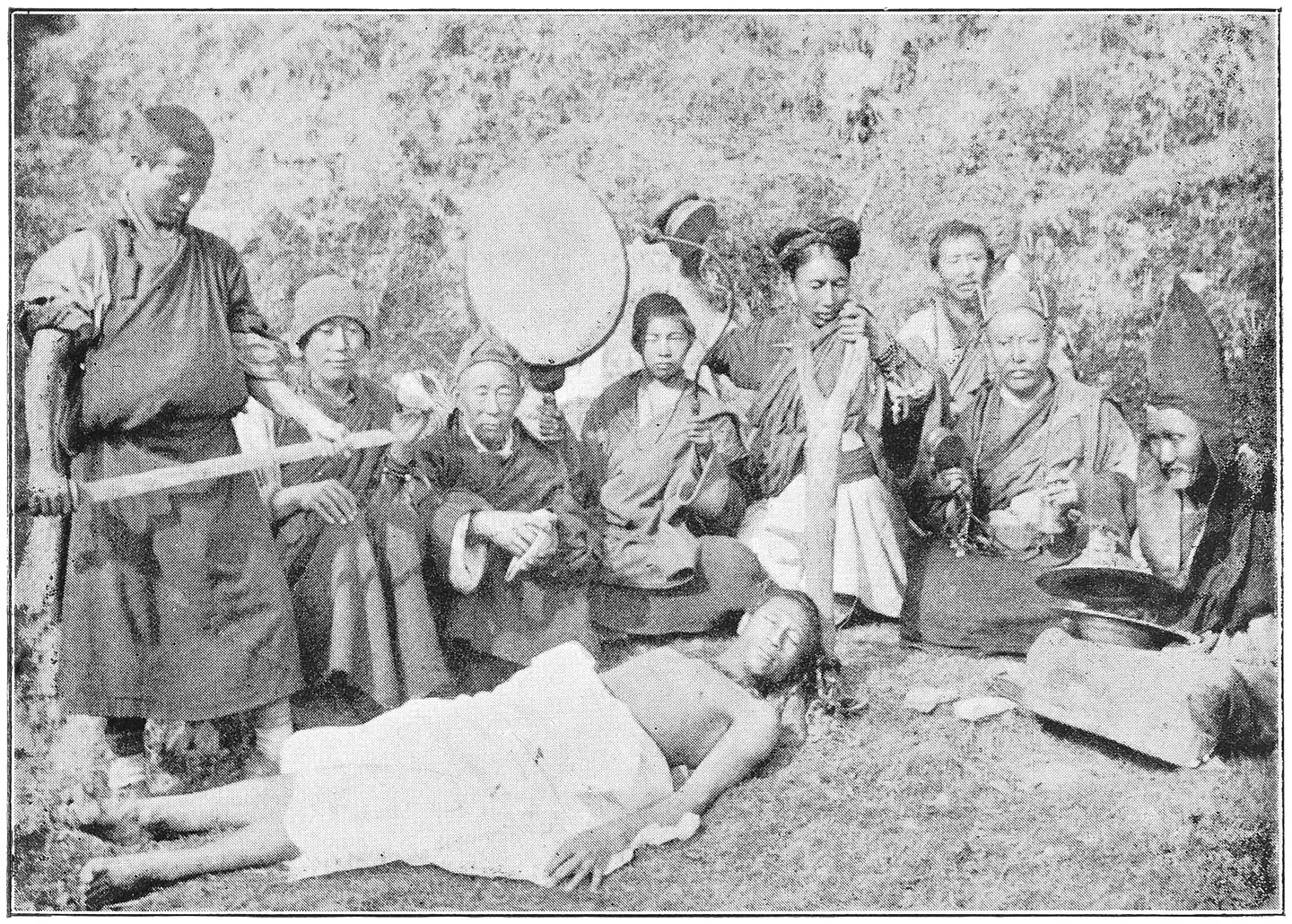
THE DISPOSAL OF THE DEAD (BY CUTTING THE CORPSE INTO PIECES).
Passing through cultivated fields, where the ponies sank up to their knees in mud, we came to a broad steppe where wild goats and sheep and a few musk deer were grazing. Dorje Phagmo is their special patron, and no wild animals may be killed in the Yamdo district.
At about 2 o’clock we reached Nangartse, and, passing by the town, proceeded northward along the bank of the far-famed Yamdo (Palti) lake, also called Yum tso, or “turquoise lake”—a name which the deep blue waters of the lake amply justify.
A little beyond the Kal-zang zamba, at a place where a string of coloured rags, inscribed with prayers, stretched between two crags on either side the narrow path, Tsing-ta made me dismount. He climbed on to a large rock, and scattered a few pinches of tsamba, and, striking a light, lit an incense-stick, which he fixed in a cleft in the rocks. This place is called Sharui teng, and is the haunt of evil spirits; should any traveller neglect to make these offerings, he would incur their anger.
From ancient times the town of Palti has been a famous seat of the Nyingma sect, and the lake was popularly known by its name. The name of the town as applied to the lake by foreigners probably originated with the Catholic missionaries who visited Tibet in the eighteenth century.
When, in the eighteenth century, the Jungars invaded Tibet, their wrath was especially turned against the lamaseries and monks of the Nyingma sect. There then lived in Palti djong a learned and saintly lama, called Palti Shabdung, well versed in all the sacred literature, and proficient in magic arts. Hearing that the invaders had crossed the Nabso la and were marching on Palti, he, by his art, propitiated the deities of the lake who caused the waters of the lake to appear to the Jungar troops like a plain of verdure, so that they marched into the lake and were drowned, to the number of several thousands. Another corps which had advanced by the Khamba la, not finding the troops which had gone by the Nabso la, retraced their steps, and so the town of Palti was saved.
On the summit of the pass are two large cairns, to which each of my companions added a stone; they also tied a rag to the brush sticking out above the heaps, and already covered with such offerings. Then they made an offering of a little tsamba and some dust, instead of wine, to the mountain god, reciting a prayer the while, which they brought to an end by shouting—
“Lha sol-lo, Lha sol-lo!
Lha gyal lo, lha gyal lo!
Kei-kei—ho, hooo!”
From this point I enjoyed one of the grandest views I have ever had in Tibet—the valley of the Tsang-po was before me, the great river flowing in a deep gorge at the foot of forest-clad mountains. Here and there was to be seen a little hamlet, most of the white-walled houses surrounded by a cluster of tall trees.
By 3 o’clock we had reached the foot of the pass, the way down being over a tedious zigzag for over five miles. Along the wayside grew brambles and wild roses, a few evergreens and rhododendrons, and some flocks of sheep were grazing on the hillsides.
Two women weeding their barley patch approached me as I rode by, and offered me a bunch of the young sprouts, in the hope, as Tsing-ta explained, that I would give them some money. This is a custom obtaining throughout Tibet, and is called lubul.
The bed of the river here is about 400 feet broad, but at this season of the year it spreads out several hundred feet beyond the extremities of the bridge, and travellers are taken across in boats.
The monastery of Palchen chuvori was also built by Tang-tong gyal-po, who is likewise credited with having constructed eight chain bridges over the Tsang-po, 108 temples, and 108 chorten on the hills of Chung Rivoche, in Ulterior Tibet, and of Palchen chuvori, in Central Tibet, or U. The Palchen chuvori monastery, where there are upwards of one hundred monks, is supported by the toll collected at the ferry.
An old woman led us to the Jya khang, where we were most hospitably received, and though there were other travellers stopping in it, we were accommodated for the sum of a tanka in a well-ventilated outer room, the inner ones being reserved for officials, particularly Chinese. Netang has about forty or fifty houses, all built closely together, but many are only miserable hovels.
May 30.—We were off at an early hour, as to-day we wanted to reach Lhasa. The hamlets of Norbu-gang and Chumig-gang, through which we passed, had a number of fine substantial houses belonging to civil officers (Dung-khor) of Lhasa, and around them were gardens and groves of trees. Leaving these places behind, we travelled for some miles over a gravelly plain, the river some distance on our right.
When near a gigantic image of the Buddha, cut in low relief on the face of a rock, Potala and Chagpori came in sight, their gilt domes shining in the sun’s rays. My long-cherished wish was accomplished—Lhasa, the sacred city, was before me.
Four miles over a fairly good road now brought us to the Ti chu zamba, a large and handsome stone bridge about 120 paces long and eight broad, beneath which flowed a rivulet coming from the hills to the north-west, where stands the monastery of Tsorpu, founded by Karma Bagshi, one of the two celebrated lamas who resided at the Imperial court of China in the time of the Emperor Kublai.
The Ti chu zamba is in the lower part of the big village of Toilung, around which are numerous hamlets, each amid a little grove of pollard willows. The adjacent plain, watered as it is by the Kyi chu and the Ti (or Toilung) chu, is extraordinarily fertile. The country around was everywhere cultivated, and the barley, wheat, and buckwheat were in many places already a foot high.
The road now became alive with travellers, mostly grain-dealers or argol-carriers, on their way to the city with trains of yaks, ponies, mules, and donkeys with jingling bells.
We halted for breakfast in a small grove in front of the village of Shing donkar, belonging to Sa-wang Ragasha, one of the senior Shape of Lhasa. We could hear from where we sat the voices of lamas chanting prayers, and I learnt from an old woman who brought my men some chang, that there were some eighteen Dabung lamas reading prayers for the recovery from small-pox of the foreman (shinyer) of the farm.
We stopped at Daru at the foot of the hill covered by Debung and its park, and Pador went to look up a friend whom he was desirous of attaching to my service. After an hour’s delay he returned without having found him, and we pushed on, passing the far-famed temple of Nachung chos kyong, where resides the oracle by whom the Government is guided in all important affairs. The temple is a fine edifice of dark red colour, built after the Chinese style, and has a gilt spire surmounting it. At this point the road nears the river, and the whole city stood displayed before us at the end of an avenue of gnarled trees, the rays of the setting sun falling on its gilded domes. It was a superb sight, the like of which I have never seen. On our left was Potala with its lofty buildings and gilt roofs; before us, surrounded by a green meadow (maidan), lay the town with its tower-like, whitewashed houses and Chinese buildings with roofs of blue glazed tiles. Long festoons of inscribed and painted rags hung from one building to another, waving in the breeze.
Beyond Daru the road lay for a while through a marsh (dam-tso) overgrown with rank grass; numerous ditches drained the water into the river, and at the north-east end of the marsh we could distinguish the famous monastery of Sera. Beyond a high sand embankment on our left was the park and palace of Norbu linga, and the beautiful grove of Kemai tsal, in the midst of which stands the palace of Lhalu, the father of the last Dalai lama.
At 4 p.m. we passed Kunduling, the residence of the regent, and entered the city by the western gateway, called the Pargo kaling chorten, and my heart leaped with exultation as I now reached the goal of my journey—the far-famed city of Lhasa, the capital of Tibet.