Chapter VIII · RETURN TO TASHILHUNPO AND UGYEN-GYATSO’S VISIT TO THE BONBO SANCTUARY OF RIGYAL SENDAR.
Reading edition
The bells of the Jo khang were ringing and the great trumpets of Tangye-ling were summoning the lamas to early morning service, when, on June 13, I took from the roof of our house a last look at the gilded spires and red walls of Potala, and started out for Tashilhunpo. I noticed near our lodgings a number of women drawing water from a well in rawhide buckets. The water of Lhasa is excellent, and both abundant and very near the surface, most of the wells being not over four feet deep; and this is the reason for the belief that the town is over a subterranean lake.
Amchi Rivola soon made his appearance, a man of commanding looks and heavily built. He was the Principal of the Vaidurya Ta-tsan of Chagpori, and physician to the regent. He expressed his pleasure at seeing me, and said he had heard me most kindly spoken of by the Lhacham Phala, and he would be greatly pleased if I would postpone my journey to Shigatse and endeavour to cure his disease, which he thought curable by an operation, but he knew of no surgeon in Tibet able to perform it.
Following the same road by which we had come to Lhasa, we stopped that night at Netang. On the 15th we reached Palti djong, and on the 18th arrived at Dongtse at 10 o’clock at night, and put up in Pador’s house.
Early the following morning I went to the monastery, and was promptly led to the minister’s apartments, where I found him covered with small-pox pustules, and hardly able to speak. The Lhacham’s son was also ill with the same disease, but convalescing.
When the minister fell asleep, I went to the Tung-chen’s room. He asked me if I had not met Phurchung on the road, as he had left for Lhasa only a week ago carrying my letters and a shot-gun. As to Ugyen-gyatso, he had returned from Lachan with the luggage that had been left there, and was now waiting for me at Gyatsoshar, near Shigatse. I remained at Dongtse until July 3, when, in company with Phurchung and Pador, I set out for Gyatsoshar, which place we reached the following day, and Ugyen gave me, to my infinite delight, a package of letters from India.
Ugyen told me that since his return from the Lachan barrier he had been busy collecting plants. He had also carefully kept a diary from which I culled the following details, which may prove of interest.
The Gologs have a few lamaseries, the heads of which come from Tashilhunpo, and are appointed for a term of five years, after which they return to Ulterior Tibet. Not long ago one of these lamas returned to Tashilhunpo, after having enjoyed during his sojourn in Gologland the confidence of the people and chiefs. He had amassed considerable wealth, and he spent on his return several thousand rupees in entertaining all the Tashilhunpo monks, and in giving them presents of money. Two years ago the wife of the Golog chief, near whom he had lived, came to Tashilhunpo on a pilgrimage, and after visiting the temple, she expressed a desire to see their former lama, but he was nowhere to be found, though it was known that he was at Tashilhunpo. Among the Golog people it is customary to greet one another with a kiss, and whoever omits the kiss when meeting or parting with an acquaintance is considered rude and unmannerly.
The lama had kissed this lady hundreds of times in her own country, but how could he kiss her now before all the monks? and particularly as the Panchen rinpoche was present at Tashilhunpo; how could he hope to escape unpunished if he committed an act of such gross immodesty?
The same friend, who had imparted to Ugyen the preceding information, told him one day this fable: In times of yore, when beasts could talk, a leopard met an ass, and, though he had a strong inclination to kill him, he was impressed by his strength, of which he judged by his loud bray, so he offered him his friendship on condition that he would watch his den when he went out in search of prey.
One day the leopard sallied forth with a mighty roar by way of prelude to his day’s work, and forthwith a wild yak rolled down the cliff overhanging his den, killed from fright at the sound. When the leopard returned and saw the dead dong, the ass said he had killed it, and stuck out his tongue, smeared with blood, in proof of his prowess.
The leopard believed him, and promised to help him when the time came. One day he told him to go and graze in the meadow on the other side of the hill. When the ass had eaten his fill he brayed twenty or thirty times in sheer wantonness, and the leopard thinking his friend in trouble, ran to his rescue, but the ass told him he was only braying for pleasure. A little while after a pack of wolves attacked the ass, when he brayed loudly, calling his friend to his help; but the leopard thought that he was only amusing himself, and did not go to his rescue, and the ass was torn to pieces by the wolves.
On the 7th of the eighth moon (June 23) a grand military review was held at Shigatse, when more than a thousand soldiers were present, and there was a sham fight in the presence of the general. There are two reviews (mag chyang) every year, one in summer, the other in winter; and besides these there is one whenever the Amban visits Shigatse on a tour of inspection.
The following day was sacred to Dipankara Buddha, and his picture was made to occupy a prominent place in the exhibition. This representation of him was about 100 feet high, and skilfully worked in different coloured satins. On either side of it were gigantic representations of the Buddha.
All the lamas and nobles of Shigatse with their families made merry under the great tent in the Chyag-tsal-gang. Sumptuous dinners, cooked by the best native and Chinese cooks, were served to the great personages of Tashilhunpo and of the Government. Many persons had pitched tents near the great one, and were amusing themselves there with their families and friends. From morning to evening the deafening music of drums, cymbals, and trumpets never ceased.
No one was absent from the fête save the Grand Lama, who, it was rumoured, was laid up with small-pox at Tobgyal, where he had gone after a visit to the hot springs of Tanag. On either side of the great nine-storied building of Kiku, between Shigatse and Tashilhunpo, were two huge lions in which men were concealed; these were moved about from time to time to the great delight of the people.
The next day was the full moon, and was sacred to Sakya Buddha. The great picture of Dipankara Buddha was removed, and one of Sakya Sinha, of gigantic size, and surrounded by all the Buddhas of past and future ages, took its place. This picture was brought out from the lamasery to the sound of deafening music, and with great ceremony. Ten black priests (Nagpa), well versed in tantrik rituals, conducted a solemn religious service, and were assisted by 300 lamas from Tsomaling chanting hymns.
In the plain of Chyag-tsal-gang the lamas and people again feasted and enjoyed themselves as on the previous day.
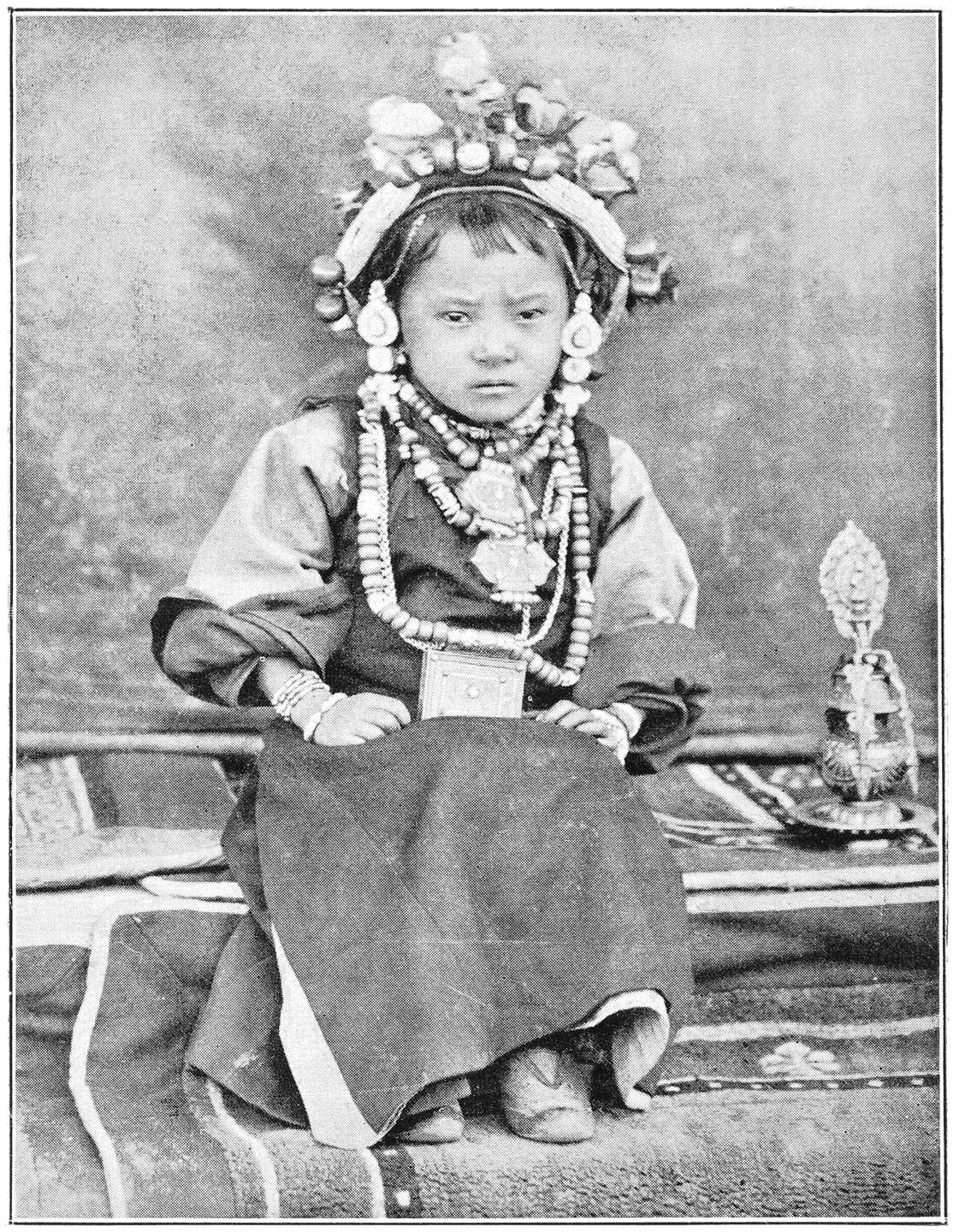
A LITTLE GIRL, DAUGHTER OF A TIBETAN NOBLEMAN.
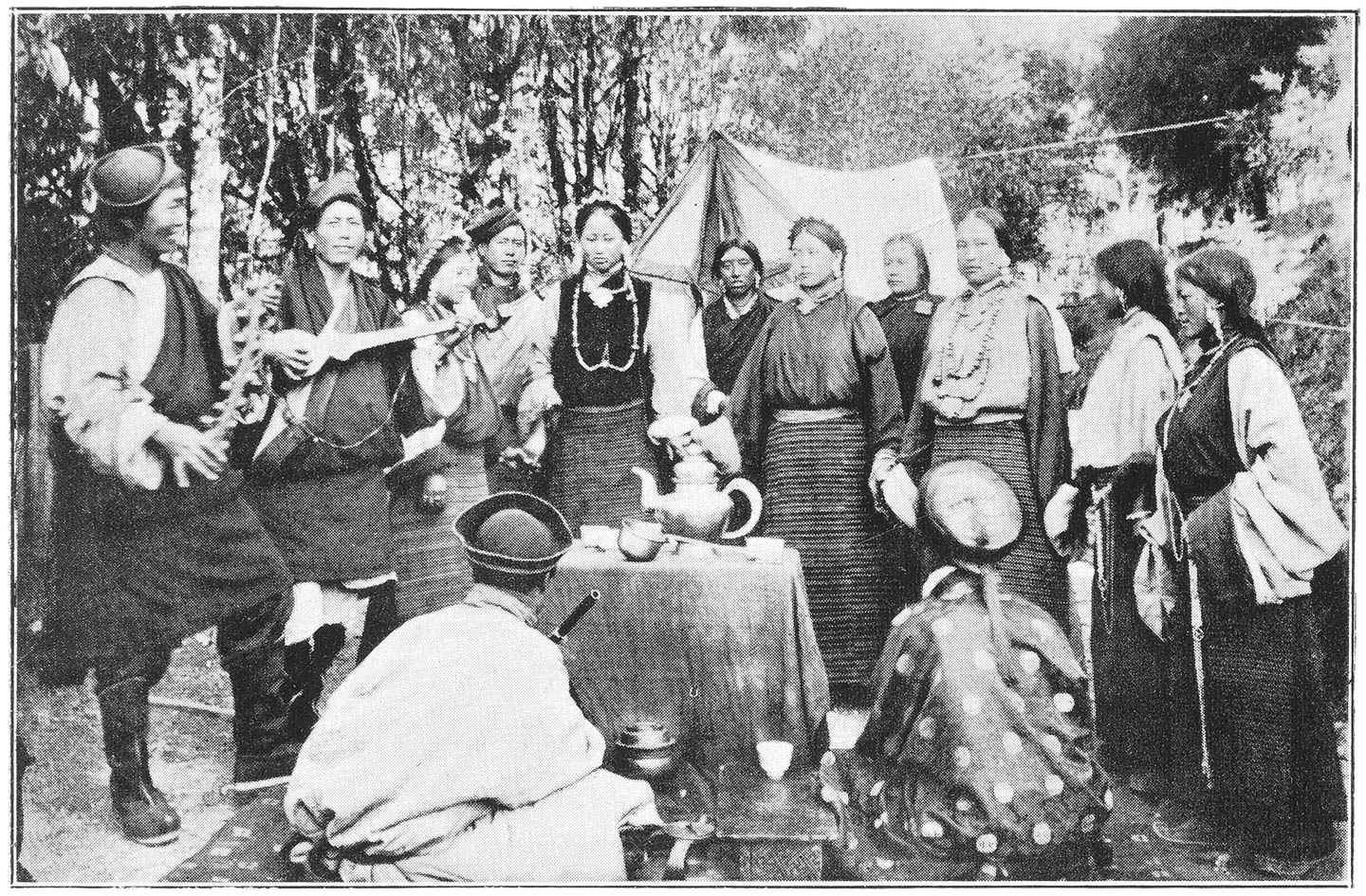
PICNIC IN A GROVE.
My health rapidly improved in these pleasant surroundings and genial temperature, and I worked diligently at transcribing works of great interest into the nagari character which had, though written in Sanskrit, been preserved in the (Wu-chan) script of Tibet. Ugyen devoted himself to botanizing, extending his excursions to considerable distances. Finally, to facilitate bringing in his collections, he bought a donkey and a pony for himself to ride.
July 19 was kept as a great holiday, it being the day on which the Buddha first turned the Wheel of the Law. The people of Shigatse and neighbourhood visited the different chapels and sanctuaries and thronged in every corner of Tashilhunpo.
As I rode back to Dongtse I was greatly struck by the beauty of the vegetation; the little pools were frequently covered with lilies, and wild-flowers were in full bloom.
The minister asked me if I would go to Tobgyal and see the Grand Lama, who was desperately ill. He had received a letter from him asking for some consecrated pills (tsé-ril); I could take this medicine along with me, and at the same time he would inform the Panchen that I was a skilful physician and might be able to cure him.
Hearing of the desperate condition of the Grand Lama, I naturally hesitated to undertake this commission, and so asked for time for reflection. The next day, however, I told the minister that I could not venture to wait on the Grand Lama unless he expressed a wish to see me; or, at all events, unless I was accompanied by the minister himself. He finally decided that he would send the tse-ril by a confidential servant, and hint in his note accompanying them, that perhaps Indian medicines might prove beneficial.
The chin-sreg ceremony on the 26th was similar to that of the day before, and wound up with a long service. In the afternoon the Seng chen (the minister) took his position on a raised seat under a spacious awning spread on the roof of the tsug-lha-khang, and ordered all the lamas, carpenters, masons, coppersmiths, gilders, etc., to assemble, when he distributed presents to them. To the lamas and monks he gave silver coins, khatag and blankets; and to the head labourers, rugs (tumshi), felt hats (khamba), and homespun cloth (gyantse).
On the 28th news reached us that two of the Grand Lama’s physicians had run away, another had gone mad, and the fourth was without hope or ability to do anything more for the illustrious patient, who had had a severe hemorrhage.
On the 31st the dreaded event took place, a letter was handed the minister announcing the Grand Lama’s death. He had died on the day previous at Tobgyal, or, as it is the custom to say, “He had left this world for repose in the realm of bliss (Deva-chan).”
A notice was issued to the people to assume signs of mourning; the women were forbidden to wear their headdresses or any other jewellery, and amusements and ornamenting of houses were prohibited. The people showed signs of deep distress at the untimely death of the Panchen; some attributing it to the sorrow he had felt at the disloyalty of his people, others said he had left this world on account of the discourtesy of the Dalai lama in not inviting him to his consecration.
At Dongtse, where I was, the minister was having performed as a termination to the ceremonies attending the consecration of the new building, a grand religious dance in the courtyard of the Choide. A great crowd, all in their holiday attire, was assembled on the roofs and balconies of the temple. The dance had but commenced; the minister’s page, who impersonated the herald of the gods, had twice fired off a gun, and had proclaimed the arrival of the four guardian deities of the world; the devils and goblins had gone through their part of the performance, when the news of the death of the Grand Lama was made known to the minister. At once the dance was stopped, and the dancers and the crowd rapidly dispersed.
On September 3 it was reported to me that the Chinese commander of Shigatse had flogged several of the Grand Lama’s servants for not having told him of the gravity of their master’s illness. One of the physicians of the Panchen had been severely beaten, and the other medical attendant was found dead shortly after the Grand Lama had breathed his last. I thanked God I had not consented to the minister’s proposal to go and attend the Grand Lama!
On the 6th Ugyen returned to Dongtse from his trip to Sakya, and from his journal I take the following facts, which may be of interest:—
On July 26 they crossed the Tanag Tong chu by an iron suspension bridge, and, travelling westward, stopped for the night in the lamasery of Tubdan. Leaving Tubdan on the 28th, the travellers reached, after a march of twelve miles in a northerly direction, the famous hot springs of Burchu-tsan. A circular wall of stone encloses a portion of the springs, and here the Grand Lama takes his baths. The place where he camps is surrounded by a low turf wall. The Grand Lama had recently taken the baths, but it was supposed that the water gods (or nagas) had in some way or other been offended, as the water had but aggravated his complaint. To propitiate these lu a hundred lamas had been employed here until within a few days conducting religious services. In and near these springs are numerous black snakes which, though they are said to be venomous, do no harm to either man or beast. They enter houses in the neighbouring villages, but no one ever thinks of hurting them.
In the mean time he was shown about the temple. In the congregation hall the priests were reading the Bonbo scriptures. In the chapel of the upper story he noticed among the images of the various gods of the Bon pantheon that of Sakya Buddha.
The Bon monastery of Shendar is now in the joint possession of the four powerful members of the family of Shen-tsang. Though they are laymen, having wives and children, yet being the descendants of Shenrab Mivo, the illustrious founder of the Bon religion, they are venerated as lamas. The mother of the two leading members of this family was the elder sister of Sikyong, the late Rajah of Sikkim. The late Panchen rinpoche was the nephew of these brothers, in consequence of which they are addressed by the people as Ku-shang, “Royal Maternal Uncle.” The late Grand Lama was of pure Bonbo stock, and the two families from which he sprang are known by the names of Shen-lug and Tu-lug. People inquire with wonder why the vice-regent of Buddha in the flesh should have been born in the family of Shenrab Mivo, the heretic. Some disaffected Tibetans were even in the habit of ridiculing this Grand Lama by calling him the offspring of Bon heretics.
In the monastery are two sections of monks, called respectively the Tibetan Association (Bod kham-tsan) and the Khams Association (Khamba kham-tsan), the latter being the most numerous. The officers consist of one priest for the grand congregation (Om-dse), two discipliners (Chos-tims), two church directors (Gekhor), two general managers (Chi-nyer), and two chapel-keepers (Ku-nyer).
The monks of the Khams Association, numbering about forty, go annually during the summer to conduct religious services in the houses of the Bon people of Chang. In the winter they remain in the monastery. During divine service the monks are allowed to drink as much tea as they like, there being no restriction in this respect, as in the great Buddhist monasteries.
The lamas here are divided into two sects, which differ slightly in their vows. In the one called Shen-tang srung-lug, a man may take vows when sixty years of age; while in the other, called Shen-tsang lug, he must take the vows of abstinence and piety as soon as he has finished his final clerical examinations. The high priest, or Je Kadub rinpoche, Yung-drung gyal-tsan by name, administers vows and ordains monks.
The rules of moral discipline, called tsa-yig, written on a broad sheet of pasted daphne paper, are posted in a conspicuous position in the monastery. When an ordained monk is found guilty of violating these rules, and particularly those of chastity, he is immediately punished and expelled from the monastery. Such punishments are, however, commutable into fines, such as the payments of money to the lama who ordained him, and providing entertainment and presents for the other monastic authorities and the members of the congregation.
Ugyen left Shendar ding on August 5, and stopped at noon at the hot springs of Langpag, where the Tashi lama has a temple-like house in charge of an officer. The water is so hot that meat can be cooked in it in half an hour.
The next day Ugyen again called on the lama, who asked many questions about the resources of India, its government, commerce, laws, etc., and as Ugyen replied he noted down all he heard.
Taking leave of the lama the same day, the travellers reached Rag-tso ferry, where they crossed the Tsang-po in a rudely constructed boat, in which men and animals were ferried across. They halted for the night at Tondub ling, in the district of Jerong. They were unable to gain admittance to any house, and had to pass the night in a sheepfold.
The next day they came to Phuntso ling, where there is a lamasery with five hundred inmates. This was formerly the seat of the Taranath lama, and from here he went to Urga in Mongolia. Ugyen visited the cave where Taranath once lived as an ascetic. He also saw the printing-house of the Phuntso ling lamasery, which contained printing blocks for many valuable historical works.
Lhartse castle (djong) is on a fine eminence overlooking the Tsang-po. It is the chief place of trade of Upper Tsang. Its monastery used to contain one thousand lamas, but now the number is considerably smaller. Some distance from Lhartse is the famous monastery of Namring, whose monks are noted for their great learning.
Proceeding by way of Tana and Lasa, Ugyen and his companions reached Sakya on the 14th, and put up in a house belonging to the chief of the ulag department. There is a good market in this town, but with the exception of meat, all articles of food are dearer than at Shigatse. No good tsamba could be bought, and straw and hay were very dear, a tanka for a basketful of not over five pounds weight.
Sakya is a notorious place for thieves and all kinds of bad characters, and the cattle have to be locked up at night in the stables and sheep-pens.
The next day, being the anniversary of the birth of Peme Chyungnas (Padma Sambhava), a grand religions dance took place in the courtyard of the temple, in the presence of the five surviving members of the royal Khon family of Sakya, who sat on chairs on a raised daïs under a large Chinese umbrella, with attendants carrying the gyal-tsan or banners, and the sceptre.
Eighty gaudily dressed dancers (chyampa) danced the day long to the music of clarionets, trumpets, kettle-drums, tambourines, and cymbals, stopping only occasionally to partake of tea. When they finally stopped they carried off with them on their shoulders quantities of khatag flung to them by the audience.
This dance, called the “club dance” (phurpai kil chyam), was performed in celebration of the birth, from a lotus flower in the lake of Dhanakosha, of the sage Uddayani. Two Timpon and a dozen policemen kept the great crowd in order with their whips.
The next day another kind of dance, called the dsa-nag, or “black hat” dance, was performed in the court of the residence of Gong-sa. There were about eighty dancers. Seventy kept up the dance continually, while the ten remaining took refreshments. They danced with much grace, the movements of their arms and hands being especially curious.
Leaving Dobta, Ugyen came to the Tsomo tel-tung, or “Mule’s Drink Lake,” which he went around, keeping it to his left, an heretical action according to Buddhist ideas.
Ugyen remained at Shigatse for seven days, drying the plants he had collected on his journey, and observing the different incidents which took place after the death of the Grand Lama.
The day after the Grand Lama’s death, he and a friend had gone to Tashilhunpo to perform their devotions, but were refused admittance. No outsider was admitted into the lamasery, the inmates of which were now not allowed to see any one or leave the monastery.
As they were coming back they passed in front of the palace of Kun-khyab ling, and saw a large pack of hounds and mastiffs, which the Panchen kept for hunting; for, though his sacred character forbade him shooting animals, he could indulge in this other form of sport.
While in the palace of Phuntso phodang, the lama’s favourite residence, and where they were allowed to enter, an officer from the Labrang attached seals on everything belonging to the deceased, and on all the doors of the principal rooms in Kun-khyab ling.
The next day there was a report that the lama had come to life again, and every one was thanking the gods; the tsamba vendors on the market-place were throwing handfuls of their ware heavenward as offerings to the gods who had restored their Grand Lama to them.
The Dingpon of Shigatse said, in the hearing of Ugyen, that last year, when the Government of Lhasa had consulted the oracle of Lhamo sung-chyongma, it had foretold great calamities for Tibet. These were inevitable, in view of the perversity of the people who no longer had faith in the gods, but let themselves be led by demons in human shape.
Witchcraft was steadily increasing, he said, and in every village there were those who said they were in communion with devils. An edict had been issued forbidding witchcraft and fortune-telling. It was found that under the castle of Shigatse itself there were fifteen witches (paonal jorma). These had been brought to trial, and had been submitted to an examination which required them to describe the contents of several chests filled with a variety of things. Four alone were able to answer, the others were flogged and then released on condition that they should give up imposing on the public credulity and would furnish bonds for their good behaviour.