Chapter III · JOURNEY TO DONGTSE.
Reading edition
One approaches Tashi-gyantsa by a lane cut through a hillock some 20 feet high, on top of which the village stands. The alleys are crooked and dirty, the houses of comfortable appearance, are painted with clay in bands of red, black, and blue colour, and surrounded by walls forming a courtyard in front of each. On the left of the road is a neatly constructed mendong. The whole village is inhabited by clerks, copyists, painters, and artisans from Tashilhunpo, most of whom get allowances (pod) from Labrang. Cattle (jo) are plentiful in the village, and as we passed, a few yaks with pack-saddles on their backs were being led off from the village by two tall, savage-looking men dressed in goatskin gowns (bokhu). The old people sat in their doorways, warming themselves in the sun, and a caravan of yaks and donkeys had halted at the chorten just outside the village.
We passed by Perong shavea, a group of hamlets, in the midst of which is a little garden and a willow grove; then by the village of Deki-rabdan; and when two miles from Tashi-gyantsa we reached the large village of Khara Tedong, the chief of which is a Dahpon (general), lately dismissed from a command at Gartok, near Rudok. Judging from the outward appearance of the houses, the village is prosperous. Passing the villages of Sunapara and Sarsha, and leaving Doring and Semaron on our right, we came, after two miles, to the Num chu, now a nearly dried-up stream, which comes down from the mountains to the north-west of Nartang, which border the plateau-like valley of Chyugpu shung. A little to the east of this stream is the large village of Gyatso-shar, composed of a dozen hamlets forming two or three groups.
December 26.—The Deba has a dozen jomo and cows yielding plenty of milk. A jomo yields four times the quantity of milk which a cow or female yak gives. The di yak cow, which pastures on mountain-tops, yields ordinarily two seers of milk a day, is not much prized, though yak milk is both sweet and wholesome; but the Tibetans value very highly the jo, which is, besides a good milker, most useful in husbandry.
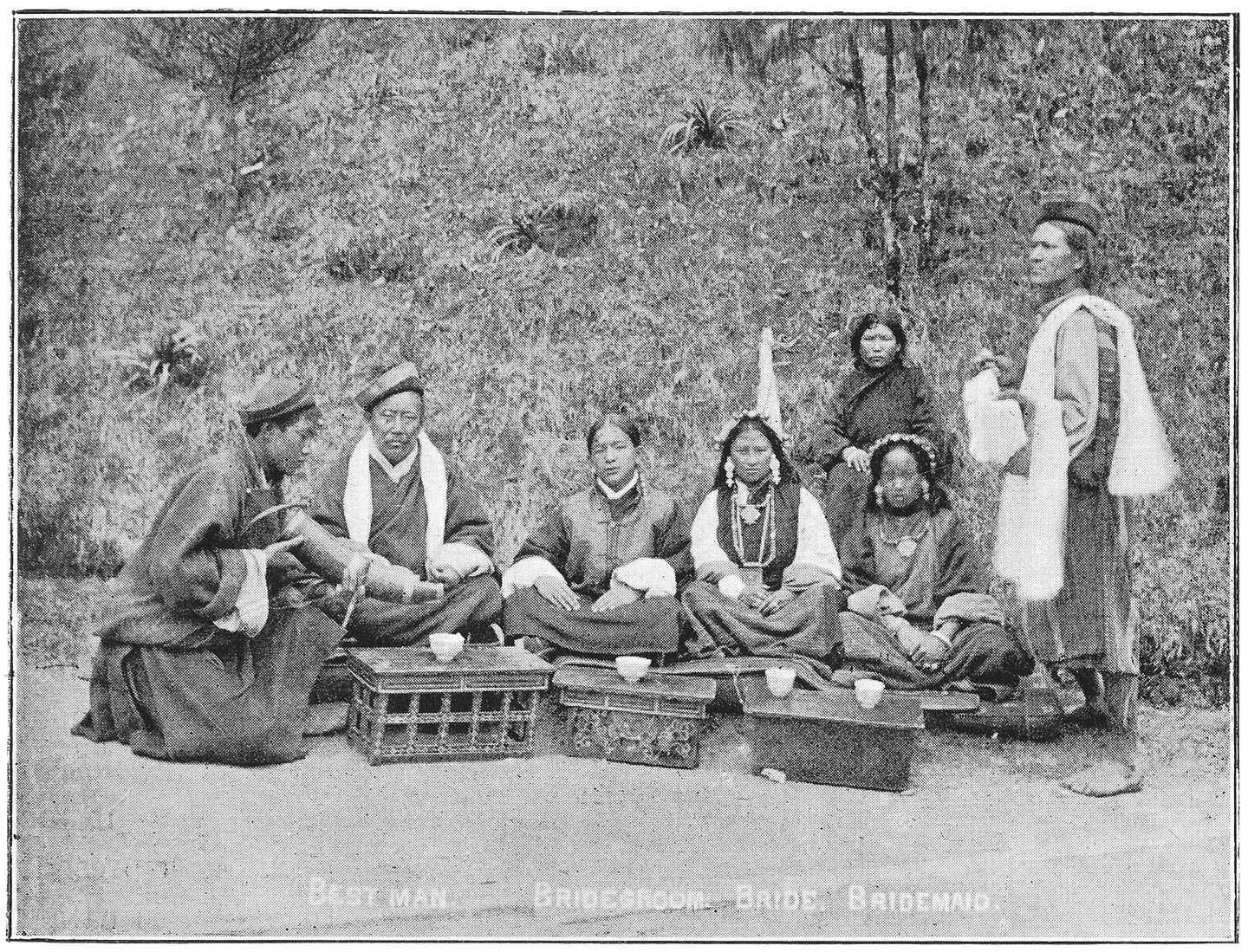
CHANG-SA RGYAB-PA, WINE-DRINKING CONCLUDING WEDDING CEREMONIES.
December 28.—After we had finished taking tea the page Ka-chan Gopa called us to the minister’s presence, to whom we gave a detailed account of our journey. After listening with attention, he observed, “Pundib la, I fail to see why you chose such a dangerous route as that by the Kangla chen and Tashi-rabka, for you had the passport issued to you three years ago by which you were permitted to return to Tsang by way of Khamba djong. Did not the officials at that place treat you well when you passed there on your way back to India?” I replied saying that I had feared that difficulties might have been raised by the Sikkim Durbar at the instance of the Phodang lama, who had of late been making trouble in Sikkim. The minister again remarked that there had been no necessity for our undertaking such a difficult and perilous journey through the Tingri djong country, when we had the Grand Lama’s (Panchen Rinpoche’s) passport authorizing us to cross the Lachan pass, which was very easy and free from snow. After a short conversation he retired to his contemplation room (oratory).
December 31.—I was anxious to take a trip to Gyantse, which Ugyen said was only eight miles distant, and could be reached in two hours. He dissuaded me, however, saying it would not be prudent, as that place is frequented by Bhutia traders from Darjiling and Phagri. At nine I was called in to the minister’s, and read a few sentences of English from the ‘Royal Reader No. 1’ with him. After this I asked to be allowed to visit the great temple of Gyantse, called the “Palkhor choide.” “If you want to visit Gyantse,” he replied, “I will arrange it for you; but you must bear in mind that the people of that town are not good. They speak much, and are given to spinning a great deal out of a little. I will have the Tung-chen take you there.” Ugyen-gyatso then asked if he might go there, as he wanted to buy me some blankets; and having obtained the minister’s authorization, he left at noon.
Arriving before the minister, they thrice prostrated themselves, each time touching their foreheads with their joined palms. The minister touched their heads with the palm of his hand and blessed them, and then they presented him with two pieces of red English broadcloth and a handful of silver coins each.
I was surprised to see such powerful and wealthy chiefs kotow before the minister; but great is the triumph in this country of the Church over the laity, and the greatest ministers of state fall down at the feet of the incarnate lamas!
Dinner was served with great ceremony. As soon as the minister had said grace, all fell to with chopsticks and spoon, and partook of each succeeding course in profound silence. After dinner, tea was served, when at last the silence was broken, conversation began, and the guests were shown the minister’s curios, the watches and the stereoscopic views especially interesting them.
In the evening there was a review in the pleasure grove, or linga, by the commander of the militia, when exercise in musketry, running, archery, etc., took place in the presence of the two dignitaries.
January 3.—After tea I was asked to read English with the minister. He transliterated the English words phonetically, but did not take the trouble of spelling them, observing that his ordinary duties left him hardly any time to devote to study. He intended asking the Grand Lama to relieve him for a time from his numerous duties in connection with the Church, when he hoped to be able to apply himself assiduously to the study of English.
January 4.—The ponies were ready at an early hour, and after receiving from the minister a few khatag to present to the deities of the Palkhor choide, the Tung-chen and I rode off.
Passing a few villages, we came to a stream flowing into the Nyang chu from the south. Here were two flour-mills, of which we had seen at least a dozen since leaving Shigatse. They were very large, and the stones four times the size of our ordinary millstones in India. In the village of Gyabshi the people seemed very industrious, the women engaged with their looms or spinning, the men tending sheep or collecting fuel from the fields.
When we came within two miles of Gyantse, our attention was attracted by the Tse-chan monastery, the entire north-eastern slope of a hill being closely covered by its whitewashed houses, so that it looked like a great castle of towering height. The Tung-chen told me that this lamasery was nearly eight hundred years old, and that the great reformer Tsong-khapa had spent several years here in the study of metaphysics (tsan-nyid). I was also shown the Tinkar la, by which herdsmen travel to the foot of the Lachan pass of Sikkim, this being the shortest route between Gyantse and the latter country.
A few minutes’ ride brought us to the bridge over the Nyang chu, a light temporary wooden structure, about twenty feet long and six feet broad, built on the ice which covered the stream.
The Kunyer, or priest, of the Gandan Chakhang, an acquaintance of the Tung-chen, greeted him, and, showing him to a seat, had tea served us. We sent the groom, Lhagpa-rida, to the market to buy arrack, and he there met Ugyen, and told him of our arrival.
As we were eating our meal several pilgrims chanting sacred hymns entered the chapel of the Lhakhang, and added some spoonfuls of butter to the lamps. Some of them stared at Ugyen and me, observing to one another that we were strangers from beyond the Himalayas, taking Ugyen for a Sikkimese, but not being able to decide whether I was from Ladak or Besahir.
Ugyen told me of his movements since leaving me at Dongtse on December 31.
He had left Dongtse at noon on December 31, riding one of the Tung-chen’s ponies. On the road he met some of the muleteers of the Dongtse Dahpon Phala, who were proceeding to Lhasa with barley, butter, and meat for the use of Bangye-shag, Phala’s residence.
Ugyen inquired of them about the state of the road to Lhasa, and the best time to make the journey there. They told him that winter was the best season to travel to Lhasa, for then there was no rain, and one could easily ford the streams and get across the Tsang-po; moreover, feed was cheap, and meat, barley, and wine obtainable everywhere.
The following day (January 1, 1882) Ugyen visited the Gyantse tom. This market and the town generally are inferior to Shigatse in importance and in the variety of articles for sale. There were people selling Calcutta and Chinese goods of very inferior quality. He saw fifteen or twenty Nepalese shops and half a dozen pastry shops kept by Chinese. The tom (or market-place) is the property of the Palkhor choide, the great monastery of Gyantse, and contributes largely to its maintenance. The monastic authorities also collect rents from the shops in the vicinity of the tom, which do not belong to either the Government or landholders (gerpas). The barley for sale was inferior to that of Shigatse, as was also the chang, which was, however, cheaper than there; and butter and mutton were in larger quantities than at the latter place.
The Dingpon and Gyapon receive pay at the rate of thirteen srang and twenty-five srang a year from the imperial treasury, but no more rations from the Tibetan Government than the soldiers.
The Chinese cemetery Ugyen found situate at the foot of the hill on which the Djong stands, a little above the high-road to Lhasa, and some three miles from the town. He counted three hundred tombs, some of which appeared very old and dilapidated, but a few quite new.
The castle or Djong of Gyantse stands on the top of a hill nearly 500 feet above the town. It is very strong, and was built by the famous Choigyal rabtan who ruled in the fourteenth century over the province of Nyang, of which Gyantse was the capital. This province was a part of the domain of the Sakhya hierarchs. He had built a long stone-covered way running from the Djong to the foot of the hill, by which he meant to secure a supply of water in time of siege from the three deep wells at the foot of the hill. Ugyen visited these wells, where water-carriers were drawing water in hide buckets attached to a rope about 150 feet long passing over a pulley.
The landlord of the Litophug sub-division of Gyantse told Ugyen that about eighteen years ago the ex-Dewan of Sikkim had come here on some State business, and had put up in the same house in which he was now stopping. One night about fifty sinister-looking Khamba traders suddenly broke into the house, beat him with clubs, tore his earring out of his ear, stripped him of his clothing, carried off all his property, and thrashed his servants and forced them to run for their lives. Some of the robbers ran away from Gyantse, taking the Dewan’s property, his mules and ponies; but on the following morning, when the matter was brought to the notice of the Djongpon, the chief of the robbers, who had stayed behind, was apprehended. He said that a year previously the Dewan had treated him and his accomplices most harshly during their stay at Chumbi on their way to Darjiling, exacting from them the last pice they had in their purses, besides depriving them of all their property to the value of upwards of Rs. 500. The Dewan lost, in his turn, over Rs. 1000 in cash, besides jewellery, clothes, etc.
At this season of the year the climate of Gyantse is very bad, high winds blowing daily, raising dense clouds of dust. The inhabitants spend this time of the year in idleness, having but little to do besides weaving and spinning.
Such was the information that Ugyen gave me to-day.
When we had finished our breakfast we went with the Kunyer of Gandan Lhakhang to perform choi-jal at the different shrines of Gyantse. The chorten is a splendid edifice of an unique style of architecture. Hitherto I had been under the impression that chorten were nothing more than tombs intended solely to contain the remains of departed saints, but now my views became entirely changed. This chorten is a lofty temple nine stories high. Ugyen, I, the Kunyer, Lhapa-rida, and our servant, Lhagpa-sring, went into the enclosure and entered the shrine with a number of pilgrims and travellers, most of whom seemed to be from Ladak or the Changtang. In the service hall, where the priests were assembled for religious service, hundreds of lamps were burning, and incense-sticks were smoking so as to nearly darken the room. We ascended at once to the top story, but the other visitors began their circumambulation from the bottom upwards—the usual practice, though many become so wearied going round and round that they do not reach the uppermost story. The chorten is about 100 to 120 feet high, the top covered by a gilt dome, the gilded copper plates of which are so thick that they have withstood centuries of exposure to the weather. The base of this sacred edifice is, we found by actual count, 50 paces square. From the cupola (pumpa), immediately under the gilt dome, I had a magnificent view of the town and monasteries and the surrounding hills and distant mountains; their black surface, broken here and there by some white-walled monastery, offered a singularly wild aspect.
There were inside the chorten innumerable niches filled with images of Buddhas and saints, and in visiting the various chapels we were required to do so walking from left to right, for this is the Buddhist usage.
On the first floor we were shown the statue of Choigyal rabtan, under whose benign rule Gyantse became famous, and who gave a fresh impulse to Buddhism and literature. The Kunyer of the chorten touched our heads with the sword of this illustrious monarch, and said that by his blessing (jin-lab) we could triumph over our enemies and enjoy longevity and prosperity in this world.
Returning to the Gandan Lhakhang, we were refreshing ourselves with copious draughts of tea, when the abbot of the Palkhor choide, with half a dozen disciples, came to make reverence to the great image of the Buddha in the shrine, on whose right and left were images of Tsong-khapa and Maitreya.
The Kunyer remarked to me that I was peculiarly fortunate in having come to Gyantse to-day, as it was the full moon, a sacred day with Buddhists, on which day, and on the day of the new moon, the doors of all the shrines and of the great chorten were thrown open to the public.
After an hour’s rest I went with the Tung-chen and Ugyen to visit the Palkhor choide. Its grand “temple of learning” (tsug-la khang) is a splendid and lofty edifice, the hall lighted by one thousand lamps. On three sides—the north, east, and west—are high niches, in which are huge images of the Buddha and Bodhisattvas. The image of the Buddha is made of copper, heavily gilt. Five hundred monks were engaged in divine service, and some two hundred more were occupied reading the sacred scriptures. No one lifted his eyes to look at us, so strict is the discipline observed here. We were conducted to the great library, the very sight of which filled my mind with feelings of awe and reverence. The books were all old, broad-leaved, and some two to four feet long. I was shown the sacred scriptures, all written in letters of gold.
With what assiduity and devotion the Buddhists perform the sacred duties of their religion, the deep interest they take in the collecting of sacred books and images, and their zealous care in preserving them, can only be realized by visiting such places as this. I was shown some sculptures executed by Indian Buddhists, and some stone images similar to what I had seen at Buddhagaya. The gilt, Indian-made images of the Sravakas, of Saripu, Mudgalputra, Ananda, Kashyapa, and other arhats were of exceeding interest. On each side of the image of Shakya Buddha were four rows of monks, of twenty each, and in front of them burned hundreds of butter-fed lamps. Behind the seats of the monks were drums, each with a long handle; these the monks beat at intervals, and to the accompaniment also of cymbals, brass hautboys (dung chen), and clarionets (gyaling), they chanted hymns in deep sonorous voices.
When exhausted by continual repetitions of mantras, they refreshed themselves with tea. Wine is not brought within the precincts of these Gelugpa monasteries; and, in fact, all drinkers of wine among the monks are expelled from the Gelugpa Church.
In the portico of the building and underneath its eaves I noticed several sorts of flowering plants in bloom.
At 3 p.m. we left for Dongtse, where we arrived before dusk. The minister’s page met me at the foot of the hill, and led me to his master, who made many kind inquiries about my trip. I told him how greatly I had enjoyed it, and that, as it was a holiday, all the buildings, the great chorten and the temples, had been open to me. “I rejoice at it,” he replied; “and I must say the gods have shown you the way [lha lam tan song], for it did not strike me at the time that to-day was a holiday. If you should have put it off till to-morrow, you would have seen but very little.”
January 5.—I called on the minister, and talked to him of my visit to Gyantse. He told me that there were half a dozen chorten in Tibet like the one I had seen there. There were now, he said, about six hundred monks in the Palkhor choide, and an equal number in the adjacent lamaseries, but in former times there were three thousand monks on the register of the college.
Ugyen-gyatso returned to-day from Gyantse, and told the minister of his experiences there. He had been lodged in Litophug in a priest’s house, where the master (nabo) and mistress (namo) showed him great courtesy. Ugyen presented the minister a dozen oranges he had bought in the Gyantse market for one anna each. I told the minister that these oranges came from Sikkim. “Oh, indeed!” he said. “It must be a happy land. In Tibet no oranges mature; at Lhasa there are orange trees producing small fruit, which do not, however, ripen.”
In the evening Ugyen told me a tale he had heard from the Chyag-dso-pa of the Palri monastery.
Once on a time Dugpa-kunleg, a famous but eccentric saint of the red-hat school, was staying at Khang-toi shikha, in Lhasa. He saw the wife of his host stealing a piece of amber from the bag of a beggar who was stopping in the house, and putting an apple in its stead into his wallet. The saint told her it was both sinful and criminal to act thus, and related to her the following tale by way of instruction.
In ancient India there lived two friends. One, a highlander, was a dishonest man; the other, a lowlander, was upright and honest. One day the two, while walking in a valley, found a bowl of gold. The lowlander said, “Well, now that fortune has favoured us with a treasure, let us first return thanks to the local divinities, and then divide the gold between us.” The other rejoined, “Friend, the day is far advanced; we can do all this to-morrow; let us rather take the bowl home now.”
To this the lowlander agreed. The next morning when he called at his friend’s house, he found him in a corner wailing and shedding tears. “Ah, friend,” he exclaimed, “my heart is filled with grief and shame. How can I tell you! The bowl of gold has been miraculously changed, for this morning I found but sawdust in it. The gods alone know what has become of the treasure! This, I am grieved to say, will put an end to our friendship, for it will create in your mind a suspicion against me.” So saying he began weeping afresh.
The other, perceiving his design, said, with wonderful calmness, “Friend, you need not cry. The loss of the treasure is not the greatest mishap which might befall us. If we two continue friends, we should hold ourselves very happy. Chance brought the treasure; chance has taken it away; crying will not bring it back.”
The false friend, thinking he had gained his end, soon dried his tears. Before leaving for his home, the lowlander said, “Friend, I have not mentioned something to you. In my orchard most delicious mangoes and other fruits are now ripe. I have no children to eat them; let your two sons come home with me that I may regale them with the luscious fruits.”
To this the other assented, and the two boys accompanied the lowlander home. On his return to his home he bought two monkeys, to which he gave the same names as the boys, and trained them to come when called by their names.
After a while the false friend came to take his boys home, when the other came out crying in a loud and pitiful voice, “Friend, my heart bleeds to have to tell you of the misfortune which has befallen you. Your two darlings have been changed into monkeys!” “How can I believe such a story?” the other replied. “If you doubt it, call your sons, and you will see.” So the father called his older son by name, and a monkey came leaping forth, and sat upon his lap, fondling him and chattering to him as if he were an old friend. Filled with surprise, he called his second son, when out came the other monkey, and climbed into his lap also.
After a while the lowlander asked his friend, “How can this have come about? Tell me how it was that the gold was changed into sawdust; it may help to explain this new wonder.” The other, fearing lest his sons had been transformed into monkeys by the incantations of the friend he had deceived, replied, “Friend, I deceived you when I said the gold had been turned into sawdust. I have got it with me; we will divide it equally between us. Is it true, my much injured friend, that my sons have been transformed into monkeys?” “Oh no. How could men become monkeys? Your sons are in excellent health, and are now in one of my distant orchards.” So the two returned to their houses with their respective treasures—the one with his children, the other with his gold.
Years passed by, and the two friends were finally summoned to the court of the Lord of death, there to have their good and bad acts weighed. Their moral merits and their prayers were also weighed, and the balance turned in their favour. A game of chess was then played by the gods and the demon, in which, by means of casting dice, the merits and demerits of gods and men are determined. In the mirror of karma (mundane actions) the two friends saw and blushed for the evil deeds they had done—the gold turned into sawdust, and the boys into monkeys. The Lord of death decreed that the uplander should pass five hundred years in hell, and that the other should for five hundred existences be born a monkey. The punishment of the latter was the severer in that he had stolen human beings, and said that they had been transformed into monkeys; but because he had desired to make offerings to the gods when the treasure had been found, the gods had pleaded for him.
Having finished his tale, Dugpa kunleg exhorted the woman to keep from stealing, and threatened her with such-like dire punishment if she did not desist. The woman put the amber back in the beggar’s bag, and the saint left her house and returned to Lhobrag.
Ugyen also heard at Gyantse that much was to be learnt concerning the ancient history of that place in a work called ‘Nyang choi jung Nyimai odser.’ He furthermore told me that he had heard that last year a mendicant from Gyantse visiting Sikkim gave out there that he was one of the discoverers of sacred books of which the Nyingma history of Sikkim makes mention. He showed what he claimed was a very ancient manuscript volume on the propitiatory ritual of Guru Thag-mar, a fearful deity of the Ningma pantheon. The Sikkim rajah gave him a very warm welcome, and, in consultation with the chief lama of his Durbar, arranged to have block prints made of the text. Recently this impostor had returned to Gyantse, bringing with him many valuable copper and brass articles, silk gowns, and coined money.
January 6.—The minister’s mother, accompanied by a maid-servant, came to pay reverence to her saintly son while I was seated with him. I could not believe that she was his mother when I saw her make three profound salutations before the minister, touching the ground with her forehead and receiving his blessing. She then presented him with a few balls of butter and a khatag; and when his holiness said he would leave for Tashilhunpo in three days, she wept bitterly.
January 7.—Early in the morning we received a message from the minister asking us to postpone our departure for Tashilhunpo, as the Chyag-dso-pa much wished me to accompany the minister to his house at Kye-pa Khangsar, where he proposed staying three days.
The parents of the minister, accompanied by their youngest boy, came again to pay their respects. The father, a quiet, respectable-looking, elderly man, saluted me by taking off his yellow felt turban and inquiring after my health. They kotowed before the minister, who gave them his blessing by touching the crowns of their heads with his hand.
At 2 o’clock the minister, dressed like a Buddhist cardinal, and accompanied by the Tung-chen, ourselves, and his domestics, entered the grand hall of worship (du-kang), the Tung-chen carrying a bundle of incense-sticks and some khatag. The head lama threw some grains of barley towards the images of the deities, and recited some mantras; then the minister, standing, recited a short prayer, and approaching the image of the Buddha, took off his mitre and placed a khatag on it. Then the head lama took the other khatag which the Tung-chen had brought with him, and flung them one by one at the other images, while the monks who accompanied him scattered flowers before them.
After this we circumambulated the monastery, and descended to the foot of the hill, where the son of the Chyag-dso-pa, dressed in a rich Mongol costume, was awaiting us with two spirited and richly caparisoned ponies held by grooms, one of which the minister mounted, while we walked the short distance which separated us from the gateway of Kye-pa Khangsar. A band of drums, hautboys, bells, gongs, and fifes marched before us, playing as we went through the lay town (sho) and along a broad road lined with poplars to the gate of the Khangsar, where the Chyag-dso-pa was standing to receive the minister. He was dressed in a rich scarlet satin robe girded by a yellow scarf, a yellow woollen turban, and a pair of Tartar velvet boots. His tall stature, graceful looks, broad forehead, and uncommonly well-shaped nose, gave him a commanding appearance. He greeted the minister with a profound bow, and presented him a khatag, and received a blessing (chyag wang) from the latter, who afterwards dismounted, putting his foot on a velvet-covered stool placed here for the purpose.
The Chyag-dso-pa salaamed to Ugyen, whom he took for me; and the latter, not taking off his hat to return his salutation (or pay his chyam-bu, as it is called), was reminded of it in a whisper by the Tung-chen.
We then ascended a flight of steps and entered the building. The minister was conducted by the host to his drawing-room, while we were led by his third son, Phuntso Yu-gyal, in company of the Tung-chen, to the chapel, the central room on the first floor. The house was very neatly built, with solid rubble walls and beautifully carved beams of old poplar. There was a skylight in the centre of the roof; thick cushions covered with Khamba rugs were placed around, and on these we took our seats. A collation was served on little tables consisting of Chinese cakes, buckwheat cakes, twisted sweet biscuits, and tsamba and tea was given us by the Chyag-dso-pa’s page Pinu. After a little while we were led into the Chyag-dso-pa’s presence, when we presented him a khatag and a few rupees, also a khatag to his wife, Ama Tung-la, and his daughter-in-law, Rinpoche. After dinner we were conducted to a dormitory on the south side of the chapel, where we found three bedsteads, and after a cup of tea we retired to rest.
January 8.—Early in the morning we asked our host’s leave to start for Tashilhunpo, but he was most reluctant to let us go, and, having obtained the minister’s sanction to our remaining here two days more, we postponed our departure.
Breakfast was served by a maid-servant (shetama) and our host’s daughter-in-law (patsa), Rinpoche, the only wife of his two sons. She is entitled to be addressed as Chyam Kusho, though it is seldom used in speaking to her. She is a young lady of about twenty, of modest manners and intelligent looks. She lingered about until the servants and other guests had left, with the evident intention of conversing with us.
Ugyen-gyatso opened the conversation by asking her to what family of Tibet she belonged. She replied by asking him if he had ever heard of Kusho Mankipa of Tanag. “Yes,” replied he, “if you speak of Manki, who is the maternal uncle of the Rajah of Sikkim.” “’Tis he,” she said; “and he died last year without my seeing him. Are you a subject of my cousin Den Jong gyalpo [the chief of Sikkim]? Oh, how I long to see my aunt!” And she began to weep. “It is now full three years since I came here, and never in that time have I been allowed to visit my fatherland. Oh, I am miserable! I have to work continuously at the loom, supervise the workwomen, attend to the kitchen, and serve the meals. My mother-in-law is without mercy. She thinks my frame is made of iron. Though this family is rich, they work like ploughmen.”
I took a seat on his right hand, and his wife, Ama Tung-la, occupied one on his left, while Ugyen, seated a little distance off, acted as my interpreter. The Chyag-dso Kusho began with: “In the sacred books we find mention of Indian Punditas who laboured for the diffusion of the enlightened religion. If you be a Pundita, as I hear from the minister that you are, we are most fortunate to have you among us. I also learn that you know about medicines, and I will later on avail myself of your knowledge.” Then, calling his son, Phunsho Yugyal, he desired me, to my great embarrassment, to foretell his fortune by the lines on his hand. Being considered a Pundit, it was impossible for me to say that I did not know such an essential science as palmistry. After mature reflection I told him that although I had studied a little palmistry, I never attached much importance to explanations it afforded of men’s fortunes. The science was very little understood, anyhow, and, in my opinion, it did not deserve any more attention than it had received: nothing could be more unpleasant than a foreknowledge of one’s misery. Human life was, albeit, full of trouble; it was for deliverance from its recurrence that the Buddha has expounded the doctrine of nirvana.
He listened attentively to me, and seemed to think very highly of me. He said that if he but knew how long he and his son would live, he could devise means of preventing accidents in consultation with the minister, for in the sacred books one is told of religious remedies by the use of which calamities caused by devils (dé) can be averted. He pressed me to examine his palm, and stretched it out toward me. How could I refuse, and how could I predict falsely? So I told him that there are certain figures and lines in the palm of the hand from which experts in palmistry can draw indications of a long or short life. In his palm the line of life was very long; and as to fortune, it was well known that he was favoured by the gods.
Ama Tung-la then showed me her hand, and I said, “Ama-la, you are very fortunate. The mother of three sons, all of them grown up and accomplished men; the wife of a great man. What more can you want of the gods?” She smiled at this, and said that for some days past she had been suffering from a cough; could I give her some medicine that would relieve her? I asked for some black pepper and rock-candy, and prepared a powder for her.
There were several chapels, in each of which was a resident priest called am-choi. On the balconies of the wings three or four old women were weaving blankets, and at the entrance to the building a huge mastiff was chained, who made furious attempts to rush at us as we passed.
One hundred yards south of the castle is a garden (linga) with tall poplars—some 80 to 100 feet high, and four other kinds of trees planted in rows along its four walks, in the middle of which is a tastefully built summer-house, its cornice and external decorations remarkably pretty. One hundred yards away from it is a target for musket and bow practice.
After dinner the Chyag-dso-pa made presents to the minister, consisting of blankets, Tibetan serge (pulo), three pieces of red, scarlet, and yellow English broadcloth, Gyantse rugs of superior quality, Khamba rugs, Chinese brocaded satin, spotted woollen chintz, about two bushels of tsamba, a large quantity of buckwheat cakes, twisted sugar cakes, loaves of bread, and three hundred tankas. The presentation of these gifts he accompanied by profound salutations, and the minister gave him his blessing, when he begged him to pray to the gods to make him prosperous and happy. After this he gave presents of about half the value to the Tung-chen, and so on, less and less, according to each one’s rank; to me he gave two Gyantse rugs, two pieces of spotted pulo, and a khatag. Alms were also distributed among the monks and the minister’s menials.
In the evening it was settled that the minister should start for Tashilhunpo on the morrow, and that Kusho Jambala, the Chyag-dso-pa’s elder brother, who was suffering from ophthalmia, should accompany him, to submit there to my medical treatment.
January 10.—We were up early, and got ready to leave for Tashilhunpo. The Tung-chen advised me to start ahead of the minister, who would overtake me on the road, as he travelled very rapidly, and he furthermore let me pick out for my use the quietest pony in the stable. We had not gone four miles when the minister and four attendants caught up with us. We rode on together some six miles, and when we reached the bed of the stream, now dry, which empties into the Nyang chu, we all alighted. The minister ordered his page to bring him a basketful of earth from a spot he pointed out. This was placed before him as he sat cross-legged on a rug, when he muttered some mantras and made an oblation of tsamba and water. The Tung-chen informed me that on the last journey the minister had made this way he had at this spot fallen from his pony, and it was supposed that some evil spirit haunting this spot was desirous of hurting him, and so this ceremony was performed to drive it away.
When it was over we had a light collation, the minister giving me some dried dates and Cabul fruits, while the Tung-chen gave the others treacle, biscuits, and tsamba.
At 4 o’clock we reached Tashi-gang. After partaking of refreshments the minister took his seat on the roof of Ang-putta’s second story. He called me and Ugyen up, and asked us to teach him the foreign system of land surveying. Ugyen showed him his prismatic compass with attached clinometer. We explained the use of these instruments, and expressed regrets that we had no tape-measure or chain with which we could take measurements, carefully abstaining from mentioning measuring distances by pacing, lest he might suspect us of being surveyors, and withdraw his protection.
He then spoke of his desire to have a sextant, various mathematical instruments, a chest of medicines, and an illustrated work on astronomy. Ugyen expressed his willingness to go to Calcutta to purchase them, were it not that he could not leave me here alone, and with my desire to see Lhasa unfulfilled. The minister replied, “That is easily provided for. I will look after the Pundit; and as to his going to Lhasa, why, there is every probability that the Tashi lama will go there to ordain the Dalai lama in the fourth month (June), when it will be possible to arrange for the Pundit’s going there also. The Shape Rampa, and Phala are my friends; they will help him. However, we will think of all this later on at Tashilhunpo.”
He then said there were five persons in Tsang who took interest in science and study—the Shape Porapa, the Chief Secretary (Dung-yig chenpo) Ka-chan Dao, the Donyer, and himself. “There are,” he added, “many other learned men at Tashilhunpo and in various other monasteries of Tsang, but they only interest themselves in sacred literature; they do not care to know of the science and civilization of other great countries such as that of the Phyling (foreigners) and India.”
The minister finally informed me that to-morrow he would visit the Kyi-phug nunnery, about three miles off in the hills behind Tashigang. The Lady Superior and her nuns (tsun-mo) had repeatedly begged him to visit their convent, but he had been so pressed for time that he had only been able to do so once in the last six years.
January 11.—The minister and his party left for the Kyi-phug convent at 7 a.m., and we set off for Tashilhunpo after breakfast. Old Kusho Jambala was unable to keep up with us. As he followed slowly the minister’s muleteers, his yellow-satin mitre, his spectacles, his manner of sitting on his pony, and his tall lank figure recalled to my mind the renowned knight of La Mancha. With his leave we rode ahead. We saw on the way a woman sweeping the ground, and on inquiry she told us that she was removing the thick grime which covered the ground so that her cattle might the more easily pick up the grass. Many sheep, we were told, die in winter on account of the ice crust which covers the grass. At 4 p.m. we arrived at Chyang chu, where we were most kindly received by the Deba Shikha, and lodged in the same quarters we had previously occupied.
January 12.—After breakfast we strolled about the linga in front of the minister’s bathing-house (cham chu). It is surrounded by a wall of sun-dried bricks, stones, and turf seven feet high. In the south-east corner is the snug little two-storied house where the minister passes a few days in October. The cooking and bathing is done under yak-hair tents pitched in the western avenue of the grove.
At 9 o’clock we set out, and were at Tashilhunpo by noon, and there found Phurchung, who had arrived the day before from Khamba jong. The Djongpon, who knew him, had told him that unless he came bearing a passport from the Tashi lama or the Commander of Shigatse, he could not let him pass the frontier. There were formal orders from the Lhasa Government not to let any one cross the frontier, even if bearing letters from the high officials of Labrang, who are not, however, in charge of frontier affairs. So Rinzing Namgyal had to leave our luggage with the Pipon of Lachan, and had gone back to Darjiling.