Chapter X · VISIT TO SAKYA AND RETURN TO INDIA.
Reading edition
On November 30, 1882, I said farewell to Tashilhunpo, and, accompanied by Phurchung and Gopon, my recent guide to Samye, I started for Sakya, from which place I proposed returning to Darjiling by way of Khamba djong and the Kongra lamo pass.
The country was now bare, the brown rocks, the gravelly soil, and the distant snow-covered mountains, added additional bleakness to the scene. We reached the village of Nartang the same evening, and were kindly received by some old friends of Phurchung.
A little before daylight the next morning we set out, following the great high-road which leads to Upper Tibet, instead of taking the direct road which leads there by the Lang la, but which is infested by highwaymen.
The wind was blowing violently when we resumed our journey, and the dust was so thick that we had to stop at Ge-chung, a little village to the west of the Singma la.
We stopped for the night at Samdong, just beyond which village is a long wooden bridge. We got accommodation in the house of a rich villager, the younger of the two husbands (and they not brothers) of the woman of the house. The other husband was the headman, or Sa-yong, and when he appeared, he obligingly sold us very good chang, mutton, onions, and other vegetables.
Several miles above the village of Sikya, where cultivation practically ceases, we came to the large Dokpa village of Jig-kyong, where we stopped for the night. In all the villages small-pox was raging, and where the people were free from it, they showed great apprehension about letting us in, lest we should introduce the dreaded disease among them.
We secured lodgings in a house in the town, near the bridge over the Tom chu, and from the window of my room, which opened to the south, I had a gorgeous view of the town by which the river gently flows; also of the great temple, and beyond these, of the snow-covered peaks of Tinki (Tingri) and Pherrug.
In the evening I strolled about the clean, though narrow streets, where the market people were still busy selling their wares.
Sakya is built on the eastern flank of Ponpoi ri, along whose base flows the Tom chu. Facing the town, but on the other side of the river, is the Lha-khang chenpo with its famous library and temple.
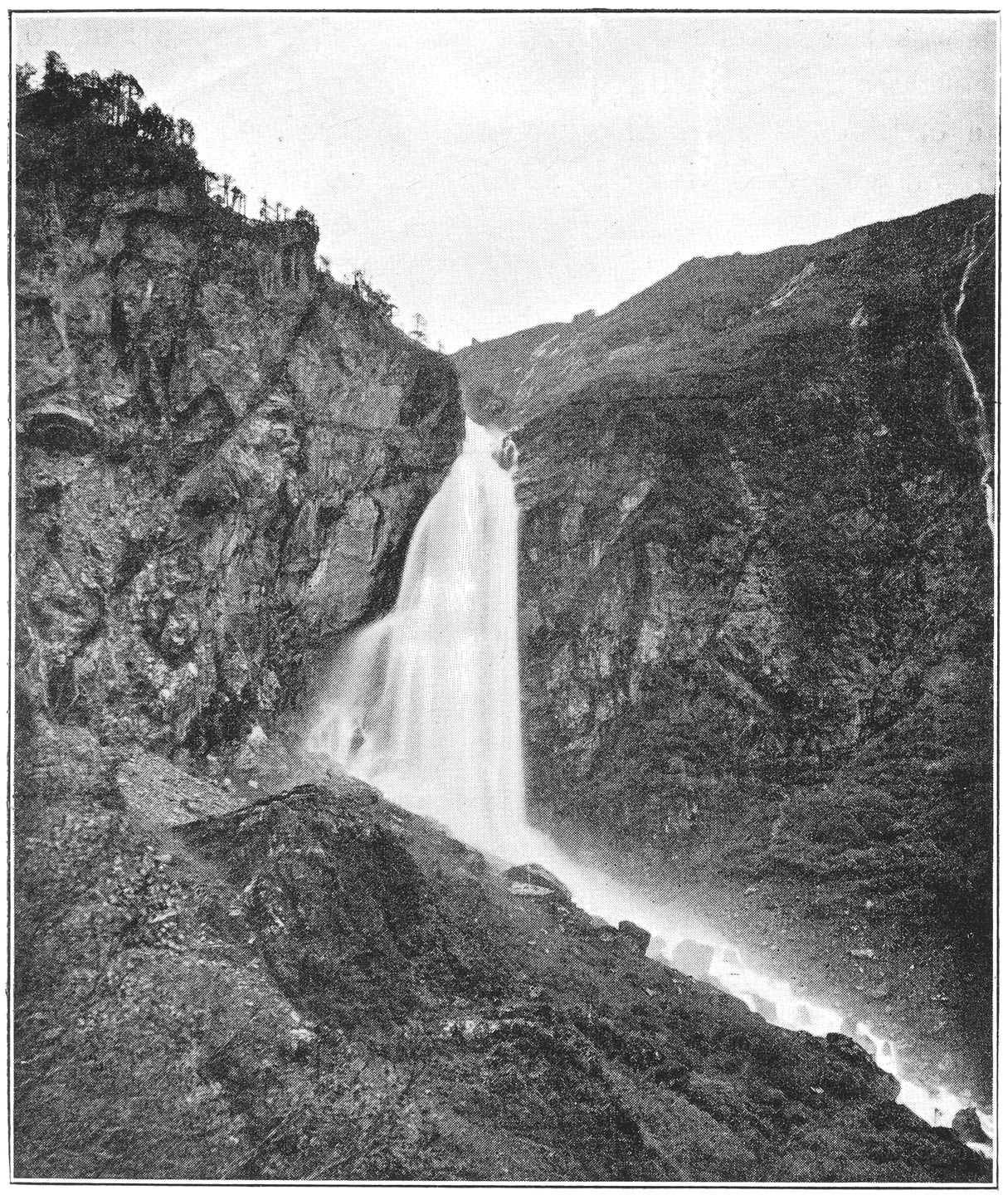
WATERFALL BELOW PACHUNGRI, BETWEEN GERA-TANG AND METANG.
In the palmy days of the Sakya hierarchy there were four abbots under the hierarch who ruled these four Labrang. The rank was hereditary in their families, and all those abbots, the hierarch included, were allowed to marry. This system of hereditary hierarchy was known as dun-gyu. At the present time the abbots are Tantrik lamas from Khams. I was told that neither the lamas nor the nuns of Sakya are held by the people to be exceptionally virtuous, and, to tell the truth, the laity of Sakya has a similar unsavoury reputation in Tibet.
In the Lhakhang chenpo (or great temple) are five seats of equal height, on which the princes take their places when conducting religious services; the one reserved to the hierarch remains vacant so long as the successor to the title has not been chosen.
Under the hierarch there is a Shape, or minister, who attends to all the temporal affairs of Sakya. The monks are divided into two orders, according to the locality of their birth; those from Tibet proper forming one set ruled by a Gekor, and having their cells near the great temple, and those from Khams (or Eastern Tibet), also with a Gekor over them, who live in the town.
As to the great library of Sakya, it is on shelves along the walls of the great hall of the Lhakhang chen-po. There are preserved here many volumes written in gold letters; the pages are six feet long by eighteen inches in breadth. On the margin of each page are illuminations, and the first four volumes have in them pictures of the thousand Buddhas. These books are bound with iron. They were prepared under orders of the Emperor Kublai, and presented to Phag-pa on his second visit to Peking.
After crossing the Yalung river we ascended the Dong la, from whose summit we saw the Chomo kankar (Mt. Everest), and the endless ranges of mountains which jut out from it westward. At the Dong la the Arun and the Kosi have their sources.
The descent of the Dong la was very gradual, the country extremely bare, not a single tree was to be seen anywhere. We reached Chu-sho, at the foot of the pass, at about five o’clock, and it was only after much persuasion that we gained admittance to a poor hut occupied by an old woman and her son.
The next day we followed for a while the course of a little stream, called the Chu-shu, and then came upon a broad, barren plain, on either side of which rose bleak and lofty mountains.
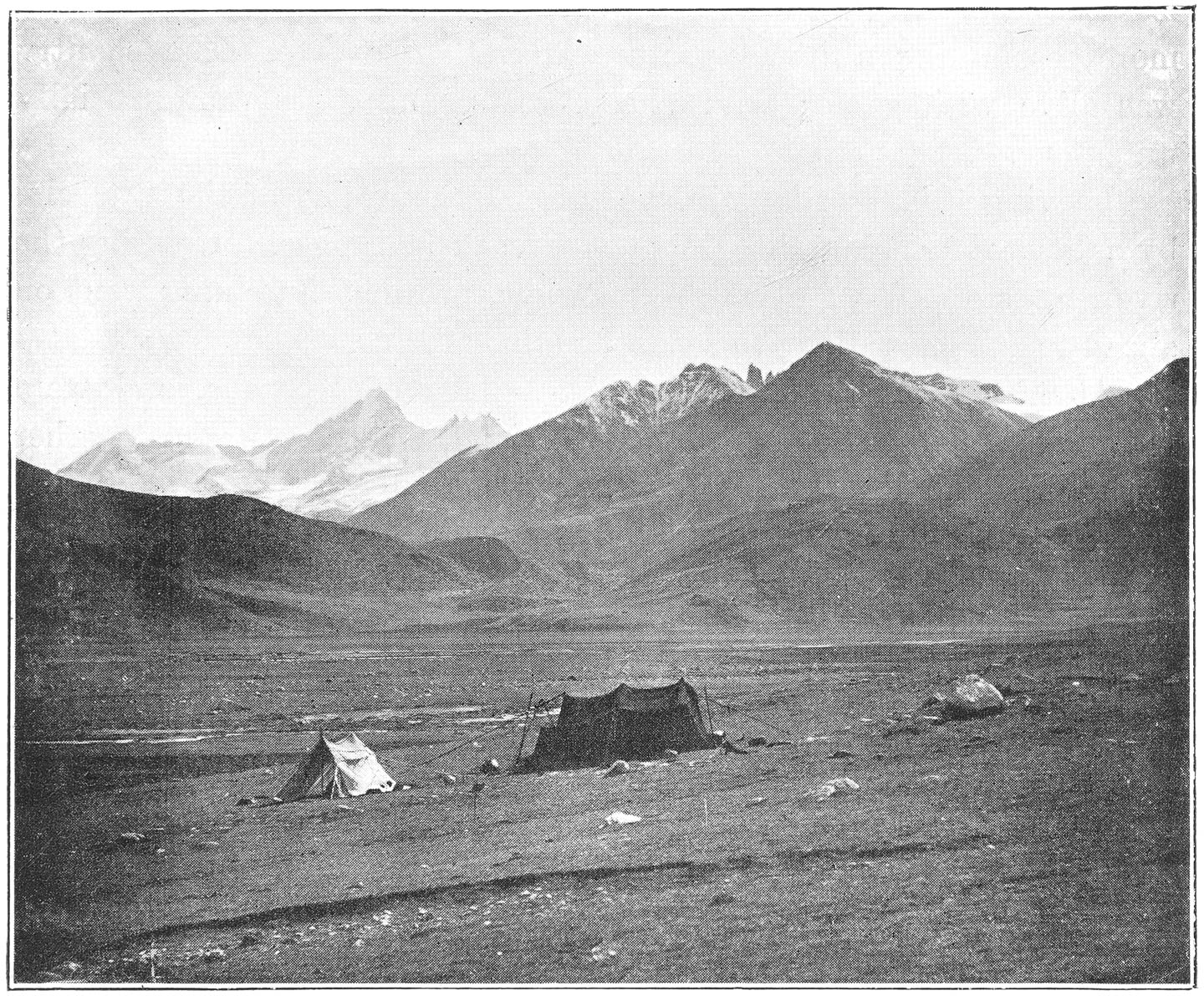
KHAMBA DJONGPON’S ENCAMPMENT ON A MORAINE BEYOND KANGCHAN JANG MOUNTAIN.
We stopped for the night at Chorka, a part of Dobta, where a villager gave us the use of a yak-hair tent standing in his courtyard. We only remained here a short while, leaving before daylight, as we wanted to reach Khamba djong the same day. The cold was intense, and the violent wind which blew made it more piercing. Our way led along the margin of lake Tel-tung, now completely dried up and more resembling a broad pasture land than a lake. The country was alive with game; wild sheep, goats, and asses were specially numerous.
At five o’clock we reached the village of Khamba, and were received most kindly by Phurchung’s friend, Wang-gyal, who, together with his wife, did everything in their power to make us comfortable.
The Djongpon were reading religious books when I entered their presence, and the lama one asked me questions about myself and the object of my journey, all of which I managed to answer satisfactorily. I showed my passport, to which they put their seals, retaining a copy of the document. When I left they presented me with a dried sheep’s carcass, ten pounds of rice, and a rug, and expressed the hope that they would see me again the following year.
On returning to our lodgings I hired two ponies and a yak-hair tent for our use as far as Gen-pang tang.
We left early in the morning, after saying farewell to our faithful guide Gopon, who left us here to return to his home at Gyantse, and breakfasted at Geru. On the way we saw several flocks of wild sheep and some foxes. Leaving Geru, we ascended, one after the other, the foothills of the Kongra lamo pass, through a wild but beautiful country, till we finally reached the snow-covered summit, near which we camped on a bare rock. Thanks to the yak-hair tent and the good fire of argols which Phurchung kept burning, we did not suffer from the intense cold and piercing wind.
The following morning (December 10) we reached, at an early hour, Gen-gang, which forms the boundary between the territories of the Grand Lama and the Rajah of Sikkim, a vassal of the British Raj. From this point my way lay through Sikkim by a route followed by various European travellers, and concerning which I need say nothing here. I reached Darjiling and my home on December 27, after an absence of over a year.