Chapter VI · RESIDENCE AT LHASA.
Reading edition
After a few minutes’ ride we came to the Yu-tog zamba, a short stone bridge with a gate, where a guard commanded by a lama is stationed, which examines all passers-by to ascertain the object of their visit to the city. To the great delight of my companions, who had been most anxious about my getting over the bridge, we passed by without a question being asked us.
At the Yu-tog zamba the city proper begins. The street on both sides was lined with native and Chinese shops; in front of each was a pyramidal structure, where juniper spines and dried leaves obtained from Tsari are burnt as an offering to the gods.
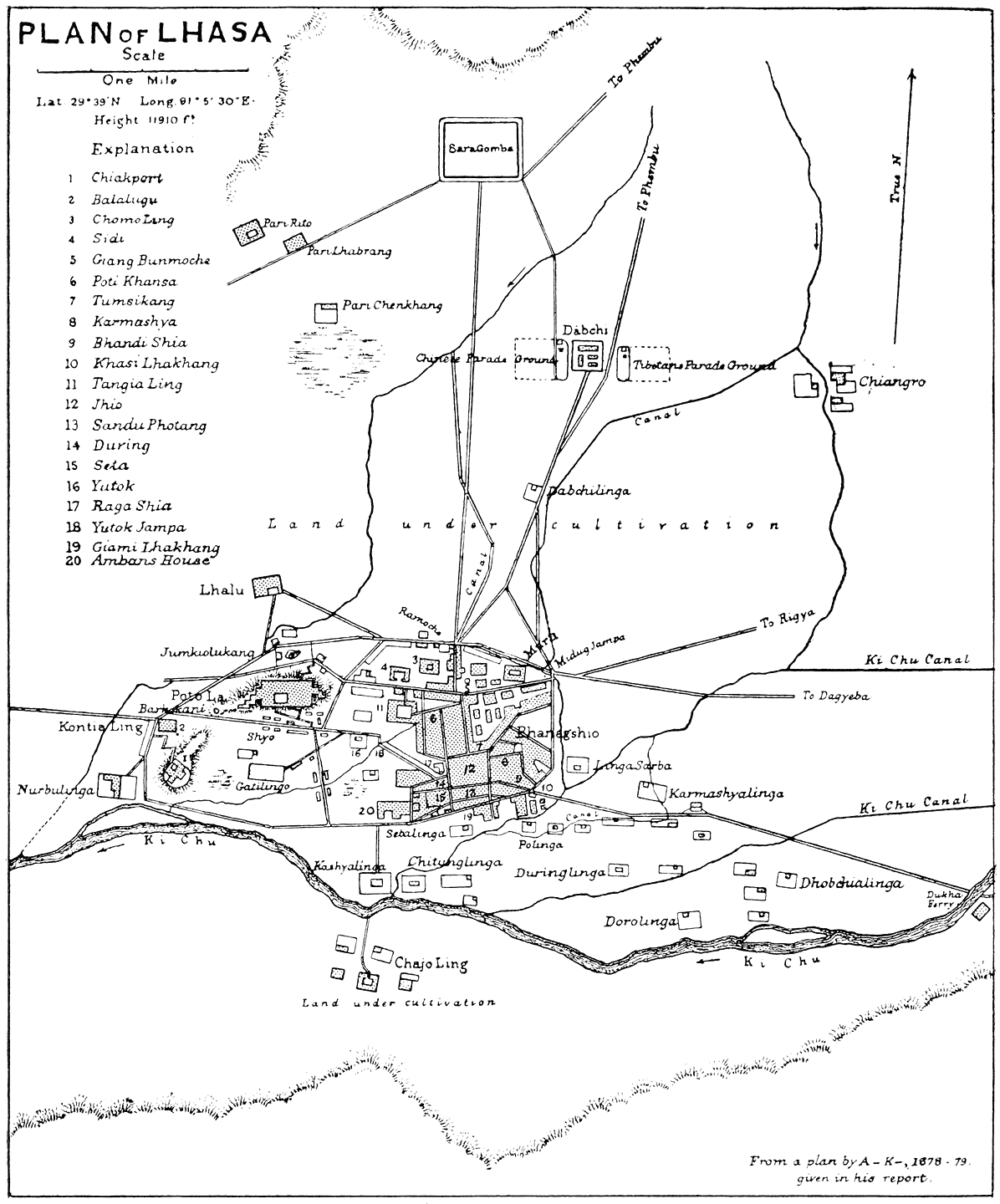
PLAN OF LHASA
Lat. 29° 39′ N Long. 91° 5′ 30″ E Height 11910 ft.
Explanation.
1 Chiakport
2 Balalugu
3 Chomo Ling
4 Sidi
5 Gian Bunmoche
6 Poti Khansa
7 Tumsikang
8 Karmashya
9 Bhandi Shia
10 Khasi Lhakhang
11 Tangia Ling
12 Jhio
13 Sandu Photang
14 During
15 Seta
16 Yutok
17 Raga Shia
18 Yutok Jampa
19 Giami Lhakhang
20 Amban’s House
From a plan by A—K—, 1878–79, given in his report.
[To face p. 149.
A lama guided us from this street to the Bangye-shag, a castle-like building three stories high, the residence of Sawang Phala, the husband of my protectress, the Lhacham. Leaving me at the postern gate, my two companions went in and presented the lady with a khatag, and she directed them to take me to Paljor rabtan, a building belonging to the Tashi lama, where all officers and monks from Tashilhunpo find lodgings when in Lhasa, and where we would be given accommodations.
Having shaved and donned my lama costume and goggles, we started for Bangye-shag, which was about a mile from our lodgings. Most of the shops we saw were kept by Kashmiris, Nepalese, or Chinese; the Tibetan ones were few and poorly supplied.
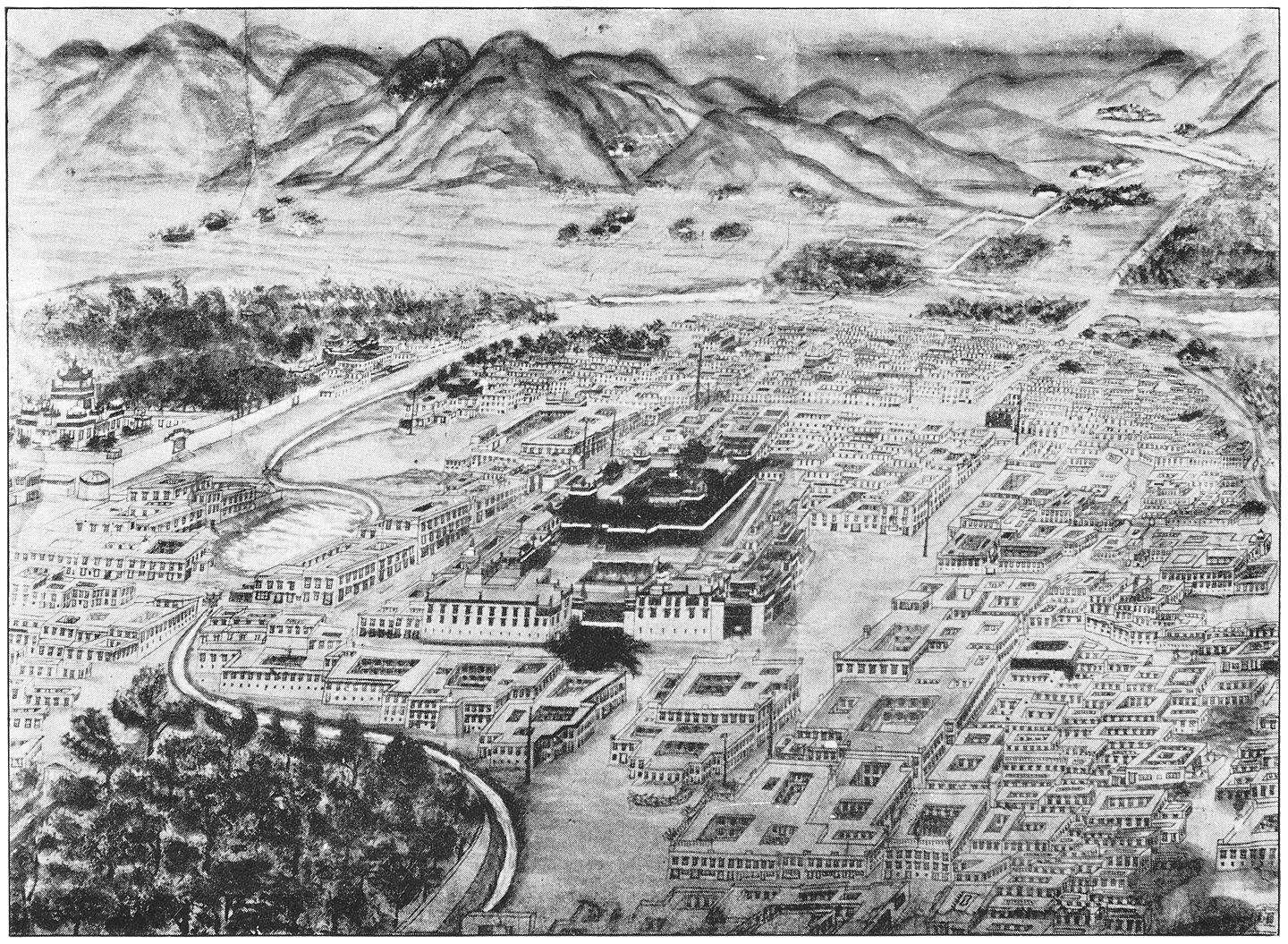
PLAN OF THE CITY OF LHASA.
[To face p. 151.
The legend goes on to say that the image was in the first place sent from India to the capital of China in return for the assistance the Emperor had given the King of Magadha against the Yavanas from the west. When the Princess Konjo, daughter of the Emperor Tai-tsung, was given in marriage to the King of Tibet, she brought the image to Lhasa as a portion of her dowry.
This statue is also known as the “five self-created” (nya rang chyung); for the Nepalese sculptor who made it said that it had sprung into shape rather than had been moulded by him, and it is further said that the souls of King Srong-btsan gambo and his consorts were absorbed in it. It occupies the northern chapel in the temple, and is surrounded by the images of a number of gods and goddesses.
In the outer courtyard of the temple is a row of statues, among which is that of King Srong-btsan gambo and various saints and Pundits. On the porch of the Tsang-khang are images of the Buddhas of the past, present, and future. Innumerable other highly interesting images and votive offerings were shown us, among which I will mention a hundred and eight lamps made out of stone under Tsong-khapa’s directions.
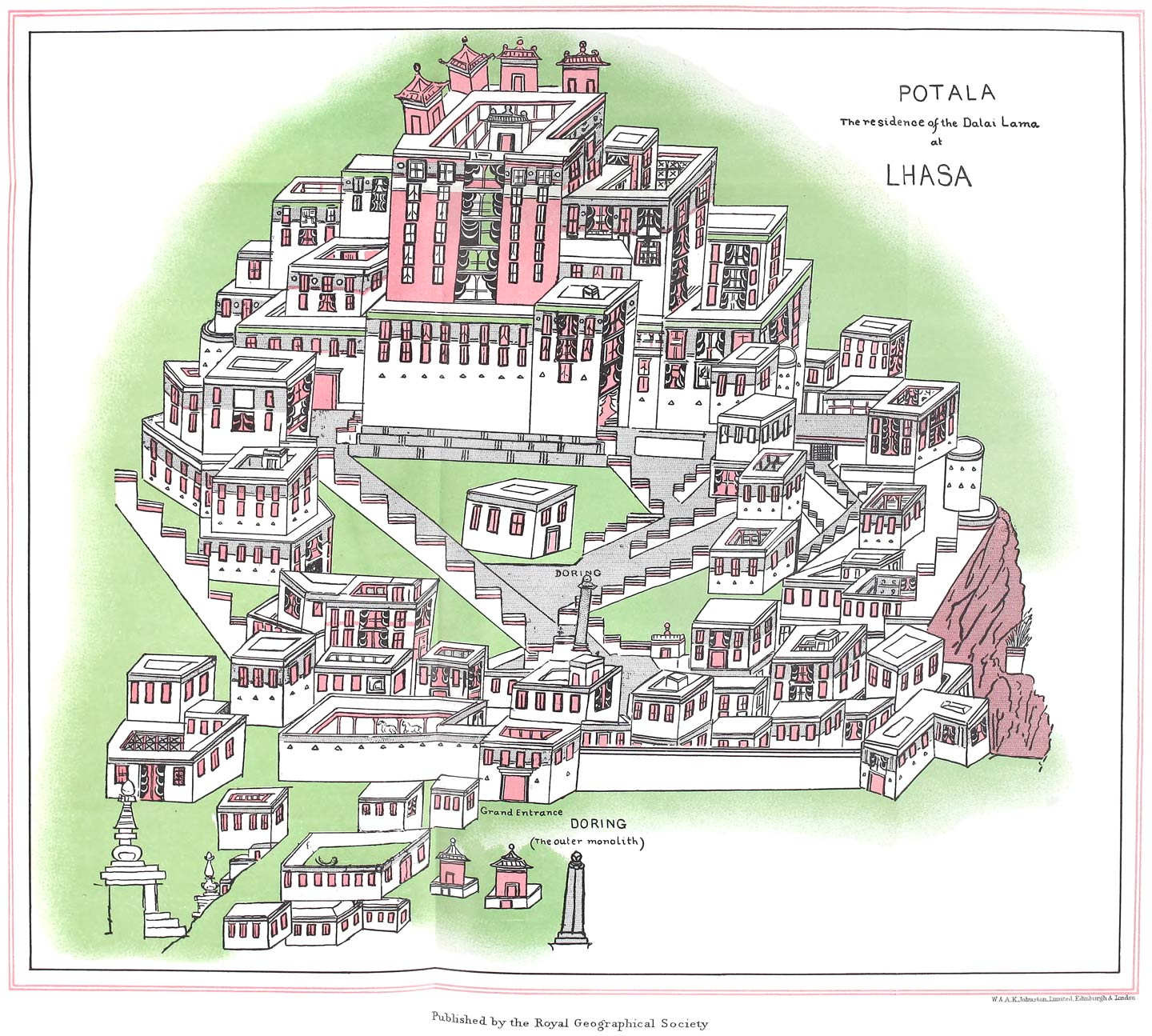
POTALA
The residence of the Dalai Lama at LHASA
W. & A. K. Johnston, Limited, Edinburgh & London
Published by the Royal Geographical Society
After visiting all the ground floor we climbed up to the second and third stories, where we were shown a number of other images, among which I noticed that of Paldan lhamo. By the time we had seen all the images we had exhausted our supply of butter, for Pador had put a little in every lamp lighted that day in the chapels. Those before the image of the Jo-vo were of gold, and each must have held ten or twelve pounds of butter.
By the time we reached our lodgings I was completely worn out, and passed the rest of the day in my rooms or on the housetop, the view from which always charmed me, especially when the rays of the setting sun shone brightly on the gilded domes of the temples and palaces.
I was much troubled in my mind by hearing from Tsing-ta that small-pox was raging in town, even the keeper of our house, his wife and children, were down with the disease, and in every dwelling in the neighbourhood some one was ill with it.
Lay monks, or Serkempa, usually perform the services held at Ramoche, and half a dozen of them and a kunyer (sexton) live in the upper stories of the temple.
As we left the temple we were met by a party of singing beggars, who followed us to our house clamouring for solra, or alms; finally we sent them off with a karma, or the value of two annas. Had we given more we would have been persecuted by numerous other parties of these pests.
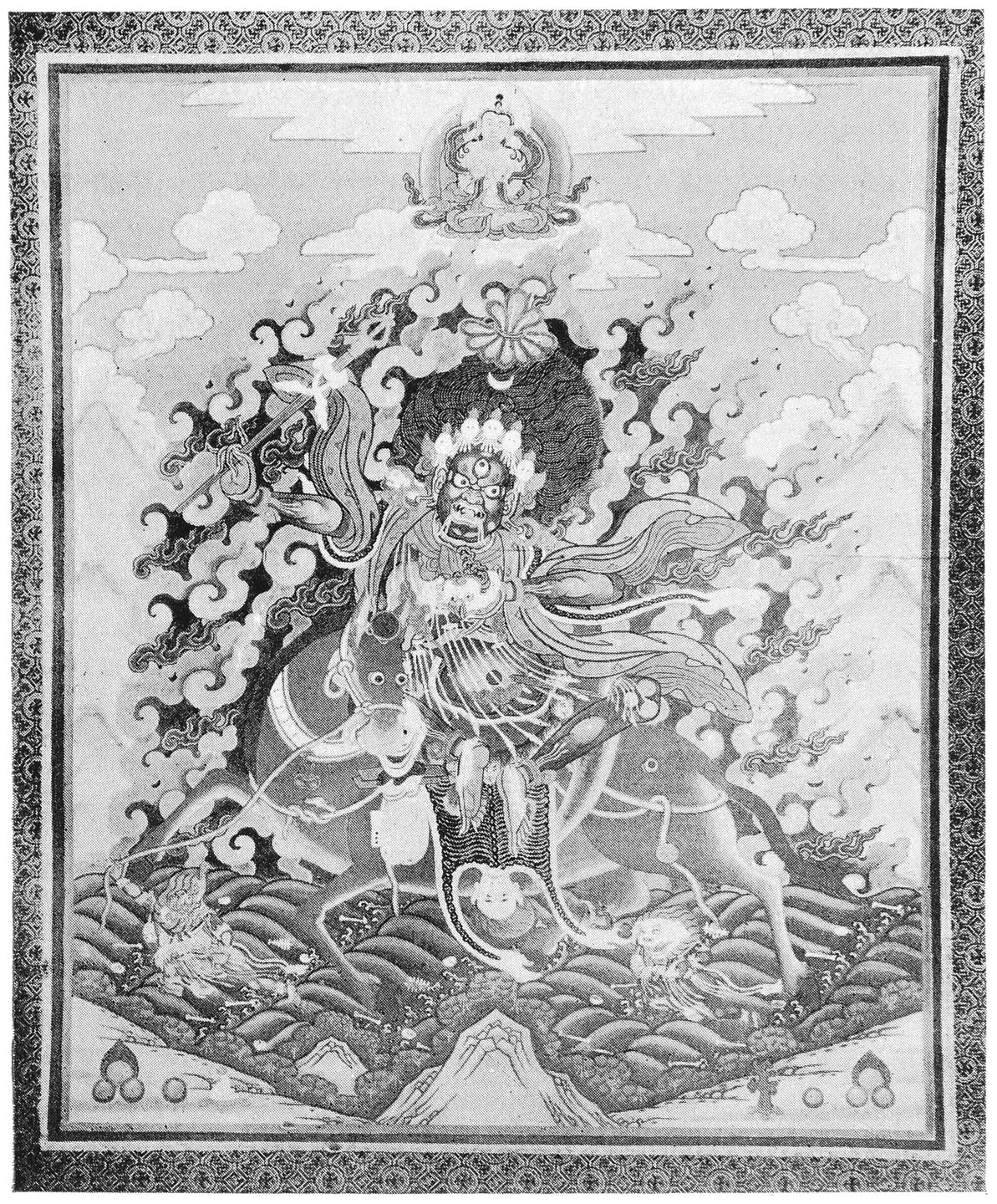
PALDAN LHAMO (SRIMATI-DEVI).
But perhaps the most revered of all the images in the Jo khang, exclusive of that of the Jo, is that of Paldan lhamo (Srimati devi). The terrifying face of the goddess is kept veiled, but the kunyer uncovered it for us. This terrific goddess is regarded as the guardian of the Dalai and Tashi lamas. The chestnut-coloured mule she rides, the offspring of a red ass and a winged mare, was given her by the goddess of the sea. The saddle she sits on is the skin of an ogre, and the bridle and crupper are vipers. Kya dorje gave her dice with which to play for lives, and the ogres, or Srinpo, presented her a string of skulls, which she holds in her left hand, and the goblins that haunt graveyards gave her corpses, on which she feeds. In her right hand she holds a club given her by the god Chyagna-dorje. ’Twas in such fearful attire that she waged war against the foes of Buddhism, and became the greatest of all its guardian deities.
The chapel of Paldan lhamo is overrun by mice, so tame that they crawled up the kunyer’s body. They are supposed to have been lamas in former existences. On one of the walls we saw a painting made with the blood of King Srong-btsan.
As we were walking home I saw some men hawking books, and told them what works I would buy if they could but procure them for me. They promised to bring them to me shortly.
The excellent brick-tea (du tang-nyipa) which I had brought from Tashilhunpo was now exhausted, and I was reduced to drinking a miserable quality known as gya-pa. Du tang, or first-quality tea, is more highly flavoured than the quality I liked, but it was too strong for me.
Some notes on the mode of selection of incarnate lamas may not be out of place here. It used to be customary when selecting incarnate lamas to either decide by throwing dice or by some other trial of luck, or by taking the opinion of the College of Cardinals; but that method not giving perfect satisfaction, it was decided that the candidates should undergo certain examinations, which, together with the hints thrown out from time to time by the defunct incarnation as to where and when his successor would be found, helped in the determination of the lawful reincarnation.
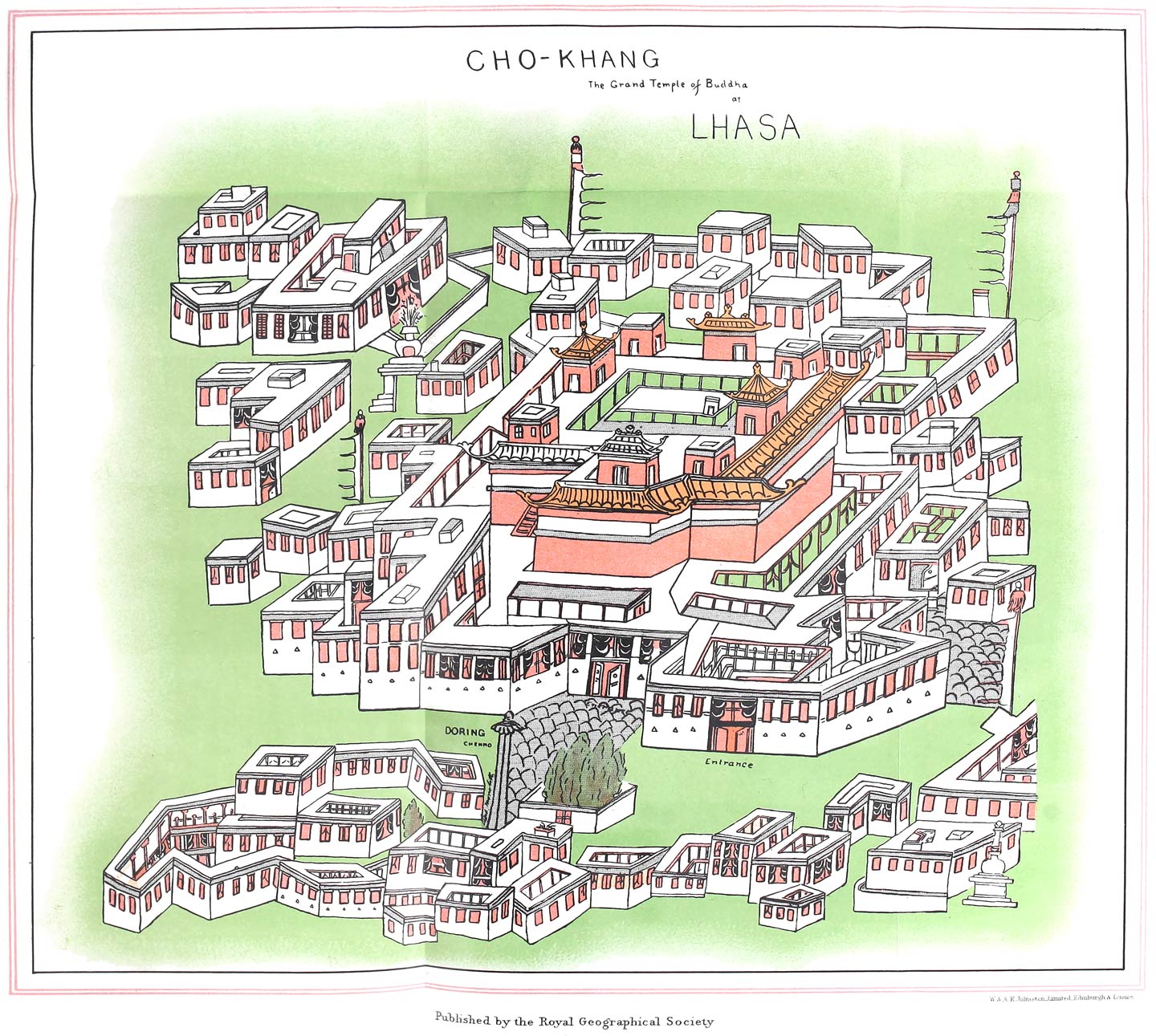
CHO-KHANG
The Grand Temple of Buddha at LHASA
W. & A. K. Johnston, Limited, Edinburgh & London
Published by the Royal Geographical Society
The reason why the golden jar was not used for finding this reincarnation was because of the apprehension that the Dayan Khanpo’s spirit—he had but recently died, and had been violently opposed to the Dalai lamas and their form of government—might be able to cause a wrong name to be drawn from the jar.
June 5.—Early this morning I was invited to dine with the Lhacham at Bangye-shag. I was received most graciously, and was led by the Lhacham to her drawing-room, a room about 16 feet by 12, facing the south and on the third story of the building. There were in it two Chinese chests of drawers, on top of which were a lot of porcelain cups; Chinese pictures—picnics and dancing most of them represented—covered the greater part of the walls; the ceiling was of Chinese satin, and thick rugs of Yarkand and Tibetan make covered the floor. Well-polished little tables, wooden bowls for tsamba, and some satin-covered cushions completed the furniture of the room.
After conversing for a while and drinking a few cups of tea, the Lhacham withdrew, and one of her maids showed me the rooms in the mansion. The furniture was much the same as that in the Lhacham’s room, only of inferior quality and ruder make. The walls were painted green and blue, with here and there pictures of processions of gods and demons, and the beams of the ceiling were carved and painted. The doors were very roughly made and without panels; the windows were covered with paper, with a very small pane of glass fitted in the middle of each. There were no chimneys in any of the rooms, but earthenware stoves, or jala. In a few of the rooms flowers were growing in pots.
June 7.—My two men had heard from Gadan Tipa, a soothsayer, that they would be stricken with small-pox if they ventured to go to Samye, and they besought me to give up the idea; but I declared emphatically my resolve to visit that famous lamasery, and also that of Gadan.
June 9.—I went out walking to-day in the direction of Ramoche. On the streets I met numerous bands of ragyabas, or scavengers, wandering from place to place, clamouring for alms from every new-comer or pilgrim they saw. If no attention is paid to them, they thrust their dirty hats in the stranger’s face and lavish insults on him; and if he take offence, they reply, “Why, my lord, this is not insolence; we are but saluting you!”
At present the chief of the ragyabas is a man of about fifty years, called Abula; he wears a red serge gown and a yellow turban. Cursed is the lot of the ragyabas, and twice cursed is Abula, if a day passes without a corpse being brought to the cemetery; for people believe that if a day passes without a death it portends evil to Lhasa.
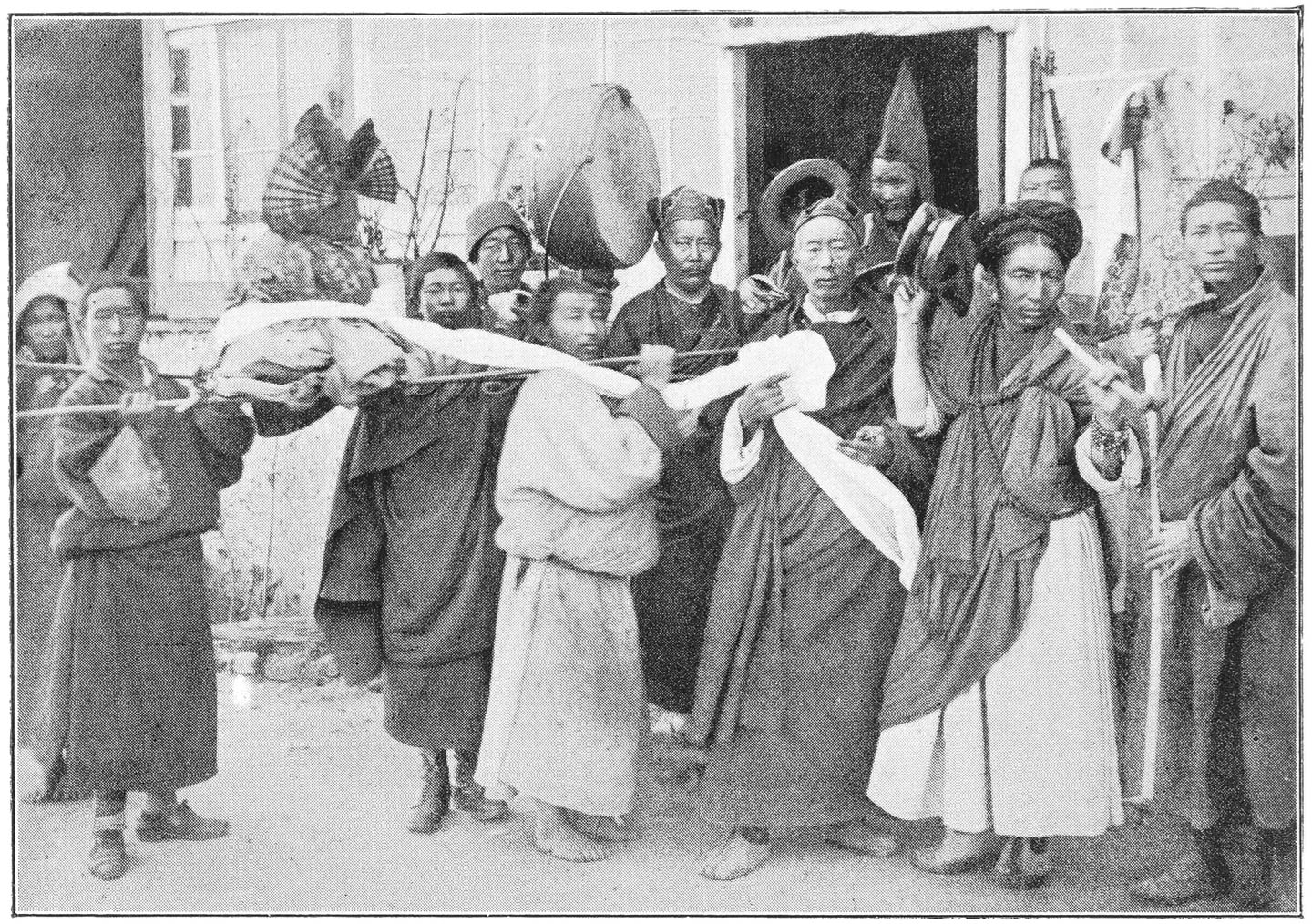
FUNERAL PROCESSION.
In the afternoon I called on the Lhacham, and was sorry to learn that her second son had small-pox. I told her how disappointed I was at not having been able to get even a glimpse of the Kyabgong, the “lord protector” of Tibet, the Dalai lama. “Alas!” I added, “I have not acquired a sufficient moral merit in former existences to be able to see Shenrezig in flesh and blood!”
Early the next day a gentleman (ku-dag), who was a Dungkhor of Potala, called on me, and said that the Kusho Lhacham of Phala had arranged with the Donyer chenpo of Potala for an audience for me with the Dalai lama, and that I must get ready as soon as possible.
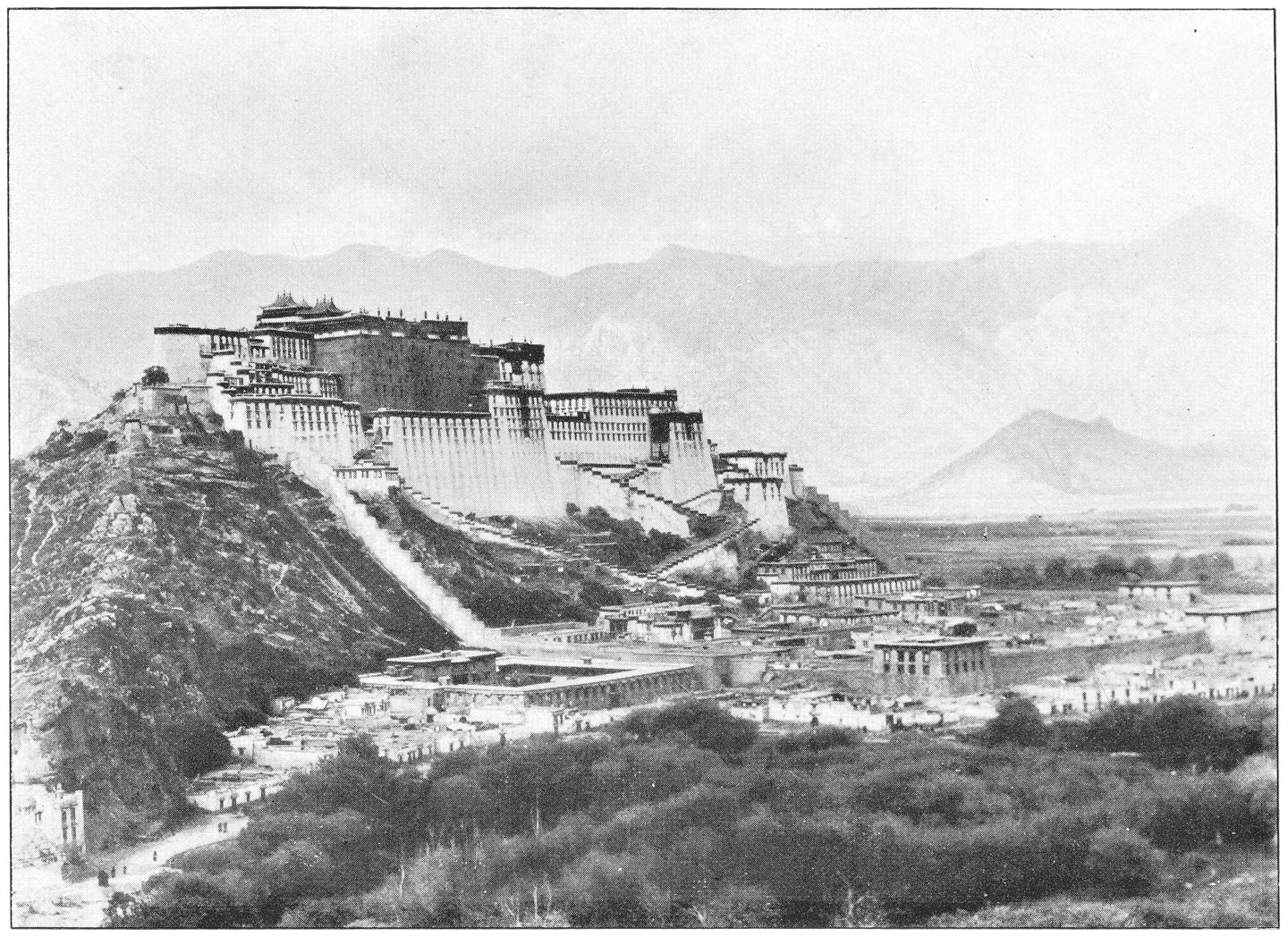
POTALA, THE PALACE OF THE GRAND LAMA.
[To face p. 166.
(From a photograph by a member of the Nepal Embassy to Peking.)
After a while three lamas appeared, and said that the Dalai lama would presently conduct a memorial service for the benefit of the late Meru Ta lama (great lama of Meru gomba), and that we were allowed to be present at it. Walking very softly, we came to the middle of the reception hall, the roof of which is supported by three rows of pillars, four in each row, and where light is admitted by a skylight. The furniture was that generally seen in lamaseries, but the hangings were of the richest brocades and cloths of gold; the church utensils were of gold, and the frescoing on the walls of exquisite fineness. Behind the throne were beautiful tapestries and satin hangings forming a great gyal-tsan, or canopy. The floor was beautifully smooth and glossy, but the doors and windows, which were painted red, were of the rough description common throughout the country.
A Donyer approached, who took our presentation khatag, but I held back, at the suggestion of Chola Kusho, the present I had for the Grand Lama; and when I approached him I placed in his lap, much to the surprise of all present, a piece of gold weighing a tola. We then took our seats on rugs, of which there were eight rows; ours were in the third, and about ten feet from the Grand Lama’s throne, and a little to his left.
After this the Solpon chenpo put a golden dish full of rice before the Dalai lama, and he touched it, and then it was divided among those present; then grace was again said, and his Holiness, in a low, indistinct tone, chanted a hymn, which was repeated by the assembled lamas in deep, grave tones. When this was over, a venerable man rose from the first row of seats and made a short address, reciting the many acts of mercy the Dalai lamas had vouchsafed Tibet, at the conclusion of which he presented to his Holiness a number of valuable things; then he made three prostrations and withdrew, followed by all of us.
As I was leaving, one of the Donyer chenpo’s (or chamberlain) assistants gave me two packets of blessed pills, and another tied a scrap of red silk round my neck—these are the usual return presents the Grand Lama makes to pilgrims.
As we were going out of the hall, we were met by Chola Kusho’s younger brother, a monk in Namgyal Ta-tsan, the monastery of the palace, and in his and his brother’s company I visited the palace, and learnt from them much relating to the history and the traditions of the place.
After visiting these halls we descended to the Namgyal Ta-tsan. The architecture of the Phodang marpo embarrassed me greatly, the halls and rooms being piled up story on story. The stonework was beautiful, but it is so poorly drained that in many places the odours are stifling.
Entering a small room, the cell of our guide, we were given seats and served with tea and a collation. Shortly after we started home, having expressed in the warmest terms our thanks to Chola Kusho and his brother for their kindness. We followed the ling-khor, as the road which encircles Lhasa is called. On the way we passed a small grove where is the elephant-shed, the solitary occupant of which—a present from the Rajah of Sikkim—was standing in a barley patch near by. Further on we came to a place where the corpses of the townspeople are fed to pigs, whose flesh, by the way, is said to be delicious. Near here are numerous huts of Ragyabas.
In the evening a drove of donkeys loaded with tsamba and butter arrived from Gyantse, and I was distressed to learn that my friend the minister had small-pox. My men again began pestering me to return to Tsang, alleging as a pretext that I might be of assistance to the minister, and I finally prepared to go to him, especially as the donkey-men said he had expressed a desire to have me near him.
On June 11 I went to see the Lhacham, thanked her for having obtained for me an audience of the Kyab-gong Rinpoche, and spoke to her about my intention of setting out for Dongtse. She advised me to leave at once, as small-pox was raging at Lhasa; her two sons now had it, and from her appearance I feared that she was about to fall ill of the same disease.
Returning to our lodgings, I despatched Tsing-ta to her to ask a loan of 200 tankas. The sum was brought me in the evening by her maid Apela, and the Lhacham also sent me provisions for the journey and feed for the ponies.