WIFE OR GALLOWS? PREFERS HANGING TO LIVING WITH HIS WIFE.
Reading edition
Hugo Devel prefers being hanged to living with his wife.
Unable to escape her in any other way, lacking the courage or nerve to kill himself, and shuddering at the idea of life imprisonment with the woman he had promised to love and cherish, he confessed to a murder he did not commit, and was ready to go upon the gallows or to penal servitude for life in the stead of the real murderer.
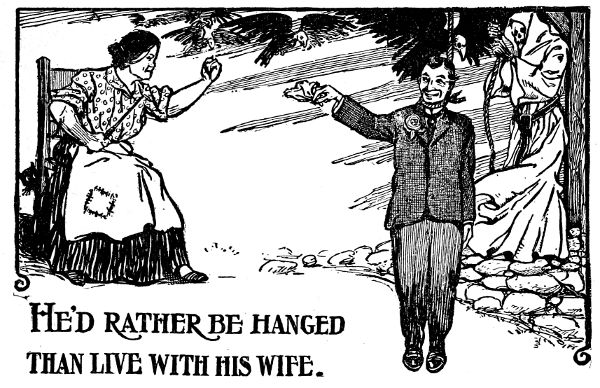
He'd rather be hanged than live with his wife.
Now he is free, and miserable, and in his home at Lubeck, in Germany. He is envying Franz Holz, who is awaiting the gallows.
Devel admits sadly that he had a double purpose in wanting to die on the gallows. First, that he would escape his wife; and, second, that, by being hanged he would make it improbable that any other man should meet his fate—not his fate on the gallows, but his fate in having wedded Frau Devel.
The case, which was cleared up by the Hamburg police, furnished a problem that would have defied the cunning of Sherlock Holmes and all his kindred analysts. Briefly stated, the facts in the case, which is the strangest one ever given to a detective department to solve, are these:
Woman Was Robbed and Murdered.
A few months ago a certain Frau Gimble, of Munich, was cruelly murdered by a man. The evident motive of the deed was robbery, and that the crime was planned and premeditated there was sufficient evidence. Every clew and circumstance pointed to Franz Holz. He was known to have been at or near the scene of the murder shortly before its commission. He knew the woman, and had knowledge that she kept a considerable sum of money in her home. He was known to have been without money for days prior to the murder, and immediately after the deed, and before the body was discovered, he had appeared with a quantity of money, made some purchases, bought drinks for acquaintances, and then disappeared.
The police were on his trail within a short time after the finding of the body of the murdered woman. Holz had fled toward Berlin, and a warning was sent in all directions, containing descriptions of the fugitive.
The awfulness of the deed attracted the more attention because of the locality and the ruthless and cruel manner of its commission. While the police were making a rapid search for the fugitive Holz, Hugo Devel, a well-to-do tradesman in Lubeck, surrendered himself to the police of his home town and confessed that he, and not Holz, had committed the crime. Devel had been in Hamburg at the time the crime was committed. His confession, which destroyed all the evidence and all the theories implicating Holz, staggered the detectives.
Devel Confesses to the Crime.
Although apparently saved from a remarkable network of circumstantial evidence, and no longer wanted for the murder of the Gimble woman, the German police reasoned that Holz, if he had not fled because of that crime, must have fled because of some other crime. So the department, which has a name a couple of feet long, which in English would mean, "the department for finding out everything about everybody," kept on the trail.
Meantime the police of Hamburg got possession of Devel and examined him. From the first they were uneasy. He confessed that he murdered the woman to get her money, and beyond that would not tell anything. It is not customary for the police to insist that a man who confesses that he is guilty of murder shall prove it, but there were facts known to the police which made them wonder how it was possible for Devel to have killed the woman. They used the common police methods, and made the prisoner talk. The more he talked the more apparent it became to the police that he was innocent, although he still claimed vehemently that he, and he alone, killed the Gimble woman.
Police Learn He is Not Guilty.
Some of his statements were ridiculous. For instance, he did not know what quarter of the city the woman lived in. He did not know how she had been murdered. He said he climbed through a window and killed the woman. When pressed, he said the window was the dining-room window. In view of the fact that she was killed while working in a little open, outdoor kitchen when murdered, the police became satisfied that Devel was not the man, and ordered the pursuit of Holz resumed by all departments.
The case even then was a remarkable one, and one which would have defied any theoretical detective. The police proved that it was impossible that Devel should be confessing in order to shield Holz—first, because he never knew Holz; and second, because the police had informed him that the real murderer was in custody, in order to discover a reason for his confession. It was suspected that Devel was partly insane and seeking notoriety. Everything in his life refuted that idea. He was a quiet, orderly citizen, who seldom read newspapers, and who neither was interested in crime or criminals. He owned a small business in Lubeck, attended to it strictly, drank little, and apparently was as sane as any one.
Searching for Motive of Confession.
The case worried the police officials. The absolute lack of reason for Devel's confession stimulated their curiosity. He was held in custody for weeks, and then the police gave up in despair, and, as Holz had been arrested and had confessed to everything, the release of Devel was ordered. The order of release proved the move that revealed the truth. When he was told that he was free to return home, Devel broke down and begged the police to keep him in prison, to hang him, to poison him, but not to send him home.
In his agony he confessed that the only reason he confessed the murder was that he desired to get hanged, and that he preferred hanging to life with his wife.
The hard-hearted police set him free—literally threw him out of the prison, and he returned to his wife in Lubeck. The following day he resumed charge of his business.
An English correspondent visited Devel in his shop and made certain inquiries of him regarding the case. As the hanging editor would say, "the condemned man was nervous." He was afraid his wife would read what he said, but the correspondent finally got him to tell.
"I desired to be hung," said Devel, mournfully. "Life is not worth the living, and with my wife it is worse than death. If I had been hanged no other man would marry my wife, and I would save them from my fate. Many times have I planned to kill myself to escape her. That is sin, and I lack the bravery to kill myself, besides. If they will not hang me I must continue to live with my wife."
Devel states, among other things, that these are the chief grievances against married life in general, and his wife in particular:
She was slender, and became fat and strong.
She was beautiful, and became ugly and coarse.
She was tender, and grew hard.
She was loving, and grew virulent.
She grew whiskers on her chin.
She called him "pig."
She wore untidy clothes, and her hair was unkempt.
She refused to give him beer.
Her breath smelled of onions and of garlic.
She threw hot soup upon him.
She continually upbraided him because there were no children.
She scolded him in the presence of neighbors.
She refused to permit him to bring his friends home.
She came into his store and scolded him.
She accused him of infidelity.
She disturbed him when he slept in the garden on Sundays.
She made him cook his own dinners.
She spilled his beer when he drank quietly with friends.
She told tales about him among the neighbors, and injured his business.
She served his sausages and his soup cold, and sometimes did not have his meals for him when he came home.
She did not make the beds nor clean the house.
She took cards out of his skat deck.
She talked continually, and scolded him for everything or nothing.
She opened the windows when he closed them, and closed them when he opened them.
She poured water into his shoes while he slept.
She cut off his dachshund's tail.
These things, he said, made him prefer to be hanged to living with her.
Incidentally Holz, who is awaiting execution, expresses an earnest desire to trade places with Herr Devel.
There is no accounting for tastes.