BUCKET-SHOP.
Reading edition
Every day the American people squander $100,000 in fictitious speculation in grain.
There are 1,000 bucket shops operating in the United States at this time, their geographical distribution marked by the boundaries of the country.
For each of these 1,000 shops an average of $100 a day gross income is necessary to meet its expenses, chief of which are for wire and ticker service and blackboard writers.
Thus, in order that 1,000 of these shops may live and remain open, they must have $100 a day each, which, in a year of 300 days, means an income of $300,000,000 annually. Many of these bucket shops fail for lack of money, while others "fail" in order that they may keep the money of the investor. While $100,000 a day as the losses of the people in the illegitimate speculation in grain is very conservative, one must add another $100,000 a day as tribute which the gullible pay to the fake "get-rich-quick" and kindred sharper concerns of the country.
"Speculation" an Unmeaning Term.
Yet with this $100,000 a day going into the hopper of frenzied speculation of all kinds, Bradstreet's for the year 1907 showed business failures from speculation as one-eighth of 1 per cent of the total failures of the country.
Whatever may be Bradstreet's definition of the word "speculation," as used in his lists, the word to the average business man who knows whereof he talks is as unmeaning as any other in the business dictionary. Suppose a man somewhere in a country town loses money in any speculative venture anywhere under the sun. If it is a few dollars only, he may not speak of it at all. If it is enough to embarrass him, perhaps he may have to speak. Under these circumstances the best possible thing to do is to explain that he lost it "on the Chicago Board of Trade." If he has no credit at stake in the matter, and is sore, he may yell murder over his losses "on the board." But hundreds of such men have lost their money in bucket shops, and scores of them have lost it at poker or some other gambling game.
"Board of Trade" Falsely Blamed.
Every little while a banker somewhere goes wrong with funds that are intrusted to him, and in the telling of the story the "Chicago Board of Trade" is the secret of his undoing.
One of the marked cases of the kind was that of the Aurora banker who defalcated with $90,000, "lost on the Board of Trade."
But when the story was run down it was discovered that his money was lost in a bucket shop in Hammond, Ind., which had been driven out of Chicago through the efforts of the Chicago Board.
When $100,000, at a conservative estimate, every day, is lost by the American public in bucket shops, just the thing that such a shop is "in being" should be of economic interest and consideration.
Within the knowledge of tens of thousands of citizens some acquaintance or person of whom they have had personal knowledge has gone "broke" in grain speculation.
Yet to find a man who has lost his fortune on the race tracks or in a gambling den is not at all an easy task.
Without a question the gambling losses in the bucket shop are more serious in consequences the country over than the losses in any other one kind of gaming, for the reason that the man who could afford to confess losses at horse racing or at cards may retain his character as a business man to a far greater extent by having lost at a "little flyer in grain."
What is a Bucket Shop.
I have frequently been requested to define bucket shops—a most difficult task, owing to the variety of disguises which they assume and the outward similarity which they bear to legitimate brokerage. The following definition covers the essential features of bucket shops from the standpoint of an expert.
A bucket shop is an establishment conducted nominally and ostensibly for the transaction of a grain, cotton or stock exchange business.
The proprietor, with or without the consent of the patron, takes one side of every deal that is made in his place, the patron taking the other, no article being bought or sold in any public market.
Bucket shops counterfeit the speculative trading on exchanges.
Continuous market quotations of an exchange are the essence, the very sinew of the gambling business carried on in a bucket shop, being used as dice are used, to determine the result of a bet.
The market quotations posted in a bucket shop are exactly similar to those posted in a legitimate broker's office, but they are displayed for a different purpose. The broker posts the quotations for the purpose of showing what the market has been on the exchange as a matter of news.
The bucket shop posts them as the terms upon which its patrons may make bets with the keeper. A bucket shop is destroyed if it loses its supply of quotations.
Margins deposited with the bucket shop proprietor by the patrons are nothing but the patrons' stakes to the wager, and are appropriated by the proprietor when the fluctuations of the price on the exchange whose quotations are the basis of the bet, reach the limit of the deposit, one party (the proprietor) to the bet acting as stakeholder. The commissions charged by the bucket shopkeepers are odds in its favor, and necessary in order to maintain their pretense of being legitimate brokers making the transaction on an exchange.
Ready to Make All Deals.
The bucket shop proprietor is ready to make all deals offered in any commodity that fluctuates in price. He may call himself banker and broker, or commission merchant, or disguise his business under the form of an incorporated enterprise or exchange. But he is still a common gambler. The interest of the proprietor of a bucket shop is at all times opposed to that of his patrons, as the profits of the shop are measured by the losses of the patrons.
Bucket shops should not be confounded with the great public markets of the world, where buyer and seller, producer and consumer, investor and speculator meet in legitimate trade; for the pretended buying of millions of bushels of grain in bucket shops will not add a fraction of a cent to the price of the product of the farm, nor will the pretended selling of as much increase the supplies of the consumer or lessen the cost of his loaf a farthing. Nor should they be confounded with the offices of legitimate brokers which they endeavor to imitate in appearance.
Name Coined in London.
The term "bucket shop," as now applied in the United States, was first used in the late '70s. It was coined in London fifty years ago, when it had absolutely no reference to any species of speculation or gambling. Beer swillers from the East Side (London) went from street to street with buckets, draining every keg they came across and picking up cast-off cigar butts. Arriving at a den they gathered for social amusement around a table and passed the bucket as a loving cup, each taking a "pull" as it came his way.
In the interval were smoking and rough jokes. The den came to be called a bucket shop. Later the term was applied, both in England and the United States, as a byword of reproach to small places where grain and stock deals were counterfeited.
Yet the bucket shop is a gambling den par excellence, with all the paraphernalia necessary for the deception of the unsuspecting. One may place a $10 bet in the bucket shop, pay a commission of 25 per cent to the "bucket shopper," who may so shuffle the "cards" that the bettor may have to lose, even after he has won. As an example:
Game Neatly Fixed.
The one thing absolutely necessary to the bucket shop are quotations, never from a legitimate board of trade, but through leased wires, or wire tappings, or from some other fake source. For the instant that the "quotations" cannot be written upon the blackboards the betting must cease. The bet of the customer is that before a certain grain drops off a point against him, it will advance a point or more in his favor, and the bucket shopper takes the bet, holding the stake himself. Frequently the bettor may realize that he has won a point, or two, or three, and may insist upon the bucket shop selling for him. Perhaps the victim lives at a distance from the shop and must write or wire his "broker." He wires for the "broker" to sell, and perhaps gets a message in reply to the effect that the market must go much better than that; that he refuses to sacrifice his patron's best interests in that way, and will hold on for the certain rise. In most cases this patron is immensely flattered, until within a few days the market is "off" again, wiping out not only his profits, but his original margins as well.
How the Suckers Are Skinned.
Or if on a certain day the customer takes advantage of a rise in the commodity bet upon, and insists upon closing out the deal, it is most frequently settled by the bucket shop upon the lowest figure for the day. Occasionally, indeed, where a bucket shop keeper has allowed one or more customers to "win" a considerable figure from it through some untoward turn in figures, the whole shop closes up and disappears, leaving the victims no redress at law for the reason that they have left the money voluntarily in the hands of the sharpers. Occasionally the country branch office of one of these central bucket shops may clean out a town of its currency until the scarcity of money in the place may demoralize the every-day business of the town.
That the man who tries to beat the bucket shop has an impossible task in front of him in investigating the $10 bet, the commonest in the shop. The man with the bill steps up to the window and asks to buy ten shares of American Sugar at $110 a share, paying 25 per cent out of the $10 as commission. Then, counting that the bucket shop might be as nearly straight as such an institution can be, remember that the decline of Sugar three-quarters of a point will wipe out the bettor's $10, while for him to win another $10, Sugar will have to advance to $111.25. In short, the customer is betting against a proposition which will lose him $10 if Sugar declines 75 cents, while to win $10 it must advance $1.25, in either case the bucket shop holding his money and taking 25 cents in tolls.
Other "Fakes" "Boost" the Game.
In the machinations of the bucket shop interests and those of kindred concerns that are garnering this $100,000 a day from the American people, the fake trade journal has had much to do; the fake mercantile agency, reporting extravagantly upon the responsibility and wealth of the schemers, has played extensively upon the credulity of men and women; fake banks and bankers have come into existence for the completion of the work of the others, and have been by no means the least in the category of rascality; the whole aggregation has been lending back and forth the "sucker lists," which is an interchangeable lists of names and addresses of men and women who have "bitten" at one scheme and may be promising of a rise to another of different type under a new title.
On file in the office of a Chicago man of affairs at the present moment is a series of interesting letters, which he shows occasionally to a friend. These letters are especially eloquent of a spirit of investment which is in the country today and which prompts the "biting" at almost any sort of flaunting announcement of quick riches. The letters are from a young man holding an official job under the government at Washington.
Big Dividend Promises False.
The first letter is apologetic for reminding the addressee that he is an old friend of the writer's family; but it recites that the young man has about $200 in bank which he has saved from his salary, and which he is disposed to invest with a certain company if his friend in Chicago thinks the prospects are in line with good business and responsibility.
Evidently the Chicago man does not regard the concern as dependable, for the next letter expresses thanks for saving the writer loss, but asks a further question of a concern that promises 20 per cent a month on cash investments in grain.
The third letter, recognizing all that the old friend from Chicago has done, explains that he has only a fair salary from which it is hard to save much money, and this fact has led him to the necessity of considering an investment of his savings that promise large returns, and yet at the same time promise the maximum of safety. Having established his reasons for such ventures, he suggests to the friend: "Perhaps you can answer all I want to know in a single reply. 'Are any of these concerns promising dividends of 50 per cent and such to be depended on'?"
And the Chicago man's letter, in substance, reads: "No!"
"Outsider" Has No Chance.
Speculation, for the most part, as in the case of this young man, means for the average intelligence a possibility for placing money in a side line where quick and profitable returns may be expected, wholly independent of the person's occupation. To the man who knows what the best of the speculative market is, the necessity for all of the time and attention and best judgment of the speculator is imperative. It is a business in which only the best business methods succeed.
On the boards of trade the commission merchants may be wholly apart from any risk in even the legitimate trading, taking the commission of one-eighth of a cent a bushel in buying and selling. On the Board of Trade of Chicago the designated leading speculative articles, in their order, are wheat, corn, oats, rye, barley, mess pork, lard, short ribs, live hogs and cotton.
A year's grain crop may be 650,000,000 bushels of wheat, 2,500,000,000 bushels of corn, 900,000,000 bushels of oats, 150,000,000 bushels of barley, and 30,000,000 bushels of rye.
Bucket shops have been condemned by statutes as criminal and pernicious in many states in the Union, but anti-bucket shop laws are rarely enforced by public servants whose duty it is to enforce them. Prosecutions thus far, except in Illinois, have been left to private citizens or associations for the suppression of gambling.
The "bucket shop" has, within a few years past, sprung from comparative inconsequence into an institution of formidable wealth and threatening proportions. There are nearly a thousand in the United States. Every large city in the west has at least one. Having banded together in a strong combination they sneer at legislation. Opulent and powerful they scoff at antagonistic public opinion.
On Level with Lottery and Faro Bank.
The "bucket shop," like the lottery and the faro bank, finds its profits in its customers' losses. If its patrons "buy" wheat and wheat goes up, the "bucket shop" loses.
Many a bucket shop commission merchant would hardly know wheat from oats, and none of their grain and produce "exchanges" ever had a sample bag on its counters. Their transactions are wagers and their existence is an incitement to gambling under the guise of commercial transactions. The pernicious influences of the gaming house are, in the bucket shop, surrounded by the allurement of a cloak of respectability and the assumption of business methods.
The legitimate exchange is a huge time and labor saving machine. Its benefits are universal. While its privileges are valuable they have been rendered so only by hard work, and its members are entitled to the protection of the state against thieves. The "bucket shop" is a thief. The quotations upon which the "bucket shop" trades are the product of the labor and intelligence and information of the exchange. The exchange gathers its news at great cost from all over the globe and disseminates it for public advantage. But its quotations should be its own property. They are the direct product of its energy, its foresight and its business sagacity.
The "bucket shop," at no parallel cost, usurps the functions of the exchange and endeavors to secure for itself the returns for a labor performed by others. Were it to use honorable methods with its patrons it would be a dishonorable institution. Using the methods it does, the "bucket shop" is twice dishonored.
As a matter of fact, all other forms of gambling or swindling are commonplace and comparatively innocent when compared to the "bucket shop" which has caused more moral wrecks, more dismantled fortunes and made more of the innocent suffer than any other agency of diabolism. Just why so brazen an iniquity in the guise of speculation should be allowed to exist it is difficult to explain.
Open Gambling Under Ban.
Open gambling has been placed under the ban of civic reform. While the policy shop, the lottery and other less dangerous methods of swindling have been effectively stamped out of most cities, the "bucket shop tiger" continues to rend the ambitions of young and old, dragging them down to forgery, embezzlement, suicide,—or that which is quite as bad,—broken spirit for legitimate endeavor. Under the circumstances the sympathy of the public should be with the movement to drive "bucket shops" out of business, to close them along with all other gambling institutions.
It is time that something was done to check the growing evil of gambling on produce, cotton and stock exchange quotations. A beginning has been made, but the movement has not gone far enough. These excrescences on the body politic have multiplied rapidly and so dangerously near do they come to being popular that the mercantile community owes it to itself to apply the knife at once.
Moreover, there is no form of gambling more disastrous to the player than "bucket shop" gambling. Its semi-respectability and likeness in many outward features to regular and reputable commission houses makes it the most insidious of all temptations to the young speculator and aspirant for wealth. It is the open door to ruin.
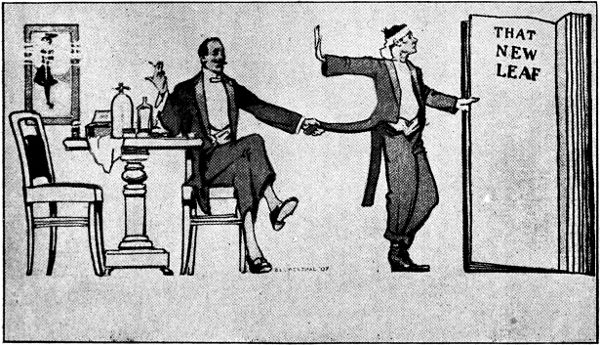
THAT NEW LEAF
Open Door to Ruin.
Men do not blush at being seen in a "bucket shop" as they would if caught in a faro bank or poker room though they are drawn thither by the same passion for gambling that takes them to the regular gambling den. The "bucket shop" successfully carries on a worse swindling game than the "blacklegs." The wealth the chief "bucket shop" men of the country have acquired proves this. Men can be pointed out in Chicago, New York and other cities of the country who have amassed fortunes at the business while their thousands of victims are impoverished and ruined.
Persons desiring to speculate or invest can avoid "bucket shops" and "fake" brokers by making a preliminary and independent investigation into the character of the broker and the merits of the enterprise. If they accept the statements and references of promoters of schemes without making such investigations they are not entitled to sympathy if they are robbed.
Legitimate brokers do not resort to sensational advertising; they do not guarantee profits; nor do they solicit funds to invest on their judgment. The functions of a broker or commission merchant are to receive and execute the order of his customers. When he offers to do more (except in the way of giving market news, advice or conservative opinions) he should be avoided. Promoters of pools and syndicates and disseminators of advance information should be carefully avoided.