FRONT.
Reading edition
A good front is a distinct asset. A good front is made up of neat, clean clothes, on a clean body, the whole housing a clean mind. A man with clean clothes on a dirty body, or dirty clothes on a clean body, is not wanted anywhere in the business world; and there is no place in the heavens above or the earth beneath, or the waters under the earth, that has room for the man with the dirty mind.
But with the clean mind inside the clean body, and neat, simple, clean clothes on the outside of it, the young man has all the essentials of a good front. Anything more is superfluous and tends to make him ridiculous. Simplicity is the keynote.
This moralizing on the value of front is suggested by observations and comparisons of the habits of certain Chicago millionaires, and the ways of some of their cheap clerks, the latter having exaggerated ideas of putting up a false appearance of prosperity.
These comparisons were so striking that they attracted the attention of Detective Clifton R. Wooldridge, and during the course of his regular work he found time to tabulate a little, with startling results.
The detective found that there are in Chicago many young men living on very meager salaries, who have such exaggerated notions of the value of a prosperous appearance that they overshoot the mark, and frequently, as result of trying, as they think, to "look like a millionaire," they often succeed in looking very much like the famous animal with very long ears and a loud voice which one spoke to the prophet Baalam.
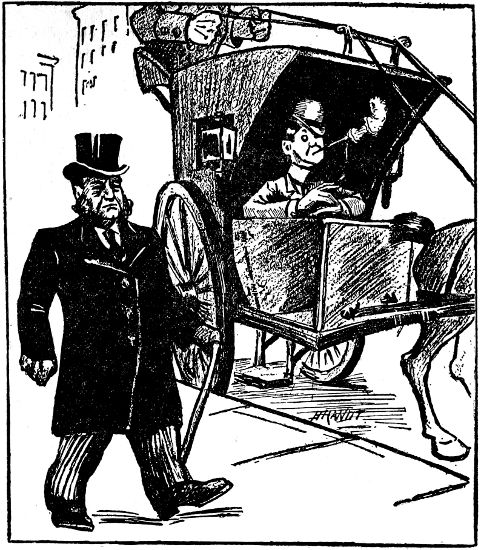
"It is easy to distinguish the real millionaire," said the great detective, in discussing this subject. "If he wants to get anywhere in a great city and his automobile happens to be engaged, he takes the same means of getting there as does the toiler in the mills or factory; he walks, or he rubs elbows on the street cars with the laboring men, many of whom never know that they are brushing against the owner of millions."
Stanley Field's Buggy.
"Stanley Field runs around town in a crazy old country buggy, just like a farmer. He took this method of going about when the great teamsters' strike was on, and he was a member of the Merchants' committee.
"But I will bet you a good cigar that there are any number of little snippety ten-dollar clerks in the great establishment of which Stanley Field is the head, who would feel themselves eternally disgraced if they were seen in that buggy.
"Not for little mister-ten-dollar clerk! No, sir. He must go out and spend three dollars for a cab if he wants to get down town to a theatre. It is just this silly pride that makes forgers and embezzlers.
"My advice to young men would be, 'Keep your mind clean, your body clean and your clothes neat and clean. Never mind about fancy show. Men will respect you more if you follow this advice than they will if you squander money foolishly in the effort to put up a false front which deceives no one.'"
Out of hundreds of cases which Wooldridge has run down, where embezzlement, forgery and theft, even of the pettiest sort, was at the bottom of the crime, the great detective declares that fully half of the cases had their origin in this silly attempt to appear something more than the real thing. Silly pride is a teacher of crime, and a sure school mistress she is.
And the absurdity, the bally foolishness of it all, is that these pitiful attempts deceive no one. Every one knows solidity when they see it, just as they know sham when they see it. A self-respecting young man cannot afford to make of himself a sham, even by taking a cab when the millionaires walk or take the street car.
Fake Pride Leads to Crime.
On the other hand, many young men have plunged into a life of crime through over-spending their salaries, in the effort to convince every one who looked at them that they were on the directorate of the Standard Oil Company. Where the millionaire walks these silly young jackasses take a cab, and pay half a day's salary in order to ride two or three blocks.
"I have seen John J. Mitchell, the president of the Illinois Trust and Savings Bank, and one of our foremost financiers, walk from the Northwestern station to the bank building, while right behind him a young donkey, who was working for $25 a week in that very bank, would pay a cabby a dollar to drive him the seven short blocks from that same station to the bank.
"It is just such young pinheads as that who afterwards turn out to be our embezzlers, forgers and financial criminals."
The man who has made a name which is known in every corner of the United States as an authority on all kinds of frauds, snorted his indignation as he thought of the silly bank clerk. Then he continued:
"Does anybody ever see Arthur Meeker take a cab to ride a few blocks? Not on your life. He walks. So does Cyrus McCormick, Harold McCormick, R. Hall McCormick, Frank Lowden, and any number of the other men whose names stand at the top of Chicago finance. I see Frank Lowden on the Indiana avenue cars, the line I take myself, time after time. He is one of the most democratic of men."