MIKE McDONALD.
Reading edition
"King of Gamblers," Supreme in His Day, Relentless Nemesis of Old "Clark Street Gang," Brings His Gray Hairs to Grave With Broken Heart.
Rises From Newsboy to Gambling King and Becomes Millionaire.
Mike McDonald's career in Chicago has been spectacular and sensational to a degree.
The present-day generation in Chicago cannot appreciate what the name Michael C. McDonald meant twenty years ago in Chicago. There is not a single man today in Chicago, or in any city in America who occupies relatively the position that Mike McDonald did in the old days in Chicago.
He never held office, but he ruled the city with an iron hand. He named the men who were to be candidates for election; he elected them; and then, after they were in office, they were merely his puppets.
While in recent years Michael C. McDonald has shown little activity in Chicago political and sporting circles, living quietly at Drexel boulevard and Forty-fifth street, in a costly mansion, his name twenty years ago was a power in both.
Born in 1840 in Niagara county, New York, he came to Chicago in 1854 and was a newsboy with John R. Walsh and other pioneers, in the city's infancy. Before the war a business venture took him to New Orleans, and when the south began to become inflamed he returned to Chicago with enough money to purchase the sample room of the Richmond House, Michigan avenue and South Water street.
Here a spectacular career began. McDonald became the big gambler of all the host of gamblers that were then growing rich in Chicago. He also became one of the leaders in the democratic organization. He made money hand over fist.
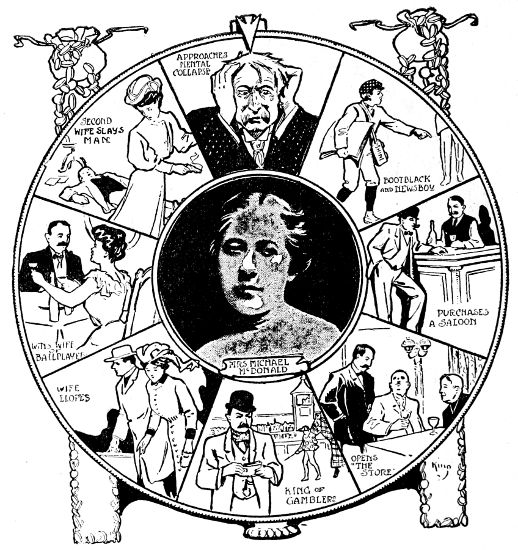
Michael C. McDonald's wheel of fortune, showing his progress from bootblack to gambling king, and the woman's face that brought him to the tragic present, causing him to exclaim: "My riches have brought me only sorrow."
Begins Life as "Candy Butcher."
Mike McDonald began life as a "candy butcher" on railroad trains before the war. He sold peanuts and popcorn and mysterious packages not to be opened on the train, and fine gold watches at $3.75 apiece.
Mike ran on many different railroads, although it must be said for the sake of truth that his customers were often very sorry to board a train and find that the energetic little candy butcher who had sold them jewelry on the last trip they had made had left and gone over to some other railroad. Mike's old customers used to beg him to return to them. They even dared him to come back.
Patriotic for a Price.
The candy butcher made money and saved it, and during the war he settled down in Chicago. Mike was very patriotic. He sent many men around to the enlistment offices, especially when big bounties were offered for volunteers. The trouble with the gallant soldiers that Mike put into the service was that after they got their bounty money they lost their enthusiasm and faded from view, like an evanescent mist.
Mike made much money out of his bounty-jumpers, but lost a good deal of it gambling. At this time he trained with "Tip" Farrell, Charley Miller, John Sutton and Matt Duffy, who figured more or less in the police records of that time. Sutton was shot and killed in front of Pete Page's saloon, on Clark street, in 1864.
Toward the close of the war McDonald and a notorious St. Paul crook lost $600 in the famous game that Colonel Cameron was running in Chicago. McDonald found out that the cards were stocked against him, and it discouraged him with having anything more to do with poker playing from the front of the table. Colonel Cameron had taught him, at the expense of $600, that the money in gambling was in running the game, not playing it. From that day Mike McDonald never gambled. He straightway opened his own game.
With Dave Oaks he started a game of faro at 89 Dearborn street. It was a nice, little, modest game, with only those two as the entire crew of the place. They took turn alternate days as dealer and roper in. The suckers who played the game used to complain frequently that the firm of Oaks & McDonald worked sleight-of-hand tricks with the faro deck, and the unkind police used to raid the game every day.
Solved Gambling Problem.
This frequent raiding cut frightfully into the profits of the enterprising firm of Oaks & McDonald, and set the junior member thinking again. He had already solved the great problem that it is better to run a brace game than to play one, but he found there were thorns even in running a game. Therefore he set to work to discover how these thorns could be removed.
The thorns that beset his career as a gambler were the police. But the police acted under instructions from the chief of police. The chief of police acted under instructions from the administration. Therefore, McDonald figured out that he would have to control the administration. So he straightway blossomed out as a politician, and grew in importance until finally he ruled Chicago, and realized the great ambition of his life, to make and unmake things like chiefs of police, with a curt nod of his head.
Once Ruled All Chicago.
Mike McDonald never got over his hatred for the police that was born in the days when they used to raid his little game at 89 Dearborn street. He probably would have abolished the police department entirely when he finally found himself on the throne of Chicago, had it not been that he found the police useful in making the other fellows behave, while he could do as he pleased. And then, it was such a joy to make the police bend the knee and acknowledge him as Lord and Master.
Generally the superintendents of police knew what was expected of them before they accepted the office, but once in a while one of them had foolish notions about duty and law, and had to be taught his place. Poor old Simon O'Donnell, when he became superintendent of police, in the days when Mike McDonald ran "The Store" and ruled Chicago, got the idea, because of numerous complaints of many patrons of the gambling games in "The Store," that the place should be raided. So he raided it.
It was a most impious act. It was like laying hands on the Ark of the Covenant. Superintendent Simon O'Donnell lost his job so quickly it made his head ache, and William J. McGarigle, whom McDonald afterward made warden of the county hospital, and who was indicted and convicted of boodling, was installed as superintendent of police in place of the simple-minded Mr. O'Donnell.
Mike McDonald's hatred and contempt for the police is preserved in a joke that the few minstrel companies still left on earth continue to cherish as one of their best beloved jests. It originated with McDonald. One day, when he was in the zenith of his power, a man came into "The Store" with a subscription list.
"The boys are raising a little money, Mike," said the man. "We'd like to have you give something. We are putting our names down for $2 a piece."
"What's it for?" asked Mike, suspiciously.
"Why," answered the man, considerably confused, "We're burying a policeman."
"Fine," said Mike. "Here's $10; go and bury five of 'em."
Near to Penitentiary.
While Mike was running the place at 89 Dearborn street he became involved in an affair that put him in jail for three months and made the portals of the penitentiary loom up largely across his path. It looked for a time as if his career was about to be nipped in the young bud.
In 1869 Charles Goodwin, assistant cashier of the Chicago Dock Company, was found to be a defaulter to the extent of $30,000. He fled from Chicago and went to California, but in a few months came back and surrendered himself to the authorities.
He testified that McDonald had lured him into the game at 89 Dearborn street, where he had played and lost his money in a series of brace games that lasted during a period of several weeks. At first he lost a few hundred dollars, and he was persuaded to go back to the Dock company's office and get money out of the safe in order that he could return the next evening and win back the money he had lost.
He never won anything back, but kept getting in deeper. At length the poor, deluded victim was told to make a big haul and skip the town. He made a last pull at the strong box for $15,000 or $18,000, and his friends at 89 Dearborn street let him play one last farewell game, at which they took the trouble to see that the boy should not be bothered in his flight from justice by lugging a big bag full of money around with him.
Case Finally "Fixed."
McDonald was arrested, and the Dock company also proceeded against him civilly, as it was not certain he could be held on a criminal charge owing to the guarded manner in which he had conducted his operation. McDonald was put under bail of $60,000, and, being unable to supply it, remained in jail for several months. Things were finally "fixed" all right, though. A few days before his trial he was released from jail, John Corcoran and Alderman Tom Foley going on his bail bond.
The trial was a farce. All the gamblers, "con" men, bunko steerers and strong-arm men in Chicago lined up in court and told how the defaulting clerk had begged to be permitted to play the brace game, with tears in his eyes, and that most of his money had been spent on wine, women and song. The jury solemnly declared McDonald innocent.
The expense of his trial on the charge of stealing the Dock company's $30,000 had made McDonald poor, and he had to get out and do a little "hustling." Soon after his release from the county jail John Donaldson, a California gambler and a high roller, made a winning in McDonald's place of $2,200 at poker. He took the money back to the hotel with him and was robbed of it and $500 besides before he had been in bed ten minutes.
A cracksman by the name of Travers was convicted of the crime.
Donaldson used to go to Joliet every day or two to interview Travers. Finally he came back from Joliet and never ate nor slept until he had run McDonald down. Tweaking his nose he shouted:
"Travers has confessed. You are a thief. You are a coward. Within twenty minutes after I was robbed you were dividing my $2,700 with Travers and his pal."
McDonald did not deny the charge or strike back at Donaldson, as the latter apparently hoped he would. Donaldson was a slight man, almost dead with consumption, but he was famous as a man killer, and while with one hand he tweaked McDonald's nose, the other hand was jammed down in his coat pocket, and McDonald knew that if he made a move or said a word he was a dead man.
Donaldson's hatred for McDonald became a mania with him. He was a doomed man, anyhow, and he wanted to kill McDonald before he went. So for the three years before death finally claimed him he would drag himself about the streets until he could stand in front of his enemy and slap him in the face and curse him, and beg him to raise his hand or say a word, or give him the slightest pretext for killing him. It was a great relief to McDonald when grim death finally claimed Donaldson.
Rises in His Profession.
After the fire McDonald opened a place on State street, in partnership with Nick Geary, a celebrated thief, who was subsequently killed in Philadelphia. McDonald next moved to the West Side, and was taken in by John Dowling, who gave him a third interest in his game in consideration of indemnity against police interference, McDonald's political star at this time being on the rise. The firm cleared $100,000 in less than a year.
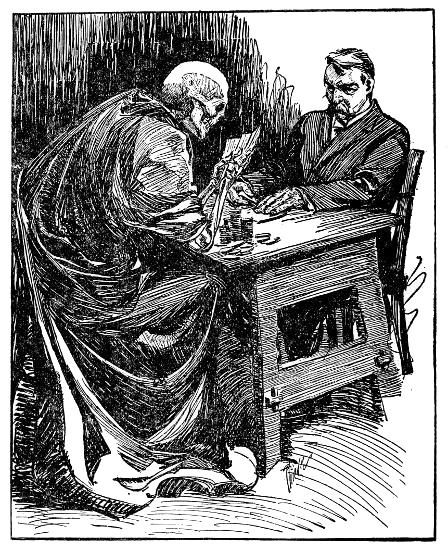
About this time McDonald formed a partnership with Harry Lawrence and Morris Martin, and for four or five years they had supreme control of the bunko business. None others could work excepting those who took the trouble to see the firm of McDonald, Martin & Lawrence. Among the gang who worked under the protection of the firm were Tom Wallace, John Wallace, "Snitzer, the Kid," John Martin, "Snapper Johnny," "Kid Miller," "Sir James" Arlington, or Gannon, "Appetite Bill," and "Hungry Joe."
There is no telling how much money these individuals took away from the unsuspecting public, but it is estimated at over $1,000,000. Of this, 20 per cent went to the police, 40 per cent to the roper, and 40 per cent to the firm. The latter furnished straw bail, witnesses and juries, and other protection, and the confidence gangs reported to it and received orders. In 1875 "White Pine" Martin shot and killed "Sir James" Gannon in front of "The Store" while quarreling over the division of the proceeds of some job.
Throne in "The Store."
The firm of McDonald, Lawrence and Martin had opened up the resort known as "The Store" on Clark street, on the northwest corner of Monroe street, where the Hamilton Club stands today. The first floor was operated as a saloon, and the floors above as gambling rooms. After public sentiment became aroused over the bunko business of the firm, Lawrence and Martin drew out, leaving McDonald to run "The Store" alone.
"The Store" was the most famous place in Chicago in those days. It was not only the rendezvous of all the sporting men, politicians and denizens of the underworld in Chicago, but it was virtually the city hall, for from his little office in "The Store" McDonald managed the affairs of the city.
Every form of gambling known flourished on that wonderful second floor. The most expert manipulators of cards that ever dealt a second or shifted a cold deck sat behind the tables. They were Clif Doherty, Frank Gallon, Billy Tyler, Charles Winship and George Noyse.
High-ball poker, in which the roller holds the high ball in his fist and rolls it to the cappers continuously, and faro, with fifty-three cards in the deck, so that the odd could be dealt, were said to have always prevailed in "The Store."
"There never was an honest card dealt in the place," is the epitaph one old-time gambler has written on its dead proprietor.
Big as the place was, it was always crowded. McDonald is said to have coined a very common phrase when, on one occasion, one of his dealers protested against putting in more tables and increasing the size of the gambling rooms.
"I tell you, Mike," he said, "we won't have enough players to fill up all the games."
"Ah, don't worry," McDonald is said to have replied, "there's a sucker born every minute."
In politics McDonald's first great triumph was when he elected Colvin mayor on the democratic ticket. Then he put the elder Harrison in the mayoralty chair, and after that he had plain sailing. His control lasted during the entire Harrison administration of eight years. In all that time there was no bigger man in Chicago than Mike McDonald.
The only time he met with a serious set-back was in 1882, when he tried to elect William J. McGarigle, then chief of police, sheriff of Cook county.
The Big Courthouse "Job."
Another disappointment of McDonald's political career was when he got a bill past the county commissioners and city aldermen authorizing Harry Holland to paint the outside of the City Hall and County Building with a mixture which was guaranteed to prevent the stone from decaying.
Holland applied his marvelous preparation, but when the time came to pay the bill a newspaper man, John J. Lane, who died only the other day in St. Louis, had dug up evidence tending to show that Holland's preparation was nothing but water and chalk, and not quite so efficacious in preventing the decay of stone as prune juice or ice cream would have been, but much cheaper. The county has never yet paid the $80,000 that Holland wanted for the job on the county building.
After the close of the Harrison administration a new day began in Chicago. The independent voter broke the power of party bosses. Mike McDonald's rule was broken. He could no longer do what he pleased with city administrations and be unofficial chief of police.
He bowed pleasantly to the inevitable, and stepped down and out. He was wise in that he saw the handwriting on the wall, and gracefully submitted instead of "kicking against the pricks" and wasting his time and his money, as did other gamblers and sports, who were finally crushed out simply because they could not recognize that new conditions and new men had come.
McDonald quit every sphere of his old life and went into business.
It was he who, with William Fitzgerald, built the first elevated road in town, the Lake street "L." Then, in 1891, he thought he would like to be an editor. He bought control of the Globe, a daily morning paper, and ran it for over two years. It was not a financial success, and finally McDonald gave it up. "I guess I was never cut out for a literary man," was his laughing remark. "There are other things I know more about."
Domestic Life Rough.
A great deal has been said about McDonald's domestic unhappiness, but it was not until his body had been buried that the truth was known.
His first wife was Mary Noonan, whom he married in the days when "The Store" was the sporting and political Mecca of Chicago.
It was a great scandal in the community later when she suddenly disappeared, and it was reported that she had run away with "Billy" Arlington, a minstrel man. It was the greater shock because her devotion and loyalty to McDonald had been the talk of the town.
One time she had stood, with a pistol, in her husband's gambling house, and defied the police when they raided the place under instruction of some blundering chief of police, who did not realize that he was toying with the lightning when he laid violent hands on anything that belonged to McDonald. Mary McDonald had held her ground at the door in "The Store," and declared she would shoot the first policeman that attempted to enter. She was as good as her word, and one of the officers was carried to a hospital with a bullet through his arm. Mrs. McDonald, through her husband's pull, was never prosecuted.
McDonald went to San Francisco and brought his wife back and installed her in the house he had built at Ashland avenue and Harrison street, considered in those days a veritable palace. McDonald gave it out to the world that he had built the mansion for his wife, and his taking her back after she was reputed to have run away with another man was accepted as a wonderful instance of his great-heartedness and magnanimity.
Sam Barclay Tells "How Mike McDonald's Coin Won Dora Away."
"Sam" Barclay (Harry is supposed to have been his baptismal name) was one of the great ball players of the long ago, and the shadows of the drama that wrecked his life are, therefore, interwoven with the world of sport, and even with the career of Charles Comiskey, "the master of the White Sox."
Barclay, a trim and graceful fellow, came into prominence twenty years ago and played with Pittsburg and St. Louis. At St. Louis he was under the command of Comiskey, who therefore knew him well, and was always interested in his doings.
On two or three occasions quarrels over the contracts of Sam Barclay nearly wrecked organized base ball. He was a wonderful second baseman, and one of the fastest and most scientific players of the day.
In 1889 Barclay's knee went back on him, and, while he regained full use of the leg, he was never fast enough to play his former game. He also began to take on flesh, and was glad to retire from the diamond.
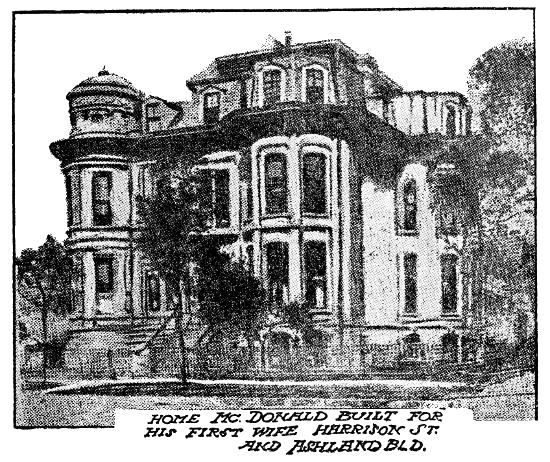
HOME McDONALD BUILT FOR HIS FIRST WIFE HARRISON ST. AND ASHLAND BLD.
Opens Saloon in Chicago.
Coming to Chicago, Barclay opened a saloon on West Madison street. Back in 1894, West Madison, from Halsted to Elizabeth, was the real red-light district, full of saloons and concert halls. Barclay's place was the headquarters of revelry, but Sam himself kept a good name for personal honesty and unbounded generosity to his friends.
When the red-lights went out on Madison street, Sam leased a saloon at 15 North Clark, where for some time he held the same kind of sway he had maintained west of the river. This place was ultimately lost, and he went over in Garfield park district, without much success.
"Sam" Barclay, former husband of Mrs. "Mike" McDonald II, 451 West Lake street, freely discussed his life with Mrs. McDonald.
It was an interesting story, in which he told of Mrs. McDonald's attempt to commit suicide once in Kansas City, of brawls in his saloon, the "Half Moon," and of how "Mike" McDonald, assisted by "Bunk" Allen, lured his wife away from him. Here is what he said:
"They have printed stories that are not true about this case. Mrs. McDonald's mother was a Mrs. Feldman, who at one time lived at 619 Harrison street. At the time I knew her Mrs. Feldman had been divorced from her husband and he was living in the Ghetto.
Likely Lad of 200 Pounds.
"It was in '89 that I met Dora. I was in the Kansas City ball team, and was a likely lad. I weighed 200 pounds, trained down, and it was a good man who was able to floor me.
"Dora came to visit her brother-in-law in Kansas City. He is Dick Vaughn, and a very good 'pal' of mine. I met her there at his house.
"We took a liking to each other, so I used to have her in the best seat every day at the games when we played on home grounds.
"And she never was slow, I tell you, of giving me credit when I made a double play or lined out a hot one.
Nothing Like Real Love.
"Well, the season came to a close. I liked the kid, but I didn't feel nothing like real love for her. I was going to leave Kansas City, and nothing was said about taking her with me. I noticed that big tears came in her eyes when I told her, but she didn't say much. That night they sent for me. They told me that Dora was dying.
"I got to Vaughn's house and found her unconscious. She had taken laudanum, the doctor said. She was in a stupor. The first chance I got, I asked her what was the matter, and she said to me, as the tears rolled down her cheeks:
"'I don't want to be left alone.'
"That, you know, touched me. We got married. I've got the license right here. It was all doped up by a fellow in the Washingtonian Home, who thought he owed a lot to me. He certainly did some fine pen and ink decorating with birds, and shadings and such things.
"So, after I quit the national game, I went into the saloon business at 292 West Madison street, first, and then started the 'Half Moon.'
"I'll tell you the truth about how Dora met Mike McDonald. She went to McVicker's theater one day with Harry Summers, who is now treasurer of the Illinois theater.
"Dora was with Mrs. Elliott. She used to be a model in Ryan's store, at Madison and Peoria streets. Summers introduced Dora to Mike McDonald, and that's the way they started.
Day of Harrison Funeral.
"Well I remember the time—it was on the day that Carter Harrison's funeral went past the house, at 319 Washington boulevard, where we were living at that time.
"'I met an old gentleman today who has lots of money,' Dora said to me, as we looked out of the window.
"'It's funny how a man gets up in the world and then loses it all when he's laid away in the narrow box,' I said, keeping my eyes on the hearse.
"I was thinking, then, but not about what my wife said. Afterward the words came to me, but I didn't realize the meaning of her expression or what it had in store for me then.
Deep Game Well Played.
"A few years passed. They went quick, then. Money made the time fly, and Dora certainly was a spender. Then one night they pulled off the game that was to separate us and give Mike McDonald a young wife.
"I was boozy with wine. Bill Hoffman and 'Bunk' Allen were masters of the ceremonies. They bundled me in a cab and drove me to a place on Wood street. Detectives came in, and my wife, too, and they there and then laid the basis of the divorce suit which ended the game between Dora and I."
Barclay then told of a fight in his saloon, in which one man was almost killed and another badly wounded. Then he said:
"That's how they wound up the 'Half Moon.' Jimmy Quinn said he was my friend, but he stabbed me in the back. I was getting too strong in politics, so he got me and I was put down and out."
Barclay had seemed perfectly happy with her, but one night when he was living in rooms over his saloon at 15 North Clark street he learned that Mike McDonald had come into her life, and it was not long before the ball player's romance was ended.
Wife Gets Divorce.
Mrs. Barclay obtained a divorce—with McDonald's money, so Barclay always said—and the ball player was left alone. The blow proved his utter undoing. Barclay lost ambition and energy. He spent hours in his rooms, gazing mutely at a huge crayon portrait of his wife, taken a year before she left him, and he seemed to have no desire or ability left for business.
Second Wedding in Milwaukee.
Mrs. Barclay was married to McDonald in Milwaukee. At the time she was in the chorus of the Chicago Opera House. Her mother is Mrs. Fanny Feldman, 338 South Marshfield avenue. She has two brothers, Harry and Emil Feldman, both known in West Side political circles. Harry Feldman was employed in the city clerk's office during William Loeffler's term.
When McDonald took his new wife to his house on Ashland boulevard there was a red-hot family row. Guy, the elder of the two sons of McDonald, had a pitched battle with her, and the fight was carried into the street. The boy was victorious at first, but his father sided with the stepmother, and eventually the boy left home.
Harold Barclay, 10 years old, Mrs. McDonald's son by her first marriage, was adopted by McDonald, and with his two sons, Cassius and Guy McDonald, has an equal share in the estate.
Induces Husband to Disinherit Son.
Shortly after her marriage to McDonald, Dora became angry at her husband's son, Harley. The latter objected to his father contracting further matrimonial alliances, and did not hesitate to say so. Mrs. McDonald prevailed upon her husband to disinherit the son, and later, of her own initiative, caused the arrest of the young man.
The charge was threats against her life. The case came up at the old Armory police court, and the young man was placed under bonds to keep the peace.
The breach between father and son is said never to have healed. Young McDonald went into the sign painting business soon after the episode.
Guy married Miss Pearl Flower, and lives in Chicago. Mrs. McDonald once had Guy McDonald arrested on the charge of writing threatening and obscene letters.
The case was hotly fought in the United States court. A juryman, and warm personal friend of Mike McDonald, saved him from conviction, which would have carried with it a penitentiary sentence.
The Sting and Curse of Ill-Gotten Money.
"Mike" McDonald, the king of gamblers, was buried like a king of men. There were flowers, tears, friends, orations and processions. But as clothes are not, neither is a funeral, an index to character—nor even is the obituary column.
Strangers, reading the story of the last day above the sod of McDonald's body, might has thought that Chicago had lost a leading good citizen. They were told that McDonald had amassed wealth, but they were not told how he got it. They read of the great men whom he had befriended, but they were not told of the men whom he had ruined. They were not told that Mike McDonald living, had violated the laws of the land, of society and of the home.
"Mike" McDonald died worth a million dollars. A young man beginning life, familiar only with the post-mortem, story of McDonald, and seeing no condemnation of his method of getting rich, might feel encouraged to hold to the idea that the accumulation of money bars all criticism for the way it is acquired.
Though the publicity of cold type has put no brand on the dead McDonald, the story of "Mike" McDonald's life and fortune is not yet finished.
Suppose he did die worth a million dollars, whom will it benefit? What good will it do?
There will be a fight in every dollar, a quarrel in every penny.
There will be a strife among men and women over this fortune.
Much of it will go to lawyers to defend a woman charged with murder. Much more of it will go to other lawyers who will try to break his will. As McDonald's money was ill-gotten, so will it be spent to no good purpose.
In a few years McDonald will be forgotten except by those whom in life he ruined. His fortune will be gone. No one will remember him for the good he did, if he did any good.
Let not "Mike" McDonald's success in securing money encourage you to follow his method.
If you, young man, had an opportunity of entering a gambling venture, with a certainty of securing for yourself a fortune of a million dollars, you would be a fool to take advantage of that opportunity.
There is nothing in the life of even a successful gambler worth imitating and nothing that he does worth admiring.
"Mike" McDonald may have been better than the ordinary class of gamblers, but the occasional good deeds that men of his character do are always exaggerated.
Ninety-nine gamblers out of a hundred that amass fortunes die paupers. The money that a few accumulate, even as McDonald did, is, as a rule, a curse to those that inherit it.
But if McDonald had sense—and we believe he did have sense—in the closing years of his life he cursed the day when he started on a career that wrecked him, socially and morally, and left him in his dying hour a bankrupt in everything but the possession of a few hundred thousand dollars, which he could not take beyond the grave.
And what has happened after McDonald's death, and what will happen in the courts of law, will prove to men that ill-gotten money carries a sting to its possessor and a curse to those who inherit it.