GAMBLING AND CRIME.
Reading edition
BEST CURE FOR GAMBLING: TEACH PUPILS IN SCHOOL LAWS OF CHANCE.
Gambling Device Swindle Is Exposed in the Army and Navy—The Scope of Fraud Is World-Wide.
There Is No Such Thing As An Honest Gambler—Suicides Are Common—Gambling Kings Go Broke, and Often Die in the Poorhouse—It Is a Hard, Cold, Brutal Road the Gambler Travels—It Ends Badly.
We do not believe that many young men DELIBERATELY take up the gambler's career. They drift into it through weakness, temptation or accident. If any young man DOES imagine that in the gambler's life he can find more money, less work and more happiness than in honest living and honest work, he is the victim of a dangerous delusion.
A most miserable creature is the gambler. He knows himself, and therefore he hates himself.
No man can gamble and be honest, even with his friends, even with his family. The idea of the gambler is to get from another man what he has not earned from that man, giving nothing in exchange. And when a man spends his time trying to get away the money of others with no return he soon drifts into throwing aside ALL honesty, even the gambler's brand.
The unsuccessful gambler is one of the worst of wrecks. He runs his little course of dissipation, dishonesty, cheating and swindling. He is over-matched and eliminated by the bigger, keener, self-controlled gambler, who eats him up as the big spider eats up the little spider. Hanging around saloons, begging for a little money with which to bet, doing the dirty work of the bigger gamblers—that is the fate of the little gambling cast-off. He is not worth talking about.
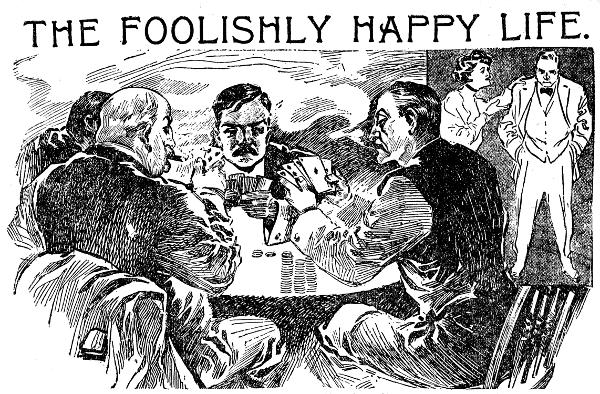
THE FOOLISHLY HAPPY LIFE.
Artist Palenske herewith forcefully presents the lamentable contrast of the man who delights to play poker when his boon companions call, and his other self when the wife pitifully and hopelessly pleads for money to meet household expenses. The "poker fiend" will lose his week's wages in a night. Sometimes, to boot, he loses money not his own, but he thinks it the part of the "game sport" if he hides his misfortunes behind the mask of a smile. "Be a good loser" is his never-failing motto. In the long run it is the neglected wife and family that are the REAL LOSERS.
The gambler's life is simply the life of a criminal. And, like every other successful criminal, the successful gambler has got to work very hard. What the burglar gets, what the pickpocket gets, what the gambler gets, is money painfully accumulated. The successful burglar, or pickpocket, or gambler must work hard and be forever on the alert. He must be remorselessly cruel in taking money from those that cannot stand the loss. He must be indifferent to all sense of decency, for he knows that he is robbing women and children.
The criminal in ANY line, gambler or other, cannot be a self-indulgent man if he is to be successful. The young man who imagines that the gambler's life is a gay and easy one is badly mistaken. If he tries it he will live to envy ANY honest man who has a right to look other men in the face.
Why Gambling Makes Men Commit Crimes.
The statistics of crime prove beyond all cavil that gambling is the king's highway to fraud and theft. This is not merely because it loosens general morality and in particular saps the rationale of property, but because cheating is inseparably associated with most actual modes of gambling. This does not imply that most persons who bet are actually cheats or thieves; but persons who continue to be cheated or robbed, half conscious of the nature of the operations, are fitting themselves for the other and more profitable part if they are thrown in the way of acquiring a sufficient quantity of evil skill or opportunity. The "honor" of a confirmed gambler, even in high life, is known to be hollow commodity, and where there is less to lose in social esteem even this slender substitute for virtue is absent. What percentage of "men who bet" would refuse to utilize a secret tip of a "scratched" favorite or the contents of an illegally disclosed sporting telegram? The barrier between fraud and smartness does not exist for most of them.
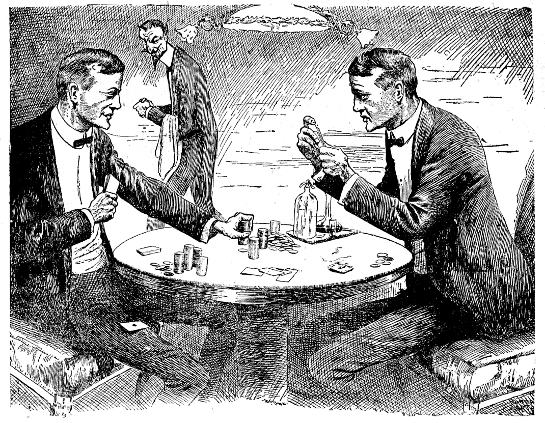
No Basis for Livelihood.
Serious investigation of the gambling process discloses the fact that pure gambling does not afford any economic basis of livelihood, save in a few cases where, as at the roulette table or in a lottery, those who gamble know and willingly accept the chances against them. And even in the case of the roulette table the profits to the bank come largely from the advantage which a large fund possesses in play against a smaller fund; in the fluctuations of the game the smaller fund which plays against the bank is more than likely at some point in the game to be absorbed so as to disable the player from continuing his play.
If a man with $5,000 were to play "pitch and toss" for $5 gold pieces with a number of men, each of whom carried only $50, he must, if they played long enough, win all their money. So, even where skill and fraud are absent, economic force is a large factor in success.
Temptation to Embezzle.
Since professional gambling in a stock broker, a croupier, a bookmaker, or any other species involves some use of superior knowledge, trickery, or force, which in its effect on the "chance" amounts to "loading" the dice, the non-professional gambler necessarily finds himself a loser on any long series of events. These losses are found, in fact, to be a fruitful cause of crime, especially among the men employed in business where sums of money belonging to the firm are passing through their hands. It is not difficult for a man who constantly has in his possession considerable funds which he has collected for the employer to persuade himself that a temporary use of these funds, which otherwise lie idle, to help him over a brief emergency, is not an act of real dishonesty. He is commonly right in his plea that he had no direct intention to defraud his employer. He expected to be able to replace the sum before its withdrawal was discovered. But since legally a person must be presumed to "intend" that which is a natural or reasonable result of his action, an indirect intention to defraud must be ascribed to him. He is aware that his act is criminal as well as illegal in using the firm's money for any private purpose of his own. But in understanding and assessing the quality of guilt involved in such action, two circumstances which extenuate his act, though not the gambling habit which has induced it, must be taken into account. A poor man who frequently bets must sooner or later be cleared out and unable, out of his own resources, to meet his obligations. He is induced to yield to the temptation the more readily for two reasons. First, there is a genuine probability (not so large, however, as he thinks) that he can replace the money before any "harm is done." So long as he does replace it no harm appears to him to have been done; the firm has lost nothing by his action.
How Commerce Condones Crime.
This narrower circumstance of extenuation is supported by a broader one. The whole theory of modern commercial enterprise involves using other people's money, getting the advantage of this use for one's self and paying to the owner as little as one can.
A bank or a finance company is intrusted with sums of money belonging to outsiders on condition that when required, or upon agreed notice, they shall be repaid. Any intelligent clerk in such a firm may be well aware that the profits of the firm are earned by a doubly speculative use of this money which belongs to other people; it is employed by the firm in speculative investments which do not essentially differ from betting on the turf, and the cash in hand or other available assets are kept at a minimum on the speculative chance that depositors will not seek to withdraw their money, as they are legally entitled to do. In a firm which thus lives by speculating with other people's money, is it surprising that a clerk should pursue what seems to him substantially the same policy on a smaller scale? It may doubtless be objected that a vital difference exists in the two cases: the investor who puts his money into the hands of a speculative company does so knowingly, and for some expected profit; the clerk who speculates with the firm's money does so secretly, and no possible gain to the firm balances the chance of loss. But even to this objection it is possible to reply that recent revelations of modern finance show that real knowledge of the use to which money will be put cannot be imputed to the investor in such companies, and that, though some gain may possibly accrue to him, such gain is essentially subsidiary to the prospects of the promoters and managers of these companies.
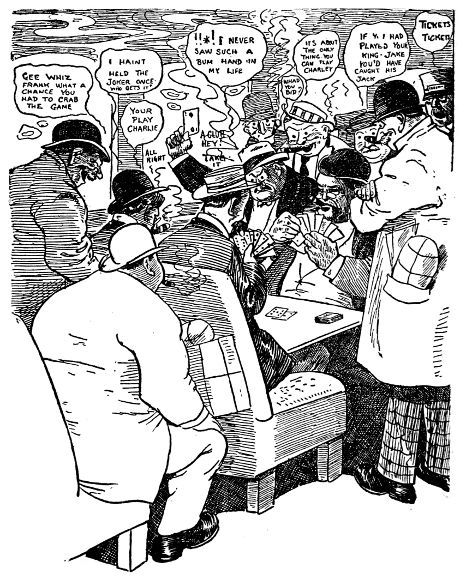
Wherein Speculation Differs.
It is true that these are not normal types of modern business; they are commonly designated gambling companies, some of them actually criminal in their methods. But they only differ in degree, not in kind, from a large body of modern businesses, whose operations are so highly speculative, their risks so little understood by the investing public, and their profits apportioned with so little regard to the body of shareholders, as fairly to bring them under the same category. In a word, secret gambling with other people's money, on the general line of "heads I win, tails you lose," is so largely prevalent in modern commerce as perceptibly to taint the whole commercial atmosphere. Most of these larger gambling operations are either not illegal or cannot easily be reached by law, whereas the minor delinquencies of fraudulent clerks and other employes are more easily detected and punished.
But living in an atmosphere where secret speculation with other people's money is so rife, where deceit or force plays so large a part in determining profitable coups, it is easy to understand how an employe, whose conduct in most matters is determined by imitation, falls into lax ways of regarding other people's money and comes in an hour of emergency to "borrow" the firm's money. This does not excuse his crime, but it does throw light upon its natural history.
When it Will Cease.
Publicity and education are, of course, the chief instruments for converting illegitimate into legitimate speculation, for changing commercial gambling into commercial foresight. This intelligent movement toward a restoration of discernible order and rationality in business processes, by eliminating "chances" and placing the transfer of property and the earning of industrial gains on a more rational foundation, must, of course, go with other movements of social and industrial reforms which aim simultaneously at the basis of reformation of the economic environment. Every step which places the attainment of property upon a sane rational basis, associating it with proportionate personal productive effort, every step which enables men and women to find orderly interests in work and leisure by gaining opportunities to express themselves in art or play under conditions which stimulate new human wants and supply means of satisfying them, will make for the destruction of gambling.
Gambling Don't Pay.
Two-fifths of all the crimes committed every year are estimated to be attributable to race tracks. Five men have been convicted this year of stealing money from the United States postoffice, and every one of them confessed he lost the money at race tracks. The mania for gambling is growing stronger, and as it grows the defenses of honesty crumble away.
What may be called gambling thieves are not so numerous in Chicago as in some other cities, for the reason that no race tracks are permitted to exist in Cook county. But there are many gambling swindlers in this city. A large proportion of the men in the county jail are there because gambling wrecked morals in them, and hardly a week passes that does not find at least one person before the courts charged with robbery because money was wanted to bet.
This is not all of the injury that gambling does to the community. Because the state's attorney's office and the police have not suppressed gambling the city is full of sharpers who make their living out of men foolish enough to think that they can get rich by betting on horse races, faro or roulette. These sharpers are an organized band of law breakers, preying on society, disorganizing it as far as is possible, their whole existence a menace to decency and order.
The passion for gambling can probably never be eradicated from human nature. But civilization should be able to prevent rogues and rascals from profiting by it in the way usual in Chicago. Professional gamblers—professional swindlers, should be sent to the penitentiary and kept there. There should be some means under the law to send all such to the penitentiary and keep them there.
How to End Race-Track Gambling.
Race-track gambling has unexpectedly become an issue of importance in New York, and widespread discussion of means to rid the city of its race tracks is taking place.
Discussion, however, is unnecessary. The way to end the plague of betting on races is plain. Let the grand jury indict officials of the Western Union Telegraph Company for complicity in bookmaking and send them to jail. Without gambling race tracks would be deserted. Without the aid of the Western Union there would be no gambling worth mentioning. Strike at the Western Union and the race tracks would go out of existence.
The Western Union Company is the one great encourager of gambling in this country. But for its reports of races, hundreds of thousands of young men would be saved from ruin every year. It is in partnership with sharpers who fleece the foolish. It shares their gains in payment for the use of its wires. The money that flows into its coffers from that source is taken by trickery from the public. The race track swindlers rob a man and hand over a part of their loot to the Western Union, because without the Western Union's assistance they could not have robbed him.
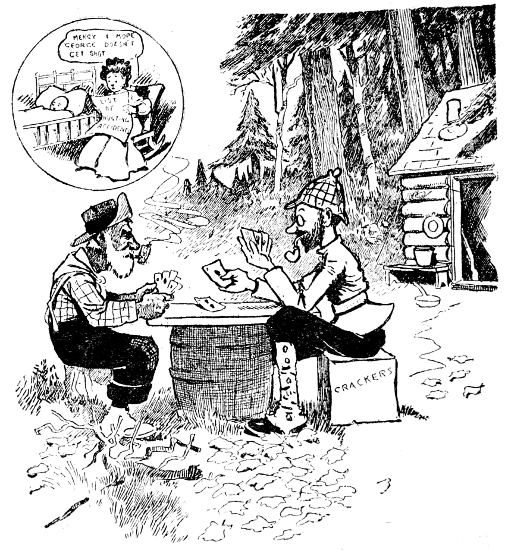
Do they think about us at home? We air having such a good time hear a lone.
But for the Western Union Telegraph Company not a single race track would be in operation in the United States, for without the Western Union's aid race tracks would not be profitable.
The way to stop race tracks gambling and drive race courses out of existence is to compel the Western Union to observe the law which forbids just such practices as those of which it is guilty every day. That can be done only by sending a few Western Union officials to jail and keeping them there until their company concludes to dissolve partnership with crooks.
Learn Early Not to Gamble; Teach Pupils Law of Chance.
Mere driftwood on a restless wave; A shuttlecock that's tossed by Fate; Year follows year into the grave, Whilst thou dost cry, "Too late! Too late!" A life that's but a wintry day, Whilst chilling storms blow thee about; A tempter thou durst not say nay; A conscience long since put to rout. Who gets by play a loser is; The gambler stakes his very heart; What's prodigally won's not his; Who wagers takes the knave's foul part. Thou shouldst not steal nor covet what Another hath by labor earned; No man who hath with wisdom wrought But this base sport hath ever spurned. Why haggard thus thy fair, young face With vigils, passions, aimed at gain? Is this thy mission in this place— This idleness which brings disdain? Be not a weakling, nor of wax; Let mind be master over thee; See that its shaping of thy acts Prepares thee for eternity!
Art thou thy brother's keeper?
Most emphatically, yes, if he be not sufficiently strong to refrain from doing that which is injurious to himself and those dependent upon him.
Public Lax; Gamblers Active.
When the law declares against gambling, and advertisement and sale of even "fair" gambling paraphernalia, why is it that the righteous majority, which would not stoop to this form of speculation, sits inertly by, allows crooked devices to be advertised and sold, permits hundreds of men to waste their time and substance, and dozens to blow out their brains as a consequence?
Why do "good" men prate on "personal liberty," which is merely their way of washing their hands of the responsibility for good government.
Does it eradicate the evil to say a man is a free moral agent and need not lose his money gambling unless he wants to; that "virtue is its own reward;" that "honesty is the best policy," or that taking without giving return is a sin?
Would it not be better for this inactive majority of talkers to elect incorruptible men who can do something besides talk—men who would enforce the laws and provide heavy punishments for concerns which make gambling machines in which the unsuspecting have absolutely no chance to win?
Are We Following Rome to the Pit?
Are we going the way of Greece and Rome? Is there a menace in the rapid increase of wealth in the United States? Are we allowing the moral tone of society to sink?
The present tendency is toward speculation, even from childhood. In most cities the child barely able to walk can find slot machines in candy stores and drug stores from which he is made to believe he can get something for nothing. Is this the proper training to give children? Is it right to get something for which no return of money or labor is given? And is it right to thus lure children when adults know that their pennies more than pay for what they get—premiums and all?
Children in school should be taught to calculate probabilities as a part of their course in elementary arithmetic. Then they would know better than to play slot machines or buy prize packages. And when they grew up they would shun the bookmaker, the lottery, and the roulette wheel.
The ordinary gambler speculates partly because he loves the excitement and thrill of the game, but mainly, he will assure you, as he assures himself, he is buoyed up by the hope of winning. He does not stop to figure out his chances. If he sees a hundred to one shot he will play it, seeing only that by risking a dollar he has a chance to win a hundred. If he had been taught in school to see that really the chances were 200 to 1 against him, and that he was betting a dollar against fifty cents, he would keep his money in his pockets. Of course the man who plays the races knows the odds of the book are against him. He prides himself, however, that he is a wise reader of the "dope sheet," and that can overcome the odds by a superior cunning.
He knows that he can't win on his luck, for this "breaks even" in the long run.
Fate's Cards Always Stacked.
But the man who plays against a machine, if he has taken the elementary course in the law of probabilities, can suffer under no delusions and cannot give himself any reasonable excuse. He is bound to lose. The odds on the machine are against him. And even if they were not, it is entirely likely that the machine would win. An old gambler contends that if a man matched pennies all day every day for a month against a purely mechanical device he would quit a heavy loser. The only way he could keep even would be to start out with "heads" or "tails," and then go away and leave the machine at work, never changing his bet. If he remained to watch the operation he would, be sure to lose his head and begin to "guess" against the relentless mechanism, and then he would lose.
In the ordinary coin-paying slot machine, the dial shows alternate reds and blacks, interspersed here and there with quarters, halves and, perhaps, $1. The player wins 5 cents on the black, 20 cents on the quarter, 45 cents on the half, and 95 cents on the dollar. The dials differ, but suppose there are thirty reds, thirty blacks, ten quarters, five halves, and one dollar. The chances are against you, then, on the red or black, 46 to 30; on the quarter, 66 to 24; on the half, 71 to 24, and on the dollar, 75 to 19. Most players, it is said, prefer the larger sums as a hazard in the coin machines, although the probabilities against them are much greater. Again, they are dazzled by the chance of winning a large sum at a small risk. Really, they are betting their nickel against 3 cents on the red or black, and against 2 cents or less on the larger sums.
Children Throw Away Money.
If the children knew this they would not fool away their money in the machines when they go for a boat ride on the lake, and it is reasonable to suppose that grown men and women would beware of them if they had learned to figure chances when they were in school. In the penny machines in the cigar stores the probabilities are harder to figure. You play a cent in the machine, and if you get two pairs from a revolving pack of cards, always exposing the faces of five, you win a 5-cent cigar. In most of the machines you must get "jacks up or better" in order to win. Any poker player will bet you a chip on any deal that you will not have as good as a pair of trays, and the chances that you will have two pairs as good as jacks up must be at least twenty to one.
Some of the machines consist of wheels of fortune which revolve from the weight of the penny dropped in the slot. In any event the child gets a penny's worth of goods, and there are chances to get two or five cents' worth. Gum machines give an alleged cent's worth of gum, with a chance for a coupon, which is good for a nickel's worth without extra charge.
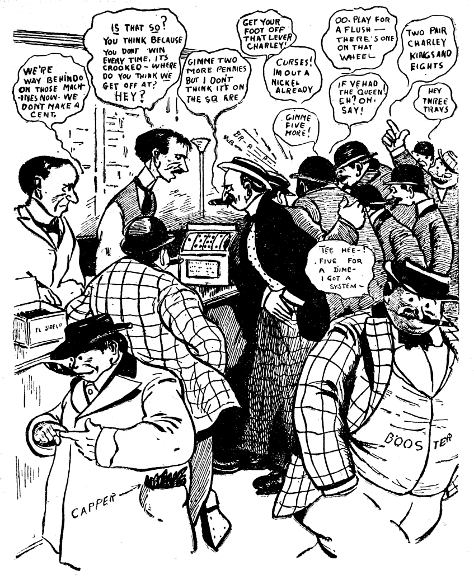
How many steps is this apparently harmless form of amusement removed from the deceptive slot machines in cigar stores? And, in turn, how many steps are these cigar machines removed from those in the saloons? The boy who wins five cents worth in the candy store will take cigarette tobacco or a cigar, if the dealer be unprincipled. Next he tries for a cigar in a cigar store, and then for a cigar in a saloon. If he is lucky in the last named, he is asked to a friendly game of poker. Beyond asking if it is a pleasure to either lose to or win from a friend, and to express the opinion that even though the game be perfectly square, and there be no rake-off, it still remains true that the time lost, and money spent for drinks and cigars, far outweigh in value any pleasure that may be experienced.
Confederates Used.
Men who make a business of conducting and playing poker games stop at nothing to get the money. The expenses of running the place, and the free lunches, drinks and cigars dispensed must be paid for by some one, and the proprietor is not in business to lose money. The game in which there is no rake-off cannot possibly be square, and where there is a rake-off the odds against you are prohibitive, if you play fair. With seven men in a game of "draw," three of whom are "house" men, the amount which goes into the "kitty" nightly is usually about equal to the losses of the other cheat who dares not be found out.
Cheating Device in a Slot Machine.
Ordinarily the owners and saloonkeepers divide the winnings of all slot machines. In a fair machine the winnings fall into the receptacle A. Most of the money gambled by players found its way into this depository. It did not please the owner of this machine to share his profits equally with the saloonkeeper. The winning player was paid from the nickels which lined a zig-zag chute ending at C. The owner changed this scheme by inserting the secret bag B. Then he cut a hole in the chute at D. and arranged a spring which diverted one out of three nickels into B. As long as the chute was empty below the point of entrance of A the nickels kept on filling the zig-zag runway.
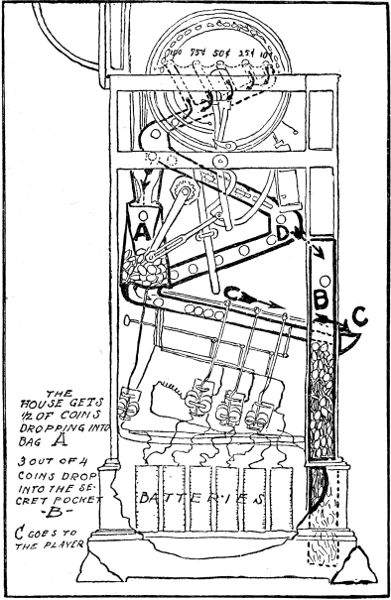
Slot Machine Proves a Fraud.
When the machine was seized, in the box where all the gains were supposed to be, $60.20 was found. These two sums represented the total proceeds of a day.
Confederates, mirrors, words, signs and hold-outs are used. A player dealing from a stacked deck will inform his confederate how many cards to draw by uttering a sentence containing that number of words. Men lounging behind a player will "tip off" his hand. Cards are marked in a manner imperceptible to the eye of the novice, and sometimes liquid refreshment is spilled on the table in front of the dealer, so that his opposite can read the reflections of the cards as they are dealt face downward across the board. The last-named scheme is used where the table has no covering.
There are many who believe that talks of crookedness at card tables are only sermons by "goody-goodies," who know not whereof they speak. Let the following advertisement, recently sent broadcast over the country by a large concern located in the business center of one of America's largest cities, refute such claims:
HOLD OUTS.
"Correspond with Us Before Buying of Others."
We have the finest line in the country, and every machine is made to get the money—not for ornament, and accuracy. Is as perfect as a watch. Works with a knee movement, and by a slight movement everything disappears. If they have played cards all their lives they will stand it.
Our price only $125.00.
The circular also mentioned dozens of other crooked devices at lesser prices, and contained illustrations showing how the machines work. Can there be any doubt these are used when concerns devote their entire time to manufacturing them and can get such high prices?
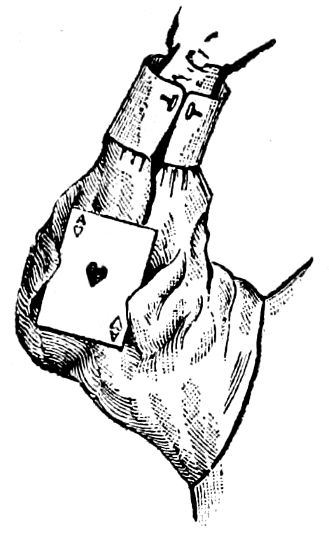
Fig. 27.—Showing card held under the arm.
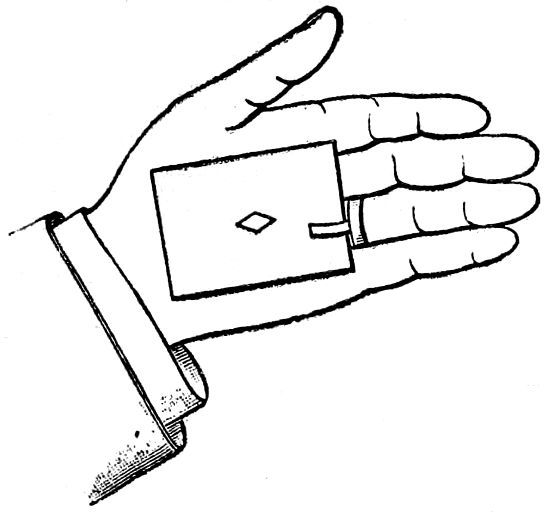
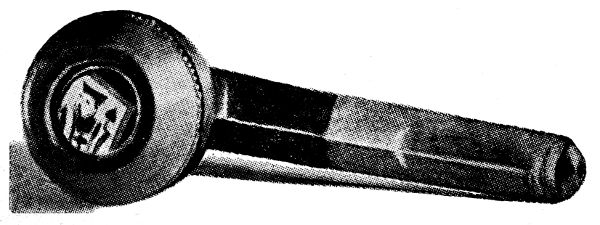
Fig. 28.—Ring Hold-out.
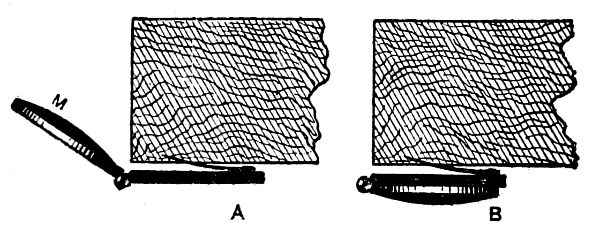
Fig. 20. 'Table-reflector.—Fastens by pressing steel spurs into under side of table. A fine glass comes to the edge of table to read the cards as you deal them off. You can set the glass at any angle or turn it back out of sight in an instant.'
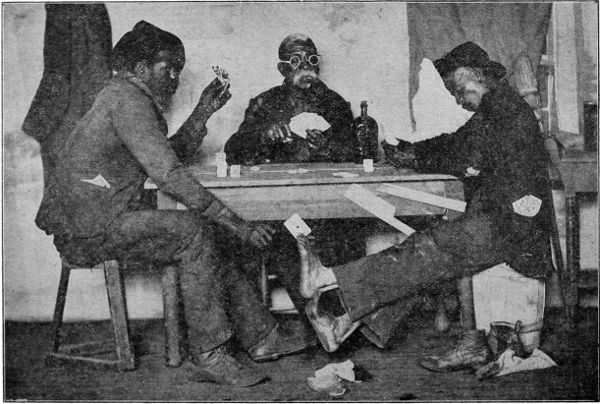
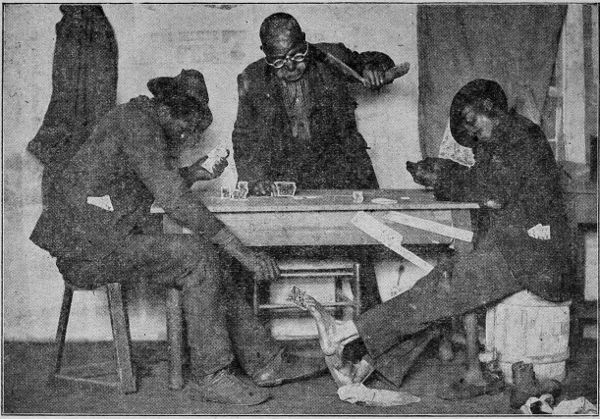
The sleeve hold-out above mentioned, is made of a hair cloth sideway, about the same size as a deck of cards, with its narrow sides laid in fine, plaited folds, so that it will either lie flat or expand. This is sewed in the sleeve of the coat or shirt and reaches from the cuff to the elbow joint. One of the wide sides is sewn or pasted to the cuff, both ends being open. At the elbow a strap fits around the arm, to which is attached a metal tube that reaches down to the near end of the sleeve, with a pulley attached to the end. A short wide elastic is also attached to the strap, and to the elastic is fastened a metal clamp that holds the cards. A cord is attached to this clamp, which runs down and over the pulley, then back to the elbow through the metal tube, thence to the shoulder, through the clothing to the body, thence down through the loop at the heel, with a hook attached to the end. The cord passes through a flexible tube from the elbow to the ankle. This tube will bend easily, but will not flatten, and is attached to the clothing with string ties to keep it in line with the body. Its use is to prevent the cord from ticking or binding.
To work this hold out the hook at the end of the cord is fastened to the loop of the shoe on the opposite foot. When the feet are spread apart the act causes the cord to draw the clamp referred to down through the sideway and to the near end of the sleeve. Any cards that are in it will reach into the palm of the hand, where they can be taken out or placed back into the clamp. By drawing the feet together again the cord relaxes, and the elastic will draw the clamp and the cards it contains back up the slideway to its place near the elbow. There are other similar hold-outs. Don't let them hold you up.
Marked Cards.
Marked cards are known among gamblers as "Paper," and are considered an article of utility in draw poker. The dealer, should he be a second dealer, will deal second to himself instead of reading the hand of his opponent's, thus giving himself a pair, two pair, threes or whatever he wishes. Marked cards are used by those who are not second dealers, as they are often able to fill a hand by holding a card in the hand to correspond to the card on the top of the pack, and in any case enabled to read opponent's hands and play accordingly. They are perhaps the greatest advantage to a professional second dealer, as by drawing a bob-tail card of any kind he can spoil the chances of an honest player, however, skillful. People at large are becoming aware of many of the schemes used in swindling, but so fast as the public becomes acquainted with a scheme, the shark invents something to take its place or practices the old one until he has it so fine under his manipulation it is hardly recognizable. A professional gambler is soon known. Even if he is never detected cheating, he is given credit for it.
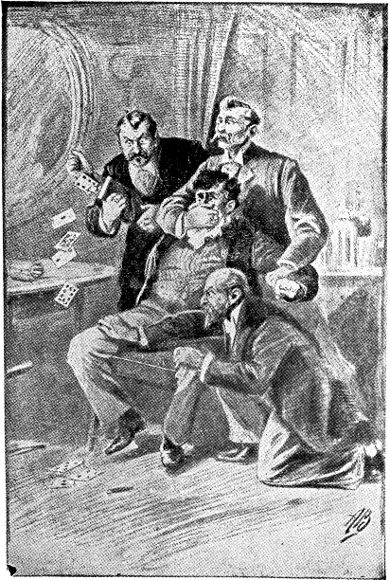
Caught Working the Sleeve Hold-out.
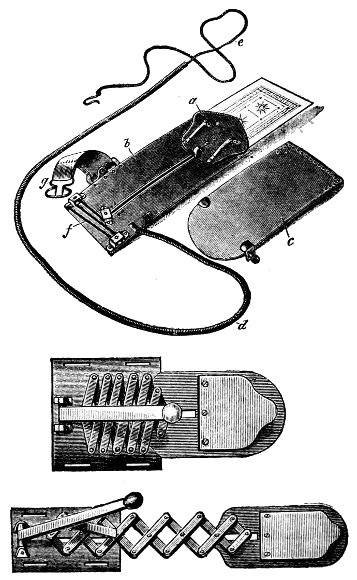
Fig. 31. Hold-outs.
Cards Marked With Finger Nails.
This is a mark put on the cards during the progress of the game, with finger nail or thumb nail. It is put on so that the gambler may know just what his opponent holds. The ace is marked with a straight line or mark in upper right hand corner. The king, is a straight line about one-half inch long in the center of the card. The queen is a straight line a half inch longer than the king. The jack is a straight line about the center of the card. The ten spot is designated by a straight line or mark in the same position as the ace. The nine spot is a slanting line in position of king. The eight is a slanting line in position of queen. Seven is a slanting line in position of jack. The six is denoted by a straight line in position of ace, running across the card at right angles to the ace mark. The five is same as six in position of king. The four is the same as five and six in position of queen. The tray is same mark in position of jack. Deuce is a cross below the jack sign. The mark denoting the suit of the card is placed in the center of the top of the card. Hearts are designated by a perpendicular line at the center end of the card. Clubs are shown by a horizontal line in the same position. Diamonds are shown by a slanting line in the same position. And of course, as hearts, clubs and diamonds are marked, a card without a mark would be a spade. This is one of the most dangerous tricks, as it is done during the progress of the game, and unless some one knows something about it, it would never be detected.
The Double Discard.
This is used by many of the gamblers, and is done through the neglect of the players. The man doing this will always draw three cards, no matter what he may hold in his hand. It is done by placing the cards he wishes to keep on top of the ones he wishes to discard, and laying them down beside him, ostensibly discarding them. As he is given his three cards he looks them over and has eight cards out of which to pick his hand. Suppose in his original hand he held three diamonds and a club; he places the three diamonds beside him and calls for three cards, holding one diamond and the club in his hand. When his cards are dealt him he has five cards out of which to pick two diamonds. He selects two cards and discards three cards; at the same time he picks up the three cards that he discarded first. Very few are expert enough to this trick without detection.
Check Signs.
This is a set of signs made with the use of checks. In making these signs a white check counts one, a piece of silver or a colored check counts five; often when colored checks or silver are not handy, matches are used instead. The count of checks corresponds to the size of the cards. One colored check would denote a pair of fives, or three fives, when used in a certain way, which I will endeavor to explain fully. Of course, all these different signs are used between two men, who are in league with each other in order to cheat a game. The first sign in this set is the sorting of cards, which means that the hand is no good. Should this sign not be given, the partner will look for the sign denoting what is held. When one man wishes to show that he has a pair, he holds the check or cards in the right hand, slightly to the left of his body. For instance, a white cheek held in the right hand, nearly in front of the heart, would denote that a pair of aces were held. Two checks, a pair of deuces, and so on to eleven, which signifies jacks; twelve, queens, and thirteen, kings. For two pair, the head pair is shown, the checks being held squarely in front. For instance, aces up would be shown by holding one white check up in front of the body. For three of a kind, the same sign is used, merely the check is held a little to the right of the body. Three colored and one white would signify that a straight was held; four colored and one white would signify that a flush was held; five colored and one white check would signify that a full house was held; six colored and one white would mean four of a kind; two colored checks, together in the palm of the hand, means a straight flush.
Uses to Which a Pack of Cards May be Put.
A pack of cards may be used as a Bible, a prayer book, and an almanac. As a Bible and prayer book, the ace should remind you that there is one God; the deuce, of the Father and Son; the tray, of the Father, Son and Holy Ghost; the four, of the four evangelists—Matthew, Mark, Luke and John; the five of the five virgins, who had filled and trimmed their lamps; the six, of the command to labor six days a week; the seven, of the seventh day, which God blessed and hallowed; the eight, of the eight righteous persons who were saved in the ark, Noah, his wife and three sons and their wives; the nine, of the nine lepers who were cleansed by our Savior and never thanked Him for it; the ten, of the ten commandments; the king, of the Great King Almighty: the queen, of Sheba, who visited Solomon; Solomon was the wisest man living, and she was as wise a woman as he was a man; the knave, of Judas Iscariot, who betrayed our Savior.
As an almanac, count the spots, and you have three hundred and sixty-five, the number of days in a year. Count the cards, and you have fifty-two, the number of weeks in a year. Count the suits, and you have four, the number of weeks in a month. Count the face cards, and you have twelve, the number of months in a year. Count the tricks, and you have thirteen, and you have the number of weeks in a quarter.
The Bill Hand.
You have often seen a lot of poker players playing with a lot of checks stacked up in front of them and a few bills or greenbacks spread out in front of them, between checks and themselves. A player having his checks in this manner needs watching, for it is easy to slide a full hand or four of a kind under those bills whenever an opportunity occurs. Whenever a good fat pot appears he can use this hand which he has under the bills by simply putting his hand on top of the bills and turning them over, which brings the good hand on top and poor ones under the bills. He always makes a practice of laying his cards down on the bills, and other players see it at different times and will think nothing of it. The only way to detect this is by missing the five cards out of the pack, and one has to be a expert to miss five cards out of fifty-two without counting them, and after playing a good hand in this way he must get rid of the deal hand, which is under the bills, in order to get ready to collect another hand for the next play. The principal thing about this work is to do it at the right time and with the right people.
Toothpick or Cigar Signs.
A gambler will use a set of signs made with a cigar, pipe or toothpick to show his partner what he holds in his hand. The signs are as follows: The cigar, pipe or toothpick placed in the left side of the mouth signifies a pair. On the right side two pair; in the center of the month means threes. To signify that a straight is held the cigar is moved up and down with the fore finger. Working in the same manner with the first and second finger denotes a flush. With the third finger denotes a full house. With fourth finger means four of a kind. To show the size of the hand the fingers are placed on the cigar, pipe or toothpick in the following manner: Suppose a pair of aces are held, the cigar is placed in the left hand corner of the mouth and touched with the first finger of the right hand. Aces up or three aces can be shown in the same way. The first finger denoting aces, the second kings, the third queens and the fourth jacks.
GAMBLING DEVICE SWINDLE IN ARMY AND NAVY.
Scope of Fraud World-Wide—Soldiers and Sailors Victims of Contrivances.
On May 19, 1906, Detective Clifton R. Wooldridge, with ten men, swooped down on: H. C. Evans, 125 South Clark street; George De Shone, 462 North Clark street; Barr & Co., E. Manning Stockton, 56 Fifth avenue. The offices were raided and sure-thing gambling devices valued at $5,000 seized and destroyed. H. C. Evans was arrested and fined $200; George De Shone was arrested and fined $100, and E. Manning Stockton arrested and fined $25. Afterwards E. Manning Stockton was indicted, arrested and gave bonds, which he forfeited and then fled.
Disclosure of conditions which so seriously threatened the discipline of the United States army and navy that the secretaries of the two departments, and even President Roosevelt himself, were called upon to aid in their suppression, were made in the Harrison Street police court following this arrest.
It was charged that a coterie of Chicago men engaged in making and selling these devices had formed a "trust," and had for years robbed, swindled, and corrupted the enlisted men of the army and navy through loaded dice, "hold-outs," magnetized roulette wheels, and other crooked gambling apparatus.
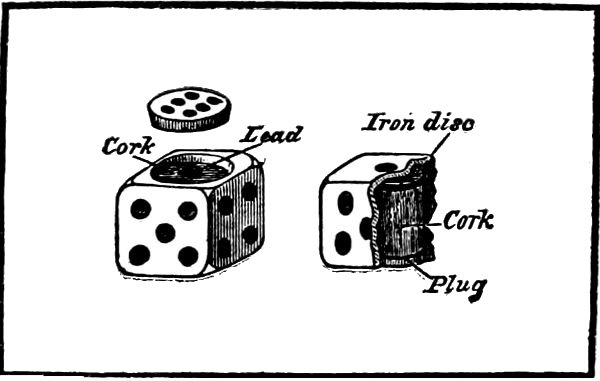
Electric Dice
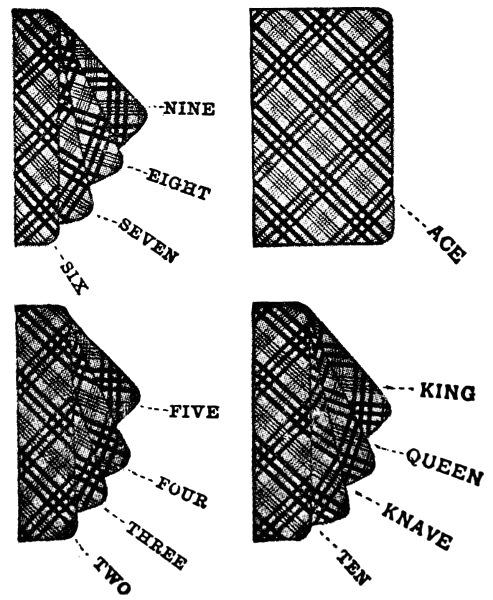
The Way Some Cards Are Marked.
The "crooked" gambling "trust" in Chicago spread over the civilized world, had its clutches on nearly every United States battleship, army post, and military prison; caused wholesale desertions, and in general corrupted the entire defense of the nation.
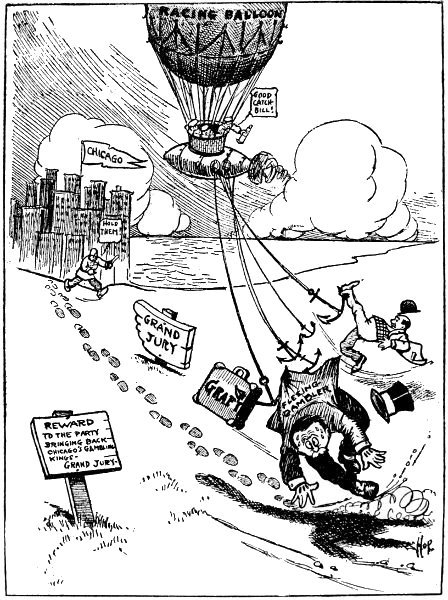
REWARD TO THE PARTY BRINGING BACK CHICAGO'S GAMBLING KINGS.—GRAND JURY.
Try to Corrupt School Boys.
Besides the corruption of the army, these companies are said to have aimed a blow at the foundation of the nation, by offering, through a mail order plan, for six cents, loaded dice to school boys, provided they sent the names of likely gamblers among their playmates.
This plan had not reached its full growth when nipped. But the disruption of the army and navy had been under way for several years, and had reached such gigantic proportions that the military service was in danger of complete disorganization.
Thousands of men were mulcted of their pay monthly.
Desertions followed these wholesale robberies. The War Department could not find the specific trouble. Post commanders and battleship commanders were instructed to investigate.
The army investigation, confirmed after the raid and arrests, showed that the whole army had been honey-combed with corruption by these companies. Express books and registered mail return cards showed that most of the goods were sold to soldiers and sailors.
Forts Infected by Evil.
Fort Riley, Cavite, P. I., Manila, P. I., Honolulu, the Alaskan army posts, Fort Leavenworth, Fort Reno, Fort Logan, Columbus Barracks, Fort McPherson, were among the posts where hundreds of dollars worth of equipment was sent, and where thousands upon thousands of dollars a month was the booty obtained by the Chicago trust on a commission basis.
Battleships in every squadron, the naval stations of this nation all through the world, navy yards, and other points where marines are stationed, have been loaded with the devices.
It was found, upon investigation, that "cappers" were selected from the enlisted men. Agents, who ran the games on commission, were also found. These men, dazzled by financial prospects, deserted in droves.
Many Victims Suicides.
The men who were fleeced and had their small pay taken from them month after month, became reckless. Some ended as suicides. Hundreds became unruly and were subjected to guard-house sentences. They deserted in their despair. The conditions in the navy were even worse. Scores of the battleship crews would be in irons at a time.
To the honor of the service, it was found that no officers had ever participated in the corrupting vocation. It was the rank and file who "fell for it," as the gamblers said. They became either tools or victims, to the extent, it was estimated, of 60 per cent.
KING DEATH.
An Average of 200 Suicides a Year at Monte Carlo—Many Bodies Are Secretly Thrown Into Sea by Authorities of This, the World's Greatest Gambling House.
Paris, Nov. 20.—Three thousand known suicides and murders have been committed in Monte Carlo in the space of fifteen years. The known suicides average fully 200 a year, and some weeks there have been as many as three a day. The Casino authorities do everything to hush up scandals and news of tragedies. A large force of plain-clothes men are engaged to either prevent suicides or to hurry the body of the dead unfortunate out of the way. It is estimated that more than one-half of the tragedies of Monte Carlo are never heard of except by the Casino staff. The corpse is rushed quietly to the morgue—a secret morgue. Here it is kept some time to see whether relatives or friends are going to interfere or kick up a row.
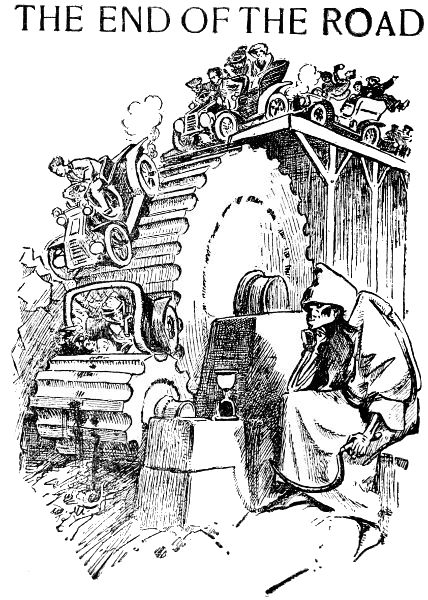
THE END OF THE ROAD
Bodies Thrown in Ocean.
Every once in a while a small steamer slips out of the harbor at dead of night. Its cargo is secured at the secret morgue. At sea the bodies are thrown overboard, duly weighted, without toll of bell or muttered prayer. There are countless graves of unknown dead in the Monte Carlo cemetery. But these are only those whose death has become known to the public. The Casino authorities have a special bureau, whose duties are to relieve persons ruined at the tables. The ruined gambler can get from this bureau enough money to take him to his home, or to some spot far from Monaco. Few know of this, perhaps, or there would not be so many deaths. The "dead-broke" gambler is taken through many inner chambers and before stern-faced men, to whom he has to tell his history in detail. He is also confronted with the different croupiers, who testify as to whether he really lost as much as he may claim.
Banish the Dead Broke.
Then the wretched man has to sign a document banishing himself forever from Monaco. His name and particulars are written in the "black book," his photograph is taken and given to the doorkeepers and other officials to study, and then the man is taken to the railway station, a ticket bought, a few dollars given him, and an official escorts him as far as the frontier. Should he return it would not avail him. The police would turn him back again into France or Italy. It is related that an American who was "broke" and anxious to get back to the United States heard of this feature of Monte Carlo. He had not gambled there because he had no money, but he managed to make his way to Monte Carlo and demanded to see the authorities. He coolly asked for a steamer ticket to New York. Inquiries revealed that he had only just arrived in Monaco, and had never put a foot inside the Casino, but despite this the authorities gave him a steerage ticket to New York and saw him on his way.
Bonapartes Big Stockholders.
There is also the case of an important Indian army officer who went broke. The authorities gave him first-class passage to Calcutta, and $250 expense money. He had lost several thousands. As much as $2,500 has been paid out to a big loser so that he could settle up his hotel bill and take himself and family home. Should such money be paid back the Casino might again welcome the man. The sums usually paid range from $25 to $200, and an average of 1,000 people a year apply for this relief. The profits of the Casino are immense. Last year they were $7,500,000, an increase of $760,000 over the previous year. Seventy per cent was paid to the shareholders. The majority of the shares are held by the Blanc family, the leading member of which is the Princess Marie Bonaparte, whose father was Prince Roland Bonaparte, and mother the daughter of M. Blanc, the founder of Monte Carlo. She is the wealthiest princess in the world, and was lately married to Prince George of Greece, who is an impecunious princeling and needs the money.
Prince Owns no Stock.
The prince of Monaco has not a single share in the enterprise. But he derives his entire income from the sum paid him by the Gamblers' Company for the lease of Monaco. The prince is of especial interest to Americans, because of his American wife. She was Miss Alice Heine of New Orleans. When she married the prince she was a widow, the Dowager Duchess of Richelieu. The prince is a "divorced" man. He first married Lady Mary, the daughter of the Duke of Hamilton and Brandon, and a son and heir was born. But eleven years after the marriage the pair were so unhappy that an appeal was made to the pope. The Catholic church, of course, does not recognize divorces, but the pope issued a special pronouncement declaring his 11-year-old marriage invalid, for the reason that the Lady Mary's mother "over-persuaded her to marry."
Receives Enormous Income.
The prince, in return for the gambling concession, has been getting an annual income of a quarter of a million dollars and all the expenses of running the State of Monaco, including the maintenance of the army and the royal palace. He recently granted a further contract to the "Monaco Sea-Bathing Company," or to give the gambling concerns the full title "La Societé Anonyme des Bains de Mer et Cercle des Etrangers à Monaco."
This concession now extends to 1947, and the annual income of the prince has been raised $100,000. Every ten years it will be raised an additional $50,000. In six years time the Casino will also have to pay him a lump sum down of $3,000,000. It is stated that the prince of Monaco is by no means in favor of the Casino, and that he abhors the gambling and the consequent scandal in his state, and that could he do so, he would at once stop it. But in the old original contract it was agreed that the concession should be extended to 1947, and the prince is not rich enough to break this contract and pay the indemnity which the law would quickly assess.
Gambling Kings Go Broke; Often Die in the Poorhouse.
Some one has advanced the statement that every human being is a gambler at heart. Yet for a man to go into the business of establishing a card gambling house under modern conditions is to attempt one of the riskiest businesses in the world. Recently one of the most noted gaming-house keepers in the country seems to have suggested a further anomaly in the situation in his utterance in a court of record:
"When I conduct a house on a 10 per cent basis of profit it is only a matter of time until my steady patron 'goes broke.'"
In the face of this statement, however, the innocent layman may be still further at sea when it is recalled by old habitues of the gaming table that nearly every gambling king of modern history has finished close to the poorhouse and the potter's field! How is it possible that the gambler with the insidious, certain 10 per cent which inevitably wrecks the man who goes often enough to the green table almost invariably dies in poverty?
Must Have Fortune to Invest.
Today it is the gambler king who at least has an ephemeral show to gain fleeting riches. But in order that these riches shall approach riches as they are measured in other businesses, the man who opens the gambling house must have a fortune for the investment. His outlawed business itself will make it certain that he pays the maximum rental or the highest price for the property which he chooses for occupancy. To sustain this he will need to seek out the wealthy patron who not only has money to lose, but who may have a certain influence which may tend toward immunity for keeper and player alike. The "establishment" will need to have the best cuisine and the best cellars, with palatial furnishings and a retinue of servants in full keeping.
And somewhere money will be necessary in blinding officials to the existence of an institution which is visible to the merest tyro in passing along the street.
A constitution of iron, the absence of a nervous system, the discrimination of a King Solomon and the tact of a diplomat are requisites for the successful gambling king. Considering the qualification of the man for such a place and the final ending of the gambling king's career, it might be a sociological study worth while to determine where, on a more worthy bent, such capacities in a man might land him.
In real life, however, it must be admitted that the gambler king is looked upon in exaggerated light. Almost without exception the big gambler is posing always. Conventionality has demanded it of him. But for more than this, in order to command the following which he desires, he must have a certain social side which is not too prominent, but which with tact and judgment he may bring out on dress parade. To the layman the gambler is the dark, sinister figure pictured in melodrama. He bears the same relation to gambling that Simon Legree bore to the institution of slavery of fifty years ago.
Story of One Gambler King.
One of the noted gamblers of his time in this country passed from laboring on the docks into the prize ring. When his ring work was ended the gambling house was an easy step onward in illegitimate fields. On the docks his reputation was not above a bit of "strong arm" work in separating a man from the money which the dock walloper wanted. Naturally, under the Queensberry rules, there were things in the ring which he could not do in overcoming an antagonist, and he learned to make concessions to fairness—which was education.
Opening a gambling house that was adapted to the wants of a rich clientele, it was a necessity that he preserve this educational regard for his patrons, and that he should add to it. Soon he was in a position where it was imperative that his reputation for fair dealing be kept intact. He became the "gentleman gambler" whose "word" carried all the accepted concomitants of his gentleman's business. In the course of events he attained a high legislative office under the government. But it may be said for those who knew the man as a man, not one ever ceased to regard him at heart as the dock walloper, with the inherent and unreconstructed disposition to regard other men as legitimate prey. Had other conditions and circumstances made a card sharp of him, he would have held to the promptings of his nature.
In the conduct of a gambling house of the first class, the gambling king needs for himself and for his patrons the assurance of uninterrupted play. Men of money and position will not go to a house where there is menace of a police raid. The small gambler may subsidize the policeman on the beat in which his house stands, but he cannot placate the whole Police Department. And even when it is thought that the gambler king is impregnable in his castle someone may break over the barriers and raid the place in the name of the law and order.
Within a few years New York has given to the world some of the inside working of the gambling business. When Jerome raided the place of places which had been considered immune, the proprietor of the house was considered worth a million dollars. Before the litigation was done and the fine paid the gambler king was out $600,000, his "club-houses" were closed, and he had been branded officially as a common gambler, pursued in the courts for payment of lawyers' fees, which he designated as outrageous and a "shrieking scandal." Yet this man was of the type whose word had been declared as good as his bond.
Dice, Faro and Roulette.
Dice, faro and roulette are the principal games of the gambling house and, considering these, the experienced player will tell you that he is suspicious of a "petey" in the dice box, a "high layout" in faro, and a "squeezed wheel" in roulette, in just the proportion that the gambling house keeper has not recognized that he cannot indulge them because of the fear of detection. The gambler holds to the gambler's view of the gambler—and it is not complimentary to the profession.
That the gentleman gambler is justified in his attitude toward the gentleman player, too, has been shown in the New York revelations. There one gentleman player, loser to the extent of $300,000. compromised with the "bank" for 130 bills of $1,000 denomination. There a gentleman player who had lost $69,000 to the bank tried to compromise on $20,000, but was in a position where the bank could hold him. How much the gambler king may loan and lose in the course of a year scarcely can be approximated. The gambling debt is "a debt of honor," and even in business not all such debts are paid. Whether a borrowed debt or a debt of loss to the bank, this honor is the security, unless in emergency the gambler king discovers that he can blackmail with safety to his interests as a whole.
In general, the gambler who is "on the square" operates on a 10 per cent basis for his bank. In addition there is the "unknown per cent" which is his at the end of the year. The roulette wheel, for example, presents to the player just one chance in thirty-seven of winning on a single play, while the winning on that play is paid in the proportion of only 34 to 1.
More Nerve to Win Than Lose.
The one great characteristic in human nature on which the gambler counts is the fact that it requires more nerve in a man to win than is required of him to lose! It is startling for the layman to be told that $5,000 in a night is a big winning for a player, while $5,000 is only an ordinary loss in a big establishment.
This fact is based on subtle psychology. There are two types of players, one of which gambles when it is in a state of elation and the other when in a state of depression. With either of these types winning, it is a gambler's observation that the man who will play until he has lost $25,000 when luck hopelessly is against him cannot hold himself to the chair after he is $5,000 winner.
Gamblers have made money—fortunes—in times past, only to be buried in the potter's field. There are several reasons assignable for this end. Extravagant living appeals to the gambler, and when he has left his own special line of gaming it does not appeal to him strongly as either pastime or means for recouping his fortune. If he turns to gaming at all it is likely to be in fields where he does not know the game. Sometimes he goes to the Board of Trade—sometimes to the stock market. Playing there he is without system and without knowledge of conditions. He is likely to bull the grain market two days after the weather conditions have assured the greatest grain crop in history.
Once a gambler, always a gambler, is his condition; and it is only a matter of time until someone has a game which beats him out.
IT'S UP TO YOU, YOUNG MAN.
There are two trails in life, young man. One leads to height and fame, To honor, glory, peace and joy, And one to depths of shame; And you can reach that glorious height— Its honors can be won— Or you can grope in shame's dark night. It's up to you, young man. Stern duty guards the upper trail— Exact obedience, too— And he who treads it cannot fail To win if he be true. But tickle folly, gay with smiles, Rules o'er the other one, And leads to ruin with her wiles. It's up to you, young man. At parting of the trails you stand. At early manhood's gate; Your future lies in your own hand— Will it be low or great? If now you choose the trail of Right. When you the height have won, You'll bask in Honor's fadeless light— It's up to you, young man.