Dramatic Scene in Courtroom.
Reading edition
The face that was turned piteously toward the jury was deeply lined with the furrows of physical and mental suffering.
The eyes drooped constantly, and there were times when she closed them for a full minute.
Every movement of the lips or eyelids, every arrangement of dress and costume, was either studiously planned or pathetically dramatic.
The weariness and bitterness were marked in the droop of her mouth, in the perplexed wrinkling of her forehead, in the stoop of her shoulders, in the relaxation of her hands, lying heavily on the table before her.
A long, long line of battles she has behind her, with her good name torn to shreds in the fight; and nobody can guess at the scars and open wounds in her soul. No matter how great may have been her fault, how untrammeled her impulses and wishes, how wild and defiant her spirit toward the law and society, now she is a tired, broken woman, who has lost the day.
Bloom Gone From Cheek.
There are many who say that the beauty of which Dora McDonald was once so proud has departed entirely. The eyes were heavy, the skin no longer showed the pink of health, but was a dead white, her figure had fallen away until she was almost emaciated, but there was a beauty in her sadness and despair that the triumphant woman never possessed.
She seldom looked at the veniremen, nor did she appear to be following the questions put to them. Occasionally she glanced at a possible juror as he stepped up to be sworn, but for the most part she sat with her head resting on her hand, or looking ahead at some mental vision. Is it the face of young Webster Guerin she sees, as he lay dead, or the face of old "Mike" McDonald as he smoothed her hair and loaded her with caresses? Is it remorse for a crime, or longing and grief for a dead admirer? Or is it despair for a wasted life, a hopeless future, a thousand lost opportunities?
No Madness in Her Eyes.
If the defense expected to utilize the plea of insanity it would have had some difficulty in inducing a jury to believe that Mrs. McDonald was greatly deranged. There was no gleam of madness in her eyes. They were dark-circled and languid, but not at all staring or strange. She seemed unusually self-poised and collected.
Without any artifices of dress or cosmetics, without any gleam of gaiety or vivacity, it was not impossible to understand why this woman wielded the great influence in the lives of three men that she did. In the first place, her features were regular and fine. Her eyebrows were delicately penciled and her eyes large and dark.
Traces of Siren Left.
The contour of her cheeks was soft and round. But one can imagine, in happier days, that there was a captivating play of expression, an esprit, a beauté de diable, that would be particularly fascinating to a man like old "Mike" McDonald. And upon such a woman would the self-made man, the gambler, uncultivated and rough, fast approaching old age, delight to heap luxury and adoration, as there is no doubt "Mike" McDonald did.
And is it not easy to imagine that such a woman would have a powerful attraction for a young man, with her sophistication and experience matched against his ignorance? And now one of the men is dead of a broken heart, and the other struck down in the very first flush of his youth, and the instrument of pleasure and destruction stands at the end of a shattered life.
Until a jury should decide, in so far as human fallibility may decide, just whether or how Dora McDonald shot down Webster Guerin, that victim of tangled love and jealousy, a waiting city hung expectant on every incident bared since the day that the artist toppled before a pistol ball in his studio with a woman of furs and furbelows standing sobbing above him.
A "Sappho" and "Salome."
A "Sappho" in a grimy city she was called because her heart was touched by the strength of youth; a "Salome" because she planted a kiss on his dying lips, but whether she was victim or vampire, sinner or sinned against, was solely for the jury to say.
Cries of blackmail, of bribery, of frenzied jealousy, of shameless love and daring intrigue, rang around the courtroom for the long days of the trial, but for the jury it was only to look behind the locked door of the artist's studio and see whether the revolver with which Guerin was shot down was held by the woman or the young man; whether there was malice or accident or self-destruction, and what the motive for either might be.
The shot that sounded his death was the climax to an attachment—guilty or not, as the case might be—that began when Dora McDonald was a wonderfully beautiful and younger woman, the wife of a wealthy gambler, and the lady of a mansion, and Webster Guerin was a mere lad, just old enough to doff short trousers for manly attire.
Affection, money and attention were lavished on the young man by this woman. At banquet board and in the theater box they passed their hours together. Of this there was no dispute. The sole question was whether the woman gave way to the lure of a boy, or whether the boy was importuned by the woman; whether in after years that boy blackmailed that same woman, or whether she loved him to a distraction that brought the madness of jealousy and the revolver.
And what of the love attachment? the police wondered. But as they delved a little they unearthed strange and tender things, but nothing more strange than poems written by the woman and apparently dedicated to the youth.
The tragedy of a soul was bared when Assistant State's Attorney Day read to the jury poems of passion found in the reticule taken from Mrs. McDonald on her arrest.
The State regarded the declarations contained in the verse as disclosing a dual motive of murder and suicide, and introduced them as circumstantial evidence. One entitled "Mistakes" was written on the day of the Guerin love tragedy.
Here is the first one read:
Tragedy of a Soul in Poems of Passion by Dora McDonald.
Put the word "finish" down by my name: I played for high stakes, but I lost the game; I played for life, for honor and love: Well, I am not the first mortal who has lost all. I have made up my mind to care not a bit; Let honor and love sink to the bottomless pit. Pull down the curtains, bring in the lights, Put from my memory horrible sights Of treachery where there should have been love, Of red blood where should have been whiteness of dove; The past, the present and the future are done: How different, O God! had it been had I won.
Written as Tragedy Approached.
We are drifting apart, Though from no change of heart: But we cannot agree, And the end we can see, So the bonds of our love we will sever; And I wonder if we Will, alas! too late see That our happiness lay in each other. For when soul finds its mate It is often too late To struggle and fight against conquering fate. And what does it mean? This parting, I ween; I'll leave you, but, well. Neither heaven nor hell Will make me forget you. Nor save you should I find Another holds the place that was and is mine.
Poem Written on Date of the Guerin Tragedy.
This poem, entitled "Mistakes," is dated February 21, 1907. 11:20 a. m.:
Said he: "Where is my sin? I'm only as men have ever been. I'm not so bad, I'm not so good, And I'd be as you'd have me if only I could. But you are strong and good and brave. Surely for me a road you can pave, A road which shall be my happiness, my very soul save. After all, it's for you and you only that I crave." She waited a moment, then came her reply: "To the old adage, that women are weak, you can give the lie. Not only you, others as well, All through life have the same tale to tell. I didn't mean to do it—I didn't, I swear, But you can forgive me; your loss I cannot bear. Can I forgive you? Well, that's not so clear, Though you certainly were to me very dear. I think, after all, now that I am awake. I think it was I who made the mistake. I thought of you ever as a flower rare. With whom other flowers could not even compare. Alack and alas! I find, after all, You are only a sunflower, of which there are many, Who take all the elements have to give And give nothing that creates or causes happiness to live."
"Kill Me If You Will," She Says in a Verse.
Another of Mrs. McDonald's poems, written on the day of the killing, is as follows:
Kill me if you will, for all is well. I know that to Satan your soul you can't sell, And I've saved you from everlasting hell. I had lifted you up, when, lo! I found Slowly but surely you were dragging me down. Out of space thus came a warning Soft and clear as the breath of the morning.
Pearls Before Swine.
Have you learned the old saying of pearls before swine? I gave every pearl that ever was mine. I've nothing more to give. And it's hardly worth while for me to live. More blessed to give than receive, they say. I followed that teaching in my poor way. I wanted returns, I'll have to confess, And I had to be cool, and firm and brave, For I knew 'twas my duty your soul to save. And I've set your feet on the path of right, And from now till the end you shall see but the light And turn from it to pitfalls and terrors of night. Turn to the right, to the wrong you may sway. From black imps' vile rottenness I've snatched you away, And though I fall slain at your feet with a moan, I care not, for evil from you has flown; And, by all the glory of God above, I've proven the strength of a weak woman's love, And I thought my pearls would bring love that was blessed. I did so want love that was loyal; 'Twas more to me than a diadem royal. But I found too late that I was wrong, That love but existed in hopes and in song. What became of those pearls of mine? Oh, nothing! I just threw my pearls to the swine.
Another Poem of Passion.
I waged a battle fierce and long, I fought to know the right from wrong. Did I succeed? I cannot tell, Yet when I met sin I knew full well That fight's not over. 'Tis scarcely begun, And I struggle again to win, one by one, Steps on the ladder that mounts to great deeds, Where the path to the right unfailingly leads. As I gazed at the battlefield, flooded with gore, Where the path to the right unfailingly bore, I knew that the wounds came from contact with sin. 'Twas demons let loose that float in the air; But the fight's worth the while, for when Misery and heartaches shall all pass away Right has full sway.
The reading of the poems was followed intently by the big crowd in Judge Brentano's courtroom. Mrs. McDonald appeared uninterested.
From poetry the step was easy into song. Accomplished and educated as Dora McDonald was, with time hanging, sometimes, heavy on her hands, what more natural than that she should set her verses to music of her own composing?
Never Again.
(Song written, composed and published by Mrs. Michael C. McDonald.)
'Twas only a story of a woman's love, a tale that has often been told. She gave a love that knew no bounds; the rest of the story is old. Again he had strayed, and this time had made a mistake she could never forget; In a voice that was dense with a grief intense she mournfully did say: I gave you sweetest love, you gave me naught but pain; Oh, I forgave you more than once but to be hurt again. This time it means the end, for I could never forget. I shall never see you again, although I love you yet. With tears in his eyes the man replied: "I know that I have gone astray; Remorse will last till life is passed; forgive me, don't send me away. Oh, let me atone, live for you alone; just once more have pity on me." But, bowing her head, with its look of one dead, she softly but firmly said: I gave you sweetest love, etc.
The mother of the woman, an aged orthodox Hebrew, never went near Dora McDonald until the trial was nearly done, though that same old woman bent her knees as she day and night raised her voice to Jehovah in lamentations.
Ill health, mental and physical, followed. All the sorrows of a shattered life befell her.
Sought Vindication to Spare Her Aged Mother.
For Dora McDonald, life had been lived when Guerin died. It mattered not after that whether she went to the gallows or to freedom. But for one reason she would not have cared a whit whether her case was fought before a jury or not. The one reason was vindication that her mother might be spared something of shame.
The vindication, however, was sought at a costly price—the price of a life and heart and love bared to a gaping world. It was an expensive effort to wash off the stain of an indictment.
At the trial Assistant State's Attorneys Edward S. Day and William H. Rittenhouse wrangled with their own witnesses and tried one after another to have them testify to things they never saw or heard.
They attacked Inspector John Wheeler, Officer J. G. S. Peterson, Thomas F. McFarland, Detective Wooldridge, Police Matron Elizabeth Belmont, Charles Freudenberg, an old soldier 60 years old, and threatened him with an indictment; Louis Jacobs, Lorenzo Blasi, Herman Hanson and Charles B. Williams.
All of those accused except Detective Wooldridge considered the fulminations of Attorneys Day and Rittenhouse a good joke. They regarded them as the vaporings of temporarily disordered intellects, minds that had become rattled by a case which was too big for them.
Owing, however, to the peculiar position in which he was placed as the officer who made the arrest, Wooldridge was forced to take cognizance of the matter.
Wooldridge denied the statements made against him and branded them as malicious lies manufactured out of whole cloth. He asked for a hearing before the Civil Service Board, which was granted to him after the trial was over.
It was fully shown at the investigation how Wooldridge had been treated in the matter, and the motive for his transfer; it was also shown that he knew no new facts, neither did he meet or know any witnesses except those who had testified to the Coroner and Grand Jury.
The motives for his transfer and the reports were fully uncovered and exposed.
Detective Wooldridge was exonerated by the entire Board of Civil Service Commissioners.
Day and Rittenhouse simply sewed up the case in criminations and recriminations.
Assistant State's Attorneys Day and Rittenhouse were outgeneraled, outclassed and whipped, and wanted to throw the blame for the acquittal of Dora McDonald on the Police Department and failed. They did everything but try the case.
Strong Defense by Lewis.
Colonel Lewis said that the State had not denied that the revolver with which Guerin was shot was his own. He called for the weapon and showed the jury how Guerin might have shot himself if Mrs. McDonald, in her struggle with him, had merely pushed the revolver around in the palm of his hand.
Again he called for the blood-stained coat that Guerin wore when he was killed. It was too good an opportunity to be overlooked by the fine dramatic eye of the Colonel.
"You remember the speech of Mark Anthony," he said; "how he produced a tremendous effect with the robe of the great Cæsar? I will not ask for more than the robe that this Cæsar wore."
Thereupon he spread out the grewsome relic on the railing on the jury box to show what he said were powder marks. In his mind, there was no doubt about how the tragedy worked out. Guerin, enraged and terrified when Mrs. McDonald told him that she had told her rich and influential husband everything, attacked her. He got the revolver out of his drawer, probably to frighten her. Mrs. McDonald, half choked, saw it gleam and pushed it away from her.
Strikes Hard at Archie Guerin.
More striking than the beautiful imageries and the wealth of quotation from ancient and modern authors with which the Colonel embellished his speech was his strong play upon "that fifteen minutes," which, according to his interpretation of the evidence, elapsed between the time the boys in Guerin's studio were ejected and the time when Archie came out, leaving his brother and Mrs. McDonald alone, behind locked doors.
"There need be nothing else in this case for you," exclaimed the speaker, "than this fifteen minutes unaccounted for. Archie Guerin knew what was going on there, and before God he should tell, but he did not. He hurried away and cleared the corridors. Nervous and confused, he hunted up Harry Feldman in the Windsor-Clifton Hotel, so that if anything happened, he could say:
"'I didn't do it. You know I didn't, Feldman. I was right here with you.'"
O'Donnell Moves to Tears.
There were wet eyes in the courtroom as the real Dora McDonald was brought to life in the closing address of Mr. O'Donnell. The bickerings and the charges and the abuse that had made the courtroom like a pothouse brawl all day were forgotten. The woman's black clad figure and her white, despairing face became the living picture of the world-old tragedy of the judgment and the problem of pardon.
"The tragedy was in that room," said Mr. O'Donnell, pointing to a plat of room 703 of the Omaha building, "and no one knows how the life of Guerin was ended.
"I am not going to place a wreath upon the brow of this woman. She is not all that a man would wish his wife to be. She has traveled the devious pathways and her eyes have fallen upon the shifting scenes of life.
"The Sabbath is coming on. Her ancestral people lit the candles at sundown last night. Somewhere in this city a light is burning where a Jewish mother is praying and hoping for her erring daughter. You are approaching the moment when you must do your great duty. You are here only to say whether she killed Guerin with a criminal intent in her heart.
Quotes the Gospel.
"A daughter of Israel coming to judgment. She may have been wayward, but we are not here to judge her past life. In a temple of Jerusalem many years ago the Saviour of us all stood before the multitude and they brought him a woman and said:
"'She has been taken in sin and she must die.' And he said:
"'Let him who is without sin among you cast the first stone.' And they walked away and left him with the woman. Then the Master said to the woman:
"'Go and sin no more.'
"Let us pass judgment upon this woman as the Son of Man passed it upon the woman of old that we may expect mercy when we stand at last where the fallen woman of Jerusalem stood."
Mr. O'Donnell created a scene of profound dramatic features when he based his contention that Guerin blackmailed Mrs. McDonald upon a letter written by Guerin. He called the ghost of Guerin to take the witness stand and testify against the state's attorneys.
Acquittal Creates Thrilling Scenes.
These were the scenes which attended the rendition of the Dora McDonald verdict:
"Bring in the jury," said Judge Brentano, as he dropped into the big leather-upholstered chair behind the bench.
Bradley was waiting for the word at the door to the Judge's right. Looking very solemn and sphinx-like, the twelve men filed in and took their usual places.
At the same time Mrs. McDonald came through the corridor from the custodian's room, accompanied by her nurse, Miss A. K. Beck. Miss Beck was trembling, but there was not a tremor in Mrs. McDonald's hands or a movement of the facial muscles to indicate that she felt the least excitement.
Attorney Norden pulled out her armchair for her and pushed it under her again as she sat down. Every man in the courtroom felt a choke in his throat, but if Mrs. McDonald felt it she gave no evidence of it.
"Gentlemen," said the judge, turning toward the jury, "have you agreed upon a verdict?"
At first there was no answer, and the judge had to repeat the question. That interval was like a lapse of a week or a month.
Mrs. McDonald, who had not been asked to rise, sat facing the jury and looking straight at them. She considered it only polite to keep awake and to forego those beloved "dreams" of hers in honor of the verdict, whatever it might be.
Suspense Frightful.
"Have you agreed upon a verdict?" repeated Judge Brentano, a little impatiently.
"We have," replied the foreman, Hugh H. Fulton, rising and displaying a paper which he held in his right hand.
"Let the Clerk of the Court read it."
A. J. Harris, the Clerk, was already in front of the railing to receive the paper. He took it to his desk, and holding it under an incandescent lamp, for the courtroom was dark, he read, in a loud voice:
"We, the jury, find the defendant, Dora McDonald, not guilty."
It was as though you had touched a match to a pile of gunpowder. The people in the courtroom seemed to explode. They did not cheer, or applaud, or shout, and yet they appeared to be doing all of them. The tension was broken and a sort of bubbling effervescence took its place.
McDonald Jurors Tell of the Verdict.
"The jury found Mrs. McDonald innocent because they could not feel sure that she did not act in self-defense, and, following the instructions of the court, gave her the benefit of the doubt."
This was the opinion voiced by Juror Charles McGrath. Mr. McGrath said that the jury presumed the defendant sane, and that the matter of possible insanity was not considered at any time.
"I think that the jury attached a great deal of importance to the testimony of Dr. McNamara," continued Mr. McGrath.
"He was the only physician that had made a thorough physical examination of the defendant subsequent to Guerin's death. We especially paid a great deal of attention to that portion of his testimony that told of the marks found on Mrs. McDonald's neck, indicating that she had been choked. This evidence, taken with that relative to the finding of the hairpins on the floor, showed that there had been a struggle, and the court had instructed us that if we found that there had been a struggle we would be justified in finding a verdict of acquittal.
"Although I, perhaps, ought to speak only for myself, I will say that I do not think that the members of the jury were much impressed with the expert testimony."
Another juror said that those favoring an acquittal based their arguments largely on the fact that most of the evidence in the case was circumstantial, and that there was no absolute proof that Mrs. McDonald fired the fatal shot at all, and that if she did it was not shown that it was not in self-defense.
"It was mostly by argument along these lines that the conviction men were won over, one by one," said this juror. "The subject of the unwritten law was not gone into at all."
Woman Serene as Verdict is Read.
Dora McDonald, in a state of serenity and composure that is baffling even to those who are nearest her, was surrounded after her acquittal by friends and relatives, who were weeping for very joy at her acquittal.
She seemed quite unconcerned about it all, but when they took her to one side and asked her how she felt about it, she said, in the amazingly simple way she has:
"I am pleased. Do you want me to tell you the five reasons why?"
They said yes, and though she lost herself several times in the attempt, for she was very tired—these were the reasons she gave:
1—Because no Jewish woman could ever do a deed like that of which I had been accused.
2—Because it removes the stigma from dad's (Michael C. McDonald's) name.
3—Because of my boy.
4—Because of my darling old mother.
5—Please believe it, last and least—absolutely least of these—because of myself.
"The only real disappointment to me is that dad did not live to hear that verdict, and that is my bitterest disappointment."
It had been the belief generally among those who followed the case that the woman would not outlive the verdict long, no matter what it might be. The original plans were that she would be sent to a sanitarium in case of acquittal. She herself is said to have planned that if let go she would make a journey to Jerusalem, and there end her days in prayer with her chosen people, in an effort to blot out her past. "Life can never have any more meaning for her," Colonel Lewis said when the jury first retired. "No matter what the verdict, it is of little consequence to her, though she will die happier, maybe, if she is acquitted."
In Jerusalem there is what is known as the "Wall of the Wailing of the Jews." In the Valley of Tyron, at the foot of Mount Moriah, on which now stands the Mosque of Omar, but where formerly the Temple of Solomon stood, there are five enormous stones built into the foot of the hill. A little courtyard beside these stones, which Solomon laid as the foundations of his Temple, is set aside for the Jewish race. Each Friday this courtyard is filled with Jews wailing for the sorrows of Israel. Every type of Jew, from the hunted Russian to the wealthy American, may be found there, reading from the Book of Lamentations, and sending the cry of sorrow to the skies. It was here that Dora McDonald proposed to weep out her ruined life.
But no, it is not the Place of Wailing in Jerusalem to which Dora McDonald has gone. Hard as it is to believe of the woman who so bravely passed through this tremendous ordeal, she has stooped, stooped lower than one would believe humanly possible. She has returned to the stage. She is now engaged in attempting to have a play based upon the tremendous tragedy of her life placed on the boards in New York.
She is attempting to lay bare to the gaping audiences of cheap theatres the sores upon her soul. She has been calloused to publicity to such an extent that she now hungers for the public eye. She has placed herself in the same class with the lepers outside the walls of Jerusalem who display their horrid sutures and demand a penny before they replace the bandages. To this petty end has come this greatest and most spectacular of modern trials, this heart-shaking romance of love and life.
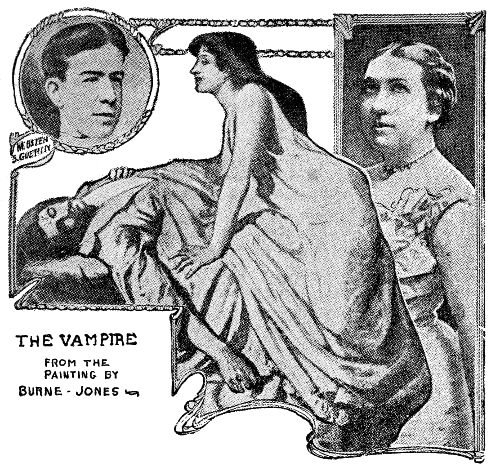
THE VAMPIRE FROM THE PAINTING BY BURNE-JONES
The Vampire.
After Painting by SIR ED. BURNE-JONES Verses by RUDYARD KIPLING.
A fool there was and he made his prayer— (Even as you and I.) To a rag and a bone and a hank of hair— (We called her the woman who did not care) But the fool he called her his lady fair— (Even as you and I.) Oh, the years we waste and the tears we waste— And the work of our head and hand Belong to the woman who did not know— (And now we know that she never could know) And did not understand. A fool there was and his goods he spent— (Even as you and I.) Honor and faith and a sure intent— (And it wasn't the least what the lady meant) But a fool must follow his natural bent (Even as you and I.) Oh, the toil we lost and the spoil we lost— And the excellent things we planned Belong to the woman who didn't know why— (And now we know she never knew why) And did not understand. The fool was stripped to his foolish hide— (Even as you and I.) Which she might have seen when she threw him aside— (But it isn't on record the lady tried) So some of him lived but the most of him died— (Even as you and I.) But it isn't the shame, and it isn't the blame That sting like a white hot brand— It's coming to know that she never knew why— (Seeing at last she could never know why) And could never understand.