SUPPRESS MANUFACTURE AND SALE OF DANGEROUS WEAPONS—THEY ARE A CONSTANT MENACE TO LIFE AND GOOD ORDER.
Reading edition
MADE SOLELY FOR UNLAWFUL USE—ENGENDER CRIME, INCREASE ACCIDENTS AND MAKE SUICIDE EASY—CARRYING CONCEALED WEAPONS A VICIOUS AND INEXCUSABLE HABIT.
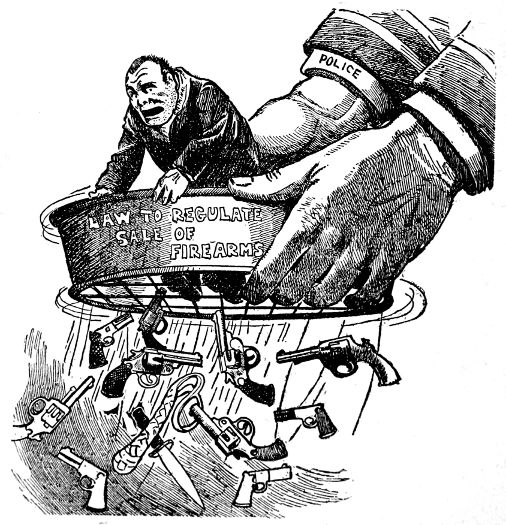
LAW TO REGULATE SALE OF FIREARMS
The "lid" should be put upon deadly weapons—pistols, revolvers, dirk knives, brass knuckles—not merely to hide them, but to prevent their manufacture and sale.
While serving as police officer I could not fail to observe that substantially all of the crimes committed with the pistol or revolver resulted from the practice of carrying the weapon upon the person. There would be a controversy in a bar-room, on the street or elsewhere, followed by a fight and ending with a shooting by someone present who had the weapon conveniently concealed upon his person. But for the presence of the weapon on the scene there would have been no shooting.
I recall but one case where the defendant left the scene of the controversy to procure a weapon. Murder committed by lying in wait or with premeditation for any length of time is extremely rare. In ninety-nine cases out of a hundred the crime is committed on the spur of the moment.
Statistics furnished by the police department show startling facts. Citizens do not realize the number of persons who are either wounded or killed every year by shooting with the revolver. One can hardly pick up a metropolitan paper without finding an account of a shooting, either by accident or design. We have laws forbidding the carrying of concealed weapons, which are to a certain extent effective, but to a very small extent, because it is practically impossible to search every man on the street—and keep him searched. The law, no matter how rigidly enforced, can do but little substantial good.
We must also consider other deadly weapons, such as dirk knives and brass knuckles. So far as these are concerned, they are manufactured solely to be used as instruments of crime. The brass knuckle is never used as a weapon of defense, but always as one of offense. The dirk knife has no use other than as a weapon to be used against human beings. It is not used either in war or for any domestic purpose.
So far as the revolver is concerned, it has no proper use anywhere in the world. It is carried either as a weapon of offense or defense; but as a weapon of defense it is only possibly effective when there is a revolver in the hands of the antagonist. If he has none, none is needed for defense.
An attack made upon a man at close quarters by the use of a sandbag or any other weapon in the hands cannot be met practically with a revolver. There is no time or opportunity for its use.
The proposition is therefore sound that, if no one carried a pistol for offense, none would be needed for defense.
Shotguns and rifles are used in hunting, but not the revolver. The ordinary revolver of commerce, the one which a man can carry concealed, has no use in modern warfare. There is no legitimate use anywhere for such a weapon.
September, 1907, officials of the New York police department, acting under Commissioner Bingham's orders, took 5,000 revolvers out to sea beyond Sandy Hook and threw them overboard. The literary secretary of the commissioner said it reminded him of the Doges who used to wed the sea with rings. If the New York ceremony was not so richly symbolical it certainly was vastly more sensible.
These revolvers were the results of eighteen months of police seizures. Some of them were automatic weapons in the $28 class, and others were of the common variety used by small boy initiates in crime. Together they were worth at least $15,000. Not so very long ago New York City held an auction sale every year just before the Fourth of July at which all confiscated weapons were sold. Thereby Fourth of July killings were made easy and cheap, and crime at all other times of the year was encouraged, for most of the weapons went to pawnbrokers and second-hand dealers, who put them back in the hands that would use them worst. The police have one instance of a revolver that to their knowledge came back into their possession four times in this way.
It is wise to destroy these weapons, but consider how little good is accomplished compared with what might be accomplished by original control of the sale of weapons. The city sacrifices the $15,000 or something less which it might have got for these weapons, but if it would take $15,000 and spend it vigorously in regulating the sale of weapons, in licensing and perhaps heavily taxing all dealers, in requiring the keeping of complete records of sales and in prosecuting all persons carrying concealed weapons, it would accomplish very much more to the same end.
Chicago is a city in which unlimited laxity is allowed dealers in pistols. The way is made easy for the criminal who wants to arm himself. Despite the successful experience of other cities in regulating the sales of weapons, the council is reluctant to give the city a stronger ordinance.
Suicide with the revolver is a favorite method of self-destruction with men. Press the muzzle against the head or heart, a slight pressure of the forefinger—instant oblivion follows.
The bandit who holds up the railroad train and robs the passengers almost invariably uses a revolver. With this small weapon he terrorizes and robs an entire trainload of travelers.
The vicious carry pistols with criminal intent, but there is also a very large class, which might be designated as a "weak" class, which carries the pistol without any criminal intent, but under the influence of a fascination for the handling of deadly weapons. Among certain classes of negroes it is the habit to carry pistols or other deadly weapons to balls, parties or other places where they congregate, and they carry them, apparently, to a certain extent, as a matter of ornament, something on the principle of our gentlemanly forefathers of a few hundred years ago, who considered no full-dress equipment complete without the rapier. The very fact that these weapons are present leads to brawls and quarrels, which result only too frequently in killing, or an attempt to kill.
It is dangerous to put into the hands of a weak person a weapon which may carry death and destruction by the small pressure of the finger. The very handling of such weapons seems to breed the desire to use them. The situation is something similar to that of a man who gazes over the brink of a precipice and to whom there comes an almost irresistible desire to throw himself over.
There would be some force in the argument that the law-abiding citizen has the right to carry a revolver to protect himself from thugs if his pistol were any real protection; but it is not. The attack from the thug on the highway comes so suddenly and unexpectedly that there is rarely an opportunity to use a weapon in defense; and, even if it should occasionally happen that a man would be at a disadvantage because he had no pistol, this loss to the community is outweighed a thousand to one by the evils which follow its use.
Why should we permit men to manufacture and sell instruments of crime—weapons which are designed for no other purpose? We do have laws which prevent the free sale of poisons, based upon the fact that poisons may be used as a means of self-destruction or in the destruction of others. But we have no safeguards against the purchase and use of these other deadly agencies.
A brilliant display of deadly weapons may be found in any first-class hardware store, one which is peculiarly tempting to the young, the weak and the vicious. Pawnshops are heavily stocked with weapons of this character.
There are a hundred places on the streets of Chicago, particularly on Clark and State streets, where may be found in cases standing in front of stores a display of brass knuckles, dirks and revolvers, which can be purchased at a very small price—and without restrictions of any kind. Yet they are purchased, almost exclusively, to be used as instruments of crime.
Experience has demonstrated that the laws which forbid the carrying of concealed weapons are not effective; and it is not possible that, in the very nature of things, they can be entirely so. There is only one sure and effective way of preventing the criminal use of these deadly weapons—that is, to make it impossible for men to get hold of them. This can be done only by forbidding their manufacture and sale. The State, in the exercise of its police power, has authority to pass laws of this character.
I submit that it is the duty of the community to demand the passage of such laws. There seems to be no answer to this proposition when you consider that these articles are not manufactured to sell for any legitimate purpose, and that to deprive men of the privilege of manufacturing and selling deadly weapons does not, in any degree, deprive the community of anything which may be of any real use or benefit.
It is the duty of the State to prevent as well as to punish crime and to protect its weak and vicious citizens, so far as it can, from the temptation to do wrong. We would not tempt men to steal by affording them easy opportunities for theft, especially if we knew that they were either weak or wicked. And yet, we make absolutely no effort to keep deadly weapons out of dangerous hands. We do attempt to forbid their concealment. Practically this attempt is a failure and, in effect, we permit men to carry deadly weapons which may be successfully concealed until the very moment they are brought into use.
A great deal of the lurid literature has grown up around the pistol. The cowboy with his gun play has always been an attractive character in fiction. No doubt there is a time in the pioneer life of a community when there seems to be some excuse for the use of the revolver. But a dispassionate view of this subject, having in mind the welfare of a settled, organized State, every part of which is pervaded by law and within its restraining influence, points to the conclusion that the time has come to legislate revolvers, dirks and brass knuckles out of existence.
QUEERS THE TOWN.
The elaborate display of revolvers, dirks and brass knuckles in shop windows creates a most unfavorable impression on visitors. Many travelers like to walk to their hotels for the exercise after the long journey from the east.
They get their first impression of Chicago from a walk up Clark or State street.
On all sides they see revolvers, bludgeons, sandbags and slung-shots. "Ah! This is the West at last," say many. "Now look out for Indians and grizzy bears."
Upon Chicagoans who witness these exhibitions of criminal tools daily the effect is most depressing. It makes them think that civilization is still far off. In New York there is an ordinance forbidding pawnshops to display such weapons in the window.
The accidental shootings, alone, caused by the careless handling of pistols, would justify a law preventing their manufacture and sale. What possible benefit can be suggested to offset the evils which we have spoken of? Certainly the idea of individual liberty cannot be carried to the extent of making it the duty of a State to afford a man the facilities for the commission of crime. There is no right involved in the matter which is worthy of respect. Let me give you a few illustrations:
A negro carried his revolver with him to a ball. This was customary. During a lull in the dance, while talking with his companions—men and women—he pulls out this revolver and shows it around for the admiration of his friends. He is under the impression that it is not loaded. He places it playfully at the head of his sweetheart, pulls the trigger, and she drops dead.
That chamber happened to be loaded. It was determined to be a case of wanton carelessness on his part and he was sentenced to two years in the penitentiary. Why should a man like that be allowed to carry a pistol at all? Under what possible circumstances could he use it in any legitimate way?
A few months ago the cashier in a bank, a valuable citizen, in a neighboring town, sat down at his desk in a despondent moment. He opened the drawer, saw the revolver lying there, and, overcome by an irresistible impulse, he placed the muzzle to his head, pulled the trigger and—he is a dead man! There is not one chance in a thousand that this man would either have taken poison, with its lingering agonies, cut his throat, hung himself or jumped off the bridge.
The other day, in the country near by, a man with his hands in his pockets stepped up to a wagon standing in front of his door and said to the driver: "You made an insulting remark about me to my wife a few weeks ago. Will you apologize?" The driver replied: "I do not know that I made such a remark." "Well," the man replied, "your time has come." He pulled out his pistol, which he had held concealed all the time in his hand, and fired the shot; the driver of the wagon fell over the dashboard—dead. Here, without warning, without the slightest ground to expect such an act, the man, who might, under any other circumstances, have had some possible chance for defense, was hurled into eternity, apparently, to gratify the mere desire to kill.
A few nights ago a lone robber boarded a railroad train and with a revolver compelled the conductor and porter to walk through the car in front of him and demanded of the passengers that they surrender their money and jewels—which the passengers promptly proceeded to do. The entire train was held up by a single pistol, a thing which would be absolutely impossible with any other weapon. A revolver enables the highwayman to use one of his hands free, which he could not if he had either a shotgun or a rifle.
And so it goes. Instance after instance is within the recollection of everyone where crime is made possible by the easy possession of this deadly weapon—the revolver. The point I wish to emphasize is, that there is no legitimate use for the revolver anywhere in the world; no reason for its existence; no legitimate use for the dirk knife or the brass knuckles.
All these things are manufactured and sold as instruments of crime. And, although their deadly use is familiar to everybody, yet we seem to take it for granted that the right to manufacture and sell them and the right to own them are rights which the law is bound to protect. We seek only to impose a restriction that is vain and ineffective.
Pistol carrying is an American habit; one which is comparatively infrequent abroad, and there is in Europe—particularly in England—compared with us, a proportionately small fraction of shooting affairs. Even policemen in London do not carry revolvers.
It is time for us to take this evil seriously in hand and effect a cure, which, to be effective, must be radical.
I favor a law restricting the display and sale of firearms. Carrying a loaded revolver concealed ought to be made a felony. For carrying a concealed weapon—firearm, dirk, brass knucks, razor, knife, etc.—the penalty cannot be too severe. I would cut out the fine and make the penalty for carrying a concealed weapon three to twelve months in the Workhouse and from two to five years in the penitentiary.
A severe penalty would help the police to break up this criminal habit. It would help to tame the ex-convict who returns to a life of crime. It would aid in overcoming the influence of the cheap novel among light-minded youth. Sale of weapons which can be concealed on the person ought to be restricted to officers of the law. If permits are issued at all, they ought to be given by a responsible officer of the law.
Concealed weapons are the cause of a large per cent of the crimes committed in which weapons are used. There were many arrests for carrying concealed weapons in the last official year. Thousands of people carry them. Every man with a concealed weapon, unless he has a right to carry it to serve the public peace, is a danger to the citizens of Chicago. Men who carry concealed weapons imagine they would protect themselves with them; often they would, but more often the weapons serve no good purpose. Make the law against promiscuous sale and carrying of concealed weapons so severe that it will be necessary for the officers of the law only to carry them.