A GIANT SWINDLE.
Reading edition
BANKS IN CHICAGO, NEW YORK AND LONDON BADLY FLEECED.
Bogus Notes and Stock—Many Firms Are Victims—Prisoners Said to Have Practiced Frauds Under Titles of Corporations—Chicago, September 14, 1906, Detectives Wooldridge and John Hill Uncover the Fraud—Five Men Arrested.
A remarkable story of swindling which, extended to many cities in America and to England, was disclosed, uncovering a gigantic forgery and check kiting plot as well as several fraudulent stock selling schemes.
Chicago Concerns Are Victims.
Banks and business concerns, especially in Chicago, suffered through the operations of the men. Their methods came to the attention of John Hill, Jr., connected with the Board of Trade, and Detective Wooldridge learned enough to convince them and the men behind institutions the objects of which were to obtain money fraudulently.
Some of the places which have been mulcted are:
Commercial National Bank, August 15; bogus note for $1,078. Stromberg, Allen & Co., printers, 302 Clark street; bogus note for $206. R. B. Padgham & Co., packing boxes, 59 Dearborn street; bogus note for $300. Matthew Hallohan, 42 River street, September 12; bogus note for $190.
Loses All of Savings.
Julius Radisch, 2509 South Halsted street, a German who lost $700 in the wreck of the National Fireproofing Company, told the police of the unique methods used by Johnston in selling him the stock. He asserts that Johnston told him that the stock would pay at least 8 per cent dividends, and as proof of the prosperity of the company took him to the downtown district and showed him several skyscrapers which he claimed were owned by the corporation. Radisch also says that Johnston also pointed out a bank where he said the company had immense sums on deposit. The story told by Radisch is peculiarly a sad one, as the money lost by him in the crash of the Fireproofing company represented the savings of a lifetime of hard labor. Shortly after the discovery that his money was lost his wife died.
FORGED NOTES CAUSE FIVE ARRESTS
$10,000 STOLEN FROM BANKS
THROUGH PLOT OF SWINDLERS
Prisoner accused as principal in mammoth swindling plot in which many banks are victims, and a facsimile of one of the notes by which money was obtained.
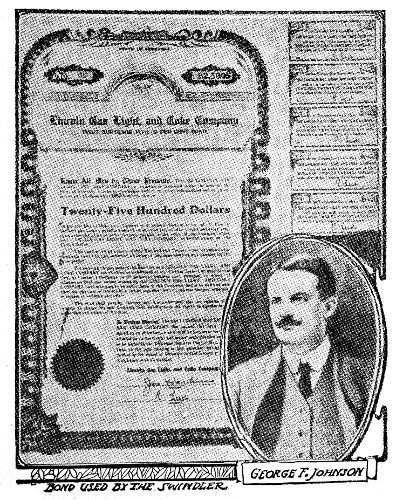
BOND USED BY THE SWINDLER. GEORGE F. JOHNSON
One Capitalized at $1,000,000.
The concerns most frequently used by the men in their transactions, the police say, were known as National Fire Proofing Company of New York and the Federal Trust Company of South Dakota. The fire proofing company was stated to be capitalized at $1,000,000 and the trust company at $100,000.
Offices for each concern were at 1138 Broadway, New York. From there, it is charged, circulars and pamphlets were sent out to investors in all parts of the country, and it was also a practice of these concerns, it is alleged, to open accounts with banks and exchange bogus notes for good ones.
Sheriff in Charge of Affairs.
About one week before the arrest the concerns were placed in the hands of the sheriff of New York County, and, following this, it is declared, disclosures were made which hastened the arrest of the men involved.
Banks and firms in Chicago, New York, Philadelphia and London, it is declared, are known to have suffered through the alleged operations of the men, who were aided by companions in the different cities.
Most of the concerns, of which there are at least twelve, all declared to be fraudulent, are in Chicago.
List of Bogus Firms.
The following is a list of the concerns, the names of which have been learned by the police:
National Fire Proofing Company, New York and Chicago.
Federal Trust Company, New York and Chicago.
Keystone Structure Cleaning Company, Philadelphia.
McGuire, Johnston & Co., New York and Chicago.
Hessley, Johnston & Co.
Hessley & Johnston, Chicago.
A. A. Hessley, Chicago.
George F. Johnston, Chicago.
C. F. McGuire, Chicago.
F. L. Cunningham, Chicago.
Chester E. Broughn, Chicago.
Lincoln Gas Light & Coke Company, Lincoln, Neb.
Another concern dealing with alleged spurious bonds of Custer County, Idaho, the police declare, was under the direction of these men.
It was the old-time favorite method of kiting checks and drafts among the banks and private individuals of the city and country that was used, and there is no doubt that it proved successful in this instance. Although it is believed the men did not obtain great riches in their operations in Chicago, it would have been only a question of time when they would have become wealthy, so apparently easy was it for them to get funds.
Opened Many Bank Accounts.
Accounts in banks in Chicago and other cities were opened and then exchanges of checks were made among them. Only the over-boldness of their operations caused their downfall.
An instance of their methods would be the following: The Federal Trust Company, one of their "paper" concerns, would deposit a check in a Chicago bank made by the Keystone Structure Cleaning Company of Philadelphia, another of their alleged firms. The check would be sent east for collection, and in a few days it would be returned marked "No funds."
Offer Bond in a Settlement.
Meanwhile the trust company had checked against its account, to which the Keystone Structure Cleaning Company's check had been credited. When the check was returned from the eastern bank the Chicago bank would notify the Federal Trust Company of the non-payment of it. The Chicago firm would then offer explanation and apologies and give a 5 per cent to concerns that cashed the checks.
When they came back, the men who got the money were shocked beyond measure and at once offered stock and bonds of twice the face value of the money involved as security. This quieted the fears and enabled the schemers to go on.
Five Men Are Arrested by Detectives Wooldridge and Barry.
Five men were arrested by Detectives Wooldridge and Barry, charged with operating twelve concerns. The Commercial National Bank was one of the victims. The men arrested are as follows:
Chester A. Broughn, broker, 218 LaSalle street.
S. L. Cunningham, 56 years old. 1009 West Jackson boulevard.
C. F. McGuire, 40 years old, arrested at the Great Northern Hotel.
George F. Johnston, 36 years old, arrested at 185 Dearborn St.
Alvin A. Hessley, 48 years old, arrested at 185 Dearborn St.
Tool Tells Truth—Usher of Church in Crime Cloud.
At the age of 50 years, S. L. Cunningham, vestryman and Sunday School teacher and chief usher in the Jackson Boulevard Christian Church, has come to the conclusion that he is "just an old fool, after all."
Mr. Cunningham was arrested recently on the charge of being one of a gang of forgers and "get-rich-quick" men who have been swindling Chicago and New York business houses and banks during the last few months. He says his only connection with the gang was in selling stock until a short time ago for the National Fireproof Paint Company, one of the concerns raided, and lending his bank account to George F. Johnston, said to have been one of the prime movers in the gang.
Mr. Cunningham looks like a bishop. His hair is white and his appearance distinguished. His story is an illustration of the manner in which swindling concerns procure one or two men of weight and respectability in a community to act as their advance agents and establish confidence.
As he sat on the white-pillared porch of his residence, surrounded by his wife and sympathetic neighbors and church members, his face in the gaslight showed the marks of grief through which he has passed since his arrest.
Cunningham Tells the Story.
"Yes," he said, "we of the fold often go astray, but I am innocent. I have a Sunday School class of young girls that I am going to take out into Lincoln Park tomorrow. I hardly know what to say to them. I can't bear to think of taking my place as head usher on Sunday, although my pastor tells me to march down the aisle with my head erect. I am getting to be an old man, you see, and I have never wilfully wronged a person in my life." His voice trembled, but his wife laid her hand on his arm and he straightened up.
"I know nothing of these men except Mr. Johnston," he said. "I was introduced to him by a friend of mine three months ago. I have sold stock and insurance for the last twenty years, and I thought he had a good thing in the National Fireproof Paint Company, so I started selling stock for him. I could not sell the stock, as I could not show enough assets, so I quit two weeks ago. I was a fool, and a dupe, all right.
Bank Account Overdrawn.
"Johnston, a young man, told me he was hard up and asked to use my bank account at the Commercial National. I let him and endorsed his checks. My wife told me not to do it, but I thought he was all right then. Well, he overdrew the account, the check was protested, and when my name was found they arrested me. I never knew any of the other men, although I saw them around the office. They did too much whispering, and I thought it did not look well."
Then, in a simple way, he went on to tell of his wife and his work in the church. He produced a letter from the pastor of his church, the Rev. Parker Stockdale:
"This introduces Mr. Cunningham, a member of my church. He enjoys among us the reputation of a thorough gentleman and a conscientious business man. He is a highly respected and useful citizen. His honesty is beyond question."
He also had a letter from Col. Jonathan Merriam, former United States pension agent, which was along the same lines.
Offer of Bribe Alleged.
Broughn, the broker, is a man of a different stripe, according to Detective Barry, who arrested him. When he was informed of his arrest he is said by the detective to have replied:
"Come down to the saloon next door. I will settle the case at once. Name your price."
When arraigned before Justice Cochrane the cases were continued until September 24. All the men were released on $1,200 bonds each, with the exception of Broughn, whose bail was fixed at $800. The bonds were signed by a professional bondsman at the Harrison Street Police Station.
C. F. McGuire forfeited his bond and fled to New York City, where he was apprehended and arrested by New York authorities at the request of John M. Collins, the Chief of Police. The information which led to his arrest was secured by Detective Wooldridge, who was made a special messenger by Charles S. Deneen, Governor of Illinois.
C. F. McGuire was a powerfully built man, weighing 240 pounds and standing over 6 feet tall. He was turned over by the New York authorities to Detective Wooldridge, who slipped on him a pair of handcuffs and crossed over to Jersey City on a ferry, and from there took a section in a Pullman car on a fast train on the Pennsylvania Railroad.
McGuire was put to bed in the upper berth, after he undressed. Detective Wooldridge told him he was bringing him back like a gentleman, but the first law of nature was self-protection. The detective then requested him to turn over all his clothes except his night shirt, which was done. Wooldridge then placed the clothes under the mattress in the berth below, which he was to occupy. He then took out a pair of leg irons, tied a strong cord to them, placed the leg irons on McGuire, threw the cord back behind the berth below, and this was tied to his hands after he had buttoned the berth curtains and pinned them with safety pins all the way down. The curtains were then stuffed in under his mattress. After all this was done Wooldridge then laid down with his clothes on and laid awake until morning, but managed to get some rest by laying down.
Chicago was reached in safety. After taking McGuire to the bureau, where Bertillon measurements were taken and his finger prints recorded, he was turned over to the sheriff of Cook County.
The trial was set, which lasted five days. Witnesses were brought from the banks in New York City and Philadelphia which had been victimized.
February 7, 1908, found guilty.
Check "Kiters" Heavily Fined—George F. Johnston and C. F. McGuire Assessed $2,000 Each.
A jury in Judge Kersten's court later returned a verdict finding George F. Johnston and C. F. McGuire guilty of swindling and imposed a fine of $2,000 each. If the fine be not paid the defendants will be compelled to serve the amount at the rate of $1.50 a day in the Bridewell. Chester A. Broughn and A. H. Hessley entered pleas of guilty at the last minute and their cases will be disposed of later by Judge Kersten. State's Attorney John J. Healy and Assistant State's Attorney Barbour expressed themselves as pleased over the outcome of the trial.