GRAFT NATION'S WORST FOE.
Reading edition
THE REIGN OF GRAFT.
Recent Exposures That Show How Strongly It Is Intrenched.
ARE YOU A GRAFTER?
Those Shocked at Exposures May Not Be Clean Themselves.
"A 'grafter' is one who makes his living (and sometimes his fortune) by 'grafting.' He may be a political boss, a mayor, a chief of police, a warden of a penitentiary, a municipal contractor, a member of a town council, a representative in the legislature, a judge in the courts, and the upper world may know him only in his political capacity; but if the under world has had occasion to approach him for purposes of 'graft' and found him corrupt, he is immediately classified as an 'unmugged grafter'—one whose photograph is not in the rogues' gallery, but ought to be. The professional thief is the 'mugged grafter'; his photograph and Bertillon measurements are known and recorded.
The world of graft is whereever known and unknown thieves or bribetakers congregate. In the United States it is found mainly in the large cities, but its boundaries take in small county seats and even villages. A correct map of it is impossible, because in a great many places it is represented by an unknown rather than by a known inhabitant, by a dishonest official or an unscrupulous and wary politician rather than a confessed thief, and the geographer is helpless until he can collect the facts, which may never come to light. The most that one man can do is to make voyages of discovery, find out what he can and report upon his experiences to the general public.
Within the last year or two it has become practically a synonym for a thief who filches public money and money of large enterprises. It has been so largely used in the public prints and periodicals, and more recently in books, that it has spread abroad; and London and Paris and Berlin, in referring to many American disclosures, adopt the word without any translation. So today no American word is better known either in this country or in Europe.
When men in office take a bribe and give away what does not belong to them, it is more than the double crime of extorting and stealing; it is treason. Graft is the worst form of despotism. It is a usurpation of government by the forces of crime. There have been many virtuous kings and honest feudal lords, but the despotism of graft never founded its rule upon a semblance of the moral law.
Graft in its highest personification is the king of the American nation in political, commercial and social life.
Graft is Overlord.
Overlord of 80,000,000 people in the greatest republic of history, commanding his tens of millions of dollars annually as tribute to graft in a million of his impersonations—was Solomon in all his glory to be compared with this?
Nine states in the union of forty-five states recently have declared that graft exposures have not been in their categories of political publicity for a year. They are Maine, North Carolina, Mississippi, Iowa, Michigan, Colorado, New York, Illinois and California. But who shall say what another six months may bring forth?
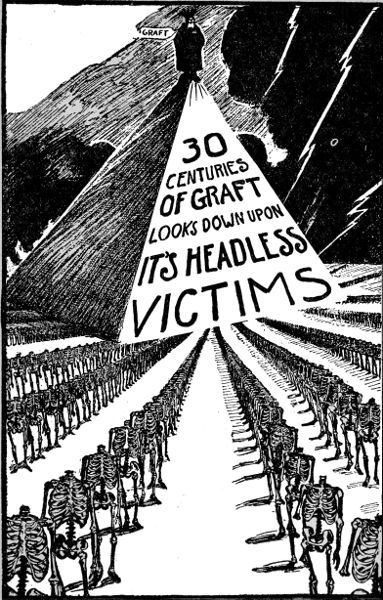
30 CENTURIES OF GRAFT LOOKS DOWN UPON ITS HEADLESS VICTIMS
In industrial, commercial and social life of the American people there is not a state in which King Graft has not his court and his following. In the capital of capitals at Washington for generations the powers of government as dreamed of for the republic have been superseded by King Graft time after time, and the impeachment of his princes, grand dukes and courtiers generally have not threatened his reign in future generations.
Scores of Proud Names Smirched.
Within the last few years names that have stood honored for a generation in financial, political and social life have been dragged down from high places perhaps as never before in America. The court of King Graft has been attacked and threatened as never before, and with greater showing. There is war in the open against this pretender king, and his legions everywhere are retiring behind their breastworks, broken but not defeated.
Graft in its nakedness, has been exposed and the people are aroused, fearing that the grafter has sucked the life blood of the republic.
What they have seen is but a glimpse of real conditions—the ulcer spots where the rottenness beneath has broken through—but they have seen enough to realize the peril and attack it. While the conditions revealed are astounding and alarming, they are signs of improvement.
The nation is better than it was a decade ago, since tens of thousands of grafters have been stamped out, since the leaders of the greatest grafts of the land have been exposed to the withering light of contempt of all decent Americans.
Life of Nation Imperiled.
Also, born of the conditions, there has arisen a little army of leaders willing to engage the enemy and lead the people against the grafters. They have been raised up to meet the crisis of the nation's life, and with every blow they strike new recruits are joining them in the war against graft.
They are still weak, and King Graft and his votaries are still strong, but during the last year the leaders have won some remarkable skirmishes and routed the grafters.
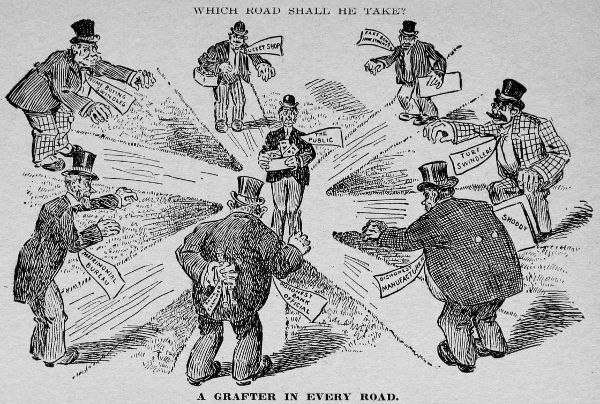
WHICH ROAD SHALL HE TAKE?
A GRAFTER IN EVERY ROAD.
The Public stands at the crossing of the roads, wondering which way he shall go with his money. Wherever he turns he sees a grafter in the road before him. The labels on these seven grafters give the names of a few of those that beset every honest man's pathway. The grafters spend twenty million dollars a year advertising; and they swindle the people out of one hundred and sixty million dollars annually.
Nation, States and Cities Aroused.
Senators and congressmen at the national capital have been impeached, and indicted, and tried, and convicted of grafting.
Bureau officials, as in the cotton scandal, the postoffice frauds, and other of the departments, and civil service exposes have been arraigned by their own democracy for traitor intrigues with King Graft, and have been beheaded.
State senators, representatives, treasurers and the innumerable "small fry" of official life, together with the millionaire briber and his henchmen at state capitals, have been uncovered and convicted of debauching democracy in behalf of a pretender sovereign.
Great cities have been shaken with the inquisitorial rounds of investigations. Philadelphia of Independence memories has been weighed in the balance and found wanting; in St. Louis the prosecutor governor, Folk, has stirred corruption to the depths; New York has been moved as it has not been since the overthrow of Tammany; Minneapolis has been cleansed; and the spectacular "graft hunt" in Milwaukee has been a lesson in "how to do it." Perhaps never before in the history of America have so many grafters been scattered to the winds, in hiding or locked behind the bars of prisons.
President Leads Foes of Graft.
But King Graft wears the crown of the pretender still, and there are few of his fighting enemies who are disposed to rest upon their arms in either truce or armistice.
The war against graft is led by the president of the United States, who stands as the foremost foe of grafting—political, financial or social—in the world, and behind him is a phalanx led by Folk, Jerome, Riis, Lawson, Hadley, Miss Tarbell, Deneen, Monnett and others of their type, fighting the nation's most crucial battle.
The grafters have declared that the objects of some of these men were selfish, but, no matter for what object they fight, they are routing the grafters in many fields and showing to the awakening public the peril of the situation; revealing to a commonwealth the worms gnawing at the vitals of the republic.
Forces of Graft Hard Pressed.
Never were the forces of money and commercial and industrial power so bewildered and so uncertain of the way to turn as they are now. Graft, to their best interests, is still covertly a necessity to them, but covert graft never was so hard to keep covert, now that briber and the bribed are the common quarry of the law. The time was when the rich man who bought political power to his uses was unnamed, standing apart. The grafter legislator was the cause and the consequence. Beginning and ending with the corrupt official whose official place was grafted upon corruption, the official became immune from the consequences.
"Grafting in this state never has cost the taxpayer a dollar," was one of the slogans of a machine government in its attempts to perpetuate that machine for the purposes of King Graft and his court.
But this false philosophy slowly was undermined. Not only was it found that graft did cost money to the state, but it became a certainty that it was costing something even more valuable than money. Graft became the one object of the political seeker after office. The impersonal graft-giver was a hanger-on at lawmaking centers, and the political graft-seeker was insisting upon election or appointment to the machine positions.
Hideous Peril is Revealed.
The result, first, was a campaign upon the man who had the graft to dispense. He was sought out, and was found in high places. His lobbyists were more easily marked than was the principal. So the law and the law's executive began also to campaign against the lobbyists. Suddenly the "good fellow" at a state capitol who had with him the perquisites of good fellowship in graft measure found himself facing the interrogation:
"What are you doing here?"
The scope of the query has grown, and it is still growing, in some quarters even to the point of requiring the man who is elected to office to render the cost figure of his successful campaign. All over the country, and touching nearly every relation in official, commercial and financial life, men have been put on the griddle of publicity by courts and commissions, and with backs to the wall have been sitting in the witness chair, holding to the one surly response to an irritating, penetrating cross-examination: "Decline to answer on advice of counsel."
But for all purposes of publicity have not these refusals to answer carried light enough?
"The public be d——d!" was the original first utterance of the millionaire, designed to stop interrogations which would not down.
"What are you going to do about it?" was the counter question of the political grafter who once was charged with grafting.
"Where did he get it?" came to be a question of the politician for political purposes, and within a year the country has heard non-political bodies asking the same question of the millionaire philanthropist who has been trying to give it away. Under the growing interrogations of the time, names have been thrown from pedestals within a year as names never before were juggled by the fates.
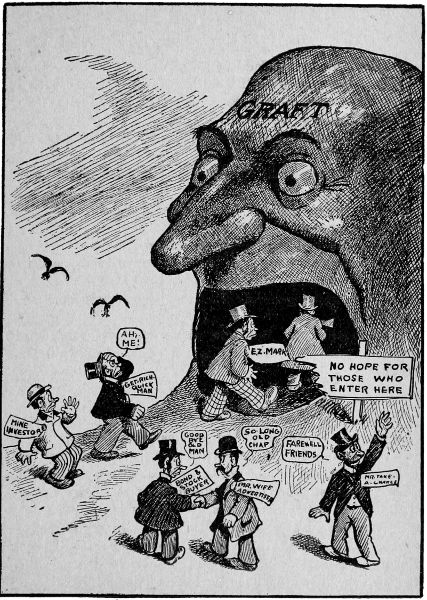
THE CAVE OF DESPAIR.
Idols Covered with Slime.
Depew, once a candidate for nomination for the presidency, a United States senator still by some grace of toleration, and at one time referred to in European royal circles as a "representative American citizen."
United States Senator Mitchell became a derelict, politically and socially.
United States Senator Thomas C. Platt was wrecked in the wreckage.
United States Senator Burton became blackened in the charges of graft.
Depew is a name no longer to conjure with.
Then followed a long list of the commercially and financially prominent civilians, blackened, and with such blackness as never to be white again by any of the old processes which once sufficed.
Graft is still king. But, truer than of any other monarch, it may be repeated: "Uneasy lies the head that wears the crown."
The Unconscious Grafter.
It was a rhetorical and sensational sentence in which a recent speaker in this city declared that the worst grafter is the man who does not vote. But there is much more than a kernel of truth in the words. The citizens of a republic need constant stimulus to the fulfillment of the plainest duties of life. The better the working of the machinery of government, the less the average man is affected. He rarely feels the pressure of taxation. He lives in a generation from which no military service is demanded. He is permitted freedom of thought, speech and religion, and almost insensibly, as a result, he loses sight of the supreme obligation which is due his country. He forgets that that country, in time of public stress, may demand his time, his property and his life, drafting him for its armies if he does not wish to volunteer, governing him under martial law, which sets aside the usual privileges accorded him, and exercising over him, if need be, a tyranny ordinarily associated with despotism among the older peoples.
The very fact that the American citizen does not often feel the exercise of the sovereign power, and is not called upon to pay the supreme obligation of service, makes him careless of his civic duties, when, it might be thought, he would feel the utmost gratitude for the privilege of living under such favoring conditions. This carelessness becomes chronic, and there is abundant need for the constant reiteration of the call to duty. If, then, a citizen is content to enjoy the comforts and the quiet of American life without rendering any return therefor, he may justly be called a grafter, and a grafter of that worst sort, who robs his benefactor. For, with duty faithfully performed by the citizen, public opinion is readily shaped, laws quickly secure enforcement, and public servants are kept clean and true. It all comes back at last to the individual citizen, upon whom must rest the responsibility for failure or success of government. It is easy enough to cry out against the grafter in official position who puts his hand into the public treasury. Perhaps, after all, the worst offender is the citizen who does not vote, who does not take a lively interest in the selection and election of his rulers, who fails to recognize the underlying obligation of service which his country has a just right to demand of him.
War on Graft Just Beginning.
But, thus far, only the beginning of the truth has been shown. There remains the senate of the United States, the railway companies, the Standard Oil Company, the great trusts, the multimillionaires, to be investigated. All of them now are in the limelight. The courts of law are under suspicion and must clear themselves by their acts, for undoubtedly the revelations of the last year have shaken the faith of the people in their judges.
After these, the huge powers of the land, cleansed states, counties and cities must join the Augean stable-cleaning, for graft is everywhere. The fight against graft is only beginning, and it will end only when a new generation learns that honor is above money, and that "grafting" is the most disreputable form of theft.
Wholesale Swindling Grafters.
A chain of stores in various cities for no other purpose than the obtaining of goods under false pretenses from wholesale merchants is the latest novelty in the swindling line. It has often been remarked that the originators of plans to dupe the public might coin their brains into cash without nearly the draft upon their originality that is called for by the devising of a swindling game. But the criminal instinct or incentive seems to lay its hold upon persons who might otherwise fill a leading and respected place in honorable avocations. The men who conceived the system of credit for goods to the value of many thousands of dollars, which they quickly disposed of in different cities by auction and attractive sales, closing up their stores and decamping when they had converted the credited stock into cash, were swindlers of unusual calibre.
The police of several cities now have the task of unearthing the frauds and bringing them to justice. They may or may not succeed in so doing, as the scheme was craftily laid and carried out. A harvest of $100,000 as the returns for a daring exploitation of the credit system will be regarded, even by the gilt-edged among the robbing fraternity, as a fine stroke of craftsmanship. The ingenuity of these cormorants calls for constant readjustment of honest persons to the conditions created. The lesson of the so-called bargain-house fraud will be conned, and for a long time to come it may be practically impossible for the same scheme to be worked again. But the feature of such enterprises is that they are designed only for the one operation. After that they become worthless to their originators.
Religious Graft Pays.
"Fake" religion as a business may have a fanciful sound, but there are plenty of men, and women, too, in this day and age who have found it to be an extremely practical, well-paying proposition. The readiness with which a good share of the people are always anxious to receive any new religion, or an old religion revamped in new fashion, makes the road of the charlatan whose trade is the promulgation of a fake religion one strewn with roses and money. Women are principally his victims, although there are plenty of men with a penchant for adopting strange religions, and from them the faker manages to reap a harvest that makes the pay of the average minister look like the earnings of an office boy. While the manner of securing money through the cloak of a false new sect is generally so hidden that the votaries of the cult are never aware of its existence until after their leader is exposed, the main object is never lost sight of by the leader, and the main object is always, "Get the money."
Out of the great mass of religions or NEW THOUGHT sects started each year in this country, it is declared that but extremely few are started with any idea other than that of separating a lot of people from their money. Occasionally there is a man who sincerely believes that he has discovered something new and precious in the way of a religion, and establishes a cult with the motive only to help people according to his own lights. But the mass of the new religions, sun worshipers, psychists, Brahmins, Hindus, theosophists, mystics, etc., are promoted with the same object in view as that of the old negro voodoo doctors—get the money.
Financial Yields Are Large.
The financial yields of the new religions are incomparably higher than is the voodoo man's gain. His followers, who believe in black art and other foolish, old-fashioned things, are nearly always drawn from the poorer, even the indigent classes—classes that have but little to spend, even on a religion. But the East Indian religionist, or the sun worshiper, draws his clientele from the better classes, and his followers have the money to reward him in a way that is astounding. He dabbles not with the poor—neither, it must be confessed, entirely with the ignorant. His victims come from the upper walks of life, sometimes from near the top, and their name is legion.
There is a Hindu who has now left this country to go back to spend the rest of his days in luxurious idleness, the while chuckling over the gullibility of the smart American people, who came here with a new religion and made a fortune.
This man was an educated, cultured man of high caste. Sent at an early age to England to attend school, he returned to his native country at the age of 28, wise in the things of two worlds, that of his own and that of the occidentals. For a while he buried himself in the native life of a loathsome colony of Fakers. There he learned much of their religious style by rote, and, putting this along with a smattering of Buddhism, psychology and sun worship, he managed to appear in America with a new religion, fairly reeking with the essentials required by those who want mysticism served along with their religious beliefs.
Mysticism Draws Many Converts.
He had a new god, a new heaven and forty different and distinct ways of torturing one's self while worshiping his deity. Mortifying the flesh through fasting and self-denial, torturing one's self by standing with the hands above the head, etc., all were included in the new creed, besides such things as astral bodies and the other things that go with a new religion. He first held forth in a sumptuously furnished city flat, where he managed to draw to him a small gathering of the select who love to dabble in mysterious oriental affairs.
The flat was a dream in itself, and when to it was added a tall, ascetic young Hindu, with the look of the fanatic burning brightly in his eyes, and mystic rites of a religious nature, the effect was irresistible; at least it proved to be to those foregathered under the tutelage of the young oriental. There were incense burnings and incantations galore. At first these things did not cost anything. No. The young mystic was simply working for the enlightenment of the world, working to spread light into the stygian darkness of the old and false dogmas and creeds.
After those who flocked to his standard had been so thoroughly imbued with the sincerity of his teachings that his word was law to them, the money question came to the fore. He, the missionary, wanted nothing for himself—oh, no. But there was need for funds for the establishment of the cult in India. A school and home must be founded for the young devotees of the new religion in that country, a place where they could go and live and be trained in the tenets of the creed and prepared to go out in the world and teach. And it was for this that the Hindu had come to this country, to permit the chosen ones here to acquirement with the new deity by subscribing to the school fund.
Since the beginning of things, when man first beheld the sun and bowed humbly before it, it has been the custom to heap offerings on the altar of worship. So the Hindu went back with funds enough to start half a dozen schools if he had been at all inclined that way, which he wasn't, and the people who were his followers are still living in the hope that he will return.
American Faker Gets the Coin.
Then there is another kind of charlatan, the American fake religionist, of which, perhaps, there are just as many as of the foreigners with the weird doctrines of the orient. This type of faker is coarse compared with the soft-shod, incense-burning Hindu, but he "gets the money" without much trouble. He is generally a ranter as far as preaching goes. His methods are those of the shouter, his religion includes visitation of spirits, shaking of bodies and other manifestations of divine power. He boldly asks for contributions, not for a school to be established for the training of missionaries for his faith, but for the furtherance of his own work right here in this country.
"It takes money to fight the devil," is a favorite cry with this type of sacrilegist. The stronghold of the religious faker is that the people who follow him believe in him implicitly. One faker recently proclaimed himself the son of God, come to revisit earth, and, when assailed by a paper for it, stood up in an audience of his believers and asked them who they thought him to be and how they regarded him. The answer was that he was the son of God, and his mission was to save all mankind from sin. It is obvious that, when a man with such a hold on a clique asks for money, it is sure to be forthcoming without question. At times he does not have to ask for it, one man of this kind having had money showered upon him at a meeting by the hysterical women of his flock.
Faith in Charlatan Strong.
This man has operated in at least four sections of this country, has served a term in state's prison for alienating a wife's affections along with the husband's money, has been driven out of two towns by angry husbands; but now he is again in possession of a following which believes implicitly that through him, and through him only, is it possible to obtain eternal salvation.
In appearance this man is a human shark, long-faced, thin of jaw and nose, and with a mouth that is nothing but a straight line cut in the face. In repose he might be taken for a shyster lawyer, but when he begins to speak and the artificial frenzy is burning in him it is easy enough to see why impressionable women may be drawn to him. Even a strong-willed man, observing his actions and the degree of enthusiasm in him, is apt to feel that he can be nothing other than sincere in his beliefs. But, if he is sincere, his sincerity runs only towards making of his beliefs a good business proposition, and avarice is one of his strongest points.
The persistency with which women will take up and practice the cruelest of religious customs is evidenced by the manner in which a Chicago girl tortured and starved herself to death in an effort to obtain salvation through the mortification of the flesh. She was not of an ignorant type, either, as might be imagined, but fairly well educated and extremely intelligent, with running to intellectuality. But the thrall of a new religion got her in its power, and, believing she was sinful, she strove to cast out her sins and died in the attempt.
It is seldom that pernicious practices of religion fakers carry persons to this extreme, but deranged mentalities, wrecked homes and depleted pocketbooks are of such frequent occurrence as to merit a wholesale crusade against this type of fraud, even without raising the question of religious scruples.
Pawn Tickets on Diamonds.
Another instance: Some working man or washing woman, having saved up a little money for a rainy day, reads an alluring advertisement in a newspaper that a party was looking for a small loan on valuable family jewelry and diamonds. The interest offered is much higher than that allowed by any savings bank. Diamonds, as everybody knows, are just as good as money and offer perfect security. In hopes of profiting a little more on their savings, such prospective victims respond to the advertisement. The party looking for the loan appears to be a well-dressed, smoothly-talking man, who represents himself to be the scion of a wealthy or aristocratic family temporarily in hard luck. He produces a pawn shop ticket, on the face of which appears that some pawn broker had advanced on certain diamonds a large sum of money, say $500.
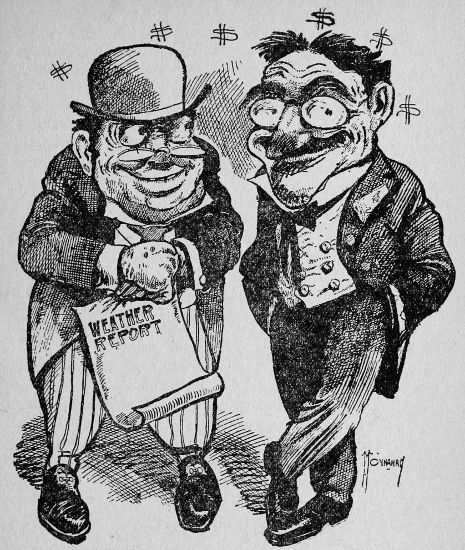
Two minds with but a single thought; Two heads that beat us all.
Now, it is a matter of common knowledge that pawn brokers know their business, and that no pawn broker would advance more than one-third, or, at the highest, one-half of the actual value of the articles pledged. It is that common belief which the swindler makes, as it were, the psychic basis for his operations. The victim having once jumped at the conclusion that the diamonds offered as security must be worth at least $1,000 or thereabouts, the rest becomes easy.
Victim Anxious for Interest.
The victim naturally considers a further loan on such diamonds of $200 or $250 a desirable risk. The offer of 10 per cent or more interest on the loan is another allurement which makes the transaction still more desirable. The pawn broker recognizes his ticket, and the diamonds, when redeemed, turn out to be worth considerably less than the amount which the broker was supposed to have advanced on them. The victim loses some more by redeeming the diamonds.
Complaints by such victims have been coming thick and fast into the state's attorney's office in Chicago and other large cities. The conspiracy between the swindler and his accomplice, the pawn broker, is almost self-evident. In some instances indictments have been returned against the perpetrators of the fraud, but the prosecution could not succeed. The reason is obvious. On the face of the transaction everything seemed to be regular, and the defendants could not be made criminally responsible for an erroneous conclusion arrived at by the victims as to the business sagacity of the pawn broker or the probable value of the diamonds. And yet who would doubt, in view of the many identical complaints, that the plans in connection with the fraudulent transaction had been laid carefully in pursuance of a conspiracy to defraud the public?
New Law Badly Needed.
On the civil side of legal practice there is the writ of injunction to prevent threatened irreparable injury to property by one person to another. But in case of organized fraud upon the public in general our modern legislatures have not yet grown to the proper appreciation of the wise and ancient saying that comes from the orient, "The rat hole, not the rat, is the thief." Our laws punish the thief when caught, but leave the "hole" intact and ready to give shelter to other "rats."
The authorities may know well the fraudulent character of a concern organized and existing for the express purpose of fleecing the public, and yet, in the absence of a complaining victim, they are absolutely helpless and unable to prevent victims from being ensnared by that concern.
Suppose the legislature would enact a law making it a felony for persons to set in operation any scheme to defraud the public and fix adequate punishment for such offense, would not such a law enable the authorities to anticipate and prevent a great deal of that misery which is caused by organized frauds of all kinds and descriptions, to a class of people that least can afford it?
Postage Stamp Grafter.
The postage stamp grafter is one of the most pestiferous of the "toucher" genus. He bobs up in offices, on the streets, in hotel lobbies, everywhere and at all times. Here is the song he sings:
"I'm broke, mister, but I don't want any money. I am looking for work and have just answered an ad. in the paper, but, to tell the truth, I have only got a nickel, and if I break that to buy a postage stamp I can't get a cup of coffee. Just a 2-cent stamp is all I ask."
It is too small a request to refuse, and besides there is a chance that the fellow may be telling the truth. Anyway, it is only a stamp. You produce the stamp, and may give the "toucher" several stamps so that he can answer more advertisements for work. A half day of industry at this scheme gives any competent "toucher" enough stamps to buy a little food, a good deal of drink and a night's lodging. There is no difficulty in disposing of stamps thus collected, for the salonkeepers and others that buy them—sometimes at a discount—know they have been given, and not stolen.
"You are the third man that has tackled me for a stamp today," said a man in the lobby of a downtown hotel recently to a young man who "wanted to answer an advertisement for work." "Here, give me the letter; I'll stamp and mail it."
Whereupon, to use the vernacular of his kind, the young man made a sensational "getaway" via the side entrance.
Akin to the postage stamp scheme is the one of "touching" for three or some other odd number of pennies to make up the amount necessary "to send a telegram home for money." The "toucher" in this case usually admits frankly that he came to Chicago and got drunk, spending all his money. For victims he picks the men that look like they might sympathize with a fellow in his predicament.
The Clerk Grafter.
It may or may not be so that a sucker is born every minute. Doubt as to the exactness of this has been expressed, the consensus of opinion being that the average runs higher than Barnum's estimate. But as to the natural increase of devious and various ways for making, or trying to make, suckers out of the world's inhabitants there can be little or no just doubt. A new one is born every time the old one gets stale. Here is the latest:
The scene of operation, which is guaranteed to be harmless when performed, but sure to be painful when the reaction sets in, is a small office, store, or shop, any place where the total number of employees is small.
Preferably it is a place where a young woman stenographer, clerk, or other worker is employed, and, preferably, the stenographer, clerk, etc., is of pleasing and attractive appearance. The more so the better, though this is not absolutely necessary.
Plays on Tardy Victim.
In fact, the only condition actually necessary to the successful prosecution of this new game is that one of the employees come down to work later than others. This must be. The operator picks a morning when said employee is late in arriving at his or her place of employment. If the employee is a young woman stenographer, so much the better. Operator may be either male or female, but should be of prosperous appearance—sort of money-no-object appearance.
"Is the Stool Pigeon in?" he inquires. Of course, he doesn't call this party "the Stool Pigeon," having first carefully informed himself as to the individual's Christian name and surname, so as to be in a position to rattle it off with becoming familiarity.
"Not yet, but soon," replies the Fall Guy. He doesn't know that he's the Fall Guy, but he is, unless he happens to possess more than a human average of suspicion and wariness.
Fall Guy Takes Bait.
"Oh, I'm so sorry! Now, I wouldn't have come to deliver this package if he hadn't promised to be here at this moment. And he wanted it so badly—and I can't wait!"
"That's too bad," says Mr. Fall Guy. "But that's all right; you may leave the package in my care and I'll see that he gets it the first thing he comes down."
"So kind of you," purrs the operator. "The only difficulty in the way of that is that I must see him when I deliver it."
Nothing coarse or abrupt, you will see; instead the smooth, purring round of the wheels that grind artistically and well.
Here the operator begins to bite the under lip and look at the clock with clouded brows.
"Hm! I can't wait, and he wanted it so much this morning!"
Sucker Digs Out Coin.
Fall Guy being a friend of Stool Pigeon's (the operator has picked him because of that qualification), gets solicitous. "Well, there's a collection of a dollar on this package; that is all, really." If Fall Guy looks burdened with money the charge may be as high as $2.50. Hardly more than this. It may run as low as 25 cents. The package contains, according to the operator, anything from a pair of cuff buttons to a pair of shoes.
And Fall Guy pays at least often enough to make the game worth playing for the operator.
FLEECING INVALIDS AND CRIPPLES.
This is a story of the most despicable graft extant. For, although it has been broken up in Chicago, it still flourishes in nearly every other large city in the country. It is not only despicable but it is heinous, fiendish, unspeakable. It is the sort of a thing that causes the blood of an honest man or of a manly rogue to boil, and long for a chance to clutch its inventor by the throat. It is the letter-copying scheme. Real criminals take chances on death, or the penitentiary, and on personal encounters with those whose money they unlawfully seek to acquire, but the vultures behind the "ads." promising lucrative work at home content themselves with mulcting helpless invalids, aged and infirm persons who seek to contribute to their own support and persons whom poverty has driven to desperation, and who see in the gilded promises of the cormorant an avenue of escape.
The public is familiar with the advertisements which constantly are seen in the newspapers offering employment that will not necessitate canvassing, or peddling, and which can be done in the home with great profit. Occasionally the "ads." explain that the work is that of copying letters.
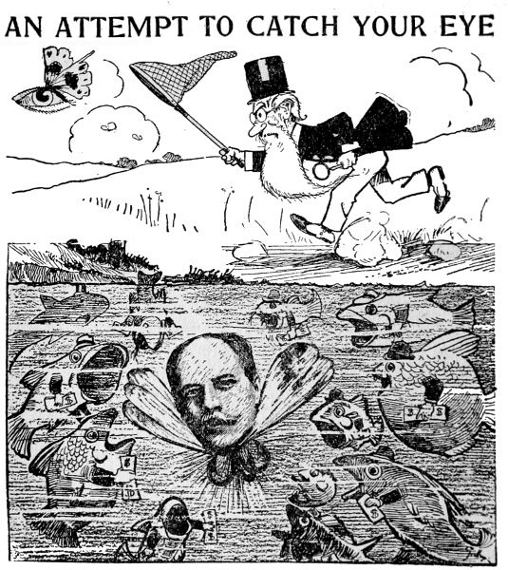
AN ATTEMPT TO CATCH YOUR EYE
Write Smooth Letters.
The victim answers the "ad." and in reply receives this stereotyped letter—the form is the same in every instance:
Esteemed Friend:
Replying to your application to write letters for us at your home during spare time, we beg to say that your writing is satisfactory, and we have decided to offer you the appointment.
The work we give out is simply writing letters from a copy which we furnish, for which we pay you direct from this office at the rate of twenty dollars ($20.00) per thousand. You do not have to write any certain number of letters before receiving pay, and all letters you write you return to us. There is no mailing them to your friends, as most other advertisers who advertise for letter writers demand, neither is there any canvassing or selling anything, or anything else to mislead you; you simply write from a copy which we furnish, and we pay you direct. We are an old, reliable firm, always state plainly what is required, do exactly as we promise and treat our employes honestly.
The work is easy; the letters to be written are the length of the ordinary business letter, and all we require is neatness and correctness. We furnish all materials free of charge, paper, etc., and prepay all costs of delivery to your home. You work only when you desire or have leisure time, and no one need know you are doing the work.
We pay spot cash for all work done the same day as received. We use thousands of these letters for advertising our business, because we receive better results from using written letters than from plain printed circulars. We have a large number of people all over the country working for us, and if you desire to become one of our regular workers we request that you send us one dollar, for which we will send you our regular dollar package of goods you are to write about.
This is all you are required to invest, there being no other payments at any further time, and this deposit is returned to you after doing work to the amount of two thousand letters. We are compelled to ask for this small deposit to protect ourselves against unscrupulous persons who do not mean to work and who apply out of idle curiosity.
We also send you first trial lot of letter paper, copy of letter to be written (as we desire all letters to be written on our own letter paper), also instructions and all necessary information. After receiving the outfit you start to work immediately. More reliable workers are needed at once, and we guarantee everything to be exactly as represented. If you find anything different we will refund the amount invested.
Fill out the enclosed blank and send it to us with one dollar or express or postoffice money order (stamps accepted), and we will immediately send everything, all expenses prepaid. You can start to work the same day you receive the outfit by simply following our plain instructions.
Kindly reply at your earliest convenience. Fill out enclosed blank and direct your envelope carefully. Trusting to be favored with your prompt services, we remain,
Very truly yours, Leslie Novelty Company, Per C. C. Kendall.
Rob Bed-Ridden Women.
In their investigation of this sort of swindle the police discovered that almost invariably the victims were bed-ridden persons or women in straitened circumstances who were in frantic search of some means of keeping the wolf from the door. Many instances were found where some unfortunate had taken up a collection in the neighborhood in order to raise the necessary dollar to send for the "outfit." Persons were found who were actually starving and who had pawned their last possession to get the money that was to start them on the road to affluence.
Of all the offices raided Detective Wooldridge did not find record of one instance where a victim had been able to keep the requirements of the swindlers. The supposed letter sent to be copied was generally about 800 words in length, full of words difficult to spell, of rude and complicated rhetorical construction and punctuated in a most eccentric manner. The task imposed was practically a life-time job, and even if anyone had fulfilled it there were a hundred loop-holes whereby the thieves could escape payment by declaring their specifications had not been heeded to the letter.
The "outfit" consisted of a cheap penholder, a pen and a box of fake pills.
Imagine the joyous anticipation with which a starving cripple would await the arrival of the "outfit" that was to give him the opportunity of prolonging existence! The bright hopes of the work-worn widow who expected by this genteel means to keep her little ones in bread!
Think of the despair of both upon discovering they had paid out money so sadly needed—money which probably had been begged or borrowed—only to discover that they had been victimized instead of benefited!
"Operators" Cringing Cowards.
Trembling, cringing, whining specimens of humanity were found in charge of each of these fakers' dens when Detective Wooldridge swooped down upon them. They were typical of their graft—small, mean, snake-like, cowardly. None among them was found who would bid defiance to the officers, who would resist intrusion by the law or who would go into court and fight. All were cheap and dirty in mind, loathsome, shrinking, snarling, but not daring to bite.
Among those driven out of business by Detective Wooldridge were the Twain Novelty Company, the Leslie Novelty Company, the Illinois Industrial Company and Blackney & Company.
"I have raided all classes of swindling institutions," said Wooldridge, "but it gave me more pleasure to run down these fellows than all the others put together. They did not dare try to get money out of people who could afford to lose it, or who were out in the world where they could talk with others of more experience. Their dupes were in almost every instance the most pitiable objects of the communities in which they lived. The facts disclosed by these raids were enough to fill the heart of the blackest grafter with indignation and a desire to trounce the perpetrators."
SHARKS RUIN BUSINESS MEN.
New Line of Financial Graft.
A new loan shark, or self-styled "financial agent," who preys on the business man and manufacturer, robbing him of his money and business more relentlessly than the old-time loan shark ever dared with the helpless wage earner, has made his appearance in Chicago and says he has come to stay.
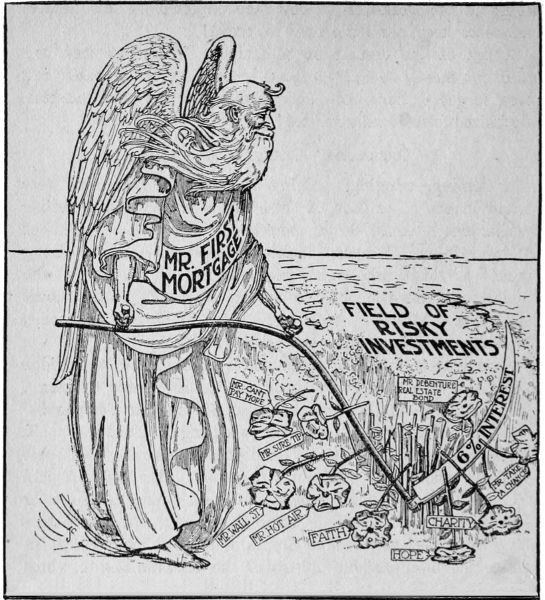
MR. FIRST MORTGAGE; FIELD OF RISKY INVESTMENTS
Under the guise of discounting a manufacturer's accounts at his usual rate of discount, the "financial agent" secures his first hold on the struggling manufacturer, who sees the opportunity to enlarge his business by collecting cash for his merchandise as he sells it. But the first step with the "financial agent" means entering the portals of bankruptcy.
The loan shark first finds for his victim an industrious, hard-working manufacturer or wholesaler, who by his push and perseverance has built a business beyond his capital, and approaches him.
"You have a good business here," remarks the agent. "If your customers all paid cash it would be pretty easy sailing. Life would be one long, sweet song if everyone paid for goods as soon as they were ordered, wouldn't it?"
Offer of Cash Arouses Interest.
Even the largest manufacturer in the country could not but accede to this.
"I have been watching your business for some time with a great deal of interest," continues the suave grafter, "and I would be glad to discount your bills at the regular rate of discount, so it would cost you nothing and you would have an opportunity to double your business.
"I presume you give the regular trade discount of 1 per cent a month for cash. On that I can save you a little money and help your credit materially. You receive 1 per cent a month on your purchases.
"This you cannot take, as you are cramped for money, because your customers do not pay their bills promptly. Thus you lose 2 per cent a month by not buying and selling for cash."
Gets $800 for $1,000.
The manufacturer begins to see a thriving business on a cash basis without exposing his weakness, and agrees to allow the banker to discount his bills.
"In the morning," begins the agent in explanation of his system, "you send us $1,000 worth of duplicate invoices of the goods which you shipped today, with shipping bills attached. You attach to the invoices a note for $1,000, so the account may be kept from the notes, and not from the invoices which we hold. In return for the note we will send you a check for $800, less our commission of 2 per cent a month, just what you are paying now because your business is not done on a cash basis. The $200, or 20 per cent, we have to deposit in the bank which loans us the money which we in turn pass to you. When any bills are paid we will refund your 20 per cent which we hold. Any bank compels us to have a representative in your store to look after our interests, as a matter of form. We will just appoint your bookkeeper—a matter of form entirely. Once a month we will send a man over to check up your books. He will see that none of our money has been overlooked."
Begins to Show His Teeth.
All this sounds businesslike and plausible, and the arrangement runs smoothly for a time, probably six months, to allow the manufacturer time to sell all his open accounts to the financial agent. Then the loan shark sends in a statement of the account, and, if the manufacturer complains, begins to show his teeth.
On the statement appears all money the manufacturer has received and in addition an extra charge for $50 a month to cover the services of their agent—the manufacturer's own bookkeeper. Also an additional charge of from 1 to 2 per cent for additional service rendered, although the agency has had absolutely nothing to do with the accounts beyond holding them as security. All overdue accounts are charged back to the manufacturer, and a request for a check to take them up immediately accompanies the statement.
As few accounts, if allowed to mature at all, are received by a manufacturer on the exact day when due, the check called for often is a formidable one. The manufacturer is at his wits' end. He goes to the agency post haste and, after they find it is impossible to hold him up for a check, they say:
"Oh, well, never mind, the bank—always the bank—is pressing us on those overdue accounts, but we can hold up the 20 per cent until these accounts are taken care of. That will be satisfactory, we are sure."
DEBT
Loses His 20 Per Cent.
After this the manufacturer's chance of ever seeing anything more of his 20 per cent has vanished. Each day the agency trumps up some fictitious charge of stamps, new check books, extra labor, taxes, additional fees or other charges that could originate nowhere but in the brain of a financial crook.
Finally the manufacturer finds he has nothing on his books but accounts belonging to the agency, on which he is paying carrying charges of from 5 to 10 per cent a month. The agency refuses to return his 20 per cent, which they claim has been charged off by the bank to take care of the overdue accounts.
The victim, seeing the plight in which he is placed, demands an accounting and threatens legal proceedings. The agency in turn demands he give them an itemized statement of each account, which they have. They agree to check them up, and, if found correct, promise to give him a check for the 20 per cent which they hold. That night the light burns late over the bookkeeper's desk in the manufacturer's office. In the morning the statements go to the office of the loan shark, who says:
"I'll have the auditor check them up and send you a check as soon as we find out everything is straight."
Trade Statements to Customer.
The manufacturer leaves the office. The loan shark gets busy with the statements, and stamps each of them:
"This account has been transferred to Killem's Mercantile Company. You are notified to pay this account to no one else."
These statements are mailed to the customers. When the manufacturer returns the loan shark greets him cordially and remarks:
"Unfortunately one of my clerks mailed out a lot of your statements last night, but I guess that won't matter. He stamped on them that they had been transferred to us and sent them out as he does everyone else's. He didn't understand. I am sorry."
As expected, the manufacturer, when he sees his business and confidence abused in this manner, flies into a rage. Then the suave agent takes the bull by the horns and issues his ultimatum.
"Our bank"—always "our bank"—"thinks we are not getting all the money coming to us from your account. They demand that in the future you deposit all your checks with us. I am sorry, for I know everything is straight, but your using us as a bank will last but a few days. Everything will then run smoothly again."
And unless some friend comes to the aid of the manufacturer the agency's prophecy comes true, and it does last but a little while.
SHREWD BEGGAR GRAFT.
Pretend to be Deaf, Dumb and Blind, Playing on Sympathy—How Philanthropy is Humbugged—Begging for Money to Reach Home—An Army of Frauds and Vagabonds—Mastering the Deaf Mute Language for Swindling Purposes—The Public Should be Careful in Disbursing Alms.
Speech is so common, eyesight so precious, that he who would appeal for charity needs no better warrant than that he is dumb or blind. In an age when words are multiplied and golden silence is seldom found, the very fact that lips can give no utterance is so unusual that their mute assertion of misfortune is seldom questioned. There is nothing so pitiful in all the world as an asylum for the blind. There is nothing which so draws one to share the burdens of another as the appeal of him in whom the wells of speech are all dried up. We sympathize with illness, we grieve at the misfortune which visits our friends, we mourn with them when bereavement comes, but all these things are in the course of nature. They are sad, but they may be expected. But then a figure in health rises and asks for charity in the hushed language of the mute, philanthropy halts and humanity gives alms. But if the dumb can evoke assistance, assuring of sincerity and disarming doubt, how hushed is the questioning when the blind apply! How much stronger than speech or silence are the sightless eyes that stare unblinking at a darkened world! How sad is the fate of that man who was buried by demons when God cried out, "Let there be light"!
But not every man is mute who stretches out his hand in silence. Laziness is such an awfully demoralizing vice that some who choose to beg a living and decline work are even base enough to feign a misfortune they ought to fear. Fellows who find the winter pinching and the ranks of vagabonds full to repletion arm themselves with a slate and pencil and haunt the public with appeals for help on the untrue claim that they are dumb. One of the most persistent beggars of this kind makes the rounds of residence districts with a printed card on which is stated the bearer's desire to reach his home in some distant city—the destination varies from time to time—together with a long-primer endorsement by a group of names which no one knows. The fraud always asks for some slight money offering—nothing can be too small—with which to assist him in the purchase of a ticket.
Usually his paper shows that he needs but a very little more, and he asks one, by a series of pantomimic signs, to enroll his name, together with the sum advanced, in regular order on a blank list which he tenders with his touching appeal. He is so well drilled as never to be surprised into speech, and looks with such straight, honest eyes into the faces of the women, who form much the larger number of his victims, that they cannot question him and usually give up a dime or a quarter without a struggle. The beggar can readily collect a good day's wages in this manner, and it is a matter of surprise if he does not receive an invitation to partake of food three or four times a day. He never lets his list get full. However small a margin he may lack of having raised the sum needed to buy his ticket to his home, he never gets quite enough, for nothing is easier than to stop in some secluded spot and erase the names of his latest donors, thus proving to those on whom he shall presently call that their help is not only needed, but will so nearly end the necessity for continued appeals. This class of beggar never looks like a dissipated man, is always polite, and bears refusal in so noble a way that nine times out of ten the flinty-hearted women who refused him at the back door hurry through to the front and give the more generously that they have harbored suspicion.
Another set of leeches have mastered the deaf mute language, and always ask with a pleading, painful face which meets you as your eyes lift from his written questions, if anyone in the house can talk with him. He supplements the penciled question and the eloquent glance of eyes trained by long use in the art with a few rapid passes of his hands, a few dexterous wavings of the fingers, in a language you have heard of and read about, but cannot understand. If the unexpected happens and a person be present who can converse with him, your beggar is sure of some entertainment, and the usual scene of one you know to be honest talking to one who may be equally so, and certainly seems needy, will almost infallibly wring from you the coveted assistance. It is like two minstrels at a Saxon court. You know your own has seen the holy land, though you have not, and as he tells you, this thread-bare guest talks familiarly and correctly of distant realms. That is all any one can know to a certainty, but you give him the benefit of the chance that he may be honest, and help him with such loose change as comes to hand. Time and again the pretended mutes have been detected in their imposture by men who pitied a misfortune and gave money at their homes in the morning to see it spent for drink by an arguing, contentious fellow in the evening.
Some beggars even assume the appearance of blindness, and haunt the homes of comfortable people, led by a little girl and asking alms in the name of an affliction that is always eloquent of need. He will sometimes carry a small basket full of pencils, or other little trinkets, and glazes over his evident beggary with the appearance of sales. But he does not hesitate, once the money is in his hands, to ask his patron to give back the pencils, as he cannot afford to buy any more. These people can sometimes see as well as the child that seems to lead them, and yet their eyes, when they choose to assume their professional attitude, seem covered with a film through which no light can penetrate.
The public should be chary in bestowing charity, and especially to able-bodied men who appear blind, deaf and dumb, or are still claiming to be victims of some recent disaster. Most any one who has charity to bestow can easily think of some deserving and honest unfortunate in their own neighborhood.
Paralytic a Bad Actor.
The most transparent fraud on the streets of the great cities is the pseudo-paralytic. At almost any street corner can be seen what purports to be a trembling wreck of a man. His legs are twisted into horrible shapes. The hand which he stretches forth for alms is a mere claw, seemingly twisted by pain into all sorts of distorted shapes, trembling and wavering. The arms move back and forth in pathetic twistings as if the pains were shooting up and down the ligaments with all the force of sciatica.
The head bobs from side to side as if it were impossible to keep it still. And the words which come from the half-paralyzed mouth are a mere mumble of inarticulate sounds, as if the tongue, too, were suffering torture.
A more pitiable sight than this could not be conjured up. And the extended hat of the victim of what seems to be a complication of St. Vitus dance, paralysis, sciatic rheumatism, and the delirium tremens, is always a ready receptacle for the pennies, nickels and dimes of the thoughtless. This is one side of the picture; now look on the other.
It is dusk. Just that time of day when the lights are not yet brightening the streets, and when the sun has made the great tunnels between the sky-scrapers, ways of darkness. Detective Wooldridge is watching. He has been watching two of the deplorable fraternity for two hours. As the dusk deepens he sees them both arise, dart swiftly across the street and board a car. By no mere chance is it that they are both on the same car. The detective follows. Before a low saloon on the West Side the victims of innumerable diseases descend from the car, walking upright as six-year soldiers on parade. They enter the saloon. They seat themselves at a table behind an angle in the back which conceals them from the street. The detective loiters down to the end of the bar and watches. From every pocket, even from the hat rim, pours a pile of coins.
The two sort out the quarters, the nickels, the pennies. The heaps are very evenly divided over two or three cheap whiskies or a couple of bottles of five-cent beer.
Then the real finale comes. Detective Wooldridge gets busy, and a goodly portion of the spoil finds its way out of the hands of the sharpers in the way of a fine.
But for every one of these paralytic frauds caught there are dozens, even scores, who get away unscathed. It is the estimate of the best detectives that not one in a thousand of these paralytic beggars is genuine. It is one of the most bare-faced cases of deception of the public which comes under the notice of the police.
Easy Money From Kind Hearts.
Charity covers a multitude of sins, almost as many backs, and quite a bit of graft.
Thoughtless giving is almost a crime. It serve to encourage idleness, and idleness is at the bottom of more crime than any other one thing, unless it is poverty.
Here is a story, given in the words of the man himself, which shows how the charity graft is worked in a number of ways. It covers several fields, and is so dramatic that it is given as the best example of all-round charity grafting:
"In experience in charitable work last summer I discovered some of these truths. It was the first time in all my life that I ever engaged in any charitable enterprise, and the needy that I sought to relieve was myself.
"Any one will beg, borrow, or steal in the name of charity. They may be as personally honest as a trust magnate—and they would be horrified at the idea of begging or stealing for themselves, but charity makes them respectable. At least this is the theory I worked on.
"I was broke and far from home. I decided that I would starve or steal rather than beg. Then a fellow I met accidentally put me on to a way of making a living.
For the Benefit of the Heathen.
"He had a lot of literature either really from a big church, charitable organization, or fraudulently printed, and he explained to me that I was to sell these 25 cents a copy for the benefit of the heathen somewhere, or home missions. I was to get 25 per cent of the money resulting from such sales.
"About a week later, when I had received $12 besides a little expense money from him. I discovered that he was keeping all the money. I took the rest of the literature and destroyed it. Three days later, when I was hungry, I rather regretted destroying it.
"I joined a circus that was moving toward my home town in Western Iowa, intending to leave it there and quit being a tramp. I was then down in Eastern Pennsylvania. I was a canvas hand. We went west by a tortuous route, and I never could accumulate enough coin to pay my way home, so was forced to stick to the place for many weeks.
"The second week one of the canvas hands came to me and asked me to circulate a subscription paper among the men for the benefit of one Will Turner, a member of the band, who, he said, had dropped off the train while running over from the last stop, and badly injured himself.
Gave the Money to Canvas Boss.
"I circulated the paper. The man told me he already had collected from the band on another subscription paper, so I needn't go to them. The man subscribed over $40 to help Turner, and I gave the money and the paper to the canvas boss who asked me to make the collection.
"He took it, and remarked gratefully that he would make it all right with me. I didn't catch the significance of the remark then. About a week after that the same canvas boss came again with another subscription paper for the benefit of John Kane, who, he said, was a gasoline lamp tender and had been horribly burned and taken to the hospital. He told me a graphic story of the accident that aroused all my sympathy. I took the paper and worked hard on it during the afternoon and evening performances, and, as it was the day after pay day, I collected nearly $100.
Worked the Game Once a Month.
"I got a shock when I took the money to the canvas boss. He gave me $50 and said:
"'That's your share. We'll work it again next pay day.'
"Then I went at him, and we had quite a fight. We were both arrested, and at the hearing next morning I learned that he had been working the game with that same circus about once a month. There were so many with the outfit and so few of them knew each other by name, and accidents were so numerous, that no one suspected him. He had grown afraid to work it for himself and used me for a tool.
"The show had pulled out and the boss and two others who had been arrested with us took the first train back to it. I used the $50 to pay my fine and get home, where I found work and honesty—and, as soon as possible, I sent to the chief horseman with the show $50, to be added to the fund for the benefit of the next person really hurt, telling him the entire story. He wrote that he had been among those who helped kick the canvas boss out of the car after he read my letter."
In Name of Charity.
There are probably more "touches" perpetrated in Chicago by professionals in the name of charity than under any other guise. In this matter, more of the protection of honest charities than for the protection of the public, the police have taken a hand and done a great deal to weed out and punish the solicitors for fake charities. An imaginary home for epileptics was one of the favorite plans. There was a home for this class of unfortunates that was honestly run, and the peculiar sympathy enlisted by the mention of the word epilepsy was seized upon by dishonest schemers. Professional women solicitors were garbed as "nurses" and sent forth. They were mostly austere-looking women and silent. Their work of nursing epileptics was supposed to produce this austere silence. This supposed charity appealed with uncommon strength to most people because these "nurses" were supposed to be performing the most unpleasant work imaginable amidst the most grewsome surroundings. Large sums were collected in this way, the promoter keeping everything above the liberal commission paid to solicitors.
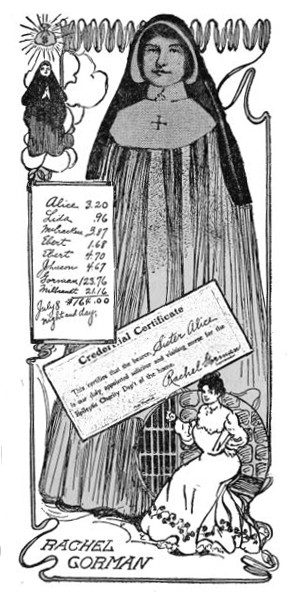
RACHEL GORMAN
This One Made Fortune.
Rachel Gorman was the originator of the "nurse for epileptics" graft, and raked in thousands of dollars before she finally was rounded up by the police. Not one cent of all the money collected by her and her garbed and hired solicitors ever got past their pockets. In this case the most shining marks were selected. William Jennings Bryan was touched for $100. as was the Governor of Illinois, and many others. This money for imaginary epileptics came so easily that the Gorman woman confessed that it was almost a shame to take it.
There is little excuse, however, for Chicago men and women allowing themselves to be talked out of money for charity. In no great city are the charity working forces better organized or better known. For virtually every form and case of need there is in Chicago a distinct form of honest, well-organized charity. This condition grew out of necessity, and promiscuous giving to "touchers" who plead as qualification charity cases is dying out as the public comes to know more of the comprehensive systems for the help of the worthy and unfortunate.
It took the hotel detectives years to check the "toucher" with the fake bank account that operated largely in the hotel lobbies. Now he works in other places. He carries a bank book that has all the superficial marks of genuineness. He engages you in conversation, and at what he considers the right psychological moment, he drops a feeler like this:
"It's h—— to be without money when you've got plenty, isn't it?"
If you have met this type of "toucher" before, you instantly see it coming and chase off to a most important engagement. If not, you only can agree. Being without money when you have none is bad; being broke when you have money is worse.
"Look here," says the "toucher," "here is my bank book. Look at this balance?"
Often Worth the Price.
A glance seems to show that the bank owes your new acquaintance many thousands. He then tells how it happened, how he came to be without a cent when he was so far to the good with his banker. It's a complicated tale, too long to tell here. There are lost letters, the cashing of checks for friends and, confidentially, a touch of the pace that flattens bank accounts. By this time you see your finish. When you seek to escape you find yourself backed up to the wall with no chance to sidestep. The best you can do is to scale the original touch from $1 to 50 cents, thereby making 50 cents for yourself and 50 cents for the "toucher."
To "stand for" all the "touches" that are made in Chicago one would require an income far in excess of that enjoyed by most. Those that are responded to are those in cases where the donor generously thinks that the "toucher" really needs the money. Probably in the vast majority of cases there is no delusion as to the fiction woven in order to drag forth the nickel, the dime, the quarter or the dollar. Often it is worth the price to hear the fiction.
But after all one feels refreshed when a frank but hoarse and trembling hobo says:
"Say, Mister, me t'roat is baked and me coppers sizzlin'. Gimme de price of a drink. Did you ever feel like jumpin' from de bridge fur lack of a stingy little dime fur booze?"
Here, you feel, is no misrepresentation. Here you may invest a dime without feeling that you have been stung.
Raffles Bank Robbery.
One of the most annoying of small grafts is the raffle, as conducted for gain. It is bad enough to be held up for 25 cents or 50 cents for a ticket which entitles you to a chance on a rug or a clock when you reasonably are sure that the proceeds will go to charity, but no man likes to be fooled out of his small change by a cheap grafter, even if the grafter happens to need the money.
A story is told of two printers who lived for a month on a cheap silver watch which they raffled off almost daily until they had "worked" nearly all the printing offices of any size in town. These typographical grafters are unworthy of the noble craft to which they belong. They pretended to be jobless on account of last year's strike, and unable to live with their families on the money furnished by the union.
How Skin Raffle is Worked.
During the noon hour, or about closing or opening time, one of the men would saunter into a composing room and put up a hard luck story. He had an old silverine watch that he wanted to raffle off, if he could sell twenty tickets at 25 cents each. He usually managed to sell the tickets.
About the time the drawing was to take place the confederate entered and cheerfully took a chance and won the watch without any difficulty. Thus, they had the watch and the $5 also. They would split the money, and on the first convenient occasion the raffle would be repeated at another place, and by some trick known to themselves the drawing was manipulated so that the confederate always won the watch.
A South Side woman recently had 500 raffle tickets printed, to be sold at 10 cents each, the drawing to be on Thanksgiving day, for a "grand parlor clock," the proceeds to be for the benefit of a "poor widow." As the woman herself happens to be a grass widow, and as the place of the drawing could not be learned, neither could there be obtained a sight of the clock, it is not difficult to guess the final destination of $50 for which the tickets were sold.
Popular Game in Saloons.
At many saloons and cigar stores there is a continuous raffle in progress for a "fine gold watch." It is well for those who buy chances to inspect the time piece with a critical eye. One of these watches was submitted to a jeweler by the man who won it. "It's what we call an auction watch," said the expert. "It is worth about 87 cents wholesale. The case is gilded, and the works are of less value than the movement of a 69-cent alarm clock. It was keep time until the brass begins to show through the plate, and it may not."
One of the attractive forms of the raffle ticket game is valuing the tickets at from 1 cent up to as high as desired. The man who buys a chance draws a little envelope containing his number. If he is lucky and draws a small number he is encouraged to try again. This is a sort of double gamble, and many men cannot resist the temptation to speculate upon the chances, simply in order to have the fun of drawing the little envelopes.
Of course, many of the raffles are for cases of genuine charity, and it is an easy way to raise a fund for some worthy object. Many a person would not accept an outright gift, even in case of sickness or death, will permit friends to raffle off a piano or a bicycle for a good round price in order to obtain a fund to tide him over an emergency. To buy tickets for this kind of a raffle is praiseworthy.
Raffle is Lottery by Law.
But sharpers are not above getting money by the same means. If a strange man, or a doubtful looking woman, wants to sell you a chance for the benefit of "an old soldier," or a "little orphan girl," or a "striker out of work," it might pay you to investigate.
But here is where the easy money comes in for the sharper. It is too much trouble to investigate, and the tender-hearted person would sooner give up the 10, 25 or 50 cents to an unworthy grafter than to take chances of refusing to aid a case of genuine need.
Then, too, there is what might be called a sort of legitimate raffle business. Of course, the raffle is a lottery under the law, and, therefore, is a criminal transaction. But in many cases goods of known value, but slow sale, are disposed of through raffles, and the drawings conducted honestly. A North Side man disposed of an automobile in this way. It had been a good wagon in its day, though the type was old. He wanted to get a new one, and as the makers would not allow him anything in exchange for the old. He sold raffle tickets to the amount of $500, and the winner got a real bargain—the losers paying the bill.
Raffles That Are Steals.
A group of young men who wanted to build themselves a little club house in the Fox Lake region, resorted to a raffle that was almost a downright steal. They had the printer make them tickets, and each one went among his friends and organized a "suit club," selling chances for a $30 tailor-made suit. Of course those who invested understood that the suit probably would be worth about $18, but they were satisfied to help build the club house on that basis, and besides they thought they had a fair chance to get the suit.
It was learned afterward by accident that there were twenty "series" of tickets sold by these young men, and instead of each series standing for a suit, only one drawing was held, and only a single suit made for the entire twenty series of tickets. In other words, they sold $500 worth of tickets for a $30 suit of clothes. They built their club house, however, and laughed at the man who kicked because he thought he did not get a square deal for the half dozen tickets he bought. They thought it was a good joke.
Graft of Train Butcher Easy.
In these days if anything gets past the up-to-date train butcher it isn't because the public knows any more than it did in Barnum's time. We get a customer every minute by the birth records.
For a genuine, all-round, dyed-in-the-wool separator of coin from its proud possessor, the train butcher is the limit. Here is a word for word story by a train "butch" of how the thing is done. He excuses his tactics much the same way that the little rogue does who points out that the giant malefactors are doing the same thing, but "getting away with it." Enter Mr. Butch.
"I got back yesterday from a two days' trip—out and in. I had $29.65 to the good, and the company satisfied, and nary a kick from the railroad. At one little place down the line, though, a railroad detective got aboard and tried to detect.
"'Say, young feller,' he said to me, 'I saw you go through here yesterday lookin' pretty spruce, and I thought I'd better take a look through yer grips as you came back. What yer got in there?'
"He kicked my grip, and I opened her up on the minute. He went through it like an old goat through a cracker barrel, but he didn't find anything—see? If he'd looked under the cushion of a seat in the smoker he might have found a whole lot of stuff that didn't look like a prayer meeting layout.
What Was Hidden Under Seat.
"Say, I bet I had fourteen $2 gold watches, twenty gold-rimmed spectacles that cost me 15 cents apiece, one dozen books, tightly sealed in wrappers, that looked mighty interesting to the jay who couldn't see into the books, and yet who had to do it finally at $2 apiece, and, as a topper of it all, my three-book monte game. Did you ever see the game?
"I've got a line of wild west books about two inches thick, each, and costing me 40 cents a volume. They've got some great pictures on the cloth covers, and maybe there's some hot stuff inside—I don't know. But here's my unparalleled offer: I pick out my man and lay these three volumes across his knees in the car seat and go after him with some of the warmest kind of air about their interest, the binding, and the illustrations.
"You pay me for the set," I explain, "but in doing it I give you a chance to get the books for nothing and at the same time double your investment.