MILLIONAIRE BANKER AND BROKER ARRESTED.
Reading edition
Ramifications of the Bucket Shop System Revealed by Detective Clifton R. Wooldridge.
George T. Sullivan, the millionaire stock, bond, grain and cotton broker at 159-161 LaSalle street, Chicago, Illinois, was arrested May 23, 1906, with 60 inmates. Twelve patrol wagon loads of books, records and papers were seized and carted off to the Harrison Street Police Station.
Mr. Sullivan at the time had one of the finest, best-equipped offices in Chicago, which was located in the Traders' Building, opposite the Chicago Board of Trade. He occupied several floors, and they were very elaborately furnished. Part of the third floor was used as a telegraph office, where forty men were constantly at work at the telegraph keys. His private telegraph wires reached from the Atlantic to the Pacific ocean, and from the Gulf of Mexico to the British possessions in the north.
Mr. Sullivan paid to the Western Union Telegraph Company for the privilege of using their wires and services $150,000 per year.
Mr. Sullivan had 111 branch offices, located in the principal cities of the United States. Each of these branch offices evidently was equipped with all the paraphernalia used in the bucketshop, and was in charge of one of Mr. Sullivan's representatives.
Mr. Sullivan owned the entire equipments of the offices and dictated the policy and work to each manager, which had to be carried out to the letter. The following is a list of the branch offices and locations which were operated by Mr. Sullivan:
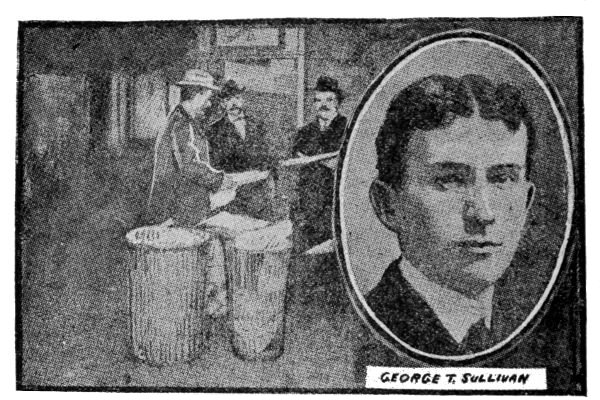
GEORGE T. SULLIVAN
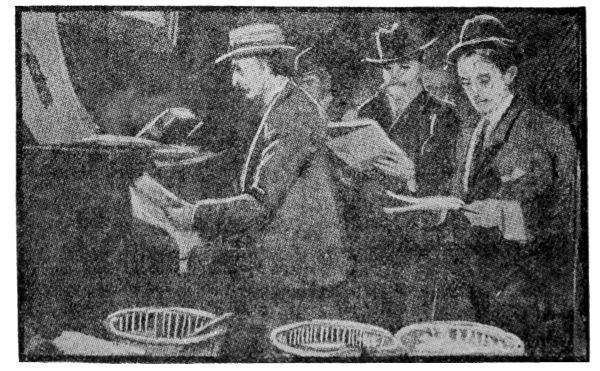
OFFICES OF GEORGE T. SULLIVAN AFTER THE RAID
List of Branch Offices.
The Sullivan letterhead gives branch offices in the following cities: Altoona, Pa., Arcola, Ill.; Aurora, Ill.; Avoca, Ia.; Boston, Mass.; Buda, Ill.; Burlington, Ia.; Cambridge, Ill.; Chicago, Ill.; Cleveland, O.; Davenport, Ia.: Decatur, Ill.; Des Moines, Ia.; Detroit, Mich.; Earlville, Ill.; Effingham, Ill.; Elkhart, Ind.; Fairfield, Ind.; Fostoria, O.; Fort Madison, Ia.: Galesburg, Ill.; Geneseo, Ill.; Gibson City, Ill.; Goshen, Ind.; Grand Rapids, Mich.; Greenville, Ill.; Grinnell, Ia.; Iowa City, Ia.; Ivesdale, Ill.; Johnstown, Pa.; Kalamazoo, Mich.; Keokuk, Ia.; Kewanee, Ill.; Lancaster, Pa.; Mansfield, Ill.; Mattoon, Ill.; Michigan City, Ind.; Milwaukee, Wis.; Monmouth, Ill.; Monticello, Ill.; Morris, Ill.; Mount Pleasant, Ia.; New Castle, Pa.; New York, N. Y.; Niles, O.; Omaha, Neb.; Peoria, Ill.; Pittsburg, Pa.; Plano, Ill.; Princeton, Ill.; Racine, Wis.; Roberts, Ill.; Saybrook, Ill.; South Bend, Ind.; Sheffield, Ill.; St. Louis, Mo.; Tolono, Ill.; Tiffin, O.; Toledo, O.; Tuscola, Ill.; Waukegan, Ill.; Wyanet, Ill.
Exclusive Offices for Lady Speculators.
Chicago—225 Dearborn street, National Life Building, 16 Imperial Building, 51 Dexter Building, 84 Adams street, South Chicago—9138 Commercial avenue.
Mr. Sullivan had his correspondents and solicitors in all of the leading stock, bond, grain and cotton markets of most of the foreign countries. On May 23, 1903, he was doing a business of from $300,000 to $500,000 per year. His weekly expenses ran from $15,000 to $20,000.
Mr. Sullivan advertised extensively in the leading newspapers throughout the United States and in foreign countries. Many of his advertisements would cover an entire page. These advertisements brought him many inquiries from persons either through curiosity or desire to invest, saying nothing of the cash customers secured.
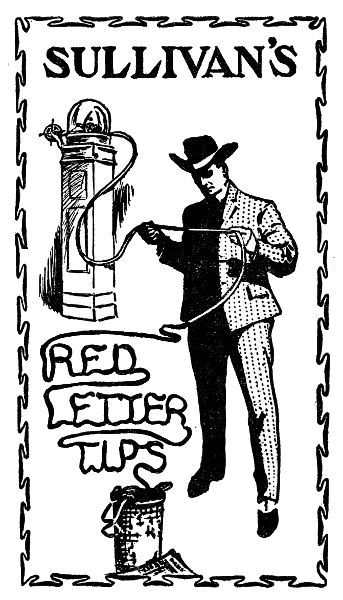
SULLIVAN'S RED LETTER TIPS
Mr. Sullivan made special effort to buy or acquire every mailing list to be found in the entire country which had been used by other fraudulent and get-rich-quick concerns.
It is said that he had secured over 20,000 names, which he had on his mailing list. These men were bombarded from day to day with his literature and his red-letters, giving the forecast of the market. These letters were very ingeniously gotten up by himself and a clairvoyant fortune teller named Madame Dunbar.
His methods were absolutely devoid of even a pretense of sound business ethics, sensationalism and red ink being his only stock in trade.
The class of literature and telegrams he sent broadcast and regardless of expense is well illustrated by the following:
Telegram sent January 1, 1903, to hundreds of persons throughout the country:
"Am going to run three-cent turn in May wheat. Let me act for you heavy. I will take loss if any. Mail three-cent margin.
George T. Sullivan."
In his "Red Letter" of May 18 he makes the following statement:
"There is only one thong about this wheat, and that is, a bull market is at hand; and those who buy cannot lose, and if they buy on my advice and buy quickly, I will pay the loss if there should be any."
He had four offices in Chicago aside from his main office, these being designated by him as "Exclusive Offices for Lady Speculators." When about to open one of these offices he addressed a circular letter to the wives of many prominent citizens announcing the opening of same. The first paragraph of this letter reads as follows:
"I have opened superbly appointed offices on the ground floor of the National Life Building, Room 120, where I accept accounts from ladies of $100 or upwards for marginal speculation in stocks, bonds, grain and cotton.
"George T. Sullivan."
George T. Sullivan, who frequently signs himself "Red Letter Sullivan," is by occupation a telegraph operator. He was first heard of in Boston during the year 1899 and the early part of 1900.
On the "Oil Exchange."
On May 17, 1900, Sullivan was admitted as a member of the Consolidated Stock and Petroleum Exchange of New York and under the firm name of Sullivan & Sullivan advertised extensively and had a system of wires through New England. It was noticed that his business on the exchange was very small and upon the complaint of a customer his trading methods were investigated, with the result that on the 11th of October he was adjudged guilty of obvious fraud or false pretenses and expelled from membership in the exchange. He made some threats of a suit against the exchange, but the firm of Sullivan & Sullivan failed in November and nothing was heard of him in New York. His customers and correspondents never received any statements of their accounts and Sullivan fled the state.
He seems to have come direct to Chicago, and was employed for several months by bucketshops and private-wire houses as a telegraph operator.
In the fall of 1901 he associated himself with E. F. Rowland, ostensibly to do a commission business in stocks, grain and cotton. His methods of advertising were extremely lurid, and he flooded the country with literature and letters printed in red ink. The employee, Sullivan, soon forced Rowland out of business and continued under the name of Rowland until the first of January, 1903, when by degrees he had worked the name of Sullivan into prominence and the name of Rowland had gradually been eliminated from his signs and literature.
Reasons Which Caused Investigation, Raid and Arrest.
The raid by Detective C. R. Wooldridge on the Lincoln Commission Company, a race track scheme, in the Portland Block, 115 Dearborn street, May 14, 1903, developed the peculiar relations between this concern and Sullivan, and the police department was somewhat astounded to find among the papers of the Lincoln Commission Company conclusive evidence, in the shape of telegrams and correspondence, proving that Sullivan's agents on his private wires were acting as the agents of the turf scheme, and that the employees and private wires of the Sullivan concern were used in common by the Lincoln Commission Company with the consent and approval of Sullivan.
More than twenty of Sullivan's agents were posting in his various offices the tips sent out by the Lincoln Commission Company and accepting bets which were transmitted over Sullivan's wires to be placed ostensibly by the Lincoln Commission Company on the horses which they tipped off as sure winners.
The mixing up of a turf scheme with a so-called grain and stock business was something new to the police, and Detective Wooldridge prosecuted the investigation, and, upon becoming fully acquainted with Sullivan's methods, concluded that he was not only running a bucketshop, but was interested in the turf scheme to a greater extent.
The evidence gathered in the raid on the Lincoln Commission Company fully established the fact. The Cook County Grand Jury was in session at the time and the evidence was presented to them. Detective Wooldridge was ordered to make a full investigation and report to them, which he did.
The Grand Jury instructed Wooldridge to lay the matter before the General Superintendent of Police, Francis O'Neill, and say: "The Grand Jury requested immediate action should be taken by the police to enforce the state law, which was being violated."
Wooldridge submitted the case to Chief O'Neill. He asked if Wooldridge had secured the necessary evidence to prove that Sullivan was conducting an illegitimate business. He was answered in the affirmative.
Wooldridge's Raid.
On the morning of May 23, 1903, ten picked detectives were secured from the Detective Bureau to accompany Wooldridge in the raid on George T. Sullivan, which turned out to be one of the largest as well as one of the most sensational raids and arrests that had occurred in Chicago for years.
Sullivan did an extensive business. The offices of the company which were raided were elaborately furnished, and there was a complete assortment of tickers, blackboards and like paraphernalia. At the time of the raid the offices were crowded, the operations on the open board and the Board of Trade being remarkably exciting. The officers who assisted Wooldridge in the raid were Detective Sergeants Howe, Mullen, Quinn, Qualey, Miskel, McLaughlin, Weber, Flint and McLane.
Offices Filled with Patrons.
It was at 10 o'clock in the morning, when the largest throng of speculators can be found in the offices at 259-261 LaSalle street, opposite the Board of Trade, that Wooldridge and his men swooped down on the place and proclaimed "every one there a patron of a bucketshop and under arrest."
The wildest excitement prevailed. Telegraph operators, messenger boys, pit men and persons of every station in life were caught. Some of the traders, thinking of their wives and children, pleaded frantically for their freedom. Some attempted to force their way from the betting rooms, but, meeting with armed resistance, they desisted.
"I don't belong here," said one man, indignantly. "I only dropped in here to see a friend." His plea was unavailing.
Another man, attired in a frock coat and a silk hat, attempted to bribe one of the detectives. "I can't have it get out that I was arrested," said he. "State your price and I will give it to you gladly."
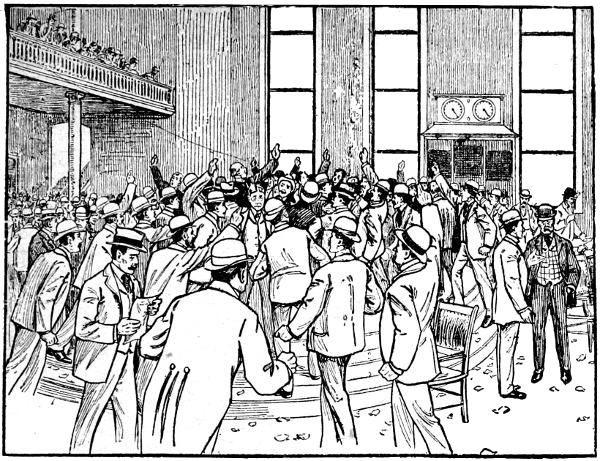
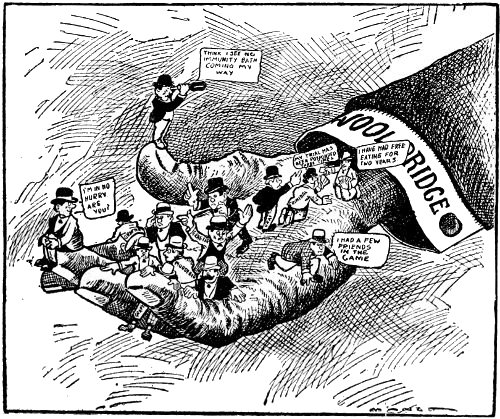
He'll have to act faster, or somebody will slip between his fingers.
The only persons allowed to escape were three women stenographers, who fled through a rear window.
Advertising matter, private correspondence, telephones, tickers, telegraph instruments and everything of consequence was seized and loaded into twelve patrol wagons and taken to the Harrison Street Police Station.
Four hundred and twenty telegraph wires were cut which connected Sullivan's bucketshops in Chicago and through the country. It took the Western Union Telegraph Company two weeks to get the wires in working order.
Names of Prisoners Arrested.
At the Harrison Street Police Station those arrested in the raid gave their names as follows:
G. T. Sullivan, W. D. Hart, John Conway, L. J. Hoff, Charles Barth, William Wilson, E. E. Matwell, J. A. Hogadorn, E. L. Wilson, T. N. Lamb, R. J. Brennan, Ralph Cunningham, Fred Boller, John Whitmar, E. F. Black, John A. Manley, Ernest Gerard, John Lawson, J. K. West, George Rodger, Henry Miller, J. A. Crandall, Y. R. Pearson, George Wilson, Harry Van Camp, George T. Kelly, J. P. Morgan, Joseph Cohen, Butler Coleman, Arthur McLane, George Frederick, A. L. Kramer, M. J. Franklin, Edward O'Connell, Oren Mills, W. H. Kelley, O. S. Reed, F. Foley, I. J. Kennedy, Robert Delaney, Joseph Bowers, John Black, L. Frederick, B. C. Cover, George Johnson, G. Weightman, H. C. Boder, Samuel E. Brown, Joseph Smith, C. E. Tracy, W. Jones, J. W. Kennedy, John P. Garrison, Al. Dewes, Elmer C. Huntley, T. A. Duey.
Crowd Gathers.
The fact that a raid was being made became known outside the offices and in a short time several thousand persons gathered. Crowds peered through the windows and doors. The Chicago Open Board of Trade is directly across the alley in the rear of Sullivan's offices, and business there was at a standstill for a time. The traders gathered about Sullivan's offices and remained until the last prisoner had been taken away in the patrol wagon.
Sullivan himself was in his private office when the raid was made. Wooldridge broke open the door and faced the man at the desk.
"You are under arrest, Mr. Sullivan," said the detective. Sullivan grew pale and then reached his hand to the telegraph instrument which stood on the table. He started to work it.
"Stop that!" ordered Wooldridge. But Sullivan continued. Wooldridge made a leap for the trader and forced him away from the instrument. But the trader was not to be thwarted. He reached over the detective's shoulder, and again the click began. Wooldridge then seized the instrument and hurled it into the desk.
"Cut all telephone and telegraph wires," was the order given by Wooldridge, and the frenzied occupants of the place were thrown into terror. There was a mad rush for the door, but the detectives stood in the way. Every inducement was offered the policemen, but efforts failed.
Then Sullivan claimed that he had an injunction issued by Judge Elbridge Hanecy forbidding the police from raiding his place.
"I have an injunction from Judge Hanecy to stop you!" yelled Sullivan. "Show me the injunction, then," replied Wooldridge, "and I will obey it. If not, I am an officer of the court and have warrants here charging you with keeping a bucketshop and gambling house."
The injunction which Sullivan claimed to have was found by the police in one of his drawers in blank form, without any signature, together with the following letter to one of his managers:
May 19, 1903.
Mr. Charles A. Warren, New York.
Dear Mr. Warren:
Your friend Wooldridge was in all day Monday. We had four detectives here all day investigating my guarantee plan, and they showed up again today and held several conversations with Miss Lorentzen before we realized who they were. It looks like they were trying to make a case.
In looking up the injunction papers, find you neglected to change them to read The George T. Sullivan Company and The George T. Sullivan Elevator & Grain Co. I took them to Morris and he rehearsed them, patched them, etc., and they are now ready to play ball with.
Morris is very busy and it looks as if we might need someone else on the scene of action to watch things.
Hope you arrived O. K., and with best wishes, I remain,
Yours very truly, George T. Sullivan.
However, it was not until 11 o'clock and more than an hour after the raid had been made that Attorney Edward Morris filed the injunction bill in the Circuit Court.
The injunction was finally issued by Judge Abner Smith at 12:30 o'clock. It restrained Chief O'Neill and Detectives Hertz and Wooldridge from interfering in any way with the property contained in the offices occupied by the concern or cutting the telegraph wires leading to them. It is represented in the bill that the company has offices at 259 LaSalle street, Bush Temple of Music, 60 LaSalle street, 16 Imperial Building and 84 Adams street; but the damage had already been done.
Sullivan was practically out of business, and was being bombarded and seized by a horde of infuriated patrons who demanded their money, entrusted to him to invest. Sullivan could not return the money, as he had spent it and was bankrupt.
"Red Letter" Well Known. Patrons Told They Would Not Lose If Advice Was Followed.
In Sullivan's office the detectives found great quantities of advertising matter. This matter was thoroughly gone over in the search for evidence against the grain and stock broker. Pile after pile of Sullivan's "red letter" circulars were found.
Sullivan's "red letter" was issued daily, and printed in red ink. The circulars were written in a manner characteristic of all the advertisements, printed matter and correspondence to patrons.
In telegrams to patrons and the "red letters" Sullivan often made the proposition that he would make good all loss sustained by patrons while they were making purchases upon his advice.
The detectives were somewhat surprised when they saw at the top of the circular in bold, red type that "four exclusive offices for lady speculators" were being operated in Chicago, one in South Chicago and one in St. Louis. The addresses given for the Chicago offices were 225 Dearborn street, 159 LaSalle street, 260 Clark street and 84 Adams street. Women speculators of South Chicago had the opportunity of making their purchases at 9138 Commercial avenue.
Wooldridge was asked by the press what justification he had in making the raids, and by whose orders they were made. He said that he raided the Lincoln Commission Company at 115 Dearborn street, May 14, 1903, which was conducting a turf investment company, and found that George T. Sullivan was operating the same in connection with his bucketshop; that George T. Sullivan and 60 inmates were arrested, and eleven wagon loads of books, letters, papers and records taken to the Harrison Street Police Station. Wooldridge said that he had evidence to indict them on 50 charges, and he intended to deliver the goods, and he would not be pulled off by any man in the State of Illinois.
Wooldridge immediately took steps to get his evidence in shape. He called on John Hill, Jr., who had charge of the Board of Trade quotations and who was an expert on bucketshop methods.
Wooldridge, Hill and two clerks went to work gathering evidence for the trial; eleven wagon loads of books, papers, letters and records had to be gone through, which was done in the most careful, systematic manner.
They worked from 2 p. m. until 12 o'clock and the evidence gathered was placed in a vault.
After they had secured something to eat in a nearby restaurant and taken two hours' sleep, they resumed their work, which was carried on until 7 o'clock Sunday morning. This evidence which was secured was locked up in another vault for safe keeping. After they had eaten their breakfast they resumed work again and worked until 6 p. m. This evidence gathered was placed in another vault. After they had eaten their supper they resumed work again and worked until 1 o'clock Sunday night, when they succeeded in going through every scrap of paper which was seized in the raid. This evidence gathered was placed in another vault.
The placing of this evidence in different vaults was for the purpose of preventing George T. Sullivan or any of his friends from securing it on a writ of replevin.
Wooldridge slept until 5 o'clock, then went to the residence of Charles S. Deneen, State's Attorney. Arriving at his house and finding that he had not arisen from bed, Wooldridge pulled up a settee which he found on the veranda and placed it in front of his door where it would be impossible for him to get out of his house without first awaking Wooldridge.
Wooldridge laid down and went fast asleep and was found there when State's Attorney Deneen was making his departure next morning for his office. Wooldridge, upon being aroused from his sleep, told Mr. Deneen of the raid made and the evidence gathered and showed him some 10 or 15 telegrams from reputable Board of Trade men who were worth over $20,000,000 collectively. The substance of the telegrams was as follows:
"Officer Clifton R. Wooldridge: We are informed that you raided George T. Sullivan's bucketshop. You have done your duty and been criticised and assailed for doing it. My name is —— and my attorneys name is —— and we are at your service night or day, without any expense to you."
Mr. Deneen asked Wooldridge how soon he would be ready to present his evidence to the Grand Jury. Wooldridge replied that he had two cases already prepared before he made the raid and would be ready in six hours with a number of additional cases.
Mr. Deneen told Wooldridge to accompany him to his office, which was done. He called Assistant State's Attorneys Albert C. Barnes, F. L. Barnett and Howard O. Sprogle and instructed them to assist Wooldridge in preparing the cases for the Grand Jury and give him a clean road just the minute he was ready. They were further instructed to give him all the assistance and advice he should need in the matter.
The special complaints were drawn, the telegraph wires became busy and at 10 o'clock Wooldridge and witnesses went before the Grand Jury and George T. Sullivan was indicted for keeping a bucketshop and common gaming house.
George T. Sullivan was also active from Saturday until Monday morning. He had prepared writs of replevin and warrants for larceny for Wooldridge and officers who were with him.
Wooldridge was called up over the telephone by Sullivan's friends and offered a bribe of $5,000 if he would release and turn over the books, letters and records which were seized in the raid, so Sullivan could resume business. This offer was refused by Wooldridge and the matter reported to the State's Attorney.
Sullivan then resorted to sending various friends and powerful politicians for the paraphernalia seized. Still Wooldridge turned a deaf ear to their requests and entreaties.
Wooldridge was a very busy man at the County Court Building on Monday. Before the George T. Sullivan bucketshop raid and the indictment before the Grand Jury, Wooldridge had the case of J. J. Jacobs, manager of the Montana Mining, Loan & Investment Company, which was a lottery, on trial before Judge Chetlain.
While in the courtroom he was informed by officers that they had a writ of replevin for the goods seized in Sullivan's bucketshop; that they also held warrants for Wooldridge and the officers who were with him, but if he would surrender the goods seized they declared the warrants would not be served and there would be no trouble.
Wooldridge called on the State's Attorney and informed him of the demand made upon him. State's Attorney Deneen called the officers in his office and told them that Wooldridge was there in attendance in the court and he would not permit the warrants to be served on him until after court adjourned. Further, he had instructed Wooldridge not to turn over any of the property.
Sullivan during the meantime had learned that there was an indictment against him by the Grand Jury and withdrew the order for serving of the warrants. He was indicted, convicted and paid a $500 fine.
After the police had secured the evidence, his books, letters and records were returned to him. He tried to start up in business again; also to get other parties interested with him who had money, but in this he failed. He was forced to refund $150,000 to his patrons who had advanced money to him to speculate in grain and stock. He expected financial assistance and hoped to resume business, but nothing materialized.
There were thousands of other creditors throughout the country who were not so fortunate in obtaining a settlement. These creditors combined and forced him into bankruptcy.
He was then cited in the United States Court for violating a federal injunction.
He quietly folded his tent at night and left Chicago without leaving his address. He was next heard of in England six months later. All traces of him were lost until, in August, 1907, at Pittsburg, Pa., he was arrested for running a bucketshop.
George T. Sullivan, of George T. Sullivan & Co., brokers, with offices in the Bijou Building, Pittsburg, and was arraigned before Magistrate F. J. Brady at Central Police Station, charged with a misdemeanor and violating a city ordinance.
Sullivan Has Record.
The misdemeanor was based on Sullivan's doing business without being properly registered at Harrisburg, and he was charged with violating a city ordinance for running a brokerage office without taking out a city license. He was held, for court in $1,000 bail on the misdemeanor charge and was fined $25 on the other.
George T. Sullivan, the Napoleon of frenzied finance, cut a large figure in Chicago. From a telegraph operator in the pool rooms and bucketshops at a salary of $18 per week, he acquired enough in the short space of two years to own and operate the largest bucketshop in the United States.
He soared high in the money circles, but at last was brought crashing to the earth, a financial wreck. He was convicted of keeping a bucketshop and gambling house. He went bankrupt, hounded to death by his creditors, many of whom he had wrecked.
He was cited to appear in the United States Court for violating an injunction, and warrants had been sworn out by the postal authorities for using the mails to defraud the public.
He took his freight from Chicago to new fields of pasture. Wine, women and high financing brought his downfall.
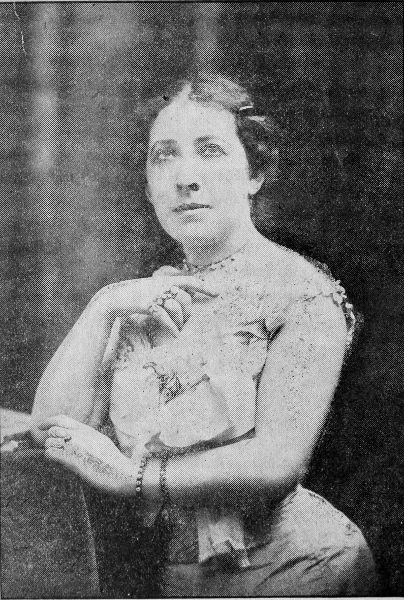
DORA McDONALD.