THE YOUNG CRIMINAL HOW HE IS BRED IN CHICAGO.
Reading edition
Chicago Raises Its Own Criminals.
There is material in this subject for earnest thought. Men under twenty-five are responsible for 75 per cent of crimes committed in Chicago, and 50 per cent of robberies and burglaries are done by boys under nineteen.
If that is true, then the idea many people have had that crimes in this city are mostly committed by a roving army of criminals, alien to Chicago and attracted hither by one cause or another, must be abandoned. If it is true, then Chicago itself is responsible for most crimes committed here. The men who are guilty have grown up in this environment, which has given them the evil impetus under which they act.
The thought that Chicago boys are the criminals who terrorize the city, rob houses and flats, hold up citizens on the streets and assault women is distressing. It was much pleasanter to attribute these crimes to desperate men from elsewhere, descending upon Chicago like raiders and leaving the city again as soon as possible. But that is a misconception. We ourselves have reared most of our criminals. They are a Chicago product. They have received their notions of right and wrong here among us. We are responsible for them.
What is the matter with Chicago? What are the elements in its life that breed criminals? What causes thousands of young boys to take up a criminal life? What must we do to change conditions?
These are questions that should engage every good citizen in anxious endeavor to find answers to them. If we are to reform criminals and lessen crime, we must first learn how to reform our own city.
Preventing Crime Better Than Cure.
Instead of attempting to prevent crime, we wait until after the crime is committed, then burden ourselves with the expense of apprehending, trying, convicting and imprisoning the criminal.
Our first duty is to adopt those measures that will prevent the further commission of crime.
Among the problems of Chicago there is no one, perhaps, that is more baffling than that of the vicious boy.
His years protect him from the rigors of the law, and it is a difficult matter to know just what to do with him.
There are all sorts of organizations formed for his aid and his reformation. There is the Juvenile Court, for instance, and there are innumerable homes and shelters, and still the problem is not solved. The boy looms large in the public eye these days, when he is sent to prison for life for murder and spends long years in durance for burglary and other serious crimes.
The story of the car-barn bandits and their tragic end is too recent to need more than a passing reference.
The car-barn bandits met an ignominious death on the gallows. Rudolph Gamof will spend the remainder of his years behind prison bars and it is quite likely Alfred Lafferty will know what hard work means in Pontiac or some other such institution before he is once more at liberty.
The End of the Gamin.
It will be remembered that little Gavroche, the gamin in "Les Miserables," came to his death on a barricade in the streets of Paris. It was during the fatal insurrection of 1830. The lad allied himself with the insurrectionists and found he was in his element. He did prodigies of valor and was robbing the dead bodies of the enemy of cartridges when he was shot. Even after he had been shot once and had fallen to the earth he raised himself to a sitting posture and began to sing a revolutionary song.
"He did not finish," says Hugo. "A second bullet from the same marksman stopped him short. This time he fell face downward on the pavement and moved no more. This grand little soul had taken flight."
Thus it is to be seen that Hugo has made a hero of this lad. But what of the little gamins that throng Chicago's streets? Will they find any such glorious end? It is not likely.
Jacob Leib is but 17 years old, and Alfred Lafferty, accused of twenty-three burglaries, is only 16. The John Worthy School is full of boys who have been gathered in by the police; the Junior Business Club, another reform organization, has a big membership, and the Juvenile Protective League is hard at work trying to do something to arrest the boy in his mad race to the reform school, prison and the penitentiary.
In looking about for the causes of crime among boys I found that poverty, liquor, divorce, yellow newspapers, cigarettes and bad company played important parts. Certain streets of Chicago are schools of crime, where boys are taught the rudiments of larceny and soon become adepts.
Hardened criminals use the more agile youths they find idle to do work they are unable to do. Certain sections of the city swarm with boys who are steeped in vice and crime and are in embryo the murderers, the burglars and the forgers of tomorrow.
Chicago Has Her Children.
Turning again to the pages of "Les Miserables," the story of Gavroche, the gamin of Paris, may easily be found, and the tale of this youth is not far different from that of the "kid" of Chicago. Here is what Victor Hugo says of Gavroche in that section of his great novel called "Marius": "This child was muffled up in a pair of man's trousers, but he did not get them from his father, and a woman's chemise, but he did not get it from his mother.
"Some people or other had clothed him in rags out of charity. Still he had a father and a mother. But his father did not think of him and his mother did not love him.
"He was one of those children most deserving of pity, among all; one of those who have father and mother and who are orphans nevertheless.
"This child never felt so well as when he was in the street. The pavements were less hard to him than his mother's heart.
"His parents had dispatched him into life with a kick. He simply took flight.
"He was a boisterous, pallid, nimble, wideawake, jeering lad, with a vicious but sickly air. He went and came, sang, played, scraped the gutters, stole a little, but like cats and sparrows. He had no shelter, no bread, no fire, no love. When these poor creatures grow to be men the millstones of the social order meet them and crush them, but so long as they are children they escape because of their smallness."
This is a true picture of the urchin of Chicago. These tiny atoms of humanity are sponges that absorb all the filth, the vice, the sin and the crime of the streets. They pick up all that is evil and nothing that is good. They are nurtured at the breast of poverty and viciousness, and are reared on a diet of depravity and degradation. There is nothing they do not know of crime and of wickedness. They are thoroughly saturated with everything that is evil, unprincipled and debased.
Is it any wonder, then, that the city brings forth an appalling annual crop of criminals? There may be heroes among the gamins in Chicago, but most of them are only heroes so long as they remain uncaught.
When they fall into the hands of the police and are taken to jail they are sorry-looking heroes.
And in the meantime the problem of the boy is still unsolved.
Graduate of the Streets.
This, then, is a good specimen of the kind of boy the schools of the street graduate. From these petty classes of crime they go to the high school, the prison, where they are further grounded in the knowledge of wickedness, and as like as not return to Chicago once more, full-fledged criminals, ready for anything. But this is only one of hundreds of such cases that are brought to the attention of the police and the public every year.
Most of the boys who come here are either orphans or half orphans. Drink has wrecked their homes, perhaps, and they are thrown out on the world to shift for themselves. If they get into bad company they soon make their appearance in the Juvenile Court or in jail.
10,000 Boys Worse Than Homeless.
A charitable worker who has come in touch with the young of the poorer districts, whence comes the tough lad, estimates that there are over 10,000 boys in Chicago who are worse than homeless. In other words, they are in direct line of becoming criminals or public charges, under the teaching of the trained criminal who makes the city his refuge.
Anderson, the stickup youth who operated extensively on the north side, choosing women for his victims, is but 23 years old. The men who relieved Alderman C. M. Foell at the point of a gun are less than 20, and thus it goes down the line.
They laugh at the efforts of the police to catch them. For the most part they live at home or with relatives, and in the neighborhoods are known as dissipated and tough boys, but not as hold-up men. With companions they sally out at night to isolated sections of the city where they know the police protection to be inadequate. They choose secluded spots offering the protection of darkness and lay in wait.
Then, with plenty of time deliberately to stop the victim and take from him valuables, they operate until it is time for the policeman to be in the vicinity, or until the profits of the expedition are sufficient to satisfy their spirit of revelry and riot.
Schools for Pickpockets.
There are numerous places in Chicago where boys are taught to become pickpockets. Poolrooms are gathering places for such young criminals and certain saloons of a low order harbor others. There is one saloon in West Madison street, for instance, not far from Canal street, where a lot of pickpockets are in the habit of congregating. They are young fellows for the most part and adepts in their particular field.
They find a sort of home in this saloon, where they can get a big glass of beer and a generous free lunch for 5 cents. They are in and out of this place day and night and manage to keep out of the clutches of the law through their sleekness and cleverness. There is one young man in there at least who has made a good living by forging orders for goods. So far he has escaped detection.
His method is to forge an order on some big business house and get certain goods. One day he got a lot of belting from a well-known firm on a forged order. He sold this later and realized $4.50 on the deal. This he spent freely in the saloon mentioned and made no bones of how he got the money. Others run out, snatch a pocketbook and make for cover. Later on they look up their cronies at the saloon and spend the money for beer and cheap whisky, and eat free lunch provided by the management.
There are numerous other such places, more especially on South Clark near Van Buren street. Some of the saloons in that section are alive with young fellows who prey upon the public for a living. They do not always beg their way, either, for they often take a run out and stick up somebody, filch a purse or break into a store. When one of them has been up to some devilment his companions can usually detect it, for he will come back and be very flush for a few hours, or a few days, all depending, of course, upon how much he was able to steal.
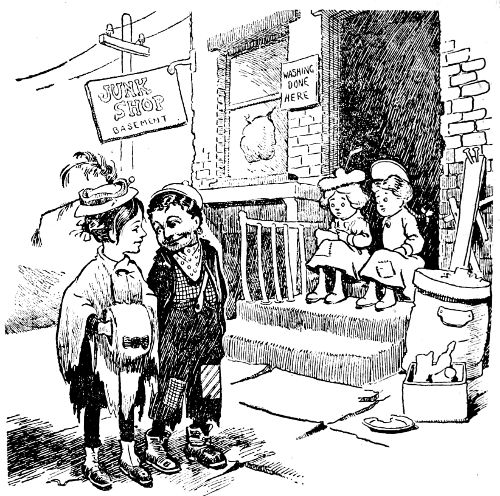
Modern Boys Are Gamblers.
But it is not only in the slums that the tendencies of the modern boy may be studied. In the more respectable parts of town, in the vicinity of schools and in the neighborhood of churches may be seen evidences of what the youth of today think play.
Time was when boys were content to play marbles. Some of them, of course, had the temerity to play for keeps. Others were taught it was wicked, and even at the risk of being called "sissy" refrained from disobeying their mothers. But now marbles are a thing of the past. As soon as spring comes boys want to shoot "craps." They want to play for money. They want to gamble.
A visit to almost any school playground during recess or the noon hour will convince any person that the modern boy is a very wise youth. His conversation is not a well of English pure and undefiled by any manner of means. In the first place, his profanity is something shocking, and, in the next place, his knowledge of the world and its wickedness is thorough.
There is nothing the modern schoolboy does not know. He is conversant with all sorts of vice and crime, even if he does not take an actual part in it. If this sort of thing obtains among schoolboys and youths of that class it is little wonder, then, that the boys of the slums are what they are. And the pictures is not overdrawn. The conversation of boys of ten and a dozen years will bring the blush of shame even to a grown man.
Just how to cure all this is a question that is bothering a good many people. Societies are being organized right and left. Homes for boys are being established, schools are being started and other efforts are being made to reclaim the delinquents. It has been found that good playgrounds in the tenement districts have been beneficial. The boy is exuberant. He must let out some of his animal spirits. If he has a good place in which to play he will not be half as apt to get into mischief.
Remedies Suggested by Some.
There are some who insist that moral suasion should be used at all times in an attempt to reform the juvenile. But this has been found to fall short in many instances in Chicago. Even the Juvenile Court, with all its benefits, is found to come somewhat short of doing everything for the vicious lad. It is found that boys who are herded together in penal institutions are inclined to leave such places much worse than when they entered. The bad boys dominate. The evil spreads and the good is suppressed. One bad boy is able to do much, while the influence of one good boy amounts to almost nothing.
Those who have made a study of the matter aver that the only true solution of the boy problem is individual work. The lad's characteristics must be studied, the conditions under which he has been living must be scrutinized and all the influences that have been brought to bear upon his particular case must be looked into. Under these circumstances it would take a reformer for every dozen boys, and so far the money has not been forthcoming to support so many reformers, for even a reformer must live. A good many of the delinquent youths of Chicago have been reared in squalid surroundings and have been nurtured in filth and unloveliness. They have been surrounded from babyhood by poverty, drunkenness and depravity. These boys take to crime as naturally as a duck does to water.
In order to reach boys and try to help them individually a movement is now on foot to form juvenile protective leagues in all parts of the city. One organization is now working in the vicinity of Halsted and Twenty-second streets to put a stop to race wars between school children. It is thought by some that this new movement will fill a long-needed want. It is admitted by those who have given the matter close study that something must be done.
The records of the Juvenile Court and the books of the John Worthy School emphatically bear out this contention.
Failure to Rule Children Makes Criminals.
What are you doing with your child's sense of right and wrong? Are you certain that you are not training a criminal, beginning with him at two years old? What is your boy at six years of age? Is he liar, thief—perhaps of insane ego as he was when he first toddled from his mother's arms? Inferentially President Roosevelt may have complimented you on the acquisition of a large family, but rather than this, has it occurred to you that the father and mother of one child, brought up in the light of wisdom, may be deliverers of mankind against the numerical inroads of the other type of parent?
Insanity is the mental condition out of which it is impossible for the person of any age to recognize the rights of others in any form. This insanity may be due wholly to the overdevelopment of the primary ego in the child. At one year old the infant may be a potential criminal of the worst type. It lies to the mother by screaming as if in pain in order that she may be brought to its bedside. If the adult should steal personal property as this babe steals food wilfully, the penitentiary would be his end. Angered, this same babe might attempt murder in babyhood, the spirit fostered by the same selfish intolerance that is filling jails and crowding gallows traps.
Respect Rights of Others.
Ego in the community life is the basis of all ill or all good, even to the dream of Utopia. The basis of all ill is the primary ego which is inseparable from the child until teaching has eliminated it. The basis of all good is that secondary ego which recognizes the rights of others.
Morality—good—virtue—all that is considered desirable in the best type of citizenship develop out of the community life. Even in the lower orders of animals a greater intelligence marks the creatures that live community existences than is to be seen in the isolated creatures. And this is from the development of the secondary ego which exacts rights for others.
The child has no knowledge of this secondary virtue save as it is taught it. The mother who, by responding out of a mistaken affection to every wail of the infant, encouraging all, no longer is susceptible to home influences in teaching the lesson. If this youth shall become entangled in the toils of the law and the mistaken parents intercede for him, gaining their ends in saving him from all punishment for his misdeeds, the boy receives through it only another selfish impetus toward more and greater offenses against society.
Reformatory After First Crime.
Here in this first offense of magnitude sufficient to call for the intervention of the law the parents have their opportunity, if only they would see. The place for such a youth at this period is a reformatory in which are sufficient educational facilities and the strictest discipline, which in justice visits the full penalty of community transgressions upon the head of the offender. In this reformatory environment the offending one finds none of the intercessions that may have been made for him in his home. In sterner fashion than he ever dreamed before he discovers that as he transgresses the community laws he receives a full penalty for the offense. Young enough, he may be led to discover that his transgressions are not worth while. Too old for these teachings, he becomes the persistent lawbreaker, or, on the other hand, degenerates to the asylum for the insane.
How intimately some of the fundamentals of training are associated with everyday lives in the home, and yet not recognized, is shown in the college life of the country. "Sophomore" is a class term in schools which needs interpreting. As a word, it is from the Greek, meaning "wise fool." Its application in the higher education is to the second-year "men"—to those students who are in that period of mental and physical stress after the age of fifteen is reached. In school parlance the word associates itself with the flamboyant youth who prates, and preaches, and struts, and lays down the law of all things as he sees it. Until twenty-five years old, indeed, the "Sophomoric" period is not fully passed.
Broadly stated for all men, it may be reiterated that in the parents' failure to enforce the subjection of the selfish first nature in the child lies the seed of his destruction. Encouraging the infant to wail again when nothing ails it is already catering to this criminal ego. Later, when a parent humors its every whim, he is stunting its growth toward good citizenship. And later still, in that crisis in physical life, between the ages of fifteen and twenty-five years, such a parent may awaken suddenly to a realization of the criminal which he has made.
Ego in the child mind prompts it to take instantly anything which it desires and which it can take. Unchecked by training, this primary ego grows with that upon which it feeds. At two years old the child should have had its lessons in the rights of others administered in any way in which it can be reached, but always in all justice. Justice in this lesson should be the first consideration. At six years of age these lessons are of special significance. It is an age in the development of the child when they may be taught with especial emphasis, with lasting results.
Guide Child of Fifteen Carefully.
At fifteen years old a new condition arises in the life of the child. At this time the race condition and the individual condition are at war. It is at the beginning of this period that an unbridled, untrained youth may take his first step toward crime, simply because the primary ego in him has not been set toward the background by the lessons of his duty toward the rights of others. Here it is that the heedless, ignorant parents may come to the first realization of what his own sins of omission have been.
If for any of the reasons suggested a youth's parents have not given him this necessary training in recognition of the rights of others, the age brings with it a condition making it impossible in ordinary cases for the parental conscience and home environment to avail.
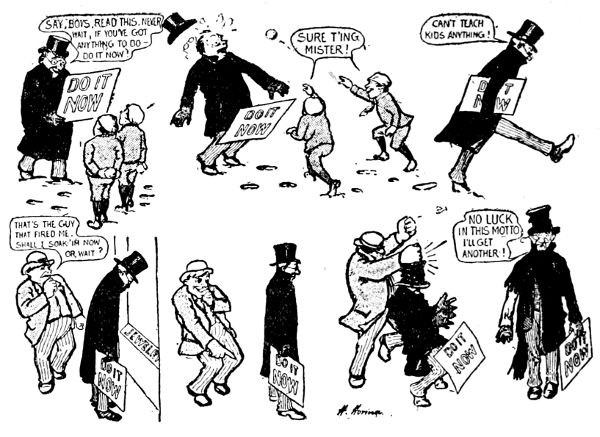
For example, the fact that the boy becomes a thief, or burglar, indicates in any or many things that disregard for the rights of others which is destructive to all law and order. Properly handled in the home he would have been amenable to all of these conditions.
Raise the child like a plant, care for it as you do for the rarest specimen of vegetation, bring it up in an atmosphere of love. Child raising and plant development are akin.
If the child has but the smallest trace of some characteristic you desire to develop, take hold of it, care for it, surround it with proper conditions and it will change more certainly and readily than any plant quality.
Child Like a Plant.
The child in nature and processes of growth is essentially the same as the plant, only the child has a thousand strings instead of but a few, as has the plant.
Where one can produce one change for the betterment of the plant one can produce a thousand changes for the betterment of the child.
Surround the child with the proper environment to bring out certain qualities and the result is inevitable.
Working in the same way as one does with the plant, the development of the individual is practically unlimited.
Take the common daisy and train it and cultivate it by proper selection and environment until it has been increased in size, beauty and productiveness at least four hundred fold.
Do our educational methods do as much for our children? If not, where is the weakness?
Rear Child in Love.
Have the child reared for the first ten years of its life in the open, in close touch with nature, a barefoot boy with all that implies for physical stamina, but have him reared in love.
Take the little yellow California poppy and by selecting over and over again the qualities you wish to develop you have brought forth an orange poppy, a crimson poppy, a blue poppy. Cannot the same results be accomplished with the human being? Is not the child as responsive?
The Greatest Reform Movement of the Day Is the Chicago Juvenile Court.
The statistics show conclusively that the operation of the Juvenile Court is an advance step in the treatment of the young and helpless. It shows that not only are the dependents helpless, but that the delinquents are helpless to extricate themselves from a life of idleness and crime, for most criminals are made, not born, and the sooner time is devoted to changing the environments of the young, the sooner will be solved the problem of criminology.
Illinois in the Lead.
Various claims have been put forth from time to time as to the State which was the first to inaugurate the Juvenile Court idea.
The Juvenile Court Law went into effect July 1, 1899, and immediately the Juvenile Court was established. The Judges of the Circuit Court assigned one of their members to preside in the Juvenile Court.
The law gave the court jurisdiction of all dependent and delinquent children who are under seventeen and eighteen years of age, and defines dependents and delinquents. The word "dependent" shall mean any child who for any reason is destitute or homeless or abandoned, or dependent upon the public for support, or has not proper parental care or guardianship, or who habitually begs or receives alms, or who is found living in any house of ill-fame or with any vicious or disreputable persons, or whose home, by reason of neglect, cruelty or depravity on the part of its parents, guardian or other persons whose care it may be, is an unfit place for said child, and any child under the age of ten years who is found begging, peddling or selling any article, or singing or playing any musical instrument upon the street, or giving any public entertainment, or who accompanies or is used in aid of any person so doing.
The word "delinquent" shall mean any boy under seventeen or any girl under eighteen years of age who violates any law of this State or any city or village ordinance, or who is incorrigible, or who knowingly associates with thieves, vicious or immoral persons, or who is growing up in idleness or crime, or who knowingly frequents a house of ill-fame, or who knowingly patronizes any policy shop or place where any gaming device is or shall be operated.
A boy of seventeen is at a period of life where he is neither a boy nor a man. In many cases he has the mind of the boy and the impulses of the savage; his ideals are force, and his ambitions that of the wild, erratic western rover. Why the wise head and steady hand of the court and probation officer should be withdrawn at this period is not explainable on any reasonable theory.
It may be contended that a boy of seventeen years is too advanced in the knowledge of crime, but it can also be contended that the boy of fifteen years is too old in crime. Just what standard can be used to find the responsibility of a boy when measured by his age and physical proportions I am unable to discover. The only just standard is mental capacity. The Judge and probation officers, who are familiar with the boy, know his parents or guardians and his environments, should be allowed to exercise their judgment as to the moral responsibility of the boy, for there are many boys at fifteen who are more responsible for their acts than others at eighteen.
In many cases where children were committed to an institution the parents were placed under the care of a probation officer and the number of failures to reform the parent are few.
In cases where the parents are responsible for the dependency of existence those parents mean well, but they are unfitted for the duties they have assumed. The father thinks he has fulfilled his whole duty to his family when he provides food, shelter and clothing; the mother thinks she has fulfilled her whole duty when she does her house work and attends to the mending and washing. The children are masters of both parents before the parents take cognizance of the actual mental state of the child.
What should be done when the boy's home is the case of his delinquency is to provide for him a place where every home impulse would be developed and where industry and economy would be practiced. He should live in this home under the jurisdiction of the court until he has reached his eighteenth year.
What is said of the boys is equally true of the girls, and, in many cases, more important. Where the father is directly responsible for the downfall of the girl, the girl should not be allowed to return to her parental home.