A CLEVER SHOPLIFTER. DETECTIVE WOOLDRIDGE FINDS A FAIR CRIMINAL.
Reading edition
While passing through the Fair, one of the largest retail dry goods establishments in Chicago, Detective Wooldridge noticed one of the cleverest shoplifters that ever operated in Chicago, Bertha Lebecke, known as "Fainting Bertha."
She was standing in front of the handkerchief counter, where her actions attracted Wooldridge's attention, and he concluded to watch her. She called the girl's attention to something on the shelf and as she turned to get it Bertha's hand reached out and took a half dozen expensive lace handkerchiefs, which disappeared in the folds of her skirt.
The act was performed so quickly and with such cleverness that it would have gone unnoticed unless one were looking right at her and saw her take the handkerchiefs.
From the handkerchief counter she went to the drug department, where she secured several bottles of perfume. As she was leaving this counter she met a Central detective who had arrested her before for the same offense. He stopped a few yards from her to make some trifling purchases. She, thinking he was watching her, left the store.
From the Fair she went to Siegel-Cooper's, another large dry goods store several blocks away. Detective Wooldridge followed her. She was seen to go from counter to counter, and from each one she succeeded in getting some article.
As she was leaving the store she was placed under arrest by Detective Wooldridge and taken to the Police Station.
When she was arrested she fainted, and a great crowd gathered around her, and many of the women cried and implored Detective Wooldridge not to arrest her, but he would not be moved by any of them to let her go free.
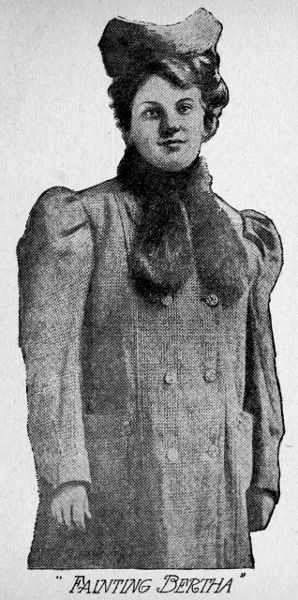
"Fainting Bertha"
When she arrived at the Police Station she was searched, and beneath the folds of her skirt was found a strong waist pocket which looked like a petticoat. It consisted of two pieces of material gathered full at the top with a strong cord or puckering string run through, and sewed together around the edges. In front of this great bag was a slit two feet long opening from the top to within a few inches of the bottom. This petticoat was worn under the dress skirt. On each side of the outside skirt was a long slit concealed by the folds of the skirt, and with one hand she could slip the stolen articles in through the slit in the inside of her dress and into the petticoat bag to the opening in front. The capacity of the bag was enormous. She had stolen some $40 or $50 worth of goods when arrested. The following morning she was arraigned in the Police Court and heavily fined, and the goods were restored to the merchants.
Bertha Lebecke, 27 years old, is conceded by Illinois state authorities to be the most troublesome person who ever crossed the state line from any direction at any time.
Just how large a cash bonus the state treasury today might be willing to advance could it be assured of Bertha's deportation forever beyond the confines of Illinois is something difficult to estimate, but it is certain that in the asylums for the insane at Kankakee, Elgin and Bartonville, and in the state penitentiary at Joliet there are attendants on salaries who would make personal contributions to help swell the possible fund.
Yet "Fainting Bertha" Lebecke is one of the prettiest, blondest, most delicate handed little bits of well-developed femininity that ever made a marked success in deceiving people of both sexes and all conditions in public, afterwards deceiving officials of jails, asylums and penitentiaries until bars and gates and frowning walls were as cobwebs before her.
Sleeps All Day; Makes Night Hideous.
Gates of steel never have held her in jail or asylum. In the mightier penitentiaries she has made herself such an uncontrolled fury by night—sleeping calmly all day long and resting for the next seance—that penitentiary gates have opened for her in the hope of having her maintained as an asylum ward. After which "Fainting Bertha" has secured keys to asylum doors and gone her untrammeled way straight back to a police record which for years has shown her to be one of the most remarkable pickpockets, diamond snatchers and shoplifters of her time.
Making such a nuisance of herself in the penitentiary as no longer to be tolerated in a refined convict community, she proves her madness. In the locked, barred, asylum she proves her cunning at escape. And, once more at liberty, the abandon with which she goes after personal property in any form, at any time and under any circumstances, proves her skill as a thief and her unbalance in the "get away."
There is her escape from the asylum at Elgin on the night of December 25, 1904. Christmas eve she had fainted in the arms of an attendant and in the scurrying which followed had secured the keys to the gates. On the night of Christmas she went out of the Elgin asylum, boarded an electric car for Aurora and bought a railroad ticket to Peoria.
Stole $1,000 Worth of Goods in Two Days.
On the way to Peoria she relieved the conductor of $30 in bills, secreting them in her hat. In Peoria, within forty-eight hours, she had stolen a thousand dollars' worth of goods from stores, registered at three hotels under assumed names, and was in a chair car with a ticket for Omaha when the Peoria police had followed her easy tracks through the city. Perhaps the broadest, most easily identified track was that which she left in a barber shop in the National Hotel, where she appeared for an egg shampoo. Two eggs had been broken into her shiny hair when Bertha promptly fainted and rolled out of the chair. As a count of shop equipment showed nothing missing an hour later, the barber shop proprietor was at a loss as to the purpose of the faint.
This girlish young woman, with the baby dimples and skin of peach and cream, the innocent blue eyes, and the smiles that play so easily over her face as she talks vivaciously and with keen sense of both wit and humor, is a study for the psychologist. There is no affectedness of speech—for the moment it is childishly genuine. She could sit in a drawing room and have half a dozen admirers in her train.
But reform schools, asylums and penitentiaries are institutions through which this young woman has graduated up to that pinnacle of notorious accomplishment which today is centering upon "Fainting Bertha" Lebecke the official attentions of a great state. What to do with her is the question.
Kept at South Bartonville Without Locks.
Dr. George A. Zeller, superintendent of the asylum for the incurable insane at South Bartonville, having fought for the care of Bertha in his institution, purposes to make her a tractable patient and willing to remain. He has the history of his institution back of him, from whose doors and windows he has torn away $6,000 worth of steel netting and steel bars.
In the first place, "Fainting Bertha" will have nothing to gain by fainting at Bartonville; she is promised merely a drowning dash of cold water when she falls. She can secure no keys by fainting, for the reason that there are no keys to doors. A nurse, wideawake for her eight-hour nursing duty, is always at hand and always watchful.
"Take away the show of restraint if you would have a patient cease fighting against restraint," is the philosophy of Dr. Zeller. "Human vigilance always was and always will be the greatest safeguard for the insane."
If "Fainting Bertha" Lebecke were a grizzled amazon, even, she might be a simpler proposition for the state. She is too pretty and plump, however, to think of restraining by the harsher methods, if harsh methods are employed. She can pass out of a storm of hysterical tears in an instant and smile through them like a stream of sunshine. Or as quickly she can throw off the pretty little witticism and airy conceit of her baby hands and become a vixen fury with blazing blue eyes that are a warning to her antagonist.
And at large, exercising her charms, she can become the "good fellow" to the everlasting disappearance of half a dozen different valuables in one's tie or pockets.
History of "Fainting Bertha."
Bertha Lebecke says she was born in Council Bluffs, Ia., in 1880. Save for the trick of raising her brows while animated, thus wrinkling her forehead before her time, she might pass easily for twenty-three years of age. In these twenty-seven years, however, Bertha Lebecke has kept the institutions of four states guessing—to some extent experimenting.
Her father was a cobbler, and there were five children, only one other of them living. The father is dead. The mother, with the one sister, is living in Council Bluffs. Seven asylums and one state's prison have held her—for a time; Kankakee three times and Elgin twice, with two escapes from each place credited to her childish cunning. But today the face of Bertha Lebecke in trouble anywhere in Christian civilization would draw helping funds for less than her asking.
"Don't write that I am the awful creature that the papers have pictured me," she exclaimed, with a tragic movement of her little hands. "Oh, I have been a bad girl—I know that—but not as bad as they accuse me of being," burying her face in her arm.
But in a moment she was sitting up, dry eyed, stitching on the bit of linen "drawn work" which she said was intended for Gov. Deneen at Springfield.
Criticises the Linen Purchased by the State.
"But what awful linen!" she exclaimed, holding it out to Dr. Zeller as she sat in a ward with twenty other women inmates regarded as among the hardest to watch and control among the 1,900 inmates of the great institution. "I'm surprised at you! Can't you buy better linen than that?"
But while she talked and the doctor smiled, a small key fitting nothing in particular was laid by Dr. Zeller close at hand and it disappeared in ten seconds. Likewise a pencil from the doctor's pocket found its way almost unnoticed into "Fainting Bertha's" blonde hair. Her smiling face all turned to frowns when finally, one at a time, he took the key from her waist and the pencil from its hiding place in her hair.
"Did you ever know a man named Gunther?" asked Dr. Zeller suddenly.
"Yes—what of it?" she asked quickly, with a show of nervousness.
"He is in the penitentiary."
"Good! Good!" exclaimed the girl. "I'm delighted to hear it. He ought to have been there long ago, and he ought to stay there the rest of his life!"
This was the man whom Bertha charged with responsibility for her first wrong step as a girl, sending her first to the Glenwood (Ia.) Home for the Feebleminded. Later she charges that this man taught her the fainting trick, by which she faints in the arms of a man or woman wearing jewelry or carrying money and in the confusion biting the stone from a pin and swallowing it, or with small, supple hand taking a purse from a pocket or a watch from its fob, perhaps with innocent eyes and dimpled face assisting the loser in the search for the missing valuable.
Bertha Says Gunther Promised To Marry Her.
"That man Gunther promised to marry me," she said, lowering her voice. "He sent me out to steal and when I wouldn't do it he used to beat me when I came home. Do you wonder I'm what I am?"
There was a burst of what might have been tears. Her face was buried and her figure shook with sobs. But in five seconds the dimpled face appeared again, dry eyed, and at a remark on the moment she turned toward her auditors, winking an eyelid slyly.
"Fainting Bertha" Lebecke has almost lost consecutive track of the asylums and prisons in which she has been locked.
From this Glenwood home for the feebleminded she was released. She got into trouble again and was sent to the Clarinda State Hospital for the Insane. Here, in the words of the superintendent, she was looked upon as a case of "moral imbecility, with some maniacal complications." Here an operation was performed, and, in the opinion of the superintendent, she was eligible to discharge soon afterwards as improved.
St. Bernard's Asylum at Council Bluffs cared for her for a time, but she succeeded in escaping from it and was not returned.
In Asylum No. 3 at Nevada, Mo., in spite of the close watch kept upon her, "Fainting Bertha" escaped several times, but was caught soon after and returned to the institution. On December 21, 1901, she was discharged as not insane and returned to Omaha, where she had lived for a time. Here Bertha remained about two years, acting as a maid of all work in households. Her experience in Chicago and Illinois is stranger than any fiction.
Most Unruly Prisoner in Joliet.
On a charge of shoplifting she was given an indeterminate sentence of one to ten years in the penitentiary at Joliet.
Records of Joliet prison show her to have been the most unruly prisoner ever confined in that institution. Her conduct was such that Prison Physician Fletcher declared that she was insane and she was sent to the asylum at Kankakee.
Twice she escaped from Kankakee, once, she says, with the aid of an employee of the institution, whom she refuses to name. This first escape was made within four months of her arrival at the institution; the second after a year. On her return to that institution for criminals her actions were such that the hospital authorities decided that she was not insane and sent her back to Joliet prison.
On this second imprisonment "Fainting Bertha" showed what she could do in making herself impossible even in a prison. Her cell was in the north wing of the building, overlooking the street. She would appear in the window with her clothing torn to ribbons, shrieking that she was being murdered. According to prison officials, there was no language too impossible for her glib tongue. Her furies of temper caused her to heap unspeakable abuse upon matrons and guards alike. Deputy Warden Sims, responsible for order and discipline, says he has been abused by her beyond belief. Her plan was to sleep in daylight and make the whole night hideous with her screams and cries and unspeakable language.
Penitentiary Glad to Be Rid of Her.
As a last resort the tortured prison officials at Joliet, taking the diagnosis of Physician Fletcher, sent her to the care of Supt. Podstata at the Elgin asylum. There, after consultation of the asylum physicians, it was found that she should have been confined in an asylum for the feebleminded when she was younger; that, lacking this treatment, she had grown and developed such destructive tendencies that a hospital for the insane was the only haven for her.
But Bertha escaped from the asylum, which has for its safeguards the lock and the steel bar. Locks and bars are nothing to "Fainting Bertha"! She was recaptured and returned, only that she might escape again on Christmas night, finding her way to Peoria, where her escapades in going through the town were marvels to the Peoria police. The conductor on the Peoria train from whom she took $30 has not claimed his money. But half a dozen stores in which she operated and the salesman from whose samples in the Fey Hotel she took hundreds of dollars worth of silks, jewelry, clothing and perfumes got back some of the plunder, which detectives found piled around her in a chair car in an Omaha train.
The Peoria police locked her up, and while the charges rested Dr. Zeller, of the asylum for the incurable insane at South Bartonville, asked of Dr. Podstata and the penitentiary authorities the custody of "Fainting Bertha." Warden Murphy at Joliet was delighted at the idea. Supt. Podstata at Elgin was as greatly pleased. Dr. Zeller at South Bartonville Asylum for the Incurable Insane, receiving the young woman, was conscious of having a unique addition to the 1,929 other inmates of his barless cottages of detention. In the history of the South Bartonville asylum only one female inmate has escaped, and she was found dead soon afterwards in a ravine into which she had fallen.
Pale Blue Color Scheme of Bertha's Ward.
"If Bertha escapes here it will be the test of vigilance as opposed to locks and steel bars," is the summing up of the situation by Dr. Zeller. Bertha is not wholly satisfied where she is. The food is not all she desires. She refers to her ward and its environment as "the dump." Yet her particular "dump" is decorated in pale blue—part of the color scheme of the asylum management,—the color scheme of her ward being adapted to her particular temperamental degree of insanity. But while Bertha has been gnawing diamonds from tie pins, one of her fraternity in ward classification has a record of gnawing the woodwork from at least a dozen other insane wards in as many institutions for the insane.
How subtly conscious of her position "Fainting Bertha" may be on occasion was demonstrated the other day when it was arranged with Dr. Zeller that she should go with two nurses and the staff member in Peoria in order that her picture might be taken in a local gallery.
Delighted at Chance of Going to Town.
With $9 to her credit in the asylum's system of personal accounts, Bertha wanted some of this sum for "shopping," but when it was refused she accepted the situation without particular protest. The idea of going uptown, five miles from South Bartonville, was delightful. Her spirits rose high at the idea, and when her nurses had brought her over to the administration building she dropped into the office chair occupied by Dr. Zeller, and in mock seriousness turned to the little group, asking what she could do for them.
On the Pekin and Peoria electric road she was banked in next the window by her escorts, and was the pink of propriety until Peoria was reached, save as occasionally she turned backward toward the conductor and smiled. And invariably the conductor smiled in return!
"Honey" was her designation of Nurse Quick. "I'm a perfect lady, ain't I, Honey?" she repeated a score of times on the trip. In the photographer's gallery the snap of the camera shutter brought a start from the object of the lens, and the first picture in six years, save as the police authority of the state had insisted that she pose for it.
But after the ordeal at the photographer's Bertha wanted most of all a "square meal." Miss Quick knew of a restaurant where quiet prevailed and where there would be little incentive to Bertha to faint, and there the little party adjourned for the "square meal." Pie—apple or mince—was the dessert.
Took Pie and Candy Back "Home."
"You won't mind, honey, if I take a pie home, will you?"
Miss Quick didn't mind at all. And not minding the pie, Miss Bertha promptly buttered four rolls liberally and included in the package a bunch of celery which had been left over after she had passed it around insistently, time and again. At the candy counter just outside the dining room Bertha balked amiably.
"I don't like to presume on your good nature, but I know you won't object to a small box of candy?" she purred.
The nurse didn't object to the 25-cent box; which was an inspiration to "Fainting Bertha."
"But don't you think this is ever so much nicer?"
The nurse had to admit that it was. It was a half-dollar box of mixed candies!
"But I'm afraid it looks like imposing on your good nature just a little?" she smiled, as the cashier proceeded to wrap it up. "And you don't mind, honey?" to Miss Quick, who smiled indulgently, and with the pie, rolls, and celery in one hand and the box of candy in the other, Bertha started back to the Asylum for the Incurable Insane at South Bartonville, five miles away.
Detention Record of "Fainting Bertha."
Asylum for the Feeble Minded, Glenwood, Ia. Discharged.
Insane asylum, Glenwood, Ia. Discharged.
Insane asylum, Nevada, Mo. Discharged after several escapes.
St. Bernard's asylum, Council Bluffs, Ia. Discharged.
Indeterminate sentence at Joliet penitentiary.
Kankakee, Ill., Asylum for the Insane. Escaped.
Kankakee, Ill., Asylum for the Insane. Escaped.
Kankakee, Ill., Asylum for the Insane. Returned to Joliet penitentiary.
Elgin, Ill., Asylum for the Insane. Escaped.
Elgin, Ill., Asylum for the Insane. Escaped.
Present address, Asylum for the Incurable Insane, South Bartonville, Ill.
But even the genial Dr. Zeller and his barless windows and lockless prison proved in time to be enervating to such a restless being as "Fainting Bertha." So, during June, 1908, she made no less than three attempts to escape. She was, however, apprehended in each case before she reached Peoria, and returned to the asylum. The authorities declare that she was really playing for theatrical effect rather than from any desire to get away from Bartonville. Be that as it may, the fact remains that if she desires to get out of Bartonville she probably will, as she is the most resourceful criminal of her sex known to the authorities.