THE SOCIAL EVIL.
Reading edition
The treatment of the social evil is one of the most difficult problems with which society has ever been confronted. Until society is thoroughly regenerated and the consequent purity, both of manhood and womanhood, has become a permanent fact, illicit relationship between man and woman will exist.
The attraction of the sexes is as mighty as it is mysterious. No legislation will weaken its inherent force.
The man who can come forward with a cure for this great curse is, I fear, yet to be born.
In common with other vices the so-called "social evil" is as old as mankind, and it will probably remain as long as vice and sin are found in the human heart. Its complete eradication will, perhaps, never be accomplished solely through the process of law, yet it seems to me that the law and its administrators should not lessen their efforts to destroy this evil.
In Norway, and in Switzerland, are the conditions most favorable to virtue and independence, the absence of extreme wealth and poverty. Both countries are comparatively isolated from the rest of the world. In Switzerland, as well as Norway, there is an absence of large masses pent up together in cities, the population being distributed in small numbers about the country. Sir John Bowring, sent from England to investigate Swiss society, found that "a drunkard is seldom seen, and illegitimate children are rare." As a people these Swiss are a testimonial to the doctrine of equal distribution of wealth and temperate habits as preventive of immorality.
America Follows Old Lines.
The history of the United States is the history of all countries as regards prostitution. The population is made up of all nations, civilized and semi-civilized. In the majority of cases poverty is the greatest incentive to prostitution. Permanent prostitution has a numerical relation to the means of occupation.
At the present time in all parts of the United States the lower strata of men and women are deprived of the results of their labor except in quantities barely sufficient to retain life in their bodies. They are huddled together indiscriminately as to sex, in close, crowded quarters, so that the ordinary delicacies of life cannot be practiced even if there should be a desire.
The chiefest and often the only form of pleasure within their reach is that given by nature for the purest and best use in life, but which comes to be the veriest debauchery. Children and youth growing up among adults, depraved because no ray of light was shed to show the way for moral and physical uplifting, must naturally imbibe the miasma of social impurity. From the very cradle through life their influence is to further degrade themselves.
On the other hand are the extreme rich, who, not being compelled to labor for sustenance, spend their time and money in selfish enjoyment. In contrast with the extreme poor, they have every possibility to cultivate the good in themselves, but will not, and it grows pale and sickly among the rank weeds of their selfishness.
Chiefly, among self-gratifications, are social evil habits, especially on part of the men of wealth. Their manner of life, the food they eat, creates a fictitious force which must expend itself. They may have a chivalrous regard for the women of their class, but consider all women below them to be legitimate prey.
Relying on their wealth to insinuate themselves into the good graces of young women by supplying them with such things as will gratify vanity, the offspring of rich parentage find fascination in pursuit of their object. When she is at last won, and her virtuous scruples overcome, she is thrown aside like the wilted flower which has yielded all its perfume. The brothel is open to receive all such, particularly if she be handsome of face or form.
Only Burned Orphan Asylum.
New York, Chicago, St. Louis, any great city will furnish examples by the thousands. Where one girl enters this life from choice (through sensuality inherited from the lust of her father, no doubt), ninety-nine are sucked into its whirlpool by force of circumstances. The young woman who is a clerk is paid an amount which will barely cover the cost of living. She is expected to dress well, and if she protests that she can not, is told to rely on some "gentleman friend" for other expenses. Likewise in factories and shops. Only she who is protected by home associations, and whose labor is done to add to the general home comfort, can hope to escape, and then not always.
The grim, irrefutable facts in connection with the thrusting of the working girl into prostitution by the wealthy owners of department stores, was never better expressed than in a recent story by O. Henry, in McClure's Magazine.
Henry dreamed that he had been dead a long while, and that he had finally arrived at the Judgment Day. An Angel policeman was haling him before the Great Court of Last Resort. As he was forced into the waiting room the Angel policeman asked him kindly if he belonged with a certain crowd which he saw near him. The members of this coterie were dressed in frock coats, gray trousers, spats, patent leather shoes, and all of them boasted of high silk hats.
"Who are they?" asked the trembling Henry. "Oh, they are the men who ran big department stores and paid their poor girls five dollars a week in order that they themselves might belong to clubs, go to Europe and own fine residences and automobiles," replied the angel.
"Not on your life," replied Henry. "I'm only the feller that murdered a blind man for his pennies and burned down the orphan asylum. I don't belong with that bunch."
With the present system of government, each year tends to annihilate the middle class, in which lies a nation's strength.
"Ill fares the Hand, to hastening ills a prey, Where wealth accumulates, and men decay."
While extreme poverty exists on the one hand, and extreme wealth on the other, it would be as plausible to dam up Niagara Falls as to stop prostitution by legislating against it. The current, checked in one course, is bound to break out in another, and with all its pent-up force. Human life, like the river, is bound to flow in the channel of the least resistance.
Nature planned the association of the sexes as surely and as inevitably as any other of her laws. Whenever her laws are trespassed upon in any way there is suffering. The wretched conditions of the poor and the perverted natures of the wealthy turn sex association into social evil.
Give All Honest Chance.
Giving to all young men and women honest means of livelihood with extra times and resources for the cultivation of their talents and their better selves, honorable marriage would be preferred to prostitution in nearly every case.
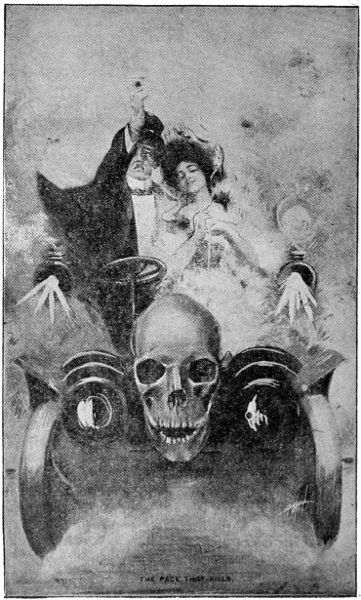
THE PACE THAT KILLS
There is no hope for moral purification among the wealthy until such time as they will use their time and talents in useful work. An enormous field for missionary work would be for some one of ability to convert the wealthy world to the religion of useful work. As a self-evident truth, no able-bodied person has the right to live off the labor of another person. Instead of the many working to the last notch of human endurance that the few may live in luxury and idleness, there should be labor for all, and enough for all. Money, however, is without love, or patriotism, or kindness—is all-powerful, and is fawned upon, and catered to by those possessing it in limited quantities.
The remedy for prostitution, as well as other evils, lies in the hands of the American people themselves, if they only knew it. Just a few years of intelligent voting and legislating for better conditions for the many, instead of for the few extremely wealthy, would tend to overcome all injustice and inequality. The social evil would be weeded out because people would then have time to obey the injunction, "Know Thyself."
Average Evil Life Very Short.
According to statistics the average life of a prostitute is four years after entering the maelstrom of such a career. The life is never such as to be recommended even by its followers. It is moral as well as physical death when followed, and is well-nigh impossible to escape once having bowed to its seeming fascination.
As to the libertine, he "sells himself for what he buys." He may enjoy pleasure, but not happiness. Happiness comes from within, in the consciousness of doing right. Pleasures come from without, in the gratification of self. In addition to the hollowness of the enjoyment in the lives of prostitute and libertine, is always the danger of loathsome disease which tortures body and brain, lowering them in their own minds. It is about the only ill in the category that does not command sympathy, but it should.
The evils of drunkenness, theft, or prostitution are on the same basis as far as the "necessity" for their existence. All are more or less the result of a badly adjusted economic condition of whatever nation. They can be reduced to a minimum, if not eradicated, by removing the cause.
Argument Against Segregation.
The first and most convincing argument against the segregation of vice is found in the fact that the law expressly condemns crime of all kinds and requires its relentless prosecution in order to effect its destruction. Besides, vice districts would shortly become breeding spots for the propagation of crime of every kind. Here would be attracted the criminal classes from all parts of the country, because here they would be protected by the very law which they violate.
Not only would the inhabitants of such districts regard themselves within the law, but others, who now fear to enter these resorts because of the probability of arrest and public exposure, would patronize the district, armed with the knowledge that non-arrest was a certainty and exposure highly improbable. The locality and extent of such districts would soon become a matter of common information, and young men would thus find easy access to disreputable resorts which otherwise they might never find.
Evil Not Necessary.
Many advance the argument that the evil is a necessary one and must be tolerated, else the safety of virtuous women upon our streets would be seriously threatened and imperiled. The fallacy and absurdity of this contention is proved by the conditions which exist in many of the large cities of Great Britain and Canada, where houses of ill-fame are practically unknown, and where women are as safe as in cities where the segregation of vice prevails. This result has been obtained by persistent effort on the part of officials whose duty it is to suppress and punish crime. Such a condition can never be secured here if districts are established where this particular form of vice may flourish with the tacit approval of our public officers. Surely we in Chicago are not willing to admit that which has been done elsewhere cannot be done here.
Chicago could not legally license or regulate this evil, for our state law forbids license. The moral sentiment of our people is also against it. Several years or so ago, when a resolution was introduced into the city council looking toward segregation, medical examination and license, a vigorous protest was made by the Chicago Woman's Club, the Evanston Woman's Club, and other such organizations. The good women of Chicago will not tamely submit to such additional degradation of their wronged sisters.
Nobler Womanhood the Goal.
Chicago women are working hard to protect innocent women from lives of infamy and to help the repentant to a nobler womanhood. If there were men working among their own sex with equal devotions there would be a lessening of the social evil. If physicians would teach men the safety of chastity and the horrors of licentiousness, if preachers would train their guns against impurity, if popular clubs would expel licentious men, if the mayor would order the arrest of every person, man or woman, found in these houses, apparently so well known to the police, and have such arrests continued night after night, these methods would cause a marked lessening of the social evil.
The police of Chicago have done much in recent years to make it a better city. To them is due the credit more than to anyone else for better conditions in our moral life. If they are encouraged and allowed to work out these problems in their own practical way they will do more for our city's good than all the theoretical reformers combined.
Many conditions ought not to exist, but they must and will remain for the present. Your reformer, so-called, writes and pleads for the ideal. The police force deals with what is and knows best what can be done.