Where Women Wear Trousers. By L. Van der Veer.
Reading edition
There is a place up in the mountains of Switzerland where from time immemorial the women have worn the garb and done most of the work of their men-folk, who stop at home and smoke or mind the babies, while their be-trousered wives and daughters toil in the hayfields or among the live stock. In this article Miss Van der Veer describes a visit to this strange and little-known community.

Away up in the mountains of one of the most beautiful cantons of Switzerland, the Valais, the peasant women have for years found it expedient to don the garb of their men-folk and work in the hayfields and among the grazing cattle on the slopes, while their lords and masters lounge their days away in ease and the quiet of their log huts.
Curious to relate, they all seem perfectly contented with this inverted order of things—the men in particular. They brew the herbs, fry the tough-as-leather mountain meat, and look after the babies, while their buxom wives are wrestling with the sterner duties of field and stable.
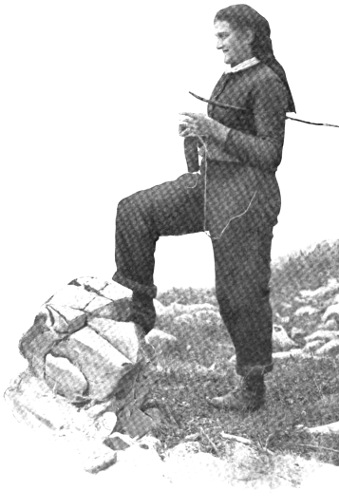
A SHEPHERDESS ON THE MOUNTAINS. From a Photograph.
During the summer of 1908 I spent some days in Champéry, the little village in the valley at the foot of the mountains where these strenuous women work and their lazy husbands smoke. At first I felt great disappointment at not seeing them about the village streets, but soon found that they seldom or never came down the mountain-side in their strange garb, or, at any rate, walked about the village in it. Tourists have become so numerous of recent years, and their curiosity so troublesome, that the village fathers have forbidden the women to come into the hamlet without skirts over their masculine nether garments. So whoever cares to behold them in the strange clothes of their choosing must scramble and toil their way up the mountain-side. On Sunday mornings it is highly entertaining to watch these women and young girls come down the zigzag footpaths to the tiny village chapel, where, just outside its doors, they halt and throw their skirts on over their heads in the most unconcerned fashion, as thoughtlessly as the fashionable dame gives her hat a furtive touch as she enters the church doors.
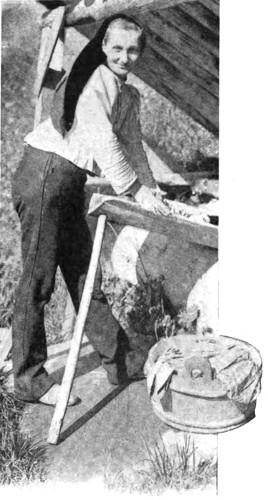
WASHING-DAY. From a Photo. by Jullien Bros.
It is difficult to trace the origin of this strange custom of the Champéry dames donning masculine nether garments. When one asks the peasants about it they do their best to look reflective, but always end in declaring that “it was always so.” “Our men-folk like best the fires, and we like best the fields,” is about the only intelligible explanation I could get out of them. They are fine, sturdy-looking beings, mostly red-cheeked and strong of limb, and many of the younger ones are strikingly handsome.
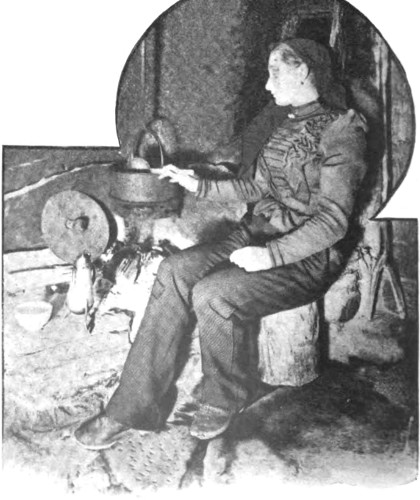
COOKING THE DINNER. From a Photo. by Jullien Bros.
One can scarcely call their costume a becoming one, though it certainly looks better than one would expect, and, after the first novelty of seeing them wears off, its absolute suitability disarms criticism.
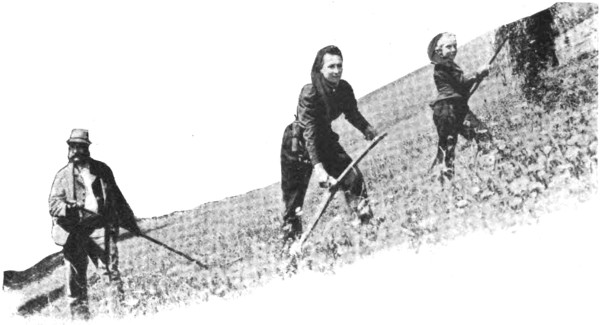
MOWING ON THE HILLSIDE. From a Photo. by Jullien Bros.
The most amusing thing about it is that the upper part of the costume remains feminine—the ordinary rough bodice of the peasant woman, often in bright colours of red or blue, worn with the most nondescript cut of trousers, of the “home-made” variety. That such a costume is necessary for women who take upon themselves the work of their men-folk in such a region of the world is quite apparent to any woman who attempts to follow them at their work for even ten minutes.
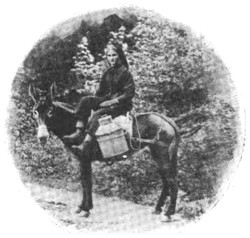
OFF TO THE VILLAGE. From a Photo. by Jullien Bros.
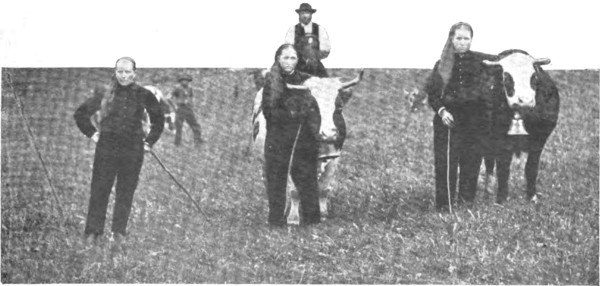
AMONG THE COWS ON THE MOUNTAIN PASTURES—THE WOMEN DO ALL THE MILKING AND BUTTER-MAKING. From a Photograph.
The constant tramping along rough mountain ways and following cows over dangerously narrow ledges, the cutting of hay on inclines so acute as to be seemingly almost perpendicular, the going in search of lost sheep in thickets and snowdrifts, are but a few of the things which make the tyranny of skirts altogether impossible. These women do not seem to mind in the least being stared at and questioned as to their clothes. In fact, they rather feel the pride of distinction their garments confer upon them. “We have never known any others,” they say quite simply, “so why should we feel queer in them? Besides, we all prefer them to skirts.”
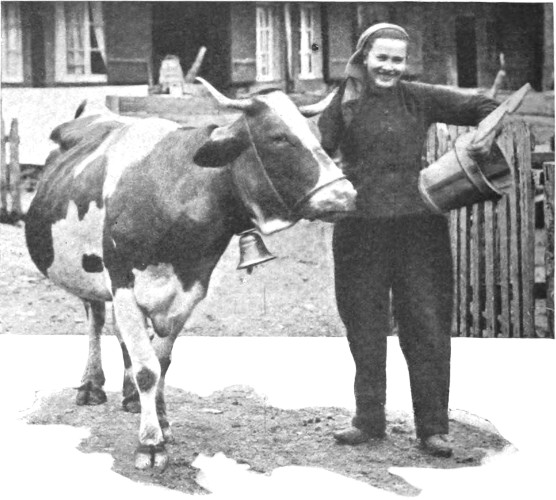
A BE-TROUSERED MILKMAID. From a Photograph.
The most surprising thing is that, in spite of their male attire, the women do not walk or sit in the masculine manner. Anyone can see at a glance that they are women in men’s clothes, though some green—very green—tourists often make ridiculous mistakes. At a mountain hut I once heard an English traveller declare that he never heard of men doing the family knitting until he came over the pass where these people live. He had evidently not the faintest suspicion that he had come across the men-garbed women of the mountain region, for they often sit knitting as they herd the sheep and cows on the hillsides.
Another thing that strikes one absurdly is that, while wearing trousers, these women nearly always sit sideways on horseback and get over fences by first mounting to the top rail and sliding down women-fashion, instead of striding over man-fashion. In truth, I observed no end of evidence that the inconsistency of the weaker sex cannot be quenched by anything so delectable as clothes.
One morning, when a heavy mist hung over the mountain-tops, quite obscuring everything, I sat outside the comfortable little chalet where a happy family of four sturdy daughters, with their mother, donned trousers every morning and disappeared up the mountain-side to work, while their stalwart “Pap,” as they called him, pottered round the house, pipe in mouth.
I could hear the women sharpening their scythes now and again, and catch snatches of mountain ditties as they sang at their mowing. Later on, as the mist lifted, I walked up to where they were working, and the first thing I noticed was that their trousers were so long as to be quite dripping with mud, just as their skirts would have been had they worn them. When the old man went out he turned his up.
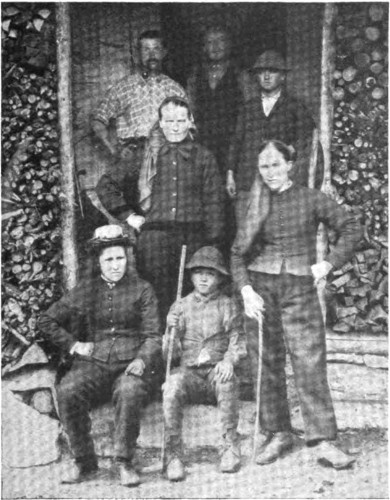
A FAMILY GROUP. From a Photograph.
Another feminine absurdity is the wearing of a long sort of toga, which trails down their backs and gets in the way whenever they bend over or go through the tangles of the mountain wood.
“Why don’t you wear a cap or small felt hat like the men?” I asked an old woman once.
“We have always covered our heads so,” was her explanation—an explanation, in her opinion, that was all-sufficing; peasants from one generation to another do everything simply because their forefathers did the same.
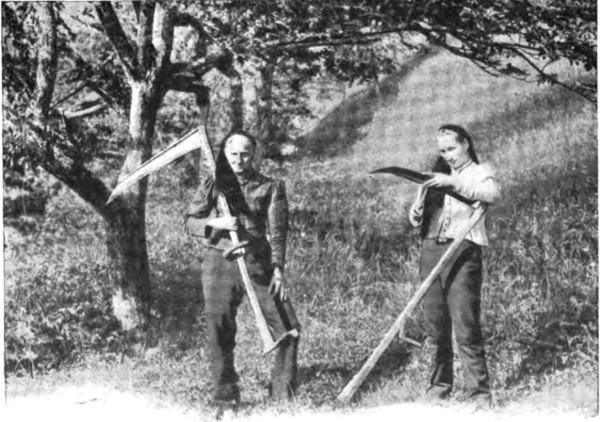
A HALT FOR REST. From a Photo. by Jullien Bros.
One would imagine that on Sundays and fête days these women, particularly the young ones, would yield to the eternal feminine instinct of assuming the finery of their sex, but not they. Rest-time and feast-time always finds them in their usual garments. They have better-looking ones for these occasions, I confess, but they have no hankering for the trammels of skirts even during their courting hours. I was highly amused at seeing the pretty girls sauntering along the picturesque trails with their sweet-hearts’ arms around their waists, looking to the casual stranger for all the world like two young men gone “loony.”
One can scarcely imagine a wedding-party with bride and groom dressed in the same kind of garments, but I have seen one in the mountains, when the bride wore a white bodice, white trousers, and a bunch of white violets in her hair! She was as pretty as a picture, too, despite the attire, and quite as blushing and shy as any bride out of a convent.
The man of her choice, a perfect giant of a peasant, was resplendent in native costume, the chief glory of which, a green waistcoat with large brass buttons, could be seen a long way off.
Most of the weddings of recent years have been held in the little chapel of the village down in the valley, where the regulation “slip over” skirt is donned at the chapel door, to be discarded before the tramp up the mountain-side is begun.
One day I was told in the village that a funeral was to be held in the little mountain settlement above Champéry, and I trudged up the zigzag pathway as hurriedly as the occasion would allow, for I confess to having a penchant for witnessing these mournful conclaves in every foreign country I may visit.
I had no trouble in discovering the house of mourning, as a crowd of peasants hung about the door. Soon the little procession, headed by the priest and his attendants, filed out of the door and moved with solemn chant down the mountain-side towards the little churchyard below.
On inquiry, I learned that the departed one was the elderly husband of a bent and weather-beaten old peasant woman, who tottered along in faded black garments, the nether portion of which looked for all the world as if she had donned the “left-overs” of her dear departed. On her head was a crisp new crape toga, however, and as she hobbled along I confess that she made a pathetic as well as an incongruous figure.
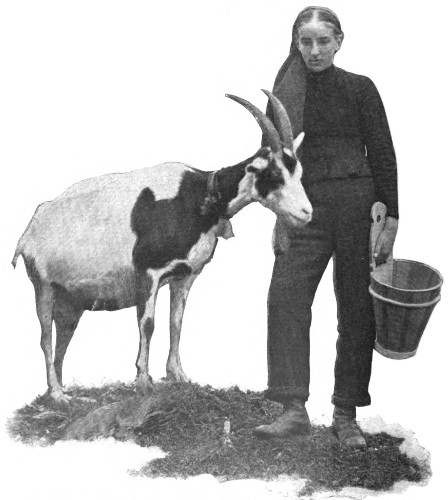
THE VILLAGERS POSSESS LARGE HERDS OF FINE MILCH-GOATS, WHICH THE WOMEN LOOK AFTER WHILE THEIR MEN-FOLK STOP AT HOME. From a Photo. by Jullien Bros.
Despite the fact that the women work hard out of doors, summer and winter, exposed to the worst of weathers, they are mostly long-lived and seldom know what illness is. I often saw them working in the hayfields with their babies lying blinking in the sunlight near by. At noon they lounged under the trees, talking mother-foolishness to the wee things, and their queer garments never seem so hideous and altogether distasteful as when they are nursing the children.
The lack of even the simplest understanding of remedies for either illness or accident has always struck me as most remarkable among the Swiss peasantry. They may live several hours’ journey away from a doctor or chemist without ever making the least attempt at learning what to do for even the simplest ailments.
I once knew one of these Champéry women to have sunstroke so badly that she became quite unconscious, and continued so long in that state that I was certain she would die.
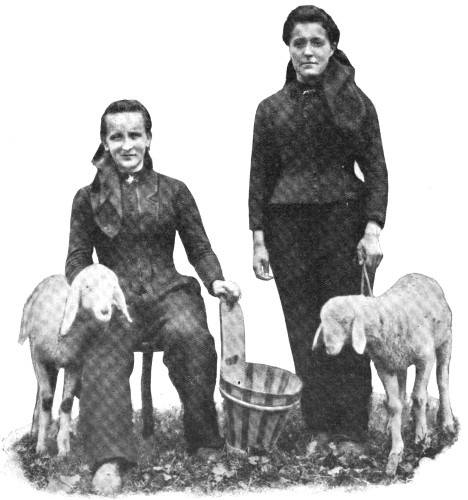
“MARY HAD A LITTLE LAMB”—THIS PHOTOGRAPH SHOWS CLEARLY THE “HOME-MADE” CUT OF THE TROUSERS AND THE CURIOUS HEAD-DRESS WORN BY THE WOMEN.
There were any number of old men and women gathered round wailing, but none of them seemed to know what to do in such a case. The woman’s mother suggested giving her a cup of coffee, which was attempted, most of it being spilt over her. Then someone took off her shoes and began slapping the soles of her feet with a piece of board.
I chanced to have a “first aid” case with me, and—greatly to the distrust of the peasants—administered what suitable remedies I had; I also insisted on one going post-haste down the valley for a medical man. But they would do nothing except wail and shake their heads. Finally the patient came round all right, saying that her head “felt full of hot things,” and the next morning, when I called to inquire after her, I found that she was at work in the hayfields, hatless, under the scorching sunlight, as usual. At another time a little child of three was taken with convulsions from having eaten too much cheese, and died without having anything done to save the little creature; the old women simply wagging their heads wisely and muttering something about their all “going” when taken like that. With them it is evidently a case of the survival of the fittest.
Last summer I was in Champéry at the time of the great Swiss national holiday, when everybody celebrates Swiss freedom by making as much noise as possible during the day and lighting huge bonfires at night. Everyone was dressed in holiday finery, many of the younger women appearing in grey-check trousers and hats with artificial flowers! One happy family party, consisting of the father and mother and four children, had evidently a decided fondness for royal purple—or perhaps this was the colour of their clan—for the six of them, even to the babe in arms, were arrayed in the purple of kings and emperors!
The baby in particular attracted my interest insomuch that I ventured to take the little creature in my arms in the hope that I might slip it out of the cartridge-like swaddling-case in which these poor little wretches are carried about. I might just as well have tried to pull off the muzzle of a gun; the babe was as tightly fixed in his terribly hot case as though it were a vice. And yet I doubt not he will grow into a fine stalwart son of the mountains, though how they ever manage to expand or lengthen at all is a mystery to me.
I once sat talking to an old goatherd who certainly looked as if he had sat in the same nook in the mountains for at least a century. He was so bent and rheumaticky-looking that I quite failed to see how he could possibly make his way along the steep and slippery paths. His “old woman,” as he called her, was off down the valley gathering faggots. “She be a great worker,” he told me, and never got tired the way he did. I asked him if he liked the idea of the women doing most of the hard work; he answered by saying that it “was their way.” It suited the women to work at the hay, he seemed to think; and, besides, they hadn’t to smoke, which was evidently sufficient occupation for the men.
This old man had never seen a railway until this last summer, when a branch line was run on to the village of Champéry, at the foot of his mountain home. I asked him what he thought of it, and he grumbled out a long tale of how it had already killed a lot of goats and sheep!
Any sort of progress is looked upon with the greatest prejudice and suspicion by these people, who will undergo any fatigue and discomfort rather than change the routine of centuries.
Coming down a mountain path one evening, I ran into a party of peasant girls toiling up with huge baskets of provisions strapped to their backs. In the half light I mistook them for men from their garb, but coming nearer I recognised their red togas, and later their women’s voices.
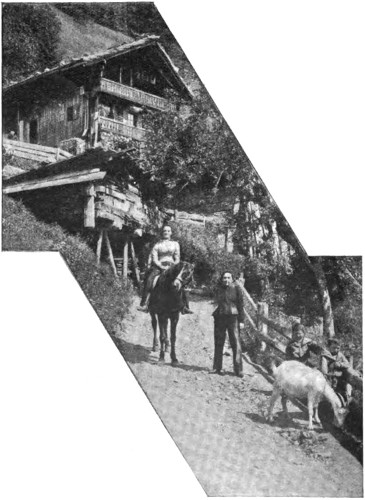
A MOUNTAIN IDYLL. From a Photo. by Jullien Bros.
Stopping to talk with them, I found that they were of the well-to-do natives who owned cows and mules, but they seldom thought of taking the mules along to carry up the provisions or themselves.
It had always been the custom of their women to make pack-baskets out of their backs, and they would never think of doing otherwise. It is not easy to get these people to talk of themselves to strangers; they often resent being asked questions about their work and ideas.
Yet the young women take interest in the pretty clothes of strangers. One of them came up to me and touched a blue lapis-lazuli ring I was wearing, her eyes simply devouring it, and the other trinkets I wore of the same stone. Finally, she exclaimed that she liked them very much, and also the frock of the same colour. I am quite certain there was a momentary pang of feminine envy in her heart, and a hatred for her own incongruous garments.
By Captain G. F. Pugh.