The Finches’ Festival. A BIRD-SINGING COMPETITION IN FLANDERS. By A. Pitcairn-Knowles.
Reading edition
Bird-singing competitions, in which substantial money prizes are awarded to the owner of the songster making the greatest number of “trills” in a specified time, are very popular in the North of France and Flanders. In this article the author describes and illustrates a typical bird-singing festival in a Flemish village. From photographs by the author.

The inhabitants of the rural district of that part of Belgium which goes by the name of Flanders seem to be possessed of a genius almost unique for instituting and organizing quaint and curious competitions designed to administer to that keen taste for friendly rivalry which is so characteristic of the population of King Leopold’s little domain. Any stranger penetrating into the heart of the country at the time of the year when many of the hamlets are about to hold their annual fairs—spun out to last a week, or even longer—cannot fail to be interested in the long posters adorning the walls of every “estaminet,” announcing a separate event for each day of the festive season, and testifying to the great hold this healthful spirit of emulation exercises upon the minds of these simple peasants.
Being one of those strangers in a strange land, I was overcome by a spirit of curiosity when a very limited acquaintance with the Flemish tongue helped me to the conclusion that the “Prijskamp voor Blinde Vinken,” announced for a certain Sunday at the untimely hour of seven in the morning, was a competition in which blind birds were to be the candidates for honour and distinction, and I resolved to be present at what promised to be a curiously interesting spectacle.
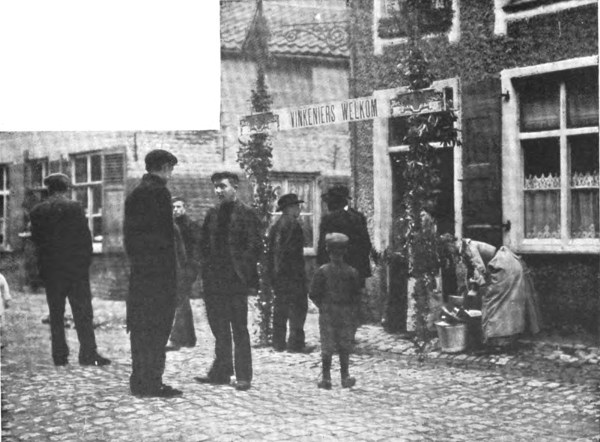
THE FINCH-OWNERS’ MEETING-PLACE AND HEADQUARTERS. From a Photograph.
Setting out on my bicycle in the early dawn of a stormy morning, I was borne with the wind through one sleeping hamlet after another. The pulse of life had scarcely begun to stir; but when I reached my destination, as the clock struck six, and wended my way to the street with the well-nigh unpronounceable name where the great event was to take place, all was alive and bustling. Peasants of both sexes, representing every stage from tender childhood to decrepit old age, were strolling up and down or standing about in groups eagerly discussing the all-absorbing event which was about to commence—the contest of the blind finches.
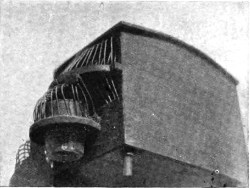
ONE OF THE CAGES, SHOWING THE DOUBLE FRONT TO PROTECT THE LITTLE OCCUPANT FROM CATS. From a Photograph.
At intervals men and boys clattered along in sabots, or proceeded with shuffling gait in gorgeously-coloured carpet slippers, bearing mysterious wooden boxes under their arms. I inquired into the nature of their burdens, and discovered that they contained cages which housed the chaffinches destined to take part in the competition. These cases, varying in size, bore little similarity to each other either in design or workmanship, for while some were roughly put together without any attempt at decoration, others, though evidently the work of the amateur, revealed traces of minute care and originality of construction, one being adorned with a rudely carved representation of the little imprisoned inmate, a work of art presumably executed by the owner himself or some village genius. A few of the boxes were really elaborate constructions, one in particular being made of highly-polished mahogany, on which figured a bird with outstretched wings, executed in relief ironwork.
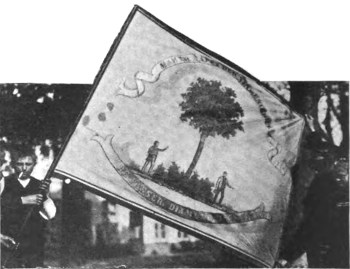
THE BANNER OF A FINCH-OWNERS CLUB. From a Photograph.
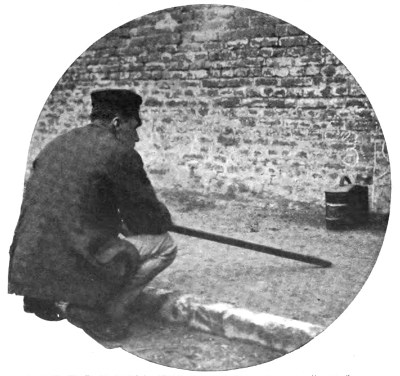
ONE OF THE JUDGES IN POSITION, READY TO SCORE THE NUMBER OF “TRILLS” EMITTED BY THE BIRD IN FRONT—NOTICE THE CURIOUS TALLY-STICK USED IN SCORING. From a Photograph.
There was one spot in particular towards which the future competitors seemed to be attracted, a rustic inn, over whose portals the flag of the local finch-owners’ club waved lustily in the vigorous breeze, and the cheery greeting, “Vinkeniers Welkom,” attracted the attention of the passers-by. It was here that the organizers and competitors met for the purpose of settling all matters pertaining to the bird-singing contest. Even at 6 a.m. beer has irresistible fascination for the true native of Flanders, and it goes without saying that every entry for the competition called forth a request for at least one “bock” on the part of the competing bird-owner. Others, who came as mere spectators, followed his example, and soon the stream of conviviality flowed freely.
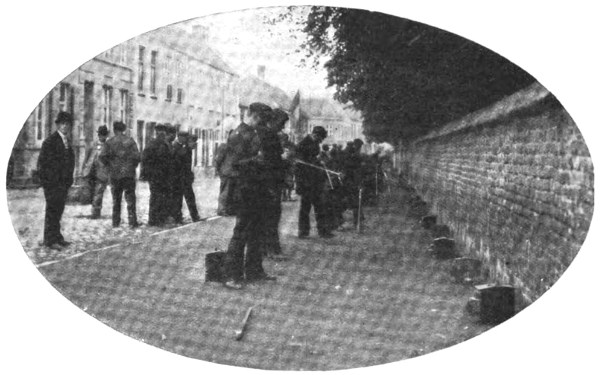
THE COMPETITORS AND JUDGES IN POSITION. From a Photograph.
A few men and boys were already opening their boxes, and tenderly lifting out strong little wooden cages with double wire fronts, designed to withstand the attacks of that relentless foe to bird life—the domestic cat. Meanwhile numbers had been chalked on to the wall along the side of the road with the object of showing each competitor his place, and one by one the owners of the feathered songsters took up their positions, until I counted fifty-six competitors seated by the roadside, waiting for the signal to begin the contest. Some of these men had walked as far as twenty miles, and, having placed their boxes three yards apart, sat down with evident relief.
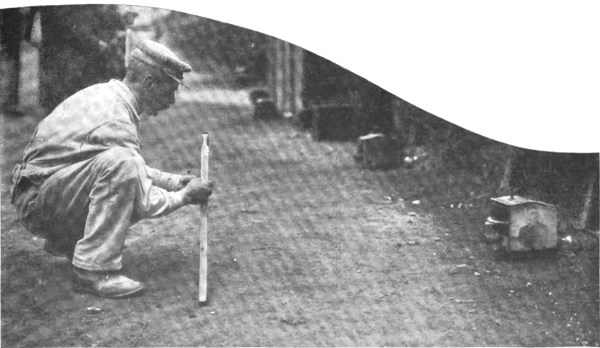
A JUDGE AT WORK—EACH MAN SCORES FOR SOMEONE ELSE’S BIRD, AND STEWARDS KEEP A CHECK UPON THEM TO INSURE FAIR PLAY. From a Photograph.
During the interval of waiting I gathered from several communicative candidates that it is necessary to blind the little birds in these “concours,” as they would stop singing immediately they found themselves to be under observation. The eye itself is not injured, however, the closed eyelids being merely glued together, so to speak, by means of a slight touch with a hot iron. Needless to say, this operation must be performed by an experienced hand, otherwise part of the lid may be left open, in which case the front of the cage must be covered, or the shy little occupant will not sing. One is relieved to know that it is quite possible to restore the bird’s sight by separating the closed lids.
As the Belgian law does not permit such cruelty to be openly practised in the country, the birds are imported—or, to be more accurate, are supposed to be imported—from France. Even the catching of birds for the purpose of employing them in these curious contests is looked upon as illegal in Belgium, but laws of this kind are more easily made than enforced. Probably the Government thinks that by keeping this pastime under a control which appears to be severe it is doing its duty, and with this object in view it demands that each owner shall carry on his person a certificate containing the following words:—
“The undersigned, burgomaster of the town of ——, hereby declares that Mr. ——, of such a trade, living at ——, is the owner of blind chaffinches, with which he travels, and that he does not practise the trade of bird-selling.” For this guarantee a fee of a hundred francs is charged, it being necessary to obtain a new signature from the authorities every fortnight.
The success or failure of a bird entered in a contest depends upon the number of perfect “trills” made by the little competitor in a certain time—usually an hour. The best result my informant had ever known at a “concours” was one thousand and nineteen trills in the hour, and after setting up this record the bird readily sold for a hundred and twenty francs. As money prizes are invariably offered, these feathered songsters are often sources of profit as well as sport to their owners, a good chaffinch easily adding a hundred francs to the family exchequer.
But now let me relate how these competitions are managed and carried on. I doubt whether any of my readers have ever witnessed such a scene as I am about to describe, and a brief sketch of what came to pass in that out-of-the-way spot can hardly fail to interest those who enjoy a glimpse of peculiar, old-world practices.
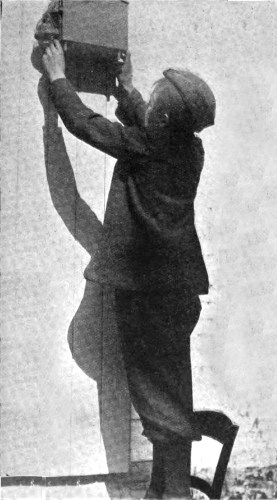
A WELL-EARNED REST—HANGING THE WINNING BIRD UP IN THE SUNSHINE AFTER THE CONTEST. From a Photograph.
As the clock of the village church laboriously chimed out its seventh stroke the manager of the competition, in a loud voice, issued the order for the contest to begin. At this there was a general stir. Each man took up a more or less business-like attitude in front of the cage of one of his opponents, every competitor acting as judge for someone else’s bird. Having produced his curious-looking marker—a thing resembling a four-sided yard-stick, painted black, with a handle either in the form of a knob or a ring at the top end—the men at once proceeded to chalk certain cabalistic signs thereupon, which a close observation showed me stood for the number of trills made by each bird—“Chuie, chuie, chuie, chuie, chuiep” being a perfect trill. It is the fifth and last part of the warble upon which success really depends. If the final “chuiep” is not heard the feat is incomplete, and the little warbler is not credited with a chalk mark.
The silence was scarcely broken save for the shrill piping of the birds, and the seriousness exhibited by competitors and spectators alike would have done credit to the mourners at a funeral. It was curious to note the manner in which some of the less gravely-disposed owners spent the interval of waiting for their charges to distinguish themselves. Some were lightening the serious business of marking by occasional draughts of beer from huge tumblers, which they had, with wise forethought, placed close at hand. Others, with that calmness that comes from long practice, were puffing contentedly at short clay pipes, while the greater number—among whom were some very youthful competitors, evidently on their first trial—wore anxious expressions, never letting their eyes rest upon any other object than the cage and the scoring-stick entrusted to their care.
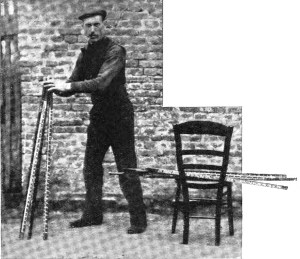
COLLECTING THE TALLY STICKS. From a Photograph.
All this time the subdued talking among the group of interested spectators scarcely rose above the continued chirping of the birds, which seemed to become more and more shrill and vigorous as the moments passed, until, after the lapse of half an hour or so, each of the little songsters seemed ready to burst its little throat in its determination to make itself heard above its neighbours.
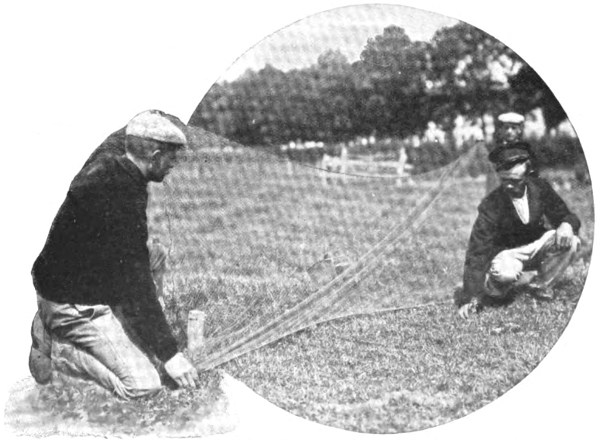
PLACING THE NET AND DECOY-BIRDS TO CAPTURE FINCHES. From a Photograph.
At the commencement of the competition I had been under the pleasant impression that the little creatures, although selfishly deprived of the blessing of sight in order to administer to a somewhat barbaric form of human enjoyment, sang their early morning songs out of pure gladness of heart and “the wild joy of living,” but my fond delusion was soon nipped in the bud, for unmistakable notes of anger were by this time distinct, and it needed not the assurance of one of the spectators to convince me that, in its wild state, this particular species of the winged creation, at all events, is far from preserving that unity and perfect agreement in the home circle ascribed to it by one of our poets and pointed out for man’s emulation. It is in order to stimulate an artificially-produced anger, considered necessary for the success of the “concours,” that these matches are held in the early morning hours, while the birds of the trees and hedges are singing most lustily. The chirping of the imprisoned songsters proceeds from a wild frenzy of desire to do battle-royal with those of their brethren still enjoying freedom, and by degrees the longing grows for an encounter with their competing neighbours.
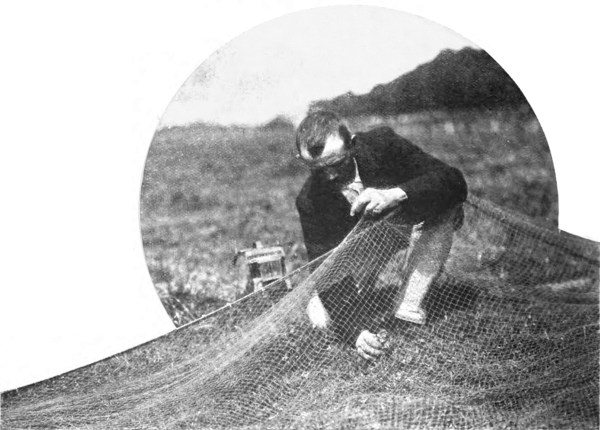
CAUGHT!—THE CAPTURE OF A FUTURE COMPETITOR. From a Photograph.
These matches are under the strictest control, both as regards discipline and fairness, and any candidate found guilty of dishonesty in marking is punished by summary expulsion from his club. Stewards controlling the judging parade up and down with their eyes upon the markers, so that cheating under such close supervision is well-nigh impossible.
As the most successful of the finches trilled forth its five hundred and eighteenth “Chuie, chuie, chuie, chuie, chuiep” the order was passed along the line to cease scoring and make known the final results. With startling promptness each candidate sprang to his feet and began to add his score. The owner of the champion bird, a cripple, showed calm pleasure as he proceeded to replace in its box his little favourite’s cage, upon which was painted a landscape which succeeded in defying every law of perspective.
During the summer months these “concours” are held at very frequent intervals in the country districts of both France and Belgium, and a competitor is frequently the possessor of several birds, which are usually caught by means of a net, but almost every method is productive of quick results, for the chaffinch is an eager wooer, his addresses to his lady-love rendering him totally blind to his own danger. He is beset with rivals, and as the female bird invariably smiles upon the strongest suitor she is the cause of innumerable battles, in which it is usual for several lovers to be left dead upon the field. The chaffinch is very easily trapped by using a tame finch to stir up his jealousy. A limed twig is attached to the tame bird, who is allowed to run about where the twittering of the wild birds is heard. As soon as the latter become conscious of the presence of an alien in their midst an onslaught is made, which generally ends in the capture of one, if not more, of the attackers. Another method of capturing the chaffinch, and the one most in vogue among the Flemish “Vinkeniers,” is represented in two of the accompanying photographs. A stuffed finch fixed to a small peg is placed in the grass, clearly visible to the birds in the trees, while a live decoy, in a cage, carefully covered up with loose grass and twigs, so as not to attract any attention, is concealed not many yards away. A long net, spread out on the ground between the two decoy birds, lies in readiness to make prisoners of the little feathered warriors as soon as they cluster round the stuffed bird, incited by the clamours of the caged enticer. A pull of the long strings, leading into the ambush of the bird-catchers, may cause as many as thirty finches at a time to fall into the hands of the trappers.